
Read what Devon Leader Cllr Julian Brazil and Whimple and Rockbeare District Cllr Todd Olive have to say about Labour’s plans for moving to unitary authorities:
“It’s not devolution – it’s control freakery,”
“Stalin would be thrilled by the way we run our country; it’s so over-centralised. This in itself is a danger to democracy.”
Julian Brazil estimates that by the time this concludes it will have taken between 5 to 10 years and two-thirds of councillors will have lost their positions, leading to a professionalisation of local government, further diluting democracy.
On Exeter’s “go it alone” power grab Todd Olive said::
“They’ve cherry-picked major areas of growth around the airport and two new towns that will create [wealth for] Exeter unitary authority, but it will be a financial disaster for the rural and coastal authorities they’ll leave behind –they will be bankrupt within a year.”
Context
Labour wants to abolish District Councils, creating large consolidated unitary authorities with populations of around half a million or more. This will inevitably mean that residents will be represented by fewer councillors in larger electoral areas, all in the name of “devolution”.
District Councils in Devon typically spend around 7% of Council Tax. The essential localised services they provide such as: managing household waste, public spaces, council housing, addressing homelessness; managing public health issues; collecting council tax and administering relief; supporting local business, dealing with planning etc. will still have to continue at the same scale – so just how much of this 7% do the government think can be saved to offset the £50m estimate of making these changes in Devon? – Owl
The councillors up in arms against Labour’s £50m ‘Stalinist’ reforms
The Government calls it devolution. Opponents see a democratic deficit as power drifts further from local communities
Anna Tyzack www.telegraph.co.uk
Amid a roster of responsibilities that includes improving outcomes for vulnerable children and tackling the crumbling roads in one of England’s largest counties, Julian Brazil, the Liberal Democrat leader of Devon County Council, now finds himself forced to divert great swaths of his day to a matter so asinine that he’s not ruling out revolt.
Labour’s sweeping plans to tear up local government – reconfiguring some 63 local councils so that they fall into vast, unitary authorities – represent a demand he argues councils like his can ill afford.
“There’s a mood within councils – we’re fed up,” he says. “We’re trying to deliver children’s services and adult social care and the last thing we need is to spend hours and hours discussing something that could well be no better in the end. If enough councils go on strike, maybe the Government will listen?”
The Telegraph has been campaigning against the postponement of elections – a move which is meant to facilitate exactly these reconfigurations. Councillors across the country, meanwhile, are up in arms about the reforms themselves.
The English Devolution White Paper, originally launched by Angela Rayner, set out plans for a major reorganisation of local government, described by Labour as the “greatest transfer of power from Whitehall to the town hall in a generation”.
The postponement of local elections is designed to provide councils with the breathing space to implement these plans and has led to concerns about a democratic deficit in vast swaths of the country. And critics warn that the reforms themselves will result in a permanent blow to democracy. Larger unitary authorities will make councils more remote from the communities they serve, weakening the direct connection between residents and their elected representatives.
In June last year, the think tank Localis warned that shire areas in particular faced losing some 90 per cent of their councillors. “Local government will get less and less local,” said Steve Leach, emeritus professor of local government, De Montfort University. “And areas that have been used to their own elected council will be subsumed into meaningless conglomerates that will make no sense as units of local government and even less sense to local people.”
Added to this already worrying prospect, councillors are fearful over the cost of reorganisation, which is likely to spiral into the tens of millions (£50m in the case of Devon), as well as the fact that for many it feels like the mergers are being imposed from above. Ministers insist the process is locally led, yet the current legislative framework permits reorganisation to proceed without unanimous consent from all councils in an area.
Surrey is a good example. Surrey County Council, along with 11 district/borough councils are being replaced by two new unitary authorities, East Surrey and West Surrey. The Government set aside a proposal from nine of the eleven district councils for a three-way split, instead mandating a two-unitary model.
For Brazil, the pace at which councils are expected to reform feels particularly punitive. Eligible councils had to submit their proposed new footprints to the Government by November last year; the Government intends to have made a decision on the delineation of each region by summer recess this year (July), leaving areas a 20-month window to reorganise (the entire system is to be overhauled by the end of the current Parliament in 2029).
“There’s absolutely no way we’re going to get the timetable through,” Brazil complains. “It’s taking up an inordinate amount of time and money and they keep moving the goalposts. They’ve bitten off more than they can chew and they need to stop.”
“It’s not devolution – it’s control freakery,” Brazil says. “Stalin would be thrilled by the way we run our country; it’s so over-centralised. This in itself is a danger to democracy – a dangerous precedent was set.” Brazil was at the County Council Network’s recent conference and said he did not meet a single councillor in support of local government reorganisation.
For Todd Olive, a Lib Dem councillor in Devon, the drive toward huge, consolidated councils feels like a direct attack on political diversity. Opponents of reorganisation warn that creating large unitary authorities with populations of around half a million or more inevitably reduces the total number of council seats and expands electoral areas, trends that historically favour larger national parties and make it harder for smaller parties, independents and truly local voices to win representation.
Analysis by the Local Government Association’s Independent Group on the political and governance effects of reorganisation has warned that such changes are likely to diminish the influence of independent and smaller-party councillors, as fewer seats are contested across broader areas and party machines gain an advantage. “We’re suspicious this is about getting rid of the smaller-scale political campaigning we’re effective at as a party,” says Olive, “and creating super councils dominated by legacy authorities.”
Phoebe Sullivan – an opposition Conservative councillor in the Lib Dem-led Waverley Borough in the Conservative-led Surrey County Council – raises a related concern about representation, warning that as councils and electoral divisions grow larger, smaller communities risk being overlooked.
Even though Sullivan is broadly supportive of reorganisation in principle, she worries that villages are losing their distinct political voice. In her own patch, the villages of Witley and Milford in Surrey – previously a ward in their own right – have been subsumed into a much larger division now labelled “Godalming and Villages”, a change she fears could leave village priorities overshadowed by those of the town.
“Councillors are likely to be Godalming-focussed,” she says. “It’s all done by density; the more dense the population the more focus they get, but rural villages need a voice as well. Villages will be let down by local government reorganisation.”
Councillors elsewhere have taken issue with a group of Cathedral cities – including Exeter, Ipswich and Oxford – who they argue are attempting to expand their borders and influence. “It’s gerrymandering. A land grab. Nothing about delivering the best services to residents,” Brazil says.
Olive, who is a councillor for the villages of Whimple and Rockbeare on the fringes of Exeter, describes the city’s plans to swallow up villages as “a bit like parking tanks on our lawns”.
These councils could seize control of affluent outlying areas; Whimple and Rockbeare are home to Exeter airport and various business parks, which would all offer a boost to the city council’s revenue (via business rates) and to its status.
“We don’t want to be part of Exeter,” he says. “They’ve cherry-picked major areas of growth around the airport and two new towns that will create [wealth for] Exeter unitary authority, but it will be a financial disaster for the rural and coastal authorities they’ll leave behind – they will be bankrupt within a year. Those parts of Devon don’t have the growth points and economic centres that enable councils to do OK.”
Brazil and Olive fear that in Devon it won’t be senior management losing their jobs during the merger – but local councillors. Brazil estimates that by the time the restructuring is complete, two-thirds of councillors will have lost their positions, leading to a professionalisation of local government, further diluting democracy.
Olive, who is 27 and still living with his parents, says that he will not stand under the new system despite being passionate about local politics and the needs of communities – he can’t afford to. Already his council work takes up at least half the week; under the new system, where councillors will be overseeing much larger areas, it would be a full-time job. “It’s becoming inaccessible to people who aren’t independently wealthy. If only one type of person is standing, you lose all of the diversity,” he says.
Sullivan agrees that lack of diversity is an inherent problem in local government, which the threat of reorganisation is doing nothing to tackle. She’s 29 and works in the private sector; if her boss wasn’t flexible about her attending council meetings during the week, she wouldn’t be able to stand as a councillor. “Statistically, the system doesn’t entice or accommodate working professionals, mothers or young people,” she says.
Although she argues that it’s not all doom and gloom – the thinking behind the new system is that middlemen will be cut out, saving time and resources – “at the moment it’s just a lot of tangled-up admin”.
Still, if Labour genuinely intends to place power in the hands of “local people with skin in the game”, as Angela Rayner once put it, Brazil argues that the Government should allow those communities to manage their own local government reorganisation without central interference.
The “cliff edge approach” in particular is fraying Brazil’s nerves and he’s looking into ways to protest, without hurting residents. “We’ll deliver unitaries to you in five or 10 years but don’t give us a ridiculous timetable,” he fumes.
“They talk about devolution and then tell us how to do it. They can’t even run their own Government. It’s not the town halls that need reorganising – it’s Westminster.”

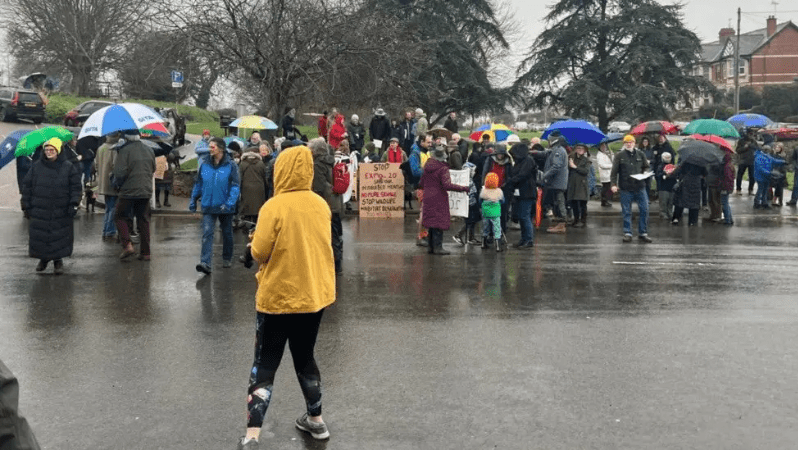


 East Devon Watch