After the “wrong leaves on the line” stop the trains; we now learn that abrasive sand is the cause of the sewers wearing out!
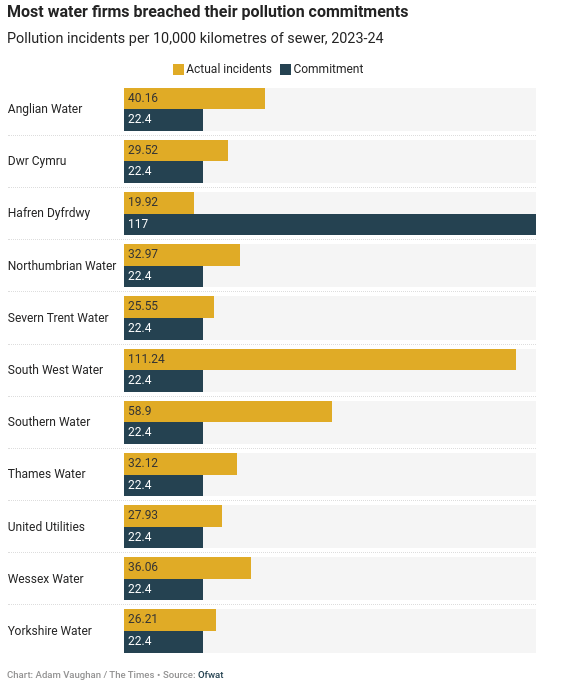
Note: according to a report in the FT, less than 12 per cent of the sewage network in England and Wales was built in the 19th century, undermining water industry claims that outflows of raw effluent and storm water are a result of antiquated Victorian infrastructure.
The majority of the network was instead built in the years before privatisation, with approximately a fifth constructed during the 1960s and 1970s, according to data analysed by consultancy Arup and campaigners Windrush Against Sewage Pollution. – Owl
Sand and grit blamed for damaging pipes – some more than a century old
Bradley Gerrard, LDRS hellorayo.co.uk
A new report on the state of Exmouth’s sewers largely blames sand and grit for causing slow but sustained damage to underground pipes.
The 24-page document by consultants Pell Frischmann was commissioned by South West Water in the wake of recent damage that caused untreated sewage to spill, leading to beach closures at the height of tourist season.
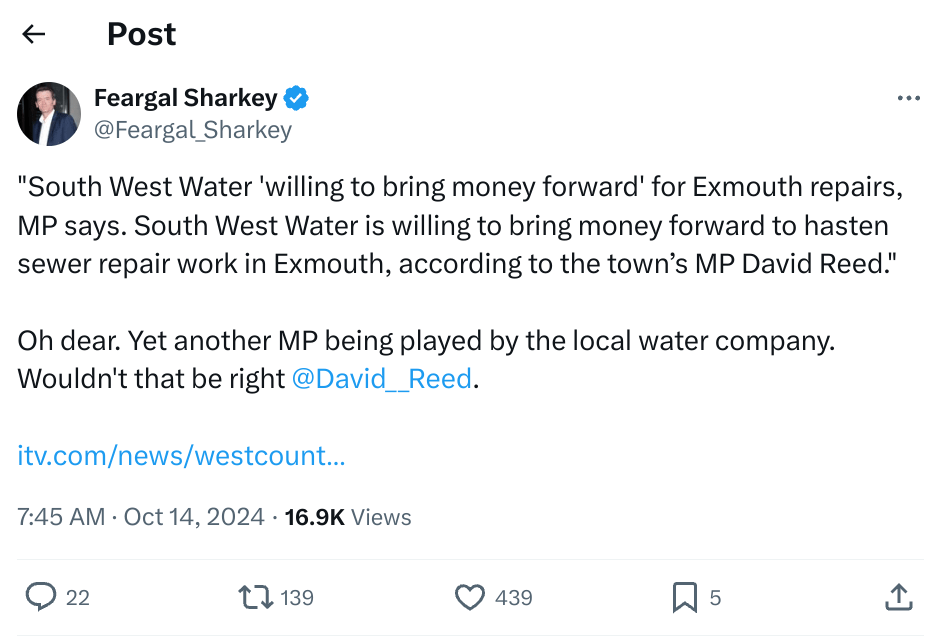
The red-flagged beaches prompted the town’s MP, David Reed (Conservative, Exmouth and Exeter East), to request a meeting with Susan Davy, the water company’s boss, with the four-week investigation by Pell Frischmann instigated shortly after.
A key conclusion of the report is that in most of the town’s rising mains – pipes which rise in level towards sewage treatment plants (STPs) – sand and grit is dragged up with the flow of effluent, scratching the inside of the pipes as it goes.
Once the pumps that push the sewerage up these rising mains stop, that very same sand and grit rolls down the same pipes, causing further scouring.
“Once the surface of the liner or pipe wall itself is compromised, failure becomes a matter of time,” the report states.
It added that with the exception of a rising main at Imperial Road, “the majority of the bursts show a similar pattern of wear and penetration of the pipe wall.
“It is noticeable that many pump stations that ultimately feed Maer sewage pump station are located in areas close to the seafront and collect flows direct from roads and hardstandings affected by wind-blown sand,” the report stated.
Exmouth’s sewerage system also deals with flows from Lympstone, the hamlet of Sowden, Sandy Bay Holiday Park and Budleigh Salterton, the majority of which can be affected by wind-blown sand because of their proximity to the coast or estuary.
Quantifying the problem
While 2024 has been a bad year for bursts in Exmouth, with incidents cited in the report at Imperial Road, Lime Kiln, Maer Road and Phear Park this year alone, Pell Frischmann claims the town does not have an disproportionate problem.
When comparing it to nine similar systems in Devon and Cornwall, the Maer Lane sewage treatment works has suffered an average 6.5 bursts per 100 kilometres of rising mains per year between 2018 and 2023, lower than 10.7 for comparative locations.
The figure for 2024 is 17.3, but Pell Frischmann said even if this was included in averages for 2018-2023, Maer would still come out below the average.
In terms of questions for SWW, the report highlights that pipes analysed from Maer Road and Phear Park did not have concrete linings, which can help lengthen their life.
Phear Park had a zinc coating on the outside, but did not have further protective measures such as plastic wrap.
Pell Frishmann said that since 1995, all ductile iron sewerage pipelines are internally coated with a thin layer of high alumina cement and the outer surfaces with zinc protective paints and “in particularly aggressive ground conditions, pipes can be sleeved with polyethylene and tape wrapped”.
Before 1995, however, there was no requirement for a standard protection.
Imperial Road’s rising main had an internal concrete lining and zinc protection on the outside as well as a polythene sleeve.
‘Constantly under attack’
The time taken to wear away part of a pipe depends on many factors, the report noted, including sharpness and hardness of debris inside, as well as the thickness of the pipes.
The first burst of the Phear Park rising main is thought to have happened in 2001, just eight years after being installed. The 10mm thickness of the pipe is possibly a key reason it failed far more quickly than Maer Road’s, which at a 22mm thickness lasted some 40 years before having its first burst in 2011.
“If sand and grit is constantly fed into the system (as is the case in Exmouth) there would be a continuous cycle of replenishment to allow the invert to be constantly under attack,” the report noted.
But Imperial Road’s pipe seems to have been corroded from the outside.
A contractor who previously replaced a section of it told Pell Frischmann that “various extraneous objects” were encountered during the excavation process to reach the pipe, “with a car chassis being one example”.
“It would therefore appear that the ground through which the main was laid was made ground and probably contaminated with a number of oils, chemicals or other substances that attacked the pipe,” the report said.
“This contaminated ground may have been identified during the design of the main as the pipes were wrapped in polyethylene, but it would appear that this protection was insufficient to prevent attack.”
Other factors
A previous surge analysis report recommended two air valves be installed in the Phear Park sewage pumping station to help manage pressure in the pipes.
Over-pressurisation, commonly known as surge, occurs in rising mains when pumps are stopped suddenly, or fail completely, or during sudden operation of valves.
“These two air valves have not been installed to date, due to construction constraints,” the report said.
“Pressure monitors are installed on both the Phear Park and Maer Road mains. The data for these has been requested but has not been received to date.”
Residents may want to know why those valves were not installed, and why the data from pressure monitors was not provided to Pell Frischmann, even though the contractor notes “there is little evidence that indicates that over-pressurisation of the rising mains is an issue or is a contributary factor to the mains failures”.
The report contains no details about around 15 bursts of the Underhill rising main prior to the early 2000s. Only two are said to have occurred since.
“Due to this apparent discrepancy, it is possible that the original main has been replaced or relined over the affected section, but South West Water have no record of any work being undertaken to replace or reline this main,” the report states.
Phear Park’s 2001 burst also has “no recorded information alongside it”.
Ageing systems
While critics may not see it as justification, most of Exmouth’s sewage pipes are also likely to be decades old and laid prior to South West Water taking on responsibility for them. Some could even be centuries old.
The Pell Frischmann report says the sewerage network accepted surface water run-off to reduce the frequency of flooding “especially when the railway was built in the 1860s and blocked run-off routes to the River Exe”.
Most of the 12 sewage pump stations in Exmouth’s system predate the formation of the South West Water Authority in 1974.
Only Phear Park (1993), Imperial Road (1996) and Lime Kiln in Budleigh Salterton (1994) were built under SWW’s ‘Clean Sweep’ programme, following privatisation in 1989.
In SWW’s favour, the report states that sections replaced in Exmouth in the past “have been undertaken using high performance polyethylene, and where this has been done, the burst profile has radically reduced”.
But looking into the future, Pell Frischmann said it is difficult to know how long the newer materials would last under the same conditions the iron pipes have suffered.
“High performance polyethylene pipelines are relatively abrasion resistant, but there is limited investigation on the resistance of polyethylene pipes to abrasion from different materials and, therefore, there is always a risk that the same damage mechanism may be at work within the replacement polyethylene pipelines,” the report added.



 1 Greenhill Avenue Lympstone Exmouth EX8 5HWRef. No: 24/1967/FUL | Validated: Fri 20 Sep 2024 | Status: Awaiting decision

 East Devon Watch