
Owl gets to the heart of each proposal
Five proposals have been submitted to the government and are subject to consultation. Here is Owl’s summary of each.
(A companion post explains how to take part in the consultation.)
No 1 Devon County Council proposal
Arguably the simplest, Plymouth and Torbay are left alone and a third “Devon Unitary” created to include all existing districts and Exeter city.
Points to note
- No of Unitaries – 3
- Population disparity. Devon Unitary would have a population of c. 850,000, Plymouth 275,000 and Torbay 140,000. Set against a government guideline of 500,000, even Plymouth falls short of this; and Torbay falls well short indicating it may not be an efficient size for a unitary authority.
- Geography. It would seem administratively convenient to centre the Devon administration on County Hall in Exeter. But there is no disguising the remoteness of the unitary council based in Exeter from Tavistock, Ilfracombe, Tiverton, Axminster and Kingsbridge, compared with residents of Plymouth and Torbay whose council is central.
Nos 2 & 3 District council proposals
These two proposals are very similar, one is simply a minor tweak on the other. South Hams, Teignbridge and West Devon have broken away from the earlier consensus amongst district councils. The difference revolves around whether or not to make a modest increase in the size of Plymouth. The proposed expansion involves switching parts of four parishes, currently in South Hams but on the edge of Plymouth, to include them in what is called the “Plymouth Policy Area”. The purpose is to stop Plymouth expanding across the Dartmoor National Park boundary, maintaining clarity and coherence in planning authority responsibilities. See dotted line on map below:
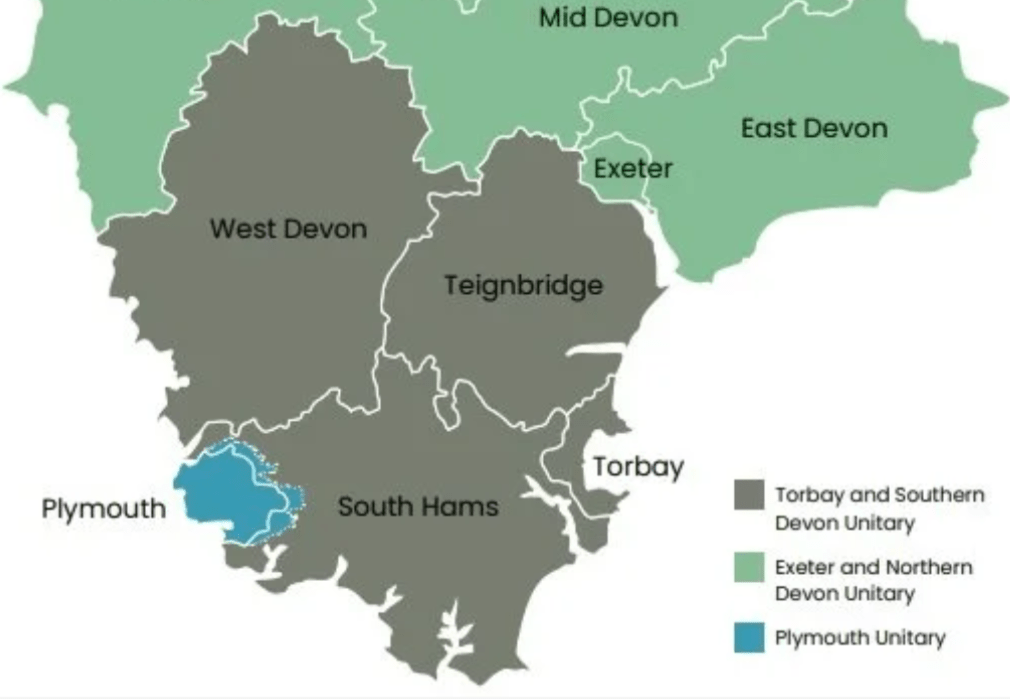
This division amongst district councils illustrates just how divisive LGR has become. It would appear that only around 6,000 residents would be affected but it is obviously important to them.
Similar issues crop up in proposals 4 and 5.
The government really has stirred up a hornets’ nest.
Both proposals are derived from the very first 5:4:1 district proposals in which the geographic county is split into three unitary councils.
- Exeter and Northern Devon Unitary. [East Devon, Exeter, Mid Devon, North Devon, and Torridge].
- Torbay and Southern Devon Unitary. [ South Hams, Teignbridge, Torbay and West Devon ]
- Plymouth unchanged in Proposal 2, or expanded, with consequential reductions in the South Hams in Proposal 3
Points to note
- No of Unitaries – 3
- Population. These proposals create a more even balance of populations in each unitary: Exeter & northern Devon c 550,000; Torbay and Southern Devon c. 420,000; Plymouth remains at the lower end of the target population of c 275,000/280,000.
- Geography. Likely administrative centers to be Plymouth, Torbay and Exeter which still leaves parts of West, North and East Devon somewhat remote.
No 4 Exeter City Council and Plymouth City Council proposal
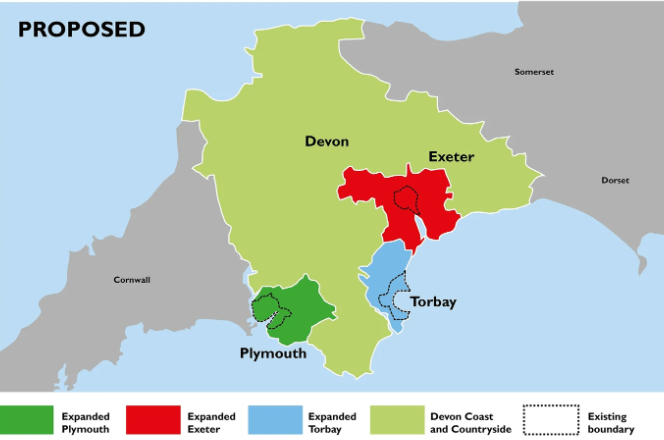
This is arguably the most radical proposal creating 4 unitaries, involving a lot of boundary changes. Three of these imply significant expansion of areas adjacent to Plymouth, Torbay and Exeter. These three areas would become compact “urban” unitaries with the rest of Devon lumped into a surrounding horseshoe of “Coast and Countryside”.
- Exeter: plus 15 parishes from within Teignbridge District Council, 28 parishes from within East Devon District Council and 6 parishes from within Mid-Devon District Council.
- Plymouth: plus 13 parishes from South Hams
- Torbay: plus 22 parishes from within Teignbridge District Council and South Hams District Council.
- Devon Coast and Countryside: The rest of Devon!
See the Proposal 4 map:
Points to note
- No of Unitaries – 4
- Population division. This proposal quite clearly creates a division between Town and Country. The populations of the three urban unitaries range from c. 305,000 for expanded Plymouth, 260,000 for expanded Exeter to 232,000 for expanded Torbay. All fall short of the 500,000 target. The rural periphery, on the other hand, is far larger with a population of c. 455,000
- Geography. Fine for the urban unitaries centred on Plymouth, Torbay and Exeter. A nightmare for the rest.
No 5 Torbay’s proposal to be left alone
This insular proposal takes Exeter’s and Plymouth’s proposal (4 above) but says “no thank you” to the idea of adding 22 parishes to Torbay. Torbay proposes these parishes should be lobbed into the “Coast and Countryside” rump, making it an even greater nightmare to administer.
Points to note
- No of Unitaries – 4
- Population division. This proposal returns Torbay to a population of c.140,000 which is really too small for an efficient unitary, smaller than East Devon. The “Coast and Countryside” rump is increased by about 100,000.
- Geography Even more of a nightmare for managing “Coast and Countryside” than in proposal 4 above.
You can find all the detailed cases made for each of these five proposals at: www.devonlgr.co.uk.
The Government “Mission Statement”
So it’s all about growth. It does nothing to address impending bankruptcy and the ballooning costs of social care and provision for children with special educational needs. More importantly the centralisation it seeks, reducing your access to councillors and making councils more remote, is the antithesis of what most people think devolution means. – Owl
“Our ambition is to simplify local government, ending the two-tier system and establishing new single-tier unitary councils that are responsible for all local government services in an area. Our vision is clear: stronger local councils in charge of all local services, equipped to drive economic growth, improve local public services, and lead and empower their communities.
Strong local government will help grow the economy and drive up living standards – the government’s number one mission. With one council in charge, we will see quicker decisions to grow our towns and cities and connect people to opportunity. Reorganisation will speed up house building, get vital infrastructure projects moving, and attract new investment – with more people able to buy their own homes and access high-quality local jobs.
New unitary councils must support wider devolution structures. Our ambition is that all of England can access devolved powers by establishing Strategic Authorities – groups of councils working together over areas that people recognise and live and work in – to make the key decisions over strategic scale and to drive economic growth. Strategic Authorities use their powers over housing, planning, transport, energy, skills, employment support and more to deliver growth and opportunity to communities across the country. In the Devon, Plymouth and Torbay area, the Devon and Torbay Combined County Authority is already established, this does not include Plymouth. “
 East Devon Watch