Group expands legal claim over South West Water sewage pollution

A group legal claim against South West Water alleging sewage pollution into coastal waters is harming businesses and individuals has been expanded across Devon and Cornwall.

Sandra Laville www.theguardian.com

Thousands more individuals could now join the first environmental community group legal action against a water company over the impact of sewage pollution.

Until now 1,400 people from Exmouth had joined the legal action but Leigh Day said on Wednesday it was being expanded to residents and businesses across Dawlish, Sidmouth, Teignmouth in Devon and Newquay and Penzance in Cornwall.

The claim argues failings by South West Water are wide and entrenched in many coastal towns across the Devon and Cornwall region, rather than just the Exmouth area.

Tina Naldrett, 62, a nurse from Dawlish, has joined the claim, after years in which she has seen the pollution at her beach get worse.

“When the sea is clear, and you can see your feet, the sun is on your back and you hear the gulls, it is free magic,” she said. “But more often I take friends into the water and we see sanitary products floating past, the plastic from tampons, actual effluent and the foam from effluent. It is getting worse.

“Water companies don’t own the sea. We are an island nation, the sea belongs to us all and for water companies to use the sea in this way feels immoral and ethically bankrupt.”

In 2024 South West Water discharged 544,429 hours of raw sewage into seas and coastal waters, including an overflow at Salcombe Regis that discharged for almost the whole year – making it the longest sewage release duration across all the storm overflow sites in England and Wales.

Last July Ofwat issued a £24m enforcement penalty against South West Water identifying systemic failings in the way it maintained and operated its wastewater treatment works and sewer networks dating back to at least 2017.

Spills of raw sewage via combined storm overflows are only allowed, and considered legal, if they take place after exceptional circumstances, such as extreme rainfall, when the system is at risk of being overwhelmed. But more than half of South West Water’s treatment plants were spilling regularly into the environment, Ofwat said.

The legal claim launched in 2024 has attracted more than 1,400 people from the Exmouth, Lympstone and Budleigh Salterton areas. They object to the repeated use of storm overflows to discharge raw sewage into the sea, triggering bathing alerts and beach closures and preventing people from using the coast.

Oliver Holland, who leads the claim, said the expansion of the legal action across Devon and Cornwall was an important step.

“South West Water has a track record of very poor environmental performance, and my clients allege this has badly impacted their lives and livelihoods. By outlining my clients’ claims and expanding in this way, we are ensuring anyone who feels they have been impacted by sewage pollution in Dawlish, Sidmouth, Teignmouth, or at Longrock beach or Fistral beach in Cornwall, has the opportunity to take action.”

South West Water has been contacted for comment.

Flawed council shake-up plans will not deliver savings

Guardian readers respond to Polly Toynbee’s article on the government’s plans to overhaul local government (18th Feb)

www.theguardian.com

Polly Toynbee is correct to point out the foolishness of a massive local government reorganisation, given other priorities (Is No 10 seeking its own destruction? Why else would it botch its council plans and hand a victory to Farage?, 18 February).

What she does not mention is that this reorganisation will lead to a large increase in inequality. The district councils that are being abolished are rising from the ashes as town and parish councils and, unlike other councils, they can set their own precept and cannot be capped. The largest town councils have budgets of more than £5m and more than 124 parish councils have budgets of over £1m. These councils tend to be in the wealthier suburban and rural areas, and can protect their residents from austerity, unlike residents of large, disadvantaged urban areas.

If you live in an area with a parish council, you will have a good library, open spaces and playgrounds will be well maintained, and you will have a thriving youth club. If you do not, your library will have closed and your playground will be covered in glass where the teenagers drink on a Saturday night following the closure of their youth club.

The government is giving grants to disadvantaged areas, but they will revert to their previous state within a few years due to a lack of local government funding. Despite the warm words from the chancellor, the cuts continue.
David Kennedy
Menston, West Yorkshire

The government seems bent on replacing one broken system with another. Local authorities have two broad functions. One is to deliver services equitably, efficiently and economically. The other is to be the living, beating heart of the communities they serve, offering local leadership and advocacy. It is, of course, a question of balance. Councils need to be big enough to be efficient, but small enough to care. Governments do not seem to understand that.

Unitary councils are certainly more publicly relatable than the two-tier system. But in choosing a population baseplate of around 500,000, this government has made it clear that any concept of local responsiveness has been abandoned in favour of an ill-conceived search for savings. It is no better than planning on the back of a fag packet.

Two “super councils”, as proposed where I live, will simply be too large to be responsive to the needs of such a large and diverse range of towns and smaller population centres. Perversely, it will also be too small to justify a combined mayoral authority, because it is not an economic entity on its own. The proposals represent another centralising nail in the coffin of local government.

Of course, if you just want your bins collected, none of that matters. But as a former three-time council chief executive, I pray for another U-turn.
Bernard Quoroll
Guildford, Surrey

Why Labour is wasting energy on an unnecessary reform of local government is, as Polly Toynbee points out, puzzling. A cynic might suggest that the reason is something scarcely mentioned in the debate: larger authorities with fewer councillors representing local interests offer more scope for the kind of large-scale planning that is needed to take forward the government’s ambitious growth strategy.

Westminster finds local council opposition to new runways, roads, railways, housing estates, power stations and so on a nuisance. Maybe local government reorganisation is driven by a desire to weaken it.
Peter Taylor-Gooby
Canterbury

Polly Toynbee has hit the local government reorganisation nail on the head. As a senior county council officer, I went through the reorganisation in the 1990s. Far from creating a more rational system, it resulted in a hotchpotch of new authorities, some of which struggled to establish sound services, and a puzzling set of changes to county councils. The process took up huge amounts of time and money, and diverted attention from planning and delivering good services into sorting out thousands of details such as changed boundaries, contracts and responsibility for future liabilities (not unlike Brexit).

The adage that form should follow function seemed to be less important than working on the assumption that reorganisation was an easy panacea. Looking at exactly what needs doing and seeing how well you could do it through minimal organisational change makes more sense – less exciting, but the public needs good services, not political excitement.
Andrew Seber
Winchester

My district council, East Devon, is due to be abolished in the name of “efficiency” some 50 years after it was created from an efficiency bonfire of urban and rural councils. The district only consumes 7% of the tax it collects from me, so I see little scope for savings. All the local services it manages – maintaining electoral rolls, running elections, dealing with household waste, street cleaning, local planning, collecting council tax etc – are essential. The only certainty is that I will have fewer councillors to turn to.

There is no consensus on how district councils should be reorganised in Devon, and my fear is that rural areas will be cast adrift from the inherently more efficient urban ones. As for mayors, even Andy Burnham might struggle to make himself known in a county that is 70 miles wide and 70 miles deep, with little public transport.
David Daniel
Budleigh Salterton, Devon

Latest twist in the complex saga of Greendale and planning permissions.

High Court battle looms over NHS vaccination building

Bradley Gerrard, Local Democracy Reporter www.radioexe.co.uk

A High Court battle looks set to be sparked over a long-running dispute to retain an NHS drive-through vaccination centre.

The owners of Greendale Farm Shop have revealed that after losing an appeal over the issue at the Planning Inspectorate, they are now taking their fight to the next level.

A spokesperson for the firm confirmed that they did not agree with the outcome of the recent appeal on a legal basis, and so have just submitted a challenge in the High Court.

“The NHS wants to stay put and they have a lease on the building,” a spokesperson for Greendale said.

“We made our appeal to the Planning Inspectorate under four grounds and we don’t believe all of those have been made reference to in the decision notice.”

The saga has been rumbling on for years, with Greendale removing a chicken shed from the same site, and according to official documents, “a new larger structure was erected in the same place which permitted development rights did not permit”.

A 2023 planning application by Greendale sought to retain the building, but that was refused by East Devon District Council because it was outside the boundary where development was permitted and because it believed there was an “absence of a robust justification and evidence of need” for the site.

That decision was taken to the Planning Inspectorate, which sided with the council. East Devon subsequently issued an enforcement notice demanding the building and parking area be returned to agricultural use.

Greendale’s owners again took their plight to the government planning arbitrator in a bid to overturn the enforcement notice.

However, in a fresh decision issued late in January this year, the Planning Inspectorate upheld the enforcement notice, meaning it supported the council’s belief that the building has to be taken down.

The NHS Vaccination Centre has a drive-through provision, and is different to the much larger structure that also served as a vaccination centre during lockdown and which is on nearby Greendale Business Park land.

That larger building is no longer used by the NHS, but is occupied by an alternative health provider, and planning permission for that building has been previously approved.

East Devon states the reasons for its enforcement notice on the drive-through building are that it is “outside of any recognised development boundary”, even though it is just metres from the well-used Greendale Farm Shop and Cafe.

It is also virtually directly opposite Mud-Ventures play site, which was itself the subject of a Planning Inspectorate decision in its favour. In that case, the council also felt it was outside the area where development should occur, but the Planning Inspectorate felt the building was in keeping with others on the site and that Mud Ventures was unlikely to draw huge amounts of extra traffic given that people were likely to use more than one of Greendale’s services once there.

The council called the drive-through building “unjustified and unsustainable development in the countryside”, and that “its nature as a drive-thru vaccination centre means that people are likely to access the site via private car”, which is contrary to its policies linked to encouraging developments that can be accessed by public transport.

“It is not considered that there are material circumstances to outweigh the adverse impacts of development in this location which justify a departure from policy,” the council said in its enforcement notice.

“The environmental harm is considered to outweigh the social benefits that would be derived from the provision of a permanent building for the NHS to roll out their vaccination programme.”

The appellants had claimed that the enforcement notice was “defective”, and while the Planning Inspectorate stated he had “sympathy” with that suggestion, ultimately it found in favour of the council, albeit suggesting amendments to the enforcement notice.

The Planning Inspectorate agreed that while there were benefits to a vaccination centre, it had not been demonstrated that the service could not be better delivered elsewhere.

The documents also state that the NHS lease ends in March 2026, but it is not clear if that has been extended in the meantime.

‘It was terrifying’: hundreds fall sick after swimming in bathing waters

Exmouth pollution mentioned again in a national newspaper. – Owl

“No family should go through this,” said Alice Clarke after her seven-year daughter, Willow, fell ill after swimming last summer at Carlyon Bay, Cornwall. Willow was ill for 12 days, vomiting, unable to keep food down and losing weight.

Adam Vaughan www.thetimes.com

The parasite cryptosporidium was eventually concluded to be the cause. “It was terrifying. Willow thought she was going to die,” said Clarke, a teaching assistant from Devon.

Willow, who recovered, was not alone in 2025. More than 1,200 people became sick after swimming in designated bathing waters across England last year, despite three quarters of those official swimming spots being rated “good” or “excellent”.

The figures, reported to the charity Surfers Against Sewage (SAS), showed Exmouth in Devon accounted for 192 cases of sickness after people had been in the water. Though the water quality was rated excellent when regulators undertook official tests during the summer, other research has found Exmouth can drop to poor during the winter months.

Hove Lawns in East Sussex and Polzeath in Cornwall also featured highly despite both being classed as excellent, having 103 and 102 sickness reports respectively.

Analysis by SAS of data from water company sewage spill maps suggests they dumped raw sewage into bathing waters across England for almost 125,000 hours last year despite dry conditions.

As the full maps only went online in late 2024, it is impossible to compare with previous years. However, demonstrating how wet it has been recently, sewage has already been spilled for 46,141 hours in 2026, less than two months into the year.

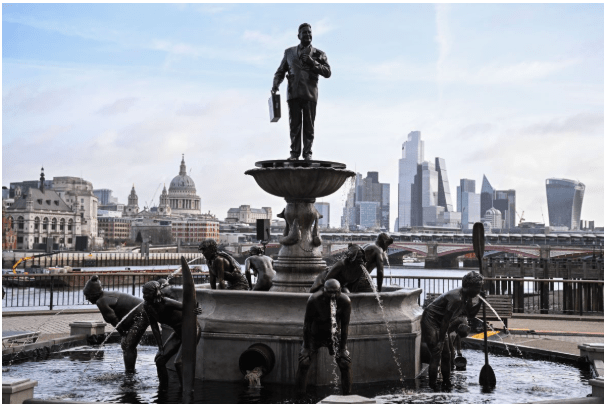
A “fountain of filth”, a temporary art installation featuring figures based on real people with cloudy water pouring from their mouths, has opened next to the Thames. Paid for by Channel 4 to promote its new fact-based water pollution drama Dirty Business, the fountain includes models based on the surfer Lizzie Cresswell and the Save Windermere campaigner Matt Staniek.

The Fountain of Filth JAMES VEYSEY/SHUTTERSTOCK

Cresswell, an SAS activist who said she had become ill several times after surfing, said she had done “lots of poses throwing up” for the 3D scan of her that was turned into the statue. “I’ve had eye infections, ear infections. It is horrific that we’re doing the things that we love doing and I’ve been sick multiple times.”

Staniek, who brought week 120 of his Greta Thunberg-style sewage strike to London on Monday, said: “It’s about bringing England’s largest lake into the fold and demonstrating to people that if it’s happening to Windermere in a Unesco World Heritage Site and a national park, then no river is safe from this.”

Jonathan Kneebone, director of the Glue Society art collective, who designed the fountain, said that the bronze-like statues of people were printed as hollow sections like “bits of macaroni”. The structure, on the Southbank in London, took three months to build but will be taken down in three days. “I love the fact that it feels like public art that should be here all the time,” Kneebone said.

Suzi Finlayson, a 47-year old swimmer from Bognor Regis, had travelled up to see the art installation. Like several other swimmers at the end of 2023, she fell ill at Aldwick beach in Sussex after swimming. She suffered a bacterial infection that reached one of her heart valves, requiring open heart surgery and leaving her reliant on weekly blood tests to this day.

“I’m still living with the consequences of that and something needs to be done about the public impact of what this sewage dumping is doing,” said Finlayson, who has reluctantly given up sea swimming.

Separately on Monday, Yorkshire Water was ordered by Derby crown court to pay a £733,333 fine for polluting a stream three times in less than 12 months. An Environment Agency investigation found several releases of untreated sewage had killed fish and insects along a waterway in Poolsbrook Country Park, near Chesterfield, during 2018 and 2019.

A spokesman for the industry body Water UK said: “Sewage spills are awful and we are working to end them as fast as we physically can. That’s why we are tripling investment over the next five years to halve spills from storm overflows and upgrade the capacity of 1,700 wastewater treatment works.”

The Times Clean it Up campaign is calling for better regulation and investment to safeguard the nation’s rivers and seas.