Devon County Council’s proposed new budget is not a good deal for residents

County Councillor Martin Shaw responds to John Hart’s “triumphalist” presentation of the DCC budget.

DCC’s leader John Hart and Chief Executive Phil Norrey are selling the budget which will be proposed on Thursday as a good deal, even the best in years. However essentially we have a standstill on services, more spending on administration and a big increase in council tax. What’s not to like?

https://seatonmatters.org/ posted on February 18, 2020

  • There will be more spending on adult social care and children’s services – but only to keep pace with demand, not to improve services.
  • 70 per cent of the Council’s spending will go on 3 per cent of the population – less than 10,000 vulnerable old people and 5,000 vulnerable children.
  • Council tax will rise by 3.99 per cent, well ahead of wage inflation at 2.9 per cent, another above-inflation increase after many years of them. The Government says it’s not increasing taxes – but by underfunding councils, it’s forcing us to increase council tax,
  • On top of this, because the Government has prioritised Brexit and hasn’t announced its medium-term spending plans, DCC is keeping more in reserves than it really needs, rather than spending on services or keeping council tax down, in case the Government lets us down.
  • And of course, we’re putting up council tax this year because next year it will be election year, and the Tories won’t want to go into the County elections with another big rise.
  • Obviously it’s right that the Council should ensure that those with the greatest needs are properly looked after. But it’s not right that most residents should pay more and more every year in return for fewer services. The Council’s own community survey shows many people complaining about this – and they are right.
  • There will be a small above-inflation rise in Highways spending – this is welcome. But other services will see no real increase, while the Council’s corporate services will get a big rise. That’s not right.
  • I’m specially concerned about libraries. The Council is rightly proud of keeping all 50 libraries open. But we are expecting a further drastic fall in book issues, from 2.4 to 2.2 million, over 8 per cent, after years of similar falls. The Council seems to think books don’t matter so much, but if we keep on like this, the core function of our libraries will be dead within a decade.
  • It’s time to put some money back into services that can benefit everyone. That’s what I shall be looking for on Thursday.
‘Best budget in a decade’ will see Devon council tax rise by 3.99 per cent

Following the previous post we now have the “you’ve never had it so good” news , well not since……… :

Council tax in Devon is set to rise by 3.99 per cent to help pay for what has been called ‘the best budget in a decade’.

Devon County Council’s cabinet on Friday morning (February 14) unanimously recommended to next Thursday’s full council meeting their budget plans, which will see the council’s spending will rise by £43.1 million from £498 million in 2019/20 to just over £541 million.

There will be an extra £23.7 million for adult care and health, £11.5 million more for children’s services and £2.7 million for highways including £1 million to help deal with drainage issues on the road network, with an increase of 8.7 per cent on spending year-on-year.

The spending rise will partly be funded by a £1.7million increase in the final Local Government financial settlement for 2020/21, but also by a proposed 3.99 per cent rise in council tax.

The proposed 2020/21 Band D Council Tax figure is £1,439.46, a rise of £55.17 from last year, or £1.06 a week. Of that 3.99 per cent rise, two per cent is ring fenced to help fund adult social care.

Councillor John Hart, leader of the council, said: “This is a good budget for Devon and better than we have had in a few years. There is extra money going in and we will never have enough to meet the rising demand.

“But we have more money going into adult and children’s services and some extra money for road drainage because, with climate change, the rain is coming down heavier than ever and we must ensure our roads can cope.”

He added: “There is an increase in expenditure, particularly in adult services and children’s services, with adult services increasing by 10 per cent and children’s by 8.5 per cent. But we are also looking to put extra money into highways as we know we have got a problem with the different type of rain today, with the more monsoon type rain we are getting. We are having a drainage problem and a breaking up of roads problem, so we have put an extra £2m into drainage.”

Explaining why council tax needs to rise, Cllr Hart added: “Council tax is going up as we don’t get enough from government in grants. Over the years we have lost something close to £300million but we have kept the services going and the show on the road by reorganising the county council.

“We are putting an £43million this year into services. It means the council tax will go up by £55 a year but it means we can maintain and somewhat improve the services we are offering.”

Chief Executive Phil Norrey added: “In cash increase terms, this is the best budget we have had for a decade. This is a pretty good budget for us due to prudent stewardship of our finances.”

Dr Norrey added that the independent Chartered Institute of Public Finance and Accountancy had judged the finances of top tier councils across the country against a number of measures of resilience. Devon’s finances had been judged to be good and robust.

www.exmouthjournal.co.uk /news/devon-council-tax-2020-21-rise-by-3-99-per-cent-1-6515475

The worst decade for growth in two centuries

Today’s [11 Feb] new GDP figures show growth at the end of 2019 grinding to a halt, bringing to an end to the worst decade of recovery in two centuries.

Owl has just found this analysis published by the TUC a week ago on 11 Feb.

Flat quarterly growth (i.e. 0.0 per cent) in 2019Q4 continues the volatile but overall weak figures throughout the year: Q1= 0.6%; Q2 =-0.1%; Q3=0.5%. Overall growth for the calendar year was 1.4 per cent, second weakest of the past decade. Within this, the manufacturing industry is in recession – a calendar year decline of 1.5% is the worst since the global recession.

This year’s growth was a dismal end to a dismal decade. Looking simply at calendar decades, over the 2010s growth averaged 1.9 per cent. This was just above the 2000s, and lower than each other decade since the war.

But decade statistics are to some extent arbitrary, depending on the timing of recessions. Performance is better judged over recovery cycles, measured from the low point of recessions.
So the present recovery begins at the trough of the ‘great recession’ in 2009 and extends a decade to the end of 2019.

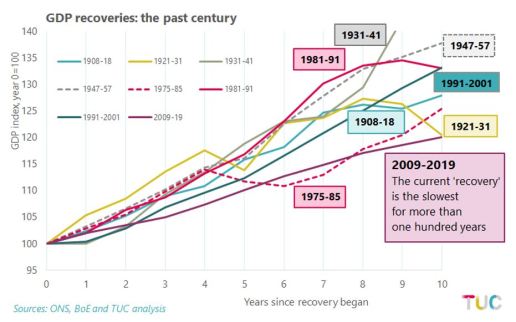
The chart below shows this episode worse than all other recoveries over the past century. The only comparable recovery was the 1920s.


Even over a decade some recovery episodes begin to overlap with others – so for example 1975 to 1985 overlaps with 1981 to 1991, depending on the frequency of recessions.

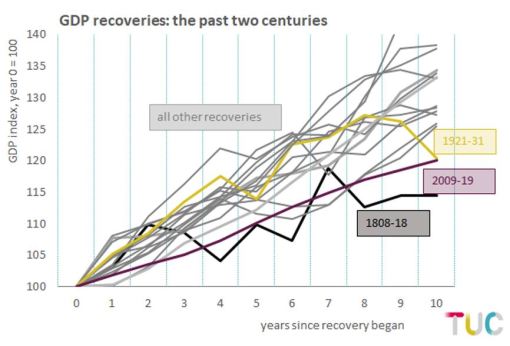
Looking at even older data the problems become more acute, with GDP data increasingly volatile. Nonetheless some judgment allows comparable figures to be devised.

On this basis the present recovery is the worst since an episode over 1808 – 1818 – which overlaps with the Napoleonic wars.

Leaving the latter figures aside, the only meaningful comparison is with the 1920s. Strikingly this is the decade that fostered modern macroeconomic thinking in the 1930s.

Over the 1920s wrongheaded monetary and fiscal policies operating in tandem meant great hardship, with the decade ending in the Great Depression – the most severe economic crisis of all time.

It is as if over the past decade ignorance has been re-invented. While renewed recession has at least been avoided for the moment, the economy has gone nowhere.

A cynic might find it unsurprising that the Prime Minister has chosen to confirm HS2 today [11 Feb].

Looking at the detail in the 2019 figures also shows that outcomes would be significantly worse if not for a recent uptick in government current and investment expenditure.

But a lot more needs to be done. Fundamentally, these figures demonstrate policy failures over the whole of the last decade.

Why has this has been allowed to happen?

Why indeed – Owl.

Is CHINO (Chancellor in name only) about to splash the cash on the orders of the weirdo-in-chief? Will the boom then be followed by bust?

There are more charts accompanying this article and Owl recommends a look:

https://www.tuc.org.uk/blogs/worst-decade-growth-two-centuries

Owl’s contact details have changed

To complete the transition between Owls Old and New, Owl’s contact e-mail has changed to eastdevon.owl@gmail.com

This change has already been made on the “contact us” page of the Watch website.

Owlets, Eager Beavers, Ferrets and Moles who have Owl on “speed dial” might like to note the change details in their contacts.

Please keep sending Owl alerts to anything of interest in East Devon.


Ministers could backtrack on crucial Flybe tax cut

As talks to secure a bridging loan continue, the change of Chancellor could hit the long-term viability of Flybe according to Oliver Gill 17 February 2020 The telegraph

New Chancellor Rishi Sunak could abandon a controversial overhaul of air passenger duty agreed as part of a rescue deal for Flybe – hurling the regional airline’s long-term future into jeopardy.

Mr Sunak is against a cut to the tax, industry sources said. His predecessor Sajid Javid had backed a reduction in a bid to keep Flybe afloat.

One source said: “The change of Chancellor will make it significantly less likely to happen.

“The message was: ‘Don’t bank on it happening.’”

Flybe has complained for years that air passenger duty (APD) of up to £26 per flight disproportionately affects its finances, making its low-cost, short trips between UK cities less attractive than alternatives such as taking the train.

Slashing the levy was a key part of a rescue deal agreed with ministers last month when the airline came close to appointing administrators after running low on cash.

The carrier’s backers – who include billionaire entrepreneur Sir Richard Branson – are thought to have warned that a tax cut is essential for its survival.

Talks are continuing over a taxpayer-funded £100m bridging loan to fix a hole in Flybe’s finances, which could go ahead even if APD is not reduced.

Ministers last month announced a review of the levy as applied to domestic flights as part of a package of short-term measures to boost “regional connectivity” and ensure Flybe’s services continued running. 

Mr Sunak is said to have opposed the reforms in his previous role as Chief Secretary to the Treasury.

Meanwhile, the Government is continuing to ramp up its contingency planning if a rescue deal cannot be struck.

The Telegraph understands Aim-quoted jet charter service Air Partner has been put on notice by the Government to fly home any passengers left stranded if Flybe collapses. Accountant EY has been lined up to handle a potential administration.

The prospect of Government intervention to save Europe’s biggest regional airline has enraged many of its rivals.

Ryanair Michael O’Leary has threatened legal action, while Willie Walsh, the boss of British Airways parent IAG blasted financial support as “a blatant misuse of public funds”.

Last week’s reshuffle has changed two of the three key decision-makers who previously suggested the Government would support Flybe.

Mr Javid was replaced along with Andrea Leadsom, the former Business Secretary. Transport Secretary Grant Shapps is the only consistent voice of support from the Cabinet outside of No 10.

Despite concerns about setting a dangerous precedent for other struggling airlines, it is understood that Mr Shapps is broadly in favour of supporting Flybe.

The airline has insisted that any taxpayer-funded support would be on commercial terms, but talks with the Government and its adviser Alvarez & Marsal have dragged on.

Agreeing a loan has been complicated by Flybe mortgaging off aircraft, engines and buildings, leaving the taxpayer little or no security as would be standard practice when agreeing loan.

The airline has asked suppliers for more time to pay its bills and insists that bookings are returning to normal levels.

But credit card firms are understood to be holding back customer payments while talks of its futures hang in the balance, because they would be on the hook for refunds under consumer protection rules if it were to go bust.

Earlier in February Flybe admitted that it only had enough cash to get through to the end of the month. Shareholders are understood to be prepared to inject more money into the business if they can secure a deal with ministers.

A spokesman for Flybe said: “Flybe and its shareholders continue to have productive and positive discussions with the Government regarding support to enable us to deliver our long-term strategic plan.”

Air Partner and the Treasury declined to comment.