Hinkley Point C work to carry on but HS2 could be paused

Owl thinks that Heart of the South West will be pleased to see that the mainstay of our local economy will continue to forge ahead.They have a target of doubling our 2018 economy over the next twenty years to meet.  Owl doesn’t think it will have any impact locally, one way or the other. We live in different times if not on a different planet. There are serious issues for the workforce.

Rob Davies  www.theguardian.com

Thousands of workers from across the country will continue to gather on the Hinkley Point C nuclear site – but work on the £106bn HS2 project could be halted – amid differing approaches in the construction industry to physical distancing aimed at containing the spread of Covid-19.

Some of the 4,000-strong workforce at Hinkley, Britain’s biggest construction project, have raised concerns over an outbreak of coronavirus at the Somerset site after the government shut down restaurants, pubs and schools to contain the outbreak elsewhere.

Around 1,500 workers helping to build Britain’s first new nuclear plant in decades live in temporary shared accommodation, either on the site or nearby, returning to their homes across the country at the end of each rota pattern.

Almost all the remaining staff use bus services from nearby train stations to travel to the site, raising fears that the close proximity of staff working on the project could allow the virus to spread within the workforce and across the country.

The company behind the project, EDF Energy, said on Monday that it plans to take “extra steps” to safeguard the health of workers on the site after workers raised concerns over crowded buses and close proximity of the workers in the local press.

One Hinkley Point worker reportedly told Somerset Live: “When we get to the site, we have to clock in for our shift and there’s 600 of us who clock in and out at the same time. At this point, there are no hand sanitiser dispensers so you cannot wash your hands. There are also areas where people touch. You don’t know what germs are being spread as a result.”

The company said it plans to conduct body temperature checks on all workers entering the site to check for a fever and has banned handshakes to help prevent the spread of Covid-19. It also agreed to provide extra buses to halve the number of people travelling in each vehicle so that they can be seated at least two metres apart.

 Bosses in charge of the HS2 high-speed rail project are keeping work under review in line with government advice. Photograph: Jacob King/PA

Work on the HS2 high-speed rail project is continuing for now but a spokesperson said that may have to change.

“Over the course of this week and into next, we will be reviewing the majority of works on our construction sites in line with government advice on dealing with Covid-19.”

Other major construction projects such as Crossrail and two major hospitals that were delayed after the collapse of Carillion, have set out plans to prevent the spread of coronavirus and will remain open for now.

The National Federation of Builders (NFB) said Britain’s construction industry was in an “unenviable position” between safeguarding workers’ health and averting an industry collapse similar to the 2008 financial crisis.

Richard Beresford, chief executive of the NFB, said: “Our industry does not want to stop working. Until we are told by the government to down tools, we will be doing everything we can to support the safest possible working environment.”

The government is understood to be wary about imposing restrictions on the construction industry, which is a major driver for Britain’s economic growth, at a time when the economy risks slipping into recession.

The construction sector contributes £117bn to the UK economy, or 6% of the total economic output, according to government data. The sector is also responsible for 2.4 million jobs or 7% of all jobs in the UK.

The Hinkley Point project alone is expected to generate £200m of value for the south-west’s economy every year by contracting local businesses – almost £4bn over the life of the project.

Sign up to the daily Business Today email or follow Guardian Business on Twitter at @BusinessDesk

Dan Dobson, a Unite member, said workers on sites across the country feared speaking out or turning their back on a job because they were self-employed and had limited employment rights or protections.

“Workers turned up at their sites this morning and expected to be told to go straight home. Instead, they were told it’s business as usual,” he said.

“The government needs to close the non-critical sites and extend the wage support scheme to the registered self-employed, and they need to take those actions immediately. Construction workers cannot afford to miss out.”
 

UK volunteers to be asked to deliver food aid within days

Planners from the government are preparing to ask some of the 2.5 million people who have signed up to community groups set up to help people in coronavirus self-isolation to start delivering emergency food aid within days.

Gregory Robinson  www.theguardian.com 

Planners from the government are preparing to ask some of the 2.5 million people who have signed up to community groups set up to help people in coronavirus self-isolation to start delivering emergency food aid within days.

Whitehall and council planners want to harness the enthusiasm of 2,700 grassroots groups that have formed in streets, villages and towns across the UK since the start of the crisis under the Covid-19 Mutual Aid umbrella.

Ian Hudspeth, chair of the Local Government Association’s wellbeing board and leader of Oxfordshire county council, said the volunteers would be asked to help deliver basic food and hygiene supplies to extremely vulnerable people, up to 1.5 million of whom the government has ordered to stay at home for 12 weeks.

Councils, supermarkets, members of the armed forces and community volunteers will be formed into a supply chain to deliver parcels to citizens being told by the NHS to go into lockdown for three months because of their underlying medical conditions. They will be asked to register online and request food and other supplies only if they lack family or friends who could otherwise help.

“It will be days rather than weeks for the first parcel,” said Hudspeth. “It is important to make sure it happens as quickly as possible. If people aren’t responding [about whether they need a parcel], they will be chased up.”

He said the first deliveries would contain the same basic range of products, but that people would later be able to select from a menu of items to reduce waste.

The Ministry of Housing, Communities and Local Government confirmed it was working with “the grocery industry, local government, local resilience and emergency partners and voluntary groups to ensure that essential items can start to be delivered as soon as possible to those who need it”.

It said the military was not likely to be used in doorstep deliveries, but that councils would be expected to “draw on the voluntary sector and emergency services”.

Based on an analysis of the membership of 100 of its groups, Covid-19 Mutual Aid estimates that as many as 2.5 million people have signed up, mostly through Facebook pages. The figure includes people offering to help and those seeking assistance for themselves or family members.

“This is people stepping up to do what they can,” said Kevin Smith, a spokesman for the umbrella organisation. “But this is not necessarily the answer. In terms of most food deliveries, this is not a replacement for an institutional response that is going to be needed.”

Some Covid-19 Mutual Aid volunteers have told the Guardian it has sometimes been a struggle to persuade the elderly to accept offers of help. Some have said they would also like to see more centralised coordination of volunteering, including criminal records checks.

“The biggest challenge has been making the older members of the community know they are vulnerable and need extra assistance,” said John Bownas, part of the Hastings and St Leonards group in East Sussex, where the population includes one of the highest proportions of people over 80 in England. “British people don’t like to impose. [But] if help is offered, take it.”

Steve Nuttall, part of the support group in Semer, a village in Suffolk, said it took him five minutes to convince his 80-year-old neighbour to stay at home and let him go shopping for him.

“Convincing older people to stay at home and that they are in a vulnerable situation is how I see the next few weeks going,” he said. “The government needs to do an awful lot more to help volunteer groups in terms of clear direction, resources and helping local support groups and to encourage people to help set up groups in their communities.”

The Poole group in Dorset attracted 400 volunteers in just over a week, although just five are currently completing errands, said Sarah Ward, one of its organisers. “We get a lot of phone calls from people elsewhere in the country who have elderly relatives in Poole who want us to contact them and make sure they’re okay in self-isolation,” she said.

The group takes food orders over the phone, places them with shops and asks customers to call the shops to pay by card. The volunteer then delivers the package, maintaining physical distancing at the drop-off.


There With You: Axe Valley charity appeals for help

An Axminster-based healthy-eating charity is appealing for urgent help to continue its work in supporting vulnerable people during the Coronavirus pandemic.

Chris Carson  www.midweekherald.co.uk

HALFF says its team of volunteers is already 50 per cent down because of self-isolation.

And its main source of income – an annual fundraisng dinner at River Cottage due to be held last week – had to be cancelled.

Founder Tiggy Parry said they are facing a fight to survive.

She said: “Literally every day I have one or two of my staff or volunteers telling me they have to self-isolate. “We are looking for people to answer the phones, sort vegetables and help in the shop, and at this moment we also urgently need financial support to help cover our costs.”

For the last ten years, the HALFF Food Hub in South Street, Axminster, has been supplying fresh fruit and vegetables to the local community and beyond.

Now, more than ever, the shop is proving a life-line for those who are particularly vulnerable.

Said Ms Parry: “We’ve been completely overwhelmed by the number of people asking for deliveries.

“More and more people are having to self-isolate and, of course, we’ve still got our regulars who’ve been using us for years – including many who are in their seventies and eighties.

“Audrey O’Shaughnessy is a typical example of one of our customers who’s been a regular in the shop since she lost her husband a few years ago.

“We know that being isolated would be particularly hard for her, along with many thousands of people like her. Being on your own right now is very, very hard.”

The charity was originally created to help people produce healthy meals at home and has, to date, helped more than 5,000 people in Devon, Somerset and Dorset.

Now it is having to re-think the support it gives.

Said Ms Parry: “Our free delivery services is one of the best ways we can help people in these very difficult times.

“We’re also regularly phoning our customers, giving them that all-important social contact, as well as making sure they’re still eating properly.

“As a small charity we have been able to respond quickly to the situation and are already in touch with hundreds of people across East Devon, many of whom will struggle to look after themselves.”

To help this vital community organisation in any way, call 01297 631782, e-mail info@halff.org.uk or go to http://www.localgiving.org/halff


Council warns hotel “self-isolation” breaks are putting others at risk

A Devon council leader has warned that hotels advertising “self-isolation” breaks are putting others at risk.

Torbay Council leader Steve Darling (Lib Dem) said he was aware of premises in South Devon staying open for visitors from elsewhere in the country.

(Nothing from EDDC on caravan and holiday parks, which have been closed in Wales – though this silence may have been overtaken when last night’s statement from Boris Johnson is clarified.)

Edward Oldfield  www.devonlive.com

He said that the approach was “reckless” and put staff, guests and the local population at risk.

On Sunday night, the Government warned people to stay at home and not to travel to holiday destinations.

It followed concerns raised by MPs and communities that an influx of visitors to Devon and Cornwall could overwhelm health and other services.

Mr Darling, Torbay Council’s Liberal Democrat leader, said: “Social distancing has to be taken extremely seriously.

“Putting themselves into a hotel where staff or customers could become affected is just recklessness in the extreme.

“I am aware of hotels in South Devon that are advertising as come here and self-isolate. 

“People are putting themselves more in harm’s way, and local residents more in harm’s way.”

Steve Darling, Liberal Democrat leader of Torbay Council (Image: Ed Oldfield)

The Government issued advice on Sunday that people should not travel to holiday premises for any reason.

A statement said: “This guidance is for people planning to visit second homes or holiday premises during the coronavirus (COVID-19) pandemic.

“Essential travel does not include visits to second homes, camp sites, caravan parks or similar, whether for isolation purposes or holidays.

“People should remain in their primary residence. Not taking these steps puts additional pressure on communities and services that are already at risk.”

Devon and Cornwall is understandably proud of its renowned stunning coastlines, wide open spaces and gallons of fresh air and thrive from the millions of visitors who come to enjoy our part of the world each year.

However, the outbreak of coronavirus in the UK has changed our day to day lives while the government is calling for the nation to stop all non essential travel in a bid to stop the spread of the disease that has so tragically already claimed 240 lives in the UK, four in Cornwall and two in Devon.

In the South West not only do we have a proportion of elderly people living here, those who are some of the most vulnerable to coronavirus, but we also have NHS trusts that are stretched to capacity without any extra pressure.

We want to help saves lives and help bring an end to the outbreak as soon as we possibly can.

Therefore we are aiming to spread the message of come back later as far and as wide as possible through a campaign launching today – #comebacklater.

Mr Darling said Torbay Council was focussed on protecting the most vulnerable and was working with community support hubs covering Torquay, Paignton and Brixham.

He urged people to follow guidance on social distancing and hand-washing and avoid meeting others.

Mr Darling said: “The only way we are going to beat this virus is by having less human contact and following the advice on washing hands.”

The council has suspended its normal democratic processes and cancelled or postponed public decision-making meetings as it focuses on responding to the pandemic.

Council decisions will be made by the leader or officers in consultation with councillors under temporary powers.

Mr Darling said the new arrangements would be regularly reviewed.


Matt Hancock: coronavirus is government’s ‘biggest public health campaign in history’ – no adverts on Facebook or Instagram

Matt Hancock is under fire after claiming “the biggest public health campaign in history” is telling people how to defeat coronavirus – despite no adverts being placed on Facebook or Instagram.

Rob Merrick Deputy Political Editor @Rob_Merrick www.independent.co.uk 

The heath secretary rejected growing warnings that much of the public is in the dark about official advice on ‘social distancing’, insisting no government had ever done so much.

However, the claim was immediately undermined by research showing not a single advert about the pandemic has run from the government’s official Facebook or Instagram accounts.

The failure is despite the fact that the UK has been offered “millions” in free ad credits to use on two of the world’s largest digital advertising platforms.

In the Commons, Caroline Lucas, the Green MP implored Mr Hancock to launch a “much bigger, wider, louder, more comprehensive public health campaign”, telling him: “Right now, it is clearly not getting through.”

But a visibly frustrated health secretary replied: “There is the most comprehensive public health campaign, probably in the history of government peacetime communications”.

And, turning to Ms Lucas, he added sarcastically: “Maybe I will send a poster to the honourable lady.”

But neither the official ‘UK prime minister’ Facebook account, nor Boris Johnson’s personal account, have run ads on any of the measures introduced to delay the spread of coronavirus, data seen by Sky News showed.

The official NHS account has run six ads on Facebook and Instagram since the start of the pandemic, advising anyone with symptoms to stay at home for 14 days.

But the messages – which were last updated on 19 March – do not mention the tougher guidelines announced since, including those urging people to stay home and for the most vulnerable people to isolate themselves.

The latest news on Brexit, politics and beyond direct to your inbox

Ms Lucas added: “It’s not being heard. We need to do be doing an awful lot more in order to catch up and get ahead of this.”

Sian Berry, the Green candidate for London mayor, said: “Two weeks ago, the external electronic advert board in my local chemist was still showing ‘Get ready for Brexit’ ads.”

And Yvette Cooper, the former Labour leadership candidate, said she had watched the prime minister’s Sunday night press conference “in despair”.

“The only ‘social distancing’ advice I can find on the NHS or government websites is very gentle,” she tweeted.

“No instructions to do this, just advice if you want it, no reference to staying more than 2m away from others.”

In South Korea and The Netherlands, aggressive use of emergency alerts, sent directly to mobile phones, is keeping people in touch with changing advice.

But the UK government does not have the ability to do the same, The Guardian reported, despite carrying out successful trials seven years ago.


Care home staff ‘struggling’ to feed residents face abuse from shoppers

Care home workers in East Devon ‘struggling’ to feed their residents have faced abuse from supermarket customers for bulk buying amid the coronavirus crisis.

Becca Gliddon  eastdevonnews.co.uk 

East Devon MP Simon Jupp stepped in to help when he learned care staff were facing public anger for buying quantities of meat and fresh food to feed the elderly and disabled.

He said workers in care homes have been forced to venture into supermarkets to buy multiple supplies because their regular food distributers have had to stop delivering – becoming so overwhelmed by the demand from supermarkets.

Care staff have been accused of being ‘greedy’ for buying up fresh food and meat to feed their residents, said Mr Jupp.

Mr Jupp said some care homes in East Devon were ‘struggling to get food’ for residents because regular distributors were cancelling or delaying deliveries to prioritise supplies to supermarkets.

In a bid to help, the MP for East Devon has liaised with farm shops and local producers to supply their own fresh food and home-reared meat to wanting care homes..

He urged shoppers to consider why customers were bulk buying before passing judgement.

He said: “I want to flag this up as an issue. I spoke to a couple of care homes recently. Some are really struggling to get food.

“Staff in one particular care home trying to get more than one chicken were told by other customers they were hoarding food, but they weren’t. They were trying to get food for the care home.

“People that pick up more food in shops than it looks like they need, they might be doing it for other reasons.

“If they are picking up three chickens, or three packs of mince, they might be getting food for another care home.”

In the midst of the coronavirus crisis, the MP for East Devon has compiled a rolling list of help available to residents, the vulnerable, and those self-isolating, through volunteer groups, town and parish councils.

The list of coronavirus help available in East Devon can be seen here.


East Devon libraries shut after U-turn on keeping self-service facilities open

Libraries in East Devon and Exeter have shut due to the coronavirus outbreak – after an idea to keep self-service facilities open was scrapped.

East Devon Reporter  eastdevonnews.co.uk 

It had been hoped facilities in Exmouth, Honiton, Sidmouth, Ottery St Mary and Seaton could be accessible so residents could still borrow books between 10am and noon on certain days.

However, Libraries Unlimited announced today (Monday, March 23) it had reconsidered its position over the weekend.

Temporary closures across the county, implemented on Friday (March 20), will now remain in place ‘until further notice’.

Staff say they are trying to continue to provide services ‘in different ways’.

A ‘books by post’ trial be taking place in Exeter, while others will provide online sessions such as Bounce and Rhyme, reading groups, and story times.

IT assistance will be provided remotely and workers will be checking in by telephone with vulnerable customers.

The teams will be taking telephone calls, helping with renewals and aiding people online to access eBooks.

However, the mobile and home library services have also been suspended.

From tomorrow (Monday, March 23), some libraries with self-service facilities will open for up to two hours.

Up-to-date information is available from the Libraries Unlimited  website.

Restrictions relaxed for bus pass holders in Devon – to help elderly get to shops early


How to feel less anxious about the coronavirus, according to psychologists

Advice that even Owl needs to heed.

@scfgallagher www.independent.co.uk

[Editor’s note: All advice was correct at the time of publication; the government now requires people stay at home where possible, avoid socialising and travel].

Boris Johnson has told the public to avoid all non-essential travel, including working from home where possible and avoiding pubs and restaurants to curb the ongoing coronavirus outbreak.

Those with underlying health conditions, over the age of 70 and pregnant women have also been told to minimise social contact for the next 12 weeks.

Despite the obvious seriousness of the situation it is important to keep the threat in perspective (during the 2017-2018 UK flu season there were 26,408 deaths and 1,692 in 2018-2019). The UK’s chief medical officer Chris Witty estimates a mortality rate for coronavirus of 1 per cent. [Other earlier estimates have been higher at between 2 to 3.4 per cent]. 

In comparison SARS had a mortality rate of more than 10 per cent.

The World Health Organisation and Public Health England have also warned there is no need to panic-buy face masks, latex gloves or other extreme protective gear if you practice good basic hygiene like regularly washing your hands and covering your mouth and nose if you cough.

Of course for many it is still hard to not worry about what is going on and what the future holds.

Dr Michael Sinclair, a consultant psychologist, tells The Independent: “It is understandable there should be a level of concern. Our minds evolved from cave ancestors to worry: we focus on doom and gloom, we chew it over in our brain and we learn new survival skills. That is our mind just doing what it is meant to do.”

Psychotherapist Silva Neves agrees but warns “panic, too, is contagious”.

So what do you do if health-related anxiety has become overwhelming? 

Don’t always listen to your mind

“Listen to what your mind says is there and then look at the evidence for what is really there,” says Dr Sinclair. “We need to recognise that it is often a story our mind is telling us, not the reality.

“Try to do this by, for example, instead of saying ‘I’m going to get ill’ say ‘I’m having the thought that I’m going to get ill’ to emphasise this is your mind telling you that not reality.”

Mr Neves adds: “We have control over how much we think about it. We do have control over our thoughts, although it is hard work sometimes to control them. Worrying about it won’t guarantee a better outcome. So try to allocate some brain space for other important things too.”

Don’t try to ignore physical symptoms of stress

“Sometimes we can make ourselves feel unwell (and like we might have something like coronavirus) through panic and anxiety – those signs; shortness of breath and heart racing,” says Dr Sinclair. “But when this happens, instead of trying to immediately eradicate or ignore those feelings, which won’t help, make space for them, describe them as you experience them.”

Mr Neves says in moments of panic you should try to take a few breaths; sit down and count your breath in and out for 10 seconds. Then repeat. 

Keep a record of your worries

Elizabeth Turp from the British Association for Counselling and Psychotherapy (BACP) says you can do something practical – something you can control – to help express anxiety. She suggests writing a journal or notebook.

“Allow yourself to worry, put it down in writing in a notebook, and then put that away. Once you’ve written it down, let it go,” she says.

You can also try drawing two circles – a circle of control and a circle of no influence – and fill them with things in your life that you worry about. This helps you to remember what things you can impact and those that, no matter how much you worry, you can do nothing about.  

Only consume what you can handle

Mr Neves says if you’re struggling to cope you don’t have to keep watching live news, have notifications turned on or use social media, instead limit your exposure to the new information. “You can be strict with yourself, decide to only watch the news and read an update on the virus once a day,” he says.

“I’m not suggesting you [totally] ignore it, it is serious. By all means, keep track of the development. But you can reduce your anxiety by reducing the amount of time you think about it.”

Take some practical steps 

As well as managing your mind, there are simple physical steps you can take to make yourself feel reassured, like following the advice from WHO and PHE. “Do wash your hands with soap and water often, especially before you eat. Or wash your hands with alcohol gel. Follow the medical advice,” says Mr Neves. 

Stay connected to your support network (digitally)

Gerard Barnes, CEO of mental health specialists Smart TMS, says that in times of stress it can be easy to want to isolate ourselves but it is crucial to maintain human interaction online or on the phone to reduce anxiety levels. “Maintaining strong connections will help you to feel supported and surrounded by positivity and good energy. 

“You are also more likely to be able to have an open conversation about the virus with those close to you – being able to discuss the issue and perhaps make jokes about it, will help you to feel more comfortable and overcome any anxiety you may have over the threat.”

Avoid speculation and focus on facts

In a world of 24/7 rolling news and social media updates, it can be easy to get drawn into speculation and hype. But Mr Barnes says: “Try to avoid being caught up in the media storm and avoid reading excessive speculative reports. Stick to respected health-first websites, such as the NHS, to get clear, simple instructions and facts on the coronavirus and how to handle it.”


Food banks are under threat due to coronavirus stockpiling and government inaction

The pressure on food banks is one of the first holes opening up in British society’s defences against the economic firestorm caused by the coronavirus pandemic. As the Independent reports today in an editorial, charities are warning that food banks are running low because of increased demand and dwindling supplies.

@IndyVoices  www.independent.co.uk

If Boris Johnson and Rishi Sunak are to make good on their fine words about our “capacity for compassion” in our “collective national effort”, this is something they need to act on urgently. 

There are, of course, other urgent priorities: income protection for freelance and casual workers is needed to put them on the same footing as employees, for example, to prevent them falling through the cracks and needing food banks. 

But there are already too many people turning to food banks, and many charities report that the supply of donations from the public on which they rely is drying up. 

The same message that George Eustice, the food and rural affairs secretary, delivered to shoppers against stockpiling needs to go out loud and clear: please continue to donate to food banks – other people need food too. 

Many individuals, charities and companies are stepping up. The Co-op today announced that it is donating £150,000-worth of food each week to food banks over the next 10 weeks. We need to see other food retailers follow this example. 

As Mr Eustice rightly said, we have enough food as a country to feed everyone, but hoarders and the sudden increase in financial hardship mean that it is not allocated fairly. 

Retailers should be encouraged to try innovative ways of discouraging hoarders. A Danish supermarket tried to deter people from buying more hand sanitisers than they needed by charging higher prices for second and subsequent purchases. A “two for the price of three” policy on goods sought out by panic-buyers might be easier for shops to enforce than simple rationing. 

If the stockpilers can be thwarted, there will be more food for everyone, including the food banks. 

But further action from the government is required. In addition to the increases in universal credit and working tax credit levels the chancellor has announced, the benefits sanctions regime that has driven so many people to food banks in the first place should be suspended for at least as long as the income support measures are in place. 

This is, as the chancellor said on Friday, a test of our decency as a nation. We have to control the coronavirus outbreak; we have to save as much as we can of the economy; but in so doing we have to protect the poorest and most vulnerable first.


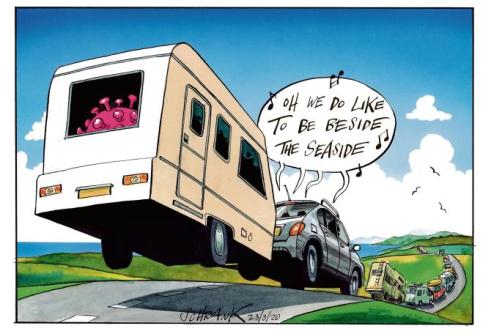
Oh we do like to beside the seaside!


(from the Times)

On 20 March Cornwall and North Devon made pleas for tourists to stay away. On 22 March many, but not all, Devon and Cornwall MPs proclaimed that these are not normal times and launched: #comebacklater

(It was North Devon Chief Executive who acted – Owl hasn’t heard a pip squeak from EDDC. We have some very big holiday sites in East Devon)

The BBC have carried the refrain on the news because similar pleas have been made across the country.

Owl fears it may be too late. With infections, currently, doubling every three days in UK – decisions have to be made very, very quickly. This government appears to be behind events, rather than ahead.

It won’t be much fun on a caravan/holiday park in “lock-down”. Nothing to do nowhere to go.

Axminster Carpet company salvage plan praised

Owl still wonders how a company that makes such a prestigious, quality, product can go bust twice in seven years. Loss of market, no longer fashionable, uncompetitive (unlikely in prestige markets), insufficient investment and saddled with debt as a result of UK businesses’ chronic short termism? The following comment looks hopeful – but it’s only a plan. And all UK businesses will be facing unprecedented problems for years. Good luck.

“There is a plan to implement an employee ownership model so that the local people who have worked so hard over some difficult years can feel part of the resurgence of this proud company.”

By News reporter  www.bridportnews.co.uk

Councillors have welcomed the ‘great news for Axminster’ that the town’s famous carpet company has been saved and will now be owned by its workers.

The company collapsed in February 2020 with the loss of 80 jobs. But now a group of UK private investors, industry leaders and the Dutfield family has rescued it.

A consortium of investors, including the family which restarted the historic business in 1937, has salvaged it from administration and intends to reboot production.

The business, which had amassed debts of nearly £8million, is now well-funded and debt free, the new owners said.

The news has been welcomed by councillors in Axminster, with Cllr Andrew Moulding saying: “It is great news for Axminster, great news for the historic Axminster Carpet industry and great news for those dedicated employees, whose jobs have been saved.”

He added: “It is not likely all the workforce will be re-employed and the council will strive, alongside other partners, to continue to support those who will be seeking new opportunities and alternative employment.”

Cllr Ian Hall added: “This will hopefully go a long way with the excellent support that has been given by East Devon and the Axminster Job Club. This will enable the individuals and their families who have been enduring a difficult journey to come to a healthy decision that must be paramount to their own wellbeing.

“Please remember, there will still be support available on Thursday’s at the Pippins Centre. It is of course excellent news that the future looks far brighter for the Carpet Industry in Axminster.”

 East Devon District Council’s portfolio holder for the economy, Cllr Kevin Blakey, added: “We were delighted to learn the news that Axminster Carpets has found a new buyer, which will enable an element of re-employment at the factory.

“We’re keen to support a more productive and sustainable future for carpet manufacturing in Axminster, and we look forward to learning how many staff will remain with the firm and in what capacity. This will help us adapt our ongoing redundancy support to employees who continue to need it.

“Our next support session is opened up to anyone who has been made redundant, be it from Axminster Carpets or more recently from Flybe. It will take place at the Pippins Community Centre in Axminster on 12 March, from 9am to 12pm.

“East Devon District Council and our partners will continue to offer one-to-one guidance and practical assistance for anyone in need of our support.”

Axminster Carpets has a long tradition of making the world’s finest carpets for the most discerning clients and is a holder of a Royal Warrant.

It was founded in 1755 by Thomas Whitty, the creator of the now famous Axminster Weave and Harry Dutfield restarted the business in 1937.

Famous customers include King George III and Queen Charlotte, who also visited the factory, and Queen Elizabeth II.

The new owners say Axminster Carpets is well placed for a successful and sustainable future, and Robert Day, who is leading the private investors, said: “The business has never been in a better position to again become a significant player in the sector.

“There is a plan to implement an employee ownership model so that the local people who have worked so hard over some difficult years can feel part of the resurgence of this proud company.”

Joint administrator Benjamin Wiles, of Duff & Phelps, added: “We are absolutely delighted to be able to announce today that we have secured the future of Axminster Carpets, one of the best-known British brands, following the successful sale of the business and assets of the company.

“The swift conclusion of this process has enabled Duff & Phelps to secure the future of the business. This deal will provide a stable financial platform, ensuring its long-term viability.”


Seaton Town Council by-election cancelled

Seaton Town Council’s by-election scheduled for Thursday, March 26, has been cancelled following Government guidance about Coronavirus.

The authority will now decide whether to co-opt the two candidates who put themselves forward for election.

Owl sees from the Town Council web site that there are currently five vacancies.

http://www.seaton.gov.uk/Seaton-Town-Council/Councillor_Vacancies_12070.aspx

Chris Carson www.midweekherald.co.uk

East Devon Returning Officer Mark Williams said: “My priority is to ensure the wellbeing of the public who were due to vote and the staff running the polling stations.

“In light of the current exceptional circumstances and on the advice of the Association of Electoral Administrators the right decision is to cancel the election.

“I have written to Seaton Town Council and suggested that the council may wish to consider co-opting the two candidates who were standing for the election.”

Any postal votes received by the returning officer will remain unopened and will be confidentially destroyed.

The town council will not be charged for any administration costs in preparation for the election.

For further information, contact the electoral services team on 01395 517402.

The Government has given its full support to returning officers to cancel or suspend elections to prevent the spread of the virus.


Much worse lies ahead. But still the Prime Minister’s message is too weak

The UK expects thousands of deaths, and dangerously mixed messages risk making an already grave situation worse – Guardian Leader

Editorial  www.theguardian.com 

Data shows that the UK’s coronavirus outbreak is following a similar trajectory to Italy’s, with around a two-week delay. While panic will not help anyone, the only rational reaction to this information is serious alarm. On Saturday, 793 fatalities took Italy’s death toll, already higher than China’s, to 4,825. The pattern of exponential growth is repeated in other western countries including Spain.

If the disease advances in the UK as scientists expect, the number of people killed will increase from 281 to around 5,000 in about two weeks’ time. These are the brute facts that led to last week’s switch in government policy, with an approach focused on “mitigation” partially replaced with a more aggressive policy of “suppression”.

Having closed schools, bars and restaurants, the government on Sunday declined to go further – for example, forcing non-essential businesses to close. Instead, the prime minister announced a new programme to “shield” the 1.5 million people at highest risk – who will be asked to stay at home for 12 weeks. The danger is that the policy, which stops short of measures taken by other European governments, does not go far enough, particularly in London where cases are most concentrated.

Those who are able to should take steps beyond what the government has advised. That means working from home, unless this is impossible, or because your job is essential to the coronavirus effort (or the allied effort to support those who are unable to cope on their own). It means shopping rarely, keeping a safe distance of at least six feet from others, and following strict hygiene rules.

It also means being aware that the restrictions do not affect everyone equally. Families in overcrowded housing, for example, face far greater hardship as a result of school and other closures. Single people and those in unhappy or abusive family situations will suffer disproportionately from quarantining. Individuals as well as voluntary organisations and councils can help (for example, by leaving parks to those without gardens, and by checking on friends by telephone and online).

After wasting vital weeks that should have been devoted to preparations, the government has been playing catch-up. The lack of support for the UK’s 5 million self-employed workers in the package of measures announced by the chancellor last week is extremely concerning in light of survey findings that around half of those who are self-employed, or in irregular work, would continue working despite having the virus. Finding a mechanism to enable these people to stop work is a task that should already have been done, along with the ordering of ventilators, testing equipment and protective clothing for medical staff and others on the frontline.

Images of crowded streets and parks over the weekend were disturbing proof that the public has not grasped the fundamental importance of social distancing. Even more disturbing is the extent to which Boris Johnson is to blame. Last week’s suggestion that we could “send coronavirus packing in this country”, and the timescale of 12 weeks, was grossly irresponsible when scientists are clear that policies to limit transmission will be needed for at least a year. On Sunday, he again struck the wrong tone. Lacking the gravity and clarity of his own cabinet colleagues, as well as foreign leaders, he instead conveyed palpable resistance to the stronger measures that may be required to protect people’s lives.

Given expert predictions that the total number of UK deaths could be 250,000, the priority is to save lives. Saturday’s announcement of a partnership between the NHS and the private sector was a rare note of encouragement. A thorough investigation of the government’s decision to aim for mitigation and herd immunity, when the international consensus pointed to suppression, will have to wait.

But questions about Mr Johnson’s judgment and leadership cannot be brushed off. Weekend reports of a policymaking process in which the views of his adviser, Dominic Cummings, appear to have been given greater weight than scientists’, are deeply worrying. In a democracy of 70 million people, this is not how policy should be made. As we career into highly dangerous and uncharted waters, it is right to ask whether our ship’s captain is up to the job.


Germany’s low coronavirus mortality rate intrigues experts

Owl’s earlier post on this subject has received a lot of interest.

Here is new attempt at discussing possible explanations

Philip Oltermann  www.theguardian.com

Germany’s relatively low mortality rate continues to intrigue experts as Covid-19 spreads across Europe, with some questioning the methodology behind its data gathering while others argue the country’s high testing rates allow a more accurate approximation of the threat posed by the novel coronavirus.

While the pandemic has hit Germany with full force, with Johns Hopkins University noting 22,364 confirmed infections by Sunday morning, only 84 people are so far reported to have died.

This means Germany currently has the lowest mortality rate of the 10 countries most severely hit by the pandemic: 0.3% compared with 9% in Italy and 4.6% in the UK.

The contrast with Italy is especially surprising because the two countries have the highest percentage of citizens aged 65 or over in Europe. If anything, the Bloomberg Global Health Index would suggest Italians have a healthier lifestyle than Germans.

German politicians and senior health officials have been reluctant to comment on the low mortality rate while the situation is developing so rapidly. Lothar Wieler, the president of the Robert Koch Institute (RKI), the government’s central public health body, has said he does not expect there to be a significant difference in mortality rates between Italy and Germany in the long run.

“It’s too early to say whether Germany is better medically prepared for the Covid-19 pandemic than other countries,” said Marylyn Addo, who heads the infectiology department at Hamburg’s University Medical Centre.

One likely explanation for the discrepancy in figures, Addo suggested, was that while northern Italy’s hospitals are being overrun with new patients, Germany’s are not yet at full capacity and have had more time to clear beds, stock up on equipment and redistribute personnel.

“One advantage Germany has is that we started doing professional contact tracing when the first cases were reported,” Addo said. “It bought us some time to prepare our clinics for the coming storm.”

Crucially, Germany started testing people even with milder symptoms relatively early on, meaning the total number of confirmed cases may give a more accurate picture of the virus’s spread than in other states.

According to Germany’s National Association of Statutory Health Insurance Physicians, the country has capacity for about 12,000 Covid-19 tests per day, while Wieler has claimed it has capacity for 160,000 tests per week.

While Germany has not tested its citizens at the same high rate practised in South Korea, guidelines have been in place for more than a month for people to be tested even if they have early-stage symptoms but have either had contact with an infected person or recently visited a “high-risk area” such as Lombardy in Italy or Wuhan in China.

The age profile of those affected in the first few weeks has also been younger than in other countries, many of them fit and healthy people returning from skiing resorts in Austria or Italy, which would also help explain the low mortality rate.

“I assume that many young Italians are or were infected without ever being detected,” Christian Drosten, a virologist at Berlin’s Charité hospital, told the newspaper Die Zeit. “This also explains the virus’s supposedly higher mortality rate there.”

Drosten, who has been advising the German health ministry, has also warned that Germany’s mortality rate is likely to rise in the coming weeks as high-risk areas become harder to identify and testing capacity becomes stretched.

“It will appear that the virus has become more dangerous, but this will be a statistical artefact, a distortion. It will simply reflect what’s already starting to happen: we’re missing more and more infections.”

The methodology behind Germany’s data gathering could also play into the discrepancy between Italian and German figures.

If a patient is tested positive for Covid-19 in Germany, the doctor will notify the local health authority, which will then digitally transfer the data to the Robert Koch Institute. The lag in this process explains why the RKI’s daily figures have been consistently lower than those from Johns Hopkins University, which updates its data tables more frequently. By 10am on Sunday morning, for example, the RKI only notes 55 fatalities in Germany.

Unlike in Italy, there is currently no widespread postmortem testing for the novel coronavirus in Germany. The RKI says those who were not tested for Covid-19 in their lifetime but are suspected to have been infected with the virus “can” be tested after death, but in Germany’s decentralised health system this is not yet a routine practice.

As a result, it is theoretically possible that there could be people who may have died in their homes before being tested and who do not show up in the statistics.

Practising medical specialists such as Addo do not believe this number of unreported cases to be statistically significant. “I have yet to see any data that would suggest a large number of untested corona-related deaths that don’t show up in the statistics,” she said.

“Clinics dealing with respiratory illnesses have been on high alert about the virus for weeks, so I would be very surprised if there was a significant figure of uncharted deaths.”

The RKI’s official mortality figures include both people who have died of the virus as well as those infected and with underlying health problems, where the precise cause of death could not be determined.


No 10 denies claim Dominic Cummings argued to ‘let old people die’

Yesterday, Owl posted a compelling, but long, account of the screeching U-Turn performed by No 10 last week, from the Sunday Times. It gave an “insight” into the role played by Boris Johnson’s DiC (Disruptor in Chief). 

Now Downing Street has rejected as “a highly defamatory fabrication” a claim that Boris Johnson’s chief adviser, Dominic Cummings, initially argued against strict measures to contain coronavirus in a view summarised as “if that means some pensioners die, too bad”.

Peter Walker  www.theguardian.com

In an unusual on-the-record denunciation, a Downing Street spokesman said the claims about Cummings’ viewpoint, made in a Sunday Times article, had not been put to No 10 in advance and contained “invented” quotes.

The report claimed that at one private event at the end of February, Cummings outlined then government’s strategy at the time in a way that was summarised by some present as “herd immunity, protect the economy, and if that means some pensioners die, too bad.”

The allegations, which have been widely shared online, connect with wider criticisms that the government response to the virus was initially too weak, based on a notion that rather than limiting its spread, enough people could be allowed to contract it to give population-wide “herd immunity”.

While the phrase “herd immunity” was used by government figures such as Sir Patrick Vallance, the chief scientific adviser, No 10 has denied it was ever a tactic. However, the use of the phrase illustrated initial tensions within government over how to balance the economic impact of a full national lockdown against the potential number of deaths from the virus.

According to the Sunday Times report, the key moment came on 12 March when a group of government experts gathered to examine modelling of the spread of the virus carried out by academics at Imperial College London and elsewhere.

This predicted that if no action was taken more than half a million people would die, and that even some limited mitigation efforts would only halve this. The Sunday Times report said this changed the mind of Cummings, who before had been an adherent of the herd immunity idea.

After the 12 March meeting, Cummings changed his view and became one of the strongest advocates in government for tough restrictions to curb the spread of the virus, the Sunday Times said. It quoted one anonymous senior Conservative as saying: “He’s gone from ‘herd immunity and let the old people die’ to ‘let’s shut down the country and the economy’.”

The Downing Street spokesman said: “This is a highly defamatory fabrication which was not put to No 10 by the Sunday Times before publication. The article also includes a series of apparent quotes from meetings which are invented.”

Cummings is already a controversial figure within government. The former Vote Leave strategist is regularly portrayed as an ideologue and hidden power over Johnson.

In January, Cummings’ call for “misfits and weirdos” to work in No 10 led to the appointment of Andrew Sabisky, who soon had to step down because of previously stated views on subjects ranging from black people’s IQs to whether benefits claimants should be encouraged to have fewer children.

It later emerged that in his own prior writings, Cummings had suggested that the NHS should cover the cost of selecting babies to have higher IQs.


10 ‘key’ coronavirus workers who earn so little they were deemed ‘low-skilled’ 4 weeks ago

Following the government’s new measures to prevent the spread of coronavirus, pubs, restaurants, cafes and gyms have closed their doors.

With almost everyone working from home, it really feels like the country has ground to a halt, as the need to “flatten the curve” of new infections becomes even more urgent.

From health to the food industry, these workers are on the front lines to keep Britain working in these incredibly challenging times.

www.indy100.com 

But many of these jobs weren’t considered valuable just a few weeks ago. Remember when home secretary Priti Patel unveiled those shiny new post-Brexit immigration controls in February?

Patel’s new guidelines were modelled on the “Australian points-based” system and unsurprisingly, it was awful. Under the proposed new rules, those earning under £25,000 per year were not be allowed entry to the UK unless the government deems there to be a shortage in the particular sector.

But others earning under the £25,000 benchmark were deemed “low-skilled” (this is how Patel described them during an interview with BBC Breakfast). She even admitted, in a later chat with LBC Radio, that her own parents – who migrated to the UK in the 1960s – would not have been able to move here under the new rules. 

It turns out that many of the workers deemed “key” during the coronavirus pandemic were also deemed “low-skilled” just a few weeks ago.

“Low-waged” doesn’t equal “low skilled” at any time. But there’s a significant correlation between jobs on the Department of Education’s new list of essential “key” workers (whose children can still be educated because they’ll still have to work) and jobs that wouldn’t meet the government’s salary threshold according to February’s guidelines.

As Britain embraces this new way of life it’s important to remember that many of the “key” workers on the front lines were deemed too “low skilled” to be allowed into the UK to work just a few weeks ago.

Here’s a list of 10 “key” jobs that wouldn’t have made the cut…

Supermarket worker

Coronavirus had made people behave completely irrationally in supermarkets, snapping up essential items with little regard for anyone else. It’s been very, very grim. But who is on the frontline of this daily battle? Supermarket workers, of course, who don’t even nearly achieve the minimum salary to be considered “skilled” by Priti Patel. If you ask us, keeping Britain fed in a time of national crisis, in hugely stressful conditions, is pretty skilled.

Banking customer service adviser

During this stressful time, people might need advice with money or help sending cash across the world to loved ones who are feeling the pinch. That banking clerk who helps with these things in person on the phone is so valuable that they’ve made it on to the government’s list of “key” workers. But they’re also “unskilled”, according to the immigration guidelines proposed just a few weeks ago.

Midwife

Coronavirus won’t stop people from having babies. And who do we need in this situation? Midwives, of course, which is why they’re very much on the “key” workers list. The midwife starting salary is just £24,000, and according to the government’s estimates this does rise, but who could actually think anyone who helps to deliver a baby is “unskilled” at any time? Let alone in a time of national crisis?

Bus or coach driver

It’s very important for essential workers to get to work, which is why bus drivers are on the “key” workers list. The majority of them would also be “low skilled” salary-wise, though, according to the Home Office.

Carer

Salaries for social carers can start from about £16,000 per year but obviously that doesn’t mean it’s “low-skilled”. On the contrary, social care is a hugely demanding job that involves long hours at unsociable times, massive amounts of empathy and a real nurturing streak. The care sector also has a shortage of around 11,000 staff (that’s one in every 11 posts not filled) so it’s unsurprising they’ve made the government’s list of “key” workers during the Covid-19 oubreak.

Paramedic 

Paramedics. You know them. The people who save lives, particularly in a situation where there’s a global virus that makes people struggle to breathe. They’re considered “essential” workers now, but the starting salary also makes them “low-skilled”, apparently.

Farm workers 

Less than 1 per cent of UK farm workers – that includes roles from fruit pickers to animal herders – are British nationals. Because Brits don’t want to work on farms, apparently. Or perhaps wages are just so low, they refused to. Either way, these people make our agricultural industry go round, even in this time of crisis, which makes them “key” workers. We think anyone who thinks this is “low-skilled” should spend a day outside on a farm, to be honest.

Nursery teacher

Most nurseries, like schools, will be closed for the foreseeable future. But some will remain open to look after the children of the people on this list and other occupations which are deemed “essential”. But most of the teachers (especially young ones) in these nurseries? “Low-skilled”, apparently.

Social worker

Children don’t stop being vulnerable because of a pandemic, which is why social workers are on the governments “essential” list. Sometimes the right interventions from a social worker can be life-changing, but this isn’t enough to make new social workers count as “high-skilled”, according to Patel’s logic.

Nurse

Nurses are key workers at any time, but particularly during a pandemic. Patel’s guidelines do state that jobs where there’s a shortage of workers will have a reduced minimum salary threshold. Given there’s a shortage of nurses, it’s likely this job (like care workers) would qualify for that. But that still, it’s obviously ridiculous that, if there were not a national shortage of nurses, new nurses wouldn’t meet the salary threshold to be considered “high-skilled”. Particularly when nurses (both new and experienced) will be on the front lines of fighting coronavirus in the coming weeks.

As Britain continues to fight Covid-19, it’s important to remember that we should value the people who do these jobs all the time, and compensate them accordingly. Because if the pandemic hadn’t happened, many of the people who are keeping our country moving, often risking their own health and not seeing their families, would have been turned away if they’d tried to move to the UK from abroad.

Let’s maybe​ re​-think that?


‘These are not normal times’: MPs across Devon and Cornwall back #ComeBackLater

Concerted action across parties from Devon and Cornwall MP today- However, Neil Parish appears to be missing.

Simon Jupp East Devon MP: “I’m proud to represent a popular holiday destination but it is completely irresponsible and against government guidelines to come to holiday parks and second homes in East Devon.

“For the sake of yourself, friends, family and our NHS, social isolation is the only responsible course of action.”

Owl can’t find a corresponding statement from Neil Parish

Ben Bradshaw’s, longer, comment below.

Richard Booth  www.devonlive.com

MPs across the region have backed the call for tourists and second home owners in Devon and Cornwall to ‘Come back later’ in a bid to save the lives of those who live here during the coronavirus virus.

“Devon and Cornwall understandably proud it’s renowned stunning coastlines, wide open spaces and gallons of fresh air and thrive from the millions of visitors who come to enjoy our part of the world each year.

However, the outbreak of coronavirus in the UK has changed our day to day lives while the government is calling for the nation to stop all non essential travel in a bid to stop the spread of the disease that has so tragically already claimed 240 lives in the UK, four in Cornwall and two in Devon.

In the South West we not only do we have a proportion of elderly people living here, those who are some of the most vulnerable to coronavirus, but we also have NHS trusts that are stretched to capacity without any extra pressure.

We want to help saves lives and help bring an end to the outbreak as soon as we possibly can.

Therefore we are aiming to spread the message of come back later as far and as wide as possible through a campaign launching today – #comebacklater.”

Earlier this week Cornwall became the first major UK tourism destination to tell visitors to stay away until the coronavirus crisis is over. This message has been echoed by Cherilyn Mackrory MP for Truro and Falmouth who simply said “do not come” in a message in full below.

It came as reports suggested that ministers’ pleas for Britons to avoid non-essential travel and practise social distancing were being widely ignored, with people heading outdoors to enjoy sunny weather.

It is feared tourists will put unnecessary strain on the NHS and other emergency services amid the coronavirus crisis.

“The coronavirus pandemic is an unprecedented situation and as a nation we must take the strongest measures to slow its spread and support our NHS.”

“With schools now closed and Easter approaching I have been working with my Cornish MP colleagues to ensure the voice of Cornwall is heard during this crisis.”

“The Government has responded with huge and sweeping changes across our society to help us deal with this outbreak. More announcements will come in the coming days. The Government’s advice on movement during this time is very clear: Do not travel unnecessarily.”

“Coming on holiday during this time to Cornwall or anywhere else is not necessary travel. My message to anyone considering travelling to Cornwall for a holiday at this time is simple:”

“Do not come.”

“We are always happy to welcome visitors during normal times. But these are not normal times.”

Cornish MP, Steve Double, said he had received reports of Cornwall’s roads flooded with tourists since travel bans to Spain, Italy and the US were announced.

He said: “The Coronavirus (COVID-19) pandemic sees us in unprecedented times for both Cornwall and the UK. This is likely to be the greatest challenge any of us will have faced in our lifetimes, and it is crucial we take it seriously.

“It is important everyone follows the advice laid out by the Government to slow and stop the spread of this virus and do everything we can to support our essential public services, especially our NHS.

“That includes avoiding non-essential travel. By anyone’s assessment a holiday at this time is not essential.

“So therefore, regrettably we are asking people not to come on holiday to Cornwall at this time.

“We need to stop the spread of this virus and also need to protect our NHS and keep our supermarket shelves stocked. An influx of thousands of tourists in the coming weeks will put unnecessary pressure on our services.

“As a supporter of the tourism and hospitality industry we fully understand the huge and grave challenges facing the sector at this time and why some businesses may want to take this opportunity to bring visitors to Cornwall.

“However, this is first and foremost a medical and health crisis. We must not underestimate how serious this is and our first priority has to be to protect the public from this dangerous virus.

“We continue to press the Government for more measures to support all businesses affected by this crisis but the overriding concern has to be to keep people safe and well.”

“Please take all the appropriate steps to keep you and your family safe, and help Cornwall stay safe and well by avoid coming here on holiday at this time.”

North Devon MP Selaine Saxby

MP for North Devon Selaine Saxby posted on social media: “These are uncertain times which are difficult for us all to deal with.  Yesterday I spoke to many businesses who were grappling with balancing the best for their customers, staff and business. 

 “Following the Chancellor’s announcement many of our best-known hotels and holiday parks took the difficult to decision to close last night.  I very much hope that other tourist and leisure businesses will follow their lead and not encourage more visitors to North Devon at this difficult time.

“Whilst pubs, restaurants, leisure centres and cafes were left with no option but to close, I recognise it is difficult for businesses that have to take the decision themselves.  We must “Stay at Home … Protect the NHS … Save Lives” and this should influence your decision. This does not mean stay in a holiday home or indulge in non-essential travel with your motorhome or caravan.

“Our fantastic North Devon District Hospital simply does not have sufficient critical care facilities to deal with any significant changes in population numbers.

“I would like to reassure everyone here in North Devon that I am working tirelessly to address this.  In the past 24 hours I have been in touch with our Council Leaders, Ministers and Number Ten to see what can be done to stop visitors to us at this time.

“I very much hope anyone even thinking about coming to North Devon makes the right decision and doesn’t.  Right now I urge you to #StaySafeStayHome. I also hope that holiday parks and campsites that are still open use the extensive new support detailed by the Chancellor last night to enable them to take the right decision and close their doors to protect our NHS and Save Lives.

“These are unprecedented times, and I know we will welcome our visitors with open arms as soon as we can, but unfortunately, that time is not now.”

Ben Bradshaw

Exeter MP Ben Bradshaw said: “When this nightmare is over we will welcome visitors to the South West with open arms, but, at the moment, please stay away.

“The last things our already stretched health and social care services need is an influx of second home owners or others from Covid19 hotspots in and around London coming “on holiday” to our region.

“The Government must make absolutely clear that avoiding non essential travel means exactly that and follow the leads of other European countries, which have told people not to visit or move to traditional holiday destinations.”

Simon Jupp 

Simon Jupp East Devon MP: “I’m proud to represent a popular holiday destination but it is completely irresponsible and against government guidelines to come to holiday parks and second homes in East Devon.

“For the sake of yourself, friends, family and our NHS, social isolation is the only responsible course of action.”

Anthony Mangnall

Conservative MP Anthony Mangnall, whose Totnes constituency includes South Hams, tweeted: “Lets be clear ‘non-essential travel’ does not mean you can undertake leisure travel. This could have a huge impact on frontline services.

“Please don’t travel across the country. Remain at home and self isolate and think of others.”

Sheryll Murray

Conservative MP for South East Cornwall, Sheryll Murray added: “Some Holiday cottages are saying to come here because it’s safer than London. Please emphasise you cannot escape to the South West to avoid the virus -stay home Stay safe.”

Luke Pollard

Luke Pollard, MP for Plymouth Sutton and Devonport, added: “For the past year we have all been promoting Plymouth as the centre of Mayflower 400 commemorations.

“We need to postpone those events. Plymouth will remain one of the nation’s best places to visit in 2021 but for now please stay home with your family, avoid travelling and make a plan to come back later.”


The NHS is not being “overwhelmed”.  It is paying the price for 10 years of austerity

Comment received from Old Owl:

“The NHS is not being “overwhelmed”.  It is paying the price for 10 years of austerity and Tory policy – bed cuts, local authority cuts, reliance on unpaid volunteers and food banks for the poor.  Tories believe in “small (microscopic) state” and “free markets” with minimal social security so people are “encouraged” to work, even if they can’t.

Unfortunately Coronavirus needs a large, well-resourced state and a suspension of greedy free markets.  Oh look – that’s what Sunak is now trying desperately to create – socialism!

Now lets see: requisition of mega-mansions for nursing homes, cuts to salaries for useless CEOs and re-nationalisation of public utilities.

Come on, Tories – you know you have to!”

Two North Wales holiday parks handed over to NHS in fight against coronavirus

What chance the owners of: Devon Cliffs (Sandy Bay) and Ladram Bay, Otterton, stepping up to the plate? Or are they just going to add to the problem with Easter Offers? 

Steve Bagnall  www.dailypost.co.uk

Two North Wales holiday parks, with more than 250 beds, have been handed over to the NHS to help with the coronavirus outbreak.

Tan Rallt Holiday Home Park and Spa in Abergele   and Marine Holiday Park in Rhyl, are just a 10-minute drive away from Ysbyty Glan Clwyd, in Bodelwyddan.

North Wales-based Pario Leisure Group took the decision to hand them over after the parks were closed to guests following Government advice.

Park owner, Wyn Williams and his family, has handed the parks and all of their caravans, free of charge to the Betsi Cadwaladr University Health Board (BCUHB) and NHS staff.

Mr Williams said: “It is so important for us to all help each other at this time, to ensure spirits are kept high and the NHS staff feel cared about.

“We are all in this together and showing love for one another is of paramount importance – now more than ever. We all need to play our part.

“Both of our parks are just 10 minutes away from Glan Clwyd Hospital and while we follow Government guidelines and close our parks to the public, it seemed the obvious solution to myself, my family and all of my staff, to now offer these beds to our loyal NHS workers who are really feeling the strain.”

Wyn added: “The health and wellbeing of all of our visitors and staff is paramount and our number one priority. Considering the rate at which covid-19 is spreading we feel we owe it to all of our loyal customers and the community to take this action.

“It is the right thing to do in the war against coronavirus.”

Broadband slows as Britons work from home

A lot of news is the same old story cropping up again. Owl has lost track of how often poor Broadband in rural areas has been the subject of previous posts. Do we have to have a national emergency every time we need something done?

The Sunday Times  www.thetimes.co.uk (need to scroll down)

Internet providers are under pressure to increase capacity in suburban and rural areas as staff are forced to desert their offices and stay at home.

Demand for video- conferencing services such as Zoom has risen sharply as workers rush to find alternatives to face-to-face meetings. Home internet connections are slowing as more people log on, with parents working from home and most children unable to attend school after Friday’s forced closure.

Britain lags behind other developed nations in the rollout of high-speed internet. Ofcom, the communications regulator, reported in December that about three million homes and businesses — 10% of UK users — have access to ultra-fast, full-fibre broadband.

This compares with more than 80% in South Korea.

The shutdown of much of the country could accelerate the rollout of full-fibre broadband, however.

Steve Holliday, the former boss of National Grid who heads the challenger broadband network CityFibre, said that, with the roads less busy, the start-up was able to lay more cables.

The upshot of millions working from home is that “more and more people will realise . . . they don’t have full-fibre”, he said.

Boris Johnson has pledged to ensure that all homes have access to full-fibre broadband by 2025.