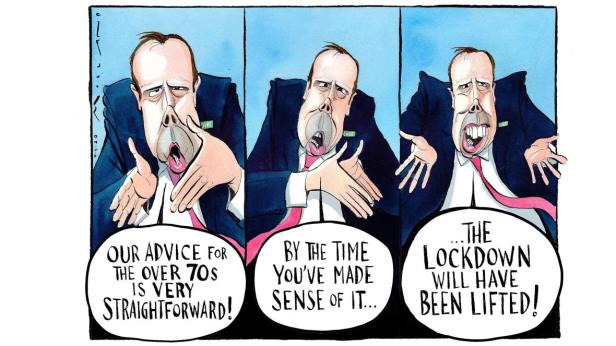
Morten Morland Times cartoon 4 May

Morten Morland Times cartoon 4 May
Following Owl’s post reviewing the 207 planning applications, determined by EDDC in April, whilst all committee meetings have been cancelled, a correspondent has been in touch.
This correspondent has drawn Owl’s attention to the latest retrospective application the Carters have made in a catalogue of retrospective applications going back for years.
In Owl’s view it is also one of the most significant in terms of its adverse impact on the environment. Worse even than the Clinton application to extend the Blackhill Engineering site on the disused quarry on Woodbury Common.
This is retrospective application 20/0297/FUL for the partial retention at Ladram Bay of a raised viewing platform including balustrade and storage areas, validated 17 February. It appears to have been made in response to an enforcement notice issued in 2018. Owl has found it difficult to conduct a full audit trail of this application.
The case concerns the construction of a viewing platform and deck projecting through the narrow natural access chine from the camp site to the beach. The platform extends in front of the World Heritage Site (WHS) cliffs towards the east at Ladram Bay. It is supported by piles driven into the beach which will undoubtedly influence the natural erosion process. Owl’s correspondent isn’t sure when this platform first appeared but it was certainly seen in the summer of 2018.

Ladram Bay showing extent of the deck
Owl will start with the planning application form.
On page 4, the answers given in box 12, concerning the reasonable likelihood of the proposal having an adverse effect on designated sites and/or on features of geological significance, are boldly marked “no” in both cases. (Designated sites include SSSI and AONB. The Jurassic WHS is defined by a series of SSSI designations. The sea frontages of the larger towns in East Devon are excluded from the WHS. But for the smaller towns or coves such as Ladram Bay the WHS coverage is continuous across the sea frontage. The definitive DEFRA “Magic” map showing this for Ladram can be found here. The “Magic” map is an invaluable tool providing authoritative geographic information about the natural environment from across government. The information covers rural, urban, coastal and marine environments across Great Britain.)
The applicant cites three main reasons why permission should be granted: to support economic growth and productivity; to provide disabled access and to provide a platform to monitor the safety of swimmers. But it acknowledges that there would be a harmful visual effect from the development. This would be minimised in the summer months by the presence of boats hiding the development but when the beach is not used in the winter months would be very visible. (Judge for yourself from the photo and think how it must look from the coastal cliff path)
Now to comments, and Owl can find no better to make the case than those of Natural England:
The development is set within the boundary of the Ladram Bay to Sidmouth SSSI, the Dorset and East Devon WHS and has significant landscape and visual impacts on these and the East Devon AONB.
Dorset and East Devon WHS: The Dorset and East Devon Coast has an outstanding combination of globally significant geological and geomorphological features. The cliff exposures along the Dorset and East Devon coast provide an almost continuous sequence of rock formations spanning the Mesozoic Era, or some 185 million years of the earth’s history. The area’s important fossil sites and classic coastal geomorphologic features have contributed to the study of earth sciences for over 300 years.
Through a search of the site’s planning history, it is not apparent that the original viewing deck, which this application seeks to secure an extension to, ever received planning permission. Please confirm what date this was granted and any conditions relating to that initial permission. [Does Owl detect a rat hole here?]
We strongly suggest that the Planning Authority enforces the removal of this structure.
Other elements of the planning application excluding the extension to the viewing platform. [Owl emphasis]
There are a number of developments within the site including various retrospective, permitted and unconsented developments which cumulatively result in a significant impact upon the purposes of designation of the AONB. [More rat holes – Owl?] We consider that without appropriate mitigation this application would:
• have a significant impact on the purposes of designation of the East Devon AONB through landscape changes and visual impacts in this location.
In order to address these cumulative impacts and to mitigate these adverse effects and make the development acceptable, the following mitigation measures are required:
• any permission for the remainder of the elements should be granted for a temporary period in line with NPPF paragraph 167 or development in areas subject to coastal erosion, e.g. for 20 years and with a condition requiring restoration of the site at the end of that period or sooner should it become unsafe due to cliff stability/coastal erosion.
• a comprehensive landscape masterplan for the whole of the Ladram Bay Holiday Park site, incorporating mitigation for this development and also previous unmitigated development impacts, to ensure an overall improvement in the appearance of the site and mitigation of its impact on the landscape of the AONB.
Natural England has also said:
Natural England is likely to oppose any attempts to interfere with natural processes through cliff protection or coastal defences in this location, which could directly impact on the Ladram Bay to Sidmouth SSSI/WHS.
(As might be expected the WHS site have also formally objected)
None of the District Councillors: Alan Dent, Paul Jarvis, Paul Jarvis or the environment supremo Geoff Jung have yet commented. The Parish Council unaccountably have raised “no objection”.
Is there no one who can take the lead to save the environment and, not just ours, but the world’s heritage?

Ladram c.1910
“Thousands of kits are sitting unused, social services chiefs said, because of a lack of clarity about who can administer them.
Residential care homes, which are registered by the Care Quality Commission, are not registered to carry out nursing tasks. Social services officials say they are unsure how far they are allowed to bend the rules on this.”
Sarah Marsh and Diane Taylor, the Guardian, 4 May 2020
Ministers are facing criticism over coronavirus testing as the number of daily tests dropped below 80,000, care home staff reported difficulties in getting checked and home kits were delivered without return envelopes.
On Friday, the health secretary, Matt Hancock, announced the government’s target of 100,000 tests a day by the end of April had been achieved, with more than 122,000 provided on the last day of the month. Since then, the number has dropped by more than 40,000, with just 76,496 delivered in the 24 hours up to 9am yesterday.
NHS England’s national medical director, Prof Stephen Powis, said: “You will see that testing capacity has ramped up very quickly over the last week or so and we are now at a very high level of testing, over 100,000 – a little bit of a dip in the weekend, but we anticipate that testing capacity will continue to increase.”
The Guardian has learned that just 7% of the 31,000 tests delivered to care homes for residents and staff had been carried out by this weekend.
Thousands of kits are sitting unused, social services chiefs said, because of a lack of clarity about who can administer them.
Residential care homes, which are registered by the Care Quality Commission, are not registered to carry out nursing tasks. Social services officials say they are unsure how far they are allowed to bend the rules on this.
One social services director said: “There’s a major flaw in this plan. Residential care staff are not registered to carry out this procedure. Yesterday not a single person was swabbed in any of our care homes. It’s another fiasco.”
The Department of Health and Social Care said: “Since we announced the further expansion to all symptomatic and asymptomatic care home staff and residents on 28 April we have delivered almost 31,000 tests. The tests are easy to use, with care workers needing to carry out simple swabs.”
The Care Quality Commission said it was not involved in mass testing in care homes.
The government has admitted “a small number” of the home corona-virus tests sent out did not have the right information to be processed. Baschea Walsh was one of those who reported receiving a test without a return envelope. “I asked how to send it back without a return envelope. I was told to chuck it in the bin – I asked them if they could send me an envelope and they said no, I would need to do a new test.”
A DHSC spokesperson said: “We are urgently seeking to resolve this so anyone affected can either be provided with a new label or order a replacement kit online, which won’t be counted in the daily figures”
Devonlive have just published an interactive map showing where Covid-19 related deaths have occurred across the country, and in Devon, up to 18 April. Sidmouth Town has the largest recorded number in East Devon (5) – below is a summary including caveats about the data. Go on-line for the details.
A new map shows the true number of people from Devon who have died from coronavirus.
The interactive map, which you can view below [go online], means you are able to see exactly where a person lived, who had COVID-19 mentioned as the underlying cause on the death certificate, or as a contributory factor.
The Pennsylvania and University area in Exeter has the most deaths recorded, with a total of six people from that area having died from coronavirus.
The map only includes deaths that occurred between 1 March 2020 and 17 April 2020 and registered by 18 April 2020 and points on the map are placed at the centre of the local area they represent and do not show the actual location of deaths and the size of the circle is proportional to the number of deaths.
People who die at a Devon hospital could live elsewhere, or a person from the county may have died at another hospital in the country.
You can use the widget above to look at the map – or find your area in the list below [go online].
The map shows a stark contrast between the South West and the rest of the UK.
“………recent figures for cases of Covid-19 which have shown a drop in numbers of new cases in hospitals but reveal significant rises among health and social care workers.
This point was stressed by epidemiologist Anne Johnson at University College London. She said cutting transmissions of Covid-19 to health and social care workers had now emerged as a major priority. “Half of all new infections reported last week were among healthcare workers,” she told the Observer. “This has now become the leading edge of the spread of the disease.”
Robin McKie www.theguardian.com
British scientists are racing to try to answer fundamental questions about the Covid-19 virus and its transmission before the lifting of the current national lockdown is approved by the government in the near future. Researchers say relaxing social distancing should occur only once it is understood why new infections of the disease are still being diagnosed in their thousands every day.
Such a rate means efforts to test and trace infected contacts – a key plank in the government’s anti-Covid strategy in coming months – would be quickly overwhelmed. Far more information is needed about the way the coronavirus is transmitted, they say. The new data will feed into the debate about the settings in which lockdown will be lifted first – for instance, whether it’s relatively safe to stage outdoor events.
And last week, several groups launched studies aimed at providing answers. These include projects to analyse how virus-laden aerosols behave in the air in a bid to understand how the disease is passed between humans. In addition, other schemes will target healthcare workers to investigate how the virus is being spread to them from patients and then on to others.
The importance of this latter approach was revealed in recent figures for cases of Covid-19 which have shown a drop in numbers of new cases in hospitals but reveal significant rises among health and social care workers.
This point was stressed by epidemiologist Anne Johnson at University College London. She said cutting transmissions of Covid-19 to health and social care workers had now emerged as a major priority. “Half of all new infections reported last week were among healthcare workers,” she told the Observer. “This has now become the leading edge of the spread of the disease.”
Lack of protective equipment and clothing may have worsened the situation, she added. “However, what is certain is that care workers are still at risk from their patients from whom they can pick up the virus and, in turn, pass it on to their colleagues, to their own families and possibly to other patients. We need to focus on limiting the spread of Covid-19 among health and social care workers as an absolute priority if we want to have a chance of bringing this epidemic to a halt.”
This view was backed by infectious diseases expert Tom Wingfield of the Liverpool School of Tropical Medicine. “The numbers show that the rate of decline of new cases is slower in the UK than other European countries and that is likely to be down to transmission occurring within health and social care settings, transmission in the community despite social distancing and, to a lesser extent, chains of transmission that are still occurring within households, especially in larger households or shared accommodation.”
Half of all new infections reported last week were among healthcare workers. Photograph: Murdo MacLeod/The Guardian
Last week, researchers at Bristol University launched a major study aimed at finding out precisely how health workers are being infected by the Covid-19 virus. “We have taken a group of 130 health workers and we are going to test them intensively over the next three months,” said Professor Adam Finn, the leader of the project.
“We will take swabs from them twice a week, take blood samples regularly, and catalogue their symptoms – in the expectation that some of them will become infected. Then we will be able to find out when they became infected; how that relates to their symptoms at the time; and how it relates to their immune response. We are going to uncover details of the disease’s natural history because none of this information is known in detail. On the other hand, it is vitally important if we are to understand how this disease behaves.”
Finn said current modelling of the disease – although superb – was based on assumptions. “Essentially, the models are guesswork about the way the virus behaves. To get rid of the guesswork we need to supply evidence about how the virus actually behaves.”
A different approach is being taken by another Bristol University group, led by chemist, Professor Jonathan Reid. His team is studying the way the Covid-19 virus is passed from one person to another. This happens when fairly large droplets are coughed up or sneezed out by infected people. However, it is also possible viruses may be spread by much smaller aerosol particles – although it is unclear if they can carry enough virus to be infectious.
“It is clearly important to find out because aerosols can travel much further than heavier droplets,” said Reid. His team has just constructed a high-containment, automated laboratory containing a device in which clouds of virus-laden aerosol particles can be suspended while researchers alter temperature, humidity, ozone, levels of sunlight and other variables.
“In this way we can study how the virus’s infectivity changes,” added Reid. “That might tell us if it is affected by heat. If it is there might be some seasonality to this epidemic. We could also get a better idea of how to run air conditioning in hospitals, care homes and public spaces – in terms of temperature or humidity – in order to reduce the lifetime of the virus so that exposure to it is reduced.”
Devonlive reviews an extensive list of ideas and suggestions coming from Government and local businesses and MPs.
Colleen Smith www.devonlive.com
As Prime Minister Boris Johnson prepares to unveil plans for what happens next in the Covid-19 crisis, we take a look at how Devon and Cornwall will look in the next few months.
The future is looking harsh for the region with tourism and hospitality forming the backbone of the economy and the sector facing the most unanswered questions.
Cabinet Office Minister Michael Gove warned that people will not be able to travel to visit seaside resorts in places such as Devon and Cornwall ‘for some time to come’.
And rather than easing the ban on holidays and travel, harsher fines for those breaching the lockdown rules are expected to be announced.
Tourism industry chiefs and MPs are working with the Government to try to find ways to keep staff and customers safe.
One suggestion is a ‘compliance certificate’ for businesses who prove they can trade in a way that stops the spread of coronavirus infections.
One holiday park owner has come up with a ‘soft opening’ plan by allowing people to take a holiday only within their own health authority area.
So what will reopen, what will stay shut – and how will everyday life change across Devon and Cornwall? We’ve had a look at the main proposals below.
Our teams at Cornwall Live, Devon Live and Plymouth Live are committed to bringing you the latest news, guiding you through this global pandemic and providing the stories that matter.
Our daily news email goes out every afternoon and offers a comprehensive overview of the day.
You can also sign up for the weekend report, to receive the top stories on a Saturday morning.
Or if you wanted something more specific, sign up to read our Truro, Exeter and Torbay newsletters.
Choose which newsletters apply to you from across our Devon and Cornwall titles here – so that you can stay informed, stay home and stay safe.
The PM’s plan will make clear that the UK is not ready to return to business as usual. Some restrictions will be eased, but others – like fines for breaches – will be made harsher than they are now.
Fines – The government is considering raising the penalty for defying lockdown from £60 to £100 for a first offence with a maximum fine rising from just under £1,000 at the moment to £3,200.
Social bubbles – People could meet small bubbles of friends and family in one of the first steps out of lockdown. But it will have to be the same small group of people for many weeks, to prevent Covid-19 being passed on more widely.
Schools – will be first to go back, with a phased return. Ministers hope that will be before the summer holidays. Boris Johnson has signalled he wants primary schools to open first, and it has been suggested Year 6 could go back first.
Years 10 and 12 (GCSE and A-level years) would be the first in secondary schools, according to one plan seen by the Sunday Telegraph.
Pubs, big sports events and large social gatherings – Pubs will be the last places to reopen as lockdown is eased, the Government has confirmed. Large indoor events could be banned until 2021.
Devon-based JDWetherspoon boss Tim Martin says he hopes to open his 900-strong stable to pubs from June.
Workplaces – The two-meter apart rules will change the way workspaces look. the Tuesday following the second May bank holiday has been highlighted as a possible date for offices, factories and some shops to re-open. But it looks as if home working will stay the norm where possible.
Sport – smaller, local cricket and grassroots football could return first, as long as spectators can stay in the open air and do not congregate in the club bar after the match.
Public transport – the time ‘is not yet’ right to allow people on to super-spreader, public transport vehicles like buses, trains and planes. But the plans include supermarket-style spacing, one-way systems and hand sanitisers. Firms could stagger work hours to cut the numbers at rush hour.
Tourism and hospitality – Sadly for the South West this vital part of the economy could be one of the last industries to reopen fully. Spaced out tables, screens between customers, paper menus…there are just some of the ideas being thrown around about how the restaurant trade will reopen.
In Parliament Michael Gove told MPs that “at the moment and for some time to come” members of the public should not travel to visit popular seaside resorts.
Cornwall’s tourism chief Malcolm Bell says said that any opening up of the holiday industry would have to be gradual. “You don’t suddenly want five million visitors from across the UK and abroad descending on us. But what’s wrong with somebody from Devon going to a Cornish holiday park? We are both relatively low-risk areas.”
Devon and Cornwall is understandably proud of its renowned stunning coastlines, wide open spaces and gallons of fresh air and thrive from the millions of visitors who come to enjoy our part of the world each year.
However, the outbreak of coronavirus in the UK has changed our day to day lives while the government is calling for the nation to stop all non essential travel in a bid to stop the spread of the disease that has so tragically claimed lives in the UK.
In the South West not only do we have a proportion of elderly people living here, those who are some of the most vulnerable to coronavirus, but we also have NHS trusts that are stretched to capacity without any extra pressure.
We want to help saves lives and help bring an end to the outbreak as soon as we possibly can.
Therefore we are aiming to spread the message of come back later as far and as wide as possible through a campaign launching today – #comebacklater.
The only alternative would be a huge injection of government cash – in the region of £1 billion for Devon and Cornwall – to mothball the tourism industry until 2021, Mr Bell said.
Andrew Baragwanath, owner of Ayr Holiday Park in St Ives suggests a staged plan: “If for example someone from Truro wanted a couple of days away in St Ives and maintained social distancing measures, the risk to the Royal Cornwall Hospital being overcrowded wouldn’t be much different to as it is now.
“But if we suddenly allowed people from a coronavirus hotspot to travel in one go, then the risk of overloading the hospitals down here is much greater as there are more people.”
The legal date to review the lockdown is Thursday May 7, and Boris Johnson is expected to extend it for another three weeks, possibly with a few minor changes.
But the PM will also – separately – announce a “roadmap” for easing the UK out of lockdown. This is expected later in the week, possibly only on Sunday 10 May.
The timing depends on the “R”, or reproductive rate, of the virus, which must be under one – with infections continually falling.
The ‘R’ number is the average number of people infected by each Covid-19 carrie.
Here at Devon Live, we’re normally all about showing you the best places to eat, drink and generally go out and have a good time.
But as social distancing replaces socialising in the battle to slow the spread of coronavirus, that’s had to change for now.
And in response we’ve created Stay In – because staying at home is the best thing we can all do to support our NHS and save lives.
We’ll be focusing our attention on ways to help you stay entertained at home – from the best film and TV recommendations to live streamed gigs and theatre shows you can watch from your sofa.
From fitness routines you can do at home to cookery tips to help you make the most of a limited larder, we’ll be bringing you daily ideas to help you get through the lockdown.
We’ll continue to champion our local businesses by showing you alternative ways we can all support our local restaurants, bars and venues during this difficult time.
With schools now shut, we know many of you will now be juggling working from home – or going out to work as a key worker – with childcare and home schooling, and we’ll be publishing plenty of family-focused content that will help you to find that balance.
You can also expect plenty of fun stuff to take your mind off the current crisis, from quizzes and activities to good old-fashioned nostalgia.
View all our Stay In articles here. Stay home. Stay safe.
Currently R is about 0.7 because so many people are out of contact with each other. Every time you relax a lockdown rule, R rises again. Ministers say they won’t do anything that pushes the R number back above 1.
The UK must also pass five tests before easing lockdown:
This would allow businesses to get ready to bring in new social distancing measures for workers, such as screens and spaces between desks, designed to prevent any further spread of coronavirus.
Adam Kucharski, an associate professor at the London School of Hygiene and Tropical Medicine, is advising the Government and has warned that the virus could spread at an exponential rate if the lockdown is ended too early and certain events are allowed.
is impossible, but also for giving people confidence they can go back to work
further apart
disinfecting objects and surfaces that are touched regularly
 East Devon Watch