Jurassic Coast closures risking £111m in tourism revenue and 2,000 jobs.

“Dorset Council backed new arrangements for the management of the world heritage site coast, together with East Devon, although one councillor was critical of the efforts of the county’s neighbour.” Owl’s emphasis.

Owl isn’t surprised at the Dorset Councillor’s view of East Devon. EDDC has always regarded the World Heritage designation as a potential blight on planning freedom – so “not invented here” – no enthusiasm.

EDDC has the same view on the proposed National Park. Can’t see the opportunities only the loss of planning control.

www.wessexfm.com 

Jurassic coast tourism said to be worth £111m a year could be at risk, together with 2,000 jobs unless the coast and coast path re-opens soon.

The figures have been put on the value of the attraction to the county and neighbouring East Devon by Cabinet spokesman Cllr Ray Bryan.

He was speaking as Dorset Council backed new arrangements for the management of the world heritage site coast, together with East Devon, although one councillor was critical of the efforts of the county’s neighbour.

Cabinet spokesman Cllr Ray Bryan said the designation meant that everyone had an obligation to protect the coast through responsible, sustainable management practices.

He said the management and partnership plan had been widely consulted on and included policies about protection and access – although most of these were on hold because of lock-down with the consequent loss of income for both Dorset and Devon.

He said that since 2017 the Jurassic Coast Trust had taken the lead in the delivery of site management for both Dorset Council and Devon County Council – costing £120,000 a year, with £80,000 of that contributed by Dorset Council.

He said a number of other funders also contributed, some of those matching contributions pound for pound, or in some cases, in higher multiple.

Lyme Regis and Charmouth councillor Daryl Turner has said he is disappointed that the new management plan mentioned little in the way of marketing the coast, vital to the area’s tourism economy.

“We have one of the most values sites in the country.

“Could this element be strengthened, could there be a bigger marketing presence?” he said.


Stay away from Lake District despite easing of lockdown, police say

Police in the Lake District have urged people to “take a long hard look at your own conscience” and stay away from the national park – despite the prime minister telling people they can drive to beauty spots for exercise from Wednesday.

Owl would point out that a week ago the Covid-19 symptom tracker app showed a small, maybe not statistically significant, uptick in the estimated symptom rate from 0.6%  to o.8% in East Devon. It has since returned to 0.6% but there are other districts in Devon with lower rates. Parts of Somerset are down to 0.3%

Helen Pidd www.theguardian.com 

Police in the Lake District have urged people to “take a long hard look at your own conscience” and stay away from the national park – despite the prime minister telling people they can drive to beauty spots for exercise from Wednesday.

Parts of Cumbria have the highest coronavirus infection rates in the UK, prompting fears that the relaxation of lockdown will lead to a further spike.

Across the country on Monday morning, officials in other tourist destinations were frantically discussing how to interpret Boris Johnson’s easing of lockdown measures while keeping local populations safe.

In the early hours of Monday morning South Lakes police tweeted a map showing infection rates in the county, saying: “Before considering travelling to #Cumbria #LakeDistrict please grab a brew, examine this map, and take a long hard look at your own conscience. We urge you to use common sense and to continue to exercise close to your own home. We need to break the cycle of infection #lockdown.”

Cumbria police issued more than 100 fines over the bank holiday weekend to people making non-essential journeys, according to its assistant chief constable, Andrew Slattery. “That’s double the amount we’ve issued over the entire rest of the lockdown,” he said, blaming newspaper headlines for “giving the impression lockdown was over”.

Hotels, campsites, cafes, pubs and public toilets will remain closed for the foreseeable future, said Slattery. “Just attracting people to the Lake District with no facilities isn’t going to benefit the economy at all and in fact it might set it back.”

He added: “If people come en masse to the Lake District next weekend it will make social distancing very difficult if they congregate in the same car parks, go on the same busy footpaths in the honeypot areas.”

Tony Watson, the head of communications at the Lake District national park, tweeted: “Before travelling to the #lakedistrict, please be kind and consider our rural communities. There have been four times the deaths in Cumbria than in the whole of Australia. Just because you technically can come, doesn’t mean you should.”

Richard Leafe, national park authority’s chief executive, said: “Following the government’s announcement that people will be able to travel for exercise from Wednesday, we know that many will be keen to visit the Lake District. This is understandable for the many physical and mental health benefits the national park provides. However, sadly Cumbria currently has one of the highest Covid-19 infection rates in the UK, therefore keeping our staff and local communities safe must remain our priority.

“For example, our mountain rescue teams are made up of volunteers, many of whom work in the NHS and other frontline professions, so we cannot afford to put unnecessary pressure on them. So for now, we’re asking people not to rush back to the Lake District. Help protect our communities – the fells will still be here when this passes.”

The latest figures show Barrow-in-Furness in west Cumbria has the highest infection rate in England, with 804 cases per 100,000 people. Lancaster is second with 513 and South Lakeland third with 482.

But Aaron Cummins,the chief executive of Morecambe Bay NHS trust, which covers Barrow and South Lakeland, said the figures should be viewed with caution.

“As a trust, we have been testing our colleagues and their family members, local care home staff and other key workers for a significant amount of time and in large numbers. It is important that these figures are viewed in this context,” he said.

Tim Farron, the Liberal Democrat MP for the South Lakeland constituency of Westmorland and Lonsdale, has written an open letter to the prime minister asking him to limit the number of miles people can drive for exercise “to help prevent the inevitable high influx of people travelling to the Lakes, the Dales and south Cumbria”.

Farron told Johnson: “With there being no changes to the guidance issued by the Welsh government, Snowdonia will still be off limits for people living in Manchester and Liverpool meaning that we are likely to see an even higher number of visitors descending to the Lake District than we otherwise would have done.”

In his address to the nation on Sunday night, Johnson said: “From this Wednesday, we want to encourage people to take more and even unlimited amounts of outdoor exercise. You can sit in the sun in your local park, you can drive to other destinations, you can even play sports but only with members of your own household.”


“We prevented this country from being engulfed by … a catastrophe …. half a million fatalities”

Spin, spin, spin. (Extract from text of last night’s speech).

This is how Boris is trying to spin history, extracting victory from a retreat. He must not be allowed to get away with it.

We must never forget that it was decisions Boris and his Government took to “flatten” the virus spread and seek “herd immunity”, rather than suppress it , that was leading us towards such a catastrophe.

The governments of other European countries took a different path that avoided exposing their people to face such a threat in the first place.

The catastrophe was “prevented” when Boris did his screeching U-turn by imposing a lockdown on March 23. (Lockdown was first discussed in Cobra ten days earlier.)  Had “libertarian” Boris not dithered and imposed the lockdown just one week earlier, then the infection base, which we have subsequently been trying to control, would have been between one quarter and one eighth the size. Covid-19 infections at the time were estimated to be doubling every three to four days. The result would have been that we would be in a much better place now to consider starting to open up the economy.

Owl wonders whether the ambiguities in the messages in the speech will lead us towards another “catastrophe”?

Dr Bharat Pankhania, Exeter University’s infectious disease and public health expert said on BBC Spotlight last night that the changes announced would, in his opinion “inevitably” lead to the “R” number rising to above one i.e. the infection would start to accelerate.

The text of the first two paragraphs for the Prime Minister’s speech is given below. As always the speech, as delivered, may be different and Owl believes Boris actually said 500,000 rather than half a million.

“It is now almost two months since the people of this country began to put up with restrictions on their freedom – your freedom – of a kind that we have never seen before in peace or war. And you have shown the good sense to support those rules overwhelmingly. You have put up with all the hardships of that programme of social distancing. Because you understand that as things stand, and as the experience of every other country has shown, it’s the only way to defeat the coronavirus – the most vicious threat this country has faced in my lifetime.

And though the death toll has been tragic, and the suffering immense, and though we grieve for all those we have lost, it is a fact that by adopting those measures we prevented this country from being engulfed by what could have been a catastrophe in which the reasonable worst-case scenario was half a million fatalities. And it is thanks to your effort and sacrifice in stopping the spread of this disease that the death rate is coming down and hospital admissions are coming down. And thanks to you we have protected our NHS and saved many thousands of lives.”


UK eyes permanent medic ‘reserve force’ to bolster NHS

The British government is exploring plans to build a permanent reserve force of medics to support the NHS, following the success of its call for retired clinicians to return to the frontline of the coronavirus crisis.

Sarah Neville and Laura Hughes in London yesterday www.ft.com 

More than 30,000 retired doctors and nurses signed up to help during the Covid-19 emergency, in what health leaders described as “the biggest recruitment drive the NHS has ever seen”.

One person familiar with the initiative, which has the backing of Downing Street and the health department, likened the potential new force to the Army reserve, in which thousands are trained to serve alongside regular troops if and when required.

Clinical staff would similarly keep skills up to date through regular deployments, the person said.

Government officials confirmed ministers were considering whether to establish a permanent reservist force of medical staff after the pandemic. “We all think it’s a really sensible idea”, said one. “It’s definitely being discussed and considered as it makes sense.” 

Another added that keeping the huge numbers of NHS volunteers on as a permanent resource for the “foreseeable future” could “ensure capacity built up within the NHS is maintained”. 

The NHS is beset by workforce shortages, which are set to worsen as it attempts to resume normal services that were put on hold during the peak of the pandemic.

The NHS told the FT that “around 10,000” former staff had now returned to the health service. Alongside existing staff and 27,000 student doctors, nurses and allied health professionals, they had played “a significant role in ensuring that everyone who has needed care over the last two months has been able to receive it”, it added.

Calculations published by the Health Foundation, a charity, late last year suggested that without “concerted policy action and dedicated investment”, NHS staff shortages could grow to up to 200,000 by 2023/24, and at least 250,000 by 2030.

Nursing remained the key area of shortage, it noted, with more than 40,000 vacancies, a figure that could double by 2023/24.

In the March budget, the government confirmed a general election commitment to recruit 50,000 more nurses and deliver 50m additional GP appointments over the lifetime of the parliament.

However, the proposal to invite retirees to become a more established part of the workforce may meet scepticism from some volunteers, who have found the NHS slow to call on their services.

With the NHS now coming through the first peak of the virus, “local leaders are developing plans to safely bring back services and meet delayed demand for care and treatment, meaning that this contribution will remain necessary”. Employers had therefore been asked “to fast-track employment offers, induction and any necessary top-up training for all remaining prospective ‘returners’ over the next two weeks”, the NHS added.


We can’t enforce relaxed lockdown, say police chiefs

“Devon and Cornwall police said that it dealt with 1,023 incidents in 24 hours, the large majority of which were reports of lockdown breaches, or alcohol-related. About 150 fines were issued at Durdle Door, a coastal beauty spot in Dorset, where motorists had travelled from as far away as Reading, Coventry and Ipswich, a 450-mile round trip.”…..

“David Hepburn, an intensive care consultant in Wales, tweeted: “Just watched the conga lines/street parties on the news. The nation has lost its f***ing mind. We’re strapping in for the second wave. I’m so, so tired, and so pissed off. We’ve had a few days of respite and I was starting to feel hopeful. Can’t believe I was so naive.””

Fiona Hamilton, Crime Editor | Kat Lay, Health Correspondent www.thetimes.co.uk

The lockdown has been rendered unenforceable by “reckless and irresponsible” advance briefings about a relaxation of the rules, police chiefs told The Times.

Senior officers revealed breaches all over the country at the weekend, with daytrippers travelling to beauty spots, friends gathering in parks and socially distanced street parties spilling into houses. The hot weather was a factor, but members of the public were also encouraged by briefings from anonymous officials about the relaxation of lockdown before last night’s announcement by Boris Johnson.

John Apter, chairman of the Police Federation, responded to the prime minister’s statement with a call for clarity in messaging. He said that some members of the public had acted as though the lockdown was over, and there was “extreme pressure” on frontline police officers.

“Police officers will continue to do their best, but their work must be based on crystal-clear guidance, not loose rules that are left open to interpretation, because that will be grossly unfair on officers whose job is already challenging,” he said.

How the lockdown has changed policing

One chief constable said that the mixed message had resulted in a huge increase in the number of people in parks and on the streets and that, apart from moving on large groups, the lockdown was impossible to police. He added: “The briefings about freedom totally burst the dam. It was irresponsible.”

The Times revealed last week that senior officers had emphasised to government that they wanted to take a less coercive approach as restrictions were eased. A National Police Chiefs’ Council document outlining principles for the next stage highlighted the importance of “no surprises”, meaning that forces should be given time to digest changes and alter their approach if needed.

The same document also called for clarification of police responsibilities and “unambiguous rule changes”.

Another senior source said that none of that had been achieved: “The clarity of message has gone and all across the country there were people gathering in parks and having house parties. Some pubs opened secretly. People were taking very, very long journeys to beauty spots.”

Devon and Cornwall police said that it dealt with 1,023 incidents in 24 hours, the large majority of which were reports of lockdown breaches, or alcohol-related. About 150 fines were issued at Durdle Door, a coastal beauty spot in Dorset, where motorists had travelled from as far away as Reading, Coventry and Ipswich, a 450-mile round trip.

Day trippers flocked to the Lake District and to Southend. Street parties were carried out with social distancing but some became house parties. One resulted in a a conga line where participants were clearly within two metres of each other. Seven people were arrested in Bolton after a birthday party attended by 40 adults and children.

In Hackney, east London, the police tweeted that they were fighting a losing battle in parks where hundreds of people sat drinking. Officers on bicycles were sent to Hyde Park, where large groups had picnics.

Ken Marsh, of the Metropolitan Police Federation, said that the pandemic response had been “wishy-washy” and the authorities “needed to be firmer right from the beginning”.

Medical staff have reacted with fury to pictures of people in crowded parks or celebrating VE day with street parties, saying that the behaviour could lead to another peak in virus cases. Patrick Connor, a paramedic with the Welsh Ambulance Service, said: “We’re definitely in for a second wave of Covid-19. These people are a disgrace. I’ve had enough of people putting our lives at risk and those of colleagues and our families who we go home to.”

David Hepburn, an intensive care consultant in Wales, tweeted: “Just watched the conga lines/street parties on the news. The nation has lost its f***ing mind. We’re strapping in for the second wave. I’m so, so tired, and so pissed off. We’ve had a few days of respite and I was starting to feel hopeful. Can’t believe I was so naive.”


The Guardian view on municipal England: the great betrayal 

“Back in March, the housing, communities and local government secretary, Robert Jenrick, pledged that his department would do “whatever is necessary” to help council leaders cope with the fallout of the coronavirus crisis. Urgent decisions, Mr Jenrick said, should not be put off because of concerns about money.”

Editorial  www.theguardian.com 

The minister was taken at his word. Impoverished by 10 years of savage cuts from previous Conservative-led administrations, local authorities nevertheless stepped up to the plate. As the government’s lack of strategic planning was exposed, they battled to provide missing personal protective equipment for care workers. Rough sleepers were housed and extra mental health support offered to vulnerable people. As reports of domestic abuse rose sharply during lockdown, extra resources were deployed to deal with the caseload. Community hubs have been set up to facilitate food distribution and fuel assistance. Across the range of frontline services, a colossal, costly attempt has been made to rescue and preserve the battered infrastructure of everyday life.

As a result, councils are now swimming in a sea of unsustainable debt. Outgoings exponentially increased as income streams collapsed during lockdown. From parking fees and business rate taxes to returns on commercial investments, the money that keeps local authorities afloat has dried up. Manchester city council projects an overall loss of almost £152m for 2020-21. Liverpool city council is on the verge of filing a section 114 notice – effectively a declaration of bankruptcy. Relatively prosperous shires are suffering too. The Conservative MP for Shrewsbury, Daniel Kawczynski, has highlighted the case of Shropshire council, which has so far incurred coronavirus-related costs of well over £20m. A social “calamity” awaits, he has said, unless Westminster fulfils its promise to stand by councils during the crisis.

But as the calls for financial assistance have become more urgent, Mr Jenrick’s responses have become more evasive. Last week, the airy rhetoric of March was superseded by a warning that councils should not “labour under a false impression that what they are doing will be guaranteed funded by central government”. This amounts to a betrayal of trust. The government has moved to bring forward some payments to councils due later in the year, but a far bigger injection of new money is required. Failing that, it may be that the coronavirus crisis will prove a disastrous tipping point for local authorities, which have been relentlessly harried, hobbled and undermined by Whitehall for 10 years.

The austerity drive launched in 2010 by the former chancellor George Osborne turned out to be a declaration of war on municipal England. Almost £16bn of core local government funding was cut – or 60p in every pound provided from Westminster for local services. Council tax rises were legally capped, as care budgets were slashed and amenities closed. Poorer regions, with smaller tax takes, suffered the most. After a decade of devastation, there are, as the leader of Manchester city council, Sir Richard Leese, wrote to Boris Johnson last month, “no easy cuts left to make”. Without a new settlement adequate to the times, vital needs in our towns, cities and rural areas will go unmet.

That prospect could not come at a worse time, as the nation faces the sharpest economic downturn for 300 years. Instead of hanging local government out to dry, Mr Jenrick should be finding ways to put it centre stage in the “test, track and trace” strategy that will be key to reopening the economy. As the Local Government Association has pointed out, public health teams deployed by councils have unmatched local knowledge and experience. This expertise risks being underutilised as contact tracing contracts are shortsightedly handed to private operators such as Serco.

In the months to come, councils will also bear responsibility for maintaining levels of social care in the community, ensuring safe provision of public transport, helping local business and providing the essential services celebrated on our doorsteps each Thursday evening. For too long, local government has been treated with ruthless disdain by ministers in London. In this time of crisis, Mr Jenrick has the opportunity to make amends. It’s time to give councils the funding and respect they deserve.

Coronavirus crisis: doctors take legal action to force inquiry into PPE shortage

Thousands of doctors have begun legal action demanding the government launch a public inquiry to investigate the failure to provide NHS and care staff with adequate personal protective equipment (PPE).

Andrew Gregory, Nicholas Hellen and Sian Griffiths www.thetimes.co.uk 

The legal challenge is being brought by the Doctors’ Association UK (DAUK), which represents more than 29,000 medics working on the front line, and the Good Law Project. Nearly 200 NHS and care workers have died after becoming infected with the coronavirus.

In a pre-action legal letter to the Department of Health and Social Care, the doctors say they support the government’s efforts to mitigate the crisis caused by the pandemic but are “deeply concerned” about the “failure to procure and supply adequate PPE”.

DAUK said the deaths of healthcare workers were a “tragedy. We had a pandemic stockpile of PPE lacking essential items like full gowns and eye protection; other equipment was out of date. There has been recurrent and systemic failure of the PPE supply chain, leaving staff in some instances with makeshift or no PPE.”

The barrister Jolyon Maugham, of the Good Law Project, which aims to use the law to improve society, said: “We must never be forced to ask NHS and care home workers to risk their lives again. We must learn the lessons from recent history. And we must learn them quickly, before the second and third waves of the pandemic.”

A separate group of more than 1,000 doctors has written to The Sunday Times urging Mark Lucraft QC, the chief coroner for England and Wales, to ensure PPE be considered “in every single inquest of a healthcare worker who has died from suspected or confirmed Covid-19”.

Dr Julia Patterson, founder of Everydoctor, a support group, said as well as helping the loved ones of those who have died, such an approach would provide a “broader picture” of decision-making in the crisis. She said seeing the death toll continue to “rise and rise” was “horrifying.”

“Some have already lost loved ones and colleagues in this crisis and indeed have had to care for their dying colleagues and then return to work the next day still wearing insufficient PPE.”

She said health workers with lower professional status were treated even worse. “There is a hierarchy of access to PPE in that if you are a senior doctor or you work in an intensive care unit, you are likely to have access to the correct PPE but the further away you get from that, the less likely you’re going to have access to PPE.”

The health department said it could not comment on possible legal action.

  • Almost 16 million Tiger Eye goggles have been withdrawn from the NHS because they do not meet safety standards. They were bought in 2009 as part of the national stockpile.


Warning issued over local government finances

In an earlier post entitled: COUNCILS ‘PLUNGING HEADFIRST IN BLACK HOLE OF DEBT’ AS EXTRA FUNDING NOT ENOUGH.

Owl noted that Ben Ingham had very little to say compared to the Leaders or Chief Executives of the other District Councils.

Owl’s question then: has he run out of steam? Still seems to apply – he really doesn’t say very much in this interview.

Don’t the residents have a right to know more given that democratic oversight and scrutiny of EDDC has effectively been suspended due to the pandemic. 

Daniel Clark  www.sidmouthherald.co.uk

A warning over the state of local government finances has been issued – with some councils in Devon predicting they could run out of money by the summer as a result of the coronavirus crisis.

A warning over the state of local government finances has been issued – with some councils in Devon predicting they could run out of money by the summer as a result of the coronavirus crisis.

Councils across the country have been at the forefront of the response to the coronavirus pandemic.

From setting up community wellbeing hubs to help the most vulnerable, to supporting businesses, they are on the front line.

But councils, having already had their funding slashed by central government over the last 10 years, are facing their own fight to survive coronavirus. Finances before the coronavirus crisis were already stretched and cash reserves were limited.

In recent years, councils have been encouraged to become businesses.

Income from car parking charges – a staple of keeping local government solvent – has dropped dramatically. Exeter City Council set its balanced budget based on receiving an average of £170,000 a week from car parking charges. Recently it took around £1,000.

Central government has pledged to help local government, but the first tranche of funding, £1.6 billion to councils, saw districts across Devon only get limited support, far short of replicating lost income and coronavirus expenditure.

Cllr Ben Ingham, leader of East Devon District Council, said: “This is a very difficult time for local authorities.

“The council has been affected by the consequences of Covid-19 through additional costs and, more significantly, the impact of a drop in income from fees and charges, which pays for the funding of services.

“Certainly, we need to monitor this situation very carefully and accept that an appropriate solution may take some time to evolve.

“It is already clear that we will need considerable additional financial support from central government as we move through the remainder of the year.

“So the announcement by Government of the provision of additional funding to support local authorities is welcome and we are hopeful that they have listened to our concerns and taken our needs into account. We look forward to learning how much we will receive.”

Central government has announced a further £1.6 billion of funding to meet additional pressures arising from the pandemic and help councils continue to deliver frontline services – funds which will be un-ringfenced – but has not yet confirmed the allocations.


No emergency work for crumbling Sidmouth cliffs – with focus on long-term scheme

Up-to date information on the EDDC position with regard to the recent Sidmouth cliff falls.

The online article linked below has some interesting photos showing a couple of cliff falls in progress, a red coloured sea and a detail of a cliff fall on East Beach.

East Devon Reporter eastdevonnews.co.uk 

No emergency action is planned to protect crumbling cliffs in Sidmouth – as council chiefs are focussed on a long-term scheme and its funding shortfall.

A number of landslides have sparked calls for temporary rock revetment to be placed at Pennington Point until the fate of a permanent project is finalised.

Councillor Stuart Hughes had even paved the way for contractors erecting a replacement Alma Bridge nearby to put the rock armouring in place.

But East Devon District Council (EDDC) – leading the Sidmouth Beach Management Plan (BMP) – says it is ‘not progressing’  any medium-term work.

The authority added that an emergency situation ‘does not currently exist’.

Cllr Hughes, who has been calling for emergency action, told eastdevonnews.co.uk: “Whilst it may seem OK to some at present…we have only a very small window of opportunity before the autumn storms are upon us once again.

“The run of cliff falls we are experiencing at the moment is that the wet cliffs are now drying out and they then fall away.

“The Pennington Point/cove is particularly worrying as the sea, as I predicted, is now getting in behind the old bridge abutment and that, too, now is under threat.

“We can only hope that a case is pulled together within the next few weeks to address the temporary/emergency works that are required.

“Eastern town is now completely open to severe south-easterlies and we can only hope that we don’t experience one of those next winter.

“On top of Covid-19 and lockdown, it would be disastrous for our local economy here in Sidmouth.”

The preferred option of the Sidmouth BMP would see a new rock groyne placed on East Beach, shingle imported, and the height of the seafront splash wall increased.

However, around £1million still needs to be found to fund the scheme.

An EDDC spokesperson said: “Cliff falls are a natural and unpredictable occurrence along the East Devon coast.

“This is because the rock from which the cliffs are formed is soft and therefore prone to rock falls and landslides, which can happen at any time, although heavy rainfall can trigger incidences.

“The Sidmouth and East Beach Management Plan scheme aims to reduce the risk of flooding to Sidmouth by maintaining the standard of defences along Sidmouth beach, and to reduce the rate of erosion to the cliffs to the east of the town (and therefore the rate of exposure of the east side of Sidmouth to coastal conditions).

“It cannot, however, stop cliff falls. In fact, many of the recent cliff falls are beyond the area the BMP will protect, occurring further east on National Trust land.

“In terms of the medium-term works, this was a call for rock revetment to protect the area near Pennington [Point], where there are properties along Cliff Road.

“We are not progressing that at the moment as an emergency situation, as defined by the Environment Agency, does not currently exist.

“Our current priority is to focus on meeting the funding gap for the BMP so that we can deliver the scheme, which will protect the whole frontage of Sidmouth.”

Calls for action came after tonnes of rubble crashed onto East Beach in a dramatic cliff fall in March – one of several this year.

Susan Clarke captured a dramatic double landslide on camera on April 25.

Jutta Gorf photographed a red sea off the town on April 21.

An Environment Agency (EA) spokesperson said at the time: “During this time of year algae comes into the water, caused by sunlight.

“The algae escalates when it is calm weather and quite warm. It’s an algae that grows, when you see it sometimes it has different colours and can look red.

“It could be that, but it is more likely to be discolouration caused by cliffs


Health Secretary auctions his NUFC shirt for NHS scrubs cash

The minister, who holds overall financial control of the health service and oversight of all NHS delivery, auctions his NUFC shirt to raise money to support a voluntary sewing collaborative making non-surgical scrubs for NHS workers.

Is this a tacky way to salve his conscience? Shouldn’t he be sorting out the underlying problems?  Owl  

Hannah Graham  www.chroniclelive.co.uk 

Health Secretary Matt Hancock has auctioned his own Newcastle United shirt to help make scrubs for NHS workers.

On Friday, Radio DJ Chris Evans held an online auction to raise money for Scrubs Glorious Scrubs, a voluntary sewing collaborative making non-surgical scrubs for NHS workers.

Celebrities including Ant and Dec and Rod Stewart took part, donating personal items for fans to bid on. The auction, run by BIN-IN Auctions, which is helping charities with fundraising during Covid-19, raised almost £600,000 for the cause.

And Mr Hancock, Secretary of State for Health and Social Care, decided to join in, offering up his own much-loved piece of Newcastle United memorabilia.

As Health Secretary, Mr Hancock has been criticised over recent weeks for issues around the supply of protective equipment for NHS workers, and last month faced calls to resign after suggesting that doctors and nurses might be overusing vital protective equipment.

Now the minister, who holds overall financial control of the health service and oversight of all NHS delivery, has helped raise a total of £1,850 through the online sale of the shirt.

In the description of the lot, Mr Hancock called the shirt “my pride and joy”.

He said: “This shirt was gifted to me by Uncle Dave. It was because of him that I am now a lifelong supporter and fan of Newcastle United.

“Signed by the team. The top as seen hanging behind me on the bookshelf during many of my Skype interviews – I will sign it for you also if you like.”

It’s not known if the winning bidder took Mr Hancock up on his offer to add his own signature to those of the Newcastle players.


Lockdown exit: rival science advisers urge government to follow ‘local’ strategy

Boris Johnson must abandon “centralised” control of the pandemic amid warnings that localised outbreaks will result in multiple new peaks of the deadly coronavirus.

Didn’t these councillors get to this conclusion first? County Councillors Hilary Ackland (Exeter), Martin Shaw (Seaton and Colyton) and Claire Wright (Otter Valley) called for a regional approach to Covid-19 on the 16 April.

Caroline Wheeler, Deputy Political Editor  www.thetimes.co.uk 

The recommendation will be made by a panel of experts that has been assembled by Sir David King, the government’s former chief scientific adviser.

The committee, which is designed to act as an independent alternative to the government’s Scientific Advisory Group for Emergencies (Sage), will urge the government to refocus the UK’s entire approach to pandemic control onto local action plans.

The finding will be included in a report to be published by the committee on Tuesday after it heard evidence last week from scientists behind a mathematical model that shows Britain is at risk of multiple further waves of the virus, hitting specific towns, cities and regions of the UK.

“The government’s top-down approach has failed,” said a source close to the committee.

“The alternative modelling seen by the committee shows that the country is set to face a series of localised pandemics and multiple peaks of the virus that can effectively be tackled only by local health bodies rather than No 10.”

The committee’s report will warn that unless the government moves additional funding to local public health bodies and councils — which deliver much of social care for the elderly — it will continue to fail to control the epidemic and will pave the way for tens of thousands more deaths.

The panel will formally submit its recommendations to the health and social care select committee, thus heaping pressure on Johnson, who will unveil the government’s own lockdown exit strategy in a televised address today at 7pm.

Tomorrow King will chair a second meeting of the independent group to decide whether to expand the committee and consider work on an “alternative road map” for the UK’s handling of the coronavirus pandemic.

King, who was chief scientific adviser to two prime ministers, Tony Blair and Gordon Brown from 2000 to 2007, has previously accused ministers of responding too slowly to the coronavirus outbreak and wrongly allowing the Cheltenham festival and other big events to go ahead in mid-March.

He served under David Cameron and Theresa May as the UK’s climate envoy from 2013 to 2017.

The committee was convened following concerns about the independence of Sage after it was revealed that Dominic Cummings — a top aide to the prime minister — had attended the group’s meetings.

It also emerged that 16 of the 23 known members of the committee, which holds its meetings in secret, are employed by the government.


Plan to open schools on 1 June in doubt as unions air safety fears

This is the direct consequence of the Government’s failure, so far, to get a stringent coronavirus “test and trace” regime in place. As Owl has frequently commented, it is an essential prerequisite to ending lockdown and opening up the economy.

Heather Stewart www.theguardian.com 

Ministers’ plans to reopen schools as early as 1 June are in serious doubt after unions representing teachers and school staff insisted that they would not consider a return without a stringent coronavirus “test and trace” regime.

In an unusual joint statement, which one senior union official said indicated that an early return to a normal school timetable was “off the menu”, the Trades Union Congress said that there should be “no increase in pupil numbers until full rollout of a national test and trace scheme”, and called for the establishment of a Covid-19 taskforce with government, unions and others to agree on the safe reopening of schools.

But with a national strategy for a scheme that would help identify who needs to be in quarantine yet to be deployed – and a contact-tracing phone app still undergoing a limited trial on the Isle of Wight – the unions’ tests are unlikely to be satisfied by the 1 June date floated by officials last week.

That could mean children in England and Wales returning to schools for just a few weeks between now and the new school year in September, and pupils in Scotland – who break up earlier – increasingly unlikely to return before the summer holidays at all.

The Scottish and Welsh governments have already announced that their schools will not reopen on 1 June.

The news comes amid growing signs that Boris Johnson will set out a cautious “roadmap” for the next phase of the crisis on Sunday after the government faced severe criticism over its mixed messages about what the public should expect.

The statement, submitted to the education secretary, Gavin Williamson, is backed by the main teaching unions, as well as Unite, GMB and Unison, which represent key school staff such as cleaners, administrators and caterers. Any return without their agreement is highly unlikely.

“The wider reopening of our schools will depend greatly on ensuring that families and carers are fully confident that allowing their children to return to school is safe. We do not believe that sufficient levels of confidence exist at this time,” it said.

Johnson told last weekend’s Sun on Sunday: “One of the things we want to do as fast as we can is get primary schools back. It’s not going to be easy, but that’s where we want to go. It’s about working out a way to do it.”

Whitehall sources suggested at the time he had in mind a phased return from the beginning of June, after the summer half-term break.

But the Guardian understands that conversations with headteachers and trade unions in recent days have underlined the practical challenges of the move – and the potential resistance from parents anxious about their children’s safety. A government source insisted on Friday: “We never set a date.”

Ahead of Johnson’s address to the nation, the environment secretary, George Eustice, on Friday played down suggestions of any major changes to the lockdown regime, stressing that the government would proceed “with the utmost caution”.

At the press briefing, Eustice also stressed the importance of abiding by the existing measures over the bank holiday weekend, despite the fact that the government is poised to allow unlimited exercise, sunbathing and picnics from Monday.

But he welcomed moves by some businesses to reopen where existing restrictions already allow – including McDonald’s. “Our view is that McDonald’s drive-through is made for the social distancing system that we are in,” he said.

The Welsh government stole a march on Johnson on Friday by announcing a three-week extension to its coronavirus lockdown and making modest adjustments, including allowing outdoor exercise more than once a day and plans to reopen libraries.

The first minister, Mark Drakeford, insisted that the lockdown needed to stay, but said “very cautious” changes would come into force. He anticipated that “broadly” similar changes would be announced by the prime minister.

He said that from Monday, people would be allowed to exercise more than once a day, provided that they do not travel “a significant distance” from their home. Garden centres will be allowed to reopen if they can ensure that the 2-metre physical distancing rule is enforced. And councils will begin work on plans to safely reopen libraries and municipal recycling centres.

The announcement came as Scotland’s first minister, Nicola Sturgeon, said she believed “all four nations now accept there may be differences in pace of how we do these things because the level of the virus is at different stages”, although she expected divergence from England’s upcoming new guidance to be minor.

The TUC’s tests include “clear scientific published evidence” that reopening schools will not increase the transmission of Covid-19; agreement between government, unions and employers over minimum safety standards for social distancing and hygiene; and a ”secure supply” of PPE for school staff.

But the key demand is that opening up schools cannot begin until there is a “full rollout” of the government’s test, trace and isolate policy, with targets for testing being consistently met and the numbers of new cases of Covid-19 falling.

Williamson has maintained that his top priority is the safety of children, and said that the question of when and how to reopen schools is the government’s most difficult decision.

The teaching unions and the Department for Education have been consulting closely in recent days, with ministers and advisers contacting individual headteachers and academy leaders to canvass their views. Following the discussions, the DfE believes the TUC’s tests do not differ significantly from those set out by the government to end the lockdown.

Michael Veale, a lecturer in digital rights and regulation at University College London who has been involved in the development of coronavirus tracing apps in countries including Switzerland and Germany, said it was possible that the first NHS tracing app could be ready by 1 June. But he warned that an app alone would be unlikely to be sufficient to curb a Covid-19 outbreak affecting schools.

“The question is, would an app help schools?” he said. “Primary schools don’t contain humans with smartphones in the same way as the rest of the world. Certainly, unions should be alert to health risks for the workers they represent, but I don’t think unions should rely on an app to protect their workers. They should make demands that relate to broader tracking and tracing capabilities.”

Veale said that an underlying problem in the UK was its failure to conduct enough tests to make tracing work effectively, even with a functioning app available. The first version of the NHS app requires users to self-report symptoms.

“We must be careful not to make strong claims about the effectiveness of an app before we have even deployed one,” he said.

The health secretary, Matt Hancock, has claimed that a nationwide contact-tracing scheme, involving 18,000 contact tracers, will be in place by mid-May. But he has conceded that it is a “huge national undertaking of unprecedented scale and complexity”.

The NASUWT teaching union has already called for schools to remain closed until the end of the summer holidays, while the National Association of Head Teachers said it is “clear that parents are very nervous about sending their children back to school”.

A DfE spokesperson said: “Schools will remain closed, except for children of critical workers and vulnerable children, until the scientific advice indicates it is the right time to re-open and the five tests set out by government to beat this virus have been met.

“We are also working closely with the sector as we consider how to reopen schools, nurseries and colleges and will ensure everyone has sufficient notice to plan and prepare.”


The UK government’s changing coronavirus strategy

Owl wonders from time to time whether the only thing driving the strategy, if you can call it that, is the formulation of catchy three word slogans. Whenever the clever clogs in No 10 come up with a new one, we are off on a new tack. Please keep up at the back!

Haroon Siddique  www.theguardian.com 

Since the coronavirus outbreak hit the UK the government has changed its strategy and public messaging a number of times, in some cases within days. Here are some of the areas where the line has changed:

Testing

Chief medical adviser to the government, Prof Chris Whitty, 12 March:

It is no longer necessary for us to identify every case and we will move from having testing mainly done in homes and outpatients and walk-in centres, to a situation where people who are remaining at home do not need testing.

Patrick Vallance, Britain’s chief scientific adviser, 5 May:

I think if we’d managed to ramp testing capacity quicker it would have been beneficial. And, you know, for all sorts of reasons that didn’t happen. I think it’s clear you need lots of testing for this …

I think if we do test, track and tracing well and we keep the social distancing measures at the right level we should be able to avoid a second wave.

Herd Immunity

Vallance, 13 March:

Our aim is to try to reduce the peak, broaden the peak, not suppress it completely; also, because the vast majority of people get a mild illness, to build up some kind of herd immunity so more people are immune to this disease and we reduce the transmission, at the same time we protect those who are most vulnerable to it. Those are the key things we need to do.

Vallance, 5 May:

I should be clear about what I was trying to say, and if I didn’t say this clearly enough then I apologise. What I was trying to say was that, in the absence of a therapeutic, the way in which you can stop a community becoming susceptible to this is through immunity, and immunity can be obtained by vaccination, or it can be obtained by people who have the infection.

Death toll

National medical director of NHS England, Stephen Powis, 28 March:

If we can keep deaths below 20,000 we will have done very well in this epidemic.

Boris Johnson, 30 April (when death toll stood at 26,711):

We avoided an uncontrollable and catastrophic epidemic where the reasonable worst-case scenario was 500,000 deaths.

PPE (personal protective equipment)

Health secretary, Matt Hancock, 11 April:

The central challenge is one of distribution rather than one of supply and going from a business as usual, relatively low levels of PPE distribution to the unprecedented level of use of PPE now has been a big challenge.

Housing, communities and local government secretary, Robert Jenrick, 18 April:

Supply in some areas, particularly gowns and certain types of masks and aprons, is in short supply at the moment, and that must be an extremely anxious time for people working on the frontline, but they should be assured that we are doing everything we can to correct this issue, and to get them the equipment that they need.

Use of face masks/coverings by the public

Deputy chief medical officer for England, Jonathan Van Tam, 3 April :

In terms of the hard evidence, and what the UK government recommends, we do not recommend face masks for general wearing.

Johnson, 30 April:

What I think Sage (Scientific Advisory Group for Emergencies) is saying, and what I certainly agree with is that as part of coming out of the lockdown I do think face coverings will be useful, both for epidemiological reasons but also giving people confidence they can go back to work.


All the planning applications submitted in Devon this week

How much longer do we have to wait before we get back to some semblance of democratic oversight of the planning process in EDDC?

Earlier this month, the government made it lawful to hold council meetings – and binding votes – remotely.

EDDC needs to stop hiding behind emergency powers, allowing the leader and relevant cabinet members to take any urgent decisions which cannot await the next formal cabinet meeting.

It just needs a bit of creativity and good will.

Surely Ben Ingham, leader in name only, having lost his majority, cannot be using the pandemic as an excuse to cling on to power?   

Daniel Clark  www.devonlive.com

Every week dozens of planning applications are submitted to the local councils, and the coronavirus pandemic has not changed that.

While some council services have been suspended as a result of COVID-19, planning departments are still working as usual to validate and to decide upon applications.

Here is the list of applications that have been submitted and validated by the various local councils or planning authorities in Devon in the last week. [Only those for East Devon have been copied below. To see the complete list go to the online article on devonlive]. 

EAST DEVON

Barns At Higher Musgrove Dunkeswell Abbey Honiton EX14 4RP – https://planning.eastdevon.gov.uk/online-applications/applicationDetails.do?keyVal=Q61TYZGH00E00&activeTab=summary


Two thirds of British coronavirus cases are missed, says app expert

Owl understands that, as part of the new NHSX tracking app being trialled in the Isle of Wight, users will be asked to report “symptoms”. But what are the symptoms of Covid-19? 

Katie Gibbons   www.thetimes.co.uk

The government’s data on coronavirus cases is nonsense and two thirds of cases in Britain are undiagnosed, a leading epidemiologist has claimed.

Tim Spector, professor of genetic epidemiology at King’s College London, has criticised Whitehall’s refusal to class common symptoms as official indicators.

The government has listed a high temperature and a new, continuous cough as the primary symptoms of Covid-19. There is evidence, however, that a loss of taste or smell is a common sign of infection. Other countries, including the US, have recognised this as a symptom on more detailed lists.

Professor Spector has collected data from three million Britons on his team’s symptom-tracking app. “The reason that we got a bit stuck in this country is we took the data from China and just instantly said, ‘OK, the disease only has two symptoms: it’s fever or it’s persistent cough.’ That meant we were missing about 60 per cent of cases,” he said. “Only people with those two symptoms got tested and ended up on the statistics. All this governmental data on confirmed cases and how many people have recovered, it’s all nonsense.”

In partnership with the Department of Health and Social Care, 10,000 app users are being sent Covid-19 tests each week, within the first day or so of developing symptoms. Clear patterns have emerged from the data in the six weeks since the app went live and the team are close to being able to plot how the disease will progress, depending on the symptoms someone has on day one.

According to the data the coronavirus may have arrived in Britain at the new year as many users reported having classic symptoms in January. The team estimated that at the end of April there were more than 300,000 symptomatic cases, a fall from a peak of more than two million at the start of the month.

Professor Spector said: “We’re able to allocate people into five or six groups at the moment that follow different patterns of symptoms at different time points. It’s not random.”

In one group are those whose symptoms are a sore throat and muscle pains, which then develop to include diarrhoea, stomach pains and fatigue. People in another group start with a headache, which progresses to a cough and fatigue, then the cough gets worse, they develop shortness of breath and may need to go to hospital. This classification is important in determining which patients are high risk.

Alan McNally, professor of microbial genomics at the University of Birmingham, agreed that there were many other possible signs of coronavirus infection. “There are myriad less common symptoms attached to Covid: things such as Covid toe [a rash on the feet] and loss of appetite,” he said.

He defended the decision by the government to concentrate on a few, however, saying: “I don’t see where on earth you draw a line on symptoms and whether or not they are Covid.”

Users of the Covid Symptom Study app log how they feel daily, even if they are healthy. The most useful loggers are people who were in good health when they first logged on to the app and have since developed symptoms.


Public health directors in England are asked to take charge of Covid-19 testing

“The switch is a conspicuous, if belated, vote of confidence in local government’s ability to help get a grip on the Covid crisis. There has been frustration and incomprehension that public health teams have until now been left as bit-players in the testing programme and in tracking and tracing carriers of the virus.”

In a national emergency it makes sense to Owl to harness all the assets available, particularly when they have the right skills and experience. But until now the Government appears to prefer to try and run things centrally using consultants. Private, good; public, bad. Are we witnessing this idea being tested to destruction?

David Brindle www.theguardian.com 

Ministers have asked local directors of public health to take charge of Covid-19 testing in English care homes in what will be seen as a tacit admission that centralised attempts to run the programme have fallen short.

In a letter to sector leaders, seen by the Guardian, the care minister, Helen Whately, acknowledged that testing of care home residents and staff needs to be “more joined up”. She describes the new arrangements as “a significant change”.

Under the new approach, public health directors employed by local councils will take lead responsibility for arranging the testing of some 400,000 care home residents and 500,000 staff, in discussion with directors of adult social services, local NHS bodies and regional directors of Public Health England (PHE).

Critically, the local public health directors will decide which homes should have priority in the testing programme, which is still working up to a capacity of 30,000 tests a day for the sector.

The switch is a conspicuous, if belated, vote of confidence in local government’s ability to help get a grip on the Covid crisis. There has been frustration and incomprehension that public health teams have until now been left as bit-players in the testing programme and in tracking and tracing carriers of the virus.

One senior director of public health said: “We’ve been pushing and pushing government to realise that we exist and that we are best placed to organise things like testing, alongside directors of adult social services, because we know our patch.”

The plight of care homes has shot up the political agenda in recent weeks as Covid has swept through many of them, leading to the deaths of 6,686 people up to 1 May in England and Wales. The health and social care secretary, Matt Hancock, offered on 28 April to test all residents and staff, but there has been widespread criticism of the availability and speed of checks.

In her letter, sent on Thursday, Whately says there will “soon” be capacity for 30,000 daily tests of care home residents and staff, adding: “This ambitious plan requires a close partnership with local leaders to help direct these efforts to where it is needed most.”

Outlining plans to order visits by mobile test units via a new online portal, the minister says lead responsibility is being given to public health directors “to ensure that testing of staff and residents in care settings is more joined up, and that available national capacity we are delivering is targeted to areas and care homes with the greatest need”.

Care home sector leaders said that while any move to reform the testing system was welcome, homes would still have no say in determining local priorities or timetables. Lack of capacity remained a grave concern.

Vic Rayner, executive director of the National Care Forum, representing not-for-profit care homes, said: “With almost a million people needing to be tested, and only 30,000 tests a day envisaged at best, what our members really want to know is when all this is going to be a reality.”


Revealed: PPE stockpile was out-of-date when coronavirus hit UK

Austerity or just plain incompetence – Owl? 

“Almost 80% of respirators in the national pandemic stockpile were out of date when coronavirus hit the UK.”

By Channel 4 News Investigations Team www.channel4.com

Reporters:  Ed Howker, Job Rabkin, Guy Basnett and Heidi Pett

Channel 4 News has obtained detailed stock lists that reveal exactly what was held, on the day coronavirus was declared an international emergency.

Around 200 million vital pieces of kit – including respirators, masks, syringes and needles – had all expired in the eight months before 30 January.

This included 20.9 million out-of-date respirators, from a total of 26.3 million. The tightly-fitting mouth masks are vital for filtering the air that NHS workers breathe.

The documents also reveal that more than half of the national stockpile of surgical facemasks had also expired.

In total, 45% of the 19,909 boxes holding PPE supplies had exceeded their use-by dates.

The documents suggest a failure by Public Health England and NHS Supply Chain’s management company, Supply Chain Coordination Limited, to maintain the stockpile in a state of readiness.

Expired stock is excluded from distribution, meaning millions of boxes of kit could have been delayed from being sent to hospitals and care homes – just as the virus began to spread.

Millions of expired respirators weren’t cleared for release until they were tested, between 10 March and 19 March. By this time, the UK was already suffering a desperate shortage of PPE.

Protection

There are questions over whether expired PPE offers the same level of protection as equipment that is still within its use-by date.

More than three-quarters of the expired respirators were manufactured by US safety firm 3M, which provided guidance to Channel 4 News that said respirators past their shelf life should not be used.

The guidance, entitled ‘Respirators Beyond Their Shelf Life – Considerations’, said: “Most respirators have a limited shelf life, after which they are intended to be discarded. The longer a respirator is stored beyond its shelf life, or stored outside the recommended conditions, the less likely it is to perform at its full potential.”

The guidance also links to a 3M blog about respirator shelf life that warns: “Over time, components such as the strap and nosefoam may degrade, which can affect the quality of the fit and seal.”

3M has stated its FFP3 respirator models have a shelf-life of five years.

Channel 4 News has learned that a substantial number of the expired respirators in the pandemic stockpile were originally amassed between 2009 and 2010 and had already had their shelf life extended – sometimes twice before.

Other studies have also questioned whether out-of-date respirators offer the same levels of protection as in-date masks.

For instance, the US National Institute for Occupational Safety and Health (NIOSH) tested expired batches of similar 3M N95 respirators. It cleared them for use, but warned: “Users provided with any of these products should be forewarned to avoid a false sense of confidence; these devices may not provide the same level of protection as those that have not exceeded the designated shelf life.”

Photographs posted by medics on social media, and others sent directly to Channel 4 News, show boxes of respirators delivered to hospitals with use-by dates repeatedly extended. Some showed original expiry dates of 2012, extended to 2016, and then again to 2019 or 2020.

Some medical staff took to social media to share complaints that they had received respirators showing evidence of degradation.

Public Health England has stated that all the expired and relabelled products distributed from the stockpile had passed “stringent tests” to ensure items including respirators and surgical masks “remain fit for consumption”.

However despite requests from Channel 4 News it has not provided the test results.

Blocked

As pressure grew on vital PPE supplies, unions and healthcare professionals criticised Public Health England and Supply Chain Coordination Limited for the delays in distribution.

Channel 4 News understands both organisations received regular readouts of what the stockpile held.

Throughout 2019 hundreds of millions of products reached their use-by date. But the timing of public procurement contracts suggests the organisations’ attempts to renew them failed to stem the tide of expirations, apparently impairing the country’s ability to respond to a pandemic.

Expired stock is excluded from distribution, until tested and cleared, or replaced.

In all, 19.9 million FFP3 respirators expired between 1 June 2019 and 1 January 2020 and therefore could have been delayed until tests confirmed they could be readmitted.

More than 84 million facemasks also expired over the same period.

They represented the majority of the stockpiled respirators and facemasks.

In November 2019, Supply Chain Coordination Limited awarded a contract to test respirators and facemasks “to provide evidence-based assurance that products are suitable for readmittance to the stock set aside for distribution in the event [of] a pandemic”.

But the process appeared to take months. Channel 4 News understands that samples of 4.6 million masks made by Cardinal Health were finally readmitted to the stockpile months after expiring – and just weeks before the peak of the UK Covid-19 epidemic. Warehouse workers were told how to relabel boxes, sticking new expiry dates over the old.

By March, more than 17 million respirators from manufacturer 3M were also out of date, and could not be distributed without being cleared.

On March 8, when the UK government initiated the drawdown of the pandemic stockpile, expired 3M masks remained untested meaning they could not be distributed.

With the virus spreading fast, a process that had previously taken months needed to happen in days. Testing was carried out between 10 March and 19 March. By this point, hospitals were facing a critical PPE shortage.

Five days later, on 24 March, the first public sign of the masks appeared, with soldiers rushing boxes of 3M respirators from the stockpile into hospitals that were already short of PPE.

To the dismay of medical staff, many displayed expired use-by dates. Apparently, there had been no time to relabel them.

Stockpile

Following an outbreak of Swine Flu in 2009, the government established the UK’s national pandemic stockpile, as an epidemic was seen as the number one threat on the national risk register. Half a billion pounds was spent on hundreds of millions of items to protect health workers in the case of an outbreak.

The documents obtained by Channel 4 News show the make-up of the stockpile on 30 January 2020 – the day the World Health Organisation declared the outbreak of novel coronavirus a Public Health Emergency of International Concern.

In all, it contained 48,998 pallets, and more than half a billion items.

The majority of the stock was held at a newly-built 373,000 square foot climate-controlled distribution centre in Merseyside, designed to house England’s pandemic supplies with products also held for use by other parts of the United Kingdom.

The stockpile was split into nine sections, with PPE the largest. It comprised aprons, gloves, and eye protection that were all in date, as well as the largely expired respirators and facemasks.

The documents confirm it did not contain any gowns, despite the New and Emerging Respiratory Virus Threats Action Group (NERVTAG) recommending to Public Health England last year that they be bought.

A shortage of gowns has been a consistent hurdle for medics fighting the infection, with many forced to rely on the much flimsier plastic aprons.

Other stockpile sections include antibiotics, antivirals, and kit for administering drugs and vaccines.

Channel 4 News has also obtained evidence suggesting the stockpile had shrunk significantly over the last ten years, while the UK’s population continued to grow.

A ‘Consumable Procurement Specification List’ from 2009 stipulated what should be stored as part of a £500 million stockpile. It recommended 28.1 million respirators, 190 million surgical masks, and 116.5 million combined needles and syringes.

However, by 30 January 2020 the stockpile held 10% fewer respirators – at 26.3 million. There were also 19% fewer surgical masks at 154.5 million, and 28% fewer combined needles and syringes at 84.2 million.

Aside from PPE, other areas of the stockpile had also fallen out of date.

The 2,409 pallets consisting of the 84.2 million combined needles and syringes had all expired in the five months between June 2019 and November 2019. And another store of 4.5 million needles had also all expired, on 31 May 2019.

An additional stockpile of 2.1 million sets of intravenous medical equipment had also exceeded its shelf life, within the six months between June and December last year.

Responding to the Channel 4 News investigation, a government spokesperson said: “The UK is one of the most prepared countries in the world and we have delivered more than 1 billion items of PPE since this global outbreak began.”

“This is an unprecedented pandemic and we have taken the right steps at the right time to combat it, guided at all times by the best scientific advice, to protect the NHS and save lives.”

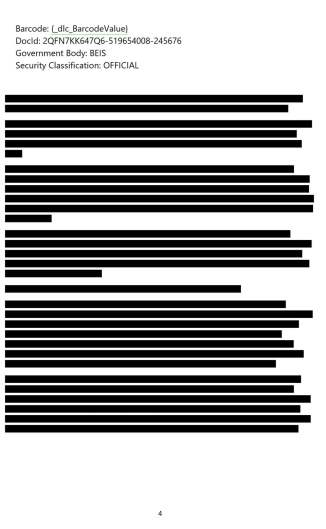


UK scientists condemn ‘Stalinist’ attempt to censor Covid-19 advice

Owl is reminded of the saying: “He who sups with the devil should have a long spoon”. Scientists were no doubt flattered to be asked to provide the Government with advice, maybe they should have considered under what terms that might be – easy to be wise after the event. 


 A page of the redacted text from the report. Photograph: No Credit

David Conn www.theguardian.com

Government scientific advisers are furious at what they see as an attempt to censor their advice on government proposals during the Covid-19 lockdown by heavily redacting an official report before it was released to the public, the Guardian can reveal.

The report was one of a series of documents published by the Scientific Advisory Group on Emergencies (Sage) this week to mollify growing criticism about the lack of transparency over the advice given to ministers responding to the coronavirus.

However, large blocks of text in the report, produced by SPI-B, the Sage subcommittee providing advice from behavioural scientists on how the public might respond to lockdown measures, were entirely blanked out.

Several SPI–B members told the Guardian that the redacted portions of the document contained criticisms they had made of potential government policies they had been formally asked to consider in late March and early April.

One SPI-B adviser said: “It is bloody silly, and completely counterproductive.” A second committee member said: “The impression I’m getting is this government doesn’t want any criticism.”

On Friday afternoon, after the Guardian revealed frustrations over the redacted report, another member of the government’s advisory committee took to Twitter to complain of what he said was “Stalinist” censorship.

“Personally, I am more bemused than furious,” said Stephen Reicher, a professor of social psychology at the University of St Andrews. “The greatest asset we have in this crisis is the trust and adherence of the public. You want trust? You need to be open with people. This isn’t open. It is reminiscent of Stalinist Russia. Not a good look.”

Members of the committee have been discussing among themselves how best to respond to the redaction, which they believe was a heavy-handed move that jeopardises their independence.

At least one scientific adviser is understood to be considering resigning over the government’s secretive approach to science around the Covid-19 outbreak, which they believe is undermining public trust.

The report, from 1 April, summarised SPI-B’s discussions about how to handle possible changes to the social distancing measures that had just been introduced to slow the spread of Covid-19.

In the version published on Sage’s government website, almost a page and a half of text was heavily redacted. The Guardian understands the blocked text related to SPI–B’s criticism about possible government proposals around that time.

These included the idea of reducing the amount of time Britons could spend exercising or shopping, and stricter financial penalties for those found to be breaking the lockdown. A third proposal involved requiring people to self-validate their movements, as was occurring in France, where citizens were required to complete permits before leaving home.

Experts on SPI-B, which includes professors in psychology, epidemiology and anthropology, said they felt the proposals were too punitive and more likely to result in unfair treatment among people in deprived economic circumstances.

A spokesperson for the Government Office for Science said the redactions took place because the policies discussed in the document were still under consideration.

“The only redactions relate to comments made by a Sage subgroup where specific reference is made to policy still under consideration or to remove contact,” the spokesperson said.

“Redactions were carried out by officials working for the Sage secretariat in consultation with the department developing the policy. All the subgroups were notified and given the opportunity to comment in advance of publication on the redactions being made to specific elements of any papers.”

However, SPI–B advisers who spoke to the Guardian disputed that they had been consulted. “We weren’t given advance notice and we still haven’t been given a satisfactory explanation,” the second SPI–B member said, adding they felt the redaction had been intended to stifle criticism.

“This government has failed to show any self-criticism whatsoever, when it is glaringly obvious to everybody that big mistakes have been made. If you want the trust of the population you hold up your hand and you say ‘we’ve made these mistakes, this is why they happened, we regret it, we’re learning from it’. Rather than just keep saying ‘we’ve done the most fantastic job’ and not being open to criticism in any way.”

A third member of SPI–B said they felt the redactions undermined the expert group’s independence from politicians. “What is recorded in the redacted document is us criticising those proposals. They were just not particularly well thought out. Here we were being independent, and you can’t see it [because of the redactions].”

A fourth member of SPI-B questions whether the heavy redaction might even have been a mistake, as the documents were summaries of the committee’s discussions produced by civil servants.

“Whether it was a mistake or deliberate doesn’t matter; it should not have happened, it’s deeply problematic,” the adviser said. “The public needs to have trust and confidence in the scientific advice, which the government claims it is relying on, and to see sections redacted in published documents diminishes trust and confidence.”

The committee’s consideration of the government proposals is understood to have occurred during the first week of the lockdown, which began on 23 March.

The behavioural scientists said in their four-page report that there was a consensus that the high-levels of adherence to government guidelines “are likely to be maintained in the short-to-medium term, for as long as it is evident that Covid-19 poses a serious risk that cannot be managed in any other way”.

However they were concerned that introducing more coercive measures, such as more draconian restrictions on movements, risked undermining the high levels of adherence, which they said was “likely based on a sense of community cooperation”.


Closed Budleigh care home to be sold ‘for the benefit of the elderly’

The recently-closed Shandford care home is to be sold and the proceeds given back to Budleigh Salterton to ‘benefit’ the town’s elderly.

Owl would like to know why go ahead with a sale when the local community clearly wanted to try to make a go of keeping it going?  The Shandford site is on a bus route and close to the town. What do “proceeds of the sale” mean? Will Abbeyfield be able to reimburse themselves for historic maintenance costs, or other fees or charges? If the building is to be sold “at fair valuation” does this mean a sale has already been agreed? How do you assess a “fair valuation” at a time that the economy has been put on hold? And, finally, is “benefit for the elderly” the same as residential care?

Becca Gliddon  eastdevonnews.co.uk 

Months of campaigning by the community to keep the care home open came to an end last month when the last resident was moved out of the Station Road site on April 21.

The Abbeyfield Society, who took over the site in 2012 and closed the 26-bed care home in mid-April 2020, saying it was no longer viable to run, said the building would be valued independently and sold in agreement with the Charity Commission.

Proceeds from the sale of the building, and any Shandford legacy fund reserves, will be returned to the original trustees of the home to help elderly people living locally.

A spokeswoman for the Abbeyfield Society confirmed the final resident had left and the care home was now empty.

She said: “The Abbeyfield Society is now working with representatives from the local community to ensure any proceeds from the sale of the property and remaining legacy funds will revert to the original local charity and will be used for the benefit of elderly people in Budleigh Salterton and surrounding villages.

“The volunteer group is now focused on assessing the options for using these funds to best effect.”

She added: “The building will be sold based upon the fair valuation of independent experts and agreed by the Charity Commission.

“The proceeds will then be invested back into the community as outlined previously.

“Abbeyfield is working to manage this process, as per the legal agreement.”

Earlier this year Budleigh Salterton came out in support of keeping the home open with an SOS campaign to Save Our Shandford.

The aim was to set up Friends of Shandford – a Community Interest Company (CIC) – to allow the care home to continue, and its residents to remain.

Despite ‘significant support’ from the community, the plan to form the CIC was unable to progress and the closure went ahead.