
- Certificate of lawfulness for the construction of single storey extension

57 Langstone Drive Exmouth EX8 4HZ
- Certificate of lawfulness for the construction of conservatories to the rear and side, dormer window to rear, and installation of roof lights.
6 Oakleigh Road Exmouth EX8 2LN
- Rear extension to existing garage
Oakhayes Green Lane Exton Exeter EX3 0PW
- Proposed single storey extension to side elevation of existing farmhouse, and alterations and improvement to existing lean-to outhouse.
Harris Farm Talaton Exeter EX5 2RQ
- Proposed single storey extension to side elevation of existing farmhouse, and alterations and improvement to existing lean-to outhouse.
Harris Farm Talaton Exeter EX5 2RQ
- New front porch and canopy
St Cecilia Marley Road Exmouth EX8 5DW
- Roof canopy to existing slurry tank.
Lawdeshayne Farm Colyton EX24 6DU
- Construction of rear dormer window
14 Darnell Close Sidmouth EX10 9JW
- T5 Field Maple – Crown raise over garage to give 3m clearance, MDC 50mm The garage roof is extremely overshadowed by tree, needs more light and air flow once Ivy has been removed
20 Summerfield Woodbury Exeter EX5 1JF
- Variation of conditions 5 and 20 of planning permission 19/1849/MFUL (Redevelopment of part of the business park (fuel storage depot and motor sales area) and extension to create 6 additional units to be used for offices and Light Industry use (Use Class B1), Storage and Distribution (Use Class B8) to allow construction and demolition works to be undertaken between 1st April and 31st December annually.
Land At Dart Business Park Clyst St George
- Removal of condition 7 (retention of right of way to graveyard) of approval of reserved matters ref. 7/37/79/C0416/116
1 The Bank High Street Newton Poppleford Sidmouth EX10 0UZ
- Pollard Copper Beech
Brampford Speke School Brampford Speke Exeter EX5 5HE
- Prior approval for change of use of workshops (use class B1(c)) to a dwelling (use class C3)
Land And Buildings At Bushy House Knowle Hill Budleigh Salterton EX9 7AL
- Construction of outbuilding
Little Sunnyhaye Sanctuary Lane Woodbury Exeter EX5 1EX
- T1 – lime, reduce height by 3 – 4m and shorten back side growth to leave a height of approximately 16m and a radial spread of approximately 4m. Remove epicormic growth from base. T2 – sweet gum, asymmetric form – reduce and re-shape by 2m to a suitable side branch to leave a height of approximately 15m and a spread of approximately 5m on the north and east side. T3 – oak, prune and re-shape to leave a height of approximately 6m and a radial spread of approximately 4m. T4 – red oak, shorten back long heavy branches by 2 – 3m and re-shape to leave a natural form to leave a height of approximately 14m and a radial spread of approximately 5m
9 Little Knowle Budleigh Salterton EX9 6QS
- Construction of two storey side extension and decking
1 Westward Drive Exmouth EX8 1JD
- Installation of 3 no. antennas and associated apparatus and ancillary works
British Telecom South Street Exmouth
- Agricultural storage building.
Royal Oak Farm Cotleigh Honiton EX14 9LF
- Construction of single storey side and two storey rear extensions, raised terrace to rear and provision of cladding
Westwood Toadpit Lane West Hill Ottery St Mary EX11 1TR
- Change of Use of an industrial building to a live/work unit
Lodge Farm Dunkeswell Honiton EX14 4QN
- Proposed demolition of rear extension and construction of replacement single storey extension; insertion of 2 no. first floor windows to rear elevation
Windwhistle Cottage Hawkchurch Axminster EX13 5XD
- Construction of two storey side/front extension and single storey rear extension.
3 Walnut Grove Exmouth EX8 2ES
- Construction of single storey rear extension
Windwhistle Cottage Hawkchurch Axminster EX13 5XD
- Construction of first floor extension and rear dormer window.
Wellfield Parva Hawkchurch Axminster EX13 5UT
- Construction of single storey rear extension
10 Chichester Close Exmouth EX8 2JU
- Construction of rear dormer window including side window, balcony and provision of cladding
3 Venlake Close Uplyme Lyme Regis DT7 3UX
- Construction of replacement conservatory
Elscombe Cottage Bishopswood Chard TA20 3RY
- Creation of 2no dwellings (outline consent sought with all matters reserved)
Garages Coombe Lane Axminster
- General purpose agricultural building and associated access track
Land At Gibbons Farm Hayne Lane Wilmington
- Beech (T1) – 1.5 m lateral reduction to retain tree height of 15m and lateral spread of 7m, to prevent encroaching into neighbouring properties. Maximum diameter cuts 50mm.
8 Moorcourt Close Sidmouth EX10 8SU
- Construction of garden shed and summer house
Land Adjacent Borough House Swan Hill Road Colyford
- Retention of first floor shower room and door leading into bedroom 2 from shower room
Rock House Membury Axminster EX13 7AG
- Conversion of ground floor of front section of former bank to residential unit and associated external alterations
40 – 42 High Street Sidmouth EX10 8EB
- Proposed yard/smoking area and installation of new door
Bicton Inn 5 Bicton Street Exmouth EX8 2RU
- Construction of extension to existing balcony
Shelsley House Millford Road Sidmouth EX10 8DP
- Construction of single storey rear extension and porch.
40 Moormead Budleigh Salterton EX9 6PZ
- Hard paved path and new door giving access to a new toilet within the village hall for church and village hall use, including repositioning of a rooflight, and extension of the path to the gate between the churchyard and the village hall parking area
St John The Baptists Church Brook Lane Colaton Raleigh
- Construction of single storey side/front extension
24 Shortwood Close Budleigh Salterton EX9 6QW
- Retrospective planning application for siting of mobile home for office manager
Bottom Barn Broadhembury Honiton EX14 3LN
- Agricultural storage building.
Stantyway Farm Otterton Budleigh Salterton EX9 7JJ
-
- Alterations to front conservatory extension including increase in height (retrospective application)
Flat 1 Fernbrook Convent Road Sidmouth EX10 8RB
- Construction of single storey lean-to timber shed
2 Granary Lane Budleigh Salterton EX9 6JD
- Reserve matters application for erection of a dwelling to assess access, landscaping, layout, scale and appearance (pursuant to outline planning consent 17/1302/OUT)
Crosslands Gammons Hill Kilmington Axminster EX13 7RA
- Construction of raised decking to rear including steps and storage underneath
Tweedsmuir Crewkerne Road Axminster EX13 5SY
- Construction of holiday lodge
Lyndhayne Woodbury Salterton Exeter EX5 1PY
- Proposed covered and partially sunken outdoor classroom and demolition of existing shed.
Musbury School Church Hill Musbury Axminster EX13 8BB
- Alterations to bank to create visibility splay to the south of the existing vehicular access
Broadclyst Water Tower Broadclyst
- Replacement of selected doors involving raising of cill heights by 150mm (partially retrospective) (revised scheme to planning permission 19/0220/FUL)
Sanditon Station Road Sidmouth
- Alterations to front conservatory extension including increase in height (retrospective application)
Monthly Archives: August 2020
Jennifer Arcuri and Russia : the unanswered questions
For the full story you need to click on the link below as it relies on a series of images.
Boris Johnson’s Mistress Jennifer Arcuri is coming back to live in England in 2020. She will be appearing on Channel Four’s Celebrity Hunted programme no doubt to tease the nation will a kiss and tell on Johnson’s peccadillos. She promised a tell all book on her time with Boris Johnson from 2011 to 2016 but instead delivers a book on Hacking.
American Arcuri is a self promoting actress and a hackivist, no bimbo but highly intelligent who shared Johnson’s Secrets during the crucial period of Russian Influence in the run up to the 2016 Brexit Referendum. ……..
Coronavirus: Young people warned ‘don’t kill granny’ as lockdown measures reimposed in Preston
A Stark message from Preston council – “Don’t kill Granny”
David Mercer news.sky.com
Young people in Preston have been warned “don’t kill granny” by the city’s council as local lockdown measures were enforced following a spike in coronavirus cases.
Households in the city in Lancashire are now banned from mixing indoors or in gardens, with local leaders blaming people mixing in pubs and other homes for restrictions having to be reimposed.
Adrian Phillips, chief executive of Preston City Council, said “young people are inevitably among the brave and the bold”, but claimed they are spreading COVID-19 in the community in “many cases”
“I know our director of public health has said ‘don’t kill granny’ to young people to try and focus the message,” he told Radio 4’s Today programme.
“Young people are inevitably among the brave and the bold, they want to be adventurous and out and about, but we know that they have the virus… they often have less symptoms, but they do take it back to their household and the community spread we are seeing, we believe in many cases (is) young people taking it home and catching the virus.”
Mr Phillips backed a call from the Local Government Association (LGA) for councils to have greater powers to close pubs to slow the spread of coronavirus.
Current guidance says licensed premises should take customer details and ensure they have infection control measures in place, but they are still voluntary.
The LGA wants these guidelines to be made mandatory immediately, and has called for local authorities to be given stronger powers to enforce them.
It wants a temporary COVID-19 objective added to the Licensing Act, allowing councils to shut premises that fail to collect contact tracing data or enforce social distancing, or even revoke their licences.
“You need responsive powers,” Mr Phillips said.
“It is useful to have something that can move quickly and we can make it entirely clear to the licensee or the operator what the consequences are.”
The new restrictions in Preston that came into place from midnight are:
- You cannot have others in your homes and gardens
- You cannot visit other people’s homes or gardens, even if they are in an unaffected area
- You are not permitted to mix with other household in indoor venues
Social bubbles are exempt from the restrictions.
Residents can meet in groups of up to six, or more than six if exclusively from two households, in outdoor areas such as parks and beer gardens.
Households can also visit indoor hospitality venues as long as they do not mix with others.
Sixty-one new coronavirus cases were reported in Preston in the seven days to August 4, which is the equivalent of 42.6 cases per 100,000 people – up from 21.7 per 100,000 in the previous seven days.
Director of Public Health for Lancashire Sakthi Karunanithi said almost half of the cases reported were among people aged 30 and younger.
Mr Karunanithi said the “two main reasons” for the rise in infections were people meeting others in their houses and households coming together in venues such as pubs.
He added: “These two are key behaviours we’re trying to protect people from. Don’t meet with members of other households in pubs and clubs.”
The new restrictions in Preston come a week after the same measures were brought in for residents in Greater Manchester, parts of east Lancashire and West Yorkshire, as well as Leicester.
The rules will remain in place for those areas for at least another week.
Bedford and Swindon have also been added to the government’s “watchlist” of places where cases are rising.
Meanwhile, from today face coverings are now mandatory across England in indoor places of worship, museums and galleries, public areas in hotels and hostels, bingo halls, libraries, cinemas, concert halls, crematoriums, aquariums and indoor zoos.
It’s taken just 12 months for Boris Johnson to create a government of sleaze
It took the last Tory government the best part of 18 years to become mired in sleaze, but Boris Johnson’s administration is smelling of it already. Whether doling out lucrative contracts, helping billionaire property developers cut costs, or handing out lifetime seats in the House of Lords, the guiding principle seems to be brazen cronyism, coupled with the arrogance of those who believe they are untouchable and that rules are for little people.
Jonathan Freedland www.theguardian.com
This week came word of at least £156m of taxpayers’ money wasted on 50 million face masks deemed unsuitable for the NHS. They were bought from a private equity firm through a company that had no track record of producing personal protective equipment – or indeed anything for that matter – and that had a share capital of just £100. But this company, Prospermill, had a crucial asset. It was co-owned by one Andrew Mills, adviser to the government, staunch Brexiteer and cheerleader for international trade secretary, Liz Truss.
Somehow Prospermill managed to persuade the government to part with £252m, boasting that it had secured exclusive rights over a PPE factory in China. Just one problem. The masks it produced use ear loops, when only masks tied at the head are judged by the government to be suitable for NHS staff. If the government wanted to spend £156m on masks for the nation’s kids to play doctors and nurses, this was a great deal. But in the fight against a pandemic, it was useless.
All this has come to light thanks to the Good Law Project, which is challenging through the courts what it calls “the government’s £15bn supermarket sweep approach to PPE procurement”. As if to remind us of the necessity of judicial review – a process now threatened with “reform” by this government – the group have initiated such proceedings over several deals with suppliers with no conspicuous experience or expertise in PPE, including a pest controller and a confectionery wholesaler. But this latest one is the biggest.
I asked Jolyon Maugham, who runs the project, whether what he had seen amounted to corruption. He doesn’t use that word himself, preferring to note that “mutual back-scratching” tends to be how it works in this country. “You have contracts awarded to the wrong people because of incompetence, and you have contracts awarded to the wrong people because the wrong people knew what ears to whisper into.”
Such whispers are becoming the background noise of this government. This week the housing secretary Robert Jenrick was asked about his encounter with Richard Desmond at a Tory fundraising dinner last November, at which Desmond showed the cabinet minister a video of the housing development he wanted to build. Jenrick said he wished he “hadn’t been sat next to a developer at an event and I regret sharing text messages with him afterwards”, which rather glossed over the key fact: namely, that Jenrick promptly rushed through a decision on the project, the speed of which allowed Desmond’s company to avoid paying roughly £40m in tax to the local council. That move was later designated “unlawful”, and Jenrick was forced to overturn his decision.
It would be nice to think that episode was a one-off, but it’s hard to do so when developers have given £11m in donations to the Conservatives since Johnson arrived in Downing Street just one year ago.
One can hardly blame entrepreneurs and go-getters for wanting to get cosy with Johnson’s ministers. They see how business is done. They’ve noticed the seven government contracts together worth nearly £1m that were awarded in the course of 18 months to a single artificial intelligence startup, an outfit that just so happened to have worked for Dominic Cummings on the Vote Leave campaign.
The company is called Faculty and, handily, the government minister tasked with promoting the use of digital technology, Theodore Agnew, has a £90,000 shareholding in it. Any suggestion of a conflict of interest is breezily brushed aside. More conveniently still, Faculty’s chief executive, Marc Warner, has attended at least one meeting of Sage, the scientists’ group advising the government on coronavirus. Better yet Warner’s brother, Ben, works at Downing Street as a data scientist and has been a regular at Sage where, as one attendee put it to the Guardian, he “behaved as Cummings’ deputy”. Faculty insists all “the proper processes” have been followed in the awarding of their contracts.
Meanwhile, a political consultancy firm with strong ties to both Cummings and Michael Gove managed to win an £840,000 contract without any open tendering process at all. Public First is a small research company, but it is run by James Frayn, an anti-EU comrade of Cummings going back two decades, and his wife Rachel Wolf, the former Gove adviser who co-wrote the Tory manifesto for last year’s election. The government says it could skip the competitive tendering stage because emergency regulations applied, thanks to Covid. Except the government itself recorded some of Public First’s work as related to Brexit (it now says this was an accounting anomaly and that all the work related to the pandemic).
To confirm the new order, you might take a look at the prime minister’s list of nominations to the House of Lords. Besides his brother Jo, you’ll also spot former advisers, donors, Brexiters, and longtime Johnson pal Evgeny Lebedev, the Russian-born billionaire owner of London’s Evening Standard. It’s all terribly cosy. “It’s a pattern of appointing your mates, that’s the common thread,” says Labour’s Rachel Reeves. When fighting a pandemic, you don’t want “contracts for contacts”, she says; you want to look for “the best people, not whether they voted leave or made donations”.
Why is the government behaving this way? An obvious explanation is the 80-seat majority it won in December. The knowledge that parliamentary defeat is a distant prospect, and that you will not face the voters for four long years, can translate into complacency, even a sense of impunity. Johnson’s sparing of Cummings and Jenrick, when a more fragile prime minister would surely have felt compelled to fire them both, has emboldened those individuals and their watching colleagues. They’re not about to start shooting people on Fifth Avenue, as Trump once boasted, but like the US president, they believe they can get away with anything.
That fits with the credo Johnson and Cummings had even before they bagged their majority. Johnson was hardly a stickler for probity to start with; his attitude to the rules, grandly branded a libertarian philosophy by his pals, has long been elastic, at least when it comes to himself and those around him. As for Cummings, his breach of the lockdown during the pandemic’s most grave phase leaves no doubt: he sees the rules as applying to lesser mortals, not him.
This week, research published in the Lancet proved how devastating “the Cummings effect” has been for public faith in the government’s handling of the pandemic. Through their cronyism, their cavalier disregard for basic propriety, Johnson and his circle are draining trust at a time when it is essential to the public health. One day that will matter for the Conservatives’ political fortunes. But it matters for the rest of us right now.
• Jonathan Freedland is a Guardian columnist
• The Scott Trust, the ultimate owner of the Guardian, is the sole investor in GMG Ventures, which is a minority shareholder in Faculty
‘Wishful thinking’: the dangers of UK hype during Covid-19
“Boris Johnson repeatedly promised to bring forward “world-class” and “world-beating” systems to tackle Covid-19 – most notably for testing and contact tracing by the beginning of June, a system that is sufficiently patchy that this week Blackburn with Darwen council had to launch its own.”
Dan Sabbagh www.theguardian.com
They were billed by the UK health secretary, Matt Hancock, as “lifesaving” and “hugely beneficial”: two new coronavirus tests that claim to deliver results within 90 minutes, promoted enthusiastically to the public with the help of front pages in the Times, the i and the Daily Mail, which declared they would “transform the war on corona”.
The suppliers are little known, evaluation data is not yet available, and it is unclear how effective the tests are outside hospital settings, not least because taking blood or swabs is difficult for non-medics.
But it is an infectious optimism that is hard to shake: during the dismal and downright frightening fallout of the Covid-19 pandemic, upbeat scientific or medical claims have been made by politicians and taken up the media, few of which have been borne out to the degree or timeline originally mooted.
There may be moments when hype is justified, but the reality, say experts, is that the crisis constitutes a long hard slog in which ordering people to stay indoors and shutting down the economy has had more impact than any medical or technological advance so far.
Some blame politicians for being a little too eager to leap on positive stories in a time of crisis, with the boosterish health secretary often appearing particularly keen. It was Hancock who claimed a contact-tracing app would be ready in England in mid-May. “NHS phone app holds key to lifting lockdown” said one Sunday paper splash in April. That app is yet to arrive, with the original version scrapped entirely.
Then there was the 100,000-a-day test target, described as “Matt’s target” – though allies of Hancock say the principal aim was to concentrate minds on increasing tests. The figure was met briefly at the end of May before falling again. Yet within days the declared target rose to 200,000, and last month to 500,000 a day. The reality? The UK is processing about 170,000 daily tests on average, far lower than some other countries.
But the problem of over-promising and hype flows from the top.
Boris Johnson repeatedly promised to bring forward “world-class” and “world-beating” systems to tackle Covid-19 – most notably for testing and contact tracing by the beginning of June, a system that is sufficiently patchy that this week Blackburn with Darwen council had to launch its own.
Officials, too, have succumbed. Prof Sharon Peacock, director of the national infection service at Public Health England, said in March that mass antibody testing would “absolutely” be available within days. Ministers had bought 3.5m of the tests but a fortnight later had to admit they did not work.
Why does the reality so often fail to match the promises and breathless PR?
Alex Thomas, a former civil servant and private secretary to the late cabinet secretary Jeremy Heywood, said: “While there is a natural optimism bias in all of us, this government has a tendency to be more comfortable about talking about the sunlit uplands, and that inevitably feeds through.”
Some scientists bemoan cutbacks in scientific advice to government over the past decade and an absence of public health specialists among the most senior scientific advisers, saying they weaken the system and the ability to deliver on abstract aims.
There are also criticisms that the UK has become, in the words of one scientist, “far too disengaged from Europe and globally”, and that there remains a lingering sense of British exceptionalism. In April, Jenny Harries, the deputy chief medical officer for England, claimed the UK was “an international exemplar in preparedness” as the death toll was soaring. England ended up with the highest excess deaths in Europe.
An emerging low-level nationalism endemic in media coverage as well as politics focuses intensely on British knowhow and developments, in the fashion of a major sporting event – whether in the much-vaunted attempt by Dyson to build ventilators for Britain, which ultimately collapsed amid lack of need, or in the focus on UK progress in developing a vaccine, while coverage of foreign efforts is more muted.
As well as ministers’ desire to emphasise the upside – likely a mixture of spin and natural, even desperate, optimism – scientists and researchers are under intense pressure to succeed in research, generate good publicity and win additional funding.
The result, says Martin McKee, a professor at the London School of Hygiene and Tropical Research, is an increase in “wishful thinking”. The academic points to research published four years ago that showed a dramatic increase in the use of positive language such as “robust”, “novel”, and “unprecedented”, in papers published between 1974 and 2014.
Compounding the problem is the sheer complexity of coronavirus virology, which often runs up against simplistic public understandings of science. Prof Deenan Pillay, a virologist at University College London, argues the usefulness of antibody tests has been misunderstood.
The problem, he says, is that after infection “the level of antibodies goes up, but then they come down”, adding: “There was this idea that if you tested positive, you were a superman, immune for life, but that’s not true. It turned out to be hype.”
As a result, related ideas for immunity passports that could let some people return to near normal lives – and these made a splash in the Guardian – were talked up as a possibility by Hancock but did not ultimately come to fruition. The latest evidence lends further credence to the possibility that antibodies drop off significantly within weeks.
Excitement about a vaccine is understandable – in particular Oxford University’s, whose initial trials generated wall-to-wall media coverage last month. “Vaccine for Christmas,” reported the Daily Mail and others, although the university had previously said it could be ready by September, a date set to be quietly missed.
But again Pillay cautions over expectations out of kilter with reality. “We have unrealistic expectations of what a vaccine might do – one or two shots and you are immune. But maybe it will be more like flu where you need a shot every year, the vaccine is only 70% effective and flu is still with us.”
The senior scientist says such over-optimism is not unique to the pandemic, but it has been brought into sharp relief by the intensity of the crisis and the dominance of the story in the news.
“There has long been a glorifying and over-emphasising of scientific advances – and it’s been increasing over time. In a way, everyone’s to blame, from scientists, politicians, investors [to] the media,” he said.
Rising tourist tide swamps the coast
New government figures show that the coronavirus R rate could be above 1 for three regions across England as thousands of people are expected to flock to the coast to enjoy hot weather this weekend.
According to data released on Friday, the R value is estimated to range between 0.8 and 1.1 for London, the northwest and the southwest.
Will Humphries, Southwest Correspondent www.thetimes.co.uk
Crowded beaches and fishing villages in Cornwall and Devon can cause despair among residents during a normal summer but with a virus added into the mix, the fear and anger at incomers has reached fever pitch.
With fewer options to holiday abroad, a wave of visitors has hit the tourist hotspots of the southwest. Residents, businesses and lifeguards have likened the scenario to an endless bank holiday weekend. While the increase in visitors is helping some businesses, with some takings up 70 per cent on July last year, locals are concerned by the numbers cramming into the narrow streets and country lanes.
“It’s hell,” said Jenny Dean, 58, who has lived in St Ives since 1974.
Banners and signs ask people to “Please Keep To Your Left” along shopping streets but these were ignored by crowds when The Times visited on Thursday. “This is the worst it has ever been,” Mrs Dean said. “I know a lot of locals who aren’t going out. We don’t feel safe.”
The sentiment was repeated by other residents across the counties.
Toni Potter, 59, a gallery assistant who has lived in St Ives for 32 years, said that she did her food shopping in town at 7am “then I don’t go back”. She added: “We do want tourists but this is so extreme.”
Devon has the lowest Covid-19 death rate in England (21.8 deaths per 100,000 people) while Cornwall & Isles of Scilly has the fourth lowest (27.1 per 100,000).
Out of 182 areas in England, Scotland and Wales, Cornwall ranks 175th for infection levels (with 162 cases per 100,000 of the population) and Devon 176th (155 per 100,000). The only places in England with a lower infection rate are Dorset and North East Lincolnshire. Despite local fears, Devon and Cornwall have so far had only a very slight increase in recorded cases at the end of last month, with the daily average rising to three from about two.
Many holidaymakers were enjoying ice creams along the promenade at St Ives on Thursday while pubs and restaurants were doing a brisk trade.
However, Scott Stevens, 48, a construction company owner from Bishop’s Stortford, Hertfordshire, visiting with his wife, told The Times: “It’s not a relaxing holiday at all. It’s uncomfortable. You have to book everything three weeks in advance and there are no tables available in the restaurants.”
Tensions between locals and tourists have boiled over on occasions. A man was arrested on suspicion of assault last week for allegedly attacking two lifeboat volunteers in St Ives when they asked a driver parked in a space reserved for them to move his car.
A 14-year-old boy was attacked with a bottle on Perranporth beach, in north Cornwall, last month after asking tourists to pick up the plastic cups they had dropped. Police said that the suspects, who have not been caught, had “London accents”.
In the sailing harbour of Fowey, on the south coast of Cornwall, the pasty shops have been proving popular and the second-home owners have been staying longer.
Justine Hambly, 51, who runs Any Old Lights, an interior design shop, said that visitor numbers were on a par with Regatta Week, adding: “I think people could be more respectful of the rules. I don’t think it’s through unpleasantness, they just come on holiday and go into a completely different mode. People aren’t wearing masks or keeping their distance.”
Holly Lovelock, 21, an assistant at the Seasalt clothes shop, said that the beaches were so “incredibly packed” that she would avoid them until after summer.

As businesses less affected by social distancing make hay while the sun shines, places such as pubs and clothes shops are struggling to recoup income lost in lockdown.
Carol Tambling, landlady of the Lugger pub in Fowey, said: “We can only book so many people in for food. We missed Easter, we are missing Regatta Week and the Christmas market is looking like it will get cancelled.”
Salcombe, on the south coast of Devon, has been disturbed by unprecedented levels of antisocial behaviour and litter.
Jeff Gillard, 42, an ambulance medic, said that the town has resembled a “war zone” of broken glasses and takeaway boxes most mornings. “I wouldn’t say the numbers of people are hugely different, it just seems to be a different type of visitor,” he said. “The middle of Salcombe feels like a bit of a no-go zone from 10pm.”
Anthony Mangnall, the Conservative MP for Totnes, has promised “more police will be on the streets this weekend to deal with antisocial behaviour”.
The beaches of north Cornwall have been the busiest that many RNLI lifeguards can remember, with 14,000 counted at Perranporth in one day last week.
Tommy Job, 30, of the Watering Hole pub on the beach, said that antisocial behaviour had been worse in lockdown: “People were having big parties . . . now things are back to more normal. I think some locals have a chip on their shoulder because they had the place to themselves for a while. It always gets busy, it’s nothing abnormal.”
National Grid pays Sizewell B owner for halving power output
Meanwhile EDF continues to work “at pace” constructing Hinkley Point C……….
Emily Gosden, Energy Editor www.thetimes.co.uk
EDF will be paid between £55 million and £73 million for halving power output from Britain’s biggest nuclear reactor this summer under an agreement to prevent blackouts.
National Grid, the company with the task of keeping Britain’s lights on, said that it had asked the French energy group to continue to limit generation from Sizewell B in Suffolk until late September. That is the maximum period negotiated in a contract that The Times revealed in May had been agreed to help to prevent the network being overwhelmed by excess power during the pandemic.
Electricity demand dropped by as much as a fifth at the height of the lockdown and, although it is returning to normal levels, National Grid said that it was lower than expected and that there was a risk of a second wave that could suppress demand again. Keeping Sizewell operating at half-output enabled it to “prepare for such an event at minimal cost”.
National Grid needed to reduce output from Sizewell so that it could free space on the network to run more flexible types of power plants needed to help to balance supply and demand. It was also concerned that the network could not cope if Sizewell, the biggest single generating unit in Britain, were to fail while operating at full capacity.
Juliet Davenport, of Good Energy, a renewable energy supplier, claimed that the contract was “evidence that inflexible, expensive nuclear power is not fit for the clean energy system we need”.
National Grid said that it was operating the system “as efficiently as possible”.
Boris Johnson threatened with legal action over delays to energy project
Eurotunnel rival to Aquind energy project is left in limbo
Sean O’Neill, Chief Reporter www.thetimes.co.uk
Ministers backed the tunnel scheme in 2017 and the company has built converter stations, manufactured the 1gw cable and received the go-ahead from French regulators. “They’re ready to go and no one knows what the hold-up is,” a Whitehall source said.
There is concern in the energy sector that the government is favouring an undersea interconnector proposed by Aquind, a large donor with close ties to the Conservative Party.
Aquind’s owner, whose identity had been hidden by Companies House, is Viktor Fedotov, a former executive in the Russian oil industry. One of Aquind’s directors is the Tory activist and donor Alexander Temerko, 53, who ran a Russian state arms business and was an oil executive before he fled Russia in 2004. Since 2011 Mr Temerko or companies he is associated with have given £1.3 million to the Conservatives, including sums to five cabinet ministers or their constituency parties.
Eurotunnel, which makes no political donations, needs final safety approval from UK officials on the Channel Tunnel intergovernmental commission. Britain missed a July 24 deadline for a decision, blaming Covid. In its legal letter Eurotunnel calls that “a delaying tactic”. Eurotunnel would not comment on a leaked letter but a spokesman said: “The question should be why British experts are still delaying their approval when the French safety authority has given its green light. Could it be related to Aquind or other interconnector projects, or is it just shocking inefficiency?”
Aquind is a British-registered firm and political donations are properly made and declared. The planning decision on the Aquind scheme — a 2gw cable it claims would provide up to 5 per cent of UK power — will be made by the energy minister, Kwasi Kwarteng.
A transport department spokesman said that assessment of the Eurotunnel project was continuing and: “We will not compromise on rail safety.”
Behind the story
Ofgem and the government have encouraged the construction of “interconnectors” such as Aquind’s between Britain and the continent to improve the security of the power supply and support the shift to greener energy (Emily Gosden writes).
When output from British wind and solar farms is low, French nuclear power can be imported; when it is high, France can use British electricity.
Most interconnectors are laid along the seabed but there is a plan for one, called Eleclink, to go through the Channel Tunnel. Interconnector operators sell the right to use the cable to international electricity traders.
National Grid is building further links with France, Norway and Denmark, scheduled for completion this year, next year and in 2023 respectively.
[There is also the FAB interconnector, closer to home, scheduled to make landfall in the lime Kiln car park Budleigh Saterton, then wend its way to a converter station near the airport. This appears stalled at the moment.]
Fresh calls for Metropolitan police to investigate Cummings’ Durham trip
Meg Hillier, the Labour chair of the public accounts committee, said: “There is also more evidence now that the police should look into, Durham police and, given the alleged travel from London, the Met police too.”
Remember the Durham Dash? – Owl
Matthew Weaver www.theguardian.com
The Metropolitan police is facing fresh calls to investigate Dominic Cummings’ decision to leave London for Durham at the height of the coronavirus pandemic.
The calls come after the Guardian and the Daily Mirror revealed that Dave and Clare Edwards, two of four people who claim to have seen Cummings on 19 April, have complained to the police watchdog, accusing the Durham force of not fully investigating their claims.
Meg Hillier, the Labour chair of the public accounts committee, said: “There is also more evidence now that the police should look into, Durham police and, given the alleged travel from London, the Met police too.”
Under questioning from Hillier at the liaison committee in May, Boris Johnson said he had seen evidence that proves his chief adviser did not make a second trip to Durham in April, as four witness have now claimed. But he refused to agree to release it to the cabinet secretary for independent verification.
Cummings previously claimed that an allegation that he was in Durham on 19 April was false and that he had evidence to prove he was in London that day. On Wednesday Downing Street said it considers the matter closed.
Hillier said: “If the PM just publishes the evidence he’s seen there would be no need for police time to be spent on this – the PM should put truth and public trust first and publish what he’s seen.”
Labour’s deputy leader, Angela Rayner, said: “The public have a right to know whether the prime minister’s chief adviser made a second lockdown-breaching trip to Durham, and it is surely therefore only right that this evidence is produced.”
She added: “If Dominic Cummings was in London during both the morning and afternoon of the 19 April, and not in Durham as has been alleged, I’m sure that the prime minister will welcome this opportunity to set the record straight.”
The London assembly has also called on the Met to investigate Cummings.
A detective-led inquiry in Durham found Cummings probably breached health protection rules by travelling to Barnard Castle on 12 April, but it made no finding on his decision to leave London because the three-day investigation was confined to County Durham.
Unmesh Desai, the Labour assembly member who chairs city hall’s police and crime committee, said that new allegations “have come to light about Dominic Cummings’ movements during the lockdown which raise a number of unresolved issues. As Durham police is itself the subject of criticism and complaints, it is only logical that Cummings’ own police force, the Met, now investigates this matter, and answers legitimate questions from the public.”
One of the other witnesses who originally complained to Durham police about seeing Cummings on his first trip to the north-east lockdown, has also called on the Met to investigate.
The witness, who does not wish to be named, has written to Met commissioner Cressida Dick, saying there were a number of unanswered questions about why Cummings left his home when his wife was sick with suspected coronavirus. The witness said: “Durham police seem to have left all these questions open – if they were fully investigated it would help restore public confidence in officials at a time when compliance with the regulations is still critical.”
Last month, the Met refused to investigate Cummings following a request by Nazir Afzal, the former chief prosecutor for north-west England.
On Friday night, the force said: “As a matter of course the Metropolitan police service is not investigating Covid guidance-related issues retrospectively.”
Afzal said the latest claims about Cummings’ movements underlined the need for a thorough investigation. He said: “My legal team and I have been sighted on these allegations and have no reason to disbelieve the clear, coherent and corroborative accounts from these witnesses. Mr Cummings stated that he was not in Durham at any time on the 19th, he and these witnesses cannot both be right. The failure of the police to investigate remains very disappointing given the public interest and concern.”
Joy Allen, Labour’s candidate to become Durham’s police and crime commissioner (PCC) next year, has urged the force to check number plate data on Cummings’ movements on 19 April.
She said: “Obviously PCCs can’t get involved in operational matters but, if I was Clare and Dave Edwards’ elected representative I would wholeheartedly support their request to review ANPR [automatic number plate recognition] data for that weekend to settle the matter once and for all.”
The Tories’ planning overhaul is a ferocious attack on democracy
“…even by the standards of the modern Conservative party, this is no ordinary regulatory bonfire. In one fell swoop, the entire system that has governed land use in England for more than 70 years has been set ablaze…”
“… concealed beneath the cuddly rhetoric about “affordable, green and beautiful homes”, lies a ferocious attack on democracy.”
[Owl can confirm the cuddly rhetoric and reasoned critique of the current system, especially in “Three Homes” Jenrick’s forward. ]
Laurie Macfarlane www.theguardian.com
Just over a month ago Boris Johnson promised to deliver the most radical reforms to England’s planning system “since the second world war”. This week we found out what that means in practice, and it’s clear the prime minister wasn’t joking.
In a new white paper the government has set out sweeping plans to “cut red tape, overhaul the planning process and build better, greener homes faster”. But even by the standards of the modern Conservative party, this is no ordinary regulatory bonfire. In one fell swoop, the entire system that has governed land use in England for more than 70 years has been set ablaze.
Ever since the Town and Country Planning Act 1947 was enacted, landowners and developers have had to apply to their local authority for planning permission to build new property or convert existing buildings from one use to another. The act was an elegant attempt by Clement Attlee’s Labour government to balance public and private interests: land was kept in private ownership but the right to develop it was nationalised.
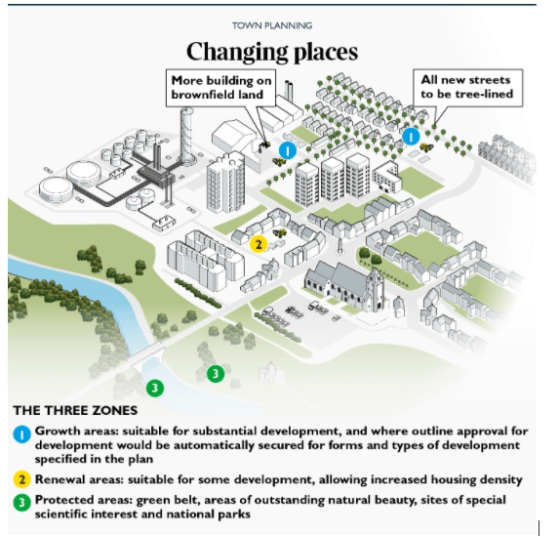
But under the reforms published this week, this will be replaced with a zoning system under which all land will be designated as one of three categories. In so-called growth areas, permission will be granted automatically without having to submit a planning application. In “renewal” areas, which are expected to cover urban and brownfield sites, permission will be automatically granted subject to some basic checks. Only in “protected areas”, such as the green belt and areas of outstanding natural beauty, will stricter development controls apply.
At first glance this may sound innocent, perhaps even sensible. But, concealed beneath the cuddly rhetoric about “affordable, green and beautiful homes”, lies a ferocious attack on democracy. Under the current system there are two opportunities for democratic participation in the planning system: first, at the formation of a local plan which sets out the strategic priorities for development in an area; and then at the planning application stage of individual developments, which tends to be many years later. Under the proposed reforms, the second stage of consultation will be scrapped. As a result, only those with psychic powers to foresee future developments will be able to object to them at the initial plan-making stage. Democratic oversight of individual developments will soon be a thing of the past.
This is, of course, intentional. More than anything else, the reforms serve to transfer power away from local elected representatives and towards private developers, who will be able to build whatever they like, unopposed. The significance of this should not be underestimated. From now on, our built environment will be shaped around the interests of shareholder value, unchecked by democratic accountability.
Some may argue that this is a price worth paying to break the logjam in housing supply. But, according to the Local Government Association, nine out of every 10 planning applications are approved by councils anyway. Some maintain that this figure is misleading, because only those who expect planning permission to be granted bother applying. But more than a million homes that have already been granted planning permission in the last decade have not yet been built. If the planning system really is the problem, why have these homes not been built?
The government’s reforms are premised on the assumption that the planning system is to blame for a shortage of housing, but curiously the white paper presents no evidence to support this claim. According to information obtained by Shelter under a freedom of information request, the government hasn’t even bothered to assess what impact its new proposals will have on housebuilding.
Luckily however, in 2018 the government commissioned an independent review to identify the drivers of slow construction rates in England. The so-called Letwin review found that the main bottleneck on housing supply isn’t the planning system, but the “market absorption rate” – the rate at which newly constructed homes can be sold on the local market without materially disturbing the existing market price.
In a system where development is left in the hands of profit-maximising firms, there is a strong incentive to build strategic land banks and drip-feed new homes on to the market at a slow rate. The reason for this is simple: releasing too many homes at once would reduce house prices in the area, which in turn would reduce profits.
By handing over even more power to private developers, the government’s reforms will make this problem even worse. Combined with the recent extension of permitted development rights (allowing change of use), the reforms could lead to a new generation of slum housing, as the Royal Institute of British Architects and others have warned. And by scrapping section 106 provisions, the future of social housebuilding has been cast into doubt.
All of this raises the question: why is Boris Johnson’s government really dismantling the planning system? As ever, it helps to follow the money.
As openDemocracy has revealed, the Conservative party has received £11m in donations from individuals and companies linked to the property sector since Johnson became prime minister. These donors are no doubt expecting a return on their investment. Robert Jenrick’s cosy relationship with Richard Desmond may may not be the last scandal to catch the limelight.
From the opening sentence to the final full stop, the government’s white paper emits a strong stench of corporate lobbying, and represents a slap in the face to evidence-based policymaking. At best the reforms represent an ideological crusade to undermine local authorities and hand over more power to private developers. At worst, they are part of a coordinated attempt to undermine English democracy. Either way, they must be resisted every step of the way.
• Laurie Macfarlane is economics editor at openDemocracy and a fellow at the UCL Institute of Innovation and Public Purpose. He is co-author of Rethinking the Economics of Land and Housing
Update on Help me hold the government to account for Covid-19 care home deaths
Update on Dr Cathy Gardner’s and Ms Fay Harris’ legal action against health secretary Matt Hancock.
“I know it has been a while since we sent out an update but please be assured that the case is still active and a full update will be posted in the next few days.
Thank you so much for donating and sharing the link to the Crowd Justice page with your family and friends. Your generosity has ensured that we have been able to submit our full case ‘grounds’ and, following responses from the defendants, we are about to submit our final comments to the court. We then have to wait for a judge to rule on whether we can go to court or not. Next weeks update will provide more details. If you have not read our full case then go to the second update (via the link on the Crowd Justice page) and use the hyperlink in the first paragraph. This is 95 pages but is worth reading to understand the scope of our claims against the three defendants and the evidence.”
many thanks
Cathy
The case has now reached the penultimate step before action in the High Court. This is stage at which the litigants, having rejected the defendant’s reply to their case, seek the “permission” of the High Court to proceed to Judicial Review. This is a paper review conducted by a Judge with the aim of weeding out cases that do not have sufficient merit to be argued in court.
When Sky News reported the story at the beginning of June they quoted independent barrister James Robottom as saying “I’ve got absolutely no doubt that permission will be granted by the High Court to proceed to judicial review.”
But there are no certainties in legal action. Previous governments have sought to make it harder to pursue a Judicial Review.
The case is being crowd funded through the link above. Owl believes that it is very much in the public interest that the case be brought to court.
Roads rammed as tourists arrive for holiday heatwave weekend
Stay safe this week end, perch in the trees – Owl
Max Channon www.cornwalllive.com
Long delays are being reported on the A30, A38, M5 and A35 as the holiday heatwave weekend begins in Cornwall and Devon.
The Met Office issued a six-day Level 3 heatwave health warning that came into force at midday yesterday.
And things are definitely hotting up on the roads, with queuing traffic on all the major routes in and out of the region.
The A38 around the Tamar Bridge and westbound beyond Plymouth, plus various parts of the A30 in Cornwall were the worst affected areas at around 11.15am this morning.
KEY EVENT
Traffic on A303 at standstill due to crash
Inrix reports: “A303 Mere By Pass in both directions blocked, stationary traffic due to accident between A350 (Chicklade) and B3092 (Mere).
“Congestion to Chicklade Westbound and Mere Eastbound. Affecting traffic between Salisbury and Yeovil, Road is blocked in both directions as police on scene await recovery.”
Max Channon
Queueing traffic and reports of crash A303
Inrix alert: “Reports of queueing traffic due to accident on A303 Mere By Pass Westbound between A350 (Chicklade) and B3092 (Mere). Affecting traffic between Salisbury and Yeovil, awaiting confirmation as to whether traffic can pass but sensors indicate the road may be blocked.”
Max Channon
Queueing traffic on A394 at Tremough
Inrix reports: “Queueing traffic on A394 in both directions from A39 (Treliever Roundabout, Tremough) to the Post Office (Rame Cross).Thought to be holiday traffic on the move.”
Max Channon
Broken down bus on main road to Dartmouth
Inrix reports: “A3122 partially blocked, slow traffic due to broken down bus near Butterwell Barn Hotel turn off. Note change of location.Originally reported to be near the Sportsmans Arms Pub. ”
Max Channon
One lane blocked on A38
Inrix reports: “One lane blocked and slow traffic due to broken down vehicle on A38 Westbound near New Road. Note change of location.Originally reported to be near Kilna Guest House. ”
Max Channon
Traffic easing on Torpoint Ferry
KEY EVENT
Traffic easing on M5, A30, A38 and other major routes

Highways England’s sensors show traffic is easing
KEY EVENT
A389 in Bodmin closed due to oil spill
Inrix reports: “A389 Priory Road Westbound closed, slow traffic due to oil spillage from Morrisons Petrol Station to Lidl Supermarket. Note change of location. Originally reported to be further up near the Church.”
Max Channon
Reports of A389 in Bodmin blocked
Inrix alert: “Reports of A389 Priory Road blocked, queueing traffic due to spillage near the Church. ”
KEY EVENT
Biker taken to hospital after crash with tractor closes beach road
A road in North Devon remains been closed after a crash involving a motorbike and a tractor.
Police say the motorcyclist has been taken to hospital and they hope to reopen the road to between Hele Bay and Barnstaple, near ilfracombe, soon.
READ MORE
KEY EVENT
M5, A35 and A396 will all be closed tonight
KEY EVENT
Hour long delays on M5 southbound
KEY EVENT
Fire service issues plea to drivers
Max Channon
Slow traffic on M5 Northbound
Inrix reports: “Slow traffic due to holiday traffic on the move on M5 Northbound from J22 ( Burnham-on-sea ) to J20 B3133 Ettlingen Way ( Clevedon ). In patches.”
Max Channon
A38 partially blocked at Buckfastleigh
Inrix reports: “A38 partially blocked, slow traffic due to broken down vehicle around A384 (Dartbridge Junction).”
KEY EVENT
Traffic easing on A30 and A38

Highways England’s sensors show traffic is easing on the A30 and A38 in Cornwall
KEY EVENT
Perranporth ‘gridlocked’ as Cornwall’s roads struggle with heatwave traffic
The beach resort of Perranporth on Cornwall’s north coast is gridlocked this afternoon, as the region’s roads struggle with heatwave holiday traffic.
Photos show a rugby pitch being used as an overflow car park is packed with vehicles – and the road into the seaside town a bumper-to-bumper queue of traffic.
READ MORE
KEY EVENT
Severe delays on M5 southbound
Inrix reports: “Severe delays and queueing traffic due to holiday traffic heading towards the coast for the weekend on M5 Southbound between J14 B4509 (Thornbury / Falfield) and J21 A370 (Weston-super-mare). Travel time is an hour and 25 minutes. ”
KEY EVENT
Traffic on the M5 south of Bristol this afternoon

Traffic on the M5 south of Bristol this afternoon
Max Channon
Expect delays on A393, says BBC
Max Channon
Traffic easing on A3O at Allet
Inrix reports: “Traffic easing on A30 from B3284 (Allet Turn Off, Allet) to A39 (Carland Cross, Carland Cross). Holiday traffic on the move.”
KEY EVENT
A361 North Devon link Road between Junction 27 M5 to Barnstaple very busy
Max Channon
Traffic “slowly easing” on Torpoint Ferry
Max Channon
Heavy congestion on M5 southbound, warns Highways England
Max Channon
Road in Exeter closed due to level crossing failure
Inrix reports: “Station Road closed, slow traffic due to level crossing failure near Pinhoe Train Station. Congestion to B3181 Main Road as traffic diverts around.The crossing barriers are stuck in the closed position since around 06:15 this morning.”
Max Channon
Very slow traffic around Torbay seafront
Inrix reports: “Very slow traffic due to beach traffic on B3201 Esplanade Road in both directions near Paignton Beach. ”
KEY EVENT
Exmouth seafront not a race track police tell Mercedes driver who overtook six cars on blind bend
Police have been forced to remind drivers that Exmouth seafront is not a race track – after a driver overtook six cars on a blind bend.
And the motorist wasn’t even driving a racing car. They were behind the wheel of a Mercedes people carrier – which had three push bikes on the roof.
Max Channon
Latest M5 updates
Inrix reports: “One lane closed and slow traffic due to broken down vehicle on M5 Southbound from J26 A38 (Wellington) to J27 A361 ( Tiverton ). Lane one (of three) is closed to assist with the tyre change.
“Slow traffic due to holiday traffic on the move on M5 Northbound from J24 A38 Taunton Road (Bridgwater South) to J20 B3133 Ettlingen Way (Clevedon).In patches. ”
Max Channon
Latest A38 updates
Inrix reports: “Slow traffic due to holiday traffic on A38 Westbound between A388 (Carkeel Roundabout, Saltash ) and A374 ( Trerulefoot roundabout, Trerulefoot ). In patches along the single lane stretches of the A38.
“Broken down vehicle removed on A38 Mill Road near the Butchers. No recent updates. Traffic was already struggling here due to holiday weekend traffic on the move.”
Max Channon
Latest A30 updates
Inrix reports: “Queueing traffic on A30 from B3284 (Allet Turn Off, Allet) to A39 (Carland Cross, Carland Cross). Travel time is around 25 minutes. Holiday traffic on the move.”
UK civil service braces for coronavirus inquiry
“A breakdown of trust between senior officials and Downing Street has sparked fears Whitehall could be thrown under the bus in an effort to save Boris Johnson and his top team.”
If Boris Johnson and “disruptor” Cummings can’t carry the Civil Service with them, what happens to the machinery of government? What happened to Ministerial Accountability? – Owl
Emilio Casalicchio www.politico.eu
LONDON — British civil servants are nervous about the impending coronavirus probe.
Britain has suffered one of the highest global death tolls in the pandemic, after waiting to lock the nation down, failing to protect care homes and only mandating the use of face masks in recent weeks, among other policy stumbles.
The decisions that led to the tragedy will be pored over in the independent inquiry the prime minister announced last month — but the fight over whether officials gave the wrong advice or ministers took the wrong decisions has already begun.
“Obviously the blame game has been going on almost as long as the virus and has been gathering force,” one former senior official told POLITICO. “As the epidemic wanes, the blame game is going to get more intense. I think the civil service is absolutely expecting that.”
One senior official said those working at the top of the government were reluctant to attach their names to decisions around the pandemic. “I’ve never seen people so averse to putting things in an email,” the person said.
Civil servants who feel they are being used as flak jackets for ministers could wage a silent protest by clogging up the wheels of government, the senior official warned.
That could see ministers become personae non gratae in the offices of those running departments, be refused advance sight of papers and lose priority treatment for their pet projects. “What you will get is a closing of ranks,” the official said. “They don’t go on strike — they are too middle class. This is their version.”
Dave Penman, the general secretary of the FDA union for top civil servants, said he did not expect relations to sink so low. But he warned that a damaging blame game would see the government lose “goodwill” from a workforce that has piled on extra hours and volunteered for difficult projects. “People won’t go the extra mile,” he said.
He also said civil servants would quit their jobs, preferring to earn more in the private sector where they hope to be treated better. “People will make choices about what they do and where they work,” he argued. “You will start to lose some talented people.”
Fair hearing
Top officials are expected to face practice grillings designed to prepare them to give evidence to a panel. Penman stressed that officials did not expect a rigged outcome to the probe because — assuming its terms are balanced and open — they will get a fair hearing. Instead, he fears a briefing war in advance to frame the narrative, as, he says, has been the routine since Johnson took office.
“Before we hit COVID, that is what people around No. 10 were doing — they were throwing civil servants regularly under the bus,” he said. “So I don’t think it’s an unfounded concern.”
Indeed, a report emerged in February that Downing Street had drawn up a “shit list” of top civil servants, thought of as roadblocks to change. Government leaders, including Cabinet Secretary Mark Sedwill, Foreign Office boss Simon McDonald and Home Office boss Philip Rutnam, have quit after negative briefings against them. The latter is suing the government for constructive and unfair dismissal over allegations of bullying by Home Secretary Priti Patel.
To some, hostility from the top comes as no surprise. Civil servants have read blogs written by top Downing Street aide Dominic Cummings, who attacked Whitehall in stark terms over its perceived failings and is said to favor “creative destruction” when it comes to reform.
The pandemic has only fueled the tensions in government. McDonald was forced to backtrack after he told a committee the decision not to take part in an EU ventilator scheme was “political.” Sedwill, bosses at Public Health England and even Health Secretary Matt Hancock are among those who have come under fire from anonymous sources in the press for their response to the crisis.
Sedwill told an event last month that the press reports were “damaging to the process of governance” and “demoralizing” for staff.
Some say an oppositional Downing Street team, made up of numerous figures from the 2016 Vote Leave campaign for Brexit, has little moral authority and will do anything to get its way — although No. 10 insists it is not behind negative briefings to the press.
Numerous current and former officials who agreed to speak for this article noted that the atmosphere could leave top civil servants fearful about the consequences of giving evidence to the coronavirus inquiry.
“People are inevitably going to be worried,” said a second former senior official. “It feels like it will come down to who has the power to get their story out, and that is something where civil servants are at a constitutional disadvantage and where the evidence of the current political team is they don’t hesitate.”
The same person warned that a negative mood could stop lessons being learned: “You have to have the ability to have the conversations about what has happened, and if people feel that the whole thing is going to become an oppositional process … [that] has long-term consequences.”
But a Downing Street official insisted the inquiry would be a fair procedure that could well “exonerate” all those involved in the pandemic response.
“If the inquiry is done fairly it may show that the advice was wrong in retrospect, but I think it should also be able to reveal that the advice was reasonable at the time on the basis of the evidence,” the person said.
The official insisted it was “absurd” to think Downing Street would “design an inquiry to frame anybody,” adding, “It would be naive of people to think that of the political layer, because I don’t think it’s ever a solution.
“There will be an inquiry, it will have recommendations and the PM has said repeatedly ‘I take responsibility for everything we did’,” the person said. “I think that is the approach you have got to take and I don’t think it can be accusatory in retrospect.”
Terms and conditions
The next battle will be over the terms of the inquiry, who chairs it and whether it has a deadline to produce conclusions. In some countries, inquiry commissions have a defined end date — but that is unusual in Britain.
It means some are already expecting Downing Street to gear the probe toward delivering the minimum political impact. “If past inquiries are anything to go by, I strongly suspect the prime minister will want this one to take place slowly — most likely to be delivering its results after the 2024 election,” said the first former senior official.
The same person argued there was no reason for preparations not to begin immediately, including setting the terms of reference and appointing a chairman. Indeed, Chief Scientific Officer Patrick Vallance has begun preparations by putting out a call for an official to gather evidence.
The sentiment was echoed by former Johnson adviser Will Walden, who argued the government should hold a short analysis of the initial failings to learn how to better handle future waves of the virus. “I don’t think this has to be party political,” he told the BBC. “It’s not about point scoring, it has to be about learning. And frankly, government is about grown-up behavior — and that has to be the way forward.”
Johnson appeared to take the advice on board, telling the broadcaster: “Maybe there were things we could have done differently, and of course there will be time to understand what exactly we could have done, or done differently.”
The Guardian view on planning: put people before profit
New green homes are needed, but the prime minister’s promise to cut red tape is a soundbite not a solution.
Editorial www.theguardian.com
How much do people care about the planning system? England is about to find out. Initial reaction to the government’s plan to strip councils of their powers over development has been ferocious, with planners, architects, local government, conservation charities and housing campaigners lining up with Labour to attack it. But whether ministers can be deterred from legislation that would replace the current case-by-case decision-making process with a presumption in favour of building in designated “growth” and “renewal” zones, will depend on whether the outcry runs deeper – and how long it lasts.
It is easy to see why ministers wanted to do something to boost housebuilding. Enormous rises in the value of residential property in recent decades, particularly in the southeast, have created a feel good factor among homeowners even when the wider economic position did not justify it. Meanwhile, frustration among a younger generation locked out of these unearned riches has continued to rise. It is 10 years since the former Conservative minister David Willetts published his provocative analysis of intergenerational inequality, The Pinch: How the Baby Boomers Took Their Children’s Future – and Why They Should Give It Back. Over that period, the impact of the banking crisis and now coronavirus, combined with a bleak environmental outlook, mean that the prospects for younger people have got much worse. One survey last year found that 70% of 18- to 34-year-olds believe they will never own their own homes.
Eager to please these voters, among whom Conservatives know they have a problem, and to boost at least one part of the economy and jobs market, ministers and their advisers set about smoothing a path for developers across the tricky terrain of local authority planning meetings. But while Robert Jenrick, the housing secretary, promised a “really serious debate” in communities about the new local planning documents, and insisted that the shakeup would “really help small builders”, the far more likely effect of the proposals, should they become law, is that local democracy will once again be the loser while property speculators, who form a powerful group of Tory donors, are the winners. While the promised “fast track for beauty” might sound attractive – for who, given the choice, does not prefer high-quality design? – in the context of a white paper that seeks to remove local scrutiny, and give developers free rein, it should be seen for what it is: a spoonful of sugar to help traditionalists swallow the rest.
It is only a few weeks since Mr Jenrick was revealed to have dined and swapped texts with the former Daily Express owner Richard Desmond in advance of granting him permission for a £1bn property scheme 24 hours before new community charges were imposed – a decision that was later quashed by the courts. Meanwhile at the Grenfell inquiry, evidence of the way that cost-cutting and safety checks were handled under a flagship Tory council continues to shock. Thousands of people across the country remain stuck in towers covered in unsafe cladding, while there is still no sign of a promised bill to strengthen tenants’ rights, a measure that is more urgent than ever given the approaching end of a freeze on evictions and predictions of an upsurge in pandemic-linked homelessness.
If the government and its MPs truly believe that a complete overhaul of a planning system created in 1947 is in the best interests of the country, and a priority in the current crisis, they must make the case for it. Environmental standards, it goes without saying, should be uppermost. Tweets from the prime minister, promising to “cut the red tape”, are not only insufficient but insulting given the recent and agonising history of buildings regulation failure. Whether green and pleasant or grey and urban, our land and the people who live on it deserve more than soundbites from the politicians who want to restrict their say over its future shape.
Homes target places Johnson on collision course with Tory shires
Boris Johnson is facing discontent from Tory-controlled local authorities by ordering England’s more affluent areas to release the most land for housing.
By Dell www.thetimes.co.uk
Under a reform of planning laws, local control over the rate of building will effectively be removed. Instead, central government will “distribute” an annual target, at present 300,000 homes, among local authorities, which will be required to designate enough land to meet it.
The consultation document proposes a new “standard model” to replace the existing system under which each council negotiates its own targets with the housing department.
It also proposes a new test to see how a development will affect its surroundings and abolishes the duty to co-operate with public bodies, such as English Heritage and the Environment Agency, on cross-boundary matters, which could dismay campaigners.
While ministers will take account of local factors such as national parks and green belts, councils that have traditionally failed to make enough land available to keep pace are being put on notice.
The document states that the new system will ensure “that the least affordable places where historic undersupply has been most chronic take a greater share of future development”.
The reforms, which also limit local politicians’ power to block individual developments, have caused unease among Tory MPs and councillors.
James Jamieson, the Local Government Association’s Conservative chairman, said: “Any loss of local control over developments would be a concern.”
Sir Geoffrey Clifton-Brown, Tory MP for the Cotswolds, said: “We do need some reform, but as people who have tried this before have found, if you are not careful it does have knock-on effects.”
“Whilst I’m all in favour of building more houses, they need to be good-quality houses, we have got to be really sure that we are not building slums of tomorrow by building today at low quality,” he told the BBC.
Hugh Ellis, a director at the Town and Country Planning Association, said the greatest factor in building decent social housing for rent was investment, not planning, and warned it was “really troubling” that “this is not a democratisation of planning”.
At present, he said, critics of a building project “get two bites of the cherry, they can have an involvement in the plan, they can comment on planning applications”, he told Today on BBC Radio 4. “Half that process is going to effectively disappear.”
Shares in Britain’s biggest listed housebuilders fell yesterday amid concerns that the changes would create years of uncertainty around planning policy while the measures were consulted on and brought forward.
Persimmon, Taylor Wimpey and Barratt Developments all lost about 4 per cent of their market value.
David O’Leary, head of policy at the Home Builders Federation, said: “The big fear is this could result in a bit of paralysis for a year or two as local authorities stop working on current local plans.” However, he said that there were no major “red flags” for the big developers, which broadly welcomed the proposals. John Tutte, the chairman of Redrow, said: “I welcome anything that streamlines the planning system. It’s long overdue.”
Anthony Codling, a housing analyst, said that if the changes were implemented it could be a huge boost to big listed developers and their shareholders because they would not need to hold such big land banks. “For the largest UK housebuilders, this could free up around £1 billion of each of their balance sheets, which could fund dividends for the future.”
Smaller builders also welcomed the changes to a complex planning system that has put them at a disadvantage.
James Forrester, managing director of Stripe Homes, said: “For too long the big house builders have had a stranglehold over the sector, allowing them to drip feed developments as they see fit in order to keep house prices and their profit margins buoyant.”
The Centre for Policy Studies said that the plan for locally agreed building design codes could reduce opposition to development and make it faster and more profitable.
“Abolishing national prescriptions will clear the way for local people to set design codes on the issues that really matter to them through neighbourhood planning,” Alex Morton, the think tank’s head of policy, said.
“More broadly, these planning reforms are an intelligent first step in reform but much more detail will be needed and many vested interests will try to slow and stop reform.”
Case study
Locals locked in a four-year battle against a proposed 3,000-home development have described the news that planning laws are to be loosened as “heartbreaking” (Tom Ball writes).
Jacky Nabb, who is opposed to the building of a new village in the Oxfordshire countryside, said that it felt as though “somebody just twisted my stomach” when she heard that the government had announced plans to slash the red tape around house building.
The proposed development near Chalgrove would feature a market, a town centre, two primary schools, a secondary school, a sixth-form college and a road bypass.
After years of opposition to the plans, residents fear that the reformed planning laws would render them powerless to prevent the development from going ahead.
Ms Nabb, a Chalgrove resident, told BBC Radio 4’s Today: “It sounds really dramatic, but it broke my heart.”
Simon Reynolds, another resident, wrote on Facebook: “Fast-tracking will simply mean the local people get even less of a say than we do at present, and we are not really listened to now. South Oxfordshire district council have paid lip service to local objections but it’s all we can do.”
He urged fellow residents to oppose the planning application “while you can” before the deadline of September 1.
“Over 200 objections so far. Let’s make it three times that. Obviously the more detailed the better, but even a short objection with relevant points is good,” Mr Reynolds added.
Robert Jenrick, the housing secretary, said that claims that the draft laws for England would create a generation of low-quality homes were “complete nonsense”.
Homes England, which owns an airfield that is earmarked for the development, said that it would help to “meet the unmet housing need of the area” and protect the green belt and local jobs.
Prove Dominic Cummings did not make second Durham trip, No 10 urged
Downing Street has been urged to provide proof that Dominic Cummings did not make a second trip to Durham during lockdown amid claims that police failed to properly investigate alleged sightings of the prime minister’s chief aide.
Matthew Weaver www.theguardian.com
Two of four people who claim to have seen Cummings on what would have been a second visit to the north-east of England have complained to the police watchdog, accusing the Durham force of not fully probing their claims.
Cummings has consistently denied returning to Durham on 19 April, days after he came back to London from a trip that was subsequently exposed in a joint investigation by the Guardian and the Daily Mirror.
The prime minister’s chief adviser has said that phone data and potentially CCTV would prove he was in London – and the Guardian has been told of one sighting of him on Hampstead Heath that afternoon.
However, neither he nor Downing Street has gone public with the evidence they say they have – and which Boris Johnson says he has seen – and pressure is mounting again for full transparency to answer lingering questions about his movements.
Cummings’ initial trip to Durham caused widespread uproar and is cited as one of the chief reasons for the public losing faith in the government’s handling of the crisis.
Clare Edwards, a nurse practitioner, and her husband, Dave, say they saw a man they believe to have been Cummings on 19 April just after 11am in Houghall woods on the edge of Durham.
On 25 May they gave statements to police about the alleged sighting, just as Cummings was giving a press conference in Downing Street denying a claim by another witness that he was seen admiring bluebells with his wife in the same woods on 19 April, at about 8.30am.
Since then, a fourth witness has alleged they saw the No 10 aide and a companion in between the woods and the home of Cummings’ parents that day, between 11.15am and 11.30am.
A further witness told the Guardian that they saw Cummings back in north London, on Hampstead Heath, later the same afternoon.
Durham police found “insufficient evidence” that Cummings was in Durham on 19 April. Following that assessment, Clare and Dave Edwards, both 59, made a subject access request under the Data Protection Act, asking the force to show them all the personal information it had about them as a result of their complaint, which they hoped might reveal how it was followed up.
Most of the police correspondence about their original complaints was redacted and labelled “official – sensitive”. All pre-dated the statements given to police, which Dave Edwards suggests means the police did nothing more with those statements.
Edwards said he believed the results, returned last week, suggested that their testimony was not taken seriously. On Wednesday the couple complained to the Independent Office for Police Conduct. They said: “Given the high-profile nature of this issue, it is inconceivable that this matter has not been followed up thoroughly. We have no personal issue with Mr Cummings or his family, but we do feel that Durham police’s handling of our complaint is below the standard we would expect from our local constabulary.”
The Edwardses asked whether officers checked automatic number recognition cameras for the movements of Cummings’ car that weekend. This information would not typically be revealed under a subject access request, and the force did not answer.
Dave Edwards, who works for a manufacturing company that supplied some of the Nightingale hospitals, remains convinced that he saw Cummings among a group of five adults and a child. “He was the dead image of Dominic Cummings. He was standing over a small child on a bike. As I got through the clearing, I said to my wife: ‘Did you see Dominic Cummings there?’
“He was identical to the TV footage: dark beanie hat, dark-rimmed glasses. If it was mistaken identity, the police could have ruled that out. If Cummings had the evidence, it would be very easy for him to say: ‘Here I am in Costa coffee in London at 10am on 19 April,’ or whatever, ‘so I couldn’t have been in Houghall woods.’
“I’m not politically motivated, I have nothing against Cummings. But we think what we saw was important given the circumstances of the lockdown, and we feel that our complaint has been airbrushed.”
Clare Edwards said: “I’m certainly sure that it was Dominic Cummings.” In her statement to officers, she said she saw a man she thought to be Cummings just after 11.01am on 19 April. She said she was able to be precise after finding a timestamped geolocated photograph she took of the woods moments before seeing the man. The couple remember the date because they had a Zoom party and quiz for their son’s birthday the day before as they were not allowed to meet due to the lockdown restrictions. Clare Edwards also called on Cummings to release evidence proving he was in London at the time.
A fourth witness, who does not want to be named, is convinced that they saw Cummings and a companion between 11.15am and 11.30am that day, between Houghall woods and Cummings’ father’s property. They made a digital note of the sighting, including location data, which was shared with friends at the time. That note has been seen by the Guardian and Daily Mirror.
The witness said: “I do follow politics, so I know what people look like.” Asked whether they were sure it was Cummings, they said: “We know his parents do live locally, so we have recognised them before in the local area. I would recognise him again. At first I could not quite believe that I had seen him. I thought: ‘Why would he be up here?’ But I posted about it on the day. I was sure about it at the time.”
A No 10 spokesman said: “Durham constabulary have made clear they are not taking any further action against Mr Cummings and that by locating himself at his father’s premises he did not breach the regulations.
“The prime minister has said he believes Mr Cummings behaved reasonably and he considers the matter closed.” No 10 did not comment on specific allegations that Cummings was in Durham on 19 April.
Cummings has defended driving to his parents’ farm from London on 27 March after fearing that he and his wife were falling ill with coronavirus, to seek potential childcare for their four-year-old son. They made a 60-mile round trip to Barnard Castle on 12 April – Cummings said to test his eyesight – and drove back to London the following day.
At his press conference in the Downing Street rose garden in May, he said it was false to claim he returned to Durham again after coming back to London on 13 April. He said: “There is a particular report that I returned there on the 19 April. Photos and data on my phone prove this to be false. And local CCTV, if it exists, would also prove that I’m telling the truth that I was in London on that day. I was not in Durham.”
Cummings said witnesses who claimed they saw him in the bluebell wood on 19 April were mistaken. He said he had walked in woodland during his self-isolation period, but only on his father’s property.
At the end of May, the prime minister was challenged by the Commons liaison committee about whether he had seen the evidence. After dodging the question three times, he said he had, but refused MPs’ requests to publish the evidence or pass it to the cabinet secretary for independent scrutiny.
The Guardian asked Downing Street to provide the data to rule out a case of mistaken identity on 19 April, but it declined.
A Durham police spokesman said: “As outlined in our statement of 28 May, Durham constabulary carried out an investigation into this matter led by a senior detective and found insufficient evidence to support the allegation.”
• Additional reporting by Duncan Campbell
7 awkward details in the small print of Tories’ 30% house price discount plan
First-time buyers will be able to get 30% off their home in a major new government discount scheme.
House prices will be drastically cut on special new homes for local people, key workers and first-time buyers on new build properties – with Londoners earning up to £90,000 able to benefit.
Lizzy Buchan www.mirror.co.uk
Housing Secretary Robert Jenrick unveiled the ‘First Homes’ scheme as part of a shake-up of planning rules aimed at boosting housebuilding in England.
He said it will allow “local first-time buyers to be able to settle where they have ties and raise families of their own”.
The discounts for local people will last for three months – and if the property is unsold, then first-time buyers from other parts of England will be eligible.
Deposits will be limited to 50%. And when the original buyer sells up, a covenant on the Title Deed will force them to pass on the 30% discount to the next owner.
And in areas where house prices are higher, local councils will be able to demand higher discounts of 40-50% below market value from developers, if they can prove there is a need for more affordable homes in their community.
But it’s not all sunshine and roses.
It’s not clear how many of these new homes will actually be available. It’s also not fully clear how they’ll be prioritised for key workers.
Some people on £90,000 salaries will be eligible for the scheme in London – hardly those most in need.
And there’s admission that First Homes will erode other affordable housing – including social rent.
So what are the pitfalls in the big plan? We’ve run the rule over the small print so you don’t have to.
1. People on £90,000 salaries can benefit
Londoners with incomes of up to £90,000 will be eligible for the new discount.
Outside London, the salary limit will be capped at £80,000.
The limit is on “household income” – so of course, if both members of a couple have a job, the threshold will feel much lower.
But if a family only has one worker, or the buyer is single, some people on pretty mega salaries could find themselves benefiting from the scheme.
The government appears to recognise this could be a problem. Its documents say “there may be local circumstances where lower caps are necessary”.
Councils will have the power to set salary caps lower than £80k or £90k – though they’ll only apply for the first three months the home is on the market.
Councils could also take buyers’ incomes – though not their assets – into consideration when looking at who should get first dibs on any oversubscribed scheme.
Prices of the homes themselves will be capped at £250,000 outside London and £420,000 in the capital.
2. It’ll mean fewer homes for affordable rent
Buried in the small print is a startling confession.
The government admits the scheme could chip away at other kinds of affordable homes – including those for “social rent”.
This is crucial, because many of the people who need a home most desperately can’t afford to buy. They need somewhere to rent, cheaply.
The confession emerged in an impact assessment that found there’ll be “both positive and negative” impacts on disadvantaged groups.
The positive is that they’ll get discounted home ownership, and more homes on the market.
But the negative is there would be “a reduction in the number of homes available in other affordable housing tenures, particularly social and affordable rent”.
The government decided to go for the scheme anyway, because “our analysis suggests that the reduction in the number of homes delivered in these tenures is likely to be relatively small, compared to the number of First Homes delivered.”
3. It’s not clear how key workers will get priority
The government pledged the new scheme will have “an emphasis on key workers”, like NHS staff or police. Officials added councils will be able to “prioritise” First Homes for these workers.
But the detail of the plans doesn’t actually spell out how they’ll be put to the front of the queue.
Councils will have the power to lower the salary cap to ensure key workers aren’t elbowed out by others on middle incomes.
There will, of course, be a “local connections” test.
And the prospect has been dangled of allowing key workers who aren’t first-time buyers to use the scheme for upsizing (see below).
But today’s plans contain no suggestion that non -key-workers will be barred from buying a First Home.
In other words, it appears the system will try to gear towards key workers in the way it’s designed, but there doesn’t seem to be an actual cast-iron guarantee they’ll come first.
4. Some people can get the discount even if they’re not first-time buyers
First Homes should “as a rule” only be sold to first-time buyers.
But a consultation found some people wanted the scheme to be open to “key workers” who are selling their first home and upsizing to a new place.
So the government says in “certain, limited circumstances”, people who aren’t first-time buyers will be able to benefit from the scheme.
The government will publish a list of circumstances under which non-first-time buyers can be eligible for First Homes.
That list, or who’ll be on it, is yet to be confirmed.
5. Not all buyers will need to be local
First Homes will need to be sold to people with “local connections”.
The definition of this – and how to prove you’ve got local links – will be decided by each area’s council.
But this restriction will only apply for the first three months the home is on the market.
While developers will need to show they’ve been “actively marketing” First Homes to local people, if it remains unsold, it’ll then open up more widely.
At that point, the home will become available to all first-time buyers across England at a 30% discount.
6. Buyers can let out their ‘First Homes’ for up to two years
First Home buyers will need to occupy the home as their “primary residence”.
However, they’ll then be allowed to let them out for up to two years – as long as they notify the local council.
This is designed to ensure people can move away from the area or find alternative arrangements in a rough patch.
The two-year period could be extended in certain circumstances, with the council’s permission.
These include a job posting or deployment elsewhere, a relationship breakdown, fleeing domestic violence, redundancy or caring for a relative or friend.
While these will no doubt help many people in need, the two-year clause could potentially attract others who don’t need the help as much. Buyers will also be able to let out their home short-term if they go on holiday.
7. Don’t expect lots of ‘First Homes’ in a hurry
The only firm, immediate commitment in today’s document is to a pilot of 1,500 First Homes to be delivered through the Affordable Homes Programme.
Beyond that, it’s not yet clear when developers would be compelled to start providing First Homes.
The government says “25% of all affordable housing units secured through developer contributions” on a scheme will need to be First Homes.
But this is a relatively small fraction of a scheme when you consider much of each scheme will not be “affordable”.
First Homes will initially be funded through something called Section 106 agreements, but these are being scrapped by the government. They will then be funded by a new-style levy designed to replace Section 106.
Tory minister skewered over property tycoon donations in toe-curling interview
This Government and its advisers appear to have no sense of shame – Owl
Lizzy Buchan www.mirror.co.uk
Tory minister Robert Jenrick has admitted he has “no idea” how much money property developers have donated to the Conservatives in the past year in a toe-curling interview.
The Housing Secretary was challenged on the number of donations to the party from property tycoons since Boris Johnson became Prime Minister, amid claims from Labour that his new planning overhaul was a “developer’s charter”.
He told BBC Radio 4’s Today programme: “Well I’ve no idea because ministers are not involved in those issues, that is entirely for the Conservative Party.”
Presenter Nick Robinson said £11m had been donated since Mr Johnson entered No10 and asked how the public could trust the Tories when they were receiving so much cash from developers.
Mr Jenrick hit back, saying: “You’re entirely mischaracterising what we’re doing here. We’re actually asking developers to pay more.”
He said the Government are “saying we’re going to abolish the current system which favours the big developers”.
In an awkward exchange, the senior Tory also admitted he regrets sitting next to developer Richard Desmond at a Tory fundraising dinner and sending him text messages afterwards.
Mr Jenrick came under sustained criticism when it emerged that he had met Mr Desmond at an event in November, where he was shown a video of the 1,500-home development at the former Westferry printworks in east London.
The Government later published documents relating to the development, which revealed that Mr Jenrick rushed through a decision on the project to prevent Mr Desmond’s company from paying an estimated £40million in tax to the local council.
Just 12 days after the decision was made, Mr Desmond personally donated £12,000 to the Conservative Party.
Mr Jenrick was later forced to overturn his own decision due to “apparent bias”.
Asked why people should trust him over the Government’s new planning proposals, Mr Jenrick said: “Well I don’t think this does give more power to developers, it creates a much more certain system. It will, for example, fix the challenge of developer contributions once and for all.”
Pushed to explain what he learned from the experience of the Westferry development, Mr Jenrick added: “I’ve set out the events around that decision and there are definitely lessons to be learnt.
“I wish I hadn’t been sat next to a developer at an event and I regret sharing text messages with him afterwards.
“But I don’t regret the decision, because I think it was right to get housing built on a brownfield site on a part of London that desperately needs it.
“The system that I’ve helped to design that is set out in the proposals we’re publishing today will actually move us forward significantly on some of the challenges that that case rose.”
Downing Street has said the matter is “closed”.
Planning for the Future – Ministry of Housing, Communities and Local Government – Consultation
The Government has just launched the consultation phase of its paper “Planning for the Future”. Consultation is open for 12 weeks closing on 29 October.
The consultation takes the form of responding to a series of questions. This might, at first sight, appear restrictive but Owl has taken the trouble of copying all the questions to show that they permit ample scope for individuals and organisations to express their views and provide supporting evidence.
Owl would also encourage individuals to lobby their MPs as well.
Find the documentation here.
Topic of this consultation:
This consultation seeks any views on each part of a package of proposals for reform of the planning system in England to streamline and modernise the planning process, improve outcomes on design and sustainability, reform developer contributions and ensure more land is available for development where it is needed.
Scope of this consultation:
This consultation covers a package of proposals for reform of the planning system in England, covering plan-making, development management, development contributions, and other related policy proposals. Views are sought for specific proposals and the wider package of reforms presented.
This consultation is open to everyone. We are keen to hear from a wide range of interested parties from across the public and private sectors, as well as from the general public.
Body/bodies responsible for the consultation:
Ministry of Housing, Communities and Local Government
Duration:
This consultation will last for 12 weeks from 6 August 2020. Enquiries:
For any enquiries about the consultation please contact planningforthefuture@communities.gov.uk.
How to respond:
You may respond by going to our website
https://www.gov.uk/government/consultations/planning-for-thefuture
Alternatively you can email your response to the questions in this consultation to planningforthefuture@communities.gov.uk.
If you are responding in writing, please make it clear which questions you are responding to.
Written responses should be sent to: 5 Planning for the Future Consultation, Planning Directorate, 3rd Floor, Fry Building, 2 Marsham Street, London, SW1P 4DF
When you reply it would be very useful if you confirm whether you are replying as an individual or submitting an official response on behalf of an organisation and include:
– your name,
– your position (if applicable),
and – the name of organisation (if applicable)
Questions
- What three words do you associate most with the planning system in England?
- Do you get involved with planning decisions in your local area? [Yes / No]
2(a). If no, why not? [Don’t know how to / It takes too long / It’s too complicated / I don’t care / Other – please specify]
- Our proposals will make it much easier to access plans and contribute your views to planning decisions. How would you like to find out about plans and planning proposals in the future? [Social media / Online news / Newspaper / By post / Other – please specify]
- What are your top three priorities for planning in your local area? [Building homes for young people / building homes for the homeless / Protection of green spaces / The environment, biodiversity and action on climate change / Increasing the affordability of housing / The design of new homes and places / Supporting the high street / Supporting the local economy / More or better local infrastructure / Protection of existing heritage buildings or areas / Other – please specify]
- Do you agree that Local Plans should be simplified in line with our proposals? [Yes / No / Not sure. Please provide supporting statement.]
- Do you agree with our proposals for streamlining the development management content of Local Plans, and setting out general development management policies nationally? [Yes / No / Not sure. Please provide supporting statement.]
7(a). Do you agree with our proposals to replace existing legal and policy tests for Local Plans with a consolidated test of “sustainable development”, which would include consideration of environmental impact? [Yes / No / Not sure. Please provide supporting statement.]
7(b). How could strategic, cross-boundary issues be best planned for in the absence of a formal Duty to Cooperate?
8(a). Do you agree that a standard method for establishing housing requirements (that takes into account constraints) should be introduced? [Yes / No / Not sure. Please provide supporting statement.]
8(b). Do you agree that affordability and the extent of existing urban areas are appropriate indicators of the quantity of development to be accommodated? [Yes / No / Not sure. Please provide supporting statement.]
9(a). Do you agree that there should be automatic outline permission for areas for substantial development (Growth areas) with faster routes for detailed consent? [Yes / No / Not sure. Please provide supporting statement.]
9(b). Do you agree with our proposals above for the consent arrangements for Renewal and Protected areas? [Yes / No / Not sure. Please provide supporting statement.]
9(c). Do you think there is a case for allowing new settlements to be brought forward under the Nationally Significant Infrastructure Projects regime? [Yes / No / Not sure. Please provide supporting statement.]
- Do you agree with our proposals to make decision-making faster and more certain? 33 [Yes / No / Not sure. Please provide supporting statement.]
- Do you agree with our proposals for accessible, web-based Local Plans? [Yes / No / Not sure. Please provide supporting statement.]
- Do you agree with our proposals for a 30 month statutory timescale for the production of Local Plans? [Yes / No / Not sure. Please provide supporting statement.]
13(a). Do you agree that Neighbourhood Plans should be retained in the reformed planning system? [Yes / No / Not sure. Please provide supporting statement.]
13(b). How can the neighbourhood planning process be developed to meet our objectives, such as in the use of digital tools and reflecting community preferences about design?
- Do you agree there should be a stronger emphasis on the build out of developments? And if so, what further measures would you support? [Yes / No / Not sure. Please provide supporting statement.]
- What do you think about the design of new development that has happened recently in your area? [Not sure or indifferent / Beautiful and/or well-designed / Ugly and/or poorly-designed / There hasn’t been any / Other – please specify]
- Sustainability is at the heart of our proposals. What is your priority for sustainability in your area? [Less reliance on cars / More green and open spaces / Energy efficiency of new buildings / More trees / Other – please specify]
- Do you agree with our proposals for improving the production and use of design guides and codes? [Yes / No / Not sure. Please provide supporting statement.]
- Do you agree that we should establish a new body to support design coding and building better places, and that each authority should have a chief officer for design and place-making? [Yes / No / Not sure. Please provide supporting statement.]
- Do you agree with our proposal to consider how design might be given greater emphasis in the strategic objectives for Homes England? [Yes / No / Not sure. Please provide supporting statement.]
- Do you agree with our proposals for implementing a fast-track for beauty? [Yes / No / Not sure. Please provide supporting statement.]
21 – appears to be missing [maybe these whizz kids can’t count – Owl]
- When new development happens in your area, what is your priority for what comes with it? [More affordable housing / More or better infrastructure (such as transport, schools, health provision) / Design of new buildings / More shops and/or employment space / Green space / Don’t know / Other – please specify]
23(a). Should the Government replace the Community Infrastructure Levy and Section 106 planning obligations with a new consolidated Infrastructure Levy, which is charged as a fixed proportion of development value above a set threshold? [Yes / No / Not sure. Please provide supporting statement.]
23(b). Should the Infrastructure Levy rates be set nationally at a single rate, set nationally at an area-specific rate, or set locally? [Nationally at a single rate / Nationally at an area-specific rate / Locally]
23(c). Should the Infrastructure Levy aim to capture the same amount of value overall, or more value, to support greater investment in infrastructure, affordable housing and local communities? [Same amount overall / More value / Less value / Not sure. Please provide supporting statement.]
23(d). Should we allow local authorities to borrow against the Infrastructure Levy, to support infrastructure delivery in their area? [Yes / No / Not sure. Please provide supporting statement.]
- Do you agree that the scope of the reformed Infrastructure Levy should capture changes of use through permitted development rights? [Yes / No / Not sure. Please provide supporting statement.]
25(a). Do you agree that we should aim to secure at least the same amount of affordable housing under the Infrastructure Levy, and as much on-site affordable provision, as at present? [Yes / No / Not sure. Please provide supporting statement.]
25(b). Should affordable housing be secured as in-kind payment towards the Infrastructure Levy, or as a ‘right to purchase’ at discounted rates for local authorities? [Yes / No / Not sure. Please provide supporting statement.]
25(c). If an in-kind delivery approach is taken, should we mitigate against local authority overpayment risk? [Yes / No / Not sure. Please provide supporting statement.]
25(d). If an in-kind delivery approach is taken, are there additional steps that would need to be taken to support affordable housing quality? [Yes / No / Not sure. Please provide supporting statement.]
- Should local authorities have fewer restrictions over how they spend the Infrastructure Levy? [Yes / No / Not sure. Please provide supporting statement.]
26(a). If yes, should an affordable housing ‘ring-fence’ be developed? [Yes / No / Not sure. Please provide supporting statement.]
- Do you have any views on the potential impact of the proposals raised in this consultation on people with protected characteristics as defined in section 149 of the Equality Act 2010?
The Secret Diary of a track and tracer “I have seldom felt so desperate”
After people working for England’s test-and-trace system told the Guardian they were making a handful of calls a month, John Crace imagines the secret diary of a contact tracer
John Crace www.theguardian.com
29th May: An email arrives. “Dear Sir, I am delighted to offer you a job as one of the UK’s ‘world-beating’ test and tracers. It will be tough, skilled work, involving dozens of phone calls each day, and your training will begin tomorrow. Thank you again for your dedication. Together we can beat the coronavirus and bring the country back to normal by Christmas. Yours, Boris Johnson and Baroness Dido Harding.”
7th June: Another email arrives. “Congratulations on completing your training.” I reply that I have yet to receive any training. Hear nothing back.
9th June: I email the head of training at Serco to remind her of my existence and to say that I am still awaiting instructions. This time she replies promptly to say that the training was targeted to help workers get used to long periods of doing nothing and that I need to be focused a great deal more on being patient. The less we do, the more effective we are being.
23rd June: I have yet to make a single test-and-trace call, despite having sat at home with my phone at the ready and the TV switched off for the past 14 days. I ring my local Serco HQ to check that they actually have the right number for me. They do so, and confirm that I am in the weekly draw for the most productive member of staff over the course of the last week.
1st July: Sod’s law. Have just invited some friends over for a barbecue, when I get an alert from the test-and-trace centre to call someone. Go indoors to prepare to give the bad news they will have to self-isolate for 14 days only to find it is a non-existent number.
4th July: I’m now on a roll. I get a second alert and call the number, which goes straight to voicemail. I don’t let this go as I don’t want to be responsible for a super-spreader slipping through the net. Eventually a man picks up and starts yelling at me. I am the 12th person to have contacted him over the past few days and would I please stop interrupting his quarantine?
10th July: The call centre emails to ask me what my favourite flower is. I give this a few minutes’ thought and reply. “On balance, I think I like bluebells the best. Why do you want to know?” An hour or so later I get an out-of-office reply saying “To be honest, we don’t give a shit one way or another what your favourite flower is. It was just a way of finding out how many of you were still monitoring your phones.”
18th July: I have seldom felt so desperate. I submit my own number to the test-and-trace database just so that someone will ring me to tell me to self-isolate. Even then no one calls. I ring the Serco human resources department. After half an hour the line goes to voicemail. “If you are a test and tracer who feels their life might be entirely futile, please try calling the self-help group Test and Trace Anonymous.”
19th July: “My name’s Simon and I’m a test and tracer,” I say. “Join the club,” says a woman. “Try not to worry too much. There are thousands of us who feel the same. Some people have been doing this for months without talking to anyone. Why don’t you sign up for one of our daily quizzes?” Finally I feel like I am getting somewhere.
21st July: Totally psyched for the quiz. “Question 1: Name the woman on the Jockey Club board who was responsible for giving this year’s Cheltenham festival the go-ahead, thereby risking the spread of the coronavirus pandemic.” Easy. Dido Harding. “Question 2: Name the former chief executive of TalkTalk whose utter ignorance of the company was famously described as a lesson to all.” That would be Dido again. I’m beginning to think there may be a theme here.
24th July: Am given a number to ring by one of the other test and tracers. Big mistake. I get through to a Liam Fox who thinks I am from the World Trade Organization. “I’m sorry about all my hacked emails on the US-UK trade talks,” he says. “But am I still in line to be director of the WTO?” I suggest that’s unlikely. But on the upside I tell him he doesn’t have to self-isolate for 14 days. He starts blubbing and I put the phone down gently.
26th July: I finally get to make a call that isn’t a fake number, doesn’t go to voicemail and hasn’t been rung countless times before. As a result, I am given a €50 voucher to spend anywhere in Spain over the course of the next month.
27th July: All non-essential travel to Spain is stopped and a 14-day quarantine imposed on travellers returning from the country. Try to flog my voucher to friends stuck in Spain for €20. Get told to bugger off.
1st August: Receive a message from Boris Johnson saying all those working from home should now be working in the office. Worried, I ring the No 10 switchboard to let them know I don’t have an office. A bored receptionist says not to worry as Boris is working from his country house for the rest of the summer.
 East Devon Watch