Are Britons too ‘freedom-loving’ to follow Covid rules?

When Boris Johnson sought to explain during his address to the nation on Tuesday why some people had failed to follow the coronavirus rules, he had a surprising explanation: they’re just too British.

Archie Bland www.theguardian.com

We have kept that virus at bay. But we have to acknowledge this is a great and freedom-loving country, and while the vast majority have complied with the rules there have been too many breaches – too many opportunities for our invisible enemy to slip through undetected.”

The message prompted some obvious questions: just how fervent is Britain about freedom, and how has that affected the country’s response to the coronavirus?

Sunder Katwala, director of the thinktank British Future, is sceptical that breaches of the rules are the result of a innate libertarian streak.

“British people are actually quite authoritarian,” he says. “There is a difference from what the political elite, left and right, say about something like, we would never ban the burka, and what the public say – which is that they would.”

In the current crisis, the same rules persist, says Opinium’s head of political polling, Adam Drummond. As a rule of thumb since coronavirus hit, “the British public will always choose the more ‘safety-first’ option,” he says. “Objections to lockdown measures are a minority pursuit.”

He points to polls finding the public backing the ‘rule of six’ by 66% to 15%, compulsory face masks by 74% to 11%, and quarantine for returning holidaymakers by 64% to 13%.

Deborah Mattinson, cofounder of BritainThinks and author of a new book, Beyond the Red Wall, looking at the voters Labour lost to the Conservatives in 2019, notes a 2018 survey which found that when asked to select the three ideas that most embodied British values, respondents chose ‘being proud to be British’, ‘respect for the rule of law’, and ‘being polite’. ‘Valuing individual freedoms’ came 7th, fractionally below ‘having a Sunday roast’.

“I thought what [Johnson] said was quite muddled,” says Mattinson. “Freedom is not the thing that people are most motivated by, especially right now – and in those red wall seats, the people he is really keen to communicate with, ideas like pride come way higher in terms of what people think of as quintessentially British.”

While Johnson tied his vision of British libertarianism to rule breaking, Katwala suggests that the evidence suggests otherwise.

To begin with, young people are three times as likely to oppose the new measures as the over 65s – yet they tend to be left of centre and far removed from the prominent critics of lockdown in the public sphere.

“Those people feel cooped up, they are politically disaffected. It’s not some big ideological commitment, it’s not ‘I’m a free-born Englishman’ – it’s just they’ve had enough.”

And, he notes, “frustration is high, scepticism in principle is very, very low.”

James Weinberg, a lecturer in political behaviour at Sheffield University who is researching politics in an age of distrust, says that all the evidence shows adherence is much more strongly linked to psychological or demographic profile than principles.

“The people who break the rules, they’re usually doing it because they feel they have no choice – they’re on precarious contracts, or living in multi-occupancy households,” he says.

“The desire to turn this into a jingoistic idea of what it is to be British might be appealing to certain politicians, but it rings quite hollow on the ground.”

Instead of ideology, says Mattinson, qualitative work undertaken by BritainThinks suggests that the likelihood of public adherence to the rules is driven by confidence and understanding of exactly what they are.

“Yes, there is increasing frustration with the rules, but that’s not about having them, that’s about struggling to follow them because they’re seen as confusing and inconsistent and a bit unfair.”

Correspondingly, most polls show higher levels of confidence in the government and willingness to follow lockdown when the rules have been simplest, even if they were also more draconian.

The pattern of the public’s willingness to wear face masks offers a clear example of the broader British approach, says Katwala.

In April, Ipsos MORI found that only 16% had already worn a face mask – which was among the lowest numbers in the world. But 74% said they would do so if they were told to, and after the guidance changed, adherence shot up to 83%. Only 4% said they would refuse a mask for reasons of personal freedom.

“If you don’t have to do so, it’s not very ‘us’,” Katwala says. “But if we’re under instruction, that means there’s good evidence. People actually want to be told whether or not to do things at the moment.”

Just one question remains, then: who, exactly, was Johnson talking to?

One explanation, suggests Mattinson, is that his message wasn’t for the public at all. “I think the audience he had in mind for that line was his more libertarian backbenchers,” she says. “He will feel has to keep his own tribe onside throughout all this.”

Or maybe it’s even closer to home. “My personal guess, I think Johnson is obviously a very liberal Conservative,” says Katwala. “His image of the public is his image of himself.”


Brexit Ferry Firm Hired By Chris Grayling Despite Having No Ships Goes Bust, Owing £2m

The company infamously contracted by Chris Grayling to run ferries in case of a no-deal Brexit – despite having no ships – has gone bust.

www.huffingtonpost.co.uk

Seaborne Freight went into liquidation earlier this month, owing nearly £2m, mainly to creditors.

The firm was handed a £13.8m contract by Grayling to bring vital supplies like food and medicine across the Channel in case there was a no-deal Brexit.

But the then-transport secretary was forced to cancel the contract more than a month before the expected Brexit date of March 29 2019, amid fierce criticism. The Department for Transport said at the time no taxpayers’ money was paid to Seaborne.

To relieve pressure on Dover, Seaborne aimed to operate freight ferries from Ramsgate in Kent to the Belgian port of Ostend.

But amid political chaos, Brexit was repeatedly delayed until January 31 this year, when the UK left with a withdrawal agreement and no requirement for special ferries.

The Seaborne fiasco led to huge criticism of Grayling, who was dubbed the “worst transport secretary of all time” by Labour and eventually sacked by Boris Johnson when he became prime minister in July 2019.

Grayling refused to apologise for the debacle, describing criticism of him as “baffling” and at one point telling the Commons “I did see ships”, in a reversal of Horatio Nelson’s famous quote. 

Commenting on Seaborne Freight’s liquidation, Labour’s shadow transport secretary Jim McMahon said: “The disastrous legacy of Chris Grayling lives on.

“Giving out a ferries contract to a company that didn’t actually have any ferries is the epitome of Tory incompetence and wasteful spending.

“Things don’t look to have improved under his successor.

“The Seaborne ferries debacle highlighted how woefully underprepared the government is in planning for our future in a no deal scenario, so with just a few weeks left of current negotiations with the EU the government must double its efforts and deliver the deal it promised the British people.”

Christine Jardine, Liberal Democrat Brexit spokesperson, said: “The demise of Seaborne Freight is a stark reminder of the challenges facing business right now, and haulage firms are no exception.

“With the economy falling off a cliff, we need the government to commit to securing a deal with Europe – this is essential to prevent further economic chaos.”

Jardine also called for “greater transparency” in the awarding of contracts, with “clear accountability” should things go wrong.

Grayling has recently taken on a role as a “strategic adviser” to Hutchison Ports Europe, for which he will earn £100,000 a year for just seven hours of work per week.

Papers filed with Companies House show Seaborne decided to enter voluntary liquidation on September 8. Quantuma have been appointed joint liquidators.

The company’s assets amount to nearly £32,000-worth of computer equipment, nearly £4,500-worth of furniture and equipment, and £2,620 cash in the bank.

The company will go bust owing nearly £2m – made up of £1.2m to trade and expense creditors, a £400,000 loan, £323,000 in directors loans and a £100 corporation tax bill to HMRC.


South West Tories demand exemption from further lockdown as infections remain low

Conservative MPs across the region claim their constituents should be exempt from any second national lockdown after region suffered UK’s highest job losses hit since pandemic hit

By David Parsley inews.co.uk 

Conservative MPs in the South West of England are calling on Boris Johnson to exempt the region from any future national lockdown as their rural constituencies continue to have the lowest number of Covid-19 infections in the country.

The rural counties of Cornwall, Devon, Dorset and Somerset have already been hit hard by lockdown restrictions, suffering the most jobs losses per head in the UK, according to new research.

Conservative MPs – which make up 29 of the 31 Parliamentary seats in the region – from the area told i they were lobbying ministers for a number of concessions on restrictions, including a “regional unlocking” and an exemption from any full lockdown should cases remain low.

Reliance on hospitality hits region’s workers hardest

According to a study of jobless figures from the Office for National Statistics by work tech company Orka, the rate of unemployment has risen fastest in the South West, from 3.1 per cent before the pandemic struck to 3.8 per cent now. The area has the highest concentration of workers in the hardest hit food and hospitality sectors, with one in ten relying on tourist trade for secure employment.

Anne Marie Morris, Conservative MP for Newton Abbot, said: “The South West does need to be treated differently given our low infection rates and the impact of lockdown measures on our economy. “

Christopher Loder, the MP for West Dorset, added his constituents were being punished for those breaking Covid-safe guidance and laws in towns and Cities across the UK.

“The measure taken are probably proportionate across the UK, but in my constituency of West Dorset we have the lowest infection rate in the whole of England and Wales,” said Mr Loder. “We also have one of the highest proportion, some 97 per cent, of micro businesses, with many of those in the hospitality sector. For me it is unthinkable we would face another national lockdown given our economy is so reliant on tourism and we have the lowest number of cases.”

A case for ‘regional unlocking’

Neil Parish, the Conservative MP for Tiverton and Honiton, said: “There are questions about whether we could have even more tailored measures for individual counties, like Devon, where cases are lower. I would support that.”

Selaine Saxby, MP for North Devon, said: “I have been speaking with ministers about looking at regional unlocking as well as regional lockdowns to reflect this as we move into the next phase of the pandemic.”

Seven other Conservative MPs in the region, who asked not to be named, said they were also discussing the idea of exempting their constituents from any future national lockdown with ministers due to the limited spread of the virus in the region.

£100Bn “Moonshot” – could there be a more cost effective solution under Boris’ nose – Dilyn?

Has superforecaster Dominic Cummings the lateral thinking to follow-up this “low tech” solution in No 10’s  high-tech “Mission Control”. – Owl

Helsinki Airport to use dogs to sniff out passengers infected with coronavirus

www.independent.co.uk 

An airport in Finland will trial using trained dogs to sniff out passengers who are carrying coronavirus.

The pilot project, taking place at Helsinki Airport, will start this week with 16 dogs – four per shift – enrolled in the scheme.

It follows a study by the University of Helsinki’s Veterinary Faculty, which demonstrated that trained dogs could smell Covid-19 with close to 100 per cent certainty.

Finnish airport operator Finavia also said the dogs could detect coronavirus from a much smaller sample: they needed between 10 and 100 molecules to identify the virus, compared to the 1.8 million required by the PCR test.

“The pilot that will be kicked off on 22 September 2020 is unique and a world first,” said director of Helsinki Airport Ulla Lettijeff.  

“No other airport has attempted to use canine scent detection on such a large scale against Covid-19.  

“This might be an additional step forward on the way to beating Covid-19.”

There will be no direct contact between the dogs and passengers. Instead, travellers will be required to swab their skin with a test wipe.

These wipes will be sniffed by the dogs, and anyone they identify as carrying coronavirus will be directed to a health information point.

The dogs have been trained by Wise Nose, a Finnish agency that specialises in smell detection.

Most of the dogs have previous scent detection experience, with the amount of time it takes to teach them the coronavirus scent varying according to their backgrounds.  

One of the dogs, eight-year-old greyhound mix Kössi, learned to identify the smell in just seven minutes.


Eighty years ago the nation had Churchill. In 2020 we have a poundshop imitation

It’s Boristime v Coronatime, and there’s only ever one winner

Some men are born mediocre. Some achieve mediocrity. Others have mediocrity thrust upon them. In 1940 we had Winston Churchill. In 2020 we have Boris Johnson, a man who believes himself to be Churchill’s reincarnation, but is nothing more than a poundshop imitation.

John Crace www.theguardian.com 

Where to start with the prime minister’s TV address to the nation? The trademark smirk? The nervous hand gestures? The fact he thinks he’s fighting a war, not a pandemic? Or just the brazen cheek as Boris tried to claim the credit for what he called the stunning triumph over the coronavirus so far? The 50,000 dead and the endless screw-ups of his own government, from care homes to test and trace, were simply airbrushed out of history. The prime minister is not just a man without quality. He is a man without shame.

All this was just a warm up for the grandiose announcement of a few extra restrictions that had already been announced and would almost certainly prove to be insufficient to cope with the second wave. Boris apologised for the new measures, though he laid the blame squarely on the British people for not having been able to abide by the existing measures. Perhaps he should have run that line past Dominic Cummings who set an example so many followed.

“Never in our history has our collective destiny and our collective health depended so completely on our individual behaviour,” he said, winding up the Churchill rhetoric. “There are unquestionably difficult months to come. And the fight against Covid is by no means over. I have no doubt, however, that there are great days ahead. But now is the time for us all to summon the discipline, and the resolve, and the spirit of togetherness that will carry us through.” Qualities that have yet to be found in Johnson.

It had been much the same story in the Commons earlier in the day and you had to feel for Chris Whitty and Patrick Vallance, who must now be wondering why they had gone to so much trouble the previous day to explain just how critical the coronavirus rates of infection had become and that the threat had now risen back to level four. For after a few token nods to the gravity of the situation – “a stitch in time saves nine” – Boris Johnson used his commons statement to introduce a few minor tweaks to lockdown restrictions that rather suggested he wasn’t too bothered.

He wanted schools, colleges, universities and businesses to remain open – with the one proviso that all those he had previously threatened with the sack if they didn’t go back to work were now advised to work from home if at all possible. His biggest change was that pubs, restaurants and bars should now all close at 10pm – it has apparently been proved that the coronavirus is mainly a nocturnal creature and is most contagious after dark – though people were obviously free to go home in groups of six, get totally hammered and infect one another afterwards.

Like most Johnson statements it felt rather as if it had been written on the fly. By a committee of his left and right brain, with little synaptic contact between the two. There were few attempts to explain the situation carefully and carry the country with him. Just a load of off the cuff measures – mandatory face masks for shop and hospitality workers etc – and the threat of stricter measures to come if people didn’t comply or the restrictions proved ineffective.

This time he was really, really serious, he said, trying not to smirk. He understood that, unlike the Hun, we Brits were too freedom loving to comply with every law – nothing to do with the government’s mixed messaging obviously – but there were limits. There was nothing the public liked less than one law for the powerful and another for everyone else, so unless it involved driving up to Durham for eye tests it was time to rein in our libertarian instincts.

These restrictions could last for up to six months, Boris added. Which immediately raised eyebrows on both sides of the Commons. Because the prime minister’s idea of time rarely coincides with anyone else’s. It was Boris who had initially said the worst of the pandemic would be over in 12 weeks. It was Boris who had said we should be back to normal by Christmas. Now he was saying we were in for another half-year. Which probably meant that you could probably double it. Maybe he was thinking of Christmas 2021.

The pandemic has highlighted the stark difference between Boristime and Coronatime. Because he is unable to treat the country as grownups and can’t handle being the bearer of bad news, Boris invariably shortens any given Covid timeframe. Years become months, months become weeks. Meanwhile Coronatime has the last laugh of turning each of his strategies from months into weeks and weeks into days. You sometimes can’t even tell if one of his promises is going to last till the end of a sentence.

If Keir Starmer was put out that his powerful virtual conference speech had been all but forgotten by lunchtime he showed no sign of it. Rather he maintained his familiar tactic of broadly supporting the government’s new measures, before pointing out some of their more obvious shortcomings. Were there any signs that localised lockdowns were proving effective? What financial support was he planning to offer for jobs and businesses affected by the new restrictions? And whatever had happened to the world-beating test-and-trace system that everyone had agreed was essential to containing the virus?

Mostly, though, Boris’s concentration was focused on keeping his own backbenchers happy, as half of them want to avoid any further restrictions to keep the economy open and half have genuine concerns that the party will not be forgiven if the death toll in the second wave matches or exceeds that of the first one. And by and large he succeeded in treading an uneasy balance between being too bullish and too pragmatic. Up until the end, that is. Then his natural enthusiasm got the better of him. The ludicrous £100bn “Operation Moonshot” was still on course and with any luck everything would be fine within a matter of a few months.

We were back on Boristime. Though not for long, as moments after he had finished speaking Nicola Sturgeon made her own statement to the Scottish parliament. Where Boris had sounded somewhat rambling and, at times, contradictory, in his statement, Nicola was a model of clarity and precision. She has a clear grasp of her priorities and sticks to them. She had listened to the advice of Whitty and Vallance and concluded it was necessary to go a lot further than England. In Scotland the “rule of six” was a goner, and there would be no unnecessary socialising between families indoors for the foreseeable future.

With Northern Ireland having already reached a similar conclusion, that left Boris as something of an outlier. Already people were taking bets that his new restrictions would have to be updated within a week. In the battle between Boristime and Coronatime, there’s so far only ever been one winner.


Government scientists’ 50,000 Covid infections graph based on few hundred cases

[The problem of trying to get on top of events using the best evidence available – very pragmatic “science”- Owl]

The government’s estimate that infections were doubling every seven days was based largely on smaller-scale studies involving only a few hundred cases rather than test and trace, amid fears that failings in national community testing meant it was critically underestimating the spread.

Tom Whipple, Science Editor www.thetimes.co.uk 

Sir Patrick Vallance and Chris Whitty, the chief scientific adviser and the chief medical adviser, said yesterday that at present rates of growth Britain could be looking at 50,000 cases a day by the middle of October.

The projection was based on an assumption that the number of infected people would double each week — a figure that appeared to contradict testing data.

Official figures show that it has taken a fortnight for the epidemic to grow from around 2,000 confirmed cases a day to 4,000.

Graham Medley, from the London School of Hygiene and Tropical Medicine, sits on the modelling committee for the government’s Scientific Advisory Group on Emergencies, Spi-M. He said that they had realised their best estimates of doubling times were out of date, and they became worried that the epidemic had gathered pace.

“The estimates from Spi-M are ten to 20 days’ doubling time, but these are largely based on data from two to three weeks ago,” he said. “The concern was that the more recent doubling time is shorter. There was also concern that the problems with testing meant that the data were not particularly reliable.”

A spokeswoman for Sir Patrick said that the seven-day estimate had instead been based heavily on the findings of the weekly survey of the Office for National Statistics, and a similar less-frequent survey called React-1, run by Imperial College London.

These studies both test a random sample of more than 100,000 people to track the progress of the virus. Because the virus is still at low levels, however, it involves making projections on the basis of small numbers of positive cases. In its latest study the React-1 team sampled 153,000 people and found 136 cases, the last on September 7.

On the basis of the change in the proportion of positives over the period they were sampling, they estimated a seven-day doubling time.

Steven Riley, from Imperial College, said that having several different sources of data is crucial, particularly if one is suffering from problems.

“The very well reported issues in the test and trace system mean that the proportion of infections that are picked up over time might not be constant,” he said.

“Studies like ONS and React are providing timely data, that is an alternative source to the test and trace data. There is a lot of value in having these parallel sources.” However, he acknowledged that there was an inherent uncertainty. “In the end it’s 136 positives. It’s the positives that give you the information. So it’s not perfect, and when you’re estimating from 136 observations you have to make sure you give an accurate sense of the uncertainty.”

Ewan Birney, deputy director general of the European Molecular Biology Laboratory, said that the nature of a pandemic made it inevitable that decisions were made on the basis of imperfect data.

“In this epidemic there is a lag until we start to see hospitalisation data and death data from infections. That is not a fault of measurement; it’s biology. There’s no way of improving it.

“There are a variety of sources that the government will use to show that now is the time for action,” he said.

“Imperial’s React study and the ONS study are both really good.”

He said that despite their low number of positive cases, because they use random community sampling, rather than relying on people to volunteer, they would be crucial pieces of information even if community testing was working perfectly.

“It is critical to have as unbiased data as possible. Big numbers won’t solve your bias problem — that’s why we have these studies.”


If this bonkers coronavirus messaging continues, Britain may start to ignore it 

Go to the pub, but don’t come into contact with other people. Only meet in groups of six, but also sit in a restaurant with 30 other diners. Go to your office, but don’t go by public transport. Listen to the scientists, except when we’re ignoring them. Relax. Under no circumstances should you relax.

Imogen West-Knights www.theguardian.com 

It is sometimes difficult, in the face of such mixed messages from the government, to resist the urge to crescendo directly into a full-throated scream on getting out of bed in the morning.

The government has an unenviable job in dealing with coronavirus, as the situation changes from day to day, but other governments have undoubtedly done it better. According to a June YouGov poll of 27 countries, Britons had the second lowest level of confidence in their government’s handling of the pandemic.

The level of trust in those making the decisions dictates whether or not people will follow their advice – so this is a pretty huge problem. Part of it is that the decision-making has seemed so erratic and opaque. Rules and advice are issued after balancing priorities and risks, but the fact that the government’s process is never made clear makes you wonder whose priorities are being valued over others’.

Getting children back to school means a risk of increased infections, so we need to limit people’s contact elsewhere, for instance in domestic social settings. This we can understand and get on board with. However, when the government pushes to get people back in the office to appease commercial landlords, and then offsets that risk by, for instance, banning your birthday picnic, it feels like being kicked while you’re down.

Then there are the times it has flagrantly revealed that there is one rule for them, and another for the rest of us. First there was Dominic Cummings’ tour of the north-east during lockdown. Now, groups larger than six aren’t allowed to meet, unless you happen to be running around in a special little costume shooting at birds for fun – which just happens to be very popular in Rishi Sunak’s Yorkshire constituency.

People have a knack of remembering past events and making their own judgments. The government can’t go from having said that nobody should leave their homes when the infection rates were rocketing in April to saying that you should get on a packed train to engineer a reunion with your colleagues’ coffee breath when the infection rates are climbing again at a similar rate. If it was dangerous then, it’s dangerous now.

To calm these fears, the government is constantly rummaging in the hat for a new rabbit to present as the magic trick to end the pandemic. The latest is Operation Moonshot, the patently bonkers idea that we are going to be able to deploy between 2m and 4m tests per day by December, and 10m by early 2021.

“It should be possible,” Johnson said last week, “to deploy these tests on a far bigger scale than any country has yet achieved.” I’m not sure what part of the last six months gives anybody in the government confidence that this “should be possible”. Under our existing testing programme, it’s difficult to get a coronavirus test any closer than Belgium – and if you’re lucky enough to have had one, there is currently a backlog of 185,000 swabs to be processed.

Before Operation Moonshot, there were the proposed immunity passports, despite the fact that scientists didn’t know how immunity to coronavirus even worked, the tracing apps that have yet to materialise, and the Covid risk monitoring system that sank without trace.

There is, of course, a delicate balancing act to achieve between stopping the economy from completely tanking, allowing people some small freedoms and protecting the most vulnerable among us from unnecessary danger. But scattergun messaging isn’t getting us anywhere, except knee-deep in the worst recession of all the G7 nations and unforgivably high death tolls. If the advice from the government continues to be this conflicting, the easiest thing for people to do will be to trust their own instincts to protect those around them.

  • Imogen West-Knights is a writer and journalist based in London


Symbol of Europe’s pandemic – Italy – keeps the virus in check

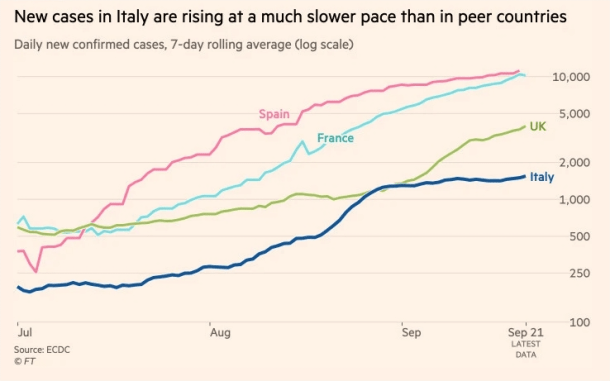
When Covid-19 struck Europe, Lombardy’s flooded hospitals and spiralling death toll provided a grim template for Italy’s neighbours. In the past weeks, however, it is offering a more upbeat, alternative path: while Spain, France and the UK are experiencing a second surge in infections after loosening lockdown restrictions, Italy has kept the disease under control.

Miles Johnson and Davide Ghiglione in Rome, John Burn-Murdoch in London www.ft.co

New daily cases are on the rise to 1,535 from the low hundreds in June, when restrictions started easing. But this compares with over 10,000 new cases in Spain and France. Life feels normal in most of Italy: restaurants and bars are open, people enjoy late-summer trips to the beach and children have returned to school.

Experts highlight three main reasons for Italy’s resilience.

First-mover advantage

For Fabrizio Pregliasco, a virologist at the University of Milan, “Italy is in a better situation than other countries such as the United Kingdom, Spain or France because we were among the first in the world to face the Covid hurricane.” Its health system and government have had more time to plan its post-lockdown response and the lifting of restrictions have been relaxed more gradually, allowing the government greater agility in reintroducing restrictions when needed.

Prime minister Giuseppe Conte has kept on reminding Italians to remain vigilant. Under Italy’s Covid-19 state of emergency he has the power to rule by decree, meaning his government was able to react swiftly to an uptick in new cases over the summer. By contrast, Spain’s state of alert, which granted the central government emergency powers over the regions, lapsed on June 21.

In August, Rome ordered a closure of discos and introduced a rule that face masks must be worn in all crowded places between 6pm and 6am. The measures, which were initially in place for a month, were extended for a further 30 days in early September. 

High public compliance and stricter enforcement

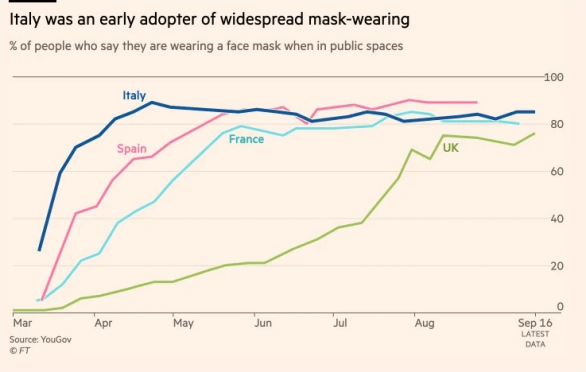
Public health officials cite the high public acceptance of restrictions, such as compulsory mask wearing in shops and on public transport. Visitors to bars and restaurants must write down their names and numbers, a measure largely complied with during the summer.

According to a survey conducted by Imperial College London, 84 per cent of Italians surveyed said they would be “very or quite willing” to wear a face mask advised to by their government. This compares to 76 per cent in the UK.

Those in breach of rules are punished. In late August, Italian media reported that a 29-year-old man was fined €400 for refusing to wear a mask near Rome’s Trevi fountain and telling the officers that “Covid doesn’t exist”.

On Monday alone police checked 50,602 people and 4,939 businesses, sanctioning 227 individuals and ordering the closure of three companies.

“Italians are more respectful of the measures of social distancing and against the transmission of the virus, even in the smallest commercial activity all measures are observed very scrupulously,” said Andrea Crisanti, a professor of microbiology at the university of Padua.

Individual behaviour, although hard to quantify, has played an important role, said Ferdiando Luca Lorini, director of intensive care at a hospital in Bergamo.

“We have gone from the most affected country to one of the virtuous countries in the management of the pandemic thanks to the clarity of the rules from the very beginning, and the willingness of everyone to respect them,” he said.

Effective testing and monitoring

Andrea Crisanti, professor of microbiology at the University of Padua, said the public health response has focused on not just mass testing but also effective surveillance of cases to track and trace anyone who has come into contact with an infected person.

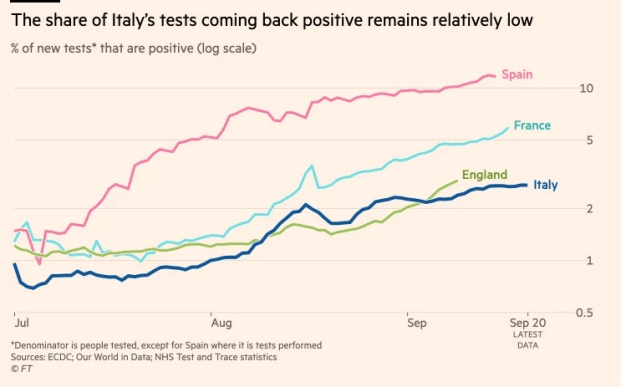
About 2 per cent of tests give a positive result, compared with about 13 per cent of tests performed in Spain, suggesting the virus is way more widespread in the latter. 

“Once there is a positive we test all those who may have come into contact with them. The real problem of the epidemic are the cases with no symptoms, if you do not intercept these, you do not come out of it,” he said.

In August, when Sardinia, a popular holiday destinations for Italians, emerged as a hotspot for the virus — former prime minister Silvio Berlusconi and Formula One boss Flavio Briatore both contracted the virus on the island — authorities introduced drive-through testing at the port of Civitavecchia on the mainland where ferries shuttle holidaymakers to and from the island. Positive cases were isolated more quickly, preventing the outbreak in Sardinia from spreading to other regions.

While few want to tempt fate ahead of winter, there is confidence that Italy’s efforts can continue to keep the virus under control.

“If Italians, who have been very diligent so far with regard to all the measures, keep holding on then we should be able to manage the situation and get used to coexisting with the problem until a vaccine arrives,” said Mr Pregliasco.

Additional reporting by Daniel Dombey in Madrid, Adrienne Klasa in London and Victor Mallet in Paris


Which science do you follow – how it played out

Fightback against rise in Covid cases thrashed out at No 10 summit

[A companion piece to https://eastdevonwatch.org/2020/09/22/follow-the-science-but-which-science-do-you-follow/%5D

Deep into Sunday night, a debate was playing out in the heart of Downing Street. The prime minister had gathered the UK’s most eminent scientists – and was learning that “follow the science” is not as simple as it sounds.

Severin Carrell www.theguardian.com

After more than a week of worrying news, with cases rising dramatically across the UK, some of the scientists at the late-night summit were in fierce disagreement over what to do.

Boris Johnson and Rishi Sunak, the chancellor, held a summit of scientists from the government’s Scientific Advisory Group for Emergencies (Sage) to help thrash out how to proceed.

Among those also present were two Oxford University figures – Sunetra Gupta, professor of theoretical epidemiology, and Prof Carl Heneghan, director of the Centre for Evidence-based Medicine.

Heneghan and Gupta have voiced caution over blanket, nationwide lockdown measures and are understood to feel strongly about the presentation of data on rising cases. They have argued for more targeted measures to protect the vulnerable, such as in care homes, so that new measures do not affect those younger people who are least at risk.

There was some controversy over data showing an exponential increase in cases, such as the one showing a jump from 6,000 a day now to 50,000 in mid-October, which could lead to 200 deaths a day by the following month.

Predictably, when it was presented at the media briefing by England’s chief medical officer, Prof Chris Whitty, and Sir Patrick Vallance, the chief scientific adviser – who stressed it was not a forecast – it was this slide that created the headlines.

A Downing Street source said the prime minister had wanted to hear “a wide range of views” from scientists and other experts.

Heneghen and Gupta have since written an open letter to the prime minister and to Whitty and Vallance to try to persuade them to change course – and to impose more targeted measures to contain the virus.

The measures expected to be announced on Tuesday – to close pubs and restaurants at 10pm and limit service to tables only – are softer than had previously been predicted or advised. Over the weekend, a source in one of the devolved administrations said there was also a concerted push from health officials to “move hard and fast: do it now and do it hard”.

That response led to some pushback from the Treasury, according to several sources, amid concern that businesses and industry had no buffer to absorb any further impact. “The economy is in a very different place to March,” one Whitehall source said. The source stressed that did not mean economic advisers had told No 10 not to act.

Leaked advice to the Scottish government laid out proposed plans for a so-called “circuit breaker” lockdown – two weeks of more severe measures – which for now appear to have been rejected by the prime minister.

Written by Scottish government officials last Saturday, based on advice given by Sage scientists who cover the whole UK, it also suggests a “rolling lockdown” for different parts of Scotland linked to October’s half-term holidays, including travel restrictions, closing play parks and shutting down hairdressers.

The measures were revealed in a leaked document marked “official sensitive”, which suggested a “general message” that people should again stay at home except for essential shopping and exercise and also avoid public transport.

At the weekend a flurry of telephone briefings took place to discuss the strategy, including a cabinet phone briefing with Whitty and Vallance on Saturday, as well as the chief economic adviser Claire Lombardelli.

The strategy was finally signed off at a Covid strategy committee meeting, involving Johnson, Sunak and Matt Hancock, the health secretary. The prime minister then briefed the heads of devolved administrations, who will join a Cobra meeting on Tuesday.

Labour officials had to scramble to respond. Keir Starmer’s keynote conference speech in Doncaster on Tuesday was hastily brought forward by two hours after the prime minister said he would make a statement to MPs in the House of Commons on Tuesday, so the Labour leader could be back in London in time to respond.


Follow the science – but which science do you follow?

Covid UK: scientists at loggerheads over approach to new restrictions

Rival groups of scientists are at loggerheads over how government should handle the Covid pandemic, with one advising that only over-65s and the vulnerable should be shielded, while the other backs nationwide measures.

Sarah Boseley www.theguardian.com 

The conflicting advice to the UK government and chief medical officers (CMOs) came in two open letters issued on Monday by the rival camps.

It came as Prof Chris Whitty, England’s CMO, and the chief scientific adviser Sir Patrick Vallance made a national TV broadcast to set out the risk of the virus spreading exponentially, with a corresponding increase in cases and deaths, if public behaviour does not change.

Thirty-two scientists signed one letter [including Professor Louise Allen; Professor of Geriatric  Medicine, University of Exeter – Owl] warning the government is heading down the wrong road and must reconsider its policy to suppress the virus, adopting a targeted approach instead.

Prof Sunetra Gupta and Prof Carl Heneghan from Oxford University, Prof Karol Sikora from Buckingham and Sam Williams of the consultancy Economic Insight issued their warning, with 28 other signatories, to the prime minister, chancellor and the UK’s four CMOs.

Support for the CMOs and Vallance, who appear to be advocating greater restrictions, came from a letter signed by second group of scientists, headed by Trisha Greenhalgh at Oxford University and backed by 22 others.

“We strongly support your continuing efforts to suppress the virus across the entire population,” they say, in what will be seen as a rebuttal of Gupta and colleagues. Segmenting the population and shielding the elderly until herd immunity has developed will not work, they add.

The two stances underline a schism within the scientific community over how to tackle the second wave of coronavirus in the UK.

The Gupta-Heneghan-Sikora letter warned that imposing lockdowns and restrictions wherever case numbers rise and potentially across the whole of the country is “leading to significant harm across all age groups, which likely offsets any benefits”.

“The existing policy path is inconsistent with the known risk-profile of Covid-19 and should be reconsidered. The unstated objective currently appears to be one of suppression of the virus, until such a time that a vaccine can be deployed. This objective is increasingly unfeasible,” they add.

Gupta and colleagues say we should think beyond coronavirus, taking account of the deaths that will occur from other causes because people are too anxious to go to their doctor or the NHS cannot treat them. And we should think about the economic and social impact of lockdowns. “Blanket Covid policy interventions likely have large costs, because any adverse effects impact the entire population,” they say.

Asked what would be an acceptable level of Covid deaths under this scenario, Williams said: “That’s not so much how we would think about it.” There were avoidable deaths from other causes during the lockdown. “You have to be quite sure you are going to save lives if you take measures that will cost them,” he said.

They say the focus on case numbers and the R number (showing the rate of infection) is wrong and they are subject to interpretation, with outcomes mattering, not case counts.

Deaths are mostly in the older population: 89% are in the over-65s and 95% in people with pre-existing medical conditions. “The harm caused by uniform policies (that apply to all persons) will outweigh the benefits,” they write.

Those at risk should be told, so that they can make their own decision about their safety. “Give the public honest and objective information about the risks they face,” Williams said. Instead, the dangers for everyone had been talked up, making people with low risk factors more scared than they should be.

The second letter, from Greenhalgh and colleagues, says that deaths and severe illness have occurred in all age groups. They argue that “long Covid” – extended and debilitating illness – has affected tens of thousands of people in the UK, many of them young.

They say it is not practical to cut off a cohort of vulnerable people from the rest in an open society “especially for disadvantaged groups (e.g. those living in cramped housing and multi-generational households). Many grandparents are looking after children sent home from school while parents are at work.”

They share the desire of the public to return to “normality”, but it must be balanced with variable restrictions to control the virus “which respond to the day-to-day and week-to-week changes in cases. “Normality” is likely to be a compromise for some time to come.

Some of the authors are members of Independent Sage, a group that established itself because of concerns over the transparency of the government’s own scientific advisory committee on epidemics, which is chaired by Whitty and Vallance.

The science itself cannot be definitive, they acknowledge. “Whilst it is always helpful to have more data and more evidence, we caution that in this complex and fast-moving pandemic, certainty is likely to remain elusive.

“A research finding that is declared ‘best evidence’ or ‘robust evidence’ by one expert will be considered marginal or flawed by another expert. It is more important than ever to consider multiple perspectives on the issues and encourage interdisciplinary debate and peer review,” they say.


The Guardian view on the Covid crisis: Boris Johnson let it happen

Downing Street is in the grip of a groupthink that delegitimises independent voices. The country is paying a heavy price

Editorial www.theguardian.com 

The United Kingdom is facing a Covid calamity, and it is a situation that was made in Downing Street. Infections and hospital admissions are rising rapidly. An exponentially growing epidemic is outpacing the rate at which the testing regime is expanding, meaning that it is not possible to properly track the spread of the disease. If nothing changes, the government’s chief scientific adviser, Sir Patrick Vallance, warned on Monday, there could be 200 deaths a day by mid-November.

It is clear that transmission of the disease through the population needs to be stopped. This might not require a nationwide lockdown, where schools and workplaces are closed. However, stringent measures ought to come into force across the country, alongside a clear strategy to rebuild the test and trace system. Boris Johnson needs to move decisively to contain the risk. There will be a balance to strike. Dilemmas such as the tension between reducing social contact and continuing economic life are not easy to resolve. But the lesson from earlier this year was that in a pandemic it’s best to move fast.

The trouble is that Britain has the wrong government for the Covid era. Boris Johnson has not yet shown that he can weigh the seriousness of the situation and act appropriately. He let events spin out of control, because he believed he could spin his way out of the problem. All too often, the prime minister has overpromised and underdelivered – if he delivered at all. Mr Johnson is unwilling to take responsibility for his missteps during the pandemic. His psychological strategy is to avoid admitting fault. This has led him to snub the checks and balances designed to ensure that the British state learns from experience to improve services. The idea is to update views to take better decisions in future.

Mr Johnson prefers non-accountability in government policy. Parliament has been sidelined during the pandemic. Graham Brady, the chair of the 1922 Committee of backbench Tory MPs, is right to insist that further Covid restrictions be debated – and voted on – in the Commons. The prime minister will probably resist this move, and he will be wrong to do so. Parliament can give the public a window on why the government acts as it does. Mr Johnson sees little value in this. He wants the public to face punitive fines for breaking lockdown while his chief adviser smirks that he did so earlier this year to test his eyesight.

Downing Street is in the grip of a groupthink that delegitimises independent voices. The clearout at the top of the civil service is part of that. What Mr Johnson seems to run is a gang rather than a government. He does not appoint people for competence but loyalty. This promotes an us-versus-them worldview. Dido Harding, the businesswoman and Conservative party peer who failed to get the test and trace system running effectively, has been picked to run Mr Johnson’s new public health system. Her qualification is that she will defend incompetence by blaming the public. Labour’s Lord Falconer calls it a “corrupting” of the constitution. He’s not wrong.

The disinformation is designed to put Downing Street above morality and the truth. There are things the country can and cannot do, and things Mr Johnson can and cannot do. The prime minister does not care that there is a difference. He tells voters that he can do anything and that the country can deliver whatever they want. He is gambling that his government will not be judged at the next election on its inept coronavirus response. It may work. Mr Johnson has reached the top by peddling half-truths. Britain’s high Covid death toll points to a set of real issues: a political culture of exceptionalism, shrivelled public services, rampant inequality and poor health. The unanimity of views in No 10 may be hard to escape, but the accumulation of blunders has led the country into a crisis.


More on the background to the Cranbrook town centre postponement

Decision on Cranbrook town centre will have to wait

Daniel Clark www.devonlive.com

A meeting that was set to determine how future development for Cranbrook’s long-awaited town centre would happen has been postponed.

East Devon District Council’s Strategic Planning Committee on Wednesday were due to discuss and make a recommendation over the way in which development would come forward.

They would have been faced with two competing proposals – one from the East Devon New Community Partners and one for the council to develop its own masterplan approach – with officers advising that the Cranbrook Town Centre Masterplan SPD should be the way forward.

However, the proposals put forward by the EDNCp – who are the developers for the majority of Cranbrook and have control of the land in the town centre – were significantly amended last week.

East Devon District Council have subsequently taken the decision to postpone the scheduled meeting so that the proposed changes can be fully considered and councillors properly advised of the proposed deal and its impacts.

A new report for the Committee will now be written detailing the amended proposals from EDNCp and help Committee councillors and the community to understand the proposals that are being put forward.

Cllr Dan Ledger, the district council’s portfolio holder for Strategic Planning, said: “The council understands the need for services and facilities to be delivered in Cranbrook Town Centre as soon as possible and remains committed to moving forward with discussions as a matter of urgency.

“It’s vital however that the discussions are informed by the most up-to-date and accurate information and that the proposals to be discussed are in the public domain and discussed in an open and transparent way. This would not have been the case had the scheduled meeting gone ahead.”

WHAT HAS ALREADY BEEN BUILT?

So far, more than 2,100 homes have been built in the new town in East Devon, as well as a train station, a primary school, a secondary school, a pub, and a neighbourhood centre with a general shop and a pharmacy.

THE EAST DEVON NEW COMMUNITY PARTNERS PROPOSALS

The proposal from the consortium of developers included:

  • A 2,500 square metres Morrisons supermarket with an additional 1,000 square metres of retail space on Tillhouse Road (around 10 to 12 shops);
  • A town square
  • A nursery
  • Around 350 town centre homes
  • Town hall with café, meeting spaces and around 15 rentable office units (including land and around one-third of the construction costs)
  • Children’s centre, youth centre and library in a single building (including land and the construction costs to the Section 106 value)
  • A skate park
  • Land for extra care facilities delivered by Devon County Council
  • Land for a “blue light” facility to house fire, police and ambulance services
  • Opportunities to provide additional retail outlets
  • Public conveniences, if not built within a commercial building
  • Option to purchase an acre of land to safeguard land for any additional development needs identified in the future, e.g. a leisure centre, workshops or light industrial units.

The main benefit of the EDNCp proposals is the short-term delivery of a supermarket and the additional 500sqm of commercial space beyond the S106 requirements, the report said.

It added: “The desire to see some delivery of services and facilities within the town centre is well understood and officers share this desire. The community questionnaires over the years have made it clear that the community want to see something delivered as soon as possible.

“This ambition is shared and there is no doubt that this would deliver a big short term gain for the town but in the long term the proposals would prevent the town centre from meeting the needs of the community in the future, lead to greater levels of out commuting, impact on health and wellbeing as well as the sustainability of the town.”

The report says that the EDNCp proposals provides clarity over how the Section 106 obligations for 500sqm retail space, youth facility, library, town council offices, health and wellbeing centre, extra care housing and public square are to be met, would see the early delivery of a supermarket, and the delivery of children’s day nursery, providing nursery care for under 2’s, not currently available in Cranbrook in a nursery setting.
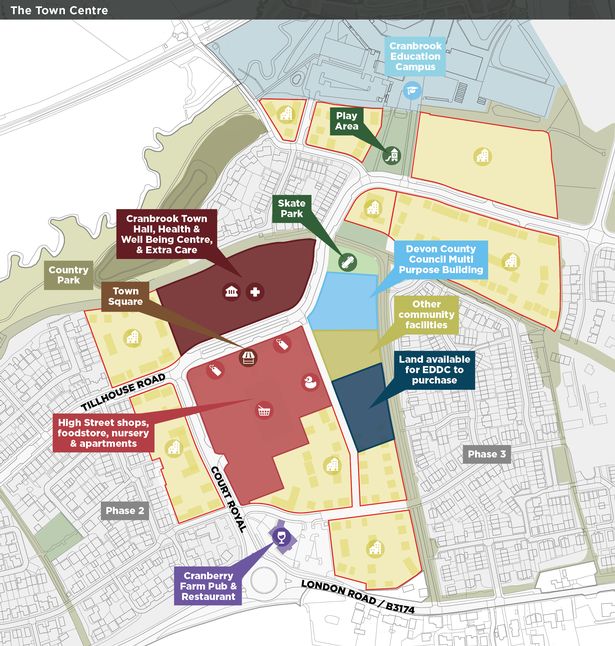
The Cranbrook Consortium proposals for the town centre

But it says that it would see a lack of space for additional retail, business, leisure and community spaces to be provided, minimal employment opportunities for residents, and the lack of space for a leisure centre despite this being a policy requirement in the Cranbrook Plan DPD.

There would be no affordable housing, a sub-optimal location for the Health & Wellbeing centre and extra care facilities, no likely connection to district heating , no or very limited contributions towards the delivery of additional infrastructure arising from the residential development, and housing types which won’t deliver the footfall necessary in a town centre location

It would have long term impacts upon health & wellbeing of residents from having a lack of employment opportunities, facilities and services in the town, the report says.

THE MASTERPLAN APPROACH

The report to the committee had said that it was considered that the SPD offers the opportunity for the Council to take a lead on the delivery of the town centre by developing its own proposals and consulting the community on these to engage the wider community in this debate.

The work seeks to use the EDNCp proposals as a starting point by incorporating their proposals for the town centre, and would see the library, youth centre, children’s centre and blue light services provided.

But the proposal would make the remainder of town centre land available for a mixture of commercial, community and leisure uses to meet the needs of the town in the future.

The location of the extra care facility would be changed, while it may make provision for a hotel in the town, and would continue to plan for the proposed leisure centre to be provided.

Pros of the masterplan approach, the report says, would be that it would allow for the delivery of the commercial scheme of them Morrison’s supermarket, High Street shops and children’s nursery, allows for the Section 106 requirements to be located in optimal locations, and enables the future proofing of the town centre through setting aside more land for future needs while still enabling significant housing development to take place.

It would provide over 250 additional jobs to the EDNCp scheme with consequential economic benefits and retained business rates income, has the potential to deliver affordable housing, the potential to achieve connection to the district heating network, and achieves greater self-containment within the town leading to less out commuting, more sustainable journeys and better health and wellbeing outcomes.

But as the land is not owned by East Devon District Council, it would be uncertain how this could be viably delivered, and the delivery of the full suite of existing town centre S106 obligations would be subject to EDNCp proceeding to reach 3,450 occupations or delivery of these being negotiated in any land deal.

The report added: “A significant concern with pursuing an SPD to deliver the indicative masterplan or something similar is how it could be delivered. The land within the town centre is understood to be entirely controlled by Hallam Land and negotiations to date have indicated that they would only be willing to sell land within the town centre at residential land values even though there is no planning policy basis for valuing all of the town centre land on this basis.”

WHAT DID CONSULTEES SAY?

The Cranbrook Strategic Delivery Board had said they were in favour of pursuing the delivery of the Consortium proposals and does not support the SPD/Masterplan proposal;

Fewer affordable homes is always a concern for elected members but Cranbrook has a very good record of delivery across the development with a high percentage delivered to date, they said.

They added: “The question of a leisure centre is not regarded as problematic in the town centre area from the members’ point of view given the facilities available at the Cranbrook Education Campus which are available to the wider community and include a sports hall and other indoor and outdoor sporting facilities.

“Further sports facilities are already delivered at Ingram’s with more planned for the expansion of the town which will create opportunities to provide additional sports and leisure facilities and there has been no interest in a hotel provider coming to the town.

“While the aim of the SPD and Masterplan is, undoubtedly, to bring forward a more extensive and holistic town centre for Cranbrook, there are clear and unavoidable risks associated with this approach and therefore considerable concern within the local community that this will take a long time to achieve and, more worryingly, may never be achieved.

“It is clear that the approach via an SPD / Masterplan will not be attractive to the Consortium and therefore the likely scenario is that the plan would be progressed through compulsory purchase of land by a local authority and subsequent marketing of the various parcels to attract commercial interest. This is potentially costly to the public purse at this time of economic uncertainty and carries with it great financial risk.

“Existing Section 106 obligations, brought forward under the Consortium proposal, will revert to the original trigger points. This means that four elements (children’s centre, blue light facility land, skatepark and 500m² of retail space) will come forward in the foreseeable future while other obligations are not due until 3,450 occupations which is probably 7 + years away.”

But Gill Munday, Head of Primary Care (North & East), NHS Devon Clinical Commissioning Group, said the small stand-alone building that just houses GP services as envisaged under Option 1 is considered sub-optimal and will not meet the needs of the growing population of Cranbrook over the longer term.

And Peter Gilpin, CEO of LED Community Leisure said that the Cranbrook School facilities are already unable to meet the demand for activities that LED is being asked to provide and that and given the future population growth, these facilities cannot be expected to provide for the future leisure demands of the town.

He added: “Whatever the eventual operating arrangements, there is a clear case for the provision of a 4-court sports hall, or the equivalent space for alternative leisure activities, within a leisure centre with unrestricted opening hours and access for the general public, and a 6-lane pool (plus teaching pool) should be provided, as originally planned for.”

Planning officers, in their recommendation, had said: “The consortium proposals may deliver what the town needs now but in so doing it precludes the delivery of future commercial and community spaces that the town will need as it grows from its current 2100 homes to around 8000 in the future. Failure to meet the long term needs of the town as it grows jeopardises the future of Cranbrook as a sustainable and healthy new town.”

But with the consortium having changed their proposals, a new report, with new recommendations, will now be written.

The council will be looking to set a new date for the meeting in October.


Boris Johnson’s ex boss says ‘cavorting charlatan’ will be unfunny joke as PM

The test of time.

Owl revisits this profile of Boris Johnson written by Max Hastings in June 2019. (Since then Labour have replaced Jeremy Corbyn with Keir Starmer)

Max Hastings www.mirror.co.uk 

Six years ago, the Cambridge historian Christopher Clark published a study of the outbreak of the First World War, titled The Sleepwalkers.

Though Clark is a fine scholar, I was unconvinced by his title, which suggested the great powers stumbled mindlessly to disaster.

On the contrary, the maddest aspect of 1914 was that each belligerent government convinced itself that it was acting rationally.

It would be fanciful to liken the ascent of Boris Johnson to the outbreak of global war, but similar forces are in play.

There is room for debate about whether he is a scoundrel or mere rogue, but not much about his moral bankruptcy, rooted in a contempt for truth.

Nonetheless, even before the Conservative national membership cheers him in as our prime minister – denied the option of Nigel Farage, whom some polls suggest they would prefer – Tory MPs have thronged to do just that.

I have known Johnson since the 1980s, when I edited the Daily Telegraph and he was our flamboyant Brussels correspondent.

I have argued for a decade that, while he is a brilliant entertainer who made a popular maître d’ for London as its mayor, he is unfit for national office, because it seems he cares for no interest save his own fame and gratification.

Tory MPs have launched this country upon an experiment in celebrity government, matching that taking place in Ukraine and the US, and it is unlikely to be derailed by the latest headlines.

The Washington Post columnist George Will observes that Donald Trump does what his base wants “by breaking all the china”. We can’t predict what a Johnson government will do, because its prospective leader has not got around to thinking about this.

But his premiership will ­almost certainly reveal a contempt for rules, precedent, order and stability.

A few admirers assert that, in office, Johnson will reveal an accession of wisdom and responsibility that have hitherto eluded him, not least as Foreign Secretary.

This seems unlikely, as the weekend’s stories emphasised.

Dignity still matters in public office, and Johnson will never have it. Yet his graver vice is cowardice, reflected in a willingness to tell any audience whatever he thinks most likely to please, heedless of the inevitability of its contradiction an hour later.

Like many showy personalities, he is of weak character.

I recently suggested to a radio audience that he supposes himself to be Winston Churchill, while in reality being closer to Alan Partridge. Churchill, for all his wit, was a profoundly serious human being.

Far from perceiving anything glorious about standing alone in 1940, he knew that all difficult issues must be addressed with allies and partners.

Churchill’s self-obsession was tempered by a huge compassion for humanity, or at least white humanity, which Johnson confines to himself. He has long been considered a bully, prone to making cheap threats.

My old friend Christopher Bland, when chairman of the BBC, once described to me how he received an angry phone call from Johnson, denouncing the corporation’s “gross intrusion upon my personal life” for its coverage of one of his love affairs.

“We know plenty about your personal life that you would not like to read in the Spectator,” the then editor of the magazine told the BBC’s chairman, while demanding he order the broadcaster to lay off his own dalliances. Bland told me he replied: “Boris, think about what you have just said. There is a word for it, and it is not a pretty one.”

He said Johnson blustered into retreat, but in my own files I have handwritten notes from our poss-ible next Prime Minister, threatening dire consequences in print if I continued to criticise him.

Johnson would not recognise truth, whether about his private or political life, if confronted by it in an identity parade. The other day I came across an observation made in 1750 by Bishop Berkeley: “It is impossible that a man who is false to his friends and neighbours should be true to the public.”

Almost the only people who think Johnson a nice guy are those who do not know him.

There is, of course, a symmetry between himself and Jeremy Corbyn. Corbyn is far more honest, but harbours his own delusions.

He may yet prove to be the only possible Labour leader whom Johnson can defeat in a general election. If the opposition was led by anybody else, the Tories would be deservedly doomed.

As it is, the Johnson premiership could survive three or four years, shambling from one embarrassment and debacle to another, of which Brexit may prove the least.

For many of us, his elevation will signal Britain’s abandonment of any claim to be a serious country.

It can be claimed that few people realised what a poor Prime Minister Theresa May would prove until they saw her in Downing Street.

With Boris, however, what you see now is almost assuredly what we shall get from him as ruler. We can scarcely strip the emperor’s clothes from a man who has built a career, or at least a lurid love life, out of strutting without them.

The weekend stories of his domestic affairs are only an aperitif for his future as Britain’s leader.

I have a hunch that Johnson will come to regret securing the prize for which he has struggled so long, because the experience of the premiership will lay bare his ­absolute unfitness for it.

If the Johnson family had stuck to showbusiness like the Osmonds, Marx Brothers or von Trapp family, the world would be a better place.

Yet the Tories have elevated a cavorting charlatan to the steps of Downing Street, and they should expect to pay a full forfeit when voters get the message.

If the price of Johnson proves to be Corbyn, blame will rest with the Conservative party, which is about to foist a tasteless joke upon the British people – who will not find it funny for long.


We’ve had Sasha on “Dave”: what do Boris Johnson’s Mates and Coworkers Say About “Him”?

What Our New PM Boris Johnson’s Mates and Coworkers Say About Him

Gavin Haynes www.vice.com

Well Britain, we’ve really done it this time. Big congrats to every single one of us for destroying literally any semblance of respect we might have held on an international political stage. Yes, of course, there was our whole British empire fuckup, which retrospectively, was not good, but we had moved away from that a bit! It was getting better! We stopped colonising places! And then Brexit came, and we fucked it, and just when you didn’t think it could get any worse: Boris Johnson.

Johnson. Johnson. What greater emblem of the entire failure of our political system than a man so fundamentally determined to lie and climb the political ladder, who is frequently touted as bad at his job, bad at creating and implementing policy, bad at managing teams, actively dangerous when it comes to international relations and routinely an embarrassment outside of the UK has become our Prime Minister. Some of his own MPs preemptively said they would not work under him – an unprecedented declaration of mistrust – and the entire of the UK has never been so politicised nor the Tory party.

Notably, Johnson’s election campaign has been characterised by a total lack of detail or policy initiative beyond “miraculously pull us out of Europe on 31st October”. Beyond grandly announcing to “defeat Jeremy Corbyn” in today’s speech, we’re unlikely to get any more detail around what he intends to do in Number 10.

So we decided to go to Johnson’s own friends and colleagues – the ones who know him best – to figure out what exactly our new *choking, barely able to get the words out* Prime Minister has in store for us.

ON BORIS JOHNSON’S TEMPERAMENT

Sonia Pernell, Boris Johnson’s colleague at The Daily Telegraph, writing in the Times:

“Boris Johnson can change from bonhomie to a dark fury in seconds… [he[ has the fiercest and most uncontrollable anger I have seen… It was the sight of Boris Johnson in full flow that convinced me all those years ago in the 1990s, when I worked alongside him in Brussels reporting on the EU for The Daily Telegraph, that he was temperamentally unsuitable to be entrusted with any position of power, let alone the highest office of all, in charge of the United Kingdom and its nuclear codes.”

Peter Guilford, who worked with Johnson in Europe as a Times journalist, in the Independent:

“[Johnson was happy to] ham up the story, so there wasn’t much difference between news and entertainment… He would write outrageous stories with only slenderest connection of truth in them.”

Max Hastings, Boris Johnson’s former boss at the Telegraph, writing in the Guardian:

“I have known Johnson since the 1980s, when I edited the Daily Telegraph and he was our flamboyant Brussels correspondent… There is room for debate about whether he is a scoundrel or mere rogue, but not much about his moral bankruptcy, rooted in a contempt for truth.”

Mathew Leeming, a friend at Oxford and former flatmate, writing in the Telegraph:

“He has a low boredom threshold and he does not do detail.”

Matthew d’Ancona, his former editor at the Spectator, writing in the Guardian:

“Especially in his early years, Johnson had the will to power of Pinochet and the social graces of Gussie Fink-Nottle. He was clever without being a swot. He winged it, which drove his editors mad but inspired considerable envy in his peers. He was fun. He activated the narcotic weakness within the English for eccentricity – especially potent when it is suspected that the eccentric in question may one day be the leader of the gang.”

Max Hastings:

“As it is, the Johnson premiership could survive for three or four years, shambling from one embarrassment and debacle to another, of which Brexit may prove the least.”

Sonia Purnell:

“That anger remains an issue. Rachel [Johnson’s sister] in particular is said to fear her brother’s ire if she dares to criticise him in public, or make her disagreement with his “leave” stance on Brexit too obvious. She has also talked of her brother’s “very Sicilian” attitude to anyone who crosses him.”

Matthew Leeming:

“Boris is the only front-line politician who can make us see Brexit as a huge opportunity.”

ON BORIS JOHNSON’S POLITICS

Max Hastings:

“For many of us, his elevation will signal Britain’s abandonment of any claim to be a serious country.”

Matthew D’Ancona:

“His shtick was no longer an aspect of his politics. It was his politics. While the rest of Westminster operated within the structures of 20th-century political discourse, Johnson worked on his material like a standup preparing for a Netflix special.”

ON BORIS JOHNSON’S FITNESS FOR NUMBER 10

Max Hastings:

“I have argued for a decade that, while he is a brilliant entertainer who made a popular maître d’ for London as its mayor, he is unfit for national office, because it seems he cares for no interest save his own fame and gratification.”

Mathew Leeming:

“Boris has an ability to articulate what the majority of people think and know, just as Margaret Thatcher did…. Boris has extraordinary talents and needs extraordinary circumstances for those talents to take him to the very top, just as Churchill did.”

Conservative MP Sir Alan Duncan, who worked under Boris Johnson and Jeremy Hunt in the Foreign Office, speaking to the BBC:

“I’ve served both Foreign Secretaries and I’ve got no doubt which is the more capable and competent. I have very grave concerns that he flies by the seat of his pants and is all a bit haphazard and ramshackle… I think he’s going to go smack into a crisis of government.”

Sarah Hayward, former leader of the London Borough of Camden who worked with Johnson as the Mayor of London, writing in the Guardian:

“The most important aspect of Johnson’s working style is his lack of attention to detail. In every setting, from one-to-one meetings to big set pieces, such as the annual London government dinner, he would be ill-prepared. This comes across as disinterest or worse. But this isn’t a problem of his manner or working style. Those who worked as his closest advisers in City Hall are quite open about the fact that Johnson would lose interest if a policy briefing took more than a few minutes, five maximum…

The challenges, first of Brexit and then of the huge domestic conundrums we face – housing, adult social care, post-Brexit industrial and trade policy – all require attention to detail, hard work and tough choices. The Boris Johnson I and many of those around him have seen has shown no evidence that he is capable of that.”


Boris Johnson accused of corrupting constitution over role for Lady Harding

Can Dido mix two high profile public service roles, subject to the civil service code, with her political role taking the Conservative whip in the Lords? – Owl

Oliver Wright, Policy Editor www.thetimes.co.uk 

Boris Johnson has been accused by a former Labour lord chancellor of corrupting the constitution by appointing the Conservative peer Baroness Harding of Winscombe to a leading role in the fight against Covid-19.

Lord Falconer of Thoroton, QC, said it was inappropriate for Lady Harding to have an executive role running the test and trace system as well as her appointment as head of the new National Institute for Health Protection.

He spoke out as Baroness Smith of Basildon, the Labour leader in the House of Lords, wrote to Simon Case, the cabinet secretary, asking for urgent clarification of what appeared to be a clear breach of civil service rules.

They argue that in both roles Lady Harding, 52, works as a public servant and is covered by the civil service code, which states that civil servants should not “act in a way determined by political considerations”. She sits as a backbench Tory peer and takes the Conservative whip.

Lord Falconer told The Observer yesterday that he had never known of anyone being allowed to mix public service and political roles in such a way and demanded that she either sit as a non-aligned crossbench peer or be appointed as a government minister. She could then be held accountable and answer questions in the upper house.

“It is such a corruption of our constitution to make a Tory backbencher in parliament a senior civil servant without any process and without even requiring the most basic rules of political impartiality,” Lord Falconer said.

Government sources said that Lady Harding, a former chief executive of TalkTalk, had shown herself to be accountable and had appeared last week before the science and technology select committee to answer questions about the Covid-19 testing system that she has led since May.

She was also tipped yesterday as a potential successor to Sir Simon Stevens, who is expected to stand down as head of NHS England next year.


Plans for 39 new homes at Rolle College site submitted to planners

Plans to develop Exmouth’s former Rolle College campus into 39 new homes have been submitted to planners in East Devon.

Joseph Bulmer exmouth.nub.news

The 39 new homes would comprise of 10 houses and 29 apartments, with Grade II Listed Eldin House being converted and refurbished into apartments.

If the plans are successful a number of buildings on the site would need to be demolished.

The planning application was submitted on Friday, September 11, by LRM Planning Ltd on behalf of developer Acorn Property Group.

The site measures 0.78ha in area and is roughly rectangular in shape, and slopes downwards from the north/northwest to the south east. The site forms part of a wider campus directly adjacent to the west, which is now being developed by the Exeter Royal Academy for Deaf Education.

The planning application’s Design and Access Statement states: “The site was formerly used as an educational campus.

“Since the campus closure, the brownfield site has fallen into disrepair and suffered from antisocial behaviour, vandalism and unmanaged vegetation growth.

“The site contains a number of buildings on the former campus site. The buildings represent a range of different building styles, ages, scales and materials.

“These buildings range from 19th century villas to post war education buildings. With the exception

of Eldin House, the majority of buildings on site are low quality post-war education buildings which are in a state of disrepair and no longer fit for purpose.

“It is proposed that these are demolished to allow for more appropriate building in keeping with the surrounding character.”

An apartment building would be located in the south western part of the site: “The apartment building has been designed to provide a range of different apartment sizes from two to three bed dwellings, all of which have been designed internally to facilitate a range of homeowner needs, including spacious and open living spaces and appropriate levels of storage.

“Each apartment has been designed to benefit from either south facing views, or views out towards Eldin House and the landscaped courtyard space to the north. At ground level,undercroft (at grade parking) is provided with bin and cycle stores.

“Generous floor to ceilings and appropriately placed windows, will create light and airy places to live. Each dwelling will have amenity space in the form of a balcony or terrace. The top floor is recessed to allow for generous outside terraces.”

The developer is conscious of the impact building work could have on the neighbouring Deaf Academy, ‘ it is of the utmost importance to ensure that the needs, comfort and safety of the Academy and young students are considered and respected’.

Currently the main entrance to the site is to the south west of Douglas Avenue. If this application is granted the gate pier and entrance wall would need to be widened to accomodate residents’ vehicles.

No date has yet been set for the plans to be discussed by East Devon District Council’s strategic planning committee.

So far there have been no comments from local residents on the planning application, if you feel strongly about the above application feel free to get in touch with Exmouth Nub News editor Joe Bulmer, joe.bulmer@nub.news.

If you would like to view the application for yourself, click here and use the following planning number to search for the application: 20/1838/MFUL.


East Devon rejects ‘ludicrous’ algorithm doubling number of homes to be built in the district

Owl is delighted to read of this example of cross party support and cooperation in strategic policy development.

Joseph Bulmer and Daniel Clark sidmouth.nub.news 

East Devon District Council has registered its opposition to a ‘ludicrous’ algorithm that could see double the number of new homes have to be built each year.

The Government is set to change the method they use for calculating the amount of housing each district should provide each year, with the new method seeing the numbers in East Devon rise by 67 per cent, Mid Devon by 75 per cent, and Teignbridge by 102 per cent.

But councillors have said that the figures are ‘completely unacceptable’, have come from an algorithm that makes no sense, and that it is very difficult to see there being enough people in the country that would want or be compelled to move to the areas to fill this number of houses.

But East Devon District Council and Teignbridge District Council so far have agreed to oppose the proposed approach, believing that the numbers are both too great and most likely, undeliverable.

Last week’s East Devon District Council Strategic Planning Committee also unanimously agreed to adopt their proposed response would see opposition to the methodology.

Ed Freeman, service lead for planning strategy and development, in his report, said: “The East Devon housing requirement is increased by a massive 67 per cent from 928 dwellings to 1,614 new homes per year. The increase, by any standards, can only be seen as a staggeringly high increase on top of what was a high level anyway.

“It must be seriously questioned whether the number of houses for East Devon, and surrounding areas, even if credible land could be allocated for their development, will actually be built. It must be seriously questioned whether there would be sufficient numbers of people wishing to buy or rent a property in East Devon and surrounding areas to sustain the level of growth the figures imply.

“Short of a massive boon in jobs in our part of England or there being some other compelling reason why people will move here, it is extremely difficult to see anything approaching a market of sufficient size to see these levels of houses built. A move to greater homeworking my generate greater levels of migration to East Devon but the long term levels of migration arising from changes in working practices as a result of the current pandemic are unknown.

“In the case of East Devon, recent research for the Council undertaken by the consultancy firm ORS shows that to meet trend based needs there is a need for 757 dwelling a year and to address pent-up demand a need for 59 dwellings a year, giving a total of 816 dwellings per year. Deducting this figure from a district total of 1,614 implies that 798 households would need to move in to East Devon each year over and above established trends.

“This level of increase is simply not a credible prediction and much less so a credible policy response when it comes to planning for housing provision.”

Councillor Mike Allen said that being asked to increase by the numbers in this way was ludicrous. He said: “There is something fundamentally wrong with the algorithm, and it shows no relevance whatsoever to local democracy and reality on the ground.”

Councillor Ian Thomas added, referring to the chaos over exam results, said: “It has not been a good summer for the Government and algorithms. To jump by 67 per cent and 102 per cent worries me and it simply isn’t credible. We are dealing with a half cooked algorithm and whipping numbers out of the air is not acceptable.”

Councillor Kevin Blakey said that as developers won’t be keen to develop properties that they can’t sell very quickly, this couldn’t possibly work, while councillor Eleanor Rylance said that ‘if we don’t resist this, we will cover the West End in housing with no transport infrastructure’.

Teignbridge’s portfolio holder for planning, councillor Gary Taylor said: “One of the most contentious issues is the suggestion that housing numbers will be based on a nationally set formula where more homes have to be built annually in areas where open market housing is often not affordable to local residents.

“In Teignbridge, the changes mean that our housing requirement could increase by 101% to 1,532 homes, double the current requirement to build 760 houses a year. This is a figure which I am sure councillors will consider unacceptable.”

Councillor Taylor said that within the consultations there is a suggestion that the identified annual housebuilding figure would be varied by the availability of land and could be reduced if there was evidence of the lack of suitable space in Teignbridge for building.

“This is a consultation and no final decisions will be made by the Government until later in the year” he added. “But as a Council we will be responding to the consultation, welcoming changes designed to make the planning system more responsive but strongly opposing the housing numbers which will adversely impact on our communities and environment.”

Now is the time to level up the economy in SW, PM told

This is the latest concerted publicity push by those behind the “Great South West”. This enterprise is headed by Steve Hindley, Chairman of Midas property services group and backed by, amongst others, The Western Morning News and Pennon, owner of South West Water. 

The Great South West is yet another unelected, unaccountable, organisation pitching for a £2M set-up fund to design our future. Owl has previously described it as the LEP for LEPs (Local Enterprise Partnership). It covers the four counties in the peninsular: Somerset, Dorset, Devon and Cornwall and their respective LEPs.

It makes sense to consider strategic infrastructure investment decisions across the peninsular as a whole. The LEPs are not the right bodies to replace the regional development agencies. What worries Owl is that the Great South West looks (and sounds below) as if it sees itself as a contender for a devolved Combined Authority.

Owl also notes that plenty of recovery plans are being made but asks the question: do we yet know what the impact of covid-19 on our economy will be? The new normal will be different to “Build,build,build”. Are they consulting with us or our elected leaders?

“Happily consult my diary” from the PM sounds like a maybe, nothing definite. (East Devon is currently having a master class on how, even if your MP has the PM’s private email and telephone number, no great favours for the South West can be expected.)

HANNAH FINCH, Western Morning News

hannah.finch@reachplc.com

Prime Minister Boris Johnson has promised to ‘consult his diary’ on discussions to ‘turbo-charge’ the economy of the South West. Johnson said that he shares the vision of a prosperous Great South West during Wednesday’s PMQs.

The prominent mention follows a visit by South West MPs to Downing Street in November 2019 where Johnson pledged to Back The Great South West. Now, business and economic leaders are calling from less talk and more action.

Susan Davy, Chief Executive of Pennon Group – which has been spearheading the Back the Great South West campaign, said: “This latest recognition of the Great South West by the Prime Minister is welcome but we need firm Government commitments to the region. In line with the ‘build back better’ agenda there is a clear opportunity for the South West to become a leader in clean, environmentally sustainable growth. Businesses in the region ourselves included – will continue to help drive this forward but better digital and transport connectivity is badly needed.

“We heard similar positive words from Mr Johnson at 10 Downing Street back in November and, while we welcome further dialogue on the issue, it is time the region was given the support it deserves.”

The Prime Minister was responding to a question by Totnes conservative MP Antony Mangnall, who asked: “The Prime Minister is rightly levelling up across the country, giving that issue both barrels, but I know that the South West has often been overlooked. Will he reassure this House and Members from across the South West that we will invest in digital and transport infrastructure, we will turbocharge opportunity and we will provide the growth that they need in the South West? To that effect, will he meet a delegation from the South West to discuss the opportunities before us?”

The Prime Minister cited investment in schools at West Alvington Church of England Academy and Eden Park Primary and Nursery School, before adding: “As for his request [to meet a delegation], I will happily consult my diary.”

The Great South West has been asking for a £2million push to set up the Great South West partnership – a region-wide organisation to rival the Midlands Engine and Northern Powerhouse. It predicts that the funding could drive a £45billion uplift to the economy with green energy at its heart. The need for the funding alongside more government infrastructure spend will be top of discussions. Gary Streeter MP, chairman of the All Party Parliamentary Group tasked with the Great South West agenda, welcomed further talks.

He said: “South West MPs would be delighted to take a delegation from the Great South West board to see the PM to discuss this vital issue

He added that any meeting would likely be after the White Paper on Devolution is published – due before the end of the year and setting out a placed-based regional strategy for the levelling up of regional prosperity. Steve Hindley, Chairman of the Great South West Steering Group said: “I’m delighted to hear the Prime Minister yet again mention the Great South West with enthusiasm. When we met with him last year at Number 10, he gave assurance that the south west could expect more investment in infrastructure; and indicated that we needed to be more ambitious in our asks for the set up funding for the Great South West partnership. £2million is what we need initially to drive a £45 billion uplift.

“We look forward to working with our partners in Cornwall and the Isles of Scilly and Dorset LEPs, the Local Authorities, our business community – including the Western Morning News which has been a vocal and valuable advocate – and indeed our wider south west stakeholders in the Western Gateway which is our neighbouring “powerhouse economy” and the latest to get formal recognition and funding from Government. We firmly believe that now more than ever is the time to Level Up.”

The Heart of the South West is soon to publish its Building Back Better plan – setting out opportunities to recover from the Covid-19 pandemic. Earlier this year, just before lockdown hit, Heart of the South West and LEPs in Cornwall and the Isles of Scilly and Dorset published its Great South West prospectus, “Securing our Future’:

Karl Tucker, Chairman of the Heart of the South West LEP said: “Our area has the potential to create a low carbon economy based on clean and inclusive growth.

“The opportunities and aspirations of the Heart of the South West dovetail with those of the wider region; and together we can build back an economy that’s not only better in terms of prosperity, but environmentally too.”


Contact-tracing app for England and Wales ‘hampered by loss of public trust’

Dominic Cummings’ lockdown travels and the exams fiasco could have contributed to dooming the government’s Covid contact-tracing app before it even launches, a technology expert has warned.

Alex Hern www.theguardian.com 

Evidence of low uptake overseas also suggests the app may not live up to ministers’ early hopes of a panacea. In late May, the health secretary, Matt Hancock, admitted it was “the cherry on the cake but [not] the cake”; in recent weeks it has barely been mentioned.

The app, which is due to launch in England and Wales on Thursday 24 September, will use the bluetooth signal in mobile phones to track close and sustained contact between users and then warn those who may have been exposed to an infectious person that they should self-isolate.

But to succeed at that goal, the app will need to be installed by a large proportion of the public. That could be hard to achieve, warned Imogen Parker, the head of policy at the tech thinktank Ada Lovelace Institute, because of a series of trust-diminishing scandals over the summer.

“In March, it was suggested that we would need 80% of smartphone users to install the app for it to reduce infections. But internationally, the best case scenario we’ve seen has been about 40% uptake, and that’s in small countries like Iceland and Singapore. Examples from larger countries like Germany and Ireland suggest we’re looking more like 18-30% a few weeks after launch,” she said.

“In the UK, uptake is going to be related to trust in government. While we were doing some public work on trust over May, you had the Barnard Castle incident; after that you had the A-level algorithm. But the flip side is that the NHS brand itself is incredibly trusted.”

Parker also raised alarm at the prospect of large numbers of people being advised to self-isolate based on “false positive” results. “The best data I’ve seen suggests 45% false positives and 33% false negatives,” she said, “but phone proximity isn’t everything. The growing body of evidence about things like the substantially limited risk outside versus inside really matters. We need to make sure the app can identify risk, not just identify phones.”

The latest version of the contact-tracing app is substantially rebuilt from an earlier version. It was pulled from public release at the last minute after tests in the Isle of Wight revealed several flaws with the iPhone version. Some of those changes should help increase uptake and efficacy, said the University of Oxford’s Prof Christophe Fraser, a scientific adviser to the national test-and-trace programme.

“We and others have shown through simulations, where we show the integration of the app with manual tracing, social distancing, and so on, even 10 to 15% uptake can have an effect,” he says.

The newest version of the app is built with a framework created by Apple and Google, which means it can begin working even before it is installed on devices. It also includes a QR code-led “check-in” function, which lets users record that they have been to public locations and receive alerts for any outbreak linked to that venue.

Those features, Fraser says, should help people see that the app isn’t just important for public health but for individual outcomes too. That means that even “false positive” warnings can be useful.

“Localised contact tracing provides information, even if you’re not infectious,” he said. “It’s not really a ‘false positive’, because it’s very important to know that Covid-19 is spreading in your local area. We’re faced with a difficult winter, a grave winter, and every little behavioural nudge matters. A little bit of ventilation, mask wearing and hand hygiene does make a difference.”

The Department of Health and Social Care has been approached for comment.


COVID-19 cluster zones in Devon – where there are cases

A live Government dashboard has pinpointed the areas of Devon where COVID-19 cases are on the rise.

Miles O’Leary www.devonlive.com

The latest coronavirus cluster map for Exeter has identified four cases have arisen out of the Pennsylvania and University district. 

Whilst another four cases have also been confirmed in Clyst, Exton and Lympstone.

Other pockets of Exeter may have COVID-19 but the number of cases in those areas are either below three or nil.

Elsewhere, Launceston has become Cornwall’s fourth new cluster with three cases.

Paignton, Torquay and other areas of the Bay do not appear to have cases of more than two.

Likewise with Newton Abbot and down in South Devon.

The latest COVID-19 cluster areas in Devon, chiefly in the Exeter area (Image: arcgis.com)

Over in Plymouth, there are nine cases in Derriford and Estover, 10 in Mutley and another three in neighbouring Peverell.

The map divides the country into small patches of around 7,200 average population and are called Middle Super Output Areas (MSOA).

A cluster is recorded when three or more cases have been confirmed in the space of seven days.

The latest information concerns the spread of COVID from September 10 to September 16.

Plymouth’s Mutley and Peverell areas have had three or more COVID-19 cases

Overall, the number of new coronavirus cases confirmed across Devon this week have fallen compared to last week’s figures.

Government statistics show that 155 new cases have been confirmed across Devon and Cornwall in the past week, in both pillar 1 data from tests carried out by the NHS, and pillar 2 data from commercial partners, compared to 154 new cases confirmed last week.

Fill in our short survey to let us know what you think about the latest Covid restrictions.

Of the 155 new cases, 9 were in East Devon, 12 in Exeter, 4 in Mid Devon, 4 in North Devon, 45 in Plymouth, 4 in the South Hams, 7 in Teignbridge, 2 in Torbay, 6 in Torridge, and 2 in West Devon.

Despite this, in Torbay new cases have fallen dramatically from 12 to 2, while in the Devon County Council area, they have dropped from 71 to 48.