Councils argue about where they sit in new lockdown tiers

Councils are jostling to be moved up and down the government’s three-tier lockdown system as they fret over the conflicting demands of local jobs and public health.

Will the Government put Exeter into Tier 3 lockdown?

Andrew Gregory and David Collins www.thetimes.co.uk
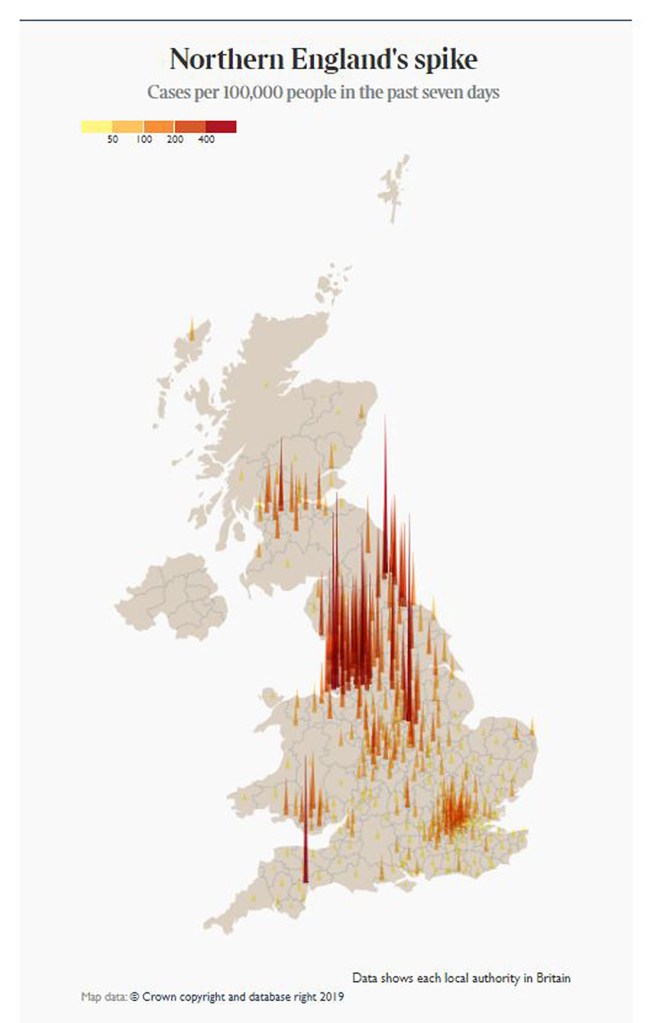
With the number of virus infections surging, Boris Johnson plans to introduce the new measures this week to simplify the restrictions.

Millions of people have been subjected to local restrictions for weeks, but there are concerns that mixed messages and confusion over changes to the rules have limited their effectiveness.

Areas with relatively low infection levels will be placed in what is being described as tier 1. Only national restrictions such as the rule of six, the 10pm curfew on restaurants and pubs and existing rules on masks and social distancing will apply.

The next tier is likely to include bans on home visits and indoor socialising with other households in bars or restaurants.

Areas with the worst coronavirus outbreaks will be put in tier 3. Options being considered this weekend include the closure of all hospitality venues, a ban on overnight stays outside your own home and shutting leisure venues such as cinemas.

Tier 3 could see people ordered not to have social contact with anyone outside their household.

The move could see 7,171 pubs in the north of England temporarily shut, accounting for one in five of England’s 37,616 pubs. The region accounts for 18 of the 20 worst Covid hotspots. Liverpool, Manchester and parts of the northeast are all set to be put in tier 3.

But yesterday, an extraordinary lobbying race erupted with several councils scrambling to be placed in higher tiers than the levels they expect.

It is understood that some London boroughs want to be in tier 2 rather than the less strict tier 1, despite relatively low infection rates.

Officials said this was because councils fear they are only weeks behind the north of England.

At the same time, some councils are lobbying the government to be in tier 3 to win economic support.

Conversely, some councils in the Midlands and the north with higher infection rates want to be in a lower tier amid concerns that the tier-3 restrictions would “finish off” their economies.

The jostling is complicated by the fact that the prime minister had yesterday not decided on the final measures for each tier.

It is understood that while pubs and bars will be forced to shut in tier-3 areas, restaurants may be allowed to stay open until 10pm. There is debate over whether to shut hairdressers, leisure centres and gyms.

One option is an 11pm curfew in tier 1. It comes amid opposition to the national 10pm curfew, which will be voted on in the House of Commons on Tuesday.

Another idea is to extend the severe measures in tier-3 cities to their suburbs, even if virus infection levels there are lower.

The rules are expected to be reviewed after a month, a government official said. But questions remained about when and how local areas would move up or down tiers. Triggers could include the level of infection, the number of cases or the R figure.

“A key concern is getting trapped in one tier or another,” said a council official. “If you are in an area deemed low-risk, in tier 1, how quickly will you be allowed to move up a tier if infections suddenly take off?”

@AndrewGregory

Tier 1

Areas with the fewest coronavirus cases. Only national restrictions such as the rule of six and the 10pm curfew on restaurants and pubs will apply. Rules on mask-wearing and guidance on social distancing will still apply. One possibility is that varied curfew times could apply to different tiers. The curfew could be 11pm in tier 1 rather than 10pm

Tier 2

The same restrictions and rules as tier 1 apply but may also include bans on home visits and indoor socialising with other households in bars and restaurants

Tier 3

The parts of the country with the highest infection rates. These areas will have to observe all the restrictions in tier 1 and tier 2 but could also see the closure of all hospitality venues, a ban on overnight stays and the shutting of leisure venues. Tier 3 residents might be banned from any social contact with anyone outside their household. Hairdressers, cinemas, and gyms may also face closure

Cumbria’s ace test-and-tracers put Whitehall officials to shame

When it comes to tracking Covid-19, the Lake District proves it is best to go local.

Tom Calver, Gabriel Pogrund and Hannah Al-Othman www.thetimes.co.uk

In May, 10 days before the launch of the national test-and-trace scheme, Cumbria set up England’s first fully functioning local version.

Members of Cumbria county council’s sexual health team — more used to tracking cases of chlamydia — were drafted in for their contact-tracing skills. They work with housing officers, who often know where vulnerable people are.

“Often, we identify someone who tested positive, and someone on the local environmental health team will say, ‘Yes, we know that person’,” said Colin Cox, Cumbria’s director of public health. “The skill of the local district council teams in knowing the complexities of their patch is just phenomenal.”

The experiment appears to have paid off. At the time of its launch, Barrow-in-Furness — Cumbria’s second-biggest town — had the highest coronavirus infection rate in the country. Although cases have soared again in the northwest, Cumbria’s rate of 87 per 100,000 is the lowest in the region.

Before the pandemic, Emma Bundock, 43, was an environmental housing manager. Since May, she has led a three-person team tracing contacts for Allerdale, a district that includes Grasmoor and Workington.

“The officers who work on this live in the communities they’re trying to support,” Bundock said. “We’re passionate about the people we’re trying to help because ultimately, it could be one of your own.”

Most cases come from the national test-and-trace programme, 24 hours after call centre operatives have had a go at making contact.

Sometimes, said Bundock, “the national tracers have not asked the questions that make the person properly think about who they’ve been in touch with, what they’ve done, or who they’ve seen”.

Cumbria’s scheme was the first and there are now 93 local contact-tracing teams. “Complex” cases involving outbreaks in hospitals, care homes and prisons are automatically passed to local teams. In the week to September 30 they reached 97.1% of contacts, compared with just 62.4% by the national teams.

In many Covid-19 hotspots, the national system is faring even worse. Blackburn with Darwen, Bury and Manchester have some of the highest infection rates, but little more than half of all non-complex contacts are being identified. In Slough, the figure is 42%.

In August, the Department of Health said NHS Test and Trace would become “local by default”. “We’re still trying to figure out what that means,” said Cox.

The department said: “NHS Test and Trace is breaking chains of transmission thanks to local and national teams working hand in glove. Almost 700,000 people have been contacted and told to isolate.”

‘Everyone is fighting’ – how Downing Street lost its grip on a divided nation

When he addressed the nation on 23 March to announce a national lockdown, Boris Johnson knew he had most of the British people with him. “Each and every one of us is now obliged to join together to halt the spread of this disease,” the prime minister said in his TV broadcast. “We will beat the coronavirus and we will beat it together.”

Toby Helm, Political Editor www.theguardian.com 

Six and a half months on, as he prepares to announce the introduction of more restrictions and a new three-tier system across the country – at what ministers say is a “critical” moment – hospitals are filling up and death rates are rising once more.

Unlike March, however, calls for the British people to unite behind a response directed from No 10 no longer command the attention or respect they did then. The many changes in rules and regulations have left people confused and choosing to rely on their own instincts as much as on what politicians tell them.

Trust in the government to handle the pandemic, say local leaders who monitor the crisis daily, has been shot to pieces. “I would say that trust in authority has completely gone,” said one senior official at the heart of the fight against Covid-19 in the north of England on Saturday.

That crisis of confidence in central government is borne out in the latest Opinium poll for the Observer on Sunday. It shows that just 31% approve of the way the government has handled Covid-19. At the end of March the approval rate was above 60%.

National targets on testing have not been met. False expectations have been set. Rules have changed at dizzying speed. “One day people are told one thing, the next another to the point where they have stopped even trying to follow,” said one public health director.

This weekend, when unity is needed, the cabinet is split. Tory MPs are split. The media is split. Public opinion is split. And council and public health leaders in some of the biggest cities of the north and Midlands are in revolt. So what can be done?

On Friday the prime minister’s close adviser Edward Lister and senior civil servants were locked in long, tense virtual meetings with local health chiefs and council leaders, trying to get them to agree to the new three-tier approach.

After two hours of talks, one of those who took part said he and many other leaders in the north of England were so furious at what took place that they were thinking of issuing a statement refusing to comply with government orders.

“They say they are listening to us but they are not. What they seem to want to do is punish the north. The extra financial support announced by the chancellor is welcome but it is two-thirds of people’s wages, not 80% which it was before. This is not enough for people and the businesses which will have to close.” Another official involved in talks with the government over the weekend said: “It is toxic and everyone is fighting.”

The reason for the anger, on display at a press conference of northern mayors on Saturday, is twofold. First the mayors demand to know why the government will only pay two-thirds of the wages of people in businesses in their areas that have to close as a result of the latest decisions by No 10, whereas they paid for 80% under the national lockdown. This, they say, is “grossly unfair” and discriminatory. It will leave many in the hospitality sector earning way below the minimum wage and unable therefore to pay their rent through no fault of their own. Many will therefore face eviction in the run-up to Christmas. Second, they do not see why central government should have the power to shut their pubs and hospitality venues, when local politicians and health leaders could do so themselves if granted so-called “summary closure powers”. In essence they want the power to make those decisions themselves.

For months council leaders and mayors have been asking ministers to allow them to fight the pandemic locally, with their own test and trace systems, rather than having decisions dictated from the centre. Mayors such as Andy Burnham in Greater Manchester have also called for greater financial help for people on low incomes required to self-isolate, arguing that without it many would not do so as they would feel they could not afford to. Leaders in the regions wanted more central government help – but it had to be help to allow them to manage their own responses, tailored to local needs.

This is not what they were hearing from No 10 this weekend, however. “There are lots of warm words,” said one senior figure. “But they are not listening. They are telling us to agree what they want. There is no consultation. We have different factors in different areas. In some university cities like Newcastle and Nottingham the virus is mainly being spread among students and has yet to spread to older people. In other areas like Merseyside we hear it has spread to older people. We need the ability to respond locally.”

In some cases local leaders believe restrictions do not go far enough. Liverpool’s Labour mayor Joe Anderson saidon Saturday that he expected his city – where there are currently 600 cases per 100,000 people – to be placed in tier three, under the highest set of restrictions. This would mean closing all the city’s pubs from Wednesday, though not its restaurants. Anderson said, however, that government would be wrong to allow Liverpool’s bars and pubs to stay open until Wednesday because the infection was spreading so fast in the city. In Merseyside things are so serious there are suggestions that local hospitals are already resigned to cancelling all elective surgery in the coming days because Covid admissions are rising so fast. Anderson said his other worry was that the public no longer listened to diktats from London. “I’m not convinced people trust the government’s decisions.”

On Monday the prime minister hopes to be able to announce the new three-tier system to parliament and to have it voted on within days. Many of his own MPs are dubious that stricter lockdowns are necessary. To add to the confused picture Labour has said it will abstain in a vote expected early next week on extending the 10pm curfew for pubs across England.

It is not just the north and Midlands where tighter restrictions appear imminent. The mayor of London, Sadiq Khan, warned people to expect new measures to be announced in the capital this coming week. “My prediction is, there will be additional restrictions being brought in because we’ve got to make sure we don’t have a situation with the NHS being overwhelmed and lives being lost.”

Another local health director told the Observer that to make any of these restrictions stick, faith had to be restored in those announcing the changes: “The only way is to do that is locally with local decisions. It is too late to rebuild trust at national level.”

Honiton Forward serves remaining town councillors with final ultimatum

A community movement established in response to certain issues surrounding Honiton Town Council has publicly requested, for a second time, that all remaining councillors resign.

Hannah Corfield honiton.nub.news

Honiton Forward serves remaining town councillors with final ultimatum

According to a statement: “This is the last time Honiton Forward will respectfully ask you all to make your own decisions and do the right thing.”

Over a thousand electorates have now signed a petition calling for the current incumbents of Honiton Town Council to step down and allow for a re-election.

“If you continue to treat the people of Honiton with contempt then you will give us no option but to exercise the will of the community and seek to have you removed though the Community Governance Review.

“We write now to urge you one last time to please stop putting your personal interests before the interests of your community and stand down to allow a new election to be held and a fresh start to be made.”

The letter also mentions specific high-profile incidents which have blighted the council recently. Included in this are the yet to be resolved negotiations with The Beehive, legal costs racked up in the apparently failed litigation against Bailey Partnership, the recent announcement from Honiton Chamber of Commerce and allegations made by the former Town Clerk who is threatening legal action.

Individual councillors, of which seven – six active – remain, are addressed with a personal message to each.

Click here for the Honiton Forward Facebook page where the letter can be accessed in full.

Honiton Nub News has contacted Chair of Honiton Town Council for comment and is awaiting response.

Planning applications validated by EDDC week beginning 28 September

Joining forces to achieve results for benefit of others

Eileen Wragg, East Devon district councillor, writes for the Exmouth Journal.

EILEEN WRAGG www.exmouthjournal.co.uk 

It is sometimes surprising how people and groups from different sectors can, with commitment, join forces and work together, and achieve results which work for the benefit of others.

I recall becoming aware of the unfair charges levied on water customers following the privatisation of the water industry in 1989, when companies replaced the water authorities, issuing shares which ensured investment in the world of water supply and sewage treatment for good financial returns.

This was not good for the six per cent domestic customer base who were supplied with meters in the early 1990s, of which I was one, and I quickly realised that my water bill was almost double that of unmetered customers who could use limitless amounts of water for a fixed price, while I had to ration my family’s use.

I eventually began a campaign against South West Water’s (SWW) charges, which grew into a national movement, attracting huge press, radio and television coverage.

The results were surprising, SWW was receiving hostile publicity which was feared to be affecting its investors and share dividends, so it decided to set up a Devon and Cornwall Customer Consultative Group, of which I became chair, and then a Special Assistance Fund which helped customers in water debt – that later became WaterSure, now outsourced to Citizens Advice.

Along with other customers, we worked well together with the company, for the mutual benefit of both sides.

Now, customers are being offered the choice of shares in SWW, or a £20 discount on their bills.

What a long way we’ve come!

The outcome personally was that I was asked to stand for local elections in 1996, and the rest is history, albeit still in the making.

I am still a Liberal Democrat district councillor, and in the spring this year, the Democratic Alliance was formed with the East Devon Alliance, Greens, Lib Dems and an Independent joining together, breaking over 45 years of Tory rule at East Devon District Council.

I am delighted to report that we now have a healthy administration and work extremely well together in a truly harmonious way.

As the late MP Jo Cox said in her maiden speech: “There is far more that unites us, and we have more in common than things that divide.”

Matt Hancock makes tasteless Covid test joke in Commons bar as he ‘joined MPs flouting 10pm curfew’

“… the Health Secretary, ‘in trademark pantomime dame-style, cracked a gag about how he’d stand everybody a drink but as PHE was keeping a count, he’d never have to pay up. It did get quite a laugh’.”

By Brendan Carlin Glen Owen for The Mail on Sunday www.dailymail.co.uk 

Health Secretary Matt Hancock was last night accused of breaking his own Covid curfew by drinking in a Commons bar beyond 10pm – where he made a crass joke about the Government’s test and trace failings. 

Mr Hancock arrived at the bar just before a 9.40pm vote, ordered a glass of white wine and announced: ‘The drinks are on me – but Public Health England are in charge of the payment methodology so I will not be paying anything.’ 

His ill-conceived joke came after he had tried to explain to the Commons why the quango had lost nearly 16,000 positive coronavirus tests – a fiasco which Labour claimed had put ‘lives at risk’. 

A senior Tory MP told The Mail on Sunday that Mr Hancock remained in the Smoking Room bar until at least 10.25pm, despite Speaker Sir Lindsay Hoyle insisting that Commons venues must abide by the same 10pm drink-up-and-leave curfew as all English pubs. 

Health Secretary Matt Hancock was last night accused of breaking his own Covid curfew by drinking in a Commons bar beyond 10pm – where he made a crass joke about the Government’s test and trace failings

In a carefully worded statement last night, a spokesman for the Health Secretary said: ‘No rules have been broken. 

‘The Secretary of State was in the Smoking Room prior to the vote that evening. 

‘The Secretary of State left the Smoking Room to vote. The vote took place at 9:42pm. ‘The Secretary of State then departed the Parliamentary estate to go home.’ 

Asked whether Mr Hancock had returned to the bar after voting and before he went home, the spokesman failed to respond. 

The Health Secretary is seen as the leading pro-lockdown ‘dove’ in the Cabinet, enthusiastically backing the curfew measures. 

Mr Hancock arrived at the bar just before a 9.40pm vote and ordered a glass of white wine

This is increasingly angering ‘hawks’ such as Chancellor Rishi Sunak, who fear the lasting economic damage being caused by stringent Covid rules. 

Other Tory MPs present in the Smoking Room on Monday have privately admitted still being in the room with drinks on their table after 10pm. 

Last night, Charles Walker, the Tory MP overseeing Commons bars, promised an investigation into claims that the curfew was not being observed. 

Mr Walker, chairman of the Commons’ Administration Committee, told The Mail on Sunday that he would now be ‘talking to senior management within the catering department’. 

He insisted it was up to fellow MPs to obey the rules, not rely on staff to tell them. 

But he added that if alcoholic drinks ‘are being consumed in our bars after 10pm, then those instances need to stop’. 

Last night the Health Secretary was under pressure to apologise over his ‘tasteless’ joke about Public Health England (PHE). 

Munira Wilson, the Liberal Democrats’ Health spokesman, said: ‘If these tasteless remarks are accurate, he must apologise. Matt Hancock has no shame. 

‘Thanks to his incompetence, we have a failing test-and-trace system which has left thousands mourning loved ones and millions worrying about their livelihoods as they face yet further lockdown measures. 

‘Instead of taking responsibility, he’s making jokes at their expense and blaming everyone for his incompetence. The British public will not forget.’ 

Mr Hancock’s spokesman declined to comment on the remark, which came just a few hours after the Minister faced a barrage of questions in the Commons over PHE’s failure to report 15,841 positive coronavirus tests in England, and fears that it meant 50,000 potentially infectious people had failed to be reached by contract tracers. 

Mr Hancock admitted the blunder ‘should never have happened.’ 

The extraordinary allegations that he broke the curfew come as Boris Johnson faces a mounting Tory rebellion over the rules, which critics claim are ineffective and killing jobs and businesses without stopping the spread of the virus. 

Sources say Mr Hancock joined about 20 other MPs in the Smoking Room on Monday evening, where he ordered a glass of French sauvignon blanc and made his joke. 

One person present described how the Health Secretary, ‘in trademark pantomime dame-style, cracked a gag about how he’d stand everybody a drink but as PHE was keeping a count, he’d never have to pay up. It did get quite a laugh.’ 

Mr Hancock left the room for a 9.42pm vote, but one person present claimed that Mr Hancock had later returned and stayed beyond 10pm. 

Another, more junior, Minister ordered a bottle of wine at 9.59pm and stayed drinking it with colleagues, the source said. 

Mr Hancock is also said to have ordered a large glass of white wine not long before the bar shut at 10pm and then stayed on to drink it. 

‘He wasn’t the only one – some people were still ordering bottles of wine right up to the deadline,’ said one MP. 

‘However, it was extraordinary that at 10.25pm our Health Secretary – the man who maybe more than Boris himself has lectured the nation about respecting the Covid rules – was knocking back a glass of vino when out in the real world, drinkers and diners had been kicked out of pubs and restaurants across England. 

‘Everyone is panicking and trying to cover for Matt, but I know what I saw and I can tell the time.’

Britain set to be left without environment watchdog when Brexit transition period ends

Britain is set to be left without an environment watchdog to replace the EU’s at the end of the Brexit transition period, because of government “dither and delay” over legislation.

www.independent.co.uk

Ministers’ flagship Environment Bill was supposed to establish a new enforcement structure for environmental regulations in time for the end of December, when EU rules stop applying.

But repeated delays to the legislation mean there is no longer enough parliamentary time for the bill to pass into law before 1 January – leaving a gaping chasm in environmental enforcement.

Environmental groups said the bill was “the most important piece of environmental law of the last decade” and that the delays would likely lead to extra environmental harm.  

“Boris Johnson’s government seems to be treating the Environment Bill like an essay crisis,” said Rebecca Newsom, head of politics at Greenpeace UK.

“Delaying this vital piece of legislation until the last minute could lead to less scrutiny, fewer chances to improve it and a cliff edge in the environmental safeguards and their enforcement once EU rules no longer apply.”

She called for a “powerful, independent watchdog that can hold ministers’ feet to the fire when it comes to protecting the living world”.      

After the resumption of parliamentary business in the summer, bills on immigration, trade, pensions, and the Commonwealth Games were all brought back before MPs – but the environment bill has yet to be so.

The government has extended the bill’s timetable three times, and Labour says the latest schedule means MPs will not be able to give it detailed scrutiny until 1 December – the start of a process that takes months.

Luke Pollard, Labour’s shadow environment secretary, said: “The government’s dither and delay highlights a worrying lack of focus on the urgent need to protect our environment. We cannot afford any more government incompetence. Ministers need to act now.”

The government says it is committed to resuming passage of the bill. A Defra spokesperson said: “We are committed to a greener future, which is why we are setting ambitious goals for nature and biodiversity in our landmark Environment Bill, as well as introducing new ways to reward farmers for protecting the environment and investing £640m in the Nature for Climate Fund.

“We remain the first major economy to legislate for net zero, and as we build back greener from the coronavirus pandemic we are committed to shaping a cleaner and more resilient society.”

The UK left the EU earlier this year, but the Brexit transition period under which all EU rules continue to apply to Britain is set to end on 31 December. The EU and UK are trying to negotiate a free trade agreement before this date to facilitate trade.