When handouts go straight to ministers’ constituencies, it’s time for local control

Simon Jenkins www.theguardian.com

Before last year’s election, Boris Johnson’s local government minister, Robert Jenrick, announced a massive £3.6bn of handouts to 101 “left-behind” towns across England. Forty of these were defined by Whitehall as most in need. The remainder were allegedly chosen by two ministers, Jenrick and his number two, Jake Berry. Most were marginal seats, all but one of which voted Tory at the subsequent election. They included Jenrick’s Newark and Berry’s Darwen, neither in the most needy category. (Newark was 270th.) Jenrick even boasted that he had secured an opportunity to future-proof Newark, after it was awarded the maximum £25m grant. He has subsequently insisted that there was a “robust and fair” methodology to the allocations and dismissed as “completely baseless” allegations that he was involved in Newark’s selection.

The grants were strongly condemned by the National Audit Office last July and Labour is now demanding an explanation, which Jenrick is refusing to give. The accusation is that, to a degree, Johnson’s majority of 80 was bought.

Never has Britain’s centralised government been more in the spotlight than now. After over six months of trying single-handedly to suppress coronavirus, Johnson has today accepted what was evident from across Europe, that local government is best at governing locally. His “world-beating” private contractors and beta-quality ministers have failed. He now needs the local knowledge, resources and staff that only elected town and city government can supply.

Local councils are replying that they need power and money if they are to rebuild Whitehall’s chaotic coronavirus regime. They need power to micro-manage social distancing, hospitality and the protection of hospitals and care homes. They need power over local universities, clearly reckless hotspots of infection. Reports of Whitehall arguments into the night suggest that Johnson’s aides are denying them this power. They want to fix the three new tiers of lockdown, their content and their timing.

Local government also desperately needs money, both to make enforcement consensual and to pinpoint the most desperate recoveries in local economies. That restoration cannot be centrally determined. Least of all can it be in the hands of Jenrick. Grants, loans and furloughs cannot be apparently built on an edifice of favouritism and political advantage.

In just a year in office, Jenrick has shown blatant bias in his decisions. He attempted to help the Tory donor Richard Desmond avoid tax by rushing through approval for a housing development in Docklands, a decision that was subsequently overturned. His new planning algorithm will favour property developers in the south. His white paper even invents a class of builder to be excused from regulations governing conserving historic buildings with “earned autonomy”. It’s not clear how those rights can be earned.

Whitehall ministers have for decades banned local councils from raising taxes or loans, forcing them to come cap in hand to the centre for grants and other favours. This has led Britain to the widest disparity between rich and poor regions in west Europe. It has also led to favouritism to contractors and projects more typical of a banana republic. Rumours are already swirling round the sums disbursed to certain companies during coronavirus.

Public funds must be subject to public audit. Yet the towns fund affair showed the National Audit Office to be a paper tiger, and parliament likewise. Vast sums of taxpayers’ money are now splurging into the public and private economy without meaningful control. If Johnson’s post-Covid, post-Brexit Britain must rely on the sweepings of a political pork barrel, the outlook is dire.

• Simon Jenkins is a Guardian columnist

A resident comments on the Sidmouth Beach Management Plan

From a resident:

“I think Owl needs to be informed that the Sidmouth Beach Management Plan, or at least its Preferred Option, is very far from ‘fully funded’, as it says on East Devon Watch.

In fact, the opposite is the case.   It is an eye-watering £50 million short, according to EDDC’s own figures.  Ironically the Preferred Option is the most expensive of all the options that have been considered.

The PO explicitly states that regular recycling and recharging of both the main and east beach will be required throughout the 100 year lifetime of the BMP.  EDDC helpfully provide an estimate of how often this will be needed and what it will cost. Recharge and recycle will be needed every 10 and 4 years respectively.   The cost of both combined is about £4 million. Recycle is less expensive than recharge, but we can therefore expect the cost to be £50 million over 100 years.   So half a million pounds per annum will have to be found.   The PO offers no indication as to where this money is coming from.   Not from EDDC, that is for sure.   I think they expect Sidmouth Town Council to find it, which is unthinkable.

So EDDC’s plan is to get a cheaper option undertaken now, and then allow future generations to pick up the longer term consequences.

But, its worse than that. The PO explicitly states that its calculations of the level of protection from sea ingress and continued erosion both depend upon the maintenance of a ‘design level’ beach.   However, by recognising the future need to recharge and recycle, the document recognises that this will not be maintained.  Why recharge and recycle, if the beach is already satisfactory and doing its job? So the PO is explicitly designed to fail.

And, its even worse than that. Most locals expect any recharged material to quickly disappear in the next significant storm. The beach presently has a fairly consistent profile arising from the forces of wind and wave that act upon it.   Since the PO includes no offshore changes, those forces are going to remain much the same over the next 100 years.   It is therefore inevitable that the beach will quickly revert to its current profile.   So well below design level. The PO thus openly acknowledges that it is not going to work.

So there is no money for recharge and recycle, and even if there were, it is only going to work quite briefly.   Both beaches are likely to return quickly to their current profiles.  This means that erosion at East Beach and vulnerability to flooding at Main Beach are likely to continue for the foreseeable future.

It is for this reason that the huge splash wall ( higher than Seaton’s ) has been introduced at the eleventh hour to the scheme, having previously been rejected.”

How is the plan for 48 hospitals going?

By Reality Check team BBC News www.bbc.co.uk 

Boris Johnson said in his virtual conference speech: “This government is pressing on with its plan for 48 hospitals. Count them. That’s eight already under way and then 40 more between now and 2030.”

This is an upgrade of the “40 new hospitals” pledge Mr Johnson made during the election campaign in 2019 – a claim we examined last December.

So, how is the hospital-building plan progressing?

The eight

In a press release announcing £3.7bn funding for the 40 hospitals, the Department of Health and Social Care (DHSC) listed the schemes.

The first four on the list are described as “in build”. Some of them were started before Mr Johnson became prime minister.

We contacted the hospital trusts involved to find out how the projects were going.

Two of them – the Midland Metropolitan University Hospital and the Royal Liverpool – have been beset by problems and delays since the collapse of contractor Carillion.

The Midland Metropolitan University Hospital was originally due to be completed in 2018 but is now expected to open in 2022. Building costs are set to almost double from the original £350m.

A report by the National Audit Office said the total costs associated with the project were likely to reach £988m, of which £709m would be met by taxpayers.

Building work started on the Royal Liverpool Hospital in 2014 and the hospital was originally scheduled for completion in 2017.

The trust told us that although parts of the hospital opened temporarily earlier this year, they were now closed and construction work was ongoing. The completion date and total cost of the scheme have not yet been finalised, it added.

Construction of the Cumberland Cancer Hospital began in January 2020 and it is expected to finish next year.

And work on the outside of the 3Ts Hospital in Brighton is almost finished, but the trust told us it didn’t have a firm completion date at this stage.

At the Greater Manchester Major Trauma Hospital, the trust says government investment has been confirmed and building work on the Acute Receiving Centre will start soon.

The rebuilding of Northgate Hospital in Northumberland is expecting final ministerial and Treasury approval of £54m funding by November. Preparatory work has started on site and it is hoped to have the new building fully operational by March 2024.

The Moorfields Eye Hospital NHS Foundation Trust says it is aiming to submit a planning application for its new building this autumn, with an estimated opening date of 2025-26.

Planning for the Defence and National Rehabilitation Centre near Loughborough is progressing – £70m of government funding has been earmarked for the building and the target is for the rehabilitation centre to be treating patients in 2024.

We asked the DHSC for a statement on the status of these eight projects and whether they were all under way. It told us that all eight were hospitals that were committed to under previous governments so were already under way when this government made its pledge in 2019 to build 40 new hospitals.

So the prime minister is taking credit for projects begun by his predecessors.

‘Forty more between now and 2030’

A further six hospital trusts have been promised funding and form the first phase of the government’s Health Infrastructure Plan, known as HIP1.

The schemes involved in HIP1 are:

  • A new Princess Alexandra Hospital in Harlow
  • The rebuilding of Watford General Hospital
  • A new hospital at Whipps Cross University Hospital in north-east London
  • A new hospital for Epsom General Hospital and St Helier Hospital
  • A rebuild at Leicester Royal Infirmary and Glenfield, and new facilities at Leicester General
  • A new hospital at Leeds General Infirmary.

We asked for updates on these projects. Most of them are still in the planning stages but demolition works have started at Leeds General Infirmary. The first patients are expected to be seen in the new hospital in 2026.

Twenty-one hospital trusts were given a share of £100m in seed funding in September 2019 to develop their proposals.

The government now says those trusts will all be fully funded to deliver 25 new hospital buildings (some trusts are building more than one).

A new hospital at Shotley Bridge in Durham has been added to the list, and the government is inviting bids for a further eight schemes.

Taken together this does add up to 40 but with eight of them yet to be identified.

How much will it cost?

Last year the government pledged £2.7bn funding for six hospitals in HIP1.

With the addition of new projects to the list, it has now increased the funding commitment to £3.7bn but this will be a fraction of the final cost of building 48 new hospitals.

The DHSC has not provided an estimate of final costs, and turned down the BBC’s request for a breakdown of how much individual trusts were receiving from the £3.7bn.

Is the Government one tier short of a full set?

The Government, following its obsession with simple messaging, has placed all local authorities into one of three tiers. The bottom tier represents “medium risk” of infection,  the one we are in. Successive tiers represent escalating risk.

In this plan, which has been in preparations for days, there is no “low risk”, no hope, no escape.

What message does that send?

How coronavirus is impacting Devon outside of Exeter

Below this article Owl posts the latest (9 October) press release from Tim Spector’s symptom tracker app group. This is less gloomy than current statements from the Government. It reports that this is the second week in a row that “R” numbers have come down. Infection rates are slowing down but still rising. 

Chloe Parkman www.devonlive.com 

The picture of coronavirus in Devon, outside of the city of Exeter which is dealing with an outbreak at the University, has been explained by health bosses.

It comes as the county is put in Tier 1, medium risk, in the Government’s three-tier lockdown system.

A spokesperson for Public Health Devon said: “Cases elsewhere in Devon are still comparatively low (and certainly below the national average) compared to other local authorities.

“Outside of Exeter the highest current weekly rate in Devon is East Devon at 48 per 100,000 population and the lowest currently weekly rate is Torridge at 20 per 100,000 population, compared to a national weekly rate of 165 per 100,000.

“There is no dominant factor that would explain how the infection is spreading – some have arisen from residents returning from abroad or other areas where infection rates are higher, while other cases arise within households, or from social interaction.

”There is no evidence to suggest significant infection occurring in schools.

”Because of that broad pattern of infection, it’s even more imperative that we follow the latest guidance around social distancing, washing our hands regularly, and wearing face coverings.”

PM Boris Johnson has warned that there are more people in hospital with coronavirus than when the country first went into lockdown and that deaths are rising.

Making a statement in the Commons, the Prime Minister said: “This morning, the deputy chief medical officer set out the stark reality of the second wave of this virus.

“The number of cases has quadrupled in the last three weeks, there are now more people in hospital with Covid than when we went into lockdown on March 23 and deaths are already rising.”

The PM added that he did not think a second national lockdown ‘would be the right course’

COVID cases still on the rise and North South divide continues

covid.joinzoe.com /post/covid-cases-still-on-the-rise

According to the COVID Symptom Study (CSS) UK Infection Survey figures, there are currently, 21,903 daily new symptomatic cases of COVID in the UK on average over the two weeks up to 04 October (excluding care homes). This is an increase of 1,000 cases in the last seven days. This figure is based on the number of newly symptomatic app users per day, and the proportion of these who give positive swab tests. The latest figures were based on the data from 12,078 recent swab tests done between 20 September to 04 October.

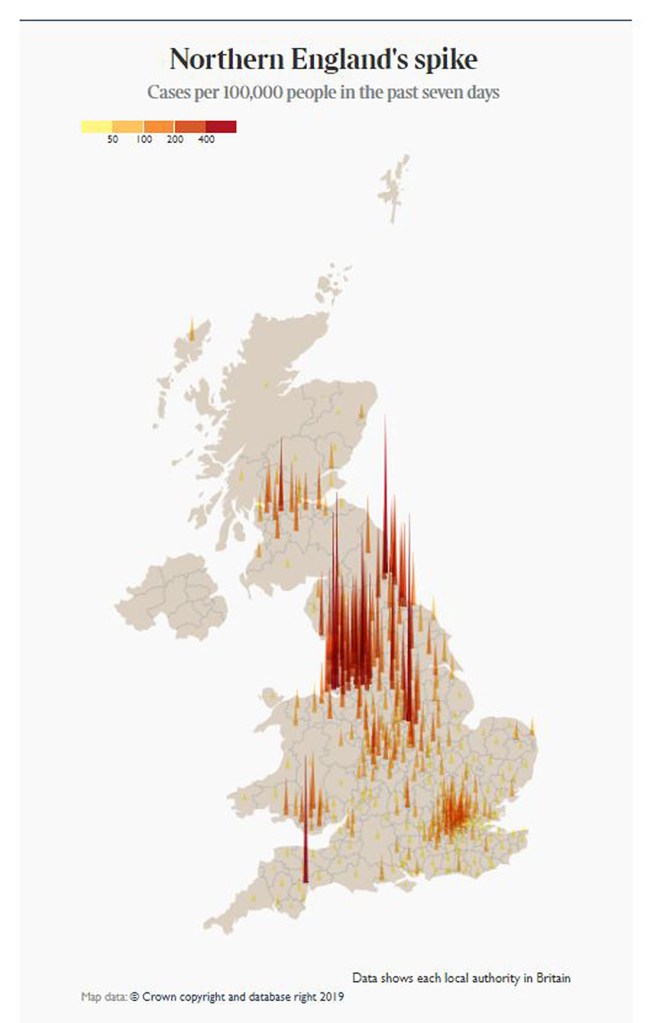
The app’s data shows a big disparity between the North and South of England. There are more than five times more cases in the North compared to the South of England, with the most new cases being seen in North East and Yorkshire (5,425) followed by North West (5,248). The South of England data suggests that the second wave has yet to impact this region. Currently the new cases in South West and South East are still below a thousand daily (985 and 914 respectively). This supports a regional approach to restrictions. The top three areas of concern with one in 100 estimated people infected are around Glasgow, Nottingham and Sheffield according to our data.

The CSS UK Infection Survey R values for the UK are; England 1.0 , Scotland 1.1 and Wales 1.1. This is the second week in a row that the R values have come down. The R value of 1.0 in England is a positive sign that the upward trend that was seen a few weeks ago has slowed down, but is still rising.

The CSS UK Infection Survey has been running since early May when the COVID Symptom Study commenced the daily swab testing programme provided by the Test and Trace. The CSS has so far recorded over a million swab results from app users. The CCS UK Infection Survey estimates the number of current COVID-19 positive cases in the community based on the information logged by users in the app and the results from the swab testing programme. It identifies differences in numbers within the regions throughout the UK, and tracks the change in estimated cases over time. It is the largest survey of its kind in the UK, bigger than the ONS’s COVID-19 Infection Survey and the REACT study by Imperial College London.

The COVID Symptom Study app is a not-for-profit initiative that was launched at the end of March 2020 to support vital COVID-19 research. The app was launched by health science company ZOE with scientific analysis provided by King’s College London. With over 4 million contributors, the Study is the world’s largest ongoing Symptom study of COVID-19.

Tim Spector, Professor of Genetic Epidemiology at King’s College London, comments:

“There are a lot of data sources out there and they are generally showing the same trends. Our data shows that rates are still rising but we have been seeing a slowing down nationally of the increase in daily new cases, which is reflected in the R values of 1 and 1.1. The data also show increasing regional differences with worst hit areas in the North of England still increasing rapidly- especially now Yorkshire and the North-East.

Our data is a number of days ahead of the other sources, which means we are an early warning system, unlike the figures on confirmed cases, which have a big lag and are prone to error. It’s good news that cases are slowing down, but we aren’t out of the woods yet, especially hospital admissions are starting to increase, which we predict will continue to do so over the next two weeks.

It’s unclear yet if local measures like the 10pm curfew have had a real impact but what is important is that people understand the risks in their area and the range of early symptoms found on the app. The key to get this virus back under control is to follow the guidelines around self isolation. If you think you might have COVID-19 stay at home, get better and help to keep others safe and stop the spread of this virus.”

Plans to hand contact tracing to England’s local authorities ‘too late’

Plans to hand greater control of Covid-19 contact tracing to town halls will come too late to affect the second wave of the virus in some of the worst affected parts of England, public health experts have warned.

Nazia Parveen www.theguardian.com 

Officials in Yorkshire and Newcastle said plans floated by ministers at the weekend to boost local resources to track outbreaks might only help stem a later third wave.

The communities secretary, Robert Jenrick, on Sunday appeared to confirm reports the government will empower councils in England to employ more people to knock on doors to get contacts of Covid-infected people to self-isolate and give them greater control over testing.

“We want to work very closely with the local mayors and with the councils,” he told Sky News. “We are going to be ensuring that the national testing infrastructure … works in harmony with what’s happening locally. Because local councils and local communities are very good at contact tracing.”

The move is seen as an admission that the national NHS test and trace system has been failing. It follows months of lobbying by local directors of public health, mayors and council leaders for more power to track the virus locally. Local leaders caution, however, that the additional responsibility, and potential for blame, must be backed by resources.

Boris Johnson is expected to address local roles in an announcement on Monday about lockdown restrictions. The Local Government Association says local contact tracing systems have a 97% success rate at finding close contacts and advising them to self-isolate. The latest figure for reaching contacts within 24 hours of them being identified by NHS test and trace is 67%.

However, Eugene Milne, the director of public health in Newcastle-upon-Tyne – where there were 487 infections per 100,000 people last week, one of the highest levels in the UK – said additional local test and trace will not, of itself, suppress the current second wave, but preparations now would ensure a working system for once the wave has passed.

Another public health director, in Yorkshire, added: “It may be too late in the university towns in the north.”

Newcastle wants to create about 15 local contact tracing teams, using the existing national call centres only as a backup. Each team would be able to track down at least eight case chains a day, with details logged on a single computer system. It also wants money to hire behavioural scientists to guide its effectiveness and fund regional advertising campaigns.

More than 90 councils have already launched or are close to launching their own locally supported contact tracing arrangements, according to the LGA. These use call centres, redeployed environmental health and sexual health officials and door knocking to trace contacts. Birmingham city council has been using members of the military to offer tests door-to-door in infection hotspots.

Andy Street, the Conservative mayor of the West Midlands, said: “We’ve always known that there was a need for a local element of test and trace, as a centralised system does not have local expertise and is not able to cut through the harder to reach communities. In the West Midlands our local councils have been leading the way on this for months.”

Privately, some local officials have voiced fury at the weaknesses of the privately run national system. One director of public health in north-west England said it was “still so bad and poor quality in the data being provided”.

“We asked for [local powers] since day one,” they said. “Shame it’s taken so long for them to realise we were right.”

Andy Burnham, the Labour mayor of Greater Manchester, said the government had finally acknowledged it would be better for test and trace to be handled locally.

“They now need to back this with serious resources,” he said. “Council leaders in many regions have been relying on volunteers but this cannot continue. It can’t be done on the cheap – councils have to be given more resources to employ expanded, trained teams.”

One local contact-tracing system in Hertfordshire has already cost £1m. Access to accurate data from the national system remains a key problem. The national contact tracing database, CTAS, remains unavailable to some local district councils, said one senior director of public health who described the system as “creaking”.

“Too many contacts are coming through without phone numbers and about a third don’t have occupations [which hinders efforts to quell workplace outbreaks],” he said.

Downing Street and the Department of Health and Social Care said they did not wish to comment ahead of Monday’s statement by the prime minister.

Sidmouth café owner threatens compensation claim citing ‘loss of business’ after Highway Authority decision

A decision by Devon County Council to prevent a town centre café in Sidmouth using a section of pavement opposite the premises for outdoor seating has been strongly disputed.

Hannah Corfield sidmouth.nub.news 

The Dairy Shops’s alfresco set up, which was given permission with a special ‘street café’ license back in July, was a crucial factor in enabling the business to remain viable during the coronavirus crisis – which continues to blight the hospitality sector.

Read the original story here.

Many have queried the risk involved with having tables and chairs positioned in Church Street, due to the area being predominantly pedestrianised.

Owner John Hammond responded: “As part of our complaint against the actions of Devon County Council removing permission for our three tables and six chairs (six covers) we are now looking at loss of business caused by the decision from the Highway Authority.

“We ask that you pass any objective evidence for the reasons that the tables have been removed onto your legal team as our estimated loss of business up until the end of December will be in the region of 6k.

“While this might not seem a lot of money to DCC, as a small business operating at 60% of last year’s turnover due to Covid-19 restrictions, this is a significant amount.

“We are trying to survive the current pandemic and decisions which are detrimental to our business will be followed through to the highest level.

“In light of ‘loss of business’ we will be looking at a compensation claim should our tables not be reinstated in line with the original agreement.”

The position of the Highways Management Team at Devon County Council, who are responsible for granting outdoor seating permits, is that the arrangement was initially allowed to support the business coming out of lockdown.

Now that the temporary license has expired it no longer meets certain requirements and, following complaints made, it has been deemed to ‘impact on adjacent businesses, whilst putting pedestrians at risk’.

A Devon County Council spokesman said: “The footway in this location is restricted and it’s unusual to grant a licence on the opposite side of the road from a premises.

“But, because it was within social distancing measures being promoted by the Town Council and had the support of the local member Councillor Stuart Hughes we made an exception in this case and a provisional licence was granted until the end of September.

“Unfortunately, the applicant then placed additional seating outside the agreed area. We advised him that further breaches would lead to the licence being revoked and asked that the extra seating be removed.

“Then, outside of what was agreed, the removed seating was put back and additional parasols were added to the tables.

“This resulted in several complaints being received by the Authority, which impacted on adjacent businesses and effectively reduced the width of the highway.

“It is not a ‘right’ to occupy the highway, but a concession granted by the Highway Authority for community benefit.”

The Tories’ Uber Eats habit is funny – the truth about money in British politics isn’t

Peter Geoghegan www.theguardian.com 

Journalists love election spending returns – and with good reason. How else would we know that the Lib Dems paid out £2,795 to Disney to cancel a Caribbean cruise in 2017 after Theresa May called a snap general election, or that last year the Tories racked up more than £22,000 on Uber Eats deliveries to their Millbank Tower campaign headquarters. (Sushi was particularly popular, apparently.)

But electoral returns are not just easy fodder for diary columns and disposable news stories. The spending data for December’s general election – partly released by the Electoral Commission earlier this week – gives a rare glimpse into how deeply money and power are entwined in British politics, and the inadequacy of transparency rules that are supposed to protect our democracy.

In general, the latest figures add texture to what we already know. The Conservatives ran a highly effective campaign in 2019, spending more than £16m to deliver a “stonking” 80-seat majority in December. (The publication of Labour’s spending has been delayed due to the coronavirus outbreak.)

The Tories’ spending last year was slightly down on 2017. Unlike the United States, British elections run on quite meagre amounts of cash – but drill down into this week’s figures and you’ll find a small world of political consultants, profiting from their access to power, that would rival anything in Washington DC.

After the cost of mailing unsolicited electoral bumf, the Tories’ biggest outlay was the more than £1.6m paid to Australian election guru Lynton Crobsy’s polling firm CTF. Not a bad return for the firm that had earlier given an interest-free loan worth over £20,000 to Boris Johnson’s successful leadership campaign.

It is striking, too, how many of those on the Conservatives’ general election payroll in December were subsequently brought in to spearhead the coronavirus response. Crosby’s protege Isaac Levido – the main credited with coining the phrase “get Brexit done” – was hired by Tory HQ at the start of the pandemic to work on government messaging.

Others were paid directly out of the public purse. During the election, Conservatives spent £458,688 with Topham Guerin. A few months later the New Zealand-based PR firm was given a £3m government contract, without any competition, for coronavirus work.

They are not the only ones. Electoral Commission data shows the Conservatives paid £700,000 to Hanbury Strategy, which is run by the former Vote Leave executive Paul Stephenson. The strategic advisory firm was subsequently handed a contract to research public opinion during the pandemic, again without any tendering process.

The latest spending figures attest to how political campaigning is changing. Back in 2017, the Conservatives spent more than £2m on Facebook and barely half a million on Google. This time around the Tories spent almost the same amount on advertising on both platforms. (The £879,091.32 outlay on Google includes the cost of promoting a fake website targeted at voters searching for Labour’s election manifesto.)

The Electoral Commission data also reveals the growing reach of so-called “third party campaigners” in general elections. Between them, Labour’s Momentum initative, pro-EU campaigners, Brexit-backing hedge fund tycoon Jeremy Hosking, and a plethora of almost anonymous Conservative-aligned websites with names such as Capitalist Worker and the Campaign Against Corbynism spent millions of pounds, often with very little transparency about where the money came from.

That’s because Britain’s electoral laws are outdated and ineffective. We have tight restrictions on political finance. Each candidate for parliament has a spending ceiling of around £15,000 (the exact limit varies by constituency size). The impetus behind these strict limits is to provide a level playing field and prevent the kind of spending wars that can characterise even minor contests in the US.

So, if a candidate can only spend £15,000, how come the average Tory seat cost the party more than 10 times that? That’s because “national” and “constituency” spending is supposedly separate. But it seldom is. Digital campaigning is almost always recorded as national spending, but is often highly targeted.

You have to go back to the 1920s to find the last time a general election candidate was actually convicted of breaking spending limits, but only the most optimistic would believe that constituency overspending has died out. Instead candidates are incentivised to work around the artificially low local spending limits.

It is remarkable how many MPs report spending almost all of their allocated allowance, without breaching the limits. (Jeremy Hunt reported spending 99.88% of his limit in the last general election.)

There is another, even bigger, problem. Spending returns are based on the idea that the political campaigns only take place over a few weeks in the runup to general elections. But with a Vote Leave government in continuous election mode, campaigning is now a constant feature of the British politics. Surely then spending outside of brief windows should all be recorded, too?

There are no shortage of demands to reform Britain’s electoral law. In June, the committee on standards in public life launched a review of electoral regulation. The public administration and constitutional affairs committee recently called for evidence for an investigation into the work of the Electoral Commission.

But the chances of meaningful change are negligible. Rather than giving new powers to the Electoral Commission, the Conservatives’ co-chair Amanda Milling has said that the regulator should become “more targeted” – or be abolished entirely.

If the government gets its way, election spending returns will continue to tell us how much parties spent on pizza and beer, but remain silent on some of the most important ways that British politics is really paid for.

• Peter Geogheghan is investigations editor at openDemocracy and the author of Democracy for Sale: Dark Money and Dirty Politics

Tories Fail To Account For Three BILLION Spent On Coronavirus Contracts

Owl is reminded of Margaret Thatcher’s quote: “The problem with socialism is that you eventually run out of other people’s money.”

Chris York www.huffingtonpost.co.uk /

The government has failed to account for £3 billion spent on private contracts since the start of lockdown, new figures have shown.

It comes as three cross-party MPs and the Good Law Project, a non-profit-making organisation, have launched legal action against the government over its failure to disclose details of its spending on contracts related to the coronavirus pandemic.

Green MP Caroline Lucas, Labour’s Debbie Abrahams and Liberal Democrat MP Layla Moran have filed a judicial review against the government for breaching the law and its own guidance and argue that there are mounting concerns over the government’s coronavirus procurement processes.

They say that, despite the Department of Health and Social Care disclosing in September that at least £11 billion worth of contracts have been awarded by the department since April, related predominantly to coronavirus, new analysis by Tussell shows that over £3 billion worth of these contracts have not been made public.

The Department of Health and Social Care has said due diligence was carried out on all government contracts which have been awarded.

The government has 21 days to respond to the judicial review proceedings.

Jolyon Maugham QC, director of Good Law Project said: “What we know about the government’s procurement practices during this pandemic gives real cause for concern. Huge sums of public money have been awarded to companies with no discernible expertise.

“Sometimes the main qualification seems to be a political connection with key government figures. And I have seen evidence that government is sometimes paying more to buy the same product from those with political connections.

“We don’t know what else there is to discover because the government is deliberately keeping the public in the dark. We are left with no option but to push for transparency through the courts.”

Lucas added: “When billions of pounds of public money is handed out to private companies, some of them with political connections but no experience in delivering medical supplies, ministers should be explaining why those companies were awarded the contracts.

“It’s completely unacceptable that, as an MP, I’m prevented from being able to scrutinise those decisions.”

Abrahams said: “Transparency is crucial for effective scrutiny and will only improve our response to this crisis.

“The persistent failure to publish the details of Covid contracts leads you to wonder what this government has got to hide.”

Moran added: “It is totally unacceptable for the government to avoid scrutiny during a public health crisis. 

“As we enter a predicted second wave we need to be able to take stock of what has worked and what hasn’t to protect as many lives as possible.

“Government must let Parliament do its job and properly scrutinise their decisions.”

The legal challenge is being crowdfunded with the support of 38 Degrees and Good Law Project and the three MPs have instructed Deighton Pierce Glynn and Jason Coppel QC and Christopher Knight of 11KBW to act in the judicial review proceedings

Campaigns director of 38 Degrees, Ellie Gellard said: “The public needs to know where taxpayers’ money has been spent in our ongoing battle against coronavirus so that we can be sure those who have been paid, deliver what they promised.

“That’s why thousands of members of the public have chipped in to help get the answers we deserve, transparency is needed to restore public trust in the government’s approach.”

Sidmouth beach management plan … a new (and welcome) approach

9 October 2020 – Progress update on storm event protection discussed at Sidmouth and East Beach Management Plan meeting – East Devon

eastdevon.gov.uk 

Sidmouth and East Beach

For the first time since March, East Devon District Council hosted a Sidmouth Beach Management Plan (BMP) steering group of local organisations, interested parties and councillors to discuss the progress being made to protect the town and East Beach from flooding.

The meeting was a held ‘virtually’ due to Covid-19 restrictions and progress updates came from district council officers working on a proposed scheme.

Cllr Geoff Jung, the council’s portfolio holder for Coast, Country & the Environment, chaired the steering group meeting and explained that following policy changes of the council’s new administration that in future all meetings will be held in public and the minutes be published.

He also proposed that all the main project documents relating to the BMP will be published and the Frequently Asked Questions (FAQs) will be reviewed on the council’s website to demonstrate the new administration’s policy of openness and transparency.

The BMP’s terms of reference will be reviewed to reflect these changes and brought before the next meeting of the group for discussion in December. Councillor Jung also proposed that because of Covid -19 restrictions, the next few meetings will be held virtually via Zoom and future public meetings will be broadcast through the council’s YouTube channel when they are held every other month.

East Devon District Council’s Engineer Tom Buxton-Smith provided the steering group with an update and progress of the proposed scheme which includes a splash defence and recharged beach along the main town frontage along with a super groyne on East Beach. The steering group discussed options for carrying out a public exhibition on the scheme and splash defence options so that residents and businesses can give their views. With Covid-19 restrictions, the group will discuss this further at its next meeting.

The scheme is now fully funded and is estimated to cost £8.7m. The funding is dependent on the Environment Agency approving the submission of the council’s Outline Business Case. Following approval, consultants and contractors will be appointed to develop the final design during 2021. A planning application will be submitted with a proposed start to the long-awaited scheme in the Autumn 2022.

Following a number of cliff-falls at Pennington Point in early Spring a review had been undertaken to consider emergency measures to protect properties in the town from the perceived sea overtopping of the Sid river wall. However, the Environment Agency advised that the works did not meet the definition of emergency works. It was concluded that the emergency works could not proceed at this time and it would be kept under review. Engineers will provide a definition of ‘trigger’ points when it may be considered that emergency works were appropriate.

Following a proposal by Devon County Councillor Stuart Hughes to consider a “recurve” to be fitted to the esplanade sea wall, it was agreed that further evidence was required to understand if this would be providing extra protection for the town. It was concluded that an additional recurve would increase the impact load on the seawall and would probably not remove the need for a splash barrier, but further assessments will be undertaken.

Mr Buxton-Smith then discussed the need for the most controversial element to the whole scheme which was referred to in earlier reports as a ‘Splash Wall’. It had always been recognised that a 1-metre high wall would not be appropriate along such an important and historic esplanade of Sidmouth, so alternative solutions are under investigation. Glass panels, removable sections, benches with raising seats to act as barriers, together with flood gates are all being considered which will be part of the public exhibition and consultations prior to the planning application being submitted.

Sidmouth Chamber of Commerce has recently proposed that Offshore Rock Islands should again be considered. Mr Buxton-Smith reported that he was in discussions with their representative and awaiting on the pricing and engineering specifications to their proposal.

In the meantime, Mr Buxton-Smith has had costings produced for the large offshore breakwater based on engineering drawings costing £13.1m – more than the total funding available for the project making this proposal unviable. Mr Buxton-Smith said he would discuss the variance of the costings with the Chamber.

• Over the last few days, a fresh report made public by Plymouth University, is estimating future rates of coastal erosion over the next 100 years in the eastern half of the district.

– The report indicates that some parts of the coastline in East Devon will erode more quickly than had previously been estimated, while some will erode less than previously thought.

– However, the university research does not take into account the mitigating protection to be provided by schemes such as Sidmouth’s BMP, discussed by the BMP steering group.

– The university’s research also shows the reasonable worse-case scenario erosion rates, whereas the erosion rates in the council’s beach management plans are the most likely scenario.

– The council’s strategic planning committee will consider a planning policy briefing paper on the university’s findings related to coastal changes at its meeting later this month. The issue will also be discussed at the next BMP steering group meeting in December.

“Three Homes” Jenrick’s £25m government funding for his constituency – Part 3

Robert Jenrick admits approving funds for town in Jake Berry’s constituency

Rajeev Syal www.theguardian.com 

Robert Jenrick has admitted that he and a junior minister approved payments to towns in each other’s constituencies from a government fund earmarked for deprived areas.

The communities secretary confirmed that communities minister Jake Berry gave the go-ahead for Jenrick’s Newark constituency to be selected for a £25m fund award even though it was 270th on the list of the UK’s most deprived areas.

Jenrick said he signed off the decision for money to be allocated to Darwen, a town in Berry’s Rossendale and Darwen constituency.

On Sunday, Jenrick insisted there was a “robust and fair” methodology behind the government’s towns fund and dismissed as “completely baseless” allegations that he had any involvement in Newark’s selection.

Last year, Jenrick announced details of a £3.6bn towns fund to be shared between 101 left-behind areas.

Under the scheme, select towns were able to bid for up to £25m each from the Ministry of Housing, Communities and Local Government.

Jenrick and Berry, his junior minister, were allegedly responsible for choosing 61 of the towns.

At a hustings during the election last year, Jenrick told voters: “I helped to secure a £25m town deal which I hope will improve the public realm and make the town centre a more attractive place to spend time in.”

After the election, Jenrick sat on a board convened by Newark and Sherwood district council that petitioned his own department for the maximum amount available of £25m.

Jenrick told the BBC’s The Andrew Marr Show: “If the question you’re coming to is was I involved in selecting my own community, absolutely not. Ministers do not get involved in their own constituencies. That decision was made by another minister in my department.”

Asked which minister made the decision, Jenrick replied: “It was made by Jake Berry.”

When Marr pointed out that a town in Berry’s constituency also received money from the fund, Jenrick confirmed that he was the individual to have given that decision the go-ahead.

Earlier this year, Jenrick rebuffed calls for his resignation after he ensured a controversial housing development was agreed before a levy was introduced that would have cost its backer millions.

Documents showed that the former porn baron and Conservative party donor Richard Desmond urged Jenrick to approve his Westferry Printworks development in east London before a new community infrastructure levy was introduced, a move which, it is believed, would have saved Desmond £50m.

Desmond had given the Conservatives £12,000 two weeks after the scheme for 1,500 homes was approved, and the housing secretary had sat next to him at a fundraising event.

Jenrick denied any wrongdoing but expressed regrets for sitting next to Desmond and exchanging messages with him.

Labour is demanding an inquiry into the way money was allocated from the towns fund.

The shadow communities secretary, Steve Reed, has written to Simon Case, the head of the civil service, requesting a cabinet office investigation.

“Three Homes” Jenrick’s £25m government funding for his constituency – Part 2

Minister dismisses call for constituency fund probe

BBC News www.bbc.co.uk

Communities Secretary Robert Jenrick has dismissed Labour’s call for an investigation into the award of a £25m regeneration grant to his constituency.

He told BBC One’s Andrew Marr show the decision to give the money to Newark, Nottinghamshire, had been taken by fellow minister Jake Berry.

Mr Jenrick said he had himself decided to grant funds to a town in Mr Berry’s constituency under the same scheme.

He called this “perfectly normal” and accused Labour of “distraction”.

But Labour described the allocation of the money “murky” and urged Mr Jenrick to submit himself to a “full” investigation.

The £25m was awarded to Newark under the Ministry of Housing, Communities and Local Government’s £3.6bn Towns Fund, set up last year to help places that had “not always benefitted from economic growth in the same way as more prosperous areas”.

Newark and Sherwood District Council submitted its town investment plan – including better transport, training and digital connectivity – in July.

Mr Jenrick, Conservative MP for Newark since 2014, supported the bid.

For Labour, shadow work and pensions secretary Jonathan Reynolds told Sky News’s Ridge on Sunday: “The whole question has always been quite a murky one as to how this money was allocated.

“The secretary of state has questions to answer and an investigation is the right way forwards.”

‘Robust system’

But Mr Jenrick said the government had a “robust” system in place for choosing which places would benefit from the Towns Fund and that the rules had been created before he became communities secretary.

He added that Mr Berry, who oversees local growth in England as a minister within Mr Jenrick’s department, had made the decision following advice from civil servants.

Darwen, a town in Mr Berry’s Rossendale and Darwen constituency, was also allocated money from the Towns Fund.

The decision, Mr Jenrick said, had been “made by myself”.

He added: “This is perfectly normal. Ministers don’t get involved in making decisions for their own constituency.

“But neither should their constituencies be victims of the fact that their MP is a minister.”

Mr Jenrick also said: “The Labour Party front bench need to get beyond the M25 and see what’s happening in our constituencies.”

Earlier, he told Sky News that Labour’s accusations were “completely baseless”.

But, following the interviews, shadow communities secretary Steve Reed insisted that, if “Robert Jenrick has nothing to hide, he should submit himself to a full investigation”.

In August, Mr Jenrick said he regretted sitting next to property developer Richard Desmond at a Conservative Party fundraising event last year.

Mr Desmond donated £12,000 to the Conservatives in January, 12 days after the minister overruled government planning inspectors to approve a development at the former Westferry print works in east London.

Labour said this had raised suggestions of “cash for favours”.

But Mr Jenrick has always insisted he had no knowledge of the donation and was motivated by a desire to see more homes built.

“Three Homes” Jenrick’s £25m government funding for his constituency – Part 1

Labour demands probe into £25m government funding for housing secretary’s constituency

Shaun Connelly www.independent.co.uk 

Labour has demanded a top-level investigation into communities secretary Robert Jenrick, over how government funding was allocated to his Newark constituency.

Shadow communities secretary Steve Reed has written to the head of the civil service requesting a Cabinet Office investigation into Mr Jenrick, concerning how recipients of the multibillion-pound Towns Fund were decided.

The move comes in the wake of Mr Jenrick’s Newark constituency being selected for a £25m funding award.

It follows a report in The Times alleging Mr Jenrick helped select Newark for the allocation.

Mr Jenrick has insisted he was not part of the decision-making process regarding Newark as funding for the town was determined by another minister.

Labour wants an inquiry to see how Newark was chosen for inclusion in the Towns Fund, and whether officials advised against such a move.

Mr Reed also wants to know if Tory-held seats were prioritised under the initiative.

The £3.6bn Towns Fund was a high-profile government scheme in the run-up to the last general election, which ministers said was aimed at “levelling-up” so-called left behind towns.

Earlier this year Mr Jenrick rebuffed calls for his resignation after he ensured a controversial housing development was agreed before a new levy was introduced which would have cost millions for its backer.

Documents released after pressure from Labour showed multimillionaire Conservative Party donor Richard Desmond urged Mr Jenrick to approve his Westferry Printworks development in east London before a new community infrastructure levy was introduced which, it is believed, would have saved Mr Desmond £50m.

Mr Jenrick faced accusations of “cash for favours” after it emerged that Mr Desmond had given the Conservatives £12,000 two weeks after the scheme for 1,500 homes was approved, and that the housing secretary had sat next to him and viewed a video at a fundraising event.

The minister originally approved the development plan in January, overruling Tower Hamlets Council and a planning inspector.

Mr Reed said: “Hot on the heels of the Westferry scandal, Robert Jenrick yet again has serious questions to answer about allegations that he used the Towns Fund to channel public money to help Conservative Party candidates ahead of the general election.

“Mr Jenrick has made an unfortunate habit of overruling officials’s advice to get his own way, just as he did during the Westferry cash-for-favours scandal.

“Now he has done the same with this blatant example of pork-barrel politics, with public money making its way to help his own re-election campaign. Misuse of public funds is a very serious abuse of public trust.

“Robert Jenrick must come to the House urgently to make a statement on how this money was awarded and submit himself to a full Cabinet Office investigation.”

Mr Reed has called for the communities secretary to appear before the Commons on Monday to make a statement on the issue.

A spokesman for Mr Jenrick said: “This reporting is incorrect as the secretary of state did not select his constituency for Towns Fund money.

“To suggest otherwise is misleading, and another minister in the department is responsible for decisions around Newark’s Towns Fund bid, as is normal practice.

“As made clear in the National Audit Office report, the process was comprehensive, robust and fair – and the Towns Fund will help level up the country.

“Delivering the Towns Fund was a manifesto commitment that the Labour Party opposed and offered no alternative to, so it was not surprising that Conservative candidates mentioned it during their campaigns.

“Conservatives in government are investing in our towns to improve the life chances of local people, Labour are resorting to baseless political point-scoring.”

Lower Otter Restoration Project – the details

One of the most interesting and environmentally significant planning applications for decades appeared in the applications posted by Owl yesterday:

Proposed breach of the River Otter embankment, Little Bank and Big Bank to restore the historic floodplain creating intertidal saltmarsh, mudflats and freshwater habitat at Big Marsh, and new freshwater habitat at Little Marsh. Associated works including development of a new footbridge, realignment of South Farm Road, and creation of a new car park. (The Lower Otter Restoration Project) Open for comment icon151 Hectares Of Land Within The Parishes Of East Budleigh, Budleigh Salterton And Otterton From Lime Kiln Car Park (SY072819) To South Of Frogmore House (SY074850) (The Lower Otter Valley)Ref. No: 20/2089/MFUL | Validated: Mon 28 Sep 2020 | Status: Awaiting decision
The application comprises 128 documents, though “The Design and Access Statement” is the document to read to give the overall picture. The extract below gives a good summary of what is proposed. Other documents are likely to provide interesting supporting ecological and historical studies.

Before that, Owl copies a paragraph from the Planning Statement which discusses the motivation driving the project. This talks about the need to provide compensating habitat for losses in the Exe Estuary. Owl suggests these habitat losses haven’t occurred because of climate change, that’s for the future, but because of overdevelopment and increasing use of the estuary for leisure activities.

“The original motivation for the LORP arose from a desire by the landowner, Clinton Devon Estates (the Estate), to manage the lower Otter valley as sustainably as possible in the face of a rapidly changing climate. The Environment Agency’s involvement in the project arose from a statutory need to provide compensatory habitat for habitat losses in the Exe Estuary. The desire of these project partners is to improve the natural functioning, ecological health and environmental status of the river, demonstrate climate change adaptation and reduce risk to wildlife and public infrastructure under future climate change.”

Planning application 20/2089 MFUL Design and Access Statement

Submitted by the Environment Agency

The Lower Otter Restoration Project (LORP) will restore the historic floodplain of the River Otter to a condition similar to that found prior to the construction of the 19th century embankments alongside the river and within the floodplain. It will retain most of the embankments and create breaches in Little Bank, Big Bank and the River Otter embankment to allow water from the River Otter and Otter Estuary to inundate the site, creating intertidal saltmarsh and mudflats. South Farm Road will be raised, and the existing Budleigh Salterton Cricket Club moved off site to another location. Development of the new Budleigh Salterton Cricket Club has been approved by successful determination of a separate planning application (reference 19/1521/MFUL) due to a need to progress the cricket pitch sooner than the rest of the LORP. The Scheme includes the elements shown in Figure 1.1

Bishop’s Clyst Parish Council meeting on Winslade Manor – the outcome

From a participating correspondent:

“A number of residents dialled in to listen and spoke at the open session. Prior to the Open Session Peter Cain read a pre prepared statement to clarify his position. The Parish Council listened to what we had to say, both Mike Howe and Peter Cain declared an interest, correctly, and took part in the discussion. The Parish Council then unanimously agreed to submit the objection that Charlie Hopkins had written with two very minor amendments.” 

[EDDC will make the final decision.]

Councils argue about where they sit in new lockdown tiers

Councils are jostling to be moved up and down the government’s three-tier lockdown system as they fret over the conflicting demands of local jobs and public health.

Will the Government put Exeter into Tier 3 lockdown?

Andrew Gregory and David Collins www.thetimes.co.uk

With the number of virus infections surging, Boris Johnson plans to introduce the new measures this week to simplify the restrictions.

Millions of people have been subjected to local restrictions for weeks, but there are concerns that mixed messages and confusion over changes to the rules have limited their effectiveness.

Areas with relatively low infection levels will be placed in what is being described as tier 1. Only national restrictions such as the rule of six, the 10pm curfew on restaurants and pubs and existing rules on masks and social distancing will apply.

The next tier is likely to include bans on home visits and indoor socialising with other households in bars or restaurants.

Areas with the worst coronavirus outbreaks will be put in tier 3. Options being considered this weekend include the closure of all hospitality venues, a ban on overnight stays outside your own home and shutting leisure venues such as cinemas.

Tier 3 could see people ordered not to have social contact with anyone outside their household.

The move could see 7,171 pubs in the north of England temporarily shut, accounting for one in five of England’s 37,616 pubs. The region accounts for 18 of the 20 worst Covid hotspots. Liverpool, Manchester and parts of the northeast are all set to be put in tier 3.

But yesterday, an extraordinary lobbying race erupted with several councils scrambling to be placed in higher tiers than the levels they expect.

It is understood that some London boroughs want to be in tier 2 rather than the less strict tier 1, despite relatively low infection rates.

Officials said this was because councils fear they are only weeks behind the north of England.

At the same time, some councils are lobbying the government to be in tier 3 to win economic support.

Conversely, some councils in the Midlands and the north with higher infection rates want to be in a lower tier amid concerns that the tier-3 restrictions would “finish off” their economies.

The jostling is complicated by the fact that the prime minister had yesterday not decided on the final measures for each tier.

It is understood that while pubs and bars will be forced to shut in tier-3 areas, restaurants may be allowed to stay open until 10pm. There is debate over whether to shut hairdressers, leisure centres and gyms.

One option is an 11pm curfew in tier 1. It comes amid opposition to the national 10pm curfew, which will be voted on in the House of Commons on Tuesday.

Another idea is to extend the severe measures in tier-3 cities to their suburbs, even if virus infection levels there are lower.

The rules are expected to be reviewed after a month, a government official said. But questions remained about when and how local areas would move up or down tiers. Triggers could include the level of infection, the number of cases or the R figure.

“A key concern is getting trapped in one tier or another,” said a council official. “If you are in an area deemed low-risk, in tier 1, how quickly will you be allowed to move up a tier if infections suddenly take off?”

@AndrewGregory

Tier 1

Areas with the fewest coronavirus cases. Only national restrictions such as the rule of six and the 10pm curfew on restaurants and pubs will apply. Rules on mask-wearing and guidance on social distancing will still apply. One possibility is that varied curfew times could apply to different tiers. The curfew could be 11pm in tier 1 rather than 10pm

Tier 2

The same restrictions and rules as tier 1 apply but may also include bans on home visits and indoor socialising with other households in bars and restaurants

Tier 3

The parts of the country with the highest infection rates. These areas will have to observe all the restrictions in tier 1 and tier 2 but could also see the closure of all hospitality venues, a ban on overnight stays and the shutting of leisure venues. Tier 3 residents might be banned from any social contact with anyone outside their household. Hairdressers, cinemas, and gyms may also face closure

Cumbria’s ace test-and-tracers put Whitehall officials to shame

When it comes to tracking Covid-19, the Lake District proves it is best to go local.

Tom Calver, Gabriel Pogrund and Hannah Al-Othman www.thetimes.co.uk

In May, 10 days before the launch of the national test-and-trace scheme, Cumbria set up England’s first fully functioning local version.

Members of Cumbria county council’s sexual health team — more used to tracking cases of chlamydia — were drafted in for their contact-tracing skills. They work with housing officers, who often know where vulnerable people are.

“Often, we identify someone who tested positive, and someone on the local environmental health team will say, ‘Yes, we know that person’,” said Colin Cox, Cumbria’s director of public health. “The skill of the local district council teams in knowing the complexities of their patch is just phenomenal.”

The experiment appears to have paid off. At the time of its launch, Barrow-in-Furness — Cumbria’s second-biggest town — had the highest coronavirus infection rate in the country. Although cases have soared again in the northwest, Cumbria’s rate of 87 per 100,000 is the lowest in the region.

Before the pandemic, Emma Bundock, 43, was an environmental housing manager. Since May, she has led a three-person team tracing contacts for Allerdale, a district that includes Grasmoor and Workington.

“The officers who work on this live in the communities they’re trying to support,” Bundock said. “We’re passionate about the people we’re trying to help because ultimately, it could be one of your own.”

Most cases come from the national test-and-trace programme, 24 hours after call centre operatives have had a go at making contact.

Sometimes, said Bundock, “the national tracers have not asked the questions that make the person properly think about who they’ve been in touch with, what they’ve done, or who they’ve seen”.

Cumbria’s scheme was the first and there are now 93 local contact-tracing teams. “Complex” cases involving outbreaks in hospitals, care homes and prisons are automatically passed to local teams. In the week to September 30 they reached 97.1% of contacts, compared with just 62.4% by the national teams.

In many Covid-19 hotspots, the national system is faring even worse. Blackburn with Darwen, Bury and Manchester have some of the highest infection rates, but little more than half of all non-complex contacts are being identified. In Slough, the figure is 42%.

In August, the Department of Health said NHS Test and Trace would become “local by default”. “We’re still trying to figure out what that means,” said Cox.

The department said: “NHS Test and Trace is breaking chains of transmission thanks to local and national teams working hand in glove. Almost 700,000 people have been contacted and told to isolate.”

‘Everyone is fighting’ – how Downing Street lost its grip on a divided nation

When he addressed the nation on 23 March to announce a national lockdown, Boris Johnson knew he had most of the British people with him. “Each and every one of us is now obliged to join together to halt the spread of this disease,” the prime minister said in his TV broadcast. “We will beat the coronavirus and we will beat it together.”

Toby Helm, Political Editor www.theguardian.com 

Six and a half months on, as he prepares to announce the introduction of more restrictions and a new three-tier system across the country – at what ministers say is a “critical” moment – hospitals are filling up and death rates are rising once more.

Unlike March, however, calls for the British people to unite behind a response directed from No 10 no longer command the attention or respect they did then. The many changes in rules and regulations have left people confused and choosing to rely on their own instincts as much as on what politicians tell them.

Trust in the government to handle the pandemic, say local leaders who monitor the crisis daily, has been shot to pieces. “I would say that trust in authority has completely gone,” said one senior official at the heart of the fight against Covid-19 in the north of England on Saturday.

That crisis of confidence in central government is borne out in the latest Opinium poll for the Observer on Sunday. It shows that just 31% approve of the way the government has handled Covid-19. At the end of March the approval rate was above 60%.

National targets on testing have not been met. False expectations have been set. Rules have changed at dizzying speed. “One day people are told one thing, the next another to the point where they have stopped even trying to follow,” said one public health director.

This weekend, when unity is needed, the cabinet is split. Tory MPs are split. The media is split. Public opinion is split. And council and public health leaders in some of the biggest cities of the north and Midlands are in revolt. So what can be done?

On Friday the prime minister’s close adviser Edward Lister and senior civil servants were locked in long, tense virtual meetings with local health chiefs and council leaders, trying to get them to agree to the new three-tier approach.

After two hours of talks, one of those who took part said he and many other leaders in the north of England were so furious at what took place that they were thinking of issuing a statement refusing to comply with government orders.

“They say they are listening to us but they are not. What they seem to want to do is punish the north. The extra financial support announced by the chancellor is welcome but it is two-thirds of people’s wages, not 80% which it was before. This is not enough for people and the businesses which will have to close.” Another official involved in talks with the government over the weekend said: “It is toxic and everyone is fighting.”

The reason for the anger, on display at a press conference of northern mayors on Saturday, is twofold. First the mayors demand to know why the government will only pay two-thirds of the wages of people in businesses in their areas that have to close as a result of the latest decisions by No 10, whereas they paid for 80% under the national lockdown. This, they say, is “grossly unfair” and discriminatory. It will leave many in the hospitality sector earning way below the minimum wage and unable therefore to pay their rent through no fault of their own. Many will therefore face eviction in the run-up to Christmas. Second, they do not see why central government should have the power to shut their pubs and hospitality venues, when local politicians and health leaders could do so themselves if granted so-called “summary closure powers”. In essence they want the power to make those decisions themselves.

For months council leaders and mayors have been asking ministers to allow them to fight the pandemic locally, with their own test and trace systems, rather than having decisions dictated from the centre. Mayors such as Andy Burnham in Greater Manchester have also called for greater financial help for people on low incomes required to self-isolate, arguing that without it many would not do so as they would feel they could not afford to. Leaders in the regions wanted more central government help – but it had to be help to allow them to manage their own responses, tailored to local needs.

This is not what they were hearing from No 10 this weekend, however. “There are lots of warm words,” said one senior figure. “But they are not listening. They are telling us to agree what they want. There is no consultation. We have different factors in different areas. In some university cities like Newcastle and Nottingham the virus is mainly being spread among students and has yet to spread to older people. In other areas like Merseyside we hear it has spread to older people. We need the ability to respond locally.”

In some cases local leaders believe restrictions do not go far enough. Liverpool’s Labour mayor Joe Anderson saidon Saturday that he expected his city – where there are currently 600 cases per 100,000 people – to be placed in tier three, under the highest set of restrictions. This would mean closing all the city’s pubs from Wednesday, though not its restaurants. Anderson said, however, that government would be wrong to allow Liverpool’s bars and pubs to stay open until Wednesday because the infection was spreading so fast in the city. In Merseyside things are so serious there are suggestions that local hospitals are already resigned to cancelling all elective surgery in the coming days because Covid admissions are rising so fast. Anderson said his other worry was that the public no longer listened to diktats from London. “I’m not convinced people trust the government’s decisions.”

On Monday the prime minister hopes to be able to announce the new three-tier system to parliament and to have it voted on within days. Many of his own MPs are dubious that stricter lockdowns are necessary. To add to the confused picture Labour has said it will abstain in a vote expected early next week on extending the 10pm curfew for pubs across England.

It is not just the north and Midlands where tighter restrictions appear imminent. The mayor of London, Sadiq Khan, warned people to expect new measures to be announced in the capital this coming week. “My prediction is, there will be additional restrictions being brought in because we’ve got to make sure we don’t have a situation with the NHS being overwhelmed and lives being lost.”

Another local health director told the Observer that to make any of these restrictions stick, faith had to be restored in those announcing the changes: “The only way is to do that is locally with local decisions. It is too late to rebuild trust at national level.”

Honiton Forward serves remaining town councillors with final ultimatum

A community movement established in response to certain issues surrounding Honiton Town Council has publicly requested, for a second time, that all remaining councillors resign.

Hannah Corfield honiton.nub.news

Honiton Forward serves remaining town councillors with final ultimatum

According to a statement: “This is the last time Honiton Forward will respectfully ask you all to make your own decisions and do the right thing.”

Over a thousand electorates have now signed a petition calling for the current incumbents of Honiton Town Council to step down and allow for a re-election.

“If you continue to treat the people of Honiton with contempt then you will give us no option but to exercise the will of the community and seek to have you removed though the Community Governance Review.

“We write now to urge you one last time to please stop putting your personal interests before the interests of your community and stand down to allow a new election to be held and a fresh start to be made.”

The letter also mentions specific high-profile incidents which have blighted the council recently. Included in this are the yet to be resolved negotiations with The Beehive, legal costs racked up in the apparently failed litigation against Bailey Partnership, the recent announcement from Honiton Chamber of Commerce and allegations made by the former Town Clerk who is threatening legal action.

Individual councillors, of which seven – six active – remain, are addressed with a personal message to each.

Click here for the Honiton Forward Facebook page where the letter can be accessed in full.

Honiton Nub News has contacted Chair of Honiton Town Council for comment and is awaiting response.

Planning applications validated by EDDC week beginning 28 September