Devon MPs split on need for Lockdown 2

“Jumping Jupp Flash” digs himself into a bit of a hole:

Simon Jupp, the Conservative MP for East Devon, two weeks ago said that another full national lockdown ‘simply isn’t necessary in the South West and I would vote against any push by Labour to force a national lockdown. This would divide the country, harm our economy and punish people across the South West.’…..

Mr Jupp had not yet responded to the questions posed around how he would vote in Parliament….

While Neil Parish plays the part of Father Christmas: 

Neil Parish, the Conservative MP for Tiverton and Honiton, is another who reluctantly feels he has to vote for a second lockdown…..

Mr Parish added that the lockdown will be time-limited, and that the mass testing – which will see everyone living or working in Liverpool will be offered tests, whether or not they have symptoms, which if successful, could be rolled out to “millions” by Christmas – was a huge boost.

Daniel Clark www.devonlive.com

“It’s an absolute tragedy for lives and livelihoods and Boris Johnson’ dither and delay and inability to deliver has led to this.”

Ben Bradshaw, the Labour MP for Exeter, cannot hide his anger over the chain of events that have led to a second national lockdown set to be imposed later this week.

“On this, there has been no trade-off between public health and economy – we have one of the worst death rates and one of the worst economic hits due to their serial incompetence and the continued scandalous failure of the test track and trace system,” he said.

On Saturday night, Prime Minister Boris Johnson announced that stringent action across the country was ‘vital’ in combating the spread of coronavirus.

Subject to MPs on Wednesday voting in favour of the second lockdown, non-essential services and businesses close, including pubs and restaurants, will once again be closed to close.

The government has also returned to its message of ‘stay at home, to protect the NHS and save lives’, although unlike the first lockdown, educational settings will remain open, household ‘bubbles’ remain and you can meet with one person not from your household outside.

Mr Bradshaw, as the Labour Party have said they will, be voting in favour of the measures, although he said any final decision would not be made until the wording of the legislation is proposed.

But he said that had the Prime Minister listened to the calls of SAGE and of Sir Keir Starmer for a two-week lockdown, then the measures needed to be taken now wouldn’t be so long or so intense.

“It’s an absolute tragedy that we have to do this,” he said. “But the Prime Minister ignored the advice, and we are now in a much worse situation as a result, and this is an absolutely tragedy for those who lives are affected, for business who face further uncertainly, for those whose jobs are on the line, and those in the front line dealing with a very different situation.

“I will wait to see exactly what is proposed but I will probably voting in favour of the measures in general because it is better late than never. The lessons of covid have been swift and decisive action saves lives and protects the economy and the clear advice from science is that if we don’t act now, then the NHS would be overwhelmed and the death toll far worse than the spring, so with a heavy heart, I will be voting in favour of the measures

“But the Government must publish clear criteria for an exit route to the lockdown and on what basis a decision to extend or end it will be taken. Sir Keir Starmer asked for this weeks ago at Prime Ministers’ Questions as to whether getting R Rate below 1 was the objective, and this is important but is it sufficient? People need something to plan and to something to aim at as if it is just a vague lockdown with no obvious exit, it will increase frustrating and desperation and damage the level of compliance

“People are really fed up and fed up with the serial incompetence of Boris Johnson and his government. Compliance was shot very badly by the Dominic Cummings scandal and has never recovered as people took the view of it is one rule for them and another for the rest of us. A huge amount of damage done to trust and levels of compliance, but I would urge people to stick to the rules and advice as one person’s behaviour has a big impact on other people and we all have a responsibility to get through the crisis.”

Mr Bradshaw was also called for the Government to immediate publish the modelling that they produced in the charts that were shown as part of Saturday’s press conference, saying they have to be completely transparent.

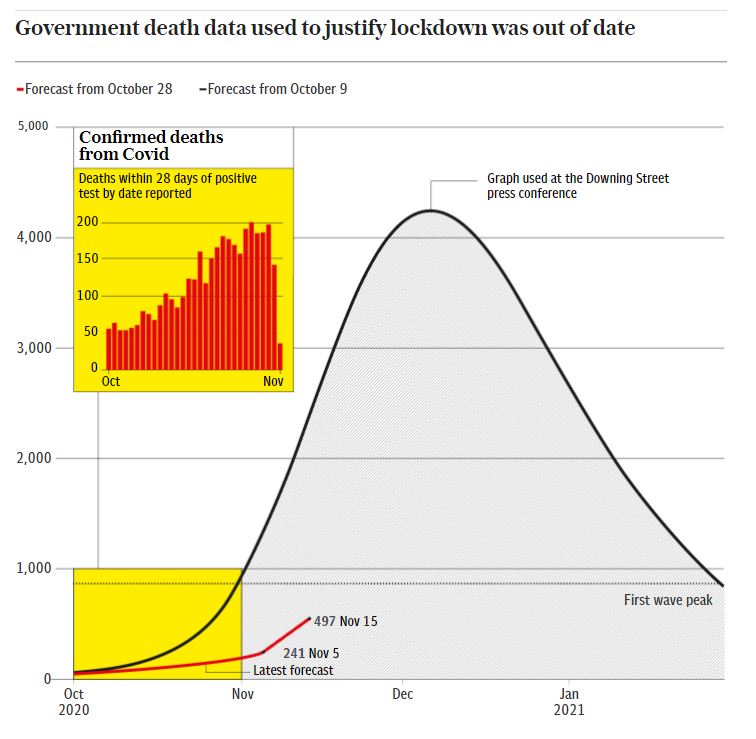
His call emerged before experts today questioned the legitimacy of those graphs which were based on an estimate R Rate of 1.3-1.5, when the Government’s own figures show the R Rate is between 1.1-1.3, and the doomsday scenario of 4,000 deaths a day by December was based on data that was weeks out of date, using a model based on the projection that there would be 1,000 deaths per day by now, when the average is less than 300.

The Exeter MP said: “Clearly the rate of increase is very serious and it would eventually impact on the hospitals, even in a region like ours when infection rates lower, but it is vital that the government publishes the modelling and is completely transparent about the information on which these decision are being made, and does it quickly and doesn’t wait several weeks.

“The problem we had was that Keir Starmer’s call was based on advice that was three weeks old, so they must publish SAGE advice immediately and stop treating the public like children who cannot be privy to the information.

“They need to publish the full impacts and modelling as they have continued to overpromise and under deliver on everything

“The lesson I hope we learn that dither and delay, which we have had is lethal for lost lives and for the economy. There has been no trade-off between public health and economy as we have among the worst death rates and the worst economic hits due to their serial incompetence and the continued scandalous failure of the test, track and trace system.

“The tracing is non-existent and they need to immediately to hand it down to local public health officials, and GPs and take it out of the completely useless private hire companies that have made a complete pig ears of the system, and if we had an effective system then we wouldn’t be where we are, and the repeated failures to deliver on promises on this has been one of the biggest scandals of the affair.

“There needs to be provided support to people, and businesses and local authority needs to be given proper support and to improve people self-isolating, as if by self-isolating you impoverish yourself then people are just not doing it and compliance will be less.”

He added: “A combination of Boris’ dither and delay and inability to deliver led to this. He has been over optimistic on everything and it would be a foolish politician to predict anything that will happen.

“The great hope is that a vaccine comes online and works, along with a combination of treatment, testing, as well as a test, track and trace and isolate that works, and if we get some of them then we can live with the virus better and open more of the economy, but we need two of the three in place.”

And he said that it was vital that as far as possible that school and university’s do stay open, if safe to do so, as the level of risk to young people and children is far less severe, and the least well off suffer the most when their education is interrupted and been disrupted enough.

He continued: “When it is all over, there needs to be a fair and just reckoning between the ages as young people have paid a huge price and have been far more economically and socially impacted and affected by this and will have to the devastating fiscal effects to deal with for the rest of their lives.”

Conservative MP for Newton Abbot, Anne Marie Morris, doesn’t often have a lot in common with Ben Bradshaw, but she is equally angry with how the crisis has been handled – but from a different perspective.

Having spoken against the ‘circuit-breaker’, she said that she remains unconvinced that a second national lockdown would have a positive and effective impact in stopping the virus and believe instead that it would have a number of wide-ranging negative impacts on the population.

She said: “While I fully understand the desire to get spread of disease under control, the Government is yet to offer any kind of roadmap as to how we get out of this situation or provide any substantial (and needed) analysis of the impact that a second national lockdown will have on the non-covid related health conditions.

“My worry is that a lockdown strategy is based on the assumption that a vaccine is just around the corner – something of which there is currently no concrete evidence. Having a continuous rolling lockdown without an ending in sight will cause more harm than good longer term.

“If we end up in a situation similar to the first lockdown, people with other health conditions will be unable to access treatment and operations will be delayed. In delaying treatments, we are causing longer lasting problems for the NHS and the health of the population. Cancers that would usually be detected earlier are being diagnosed later, a reduction in postnatal support is having an impact on new parents and babies and mental health support has been impacted at a time when it is perhaps needed more than ever. The reality is that the non-Covid health impact will far outweigh that of Covid itself.”

And on the economic impact, Ms Morris added: “The evidence shows that the South West has been and will be the hardest hit economically by Covid-19 due to our focus on not only tourism and hospitality but also our large number of small and medium sized businesses. Our businesses have already taken a massive kicking and it would be utterly irresponsible to let this happen again. Put another way – businesses in Devon cannot afford a second lockdown without increased levels of support.

“Fundamentally, we are where we are, and now it is vital that we are able to support those across the community who need help. Things will get worse before they get better, and it is critical that we all continue to support each other, as has been the case so far this year.”

Mel Stride, the Conservative MP for Central Devon, called for a balanced debate about lockdown between scientists and economists to take place when speaking in Parliament, although he didn’t directly respond to questions asked.

He said: “This lockdown will inevitably have very serious consequences for our economy, and for the livelihoods of millions of people up and down the country, for many years to come. We do not wish to see the NHS overwhelmed, but, equally, we do not wish to see the UK economy overwhelmed.”

Speaking in Parliament, he asked the Prime Minister: “Do you agree that perhaps we need a more balanced debate about lockdown, involving both scientists and economists more prominently? With that in mind, would he consider the Government’s chief economic adviser—or similar economic expert—joining the Government’s scientific experts for the No. 10 press briefings?”

In response, he said: “I am grateful to for that point. I am not sure that I want to put the Government’s chief economic adviser through the experience of the press briefings, but we are always aware of the economic consequences and the downsides of what, alas, we are forced to do at the moment.

“That is why it is vital that we work together and get the R down below 1 again; it is only just above 1, and I do believe that we can do it by December 2. We can then open up the economy again in the way that I know both he and I would like to see.”

Anthony Mangnall, the Conservative MP for Totnes, was another who wanted reassurance over the economic impact of the lockdown when speaking in Parliament, although he didn’t directly respond to questions asked.

He said: “Given that there is an economic impact from this lockdown and that will have an impact on livelihoods, what can the Prime Minister do to reassure my constituents, who have striven so hard since the relaxation of the lockdown on July 4, that there is a brighter future and there will not be mission creep in terms of a lockdown beyond December 2?”

Mr Johnson said: “I cannot say often enough that this is a time-limited lockdown and it ends on December 2 unless this House decides to extend measures of one kind or another. Any further measures will be a matter for this House, and it is fully my intention that the lockdown should end on December 2.”

Simon Jupp, the Conservative MP for East Devon, two weeks ago said that another full national lockdown ‘simply isn’t necessary in the South West and I would vote against any push by Labour to force a national lockdown. This would divide the country, harm our economy and punish people across the South West.’

Mr Jupp had not yet responded to the questions posed around how he would vote in Parliament, but during Monday’s debate, he said: “Cases in the South West remain lower than in most of England, although the numbers are heading in the wrong direction. We are well prepared in Devon with the Nightingale hospital in Exeter. We must take steps to ensure that our NHS is not put under severe strain this winter and keep our hospitals open for non-covid admissions.

“We have a duty to protect lives and livelihoods, and our local economy is already incredibly fragile, so what assurances can the Prime Minister give East Devon that come December 2, without a shred of doubt, the return to a regional tiered approach will happen to reduce the spread and keep businesses going?”

Kevin Foster, the Conservative MP for Torbay, said while there are no easy options, simply ignoring things, hoping for the best and waiting until Torbay Hospital is under pressure it cannot manage from this and other conditions before doing something is not an option.

“In essence, no action being taken could see Hospitals in the South West run out of capacity or only able to deal with the most urgent cases by the end of this month

“I know these restrictions will be a blow to many businesses locally, although from speaking with several in recent days many were already seeing trade slow down and bookings fall off, especially in the tourism sector where the season normally would have ended this week. It is therefore very welcome the Furlough Scheme has been extended until December.

“I have had some ask why this cannot just be an issue where individuals decide to take their own risk, like they can do with other items like smoking which is banned in places where it would affect others, but despite the well-known health impacts you can still do it legally.

“Yet the problem with this theory is those deciding for themselves would almost certainly turn to the NHS for treatment if/when they fell ill, not just putting healthcare workers at extra risk, but using up the very resource we need to protect for not just Covid-19, but other conditions. They may also infect others working in essential retail and make it more likely their neighbours who are following the guidance are infected as well. Hence this cannot just be a matter of personal choice.

“I appreciate some will disagree, and I hope there can be some further tweeks to the rules if items like rapid testing become more available in coming weeks. Yet for now, with the situation at our local Hospital and nationally pointing to a need for action to prevent it escalating doing nothing or waiting to see what happens if we have to start cancelling even more NHS services or bring in restrictions which also involve closing vital services like Courts and Schools is not an option. There are no easy options.”

Neil Parish, the Conservative MP for Tiverton and Honiton, is another who reluctantly feels he has to vote for a second lockdown.

He said: “We need to reduce social contact and the transmission of the disease now so that we can buy time, save lives and hopefully have a decent Christmas together. The Prime Minister has been quite clear that on our current trajectory, hospitals even in the South West will be overwhelmed, within a matter of weeks.

“I support the measures taken backed up with proper financial support, including an extended furlough scheme, and I think the nation supports and understands why we need to do this. Nobody wants these restrictions, least of all the Prime Minister, but it is the best way to control the spread of the virus and put it into reverse.”

Mr Parish added that the lockdown will be time-limited, and that the mass testing – which will see everyone living or working in Liverpool will be offered tests, whether or not they have symptoms, which if successful, could be rolled out to “millions” by Christmas – was a huge boost.

He added: “I hope hospitals and teachers in our area will have access very soon. This lockdown is a time-limited lockdown and there is light at the end of the tunnel, with rapid testing, Christmas and a vaccine in the New Year.”

And giving more hope for the future, Mr Foster added: “The forthcoming restrictions is not a position anyone wants to be in. We all look forward to the day next year when we can get back to a more normal way of life and enjoying the things which make our bay the special place to live it is. As medical treatments advance, rapid testing becomes more developed and with the prospect of a vaccine tantalisingly close there are lots of reasons to be optimistic for the future.

“By this time next year Covid-19 is likely to be in the position where it is just one of the issues our NHS deals with each day and the pandemic will be a memory, not a daily reality. Yet for now our NHS and Social Care Teams are asking us to help them to help us by following the rules due to come in on Thursday.”

Geoffrey Cox, the MP for Torridge and West Devon, and Selaine Saxby, the MP for North Devon, neither responded to the request for comment, nor spoke in Parliament.

Sir Gary Streeter, MP for South West Devon, added: “I will be supporting the government because we have no choice.”
Whitty live evidence to Commons Select Committee

“Occupancy levels are lower in the South West but the rate of increase is faster and bed capacity is lower, so “although they look further away at the moment, they could hit difficulties relatively quickly”, he added.”


Who reduced the bed capacity to land us in this dire situation and why?

We all pay the same taxes don’t we?

Why do we always lose out in Devon?

Who is shouting the case for more? Tory MPs? John Hart? Heart of the South West? The Great South West?

Chris Whitty and Patrick Vallance called before MPs to explain second lockdown evidence

Throughout the pandemic Sir Patrick Vallance and Professor Chris Whitty seem to have relied predominantly on the results of one theoretical model to predict its course. They appear in front of the Science and Technology Select Committee this afternoon and this article gives a taste of what they might be in for. – Owl

By Sarah Knapton, Science Editor www.telegraph.co.uk

Chief scientific adviser and chief medical officer to face committee amid concern graphs shown were out of date and alarmist

Sir Patrick Vallance and Professor Chris Whitty have been summoned before MPs to explain the evidence for a national lockdown, after their 4,000 deaths figure was questioned by scientists.

The pair will face the Science and Technology Select Committee on Tuesday afternoon, amid mounting concern that the graphs shown at a press conference on Saturday evening were out-of-date and alarmist.

Modelling presented by Sir Patrick, the government’s Chief Scientific Advisor, showed that under a worst case scenario 4,000 deaths-a-day could occur by December 20 – four times more than the worst day of the first peak.

However, the forecast was compiled on October 9, five days before new tier restrictions came into effect, and researchers at Oxford University pointed out that if the modelling had been correct, deaths would now be around 1,000-a-day. 

Instead, the current rolling seven day average is around 265 and Monday’s death figure was just 136.

It has since emerged that the modelling was based on an ‘R’ rate of 1.3 to 1.5 and shown despite the Government publishing a rate of between 1.1 and 1.3 the day before the press conference. 

Yesterday the government office for science refused to release the key to the graph explaining which groups had modelled the varying scenarios, or what parameters had been used, saying ‘relevant papers would be published shortly.

Science Committee chairman Greg Clark said: “This is an important moment in the handling of the pandemic. Parliament must have the chance to understand and question the evidence and rationale behind the new restrictions in advance of Wednesday’s debate and vote.

“I am grateful to Sir Patrick Vallance and Professor Chris Whitty for having agreed immediately to my request to appear before the science and technology committee on Tuesday.”

Last week, Sir Patrick said the three-tier restrictions were starting to have an impact and the ‘R’ rate was now clearly in decline. A graph shown at the press conference also illustrated a clear downward trend.

Professor Tim Spector, of King’s College London, said a national lockdown was being implemented just as the second wave was “running out of steam in the worst affected areas”.

Prof Spector said new data from the King’s app, which has been monitoring the spread since the first wave, showed that cases stopped growing in northern England four days ago.

Professor Carl Henegnhan of Oxford University also published a graph demonstrating that Liverpool cases have nearly halved since the peak on October 7.

“Am I missing something?” he said, referring to the decision to lockdown the country.

Professor Neil Ferguson of Imperial College, a member of the Scientific Pandemic Influenza Group on Modelling (SPI-M) group which produced the 4,000 death graph, admitted that the graph showed a situation where the tiers had little impact. 

“The “up to 4000 deaths a day” scenarios represent preliminary work to generate a new reasonable worst case planning scenario to assist NHS and other government planning,” he said. 

“The reasonable worst case is intended to be pessimistic, so these scenarios assumed an R value of 1.3-1.5 and that the tier system would have minimal impact.”

However Prof Ferguson said that even allowing for the effects of the current tier system, a second wave is still likely to exceed the first wave in hospital demands and deaths.

Covid-19 Update: 2 Nov 2020: House of Commons debates, Jupp’s big moment.

www.theyworkforyou.com /debates/

Did Boris fully grasp the question? Does Owl have to call on the Gnomes to interpret this exchange?


 Simon Jupp Conservative, East Devon

Cases in the south-west remain lower than in most of England, although the numbers are heading in the wrong direction. We are well prepared in Devon with the Nightingale hospital in Exeter. We must take steps to ensure that our NHS is not put under severe strain this winter and keep our hospitals open for non-covid admissions. We have a duty to protect lives and livelihoods, and our local economy is already incredibly fragile. What assurances can the Prime Minister give East Devon that come 2 December, without a shred of doubt, the return to a regional tiered approach will happen to reduce the spread and keep businesses going?

 Boris Johnson The Prime Minister, Leader of the Conservative Party

I can tell my hon. Friend without a shred of doubt that these measures are time-limited and expire automatically on 2 December, and we will go back into the tiered system, depending on the data—though he is entirely right in what he says, alas, about the spread at the moment in the south-west. But it will depend on the state of the data at the time.

Planning applications validated by EDDC for week beginning 19 November

Bit later than usual

Alteration to existing access to property to allow for parking inside property boundary Open for comment icon9 Cooks Mead Uplyme Lyme Regis DT7 3XJRef. No: 20/1844/FUL | Validated: Tue 20 Oct 2020 | Status: Awaiting decision

Despite low infection rates, South West could run out of COVID hospital beds in 2 weeks

People are reasonably asking why? (E.g. BBC Spotlight last night). 

This devonlive article below gives the immediate explanation.

The fundamental problem was explained by Owl on 19 March:

“The south west looks most vulnerable in terms of ratios. It has the oldest population (so highest expected mortality) and lowest number of critical care beds per head of population. The modelling suggests it needs six times more than currently exists there (600 per cent).”

“On the upside, the south west currently has a relatively low infection rate. Public Health England (PHE) should be doing everything possible to keep it that way through aggressive testing and containment of new cases [If only! – Owl]. If the virus gets out of control in the south west it is likely to sweep through the region’s retirement towns and nursing homes, overwhelming local hospitals.”

Owl hopes that all those who went along with bed closures locally will reflect upon their actions – we are all in this together – no-one is immune, no-one can “buy their way out”.

See also  www.hsj.co.uk 

Paul Greaves www.devonlive.com

The South West will be one of the first regions to run out of hospital capacity if nothing is done to stop the spread of coronavirus, according to a document presented to the government.

Based on NHS England modelling from 28 October, it warns the NHS would be unable to accept any more patients by Christmas – even if the Nightingale hospitals are used, reports the BBC.

It says that the South West and the Midlands are the least equipped to cope – and could run out of capacity within a fortnight.

The documents makes grim reading and comes amid reports that the government is considering a national lockdown of some form to halt a surge in COVID infections. The plan would be to ease pressure on the NHS in the hope the measures could be relaxed for Christmas. But tougher restrictions will have a severe impact on people’s livelihoods.

According to the BBC, documents suggest the UK is on course for a much higher death toll than during the first wave unless further restrictions are introduced.

Papers prepared by the government’s pandemic modelling group, SPI-Mseen, are understood to be part of a presentation to the Prime Minister.

All the models predict that hospitalisations are likely to peak in mid-December, with deaths rising until the end of the year before falling in January. The government will hope that by then a vaccine for the virus will have been signed off.

Scientists believe it is now inevitable that the whole country will end up in some form of lockdown to prevent more than 500 Covid deaths a day over winter – and a lockdown now is the only way families will be able spend Christmas together – reports The Mirror.

Sage is advising that it is not too late to save Christmas – but it will take a longer lockdown than the two week ‘circuit breaker’ they recommended last month.

The current estimate of the R number in the UK – the number of people each infected person passes the virus on to on average – is between 1.1 and 1.3, indicating that cases are still growing.

Sage member Prof Gabriel Scally told the BBC’s Newsnight that a national lockdown was inevitable.

“The R number is still far too high. Everyone knows that these tiers are not working and they’re not going to work.

Daisy Chain: Can a Cornish town adapt to survive another lockdown? – video

Lessons from a small town: imagination and community is the key to sustainability

Lindsay Poulton www.theguardian.com 

When the remote town of St Just, Cornwall, was locked down in March, the small community worried that its economy wouldn’t survive. But one town councillor, Daisy Gibbs, rallied an army of volunteers to form ‘the Daisy chain’, an informal support network to ensure every household in the district had support. Inspired by her imagination and resilience, filmmaker Sky Neal followed the Daisy Chain for seven months, as local businesses adapted and the community pulled together to realise a more sustainable future.  However, as a second wave of restrictions threatens, the town has to dig deep to find the resilience they need to ensure their future. Can they re-invent their local economy to survive and thrive beyond Covid?

Lessons from a small town: imagination and community is the key to sustainability

Lindsay Poulton www.theguardian.com 

The new Guardian documentary follows the innovative activities of a volunteer support network, the Daisy Chain. For seven months, filmmaker Sky Neal immersed herself in the community of St Just, the most westerly town in England. As food producers and business owners in the town struggle to survive the first lockdown, how will they find the resilience to pull together and face a second wave with winter approaching?

What inspired you to make this film?

The town of St Just has strange depths, with a landscape littered with remnants of lost industries and ancient prehistoric sites, its bleak rugged coastline often immersed in a deep, eerie fog. When I heard about the Daisy Chain it immediately captured my attention. The idea of this metaphoric chain of humans weaving throughout this tiny peninsula at the end of the land, taking care of each other and striving for a more caring and resilient community struck me as a beautiful story that was really needed at such a strange time.

What was your creative approach?

With the descent of Covid and the strict lockdown restrictions it was obviously a tricky time to be approaching people to make a film, so it helped enormously that I had such personal connections. My overall aim was that audiences would experience the important themes at the heart of the film but through the reflections and epiphanies of the contributors. That it wouldn’t feel like a campaign film but would have the effect of triggering thought about where our food is coming from, the fragility of our dependence on the global supply chain, how heavy our footprints are, and how community resilience is key for sustainability.

It was safer to film outside rather than indoors and that actually became a strength of the film because the natural world means so much to every one of my contributors. I wanted to reflect the coherence of this community and for it to feel like a weaved tapestry of interconnected lives, and this became an interesting creative challenge to transcend into a collective story arc. The recurring radio motif served to help mark the passage of time as well as connect us with the national climate.

You say much was unknown but the film feels particularly resonant now that we are heading into winter and a second wave?

Yes, as this film is being released there is a significant light being shone on food poverty, and once again we see a national movement of communities working together to protect the most vulnerable. It’s a time when so many of us have been seriously reflecting on how sustainable our lives are and how much inequality, isolation, stress and environmental damage is generated by our current economic model.

In Cornwall, where neighbourhoods number among some of the most deprived in the country, this crisis has forced many of us to think about what it means to have such a fragile economy that has lost or almost lost its key industries, and been forced to become overly dependent on tourism. A depressing £41m out of £177m coronavirus small business grants went straight out of the county to owners of holiday homes. Supermarkets have had a major impact on the self-sufficiency of all communities, and this time has shown us that, as we face so many unknowns, we have to start investing in and strengthening our local economies.

Who were the team that shaped this film?

This was a wonderful film to make – how often do you get a chance to show the little pocket you grew up in to the rest of the world? St Just has an exceptional community. There is something about being at the end of the land exposed to the elements that creates a hardy and creative bunch, and a wicked sense of humour to match.

West Cornwall is a hive of creative talent, so I was lucky enough to be able to put together a strong team from the local area – brilliant editors, Robin Simpson (who is from the centre of St Just) became a solid force behind the film throughout the seven months, and Melissa Warren really helped me wrestle the narrative and tease out the character journeys. Morgan Lowndes, a great cinematographer who has worked on the Poldark series among many others, helped bring the sense of movement into the film with his great gimbal work from his push bike, as well as some superb scenic shots, and Nick Harpley who came in last minute and pulled the lovely soundtrack out of his hat in a few short days. But also the contributors themselves were really key to the creative journey.

As with all my films I like to make the process as collaborative as possible – it always adds nuances to the film I would not have found alone.

About the filmmaker: Sky Neal is a producer/director and founder of Satya Films. Her BFI and Sundance supported feature documentary Even When I Fall (2018), received numerous awards, nominations and official selections including a British Independent Film Award nomination. Sky has been making films since 2006 after graduating from a Visual Anthropology masters at Goldsmiths University. Her work is often rooted in human rights (Including Children at Work, Series for BBC, 2013, Nepal’s Lost Circus Children, Al Jazeera English, 2012) and Satya Films’ current slate includes films resonating with migration, gender and identity.

Watch more Guardian Documentaries here.

‘Regeneration’ is too often an unfair fight between local people and global finance

On Tuesday a London council decides over a 20-storey tower in Brixton – a tale familiar to cities from Manchester to Sydney

[‘Scaring the living daylights out of people’: The local lobby and the failure of democracy, featuring historic “goings on” in East Devon, also by Anna Minton, is also relevant. – Owl] 

Anna Minton www.theguardian.com

Taylor McWilliam, the Texan property developer, friend of Prince Harry and DJ, has been no stranger to gentrification battles since he bought large swaths of Brixton, in south London, with the backing of a New York hedge fund.

One of the most multicultural and vibrant parts of London, Brixton has been at the heart of the UK’s gentrification struggles for more than a decade. A hard-fought community battle to save the famous glass-covered indoor markets eventually resulted in listed status, which staved off demolition, on the basis of their cultural significance as one of the principal centres of the Afro-Caribbean community.

More recently an equally heartfelt campaign to save small businesses in the railway arches failed after the £1.5bn selloff of thousands of arches around the country by Network Rail. After the sale to the Arch Company, which is part of the US private equity firm Blackstone, the majority of the businesses in the Brixton arches were forced out by rising rents.

Since he bought Brixton market in 2018, McWilliam has rarely been out of the news, with campaigners claiming the tourist-destination image of the market is undermining local businesses and the character of the area. This summer he hit the headlines when the campaign to save Nour Cash & Carry from eviction unexpectedly went global after a protest during an online charity concert featuring a DJ set by McWilliam, in front of an audience of more than 1,000 people.

A much-loved family business, Nour has been saved, but McWilliams is once again the focus of huge local opposition, this time against plans to build a 20-storey tower, designed by the British Ghanaian architect David Adjaye. Council officers have recommended that the tower go ahead on the basis that it will regenerate the area and provide jobs and a new public realm.

Yet prior to the council’s forthcoming decision on Tuesday, more than 1,000 objections had been lodged, including from the local MP, ward councillors and a 7,000 strong petition against the scheme.

McWilliams, with his partying and royal connections, is the perfect target for community anger. But the story of a colourful developer at loggerheads with local activists obscures the bigger picture, which is the effect that global finance, in the shape of hedge funds, private equity and global property development companies, is having on places such as Brixton. Although McWilliams announced that he had bought Brixton market through his company Hondo Enterprises, the legal owners are two special-purpose vehicles backed by the New York hedge fund Angelo Gordon, while the fate of the Brixton arches was determined by US private equity.

Earlier this year, Lambeth council appointed Tom Branton as director of regeneration, giving an indication of its vision for the area. Branton has previously worked for Southwark council, as project manager of the controversial Elephant & Castle regeneration scheme, carried out in partnership with the Australia-based developer Lendlease. He moved on from the council to work for Lendlease, where he was development manager on the same project, Elephant Park. Built on the site of the demolished Heygate estate, Elephant Park includes nearly 3,000 luxury apartments, of which only 82 are social housing. Of the properties built in the first phase, most were sold to foreign investors.

Branton later went with Lendlease to Kuala Lumpur, Malaysia, to work on the Tun Razak Exchange, described as an Asian version of Canary Wharf.

Lendlease and Branton describe themselves as experts in “placemaking”, a process said to bring regeneration, housing and jobs to rundown parts of the city. Critics claim it displaces local people and reconfigures places into bland clusters of luxury apartments, shops, restaurants and perhaps an art gallery or university.

Elephant & Castle, King’s Cross and Greenwich Peninsula in London, and the centres of cities such as Manchester, Edinburgh, Liverpool and Bristol include all these elements alongside an increasingly privatised “public” realm, policed by security guards, where access and behaviour are closely monitored and surveilled. This model of development, which is common to the deregulated economies of North America, Australia and the UK, often appears in former industrial or waterfront areas, featuring docks and old warehouses that lend themselves to hip new uses in the creative industries.

In Australia, Lendlease is responsible for Sydney’s giant waterfront Barangaroo project. The type of “placemaking” achieved by global property finance forces out local communities through rising rents and property prices, and airbrushes local culture from existence. Historic England’s objection to McWilliam and Adjaye’s tower is that the development would “markedly detract from the strong sense of place that Brixton already has”.

Despite the gentrification struggles of the last few years, Brixton still has a sense of place and a soul that many areas would love to emulate, and which the local community is desperate to protect. Adjaye has described the scheme as an opportunity to “give back” to the community. Now local ward councillors would like to invite him to come and meet local people to hear their views.

• Anna Minton is the author of Big Capital: Who is London for? and is a reader in architecture at the University of East London

Boris Johnson has wine and caviar confiscated for exceeding limits on gifts

Do you remember Boris Johnson saying that a cabinet ministers salary of £141,000 is not enough to live on?

Now the poor man has his “gifts” taken away. Makes you weep. – Owl

Boris Johnson has had wine, caviar and other luxury items confiscated by the Cabinet Office because they would have broken corruption rules, the government has revealed.  

Adam Forrest www.independent.co.uk 

The prime minister was also given a painting, a sculpture, Scotch whisky and some expensive olive oil – but they were all removed because they all exceeded strict limits on freebies.

The ministerial code, aimed at preventing individuals exerting undue influence over our politicians, means MPs cannot accept any gifts valued over £140.  

Mr Johnson was also gifted a “futuristic” strategy game similar to chess, and a pen and pen holder set, but won’t get the chance to use them.

The wine – a present from the government of Hungary – will remain uncorked after being taken away by Cabinet Office officials for “disposal”.  

The latest Cabinet Office data release also reveals that Mr Johnson held meetings with leading media and philanthropic figures in recent months.

The PM met with Aidan Barclay and Howard Barclay, the owners of The Telegraph Group, on 19 May. Two days later, Mr Johnson met The Daily Telegraph’s editor Chris Evans.

The government stated that he also spoke to Bill and Melinda Gates on 19 May to discuss “global efforts to tackle Covid-19 and the forthcoming Global Vaccine Summit”.  

But there was no information provided on what he talked about with The Telegraph Group’s senior figures.

When asked by The Independent about the reason for the meetings, Downing Street refused to say what specific issues were discussed by Mr Johnson and the newspaper executives.

Mr Johnson had been paid £275,000 a year for his weekly column for the newspaper, but the arrangement came to an end when he entered No 10 last year.

Covid lockdowns are cost of self-isolation failures, says WHO expert

Lockdowns affecting entire populations is a price countries pay for failing to ensure people with coronavirus and their contacts self-isolate, according to an expert from the World Health Organization.

Sarah Boseley www.theguardian.com

The WHO does not recommend that countries enter lockdowns. It has consistently said that the key to controlling epidemics, whether Covid-19, Sars or flu, is to test people, trace their contacts and ensure all those who are positive or who have been close to those infected are quarantined.

While countries like the UK have been massively increasing the numbers of tests carried out, contact tracing has fallen short, and studies have shown that as few as 20% of people in England fully comply with self-isolation.

“For me, the big missing link in what’s going on in many European countries is management of isolation,” said Dr Margaret Harris of the WHO. “That’s not just isolation of people who are sick – it’s isolation of people who have contacts and are first-degree contacts.

“They don’t think they have Covid, because they feel fine, and even if they are told they should stay home, they don’t feel a strong social obligation or they do not necessarily have that reinforced as happens in some countries.

“So for instance, in a place like Hong Kong, you would be called every day, or the police come to your house,” she said.

Across Asia, there is a mixture of economies that have managed the virus well – not just those that may be non-liberal, non-democratic command economies, she added. “Taiwan, for instance, probably has the best management. They are definitely a highly liberal society.”

A lockdown which effectively isolates everyone does work, Harris said, “but it also causes massive dislocation, massive disruption. And unless you’ve worked out how you can possibly put that pause button on and maintain your economic and social lives, the price you pay is very, very high.”

The WHO doesn’t say don’t do it, she said. “We just say, if you’re doing it, you’re paying a very high price, so therefore get some return for what you pay.”

That means getting test and trace to work efficiently “and you could think very hard about how to make self-isolation doable” she said.

“You’ve got to do it at grassroots level, because it’s very different, say, in London from somewhere rural, it’s different in housing estates, you may have people living on the streets, you may have people living in institutions. So, you have to really know your society, and know how you’re going to make it possible for them to self-isolate.

“There will be people who cannot possibly self-isolate, because they live in crowded conditions or on the streets. You may have to think of offering them somewhere else to stay.

“It does require a lot of planning. It requires a lot of a great deal of partnership with community and with local authorities, and really listening to your mayors and your councils and all the people in your local groups or your NGOs who understand how communities really function and ensure that you’re reaching everyone.

“You might have communities who don’t have access to standard English-language channels and all the rest of it, and don’t really know what is being asked of them or whether it’s possible.”

Harris said that some countries, such as Hong Kong, isolate those who have Covid-19 by putting them in hospital with even mild symptoms, which means it is far easier and quicker to spot those who deteriorate and treat them, saving lives. Early medical monitoring helped with getting people the right treatment, she added, and although it’s not yet clear, getting earlier care to people could also save some from the after-effects known as long Covid.

Doubts over ‘rapid turnaround’ Covid tests pledged by Johnson

The “rapid turnaround” coronavirus tests the prime minister announced on Saturday are not approved for the public to interpret themselves without an expert’s help and so will not provide results in the promised 15 minutes, the Guardian has learned.

Sarah Boseley www.theguardian.com

Boris Johnson’s briefing about this week’s national lockdown in England included the promise of a mass rollout of “tests that you can use yourself to tell whether or not you are infectious and get the result within 10 to 15 minutes”, which would be made available at universities and across whole cities.

He said the army would be deployed to roll out the “many millions of cheap, reliable and above all rapid turnaround tests” everywhere they were needed.

Three of these rapid antigen tests, called lateral flow tests, have passed an assessment by Porton Down with Oxford University. The government has bought one of them. The health secretary, Matt Hancock, announced the government had signed a deal for 20 million, from the company Innova Tried and Tested, on 19 October.

But the Innova tests are not for people without symptoms, such as university students or people wanting to get on a plane or go to the theatre. They are designed for people who already have Covid symptoms. And the devices, which look like a pregnancy test, are intended to be read by a healthcare professional.

The company is clear about their limitations on the instructions for use, which can be found on its website. The tests analyse throat and nose swabs “from individuals who are suspected of Covid-19 by their healthcare provider, within the first five days of the onset of symptoms”. The test is designed for use by trained lab and healthcare staff, it says.

Johnson hopes the tests will help show the way out of the pandemic. They will be deployed in a wide range of situations, he said, “from helping women to have their partners with them in labour wards when they’re giving birth, to testing whole towns and even whole cities.

“The army has been brought in to work on the logistics and the programme will begin in a matter of days, working with local communities, local government, public health directors and organisations of all kinds to help people discover whether or not they are infectious, and then immediately to get them to self-isolate and to stop the spread.”

Prof Jon Deeks from Birmingham University and a member of a working group of the Royal Statistical Society, which is looking at coronavirus tests, said they were not ready for this type of use.

“At the moment, if you were bought this test, you would not be using it for this purpose,” he told the Guardian.

Lateral flow tests are now being offered to students at two universities – Durham and De Montfort – in a pilot study. Deeks questioned whether those involved had the right information.

“There are real issues in what people are being told in these studies,” he said. There was no transparency around the assessment of the lateral flow tests, he said. The announcement that the three tests had passed did not explain how they were assessed or how well they performed.

While everyone agrees that lateral flow tests, which could use either swab samples from the nose and mouth or saliva, have huge promise, Deeks said the technology at the moment appeared to struggle to register low levels of virus. They may pick up people who are infected and have high virus levels and may have symptoms, but they tend to miss people who are asymptomatic, as many young and fit people are.

A second test approved by Porton Down, from the Korean company SD Biosensor, has been validated by the World Health Organization and a package of support has been agreed to supply low- and middle-income countries that do not have access to PCR lab testing. However, these tests are also to be read by a healthcare professional.

Mass testing was part of the government’s controversial Moonshot plans. Last week the Guardian revealed that local health leaders had been asked to sign up to testing 10% of their populations every week using lateral flow tests, following the announcement of the deal with Innova.

In a leaked letter, Alex Cooper, the director of rapid testing at NHS test and trace, said the ambition was “to make this technology available for local areas to roll out at pace”, adding that the programme would go nationwide “as quickly as possible”.

Labour has called for frontline workers and vulnerable people living in coronavirus hotspots to be tested every week. NHS staff and those working in education, transport, retail and hospitality, as well as at-risk groups in areas with high infections, should be given access to rapid saliva tests, the party said.

It urged ministers to use the November lockdown to expand testing and fix contact tracing, saying that a plan to roll out strategic mass testing would provide a roadmap for containing the virus.

Tim comments on Exmouth’s Albatross saga

Owl is mortified to find this comment by Tim got lost in 266 items of spam (a couple of week’s worth).

It deserves repeating as a full post.

In reply to A Budleigh Correspondant.

Congratulations to the lady or gentleman who put this account together for it has seldom been an easy task to determine the real facts of a matter under the old Tory regime.

I would like to add a couple of observations, the first already hinted at. Frankly the ducking and diving performed by the old regime, both from various officers and members, in their efforts to hide much of what was going on. It was shameful. I submitted numerous FOI’s including that which confirmed the £50k on the covenant purchase. It was like trying to draw blood from a stone.

I cannot readily find the reference but I am pretty sure that there were £10k legal fees on top of the £50k paid for the covenant, a covenant incidentally that EDDC at one point claimed they didn’t need for the Ocean!

In regard to the retail element, we were promised something exceptional by way of tenants, something that would act as a draw to Exmouth without adversely affecting the town’s businesses. Initially a water-sports business operated in one part but I seem to recall that the rates were excessive and they moved their operation elsewhere.

So what ‘exceptional’ retail did we end up with, a grocery type outlet which popular though it may be, would go bust I suspect if its alcohol licence were removed. The retail element of the Ocean leads me to wonder what sort of retail we shall see at the newer water-sports centre, what amazing year-around draws will rent the brick garage-like structures. So far it looks like more take away cafes. Expect longer queues at the inadequate newest loos!

Cllr Moulding amongst others has held the Ocean up as an example of excellent development.; well the writer of the account above has debunked that well and truly. Cllr Moulding has always failed to provide evidence for his praise of Exmouth developments not least for the fact that EDDC has never carried out the necessary research.

I should like to know more about LED, their involvement, and the cost to the taxpayer- but they are not covered by FOI so that element remains largely hidden from public inspection.

I had not appreciated the involvement of FWS Carter at an early stage: I should have known better.

Notwithstanding all of the above, we are now stuck with the Ocean and must make the best of it. After years of parts of it not being used, I believe that most of it is in use apart from those restrictions due to Covid. I hope that it does get used to the fullest and make some money for the public purse .

Finally, to address the Budleigh commentator’s valid concern over availability of records, the whatdotheyknow.com website, with it’s record of FOI applications (although some refs/links may no longer work) sits alongside EDW as a repository of some of EDDC’s darker planning years .

UK house price boom will collapse once buyers lose their jobs

Bars are closing. Restaurants are seeing bookings cancelled. Retailers are worried about the impact of tightened Covid-19 restrictions on their businesses in the run-up to the crucial period. Everywhere there are signs of an economy rapidly losing momentum after its summer growth spurt.

Larry Elliott www.theguardian.com 

Everywhere apart from the housing market. There demand is booming, with the Bank of England reporting that mortgage approvals in September were the highest since 2007, the year the last crisis started.

Stronger demand for property is feeding through into higher prices. The Nationwide building society said in its monthly report that prices rose at an annual rate of 5.8% in October, the highest house-price inflation in six years.

There are two big questions about what Martin Beck of the consultancy Oxford Economics calls “a very peculiar housing boom”: what is causing it, and how long will it last?

The answer to the first question is that a bunch of factors have come together to boost activity. For a start, the housing market – like much of the rest of the economy – went into deep freeze in the spring, normally the time when house hunters are out in force. When restrictions were lifted, there was plenty of pent-up demand to tap into.

Rishi Sunak did his bit to keep the market hot by announcing a temporary reduction in stamp duty in his July mini budget. Past experience, the pre-announced end to double mortgage relief in 1988, for example, shows that the British public does not need much encouragement to buy property, and a stamp duty exemption for homes worth up to £500,000 is quite an incentive to bring forward purchases.

Beck also makes the point that the property market has been insulated from the wider economy’s troubles because the job losses that have been seen so far have been concentrated among the young, who tend to be renters not owner-occupiers.

The answer to the second question – how long before the market comes back down to Earth? – is simple: not all that long. The Nationwide itself injected a strong note of caution into its statement accompanying news of the latest house price rise, noting that the outlook remained “highly uncertain”.

It warned that activity was likely to slow, perhaps sharply, over the next few quarters if the expected increase in unemployment materialised, especially when the stamp duty holiday comes to an end in March.

Sign up to the daily Business Today email or follow Guardian Business on Twitter at @BusinessDesk

What the chancellor’s tax break has done is to bring forward house purchases that would have taken place anyway, leading to a bunching effect. The flipside of that is a drop-off in demand from next spring onwards.

That, in itself would not be enough to lead to a full-blown housing market correction. For that to happen house buyers have to face severe difficulties paying their mortgages, either because interest rates go up sharply or because they are losing their jobs.

With interest rates at rock-bottom levels and certain to stay there, the first of these is not a threat. The second, though, most certainly is.

Marcus Rashford backs Unicef after it steps in to feed 15,000 British kids over Christmas

HOW shocking is it that Unicef, which aids the world’s poorest kids, will hold its first-ever emergency response in the UK to help feed 15,000 children at Christmas?

Jonathan Reilly www.thesun.co.uk

MARCUS Rashford has backed Unicef after it stepped in to feed 15,000 British kids over the Christmas holiday.

The football ace and food poverty campaigner, 23, welcomed the UN children’s charity’s allocation of just under £750,000.

It is Unicef’s “first ever emergency response within the UK”. The money will feed youngsters through local charities, community and support groups over the festive holiday and half term next February.

The England and Manchester United striker has been urging the Government to fund free meals during school holidays.

He told The Sun: “Unicef’s emergency response just reinforces the absolute need to identify a long-term sustainable framework to stabilise the households of our most vulnerable children.

“There’s an evident gap in accessibility to provision for children and this needs to be reviewed as a ­matter of urgency.

“I stand with Unicef and thank them for their support.”

The Sun Says

HOW shocking is it that Unicef, which aids the world’s poorest kids, will hold its first-ever emergency response in the UK to help feed 15,000 children at Christmas?

But the announcement is further vindication of the admirable free school meals campaign fronted by footballer Marcus Rashford, MBE.

Whatever the long-term solution, the pandemic means there is a real crisis, and the Government must up its game.

Unicef — more used to helping the world’s poorest children — has handed out grants to seven charities, with another 21 set to be announced.

Tulip Siddiq, Shadow Minister for Children and Early Years, said: “The Government should be ashamed that Unicef has had to step in to feed our country’s hungry children.

“Charities and businesses have done a brilliant job but it should have never come to this.”

Labour’s Tulip Siddiq says the Government ‘should be ashamed’Credit: PA:Press Association

Rio Ferdinand compares Marcus Rashford’s performance to an older kid bullying younger kids and “taking their dinner money”

‘It should be me giving food’: people made poor by Covid turn to Devon charity

“Most people we see never thought they would ever be in the position of having to ask for help,” says Stella West-Harling, the founder of the Dartmoor Community Kitchen Hub. “We do ask ‘have you used food bank before?’ Most reply they’ve never even thought about it.”

Patrick Butler www.theguardian.com 

The hub has helped growing numbers of local people in food poverty as a result of Covid, and has witnessed close-up the emerging phenomenon of the “newly hungry” in which previously relatively comfortably off families have been forced to resort to food banks and the benefit system to survive.

Out of 130 people who approached the Devon-based hub for food support between March and September, 110 had never previously needed charity food help. “I’m seeing people dropping into poverty because Covid hit, and they suddenly realise they don’t have any reserves,” says West-Harling.

Many are young families “up to their neck in debt,” she says, people who have taken advantage of easy credit or over-extended to get on the housing ladder. “If you are on the minimum wage and 20% goes [under furlough] you still have bills and debts. Many can’t afford to feed themselves.”

It is not only the young who have suffered. West-Harling originally set up the hub, a not-for-profit company, to provide a nutritious meals-on-wheelsstyle service for isolated older people in the county. Many of them, sometimes living in draughty old houses in lonely “genteel” poverty, have struggled under Covid.

Self-employed people, often running their own businesses, have found themselves in unexpected hardship and feel acute shame about relying on charity, says West-Harling. “I delivered food round to a chap who owned a tool repair business. He was devastated, saying: ‘I should be the one taking food round to people.’”

In one case, they took food to a vulnerable young woman who was stranded alone in rural isolation. She had been too scared to leave her house during the pandemic. “She eventually phoned in terrible distress as she had not eaten in three days and had eked out what little food she had over a period of weeks.”

West-Harling, who founded and runs the Ashburton cookery school, says Covid has highlighted hidden areas of rural deprivation in Devon as well as the fragility of the tourism-farming-hospitality economy. The hub has been supported well by local volunteers and food banks, but needs financial help to keep going.

It is a shame the UK has never eradicated food poverty, she says, though she believes there will always be people who need help. “The way forward is a compassionate society. You cannot deal with poverty, social isolation and loneliness without compassion.”

COVID rates are not surging

Data press release 30 October covid.joinzoe.com

According to the ZOE COVID Symptom Study UK Infection Survey figures, the number of daily new COVID-19 cases in the UK are continuing to steadily increase and not surging as other sources have suggested this week.

Key findings from ZOE COVID Symptom Study UK Infection Survey this week: 

  • There are currently 43,569 daily new symptomatic cases of COVID in the UK on average over the two weeks up to 25 October (excluding care homes) 
  • This compares to 36,251 daily new symptomatic cases a week ago
  • Rates in the North of England are still around four times higher than the South of England although the gap is narrowing
  • In Scotland cases are potentially levelling off
  • London rates continue to climb in a steady linear fashion (see full table of regional results below)
  • The doubling rate for cases is currently 28 days 
  • The UK R value is 1.1 
  • Regional R values are: England 1.1, Wales 1.2 and Scotland 1.1
  • Infections nationally have stopped increasing in children and are still rising fastest in 30-59 year olds with only gradual increases in the over 60s (see graph below)

According to this week’s Tier Prediction Model, Bradford, Leeds and Sunderland are the next regions most likely to be moved into the tighter restrictions of Tier 3.

The ZOE COVID Symptom Study UK Infection Survey figures are based on around a million weekly reporters and the proportion of newly symptomatic users who have positive swab tests. The latest survey figures were based on the data from 12,390 recent swab tests done between 11 October to 25 October. 

Tim Spector, Professor of Genetic Epidemiology at King’s College London, comments: 

“While cases are still rising across the UK, we want to reassure people that cases have not spiralled out of control, as has been recently reported from other surveys. We are still seeing a steady rise nationally, doubling every four weeks, with the possible exception of Scotland which may be showing signs of a slow down. With a million people reporting weekly, we have the largest national survey and our estimates are in line with the ONS survey. 

“Data on covid-19 can be confusing for the public and we can’t rely simply on confirmed cases or daily deaths, without putting them into context. Hospital admissions are rising as expected, but deaths are still average for the season. As we become citizen scientists it’s important to look at multiple sources to get a broader view. Trends can be different at the local level and our app allows users to monitor this themselves.” 

Campaigners hail dramatic government climbdown in battle to protect post-Brexit food standards

A dramatic government climbdown will protect post-Brexit food quality, delighted campaigners say – after fears that chlorinated chicken and hormone-fed beef would be allowed in.

Rob Merrick Deputy Political Editor www.independent.co.uk 

In another U-turn, Liz Truss has bowed to pressure to give teeth to a new watchdog to prevent trade deals, particularly with the US, watering down food and animal welfare standards.

Now the new Trade and Agriculture Commission will be made properly independent, permanent and given the power to scrutinise each deal for its impact on food, welfare and environmental standards.

The National Farmers Union (NFU) hailed “a landmark moment”, saying: “This significant commitment to primary legislation on food standards is exactly what we have been calling for.”

And Neil Parish, a Tory rebel on the issue, said: “It’s been hard work, but I think we’re in a much better place now. We wanted firm guarantees in legislation and that is what we’ve got.”

Anne McIntosh, a Conservative peer and campaigner, said: “All our farmers ever wanted was fair competition and a level playing field and the government has recognised this and addressed these concerns.”

Ms Truss was forced to concede the setting up of the commission in the summer – but it had no budget, an advisory function only and was due to be wound up after six months.

Once permanent and independent, campaigners believe it will not sanction lower standards, achieving the “same objective” as an outright legal ban on acid-washed chicken, for example.

However, the climbdown is a huge blow for Ms Truss’s hopes of striking a quickfire trade deal with Washington, which has insisted access for its agricultural products is a red line.

Ms Truss had urged MPs and worried groups to simply trust the government when it said it would not cut food standards.

But they feared she did not want her hands tied – noting the UK has already proposed allowing in chlorinated chicken and hormone-fed beef in the US trade talks, albeit with higher tariffs.

Jamie Oliver had stepped up his warning of an influx of cheap food if ministers are able to prevent “proper parliamentary scrutiny”, saying: “I don’t like the smell of it.”

Announcing the U-turn, Ms Truss, along with environment secretary George Eustice, said, in a newspaper article, that an amendment had been tabled to the Agriculture Bill.

“It will place a duty on the government to report to parliament on the impact of trade agreements on the maintenance of food, welfare and environmental standards,” the pair wrote.

“Also, we have the independent Trade and Agriculture Commission, under the chairmanship of the trusted former Food Standards Agency head Tim Smith.

“Thanks to the commission’s excellent work, we are announcing today that it will be made a statutory body which will give independent advice on trade deals as they go through parliament.”

What are the rules of the new national Covid lockdown in England?

Boris Johnson has announced a four-week lockdown in England, following weeks of pressure from his own scientific advisers and opposition parties to introduce tougher measures to tackle coronavirus. The full details of the restrictions will be published on Tuesday before a vote in parliament, but this is what we know so far.

Jedidajah Otte www.theguardian.com 

When is England going into lockdown?

The measures will come into place at midnight on Thursday after MPs vote on them this coming week. While the lockdown will end on 2 December, it will be replaced with the current tier system and local restrictions will be introduced depending on an area’s infection rate.

Can different households mix indoors?

No, not unless they are part of an “exclusive” support bubble, which allows a single-person household to meet and socialise with another household.

However, people are allowed to meet one other person outside for “recreation” as well as exercise, and parents are allowed to form a childcare bubble with another household for the purposes of informal childcare, where the child is 13 or under.

What can I leave home for?

People can only leave home for the following reasons:

  • Education.
  • To go to work unless it can be done from home.
  • Outdoor exercise either with household members or with one person from another household.
  • For all medical reasons and appointments.
  • To escape injury or harm.
  • To care for the vulnerable or volunteer.
  • To shop for food and essentials.
  • To see people in your support bubble.
  • Children will still be able to move between homes if their parents are separated.

However, people could face fixed penalty notices from police for leaving their home without one of the above excuses.

Can I travel?

Most outbound international travel will be banned.

There is no exemption for staying away from home on holiday. This means people cannot travel internationally or within the UK, unless for work, education or other legally permitted exemptions.

Overnight stays away from primary residences will not be allowed, except for specific exceptions including for work.

Which businesses will close?

Everything except essential shops and education settings, which include nurseries, schools and universities, will close.

Entertainment venues will also have to close. Pubs and restaurants will have to close their doors once more. Takeaway and delivery services will still be allowed, while construction and manufacturing will stay open.

Parents will still be able to access registered childcare and other childcare activities where reasonably necessary to enable parents to work.

Public services, such as job centres, courts, and civil registration offices will remain open.

There is no exemption for communal worship in places of worship (except funerals and individual prayer), for organised team sports, or for children’s activities.

Elite sports will be allowed to continue behind closed doors as currently, including Premier League football matches.

Should some people be shielding?

The prime minister said that the clinically vulnerable or those aged over 60 should be especially careful and minimise contacts, but there would be no return to the shielding programme used in the first lockdown. Johnson said those in this category should work from home.

Will there be a return to the furlough scheme?

The furlough scheme was set to end on Saturday and be replaced by a less generous package of support for employers and businesses. But that was before the announcement of a second lockdown. The PM said on Saturday that the old scheme – which pays 80% of salaries – would now be extended throughout November. No further details were given.

Why has the decision been made?

Confirmed cases are rising steeply, with an estimated 568,100 people in households infected in the week ending 23 October. Scientists on the Scientific Advisory Group for Emergencies (Sage) have warned that deaths could potentially hit 500 a day within weeks and that coronavirus could kill 85,000 people this winter.

The group has been concerned that the number of infections and hospital admissions is “exceeding the reasonable worst-case scenario planning levels at this time” and they first called for a national lockdown on 21 September.

“We’ve got to be humble in the face of nature,” said Johnson on Saturday. “The virus is spreading even faster than the reasonable worst-case scenario of our scientific advisers.

“Unless we act, we could see deaths in this country running at several thousand a day – a peak of mortality, alas, bigger than the one we saw in April.”

What difference could a lockdown make?

A lockdown can stem the spread of the virus and thus reduce the reinfection rate.

“The idea of a lockdown is to save lives primarily,” Prof John Edmunds, a member of Sage, told BBC Radio 4’s Today programme on Saturday. “I think the only real way that we have a relatively safe Christmas is to get the incidence right down.”

Johnson warned that “Christmas is going to be different this year” but

added that by taking action now, he hoped that families could be together.

Add vitamin D to bread and milk to help fight Covid, urge scientists

Scientists are calling for ministers to add vitamin D to common foods such as bread and milk to help the fight against Covid-19.

James Tapper www.theguardian.com 

Up to half the UK population has a vitamin D deficiency, and government guidance that people should take supplements is not working, according to a group convened by Dr Gareth Davies, a medical physics researcher.

Low levels of vitamin D, which our bodies produce in response to strong sunlight, may lead to a greater risk of catching the coronavirus or suffering more severe effects of infection, according to some studies. Last week, researchers in Spain found that 82% of coronavirus patients out of 216 admitted to hospital had low vitamin D levels. The picture is mixed, however – some research shows that vitamin D levels have little or no effect on Covid-19, flu and other respiratory diseases.

Vitamin D deficiency can cause rickets in children and osteomalacia in adults – soft bones that lead to deformities – and children with severe vitamin D deficiency are prone to hypocalcaemia – low levels of calcium in the blood – which leads to seizures and heart failure.

However, Public Health England (PHE) and the Department of Health and Social Care have rejected calls over the past 10 years to fortify foods such as milk, bread and orange juice, which is the practice in Finland, Sweden, Australia and Canada.

“In my opinion, it is clear that vitamin D could not only protect against disease severity but could also protect against infection,” Davies said. “Food fortification would need careful planning to be rolled out effectively, particularly as people are now taking supplements. Picking the right foods to fortify would need to be done carefully.

“But it’s clear that the current policy is not working – at least half the population have a vitamin D deficiency.”

Adrian Martineau, professor of respiratory infection at Queen Mary University in London, who is not part of Davies’s group, is leading a clinical trial to examine whether vitamin D can reduce the risk of Covid-19, or its severity. The Coronavit study, which began last week and is backed by the Barts Charity, the Fischer Family Trust and the AIM Foundation, will follow more than 5,000 people through the winter.

“The government recommends that the whole population takes vitamin D supplements in winter months, and those in high risk groups take it all year round,” Martineau said. “But we know that people just aren’t doing that in any significant numbers. Even I forget to take my supplement sometimes, and I’m living and breathing this subject. Fortification is a really good way of eliminating deficiency.”

Our bodies produce vitamin D in response to strong sunlight. In the UK, that means that from October to March, people need to rely on other sources: oily fish, eggs and food supplements.

Some foods, such as breakfast cereals and mushrooms are fortified with vitamin D, and people in low-income households are entitled to free multivitamins. White flour in the UK is already fortified with vitamins B1 (thiamin) and B3 (niacin), and last year the government began a consultation on adding vitamin B9 (folic acid) to help prevent spina bifida and other birth defects of the brain and spine.

A 2019 study at the University of Birmingham, led by Magda Aguiar, a health economist, showed there would be at least 25% fewer cases of vitamin D deficiency over the next 90 years if flour fortification were adopted, saving about £65m.

In 2017, Professor Louis Levy, PHE’s head of nutrition science, responded to calls for fortification by saying that there was not enough evidence that vitamin D would reduce the risk of respiratory infections.

The Department of Health and Social Care was approached for a comment but failed to respond.

Recruitment to the clinical study trial at Queen Mary University has recently been extended. Observer readers who would like to find out more should email coronavit@qmul.ac.uk

For the health of the nation, shouldn’t Johnson’s medical fitness for office be scrutinised?

Just six words, Doctor Who said, would be enough to bring down the unprincipled prime minister Harriet Jones. “Don’t you think she looks tired?”

Would it work on a man?………

Catherine Bennett www.theguardian.com 

……. Time to find out. “I have read a lot of nonsense recently, about how my own bout of Covid has somehow robbed me of my mojo,” Boris Johnson said in his party conference speech. Was he thinking of the Daily Telegraph, where he appeared“strangely out of sorts”, or of the protracted lament by a former fan, the Spectator’s Toby Young: “What on earth happened to the freedom-loving, twinkly-eyed, Rabelaisian character I voted for?” Young cited one theory, “that the disease actually damaged his brain in some way”.

Covid-19 damage featured again in a Times report detailing the exhaustion of a miserable and forgetful prime minister, who was also struggling with his latest infant, whose exact age recently escaped him. “Physically, I think Covid has had huge impact, definitely,” a source said.

“Of course,” Johnson told conference, “this is self-evident drivel, the kind of seditious propaganda that you would expect from people who don’t want this government to succeed.” This seems unnecessarily harsh on some recently prized supporters, yet more unkind to the elderly huntsman Sir Humphry Wakefield, father-in-law of Dominic Cummings, who reportedly said that Johnson is so unwell he will step down in months and should not have gone back to work early because you’d never do that with a horse.

Johnson added, presumably for the benefit of the imaginary seditious propagandists to whom, in dreams, he shows scant mercy: “I could refute these critics of my athletic abilities in any way they want: arm-wrestle, leg-wrestle, Cumberland wrestle, sprint-off, you name it.” And if protecting the population in a pandemic ultimately came down to the prime minister’s victory in next summer’s Lakeland Games, while a non-catastrophic Brexit depended upon the physical humbling of Michel Barnier in a series of tap-room challenges, hopefully excluding the more cerebral skittles or darts, that might indeed have been one of Johnson’s more impressive performances since, well, maybe that time he identified as the Incredible Hulk?

Alas, the most convincing rebuttal of unkind post-Covid-19 “Don’t you think Johnson looks tired/sick/thick/dishevelled/shifty/dandruffy/unRabelaisian” commentary is the one line Johnson can’t deploy: what the hell did you think he was like before?

As it is, Johnson’s affirmation of undiminished mojo seems to have been roughly as effective as reports of Donald Trump’s alleged plan to prove his potency by ripping off his shirt to reveal a Superman T-shirt. Like Trump’s accompanying protestations of perfect health and eternal youth, the (unrealised) stunt only added to his critics’ case for invoking the 25th amendment, which allows Congress to rule a president unfit for office. Regular medicals, even if these duly descended into farce under Trump, also mean that, at least in theory, US politics legitimises public interest in a leader’s physical and intellectual fitness for the job.

However idiotic, Johnson’s boasting about Hulk-level athleticism suggests a measure of respect for the above principle and, perhaps, it follows, for the former MP Lord Owen’s proposal, that prospective leaders provide medical reports just as many CEOs are required to do. “I see every case for those who seek the highest political office at least subjecting themselves to a medical prior to nomination,” Owen wrote, years before Johnson’s serious illness indicated need for regular check-ups in order to address the – obviously minute – risk that an ailing leader could put personal ambition before the needs of the country.

Having continually advertised his prowess in everything from tennis to barging child sports opponents to the ground, while denigrating wetness, “malingering”, “languishing”, “girly swots” and, indeed, swotty girls, Johnson is now dismissing as “nonsense” public interest in his stamina. Maybe it’s unwise, in the long run, repeatedly to compare yourself to “a greased panther”? Since the suggestion that competitive virility denotes political prowess – possibly the result of some twisted public school code’s intensification within the legendary rough and tumble of the Johnson household? – must amount to a parallel concession that deficient greasiness will inevitably undermine a panther’s claim to authority. Actually, it’s tantamount to an admission, if it wasn’t obvious, that the peerless humanitarian Marcus Rashford, being also good at football and probably at leg-wrestling, would be a better leader than Johnson.

If unsuspecting US citizens have the right to know if their president becomes unfit, those of us currently at the mercy of Boris Johnson’s shambolic and recently Covid-19-infested cabal can surely be excused for wanting medical confirmation that his faculties are adequate to handle even a few more days of ignoring life-saving scientific advice.

You hardly need a doctor, it’s true, to see that as well as performing serial U-turns, appearing defeated, indecisive, irritable, incoherent and inept to the point of being owned by mayors, footballers and, worse, lefty lawyers, and too weak to dispense with an adviser who has single-handedly destroyed public compliance, Johnson does not even know his own Covid-19 regulations (“Apologies, I misspoke today”). Anyone, even anyone without a classics degree, must also have spotted his rhetoric declining from the showily ornate to “a stitch in time saves nine”, from the faux Churchillian to the full Gavin Williamson “I have had more than enough of this disease”.

But new findings, indicating “significant cognitive deficits” in coronavirus survivors, raise the possibility that the prime minister may more than tired. Researchers identified “pronounced problems”, with patients who had been hospitalised experiencing as much as an 8.5 point drop in IQ.

If only to signal the risks of pointless presenteeism Johnson would surely welcome the chance to confirm, via a thorough medical, that he is not in his current state a national liability; that is, no more so than usual.

• Catherine Bennett is an Observer columnist