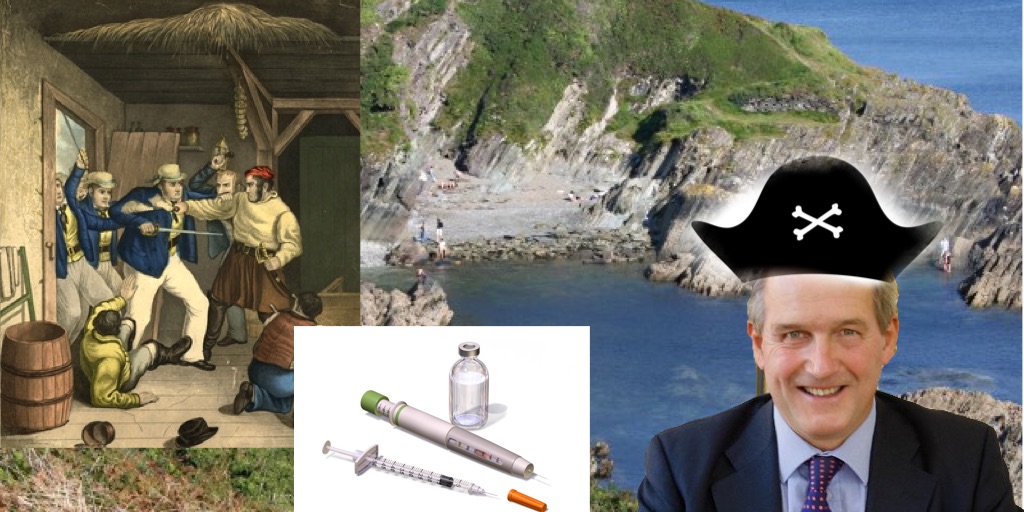
I won’t accept bullying, Boris Johnson tells cabinet

Just shows his lacklustre cabinet would believe anything!

This is Owl’s “in bad taste” joke of the day.

Eleni Courea, Political Reporter www.thetimes.co.uk 

Boris Johnson spoke out against bullying yesterday during a cabinet meeting and referred to Winston Churchill’s wife imploring him to be kind.

The prime minister last week overruled Sir Alex Allan, his adviser on ethics, as he cleared Priti Patel, the home secretary, of breaching the ministerial code. Sir Alex found Ms Patel had “unintentionally” bullied civil servants but Mr Johnson argued that the cases were not clear. Sir Alex subsequently resigned.

Mr Johnson told cabinet he would not accept bullying and referred to Clementine Churchill, who in 1940 wrote to her husband after one of his friends had complained of his “rough, sarcastic and overbearing manner”.

She urged him to combine his “terrific power” with “urbanity, kindness and if possible Olympian calm”. “You won’t get the best results by irascibility and rudeness,” she wrote. “They will breed either dislike or a slave mentality.”

A former cabinet secretary has said that Mr Johnson should reassert the principle of ministerial responsibility instead of demonstrating “tribal” loyalty to allies such as Ms Patel.

The prime minister appears not to “hold his colleagues responsible for their actions where they have got things wrong but it would be inconvenient to accept it”, Lord Wilson of Dinton, a crossbench peer and former head of the civil service, wrote in a letter published in The Times today.

Lord Wilson criticised Mr Johnson’s refusal to sack his home secretary after Sir Alex found that she had bullied officials. Sir Alex’s report said that Ms Patel had shouted and sworn at officials in her department, amounting to “behaviour that can be described as bullying”, in breach of the code.

Lord Wilson, who was cabinet secretary from 1998 to 2002, described the prime minister’s decision as “worrying”.

“There is a growing string of cases where ministers wrongly disclaim responsibility, whether it be the harassment of civil servants or intervening improperly in the planning process or blaming others for the exams fiasco or poor handling of the pandemic,” he wrote.

“Forming a square around a colleague who is in trouble sounds tribal rather than good governance. Perhaps refurbishment of No 10’s image could include reassertion of the principle of ministerial responsibility.”

This episode of the Stories of our Times podcast will form part of a week-long series. We’ll explore: what should happen to British nationals who left to join Islamic State, and do we have a responsibility to bring them back?

A union leader criticised Ms Patel over reports that she intended to shake up the Home Office by forcing officials to work some weekends and introducing performance reviews for senior civil servants.

Figures from a union survey of senior Home Office officials this month, seen by The Times, suggested that 40 per cent worked at least an additional eight or more hours every week, unpaid.

Dave Penman, head of the FDA union, which represents civil servants, said: “To suggest the home secretary is now responsible for performance reviews for the ‘senior ranks’ is simply fiction. It is also insulting to suggest that the civil service does not respond to demands or is stuck in a 9-5 culture, as the anonymous briefings suggest.”

Exclusive: Electoral Commission Urged To Investigate Facebook Ads For Towns Fund

The election watchdog faces calls to investigate Facebook ads about the government’s controversial Towns Fund targeted at key marginal seats in 2019.

www.huffingtonpost.co.uk

HuffPost UK revealed last year that the government paid for more than 20 ads in swing seats trumpeting £25m investment in “your town”.

The messages, which could still be found on the site when MPs backed an early general election in October, all appeared to be specifically targeted at areas where the sitting MP had a majority below 5,000, such as Milton Keynes, Morley and Workington. 

Facebook pulled the ads after they were highlighted, saying they were not correctly labelled.

“Ads about social issues, elections or politics that appear on our platforms should include a disclaimer provided by advertisers,” a spokesman for the site said. 

Now, Labour has written to the Electoral Commission asking the body to “investigate the circumstances of this alleged misuse of public funds”. 

It follows fresh questions for communities secretary Robert Jenrick, whose Ministry of Housing, Communities and Local Government runs the scheme, who has repeatedly been called to parliament to answer questions about whether the fund was used to “funnel” cash to target seats.

The government has insisted the process “comprehensive, robust and fair” but a highly critical report by the Public Accounts Committee said the fund was “not impartial” and ministers ignored officials’ advice. 

Meg Hillier, chair of the committee, said the system gave “every appearance of having been politically motivated”.

MPs also said some towns were picked by ministers, including Jenrick’s own Newark constituency, “despite being identified by officials as the very lowest priority”.

Cat Smith, shadow minister, has written to Bob Posner, chief executive of the Electoral Commission.

In the letter, seen by HuffPost UK, she says: “On the cusp of a general election, this sort of targeted advertising is clearly inappropriate when paid for out of the public purse.

“This is a clear case of public money being used to advance the political interest of the Conservative Party.

“In light of the recent Towns Fund scandal, we know that taxpayers’ money has been used to benefit the Conservative Party.”

She adds: “In a time of increasing disregard for democratic processes and norms worldwide, it is vital that the UK government is held to the highest democratic standards and acts both legally and transparently.

“I would urge the Electoral Commission to investigate the circumstances of this alleged misuse of public funds, and to report on its findings publicly as soon as possible.

“Ministers must answer these questions and reassure the public that taxpayers’ cash is not being spent by the Conservatives for their own gain.”

When approached the government about the Facebook ads last year, a spokesman said “all towns selected were chosen according to the same selection methodology, including analysis of deprivation, productivity, economy resilience and investment opportunities”.

It said that the ad campaign ended before the official election campaign started, even though posts could still be found.

They said: “The My Town campaign began on 25 October and has now ended in the run up to the pre-election period. While the posts are still be present on Facebook, they are no longer being promoted as the paid-for campaign has ended.”

Huge rise in people on Universal Credit across Devon

Figures have shown that the number of people in Devon claiming Universal Credit almost doubled since the start of the coronavirus lockdown.

Colleen Smith www.devonlive.com 


The figure rose by 95 per cent from 48,190 claimants in March to 93,917 in October. The latest provisional figures from the Department of Work and Pensions have revealed the devastating impact of the pandemic on incomes in the county.

It means one in eight people of working age – from 16 to 64 – are now on Universal Credit. The figure ranges from 10% in places like Exeter and West Devon, to 18% in Torbay.

Sara Willcocks, head of external affairs at Turn2us, said: “These new Universal Credit figures clearly show the pandemic’s profound and devastating impact on people’s income, employment and how close to the cliff edge many of us are – even prior to the first lockdown.

“Recent government schemes have protected some people from the economic consequences of the pandemic, yet there’s more that needs to be done.

“A Universal Credit system that is fit for purpose would do much to help people recover and to loosen poverty’s grip.

“If this government truly wants to stop people from being pulled into homelessness, hunger and debt, we urge them to increase to the child element of Universal Credit, maintain the increase to Local Housing Allowance rates and urgently review policies like the Benefit Cap and Two-child Limit.”

Nationally, there were 5.7 million people across Great Britain claiming Universal Credit as of October. That was nearly double the 3.0 million claimants in March.

Area% on UCJanuaryOctober
Torbay18%6,23513,707
Plymouth16%14,94526,947
North Devon14%3,4757,889
Torridge14%2,4885,228
Teignbridge12%3,7869,060
Mid Devon12%2,2635,250
South Hams11%2,1185,296
East Devon11%3,5398,528
West Devon10%1,3613,276
Exeter10%3,6058,736


A government spokesperson said: “We are wholly committed to supporting the lowest paid families and our policies, in particular those related to the pandemic, are under constant review.”
They added that they have recently confirmed the £20 UC uplift will remain in place until March 2021, and that they have already taken steps to help ease the burden of UC debt repayments, including reducing the maximum deduction from 40% to 30% of a claimant’s standard allowance.
From October 2021 they will reduce this further to 25%, and will double the time available to repay an advance to 24 months.

The table above shows that while Torbay has the highest percentage of people of working age claiming Universal Credit – other areas are seeing a fast rise, with figures more than doubling this year in many other parts of the county.

Hidden Devon

Devon Live has launched Hidden Devon, a series of campaigns highlighting issues that lie beneath the surface of our county.

The first concerns the issue of homelessness in the county’s cities, towns and villages – exacerbated by the grim impact of the global pandemic.

Not only do scores of people sleep rough on streets, in parks and even on farmland, there are those labelled ‘of no fixed abode’ for other reasons. They may have fled to a refuge, they may have been temporarily housed in a bed and breakfast or they may simply be living in one of region’s dedicated homeless hostels.

How to give

A big part of our campaign is recognising the institutions across the region that are desperately trying to help those in need. In many instances, they are staffed with volunteers giving up their own free time.

You can donate to various charities including PATH Torbay via this link, the Julian House Christmas Appeal covering Exeter and other parts of Devon via this link, or St Petrocks in Exeter via this link.

Are you a charity that would benefit from our fundraising? Contact us at newsdesk@devonlive.com

Find more Hidden Devon stories here

UK facilitates one-third of global tax dodging, study finds

The UK and its “spider‘s web” of overseas territories are responsible for more than a third of global tax avoidance each year, a study has found.

Ben Chapman www.independent.co.uk

Abuse of the tax system by multinational firms and wealthy individuals deprived countries of $427bn (£321bn) for hospitals, nurses, schools and other public services last year, according to advocacy group the Tax Justice Network. Of that figure, more than $160bn was facilitated by the UK and its territories and dependencies.

As coronavirus claims hundreds of thousands of lives and causes governments across the globe to spend trillions of dollars to support their citizens, the research gives the clearest picture yet of the damage wrought by those who funnel profits into tax havens and stash wealth offshore.

TJN analysed the first detailed, international set of data reported by companies showing where they avoid tax.

It calculated that Europe lost the equivalent of one-eighth of its health budget to tax dodging last year.

While wealthy countries are responsible for 98 per cent of tax avoidance, less wealthy ones bear the brunt of the impact. Latin America and Africa lost the equivalent of a fifth and half of their respective health spending, TJN calculated.

Lower-income countries lose the equivalent of 5.8 per cent of the total tax revenue they typically collect a year whereas higher income countries on average lose 2.5 per cent.

The UK maintains its position at the top of the list of jurisdictions helping firms shift vast sums of money away from public  investment and services.

The Cayman Islands – a British Overseas Territory of just 65,000 people – helped multinational companies and individuals avoid paying $70bn, or one dollar in every six that countries are deprived of each year.  

The UK itself, which provides world-beating tax avoidance advice through City of London banks, trust lawyers and accountants is second on the list, responsible for $42bn of tax losses. Together, the UK and Cayman facilitate more than a quarter of the booming tax avoidance industry.

Since the 1950s, when the UK helped to create the world’s tax haven network, ministers have claimed that they have little control over territories like Cayman.  However, the UK has power to veto laws and appoint key government officials, and is also responsible for the island’s defence and international relations.

The Netherlands is the third most damaging country for the global tax system, responsible for $36bn of losses annually. Luxembourg and the US make up the top five, responsible for £28bn and  £24bn respectively. Jersey, Bermuda and the British Virgin Islands make the top 20, alongside China, Singapore, Ireland and Hong Kong.

Globally, more than half of tax losses – $245bn – resulted from companies shifting $1.38 trillion of profits out of the countries where they were generated into jurisdictions where they pay little or no tax.

The rest was from individuals avoiding tax by holding $10 trillion of assets offshore. The amount held in secretive, low-tax countries is roughly equivalent to five years of the entire economic output of every person in the UK.

“A global tax system that loses over $427bn a year is not a broken system, it’s a system programmed to fail,” said Alex Cobham, TJN’s chief executive.

“Under pressure from corporate giants and tax haven powers like the Netherlands and the UK’s network, our governments have programmed the global tax system to prioritise the desires of the wealthiest corporations and individuals over the needs of everybody else.  

“The pandemic has exposed the grave cost of turning tax policy into a tool for indulging tax abusers instead of for protecting people’s wellbeing.

“Now more than ever we must reprogramme our global tax system to prioritise people’s health and livelihoods over the desires of those bent on not paying tax.”

TJN is calling on governments to introduce an excess profits tax to recoup money from multinationals that have “short-changed” countries for years.

Those companies that have seen their profits soar while local businesses have been forced to shutdown should be targeted first, TJN said.

“A wealth tax alongside this would ensure that those with the broadest shoulders contribute as they should at this critical time,” Mr Cobham said.

Rosa Pavanelli, general secretary at Public Services International, said: “The reason frontline health workers face missing PPE and brutal under-staffing is because our governments spent decades pursuing austerity and privatisation while enabling corporate tax abuse.  

“For many workers, seeing these same politicians now ‘clapping’ for them is an insult. Growing public anger must be channelled into real action: making corporations and the mega rich finally pay their fair share to build back better public services.”

Trouble afoot for PM as Tory councils warn about being ignored in spending review

Boris Johnson was probably right to kick off a much-needed conversation about devolution of power last week, even if the manner of doing so – saying it had been a disaster in Scotland – was for many Tories the kind of quip the head-exploding emoji 🤯 was invented for.

Sam Coates news.sky.com 

In fairness to the PM, you need to highlight this subject in an eye-catching way because it is so immensely dull and complex.

Any question to which well-meaning people can then suggest the answer is a “constitutional convention” (Google it and you’ll wish you hadn’t) is often better not asked in the first place. Devolution in all its forms is a mess – precisely because it is just so boring and complex to sort out.

The coronavirus pandemic has driven home in Westminster what has been obvious in Manchester, Belfast, Edinburgh, Cardiff, Birmingham – most places outside of London in fact: That devolution of power is a serious business, and has involved the transfer of serious powers.

Every bit of local regional and national government has had to step up to the plate to deal with the effects of COVID-19, causing much wailing and gnashing of teeth in Downing Street.

It is presumably no coincidence that London mayoralty has some of the weakest powers of any devolution deal. City Hall and its bully pulpit alone were the travellator which took Mr Johnson from backbench obscurity to Downing Street.

London Mayor Boris Johnson as he is left hanging in mid-air after he got stuck on a zipwire at an Olympic event at Victoria Park in the capital. 2012

Image: The mayoralty took Boris Johnson from backbench obscurity to Number 10

Westminster was, and is, vaguely in favour of the devolution of power, but cannot decide where and how decisions should be made, and ministers always have an aversion to anything that looks or smells like an alternative powerbase.

So it’s all inconsistent: the devolution settlement with Edinburgh is different to the one with Cardiff (the scale of tax-raising powers in the former being the biggest difference). Northern Ireland operates without directly elected government for years at a time.

Meanwhile in England each “City Deal” is different: NHS spending is devolved to the 10 councils in the Greater Manchester region, but not in Birmingham. Some areas are without mayors altogether, and after the PM’s row with Andy Burnham last month, they seem likely to stay that way.

The uncertain attitude to devolution was captured by Mr Johnson rather brilliantly in his speech to Tory Scottish conference.

“Devolution should be used not by politicians as a wall to sequester, to break away, an area of the UK from the rest,” Mr Johnson said.

“It should be used as a step to pass power to local communities and businesses to make their lives better. It’s that kind of localism which I believe in and want to take further.”

It’s entirely ambiguous who these “local communities” are – be they councils, regional authorities or mayors. He won’t tell us where power should be devolved to. Maybe he doesn’t know.

The Tory answer seems to be putting Union Jacks on everything. Labour’s answer looks like it will be a constitutional convention. Neither answer will go down well with those trying to run services across the country.

Nobody captured this ambiguity better than George Osborne, whose messy legacy Rishi Sunak must now decide whether to clear up. For some he is the champion of the Northern Powerhouse – he oversaw the “City Deals” and was in office when more powers were handed to Scotland.

Yet he was also the chancellor who put an extraordinary squeeze on council day-to-day spending. A breakdown by the Financial Times of council spending between 2010 and 2015 revealed that local government budgets cut by £18bn in real terms.

This trend accelerated. The House of Commons library says this year’s local government finance settlement leaves most authorities “well below” the level of funding that they were receiving in 2015.

Mr Osborne raided local authority budgets with impunity because he knew there was very unlikely to be political repercussions in parliament, unlike squeezing the education and welfare budgets which both came to his cost.

This legacy, on top of present day problems, is unsettling leaders of Tory councils in Conservative heartlands.

Keith Mans, the Tory leader of Hampshire council, told me that he wished his party had been more concerned with local government. Now they want sums which sound eye-watering.

“We would expect with the annual funding round going on at the moment to expect at least the same increase as the health service is getting because our increase in demand is very similar,” Mr Mans said, adding: “The NHS has got £30bn more. Local government has got £20bn less.”

There are similar views from the Tory leader of Leicester Council Council, who said the government made a promise at the start of the pandemic it now looks in danger of breaking.

“When we first started off with the coronavirus – the government said whatever it takes, and I took that to mean that whatever we spent would be covered by grant,” said Nicholas Rushton.

“They have been relatively generous but they’ve possibly only funded 50% of our increased costs. The problems are entirely about money. We need money to carry on what we’re doing.”

He spelt out which services were at risk. “20% of our budget is spent on things that people appreciate that isn’t protected (in law so could be cut). Subsidising buses isn’t protected, filling potholes isn’t protected, cleaning road signs not protected, repainting markings, not protected. Libraries are not protected. We need money to ensure we can provide 20% of services unprotected by statute.”

There are two fronts when it comes to fighting coronavirus – one for national government, the other local councils.

But council leaders are worried that they don’t have the same megaphone or the same representation round the cabinet table, as, say, the Department of Health, which the Treasury confirmed on Sunday would get £3bn more in the spending review.

Mr Sunak was once a local government minister, but budgets are tight, and the reason Mr Osborne was able to squeeze local authority budgets was because it came with no political cost to the Tories in Westminster. So the dilemma continues.

For ministers, local councils are often seen as a cost centre. For voters, an everyday lifeline. Will the pandemic mean warnings are heeded this time?

Local people have had to improvise during the pandemic. Could their solutions stick?

I live in Frome in Somerset – where, in 2011, a town council with an annual budget of about £1m was wrested from the Tories and Lib Dems. A new group of self-styled independents began running things, with an accent on participation, sustainability, community wellbeing, and the rejection of traditional party politics. The same basic idea has now spread to about 15 other places: its name, coined by an inspirational councillor called Peter Macfadyen, is “flatpack democracy”.

John Harris www.theguardian.com 

About eight months ago, a fascinating social change began to ripple through hundreds of British neighbourhoods. Given the deluge of news that has happened since, it is easy to forget how remarkable it all seemed: droves of volunteers who were gripped by community spirit coming together to help deliver food and medicines to their vulnerable neighbours, check on the welfare of people experiencing poverty and loneliness, and much more besides. From a diverse range of places all over the country, the same essential message came through: the state was either absent or unreliable, so people were having to do things for themselves.

A couple of tantalising questions were triggered by all this. Would at least some of the energy and creativity that had been unleashed be sustained beyond the pandemic? And if that happened, might any of the people involved shift their attention to politics? Unfortunately, before any answers started to become clear, the end of the first lockdown saw many local efforts apparently being wound down or fizzling out.

Look closer, though, and it’s clear that in plenty of places, the basic structures of self-help have remained in place. And, in some areas, what seems to have kept the early lockdown spirit intact is the fact that on-the-ground work has been based around town and parish councils that were once barely visible; these are now run by energised community activists who have used recent localism laws to push their work way beyond such staple responsibilities as parks and bus shelters. They’re now blazing a trail for a new kind of ultra-local government.

I live in Frome in Somerset – where, in 2011, a town council with an annual budget of about £1m was wrested from the Tories and Lib Dems. A new group of self-styled independents began running things, with an accent on participation, sustainability, community wellbeing, and the rejection of traditional party politics. The same basic idea has now spread to about 15 other places: its name, coined by an inspirational councillor called Peter Macfadyen, is “flatpack democracy”.

In the first phase of the pandemic, the agile, open way that the town council now works came into its own. The town centre venue previously used for gigs and indoor markets was turned into a bustling food depot. Banners suddenly appeared everywhere, suggesting we all check in on five of our neighbours. Cyclists raced around town dropping off food and prescriptions. This work, which also includes help for local businesses, has carried on; the town council is now thinking hard about how to sustain it beyond the pandemic.

Something similar has happened in Queen’s Park, the London “civil parish” where a new community council held its first elections six years ago, and has dedicatedly worked on helping people through the crisis. But perhaps the most vivid story of all has transpired in Buckfastleigh – a small Devon town on the edge of Dartmoor with high levels of deprivation, and a town council run by a new force called the Buckfastleigh Independent Group, whose prime mover is former civil servant Pam Barrett.

Devon county council, she told me last week, gave the town only £500 for Covid response work during the first lockdown, about 13p per resident. But by that point, the independent-run town council had already directed £20,000 into a relief programme that stretched from supplies of food and medicines, through activity books for local children, to YouTube videos capturing the start of spring for people trapped indoors.

Now, Barrett says, new parents are worrying that their babies are becoming toddlers without having meaningfully socialised with other children, so the council is turning its attention to early-years provision. “We don’t have any public sector in Buckfastleigh any more,” she explains: she and her colleagues are not just filling gaps left by austerity, but basically reinventing local government from the ground up.

There and elsewhere, the key story of the Covid crisis has been that of town and parish councils enabling people to participate in community self-help. But as Macfadyen, Barrett and other flatpackers see it, the next chapter is about moving in the opposite direction, and trying to get people who have been involved in mutual aid to start running the places where they live. As part of the local elections scheduled for May 2021, there will be elections for a huge number of town and parish councils. So, online launch meetings are now being organised to bring people together, and mentors are being put in touch with those who might fancy standing for office. There is an accompanying initiative, partly rooted in the activism around Extinction Rebellion, called Trust the People, which has just started running courses in community organising, grassroots democracy and how to get involved in local decision-making.

These are early, tentative moves. But even in more orthodox parts of politics, you can sense something of the same mood. In the London borough of Barking and Dagenham, the Labour-run council has worked on a new way of collaborating with voluntary and grassroots groups that was a huge help in dealing with the pandemic (as the left-of-centre pressure group Compass put it, “a council working hand in hand with the community unleashed purpose, speed and agility”). From the other side of politics, it is worth reading a recent report by the Tory MP Danny Kruger, commissioned by the government to look at “sustaining the community spirit we saw during lockdown, into the recovery phase and beyond”. Kruger proposes a new Community Power Act, using deliberative democracy, participatory budgeting and citizen assemblies “to create the plural public square we need”.

Last week I spoke to Adam Hawley, a maths teacher who is trying to galvanise people to run for office in Hull, the city that has lately become a byword for the virus and the crisis it has caused. His focus goes beyond the town and parish level, to seats on the city council. Party politics, he says, seems “awful and embarrassing, and just unhelpful at a local level”. He talks about people’s experience of the Covid crisis, and “a sense that our institutions didn’t know how to respond in a very direct, or even human way”.

If the grassroots politics of 2020 can be boiled down to their essence, he says, it’s been “a big increase in the number of people getting involved in where they live, and looking for ways to do more of it”. These sound like simple enough things. But whether we can reshape our systems of power and politics to accommodate them strikes me as one of the key questions of this crisis, and the uncertain, turbulent future to come.

• John Harris is a Guardian columnist

NHS bed numbers plunge to 10-year low after Tories axe 13,500

The NHS is heading into winter with the fewest hospital beds in a decade – leaving jam-packed A&Es and patients lined head-to-toe in corridors, came a warning last night.

John Siddle www.mirror.co.uk

New figures show a 13,500 fall in general beds since 2010 as exhausted staff battle unprecedented demand.

The British Medical Association warned: “The NHS needs proper support, now more than ever. Otherwise we face a hard winter like no other.”

Data published this week by NHS England revealed there were just 94,787 general beds in September – down more than 5,500 from 100,370 in 2019.

In 2010 there were 108,349.

It was reported this week that patients in Manchester, including those with Covid, had been kept “head to toe” on trolleys, with some forced to wait 40 hours for a bed.

The Royal College of Emergency Medicine estimates the NHS has 10,000 fewer beds than it will need this winter.

Vice-president Dr Adrian Boyle said: “It was bad last year before Covid – people picked up flu, norovirus. It’s doubly dangerous now.”

NHS chiefs say there are fewer beds because of Covid distancing measures.

But critics blame under-investment by successive Conservative governments.

NHS Providers, which represents trusts, warned some hospitals will have 20 per cent less capacity this winter.

Chief executive Chris Hopson said: “We have been arguing for a long time that the NHS is short of beds. One key reason for the gap is the deepest and longest financial squeeze in NHS history we have seen over the last decade.”

The Department for Health and Social Care said it had put £450m towards A&E upgrades, on top of £31.9bn announced in July for health services to cope with the pandemic.

A spokesman insisted: “We are working hard to provide the NHS with everything it needs this winter.”

Political lobbying explained: power and influence are a just handshake away

[Under Covid restrictions should that read: “an elbow bump on the funny-bone away”? – Owl]

John Arlidge www.thetimes.co.uk 

It started with a one-line email that was designed to look casual, almost an after-thought. “Completely unrelated,” wrote David Bass, who was then working for the lobbying and communications firm Bell Pottinger. “Do you have an interest in South African business and politics?” I replied: “Keen but need to know in advance who’s your client(s)?” Bass wrote back: “Probably better if we tell you more over a drink, or lunch.” So began my introduction to the dark world of influence-peddling.

Over a £60 bottle of Nyetimber sparkling wine in the Gilbert Scott bar at the St Pancras Renaissance Hotel, London, Bass and his colleague Victoria Geoghegan dangled a juicy story: a chance to travel to South Africa to talk to business leaders and politicians for The Sunday Times Magazine. There was only one problem: they would not say who they were working for or why their clients were so keen to open boardroom doors to me, from Pretoria to Cape Town.

“They prefer to remain anonymous,” Bass said. I declined the invitation.

Good job too. Bass and Geoghegan had been hired by the Johannesburg-based business magnates Atul, Ajay and Rajesh Gupta to come up with a plan to distract attention from their corrupt relationship with Jacob Zuma, South Africa’s leader at the time. Bass and Geoghegan aimed to create the impression that the Guptas and Zuma were victims of a smear campaign by racist white business interests who did not wish to see Asian-owned businesses or the ANC government succeed. They recruited business leaders who would spread the — entirely bogus — narrative.

Lobbying — influencing decision-makers either directly or via other participants such as the media — is a big global business, and London is at its centre. Almost 100,000 people work in the sector, which is worth more than £20bn, analysts estimate. Of those 100,000, a third focus on government relations, brand management and reputation management.

Lobbying is riven with conflict of interest and prone to abuse. In recent weeks, The Sunday Times has exposed how George Pascoe-Watson, the chairman of Portland, a London-based communications outfit, secretly served as an adviser in the Department of Health and Social Care (DHSC) during the pandemic. Pascoe-Watson took part in daily calls with Lord Bethell and Baroness Harding, the two heads of the UK’s NHS Test and Trace system. Matt Hancock, the health secretary, was on several calls.

Pascoe-Watson’s role, which lasted from April until October, was never publicly declared, although he has insisted that he declared his position to the DHSC. Days after formally completing his role, he was able to disclose to clients that “decision-makers have told me personally” that London’s recently announced tier 2 restrictions would remain in place until at least next year. Portland later wrote to clients to provide detailed information on the debate raging in No 10 about the possibility of a second national lockdown. It was three days before the news became public. Pascoe-Watson has said none of the information shared with clients was connected to the test and trace calls in which he participated.

The Gilbert Scott bar where John Arlidge met Bass and Geoghegan

The Gilbert Scott bar where John Arlidge met Bass and Geoghegan

Lobbying is legal and, some argue, serves a useful purpose. “Everyone, every company, every institution, is entitled to and should try to get close to power and influence and to get their point of view across to lawmakers, media and the general public,” says Alastair McCapra, the chief executive of the Chartered Institute of Public Relations.

Getting your point across can make the difference between good and bad government decision-making, McCapra adds. He points to Rishi Sunak’s much-praised furlough and financial support schemes for businesses hit by lockdown restrictions. “Those schemes that have saved millions of jobs and livelihoods came about because MPs and ministers listened to people with detailed, specific knowledge of particular sectors. Representatives of hospitality firms, manufacturers, travel companies — you name it — all lobbied on behalf of their sector. What about this? Have you thought about that? You need that to have an informed democratic process and good outcomes.”

But there’s a familiar problem: money. “Companies and individuals are prepared to offer money like you would not believe to get lobbyists to do things they shouldn’t,” says Oliver Bullough, the author of Moneyland: Why Thieves and Crooks Now Rule the World & How to Take It Back.

It was a £1.2m a year retainer, plus generous expenses, that tempted Bell Pottinger to work for the Guptas.

Conflicts of interest, such as Pascoe-Watson’s role at the DHSC, risk corrupting the political process and decision-making, says Peter Geoghegan, the author of Democracy for Sale: Dark Money and Dirty Politics (and no relation of Victoria, he stresses). He criticises the “revolving door” between government and the private sector, with former MPs turning lobbyists and vice versa.

“This kind of in-out, in-out access comes at a price: not for the lobbyist but for taxpayers, who can find themselves picking up the tab for bad decisions made by ministers at the urging of their former colleagues,” he says.

A National Audit Office report revealed last week that companies that had links to ministers, often via lobbyists, were fast-tracked contracts to supply PPE — personal protective equipment — at the start of the Covid-19 epidemic, with little due diligence. More than half of the £18bn spent on pandemic-related contracts was awarded without competitive tender, the watchdog found. Not enough was done by ministers and other government officials to address potential conflicts of interest, it warned.

In other cases, lobbying — usually accompanied by hefty donations to political parties and “good causes” — can allow crooks to “launder” their reputations and transform themselves into what look to the untrained eye to be pillars of the Establishment. Tom Burgis, an investigative journalist and the author of Kleptopia: How Dirty Money Is Conquering the World, points out that “Boris Johnson and his party count among their major donors figures who grew rich in ex-Soviet kleptocracies”.

Sometimes nation states get in on the act. In Moneyland, Bullough reports how the European Azerbaijan Society, run by the son of an Azerbaijan government minister, “spent tens of thousands of pounds flying [British] members of parliament to Baku, putting them in top-class hotels and showing them around. When those MPs came back, they almost invariably spoke favourably about Azerbaijan in the House of Commons, which seemed strange, since this former Soviet republic is a hereditary dictatorship [that] jails journalists who reveal the business dealings of the country’s ruling family”.

The power of lobbying can damage the political system in other ways too. Instead of staying and fighting to revive the fortunes of the Liberal Democrats after he lost his Sheffield seat in the 2017 election, Sir Nick Clegg, the former Lib Dem leader and former deputy prime minister, quit the UK. He became a spokesman for Facebook, a company many condemn for its impact on democracy and good government because it provides a platform for and encourages political extremism. Why did he move from London to Silicon Valley? Money, most say. He is estimated to earn more than £1m a year, plus bonuses. The former MPs Luciana Berger and Chuka Umunna, once rising stars who found themselves unable to remain in the Labour Party during the Corbyn era, have quit politics for the PR firm Edelman.

Most of the time, lobbyists get away with plying their trade in the shadows. Regulation is narrow and there is no central register of lobbyists and few requirements to keep a public register of clients or fees. For every scandal that is exposed, thousands more go undetected. But sometimes lobbyists are so badly exposed that they are forced to fall on their sword. That’s what happened to David Bass and Victoria Geoghegan after I met them in the bar of the Gilbert Scott.

When news emerged of their attempts to portray the Guptas as victims of racism, rather than the two men who looted South African state coffers with the connivance of Zuma, Bell Pottinger found itself accused of stirring up racism in South Africa. Clients of every moral hue deserted the firm and it collapsed into bankruptcy. After he lost his job, Bass emailed me to say: “I am hoping we can continue our working relationship. I wondered whether I could interest you in breakfast or lunch?”

More on “Chumocracy” in Government: Matt Hancock gave key Covid role to lobbyist pal

Matt Hancock has failed to declare that he appointed his closest friend from university, who is the director of a lobbying firm, as an adviser — and later gave her a £15,000-a-year role on the board of his department.

Gabriel Pogrund, Whitehall Correspondent www.thetimes.co.uk

Gina Coladangelo, 42, is a director and major shareholder at Luther Pendragon, a lobbying firm based in central London that offers clients a “deep understanding of the mechanics of government”. She is also communications director at Oliver Bonas, a fashion and lifestyle store founded by her husband.

Hancock, the health secretary, first met Coladangelo, a public relations consultant, while involved with radio at Oxford University and the pair remain close friends.

In March, he secretly appointed her as an unpaid adviser at the Department of Health and Social Care (DHSC) on a six-month contract.

She has since accompanied Hancock, 42, to confidential meetings with civil servants and visited No 10 Downing Street.

One source said: “Before Matt does anything big, he’ll speak to Gina. She knows everything.” Another added: “She has access to lots of confidential information.”

In September, Hancock appointed Coladangelo as a non-executive director at DHSC, meaning that she is a member of the board that scrutinises the department. There is no public record of the appointment, which will see her earn at least £15,000 of taxpayers’ money and could rise by a further £5,000.

March 23: Matt Hancock in Victoria Tower Gardens, Westminster, with Gina Colandangelo, days before the national lockdown

March 23: Matt Hancock in Victoria Tower Gardens, Westminster, with Gina Colandangelo, days before the national lockdown

Since April, Coladangelo has had a parliamentary pass, giving her unregulated access to the Palace of Westminster. It bears her husband’s surname, which she does not use professionally, and is sponsored by Lord Bethell, the hereditary peer, health minister and former lobbyist.

However, Coladangelo is understood to play no role in Bethell’s team.

Yesterday, the DHSC could not explain why he had sponsored her pass and had to ask this newspaper for help in finding the documents showing that he had done so.

The disclosures come as the government faces allegations of “chumocracy” and a lack of transparency in appointing friends from the private sector to key roles.

Lord Evans, the ex-MI5 boss, has warned that a “perception is taking root” that “some in our political leadership, are choosing to disregard the norms of ethics and propriety that have explicitly governed public life for the last 25 years”.

Last week, The Sunday Times also revealed that George Pascoe-Watson, chairman of Portland Communications, another lobbying firm, had advised a minister in Hancock’s department for most of the pandemic.

Shortly after leaving his role, he passed sensitive information about lockdown policy to paying clients. They include McDonald’s, which says that it has ceased all work with the firm and placed their relationship under review. Pascoe-Watson has insisted he did not gain the information through his role.

Angela Rayner, Labour’s deputy leader, responded by calling for an inquiry into how lobbyists are able to serve as government advisers, saying: “The public need answers now.”

May 15: The pair arriving at No 10 for the daily press conference

May 15: The pair arriving at No 10 for the daily press conference

She redoubled those calls last night as the government declined to dispute any aspect of the latest “chumocracy” story.

Instead, a government source said that Coladangelo — who studied economics at Oxford and is not known to have a health background — worked to “support DHSC in connection with its response to the current coronavirus global health emergency”.

Hancock and Coladangelo were pictured together as recently as last Monday. However, the source said that she had “previously” worked for Hancock, implying that her advisory role had come to an end. They added that she had signed a “volunteer’s agreement”, meaning that she is bound by the Official Secrets Act.

Left, June 7: Heading for The Andrew Marr Show at the BBC. Right, July 5: Arriving at BBC HQ again

Left, June 7: Heading for The Andrew Marr Show at the BBC. Right, July 5: Arriving at BBC HQ again

The DHSC did not respond to questions about a number of possible conflicts of interest arising from her role.

Luther Pendragon, the lobbying firm in which she is a director, boasts clients who have secured lucrative contracts during the pandemic, including British Airways (£70m) and Accenture, which received £2.5m to help build the NHS Covid-19 app.

Trade publications have described Oliver Bonas, for whom she works as communications and marketing director, as something of a “poster boy” for the government of late.

In June, for example, a blog was published on the government website entitled: “Oliver Bonas: Fashion and homeware store reopens safely.”

Then there is Coladangelo’s appointment as a non-executive director of DHSC, which appears in just one place publicly: her LinkedIn page. The role makes her responsible for “overseeing and monitoring performance” — in effect, scrutinising matters of concern to Hancock, with whom she attends Christmas drinks, birthday parties and family dinners.

Left, September 20: Using a socially distanced greeting at the BBC. Right, September 24: Returning to parliament on the day Rishi Sunak presented his winter economy plan

Left, September 20: Using a socially distanced greeting at the BBC. Right, September 24: Returning to parliament on the day Rishi Sunak presented his winter economy plan

Coladangelo’s role does not break any rules — because there are none. As Peter Riddell, the commissioner for public appointments, noted recently, such appointments are “not regulated at all” and increasingly take place “without competition and without any form of regulatory oversight”.

Ministers, in other words, are free to create a process or, as Hancock has apparently done, reward their closest friends with roles.

MPs also do not have to declare such advisers on the register of MPs’ staff and secretaries, which is designed to ensure transparency. On Hancock’s register, the West Suffolk MP lists three people. Coladangelo is not one of them.

Alex Thomas, who was right-hand man to Jeremy Heywood, the former cabinet secretary, and is a programme director at the Institute for Government, said: “It’s reasonable for ministers to take advice from a range of sources, but advisers should be transparent, accountable and appointed on merit.”

The former senior civil servant added: “Non-executive directors are appointed to bring in commercial and other expertise to departments, and to help ministers and civil servants deliver high priority projects. That’s where they add most value.”

During his time as a student journalist at Oxford, Hancock overslept on the day he was supposed to cover a rugby match at Twickenham. Instead of making it to the stadium, he got off the train early, found a nearby pub and watched the match on television, before writing the match report as planned.

In an interview on the BBC in April, in which she did not disclose her role, Coladangelo, a colleague of his at Oxygen FM, recalled: “He told a white lie, pretended he was at Twickenham watching the rugby, when in fact he was in a pub in Reading.” She added: “Successfully. Nobody ever found out.”

More than two decades later, Hancock is one of the most powerful officials in government and a member of the “quad” of cabinet ministers who determine Covid-19 policy. Some even credit him with persuading the PM to return to a second lockdown.

Coladangelo is now a successful businesswoman. And yet she finds herself facing questions, again, over what Hancock has and has not disclosed.

Tories call for inquiry into ‘bad data’ to justify rural housebuilding

Tories call for inquiry into ‘bad data’ to justify rural housebuilding

Conservative MPs have called for an inquiry into “bad” official population projections that are then used to justify the construction of thousands of homes on open fields.

[CPRE Devon have also consistently questioned the baseline used in housing need calculations for Devon – Owl]

Robert Booth www.theguardian.com 

Tory backbenchers in Warwickshire claim that a population projection for Coventry exaggerates growth by up to 60,000 people over the next two decades, resulting in “major incursions into the countryside”, with areas including the Forest of Arden being zoned for housing unnecessarily.

They are being backed by the Conservative mayor of the West Midlands, Andy Street, in a complaint to Sir David Norgrove, the chairman of the UK Statistics Authority, that “bad decisions – to irrevocably destroy historic countryside – are being made on the back of bad data”.

Two local Labour MPs have joined the complaint, which is being coordinated by the Warwickshire branch of the CPRE, the countryside charity.

The move opens a new front in the backbench rebellion against rural housebuilding and comes amid continued tensions between Tory councillors and MPs and the government over proposed planning reforms, which could make it easier to build houses in the countryside.

Last weekend, the UK housing minister, Robert Jenrick, was forced into a U-turn on housing targets for some Tory shire heartlands in the south of England under pressure from backbenchers, including the former prime minister Theresa May and the former health secretary Jeremy Hunt. Jenrick announced an algorithm being used to set targets would be reset to allocate more homes in towns and cities and the north.

Midlands MPs are calling for an inquiry into the population projections produced by the Office of National Statistics that they allege overestimate Coventry’s birth rate and underestimate its death rate. They also say it understates international emigration, particularly among students finishing courses.

Merle Gering, the chairman of Warwickshire CPRE who carried out the statistical analysis, said it meant houses were being planned for “ghosts”.

Their letter to Sir David Norgrove, the chair of the UK Statistics Authority, comes on the eve of a decision on a planning application for up to 2,400 homes on land known as Eastern Green to the west of Coventry, which until recently was part of the green belt separating the city from Birmingham.

The population projections used to set the targets were produced in 2014. More up-to-date figures from 2018 were made available this summer, but the government is sticking with the earlier numbers to ensure “stability and certainty”, the ONS said.

The letter, signed by the Conservative backbenchers Craig Tracey, the MP for North Warwickshire, Jeremy Wright, the MP for Kenilworth and Southam, and Mark Pawsey, the MP for Rugby and Bulkington, said: “The very high figures for Coventry have led that authority and neighbouring Warwickshire authorities to over-allocate land for housing in their local plans. This has resulted in major incursions into the countryside, both in Coventry itself and in those parts of Warwickshire immediately surrounding it.

“Large amounts of the historic Forest of Arden – precious for history, biodiversity, landscape, heritage, flood control, recreation and providing the green lungs of a crowded urban area – have been removed from green belt in and around Coventry and allocated to unnecessary housing.”

Similar issues have been raised elsewhere. Last year, Andy Burnham, the mayor of Greater Manchester, accused the government of making it impossible to reduce the amount of protected green belt allocated to housing through the use of old population growth figures, which are higher than the most recent projections.

A spokesperson for the ONS said: “Projections aren’t predictions or forecasts and simply show the trajectory of the population or number of households based on a set of plausible scenarios of what could happen to births, deaths and migration. Projections are updated every two years to ensure they use the latest data and methods, new versions supersede old versions.

“We are continuing to have conversations with residents and academics in Coventry and all of our methods have been explained to be fully transparent and helpful.”

Boris Johnson ‘acted illegally’ over jobs for top anti-Covid staff

Cathy Gardner not the only one legally challenging Matt Hancock

Michael Savage www.theguardian.com

Boris Johnson and his health secretary, Matt Hancock, acted “unlawfully” when appointing three key figures – including the head of NHS Test and Trace, Dido Harding – to posts in the fight against Covid-19, according to a legal challenge submitted by campaigners to the high court.

The Observer has seen details of documents from those pursuing the case – and initial responses from government lawyers – relating to the call for a judicial review into the appointment of Baroness Harding, who is a Tory peer, and into those of Kate Bingham to the post of head of the UK’s vaccine taskforce and Mike Coupe to the role of director of testing at NHS Test and Trace.

The case has been lodged jointly by the not-for-profit Good Law Project headed by Jolyon Maugham QC, and the UK’s leading race equality thinktank, the Runnymede Trust. If it is successful, it would represent a further serious blow to the credibility of the government’s handling of the pandemic and support claims that ministers have been running a “chumocracy”.

The claimants say the appointments were made without advertising the positions, and without the open competition normally insisted on for important public sector roles. Instead they suggest those identified and then appointed were installed in part because of their Tory connections. Harding and Bingham are both married to Conservative MPs while Coupe is a former chief executive of Sainsbury’s, and was a colleague of Harding’s at the supermarket.

The claimants question the experience and suitability of the three to carry out the roles and also say that because the positions were not advertised and are unpaid, the government was guilty of indirectly discriminating against others outside the very well-off, predominantly white group from which the three were chosen. They also say the government breached equality obligations for public sector appointments.

In relation to Harding’s appointment by Hancock in May to head the test and trace programme, the claimants say her experience “was not such that it was obvious without a selection process that she was uniquely qualified for the role”. Hancock and Harding already knew each other, partly through horse racing connections. Harding was appointed to a second role in September as head of the National Institute for Health Protection, again without an open competition or the role being advertised.

The claimants say Bingham, who has worked in the fields of venture capital and therapeutics, and was at school with the prime minister’s sister, Rachel, “has no experience of public health administration and no expertise in immunology”. Her husband, Jesse Norman, is a Tory minister and was a contemporary of the prime minister’s at Eton.

Referring to Coupe’s appointment the claimants say: “Mr Coupe’s most significant professional experience is as the former CEO of Sainsbury’s. He has no experience as a public administrator or in the health sector. He is a former colleague and friend of Baroness Harding, who worked with him at Sainsbury’s.”

The claimants are inviting the court to declare that the government acted “unlawfully” in the way it made the appointments. They are not seeking to remove the three from their posts, which they accept would be disruptive at a time of crisis, but to ensure that in future governments are bound to act fairly and lawfully.

Another 341 people in the UK died of Covid-19 on Saturday, and 19,875 new cases were recorded.

News of the legal legal challenge comes as Johnson prepares to outline to parliament on Monday details of the restrictions that will apply after the lockdown in England ends on 2 December. He will hold discussions with his cabinet on Sunday to finalise the details of extra restrictions that will have to apply in the worst-hit areas, and how rules can be loosened for a few days over Christmas. Sources said the three-tier system would remain, although with extra restrictions imposed where necessary.

Johnson may have to rely on support from Labour when the new restrictions are voted on. It is understood 70 Tory MPs have signed a letter warning they cannot support a return to a tiered system unless ministers can demonstrate measures “will save more lives than they cost”.

The group, led by former chief whip Mark Harper and former Brexit minister Steve Baker, are demanding to see a full cost-benefit analysis of the restrictions being proposed after the current national lockdown ends.

A pre-action letter outlining the details of Good Law Project’s case has been sent to Johnson and Hancock. The government legal department has responded by defending all the appointments, saying the urgency of the pandemic necessitated swift, ad hoc and temporary appointments.

The legal department said they were not civil service roles so fell outside the requirements for full and open competition, and praised the administrative abilities and experience of those chosen. It also dismissed the claims of indirect discrimination as baseless, saying the claimants had failed to say precisely who had been discriminated against. The government’s lawyers say the case is “unnecessary and will soon be academic”.

Dr Halima Begum, director of the Runnymede Trust, said in her submission: “Corners must not be cut to the point where the government is discriminating against non-white and/or disabled people. Qualified individuals should all have an equal opportunity to compete for these vital jobs, no matter their background. They should also be able to afford to accept these jobs while supporting themselves and their families.

“Dispensing with open competition and failing to remunerate full-time positions builds a perception that important jobs are being given to an inner circle of wives and friends within Westminster. This is what people increasingly call the ‘chumocracy’.”

Dave Penman, head of the civil servants’ union the FDA, said: “Ensuring civil servants are recruited on merit is not only a legal obligation on the government, it is critical in ensuring the effectiveness of public services and protects the civil service from cronyism and corruption. It ensures that from local jobcentres to ministerial private offices, civil servants are recruited for what they can do, not who they know or what they believe.”

Maugham said: “If our politicians care in the slightest about public trust, we need to get back to how things used to be. Public service needs to be exactly that – not a cloak for the advancement of private interests.”

Good Law Project is also pursuing allegations that Covid-19-related contracts have been awarded to people with close Tory connections. Last week Julia Lopez, a Cabinet Office minister, said an internal review would be held into the awarding of private contracts during the pandemic, so ministers could be sure there was “no basis” for claims of favouritism towards Tory supporters or donors. The National Audit Office is also carrying out its own review into procurement.

A spokesman for No 10 said: “We do not comment on ongoing legal proceedings.”

From Grenfell to PPE, absolute power still corrupts in high places

Owl was surprise, but on reflection shouldn’t have been, that the Minister “on duty shamelessly forming a square around the Prittster” yesterday was none other than “three homes” Jenrick.

Readers will recall that, at the beginning of lockdown 1, Robert Jenrick fled London to hole up at his second home/mansion in Hereford. Obviously his eyesight is now good enough to read from a script.

Of all the articles describing the extent of sleaze and chumocracy surrounding the Government, this one seems to summarise it well.

Kenan Malik www.theguardian.com

A  cladding manufacturer allegedly fakes results to win a contract for material it knows is a deathtrap. The government sets up a system to reward companies with whom ministers have links. Almost 90% of Windrush victims making compensation claims have yet to receive payment, while the home secretary responsible for that scheme is found guilty of bullying.

Just another week in 2020 Britain. And, this being 2020 Britain, the people facing the consequences of abuse of power, malfeasance and incompetence are not those responsible but those who suffer.

Last Monday, the inquiry into the Grenfell Tower fire heard how, after its cladding had failed the first safety test, the manufacturer, Celotex, simply set up a second test, apparently rigged the results and won the contract to wrap the block with flammable cladding. It was an astonishing revelation, but barely reported in the press.

Two days later, the National Audit Office published a damning report on the government’s procurement process for Covid-19, revealing that companies placed in a “high-priority” channel were 10 times more likely to be awarded a contract. You didn’t need to be good at producing PPE to be in this channel, you just needed to know a minister. A currency trading firm, Ayanda Capital, won a £252m contract to supply millions of face masks, in a deal brokered by Andrew Mills, a government adviser who just also happened to be an adviser to Ayanda.

Jobs, too, from the chair of the vaccine taskforce to the head of the disastrous NHS test-and-trace operation, are seemingly allocated on the basis not of what you know but of who you know (or are married to).

Meanwhile, the Guardian’s Amelia Gentleman revealed that Alexandra Ankrah, the head of policy for the Home Office Windrush compensation scheme, had resigned in frustration. The scheme, Ankrah pointed out, was administered by “the very same people who hadn’t questioned the Windrush situation in the first place”. Nine people have died while awaiting compensation.

Look at these cases individually and you might describe each as an isolated instance of “chumocracy” – some might call it corruption – or “policy failure”. They are all different kinds of wrongness. Celotex’s seemingly shocking disregard for human life in the name of profit-making is of a different order to the indifference to people’s needs apparent in the Home Office. But put these cases together and a different picture emerges. A picture of how power works. A picture of elite contempt for rules, for social needs, for the little people.

There is nothing new in corruption or incompetence. Business and sleaze have long worked hand in hand, public officials have often been negligent, ministers have rarely been shy of taking advantage of their connections. What is new is the lack of pushback or the threat of any consequences.

The housing secretary, Robert Jenrick, “shocked” by the Grenfell revelations, insisted on the need for “stiffer regulation for building safety”, which is “too lax”. He failed to mention that the regulations are too lax because of a long history of government mania for deregulation. Or that the year before the Grenfell fire, the then business secretary, Sajid Javid, had introduced a “one in, three out” rule, meaning that for every regulation introduced, three had to be cut, and the government boasted of reducing fire safety inspections from six hours to 45 minutes.

After the NAO report, ministers simply shrugged their shoulders as if to say that’s how it is. “At the time there was huge pressure to get PPE into the system and that’s what we did,” said the business secretary, Alok Sharma. As if a health emergency is good reason for malpractice.

There was a time when those responsible for incompetence might have resigned. Now, it’s those who expose the wrongdoing who have to go: not just Ankrah, but Alex Allan, too, Boris Johnson’s adviser and the author of the bullying report about Priti Patel.

And all the while, the Labour party is too busy fighting with itself, and wanting to appear “responsible”, to hold ministers to account. A 23-year-old footballer has put more pressure on the government than the official opposition. The media seem more interested in soap operas, whether in No 10 or in the Home Office, than in failures of policy or misuse of power. And so incompetence and sleaze have become normalised, brushed aside with a shrug or a transparently insincere apology.

The English ruling class, George Orwell wrote in 1941, during the Blitz, “will rob, mismanage, sabotage, lead us into the muck”, but in a crisis it is “morally fairly sound”. I doubt if it was true then. It is even less true now.

• Kenan Malik is an Observer columnist

Another 244 Covid cases in East Devon with ‘clusters’ in 19 areas of district

 Devon’s director of public health Steve Brown has issued a new plea to residents and said: “There is cause for optimism, without doubt.

“The challenge to us all – my plea to you – is that we do not let our enthusiasm to return to normal actually set us further back.”

East Devon Reporter eastdevonnews.co.uk 

A further 244 cases of coronavirus have been confirmed in East Devon in the past week – with ‘clusters’ remaining in all but one of the district’s wards.

Nineteen areas – spanning Exmouth, Honiton, Sidmouth, Budleigh Salterton, Ottery St Mary, Seaton, and Cranbrook – currently have three or more Covid infections.

The highest numbers are in Exmouth Brixington (23), Exmouth Littleham (19) and Ottery and West Hill (18).

In fact, Exmouth’s six wards are in the district’s top seven areas for current infections.

Axminster is the only part of East Devon where there is not a ‘cluster’.

The new cases recorded in East Devon in the last week represent an increase of 27 when compared to the previous seven-day period.

There were 220 new cases in Exeter – a week-on-week increase of 31.

A total of 1,301 Covid-19 cases have now been confirmed in East Devon and 2,428 in Exeter.

As of yesterday afternoon (Friday, November 20), government statistics showed that 2,367 new coronavirus cases had been confirmed in seven days across Devon and Cornwall.

That is compared to compared to 2,068 cases in the previous week.

A total of 15,982 cases have now been confirmed in both counties since the beginning of the pandemic.

‘Clusters’ in 19 East Devon areas

Nineteen ‘clusters’ – where three or more Covid cases have been confirmed – have been identified in East Devon:

  • Exmouth Brixington (23 cases);
  • Exmouth Littleham (19);
  • Ottery St Mary and West Hill (18);
  • Exmouth Halsdon (17);
  • Exmouth Withycombe Raleigh (17);
  • Exmouth Town (15);
  • Cranbrook, Broadclyst and Stoke Canon (14);
  • Clyst, Exton and Lympstone (14);
  • Feniton and Whimple (ten);
  • Honiton North and East (ten);
  • Seaton (nine);
  • Honiton South and West (eight);
  • Dunkeswell, Upottery and Stockland (eight);
  • Sidmouth Sidford (seven);
  • Newton Poppleford, Otterton and Woodbury (five);
  • Budleigh Salterton (five);
  • Kilmington, Colyton and Uplyme (four);
  • Sidmouth Town (three);
  • Sidbury, Offwell and Beer (three).

The ‘clusters’ data, last updated this afternoon (Saturday, November 21), is based on a rolling rate of new cases by specimen date ending on November 16.

‘Clusters’ remain in all of Exeter’s 15 wards:

  • Pennsylvania and University (32 cases);
  • Wonford and St Loye’s (29);
  • St Leonard’s (21);
  • Middlemoor and Sowton (19);
  • St Thomas East (18);
  • Central Exeter (15);
  • Mincinglake and Beacon Heath (12);
  • Pinhoe and Whipton North (ten);
  • Heavitree West and Polsloe (ten);
  • Alphington and Marsh Barton (ten);
  • St Thomas West (ten);
  • Exwick and Foxhayes (ten);
  • Countess Wear and Topsham (nine);
  • St James Park and Hoopern (six);
  • Heavitree East and Whipton South (five).

New cases across Devon and specimen dates

Of the 2,367 new cases confirmed since November 13 up to yesterday afternoon (Friday, November 20), 244 were in East Devon and 220 in Exeter.

There were 79 cases in Mid Devon, 170 in North Devon, 597 in Plymouth, 89 in the South Hams, 108 in Teignbridge, 263 in Torbay, 66 in Torridge and 53 in West Devon.

Cornwall recorded 478 cases.

Of the 2,367 new cases, 1,539 had a specimen date between November 13 – 19, with 172 of these in East Devon and 153 in Exeter.

There were 61 in Mid Devon, 103 in North Devon, 349 in Plymouth, 51 in South Hams, 65 in Teignbridge, 182 in Torbay, 50 in Torridge and 33 in West Devon.

Cornwall had 320.

Despite more new cases being confirmed this week, they are in fact falling in East Devon when looked at purely by specimen date.

Total Covid cases

A total of 1,301 Covid-19 cases had yesterday afternoon (November 20) been confirmed in East Devon and 2,428 in Exeter.

Torridge has had 308 positive cases, West Devon 347, with 542 in the South Hams, 597 in Mid Devon, 709 in North Devon, 861, in Teignbridge, 1,773 in Torbay, 3,436 in Cornwall and the Isles of Scilly, and 3,680 in Plymouth.

The total for Devon and Cornwall has, however, only risen by 1,911 after 204 cases were this week reassigned to other local authorities.

Hospital admissions

The number of people in hospital in the South West has risen to 942 from 759.

There are currently 65 patients in mechanical ventilation beds, up from 58 as of last Friday.

NHS England figures show that, as of Tuesday morning (November 17), there were 265 patients across Devon and Cornwall in hospital after a positive Covid-19 test.

Of them, there are 106 in the Royal Devon and Exeter Hospital (up from 69), 90 in Derriford Hospital in Plymouth (76), 18 in North Devon District Hospital (down from 19), and 39 in Torbay Hospital (down from 43).

There are 19 patients in mechanical Ventilation beds, up from 18, with three at the Royal Devon and Exeter Hospital, one in Torbay Hospital, eight in Derriford Hospital, and seven in North Devon District Hospital.

‘Cause for optimism’

Devon’s director of public health Steve Brown has issued a new plea to residents and said: “There is cause for optimism, without doubt.

“The challenge to us all – my plea to you – is that we do not let our enthusiasm to return to normal actually set us further back.”

Hedgies take controls to pilot Flybe back into stormy skies

It was easy to identify the biggest losers when Flybe plunged into administration.

[But the winners are……..(Some may also be dismayed by the fees paid to the administrators) – Owl]

Robert Watts www.thetimes.co.uk 

More than 2,000 staff lost their jobs when the airline went bust in March. There was also a £96.5m hit to the pension scheme.

Then there were the passengers and other small creditors, who were owed more than £450m when the Exeter-based airline went down, and a hit of more than £50m to the taxpayer.

However, eight months on, the winners in this sorry tale are finally starting to become clearer. A new company called Thyme Opco has bought Flybe’s brand and many of its assets out of administration — and now there are plans for the airline to return in the new year.

The two names on Thyme Opco’s incorporation documents are Lucien Farrell and Jonathan Peachey.

Farrell and Peachey are part of Cyrus Capital, a $4bn (£3bn) transatlantic hedge fund, which had owned 40% of Flybe before its demise. Virgin Atlantic and the Stobart Group each had 30% stakes in what had become the UK’s third-largest airline. It floated in 2010 at 295p a share for a valuation of £200m, but the consortium had bought it for £2.2m — 1p a share — in January last year.

Peachey, 46, is the better-known of the pair. After graduating from Warwick University, he joined PwC in 1996 and trained as an accountant. Two years later, Peachey moved to Virgin and soon became a powerful figure in Sir Richard Branson’s US operations, running the American airline and becoming heavily involved in Virgin Galactic, the space travel venture.

In 2013, Peachey left Virgin to run the wearable tech firm Filip Technologies. Four years later, he became an airlines adviser to Cyrus.

Farrell — also 46, born two days before Peachey — runs Cyrus’s European operation. In 2005, American founder Stephen Friedman hired the Cambridge graduate and Farrell has run that side of the business ever since, building a reputation for artfully buying up distressed debt and making investments in more than 100 companies.

Not all of Farrell’s personal investments have proved a triumph. The Notting Hill-based hedgie was one of more than 500 people — along with the comedian Jimmy Carr and the DJ Chris Moyles — to pour money into an investment scheme clobbered by HM Revenue & Customs for tax avoidance.

The episode led to considerable public scorn for Carr, although Farrell managed to retain his customary low public profile.

During his days at Eton, Farrell struck up a friendship with Ben Elliot, co-founder of the luxury lifestyle business Quintessentially. Elliot is now co-chairman of the Conservative Party and they remain friends, completing the same charity bike rides.

When Flybe secured a tax holiday and potential state bailout two months before its March collapse, Cyrus stressed that Elliot was not involved.

Those who lost money in Flybe’s collapse may also be dismayed by the fees paid to the administrators, EY. With the hourly rate of some of staff working on Flybe exceeding £1,000, EY’s bill has topped £13.9m, and it expects to charge £9m more before the job is done.

The terms of the sale were not made public, making it hard to ascertain just how much of a bargain Farrell and Peachey landed. Nor is it clear how they plan to make their money from what has been a perennial basket case, given the slender demand for regional flights.

“We are extremely excited about the opportunity to relaunch Flybe,” said Cyrus. “The airline is not only a well-known UK brand, it was also the largest regional air carrier in the EU.”

However, with many of the best routes snapped up by rivals in recent months, the new Flybe will have a far less attractive roster of slots. The skies are clear for no one in the pandemic-hit airline industry — least of all Flybe.

Planning applications validated by EDDC for week beginning 9 November

Standing as an Independent

What does it take for women to stand as an independent political candidate? This is a women-only event.

www.eventbrite.co.uk

About this Event

Join us in the next online workshop in our Standing for… series.

If you are a woman, that has yet to wooed by any of the political parties on offer and are toying with the idea of standing as an Independent candidate, then this workshop is for you!

In this session we will be demystifying the process of standing for election as an independent political candidate, covering everything from the application to the campaigning process. We will be highlighting the support that is available to you as you embark on your political journey as an idependent candidate and we will be talking about the other programmes available to you from the Parliament Project.

Most importantly we want to support you to define your own next steps in standing for elected office.

During the session we will be joined by Cllr Marianne Overton MBE, who is the Head of the Independent group at LGA and Head of the Independent Network and Independent Cllr Kaye Corfe.

Both women will be sharing with us their knowledge and experiences as standing as Independent candidates n order to help you develop your plans for standing.

This session will be facilitated by Parliament Project facilitator Zainab Asunramu.

A zoom link to access the session will be sent to you in the days leading up to the webinar. You may be interested in other webinars in this series. Check them out on our website here.

Live Captions will be available for this session. A live link will be provided at the start of the workshop.

If you have any access or audiovisual access needs that we should know about in order to support you in accessing the content of the session, please contact us at events@parliamentproject.com so we can ensure we accommodate your needs.

By registering for this online session are agreeing that you will behave in line with and to respect Equal Power’s values both in and outside of the workshop. Please take a couple of minutes to read our values statement here.

By registering for this event you are agreeing to receive information about future Parliament Project activities that you may be interested in, to support you on your own political pathway. You have the right to unsubscribe from these updates at any time.

ABOUT US

Equal Power is a ground-breaking campaign to transform women’s representation at every level of politics. It’s time for Equal Power: equal representation for women in all our diversity. This three-year campaign, run by a coalition of women’s and civil society organisations, is funded by Comic Relief. We will track the journeys of aspiring leaders to office and the barriers and discrimination they still face.

The Parliament Project is a non-partisan project to inspire, empower and encourage women to run for political office in the UK. Focusing on practical, hands-on training and support, we run workshops and webinars to demystify the process for women wanting to get involved in politics and online peer support circles to support women’s political ambitions more deeply.

Date and Time

Location

Online Event

The Parliament Project is a non-partisan organisation which aims to get more women elected in the UK. It helps by running informative and skills building events, providing links to current research in women in politics and offering a peer networking service to support women’s journey to get elected.

Award for tireless effort in Otter Valley – a positive approach to “restoration”

From a correspondent:

Many of the people living in the lower Otter Valley have expressed very forcible views on the Lower Otter Valley Restoration Project but few have actually shown the “get up and go” of Patrick Hamilton, the new Pride of Devon 2020 Countryside Champion, sponsored by Bicton College.

Since 2011 Patrick has led the Otter Valley Association’s project to eliminate Himalayan Balsam, an invasive species on the whole of the Otter catchment and has helped make a big impact on the Lower Otter. He has organised volunteer work parties to pull up the plant and strim in open areas without major obstacles.

Whilst herbicides are effective, they cannot be used indiscriminately, particularly close to water courses.

Annual return visits are required to discourage re-growth.

Following the River Tale’s successful strategy of first clearing the tributaries, the OVA adopted this same policy on the Lower Otter catchment, led by Patrick. He has liaised with the many partners and land owners tackling this project.

In addition, for many years he has organised the annual litter pick at the mouth of the Otter estuary.  

As the citation quotes:

Patrick plays a huge part in the Otter Valley Association running worthwhile projects and practical conservation work including annual litter picks and extricating Himalayan balsam – a plant that threatens the native biodiversity of the Otter Valley. This year despite restrictions on group sizes, Patrick’s efforts have not been diminished. Him and a team of volunteers have still managed to win the fight against the invasive plant. His personal contribution and response to this alien invader locally would not be where it is today. The landscape and communities of the Lower Otter Valley are much indebted to Patrick’s tireless effort. He is a true countryside champion.

www.radioexe.co.uk

Pride of Devon Awards 2020

Countryside Championsponsored Bicton College

Patrick Hamilton

Nominated by Kate Ponting from Clinton Devon Estate

Priti Patel damaged by bullying inquiry process

– and there’s a chance it could rear its head again 

By Tom Rayner, political correspondent news.sky.com 

The Cabinet Office report into whether or not Priti Patel bullied her civil servants has been sitting on the prime minister’s desk for months.

Since March, political reporters have asked about the progress of the inquiry into the home secretary on a near-daily basis, only to be told by Boris Johnson’s official spokesman: “I don’t have any update for you.”

It’s not entirely clear why this week was chosen as the moment to finally publish the findings, but the controversial nature of the prime minister’s response might at least explain why there had been such a delay in Number 10 in coming forward with it.

Sir Alex Allan, his independent adviser on ministerial ethics, had concluded Ms Patel had behaved in a way that constituted bullying, and was in breach of the ministerial code.

Normally it would then be for the prime minister to determine whether that breach constituted a sackable offence.

Instead, Mr Johnson decided that was immaterial because in his eyes there was no breach.

He was within his rights to make that call, because he has the final say on matters relating to the code, but it is a fact there is no precedent for prime minister contradicting the conclusion of their ministerial ethics adviser following such an investigation.

The response of Sir Alex was to immediately resign from his post.

The justification Number 10 gave for this unprecedented approach was that the prime minister had to consider the matter “in the round”.

His spokesman said Mr Johnson had concluded there was no breach because any offence caused was inadvertent and that the home secretary had not been made aware of it. He went on to say that given Ms Patel had made an “unreserved apology” the matter was now “closed”.

But is it? Has the “unreserved apology”, as Ms Patel described it herself, done enough for the issue to go away? The short answer is no.

Already opposition politicians are expressing outrage that the home secretary’s apology was for the upset caused, rather than the behaviour itself.

The full publication of the report is another issue that is likely to linger.

The government have said the final document cannot be published without compromising the private information of those who contributed evidence to it.

However, Yvette Cooper, who chairs the Home Affairs Select Committee, has already requested a copy for scrutiny of whether key evidence has been overlooked in the summary that was published on Friday. A political row will ensue if that is denied.

Similarly, Lord Evans, the chair of the Committee for Standards in Public Life, has said Sir Alex’s resignation was “deeply concerning” and indicated it would now be looked at as part of his ongoing inquiry into the ministerial code.

On top of all that, the former senior civil servant whose resignation sparked the inquiry in the first place has raised questions about whether the findings presented on Friday were accurate.

Sir Philip Rutnam, who quit as permanent secretary at the Home Office in February, has said it is false to claim the home secretary was not made aware of the offence that her behaviour had caused.

In a statement, Sir Philip said Ms Patel had indeed been warned about shouting at staff in August and September of last year, and again in February of this year.

All of this is likely to be raised at the employment tribunal Sir Philip has launched for what he claims was constructive dismissal.

But that tribunal, if it goes ahead, is not expected to be held until next September.

The select committees that are indicating they want to investigate these matters are unlikely to move forward particularly quickly.

Given the reaction from the Conservative backbenches has been broadly supportive of the prime minister’s decision, it is possible to see why Downing Street chose to publish the findings on Friday.

The matter may not be as closed as Mr Johnson claims it to be, but given the next few weeks are likely to be dominated by a focus on the spending review, Brexit talks, vaccine rollouts and rows over changing coronavirus restrictions, the scope for this issue to remain at the top of the agenda is limited.

That does not mean Ms Patel is safe in her post for good.

There is no doubt she has been damaged by this process, and there’s plenty of scope for it to rear its head once again.

But Number 10 appears to have concluded that the storm created by sticking by a home secretary, who is popular with Conservative MPs and party members alike, will soon be blown away by the bigger political storms on the horizon.

From the Waugh Zone Huffpost uk:

“form a square around the prittster”

One Tory insider believes that like the Cummings case, the story is not going to go away.

“Patel needs to go, she needs to resign,” they told me.

“Keir Starmer if he’s smart is going to frame this as a condition of Johnson’s premiership – who do you stand up for? You’re a bully, you don’t care about the little guy.

“It’s the elitist thing – it’s Barnard Castle, it’s Priti Patel.”

Matters were made worse when it emerged that the PM texted Tory colleagues urging them to “form a square around the prittster”, which Stratton [Allegra Stratton PM’s new Press Secretary] was again forced to defend by stressing Patel was going to have a “testing day” – that is true, and it’s because she broke the ministerial code.

Cornwall to build hundreds of new coves in preparation for smugglers post Brexit

Cornwall is set for a construction tidal wave with the announcement that the Home Office is finalising plans to construct hundreds of new prime location coves.

28TH JULY 2018 BY GARY SEARCHLIGHT now, in 2020, looking prescient

LCD VIEWS www.lcdviews.com 

Government mocking and Brexit related satire, as well as general nonsense now and then. They’re playing us all for fools so let’s laugh in their faces.

”Just imagine the view,” a spokesman for the department told LCD Views, “and then imagine spending your summer with a pick and a shovel in hand preparing Cornwall for life after Brexit.”

The pitch is a clear play for the lazy students that infest the country doing nothing of much use, while moaning about having over £50K in debt and no freedom of movement.

”If they’re too lazy to pick fruit,” Owen Paterson posted on Twitter, in support of the initiative, “they can at least knock a few rocks about in the southwest. It’s their patriotic duty. You don’t need a burgundy passport to leave your London swat and go to Cornwall. Yet.”

But critics of the plan have leapt on what they see as a flaw in the scheme.

”The plans show the new coves being built inland,” professional smuggler, Mrs Arrrrr, told us, while shouldering a barrel of rum, “It’s not much use to a pirate if you can’t access the cove from a safe anchor in an inlet. They’re just ditches. Someone could come to grief in them.”

LCD Views would like to take this opportunity to chastise the limits on the thinking of so called experts like Mrs Arrrr. If we can’t think outside of the box, we’re not going to make the most of the opportunities presented by Brexit.

”This is a chance to trade with the world,” professional muppet Paterson opined, while sitting in his Chinese car, using his American designed phone and wearing his Australian made sheepskin boots, “mostly the trade will be in insulin, insults, blood products and fresh produce. And whatever else the EU has banned us producing in the U.K. for far too long. I say seize it with both hands and one leg. Arrrr indeed.”

Devon woman ‘had Covid last December’

A woman from Devon says an antibody test proves she caught the coronavirus in the UK in December of last year – more than a month before the first cases were confirmed in the country.

Paul Greaves www.devonlive.com 

Sue Reader, 59, from Ogwell, believes she caught the virus during a trip to arrange travel documents from the Chinese Visa Application Centre in London on December 16.

She did not develop symptoms until December 30 and immediately self-isolated. She displayed all the usual symptoms we now associate with Covid-19, including acute shortness of breath, fatigue and loss of smell.

The NHS worker had an antibody test in June which proved she had contracted the virus.

If correct, Sue’s experience adds to growing evidence that the virus was active in the UK much earlier than first thought. The virus is understood to have started in Wuhan, China, in December 2019. The UK did not confirm its first Covid positive case until January 31, 2020.

Sue said: “It just seems to me the government are in complete denial by saying they don’t believe it was in this country before the end of January.

“I’m not suggesting I was the first person in the country to catch it but I may well have been the first in Devon, simply because of the circumstances in which I contracted it and the fact I was at home in bed completely floored by it.”

Sue was staying at her parents home in Henley-on-Thames when she visited the Chinese Visa Application Centre in the City of London on December 16. She was planning a holiday to the Great Wall of China and needed the appropriate travel documentation.

She said: “Inside the building it was full of people coughing and spluttering. I always notice this type of behaviour because I am the type of person who never gets sick. I lead a very healthy lifestyle but the coughing was very apparent.”

While at the visa centre Sue was busy photocopying documents, touching cash machines, having face-to-face discussion with staff, using the photo booth. She believes this was the crucial period when she caught the virus.

“That was the 16th and basically it wasn’t until the 30th when I was suddenly completely and absolutely overwhelmed,” she says.

“I had a high temperature, I was aching, I couldn’t breathe and I was hallucinating. I remember saying to my family ‘do not let anybody come into my room. Whatever I’ve got nobody wants it’.

“My father is 88 and has heart failure and I was very conscious that I could not stay because whatever I had was serious. I don’t think he would be here now if I had stayed. I knew it was a virus and not just a cold or something like that.”

Despite her failing health Sue managed to drive back to Ogwell near Newton Abbot on January 1. She spent the next month in complete isolation, mostly sleeping, not leaving the house.

By this time there had been a number of confirmed coronavirus cases in China. The first known death from the illness was in China on January 11. In the UK, the virus was almost unknown outside of medical circles.

The first cases in the country were not confirmed until January 31 in York, though anecdotal evidence suggests it was here before that date. An 84-year-old man from Kent who died on January 30 is certified as the earliest Covid-related death in the UK. Peter Attwood showed symptoms on December 15, 2019.

Sue says: “It wasn’t like anything I had experienced before. I didn’t know anything about coronavirus at the time, nobody did. I remember the first time I heard about it and it was like a light bulb moment.

“I was extremely ill. I couldn’t even walk up the stairs. All I wanted to do was sleep. I was on my own and very ill for about a month.”

Antibody tests were offered to NHS staff in June this year and Sue, who was convinced she’d had the virus, decided to take one. It came back positive for Covid antibodies, meaning her body’s immune system had built up a level of protection and she had indeed had the virus.

She wanted to donate plasma to help those convalesing with the virus but was told her veins were were too narrow for it to be safe.

What worries her now is the long term toll the virus has taken on her body. Sue displays ongoing health issues commonly connected to ‘Long Covid’.

“I’m a keen gardener and my allotment is at the bottom of a hill. By the time I walk back I’m completely out of breath for five minutes. For me my biggest anxiety is that nobody knows the long term effect it has on people’s health.

“What I don’t understand is why they are not looking at a person’s lung capacity. I don’t know what long term damage has been done to my lungs and nobody seems to be considering it.”

She also thinks the incubation period of the disease is longer than commonly thought.

“I hadn’t been unwell in the 14 days between my visit to the visa centre and the 30th and had carried on as normal over Christmas. But nobody else in the household got ill, not my father or grandmother.

“It is my belief, because of my personal experience, that you start being contagious when the coughing begins.”

Current health advice is that people appear to be most infectious just before they develop symptoms (namely two days before they develop symptoms) and early in their illness.