Seven major plans that will transform Devon in 2021

Works to transform Devon’s landscape and skylines have been rocked by the pandemic, like almost everything else.

But 2021 could hopefully be a better year than 2020 – with plenty of landscaping changing developments set to be completed across Devon.

Hmmmm! – Owl

Daniel Clark www.devonlive.com 

Devonlive has taken a look into some of the more exciting projects that we can look forward to hopefully opening next year and by the end of 2021.

ST SIDWELL’S POINT

Exeter’s new state-of-the-art new leisure centre is set to open in the Summer of 2021.

Work on the St Sidwell’s Point development continues to take place and the structure rising above the hoarding line and the striking curve of the building is starting to take shape.

CGI image of the new St Sidwell's Point leisure centre

CGI image of the new St Sidwell’s Point leisure centre

The £44m passivhaus leisure centre is set to open in the Summer of 2021, and Exeter City Council have released the video showing what it will look like when construction is complete.

St Sidwell’s Point will replace the city’s aging Pyramids swimming pool, and the water quality in the new pool is expected to be better than at any other swimming pool in the country. A special filtration system will mean there will be minimal chemical content.

Built to healthy building and super energy efficient Passivhaus standards, St Sidwell’s Point will include:

  • Main swimming pool and learner pool with moveable floors
  • Confidence pool for young children
  • Spectator seated area
  • Café
  • Health suite, spin studio and two fitness studios
  • Gym
  • Spa facility
  • Children’s soft play area

EXMOUTH WATERSPORTS CENTRE

Exmouth’s new Sideshore development will be open by the Summer of 2021.

The watersports centre on Exmouth seafront was due to open this summer but has been delayed due to Covid-19. Work has been continuing on the site and a date for when it will all be open is yet to be confirmed.

However, local developer Grenadier has indicated it will be a phased opening which has begun with local operator Edge Watersports opening first. It is being run by four times world champion kitesurfer Steph Bridge.

New aerial pictures of Exmouth’s Sideshore development (Image: TIM PESTRIDGE PHOTOGRAPHY)

As well as offering a watersports centre, the development will include a casual seafront bar, restaurant and café run by Exeter celebrity chef Michael Caines.

The Mickeys Beach Bar and Restaurant alongside Sylvain Peltier and Michael’s Café Patisserie Glacerie – will open in March 2021.

The project will incorporate a casual bar complete with resident weekend DJs, first floor destination restaurant with a glasshouse and outdoor terraces alongside neighbouring Café Patisserie Glacerie which will serve serve artisan pastries and ice-creams.

OKEHAMPTON RAILWAY LINE

Regular Okehampton to Exeter passenger services were withdrawn on June 5, 1972, although since 1997 a limited service has run between Okehampton and Exeter on Sundays during the summer.

But a regular passenger rail service between Okehampton and Exeter is returning, the Government has confirmed.

The reopening of the line between Okehampton and Exeter was included in the Government Comprehensive Spending Review and the National Infrastructure Strategy.

Central Devon MP Mel Stride has said that he hopes to get the service up and running as soon as possible, with a hope being that by the end of 2021, passenger trains will be running.

SANDY PARK HOTEL

Work has begun on the new multi-million pound Sandy Park Hotel in Exeter which when open in December 2021 will be the ‘biggest commercial hotel this side of Bristol’.

The state-of-the-art hotel is the next stage in the development plans of Exeter’s award-winning Sandy Park complex, which is home to Gallagher Premiership Rugby club Exeter Chiefs, and the region’s premier Conference & Banqueting venue.

Once built, the eight-storey, L-shaped, £30m hotel will feature leisure facilities on the ground floor and a restaurant on the top floor, and be a Marriott Courtyard hotel.

In addition to housing 250 bedrooms, the hotel situated off Old Rydon Lane will provide leisure facilities on the ground floor, as well as a rooftop cocktail bar and restaurant that boasts picturesque views along the River Exe Estuary.

Coming under the worldwide Courtyard by Marriott brand, the four-star facility will also boast a glazed bridge link to Sandy Park, as well as an extensive reception area, open plan bar, coffee bar and lounge.

Artist impression of the new Sandy Park Hotel plans

Artist impression of the new Sandy Park Hotel plans

Access to the hotel be via a purpose built footbridge from the existing stadium complex, and it will include a unique, rooftop glazed restaurant for 172 covers on the ninth floor of the hotel.

The rooftop restaurant is described as ‘one of its kind for the area’ and will provide a ‘unique dining experience for guests and visitors’, while the basement of the hotel would provide spa and fitness facilities, including a sauna, steam room and gymnasium.

MARSH BARTON RAILWAY STATION

There is hope that by the end of 2021, trains will finally be stopping at Marsh Barton railway station – five years after they initially should have been.

The planning application for the construction of a new two platform railway station to serve the Marsh Barton Industrial Estate has this week has been approved Devon County Council planners under delegated powers.

As well as the station, the scheme for Clapperbrook Lane East, contains a new cycle way embankment and footbridge, to link the station to, and provide a dedicated pedestrian and cycle way.

Artist impression of the new Marsh Barton railway station

Artist impression of the new Marsh Barton railway station

Funding has been secured to cover the current project estimate cost, excluding contingency, and Devon County Council’s cabinet will now meet early in 2021 to discuss, finalise and sign-off on committing the cash towards the build of the station.

No details yet have been revealed as to when the work will begin and when the station will see trains stop, but when the application was submitted in July, it was hoped that the station will be open by the end of 2021.

The delivery of the station has been a long-term aspiration for Devon County Council and forms part of the Devon Metro project, which encompasses a range of rail infrastructure improvements in the Exeter area, with the scheme for Marsh Barton station aimed to provide sustainable access to employment, retail and leisure opportunities.

The proposed station will have two platforms, with the eastern and western platforms served by trains to Newton Abbot and Exeter, respectively. Each platform will be 124 metres in length, sufficient to accommodate trains formed of up to 5 cars, and will be 4m wide.

Each platform will have a waiting shelter, 10m wide by 1.5m deep, containing 12 stainless steel seats with arm rests, and a perch rail for four passengers, as well as one ticket vending machine on each platform, located inside the waiting shelters.

Two help points will be provided on each platform, one adjacent to the waiting shelter, and one in the emergency refuge area, while in addition to the help points, there will also be ‘next train indicators’ on each platform, providing audio and visual information regarding services.

Vehicular access to the station will be from Clapperbrook Lane East, with a new access road meeting the existing road at a junction on the eastern edge of the side, with access to the station for pedestrians and cyclists will be via paths which connect to the new footway/cycleway.

No parking spaces will be provided for general use, as it is expected the station will primarily serve as a destination, and it is intended to encourage use of sustainable modes of transport.

NORTHAM BURROWS

Plans for improved visitor centre at Northam Burrows have been given the go-ahead and will be completed in time for the 201 season.

Torridge District Council will refurbish the existing centre at the country park and build a new single-storey cafe and toilet block with outdoor seating.

The current centre, built in 1985, will be refurbished, see an ‘enhanced exhibition space’ which can be expanded into an education and meeting room used by schools and groups.

A cafe and toilet block will sit opposite and will be manufactured off-site before being delivered to the burrows in time for the 2021 season.

NORTH DEVON LINK ROAD

While not complete, major construction work will have begun in 2021 for the biggest transport investment in North Devon for a generation” after the Department of Transport has signed off on the major improvements to the North Devon Link Road.

The major project, being led by Devon County Council, will boost the local economy by supporting plans for 6,700 new homes in the region, making it easier for people to access job opportunities, and for businesses to get around.

The works will focus on a 7.5km stretch between South Molton and Barnstaple and the route will be modernised with a wider carriageway, which will greatly improve overtaking opportunities, safety and resilience.

The road’s capacity and eight key junctions will be upgraded – and to boost active travel, facilities for pedestrians and cyclists will be introduced along the route.

The main work is slated to start in November 2020, with major construction work would likely begin in 2021, and last for around two years.

Advance planting along the 10km length of the scheme between Filleigh and Portmore has been already been completed, with the scheme’s planting programme involves the planting of over 20,000 trees and bushes to establish ecological habitats before the start of construction work and further replacement of trees and bushes which will be removed.

North Devon Link Road

North Devon Link Road (Image: Lewis Clarke)

Approximately seven kilometres of “alternating overtaking” lanes to the road between Portmore to Landkey (1km), Landkey to Swimbridge (2km) and Swimbridge to Filleigh Cutting (4km) will be added, with them monitored by average speed cameras, which Devon County Council says will provide “more reliable journey times, less accidents and greater resilience”.

Eight junctions will be improved, while a pedestrian/cycle subway to enable safe passage across the A361 at Bishop’s Tawton, with a spiralling bridge to allow the safe crossing of pedestrians and cyclists from Landkey village and a proposed new housing development at Westacott.

The objectives of the scheme are to reduce journey times, improve highway safety through reducing the rate of fatal and serious accidents and improving network resilience through reducing the effects of accidents and incidents on the road.

Covid vaccine not reaching care homes with 12,000 being ‘failed’ by Government

Hundreds of thousands of care home residents have been left in the lurch by the Government over the life-saving Covid-19 vaccines.

Dan Warburton www.mirror.co.uk 

Politicians and care chiefs last night accused minsters of failing to keep promises after it emerged 80 per cent of the 15,000 care homes in England are not currently being considered for Pfizer/BioNTech inoculations.

Nearly 30,000 residents died in England directly or indirectly from coronavirus in the first wave, according to the latest research.

But the Sunday People can reveal that…

ONLY around 0.3 per cent of the total population given the jab so far are care home residents.

JUST SEVEN care home areas have received the first dose of the jab.

THE MUTANT strain of the virus could wreak havoc in care homes if, as scientists fear, it spreads faster.

The revelations come as the number of cases rose by 34,693, up 7,000 on last week, although deaths fell to 210. Another six million people have also gone into stricter lockdown.

Liberal Democrat health spokeswoman Munira Wilson said: “Far from avoiding a wide scale repeat of the earlier tragedy in our care homes, ministers are failing to make homes a safe haven for the most vulnerable.

“People have had enough of the excuses. No ifs and no buts, the Government must prioritise delivering a vaccine to all homes immediately.”

And Labour’s shadow health secretary Jonathan Ashworth said: “With a new coronavirus variant spreading with speed we’re now in a race against time to roll out vaccination.

“Ministers have repeatedly been too slow to protect care home residents. They can’t make the same mistakes again. We need vaccination rolled out urgently to our most vulnerable.”

Health Secretary Matt Hancock has vowed to prioritise larger care homes which had between 50 and 70 beds because there were problems breaking down the Pfizer/BioNTech vaccines into smaller batches.

Currently they come in 975 doses which following a trial can be broken into 75 pack doses to take into care homes.

It is understood around 2,900 homes in England which have 50-70 beds are in line for the jabs.

They represent a fifth of the 15,000 homes in England, home to around 400,000 residents in total.

The Department of Health and Social Care revealed that care home residents in seven areas in England have so far been given the coronavirus vaccine.

It suggests that they account for about 0.3 per cent of the 613,000 people who have been inoculated.

Officials insisted this was just a preliminary figure and hundreds more have been given the jab in recent weeks. However they have refused to give an updated breakdown of the number of vaccines handed out to care home residents and staff.

Care chiefs last night blasted Matt Hancock for “overpromising” to ensure care home residents would be prioritised for the vaccine, which has to be stored at ­minus 70degC.

Nadra Ahmed, chairman of the National Care Association, said: “Because of the composition of the vaccine and its transportation challenges we can see why the roll-out is going to be difficult.

“But it’s another case of the massive overpromise on something that just cannot be delivered. It’s constant.

“This whole rhetoric of ‘We’re going to get it in to care homes, we’re going to get this vaccine to the frontline’, certainly in social care is an overpromise.

“We understand why that is but they need to be more upfront about the barriers rather than just keep telling the world this is what they are doing.”

Earlier this month Matt Hancock promised in the Commons that “we’ll vaccinate in care homes by Christmas.”

The Joint Committee on Vaccination and Immunisation put care home residents at the top of its priority list.

But regulatory concerns about splitting cases of the vaccine have been blamed for the delays.

On Christmas Eve the Government said 616,933 UK people have been given the first dose of the Pfizer/BioNTech vaccine between December 8 and December 20.

Granny Margaret Keenan, 90, was the first person to have it – but the jab took place at Coventry’s university hospital, not a care home.

The Oxford AstraZeneca vaccine is also being considered for approval by the Medicines and Healthcare products Regulatory Agency, with a decision as early as next week.

A Department of Health and Social Care spokesman said: “Vaccines have been administered to care home residents, those aged 80 and over and health and social care staff, through over 500 vaccination sites.

“The vaccine roll-out in care homes in England began on Wednesday December 16, with hundreds of residents vaccinated across care homes in Slough, Aintree, Herne Bay, Thanet, Chalfont St Peter, Droitwich and Cheltenham, as well as the Chelsea Pensioners.

“We are working hard to vaccinate all care home residents and workers as quickly and safely as possible.”

A doctor with a history of allergies said his heart rate increased, blood pressure dropped, tongue went numb and he broke out in a cold sweat after taking the US-approved Moderna jab in Boston – the first known reaction of its kind with this vaccine.

Give UK pubs extra support from repaid Covid rates relief, Labour urges PM

Pubs face losing out on billions of pounds in income over the Christmas period and many may close as a result of coronavirus restrictions, Labour has claimed.

Rajeev Syal www.theguardian.com 

The party has called on the government to use business rates relief returned by supermarkets to provide extra support for the industry.

Pubs and bars made £3.8bn in sales in November and December last year, but will have lost out on the bulk of that income this year due to the restrictions.

Britain’s 47,200 pubs would usually have one of their most lucrative weeks of the year over Christmas, but 85% are now closed or unable to trade viably because they are outside tier 1, according to the British Beer & Pub Association (BBPA).

On Christmas Day, pubs would usually expect to sell more than 1m dinners but are now forecasting just 200,000, while the number of pints they pull is predicted to decrease from 10m to 630,000.

Sites in tiers 3 and 4 can only operate as takeaways, and in tier 2 alcohol can only be served with food, an option not available in thousands of “wet-led” bars.

From Boxing Day, when more areas enter tier 4, 93% of pubs in England will have been forced to shut, a Labour analysis claims.

The party said the majority of pubs hit by restrictions were receiving less government support than in the March lockdown.

Lucy Powell MP, shadow minister for business and consumers, said: “Pubs are a vital part of Britain’s high streets. They bring people together and help communities thrive.

“They’ve had the toughest of years as a result of the pandemic and, if the government doesn’t step up and put a proper support plan in place to secure their future, it will be last orders for many.

“Boris Johnson is failing our pubs. His glass half-empty approach is a real threat to their future.”

The outlook became even more grim after millions more people were told late on Wednesday they would be plunged into tier 4 from Boxing Day.

Large retailers have paid back about £2bn in business rates relief and Labour has called for the money to support the hospitality industry and high street businesses.

A government spokesperson said: “We understand the pressure pubs and other businesses are under, however the current restrictions are essential so we can control the virus, protect the NHS and save lives.

“Businesses can access our unprecedented support package worth £280bn , including the extended furlough scheme, business rates holidays, various loan schemes and VAT deferral in addition to grants of £3,000 a month for businesses required to close.”

Planning applications validated by EDDC for week beginning 14 December

UK’s biggest financial firms have given boards near-80% pay rise since 2009

The UK’s largest listed financial firms have handed their board members a near-80% pay rise since 2009, prompting shareholder advisers and high pay campaigners to call for greater transparency on director fees.

Kalyeena Makortoff www.theguardian.com

Data gathered by the Guardian shows median pay for the three highest earning non-executive directors (NEDs) in each of the FTSE 100’s 17 financial firms surged from £90,700 in 2009 to £162,000 in 2019.

It means board members overseeing the UK’s largest banks, insurance and investment firms are earning 79% more than they did a decade earlier, despite being in part-time roles.

The largest increases have been at Lloyds Banking Group, where top NEDs are earning 257% more than in 2009; the London Stock Exchange Group, where there has been a 219% rise; and investment platform Hargreaves Lansdown, where fees have jumped 170%.

Headhunters said the rise was partly due to strict regulations introduced after the financial crisis, which meant NEDs had to keep closer tabs on operations, and take greater responsibility when things went wrong.

However, there is no precedent for UK NEDs having their pay docked for company misconduct. The insurance company Aviva is considering clawing back director pay after a row over how it announced a plan to cancel its preference shares in 2018, but blame for corporate failures has historically been laid at the feet of company executives.

It is also difficult to confirm directors’ workloads beyond what is disclosed in annual reports. Data suggests the highest-paid NEDs were attending just five more committee and board meetings a year in 2019 than they did in 2009, with the median number of meetings now sitting at 26 compared with 21 a decade earlier. The busiest among them sat through 48 meetings last year.

Reacting to the Guardian research, the High Pay Centre thinktank and influential shareholder adviser PIRC called for more detailed information about top earners like NEDs, whose ballooning fees have flown under the radar over the past decade.

While criticism has been aimed at multimillion-pound pay packages granted to company executives in recent years, the High Pay Centre said some board members were already earning more than 99% of the UK workforce, despite committing just a fraction of the hours.

“On balance, NED pay should require greater scrutiny, expecting the same rigour as executive pay and linked to demonstrable peer-group benchmarking in terms of fees, workload and meetings and items discussed,” said Francesco Navarrini, PIRC’s head of research.

He said companies should consider the pay ratio between NEDs and a company’s rank-and-file employees when considering further pay rises.

NEDs at financial firms could face greater pressure over fee transparency, since they are earning significantly more than their UK peers. On average, NEDs at financial firms are now earning £210,019 a year, which is more than double the average £99,139 earned by NEDs across all of the UK’s 150 largest listed firms, according to separate figures gathered by headhunter Spencer Stuart, which did not include median pay. While the median captures the middle of the range, the mean or average captures the typical figure when dividing fees equally between the entire group.

Luke Hildyard, the director of the High Pay Centre thinktank, said: “Paying out such lucrative sums for part-time work does create a damaging public perception of directorships and the way businesses are run, and potentially attracts people to the roles for the wrong reasons.”

“Pay for high earners, particularly in financial services, amounts to a significant cost for businesses, and there should probably be more detailed disclosure requirements on what companies are spending on those making six figures and upwards,” he added.

Board members are usually paid a so-called base fee but earn extra money for sitting on key committees that help decide executive pay, oversee financial reporting and governance. Both have jumped over the past decade, with base fees rising by nearly 20% to £75,000 on a median basis. Committee membership earned NEDs 55% more in 2019 than a decade earlier, while chairing those committees will mean pocketing 71% more in fees.

While none of the financial company NEDs from 2009 are still in their post – owing to a nine-year-limit – many serving on financial services boards have seen their fees double or triple during their tenure.

Among them are HSBC’s board member Heidi Miller, who has received a 204% pay rise from £206,000 to £627,000 over four years, after she was appointed as non-executive chair of HSBC’s North American operations – earning her an extra £431,000. Meanwhile, NatWest’s Frank Dangeard has seen his pay rise 91% from £138,000 to £264,000 since 2017, having since taken over as chair of the group’s investment bank NatWest Markets. However, NatWest does not break down his fees.

While a handful of NEDs included in the data do hold additional non-executive roles within their businesses like Dangeard and Miller, not all firms will disclose how much they are paid for each position, strengthening the argument for further transparency and more rigorous standards around NED fees.

Jenni Hibbert, a global managing partner at executive search firm Heidrick and Struggles, said directors put in more time than is disclosed in company reports. She estimated that NEDs for complex, FTSE 100 financial firms will usually be putting in about 80 to 100 days a year, including time spent preparing for meetings and getting to know the business.

“We have to remember that being a NED is a huge responsibility – the Companies Act does not differentiate between an executive and a non-executive director when it comes to fiduciary responsibilities,” Hibbert said.

“An NED is therefore required to take the same level of care as an executive, and they cannot do this by just turning up to board meetings – it takes many hours of reading, investigating and getting under the skin of things, to do their job well.”

Sign up to the daily Business Today email or follow Guardian Business on Twitter at @BusinessDesk

But with roughly 250 working days a year, NEDs are still working part-time while earning significantly more than most employees within the business.

“Many financial services firms paying six-figure sums to their NEDs will also have low-paid staff in branches, call centres or administrative roles struggling to make ends meet,” Hildyard said.

“The UK should be debating what we could do more generally to achieve a more even income distribution.”

More on: Five high streets in Devon and Cornwall to share £51m

Five high streets across Devon and Cornwall are set to benefit from millions of pounds in investment, the Government has announced.

Aaron Greenaway www.devonlive.com

Plymouth, Newton Abbot, Barnstaple, Paignton and Penzance will share £51,565,473 in funding from the Government’s Future High Streets Fund which aims to invest in a number of improvements and changes is part of a £1bn package promised by the Prime Minister, Boris Johnson.

The news of the announcements comes after a number of towns and cities received initial funding to develop plans and proposals for the fund earlier in the year and will see them benefit from a number of changes and improvements

Redevelopment of the Civic Centre in Plymouth is among the proposals part of the Plymouth successful funding bid. (Image: Penny Cross / Plymouth Live)

Paignton is set to receive £13,363,248, Plymouth £12,046,873, Penzance £10,403,112, Newton Abbot £9,199,364 and Barnstaple £6,548,876. None of the towns successful in their bids has received the full funding they bid for, meaning the offers are currently listed as provisional. A funding bid for Bideford was unsuccessful.

The schemes promise to bring a number of improvements to the town centre including regenerations and changes to key shopping areas and buildings, with a large-scale redevelopment of the Civic Centre in Plymouth, as well as public wi-fi in Penzance among the proposals.

Robert Jenrick, Communities Secretary said: “The year ahead will be a big one for the high street as it seeks to recover, adapt and evolve as a result of the pandemic, Today’s £830m investment from the Future High Streets Fund is one of many ways the government is working to help our much-loved town centres get through this and prosper into the future.

“The role of the high street has always evolved. We want to support that change and make sure that they are the beating heart of their local community – with high quality housing and leisure in addition to shops and restaurants.”

In Paignton, Councillor Steve Darling, Leader of Torbay Council welcomed the news, saying: “This is a timely and much-needed boost for Paignton. Our towns and our town centres continue to feel the impact of COVID-19 and we are starting to see its full economic impact.

“The Future High Streets Funding is vital for Paignton Town Centre as it provides us with the resources to accelerate the regeneration of these key sites. This will support the recovery and repositioning of the town centre improving the long term sustainability of businesses in Paignton.

“We know that over 75% of businesses in Paignton town centre are independently owned. They employ local people and provide valued local services. Their success is vital to people and families in Torbay.”

72 high streets to share £831m recovery fund, as Sunderland and Swindon get biggest payouts

High street fund worth £830 million shared across England as Sunderland and Swindon get biggest payouts

By Josh Barrie inews.co.uk

The largest sums are to go to Sunderland and Swindon, which will get £25 million each to fund improvements to a railway station and town centre modernisation plan respectively

More than 70 high streets across England will get a share of £830 million to help fund their recovery from the coronavirus pandemic.

The Future High Streets Fund will support areas most in need, with the likes of Swindon, Sunderland, and Tottenham in London all in line to benefit.

Communities secretary Robert Jenrick said the money would “help our much-loved town centres get through this and prosper into the future”.

The fund was initially announced by the then-Chancellor Philip Hammond in the 2018 Budget and is intended to help local authorities modernise and revitalise their town centres.

High streets in need

It was thought up long before coronavirus wrought havoc to the economy, and was, when first conceived, worth £1 billion.

Now standing at £830m, the largest sums are to go to Sunderland and Swindon, which will get £25 million each to fund improvements to a railway station and town centre modernisation plan respectively.

So far, 15 areas have been awarded a share of £255 million, while a further 57 authorities will be given provisional funding worth a total of £576 million.

Mr Jenrick said: “The year ahead will be a big one for the high street as it seeks to recover, adapt and evolve as a result of the pandemic.

“Today’s £830 million investment from the Future High Streets Fund is one of many ways the government is working to help our much-loved town centres get through this and prosper into the future.

“This investment will help us build back better and make town centres a more attractive place to live, work and visit.”

In August last year, Dudley, Dover, Stockport, and Scarborough were also said to be in line for a cash injection.

Vital investment

The Prime Minister Boris Johnson said previously: “Our high streets are right at the heart of our communities, and I will do everything I can to make sure they remain vibrant places where people want to go, meet and spend their money.

“But with our town centres facing challenges, we’re today expanding the High Streets Fund to support over 100 high streets to regenerate – backed by £1 billion of vital investment.

This scheme is going to re-energise and transform even more of our high streets – helping them to attract new businesses, boost local growth, and create new infrastructure and jobs.”

The 15 places recieving full funding are:

  1. Tamworth £21,652,555
  2. Sunderland £25,000,000
  3. Sutton £11,346,704
  4. Bishop Auckland £19,856,853
  5. Blyth £11,121,059
  6. Kidderminster £20,510,598
  7. Old Kent Road, Southwark, £9,605,854
  8. Swindon £25,000,000
  9. Stockport £14,500,000
  10. Winsford £9,980,000
  11. Sheffield £15,817,001
  12. Blackfriars, Worcester, £17,939,000
  13. Birkenhead, Wirral £24,581,011
  14. Brierley Hill, Dudley £9,985,689
  15. Stretford, Trafford £17,605,674

The 57 places receiving provisional funding offers are:

  1. Leamington Spa– £10,015,121
  2. Nuneaton – £13,362,736
  3. Wolverhampton – £15,760,196
  4. Walsall – £11,439,967
  5. Newcastle-Under-Lyme – £11,048,260
  6. Stafford – £14,377,723
  7. Tottenham – £10,019,648
  8. Woolwich – £17,150,964
  9. Wealdstone – £7,448,583
  10. Putney – £1,058,706
  11. Elland, Calderdale – £6,310,812
  12. Northallerton, Hambleton – £6,085,013
  13. Rotherham – £12,660,708
  14. Halifax – £11,762,823
  15. Barnsley £15,624,456
  16. Scunthorpe – £10,675,323
  17. New Ferry, Wirral – £3,213,523
  18. Wigan – £16,633,691
  19. Crewe – £14,148,128
  20. Rochdale – £17,080,458
  21. Farnworth, Bolton – £13,306,817
  22. Oldham – £10,750,237
  23. Kirkham, Fylde – £6,290,831
  24. Maryport, Allerdale – £11,527,839
  25. Carlisle – £9,129,874
  26. Plymouth – £12,046,873
  27. Barnstable – £6,548,876
  28. Newton Abbot, Teignbridge – £9,199,364
  29. Paignton – £13,363,248
  30. Kingswood – £12,555,464
  31. Salisbury – £9,355,731
  32. Penzance – £10,403, 112
  33. Trowbridge – £16,347,056
  34. Yeovil – £9,756,897
  35. Taunton – £13,962,981
  36. Loftus – £5,833,628
  37. Middlesbrough – £14,170,352
  38. Stockton – £16,543,812
  39. South Shields – £5,959,187
  40. Derby – £15,034,398
  41. Sutton-in-Ashfield – £6,279,872
  42. Grantham – £5,558,818
  43. Grimsby – £17,280,917
  44. Nottingham – £12,523,981
  45. Heanor, Amber Valley – £8,592,837
  46. Northampton – £8,442,730
  47. Buxton – £6,608,223
  48. Dover – £3,202,226
  49. Newhaven – £5,004,939
  50. Chatham – £9,497,720
  51. Ramsgate – £2,704,213
  52. Commercial Road, Portsmouth – £3,122,375
  53. Fratton, Portsmouth – £3,858,489
  54. High Wycombe – £11,886,876
  55. St Neots – £3,748,815
  56. March, Fenland – £6,447,129
  57. Great Yarmouth – £13,774,430

Additional reporting by Press Association

What is next for Axminster? Asks Barrie Hedges

At a time when so many small local traders are struggling to survive, it’s hard to be positive about your high street. But those who love Axminster will agree that something is stirring in a town that has been struggling over recent years. 

Barrie Hedges www.midweekherald.co.uk 

The turning point came a few months ago when the abandoned anchor shop, Trinity House, found a new owner in the shape of Axminster Property whose wider mission is to invest and manage on behalf of pension funds. From the deep gloom that had descended when that pivotal building closed as a department store suddenly came new hope. 

All eyes turned to managing director Ian Styles to see what would emerge from a man recognised for his ideas. Would it be a quick fix followed by a swift re-let to the first available bidder? Fortunately for Axminster, Ian Styles loves his home town and had rather different thoughts washing around – and a very different approach to restoring the fabric of a beautiful old building. 

Within weeks, the skilled carpenter was himself back ‘on the tools’ at the head of a small and talented team who formed a work bubble to enable them to progressively attack years of decay on a building whose origins go back 200 years. 

Fast forward to today and that team has delivered something quite startling with the opening of an inspirational new Community Waffle House stretching right across the first floor. 

Those with an insight will know that ‘the Waffle’ is not just about enjoying a tasty delicacy and drinking excellent coffee. 

Waffling is also about getting people talking, tackling isolation and a host of other social challenges. Its role in the community is truly transformational. 

Ian Styles and his team had already delivered a new home within Trinity House for the rebranded Lou la Belle boutique where owner Louise Wall is reporting a big customer response. 

More recently came the Crafty Hobbit, which serves as a market for a large group of local craft ‘makers’. Two more retail units are in the offing on the ground floor – and there’s also a large basement with great potential. 

But if Trinity House marks a tipping point, don’t for a moment dismiss the underlying strength that surrounds it in a town whose bedrock is small, independent and often unique businesses. 

There are few shops more beautiful in my view than Collate Interiors, the Acorn Gift Shop and Courthouse Makers, and few more embedded long servers than Axminster Printing, the Fabric Shop and Axminster Jewellers. 

Archway Bookshop has true old-style bookshop atmosphere yet has also reinvented itself during lockdown with an online service that punches way beyond its weight. 

The faith in Axminster in the midst of a pandemic is significant. In addition to the Waffle, the town’s eating opportunities have been further boosted by Ric’s Kitchen, the Cow and the Bean and the Corner House Bakery. 

The town centre is undoubtedly ‘on the turn’; but it still desperately needs a longer-term direction that can only come from development of a real vision for the future. 

With its Neighbourhood Plan having stalled in mid-air nearly four years ago, there is a burning need right now for a lead to be taken in setting a direction and, crucially, in winning funding. Issues such as pedestrianisation, heavy traffic and what to do about empty shops are nitty gritty bullets to be bitten. 

Retail experts seem to agree that we can’t turn back the clock – the fundamental structure of high streets has changed and it’s no good being sentimental. 

The feeling is that town centres have to be reshaped to equip them for a new future that draws people for different reasons such as health, beauty, entertainment and education. 

While they are there, they will also hopefully shop. The challenge lies in creating an overall experience, making Axminster’s town centre a go-to destination where people want to dwell a while. 

The Times Diary: Dear Santa, all I want is [next slide]

For this year’s Christmas competition I asked readers to submit letters written to Santa Claus. As ever, I received many more than I could include, and enjoyed reading them all. These are the winners, names at the bottom.

Patrick Kidd www.thetimes.co.uk 

Dear Santa, Because of the fantastic job I did — THE BEST EVER — controlling the China virus I deserve the following: Wisconsin, Michigan, Pennsylvania and Georgia. Yours, Donald J Trump

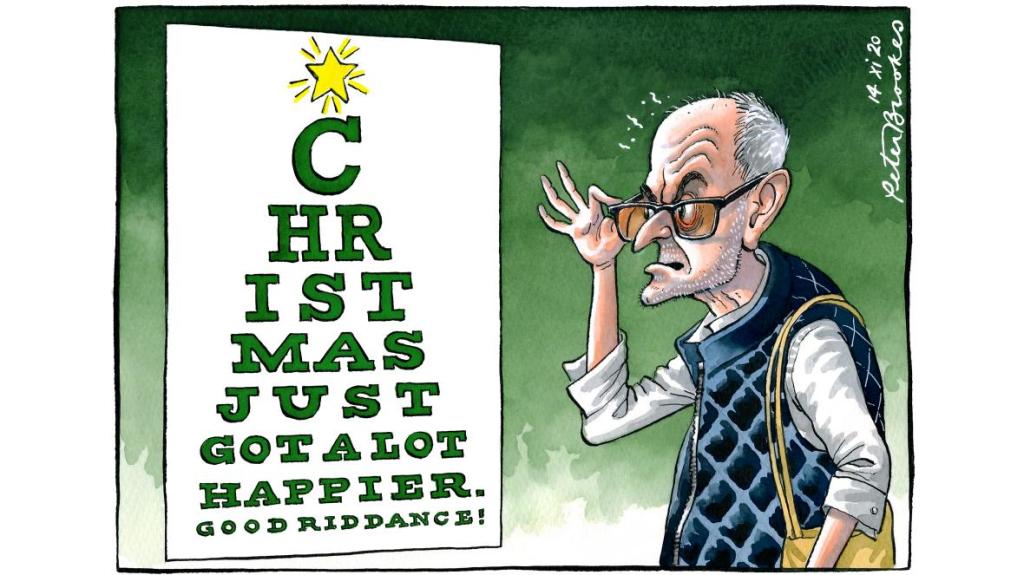
Dear Santa, All I want is some decent soap. I can’t seem to get my hands clean these days — always one damned spot left. But it needn’t be highly scented; I’ve tried all the perfumes of Arabia to no avail.

Also, my husband needs some new glasses. He keeps seeing things that aren’t there, daggers mostly. I don’t think it’s the drink.

By the time you get to Glamis, you’re nearly home so why not stop over for a rest? I’ll make up the spare room, like I did for Duncan. You’re welcome to stay until tomorrow — and tomorrow and tomorrow. All the best, Lady Macbeth.

Jacob Rees-Mogg, Leader of the House of Commons, Lord President of the Council, Member of Parliament for North East Somerset presents his compliments to Saint Nicholas, Holy Hierarch, Bishop of Myra and begs to inform him that during the past twelvemonth his behaviour has been without fault. In consequence of which he humbly requests the Patron of our Yuletide Festival to furnish him with the following:

Item: One monocle

Item: A new pair of spats

Item: A carbon-neutral penny-farthing.

In joyful anticipation, he expresses his profound gratitude.

Dear Santa, Please could I have some tickets for the theatre? After a difficult few years I need a relaxing evening where nothing can go wrong. Yours, Abraham Lincoln

Dear Santa, We haven’t written for many years — I used to sign my letters Lilibet — but write now to ask for a new cabinet for one of our palaces. My husband and I are in disagreement over this. He says we have plenty. We have had plenty, but when I heard him talking about a William Kent yesterday I realised how desperately we need a new one. Please send a Lord Privy Seal, First Lord of the Treasury, Chancellor of the Duchy of Lancaster, etc etc, to the Palace of Westminster. Yours affectionately, E To Err

Dear Santa, There’s something we just can’t abide: politicians who cannot decide. [Next slide]

The two of us each eventide with Matt or Boris by our side [Next slide]

(Though neither of them’s qualified to lock down part or nationwide), [Next slide]

And Gavin, who should be certified, or Peston with his diatribe. [Next slide]

So next year please let’s turn the tide and get through this with British pride [Next slide]

If, Santa, will you please provide your sleigh for vaccines countrywide. Yours truly, Chris & Patrick

Listen Santa, When I asked for a cowboy outfit, I expected a profitable business not some Village People schmutter. Anyway, the chaps were too long, the waistcoat too small, and the hat blew over the side of the yacht. This year I expect a peerage. No, not porridge. If you’re looking to sell up, I’ll take the workshop — but I’m not paying the elves’ pensions. SIR Philip Green

Father Christmas, When I sent you my list of presents, I did NOT expect to wait until Christmas Day. I wanted them the same day. You’re a useless idiot. It pains me to say it but civil servants could do a better job. Priti Patel

Dear Mr Claus, Please could I have a plastic skeleton? As Secretary of State for Education I have singlehandedly guided us through these problematic months and confidently expect a promotion to Health in a reshuffle. My plan is to learn all the body parts so I can tell the doctors how to do their jobs. However, I overheard Boris telling someone I don’t know my arse from my elbow, so realised I need help. Your ’umble servant, Gav

Dear Santa, I’ve been a very good boy so please can you bring me an oven (British, of course, or your reindeer will get stuck in the queues from abroad) because my one isn’t working. A deal I recently cooked came out very flat. I was going to ask for some fish as well but I’ll be able to get loads very cheaply soon. Thanks very much, Boris Johnson

Dear Claus, You are, by edict of Parliament, instructed to stay away from our lands. Should you doubt our resolve, I remind you of the late Charles Stuart. With the grace of God, Cromwell, Protector.

Dear Father, I have been good, so far. I was a bit disappointed to get gardening equipment and a fruit tree last year. I’d love some clothes! Eve

Darling Santa, All I want for Christmas is a private island where we can live our simple lives, growing carrots and eggplants far away from PR people and photographers. And could it have a small jet and a landing strip so Harry can pop over to the mainland when we run out of oatmilk? Yours humbly, Meghan.

Dear Santa, Rather than seeking a gift, I offer one. Having observed your lifelong need to please, dress in bizarre costumes and pop down chimneys, I propose you swap your sleigh for my couch. No charge. Yours professionally, Sigmund Freud

Dear Santa, For my first Xmas can I please have a smooth exit for Papa, less vexit for Mama and a lot more bixcits for Dilyn as well as a scalextric for me. Thank you x Wilfred Johnson, aged 7 months

Dear Father Christmas, We feel rather embarrassed about sending a list since you gave us EVERYTHING we asked for last year. War, Poverty and Death are, for us, like socks, boxer shorts and a book token but, oh boy, to get Pestilence too! Wow!

However, our PR dept caution against “catastrophe fatigue” and suggest that this year we ask for a Cliff Richard CD, a pair of slippers, Quality Street and a voucher for an Unconscious Bias Course. Though if you could manage a teeny bit of cataclysmic flooding . . ? Thanks v much, White, Red, Black and Pale

Winning entries sent by Bharat Jashanmal, Vivien McCoubrey, Margaret Attlee, Pete Moore, Nicholas Cranfield, Jeremy Fox, Gerald Gouriet, Jeremy Dore, Steve Larkin, Zilma Watts, Alastair Stewart, Tina Morgan, Joan Salter, Walter Ford, Ian Elliott and Suzie Marwood.

Alas, poor Boris: PM’s go-to word for delivering bad news

It is the word the prime minister turns to when he is about to deliver bad news. And it’s become the signal for the rest of us to brace ourselves.

Nick Hopkins www.theguardian.com

Alas, it seems, is the word poor Boris knows all too well.

And according to the team behind the BBC TV show QI, it has become a staple during parliamentary debate too – it was said more than 80 times in the House of Commons in November 2020, more than any other month since 1800.

A now-unfashionable word, with its origins from Old French in the mid-13th century, “alas” was used by Shakespeare in one of his most famous and misquoted lines. In a graveyard, clutching the skull of the court jester, Hamlet declares: “Alas, poor Yorick! I knew him, Horatio …”

Then, as now, it is word commonly used to express sorrow, grief and concern, and there’s certainly been a lot of that this year.

At his last Downing Street press briefing on 21 December, Boris Johnson used it for the umpteenth time. “As we’ve seen throughout this pandemic, this virus, alas, can move all too swiftly from one nation to another …”

Five days earlier, with coronavirus spreading rapidly across the nation and new tougher restrictions in the offing, the prime minister admitted “the overall situation is, alas, worse and more challenging than we had hoped when we first set the rules”.

In late November, Johnson told the nation that the tiering system wasn’t really working. “I should warn you now that many more places will be in higher tiers than, alas, was previously the case,” he said. Two weeks before that, on 9 November, “alas”, he said, the death figures were rising fast.

And in his statement to the Commons at the beginning of the month, it was double portions. “When I look at what is happening now amongst some of our continental friends and see doctors who have tested positive being ordered, alas, to work on Covid wards … I can reach only one conclusion: I am not prepared to take the risk with the lives of the British people.” Getting the R number down was essential to avoid “more hospital admissions and, alas, more fatalities”.

These aren’t the only occasions the prime minister has used the word in recent weeks. And given the bleak news about the spread of the virus, they are unlikely to be the last.

Alas.

Bradshaw scores government 3 out of 10

[Ben Bradshaw MP was Minister of State for Health from 2007 to 2009 before promotion to Secretary of State for Culture, Media and Sport in the last Labour Government. – Owl]

Ben Bradshaw, the Labour MP for Exeter, has a lot to say about how the government has handled the coronavirus pandemic.“Three out of ten. At best, he says. “The actual response to the pandemic has been shambolic, unpredictable, veered all over the place and full of over promising and under delivering.”

Daniel Clark, local democracy reporter www.radioexe.co.uk 

A former health minister, Mr Bradshaw has called the repeated failure of the government to be ahead of the curve and anticipate events scandalous. He says the buck has to stop with the prime minister who has proven himself to be unqualified for the task.

Mr Bradshaw said alarm bells for him began to ring loudly when he was in Italy in February and saw how they were handling the pandemic.

“There were reports in the media about this mysterious virus before that and I think we were so wrapped up in the aftermath of the general election and Brexit that I think we weren’t as a country we weren’t very quick to realise what was coming to hit us. But if you listened at the time to various medical experts or read journals like the Lancet, then alarm bells might have been ringing earlier.

“Co-incidentally I happened to go to Italy for the February half-term and when we arrived at Catania Airport, we were temperature-checked on arrival, and I thought, that’s interesting, as there was absolutely nothing going on in the UK whatsoever, and of course, we know what happened.

“The first wave hit Italy first in the ski resorts and elsewhere and then spread like wildfire to the rest of Europe and the rest of it is history, so it is extraordinary thinking back a year that the whole of 2020 has been dominated by this dreadful pandemic.”

It was a month later before the UK went into its first lockdown, and Mr Bradshaw said: “There is a general consensus that we were far too slow to act. We went into the first lockdown two or three weeks too late and been well documented that thousands of lives could have been saved had we gone into that lockdown earlier.

“Because I have friends and family in Italy I was watching in horror what was happening with the hospitals filling up and not just old people getting ill and dying, but young otherwise healthy people, and we were still fiddling around in Britain.

“We did get the numbers well down in the summer and I would have thought it would have been unsustainable to have maintained those restrictions throughout the summer given the numbers were coming down, but when they started going up, again it seemed the government did too little, too late.”

Mr Bradshaw says he has raised serious questions of what the £12 billion spent on test and trace has actually been spent on, given the country has been through a second lockdown and could be on the verge of entering a third.

“It’s absolutely scandalous that test and trace is completely failing,” he said. “The tracing element is a disaster. Billions and billions of tax payer’s money has been spent on this privatised system run by a crony of the government with no obvious experience or qualification to do the job.

“It’s done an appalling job and the levels of compliance with self-isolation is incredibly low and they are only tracing a fraction of the people, so we cannot afford another national lockdown before we are rescued from a vaccine but if the government doesn’t do better, then I fear that’s where we are heading.”

Asked why people are not complying with some of the restrictions, and the requirement to self-isolate, he said: “I think there are three reasons for that. One is that people can’t afford to do it as the level of income support is not sufficient for them to survive and feed their families. The second is the loss of trust because of Dominic Cummings – one rule for them and one for the rest of us.

“And the third is because of the government’s obsession with this privatised and centralisation approach using huge national call centres that don’t know local areas instead of using existing public health expertise that we have at local level.

“Where the local government has been doing the tracing, they have had a contact tracing rating of 97 per cent, even going and knocking on people’s doors. You can’t do it all using a centralised telephone system, not least when a lot of people, including me, don’t answer the phone when we get a withheld number or an anonymous number that we don’t recognise, so the whole system has been hampered by the government’s obsession with over centralisation, privatisation and handing out these multi-billion pound contracts to the favourites of ministers.

“Look at how well they dealt with and eradicated the Exeter University spike in September and October. That is a very good example of where the partnership working in Devon has been highly successful as it’s been locally driven. They’ve basically ignored what the government has been saying and have been doing their own thing and much more successfully as a result.

“The secret, the big secret, was the university many months beforehand commissioned their own private testing system so they did not have to rely on the disastrous failing national government one. I think the vice chancellor of the university working with Public Health Devon did a fantastic job, and the students did very well in adhering to the rules.

“It goes back to the terrible habit that the government had all the way through of over promising and under delivering and preferring big, glossy, visual PR projects like the Nightingales, which made great telly for the secretary of state to go and open but didn’t address the real need we had at the time.

“Exeter’s Nightingale is one of the few that has actually been used. Most of them have stood empty. I just hope countless lessons are learnt as a result of this, but very depressing at how poor the government has been at learning the lessons and they have kept repeating the same mistakes.”

Devon has fared far better than other areas of the country, and remains the area in England with the lowest death rate. Only Cornwall, the Isle of Wight, Dorset and Wiltshire have had lower infection rates than Devon throughout the pandemic, and at lower tier level, the South Hams, Torridge, Teignbridge, West Devon and Mid Devon are among the bottom ten areas in England.

Asked why Devon has fared better than some other counties, Mr Bradshaw said there was a number of reasons. He said: “Firstly the nature of Devon as a county. It has tended to be the more peripheral and sparsely populated areas that have done best simply because there aren’t vast numbers of people living on top of each other is cramped conditions moving around.

“Secondly, I think the timing of the measures that were taken benefitted us as after the initial small spike in Torbay of holidaymakers who came back from ski holidays, we had very low numbers in the beginning and our numbers were still low when the first lockdown kicked in and they stayed low, and that has been really helpful for us.

“And we have had superb collaborations between our local authorities, the health service, and our public health officials and they have been in the forefront of doing some of the work on contact tracing long before it was happening elsewhere, and they have been ahead of the problems we have had.”

Asked for a rating of the government’s response out of ten, he said: “I’d give them at the most three. The only thing that has been reasonably successful has been the economic support package but even that has been full of holes with millions of people left without support.

“The actual response to the pandemic has been shambolic, unpredictable, veered all over the place, and the buck has to stop with the PM and he is ultimately in charge and he sets the tone, and I’m afraid its revealed Mr Johnson as someone who is not across the detail and he is not able to take unpopular decisions in the timely manner, which sometimes you have to do as a PM.”

One unpopular decision though that he has taken is the cancellation of Christmas for people living in Tier 4 areas, and the relaxation of the rules from five days to just Christmas Day for the rest of England, but Mr Bradshaw said that changing of Christmas rules have left him never having felt so angry with the prime minister.

He said: “I don’t think I have ever felt so angry with this Prime Minister. He never learns. Always over promising and under delivering. Millions of people were encouraged by him to make plans to see family and friends for Christmas, even though he knew cases were soaring and now all these people’s plans have had to be scrapped.”

Mr Bradshaw “When it is all over, there needs to be a fair and just reckoning between the ages as young people have paid a huge price and have been far more economically and socially impacted and affected by this and will have to the devastating fiscal effects to deal with for the rest of their lives.”

‘Christmas gift’ or ‘bad timing’? Brexit deal greeted with joy and foreboding around world

Britain should be congratulated for coming to a Brexit deal with the EU, but be wary of the very different world they are walking into, international analysts have said.

Helen Davidson www.theguardian.com 

Outside Europe, politicians, experts, and media took a short break from Christmas and the pandemic to welcome the end of Britain’s long and torturous Brexit process, but there was little in the way of celebration.

In the New York Times, Mark Landler reflected on how much Britain, and the world, had changed since the 2016 vote, when a narrow majority of people were “tempted by an argument that the country would prosper by throwing off the bureaucratic shackles of Brussels”, develop new industries and cut its own trade deals.

But now the world is more protectionist and nationalistic, and vulnerable post-pandemic.

“The world is now dominated by three gargantuan economic blocs – the United States, China and the European Union,” wrote Landler. “Britain has finalised its divorce from one of them, leaving it isolated at a time when the path forward seems more perilous than it once did.”

In that same piece, Thomas Wright, the director of the Center on the United States and Europe at the Brookings Institution cut to the chase: “Becoming a global free trader in 2016 is a bit like turning into a communist in 1989. It’s bad timing.”

In a comprehensive step through of the politics behind history, Linton Besser, the Australian Broadcasting Corporation’s Europe correspondent, predicted Boris Johnson, ever the populist, would swing with the wind on whether the deal was working out.

“The prime minister will continue to trumpet the breakthrough for as long as it’s advantageous to do so,” wrote Besser. “Then, in the not-too-distant future, when electoral profit beckons, he and his allies will find a way, whatever rhetorical contortions are required, to condemn the EU all the same.

The deal will be reprosecuted – perhaps by Johnson himself – in pursuit of another chance to wave a kipper at those pesky Europeans from up on a stage.

“And that’s because Europe has for decades been a very handy straw man for many in the establishment, not least Johnson himself, who paved a path to politics with wildly exaggerated newspaper columns pouring scorn on European cooperation.”

Chinese state media reports on Brexit were viewed more than 140m times on microblogging platform, Weibo, but they did not appear to publish any Chinese-language commentary.

The state-backed tabloid, Global Times, said the deal was “a Christmas gift not only for the British economy but also for the Covid-19-battered global financial market”.

The editorial said the world’s markets were still struggling with the pandemic, and looking for “less chaos”. It commended the British government’s “last ditch efforts” to secure a deal under so much pressure. “There is no denying that a no-deal Brexit would lead to a dramatic change in the life and employment prospects of the Britons,” it said.

In English, Xinhua said that while the deal will “certainly help avoid a Brexit cliff edge”, it was not “a Christmas gift for all”.

Other English-language state media, including CGTN and China Daily, went with an op-ed by former MEP Jonathan Arnott. Arnott wrote that the last-minute nature of the deal – on Christmas eve and a week before deadline – was “breathtaking, though hardly surprising”. “The world is changing,” he said, and how the UK deals with the growing markets of China, India, and South America will be “pivotal”.

“One way or another, it must demonstrate a clear strategy: unless such trading relationships are signed, sealed and delivered, the UK cannot claim to have gained economically from Brexit.”

Japan’s finance minister, Taro Aso, told reporters he welcomed the deal, and “it should be highly valued that a broad agreement was clinched between the two”.

New Zealand’s minister for foreign affairs, Nanaia Mahuta, also congratulated both sides. “We welcome continued stability and continuity,” she tweeted.

A US state department official said the US was committed to negotiating a comprehensive free trade agreement with the UK. “We support the UK in its sovereign decision to depart the EU, and we look forward to continued strong relationships with both the UK and EU,” they said.

The Times of India reported the agreement left “critical parts of the relationship to be worked out later”, and WIO News reported the two parties had “finally agreed” on a deal, and led on reassuring comments by the EU’s Ursula von der Leyen, that the two sides would “stand shoulder to shoulder to deliver on our common global goals”.

However it also reported on economists’ warnings that “leaving the EU’s orbit will still hurt” the world’s current sixth largest economy.

‘If I die, better to die gloriously’: the volunteers catching Covid for science

Alex Greer, a chemistry student, runs the Effective Altruism Society at Durham University. “It’s about using evidence and careful analysis to do the most good in the world,” he says. With this mission in mind he recently received an offer he felt could not refuse: would he allow himself to be infected with Covid-19 in the name of science?

Uplifting altruism in action – Owl

www.thetimes.co.uk

Mr Greer, 20, is one of more than 2,500 Britons who have volunteered to take part in the world’s first coronavirus “human challenge trials”. Due to begin in a London hospital next month, they will involve participants being deliberately exposed to the virus in a secure bio-containment suite.

The aim is to accelerate research by studying, in a way not possible in other settings, how our bodies react to the bug and how well the next generation of vaccines can fend it off.

Dominic Wilkinson, a professor of medical ethics at Oxford University, believes the dangers are acceptable and that volunteering signals “an enormous amount of altruism and maturity”.

The project, led by Imperial College, will initially involve a few dozen 18 to 30-year-olds, free of risk factors such as heart disease or diabetes. For this age group studies put the chances of dying of Covid once you’ve caught it at somewhere in the region of one in 10,000. “It’s the sort of risk that women run of dying in childbirth,” Professor Wilkinson said.

On top of that there is the possibility of “long Covid”, where symptoms linger for weeks or months. “But a lot of people have caught the disease and had no say in it,” Mr Greer said. “Hopefully by giving my informed consent I can help prevent others being blindsided.”

At 66, Paul van den Bosch, a GP who has worked for Médecins Sans Frontières, will not be eligible for the first trials but he hopes that older people, a priority group for vaccines and treatments, will eventually be allowed to take part.

“We’ve become a little bit obsessed by an injunction to stay safe,” he said. “Our lives are finite and it’s not our job to to stay safe all the time. We’re going to die in the end — and if one wants to be romantic about it then, you know, dying gloriously is better than dying of dementia. And from a practical point of view, the risks aren’t huge. They’re much smaller than a lot of the things that people do, like climbing Everest [where about one in a hundred climbers beyond base camp die].”

What does his family think? “I’ve worked overseas in difficult environments and a few years ago I donated a kidney so I’m known as a risk taker.”

Over the past year scientists have developed vaccines at a pace that many doubted was possible, but it still was not fast enough to stop the world being turned upside down by the virus. By providing £34 million for the challenge trials, the UK government is signalling a belief that the process can be accelerated further still.

This seems plausible: the American company Moderna had created a coronavirus jab by February 24, although it took another eight months to show that it worked. This was done by recruiting 30,000 people for a field trial and giving half of them the real vaccine and half a placebo. The scientists had to sit back and wait for infections to strike naturally. It took until mid-November for 95 people to catch the bug, enough to assess with reasonable statistical certainty that it was effective.

Challenge trials offer a shortcut to that process because scientists can observe infections from the moment the pathogen meets its host. By scrutinising every detail from the outset the trials should help to define how the immune system mobilises to fend off the coronavirus, as well as the duration of vaccine-induced immunity and the measurable signs that a person is protected. The first step will involve working out the smallest amount of virus you can expose somebody to and cause an infection. (Volunteers will probably have it dripped into their nose.) This should help to minimise the risk of severe disease.

The Vaccine Task Force, the government body responsible for building stockpiles, has secured the first three challenge trial slots to test new jabs. A second generation of vaccines is likely to be needed, it says, for boosting protection, addressing supply challenges, tackling mutations in the virus and making immunisation campaigns cheaper. It envisages a “fast to fail” approach, where challenge trials quickly sort out the vaccine chaff. If transmission rates are low this may be the only way that the next swathe of inoculations could be tested. The option for large-scale field efficacy studies simply may not exist.

The volunteers are on board with this thinking. Jennifer Wright, 29, a physics PhD student at the University of Glasgow, says she has been motivated by the ability to gather otherwise unobtainable data. She would also like to feel as if she had done her bit. “I’m very sure that I would like to take a risk to help out,” she said. “Some of my friends work for the NHS and they’ve been taking risks all through the pandemic while I’ve been looked after and stayed safe.”

In the spring Seán McPartlin, 22, a philosophy student at Oxford, became involved with 1Day Sooner, the non-profit group through which all the volunteers interviewed here have signed up. It has held discussions with Imperial but the researchers may end up enrolling volunteers through other channels.

Volunteers for the Imperial trial are expected to be paid about £4,000 for a two or three-week stay at the Royal Free Hospital in London and probably about a year of follow-up appointments. Mr McPartlin has been calling would-be participants and says they have not seemed very interested in financial incentives. “They’re committed to the rationale,” he says.

Around the world 1Day Sooner has recruited more than 38,000 challenge volunteers and won the backing of several Nobel winners as well as Adrian Hill, one of the leaders of the Oxford vaccine team. Mr McPartlin has been making sure that the volunteers know what they are letting themselves in for.

“Most had done their due diligence,” he says. “The outstanding questions were practical. What exactly is the quarantine facility going to be like? Will there be wifi?”

Record breaking jabs

A Christmas Message

This is just a start. Owl has a little list of those who won’t be missed.

And:

Consulting, blogging, eye test advertising: what next for Dominic Cummings?

Rajeev Syal www.theguardian.com 

For an alleged “career psychopath”, as David Cameron once described him, Dominic Cummings appears to have a number of job options available when he leaves the employment of Downing Street next week.

Friends and rivals wonder whether Boris Johnson’s chief aide – who survived unprecedented anger over his lockdown travels but not a power struggle involving the prime minister’s fiancee – will set up a thinktank, launch a consultancy specialising in data, or just write a series of 5,000-word blogs.

Former colleagues say he can take his pick of possible new jobs, including lucrative consultancy work for hedge funds and City banks keen to take advantage of his expertise and inside knowledge on the UK’s post-Brexit future.

Two Conservative sources said Cummings, 49, might seek to work with Ben or Marc Warner – brothers with whom he has been closely associated and reportedly admires. Ben Warner, a data scientist recruited to Downing Street last year after running the Tory party’s general election campaign model, attended Sage meetings with Cummings during the pandemic.

Marc Warner runs Faculty, an artificial intelligence company involved in an “unprecedented” data-mining operation as part of the government’s response in mapping the coronavirus outbreak. Faculty was hired by Cummings to work for the Vote Leave campaign and counts current and former Conservative ministers among its shareholders. It was paid £400,000 by the Ministry of Housing, Communities and Local Government for the work, according to the contract.

One former colleague of Cummings said: “Dom will want to do something that interests him. He is still fascinated by data and the possibilities of AI. Plus, it would enhance that image of himself as a cutting-edge maverick, breaking new barriers. He would like that.”

Cummings could seek to further influence the direction of government by either setting up a thinktank or taking up a lofty position within one. Another former colleague said: “He will no doubt still believe that there is work to be done, for example on calling for a referendum on the European convention on human rights or civil service reform.”

If he does decide to set up on his own – with a consultancy, lobbying firm or thinktank, Cummings could attract support from several wealthy admirers. Friends say he has close ties with political benefactors including Lord Nash, Paul Marshall and members of the Bamford family behind the machinery manufacturer JCB.

Another option would be to reinvigorate his eponymous blog in which he wrote about Brexit, education reform and even claimed to have predicted the coronavirus pandemic.

Last year, he extolled the virtues of a Darpa-like agency, a US government body that encourages emerging technologies, which some claim he could help pioneer in the UK.

Whether or not Cummings decides to join the private sector, former colleagues said that he still commands respect among senior cabinet ministers, including the chancellor, Rishi Sunak, and the foreign secretary, Dominic Raab, even as his relationship with Johnson has cooled.

One said there’s a chance Cummings could return to frontline politics if a pro-Brexit government asked him. His campaign slogans helped win a referendum and an 80-seat majority. “Boris and Dom had a close professional relationship which could be reignited again if needed. If the Conservatives need to win another election to preserve Brexit, Dom could be persuaded to return,” the source said.

Seventeen months ago, Cummings was some way from being a nationally known figure when he was invited into Downing Street by Johnson. He had already been labelled a “career psychopath” by Cameron, who was perhaps stung when Cummings paraphrased Bismarck to label the former Tory leader “a sphinx without a riddle”.

His combative nature, ruthless attitude towards fellow advisers and his decision to bend the rules in the first lockdown to travel from London to Durham with his unwell family in May put him under an unprecedented media spotlight for an unelected aide.

In the controversy that followed the revelation of the Durham trip, Cummings claimed he had undertaken a visit to nearby Barnard Castle to test his eyesight. Last month, following a power struggle involving Johnson’s fiancee, Carrie Symonds, Cummings announced he would stand down in December, and work from home until then.

In the unlikely event that other options are closed, Cummings could perhaps still attempt to cash in by advertising eye tests – but the high street opticians Specsavers said that the peak moment for publicity may have passed. After the scandal of the Durham trip broke, daytrippers took to posing for selfies outside the town’s branch of the opticians.

A Specsavers spokesperson said: “Dominic Cummings has done more than anyone this year to promote the importance of regular eye tests. We very much doubt that anything could top the interest he generated in Specsavers back in May and our store in Barnard Castle is keen to keep a lower profile next year.”

The Scott Trust, the ultimate owner of the Guardian, is the sole investor in GMG Ventures, which is a minority shareholder in Faculty.

How a string of failures by the British government helped Covid-19 to mutate

“The prime minister’s repeated dithering, delays and seeming inability to make unpopular decisions have led Britain to have one of the worst death rates in the world. We have now cancelled Christmas and triggered international alarm. We can only hope that we’re not still in this position by Easter.”

Anthony Costello www.theguardian.com

During the first wave of Covid-19 in Britain, many scientists – myself included – said the government should be pursuing a “maximum suppression” or “zero Covid” strategy. One of the many reasons for this was to stop natural selection doing its work. When a virus is allowed to spread, spending time in different hosts, it evolves and mutates. Scientists have now found a “mutant” variant of the virus that causes Covid-19, which has 17 alterations to its genetic sequences, including changes in the spike protein that enables the virus to enter our cells.

Despite the warnings, the government’s strategy throughout the pandemic has been to slow the spread of the virus and reduce pressure on the NHS, rather than eliminating Covid altogether. As late as 13 March, Scientific Advisory Group for Emergencies (Sage) minutes recorded that “measures seeking to completely suppress [the] spread of Covid-19 will cause a second peak”. Advisers warned that countries such as China, where heavy suppression was already under way “will experience a second peak once measures are relaxed”. Instead of eliminating coronavirus, the logic seemed to be, Britain would learn to live with it.

Nine months later, China and South Korea have recorded three and 12 deaths per million people respectively. By contrast, based on the government data for deaths occurring within 28 days of a positive Covid test, the UK has recorded 970 deaths from Covid per million people.

Scientists only expected the virus that causes Covid-19 to undergo one to two mutations each month – but with an estimated 2 million people now infected with Covid in the UK, there are many more opportunities for the virus to mutate. The new variant seems to be accelerating transmission. Many have asked whether this will affect the efficacy of a vaccination programme – but this is something scientists could likely fix reasonably quickly by adjusting the RNA coding of the new vaccines. It’s not possible to tell yet whether the new variant of the virus will change the severity of Covid-19 in those who catch it.

What’s certain is that the greater the number of people who are infected, the more chance a virus has to evolve. The government rightly fears that a surge in cases in southern England, where transmission is worryingly high, will spread across the country, and EU member states have banned travel and limited freight from the UK in an attempt to stop the variant spreading. Measures to prevent the spread of Covid are much the same as before – restricting household mixing, social distancing, travel bans, rapid testing, contact tracing and isolation, face masks, hand hygiene and working from home. Workplaces and schools will remain shut over Christmas, and the tier 4 lockdown in London and the south-east should dampen the opportunities for infections. For now, the government’s priority should be scaling up vaccinations as quickly as possible, and offering proper support to those affected by lockdown and self-isolation measures.

But none of this was inevitable. The recent surge cannot be blamed on a mutant virus alone; in fact, government mismanagement of the pandemic meant that many more people became infected, creating the conditions for mutations to occur.

The failures of the government’s pandemic response are legion. An earlier lockdown by just one week in the spring could have halved the death rate, according to Nick Davies, a Sage adviser. Ministers wasted billions on outsourcing an allegedly “world-beating” test-and-trace system to private companies. It has failed to monitor rates of self-isolation and provided scant financial support to those asked to quarantine at home, relying on workers who don’t get sick pay, such as those in the gig economy, to isolate while losing wages. After Britain’s spring lockdown, infection rates fell, but the government again failed to do what was needed in time to suppress the virus.

The government’s poor control of Covid-19 has increased the force of the infection and allowed more mutations to happen. On top of the economic costs of lockdown measures, the UK has now been effectively placed in quarantine by the international community. The prime minister’s repeated dithering, delays and seeming inability to make unpopular decisions have led Britain to have one of the worst death rates in the world. We have now cancelled Christmas and triggered international alarm. We can only hope that we’re not still in this position by Easter.

  • Anthony Costello is professor of global health and sustainable development at University College London and a former director of maternal and child health at the WHO

Led by Donkeys – a second attempt

Occasionally, Old Owl sets New Owl a cryptic challenge.

This one is to find the “right” led by Donkeys update.

The one posted yesterday, though entertaining, wasn’t the one intended! Ooops.

So let’s try this.

East Devon public toilets set to close for Christmas

East Devon’s 20 Covid-safe public toilets will be closed on Christmas Day and will re-open as usual from Boxing Day onwards. 

Don’t get caught out! – Owl

Daniel Wilkins​ www.exmouthjournal.co.uk 

Due to the level of staffing needed for the required enhanced cleaning for Covid 19 compliance, the council has decided to close the public toilets on Christmas Day.  

An East Devon District Council spokesman said: “Closing the toilets on Christmas Day will allow staff to be with their extended families – their  ‘Christmas Bubble’ –  which, due to national restrictions, is the only day where they can meet their family and friends.”

Since the first national lockdown, the majority of East Devon’s public toilets have remained open with enhanced Covid cleaning – three times a day in the winter and five times a day over the summer. 

New contractors to roll out fibre broadband across region – News centre

Three companies have been selected to roll-out full fibre broadband networks on behalf of the Connecting Devon and Somerset (CDS) programme, backed by Government funding.

Three for the price of one?

Everyone jumping on the bandwagon – why has it taken so long to get going?

In March Owl wrote:

“Owl recommends searching the archive using a combination of these terms: Twiss; broadband supremo; omnishambles. How far back can you go?”

Posted on: 23 December 2020 www.devonnewscentre.info 

Airband, Truespeed and Wessex Internet will be installing full fibre broadband across Devon and Somerset to more than 56,000 rural homes and businesses over the next four years.

The combined public and private sector investment of around £80million will be in the vanguard of the Government’s ambitions to build a Gigabit capable network across the UK.

The three companies all have experience of working in the region and, between them, have already delivered connections to nearly 41,000 premises in the CDS region.

In the new roll-out, Airband will be expanding its full fibre coverage into rural areas of Somerset West and Taunton, parts of Sedgemoor, East Devon, as well as areas of Mid Devon, South Hams and Teignbridge.

Truespeed will be working in B&NES (Bath & North East Somerset), North Somerset, Mendip and part of Sedgemoor, while Wessex Internet will deliver in rural communities of South Somerset.

Work is due to start next year for completion in 2024. The initiative is being funded by the Department of Digital, Culture, Media and Sport, Heart of the South West LEP, CDS local authorities, European Regional Development Fund and the Rural Development Programme for England.

Minister for Digital Infrastructure, Matt Warman MP, said: “Today’s announcement marks a major step forward in our mission to build back better in the South West, with thousands of homes and businesses set to be linked up to lightning fast gigabit broadband thanks to an £18.4 million investment by the government. With Airband, Truespeed and Wessex Internet now on board I am confident we will deliver on our ambition for an infrastructure revolution in Devon and Somerset.”

Councillor David Hall, CDS Board Member and Somerset County Council Cabinet Member for Economic Development, Planning and Community Infrastructure, said: “We’re pleased to confirm the appointment of three well-established, regionally-based suppliers to help with the challenge of delivering the next phase of the CDS programme. They have significant experience of delivering broadband connections in rural areas of Devon and Somerset, so they have an understanding of the remote areas where CDS is looking to improve connectivity. This investment will deliver full fibre broadband ahead of many other parts of the country.”

Councillor Rufus Gilbert, CDS Board Member and Devon County Council Cabinet Member for Economy and Skills, said: “These contracts will deliver vital connectivity to a significant number of rural communities across Devon and Somerset helping our businesses and supporting local jobs. Access to services online, home working and staying connected has never been more important, and these investments will provide a much needed boost to our rural and coastal communities”.

Redmond Peel, Founder and Director of Airband, said: “We are thrilled to have won these contracts. As a company, we passionately believe that rural communities should have access to the same level of high-quality connectivity, and therefore opportunities, as those in urban areas. Today’s announcement is a step towards closing the digital divide and delivering industry leading connectivity to those who need it most.”

Evan Wienburg, Truespeed CEO, said: “We are delighted to have won these prestigious contracts with CDS to bring Gigabit-capable full fibre broadband to harder to reach communities in the south west. As a Somerset-based business focused on building out our own full fibre infrastructure to areas left behind by the industry giants, we are the natural partner for CDS. The requirement for full fibre broadband is essential as more people study and work from home. Many Truespeed customers are already benefiting from our ultra-reliable, ultra-fast broadband service and we will continue to work as hard and as fast as we can to accelerate our roll out.”

Hector Gibson Fleming, Managing Director of Wessex Internet, said: “This hugely exciting programme will allow us to focus on delivering even more connectivity to rural homes and businesses across South East Somerset. We already have a track record of delivering in this challenging geography and the programme will allow us to accelerate our work while still retaining our collaborative approach. We now look forward to partnering with more farmers and communities across the area to deliver full-fibre connections to even more of the countryside that has been overlooked by the major network providers.”

Karl Tucker, Chair, Heart of the South West LEP, said: “The appointment of the three suppliers to deliver the rollout of full fibre coverage to people and businesses into thousands of rural homes and businesses in the Heart of the South West LEP area is good news. It has never been more vital than it is now to ensure our communities and businesses have access to good connectivity and the three companies all have extensive experience of working in our area. The HotSWLEP is delighted to be supporting this programme through our Growth Deal funding.”

CDS has delivered connectivity to more homes and businesses than any other broadband programme in England.

Nearly one million homes and businesses in Devon and Somerset now have access to superfast broadband thanks to the Government supported CDS programme and stimulation of the commercial market which is an important element of CDS’s role. Of these, over 300,000 homes and businesses have access to superfast broadband as a direct result of public funding.

As part of its Fibre Extension Programme, CDS is currently funding fibre broadband connections to over 6,000 homes and businesses being delivered by Airband. Thanks to the high level of take-up of broadband services in the region from previous connectivity delivered by Openreach, CDS is also re-investing a £6 million dividend to extend full fibre coverage to over 2,000 premises, again working with Openreach, through the Government’s “Gainshare” agreement with the company.

CDS is also working closely with the Government’s Rural Gigabit Voucher programme to support communities who wish to contract with telecoms providers to design bespoke broadband solutions for their communities. To date, over 3,400 premises in Devon and Somerset have been connected to fibre through the Rural Gigabit Voucher Scheme, with another 2,800 vouchers approved for build over the next 12 months. This represents a voucher investment of nearly £7.4 Million in full fibre across the CDS region.

Investment from CDS can only take place in areas where there are no current or credible future plans to deliver Next Generation Access (NGA) broadband infrastructure capable of download speeds of at least 30Mbps.

The whole Connecting Devon and Somerset programme is expected to deliver an £800 million boost to the regional economy.

Led by Donkeys – update