Is this the start of the third wave?

According to the ZOE COVID Symptom Study UK Infection Survey figures based on swab tests data from up to five days ago, daily new cases of COVID-19 in the UK are rising again but there are big differences between regions. Regions like Wales and London are seeing sharp rises, whereas in  the North East and Yorkshire cases are still falling, and others are rising slowly. 

Covid.joinzoe.com Data Press Release 18 December 2020

Key findings from ZOE COVID Symptom Study UK Infection Survey this week: 

  • There are currently 26,897 daily new symptomatic cases of COVID in the UK on average over the two weeks up to 13 December (excluding care homes) 
  • This compares to 19,190 daily new symptomatic cases a week ago
  • The UK R value is 1.1.
  • Regional R values are: England, 1.1. Wales, 1.2. Scotland, 0.9. (full table below) 
  • Wales with an R value of 1.2 now has more cases than at the peak of its second wave before the firebreaker and is still rising rapidly with more cases than anywhere else in the UK
  • In London, where cases never truly peaked since April, the number of daily new cases is climbing again and nearly 10 percent of tests are positive. There are wide six fold differences across the boroughs. Enfield, Havering and Merton are the worst affected areas. Westminster, Kingston upon Thames and Hounslow are the least affected areas (see a map and a graph of for London below)
  • In most other UK regions, cases are either steady or rising, the only exception is the North East and Yorkshire where daily new cases continue to fall 
  • Age groups: cases in the over 60s are slightly up from last week, notably in Wales, which is a key metric linked to hospital admissions (see graph below)

The ZOE COVID Symptom Study UK Infection Survey figures are based on around one million weekly reporters and the proportion of newly symptomatic users who have positive swab tests. The latest survey figures were based on data from 10,442 swab tests done between 29 November to 13 December 2020. 

ZOE COVID Symptom Study English Tier Dashboard 

With the recent Tier change announcements, the ZOE COVID Symptom Study’s English Tier Dashboard [**] this week shows the regions that are performing badly in Tier 2 and well in Tier 3. Full table of results below. 

Tim Spector OBE, lead scientist on the ZOE COVID Symptom Study app and Professor of Genetic Epidemiology at King’s College London, comments on the latest data:

With just a week until Christmas Day it’s a bleak picture across the UK, particularly for Wales and London. Our data shows that cases and hospitalisations are rising again, which worryingly could mean the start of a third wave earlier than we expected. Sadly, Christmas 2020 won’t be normal . People should stay in small groups, avoid travelling to and from higher risk areas and socialise outdoors. People also need to know about the 20+ symptoms of early infection they can experience including fatigue and headache and not take risks if they start feeling unwell. There are no exceptions, everyone needs to take care, but we are urging people to consider postponing Christmas socialising until Easter.”

Graphs and tables for ZOE COVID Symptom Study – 18th December 2020:

Worst performing regions in Tier 2:

Best performing regions in Tier 3:

Incidence / Daily new symptomatic cases regional breakdown [*]

Borough-level Prevalence map of London

Borough-level prevalence rates in London

The COVID Symptom Study UK Infection Survey results over time for the UK

Table of R Values

Map of UK prevalence figures: 

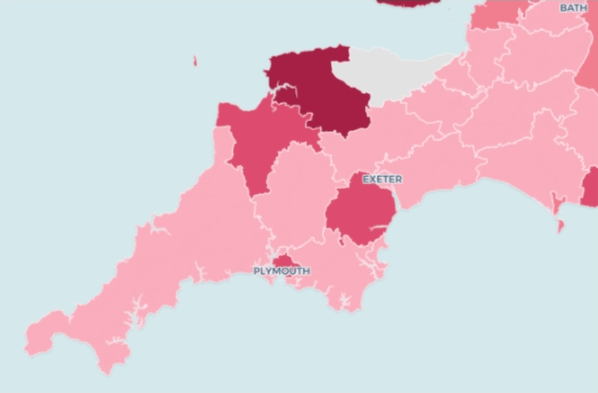
[Owl expands the prevalence map for Devon and Cornwall below to show the Devon current “hot spots” and that, for the moment East Devon is on a per with Cornwall.]
Estimated rate of people with Symptomatic COVID across age groups

 NOTES TO EDITORS

[*] Note that incidence estimates by NHS region are calculated separately from the UK nations and  they don’t necessarily add up to the total for England.

[**] Explanation of how the English Tier Dashboard is created. Using data from the app and from publicly available sources, the ZOE app team has created a way of tracking regions based on alignment with the five key indicators the Government has outlined as its criteria for the current tiers in England (five indicators detailed below). Based on this data, the English Tier Dashboard ranks the regions to show which areas best and worst according to the government’s own criteria. Note that prevalence rates indicate the total numbers with symptoms and typically lag the changes in daily new symptomatic cases (incidence). 

Government indicators are: 

Sources to recreate the government indicators:

CSS data:

  • Prevalence and prevalence rate in the 60+ age group is computed  on the tier subregion level.
  • Positivity rate and R is computed  on NHS region level.

Publicly available NHS data:

  • The % hospital bed occupancy is calculated as a ratio of the Total number of confirmed COVID-19 patients in hospital on the reporting date (source: coronavirus.gov.uk, frequency: daily) and the overnight bed availability for acute and general cases (source: NHS Statistics, frequency: quarterly)

..//

This analysis for incidence data requires swab testing, which was kindly provided by the Department of Health and Social Care for England. As Scotland and Wales are not yet offering tests to our app users, we provided indirect estimates using countrywide averages and wide confidence limits. Testing is happening in Northern Ireland, but the number of participants is too few to generate an accurate estimate. These figures exclude care homes as there is not enough data from the app to estimate this population.

..//

The COVID Symptom Study UK Infection Survey has been running since early May when the COVID Symptom Study commenced the daily swab testing programme provided by the Test and Trace. The CSS has so far recorded over a million swab results from app users. The COVID Symptom Study UK Infection Survey estimates the number of current COVID-19 positive cases in the community based on the information logged by users in the app and the results from the swab testing programme. It identifies differences in numbers within the regions throughout the UK, and tracks the change in estimated cases over time. It is the largest survey of its kind in the UK. We estimate from a sub-study of app users with antibodies that the asymptomatic rate is around 19%, which should be added when comparing to general surveys like ONS. The paper is live on the Journal of Infection: https://www.journalofinfection.com/article/S0163-4453(20)30653-8/fulltext

What have the Romans ever done for us?

Dr Mike Galsworthy on Twitter: “This is superb. Monty Python’s “what have the Romans ever done for us?” 👇😂 

Travel chaos as trains and motorways loaded with people escaping London for Christmas

Travel chaos took hold on Saturday evening as people rushed to leave London before the introduction of tier 4 restrictions.

www.independent.co.uk

Traffic data showed jams increasing inside London and its surrounds, and train prices were surging with increased demand.  

Additionally, train tickets were selling out quickly. By 7pm on Saturday evening, there were no trains available online from several London stations including Paddington, Kings Cross and Euston.

Footage taken at London’s St Pancras station showed passengers streaming down the concourse to board trains heading north.

Travellers were told that social distancing “will not be possible” due to the volume of people on board, and those that felt “uncomfortable” should not stay on the train.

Harriet Clugston, a passenger, said that people on board the trains had attempted to secure space for themselves, but that there was not enough room to do so.

“As expected, train is crammed,” she wrote on Twitter.

“Announcement on tannoy says social distancing ‘will not be possible’ due to volume and to get off if you are not comfortable with that.

“People have tried to secure social distance by placing [bags] on seats but being asked to remove them by other passengers as the train is so full.”

One woman, who did not wish to be named, said she and her partner had made the “split decision” to take their young son to her parents’ home on the coast.

“We just made the decision to leave based on the fact that my parents said come, and we couldn’t bear the thought of no fresh air and a toddler going rogue round a small flat for the foreseeable,” she told the Press Association.

Anectdotal reports suggested motorways leaving London were packed with drivers heading out to beat the new restrictions. 

Some people were driving to leave their newly-restrictive areas for a long stretch of time, while others were leaving to spend the last few hours without tier 4 anywhere.

Izzy, 22, from Bristol, said that she wanted “the security of being home for Christmas” and that her parents had come to collect her before the restrictions came into effect.

“I have a slight nervousness that they might block the roads or something stopping me going home,” she told Press Association.

Boris Johnson announced on Saturday that all areas of east and southeast England – including London – that had been in tier 3 would go into the newly defined tier 4 from midnight.

Tier 4 effectively returns residents to the rules in place during the national lockdown.

Those in tiers 1, 2, and 3 are now only able to mix with other households for a Christmas celebration on 25 December instead of the longer stretch initially planned by the government.

Additional reporting by Press Association

What is the new Covid strain – and will vaccines work against it?

Viruses mutate all the time. Most of the new variants die out. Sometimes they spread without altering the virus’s behaviour. Very occasionally, they trigger dramatic changes.

Robin McKie www.theguardian.com

And the question now facing scientists is straightforward: does variant VUI-202012/01 fall into this last category? Does it represent an increased health risk? Or has its recent rapid spread through southern England occurred because it has arisen in people who are infecting a lot of other people, possibly because they are ignoring Covid-19 restrictions?

These key questions, debated last week after health secretary Matt Hancock revealed the existence of the new variant, were answered firmly yesterday, by the government’s chief medical officer, Chris Whitty.

“As a result of the rapid spread of the new variant, preliminary modelling data and rapidly rising incidence rates in the south-east,” he announced, “the New and Emerging Respiratory Virus Threats Advisory Group (Nervtag) now considers that the new strain can spread more quickly. We have alerted the World Health Organization and are continuing to analyse the available data to improve our understanding.”

These analyses will involve scientists growing the new strain in laboratories, studying its antibody responses and testing its cross-reactions with Covid-19 vaccines. In addition, health officials are now carrying out random sequencing of samples from positive cases across the country in order to survey its spread through the nation and to build up regional maps of its prevalence. This will take at least two weeks.

The appearance of the new variant is alarming – though it should be noted that there have been several previous mutations of Covid-19. Last month, the Danish government culled millions of mink after it emerged that hundreds of Covid-19 cases were associated with Sars-CoV-2 variants carried by farmed mink. And in October, analyses suggested a coronavirus variant that originated in Spanish farm workers spread rapidly through Europe and accounted for most UK cases.

In neither case was it found that these variants increased transmission of the disease. However, it is now clear that this not the case for variant VUI-202012/01. What scientists must now tackle are concerns about the impact of the new variant – in particular whether it will lead to an increase in cases of severe Covid illness or actually result in fewer cases. The other big issue is whether the new variant will be able to bypass the protection offered by the Covid-19 vaccines now being administered across Britain.

“If the new variant was going to have a big impact on disease severity, we would have seen that by now,” said Ewan Birney, deputy director general of the European Molecular Biology Laboratory and joint director of its European Bioinformatics Institute in Cambridge.

“Hospital cases as a proportion of numbers of infections would have either rocketed or dropped dramatically. Neither has happened, so we can conclude that the impact on numbers of severe cases is likely to be modest: slightly more or slightly fewer.”

In addition, Birney said the vaccines have been tested with many variants of the virus circulating. “So there is every reason to think that the vaccines will still work against this new strain, though obviously that needs to be tested thoroughly.”

Exactly where the variant first appeared is not known. It may simply be that Britain’s extremely robust virus surveillance system spotted it before other nations did. “However, it is just as likely that the mutations that created this variant occurred in the UK and that is why we have seen it first,” added Birney.

Budleigh postboxes ‘yarnbombed’ for charity

Post boxes in Budleigh have been given a unique makeover in a bid to raise funds for two regional causes. 

Daniel Wilkins​ www.exmouthjournal.co.uk 

Budleigh postboxes get a yarnbomb make over.

Budleigh postboxes get a yarnbomb make over. – Credit: Clare Suttie

Yarnbombers have topped four red post boxes in the town with knitted coverings – one of which depicts the three kings from the Christmas story. 

Yarnbombing is the practice of covering public landmarks with knitting usually in an effort to spread positivity. 

Budleigh postboxes get a yarnbomb make over.

Budleigh postboxes get a yarnbomb make over. – Credit: Clare Suttie

The initiative is part of a fundraising campaign for charities Devon Mind and Hospicare and is the brainchild of Clare Suttie and the team at Atlas Translations.

Clare, who lives in Colaton Raleigh, said: “After everything that 2020 has thrown at us, the Atlas Translations’ team thought Budleigh Salterton needed a bit of extra festive cheer. And what could make you smile more than some clever crochet and knitting?

“We ask people to admire the postbox toppers, smile, take a photo, share on social media #budleighsaltertonpostboxes – and donate using the link below.

“There are 4 postboxes to find in Budleigh Salterton.”

Budleigh postboxes get a yarnbomb make over.

Budleigh postboxes get a yarnbomb make over. – Credit: Clare Suttie

Andre Pusey, marketing and fundraising officer at Devon Mind, said: “We’re so grateful to Clare, Candy and the Atlas team for going the extra creative mile for Devon Mind. 

“It’s thanks to such generous support that we are able to grow and improve the services we offer the people of Devon. We know that the mental health impact of Covid is huge, so we’ve got big plans in 2021 to reach as many people in isolated areas and underrepresented groups as possible.

“Any money raised as part of this campaign will be hugely beneficial to these efforts.”

Karen Palmer, fundraiser at Hospiscare, said: “We have just over three clinical nurse specialists working in the EX8 area and eight Hospiscare at home nurses who also cover the Budleigh area.

“In the last 12 months, the combined team have had 243 referrals and have noted that the care is becoming more complex and the support need ever more vital.  

“To provide this and many other services to local people,  Hospiscare needs to raise £8million with just 18% being provided by the NHS.

“The impact of Covid on our finances has been devastating and we are predicting a £1million+ deficit this year.”

The people are urged to go to a Virgin Money page to donate – so far £75 has been raised. 

To donate, visit http://uk.virginmoneygiving.com/Team/BudleighSaltertonPostboxes

New help-to-buy loans are limited to first-time buyers

The latest version of the help-to-buy equity loan scheme opened on Wednesday, with first-time buyers now the only people allowed to apply for government assistance to get on to the housing ladder.

Duh! Imagine that! – Owl

Hilary Osborne www.theguardian.com

The scheme, which allows buyers to borrow up to 20% of a new-build property’s value, or 40% in London, will no longer be available to movers and is subject to new regional caps on prices.

In London, it can still be used to buy a property costing up to £600,000 but in the rest of England prices will be capped at 1.5 times each region’s average first-time buyer house price.

In the north-east, for example, the maximum property price it can be used on is £186,100, while in the east Midlands it is £261,900.

More than 270,000 properties were bought with the first version of the scheme between April 2013 and 31 March 2020, with first-time buyers accounting for 82% of purchases, but there were concerns that help was not being targeted at those who most needed it.

The loans granted through the scheme are interest-free for the first five years. Buyers pay a reservation fee of £500 and need to raise a deposit of at least 5% of the property’s value.

The loans can be repaid at any time but must be settled when the home is sold or the mortgage is paid off.

First-time buyers who sign up will be able to move in from 1 April 2021. This version of the scheme is set to close in 2023.

UK fishing rights will remain ‘in hands of millionaires and multinationals’ after Brexit

Could it be that some of these millionaires live in East Devon? – Owl

Martina Bet www.express.co.uk 

Fishing has been a contentious point in Brexit talks, with the UK highly critical of the EU’s longstanding Common Fisheries Policy (CFP), which allows member states to fish in each others’ waters based on a quota system set by the bloc. The EU’s own mandate for trade talks says the UK and Brussels should fix a long-term deal on access to each others’ waters in exchange for a Free Trade Agreement (FTA), but the UK is pressing for annual talks to set those quotas – with the ability to block EU vessels if those discussions break down. France is one of many nations dependent on British fishing grounds and before the negotiations even started, it was Emmanuel Macron’s government who made it clear to the EU’s chief negotiator Michel Barnier that he had to push for stronger commitments on regulatory alignments in return for maintaining free trade.

Seven months later and with less than two weeks until the transition period comes to an end, an agreement still appears far away.

As many Brexiteers wonder whether a no deal scenario could be the only way to get back control of British waters, a 2018 investigation reveals that even if there is no agreement struck between the EU and Britain, the majority of UK fishing rights will remain in the hands of a small domestic elite and a handful of foreign multinationals.

The Fisheries Act published in 2018, which sets the legal foundations for the UK’s fishing industry after Brexit, does not see any redistribution of Britain’s existing quota rights.

The investigation published by Unearthed reads: “More than two-thirds of the UK’s fishing quota is controlled by just 25 businesses – and more than half of those are linked to one of the biggest criminal overfishing scams ever to reach the British courts.

“Meanwhile, in England nearly 80 percent of fishing quota is held by foreign owners or domestic Rich List families, and more than half of Northern Ireland’s quota is hoarded onto a single trawler.”

Half of England’s quota is held on Dutch, Spanish, or Icelandic-owned “flagships”, so called because they sail under a British flag.

One Dutch multinational alone controls around a quarter of English quota, the investigation found.

By comparison, the UK’s small scale, “inshore” vessels must fish from a pool of quota amounting to less than two percent, despite making up around 79 percent of the UK fishing fleet.

Responding to Unearthed’s findings at the time, former Shadow Environment Secretary Sue Hayman said that ministers needed to take “urgent action to use the powers that they have domestically to redistribute fishing quota to deliver a fairer deal for smaller boats”.

She continued: “Fishing was the poster child of the Leave campaign and Michael Gove has already broken promises he made to the industry to secure full control of our waters during the transition.

“With all the talk of ‘take back control’, ministers have the power to distribute UK quota now and put the smaller-scale fleet first. So why wasn’t it mentioned in their white paper?

“This investigation shows that, while it points the finger at others, this government is to blame for a sector rigged in the interests of the super-rich.

“Any future fishing policy must consider how new and existing quota can be more fairly distributed and we will treat this as a priority in the upcoming Fisheries Bill.”

One of the priorities of the Fisheries Act, which became law on November 21, is that “fishing activities of UK fishing boats bring social or economic benefits to the United Kingdom”.

Current rules say even if vessels are 100 percent foreign-owned, they must have an “economic link” to the UK.

That means they must meet one of five conditions, which include landing more than half their catch at UK ports or having majority British crews.

A consultation by the Department for Environment and Rural Affairs (Defra), which closed in November, outlined plans to “increase the landing requirements from 50 percent to 70 percent for quota catch caught by English registered vessels landing more than two tonnes per annum”.

The consultation stated that this change “could result in up to £60million worth of additional landings each year”, but it did not mention any changes to rules around ownership.

A Defra spokesperson told Express.co.uk: “As an independent coastal State we’re committed to ensuring a fairer share of fishing opportunities, and while we will provide certainty and stability to the industry by managing existing quota with the current method – we are currently exploring alternative methods for allocating and managing additional quota.

“Commercial fishing vessels must demonstrate a genuine link with the UK economy to fish in our waters, ensuring local communities benefit from the fishing activities of UK-registered vessels.”

For many in the fishing industry, though, Defra’s proposals are not good enough.

Paul Lines, from Fishing for Leave, a pro-Brexit group within the British fishing industry, recently told BBC: “If the Government allows foreign companies to continue to own more than half of England’s quota, it would be a calamity.”

Darts Farm defends carol service from Covid criticism

Darts Farm has come under fire after pictures circulated on social media of a carol singing event which appears to show vast numbers of people not socially distancing or wearing face coverings.

132 comments so far, mostly scathing! – Owl

Anita Merritt www.devonlive.com 

However, the popular farm shop in Topsham – which shared the event live online yesterday – has insisted that the event was safe and well-organised, and did not breach Covid-19 regulations.

An outdoor Christmas carol evening was held within the grounds of the farm last night [Friday], December 16, from 7.30pm.

Visitors were asked to congregate outside by The Shack with Christ Church Woodbury and SW Comms Band leading the music.

A screen shot of the outdoor Christmas carol evening at Darts Farm

On its Facebook page yesterday, Darts Farm stated: “Everyone is welcome, there is no need to book.

“Please note, we will not be handing out booklets. Instead, all of the carols can be found here https://www.dartsfarm.co.uk/outdoor-christmas-carol-evening – please bring your phone with you to access them.”

The event, which included a collection for Exeter Foodbank and offered mince pie and mulled apple juice, was watched by many on Dart Farms Twitter feed last night and the link has since been removed.

On its Facebook page, people have vented their anger and disgust at how the event has potentially put peoples’ lives in danger.

One person said: “Who thought this would be a good idea? I’m furious how you think you could be above the law?”

In agreement someone said: “I am beyond fuming. You’re bragging about supporting families who have been hit hard by Covid then you host a get together to sing carols.

“The pictures show the massive crowd with no distancing and no masks. Covid has affected us all in one way or another, but you go ahead with a get together that the government has banned others from.

“Those that attended and whoever thought up such a stupid idea should be fined too.”

Another said: “This is disgusting. In the current situation and having friends working at RD&E and also having family and friends currently recovering from Covid and laying in ICU with Covid this is appalling.

“By all means have a carol concert, but lay down Covid rules such as masks must be worn, social distancing and limit numbers.”

A concerned Devon Live reader added: “I am horrified having watched it on Instagram. Hundreds of people were not socially distanced and without masks. They are singing which increases the spread.

“This is surely illegal, immoral, irresponsible. Several people could die as a result of this.”

A spokesperson for Darts Farm said: “We are so thrilled to have been able to run our Outdoor Christmas Carol Evening last night, that complied with all the guidance from the government’s ‘Covid-19: suggested principles of safer singing’.

“With unlimited outdoor space and using closed off car parking, everyone was able to social distance and stand where they wanted. You could say that it was more organised than most busy high streets on a Saturday.

“The actual programme for the evening, including all of the carols, was on our website so that everyone could follow and sing using their phones – reducing any contact with no one gathered around a screen with projected words.

“From all those that attended, we have had nothing but positive feedback and interestingly the only criticism has come from those that didn’t actually attend the evening.

“The comments we have received include, ‘really moving hearing people singing together again even at a distance’, and ‘a big thank you for the organised carol service this evening. You do not know how much we needed that. God bless and merry Christmas’.

“It was brilliant to be able to see our local community come together in festive spirits in what has been a very challenging year. Outdoor carol singing is something that has been encouraged by the government in their recent guidance to help lift our spirits this Christmas.”

Greedy developers sitting on land for 1 million homes despite housing crisis

The Government is under pressure to tackle greedy developers sitting on land for a million homes as the housing crisis continues to grow.

Chris McLaughlin www.mirror.co.uk 

Critics say builders are hoarding “land banks” until they can make bigger profits.

And councils are demanding powers to force them to build on the sites or sell up using compulsory purchase orders.

The Local Government Association says 1,003,600 homes given approval are unbuilt. It comes as charity Shelter says the social housing waiting list has hit 1.6million, with 280,000 homeless.

The Covid crisis could force thousands more into homelessness while official figures say 4,500 people will be sleeping rough this Christmas. David Reynard, LGA housing spokesman, said the system was “broken”.

And Labour’s Shadow Housing Minister Mike Amesbury, said: “Some greedy developers have to be told to get building.

“The Government has to give councils the teeth to ensure land owners are forced to use it or lose it.”

The Home Builders Federation insists some sites are not “deliverable”.

But a Housing Department spokeswoman said: “Compulsory purchase can play an important role in supporting housing development – we plan to consult on reforms to improve this process next year.”

Lies, Damned Lies and Housing Statistics – Byline Times

The  Campaign to Protect Rural England (CPRE) analysis of the statistical underpinning of the 300,000 annual house building target gaining traction. – Owl 

Julian Mercer bylinetimes.com 

Julian Mercer continues his investigation into the erroneous calculations underpinning the Government’s house building programme

The Office for National Statistics (ONS) is under investigation for the way in which it forecasts population growth – a key component informing the Government’s drive to build 300,000 homes a year.

The UK Statistics Authority has accepted an appeal from the Campaign to Protect Rural England (CPRE) to review ONS data in the West Midlands that, protestors say, has multiplied housing targets by three times the actual need.

In a letter, co-signed by cross-party MPs and the Conservative West Midlands Mayor Andy Street, CPRE claims that the impact of the ONS data will be devastating.

“Large amounts of the historic Forest of Arden – precious for history, biodiversity and providing the green lungs of a crowded urban area – have been removed from green belt,” it reads. “It is a case of bad data leading to bad decisions.”

Last month, Byline Times reported how the Government is sidestepping another factor in the calculation of housing need. Overestimates of the rate at which households form mean up to 80,000 unnecessary homes are built every year. If the new ONS complaint is upheld, a second key pillar of Government’s housing policy will be undermined.

The situation in the West Midlands came to light through the work of Merle Gering, a Californian who has lived in Coventry for 40 years and chairs the protest group, Keep Green Belts Green. For years, Gering has seen favourite country walks bulldozed for house building, but his concern reached new heights when Coventry council, heeding the ONS data, targeted 42,000 more homes by 2031.

Definitive measures of population come only from the 10-yearly Censuses. From 2001 to 2011, Coventry’s population rose by 5% to 317,000. Before the next census in 2021, planners rely on ONS projections – which is where the trouble begins. The ONS predicts that the city’s population will mushroom – at three times the rate of the West Midlands region – to reach 420,000 in 2031.

“Nothing in the geography or economy of the city justifies these differences,” wrote CPRE to the statistics regulator. “Coventry is a traditional centre of population that has experienced relatively sluggish growth in recent decades. That its population will now suddenly ‘take off’ defies belief and is against all intuition.”


Ghosts Who Leave No Shadow

Gering began a detailed study of local population indicators to see how much growth had actually occurred.

“If there are vast numbers of people pouring into Coventry, they don’t vote, don’t go to A&E, don’t have babies or send children to school and they don’t make waste,” he says. “They are ghosts or vampires who leave no shadow.”

He then analysed the key elements of population forecasting: the numbers of births and deaths, and of migration. Outside London, Coventry has one of the highest student populations, with 16,000 overseas scholars coming every year to the city’s two universities.

Their presence is confirmed in the age profile of the ONS data, revealing a sharp rise in 18 to 24 year olds. But is it fair to assume that they stay in the city after graduating and will thus trigger a huge increase in housing? In a review of migration policy in 2018, Theresa May didn’t think so: “Students, coming in for the period of their education and then leaving, actually wash through the numbers; they don’t have a long-term impact.”

To gauge graduate destinations, the ONS consults the International Passenger Survey (IPS), which questions people moving in and out of the UK. But the IPS has been widely criticised, not least because of its relatively small sample size. The House of Lords concluded in 2017 that it “cannot be relied upon to provide accurate estimates of net migration” and the statistics regulator said that it “generates a narrative that is potentially misleading”.

So Gering looked elsewhere. Warwick University revealed that only 4% of graduates remained in the city after 10 years – exactly the percentage who came from Coventry in the first place, and a number matched by the Home Office exit checks which ensure non-EU students don’t overstay their visas. The Higher Education Statistics Agency reckons, meanwhile, that 94% of Coventry’s overseas students leave promptly.

“This could have the effect of exaggerating the growth in Coventry’s population by up to 60,000 over 20 years”, wrote CPRE to the regulator. “We believe this may well be a more general problem. Others around the country disbelieve the projections in their local authority areas.”

Other university towns are indeed receiving high growth projections but perhaps of greater concern to the nation as a whole is how the ONS counts natural change – the difference between births and deaths.


Hatches and Despatches

A glance at birth and death registrations in Coventry reveals that the native population is growing, but at a decreasing rate. The number of deaths is relatively constant but there are fewer births.

Inexplicably, the ONS forecasts the opposite. For example, a series of projections of Coventry’s population in 2019 predicted that, on average, there would be 2,400 more births than deaths. But when the actual number of registrations in the city last year was counted, the difference was only 1,451. In other words, whatever else is decided, Coventry’s population is being overestimated by at least 1,000 a year.

How could the ONS get it so wrong? “The birth rates that feed into the projections will be affected by the increased numbers of students,” wrote the ONS’ deputy director, Rich Pereira, in a letter to Gering. A reasonable assumption if those students hung around.

Gering believes that the ONS projections of migration and natural change are inflating Coventry’s population by up to 80,000 people. And he has impressive support. “Compelling evidence,” said past-President of the British Society for Population Studies, Piers Elias. A leading demographer at Newcastle University, Professor Tony Champion, called it “highly valid” and, at Oxford University, Professor David Coleman described the work “as good as it can be”.

To be clear, 80,000 extra people would require at least 30,000 extra houses, almost exactly the number by which the city has been forced to raise its housing target. “We have been forced to use figures that are stupid by the Government,” said one former council leader, John Mutton.


An Emperor Without Clothes?

In launching the ONS investigation, the UK Statistics Authority promises to ensure that “the official statistics can bear the weight put on them where they are used in decision-making”.

The ONS says that it will work with the review and has “always sought to be fully transparent and helpful in discussions around the methods we use”.

But if it is found to have miscalculated, will it make any difference?

Byline Times also reported last month how the Government dismissed as “methodological” the shortcomings in its household projections. “They do not understand the changes are not ‘methodological’ but about removing obsolete, distorting data,” says a housing activist in Liverpool, Professor David Gregg. “You cannot make rational local policies based on grossly distorting ‘adjustments’ imposed from the centre for political reasons.”

The findings of the review are awaited, but Gering knows time is of the essence: “On the back of absurd population projections, a cherished piece of our green and pleasant land is about to vanish, because no one will admit that the numbers do not stack up and the emperor has no clothes.”


Never say these 28 things to people from Devon

People from Devon tend to have a reputation as being a fairly friendly, welcoming and easy-going bunch.

Howard Lloyd www.devonlive.com

But, as with anywhere in the world, there are certainly a few tender areas that it’s best to avoid if you don’t want to rub a Devonian up the wrong way.

It takes quite a lot to trigger people from down here, but be warned – there are definitely one or two that will do a proper job of winding people up.

Second homes, grockles and – inevitably – putting jam on a scone first will easily do the job.

But there are a few others which are a bit more obscure which will prove just as effective.

If you are not from around here, you may wonder why they can rub people up the wrong way. We have decided to provide a little explanation next to each one, but you are probably better off just taking our word for it and not putting any of them to the test.

You have been warned!

1. Where can I get a cheap beer?

The Admiral Collingwood Wetherspoons pub in Ilfracombe – pictured prior to the coronavirus pandemic (Image: CAMRA)

This is really annoying for us locals – believe it or not, a burger and a beer at your local ‘Spoons in Devon is pricier than in most other parts of the country.

This is particularly annoying as Wetherspoon founder Tim Martin started out in Devon. How’s that fair?

According to a recent survey, The Admiral Collingwood in Ilfracombe on the North Devon coast is the priciest location in Great Britain for this particular deal.

2. Life is sooooooooo boring in Devon

Rod Stewart enjoying the view over the River Dart at Salcombe

Yep – legendary rock ‘n roller Rod Stewart looks really bored as he relaxes on a short break holiday at Salcombe. Why would anybody want to spend time doing absolutely nothing in boring Devon?

3. Do you like my second home?

This South Hams town is the least affordable place in Devon to buy a property, according to Zoopla

Many of the most expensive homes sold in Devon are in the Salcombe area

This is likely to get you run out of town in many of Devon’s most picturesque seaside areas – especially around Dartmouth, Salcombe, Croyde, Woolacombe and Kingsbridge. One in every 11 residential properties in the South Hams is an unoccupied second home for much of the year.

4. Jam first

Boris Johnson puts jam first in Cornwall

If you mistakenly think it’s jam first on your scone, with cream on top, it means you should be in Cornwall (see Boris Johnson above – I rest my case). Don’t forget – this is the county where the Devon Cream Tea originates, so what does Cornwall even know about the subject?

5. Is Plymouth the capital city of Devon?

Exeter Cathedral

This may start a fight.

Exeter is the capital. It is a cathedral city. But it is also the county town of Devon, and the administrative base of Devon County Council.

But Plymouth is bigger, has its own city council and is known as the Ocean City.

Go figure.

6. Do you know Matt Bellamy from Muse?

Muse frontman Matt Bellamy paints a sheep guitar near his home in Teignmouth

Muse frontman Matt Bellamy paints a sheep guitar near his home in Teignmouth

For a county that conjures up images of farmers fields and sheep, there are actually a lot of famous people with connections to Devon.

And no, we don’t know Matt Bellamy or fellow Muse band members Chris Wolstenholme and Dom Howard (although I do know his mum and she’s very nice). Also we are not all on first name terms with Chris Martin from Coldplay, Damien Hirst, Kirstie Allsop, Will Young, Joss Stone or Rosie Huntington-Whiteley.

7. Do you know the way to Lighthaven?

A scene from the BBC's The Coroner

A scene from the BBC’s The Coroner

Daytime TV crime drama The Coroner is filmed on location all cross South Devon – including Totnes, Dartmouth, Hope Cove and Brixham.

But the village of Lighthaven is not real! The stunning views filmed from a drone over the Devon coastline are real though – as is this shot of the River Dart with actress Claire Goose.

8. What happened to the motorway after Exeter?

It’s called the A30/A38 or the A39 and it’s dualled (in places).

Yes, there are daily snarl-ups and we deserve better but just remember how bad it used to be.

On a serious note, Devon does have some of the most dangerous roads in the country.

The A39, A361 North Devon Link Road and A38 are renowned accident hotspots that regularly feature among the worst in Britain.

9. Cornwall is so much better

Ridiculous! Enough said.

10. Nothing exciting ever happens in Devon

Teenagers run through the crowds with a burrning barrel soaked in tar on Ottery St Mary

Anybody who thinks life in Devon is tame has never been to the Ottery Tar Barrels, when residents carry burning barrels soaked in tar. The 400-year-old event at Ottery St Mary sees competitors and even teenagers run with burning barrels on their backs through the village, until the barrel breaks down.

11. Are you a grockle?

North Devon has a huge reliance on the tourism industry

This is the worst insult you can use on a Devon person.

Just so you’re aware, ‘grockle’ is a slang term for holidaymakers coming to the county. It is definitely not a term to apply to locals!

12. It’s fun to play in the waves

Huge waves at Paington last night (Image: Samantha Louise Mee)

Please learn how dangerous the sea is and save a call to the RNLI and our hardworking coastguards.

13. Are you attracted to sheep?

Snow near Exeter in 2010 (Image: Douglas Sims)

We just have a lot of farms. Nothing suspicious with that.

14. You don’t have any decent sports teams

The Exeter Chiefs Tribe travelled in large numbers to see their side in four successive Premiership finals. (Photo by Matthew Lewis/Getty Images)

The Exeter Chiefs Tribe

Premiership and European champions Exeter Chiefs not good enough for you?

15. The Devon accent makes you sound thick

Josh Widdecombe before the Sky Bet League Two match between Plymouth Argyle and Leyton Orient in October

There’s nothing wrong with ‘ow we sound, just like the rest of the South West. As long as you can understand us, what’s the big issue?

16. Is Plymouth in Cornwall?

Granted, Plymouth is pretty close to Cornwall. It is practically in spitting distance across the River Tamar. But ‘No’ it is 100 per cent Devon.

17. I’ll just bury my plastic/barbecue on the beach

Take it with you please, our Devonshire toes and environment are very special to us. Just remember at the beach: take nothing but photos and leave nothing but footprints. That’s our rule. Please stick to it.

18. Why is the beach so small today?

One of the six people getting airlifted from rocks at Putsborough in North Devon

One of the six people getting airlifted from rocks at Putsborough in North Devon (Image: Wendy Nicholls/Imagination Photography UK)

Learn about the tides at the beach. Every year our emergency services save countless lives caused by ignorance of the basic rules of the sea.

19. What time is the last bus home?

If you are anywhere outside of a handful of main towns, it’s too late – you’ve probably already missed it. Public transport is pretty non-existent at night in many rural parts of the county.

Devon has more road mileage than any other county in England so covering them all with transport links is impossible.

20. You’re all inbred

How bleddy dare you! I’ll get my husband-brother-cousin on you.

21. I’m looking for a job with a starting wage of £30,000+

Hahahahahahahahahahaha! Sorry. Hahahahahahahaha!

23. Why don’t they widen the lanes for 4x4s?

I will have you know that the famous ‘Devon banks’ which line our lanes date back around 4,000 years. The historic hedges often mark boundaries going back to the Bronze Age.

It needs skill to drive on our roads and if you can’t reverse your Chelsea tractor, perform a 99 point turn and head back to Knightsbridge.

24. Where are the best dogging spots?

Moving swiftly on.

25. I’ve just come down on holiday and am about to give birth, where’s the hospital?

Torbay Hospital

Torbay Hospital (Image: Andy Styles)

Please, please, please, if you’re coming to Devon in the summer and are suffering from rabies or have a limb hanging off, DON’T visit our hospitals. They are stretched to breaking point already and you’re causing havoc. If you are having a baby, cross your legs and go home.

26. Why is there a tractor holding up the road?

Who doesn’t like a tractor (Image: Matt Gilley/Plymouth Live)

This is a rural, farming county. Have some respect and expect to get stuck behind tractors/sheep/cows/horses.

27. Devon and Cornwall are practically the same place

One flag has plenty more history than the other…..

We love our slightly curious Cornish cousins over the border, but there’s nothing worse than telling someone you’re from Devon and them saying “oh, you must know Brad Pengelly in Newquay then”.

Wrong county, mate.

28. Why is the petrol so expensive?

Given what we’ve already said about poor public transport and the biggest road network of any county in England, this also drives us mad.

You’d think a county that relies so heavily on cars would get a break when it comes to filling up the tank.

On the contrary, Devon has some of the highest fuel prices in the UK – simply not fair.

I do love Sasha Swire, but she’s got to stop her coy act. She’s hard as nails

At this stage, there may be many contenders for person of 2020, but perhaps only one for plus one of the year.

Barbara Ellen www.theguardian.com

Cue Sasha Swire, one-time journalist, daughter of former defence secretary Sir John Nott, wife of erstwhile Tory MP/minister Hugo Swire and author of Diary of an MP’s Wife, the tell-all on the David Cameron “chumocracy” that titillated the nation a few months back.

There was plenty to be titillated about, not least Cameron saying on a walk that he wanted to push Swire into bushes and “give her one”. Now she has reappeared to defend her book against charges of betrayal, while insisting that Cameron’s remark was a joke. As if people hadn’t already worked it out.

The point is not what Cameron said (save for confirmation that toff “bants” isn’t up to much), but that Swire desperately wanted people to know what Cameron said; to realise that she was once desired by a prime minister, albeit fleetingly and facetiously while chillaxing on a stroll.

Therein lies the issue. Not with the book itself, which is a spiky, pacy read. But not only does Swire now compare herself to Samuel Pepys, and chuck around thinly veiled threats to friends who may yet ditch her (she has other diaries, dontcha know!), she also tediously persists in affecting to hate all the attention (“I never had any desire to be in the limelight”) in the same way that a wicked Disney queen might simper that she doesn’t care who the mirror thinks is the fairest of them all.

This coy denial of her own industrial-strength ego was the central deceit of the diary and seemingly continues to be true of Swire herself. Far from being an astute chronicler of an elite political circle, she exudes the bottled-up fury and eternal ache of the wrongly miscast plus one. When I read the book, resentment, jealousy and yearning billowed from the pages. One almost expected to turn to a double-page spread of Swire screaming in extra-large bold print: “Why, reader, are you interested in them, when I (YES, I) am so much more interesting?” All of which contributed hugely to why I enjoyed the book. As much as it revealed about the chumocracy, it ripped the skin from Swire too.

Truth is, she wasn’t an honest, unwitting diarist; rather, Swire is a journalist who never stopped working but failed to alert those around her – and that was the betrayal, if there was one. That aside, a little self-awareness may be in order. It seems clear that a craving for the limelight was Swire’s true motivation. And what of it? It’s not a crime to refuse to be human wallpaper. As her 2021 resolution, Swire should drop the literary “What, little me?” act, bare her friend-feasting fangs and stand proud.

Plea to ‘not ring death knell for villages’ in East Devon local plan

Consultation will begin early in 2021 on a new blueprint for development for East Devon – with a plea from councillors to ensure the death knell for villages isn’t sounded.

Daniel Clark www.devonlive.com 

East Devon District Council’s strategic planning committee on Tuesday agreed to start consultation in January 2021 on a new local plan issues and options report, which aims not to set out defined solutions for a new local plan, but to raise some of the key issues and seeks feedback on options presented.

The feedback received from the consultation will be used to inform emerging and developing thinking on the form, structure and content of a new local plan.

And while the new local plan will set out how development in the district should take place, as well as allocating some land for large scale strategic development – potentially including another Cranbrook-style new town – councillors were keen to make the existing small villages in East Devon sustainable.

Cllr Mike Howe, speaking at the meeting, said: “We need to make the sustainability work better for many villages who have been left to quite honestly go on and die. We have to bring some sustainability to the communities, particularly those who want some small scale growth.

“We need to keep them sustainable as they are and things like bus services, even if just one a week, are under threat unless there is a gentle keeping the population at the same level. We do need to keep the unsustainable villages ticking over which is different to make them sustainable.”

Cllr Eleanor Rylance added: “Our planning policy has effectively rung the death knell for small villages. We have told them they are not sustainable because they don’t have ‘x, y and z’, which leads to a total demographic change as some people afford to live there and have to move out. And the first thing is the school shuts as there are no more children any more.

“And then bit by bit, all the things that contribute to a village being sustainable go and then you end up with a hamlet.

“Our own planning policy can ring the death knell for a village and that is shocking. There is a village in the district told unsustainable even though there is a main road through it, a shop, a school, and on a main line train line, that village was told it was unsustainable.

“We have to be mindful a village isn’t a collection of houses but people who live there and the range of demographics that make it a community. I have a village in my patch with no new houses since 1999 and the school is only hanging on by a thread.

“That village could be more sustainable if we had not told them they could not built anything. Our focus has been building new towns but there are existing communities that need to expand a little to accommodate for existing residents. It need a rethink and if a village wants to develop then they should be allowed to develop.”

Cllr Philip Skinner said: “In some of my villages, they wouldn’t want to support 50 houses, or 20 houses, but allowing some houses to come through incrementally and evolve out the plan period rather than a big chunk of housing at once, and we cannot get lumbered with something that people neither need for want in their villages.”

Ed Freeman, Service Lead for Planning Strategy, said that this was a big issue for the local plan as to how they support rural communities in the future.

He said: “Community led development is a big part of that to allow communities to bring forward growth where they want it without imposing it on the communities that don’t want growth. The challenge for villages that the scale of growth needed to deliver the facilities these need may not be that appetising – you may have to double the size of communities, but it does need a lot of further work and thought and discussions.”

This substantial station house is in an idyllic East Devon village

This substantial station house is in an idyllic East Devon village

And Cllr Nick Hookway added that the concerns over infrastructure had not gone away, saying: “You cannot have new developments that are not connected and some of the infrastructure issues aren’t going to go away, so that needs to be considered as part of the call for sites.”

The committee unanimously agreed that consultation on the draft issues and options report should start on January 18, 2021, and run for eight weeks, with the feedback received from the consultation to be used to inform emerging and developing thinking on the form, structure and content of a new local plan.

Work will also start in January to assess the smaller sites submitted into the Greater Exeter Strategic Plan call for sites in 2017, as well as running a new ‘call for sites’ for development.

And the committee recommended to Cabinet that a budget of £300,000 over a three year period is established for work towards the delivery vehicles for any proposed garden community.

Payhembury village centre

Payhembury village centre

Andy Wood, Service Lead for Growth, Development & Prosperity, in his report, added: “While we start to contemplate the next generation of strategic sites through the Local Plan review, the development of Cranbrook is far from complete and indeed there are immediate challenges not least in relation to the delivery of the town centre.

“The development to date has benefited from the land largely being in the control of a single Consortium but by contrast, the Cranbrook expansion areas are all in the control of separate, unconnected developers. This will make the timing and coordination of infrastructure delivery much more challenging.

“There is a logic therefore in testing whether some form of delivery vehicle could be also retrofitted to encompass Cranbrook and support the growth of the town up to the circa 8,000 homes anticipated in the current Local Plan

“Finally it is important to emphasise that the delivery of major strategic developments is a long term endeavour. Even when the development of individual homes has finished it is essential that there are robust and cost effective stewardship arrangements in place to ensure the ongoing delivery of assets and services that continue to meet the needs of the residents over time. Ensuring that such arrangement are in place is again one of the leading objectives for development corporation status.”

Cllr Ian Thomas, asked for clarification as to the scale of development that would be provided by any development corporation around a garden community, asking: “Are we talking about significant strategic developments rather than adjustment of villages, and would it be fair to say to support this proposal, the principle of looking for one or more significant strategic developments would be implicit in support for this?”

In response, Mr Wood said: “Yes, it would focused on big strategic developments, subject to what comes through the local plan review. The business case would only stand if there is strategic development to deliver.”

NHS must double efforts to vaccinate key workers and vulnerable by Easter

The NHS is set to miss its target of vaccinating all vulnerable people and key workers by Easter, official data suggests.

Katie Gibbons www.thetimes.co.uk 

The health service will need to more than double its efforts, ministers have been told, as figures suggested the government will also fall short of a pledge to vaccinate millions by Christmas.

In all, 137,897 people in Britain received the Pfizer-Biontech vaccine in the first week up to December 15. However, unless the pace increases to about 17,237 jabs per day, fewer than 400,000 would get the first dose of the vaccine by December 25.

Pfizer pledged to deliver five million doses by the end of the year, to inoculate 2.5 million people with two jabs three weeks apart. Matt Hancock, the health secretary, last week said that “several million people” would be vaccinated by Christmas.

Responding to Mr Hancock’s latest Covid-19 statement yesterday, Jonathan Ashworth, the shadow health secretary, questioned how realistic the goals were. “To vaccinate every older person, vulnerable person and key worker by Easter, we’ll need to do something like double that, every day,” he told the Commons.

Last month Boris Johnson suggested that the “vast majority” most vulnerable to coronavirus could be vaccinated by Easter. The programme has been allocated £11.7 billion in funding and 46,000 extra staff, the National Audit Office revealed this week.

Due to the complex logistics of the Pfizer jab, which must be stored at around minus 70C, only 50 major hospitals were able to administer the vaccine in the first week. This is to increase to 70. As of this week 200 GP surgeries and hubs, including at football stadiums, are administering the vaccine.

However, several GPs have complained of deliveries not arriving on time, forcing them to push back hundreds of appointments. Technical problems meant that many GPs had to record data by hand on who had received the vaccine.

These system errors have not been rectified and threaten to cause further delays. A senior health official told Sky News that the IT system, known as Pinnacle, was “failing constantly” and that GPs were “having to record on paper and then transfer”.

A second coronavirus vaccine neared approval for emergency use in the US last night.

The two-injection Moderna vaccine cleared a committee of experts convened by the Food and Drug Administration with six million doses on standby for distribution in the US next week. The FDA is expected to pass it for emergency use today, and the US will then become the first country to use it.

Trickle down doesn’t trickle

50 years of tax cuts for the rich failed to trickle down, economics study says.

Aimee Picchi www.cbsnews.com 

Tax cuts for the wealthy have long drawn support from conservative lawmakers and economists who argue that such measures will “trickle down” and eventually boost jobs and incomes for everyone else. But a new study from the London School of Economics says 50 years of such tax cuts have only helped one group — the rich.

The new paper, by David Hope of the London School of Economics and Julian Limberg of King’s College London, examines 18 developed countries — from Australia to the United States — over a 50-year period from 1965 to 2015. The study compared countries that passed tax cuts in a specific year, such as the U.S. in 1982 when President Ronald Reagan slashed taxes on the wealthy, with those that didn’t, and then examined their economic outcomes. 

Per capita gross domestic product and unemployment rates were nearly identical after five years in countries that slashed taxes on the rich and in those that didn’t, the study found. 

But the analysis discovered one major change: The incomes of the rich grew much faster in countries where tax rates were lowered. Instead of trickling down to the middle class, tax cuts for the rich may not accomplish much more than help the rich keep more of their riches and exacerbate income inequality, the research indicates.

“Based on our research, we would argue that the economic rationale for keeping taxes on the rich low is weak,” Julian Limberg, a co-author of the study and a lecturer in public policy at King’s College London, said in an email to CBS MoneyWatch. “In fact, if we look back into history, the period with the highest taxes on the rich — the postwar period — was also a period with high economic growth and low unemployment.”

Because the analysis ends in 2015, the research doesn’t include President Donald Trump’s massive tax overhaul, which he signed into law in late 2017 and which slashed taxes for the rich and corporations while providing a moderate cut for the middle class. But Limberg, who co-authored the study with David Hope, a visiting fellow at the London School of Economics’ International Inequalities Institute, said that he wouldn’t expect the results of that tax cut to be much different.

Already, Mr. Trump’s tax cuts have lifted the fortunes of the ultra-rich, according to 2019 research from two prominent economists, Emmanuel Saez and Gabriel Zucman of the University of California at Berkeley. For the first time in a century, the 400 richest American families paid lower taxes in 2018 than people in the middle class, the economists found. 

 The “careful” new research from the London School Economics “suggests indeed that tax increases on the wealthy should be considered post-COVID,” Berkeley’s Zucman said in an email to CBS MoneyWatch.

Engine for stronger economic growth?

To be sure, the economy was humming along before the pandemic struck the nation in March, with an unemployment rate that was at its lowest in about half a century. Conservative think tanks such as the American Enterprise Institute pointed to Mr. Trump’s tax cuts as an engine for stronger economic growth.

Yet even so, millions of American families struggled to find jobs that paid living wages, while the cost of essentials such as health care, housing and education increased at far faster rates than the typical income. Even before the pandemic, income inequality had reached its highest point in 50 years, according to Census data.

In 2020, the pandemic has worsened inequities across all spectrums, touching racial, gender and educational divides. When the economy shut down in March, workers who couldn’t transition to remote work — typically lower-paid employees involved in retail, service and hospitality jobs — were hit the hardest.

At the same time, white-collar workers generally fared better as they were more likely to maintain their jobs as they shifted to remote work. Investors also benefited as the stock market rallied on hopes for an economic recovery — a development that doesn’t help most low- and middle-class workers. Only about half the U.S. population is invested in the stock market through their retirement and savings accounts, and even then more than 80% of all stocks are owned by the richest 10%.

Since the pandemic began, the combined wealth of America’s 651 billionaires has jumped by more than $1 trillion, reaching $4 trillion in early December, Americans for Tax Fairness said earlier this month. 

Meanwhile, almost 8 million Americans have fallen into poverty since the start of the pandemic through November, according to new data released by the University of Chicago and the University of Notre Dame.

Rebuilding the economy and household wealth for low- and middle-class families are among the issues facing President-elect Joe Biden after he’s inaugurated next month. Raising taxes on the rich and corporations could provide trillions of dollars in resources for helping the economic recovery, Zucman told CBS MoneyWatch.

“This is not only a viable option, but also a fair option, because some of the wealthiest taxpayers have benefited from the pandemic — for instance large corporations such as Amazon and their shareholders,” he noted. “These taxpayers could reasonably be asked to pay more to make up for pandemic losses.”

Why Sasha Swire regrets nothing about Diary of an MP’s Wife

“Regrets, I have a few, but nothing major. I regret that my husband comes across as a bit hapless, which he isn’t at all in his professional life. It was much more a case of a husband coming home from his grand job in the capital and his wife telling him to take out the rubbish and the whole of the bottom of the sack spills out over the kitchen floor. ….”

Susan de Soissons, SS’s publisher, says that, since the original article is copyright Owl may only publish an extract.

(Owl had another word in mind “useless” considering he was so “in” with Dave but didn’t “do” anything for his constituency. Christmas sales of the book need a bit of a puff?)

Read the full article here

Sasha Swire www.thetimes.co.uk

‘Heavy and intense’ rainfall sparks flood alerts for parts of East Devon

The Environment Agency has warned of possible flooding in areas of East Devon as a result of heavy rainfall expected to start on Friday afternoon (December 18).

Becca Gliddon eastdevonnews.co.uk 

Flood alerts have been issued for the areas of the River Axe, Lower Exe, Rivers Clyst, Culm and their tributaries, plus the Rivers Otter, Sid and the Exmouth area.

The Environment Agency (EA) said ‘heavy and intense’ rainfall of up to seven centimetres could fall in localised areas within a 15-hour period, beginning on Friday afternoon and continuing until the early hours of Saturday morning.

It is warning of possible flooding of low-lying land and roads near to rivers, plus blocked drains.

The EA said further heavy rainfall was expected for Monday into Tuesday across East Devon.

An EA spokesperson said: “Widespread totals of up to 35mm, with localised totals up to 70mm are forecast within a 15-hour period from Friday afternoon.

“Areas of higher ground such as Dartmoor may see isolated totals of up to 100mm in fifteen hours.

“Rivers are expected to respond quickly to this rainfall.

“Flooding of low-lying land and roads close to rivers is possible.

“Surface water may be deep, especially where leaves have blocked the drains.”

The EA said it would monitor river levels and staff would check and clear any blockages.

A flood warning for the South Devon coast, from Dawlish Warren to Seaton, was removed on Friday lunchtime.

The EA said: “Coastal conditions have now improved and this flood alert is now below criteria.”

Ministerial aide sacked after leaking of letter warning MPs not to leak to media

What would Owls do without “chatty” rats and moles, and are canary traps legal?

Archie Bland www.theguardian.com 

A ministerial aide was sacked on Thursday night after the Conservative chief whip sent out a letter with varied wording in a “canary trap” designed to catch whoever leaked it.

Andrew Lewer, a Home Office parliamentary private secretary, was fired from his junior government role when a letter urging the recipients not to leak information to the press found its way into the hands of the Guido Fawkes website.

But it is understood that the letter, from the chief whip, Mark Spencer, was worded slightly differently for each recipient so officials would be able to tell which version had reached the media.

Lewer, PPS to the policing minister Kit Malthouse, denied he had leaked the letter when confronted by Conservative whips, but suggested it could have come from a member of his staff.

He told the Politico website: “In nearly 20 years of elected office I have never leaked to the press.” The Guardian has approached Lewer for comment.

The letter, sent to all PPSs and vice-chairs of the Conservative party, told recipients – or, at least, told Lewer – that “there seems to be a lack of clarity in what is expected of you in your position as Private Parliamentary Secretary or Vice Chair … I would like to take this opportunity to remind you of the severe consequences that you will face, should you choose to breach the [Ministerial] Code.”

It went on to say that the prime minister’s foreword to the code “strictly prohibits ‘leaking’ or any other breaches of trust”.

The letter was swiftly leaked to Guido Fawkes and published under the headline: “LEAKED: CHIEF WHIP WRITES TO PPS’S WARNING THEM NOT TO LEAK.”

It is not clear which parts of the letter were varied in order to catch the leaker, but the entire text was published as part of the Guido Fawkes story.

Ministers could not claim not to have been warned of the possibility of such a method being used to identify possible leakers. Last month, No 10 briefed that it could use a “canary trap” strategy in an attempt to identify the source of leaks. That ploy was viewed by some Westminster observers as unlikely to succeed given it had been announced to the press.

Despite attempts by the former No 10 aide Dominic Cummings to crack down on leaking, with threats of the sack for any adviser who was found to have given information to the press, the government has so far been unable to clamp down on leaks since it won reelection.

A Cabinet Office inquiry is under way to find the “chatty rat” who passed plans for the second lockdown to the press before they had been finalised.

Do we hear from Johnson the voice of authority he admires in Churchill? We do not

The prime minister has at least been impressively consistent with his incoherent, indecisive hopelessness.

“But at least Covid has brought some cheer at last. Because Priti Patel announced she won’t be visiting her parents this Christmas. They must be bloody delighted.”

Mark Steel www.independent.co.uk 

It’s quite charming now, how this government changes the rules back and forth every few days, like some eccentric old professor that’s lost his short-term memory.

So they shout: “Why are the schools shut? We can’t have schools shut, it’s where children go.”  

“You shut them, prime minister, to stop the virus spreading.”

“Nonsense. Open them up.”  

Then a week later they go: “Who opened the schools? That’s how the virus spreads, what idiot did this?”

“You did, prime minister.”  

“Balderdash. Oh my God, why are the pubs shut? You can’t shut pubs, the Battle of Waterloo was fought so we could go to the pub.”

The Independent would like to keep you informed about offers, events and updates by email, please tick the box if you would like to be contacted

Read our full mailing list consent terms here

“But that’s where the virus spreads, prime minister.”

“Don’t be such a nincompoop, who are you?”

“I’m the global scientific advisor for the transmission of viruses in pubs”  

“You know nothing. I order all scientists to do your duty to go to the pub and get ratarsed.”

Then a week later: “WHO OPENED THE PUBS?”

A week ago they were saying: “It’s Christmas, you are commanded to be British, by giving your grandparents a naked massage with your own spit, it’s what Christmas is all about.”  

But this week they screamed: “Why are you idiots going round each other’s houses at Christmas? Christmas must be on Zoom, or held on an app we contracted to a company owned by an MP’s sister-in-law who has no experience of apps, but she has trained beagles. DON’T GO ANYWHERE, YOU MURDERERS.”

So now no one knows the rules, as once an hour there’s an announcement: “Matt Hancock has said you CAN cross one edge of tier 2a to get to tier 3b+ as long as you travel through space but NOT on a comet unless you’re with less than three people from at least four different planets.”  

Half the country is looking at government guidelines on websites, trying to make sense of instructions such as: “If you yawn on Boxing Day, you must sit on a bus shelter for 10 minutes. Before you open presents, all your cats must point south.”  

None of the rules seem to make sense. Theatres are shut, presumably because that’s where no one can be trusted, because the minute the curtain goes up, everyone starts gobbing on the violinist, and everyone in the circle wees into the stalls.

But pubs were allowed to stay open because in a pub, no one behaves in a way that might spread a virus. Everyone sits quietly, reading old legal documents, or admiring the craftwork of the beer pumps.

Maybe one of these people who talk about parenting, on daytime television, should tell the government: “The problem you have, my darlings, is you’re sending out mixed messages.” Because they are like someone telling a six-year-old: “We’re going to the seaside, so to be safe, before we set off, make sure you go to the toilet, which is shut and bolted. Because it’s dangerous to go to the toilet, so we’re trusting you to decide whether you should go or not, though you shouldn’t, unless you go outside, and I know Uncle Dominic did a huge turd on the kitchen floor but that was because he was testing his hearing.”

One of the instructions this week was: “Try and avoid crowds in the Boxing Day sales.” That makes sense, in the same way as if you said: “You are allowed to go swimming, but while you’re doing it, try not to get wet.”

Perhaps the reason for this is to pass the responsibility onto us. Matt Hancock said: “It’s up to each of us to collectively do our bit.”  

This is fine, but it’s harder to do your bit when you’ve no idea what you’re supposed to do, as the instructions are so hopeless. This is why, if you go to bomb disposal school, I don’t suppose the instructor says: “The thing with a bomb is there are wires poking all over the place. Some of them are fine and some blow the street up, so be careful. You just prod about with whichever one you fancy, I’ve no idea which ones to leave alone and which ones to snip, so it’s up to you to do your bit with each bomb, and if you can, try and avoid taking it into a crowded Boxing Day sale.”

Boris Johnson’s other instruction has been to make Christmas “shorter and smaller”. So does Christmas Day end at half past six? Do the crackers have to be half an inch long? Will the Queen just say: “Hello. What a shitty year” for her speech?  

He might as well have said: “This year, make Christmas more triangular than normal, and less prosaic, with a hint of irony.”

This is the decisive voice of authority he admires so much in Winston Churchill. It’s as if he’s copying his hero’s famous speech: “We face a brutal enemy, so I demand of all of you, make things a bit shorter and smaller, Hitler won’t like that.”

But at least he’s been impressively consistent with his incoherent, indecisive hopelessness. The instruction about masks was to wear one if you fancy but not if you can’t be bothered. The instruction for whether to shake hands with people who are infected was: “You might as well, I don’t have a clue.”

When he was ill with it himself, maybe the medical staff were like that, and said: “You can wear a respirator if you want, some people think you need air to live but it’s up to you, really.”

But at least Covid has brought some cheer at last. Because Priti Patel announced she won’t be visiting her parents this Christmas. They must be bloody delighted.