Chunk of Exmouth cliff ‘on brink of collapse’

A huge chunk of cliff near Orcombe Point appears to be on the brink of collapsing into the sea.

Chloe Parkman www.devonlive.com

The rock located between Orcombe Point in Exmouth and Devon Cliffs Holiday Park can be seen balancing 180 feet high at the coastal spot.

It comes just two weeks after there was an enormous cliff collapse in Exmouth which saw massive rocks crashing onto the popular beach.

A spokesperson for East Devon District Council (EDDC) said: ”Cliff falls are a natural and unpredictable occurrence along the East Devon coast, this is because the rock from which the cliffs are formed is soft and therefore prone to rock falls and landslides, which can happen at any time, although heavy rainfall can trigger incidences.”

Last week, Devon Live reported on all of the properties in Devon most at risk of toppling into the sea.

Following the recent landslide in Exmouth, a spokesperson for National Trust said: ”Orcombe Point is cared for by the National Trust.

”Cliff falls are a regular occurrence around the SW coast and there’s nothing we can do to prevent this.

The chunks appear to be on the brink of collapse

”Following heavy rainfall an increase in cliff falls are also quite likely.

”In this area, as with any of our outdoor sites and particularly coastal sites, we strongly encourage our visitors to heed any information signs, keep to the designated paths and not to gather at the foot of cliffs.”

Less than a year ago, Devon Live reported that three cliffs collapsed in Sidmouth within just 24-hours of one another.

With regards to the ‘suspended’ chunks of the cliff face near Orcombe Point, a spokesperson for EDDC said: “The land in question belongs to the National Trust.

”Should anyone want to report hazards on this land, they can call their local ranger team on 01297 680507.

“In terms of reporting cliff falls if there is an immediate risk to life people should call 999 and ask for the coastguard.”

Scientists don’t think Covid mutations have yet presented us with “immune escape”

Whilst working on tweaks to their vaccines, Pfizer and Oxford scientists don’t think the new Covid mutations have yet presented us with an “immune escape” problem.

Interesting observations from the experience and evidence from Mers and Birdflu vaccines were presented in a Sunday Times article.

Extract from Ben Spencer, Science Editor www.thetimes.co.uk

Towards a second-generation vaccine

Pfizer is working on the prototype of a tweaked vaccine to see off this threat [from covid mutations]. In Oxford, Professor Sarah Gilbert, principal investigator of the group that developed the AstraZeneca vaccine, is also developing a new formulation.

Her team is confident that a modified version will be ready by the autumn — an incredible feat in normal times. For many, however, even that is not fast enough. “We are getting a lot of hate mail from people saying, ‘Why are you going to take so long to make a new vaccine?’” Gilbert said.

Neither Gilbert nor Dormitzer (Philip Dormitzer, the chief scientific officer of Pfizer’s viral vaccines divisioni) is convinced that an adjusted vaccine is necessary. Studies suggest that the South African B.1.351 variant, in particular, reduces the ability of vaccines to ward off mild disease. But there are indications that they still provide enough immunity to prevent hospitalisation and death, the main task of the vaccines.

Pfizer and Oxford are working on prototypes of tweaked vaccines in case these are needed later in the year. The Oxford team has started sequencing the genetic code of several mutated spike proteins, which will be inserted into cells to create a seed stock. “From that master virus seed stock all the batches can be created,” Gilbert said.

Dormitzer is working on a similar process. “I don’t think we are seeing immune escape quite yet — but we may see a strain in the future that does,” he said. “We must be prepared for the worst because the consequences of not doing so are too great. So that is what we are doing. And the best way is to make a small batch and take it to the point of a clinical trial.”

Boosters

Boris Johnson told the Commons last week that people were “going to have to get used to the idea” of vaccinating and revaccinating. Repeated boosters might be needed for two reasons. The first is to provide a top-up, perhaps every year or two, if immunity wanes. The second is to deal with variants. If a virus changes year to year, vaccines need to keep up. That is the case with flu, which mutates far more quickly than any coronavirus.

In fact scientists are confident that boosters will not be needed — for either reason. A third dose may well be required this year to cope with the new strains, and is likely to be given to elderly and vulnerable people in the autumn. But Dormitzer said that a third dose of the same strain could provide enough immunity to get around even a particularly troublesome new strain after that.

Before he joined Pfizer, he led the viral vaccines team at Novartis and spent several years developing immunisations against pandemic influenza. There he learnt that the spacing of doses can help produce lasting immunity.

Vaccines against H5N1 bird flu, which spread throughout the world from 2005, generated an extraordinary immune response if two doses were given a few weeks apart, followed by a third some months later. The result was immunity against five strains of the virus.

“It gave not only very strong immunity but very broad immunity,” Dormitzer said. “You didn’t have to change the strain and the response you got was terrific. Now, that doesn’t mean that would be true for Sars-Cov-2. We have to test that hypothesis.”

Gilbert, too, is confident of the staying power of immunity. She points to a study her team did on Mers, another coronavirus, in which a single vaccine provided stable protection. They found that antibody and T-cell levels dropped for the first six months, then hit a plateau. “And then it just stays at that level,” she said. “They didn’t really change after a year — and that’s just with one vaccination. So I would predict that having given two vaccinations 12 weeks apart, it will look even better. The plateau will be at a higher level.”

A childhood vaccination programme?

The possibility of stable immunity offers a tantalising prospect for Dormitzer. “If we have very long-lasting immunity then the question is, could this become a childhood or infant vaccine?” he said.

It could mean children are vaccinated early and protected for much of their lives. Anyone exposed to the virus as an adult may suffer a mild illness — but that would merely serve to boost immunity. “If they get infected, it won’t be very serious — it will just be a sniffle,” Gilbert said.

As people age, and the consequences of infection become more serious, it might be necessary to vaccinate again, potentially more than once. The prize is lifelong freedom from fear of the virus and the restrictions and sacrifices that it once brought.

Pfizer and Oxford are taking the first steps towards such a programme. Both teams are set to begin trials of their vaccines on children this spring. Oxford is starting with teenagers and working down the age groups, while Pfizer is vaccinating children aged 5 to 11, having already vaccinated the 12-15 age group as part of the original adult trial.

Professor Adam Finn, deputy chairman of the joint committee on vaccination and immunisation, which advises the government, has said the results will come in by the autumn. In his view the Medicines and Healthcare Products Regulatory Agency is unlikely to demand a similar quantity of data to that required for the adult trials.

“We need to know we’re giving the right dose to younger children,” Finn told the BBC’s Today programme. “We need to know they’re safe — and that information needs to come in before we start using them. I think we will see vaccines being used in children later in the year.”

Further developments

Vaccine developers are also due to start trials among pregnant women. None of the existing vaccines is licensed for pregnancy, because mothers-to-be were not included in the initial trials.

Women who are at high risk from Covid-19, such as medical staff and those with certain health conditions, therefore face a difficult choice: take an unlicensed vaccine and risk harm to their baby, or face catching the virus, which could also harm the foetus.

Both Pfizer and Oxford have since their initial trials completed developmental and reproductive toxicity studies, which check whether the vaccines might affect the development of a baby in the womb. This means that the two companies have the all-clear to carry out clinical trials among pregnant women.

Pfizer is also working on trials to make its vaccine easier to distribute. At the moment storage at minus 70C necessitates a cold chain, which poses immense logistical challenges.

The Pfizer team has started work on a freeze-dried version, which could be stored in a normal fridge. If this lyophilisation process is successful, the powder version could be ready for distribution early next year — and many more people would be able to receive the vaccine.

“We’re looking to improve the storage and distribution conditions,” said Dormitzer. “I look forward to the day we don’t have to put our vaccines in dry ice,” he said. “But, for now, it is working.”

Devon’s Best Churchyard Competition 2021

This will be the fourth year that CPRE have held a competition to find Devon’s best Churchyard.

 Last year: All Saints’ Church, East Budleigh and Point in View Chapel, Exmouth were both Highly Commended.

Yesterday’s post on meadows turns out to be timely because churchyards are one of the places to find examples of long established “mini” meadows and meadow flora. 

Could your local churchyard be the best in Devon this year?

Devons Best Churchyard 2021 information

During the pandemic, Devon’s residents have appreciated the green spaces around their churches like never before and now we are inviting churches of all denominations to enter this year’s competition to find the ‘Best Churchyard’ in the whole of the county.

Following a year with little to celebrate, Devon CPRE applauds the volunteers helping to maintain and ‘green up’ Devon’s churchyards. During the challenging months of lockdown, many churchyards have become real sanctuaries for the local community – not just for church-goers. In some places, they’re the only public space to exercise and observe nature.

This is the fourth year we have held our churchyard awards and we’re hoping to receive more entries than ever by the end of March. The judges are not seeking the most pristine or manicured churchyards. They are looking for those which are well-managed to provide a peaceful haven for people and wildlife. Each entry is visited by the judges and assessed on a range of criteria, including the measures put in place to increase biodiversity.

Penny Mills, Director of Devon CPRE, says, “Devon has hundreds of beautiful churchyards and they’ve really come into their own during the challenging circumstances of 2020. Residents the length and breadth of Devon have appreciated their local churchyard like never before, so we want to really celebrate these special places in 2021 and celebrate the people who look after them – because they are all volunteers and they do a fantastic job.”

CPRE Devon trustee and fellow churchyard judge Ivan Buxton has been impressed by the standard of entries year on year: “We are particularly impressed by the careful management of these ancient burial grounds to create sanctuaries for the living. Measures to encourage wildlife and biodiversity have included bug hotels, mini-beast trails, ponds, bird boxes, composting areas, wildflower meadows and even gardens producing fruit, vegetables and herbs for parishioners to enjoy.”

Because of Covid-19 restrictions, last year’s competition had to be run differently to previous years. The judges waited until after Lockdown travel restrictions were lifted in the summer to begin their on-site inspections. There was no official prize-giving ceremony in 2020 but the Winner and Runner-up were presented with their trophies in person, in informal visits observing strict social distancing. This year’s competition will be conducted along similar lines.

Which Devon churchyards will make the shortlist in 2021? As well as the kudos of winning, there’s a top prize of £200 and a beautiful oak plaque, made in Devon from sustainable wood, to display to locals and visitors.

The deadline for entries is March 31st. Download the entry form and more information below.

Devons Best Churchyard 2021 information

churchyard entry form 2021

Honiton Town Council U-turn on grants for local groups

Left hand doesn’t know what right hand is doing in Honiton Town Council – are we surprised? – Owl

Hannah Corfield honiton.nub.news 

No further grants for this year will be awarded to local organisations in Honiton, despite the town council suggesting more money would be made available.

Since the January meeting – in which the grant application deadline was extended with the promise of more funding – council members have gone back on that agreement, stating that ‘unfortunately’ it is not possible to award further grants in 2020/21.

The reason for this change of heart is that the council must first ‘review this year’s reserves’, which won’t be known until the end of the financial year.

The decision was apparently made at the February full council meeting, although no mention of this outcome was recorded.

Honiton Town Council issued the following statement: “It was agreed back in January to grant £40,000 to local organisations for 2020/21, to support local organisations during a particularly challenging year.

“The council has agreed in excess of its £18,0000 budget.

“Grants were agreed on the basis that local organisations have experienced financial difficulties this year arising, not least, from Covid-19.

“At its meeting held on 8 February, the council decided that it unfortunately could not award further grants in 2020/21.

“This is because the council financial outturn 2020/21 will not be known until year end and reserves to be reviewed.”

While no further grants are to be awarded, Honiton Town Council has stated that it wishes to help local groups by other means.

Cllr Philip Carrigan said: “The council would like to continue to financially support local groups.

“There may be other sources of funding that the council (and perhaps others, e.g. East Devon District Council) can direct organisations to.

“The council will explore using other funding including S106 financial contributions, CIL payments and other council revenue budget.

“It is likely that the Council will open its grant bids for 2021/22 from April 2021, which would provide another opportunity for local organisations to secure council grant funding.”

An NHS shakeup could be revolutionary – but only if staffing levels are boosted too

So says Jeremy Hunt, Secretary of State for Health, later Secretary of State for Health and Social Care, from 2012 until 2018. On 3 June 2018, Hunt became the longest-serving Health Secretary in British political history. (The portfolio of social care in England was reinstated in January 2018).

Jeremy Hunt www.theguardian.com

The three biggest challenges facing the NHS are workforce shortages, a struggling social care system and persistent issues with safety and quality, the latter highlighted by the worrying Ockenden review into baby deaths in Shrewsbury and Telford. The shake-up announced by the health secretary, Matt Hancock, does not completely solve any of these issues. Some people are asking, reasonably enough, if it is therefore the right time for such an upheaval, not least with NHS staff exhausted by a pandemic that has lasted far longer than anyone expected.

At the heart of the new reforms is the abolition of clinical commissioning groups (CCGs) – unloved administrative bodies few have heard of, which have the legal responsibility to buy NHS care in every area. They are to be replaced by larger “integrated care systems”, which have an equally jargony name. But curiously this obscure-looking change should help to address all three of those big NHS challenges.

NHS staff feel frustrated they cannot deliver more joined-up care to the growing number of older, vulnerable patients who often have more than one thing wrong with them at the same time. If the new integrated care systems mean better links between hospitals, GPs and community care, staff will feel more motivated, because they can do a better job looking after patients, particularly if they can deliver more preventative care that keeps people out of hospital in the first place.

Social care reform is long overdue, and this bill does not give the social care system a 10-year plan like the NHS has. Nor does it stop families who are living with dementia losing their savings, or provide a penny of extra cash. But the new structures, unlike the CCGs, will sit along local authority boundaries and make it much easier for the NHS and social care systems to merge. Local authorities will have a seat on their boards, so single electronic health and care records will be much easier to set up. This will make a big difference to patients currently having to repeat their story to every new clinical team they see.

But it is on driving forward recent progress on the safety and quality of care that these reforms will really be judged. As health secretary, I introduced Ofsted-style rating of hospitals and other NHS organisations to stop another scandal such as Mid Staffs, and to change the culture of an NHS dominated by targets. By the time I left, 3 million more patients were being treated in good or outstanding hospitals. But how will patients know if their new local NHS system, supposed to be joining up hospitals, GPs and community care, is doing a good job? How will they know, for example, if cancer networks are being set up to speed up diagnosis – essential if we are to improve to French and German cancer survival rates?

With such a lot of taxpayers’ money at stake, it is essential the Care Quality Commission (CQC) is allowed to give the new bodies independent quality ratings, just as it now does for hospitals. Hancock indicated to me in parliament that he plans to do this, but we will need to scrutinise the details. The last thing the NHS needs is unaccountable local monopolies.

Nor should the risks of this new plan be underestimated. NHS restructuring rarely works out as intended, as I know from my own experience. We must avoid the jobs merry-go-round that happened last time, with managers accepting huge redundancy payments only to be re-employed a few months later. The politics, too, are risky, with Labour always tempted to turn any reforms into a secret privatisation conspiracy story. However, I would not expect that from the shadow health secretary, Jonathan Ashworth, given his strong track record of constructive opposition.

The biggest risk of all is that setting up new statutory bodies becomes an enormous distraction. That should be mitigated this time because the new bodies already exist in shadow form. But it will need an iron grip from ministers and NHS leaders over the next year to make sure the focus of all NHS managers remains on improving patient care rather than an administrative shuffling of deckchairs.

An NHS restructuring is a brave thing for Boris Johnson to do. But if we are to turn 2021 into a new “1948 moment” for the NHS, as significant for its future as the year it was founded, it is the right way forward, because you have to start by making the plumbing underneath the world’s fifth largest employer fit for purpose. In that context, it shows boldness and vision. But if it is to be as revolutionary as Hancock hopes, it will need to be accompanied by proper workforce reform to boost staffing levels and a long-term plan for social care.

  • Jeremy Hunt is the Conservative MP for South West Surrey

Seaside towns ‘at risk of losing their high streets for good due to Covid’

SEASIDE towns are at risk of losing their high streets for good due to the Covid pandemic, research reveals.

Natasha Clark www.thesun.co.uk 

They rely on travel, leisure and hospitality — which have all been hit badly by lockdown closures.

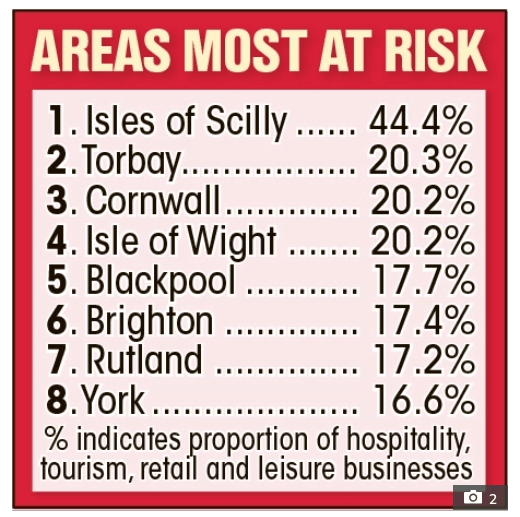
Analysis by the Labour Party highlighted 20 tourist destinations in England where high streets are in danger. Their list includes Blackpool, Brighton, Southend-on-Sea in Essex, Torbay in Devon, Dorset, Cornwall and the Isle of Wight.

The Isles of Scilly are deemed most at risk.

According to the research, 44 per cent of its businesses are linked to hotels and B&Bs, restaurants and pubs, clothing and book shops — which in normal times would prop up its economy.

Labour warned that cash reserves are drying up and debts are building as several government support schemes including furlough and extra grants are set to come to an end within weeks.

It wants the VAT cut to carry on to keep businesses going until firms can get back on their feet in the summer.

Revealed: Cummings’ role in handing Covid contract to firm run by ‘friends’

Dominic Cummings was instrumental in the process of awarding a government contract without tender to a company run by his “friends”, according to court documents that raise questions about whether the Cabinet Office may have misled the public.

David Conn www.theguardian.com

The documents reveal the central role the prime minister’s former chief adviser played in the awarding of the contract to Public First, a research company owned and run by two of his longstanding associates.

Public First was paid £564,393 to research the public’s understanding of the coronavirus and the government’s messaging around the pandemic, and one of its partners was seconded to work in Downing Street.

The company is run by James Frayne and Rachel Wolf, who are both former colleagues of Cummings and the Cabinet Office minister, Michael Gove. In 2019 Wolf co-wrote the Conservative party’s general election manifesto.

When the Guardian and openDemocracy first revealed in July last year that Public First had been awarded a contract without tender, the Cabinet Office said in a statement it was “nonsense” to suggest the owners’ long associations with Cummings and Gove were a factor in the decision to award it a contract.

However, in a witness statement submitted to the high court on Monday as part of a judicial review of the award, Cummings described himself as the “driving decision-maker” behind the government’s decision to conduct more focus groups and hire Public First, and said his faith in the company was based on his extensive experience working with its staff.

Cummings described Frayne and Wolf as his “friends”, but added: “Obviously I did not request Public First be brought in because they were my friends. I would never do such a thing.” He said he “requested” civil servants hire the firm because, in his experience, it was the only company with the expertise to carry out the required focus groups urgently.

“The fact that I knew the key Public First people well was a bonus, not a problem,” he said, “as in such a high pressure environment trust is very important, as well as technical competence.”

Cummings said he knew the quality of the company’s work and “I knew they would give us honest information unlike many companies in this sector”.

“I am a special adviser and as such I am not allowed to direct civil servants,” he added. “However, as a result of my suggestion I expected people to hire Public First. The nature of my role is that sometimes people take what I say as an instruction and that is a reasonable inference as people assume I am often speaking for the prime minister.”

Cummings said he had not met Frayne since 2016 and had no involvement in the contractual arrangements with Public First or the company’s remuneration.

The court documents included an email exchange between civil servants in the Cabinet Office in March, questioning the impartiality of Public First’s work. One said: “I know they’re not going to go away, but I have genuine concerns about the way in which they MIGHT be spinning stuff coming out of focus groups – way, way too close to No10 to be objective.”

Her colleague agreed, saying she was thinking of limiting the company’s work to testing opinion on Johnson’s messages, and having another company, Jigsaw, do focus groups with older and vulnerable audiences.

The head of insight and evaluation at the Cabinet Office and the prime minister’s office described Public First in internal communications as “mates” of Cummings and of Boris Johnson’s then head of communications, Lee Cain, “hence getting all our work with no contract”.

In a witness statement, the official said the email to colleagues was meant as a joke in an effort to ensure overdue invoices were paid to the company, and it “was not true” that Public First was given the work without a contract because of relationships with Cain and Cummings.

Jason Coppel QC, representing the Good Law Project, the not-for-profit campaign group that brought the judicial review, referred to another internal message from the head of insight and evaluation at the Cabinet Office. Sent in January, it related to a previous appointment of Public First for work unrelated to the pandemic. In that message, the official referred to Public First as “Tory party research agency tests Tory party narrative on public money”.

Coppel said that showed senior civil servants had “deep misgivings” about the contract. However, in her witness statement, the official pointed to the rest of her message, which said “but actually, it will be very interesting and very good”. She said her reference was “meant to be frivolous and lighthearted,” and she did not regard Public First as a “Tory party research agency”.

In its legal case, the Good Law Project argues that the Cabinet Office acted with “apparent bias”, given that the contract was directly awarded without competition, and Frayne and Wolf’s work with Gove and Cummings at different times over many years.

The Cabinet Office’s legal case makes a virtue of previous relationships with Public First, saying Cummings wanted Gabriel Milland, a Public First partner, to be seconded to Downing Street because he had worked with him previously “and had a high regard of his abilities, expertise and experience”.

The government argued that Gove’s and Cummings’ relationships with the Public First partners meant they knew the quality of their work, and denied it showed “bias” in appointing the company. “On the contrary, past professional connection simply enabled a better judgment to be reached about whether Public First were indeed the best/only suitable body to perform the services as needed,” its defence states.

The Public First contract was not put out to competitive tender under emergency regulations that waived normal procurement procedures owing to the pandemic.

Frayne has said Public First was “the obvious choice” to run the government focus groups, as it was “one of a tiny number of agencies that could meet this demand”, and was chosen due to its expertise and ability to work at unusually short notice. The company was already doing research for the government in February before it was asked to conduct more than 100 focus groups across the country relating to Covid-19, specialising in researching “hard to reach” communities.

There is no evidence to suggest that Gove was involved in the process to award the contract. The Cabinet Office, represented by Sir James Eadie QC, denied that there was bias or apparent bias in the contract award or on the part of Cummings, and said that other companies were not used because “they could not provide the requisite services”.

The department did not respond directly to a question about whether its statement to the Guardian in July misled the public. Asked at that time whether the fact Frayne and Wolf were “longstanding close associates” of Cummings and Gove had been “a factor” in the decision to award the contact, the Cabinet Office strongly rebuffed the suggestion.

“This is nonsense,” it said in its July statement. “Public First were contracted to undertake this work because of their wealth of experience in the area. We have a number of suppliers for work on government research, of which Public First is just one.”

The judge, Mrs Justice O’Farrell, will determine the judicial review case following the one-day hearing of both sides’ arguments.

Police not amused by Exmouth Mockingbird fans

Bird spotters who breached lockdown restrictions to catch a glimpse of a rare bird have been handed fines.

BBC News www.bbc.co.uk 

Northern mockingbird

The bird watchers travelled to see the rare Northern mockingbird in an Exmouth garden, image copyrightGetty Images

The Northern mockingbird, not often seen in the UK, was first spotted by Chris Biddle in his garden in Exmouth, Devon, on 6 February.

He tweeted about the sighting, prompting excitement among twitchers.

Five were fined for travelling to the town to photograph the bird after Devon and Cornwall Police were contacted on Saturday over the lockdown breaches.

In a statement, the force said: “It was reported that a number of individuals, suspected to have travelled from outside the area, were trying to photograph a rare bird which had been seen in a garden.”

The grey, long-tailed Northern mockingbird is known for its mimicking ability, and is found in southern Canada, across the US, Mexico and the Northern Caribbean.

It is not thought to have been seen in the UK since the 1980s.

‘Significant risk’ to beach users after storm exposes pipework

‘Significant risk’ to beach users after storm exposes pipework

Owl assumes everyone can guess what the purpose of the pipe was. Is it still operational as a storm overflow?

Charlotte Becquart www.devonlive.com

The recent weather and sea conditions have exposed old pipework on a Devon beach.

The picture above was taken at Exmouth beach, west of the lifeboat station.

It shows old broken pipework which is a significant risk to all beach users.

Exmouth RNLI shared the picture above to raise awareness. The team said the pipes could cause ‘serious injury’, especially during high tides.

It is urging people to avoid the area.

A spokesperson wrote on Facebook: “Fierce sea conditions have exposed some old broken pipework that is a significant risk to sea swimmers, kite surfers and other water users on Exmouth beach and could cause serious injury especially during high tides.

“The hazard is located about 80 yards west of Exmouth Lifeboat Station.

“Please avoid this area.”

Meadow-makers plan to get East Devon and the Blackdowns blooming and buzzing

Two new community groups for East Devon and the Blackdown Hills aim to support landowners and gardeners keen to restore or create wildflower meadows.

Obviously this is something Owl would encourage – the traditional manicured lawn is pretty much a wildlife desert, a wildflower patch doesn’t have to be big. Everyone with a garden can have one. Make this your spring project.

The local More Meadows groups are based on the successful Moor Meadows Dartmoor community, which since its founding in 2015 has grown to include more than 800 meadow-makers, managing more than 1,000 acres of wildflower meadow to benefit wild plants and wildlife on Dartmoor and beyond.

Thanks to funding from Devon Environment Foundation, the More Meadows concept is an attempt to replicate the original Moor Meadows group’s success by supporting new networks of meadow-makers across Devon.

The new More Meadows groups for the Blackdown Hills and East Devon have been founded by local nature enthusiasts concerned about ongoing wildlife declines but inspired by efforts to create more wildlife-friendly habitats.

Although lost from much of the countryside due to changes in agriculture during the 20th century, traditional wildflower-rich grassland can be maintained, restored or created on farmland, in gardens and churchyards and on road verges.

This conservation work can play a crucial role in turning around the fortunes of threatened bees, butterflies and other pollinators as well as the birds and mammals that rely on insects for food.

Helping to start the Blackdown Hills More Meadows group is Julian Pady of Goren Farm, at Stockland Hill, near Honiton. The wildflower meadows at Goren Farm already provide a commercial supply of wildflower seeds, with customers including many meadow-makers in Devon.

Julian Pady said: ”Covid restrictions permitting, we will be opening our meadows from the 1st of May in conjunction with the National Gardens Scheme and we will be running open meadows events throughout June for meadow makers to attend. I will lead guided walks, talking about meadow management and demonstrating how we approach farming and wildlife on the 70 acres at Goren.”

Potential meadow-makers in East Devon joining the new More Meadows group also have an opportunity to help one of England’s rarest animals. The grey long-eared bat preys on moths and other insects, so wildflower-rich meadows provide ideal foraging habitat. With two key maternity roosts located in East Devon, a new project led by East Devon AONB and Bat Conservation Trust is focused on securing the future for this rare species.

Leading the new bat project is Craig Dunton, who said: ”If you are seeking support for meadow creation, this project will be providing land management advice to reconnect and restore wildflower meadows in the parishes of Colyford, Colyton, Musbury, Shute, Uplyme, Combepyne and Rousdon, Kilmington, Axminster and Hawkchurch. More meadows will mean more vital foraging habitat, helping to save the grey long-eared bat.”

An online forum for meadow makers launched last month to encourage the creation and spread of new More Meadows groups. Julien Pady of Goren Farm said: “The More Meadows forum is an amazing space, a valuable resource of information for all who join.” The Blackdown Hills and East Devon groups are the latest to form and details of both groups can be found at http://forum.moremeadows.org.uk/ 

Supporting this process for More Meadows is Devon ecologist Tracey Hamston, who said: “New groups of local meadow enthusiasts are being formed as individuals reach out to other wildlife-friendly landowners in their area. The online forum is providing a network for people to find others living nearby, organise getting together and planning how to move forward, with the aim of creating and restoring as much species-rich meadow as possible and connecting to like-minded folk in the process.”

Joining the forum is free and offers resources and advice on managing a meadow – including where to source wildflower seeds or seed-rich ‘green hay’ – while forum members can help identify the wild plants and creatures in field or garden meadows.

More Meadows also organises a series of free online talks by expert speakers, open to everyone. The next event, ‘How to Create a Meadow’, is a guide on how to turn a field or paddock into a wildflower-rich meadow. Tickets for the online talk on Thursday 25 March are free but you must register a place at https://createameadow.eventbrite.co.uk 

For more information on More Meadows visit the forum at http://forum.moremeadows.org.uk/

small tortoiseshell

Planning applications validated by EDDC for week beginning 1 February

Remove the existing roof coverings from the area over the failed timber members, reconstruct the roof structure and reinforce with structural steel beams then re-thatch and put back existing slate tiles Open for comment icon

Lincombe Farm Sidbury Sidmouth EX10 0QE

Ref. No: 20/1736/LBC | Validated: Tue 02 Feb 2021 | Status: Awaiting decision

Despite the success of the vaccination rollout the consultancy gravy train continues

The consultancy gravy train shows no sign of stopping. The Department of Health awarded the multi-national professional services firm, Deloitte, a COVID-19 contract that could be worth almost £1 million a day without the contract ever going to tender. 

The deal, worth up to £145 million, was handed to Deloitte to ‘support testing for Covid 19’ for just five months. Deloitte has been given at least 25 public sector COVID-19-contracts since the outbreak of the pandemic, of which contracts totalling £170 million were awarded without any competition. 

Not only did Government fail to advertise or put this huge contract out to tender, they didn’t come clean about the enormous sum of public money handed to Deloitte until around the time the contract had ended. The contract started in September 2020 and was only made public by the Government in January 2021. It’s almost impossible to scrutinise contracts when Government routinely fails to publish the details within the legal timeframe. 

We do not believe the award of this contract worth up to £145 million was lawful. We are left with no option but to pursue transparency through the courts. We have taken the first step in legal proceedings.

Government’s approach to procurement throughout this pandemic has been characterized by a repeated failure to follow its own rules. For the sake of the public purse, we will continue to push for proper governance. 

Thank you, 

Jolyon Maugham QC

Director of Good Law Project

UK vaccine rollout success built on NHS determination and military precision

Owl’s view of the welcome success of the vaccine rollout is that it stands out as using “in-house” expertise rather than consultancies such as Deloittes. If only the Government had taken a similar path earlier…….

Extracted from Sarah Neville and Helen Warrell in London February 12 2021 www.ft.com

…The UK had carried out more than 14m vaccinations by Friday morning and was fast approaching the target of inoculating the 14.6m most at risk from Covid-19 by the start of next week. Only Israel and the United Arab Emirates, among larger countries, have inoculated more per head of the population.

Global leadership is an unaccustomed status for a country with one of the highest rates of excess deaths in western Europe. Multiple missteps, such as the government’s failure to deliver on a “world beating” test and trace system, have engendered cynicism about its handling of the pandemic.

The UK’s achievements have come despite far more constrained vaccine supply than Israel, for example. This has ruled out a demand-led model in favour of a “risk pyramid” laid down by government advisers, with the oldest immunised first alongside frontline health workers. 

Jeremy Hunt, UK health secretary until 2018, said Asia had provided inspiration. Having failed to learn from that region’s recent experience in tackling deadly diseases caused by other coronaviruses in the early part of the pandemic — the UK halted community contact tracing, for example — the opposite was true when it came to vaccination.

“The main difference is that we really did learn the lessons from Sars and Mers when it came to the importance of the vaccine,” he said.

The Financial Times has spoken to more than a dozen people at the heart of the programme to discover the key decisions that were taken and examine whether the right lessons were learned from a litany of earlier failures.

Planning began long before it was clear whether any of the vaccines being developed at historic speed would win the approval of regulators. Back in the summer UK prime minister Boris Johnson put Sir Simon Stevens, head of the NHS in England, in charge of delivering the country’s biggest ever mass inoculation campaign.

The challenge was to avoid the problems that had befallen the highly centralised test and trace system, which was delivered by outsourcing companies and had largely ignored expertise on the ground.

Stevens chose a different approach. Rather than creating a new system, he used existing groups of GPs, known as primary care networks (PCNs), which each cover up to 50,000 patients, as his main conduit. Each had to commit to vaccinating for 12 hours a day, seven days a week.

In total, around 1,500 vaccination centres have been established in England, including some in football stadiums and other large venues, staffed by 30,000 NHS workers and as many as 100,000 volunteers.

Some decisions were devolved — PCNs chose their own jabbing sites, for example — but for others the NHS’s ability to compel action through national edict proved effective.

When, several weeks into the rollout, ministers took the key decision, announced on December 30, to delay second doses to stretch supplies, Stevens, along with UK chief medical adviser Chris Whitty held a video call with hundreds of PCN leaders on a Sunday night to explain the new policy. The next week, second shots largely stopped — a level of compliance a more fragmented health system would have struggled to secure.

Planning had moved into a higher gear in November. With regulatory approvals for at least one vaccine imminent, Emily Lawson, NHS chief commercial officer, selected by Stevens to run the programme, assembled military and private sector support.

Brigadier Phil Prosser, commander of the army’s 101 Logistic Brigade, was taking part in an exercise with more than 2,000 soldiers on Salisbury Plain when he got the call on November 11 instructing him to leave immediately to start work on vaccine delivery.

Five days later, he and 50 military logistics experts were installed at the NHS headquarters in Skipton House, south London, to help co-ordinate distribution and set up vaccination centres. 

Military specialists calculated the optimum location of centres to ensure every UK resident could access a jab within 10 miles of home, as ministers had promised. Security officials worked out how to safeguard shipments of vaccines from theft or attempts to disrupt the rollout. 

“There’s no other supply chain that’s built like this,” said Prosser. “This is the largest vaccination programme this country has ever run.”

Three weeks later, on December 8, the first cohort were inoculated.

For those at the sharp end, the day starts at 8am with a meeting chaired by Lawson, where the head of each delivery group — GPs, hospitals and mass vaccination centres — reports on progress and the logistics team briefs colleagues on vaccine stocks for the next three days.

Palantir, the US data analytics company which had also worked with Lawson previously on a mechanism for PPE delivery, was contracted in November to provide a vaccine supply database. 

“The issue essentially is how do you get it into the right arm in the right place,” said Louis Mosley, head of Palantir UK, who works on the programme. “You’ve got a huge number of logistical constraints, because the vaccine expires . . . [and] you often don’t know until the last minute how much you’re going to get.”

Each vaccine centre set up outside GP practices or hospitals needs more than 400 items of equipment to function, from needles to fridges and resuscitation equipment. Palantir’s system brings together warehouse inventories and information about patients and the readiness of trained staff. The database also keeps a running total of vaccinations to give the NHS instant progress reports. Palantir said it does not receive or hold identifiable patient data.

When it came to allocating the vaccine, the uniting principle has been to ensure equal access. Christina Pagel, professor of operational research at University College London, said that in Germany, by contrast, it is usually up to individuals to book an appointment once they are informed they are eligible. She said that sort of approach favoured the “tech-savvy” and made the process a “bit of a lottery”.

However, the scale of progress, and the political narrative ministers have woven around it, would by now look very different were it not for the decision to delay the second dose of the UK’s two approved vaccines by up to three months.

Supplies of the vaccine stood at only half the volume needed to fully immunise the most vulnerable by mid-February, threatening to leave millions unprotected as troubling new variants spread.

That move sparked international criticism, including from Anthony Fauci, the US president’s chief Covid-19 adviser. This week, however, the World Health Organization backed the approach with the Oxford/AstraZeneca vaccine — one of the two used in the UK.

Mary Ramsay, head of immunisation at Public Health England, said the agency had originally discussed the importance of aligning the dosing intervals for the BioNTech/Pfizer and Oxford/AstraZeneca vaccines, which were meant to be given respectively three and four weeks apart. “Operationally it was felt it would be easier to stick to a single interval,” she said. 

Then data came in from AstraZeneca showing the effectiveness of a single dose up to 12 weeks. Moreover, as more analysis came in from the Pfizer trials, following the vaccine’s approval by regulators in early December, it reassured government advisers that it, too, was likely to be highly effective after the first dose — although the US pharma group was insistent on sticking to the approved three week schedule.

Former UK prime minister Tony Blair, who was an early advocate of the delayed second dose strategy, praised the government for the rollout of the programme. “I was sceptical as to whether the government would perform the logistics effectively enough but . . . by and large, they have.”

While the numbers vaccinated point to a successful project, there have been inevitable bumps along the road. Some GPs have criticised the model through which vaccine supplies were “pushed” out to them, particularly those with low-income patients who tend to suffer poor health at younger ages…

Ex-Persimmon chief fails to set up charity three years on from bonus row

Beware the “Developer’s Pledge”.

Perhaps the phrase deserves to be used more widely as a general description for a worthless promise. – Owl

Rupert Neate www.theguardian.com 

Jeff Fairburn, the former chief executive of the housebuilder Persimmon, has failed to set up a charity three years after pledging to do so in an attempt to assuage public and political anger at his £82m bonus.

Fairburn has not registered a charity with the Charity Commission or made any inquiries about how to set one up, after he said on 14 February 2018 he would donate a “substantial proportion” of his bonus to a charitable trust. The furore over the payout, believed to be one of the most generous in the FTSE 100 at the time, led to the chief executive losing his job later that year after the company said it was having a negative impact on the reputation of the business.

The controversial bonus payment resulted from a scheme linked to the housebuilder’s share price, which soared thanks to the government’s help-to-buy programme. About half of Persimmon’s homes are bought with its assistance.

Fairburn is also not named as a trustee of any charity in England or Wales. It is not known whether he has donated to any separate existing charity. He did not respond to repeated requests for comment, nor did several of his colleagues at the housebuilding company.

The revelation that Fairburn appears not to have set up a foundation to donate any of his bonus comes days after his former company set aside £75m to pay for work needed to remove flammable cladding on its high-rise buildings following the Grenfell Tower fire. An independent review in 2019 had found that Persimmon had built homes so shoddily that it left its customers exposed to an “intolerable risk” in the event of fire.

Garry White, chief investment commentator at investment firm Charles Stanley, said: “Jeff Fairburn won the equivalent of an LTIP [long-term incentive plan] lottery. The ticket was handed to him by [former chancellor] George Osborne, but was bought for him by Britain’s taxpayers.

“About half the company’s houses are sold via the government-backed help-to-buy scheme and the debacle demonstrates why LTIPs are a poor way to reward company executives. Share price moves can be gamed by corporate action such as share buybacks and the imperfect system introduced by Persimmon has given the impression of corporate looting. All such schemes should have an upper limit.”

While Fairburn appears not to have set up the promised charity, he has re-entered the housebuilding market after buying a 50% stake in Yorkshire house builder Berkeley DeVeer and becoming its chief executive. In a press release announcing his investment in Berkeley DeVeer last year, Fairburn said: “I’m honoured to join the company as CEO, and to have become a significant investor.”

A Charity Commission spokeswoman said: “We have no record of a registered charity bearing Jeff Fairburn’s name. Nor does it appear Mr Fairburn is a current trustee of an active charity. We can’t categorically state that no charity has been registered that involves Mr Fairburn in some capacity. It would also not be possible for us to confirm whether or not any funds have been donated via another charity.”

Luke Hildyard, the executive director of the High Pay Centre thinktank, said: “When this obviously excessive and unearned payment was first made, the promise that a substantial portion would be used to set up a charity enabled Persimmon to draw a line under the affair. So there is a moral onus on Fairburn to provide some transparency over the matter.

“Charitable giving by the super-rich is claimed to be an example of the so-called ‘trickle-down’ effect but as this case suggests, philanthropy can be highly whimsical, opaque and unaccountable. The benefits it provides for wider society are minimal compared to proper taxation of extreme wealth.”

Boris Johnson’s top aide Eddie Lister still on payroll of two developers

Do you ever wonder why “development” always features so strongly in all Tory plans?

Developers are just never very far away. – Owl

Emanuele Midolo, Gabriel Pogrund www.thetimes.co.uk 

Boris Johnson’s closest adviser faced fresh conflict-of-interest allegations last night after it emerged that he has stayed on the payroll of two property developers during his time in Downing Street.

Lord Udny-Lister has served as the prime minister’s chief strategic adviser since 2019. No 10 announced last week that he would soon leave for a new role as Johnson’s special envoy for the Gulf, responsible for courting Middle Eastern investment. The announcement came days after we revealed that Lister had been paid by both the buyer and seller of the new site of the Chinese embassy while leading talks over the £255 million deal on behalf of the government.

Rachel Reeves, the shadow Cabinet Office minister, said: “We need urgent answers from the government on how they’ll deal with what appears to be a serious conflict of interest. This government’s catalogue of cronyism grows every week. Yet they seem to feel no urgency in addressing these concerns. There needs to be more integrity at the heart of government.”

Lister has been on the highest salary band of any special adviser in government since December 2019, paid between £140,000 and £149,000 a year. Throughout that time, he has been a non-executive director of Stanhope, one of the largest private developers in the capital, whose £500 million redevelopment near East Croydon has been picked by the government as the location of a new civil service hub.

Lister is also a member of the strategic board of Delancey, a property company that has given £350,000 to the Conservative Party over the past decade. While at No 10 Lister invited its owner, Jamie Ritblat, to provide advice on the property market several times during lockdown.

No 10 said on Friday that Lister would report directly to Johnson in his new role in the Gulf. Neither Delancey nor Stanhope have interests in the region. But both have dealt with Middle Eastern states on flagship deals.

Delancey and the property arm of Qatar’s sovereign wealth fund jointly bought the £557 million Olympic village, while Stanhope sold an office block near King’s Cross to the Qatar royal family in 2015. The Gulf states remain among the most active investors in London property, and are expected to play an increasingly important role post-Brexit.

“I’m very pleased to be sending Lord Udny-Lister to work with our partners there,” Johnson said. “His appointment marks my ambition to achieve a wholesale modernisation of our Gulf relationships, creating jobs and driving prosperity at home while delivering on our priorities and values overseas.”

Lister received a peerage last summer but at the time of publication his Lords register of interests was empty.

Downing Street refused to answer specific questions but a government spokesman said: “Mr Lister has at all times followed the Cabinet Office’s guidance and codes of conduct.” Ritblat’s conversations with Lister, when he advised on the property market, are understood to have taken place by phone. Asked if they were minuted, a government spokesman declined to comment.

Delancey said last week that Lister was not involved on behalf of the company in the sale of Royal Mint Court, which is to be redeveloped and serve as China’s new British embassy. The company said: “Delancey is not aware of any past or existing conflict of interest by Lord Udny-Lister sitting on its advisory board.”

Stanhope said Lister’s role was to ensure “good governance within the company and he has no involvement in any existing or past Stanhope projects”.

Idyllic sea view village aims to ensure young can afford homes

Another neighbourhood plan seeks to control second homes – Owl

Daniel Clark www.devonlive.com 

With outstanding sea views across Start Bay, and with the parish lying entirely within the South Devon Area of Outstanding Natural Beauty, Strete is one of the South Hams’ historic and picturesque villages.

The village, located five miles away from Dartmouth, sits atop the cliffs behind Pilchard Cove at the north end of Slapton Sands, and the heart of the village is a Conservation Area with several listed buildings.

The area is popular with holidaymakers and the local economy rests primarily on tourism and agriculture, but job opportunities are few and far between, and house prices are high which can make it hard for local people, especially the young, to afford to stay in the parish.

As a result, the villagers have put together a plan to address the issues and to involve the local community in making sure that change and development in future are for the good of the parish.

Strete Village Centre

Strete Village Centre

The neighbourhood plan for Strete, which is hoped to go before the parish in a referendum in May, aims to help deliver the local community’s aspirations and needs.

The vision for Strete is to grow slowly and sustainably so that its high coastal character, sea views and natural beauty are conserved and enhanced while meeting local needs and improving local services.

THE HISTORY OF STRETE

The first documentary mention of the place was as Streta in 1194, and the name derives from Old English Strǣt , meaning a road or Roman road, as the village lies on an ancient trackway, but the name Strete appears to have first been documented in 1244. Formerly a part of the parish of Blackawton, Strete became a separate parish in 1881 when the Chapel of Ease (built in 1836) became the parish church of St Michael’s.

The ancient heart of the village is protected as a conservation area and the plan aims to safeguard its historic and architectural character for present and future generations

THE VISION FOR STRETE

The parish is home to about 400 people and the village still provides local facilities including a shop with a Post Office, a pub, a village hall, some public spaces and the parish church.

The area is popular with holidaymakers and the local economy rests primarily on tourism and agriculture, the plan says, adding that hob opportunities are few and house prices are high which can make it hard for local people, especially the young, to afford to stay in the parish.

The neighbourhood plan for Strete aims to help deliver the local community’s aspirations and needs. It has been produced by local volunteers, with the support of the Parish Council, based on the collective views of the people who live in Strete.

Strete: by Magnolia Cottage

Strete: by Magnolia Cottage (Image: Martin Bodman/Geograph)

The Strete Neighbourhood Plan aims to: protect the village from uncontrolled, large scale, or poorly placed development; allow for small scale development which is sympathetic to and will improve the look and feel of the village; take steps to give residents preferred access to many of the new homes; and give the village the potential to access funding to improve village facilities.

The vision for Strete is to grow slowly and sustainably so that its high coastal character, sea views and natural beauty are conserved and enhanced while meeting local needs and improving local services.”

The local community expects the plan to respect and protect the precious natural and historic environment, maintain and improve community facilities, services and infrastructure, and support existing and new business opportunities and tourism, in order to maintain and enhance the character and vitality of the village and parish, and allow sustainable development for natural growth to meet future local needs.

THE OBJECTIVES OF THE PLAN

The plan aims to create a place where the following objectives are achieved

  • landscape character and the natural setting of the parish are maintained and enhanced, including the high coastal setting of the village, the outstanding sea views, woods and copses throughout the parish
  • the particular sensitivity and visual prominence of the landscape on the seaward side of the A379 is recognised and suitably protected
  • valued local green spaces are maintained and enhanced
  • local heritage is valued, conserved and enhanced, including local history, village form and character, architecture, footpaths and other important features, and new buildings are sympathetically designed
  • local tranquillity and dark skies are conserved
  • people are able to move more freely, safely and conveniently, with new and improved footpaths, particularly in the village;
  • local needs are met through small organic developments, in scale with the locality and allowing future generations to maintain the viability of local businesses, but without substantially altering local character
  • There is economical use of resources so that future generations are not left a legacy of pollution, financial or environmental debt, with steady progress towards zero carbon energy and water footprints
  • local services are maintained, enhanced and extended with improved public car parking close to the coast path in the village, public transport to nearby centres maintained and enhanced and improved Broadband and Mobile Phone coverage, both for individuals and for businesses;
  • community well-being is enhanced and there are growing opportunities for people of all ages to expand and develop themselves, including public buildings and spaces to gather, pursue shared interests and contribute to the life of the community.

The plan adds: “The coast and countryside in and around Strete is recognized for its high quality natural environment, and unspoiled natural beauty. It is well loved by residents and visitors alike.

“But insensitive development could damage it irreparably. The plan recognizes the local landscape as one of the parish’s most precious assets and aims to protect it from harm.

“Development shall not harm, but maintain and enhance the landscape by having regard to the special qualities of the AONB in the area, safeguarding and enhancing local features that make a positive contribution to the landscape, particularly areas of green space, protecting the high coastal setting of the parish, and incorporating high quality landscaping, which retains existing features reinforces local landscape character, and provides mitigation from harm.

Pilchard Cove near Strete, Devon

“Development shall not harm but conserve and enhance designated and non-designated historic and heritage assets and their settings, both above and below ground, by having regard to national and local strategic policies for heritage and conservation.

“Strete is notable for its rural tranquillity. Apart from traffic passing through on the A379 coast road there is little to disturb the peace. The parish is also sufficiently removed from light pollution that it affords good views of the night sky. Development shall be designed so that it will cause no undue noise or light pollution.”

SOUTH OF THE A379

The plan recognises the sensitivity of the environment in and around Strete, both natural and man-made, and that these two aspects combine to create a particularly sensitive landscape setting for the village.

As the views of Strete are framed by its coastal setting and the land lying on the southern side of the A379 coast road is particularly important in this respect, any development in that area should therefore pay special regard to the sensitivity of the location and its coastal landscape importance and development there shall not harm but must enhance that coastal setting

South West Coast Path above Landcombe Cove

South West Coast Path above Landcombe Cove (Image: Derek Harper/Geograph)

THE WESTERN AREA

The western parts of the village, along the A379 and western Hynetown Road, are predominantly characterised by detached dwellings built over the course of the twentieth century on single plots. That low density character is distinct from the rest of the village and the plan requires that any development should retain that character.

To protect the character of the area, proposals for residential development within this area should reflect the established low-density character

DEVELOPMENT

The availability of facilities and support services in and around Strete means that it is a sustainable location for small scale growth. While there are fewer than 300 homes across the parish with about 230 of those being in the village, development in scale with the village could help to meet local needs for affordable homes and some additional community infrastructure.

The plans outlines that some development is needed to help to sustain the community and meet local needs, but plan defines and shows the settlement boundary for the village within which suitable development will generally be acceptable.

Strete Church

Strete Church (Image: N Chadwick/Geograph)

Outside the village, development will be tightly controlled and only permissible where it is essential in order to meet agricultural, forestry or other small-scale needs which cannot be met within the village, it says.

The plan aims to control the scale and density of development so that it is in keeping with the parish and geared to meeting local housing needs, and development will be supported inside the settlement boundary, provided it is in conformity with relevant policies in the Development Plan, is of a scale and character with the site and surroundings and will cause no significant adverse impacts on the natural or historic environment, amenity, traffic, parking or safety.

Outside the settlement boundary, development will be strictly controlled and only permitted where it is in accordance with the Development Plan, can be delivered sustainably and requires a countryside location or will meet a proven local need which cannot be met inside the settlement boundary

As part of the plan making process a call for sites was issued late in 2016 and two possible sites for development were identified. The more suitable of these, at Cox’s Farm Fields, was proposed in the initial drafts of the plan, but no satisfactory way could be found to develop the site in keeping with local aspirations and constraints, and therefore allocating the land for development no longer features in the plan.

Housing development sites in Strete shall be limited to small sites to ensure that growth is at a scale in keeping with the special qualities of the village and the AONB and affordable homes for local people will be particularly welcomed, the plan says.

The parish of Strete

The parish of Strete

SECOND HOMES

The growth in the number of dwellings being used as second or holiday homes is having a significant impact on housing stock in the parish, the plan states, adding that in 2011 there were 50 second homes recorded but that had risen to 66 by 2016 – about 20 per cent of the local housing stock.

It adds: “House prices have been pushed up such that local people, particularly first time buyers, are generally unable to compete in the market, and that trend is continuing. The plan addresses this by requiring that new housing be restricted to occupancy as a principal residence.”

Occupiers of homes with a principal residence condition will be required to keep proof that they are meeting the obligation or condition and to provide this if/when South Hams District Council requests this information, and proof of principal residence could include residents being registered on the local electoral register or being registered for and attending local services (such as healthcare, schools etc.).

LOCAL FACILITIES

Strete is a beautiful place to live with a good quality of life, but with relatively few local facilities. Those which do exist – particularly the village shop and the pub – are therefore especially precious and the plan aims to safeguard them for present and future generations, and their retention and prosperity are important to local well-being, the plan says.

New facilities that will support the local community and enhance their well-being will be welcomed and supported, particularly if they will bring improvements in car parking or open space provision.

The local green spaces in the plan – The Village Green, The Village Wood (Blackbird Wood) and The Village Play Park – will only see development on them permitted in very special circumstances.

WHAT HAPPENS NEXT?

The Neighbourhood Plan was assessed by an Examiner at the end of 2020, and they have confirmed that, subject to the minor amendments being incorporated into the revised Plan, the Strete Neighbourhood Plan meets with the legislative and regulatory requirements and can proceed to referendum.

The plan will now forward to South Hams District Council, who at a forthcoming meeting, will be asked that the Examiner’s recommendations on the plan be endorsed and that a ‘referendum version’ of the Plan should proceed to the referendum stage.

A referendum where all electors within the parish of Strete will be invited to vote on whether the neighbourhood plan will be used to make planning decisions in the parish.

If more than 50 per cent of those who vote say ‘yes’, the neighbourhood plan will be made and will form part of the development plan for the South Hams, where it will carry full weight in the planning decision making process.

The earliest date on which the referendum can take is May 6, 2021, where it is expected that if the local elections go ahead as planned, as the Government has indicated, then the Neighbourhood Plan referendum would take place at the same time.

The’re obviously rattled already!

Devon Tories use postal vote applications to capture voters’ data

seatonmatters.org 

Posted on February 11, 2021

While the Government refuses to hold the postal-vote-based election which would be safe in current pandemic conditions, Devon Conservatives have nevertheless been mailing out postal vote application forms to unsuspecting voters.

What’s more, they’ve inserted a big black tick-box at the bottom of the official-looking form, so that they can harvest would-be postal voters’ information for sending out further propaganda. The form comes with a SAE to send to the local Tories and a copy of their ‘plan’ for Devon.

I gather one of the recipients is making a complaint to the Information Commissioner.

If you want to get a postal vote, act now to download a form here or phone East Devon Electoral Services on 01395 517402. You must of course be on the electoral register before you can apply for a postal vote! If you’re not on at your current address, you can apply online here.

Contradictory messages and muddled priorities from Government on Green Policies

While Neil Parish and his committee says the government must set tougher targets to lower air pollution if it hopes to reduce the health inequalities that have been laid bare by the coronavirus pandemic, the Government backtracks on other Green Policies.

For instance:

The much trumpeted £27bn roads plan is in doubt after  after documents showed the transport secretary, Grant Shapps, overrode official advice to review the policy on environmental grounds.

It has been a legal requirement to take into account the environmental impact of such projects since 2014. Shapps appears to have pressed ahead despite the advice of civil servants in his own department.

This is likely to be challenged legally.

Also:

Ministers are withdrawing hundreds of millions of pounds from a green home improvements scheme championed by Boris Johnson as a key element of the government’s net zero strategy.

These two example are neatly put together in this extract from the print edition of an article yesterday by Fiona Harvey Environment correspondent, The Guardian

… the central point [is] that major infrastructure decisions must take account of the UK’s binding climate obligations was affirmed. Campaigners want to use the same argument to force a review of the government’s £2bn road-building scheme, which they say would bust the UK’s carbon target and is incompatible with the obligation to reach net zero emissions by 2050.

Mike Childs of Friends of the Earth said: “We need to see a conclusive end to the damaging fixation with new fossil fuel-heavy projects. It’s hypocritical having a government that is happy to talk the talk on climate change, but then spends billions of pounds on roads.”

…….Road-building pledges are a staple of governments to show business-friendly credentials through infrastructure that supposedly creates jobs and boosts enterprise, and this seems to be the current motivation. Yet ministers show little interest in other projects that have a better chance of achieving this while reducing emissions.

The government has admitted its green homes grant scheme – central to the “build back better” pledge will have most of its £2bn funding withdrawn. Applicants have waited months for money, meaning most of the £2bn remains unspent. Yet that funding will not be rolled over after March, so the scheme is essentially over. In the light of the pandemic, miles of new motorway may be less essential to the way people work than a boost to broadband connectivity in rural areas. That would also create “shovel-ready” green jobs and equip the UK for a low-carbon and digital future. That seems as far away as ever. [Owl emphasis]

We all know, alas, that “shovel-ready” has a very literal meaning to the Government (and our LEP) – Owl

Local MP says improving air quality should be at core of rebuilding after the pandemic

A committee chaired by local MP Neil Parish has said the government must set tougher targets to lower air pollution if it hopes to reduce the health inequalities that have been laid bare by the coronavirus pandemic.

Francesca Evans seaton.nub.news

Local MP says improving air quality should be at core of rebuilding after the pandemic

The Environment, Food and Rural Affairs Committee has put forward a report on air quality.

In presenting the report, Mr Parish, who represents the Honiton & Tiverton constituency, said: “Every year, an estimated 64,000 deaths are linked to air pollution disproportionately affecting disadvantaged communities.

“In rebuilding after the pandemic, we have a moral duty to put improving air quality at its core.”

The report summary stated: “Cleaner air and clearer skies were one of the few positives that many people experienced following the first COVID-19 lockdown in March 2020.

“However, as the pandemic progressed evidence also began to emerge that air pollution might be playing a role in people’s susceptibility to, and increased mortality from COVID-19.

“Air pollution is the largest environmental risk to UK public health and is linked to as many as 64,000 early deaths a year. It is an issue that our predecessor committees returned to several times, concluding the government had failed to address the scale of the challenge.”

The committee has revisited air quality in light of the pandemic and has presented its key findings as follows:

▪ Lockdown restrictions from March 2020 led to less traffic and changing travel patterns and many people experienced better air quality. But by September 2020, most towns and cities saw a return to pre-lockdown levels of air pollution.

The temporary improvement in air quality does not mask the need for faster progress on air pollution.

▪ Although there is a link between poor air quality and COVID-19 mortality and morbidity; a strong and established case already existed for taking action to reduce health inequalities from air pollution, and the government’s Clean Air Strategy should be amended to include measures to reduce these long-term health inequalities.

▪ The Environment Bill should also be amended to include a health inequalities target; require the Secretary of State to take account of human health considerations when setting or reviewing air quality targets; and include a duty on all government departments and local government to work together to deliver these targets.

▪ The Environment Bill does not provide the robust legal framework needed given the scale and urgency of the challenge. It should be amended to include a specific target to reduce the annual mean concentration of PM2.5 to under 10μg/m3 by 2030, in line with World Health Organisation-guidelines.

The Secretary of State should also use his discretionary powers in the Bill to set additional long-term air quality targets for the other key pollutants that harm human health.

▪ The Clean Air Strategy relies too much on local authorities, delegating most responsibility for delivering air quality improvements to them without providing sufficient competencies and resources to deliver. 

The duties related to local “air quality partners” in the Environment Bill should apply to all levels of government and public bodies; and the Government should commit to a long-term funding structure for local authorities to underpin their new duties in the bill.

▪ Reducing the use of public transport was necessary during the pandemic, but action is needed to prevent a permanent shift in public attitudes towards it as well as to maintain momentum in increasing active travel. 

As restrictions are lifted, the government should work with local authorities and providers to reassure the public that public transport is safe and to promote its use. The government should also match its rhetoric on active travel with sufficient funding.

Click here to read the full report form the Environment, Food and Rural Affairs Committee.


NHS reorganisation: the need for change but is this the right moment?

The Lansley reforms of the National Health Service in England, embodied in the Health and Social Care Act 2012, failed. More than 500 pages long, and often opaquely expressed, the legislation stripped control of the NHS from national and local government, and thus from the public, creating a large new bureaucracy to manage healthcare, drive competition and build a regulated internal market.

Owl recalls that, at the time, these reforms were expressed in language so opaque that only the author seemed to understand them. Reason enough for a strong Prime Minister to call a halt. “If you can’t explain it simply, you don’t understand it well enough” – Albert Einstein. Such opacity was contagious and was even infecting EDDC around 2015.

The Guardian view on NHS reorganisation: the need to integrate 

Editorial www.theguardian.com 

Few would dispute that the Lansley reforms of the National Health Service in England, embodied in the Health and Social Care Act 2012, failed. More than 500 pages long, and often opaquely expressed, the legislation stripped control of the NHS from national and local government, and thus from the public, creating a large new bureaucracy to manage healthcare, drive competition and build a regulated internal market. Coming amid fierce spending austerity, the reforms were often seen as the enabler of a programme of cuts and privatisation. “I could and should have stepped in earlier,” David Cameron admitted in his memoir.

Disastrous though the reforms have been, and clear though the case is for replacing them, a new attempt at reorganisation would be destabilising, mid-pandemic, without strong support within the NHS that it can be implemented sympathetically. Matt Hancock embarked on such an attempt on Thursday, in his Integration and Innovation white paper. His proposals unquestionably cut with the grain of much that NHS England has been advocating to improve integrated care in the past two years. But Mr Hancock will have to make a strong case over the coming weeks if the public is to be persuaded that this reorganisation is the right priority in health policy.

That’s because the context is at least as tough today as it was in 2010-11. The NHS is in the midst of the biggest public health crisis it has ever faced. Staff are exhausted and there are large numbers of vacancies. Waiting lists for essential interventions are lengthening alarmingly – nearly quarter of a million people are now waiting more than 12 months for treatment. The care crisis is getting worse and there is no clear plan for reform and financing. The economy is on life support, with public money likely to be very tight for years. Ministers mess with the NHS at their peril.

Exactly why this is the right or necessary time to launch a structural reorganisation of the NHS is not obvious. Higher spending seems a much more immediate and practical response. Mr Hancock says that lessons from the pandemic point towards the need for his new approach. That may well be true. Covid has cruelly exposed some of the multiple fragmentations in the health service – not just between health and care, but between proactive and reactive health services, between hospitals and GPs, and between physical and mental health. Nevertheless, Mr Hancock was very selective in the lessons he cited to MPs. Nor were the lessons he mentioned new discoveries.

It is true that the Covid-19 crisis shows the need for better integration. This is something for which NHS England has been pressing, in the form of what it calls integrated care systems. But the largest single example of the current fragmentation – the relative neglect of care homes in relation to hospitals – will remain unaddressed until there is a proper spending programme, which forms no part of the white paper.

The past 12 months have exposed several ways in which the health department and NHS England have struggled to respond as effectively as they should. But it is far from obvious that these would have been better handled by Mr Hancock taking more powers from the NHS England chief executive, Simon Stevens, as he proposes to do. It is not clear that an empowered Mr Hancock would have avoided many of the most significant failures of the pandemic to which he conspicuously did not refer in the Commons on Thursday. These include major failures of equipment provision, staffing shortages, lack of proper training for the Nightingale hospitals, poor coordination, IT deficiencies, the abortive test-and-trace system, and the appointment of inadequately qualified cronies to management roles. After the immense efforts and sacrifices made by NHS and care workers, Mr Hancock needs to proceed with a humility that his tin-eared predecessor failed to show a decade ago.