Covid wrecks new ambitions for Devon town

Premier Inn has pulled out of plans for them to occupy a hotel in the centre of Teignmouth, it can be revealed.

Daniel Clark www.devonlive.com

The three storey 68-bed hotel and Beefeater restaurant, which was approved under delegated powers by Teignbridge District Council last year, was due to be built on the derelict Brunswick Street site.

Once completed, the Premier Inn was due to be the only branded hotel in Teignmouth offering affordable and high-quality accommodation for visitors to the coastal resort and boosting the local economy.

However, at Tuesday morning’s Teignbridge overview and scrutiny committee, leader of the council, Cllr Alan Connett, confirmed that ‘rumours’ over the future of the site were true and the hotel chain had withdrawn from the project.

CGI Artist impression of what the Premier Inn for Teignmouth would have looked like

CGI Artist impression of what the Premier Inn for Teignmouth would have looked like

He said: “There have been some setbacks and Premier Inn have notified the council they are withdrawing from the project. They have said they do want a presence in Teignmouth but not at this time,” adding that the coronavirus pandemic had meant that they had re-evaluated their investments in the short term.

Cllr Connett added that he had asked officers to re-evaluate the plans for the site.

Teignbridge District Council had agreed to construct the new hotel to Premier Inn’s latest specification, with the final building being leased to Whitbread, Premier Inn’s parent company, for a minimum of 25 years, but those plans are now in question following the hotel chain’s decision to withdraw.

It is unknown as to whether the council will still go-ahead with the construction of the hotel and look find a partner to lease it out to, or if the project will be paused until an alternative operator can be found.

After the meeting, a spokesman for the council added: “We are disappointed by the Premier Inn’s decision to withdraw and we are exploring alternatives for the site which will help to regenerate the town.”

A spokesperson for Premier Inn said: “Before the pandemic we were confident we could operate a 68-bedroom Premier Inn hotel and Beefeater restaurant on Brunswick Street in Teignmouth profitably.

“As a responsible publicly owned business, we reviewed the expected trading levels of all our pipeline developments to ensure these new hotels and restaurants are financially viable for us following the coronavirus pandemic.

“Regrettably, the proposed hotel and restaurant at Teignmouth town centre is no longer financially viable for Whitbread. We have therefore reluctantly withdrawn from the scheme.

“This difficult decision does not impact our commitment to any other of our trading or pipeline developments in Devon or elsewhere.”

The hotel, for which construction has yet to begin, was due to be built on the existing Brunswick Street car park site and the former Swanson workshop, as part of the wider regeneration of the area of the town.

A new health and wellbeing centre, which would include relocation of the town GP practices, will also be among the plans for Brunswick Street, as would be the refurbishment of the Teignmouth Arts and Community Group’s home in Northumberland Place.

Cutbacks stopping vital work on river pollution and floods in England

Vital work on river pollution and flood defences is being stopped or cut back because the Environment Agency has been underfunded for years, freedom of information documents reveal.

Sandra Laville www.theguardian.com 

A shortfall in funding of tens of millions of pounds is having real world consequences for our rivers, according to a letter from Emma Howard Boyd, the chair of the EA, to George Eustice, the environment secretary. The letter was obtained by River Action, a campaigning body, under FOI laws.

The funding is also affecting the agency’s ability to protect thousands of homes from increased flooding as a result of climate change, the letter goes on to say.

Howard Boyd’s agency and the government are under growing pressure over the state of English rivers. The latest data shows every river in England is polluted, failing to meet minimum standards of water quality tests. No river has achieved good chemical status, suggesting pollution from sewage discharge, chemicals and agriculture are having a huge impact.

But government funding for the EA’s work on areas including river quality for 2021-22 has remained at just over £40m, which represents a continuing reduction in financial support for the agency, said Howard Boyd. Since 2010, funding for the EA’s work has been cut by nearly two-thirds, from £120m to the latest settlement of £43m plus £5m for new activity.

In her letter to Eustice, dated 12 April 2021, Howard Boyd wrote: “This money has to fund all of our environmental work: our monitoring of air and water quality, enforcement of the regulations that protect the environment, prosecutions, closing down illegal waste sites and tackling waste criminals … responding to environmental incidents.

“Over the last few years the drop in grant has forced us to reduce or stop work it used to fund, with real-world impacts (eg on our ability to protect water quality) for which we and the government are now facing mounting criticism.”

Howard Boyd said the agency was now forced not to respond to environmental incidents such as pollution, only attending to the most serious ones.

Serious shortfalls in the money provided by the government to protect communities from the increased risk of flooding were also challenged by Howard Boyd.

The grant for building and maintaining flood defences in the face of increased risk as a result of the climate crisis was tens of millions of pounds short of what was required and, she said, would put communities at risk.

“We had extensive exchanges with you and your officials on this funding,” wrote Howard Boyd. “We advised that to deliver the government’s commitments in FY 2021-22 the EA needed an additional £50m resource grant on top of what we had in FY 2020-21.”

The £50m extra would pay the £17m required for the new six-year flood defence scheme promised by the government and a large programme of maintaining existing flood defences, many of which are reaching the end of their life, which required £33m investment. “We advised that without this uplift we would not be able to maintain all our defences in the desired condition, putting communities at risk,” she wrote.

But Howard Boyd said Eustice had rejected their request. “You decided that we would receive an effective increase of £12m for both programmes.”

The shortfall would leave the EA struggling to maintain the country’s flood defences, she said.

EA data obtained by Unearthed, the investigative arm of Greenpeace UK, in January revealed the dire state of flood defences in England.

Howard Boyd called for Eustice to give the agency more money in the next spending review for flooding and environmental work, including on river quality.

She said: “That would make it possible for us to deliver the government’s ambition to make us the first generation to leave the environment in a better place than when we found it.”

Charles Watson, the founder and chair of River Action, which is calling for a doubling of budgets for environmental protection, said: “With the Environment Agency’s funding slashed by 75% in real terms over the past decade, it no surprise that polluters are able to act with impunity and that river health is declining drastically in front of our eyes.

“It is time for government to heed these warnings: none of its nature recovery plans can be a success if it does not provide the funding and capacity needed to underpin them with effective monitoring and enforcement.”

A government spokesperson said: “The government recognises the importance of protecting the nation’s natural environment and we are investing accordingly. Defra and its agencies received a £1bn increase in overall funding at the spending review so we can do more to tackle climate change and protect our environment for future generations.”

Bosses build case to solve puzzle of UK’s new homes target

New development pressure group forms, but doesn’t comment. – Owl

Mark Kleinman news.sky.com

Some of Britain’s most influential company bosses are forming an industry group aimed at solving one of the country’s most protracted infrastructure puzzles: how to achieve a target of building 300,000 homes each year while sharply reducing carbon emissions.

Sky News understands that Nigel Wilson, the Legal & General chief executive, and David Thomas, CEO of Barratt Developments, will be among the members of a body called the Building Back Britain Commission, which will be launched later this week.

The new group will be chaired by Terrie Alafat, the chair of Riverside Homes and a former director at the Ministry of Housing, Communities and Local Government (MHCLG), according to insiders.

It will present ideas to the government in the form of a report later this year that will address ministers’ long-held target of delivering 300,000 new homes annually by the middle of the decade, while demonstrating the value of the housebuilding sector to the wider economy.

The Commission will also publish a report ahead of November’s COP26 climate summit in Glasgow focused on ensuring that emissions from the UK’s residential building stock are rapidly reduced.

WPI Strategy, a consultancy which earlier this year oversaw a series of recommendations from the Covid Recovery Commission – another group of senior private sector figures – is understood to have set up the Building Back Britain group.

Its other members will comprise representatives from Mace, Thakeham Group and the National House Building Council.

One insider said the Commission’s reports would be written by Chris Walker, a former government economist who has previously worked in the Treasury and MHCLG.

An advisory group whose members will include the Green Finance Institute and Home Builders Federation will support its work, they added.

None of those contacted by Sky News would comment on Tuesday.

Rise in virus in G7 area prompts concern over holiday hotspots

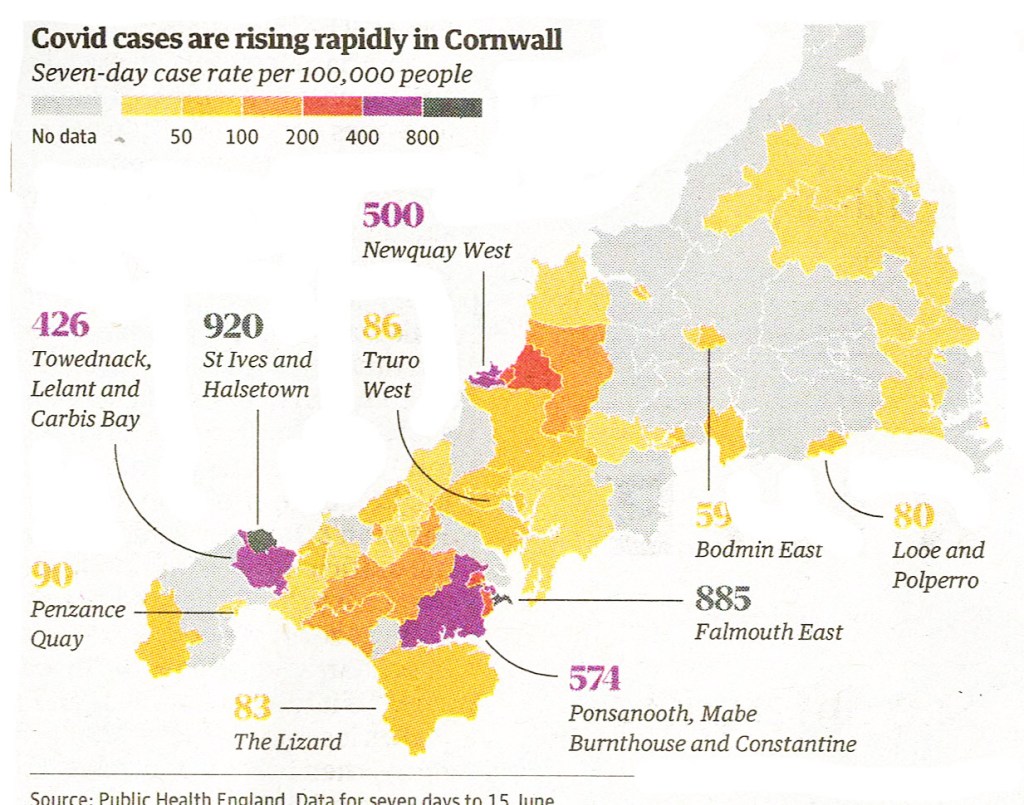
The government has denied the G7 summit is behind a rapid increase in Covid-19 cases in Cornwall, a rise that is raising significant concern about extra tourism pressures on the region in the summer weeks.

Nicola Davis, Jessica Elgot, Aubrey Allegretti print edition today’s Guardian

Recent seven-day case rates have risen rapidly for Cornwall and the Isles of Scilly, increasing from 4.9 per 100,000 people on 3 June to 130.6 per 100,000 people on 16 June.

Outbreaks among students, as well as the impact of people travelling to and from Cornwall during half-term, are believed to have contributed to the rise in cases.

There have been significant outbreaks in Carbis Bay – the area where the G7 summit was held – as well as nearby St Ives and Newquay West where many delegates stayed during the summit.

Rates are currently high in Ponsanooth, Mabe Burnthouse and Constantine, where the uptick has been linked to an outbreak at the Penryn campus that is shared by Exeter and Falmouth universities.

Andrew George, the former Lib Dem MP for St Ives who is now a councillor in Cornwall, said the government must publish its risk assessment for the summit, a request he said had been denied.

“The correlation between G7 and the tsunami of Covid-19 case-load in St Ives/Carbis Bay and Falmouth is undeniable,” he told the Press Association.

“It ought to drive public bodies to at the very least maintain an open mind about the connection between the two. Those who were responsible for that decision and for the post-G7 summit Covid-19 case management and assessment should be held to account for their decisions and actions.”

A spokesman for Boris Johnson yesterday denied a link between the event and the rise in cases.

“We are confident that there were no cases of transmission to the local residents. All attendees were tested, everyone involved in the G7 work were also tested during their work on the summit,” he said. “We always said, following the move to step three, that we will see cases rising across the country. That is what we’re seeing playing out.”

Concerns have been raised that those indirectly linked to the G7 summit could be associated with the rise, with police, hospitality venues and a protest camp in St Ives all reporting cases of the virus.

Rowland Kao, a professor of epidemiology at the University of Edinburgh who contributes to the Spi-M modelling subgroup of Sage, said Cornwall was not an outlier for vaccination uptake nor levels of the Delta variant, suggesting other factors were behind the rise in rates.

These, he said, may include low rates of infection in previous waves – meaning those not yet vaccinated are also unlikely to have natural protection – as well as seasonal working patterns and increased mixing among locals.

“Of course any risks would have been exacerbated by the large numbers of people arriving in Cornwall both for the G7 summit and for recreational purposes,” he said.

Dr Michael Head, a senior research fellow in global health at Southampton University, also said a mix of factors was likely to be at play. “Whilst the arrival of the G7 attendees may have had some impact upon the numbers we are now seeing [in Cornwall], cases are predominantly among 15- to 24-year-olds. These populations will mostly be unvaccinated, and there may well have been a fair amount of travelling to tourist sites over the recent half-term?’

The increase in Cornish cases is likely to raise questions about the effect on other holiday hotspots in the UK with the public now being advised to avoid international travel.

Officials believe that a vaccination drive targeting younger adults, ahead of the school holidays, is now possible with the four-week delay to the final easing of lockdown restrictions.

Planning Bill: Why do house building proposals face a backlash?

The government has put sweeping changes to England’s planning rules at the heart of its plan to increase house building.

BBC News www.bbc.co.uk 

Ministers insist the current system needs a radical shake-up to ensure more homes and vital infrastructure are delivered.

But the proposals have prompted a backlash, with some Conservatives citing them as a factor in local and by-election defeats for the party.

What’s going on?

The government wants to make controversial changes to the rules that determine house building and land use in England in a new Planning Bill.

The legislation was outlined at the Queen’s Speech in May, with detailed plans expected to be published later this year.

Ministers say the current system, still largely based on laws passed after the Second World War, has become outdated and ineffective.

As a devolved issue, the planning rules in Scotland, Wales and Northern Ireland are set by politicians there.

What are the new proposals?

Although ministers are still working on the exact plans, a blueprint for the overhaul was published by the government last summer.

It would see the current regime – where local planning officials assess applications case-by-case – replaced with new rules based on zones.

Councils in England would have to classify all land in their area as “protected”, for “renewal”, or for “growth”.

In protected areas, including areas of natural beauty, places at risk of flooding, and the green belt, development would generally remain restricted.

But councils would have to look favourably on development in “renewal” areas, whilst in “growth” zones, applications conforming to pre-agreed local plans would automatically gain initial approval.

Local residents would get a say on new 10-year plans underpinning the zones, but their ability to comment on individual applications would be curtailed.

Ministers argue this will speed up the planning process, and prevent viable developments being derailed by a “small minority” of vocal opponents.

They say zoning – as used in countries including Japan, Germany and the Netherlands – gives developers more “upfront” certainty of what can be built.

In addition, each council would have to plan for a share of homes from the government’s 300,000 annual house building target for England.

These quotas would be calculated by ministers and made binding – although how they would be enforced has not yet been specified.

Why have they been controversial?

Opposition parties say the plans would sideline communities from planning decisions – a criticism shared by many Conservative MPs and councillors.

They also argue that many developments that already have planning permission aren’t being built, and this should be more of a priority than changing the system.

In addition, Tory MPs in particular have expressed concern at government plans for calculating the binding local house building targets.

Although the exact formula has not been set out, ministers have said it will be based on a revised version of the algorithm currently used to estimate annual housing need in different areas.

That algorithm has already proved controversial among Tory MPs – with the government backing down in December on a previous plan to tweak it.

A number in southern constituencies had warned the changes, which gave a greater weight to affordability, would have concentrated house building in the party’s traditional heartlands.

How has the government reacted?

Following Tory MPs’ criticism, ministers unveiled a different tweak to the algorithm that placed a greater emphasis on building in urban areas and on brownfield sites.

According to planning consultancy Lichfields, it will see the planned allocation for southern England outside London drop from 137,000 to 113,700.

The capital itself will see a slight increase in its figure, with the biggest increases in Manchester, Leicester, Bradford, Derby, and Liverpool.

However, the change has failed to alleviate Tory backbenchers’ unhappiness on planning. Over 90 are said to be part of a WhatsApp group to share concerns.

Why is it a political problem for ministers?

The government will need new legislation to bring in its proposals, meaning it has to keep its MPs onside.

Some Conservatives also believe the plans were a factor in the party’s by-election defeat in the suburban seat of Chesham and Amersham, as well as notable losses in southern England at the May 2021 local elections.

But although changing course could bring some short-term respite for the government, it would also cause problems too.

Ministers have prominently argued their planning system is key to boosting house building, and “levelling up” the country through development in the Midlands and the north of England.

As well as being a key manifesto promise, this has emerged as a key plank of the party’s attempt to widen its geographical appeal.

And others in the party argue that unless more housing is delivered, the party could find it difficult in the long term to attract younger voters struggling to get a foot on the property ladder.

A Labour/Lib Dems alliance could defeat the Tories in seat after seat

“The Liberals in particular are a classic nuisance party, one that has not won a general election on its own since women won the vote. The party should either disband or sit down with Labour and agree never to contest at least winnable seats, in return for an agreed role in government. This must be what the electorate would welcome and is being denied.”

Simon Jenkins www.theguardian.com 

Anyone who predicts the outcome of general elections from byelections should stick to the horses. This applies especially to periodic Liberal Democrat upsets such as last week’s at Chesham and Amersham in Buckinghamshire, where they overturned a blue majority. This was nothing to do with choosing a government, rather it was passing judgment on Johnson’s “algorithmic” deregulation of rural planning in the south-east. It was about “taking back control”, community politics not party politics.

The Lib Dems stand for nothing radical or recognisable, just a vaguely left-of-centre outlook on life. Local issues aside, they appeal to those who vaguely agree with Labour, but cannot quite vote that way. As across Europe, the effect is to split the left-of-centre vote and thus empower the right. Over the weekend, the Lib Dem leader, Ed Davey, appeared to rule out any formal progressive pact. “We don’t need stitch-ups and deals,” he said. “I’m very sceptical about all that.”

Were Britain to be ruled by one-person-one-vote nationwide, it may well have returned a left-of-centre government in three of the past four elections. In the 2010 general election, the Tories won 36.1% of the vote, Labour and the Lib Dems together picked up 52%. In 2017, the Tories won 42.4% and Labour and the Lib Dems 47.4%. The last election in 2019, which was a Tory triumph in terms of seat numbers, saw the party win 43.6% of the vote, with Labour and the Lib Dems just ahead on 43.7%. In every one of these cases, the Tories still entered Downing Street.

First-past-the-post cannot be entirely blamed for this, though an additional member system as in the devolved assemblies in Wales and Scotland would partly redress it. The real cause is simply the refusal of the two major parties of the left to agree any form of alliance, local or national, against the right. The seismic upheaval of Brexit has seen a much-cited shift in the socio-economic underpinning of the left, of lower-income voters moving right and higher-educated voters moving left. In theory, that aids the Lib Dems, but it merely aids them in splitting the left.

Nationally, the Lib Dems are a Westminster club. When in the 2000s their leader, Charles Kennedy, pondered veering to the left of Tony Blair’s New Labour, he decided against it. But his party should then have set aside personalities, disbanded and thrown in its lot with Blair. A modern fusion of Labour and the Lib Dems should be forcefully capitalising on a Tory party steeped in corruption allegations.

If the Lib Dems are vacuous at Westminster, they are lethal at the constituency level. As has been pointed out, Labour’s red wall in the north has not stopped crumbling, while the idea that Chesham represents an equivalent blue wall failure is fanciful. All the Lib Dems (and Labour) are doing is ensuring the left-of-centre stays unrepresented in seat after seat where it enjoys an electoral majority. The Liberals in particular are a classic nuisance party, one that has not won a general election on its own since women won the vote. The party should either disband or sit down with Labour and agree never to contest at least winnable seats, in return for an agreed role in government. This must be what the electorate would welcome and is being denied.

At present Davey is simply determined to keep the Tories in power. He already has a knighthood. Johnson owes him an earldom.

They didn’t want to reveal these names

us15.campaign-archive.com /

Good Law Project is now able to reveal the names of six more companies awarded PPE contracts through the controversial ’VIP’ fast-track lane for associates of ministers and advisers. These six firms landed nearly half a billion pounds of public contracts – all without competition – and were uncovered in documents prised from Government in the course of our litigation:

  • Uniserve Limited is a logistics firm controlled by Iain Liddell. Prior to the pandemic the firm had no experience in supplying PPE, yet the firm landed a staggering £300m+ in PPE contracts from the DHSC and an eye watering £572m deal to provide freight services for the supply of PPE. The company shares the same address as Cabinet Minister Julia Lopez MP and is based in her constituency. Here they are together.
  • Draeger Safety UK Ltd which is a subsidiary of the Germany-based Draeger AG, landed a direct award contract in July 2020 to supply FFP3 masks valued at £87m. 
  • Urathon Europe Limited, a Wiltshire based supplier of wheelchair accessories, was handed two contracts worth £74m to supply face masks. Correspondence released during our recent PPE hearing revealed the Urathon contracts were ‘escalated through VIP Channel’. 
  • First Aid For Sport Limited, SanaClis, and Global United Trading and Sourcing PTE Ltd were awarded contracts from the DHSC worth a combined total of £28.6m. 

The six companies revealed here are in addition to the six other ‘VIPs’ previously revealed by Good Law Project. In April we revealed documents showing P14 Medical, Luxe Lifestyle, and Meller Designs were fast-tracked down the ‘VIP’ route alongside Pestfix and Ayanda. P14 Medical, run by a Tory donor and ex-Tory councillor, was awarded £276m in PPE contracts. Meller Designs, run by another large Tory donor, David Meller, won more than £160m of PPE contracts. Luxe Lifestyle, a tiny recently-formed company with no staff and no experience in buying and selling PPE, was awarded a contract worth £26m after being referred to the VIP lane by an MP.

This followed our scoop last December that Government had handed PPE Medpro, a firm linked to an associate of a Conservative peer with mystery investors, £200m of PPE contracts via the ‘high-priority lane.’

It’s been months of battle to get here. Why is Government so determined to keep the names of VIPs hidden? At whose request did they get ushered through the VIP lane? Documents revealed during our High Court hearing last month show civil servants were “drowning” in referrals from politically connected individuals, which were “consuming bandwidth to progressing viable opportunities”.

The NAO says 47 companies received PPE contracts after being referred to the VIP lane. Our investigations and cases have so far revealed the names of 12 of those companies.  

With your help, we will get to the truth. The more people are aware, the more powerful we will be. Will you please share this update with your friends and family now?

Thank you,

Jo Maugham

Director of Good Law Project

Exeter vaccine centre offering drop-in service for second jabs – this week only

For one week only, adults who are aged 40 and over can visit Exeter’s vaccination centre without having made a pre-booking to receive their second dose of the Oxford AstraZeneca vaccine.

Anita Merritt www.devonlive.com 

From today (June 21) until Sunday (June 27), drop-in appointments are being offered at Greendale Business Park which became Exeter’s mass coronavirus vaccination centre last month after relocating from Westpoint.

They will be available from 8.30am to 7pm, and are only available for certain people.

Anyone within one of these groups will be eligible:

  • aged 40 or over, clinically vulnerable or extremely clinically vulnerable
  • received their first dose of the Oxford AstraZeneca vaccine at least eight weeks ago
  • has yet to make an appointment for your second dose, or missed their original appointment

Those who do attend are being advised that the centre will also be dealing with booked appointments so there will be a wait, and that it is only for second doses of Oxford AstraZeneca.

An NHS spokesperson said: “Please continue to check social media for further information, in particular whether we need to close early due to demand.”

Devon has recorded 132 new positive coronavirus cases in the latest 24-hour reporting period, the newest data has revealed.

The new cases in Devon can be broken down according to council areas as follows: six in East Devon, 45 in Exeter, 10 in Mid Devon, six in North Devon, 40 in Plymouth, two in South Hams, four in Teignbridge, 11 in Torbay, eight in Torridge, and zero in West Devon.

People have been urged to take a lateral flow test twice a week if they are out and about. You can see where they are available by clicking here, and they are free.

Nationally 9,284 new cases have been recorded, making a total of 65,558 new Covid-19 cases in the past week.

Last week, Devon County Council said the largest volume of positive Covid-19 cases are among young people and the younger working age population, 20 to 39 year olds.

A spokesperson said: “It’s probably less to do with the fact they’re working – we’re not seeing an especially high number of outbreaks in workplace settings – and more likely that these age groups are just beginning to be vaccinated, so until now they haven’t been as well protected as older, already vaccinated, age groups.

“It is also likely that this is an age group that tends to mix more socially. We know that increased socialising, particularly indoors, increases the risk of transmission, and with pubs, restaurants and many other places open again, the opportunity for social contact is much more available.

“So, here’s a plea to everyone, including this younger working age population. Please be mindful. We’ve still got to be careful.

“There are still rules, especially around social distancing and face coverings indoors, and we need to follow them. And please take up the vaccination when you’re invited to do so.”

If you are eligible and wish to book a first vaccine appointment, please visit www.nhs.uk/conditions/coronavirus-covid-19/coronavirus-vaccination/book-coronavirus-vaccination

Planning applications validated by EDDC for week beginning 7 June

Catch-up on the major developments approved or rejected in Devon in the last six months

“New student flats, cinemas, thousands of new homes, river restoration works, health centres, new roads, hotels, Dawlish railway line works and town centre regeneration schemes are all among the list of plans that have either been put forward or seen councillors cast votes for approval or rejection.”

New cinema and giant indoor climbing centre for Exeter

Daniel Clark www.devonlive.com

It may not necessarily feel like it, but we are nearly half-way through 2021.

And with lockdowns, coronavirus restrictions, and a slow return towards normality, you can easily be forgiven for missing some of the bigger stories that have happened in the past six months.

New student flats, cinemas, thousands of new homes, river restoration works, health centres, new roads, hotels, Dawlish railway line works and town centre regeneration schemes are all among the list of plans that have either been put forward or seen councillors cast votes for approval or rejection.

But the Local Democracy Reporting Service has taken a look back at the biggest planning applications that have both been submitted, and determined, by councils, so far this year.

SUBMITTED

KING BILLY

Plans to demolish an historic Exeter city centre pub and replace it with student flats have been resubmitted to planners after the time limit for work to begin expired.

Back in October 2017, Exeter City Council’s planning committee granted approval for the major student flats plan for Exeter’s The King Billy, which would also see a commercial unit and a restaurant/pub at street level.

Promoted Stories

But as more than three years later, work on the redevelopment of the Longbrook Street site has not begun, the extant planning permission has expired, forcing developer Rengen to go through the planning process again.

It has resubmitted the application, which is identical to the one that was given the go-ahead by planners more than three years ago.

The student flats plans would see 108 bed space student accommodation above a retail unit and a pub/restaurant on the ground floor, over 6 and 7 storeys.

The King Billy pub in Exeter closed in July 2018

The King Billy pub in Exeter closed in July 2018

When the scheme was recommended for, and subsequently granted, planning permission in 2017, officers in their report said: “It is considered that the scheme represent an opportunity for the site, which has remained, in part, vacant for many years to be developed for uses which are appropriate for this location.”

CLIMBING CENTRE

Fresh plans to open a new indoor climbing centre in Exeter have been unveiled after a previous bid fell through.

Last June, Grip UK Ltd’s plans to convert a vacant building in Mallard Road, in the Sowton Industrial Estate, into an indoor climbing centre, were approved by Exeter City Council under delegated powers.

But discussions with the freeholder of the building did not proceed further and therefore alternative premises have had to be considered to accommodate the use, a statement with the new planning application says.

And new plans to convert a vacant warehouse building and two-storey office accommodation at 6 Marsh Green Road, Exeter, into an indoor climbing centre have now been submitted to Exeter City Council.

The venture would be operated by the Climbing Hangar, which already has a site in Plymouth and which provides a unique leisure experience comprising a centre for climbers of all levels to practice bouldering.

STUDENT FLATS

Plans for new student flats right in the heart of Exeter city centre which would also see vacant shops brought back to life have been lodged.

SJR has submitted plans to Exeter City Council which would see the upper floors of 36, 37 and 38 High Street converted into student accommodation, with the reconfiguration of the ground floor retail units.

Numbers 36 and 37 were previously occupied by Paperchase, while 38 is currently occupied by Mountain Warehouse, with retail space spread over three storeys.

The plans would see the unoccupied basements brought back into use to support the retail uses, while the redundant upper floors would be converted into affordable student accommodation, with a total of 24 bedrooms configured within eleven self-contained student apartments.

A key objective of the proposal is to invest in the building to maintain retail uses on the ground floor and bring life back into this area of the high street, documents with the planning application state.

Artist impression of the student flats plan for Exeter High Street

Artist impression of the student flats plan for Exeter High Street (Image: Willmore Iles Architects)

It is proposed that the building will be named ‘Martin’s Gate’, in reference to one of seven historic gates used to enclose Cathedral Close, one of which was located in Martin’s Lane itself which will get an improved entrance under the scheme.

CIVIC CENTRE

Long-awaited plans for the demolition and replacement of a huge building widely considered to be one of the ugliest in Devon have finally been unveiled.

The Civic Centre on the banks of the River Taw in Barnstaple has been sat empty since 2016 when owners Devon County Council withdrew its staff from the property. That followed the relocation of North Devon Council staff to new premises at Brynsworthy on the outskirts of Barnstaple back in 2015.

The 10-storey 1960s-built office block has been empty ever since, but Churchill Retirement Living Limited has now submitted plans for the site at North Walk.

Artist impression of the proposed redevelopment of the North Devon Civic Centre

Artist impression of the proposed redevelopment of the North Devon Civic Centre (Image: NPA Visuals)

Its scheme, submitted to North Devon Council planners, would see the building partially demolished and then redeveloped into a five and six-storey retirement living development comprising 77 retirement apartments including communal facilities, access, car parking and landscaping.

The proposed development comprises of 49 one-bedroom and 28 two-bedroom apartments, with a statement in support of the application saying that it is acknowledged that there is a “critical’’ need for the delivery of older people housing and a significant pressing need within the administrative boundary of the council, to which the proposal will contribute towards delivering these much needed homes, including older people housing.

DECOY PLAY PARK

Grand plans for the refurbishment of the Decoy Country Park play park to provide excitement, fun, movement and adventure have been unveiled.

The play park in Newton Abbot will be closed from June 6 for approximately eight weeks while Teignbridge District Council carry out the works.

Last year, councillors agreed to spend a six-figure sum on refurbishing the three play zones at Decoy Country Park, with the cost of the refurbishment funded by the Community Infrastructure Levy and Section 106 funds gained through the planning process.

The works have been delayed as a result of the coronavirus crisis with them initially set to be carried out in 2020, but when complete, it aims to ensure the provision of an updated exciting facility which maintains Decoy Park as a popular outdoor attraction.

And while most of the scheme doesn’t require formal planning permission, the provision of a new 5.4m high timber tree house to replace the existing 5.62m high castle unit does, and the council has submitted a planning application for the works.

The new tree house will be of a similar timber construction to the existing castle unit, will feature a multi deck at a height of 1.45m and a twisting tube side that descends from the tallest deck on the structure at 2.8m, and will feature multiple routes up to the highest platform to ensure good safe movement around the play equipment.

Artist impression of the proposed refurbishment of Decoy Play Park

Artist impression of the proposed refurbishment of Decoy Play Park

Documents with the planning application also reveal further details of what the refurbishment to the play park will consist of, with the overall design aimed at providing as naturalistic a play area as possible, while recognising the need to provide robust play equipment and safety surfacing that can be used all year round.

There will be a junior area, a toddler area and an adventure area as part of the works, with new hard landscaping to make it more usable by removing some of the worst mud spots, while new seating areas will also be included in the improvement scheme.

BOVEY TRACEY HOSPITAL

Revised plans for the demolition of a former hospital which would see custom built housing in its place have been unveiled.

Bovey Tracey Hospital dates back to 1931, but was closed by health officials in 2017, although the inpatient ward at the hospital had closed in December 2015.

Artist impression of the housing plans for the former Bovey Tracey Hospital

Artist impression of the housing plans for the former Bovey Tracey Hospital (Image: H2land Ltd)

The Furzeleigh Lane building had been registered with Teignbridge Council as an asset of community value, but no viable use or community group came forward with a bid for the site.

Last year, plans by H2land Ltd on behalf of the Torbay and South Devon Foundation Trust, which owns the site, were submitted to Teignbridge District Council to demolish the building and build six new homes in its place.

Those plans have now been superseded by a revised scheme which would see four self and custom-build new homes provided on the site so that homeowners can tailor their properties to suit specific individual requirements.

TEIGNMOUTH HEALTH AND WELLBEING CENTRE

Plans for Teignmouth’s new health and wellbeing centre as part of a town centre regeneration project have been submitted.

The £8 million Health and Wellbeing Centre is to be built by Torbay and South Devon NHS Foundation Trust in the heart of Teignmouth and is due to open in 2022, subject to planning permission.

The South Devon Health Innovations Partnership has put forward the formal planning application for the scheme which would see the demolition of redundant building on Brunswick Street and a new health centre built in its place.

Artist impression of the new Teignmouth health and wellbeing centre

Artist impression of the new Teignmouth health and wellbeing centre (Image: KTA Architects Ltd)

The Torbay and South Devon NHS Foundation Trust proposes to re-provide and co-locate a number of health services at the site, and the centre will accommodate two GP surgeries (Channel View Medial Practice and Teignmouth Medical Group) together with community nurses, therapists and lifestyles and prevention services as well as voluntary services and a pharmacy.

The inclusion of an on-site pharmacy is important since it allows GPs to liaise with the pharmacist easily and directly about the best drugs regime for patients and it provides patients with a one-stop shop alongside consultation and treatment, a statement with the application submitted to Teignbridge District Council planners says.

The building will include 25 specialist consulting rooms, six healthcare assistant rooms, seven specialist treatment spaces, musculoskeletal assessment, an audiology room, a podiatry room, as well as space for Volunteering in Health, the integrated pharmacy, a main reception space, four waiting areas and admin, office, staff hub and interview spaces.

Some of the services proposed for the new health and wellbeing centre are set to be transferred from Teignmouth Hospital, for which the Devon CCG in December 2020 gave approval, although councillors subsequently asked independent experts to look again at the decision.

EXETER CINEMA

Plans have been unveiled to convert Exeter’s closed Debenhams store into a new cinema.

Montagu Evans LLP, on behalf of Purple Investment Management LLP, has submitted a scheme for the former department store in Princesshay that would “contribute to the vitality and economy of the city centre”.

The four-screen cinema would be situated on the third floor of the building, with the applicants seeking tenants for the ground, first and second floors of the Bedford Street premises.

Artist impression of the proposed new cinema for the Exeter Debenhams site

Artist impression of the proposed new cinema for the Exeter Debenhams site (Image: Chapman Taylor)

A large foyer on the top floor area would also be provided, including a seating area and a bar, with the application stating that the views to the cathedral is a key consideration for the cinema operator when selecting the site for its proposed operation in Exeter.

CREDITON LIDL

Plans for a new Lidl in Crediton that would also help unlock land for a new housing development have been unveiled.

The budget supermarket has submitted plans for a new store on the outskirts of the town on land that is currently used by Crediton Rugby Club.

Under the proposals, Lidl would provide a £400,000 financial contribution to the club to allow them to move forward with purchasing their new home at Pedlarspool.

This would also unlock the reminder of the site off Commercial Road for housing, with up to 120 new homes allocated as part of the local plan – but with a condition that no development can take place until the rugby club have a new home.

A statement with the planning application says that if approved, the new Lidl will be constructed “at the earliest opportunity” and provide residents with increased choice and competition in food shopping in the town.

TORQUAY GATEWAY

Plans for a new Aldi, Costa Coffee and a fast food restaurant at ‘the gateway to Torquay’ have been unveiled.

The supermarket chain submitted plans for a new supermarket to be built on the edge of the town, saying that in light of the current economic uncertainty, the investment is more important than ever.

The scheme for Kerswell Gardens would see the demolition of the existing buildings on the existing Devon Garden Machinery on Newton Road, in Kingkerswell, right next to the end of the South Devon Highway, and the construction of the discount supermarket, drive-through coffee shop, drive-through fast food restaurant, as well as a replacement retail building for Devon Garden Machinery.

A statement with the application said the redevelopment will re-invigorate an under-developed site, help maintain continued investment and jobs within the local area, that the provision of a discount food store and food outlets will provide valuable services to the local community and open up opportunity for future development to the north of the site.

A new single-storey Aldi food store with associated customer parking is proposed in the lower half of the site, and the scheme would provide 106 parking spaces.

Kerswell Gardens new Aldi artist impression

Kerswell Gardens new Aldi artist impression

The fast food outlet – an occupier of which is not named – would consist of a unit that would also facilitate drive-through as well as space for a restaurant, kitchen and back of house uses.

The coffee shop – for which Costa Coffee is named – would be a single-storey standalone outlet with a drive-through facility.

A two-storey workshop/showroom and repair bay building for Devon Garden Machinery, a garden, estate and turf maintenance machinery retailer and servicer as well as an area of land reserved for external storage would also be created.

PUB CONVERSION

This is a bid to diversify the operation of the Highwaymans Haunt pub on the edge of Chudleigh to accommodate a strategy better suited to the changing needs of the hospitality industry in the countryside.

The application would see a change of use from a public house to mixed use, licensed café and farm shop, and change of use of land from agricultural to tourism to provide a 25-pitch campsite.

The Highwaymans Haunt pub in Chudleigh

The Highwaymans Haunt pub in Chudleigh (Image: Daniel Clark)

It says the strategy will have the potential to increase the current employment by four full-time employees and six part-time staff along with increased employment for local traders and producers

DETERMINED

LOWER OTTER RESTORATION

Councillors unanimously backed multi-million pound plans to restore the Otter estuary to its natural and historic flood plains.

East Devon District Council’s planning committee voted to approve the Lower Otter Restoration Project (LORP), which will create 55 hectares of mudflats, saltmarsh and other valuable estuarine habitats.

The £15m project, led by landowner Clinton Devon Estates and the Environment Agency, will see the Big and Little Marsh floodplains around Budleigh Salterton restored, with breaches created in the Little Bank, the Big Bank and the River Otter Embankment to allow water to flow through.

The aim is to avoid the significant risk that a major flood or extreme tidal event could lead to catastrophic failure of the existing embankments, with unpredictable environmental and social impacts, given that in recent years, part of the South West Coast Path that runs along the embankments have been closed to the public for significant periods due to erosion caused by such events.

The committee heard that if nothing was done, then changes to the environment would likely occur, but would be unmanaged and unpredictable, and backed the officer recommendation to approve the scheme.

Mike Williams, from the Environment Agency, told the meeting that its vision is for a nation ready for and resilient to coastal change, today, tomorrow and to the year 2100, and the LORP plays a part in delivering that vision for East Devon.

As part of the plans to restore the historic floodplain of the River Otter, breaches in existing embankments would be created to allow water from both the River Otter and the estuary to inundate the site, creating intertidal saltmarsh and mudflats.

The Lower Otter Estuary in Budleigh Salterton.

The Lower Otter Estuary in Budleigh Salterton. (Image: PACCo)

In addition, South Farm Road will be realigned and raised at a point just to the south of the existing road, and a small car park created at its western end and a new road bridge will be required, and a new footbridge to the south. Existing footpaths will be realigned and the landfill site capped and planted with grassland and woodland.

The spit to the south will be allowed to evolve naturally, necessitating the removal of the southern part of the loop path known as Donkeys Turn.

The cricket club will be moved from its current location to land off of East Budleigh Road, permission for which has already been granted under a separate planning application. Floods have left part of their current Ottermouth home under water on three occasions in the past 10 years, with a plan to relocate to Janie’s Field on the outskirts of the town having been agreed.

ILFARCOMBE EXTENSION

Plans for nearly 350 homes as part of the first phase of the major southern expansion of Ilfracombe have been given the go-ahead.

North Devon Council’s planning committee backed Inox Homes (Ilfracombe) Ltd’s scheme which will see 347 homes built on land to the east of Old Barnstaple Road

Outline plans for up to 750 homes together with a mixed-use centre, extra care housing/facility and primary school the huge 187-acre site off Old Barnstaple Road were approved back in 2017.

Councillors agreed with the officer recommendation to approve the scheme, as well as a related application for playing pitches, a multi-use games area (MUGA) and car parking.

STUDENT FLATS

Plans that could see an extra 1,250 bedrooms in student flats to be built on the University of Exeter campus have been given the go-ahead.

The university’s plans for the development of the Clydesdale, Nash and Birks Grange Village Halls of Residence site off Stocker Road, which could deliver an additional 1,250 bedrooms, were overwhelmingly supported by Exeter City Council’s planning committee.

Councillors agreed with the recommendation of approval that planning officers had suggested, saying that purpose-built accommodation on the university’s own campus was the best way to reverse the trend of family homes in the city being occupied by students.

The plans would see the demolition of the existing Clydesdale and Nash Grove accommodation buildings – built in the late 1980s and early 1990s – and the construction of new student accommodation buildings ranging in height from three to eight storeys.

Ancillary services, such as a shop, café and facilities, are to be provided in the ground floor of some of the buildings.

The scheme will also see the existing Birks Grange refectory building demolished and replaced with the construction of a new six-storey student accommodation building, with ancillary social and amenity space on the ground floor.

At the existing Birks Grange Village Student residences, the accommodation blocks would be refurbished to Passivhaus standards and include changing from catered halls to self-catered halls by introducing a kitchen within each flat.

Artist impression of the Clydesdale and Birks Residential student flats development at the University of Exeter

Artist impression of the Clydesdale and Birks Residential student flats development at the University of Exeter

The Estate Services Centre would also be demolished and replaced with the construction of a new three and four-storey student accommodation building, with separate plans to relocate the existing Estate Services Centre to a new location at Rennes Drive also approved.

A net increase of between approximately 1,200 to 1,250 student bedrooms within the university campus would be delivered, a statement with the application says, although the precise number of units is not for determination at this stage given that this was an outline application.

YELLAND QUAY

Locals cheered as North Devon Council Planning Committee voted 11 to 2 in favour of rejecting plans to build a multipurpose housing development on the Taw-Torridge Estuary.

There had been more than 900 objections to the proposals – with only two letters of support – but planners had recommended that the scheme for Yelland Quay be approved.

Artist impression of the Yelland Quay regeneration scheme

Artist impression of the Yelland Quay regeneration scheme (Image: Woodward Smith Chartered Architects LLP)

The scheme includes 250 new homes, employment land, retail space, cafes and restaurants, indoor sports provision, public halls, with a unique community centre building to be found almost floating at the heart of this mini-development.

But on the grounds that it would not deliver “appropriate” housing requirements, impact on highways and local traffic, the harm it will cause to the landscape and “inadequate infrastructure” that does not meet local needs, councillors refused the scheme.

NEWTON ABBOT TRAVELODGE

Plans for a new Travelodge hotel to be built in the heart of Newton Abbot have been given the go-ahead.

Teignbridge District Council’s planning committee backed the council’s own plans, which would see the Halcyon Road car park converted into a 72-bedroom hotel with a restaurant.

Councillors agreed with the recommendation of officers of approval, saying that it was a long-term aspiration for the town, would boost footfall and spending, especially post-Covid, and would have significant net benefits.

The new hotel is the second phase of Teignbridge District Council’s masterplan for the centre of Newton Abbot, with a 25-year lease having already provisionally been agreed with Travelodge.

Artist impression of the Halcyon Road Travelodge plans for Newton Abbot

Artist impression of the Halcyon Road Travelodge plans for Newton Abbot

The five-storey hotel would include a total of 72 bedrooms, as well as a restaurant for 48 covers. There will be 31 parking spaces located to the southern part of the site, with further spaces to be allocated to Travelodge in the multi-storey car park with a voucher ticketing system in the hotel foyer.

SALSTON MANOR

Plans to save one of Ottery St Mary’s most important buildings have been approved.

East Devon District Council’s planning committee unanimously agreed to support plans that would see 13 homes built within the grounds of the former Salston Manor on the edge of the town.

The Salston Manor Hotel in Ottery St Mary

The Salston Manor Hotel in Ottery St Mary

The plans would also see an extension to the building constructed for a further two homes and would enable a previously consented but not implemented scheme for the conversion of the main building to form 11 flats to go ahead.

Councillors heard that the site is outside the built-up area boundary of Ottery St Mary and was contrary to local plan policies, particularly as no affordable housing was to be provided, but that the wider benefits from the restoration of the listed building outweigh the negatives of the scheme and thus it was recommended for approval.

BRUNSWICK WHARF

Multi-million pound plans for the regeneration of the waterfront area in Bideford have been given the go-ahead.

Torridge District Council’s planning committee almost unanimously supported the redevelopment of the Brunswick Wharf site on the East-the-Water side of the Long Bridge.

The £20m-plus scheme from Red Earth Developments features apartments, design studios, boutique retail and restaurants, as well as 85 apartments and a public square with a riverside walk.

Councillors heard that the scheme aims to breathe new life into this neglected stretch of waterfront, bringing vital long term investment to the East-the-Water area, as for “too many years, the site has sat like an open wound in the heart of Bideford, festering and decaying and blighting the river frontage”.

The scheme includes 85 apartments, a signature restaurant, five design studios with potential for live/work, a café, eight boutique retail units, a public square with a riverside walk, 103 private parking and 45 public parking spaces, 133 private cycle stands and 40 public cycle stands.

A public square and attractive new riverside walk will also be developed as the scheme aims to breathe new life into this neglected stretch of water-front, bringing vital long term investment to the East-the-Water area.

Artist impression of the Brunswick Wharf regeneration plans

Artist impression of the Brunswick Wharf regeneration plans (Image: Red Earth)

The layout of the development will create three open-sided squares – two private and one public – linked by a quayside walk along the entire frontage of the site.

The public square will have retail, restaurant and design studios around the three edges with different levels giving form and interest for visitors, and a coffee house sits central to the square and its design form references the shipbuilding history of the site

WOLBOROUGH HOUSING

The massive new 1,210-home housing development on the green hills outside Newton Abbot is set to go ahead after the last legal challenge to block the scheme failed.

The Court of Appeal this week has rejected all the arguments put forward by Abbotskerswell Parish Council over whether a High Court ruling that the planning permission for the Wolborough scheme was sound.

The parish council had claimed the judge’s verdict contained errors in law, but in the order made by the Right Honourable Lord Justice Stuart-Smith, it was ruled that none of the grounds for appeal on which Abbotskerswell Parish Council had challenged the initial verdict on were valid, ruling that in his judgement that there is no discernible error and no other compelling reason for an appeal to be heard as the judgement is closely reasoned and successfully applies conventional and established principles to the facts of the present case.

The Wolborough Barton masterplan

The Wolborough Barton masterplan

The rejection of the appeal means that the challenge to the granting of planning permission which the secretary of state had given can go no further, meaning the outline permission for the scheme, as well as full permission for the Wolborough Barton farmstead element has now been given.

PCL Planning’s scheme, submitted on behalf of the Rew family, for the land at Wolborough Barton, in Newton Abbot includes an outline scheme of 1,210 homes, a primary school, employment land, community facilities, including a day nursery and a health centre, a local shopping centre, play area, allotments and a multi-use games area, as well as a link road connecting the A380 and the A381.

Reserved matters for the detail will need to be submitted and approved before work can begin, but full planning permission to convert the Wolborough Barton farmstead into a boutique hotel, restaurant and bar, has now been granted.

BARNSTAPLE CINEMA

Plans to extend a North Devon shopping centre to create a new seven-screen cinema and refurbishment of retail units have been approved.

The application, granted planning permission under delegated powers by officers, would see big changes made inside the Green Lanes Shopping Centre in Barnstaple.

The space occupied by the former BHS store will stay as retail, but the upper two floors, plus an additional newly-built floor above, would be converted into a seven screen multiplex cinema.

Artist impression of the Green Lanes Shopping Centre Cinema plans

Artist impression of the Green Lanes Shopping Centre Cinema plans

It would be the replacement cinema for the existing four screen Scott Cinema on Boutport Street, the application says.

It adds that there would be clear significant economic benefits for the town and this area of North Devon and the improved cinema facility will be of benefit to both the resident population and tourists/visitors.

Granting planning permission for the scheme, the report of planning officers concluded that the public benefits of the scheme, which includes protecting the vitality and viability of the town centre and overall economic benefits, outweigh the negative impacts on balance.

DAWLISH ROCKFALL SHELTER

Work is set to begin this summer of a 200m tunnel to protect trains against falling rocks on the Dawlish railway line.

Teignbridge District Council planners under delegated powers have approved Network Rail’s plans to extend the existing rockfall shelter over the railway line between Dawlish and Holcombe.

Following approval, Network Rail hopes to begin construction work on the 209m extension of the rockfall shelter north of Parsons Tunnel in August which will help protect trains against falling rocks along this section of vital railway that connects communities across the South West with the rest of the country.

Parsons Tunnel was previously extended 100 years ago, and Network Rail will extend that further by providing a rockfall shelter in modern materials, but with open sides rather than the brick built enclosed tunnel extension.

Once started, construction of the £37.4m project is expected to take around a year to complete.

Artist impression for the Parsons Tunnel North rockfall shelter plans

Artist impression for the Parsons Tunnel North rockfall shelter plans (Image: Network Rail)

Preparatory work at the top of the cliffs overlooking this stretch of railway has already begun in March whereby Network Rail engineers started cutting back some of the vegetation. This work is being closely monitored to ensure the least disruption for wildlife habitats and biodiversity.

The rockfall shelter, which is the third phase of works on the Dawlish line, and follows the two sections of new sea wall in Dawlish, is critical to ensuring the resilience of the railway between Dawlish and Teignmouth for generations to come and protecting this critical route from falling debris.

PIRATES STATUE

Plans for the installation of a statue of two real-life female ‘Pirates Of The Caribbean’ on Burgh Island have been withdrawn.

Earlier this year, the bid for the art installation on Burgh Island to represent two of Britain’s forgotten pirates – Anny Bonny and Mary Read – was unveiled and a planning application submitted to South Hams District Council.

The pair were among the most notorious pirates as they wreaked havoc throughout the Caribbean during the golden age of piracy in the early 1700s.

Some historians have claimed the two became lovers while others suggest they formed a three-way relationship with Anne’s husband, the English pirate captain Jack Rackham – more commonly known as Calico Jack.

The sculpture would have measured approximately 2.4m high and sat on plinths that would be 50x30cm and 25x30cm, respectively, with the addition intended to be “a gift to the Island that is home to such rich pirate history”.

Anne Bonny, John 'Calico Jack' Rackam and Mary Read: Some historians claim the two became lesbian lovers while others suggest they formed a three-way relationship with Anne's husband, the English pirate captain Jack Rackham - more commonly known as Calico Jack

Anne Bonny, John ‘Calico Jack’ Rackam and Mary Read: Some historians claim the two became lesbian lovers while others suggest they formed a three-way relationship with Anne’s husband, the English pirate captain Jack Rackham – more commonly known as Calico Jack (Image: Getty Images)

But following objections to the proposals from the parish council, the applicant – The Producers Live Ltd – has withdrawn the plans and instead will focus on finding an alternative location for the memorial.

Its statement said: “Following feedback from the parish council, we will be withdrawing our application to install “Inexorable” on Burgh Island. The statue was intended to be a gift to the Island that is home to such rich pirate history. We absolutely respect the decision of the council and will find an alternative home for Anne Bonny and Mary Read.”

EXMOUTH HOUSING

Plans for more than 300 homes to be built on the edge of Exmouth have been given the go-ahead despite the scheme “lacking vision and being fit for the 20th, not 21st century”.

East Devon District Council’s planning committee almost unanimously backed the recommendation of officers to approve the scheme for the Goodmores Farm site at Hulham Road.

Outline planning permission for the scheme was granted for up to 350 homes in June 2018, which included only five per cent of the homes being affordable.

And while councillors were upset with the lower than 25 per cent policy requirements, there was nothing they could do to change it as the principle of the development had previously been agreed.

The proposals for 303 homes at the Goodmores Farm site at Hulham Road in Exmouth

The proposals for 303 homes at the Goodmores Farm site at Hulham Road in Exmouth

The scheme, which was backed by 11 votes to 1, with one abstention, includes 303 homes, 2.3 hectares of mixed use employment land, 1.3 hectares of land for a primary school, a football pitch and a locally equipped area for play.

CULLOMPTON RELIEF ROAD

Plans for Cullompton’s long-awaited and “essential” relief road have been unanimously given the go-ahead. Mid Devon District Council’s planning committee voted in favour of the new road that aims to take traffic out of the town centre.

The £15million relief road scheme, which officers recommended for approval, will see the new road built to connect Station Road to Duke Street near the Meadow Lane junction and to divert traffic away from travelling through Cullompton town centre.

It is primarily proposed to address existing traffic and transport problems within the town and the associated impacts on air quality, environment and amenity.

The route for the Cullompton relief road

The route for the Cullompton relief road (Image: Devon County Council)

It would incorporate land currently within Tesco’s ownership, land that is part of the Cullompton Community Association (CCA) fields and sports facilities, including those used by Cullompton football, cricket and bowls clubs, and agricultural land to the south.

It is hoped that phase one works would be able to commence in winter 2021 and the scheme is proposed to be implemented in three phases, allowing for as little interruption to as possible to existing sports facilities, recreation and amenity land, and reducing the wider impacts on other amenities as a result of the construction period.

DARTINGTON HOUSING

Councillors have backed plans for 120 homes to be built on the edge of Dartington.

The sites – at Broom Park and Sawmills North – cover two green fields with 120 houses planned and are both allocated for residential development as part of the adopted Plymouth and South West Devon Joint Local Plan.

The outlines schemes – put forward by Baker Estates and the Dartington Hall Trust – would see 80 homes built at Broom Park and 40 at Sawmills North and when South Hams District Council’s development management committee considered them, it agreed with the officer recommendations for approval, despite more than 200 objections to the plans.

The officers, in their report, stated that all statutory consultees and specialist advisers had no objections to the proposals and, as such, they are recommended to go ahead, and councillors voted by 10 votes to 2 in favour of the Sawmills North scheme and by 10 votes to 1, with one abstention, for the Broom Park plan.

INGLEWOOD HOUSING SCHEME

Plans for a new village on fields near Paignton have been given permission by a planning inspector. The government-appointed official has allowed an appeal by the developer for the site known as Inglewood.

The scheme was opposed by Torbay Council because of its impact on the landscape.

Evidence for the appeal was heard at an online planning inquiry in January.

In a published decision, inspector Andrew Dawe has given outline permission for up to 373 homes, a pub and primary school on land alongside Brixham Road near White Rock.

Objectors said the development would cause unacceptable harm to the setting of the protected landscape and the open space between Paignton and Brixham.

The inspector accepted the scheme would cause some harm to the landscape character and appearance of the area.

Indicative image of the Inglewood development, proposed between Paignton and Brixham

Indicative image of the Inglewood development, proposed between Paignton and Brixham (Image: Stride Treglown)

It would also go against local planning policies by filling part of the “settlement gap” of open countryside.

But he said the limited harm to the landscape was not enough to justify rejecting the application.

TOPSHAM GAP HOUSING

Plans for nearly 250 new homes for the ‘Topsham Gap’ have been given the go-ahead by councillors.

Exeter City Council’s planning committee unanimously approved three separate applications for the edge of the town.

The Clyst Road site where 155 homes in the Topsham Gap will be built

The Clyst Road site where 155 homes in the Topsham Gap will be built

Outline plans for 61 residential units for land at Broom Park Nurseries and Five Acres on Exeter Road, and outline plans for 24 homes at an adjacent site off Exeter Road were given the go-ahead in line with the officer recommendation for approval.

And councillors also granted the reserved matters approve for 155 homes at Clyst Road, a site that they have previously refused planning permission for, only to see a planning inspector overturn the site on appeal.

MONKERTON HOUSING

Plans for 200 homes on the edge of Exeter which include safeguarding land for the potential Monkerton railway station have been approved.

Exeter City Council’s planning committee almost unanimously backed the scheme that will be up to 200 homes built on land at Hill Barton Farm.

The site is allocated for development within the Monkerton and Hill Barton Strategic Residential Allocation and previous outline planning permission for a scheme had been granted but lapsed as work had not begun.

Planners had initially recommended refusing the scheme as only 10 per cent of the houses were due to be affordable, but following late negotiations, that had been increased to a policy-compliant 35 per cent.

They subsequently changed their recommendation to approval, and councillors backed the plans by 12 votes to 0, with one abstention, when they met.

Planning officers had told the committee that it was accepted that the site meets the principle for housing as sustainable development, that the council does not have a current five year housing land supply, and it was clear that the scheme as submitted for 200 dwellings would contribute towards the council’s shortfall of deliverable housing sites in the area.

And following the confirmation that their proposed offer of 10 per cent affordable housing has been increased to a policy-compliant 35 per cent affordable housing, they said that it was recommended the plan be approved.

HARLEQUIN SHOPPING CENTRE

Controversial plans to redevelop Exeter’s Harlequin Shopping Centre into co-living apartments will go ahead after the secretary of state for housing, communities and local government decided against calling the application in.

Exeter City Council approved plans to turn the centre into co-living apartments, along with a hotel and other facilities, back in October.

The redevelopment will see two blocks built on the site – block 1 would see a total of 251 co-living bedrooms – which involves a number of flats being built for students but can be rented by non-students as well – with 116 hotel bedrooms in Block 2.

The plans will also see the creation of a pocket park, significant improvements to the urban realm of Paul Street, enhancing the environment for pedestrians and cyclists and the replacement of the pedestrian bridge over Paul Street with a modern, lightweight bridge.

New artist impression of the Harlequin Shopping Centre redevelopment scheme (Image: Curlew)

However, requests were then made to the government calling on the secretary of state, Robert Jenrick, to make the final decision because of the impact on the historic environment.

But Mr Jenrick has said he is satisfied that in this case it was appropriate that the decision was made at local level.

In deciding not to call the application in, the government said: “The secretary of state has carefully considered this case against call-in policy, as set out in the written ministerial statement by Nick Boles on 26 October 2012. The policy makes it clear that the power to call in a case will only be used very selectively.

“The Government is committed to give more power to councils and communities to make their own decisions on planning issues, and believes planning decisions should be made at the local level wherever possible.”

Exmouth to get new free-to-use car park

Works to create a brand new free-to-use Exmouth car park will begin on Monday, 21 June.

Authored by Mary www.thedevondaily.co.uk

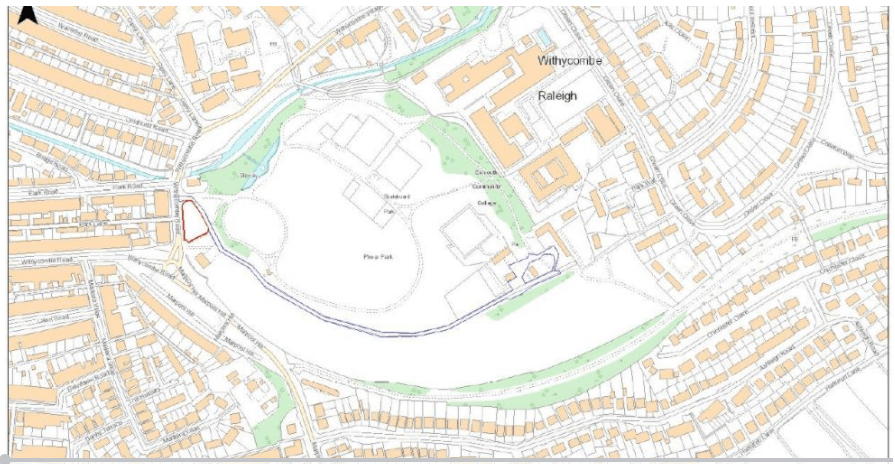
East Devon District Council (EDDC) will be creating the 12-space parking area in Phear Park.

The authority will also be resurfacing the area’s access road, from Withycombe Road to the Rifle and Pistol Club.

The access road has been in a deteriorating condition for several years, requiring regular pothole repair. It is hoped the resurfacing works will help to reduced ongoing maintenance costs.

The new parking area will be built on the grass verge near to the vehicle entrance of Phear Park, providing a further dozen parking bays and a dedicated area for manoeuvring.

Although a parking area is currently provided at the far end of the access road, there have been historic issues with vehicles parking on the pavement near the entrance of the park.

This has prevented other vehicles from passing, as well as restricting the width of the pavement available to pedestrians and causing damage to the footways, grass verges and tree roots when manoeuvring.

It is hoped the new car park will help to reduce the issues.

As well as this, EDDC will also be installing steel reinforced recycled plastic posts as parking prevention measures on the footway edge between the park entrance and shelter to further prevent anti-social parking.

The works will take place in four consecutive phases, starting on Monday 21 June.

Phase 1 is the construction of the new parking area, which is anticipated to take approximately two and half weeks and to be completed by Wednesday 7 July.

The access road will remain open throughout this phase of the works, and businesses within the park will be unaffected.

Phase 2 is the resurfacing of the far end of the access road and existing parking area, while Phase 3 is resurfacing the rest of the access road and Phase 4 construction of the speedhumps.

Phases 2-4, starting on Wednesday 5 July, are expected to last eight working days and therefore should be complete by Friday 16 July, weather permitting.

During these phases, it will be necessary to close the access road to all public transport and during Phase 2 of the Works, the public toilets and other buildings adjacent to the access road will be inaccessible. There will therefore temporarily be no public toilets available within Phear Park during this period and further notification will be provided via social media.

Sustainability of materials and construction methods used has been key throughout design of this project. The access road will be resurfaced using a type of asphalt referred to as ‘warm mix’ which is manufactured at a temperature up to 35°C lower than conventional asphalt through incorporation of a micro-foaming process.

This lower production temperature also produces safer working conditions for those laying it, due to the reduction in volatile fumes. The product selected offers carbon reductions of up to 50 per cent compared to conventional asphalt, and also uses 5 per cent recycled aggregates, reducing the carbon impact associated with quarrying aggregates for construction.

The new parking area will be constructed from a permeable cellular concrete system, often known as ‘grasscrete’.

The use of this lower carbon material is in line with the council’s Climate Change Action Plan, which aims to make the council and its activities carbon neutral by 2040.

EDDC’s Engineering Department who will oversee the works, will continue to use more sustainable materials within their projects and have taken measures, such as including compulsory carbon reduction questions within tenders, in order to ensure future works are more environmentally friendly.  

Councillor Geoff Jung, EDDC’s Portfolio Holder Coast, Country and Environment said: “There have long been issues with vehicles parking on the footway in Phear Park, making access difficult for pedestrians and vehicles.

“The 12 additional spaces provided in the new parking area should go some to way alleviating this and will utilise an underused area of the park. It is good to see officers making every effort to reduce the environmental impact of construction where possible through use of modern and recycled materials, contributing to the council’s aim to be carbon neutral by 2040.”

Rural house prices in England and Wales rise twice as fast as in cities

Rural house prices in England and Wales are increasing twice as fast as in cities, triggering a fresh affordability crisis for young people, with hot spots flaring up across the country from Lincolnshire to Lancashire as people seek more space post-pandemic.

Robert Booth www.theguardian.com

Prices are rising 14.2% a year in countryside locations on average compared with less than 7% in urban areas, figures analysed by Hamptons estate agency for the Guardian show. It is compounding existing affordability problems in places such as Cornwall and Devon, but the biggest percentage increases of up to 30% were in Broxtowe in Nottinghamshire, around Lancaster, in Arun in West Sussex and Amber Valley in Derbyshire.

Hamptons said registrations to buy in its rural offices were up by 50% on the same period for 2019, while city buyer registrations rose just 9%.

“People struggle to stay because of the affordability and there is not much turnover of housing,” said Elizabeth Williamson, an independent councillor in Broxtowe, whose three children aged 24 to 30 have have left the area partly due to local housing being unaffordable.

The average rural house price in the borough rose from £234,150 last May to £303,780 a year later.

In Arun, close to the West Sussex coast and the South Downs National Park, Chris Morgan, 46, a sales manager who rents and has a budget to buy of about £200,000, said people moving from London and working from home on higher salaries than locally had driven prices further out of reach. Rural house prices in the area rose more than 29% to £387,510 in the last year.

“The only way I will get on the housing ladder is when my parents are no longer alive and I inherit their house,” she said. “I could be in my sixties by then.”

Merryn Voysey, 32, a gardener who has lived in a Renault minibus for the last two years in Cornwall, where already high prices have increased a further 12% in the year to May, said he has no prospect of housing unless he moves to an urban area like Plymouth.

“I saw a bedroom in a shared house for £650 per month, but that wouldn’t be affordable for me at the moment,” he said. “I could probably afford housing if I worked every day of every week but I want to enjoy my life.”

Research by the Labour party suggests that even before the pandemic young people in the countryside were struggling most to get on the housing ladder outside London. Rural house prices were nearly nine times higher than a person’s annual earnings, whereas in predominately urban areas outside London they were seven-and-a-half times higher. By 2020, it was estimated there were 132,000 fewer young homeowners in rural areas in England than in 2010.

The party has also said that standards of housing are lower in rural settings, with official figures showing the number of homes classed as non-decent is more than double in suburban residential areas.

“It is fundamentally unfair that so many young people who want to live and work in rural areas are priced out of staying in their community,” said Luke Pollard, the shadow environment, food and rural affairs secretary. “People should not be forced to move away from where they grew up to get on the property ladder, and nor should they have to live in below standard housing in order to stay.”

Jenny Fox, 31, a community support worker and parish councillor in Kingsand on the Rame peninsula in south-east Cornwall, said villages in the area had become “totally unaffordable for local families”. House prices have been soaring and there is a new shortage of rental properties as more owners turn to more lucrative short-term holiday lets on platforms like Airbnb.

She lives with her partner in a shared house at below market rent, but if she had to find a home on the open market she said she would “have to move back with my parents and hope something comes available in line with local wages”.

“Most friends who grew up in the village are already priced out having moved to neighbouring villages,” she said. “The impacts of second homes and holiday lets are starting to become apparent there too. I am early thirties and want to have children soon but I am worrying about where I am going to live and whether my children will be able to live down here.”

Seven people charged over donations to Conservative local association

“The defendants have been charged under a section of the Political Parties, Elections and Referendums Act 2000 which requires donors of over £500 to a political party to give details of the source of the funds.”

www.markpack.org.uk 

The BBC reports a dramatic twist in a long running saga:

Seven people have been charged with electoral offences by police investigating a missing £10.25m loan to Northampton Town Football Club.

The six men and one woman have been charged over donations made to Northampton South Conservative Association in 2014.

It is alleged they failed to ensure the true source of the money was disclosed.

They are due to appear before Northampton Magistrates’ Court on 16 July.

The hearings will take place almost six years after the launch of Operation Tuckhill, the police inquiry into the disappearance of money loaned by Northampton Borough Council to the football club to pay for the redevelopment of its East Stand and nearby land.

The stand remains uncompleted.

The defendants have been charged under a section of the Political Parties, Elections and Referendums Act 2000 which requires donors of over £500 to a political party to give details of the source of the funds. [BBC]

To give some context, earlier this year a KPMG report found serious problems over the loan:

A £10.25m council loan to a football club for use on a stadium redevelopment had “serious failings”, a report found.

Northampton Borough Council loaned the money, which has since disappeared, to Northampton Town in 2013 and 2014 to rebuild a stand and develop land.

The Public Interest Report “calls into question the legality” of decision-making over the deal…

It found “serious failings” in the council’s “arrangements” over the loan and said it should have been possible to “foresee the risk of the council being exposed to financial loss or liability” and it “should have mitigated that risk accordingly”.

A failure to do this “rendered the decisions… unlawful”, the report said…

The report authors were told by officers and councillors there had been pressure, “mainly” from David Mackintosh, the then Conservative leader of the council, to complete the deal. [BBC]

“Crudding” his way through

Apparently a school newspaper report at Eton College described Boris Johnson (playing the Eton Wall Game of course) in these terms: “Watch the Blond Behemoth crud relentlessly through the steaming pile of purple-and-orange heavyweights.” 

Boris Johnson continues to “crud” his way through politics but for how much longer will it work with the electorate?

Councillor resigns over ‘animosity and bad feeling’ between Colyton and Colyford

Colyton parish council scores again in its bid to become East Devon’s very own Handforth, with Honiton town council in close contention.

(Andrew Parr is now in his 14th or 15th consecutive term of office as chairman of Colyton parish council. No doubt he is what is often referred to in political circles as “a safe pair of hands”.) – Owl

Francesca Evans seaton.nub.news 

Howard West has resigned from Colyton Parish Council, saying he had 'reached the end of my tether'

Howard West has resigned from Colyton Parish Council, saying he had ‘reached the end of my tether’

A member of Colyton Parish Council has resigned, saying there is too much “animosity and bad feeling” between the communities of Colyton and neighbouring Colyford.

Howard West announced his immediate resignation following Monday evening’s council meeting.

In a letter sent to the parish clerk and all councillors, he wrote: “It is with some regret that I decided to resign as a Colyton parish councillor with immediate effect, as at the end of last evening’s council meeting.

“I have put every effort that I could muster to support the work of the council, but I feel that I have reached the end of my tether in witnessing what is going on, or not going on, in the council on a day to day basis.

“There is so much animosity and bad feeling towards Colyford in general, and I feel that I have failed in trying to bring the two communities together, as has been seen in the last few months in particular.

“At the same time, I have done everything I could to assist in solving many of the Colyton-based matters, as and when these have occurred.”

Mr West also raised issue with long-serving council chairman Andrew Parr being re-elected for another year.

He continued: “You heard in my resignation speech that I feel strongly that the council chairman should stand down after three years, to make way for a replacement with his or her ways of chairing the council.

“Our current chairman Andrew Parr has now been re-elected to serve his 14th or 15th consecutive term of office, which I and others feel is not good for the community as a whole.”

Mr West called for a vote of no confidence in Cllr Parr in December 2020, which failed by one vote.

He also verbally resigned from the parish council in October 2020 over arguments surrounding the Neighbourhood Plan, but later rescinded this before submitting a formal written notice of resignation.

The process of establishing a Neighbourhood Plan, which aims to guide future sustainable change, growth and development within the parish, has been plagued with controversy over the past five years, with claims of “turf wars” between Colyton and Colyford and a mass resignation of volunteers back in 2016, which included Mr West.

Commenting on the Neighbourhood Plan in his resignation from Colyton Parish Council this week, Mr West said: “The way that the Neighbourhood Plan was pushed through without any real discussions prior to both the Regulation 14 and 16 processes, was unforgivable, and many important comments received during the process were not even discussed by the council.

“I will not say any more about many other matters of my concerns. However, I do hope that Colyton Parish Council does face up to these problems, and the future situation improves dramatically.”

Colyton Parish Council declined the opportunity to respond to Mr West’s comments.

Mr West’s resignation leaves one vacancy on the council, with three having been filled by an election last month.

The current vacancy will be filled by election if 10 or more electors call for a vote, or otherwise will be filled by co-option.

Save our Environment: Save Lewis Haye!

Attempt to save 3 acre site in Sidmouth Road on the edge of Colyton (with “planning potential”) by crowd funding a bid. 

Lewis Haye (formerly Seller’s Grave) is for sale by sealed tender on 30th June, at a starting price of £60,000.

The land is Green Wedge and in this time of Climate Emergency we desperately want to protect this beautiful landscape from commercial development – to plant trees and wildflowers for the local community to enjoy, both now and in future years.

The land will be held in trust and fund are for the purchase of the land and legal fees associated with this and setting up of the trust to maintain the site. 

More details and contacts here www.crowdfunder.co.uk

Electoral Commission to be stripped of power to prosecute after probe into Boris Johnson’s flat makeover

Boris Johnson is to strip the Electoral Commission of the power to prosecute law-breaking, just weeks after it launched an investigation into his controversial flat refurbishment.

www.independent.co.uk

The watchdog has been threatened with curbs ever since it embarrassed senior Tory figures by fining Vote Leave for busting spending limits for the Brexit referendum.

Now ministers have announced that a new Elections Bill will remove its ability to prosecute criminal offences under electoral law – arguing it “wastes public money”.

The watchdog launched an immediate protest, warning the move would “place a fetter on the commission which would limit its activity”.

The shake-up was condemned as a “thinly-veiled government power grab” by the Electoral Reform Society.

Cat Smith, Labour’s shadow minister for democracy, said: “It is not for any government to dictate the priorities of an independent watchdog. This is yet another attempt by the Conservatives to rig democracy in their favour.”

Parliament’s standards chief has stepped back from her own probe into flat makeover – which saw a Tory donor originally fund the lavish redecoration – while the commission does its work.

Amid that furore, it was widely anticipated that the government would back away from changes that would be seen as enfeebling the commission.

But Chloe Smith, the constitution minister, insisted “the proper place for criminal investigations and prosecutions relating to electoral law is with the police and the Crown Prosecution Service”.

“In recent years, the Electoral Commission has sought to develop the capability to bring criminal offences before the courts,” she said. “This has never been agreed by the government or Parliament.

“Having the Electoral Commission step into this space would risk wasting public money as well as present potential conflicts of interest for a body responsible for providing advice and guidance on electoral law to initiate proceedings which might depend on the very advice that was given.”

Jess Garland, the Electoral Reform Society’s policy director, said: “The government is on the one hand creating new rules for the Electoral Commission to enforce – while at the same time reducing its independence, extending political influence over what should be a neutral body,” said.

“The Electoral Commission is the UK’s number one experts on Britain’s complex electoral law, so it is vital it retains the ability to raise alleged wrongdoing in the courts.”

The shake-up will also see a Commons committee – with a Conservative majority – set strategic priorities, in a further perceived undermining of the watchdog’s impartiality.

A commission spokesperson said: “Parliamentary oversight and scrutiny of the commission’s activities are essential in ensuring the commission commands trust and confidence.

“It is important, however, that the commission’s independence is preserved and that it is able to continue to deliver all duties within its remit, including effective enforcement.

“Some changes announced today place a fetter on the commission which would limit its activity. We will work with the government to explore these areas.”

Defiant Boris Johnson tells planning critics they’re wrong despite by-election humiliation

In addition to planning reforms, there is evidence of tactical voting with Labour voters switching to support the Lib Dems in this instance. The message to opposition parties is that they need wins like this to rebuild their credibility, and they probably have to do this collaboratively. – Owl

www.independent.co.uk

A defiant Boris Johnson has told critics of his planning shake-up they have got it wrong, despite his humiliation in the Chesham and Amersham by-election.

The prime minister called suggestions that the Conservatives are losing their Southern heartland voters “a bit peculiar, a bit bizarre”.

And he insisted: “I think there’s some misunderstanding about the planning reforms – even some wilful misunderstanding on the part of some of our opponents.

“What we want is sensible plans to allow development on brownfield sites. We’re not going to build on greenbelt sites, we’re not going to build all over the countryside.”

The triumphant Liberal Democrats have pointed to anger over the top-down planning changes as a key reason for the shock overturning of a 16,000 Tory majority in the true-blue Buckinghamshire constituency.

Some believe the shake-up – which critics say hands too much power to developers, undermining local democracy – may be dead in the water, with the government fearing a further backlash.

But Mr Johnson appeared to point to the construction of the HS2 high-speed rail line as the reason for his crushing defeat, referring to “particular circumstances there”.

And he defended the planning changes, claiming they are vital to enabling young people to get onto the housing ladder – something rejected by a recent Commons inquiry.

“The young people growing up in this country should have the chance of homeownership and that’s what we’re focusing on,” the prime minister said, on a college visit.

“I think it’s a great dream for young people in their 20s, 30s that they currently don’t have in the way that they perhaps had a few decades ago.

“And that’s something that we want to bring back, we want to make it easier. And that’s what we’re all about.”

Ed Davey, celebrating his party’s “best-ever by-election result”, called the planning controversy “symbolic” of the way Southern voters are being ignored by the Tories.

It would “give so much power to developers and take them away from communities and not result in the affordable housing people need”, the Lib Dem leader warned.

But the prime minister’s spokesman played down any immediate rethink, telling journalists: “I’m not aware of any planned changes.”

Speaking in Dewsbury, West Yorkshire, Mr Johnson also said he is “very confident” that the remaining coronavirus restrictions in England will be lifted on 19 July.

Again, calling it “a terminus date” he said: “I think that’s certainly what the data continues to indicate.”

And he backed Matt Hancock despite the revelation that he called the health secretary “f***ing hopeless” in embarrassing messages revealed by Dominic Cummings.

Mr Johnson said: “I have complete confidence in Matt and indeed all of the government who have been dealing with Covid-19 during the pandemic.”

So, to the classic by-election question: how much does it matter?

Extract from Telegraph “Front Bench”

The usual argument is that by-elections should never be extrapolated and there are reasons to think that this morning. 

Unlike Hartlepool, where the Government picked up a seat, this is a resumption of normal service, where voters punish the ruling party.

There were also two key local issues making the Conservatives particularly unpopular: HS2, which cuts through the constituency, and the possibility of big new housing developments under the Government’s planning reforms. 

Indeed, the fact that Labour mustered just 622 votes suggests there was a strong element of tactical voting (although that is an abysmal result for Labour nonetheless).

And yet, this was a huge swing – the 14th biggest in a by-election ever. And the fact that it was the Lib Dems, rather than Labour, lends it more significance.

Just as there is a political realignment going on in the North and Midlands that has allowed the Tories to bag dozens of seats, there appears to be a concurrent realignment in the South.

Like the Conservatives in 2017, albeit on a much smaller scale, the Lib Dems fell badly short in 2019 but did finish second in many places that they hadn’t been competitive in before.

Chesham and Amersham is one of them. In 2017 they were third and in 2015, fourth. 

Indeed, this result wasn’t actually completely out of the blue. The Lib Dems went from zero seats to majority control of Amersham council at the local elections earlier this year, suggesting there’s genuine substance to this result.

There are other signs of realignment too. In 2015 Ukip came second. That’s an indicator of the change in the local area, driven by wealthy millennials moving out of London and bringing their liberalness with them. 

The question for both the Tories and the Lib Dems is whether this is the first manifestation of a wider trend. Is this the southern corollary of realignment that is turning the North blue and transforming the Conservative party?

If so, can the Tory majority survive it? 

Of course, that’s reading rather a lot into a single by-election, and more swallows will be needed before the Lib Dems can declare it summer. 

Even in the medium term, though, this shock result is likely to have significant consequences. For one, the Tory backbenches are only likely to get more jittery over planning reforms. 

For the Lib Dems, though, this is a vital moment in proving that they are still relevant and building momentum towards the next election.