Planning applications validated by EDDC for week beginning 31May

Headache and runny nose linked to Delta variant

A headache, sore throat and runny nose are now the most commonly reported symptoms linked to Covid infection in the UK, researchers say.

BBC News www.bbc.co.uk

Prof Tim Spector, who runs the Zoe Covid Symptom study, says catching the Delta variant can feel “more like a bad cold” for younger people.

But although they may not feel very ill, they could be contagious and put others at risk.

Anyone who thinks they may have Covid should take a test.

The classic Covid symptoms people should look out for, the NHS says, are:

  • cough
  • fever
  • loss of smell or taste

But Prof Spector says these are now less common, based on the data the Zoe team has been receiving from thousands of people who have logged their symptoms on an app.

Figure captionWarning: Third party content may contain adverts

“Since the start of May, we have been looking at the top symptoms in the app users – and they are not the same as they were,” he says.

The change appears linked to the rise in the Delta variant, first identified in India and now accounting for 90% of Covid cases in the UK.

Fever remains quite common but loss of smell no longer appears in the top 10 symptoms, Prof Spector says.

‘Off’ feeling

“This variant seems to be working slightly differently,” he says.

“People might think they’ve just got some sort of seasonal cold and they still go out to parties and they might spread around to six other people.

“We think this is fuelling a lot of the problem.

“The message here is that if you are young, you are going to get milder symptoms anyway.

“It might just feel like a bad cold or some funny ‘off’ feeling – but do stay at home and do get a test.”

Muscle aches

Similarly, the Imperial College London React study of more than a million people in England – when the Alpha or UK variant was dominant – found a wide range of additional symptoms linked to Covid.

Chills, loss of appetite, headache and muscle aches were together most strongly linked with being infected, alongside classic symptoms.

Government advice says the most important symptoms of Covid are:

  • new continuous cough
  • a high temperature
  • loss of or change in smell or taste.

“There are several other symptoms linked with Covid-19,” it says.

“These other symptoms may have another cause and are not on their own a reason to have a Covid-19 test.

“If you are concerned about your symptoms, seek medical advice.”

Illegal sewage discharge in English rivers 10 times higher than official data suggests

Weak regulation, self reporting and failings in enforcement. What do you expect? – Owl

Sandra Laville www.theguardian.com 

Water companies are being allowed to unlawfully discharge raw sewage into rivers at a scale at least 10 times greater than Environment Agency prosecutions indicate, according to analysis to be presented to the government.

The number of prosecutions of English water companies for unlawful spills from sewage treatment plants in 10 years are just a tiny fraction of the scale of potentially illegal discharges, the research presented to the environment minister, Rebecca Pow, this week will suggest.

Prof Peter Hammond, visiting scientist at the UK Centre for Ecology and Hydrology, will tell Pow that weak regulation, underreporting by water companies of potentially illegal discharges and a failure to hold companies to account mean there has been unchecked dumping of untreated sewage which would have resulted in ecological damage.

His analysis covers a 10-year period from 2010, when the regulations changed to allow water companies to self-report spills from storm overflows which might be illegal.

The Environment Agency issues permits to wastewater companies to allow them to discharge untreated sewage into rivers after heavy rainfall to relieve pressure in the system.

The conditions include a requirement that water treatment continues to a minimum level set down in the permit, while raw sewage is being released into rivers.

Hammond has examined the scale of breaches of this permit requirement and he believes there is gross under-reporting by water companies.

His data has been drawn from environmental information requests (EIRs), examination of permits issued by the EA to sewage treatment works, analysis of the rates of flow of untreated and treated sewage at treatment works, and the stop and start times of raw sewage discharges which are recorded on telemetry known as event duration monitoring.

In response to an EIR, the EA catalogued 174 prosecutions of water companies between 2010 and 2020 for breaches of this condition across more than 1,000 sewage treatment plants.

But Hammond’s analysis snapshot of 83 sewage treatment plants suggests in the same period there were at least 2,197 potential breaches.

The permits do not require the companies to measure or record that they are continuing to treat a minimum amount of effluent. This was a “calamitous error”, which suggests water companies were allowed to carry out potentially illegal discharges of raw sewage on a scale 10 times greater than the Environment Agency has prosecuted, said Hammond.

Growing pressure on the government and the EA as a result of investigations by the Guardian and Panorama led to the creation of a storm overflow taskforce by Pow. She has asked for Hammond to present his findings to her at a meeting next week.

“The evidence suggests that in the last decade, ‘early’ dumping of untreated sewage to rivers has been at least 10 times more frequent than EA monitoring and prosecutions suggest,” said Hammond.

“For rivers, wildlife and environment there has been unchecked dumping of untreated sewage which would have resulted in ecological damage.”

Temporary permits issued by the EA to water companies to allow them to discharge raw sewage are 11 years old, in some cases. For example, the Oxford sewage treatment plant owned by Thames Water has had the same temporary permit since September 2010.

The wording reveals how the watchdog allows the company to release solid waste into rivers – including faeces, sanitary towels and condoms – as long as they try to clean up afterwards.

The permit reads: “Where the discharge … results in unsatisfactory solid matter being visible in the receiving waters, or on the banks of the receiving waters, beach or shoreline … the permit holder shall take all reasonable steps to collect and remove such matter as soon as reasonably practicable after the discharge has been reported.”

Pollution from raw sewage discharges by water companies directly into rivers, chemical discharges from industry and agricultural run-off are key sources of pollution, according to data released by the EA last year. Only 16% of waterways – rivers, lakes and streams – are classed as in ecological good health, the same as 2016. Recent research by Prof Jamie Woodward has suggested untreated sewage is the main source of microplastics found in river sediment.

The EA said: “Where there is evidence, the Environment Agency uses a full range of enforcement options ranging from advice and guidance through to prosecution.

“We know the impact major pollution incidents can have and, while water quality has improved dramatically over the last decade, we are committed to improving it further – so far in 2021 the EA have concluded 2 prosecutions against water companies with fines of £2.3m and £4m.”

Sewage wastewater discharges by water companies into rivers account for damage to 36% of waterways, and runoff from agricultural industries is responsible for 40% of damage to waterways, according to the EA.

Police break up rowdy teens in Exmouth

New dispersal orders used

Adam Manning www.radioexe.co.uk

Police have broken up partying youths on Exmouth seafront, using recently introduced powers.

A Public Space Protection Order (PSPO) covering the town centre was extended to cover Exmouth seafront at the beginning of this month. It allows police to act when they find people drinking or behaving anti-socially. 

On Saturday, around 100 drunken youths were seen fighting, urinating and selling and taking drugs on the beach as temperatures stayed high into the evening.

Bottles of beer quickly disappeared into rucksacks before furtive youths left the area as the police presence increased.

Four police vehicles, two riot vans, around ten officers broke up remaining revellers and escorted them along the seafront.

An eyewitness told Radio Exe at the scene, “We have been here all afternoon enjoying the sunshine and have seen the group get rowdier throughout the day, drinking selling drugs and urinating on those bins up there by Orcombe Point”. 

“As you can see there are families on holiday here sat on the beach and they have had to watch all this unfold so we thought enough was enough and called it into the police”

Property tycoon donates £150k to Tories 48 hours after housing development is approved

A billionaire property tycoon gave £150,000 to the Conservative Party 48 hours after a government minister approved a controversial housing scheme for him.

By BritFinanceNews www.thelondoneconomic.com 

In a move that smacks of the Richard Desmond affair, John Bloor plunged an eye-watering sum of money into the Tory coffers after the Ministry for Housing, Communities and Local Government, the department run by Robert Jenrick, green-lighted his Sandleford Park development.

Bloor Holdings Ltd had their application to build 1,000 new homes at Sandleford Park in Berkshire repeatedly rejected.

But that was overturned when Jenrick exercised his powers to ensure he and his ministerial team made the decision instead.

“Selling out communities”

Yesterday Labour accused the Tories of “selling out communities to pay back developers”.

It comes after figures showed 13 per cent of recent Tory donations are from property tycoons and firms, The Guardian has reported.

Based on information from the Electoral Commission, Labour said companies gave £891,984 to Tory central office and eight local associations.

This makes a big part of the £6.4 million coming from 36 developers donations that the Tories reported for the first three months of this year.

Tory response

A Conservative party spokesperson said: “Government policy is in no way influenced by the donations the party receives – they are entirely separate.

“Donations to the Conservative party are properly and transparently declared to the Electoral Commission, published by them, and comply fully with the law. Fundraising is a legitimate part of the democratic process. The alternative is more taxpayer funding of political campaigning, which would mean less money for frontline services like schools, police and hospitals.”

The spokesperson added that “working with the housing industry is an essential part of getting new homes built and regenerating brownfield land”.

‘Tiny forests make a big difference’

A team of volunteers is hoping a “tiny forest” planted at a community farm will make a big difference to the environment.

www.bbc.co.uk  (Watch short video on this site)

Rachel Richards designed the Miyawaki-style forest, inspired by Japanese botanist Akira Miyawaki, which has been planted at the farm in Screveton, Nottinghamshire.

“Akira Miyawaki found trees naturally grew much faster if planted closer together than ones that were planted and spaced out on soil that had been cleared,” she said.

“The reason why I decided to design a forest like this was because it absorbs 30 times as much carbon as a normal forest because it’s so densely planted.”

We face a third wave of Covid-19 and the die may already have been cast

The raw data does not look good – cases of the delta variant have been growing exponentially since the last unlocking in May

By Paul Nuki, Global Health Security Editor www.telegraph.co.uk

Making a bad decision is never good. But there is nothing worse than jumping into a fire when all your instincts tell you to move the other way.

Matt Hancock, the Health Secretary, made this point in the Commons last week. He said he had heard from China in January 2020 that the virus was spreading asymptomatically but was assured this was not the case.

“The formal advice I was receiving was that asymptomatic transmission is unlikely, and we shouldn’t base policy on it,” he said.

“I bitterly regret that I didn’t overrule that scientific advice at the start and say we should proceed on the basis that there is asymptomatic transmission until we know that that isn’t, rather than the other way around.”

I’ve limited sympathy for Mr Hancock. A quick search of Google Scholar would have told him the spread of previous coronaviruses and indeed influenza – the disease the UK’s pandemic plan was based on – all have an asymptomatic element. 

Once burned twice shy? It would be nice to think so but wave two of the pandemic was predicted by the Government’s own “reasonable worst case scenario” published in July last year, and still we walked straight into it, recording a further 90,000 deaths.

Now that we face a third wave of Covid-19, we must hope for “twice burned thrice shy” – but there are reasons to think that die may already have been cast.

On Monday, the Prime Minister is expected to announce the June 21 unlocking – the point at which “all legal restrictions” were to be lifted – will be pushed back a month

As he told reporters on Saturday: “In order to have an irreversible roadmap, you’ve got to be cautious.”

It makes sense not to pour fuel on the nascent wave of the new delta variant which arose in India, but can a fire that is already spreading exponentially really be stopped without reversing course and cutting new fire breaks? 

This is the real question occupying minds across Whitehall at the moment. Will we get lucky and see the third wave briefly flare up before petering out as vaccines douse it? Or will it grow and threaten to consume us like the others because we failed to stamp out the first sparks?

Following the data

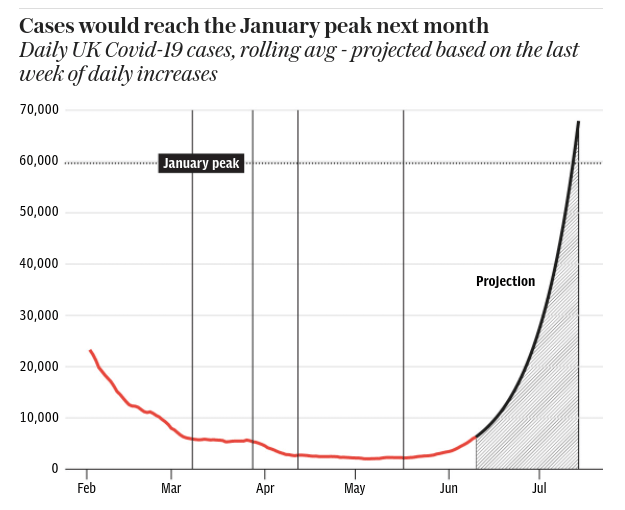
The raw data does not look good. Cases of the delta variant have been growing exponentially from a low base since early May, and for the past seven days have averaged about 5,000 new cases a day.

Hopes that its transmission advantage would turn out to be moderate have been dashed, as its estimated R number has continued to climb

It now appears to have settled at or about R1.5 with a doubling time of nine days. If you start from 5,000 and double three times you get to 40,000 cases a day by early July. If you double that again you get to 80,000 cases nine days later – a number that bursts through the January peak.

The epidemiologist Adam Kucharski captured the mood among Sage’s modellers on Saturday morning by Tweeting: “That depressing feeling of having to extend y-axes [vertical] again”.

He noted, too, that the variant’s estimated growth rate already “prices in” our existing firebreaks. “Without vaccination and the social distancing still in place, R would be *much* higher”, he said. 

Other data show UK delta cases to have started in the young but to be moving up the age groups and even social classes. 

A similar pattern was observed in the US last summer when a wave of virus started among the young in Florida and other southern states. At first, people dubbed it a “casedemic” – but then it found its way into older and more vulnerable age groups. 

Vaccines and immunity

Cases, of course, are only a worry if they lead to hospitalisations – and this time around we have vaccines to protect us. 

But here, too, the news is not all good with the delta variant. The latest Public Health England (PHE) data put the vaccine’s effectiveness against symptomatic disease at 33 per cent after one dose and 81 per cent after two.

The mathematician and Covid modeller James Ward estimated this should rise to something like 80 per cent and 95 per cent respectively when it comes to protection against “severe disease and death”.  

On one level, those numbers are reassuring, but the evidence to support it is incomplete. PHE is still awaiting evidence on how well the AstraZeneca vaccine, which accounts for about 70 per cent of all UK jabs, performs after two doses against the delta variant.

“There is uncertainty around the magnitude of the change in vaccine effectiveness after two doses of Oxford-AstraZeneca vaccine,” said its latest report.

The same report revealed that of the 42 people known to have died so far with the delta variant in the UK, 29 per cent (12 people) were fully vaccinated. 

“Of note is the high percentage of severe outcomes among people [with vaccine] breakthrough infections”, observed the PHE epidemiologist Meaghan Kall on Friday. 

“Who are they and why is that happening? Work ongoing to understand the profile of fully vaxxed people with severe outcomes,” she added.

It is speculation, but they are likely to be older or more frail people in whom immunity has faded since they were given their jabs. 

A Lancet study published last week found the Government’s policy of spacing doses of the Pfizer jab beyond the manufacturer’s three-week recommendation causes immunity to tail off faster than it otherwise would, especially in the old.

“These data therefore suggest that the benefits of delaying the second dose, in terms of wider population coverage and increased individual [protection] after the second dose [of Pfizer], must now be weighed against decreased efficacy in the short-term, in the context of the spread of B.1.617.2 [delta]”, said the authors. 

Hospitalisations and the NHS

Ultimately it will be the number of hospitalisations that determines if the roadmap ends up having to be reversed and a new lockdown imposed.

It’s a hard truth but the UK pandemic strategy from 2011 has always allowed for a very significant number of deaths. What cannot happen is for the NHS to be overwhelmed as this leads to a wider socio-economic breakdown as seen in India last month.

The latest Sage modelling on hospitalisations is expected to be released on Monday to coincide with the Prime Minister’s statement and seems unlikely to contain good news. 

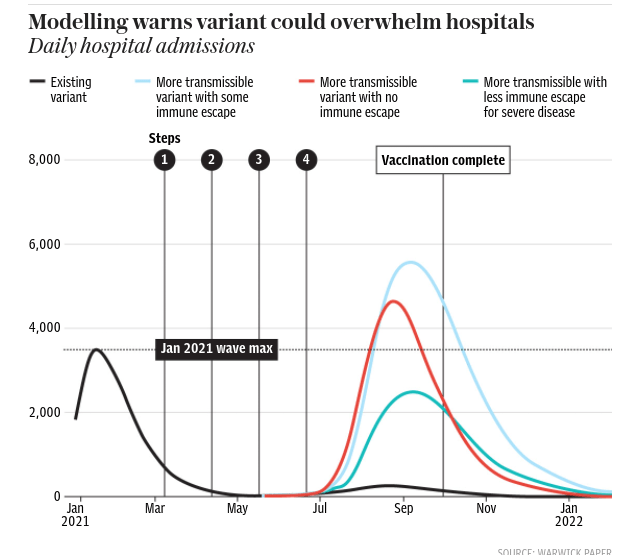
The last set of modelling, published in May, contained projections for what might happen if a new, more transmissible variant broke loose – and the numbers were not pretty. 

The University of Warwick’s modelling showed a variant that was 50 per cent more transmissible would, more or less, take the course that the delta variant has to date. It would then breach the second wave peak of about 4,000 hospital admissions a day in late July even if the final stage of reopening was postponed. 

A new paper published by Warwick on Friday and adjusted to take account of age, showed a similar if slightly more optimistic pattern (see chart above). The two scenarios which best match the known characteristics of the Delta variant still breach the January peak if lockdown is ended on June 21 but come in underneath if – as is expected – it’s deferred. The timing of the peak is also pushed back a month.

The projections published by Sage on Monday will differ in their detail but the broad logic of the maths will remain the same: We have a lot of people vaccinated but about 57 per cent of the population are not yet fully protected. If you get a very big wave of infections, the total number being hospitalised – while a tiny proportion of the total – could still be too big for the NHS to handle.

But we may yet get lucky. The delta variant remains unevenly spread across the country, with cases still concentrated in about a dozen areas and there are very early indications is growth is slowing.

As Ms Kall of PHE points out, we were seeing a much wider dispersion of cases eight to 10 weeks after the Kent variant was first spotted. “This is cause for optimism that vaccines are indeed slowing and in some populations halting the spread of Covid-19,” she said.

On the other hand, if delta explodes across the country in the coming weeks, optimism will fade fast, just as it has Chile which locked down again last week despite a faster double-dose vaccine rollout than our own.

In that fireball scenario, we’ll remember the instinct of those in Whitehall who tried to sneak in local restrictions under the radar even as the Prime Minister pushed ahead with the last reopening on May 17. And we’ll ask: why didn’t you jump the other way?

Baron Cruddas

Peter – or Baron, as for now we must call him – Cruddas was once a Treasurer of the Conservative Party.

us15.campaign-archive.com /

In March 2012 the Sunday Times published a rather mean piece about him which included the claim that (as the Court put it) “in return for cash donations to the Conservative Party, [he] corruptly offered for sale the opportunity to influence government policy and gain unfair advantage through secret meetings with the Prime Minister and other senior ministers.”

He sued the Sunday Times for defamation and, to be fair to him, he won but the Court of Appeal also said the claim above was substantially true. As a candidate for a great honour you would think he was, well, you would think he was an odd one.

On the other hand, he is Very Rich. And he has given quite a lot of money to the Conservative Party: over £3m. He gave a quarter of a million quid to them on 10 January 2020 and a few weeks later it emerged he’d been nominated as a Baron by Boris Johnson.

He was crowned, or whatever happens to them, ‘Baron’ Cruddas on 2 February 2021 and a few days later, on 5 February 2021, he gave the Tories another half a million. We’re not saying any of this was pre-arranged – there’s no evidence of that and buying and selling peerages is a crime – but the timing of it all is, well, it is odd.

Given his past record, the House of Lords Appointments Commission thought he wasn’t the kind of man we should be giving a peerage to. And it advised Boris Johnson not to make him a Baron. But Boris did anyway – making history by ignoring the Appointments Commission for the first time ever.

We don’t only think it is odd. We also think it is unlawful. We think a fair-minded and informed observer, presented with the facts of the matter, would conclude that there was a real possibility or danger of bias in the Defendant’s decision making. We also think that the Prime Minister took legally irrelevant considerations – past donations and the prospect of future donations – into account in making him a Baron.

And so we’re suing. We’ve instructed Bindmans LLP, Dan Squires QC and Alice Irving. You can read our letter here.

Make no mistake, we intend to issue proceedings. But this time, we’re not setting up a crowdfunder. What we’d really like you to do instead is (1) sign our petition calling for him to be stripped of his peerage and (2) share this update with your friends and family.

Thank you,

Jo Maugham

Director of Good Law Project

G7 cops in covid isolation

A dozen Devon and Cornwall police officers are isolating after a coronavirus test taken by one of them proved positive.

Radio Exe News www.radioexe.co.uk

They’ve been in accommodation on a ship off the Cornwall coast whilst policing the G7 summit of world leaders at St Ives.

In a statement the force says: “As part of our testing regime, during the early hours of 11 June we have identified one officer who is currently supporting G7 policing and accommodated on the ferry has given a positive lateral flow test for covid.

“The officer, plus those who have come into close contact, are currently self-isolating at another designated location.

All who have come into close contact or are in the bubble of those who tested positive are also currently self-isolating which equates to 12 officers in total. The next stage is for those who have tested positive to undertake a PCR test.”

The force hasn’t said whether the officer who tested positive has been in contact with any of the delegates at the G7. Members of the royal family, including the queen, have also been in Cornwall on Friday to welcome the international leaders.

Devon objects to plans for moors

Begs the question as to whether the local management of designated landscapes is “safe in our hands”. Think Old Guard EDDC and the East Devon AONB, and how you manage consistent standards, expertise and funding.

Remember also who actually owns Dartmoor? – Owl

Daniel Clark, local democracy reporter www.radioexe.co.uk

Any proposals to remove local responsibility for Dartmoor and Exmoor will be strongly opposed in Devon, the leader of the county council has declared.

There has been considerable speculation that the government is planning to centralise the management of Britain’s national parks and areas of outstanding natural beauty in a new National Landscape Service.

But Cllr John Hart, Devon County Council’s leader, has written to the secretary of state for environment, food and rural Affairs, George Eustace, and Devon’s MPs urging them to keep the management local.

Cllr Hart sent the letter on behalf of Team Devon, the organisation representing the county council as well as district, town and parish councils, saying he was alarmed and had grave concerns about the potential impact that this might have.

However, Devon County Council’s cabinet meeting has recommended to full council that while any merger of the functions of our National Parks and Areas of Outstanding Natural Beauty would be strongly opposed, there remains a case for a National Landscape service bringing together and strengthening existing national support and protection.

Cllr Alan Connett, leader of the Liberal Democrat group, who had put forward his motion on saving the National Parks, said that doing so would be seen as a coded signal that Devon does support this and the admissions would undermine the efforts being made.

In the letter, Cllr Hart said: “All Devon’s local authorities were alarmed to read media reports referring to the consideration being given to the possible role and structure of a new National Landscape Service.

“We share grave concerns about the potential impact that this might have on the management of Devon’s unique series of nationally protected landscapes.

“The Dartmoor and Exmoor National Park Authorities, together with our five areas of outstanding natural beauty (AONBs) are instrumental in conserving, enhancing and promoting Devon’s natural environment and the social and economic benefits that they provide.

“The localised management of each of those areas is critical to their success and we would strongly oppose any centralised merger of their functions.

“When the Government responds to the 2019 Landscapes Review, I hope that you can urge it to make a positive contribution to the ability of National Parks and AONBs to continue their important work and retain their autonomy.”

But he said that a National Landscape Service which brings together and strengthens existing national support for landscape conservation and the protection of the natural environment could be of great benefit and that it could also provide a strong national voice for all protected landscapes.

“Such increased national support, coupled with local autonomy in governance and operation, provides the most effective model to improve upon the fantastic work which is already led and managed in Devon,” Cllr Hart added.

Cllr Connett’s initial motion had called for Devon County Council to urge Government not to proceed with a National Landscape Service or to take any step which will remove local engagement and involvement in our precious national parks and Council instructs the Chief Executive to write urgently to the Prime Minister and local Members of Parliament serving Devon and Somerset setting out our support for our local National Parks.

But Cllr Hart’s recommendation from the cabinet was for the Council to note that they had already indicated to Government and local MPs that any merger of the functions of our National Parks and Areas of Outstanding Natural Beauty would be strongly opposed, but there remains a case for a National Landscape service bringing together and strengthening existing national support and protection of our natural environment and providing a strong national voice for all protected landscapes.

Cllr James McInnes, deputy leader of the council and also a member of the Dartmoor National Park Authority, added: “We accept some form of National Landscape Service. There needs to be cohesion between national parks and how they speak to the government, and that’s why we have written the response we have, as we do think there is some way to make national parks cohesive on the national stage which at the moment they are not.”

But Cllr Connett pleaded with them to remove the second part of their recommendation, saying: “I understand the first part but am hugely disappointed by the second part. The admission the county thinks that may undermine the efforts to protect Dartmoor and Exmoor and undermines the responses that have been sent

“You should remove the sentence about the National Landscape Service as this shoots us in the foot in the stance to defend Dartmoor National Park. It will be seen as a coded signal that Devon does support this which I don’t think Devon does and I don’t. It will draw support away from National Park authorities and will be the thin end of the wedge.

“I can live with the first part, but I cannot with the second, and so if you don’t withdraw it, I will move an amendment at full council.”

A final decision on the response to the motion will be taken when Devon County Council’s full council meets on 22 July.

Property developers gave Tories £891,000 in first quarter of 2021

(And they still keep arguing that they can’t afford to build all the “affordables” required in planning permissions. – Owl)

Don’t forget the small, regular, donations from developers to MPs such as the Carter donations linked to Simon Jupp.

Aubrey Allegretti www.theguardian.com

Labour has accused the Conservative party of “selling out communities to pay back developers” after figures revealed that 13% of the Tories’ recent donations came from property tycoons and companies.

Labour’s analysis of declarations released by the Electoral Commission show the firms gave £891,984 to Tory central office and eight local associations – a sizeable chunk of the £6,418,295 the party reported receiving in the first three months of 2021.

It comes as the government prepares to launch sweeping changes to the planning system that Labour says will remove communities’ right to object to inappropriate individual developments in their area.

Ministers are aiming to centralise and accelerate the housebuilding process in England to help boost homeownership in areas across the north and Midlands, which have seen increased levels of Conservative support.

But opposition among Tory MPs has been well aired in advance of the planning bill being introduced to parliament, with the former prime minister Theresa May among the potential rebels who told the government to “think again”. Another backbencher, Bob Seely, said last month that the plan “threatens to give our opponents throughout England a rallying cry of ‘save local democracy from the Tories’”.

It has now been revealed that 36 donations from developers were made to the Conservatives in the first three months of this year.

Most sums were paid to Conservative central office, with the largest single donation made by Bloor Holdings Ltd, which gave £150,000 and has reportedly had an application to build 1,000 new homes at Sandleford Park in Berkshire “recovered” by the Ministry of Housing, Communities and Local Government, meaning it will be ruled on in Whitehall.

Local associations that received money directly include Witney – the constituency of the junior transport minister Robert Courts – as well as Tatton, Suffolk West and Enfield Southgate. There is no suggestion of any wrongdoing by the donors or the party.

Labour’s Steve Reed, the shadow communities and local government secretary, said the new figures were “yet more evidence of the cosy relationship between the Conservative party and property developers, who for their investment will be allowed to concrete over communities at will”.

He said the planning bill would “reward developers by gagging residents so they have no say over plans to bulldoze local neighbourhoods” and added: “The Conservatives are paying back developers by selling out communities. Labour will fight this developers’ charter so that communities have right to a fair hearing in planning decisions.”

The Lib Dems have also sought to use the controversial planning changes as fodder for attacking the Conservatives in the Chesham and Amersham byelection on 17 June. The frontbencher Layla Moran recently said the bill would “create a developer’s free-for-all across the Chilterns” and mean builders could soon be “riding roughshod over the views of local people”.

A Conservative party spokesperson said: “Government policy is in no way influenced by the donations the party receives – they are entirely separate.

“Donations to the Conservative party are properly and transparently declared to the Electoral Commission, published by them, and comply fully with the law. Fundraising is a legitimate part of the democratic process. The alternative is more taxpayer funding of political campaigning, which would mean less money for frontline services like schools, police and hospitals.”

The spokesperson added that “working with the housing industry is an essential part of getting new homes built and regenerating brownfield land”.

Fixing NHS waiting times could cost £40bn, leaked No 10 estimates show

Boris Johnson may have to spend up to £40bn to try to repair NHS waiting times and end the long delays being faced by patients, according to unpublished Downing Street estimates.

Denis Campbell www.theguardian.com

Calculations for No 10 drawn up by the Cabinet Office make clear that the prime minister may have to commit anywhere between £2bn and £10bn a year for up to four years, on top of core NHS funding, to tackle what is fast becoming a major political headache for the government.

The figures, disclosed by Whitehall sources, underline the huge scale of the challenge in getting NHS waiting times back to manageable levels before the next election.

The latest NHS England performance figures, out on Thursday, showed that the total number of people waiting for hospital treatment, especially surgery, had topped 5 million for the first time. It stood at 5,122,017 in April, the highest since records began in 2007.

However, despite negative publicity, Downing Street thinks it does not need to start throwing money at the problem soon because the public are not yet “distressed” about long delays, a source with knowledge of No 10’s thinking said.

The projections were put together by the Cabinet Office as part of its work looking at the scale of post-Covid support needed in health, education and justice. Some Tories are tipping Michael Gove, the Cabinet Office minister, to succeed Matt Hancock as health and social care secretary.

The Treasury is reluctant to hand over large sums to tackle the deepening waiting list problem, sources say. NHS England plans to give Downing Street a detailed analysis soon of how long it will take to start providing care again within its existing set of targets, to help inform No 10’s thinking before the comprehensive spending review in the autumn.

The waiting list has soared by almost 425,000 people in just the past two months as people who either could not access non-Covid NHS care during the pandemic or were reluctant to do so belatedly saw their GP and were referred to hospital.

Hospitals in England managed to get back to providing 90% of pre-pandemic levels of non-urgent care in April. But they are hamstrung by personnel shortages, staff sickness linked to the strain of dealing with Covid and having fewer beds because of social distancing measures.

Of the 5.1 million, almost 400,000 people have had to wait more than a year for treatment for conditions including cancer and heart problems, hip and knee replacements and cataract removals. A small number – 2,722 – have already been waiting longer than two years. The NHS has not met its target of treating 92% of all patients on the waiting list within the supposed maximum 18 weeks since 2016.

Prof Anita Charlesworth, an NHS finances expert at the Health Foundation thinktank, said it had estimated that ministers would need to spend £6bn over three years to tackle the backlog. However, the sums needed will have gone up as a result of the second wave of Covid over the winter, which once again disrupted key services.

“The health service now has a mountain to climb. Reducing the backlog of long waits and getting the NHS into a position where waiting time standards are consistently met will need a major increase in funding,” Charlesworth said. But that would also need 5,000 extra beds, 4,100 more consultants and 17,100 additional nurses, she added, as the NHS was too under-resourced to ramp up the number of patients treated.

Richard Murray, the chief executive of the King’s Fund thinktank, said the NHS’s lack of scanners and operating theatres would severely limit its ability to increase activity.

Downing Street declined to comment on the leaked figures.

The Department of Health and Social Care said: “We’re backing the NHS with £1bn to tackle the waiting lists which have built up, providing up to 1m extra checks, scans and additional operations, and the NHS is providing £160m to trial innovative ways to accelerate elective recovery in key areas and enable more hospitals to go further, faster.

“That’s on top of an extra £7bn funding we’re giving health and care services this year.”

Chris Hopson, the chief executive of the hospitals group NHS Providers, said: “Trust leaders are deeply aware of how frustrating long waits for care are, and are doing all they can to prioritise those who need to be seen urgently.”

Ministers, NHS chiefs, medical groups and health charities are worried that lengthening waits for treatment could lead to patients’ health deteriorating and some even becoming untreatable.

The latest official figures show that there were a further 7,393 lab-confirmed cases of Covid-19 in the UK by 9am on Thursday. Seven more people have died within 28 days of testing positive, bringing the UK total to 127,867.

Public Health England data shows that infections are now rising again in every area of England, especially in the north-west.

Danny Mortimer, the deputy chief executive of the NHS Confederation, warned that hospitals might once again have to shut down normal care if the rising number of Covid infections produced a third wave that put serious pressure on them. He urged Boris Johnson to be ready to delay the lifting of restrictions as planned on 21 June.

In one positive element in the latest figures, the number of people being forced to wait at least a year for planned, non-urgent treatment in hospital has fallen from 436,127 to 385,490.

“Despite the extensive disruption to care caused by the pandemic, it’s encouraging that today’s figures show routine operations, cancer and mental health care have now all rebounded sharply,” said Prof Stephen Powis, NHS England’s national medical director.

“Average waits for non-urgent care have fallen to 11 weeks, and the number of people waiting over 52 weeks fell by more than 50,000 in April. Mental health services are back at pre-pandemic levels, and treatment rates for cancer are also now back to usual levels.”

G7 hotel in Cornwall closes after outbreak of Covid-19

A hotel in Cornwall reportedly hosting media and security staff for the G7 summit has closed following a coronavirus outbreak.

Neil Shaw www.devonlive.com

The website for the Pedn Olva hotel in St Ives said it has temporarily shut on Thursday and directed inquiries to its owners, St Austell Brewery.

The hotel said a number of staff had been affected and it would close for deep cleaning following discussions with Public Health England (PHE).

German media reported that two security guards for Germany’s Chancellor Angela Merkel were staying inside the hotel, although it is not clear if they are quarantining or have been relocated.

A spokesman for Prime Minister Boris Johnson confirmed Ms Merkel would still be attending the summit.

According to reports, the hotel had identified a coronavirus outbreak on Wednesday.

The hotel owners, St Austell Brewery, said: “We can confirm that a number of our team at the Pedn Olva, St Ives, have tested positive for Covid-19.

“We immediately notified Public Health England of these cases and have been working closely with them to ensure we follow all appropriate safety guidelines.

“Following extensive discussions over the last few days with PHE and Cornwall Council, we have taken the decision to fully close the hotel.

“We fully appreciate the inconvenience given the limited accommodation options available in the area at the moment but the safety and security of our team and guests is our upmost priority.

“The hotel will reopen once a full Covid-19 deep clean has taken place and we have the available staff to run it.”

Simon Norris, 62, who also lives near the hotel, said his wife saw people checking out of the hotel and leaving with bags at about 5pm.

“We don’t have a lot of direct contact with the hotel, I’m really saddened by the outbreak,” he told the PA news agency.

“I feel very sorry for the staff that work there because they have done a lot of work to open the hotel up for the G7 and visitors. It’s extremely disappointing.

“When we’ve gone there they’ve met all the Covid protocols, I think they’ve just been very, very unlucky. It’s a great shame really. Prior to this we have had no incidents of Covid in St Ives.”

PHE and the Department for Health and Social Care have been approached for comment.

Elsewhere, Devon and Cornwall Police denied claims of a coronavirus outbreak on the ferry used to accommodate officers to the G7 summit, saying none had tested positive.

Rachel Wigglesworth, director of Public Health for Cornwall and Isles of Scilly, said that public health teams were used to dealing with outbreaks of coronavirus.

When asked on Sky News on Friday about a hotel, reportedly hosting G7 media and security staff, having to close due to a Covid-19 outbreak she said: “As we know from living with this global pandemic there’s always these cases that arise but we are used to dealing with these sort of incidents across the country now.

“Our public health teams and the expertise around them are helping to support venues where there are any outbreaks and sometimes a business has to make the decision that they operationally cannot continue to work rather than it necessarily being a public health issue where staff have to self isolate.

“What we are seeing across the country is there are outbreaks, we have slightly increased the rates of Covid over the last few weeks, I think related to the relaxation of the restrictions from May 17, so a lot more cases amongst hospitality venues and amongst younger people that are not vaccinated.

“So we do need to continue to vaccinate but also to then suppress these cases where we do identify them.”

Matt Hancock pledges to hand over any advice on discharges to care homes

Matt Hancock has promised to reveal internal advice that is alleged to have required testing for people discharged from hospitals into care homes at the start of the Covid pandemic, amid claims the guidance was weakened following pressure from his department.

Robert Booth www.theguardian.com 

The claims go to the core of a decision that meant thousands of people were discharged without Covid tests from hospitals into care homes in March and April 2020.

Giving evidence to MPs investigating the government’s Covid response, the health secretary denied knowledge of the advice that a whistleblower said was produced by two senior officials at Public Health England in March 2020, according to a report in the Byline Times. However, he said he would provide whatever they produced.

The practice of discharging without testing was driven by a need to free up hospital beds, but it seeded outbreaks in care homes where thousands died in the first peak of the pandemic. Testing only became mandatory in mid-April, but care operators have said they told Hancock and his officials several weeks earlier that testing was needed to stop outbreaks spreading from hospitals.

Public Health England (PHE) declined to comment on the claim. A spokesperson for Department of Health described it as “categorically untrue”.

“Our primary duty has been to save lives and our approach has been guided by the latest scientific evidence,” they said. “We have been committed to transparency throughout this pandemic, including working closely with Public Health England to ensure scientific advice and data is published honestly, openly, safely and in a timely manner.”

Hancock has previously claimed that the government put a “protective ring” around care homes, but he told the joint hearing of the health and social care and the science and technology select committees: “I think the most important words in the sentence are: ‘We tried to.’ It was very hard.”

He said that the decision to empty hospital beds amid rising cases was not made “to favour the NHS” and recalled seeing a TV news report from Spain early in the pandemic in which a care home had been abandoned and all of the residents had died.

However, he played down the effect of hospital discharges. He claimed that a study by PHE, which showed that only 1.6% of outbreaks in the first wave were caused by people discharged from hospitals, suggested that community transmission was a far bigger cause of infection in care homes.

However, the true number is likely to be significantly higher, as so little testing was available. Greg Clark, the chair of the science and technology committee, suggested it was therefore “completely impossible” for Hancock to make the claim. The health secretary stood by the figure but conceded it was based on “imperfect information”.

Hancock told the committee that “each and every death in a care home weighs heavily on me and always will” and he denied the explosive claim last month by the former No 10 adviser Dominic Cummings that he had misled the prime minister in March by telling him people discharged into care homes were being tested.

“We set out a policy that people would be tested when tests were available and then I set about building the testing capacity to be able to deliver on that,” Hancock said.

He said he did not recall Boris Johnson being angry about what had happened in care homes in April after he had been in hospital with Covid, as Cummings has claimed.

He said: “The clinical advice was that a test on somebody who didn’t have any symptoms could easily return a false negative and therefore give false assurance … Clinicians were worried that because it took four days to turn a test around that if you leave somebody in hospital those four days, they might catch Covid and therefore go back to a care home with a negative test result but having caught it.”

That appeared to be supported by Dr David Oliver, a consultant in geriatrics and acute general medicine, who wrote on Wednesday in the British Medical Journal that concerns raised by social care leaders about discharges were overridden as much by clinicians and NHS managers as by politicians.

Oliver said: “Keeping lots of care home residents in scarce beds, waiting for tests we had insufficient access to, with a high first false-negative rate and no clear understanding of how long people remained infectious, could have posed other risks to these residents and to other patients in need.”

Devon home care agency placed in special measures – Newton Poppleford

Following a safeguarding investigation, East Devon home care agency Charity Earnshaw has been rated ‘inadequate’ and placed in special measures.

Anita Merritt www.devonlive.com

The domiciliary care service, which supports adults in the community who require assistance with personal care – including people living with dementia, physical disabilities, mental health needs and sensory impairments – has had local authority placements suspended, as well as new private placements.

Independent health and social care regulator Care Quality Commission (CQC) recently inspected the service and fund it was failing in an number of areas. These include:

  • Safe and effective care
  • Risks were not well managed
  • The administration of medicines was not safe
  • Safeguarding concerns had not always been managed appropriately and had not been reported
  • People were not supported to have maximum choice and control of their lives
  • Inadequate staff training and support
  • ‘significant delay’ in Covid-19 infection control training

The CQC said the Newton Poppleford based provider had not recognised the quality of the service had significantly deteriorated and had therefore put people at risk of unsafe care. It added it had only begun to make improvements when other agencies became involved through the safeguarding process.

The recently published report said: “We undertook this targeted inspection to follow up on specific concerns we had received about the safety and quality of the service. These concerns were subject to individual and whole service safeguarding investigations.

“A decision was made for us to inspect and focus on the management of risk, staff training,medicines administration and quality assurance. During the inspection, we found additional concerns related to protecting people’s human rights; the management of safeguarding and the knowledge and skills of the provider.

“We therefore widened the scope to become a focused inspection which included the key questions of safe, effective and well-led. We have found evidence that the provider needs to make improvements.”

It added: “Prior to our inspection we found peoples experience of the service was poor and made a number of safeguarding referrals. A whole service safeguarding enquiry was in progress with the local authority. A suspension of local authority placements was in place, and a voluntary suspension of new private placements.”

It continued: “Concerns about people’s health and safety had not always been escalated by staff, and not all staff we spoke with were aware of the processes for doing so. External health professionals and relatives told us the provider did not always work effectively with other agencies to provide safe and effective care.

“Safeguarding concerns had not always been managed appropriately and had not been reported to the local authority or the CQC. Safeguarding policies and procedures were out of date.”

It was noted Charity Earnshaw had expanded significantly since the last inspection in June 2019, when 18 people were being supported.

By August 2020 it had increased to 33 people. The staff team had increased from five to 14. It provides services in Newton Poppleford, Sidmouth, Ottery St Mary, Woodbury, Seaton, Tipton St John, Exmouth and Colyton Raleigh.

The report said: “The provider told us the training and development of the staff team and service had been delayed as a result of the pandemic and lockdown.

“The provider and staff team were committed to improving the quality and safety of the service. One member of staff told us, ‘a lot of things need to be updated. I know the provider is doing their utmost to get everything in place. I’m happy now it’s being put in place. It’s improving’.”

Inspectors also received positive reports about the service. Overall people said the service was reliable. One person said: “I have no objections. They turn up on time. They are nice carers, very helpful… I have a list of who is coming and what times and they turn up on time.”

Charity Earnshaw is working with the local authority and has drawn up a service improvement plan.

The overall rating for this service following the CQC inspection is now ‘Inadequate’ and the service is therefore in ‘special measures’. It means the CQC will keep the service under review and will reinspect within 6 months to check for significant improvements.

Charity Earnshaw were approached for a comment.

Investigation concludes at care home at centre of Covid outbreak

Police have concluded an investigation into a Sidmouth care home where 11 residents died following a major Covid-19 outbreak – with no further action to be taken against two staff members who were arrested.

Jamie Hawkins www.devonlive.com

The deaths were reported at the Holmesley Care Home in Sidford between February 25 and April 16, which were all believed to be related to a coronavirus outbreak.

An investigation, led by Devon and Cornwall Police, was launched in partnership with a multi-agency safeguarding response to ensure the well-being of the residents in the home and specialist officers have been liaising with family members.

Following extensive enquiries, which involved interviewing staff and residents’ family members and searches of the home, and with early consultation with the Crown Prosecution Service, the decision has been made that the criminal threshold for neglect has not been met.

As part of police enquiries, no further action will therefore be taken against a 57-year-old woman from Sidmouth and a 30-year-old man from Exeter, who were investigated on suspicion of wilful neglect under the Criminal Justice and Courts Act 2015.

Both the Care Quality Commission (CQC) and the Health and Safety Executive (HSE) are now considering offences relating to the Care Act 2014 and health and safety legislation.

Senior investigating officer, Detective Inspector Lesley Bulley, said: “Our priority has been to understand the cause of the outbreak at Holmesley Care Home and ensure that safeguarding concerns were addressed.

“We would like to thank the families of the deceased for their patience throughout what has been a really complex case.”

A CQC spokesperson, added: “Following the inspection of Holmesley Care Home, CQC imposed urgent conditions upon the service. Following this, CQC are considering what further action we may want to take.”