Planning applications validated by EDDC for week begining 12 July

Both the Telegraph and Times feature the Salcombe revolt on second homes

The story goes national under the headlines: “Millionaire hotspot Salcombe blocks second home buyers” (Telegraph) and “Salcombe pulls up drawbridge against the second-home invasion” (Times).

The Times, however, explains the intricacies of using “Section 106” agreements to ensure the concept of “principal residence” endures. (Planning officers more often chose to use planning conditions because they caused “less hassle”, but the Council wants to remove this option).

Salcombe pulls up drawbridge against the second-home invasion

Will Humphries, Southwest Correspondent www.thetimes.co.uk

Some people will do anything for their own slice of the seaside idyll. Even if it means bending or breaking a few planning rules along the way.

The people of Salcombe, the Devon seaside town nicknamed Chelsea-on-Sea, have become so worried about the influx of second-home owners that they have enacted the strictest code against out-of-towners in the country.

In 2018 the neighbourhood planning steering group calculated that about 57 per cent of homes in the town were second homes. South Hams district council is hoping to curb this trend by making it a legal requirement that all newbuild homes be sold as a principal residence and stay that way for ever.

In the past, planning officers had the choice to attach a planning condition to a new development, stating it must be a principal residence, or draw up a Section 106 agreement with the developer, which makes it legally binding on the property’s title deeds.

Judy Pearce, Conservative leader of South Hams district council, said that planning officers more often chose to use planning conditions instead of Section 106 agreements because they caused “less hassle”.

She said that because planning conditions were not registered on the property deeds, unlike a Section 106, they often get “lost or overlooked” by homeowners and lawyers during house sales.

This allowed properties first bought as a principal residence to be sold on years later and added to the growing list of second homes.

“Particularly in the case of Salcombe, where people will do almost anything to get hold of a property,” Pearce said. “I am not saying people do cut corners but if you were of the mind to, it would be easy [to overlook a planning condition].”

The council has now voted to ensure that its neighbourhood plan demands all new developments, excluding replacement dwellings, must have a Section 106 agreement stating it will remain a principal residence in perpetuity.

“We had to take it to council because the planning officers wouldn’t sign it off,” Pearce said. “The officer who deals with neighbourhood plans agrees with us but the majority didn’t.”

Salcombe has long been a mecca for the boating fraternity. Wealthy out-of-towners arrive in the summer months to sail on the Kingsbridge estuary and moor up in sandy bays for lunch. The population can rise from about 2,000 during the winter to more than ten times that in summer. The closest railway station is a 40-minute drive away in Totnes and trains to London take about three hours.

The new neighbourhood plan amendment will be assessed by an independent examiner before it is officially approved as part of the planning framework for Salcombe. Nikki Turton, the town mayor, said that the blanket use of Section 106 agreements would ensure the town “doesn’t need to keep an eye on every property and report constantly on possible breaches”. She added: “We want families to come and live and work here. We are not just a holiday destination, we are a thriving town and we want to exist in the future.”

The average wage in Salcombe is below the national average but the cost of buying a home is about £750,000, with a majority selling for well over £1 million.

Blair Stewart, a local estate agent with Strutt & Parker, said that there “have been instances” of planning conditions being avoided during house sales. “It’s not rocket science that clever solicitors and lawyers will find ways and means of getting around things,” he said. He believes the new rule will cause “quite a significant issue” for people looking at new developments, which typically cost between £800,000 and £1.5 million, if they have to commit themselves to making it their principal residence.

“It is the significant upper end of the market, which tends to be new developments. There are virtually no affordable homes in Salcombe,” Stewart said.

Property values in and around Salcombe have risen by 10 to 15 per cent in the past year. Stewart said that he had seen a 30 per cent rise in buyers coming to live full-time in Salcombe in the past five years, with draws including Ofsted-rated outstanding primary and secondary schools and improved wifi coverage. “It helps that the head of BT has a house in Salcombe and sorted that out,” Stewart said.

An idea that is catching on

Salcombe is not the first seaside town to move to tighten its planning rules.

St Ives voted to ban the selling of newbuild properties as second homes in 2016, and has been followed by other Cornish tourist hotspots such as Fowey and Mevagissey.

These towns have passed neighbourhood plans stipulating planning conditions that newbuild properties must be sold as principal residences.

However, none of them has gone as far as Salcombe, which is looking to dictate that only a Section 106 agreement attached to the title deeds can be used.

Since St Ives voted for its neighbourhood plan there has been much debate about whether it will have the desired effect of making more affordable properties available to local families. Some estate agents insist that the regulation is hampering supply.

A London School of Economics study published in 2019 said that the policy had led to an increase in the price of existing homes because prospective second-home owners were competing for them with residents. Professor Christian Hilber, who led the study, said a better option would be a local annual tax on the value of a second home.

Councillors have said that it is too early to judge the merits of the policy. However, before the pandemic the average property price had risen 3 per cent since 2016. At times in the past decade prices were growing by more than 10 per cent a year.

Boris Johnson’s planning reforms could turn southern England into urban sprawl

The British government is trapped again by the picaresque politics of Boris Johnson. When the pandemic has subsided, the legacy of 2021 could yet be something more long-lasting – the permanent scarring of the landscape, courtesy of the 2019 parliament.

Simon Jenkins www.theguardian.com 

Last spring, the prime minister trumpeted the “tearing down” of English town and country planning regulations, in place since the 1940s. That was enough to have him pummelled at last month’s Chesham and Amersham byelection. The planning minister, Robert Jenrick, then protested that “tearing down” did not mean “ripping up”, whatever that means. He is now wrestling with a shambles of reform.

At the root lies Johnson’s perfectly commendable ambition to “level up” the north and south. Britain has one of the most regionally divided economies in the developed world, with parts of northern England poorer than the regions that used to make up East Germany. Johnson rightly wants to divert wealth, talent, investment and productivity in that direction, but he has no clue what this means.

Jenrick’s response is to seek to cram even more houses – and thus people – into the south-east. Backed by his army of Tory-donor property developers, he hopes to designate specific areas of countryside – mooted as “30% of UK land” – as protected, and with a casual presumption in favour of “developing” the rest. Since protection likely includes the mostly mountainous areas of Wales and Scotland, it is hard to see a vision of southern England as anything but open to a creeping, Los Angeles-style urban sprawl. This means ending 50 years of the once-prized divide between Britain’s towns and their surrounding countryside.

The ambition to promote building in the south plays on Johnson’s other arbitrary ambition, to build some 300,000 houses – their location unspecified – every year. Given that permission already exists for a million homes in land banks, this appears to be mere lobby appeasement. But the consequence will likely be a dramatic rise in housing imposed on the countryside. Analysis by the CPRE, the countryside charity, of the algorithm devised to calculate housing needs shows Johnson’s Uxbridge seat will have to find room for 10 times more houses than Rishi Sunak’s Yorkshire one. This is hardly “levelling up”, and has led Johnson’s predecessor, Theresa May, to condemn building “the wrong homes in the wrong places”, and the former Tory leader William Hague to label the proposed planning reforms “Johnson’s poll tax”.

The reality is that English housing policy is still in the dark ages. Jenrick should be promoting downsizing, taxes to discourage under-occupation, the renovation of old building and increasing housing density in suburbia. There is no need to build on greenfield rather than brownfield land anywhere in Britain. Ministers seem to think the only “real” house is a car-dependent executive home in a southern meadow. It is, as Jenrick says, a “dream” – but that is not a need.

The way to level up the regional divide is to make northern towns and cities more attractive places to live. This means stopping Manchester and Liverpool letting developers turn them into concrete jungles – and avoiding such humiliations as having Unesco this week strip Liverpool of its world heritage status. It means galvanising the creative potential of old Victorian city centres such as those of Bradford and Huddersfield. It means smart conservation, not mindless destruction. British town and country planning must recover both its architectural flair and its democratic virility.

Rumour has it that Jenrick’s department is now frantically trying to “de-Cheshamise” his planning bill. This could mean abandoning the simplistic zoning plan and restoring democratic control over planning permissions. It is absurd for him to claim that this will impede development. Some 90% of planning permissions in England go through. Otherwise local democracy’s only defence will be endless resorts to the courts. Already, judges are forced to become substitute town planners. Hence Johnson’s frantic steps to curb judicial review. The man is, heart and soul, an anti-democrat.

Jenrick’s other controversial proposal is to loosen restrictions on change-of-use in high streets, to hasten their switch from communal hubs into “volume” housing. That high streets need reappraisal is beyond doubt. The idea that local people deserve no control over the future of their high streets is centralist arrogance.

Jenrick has recently claimed to want houses to be “built of local materials” and erected in tree-lined streets. So do we all, where appropriate. But who is to decide? The answer is apparently a corps of Whitehall aesthetes, replacing generations of planners responsive to their residents. These decisions must be returned to localities. Like politics, all true planning is local. Many terrible things may happen to Britain in the aftermath of the current pandemic. It would be a tragedy if the guardianship of the built and rural environment becomes another casualty. We are told that Britain is not going the way of Los Angeles. Would someone kindly explain how?

Coastal towns economies set to benefit from £10m fund

Before readers get too excited this Exeter University project is one of six sharing £9.2 million funding from UK Research and Innovation (UKRI). Will any cash actually filter down to local economies? – Owl

Patrick McAndrew www.plymouthherald.co.uk 

The University of Exeter has announced a new project which will aim to aid the economies of UK coastal towns as part of a new nearly-£10million fund.

The “Sustainable Development and Resilience of UK Coastal Communities” project will first focus on a range of locations across Devon and Cornwall before applying the practices across the rest of the UK.

University bosses say the project aims to “build the marine economy while protecting ecosystems and communities”.

With a focus on local maritime communities, the university is working in partnership with Devon Maritime Forum and Cornwall Rural Community Charity in the attempt to revitalise areas that face the challenges of the climate emergency, Covid-19 and Brexit.

Dr Louisa Evans, who will lead the project, said: “Marine resources and coastal heritage are some of the country’s greatest assets.

“I am over the moon to have this opportunity to help coastal communities and marine ecosystems thrive now and in the future.

“Our programme will identify how people and livelihoods can be more resilient to environmental and social change, while also improving the well-being of coastal communities and the health of the marine environment.

“We will deliver these benefits across different projects and policies, ranging from sustainable seafood and marine apprenticeship schemes to coastal heritage decision-making and marine conservation policy.”

Steven Guilbert of the Devon Maritime Forum added: “This project will allow us to focus on key areas of interest, namely: blue growth, marine conservation, and climate and coastal change.

“This, in turn can lead to more effective and sustainable outcomes for the marine environment in Devon and the wider South West peninsula.”

The project has been announced soon after England’s chief medical officer Chris Whitty highlighted the difficulties many coastal towns, including Torbay, face in his annual report last week.

He said: “Coastal areas are some of the most beautiful, vibrant and historic places in the country but they also have some of the worst health outcomes with low life expectancy and high rates of many major diseases.

“These communities have often been overlooked by governments and if we do not tackle these issues vigorously, they will get worse as the current population ages.”

Early days but fall in Covid cases is reason to be cautiously optimistic

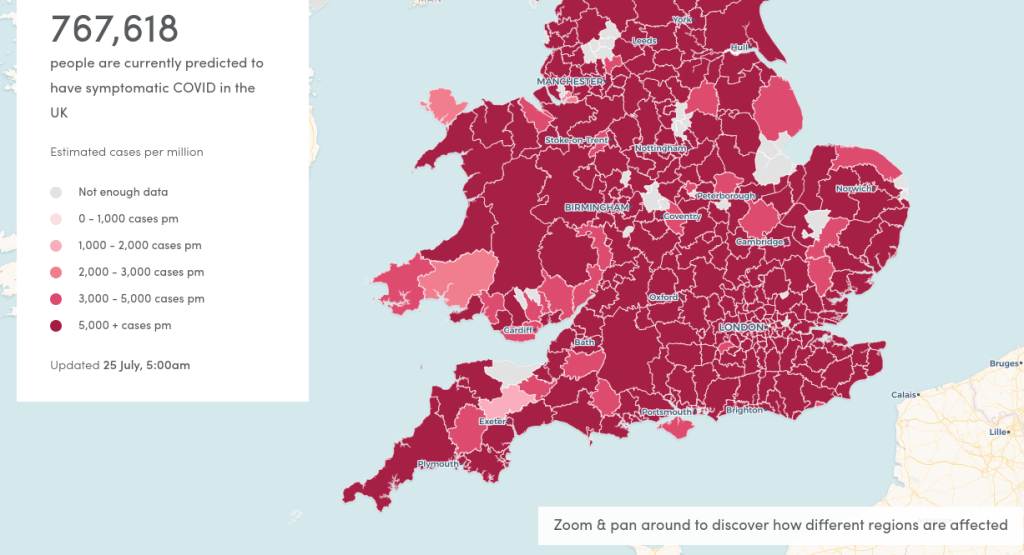
There is something unexplained going on in the data. Tim Spector’s symptom tracker app appeared to have picked up a turning point a couple of weeks ago, but that was considered to be a sampling blip. His app still indicates widespread infections in the South West, see below, and no fall nationally. – Owl

Tom Whipple, Science editor www.thetimes.co.uk 

It is great news that cases are falling. It is also slightly mysterious. In only a few days we have gone from rapid increases to rapid decreases. The graph of UK cases looks like a spiky Matterhorn.

What is confusing is that if this change was a result of infections and vaccinations only we would expect the rounded dome of a Mont Blanc-style summit, as we slowly edge up to and then pass herd immunity.

So what is happening?

The first thing to note is that we have yet to see most of the effects of England’s July 19 reopening percolate through. Neither, though, have we seen the (hopefully) opposite effect of schools closing for summer.

What is happening now, which cannot be explained by falling test numbers, largely represents trends that came before.

It may be partly the consequences of the Euros ending. We know that football affected case numbers because for the first time we could see a gender split. There was a divergence between men, who watch a lot of football, and women, who not only watch it less but are less likely to do so while congregating in crowds with flares up their bottoms.

The fall may also be the effect of better weather — for both fire safety and infection control reasons it is greatly preferable to have such celebrations, and more staid gatherings, outdoors.

Vaccines have had a huge effect, yet it still remains the case that every thousand fewer infections translates into about one fewer death.

But if behaviour rather than immunity is the most plausible explanation, there is also still some reason for wariness. After all, behaviour, not to mention lifted restrictions and worsening weather, can take cases in both directions.

Both Blackburn and Bolton had early outbreaks of the Delta variant and became the Petri dish for the nation’s third wave. In May their peaks declined, which led some to suggest they had reached herd immunity, but they are rising again.

Even so, this is a good day. Many thought reported cases would keep rising until we hit 100,000 a day. Many looked at the trajectory and thought 200,000 a day — a figure that could threaten the NHS — would not be unreasonable.

Today, with due caveats and uncertainty, it is plausible to believe that we have peaked at 50,000 and are on our way down. All of which means there is reason to be cautiously hopeful.

From Zoe Covid Symptom Tracker

China’s nuclear power firm could be blocked from UK projects

Has Heart of the South West (HotSW) been betting on the wrong horse? – Owl

www.theguardian.com 

China’s state-owned nuclear energy company could be blocked from all future power projects in the UK, with ministers understood to be investigating ways to prevent its involvement.

The move would exclude China General Nuclear (CGN) from the consortium planning to build the £20bn Sizewell C nuclear plant on the Suffolk coast, as well as one in Bradwell-on-Sea in Essex.

A Whitehall source confirmed a report by the Financial Times that first revealed the government is exploring ways of removing CGN from future projects.

The move would be likely to stoke further tensions between the UK and China and would also mark a toughening of Britain’s stance towards Beijing. It would come amid major concerns about Beijing’s clampdown in Hong Kong and the treatment of the Uyghurs in Xinjiang.

China’s involvement in nuclear power in the UK dates back to an agreement endorsed by then prime minister David Cameron and Chinese president Xi Jinping in 2015.

A spokesman for the Department for Business, Energy and Industrial Strategy said: “Nuclear power has an important role to play in the UK’s low-carbon energy future, as we work towards our world-leading target to eliminate our contribution to climate change by 2050.

“All nuclear projects in the UK are conducted under robust and independent regulation to meet the UK’s rigorous legal, regulatory and national security requirements, ensuring our interests are protected.”

Former Tory councillor got £120m ‘VIP lane’ government contract for face shields now lying unused

More cronyism. – Owl

A former Tory councillor was given a £120m government contract for personal protective equipment (PPE) which is now lying unused because of concerns about its quality, it has been revealed.

www.independent.co.uk

Steve Dechan, who owns medical device manufacturer Platform-14, had his offer to supply protective equipment from China fast-tracked through the government’s controversial “VIP” lane.

The Sunday Times newspaper reports that fewer than 1 in 400 of the face shields procured by the company on behalf of the government have been used, because the regulator does not believe they meet the right standards.

The original order for 120 million shields has delivered just 274,200 into the NHS supply chain, representing 0.23 per cent of the overall stock.

It means the shields used so far have cost the equivalent of £423 each, despite similar ones being available to buy online for less than £1.

The Health and Safety Executive (HSE) has to authorise all PPE that is not CE marked (an EU designation that means it complies with European standards).

But the regulator said: “None of the documentation provided to HSE indicated the product to be CE marked.”

The regulator wrote to officials in September last year saying the shields “cannot enter the NHS supply chain” and repeatedly refused to approve them.

But in February, the Department for Health and Social Care (DHSC) stepped in and directly approved the face shields, with 274,000 used in the NHS so far. At the height of the pandemic last year, none could be used.

Mr Dechan told The Sunday Times that the “application and usage [of the shields] is entirely a matter for the DHSC”.

He said they had met “the required standards” and added: “As an NHS supplier for nearly 10 years, we will continue to provide innovative solutions and support trusts and patients across the UK.”

The reports come amid concern about the government’s procurement during the pandemic. The National Audit Office (NAO) found that firms referred to the VIP lane were 10 times more likely to have been given government contracts to supply PPE.

The NAO, the government’s spending watchdog, said in a report in November 2020 that there was a “lack of transparency and adequate documentation of some key decisions, such as why particular suppliers were chosen, or how the government identified and managed potential conflicts of interest in the awarding of some contracts”.

Another report released by the Commons Public Accounts Committee on Sunday said that the government is still wasting vast amounts of money on PPE that is “not fit for purpose” a year and a half into the pandemic.

Official figures show that overall nearly 7 per cent of all items purchased by the DHSC have failed quality checks, while ministers are spending £6.7m every week to keep the items stored.

An eye-watering 2.1 billion items have already been found unsuitable for use in medical settings, and 10,000 shipping containers are still to be unpacked.

The same committee also warned of “significant financial risks for decades to come”, with the estimated lifetime cost of all the government’s Covid measures reaching £372bn in May 2021.

There is a way to save our coastal resorts… welcome to Zoomtown-on-Sea

“It is a once in a century chance on which our political establishment should capitalise, especially the Tory party, which represents nearly all the coastal constituencies it so shamefully neglects.” 

Will Hutton www.theguardian.com 

Britain’s coast is in desperate trouble. As more of us head for our beaches this summer than since the 1950s, spare a thought for the 3.5 million who live on the coast all year round – disproportionately poorer, iller, older, more mentally depressed, in low-paid temporary work, more overweight and more prone to suicide, drug abuse and self-harm than if they lived just a few miles inland. Levelling up is too often associated with derelict industrial Britain, but it is on our coast that the crisis over living standards, life expectancy and health is most acute. If the EU referendum was lost anywhere, it was lost here.

The story is hardly new, as the chief medical officer, Professor Chris Whitty, recognised in last week’s devastating report on the health and wellbeing of coastal communities. As he says, Blackpool has more in common with Hastings 255 miles distant, in its chronic ill health and poor public health services, than Preston just 15 miles inland. Even adjusting for deprivation and an elderly demographic, rates of mental illness and heart and kidney disease in coastal communities are roughly 10% higher than the national average – just one dimension of the “ shit-life syndrome” endemic on our coast. The quality of NHS care in response is enfeebled by major shortages of health and social care staff – 15% fewer postgraduate medical trainees, 15% fewer consultants and 7% fewer nurses per patient in coastal towns compared with the average inland. In any case, medical and public health services can only make so much progress in the teeth of the economic and social forces that create such a lack of wellbeing. Locked in a despairing vicious circle, coastal towns, often beautiful and with healthy sea air, are forgotten casualties because problems seem worse inland. There must be, declared Whitty, a national strategy to engage with this national wrong.

The underlying reasons are well known. The “blue economy” – fishing, shipping, shipbuilding, port traffic and tourism – has been hit hard by deep-seated trends. Industrial fishing has fatally wounded local fishing fleets; containerisation has killed small ports; shipbuilding has migrated to Asia; the British usually holiday abroad. The evaporation of a vibrant private sector with nothing spontaneously taking its place has seen wages, rents and local house prices suffer, on average over a quarter lower than a few miles inland, so that in general coastal towns have become poverty sinks. Neglect and deprivation beget still more, while teachers and doctors are reluctant to make their lives in these run-down places, exacerbating the decay.

What has given the decline its own special British twist is the way political and administrative centralisation, systemically denying local capability to raise taxes, borrow and spend, has interacted with a refusal to recognise that public and private are necessarily a symbiotic whole, more obvious on the coast than inland. Unless there is a vigorous public infrastructure of beautiful seaside fronts, promenades, well-tended beaches and amenities there cannot be successful coastal private enterprise. But that is impossible to create without sustained public resource and the accompanying structures.

Coastal communities in Holland, northern France, Denmark and Germany battle similar forces to our own, but their localities are afforded more chances to pull themselves up. Our coast’s decline is littered with examples of local energy and initiative running into difficulty for lack of any supportive, long-term framework, so that for every successful beachside art gallery or revived old port there is a parallel story of bankrupt pier companies and amusement parks. The doctrine in response is not to empower, but, rather, create Whitehall-controlled funds for which local communities bid against each for fixed pots of money. The root-and-branch overhaul in the way our towns and cities are governed, from which coastal towns would be prime beneficiaries, is abjured. The heroin addicts hanging out in the derelict seafront bandstand are umbilically linked to our pre-modern system of government.

The prime minister did not single out the plight of coastal communities in his recent speech on levelling up ten days ago – on the government website but surreally with no punctuation –, in which he simultaneously deplored so much spatial inequity in Britain while arguing that tall poppies should remain tall. Hence levelling up – not down. But importantly, he did call for more enabled local leaderships, the mayoral model to be extended to shires and counties, which could then put their plans to the centre. He envisages an extension of the existing model: more people to bid for these fixed pools of cash on which Whitehall would decide.

It can’t and won’t deliver what he wants. Yet for all the derision directed at his over-hyped speech so much of which was reheating pre-existing policies, at least he has put spatial inequality at the political forefront, while recognising any success must involve local leaders. It has created a unique moment that coincides with another break from the past. The working from home revolution prompted by Covid is creating the first mass re-engagement with our coast since the 19th century. Thus the Rightmove property network reports a 115% increase in inquiries this summer from city dwellers about buying property in seaside towns. House prices on the Cornish coast have exploded, while Scarborough is reinventing itself as “Zoomtown-on-sea”.

It is a once in a century chance on which our political establishment should capitalise, especially the Tory party, which represents nearly all the coastal constituencies it so shamefully neglects. Britain’s coast should become the spearhead of a green revolution, cementing the growing readiness of city dwellers to live there. There should be massive investment in beautifying our seafronts; in green energy for which the coast is so suited; in super-broadband; in upgrading housing stock; in quality attractions and creative quarters populated by a new generation of art and music colleges. St Ives, Hastings and Margate have shown what can be done with modern art – it can be universalised. All public sector workers in coastal communities should receive a coastal pay uplift. Coastal authorities should be allowed to experiment with spending, borrowing and tax freedoms.

The coast could and should become emblematic of health and vitality – a source of national pride. Chris Whitty is right. What has happened to our coast is shameful, not least as a public health disaster. It can and must be reversed.

Is “Experience” the future of the High Street with department stores of fun?

I’m taking a spin on a go-kart track with a difference. It’s the old beauty hall of the Debenhams store in south-west London.

By Emma Simpson www.bbc.co.uk

The escalators are the only trace of the former department store which remain. All four floors are now being transformed into a high-tech entertainment venue.

As we filmed, shoppers stopped to take photos when the shutters briefly opened giving a glimpse of the flashing lights and builders beavering away inside.

“We’re creating a department store of fun,” says Michael Harrison, the co-founder of Gravity which is due to open on 1 August.

“We have three bars, two restaurants, go-karting, a bowling alley, huge screens to watch sporting events and adventure golf. This is the future of the High Street. It’s about experience,” he says.

Michael has no shortage of retail landlords now ringing him up offering him potential new locations.

They’re grappling with the need to rethink, or repurpose, empty shops. Latest figures suggest one in seven stores, on average, are lying vacant. And in some places the number is far higher.

The UK’s biggest property company, Landsec, owns the Southside shopping mall where Gravity is based. Its other centres include Bluewater in Kent and Trinity in Leeds.

Landsec boss Mark Allan thinks a quarter of what is currently retail space will need to be turned into something else.

“For me, it’s really difficult to think of an example where you have 25% of something that it exists in the UK that is no longer required. And so you’re not going to solve that sort of a problem by tinkering around the edges,” he says.

The pain won’t be evenly spread either, says Mr Allan: “Some places are going to be virtually empty and they are not going to survive as retail in any shape or form.

“Some are going to be absolutely fine – rents are lower, sales are lower and they’re worth less than they were but fundamentally they’ve got a role to play longer term and some places are going to be in the middle where they are going to survive but they need some investment.”

Some industry experts think the amount of redundant retail space is even higher. So how did we get here?

We’ve seen a huge proliferation of shops over the last 40 years. Retail has just been growing and growing, from out of town retail parks and shopping centres to so called clone towns dominated by chains, who were willing to pay higher rents.

That retail property boom is now over. Many of our town centres will have to find a new purpose.

We’ve been talking about how to save the High Street for more than a decade but the pandemic has turbo charged the problems now.

Mr Allan says it’s time to act. “Covid has been a tipping point. If we don’t tackle it over the next couple of years together then there’s a real risk some of this redundant retail property sits there for decades empty and that would be a disaster for the communities where that property is located.”

And he says there’s no single party that can solve the problem: “This needs people to come together. I think it’s a significant moment and a really big opportunity, particularly for those centres and high streets where there is no future for retail, for radical, bold, thinking. I think it could be exciting.”

Stockton-on Tees has one of the boldest plans to reshape its entire town centre. It has decided to demolish a large part of its high street.

The local council bought Stockton’s two shopping centres and plans to knock one of them down, creating a new riverside park to make the town a greener, nicer place.

The £37m project is largely being funded with money from the Tees Valley Combined Authority and the Government’s Future High Streets Fund.

The Castlegate mall was built in the 1970s, an era when local authorities were falling over themselves to attract big retail development.

media captionFormer staff reminisce about life at their town’s Debenhams branch

“Retail is still very important, but we now need to consolidate it to meet the demand,” says councillor Nigel Cooke, cabinet member for regeneration.

Businesses who want to stay will eventually move into the other shopping centre further up the street.

The scheme is part of a wider masterplan to market Stockton as an events town. The main high street, the widest in the UK, has been spruced up with new paving, lighting and a big water fountain. The council is also paying for the renovation of the town’s Grade II-listed art deco Globe Theatre.

“I think it is money well spent and I am convinced it’s the right thing to do. We need to get people back onto the high street either to live, to work or to enjoy themselves,” insists Mr Cooke.

“It would be easy to hide under my desk and say guys, we can’t do anything, let’s just wait for the good times to come back. But we have to do something.. nothing is risk free, it’s about managing the risk.”

But Stockton has now got a large, empty Debenhams to contend with, too.

Town centre regeneration is often complicated stuff, with a myriad of owners, stakeholders and issues to solve.

It’s taken Stockton 13 years to get this far and it’s only a third of the way through. But given the magnitude of the challenges now, doing nothing is no longer an option.

Salcombe to stop people buying second homes

Remember: if you rent your second home out as a “furnished holiday let” for part of the year (it should be “available” for 140 days but needs to be let for only 70), you no longer have to pay council tax, but can register instead as a business ratepayer. Then you apply for 100% small business rates relief, cancelling the entire bill. So while every other kind of housing is taxed, second homes, if you play it right, are tax-free. Owl believes that these “reliefs” need to be cancelled nationally as a starter. It would, at least, ensure that second home owners paid their wack and might damp down the demand. Call it “levelling up” if you like. Unfortunately, many of the other schemes end up with “unintended consequences”.

Philip Churm, local democracy reporter www.radioexe.co.uk

A Devon council is hoping to introduce measures which would stop people from outside the area buying new properties as second homes. 

South Hams District Council unanimously agreed an amendment to the neighbourhood plan for the picturesque town of Salcombe which would ensure that all newly built homes could only be used as a primary residence. 

Average house prices in Salcombe exceed £750,000 with many selling for over £1 million.  However salaries in the area are lower than the national average, making it increasingly difficult for young people to get onto the property ladder.

The amendment presented to the council would mean that a so-called Section 106 agreement would be applied to all newly built dwellings. 

Many new-build properties have already been subject to a planning condition which stipulates that a house must be used as a primary residence but council leader Judy Pearce (Conservative, Salcombe and Thurlestone) said more robust measures are needed. 

“We accept that a planning condition may usually be suitable to secure principal residency,” she said. 

“But this does not allow for the exceptional circumstances encountered in Salcombe and the surrounding area where there’s a very high percentage of second homes. And many houses changing hands frequently between people who are prepared to pay – and do – almost anything to acquire them.”

Cllr Pearce explained that, over a number of years ordinary planning conditions tend to get lost or are overlooked when a house is resold; allowing them to quickly become second homes.

A Section 106 agreement, however, is registered against the property title and would therefore be easily seen by any potential buyer in the future. 

The amendment to the Salcombe Neighbourhood Plan says: “New open market housing, excluding replacement dwellings, will only be supported where there is a Section 106 agreement to ensure its occupancy as a principal residence. This policy is as a result of impact upon the local housing market of second or holiday homes. This occupancy restriction will therefore require the imposition of a legal agreement. New unrestricted market homes will not be supported at any time.” 

Before the amendment was agreed by all councillors Cllr Pearce added that a precedent had already been set in the neighbourhood plan for the village of Thurlestone, near Kingsbridge, which only allows a Section 106 agreement for any new properties attracting a principal residency requirement.  

Although this has now been approved by SHDC the amendment still has to be approved by an independent examiner.

Britain faces ‘decades of financial risk’ as £370bn pandemic bill mounts

Taxpayers will be left facing “significant financial risk for decades to come” because of the levels of emergency government spending on the pandemic, totalling more than £370bn, a powerful committee of MPs says today.

(There was a time when Conservatives claimed to looked after taxpayers’ money! Owl)

Toby Helm www.theguardian.com 

In two separate reports, the all-party public accounts committee (PAC) paints a daunting picture of the lasting financial strain caused by the first 16 months of combating Covid-19, and says the government must not wait until after the official inquiry to learn the lessons of what went wrong.

The MPs say that by this March the lifetime cost of the government’s rescue measures had reached £372bn, government-backed loans had soared, and taxpayers had been left “on the hook” for an estimated £26bn of credit and fraud losses from the bounce-back loan scheme for small- and medium-sized enterprises alone.

While Boris Johnson, has promised a public inquiry into the handling of Covid-19 it will not begin until next spring and will take years to complete, leaving the prime minister open to accusations that he wants to avoid the truth coming out before the next general election.

The PAC says, however, that the national interest demands understanding and recognition of the many shortcomings far sooner. The MPs say it is “clear that the government cannot wait for the review before learning important lessons”.

They expect ministers to “set out a fully costed plan for recovering from the pandemic” in the autumn spending review, alongside a comprehensive framework for managing the risks to public finances resulting from the Covid-19 response.

The committee also highlights worries about the government’s readiness to fight Covid-19 and other diseases in the future, saying it “remains concerned that, despite spending over £10bn on supplies, the PPE stockpile is not fit for purpose”.

Listing a catalogue of problems, the MPs found that up to this May 32 billion items of PPE were ordered by the Department of Health and Social Care (DHSC). But of these only 11 billion have so far been distributed, while 12.6 billion are stored in the UK as central stock, and 8.4 billion on order from other parts of the world have still not arrived in the UK.

The stockpile is costing the DHSC about £6.7m a week to store, the PAC says, with waste being “unacceptably high”. As of May, 10,000 shipping containers of PPE still had to be unpacked, having been ordered in 2020, and 2.1 billion items had been found unsuitable for use in medical settings.

Meg Hillier, chair of the PAC, said: “With eye-watering sums spent on Covid measures so far, the government needs to be clear, now, how this will be managed going forward, and over what period of time.

“The ongoing risk to the taxpayer will run for 20 years on things like arts and culture recovery loans, let alone the other new risks that departments across government must quickly learn to manage. As well as monitoring procurement and its effectiveness through the next few years, the PAC will be watching this spending and risk for decades to come. If coronavirus is with us for a long time, the financial hangover could leave future generations with a big headache.”

While examining the efficiency of the government response, the PAC highlights serious staffing problems inside the NHS, which have been brought into focus by the pandemic. The service was already struggling with 40,000 nursing and 9,000 medical staff vacancies before the first lockdown in March last year. By September, six months in, more than a third of remaining nurses were considering leaving.

The report warns that with the health and social care workforces “under constant pressure”, patient waiting times were continuing to increase and waiting lists for non-urgent treatment were growing significantly, storing up huge challenges for the future.

Widescale sewage discharge alerts along coast

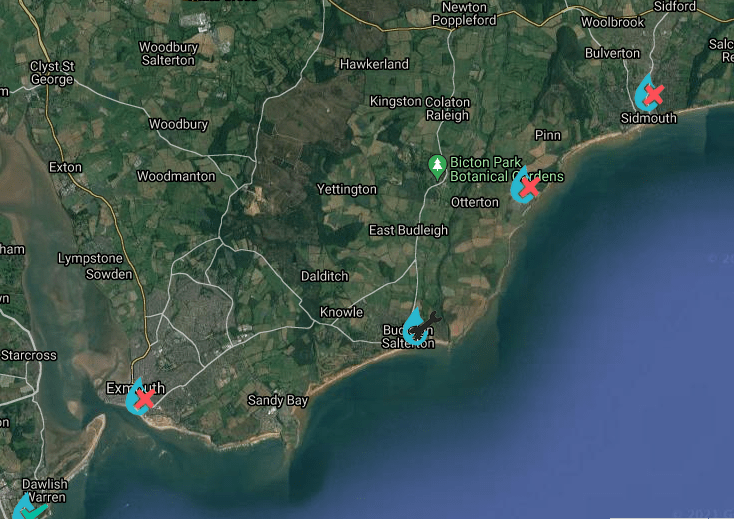
As the holiday season kicks off in earnest, there are widescale sewage alerts are in operation for East Devon beaches see https://www.sas.org.uk/map/ and the alert system at Budleigh Salterton seems to be out of action.

E.g: Sidmouth Town


“Pollution Alert: Storm sewage has been discharged from a sewer overflow in this location within the past 48 hours.
Rock pools to the west, overhanging cliffs to the east, Sidmouth Town beach compromises 900m of legally protected pebbles broken up by rock groynes and backed by a promenade and the town. Two sewer overflows are located at Sidmouth, one discharges through a long sea outfall some 600m out to sea while the other discharges into the River Sid, just under 400m to the east.”

In 2020 there were 1,919 pollution incidents, a decrease from 2,204 in 2019, but the second highest total since 2015. See this report.

“Southern Water and South West Water both performed significantly below target for pollution … Southern Water for the second year in a row and South West Water for the 10th year in a row,” the Environment Agency said. “Both companies’ performances have been consistently unacceptable.”

The impact of pollution from water companies can be seen in the poor quality of water in English rivers. Last year every river failed pollution tests. Pollution from raw sewage discharges by water companies directly into rivers, chemical discharges from industry and agricultural runoff are significant sources of pollution, according to the data.

Emma Howard Boyd, the chair of the Environment Agency, said on Tuesday: “The bottom line is, England’s rivers are too polluted.”

Nearly a third (32%) of rivers were failing to meet tests for good ecological status because of discharges from sewage treatment works. About 7% of rivers are polluted because of raw effluent flowing from storm overflows, the EA said.

(Southern Water has just been fined a record £90m for dumping billions of litres of raw sewage into the sea).

Exeter and Torbay team up in bid to become ‘City of Culture’

Exeter has joined forces with Torbay in a bid to become an internationally-recognised ‘City of Culture’.

eastdevonnews.co.uk 

The two UNESCO-designated areas have teamed up in their ambition to provide ‘significant financial, social, and cultural benefits to the region’.  

 If the bid is shortlisted into the final six, Exeter and Torbay will receive £40,000 to develop a programme to secure the status.

If successful, the next stage would see the cultural community fully consulted to develop the proposal.

Driving forces say that, even if unsuccessful, the joint bid will lead to future opportunities ‘to work together to capitalise on opportunities and ideas’ included in the City of Culture proposal.

The bid sees Torbay Council joining forces with Exeter City Council to become a world-renowned City of Culture in four years. 

The designation is given to a city in the UK for a period of one year.

The aim of the initiative, which is administered by the Department for Digital, Culture, Media and Sport, is to build on the success of Liverpool’s year as European Capital of Culture 2008, which had significant social and economic benefits for the area.

The inaugural holder of the award was Derry in 2013. In 2017, Kingston upon Hull took over the title before Coventry hosted in 2021.

Torbay and Exeter’s bid links the City to the Sea and is inspired by the connections between Torquay, Paignton and Brixham to Devon’s capital.   

The bid will look to showcase closely-connected coastal and city destinations; creating a ‘cultural corridor’ between the places.

It will also provide the opportunity to for other towns between Exeter and Torbay to play a major role in a focused programme of events. 

Councillor Amal Ghusain, Exeter City Council’s lead for culture and communities, said: “Torbay and Exeter naturally complement and enhance each other, with firm roots in the natural environment, art, literature and learning, with shared aspirations about NetZero carbon targets and with recognised opportunities to learn from each other.”

In its submission, the bid says: “Both Torbay and Exeter provide a brilliant alternative to a one centre cultural prize, the partnership is determined to innovate and create, and present its cultural credentials set against a backdrop of rivers, moors, and market towns, which lend themselves to be front and centre of a cultural and creative programme.

“Our people are passionate about their green and pleasant land, they are fiercely proud of their surroundings, yet celebrate the opportunity to share and develop their cultural offer and their creative skills.

“Independent artists, music makers, crafters, designer makers, theatres, and creative industries find a home and a rhythm on the foundations of a Roman City, in a natural harbour, via UNESCO designations and within the finest natural environment.” 

The bids that are successfully shortlisted by the Department for Digital, Culture, Media and Sport will be notified in September. 

Peak of third wave or mirage? Scientists are divided.

The recent drop in new daily reported Covid cases in the UK has led some scientists to hope that the country has reached the peak of this wave – but others say the dip could be something of a mirage.

Nicola Davis www.theguardian.com 

According to the latest figures from the Office for National Statistics, based on swabs collected from randomly selected households, about 1 in 75 people in the community in England had Covid in the week ending 17 July, up from 1 in 95 the week before. The survey suggests infection levels have also risen in Wales and Northern Ireland, although the trend in Scotland was unclear.

However, case data, based on those coming forward for testing – often once they have symptoms – is painting a different picture. On Friday 36,389 new cases of Covid were reported in the UK, down from 39,906 the day before and the sixth day in a row that cases were below the 54,674 figure reported on 17 July.

The decline has led some to voice cautious optimism. Tweeting about Thursday’s figures, Prof Eric Topol, director of the Scripps Research Translational Institute in California, wrote: “This could turn out to be the best Covid news of the day,” adding along with the prayer hands emoji that new cases in the UK appeared to be starting a descent.

But as so often in this pandemic, it will take time for the situation to become clear.

Dr Mike Tildesley of the University of Warwick, a member of the Scientific Pandemic Influenza Group on Modelling (SPI-M), said it was impossible to tell whether the recent fall in cases meant the tide was starting to turn. “We really need to see a trend, and if this continues for the next week,” he said. “Right now it could be a blip.”

A key factor is that it will be two to three weeks before the impact of the relaxation of Covid restrictions on 19 July and the influence of school holidays begin to be seen in case figures. Many schools in England only broke up on Friday.

While the relaxation of restrictions is expected to boost the spread of Covid, school holidays may lead to reduced transmission – as well as testing. However, with the majority of children not eligible for vaccination, the return to school in September could fuel a further rise in cases.

And there are other factors including Euro 2020 – there are signs that mass gatherings for the matches may have fuelled an increase in infections.

“Given that the final was on 11 July, the peak – and then dip – around four days after that, does coincide with any such infections being reported in the next four or five days later,” said Prof Rowland Kao, an epidemiologist at the University of Edinburgh who also contributes to Spi-M. “If so, it could be that what we are seeing is a decline that is due to the passing of that possible [event] – and it may be followed by a more sustained rise.”

Another factor relates to immunity. While documents released by Spi-M on Friday dated to 14 July noted signs of a slowdown in growth in the north-west of England, something ONS data suggests has since turned into a decline, the group suggested there was no clear indication from observed local antibody prevalence data that herd immunity was causing the downward trend.

However, Kao said it is possible that factors with a more sustained impact than the football could be at play in the UK. “In particular, the proportion of individuals with either natural or vaccine-induced immunity is getting high, and if people are being more aware of the need for continued personal measures to control Covid than the modelling anticipated … then together that may be enough to signal a more sustained decline, at least in some areas of the country,” he told the Guardian.

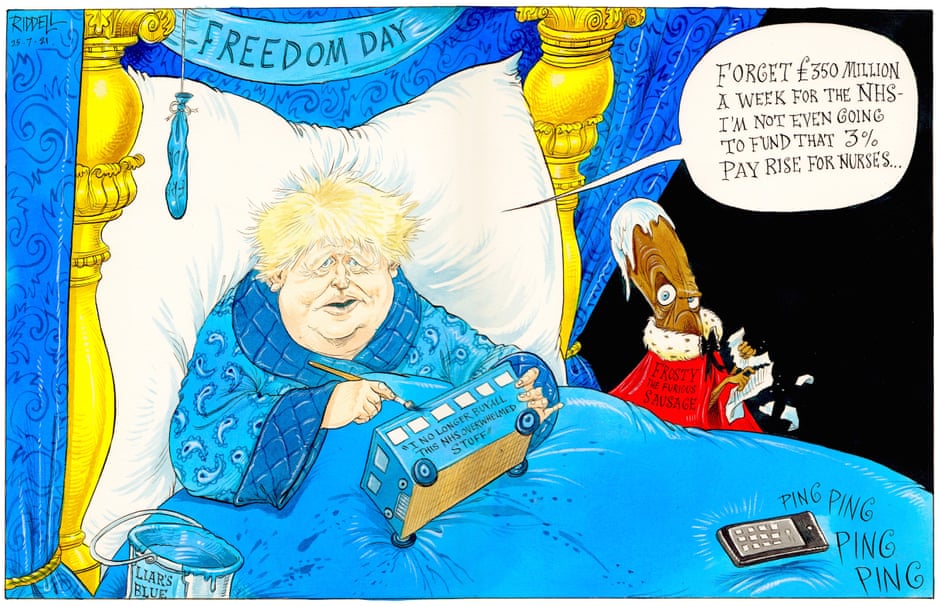
More on: Were we turning a corner when Boris hit the gas?

“The number of new coronavirus cases confirmed across Devon and Cornwall in the last week has reached record levels – but new infections are starting to fall.”

However, there will be a lag of a couple of weeks before we see what the impact of “July 19 Freedom Day” really is. Uncontrolled exponential growth is inherently dangerous. – Owl

Number of new Covid cases at record levels

Daniel Clark www.devonlive.com 

A total of 8,570 new cases were confirmed across the two counties for the second successive week – with the total since the start of the pandemic at 73,862– with some significant week-on-week rises.

It is the highest weekly total in terms of the number of new cases, up by around 25 per cent on last week’s total – but the number of new infections confirmed in the previous two days have both been significantly lower than the figure last week, showing early signs that the wave may have peaked.

While every single region saw a rise in the number of new cases, and infection rates are at record levels, the rise in the number of people in hospital was less steep and is significantly lower than the peak – and the number of deaths remains very low.

At the peak of the second wave, there were 403 patients in hospitals across Devon and Cornwall following a positive Covid-19 test, compared to the 72 at present.

And Plymouth hasn’t seen a death since March 1, while Devon saw one death this week on July 17, its first for two months, with three deaths in Cornwall.

Government stats show that 8,570 new cases have been confirmed across the region in the past seven days, to 6,560 new cases confirmed last week.

Since July 16, of the 8,570 new cases confirmed, 2322 were in Cornwall, 600 in East Devon, 549 in Exeter, 300 in Mid Devon, 497 in North Devon, 2192 in Plymouth, 338 in South Hams, 534 in Teignbridge, 891 in Torbay, 200 in Torridge and 147 in West Devon.

This compares to the 6560 cases confirmed between July 10-16, of which, 1589 were in Cornwall, with 491 in East Devon, 434 in Exeter, 275 in Mid Devon, 373 in North Devon, 1713 in Plymouth, 263 in South Hams, 479 in Teignbridge, 726 in Torbay, 125 in Torridge and 92 in West Devon.

Infection rates across Devon and Cornwall are highest in the 20-39s and then the 0-19s, followed by the 40-59s, 60-79s and 80+ in every region, and have risen in every region, but the infection rates for the over 80s in Devon and Torbay is lower this week than it was seven days ago, and by specimen date, no-one aged 80+ in West Devon has tested positive in the last week.

But despite the large spike in cases, and while there has been a rise of those going into hospital, the increase is not as large – although the numbers are growing.

The latest Government figures, which give the position as of Tuesday, July 20, show that across hospital trusts in the two counties, there are 72 patients currently in hospital in the two counties – up from 53.

Derriford Hospital has 23 patients – up from 15, with Exeter having 16, up from nine, Torbay 11, up from nine, and North Devon two, up from one, with seven patients in mechanical ventilation beds in Devon. In Cornwall, there were 20 patients in hospital, up one from 19 last week, with none in a mechanical ventilation bed.

The figures show how many patients are in hospital following a positive test for Covid-19, but not whether they were admitted for Covid-related reasons, whether they were infected inside the hospital, or whether their admission was entirely unrelated but they happened to have Covid at the same time.

In terms of the latest MSOA cluster maps, that cover the period of specimen dates between July 12-18, only the Isles of Scilly reported between 0-2 cases, with all 229 areas of Devon and Cornwall reporting three or more cases.

Millbay & Stonehouse, and Newquay East, both reported 120 cases, with Plymstock Hooe & Oreston seeing 117, St Budeaux 115, and Blatchcombe & Blagdon 102.

Braunton (98), Ham, Beacon Park & Pennycross (97), St Columb Minor & Porth (97), Derriford & Estover (93), Ford & Blockhouse Park (93), Cattedown & Prince Rock (92), Devonport, Mount Wise & Morice Town (91), Newquay West (91), and Chelston, Cockington & Livermead (90) also saw 90 or more cases.

Cranbrook, Broadclyst & Stoke Canon, and Exmouth Town (both 82), Pinhoe & Whipton North (72), Bradninch, Silverton & Thorverton (69), Woolwell & Lee Mill (40), Chudleigh & Bovey Tracey (56), Bideford South & East (52), and Tavistock (31) were the worst hit areas of the other districts respectively.

It comes as closing in on around 90 per cent of adults in Devon and Cornwall have had their first Covid-19 vaccine, with around seven per cent having had both doses.

Of the adult population, 85.5% in Cornwall, 89.2% in East Devon, 77.1% in Exeter, 88.1% in Mid Devon, 86.5% in North Devon, 82% in Plymouth, 87.3% in South Hams, 88.5% in Teignbridge, 84.7% in Torbay, 88.3% in Torridge, and 89% in West Devon, have had one dose.

And of the adult population, 69.6% in Cornwall, 74.2% in East Devon, 55.1% in Exeter, 71.4% in Mid Devon, 70.3% in North Devon, 62.6% in Plymouth, 72.2% in South Hams, 74.2% in Teignbridge, 71.7% in Torbay, 73.9% in Torridge and 76.6% in West Devon, have had a second dose.

Steve Brown, Director of Public Health Devon is urging residents to keep doing their bit to reduce the spread of coronavirus in Devon and to continue looking out for each other, particularly the most vulnerable, as we have done throughout the pandemic.

He said: “With most legal COVID-19 restrictions lifting this week, I want to say a huge heartfelt thank you to everyone in Devon for all they have done so far to keep each other safe.

“I want us to continue to be careful because positive cases in Devon are still rising, in fact at the moment we’ve got the highest rate of COVID-19 we’ve seen during the whole pandemic.

“While most people who catch COVID aren’t becoming seriously ill, due to the vaccination programme, there are some who do need medical care and unfortunately we are seeing hospital admission rise. There are plenty of people feeling the disruption of having to self-isolate with COVID-19 or because they have been identified as a close contact of a positive case.

“Over 38,000 people in Devon were identified as being Clinically Extremely Vulnerable and asked to shield from coronavirus. Many spent several months with little if any interaction outside of their households.

“And now as restrictions lift, these vulnerable people are once again being advised by the government about extra steps they may wish to take to protect themselves, such as making sure they have both does of a COVID-19 vaccine, meeting friends and family outside if possible and visiting shops and pharmacies at quieter times of day.

“But I strongly feel that it is up to all of us to carry on doing everything we can to continue keeping each other safe.

“Many people, particularly if they are Clinically Extremely Vulnerable, have dreaded the day legal restrictions lift for fear of catching coronavirus. I understand that you’re in a difficult position, and you may be feeling worried about the current situation.

“Although the legal restrictions have lifted, our responsibility to members of our family, friends and society has not changed. I urge everyone in Devon to choose to do the right thing and keep doing your bit to reduce the spread of coronavirus by respecting the personal space of those around you, wearing a face covering in crowded areas, getting tested regularly, having both doses of the vaccine and washing your hands properly.

“We have been good at looking out for each other and helping those in need so we need to respect those of us who will still be feeling anxious and behave in ways that protect them and ourselves from the risk of coronavirus.”

[Detailed data in online article]

More on the Barnstaple daily gridlock

“Greedy developers”; “Cheap Options”; “Whatever we do will be a disaster”; “Better to wait until we have future planning permissions”; “Let’s talk to the developers”. Under Jenrick’s new planning proposals will this sort of problem become less likely? – Owl

Fears over gridlock chaos in Devon

Lewis Clarke www.devonlive.com 

Fears a busy area will become ‘completely and utterly’ gridlocked have been voiced as housing development continues in Sticklepath.

Devon County Council is looking at the possibility of revoking a bus gate at Gratton Way, which is operated by a rising bollard system, and introduce a new bus gate on Old Torrington Road to the north of the junction with Gratton Way, enforced with cameras.

Traffic would then be directed through Gratton Way to the new development, the crematorium and properties at the southern end of Old Torrington Road instead of from the A3125 on Bickington Road.

The council hopes this will help better manage traffic in the area and reduce congestion due to the new housing development at Larkbear, where permission has been granted for 200 homes with the potential for more.

During a consultation period, 224 responses were received, with 174 in favour and 47 objectors. The council also backed the move.

At the North Devon Highways and Transportation Orders Committee held on Wednesday, July 7, Councillor Caroline Leaver (Barnstaple South, Liberal Democrat) said: “The reason for the bus gate is the impact of the additional traffic that is being generated by those houses. It is something that has been fully considered and has been subject to public consultation.

“We found that the impact of another rat run at the Wrey Arms roundabout, and indeed on Rhododendron Way and Broadclose Road, would impact them significantly enough that planning permission would not be granted without it.

“The other issue is about getting to the crematorium. Once we get the bus gate, we can discuss restrictions; there is nothing to say a bus gate has to be 24-hours a day.

“This has been explored extensively; it’s trying to avoid a problem becoming even worse. It is not about trying to restrict people, so they are not able to move around, but to protect an area becoming so completely and utterly gridlocked that people can’t go about their normal daily lives.”

Early morning traffic congestion at the junction of the A3125 with the B3233
- This queue of traffic into Barnstaple occurs every weekday morning and further housing developments in Bickington, Fremington and Yelland are likely to exacerbate the situation.

Early morning traffic congestion at the junction of the A3125 with the B3233 – This queue of traffic into Barnstaple occurs every weekday morning and further housing developments in Bickington, Fremington and Yelland are likely to exacerbate the situation. (Image: Roger A Smith / Geograph)

Councillor Ian Roome (Barnstaple North, Liberal Democrat) said people were currently using the bus gate on Gratton Way as there was no legal way of enforcing traffic there.

He said: “Everyone is using that bus gate now anyway, whether you like it or not. I was there the other day, and cars are going through it willy-nilly.”

Councillor David Knight, a committee member representing North Devon Council, added: “If we do nothing, we are rubber-stamping people using it as a rat run.

“Doing nothing doesn’t do anything for residents in Rhododendron Avenue and Broadclose Road who are suffering greatly from people shooting up that narrow road.”

Speaking to councillors, Michelle Ward, a resident of Tower View and a driving instructor, said the area had been plagued with issues.

“We used to be able to collect our students anytime and anywhere around the Barnstaple area,” she said.

“Over the last five years, it’s been a total nightmare. We no longer collect students from Fremington, Bickington, and Roundswell between 7.30 am, and 9.30 am due to the sluggish and stagnant traffic.

“We also get a lot of complaints from parents that their children are in lessons and sat in traffic.

“As a reputable company, this didn’t sit well with us at all. We don’t like complaints of any sort, especially when people are sat in traffic.

“My husband and I, along with 40 other driving instructors, find the traffic in Barnstaple so unpredictable and often gridlocked from Bickington through to the hospital. The bus gate move will alleviate the traffic issues on this side of town and will be life-changing for residents living in this area.

“The bus gate move will encourage drivers to use the A361 and the A39 circular routes which have been put there to avoid the town.”

However, some members called for a delay in the decision.

Councillor Paul Henderson (Conservative, Chulmleigh and Landkey) said: “It’s a very emotive subject. People on Old Torrington Road and further north will not want increased traffic flow, but people living south in the new estate with much longer journeys going around.

“Surely it’s better to leave the bus gate issue until we have future planning permissions, which will see the new site access and new homes being developed being required to manage traffic flows.”

“This was going to be a sensible development with access off the A361,” he explained. “It was going to link into the back of Petroc to take coaches off Old Torrington Road, and it was a win-win.

“Then the greedy developer has come along, saw it was going to cost a lot of money, and did the cheap option to come out on Old Torrington Road.”

He said it was now a ‘complete nightmare’.

“I think the sensible thing to do now is nothing,” he said. “People will take the fastest and shortest route, and we can take a look at where people start going.

“Whatever we do will be a disaster, and adding all these extra houses will make it a bigger problem. Let’s talk to the developers, bring it back for discussion as soon as we can, and get this as right as we possibly can.”

Councillor Pru Maskell (Braunton Rural, Conservative) added: “Why was that development given planning permission without the original proposal for access onto the A361?

“It seems this whole issue has been created by that fact, and it could have solved a huge amount of traffic issues if that had happened.”

Workers in south-west England hardest hit by Universal Credit cut

The south-west of England will have the highest proportion of low-income workers affected by a £20-a-week cut later this year in universal credit payments, according to analysis by the TUC that illustrates the widespread culture of low pay from Cornwall to Gloucestershire.

Phillip Inman www.theguardian.com 

More than four in 10 universal credit claimants in the south-west have a low-paid job that qualifies them for benefits, a larger percentage than any other region, said the trade union body.

The rate of claimants who had a job in May was 42.1% in the south-west compared with 41.2% in the east Midlands, the next worst affected, and 36.7% in the West Midlands.

The TUC general secretary, Frances O’Grady, said 2.3 million working families, as well as those who rely solely on benefits, would see their incomes drop by more than £1,000 a year if the government presses ahead with a planned £20-a-week cut in universal credit from October.

The report also highlights the impact on individual parliamentary constituencies, revealing that the prime minister’s west London Uxbridge and South Ruislip seat has 9,546 UC claimants of whom 3,665 are in work, 38.4% of the total.

In the chancellor Rishi Sunak’s Yorkshire constituency of Richmond nearly half, 48%, of people receiving universal credit are in work.

The TUC said: “It shows that even in wealthier parts of the UK the cut to universal credit will impact heavily on low-paid workers.”

About 6 million families claim UC and its predecessor, working families tax credit – twice the figure before the pandemic. More than 500,000 people were forced to file a claim during just nine days in March 2020 as the virus began to spread and the government announced the first lockdown.

In the same month, ministers agreed a £20 rise in universal credit and tax credits as a one-year measure to help new claimants adjust to the extra costs of the pandemic.

Estimates suggest it helped 700,000 people stay above the poverty line during the pandemic. Surveys have shown the public support it being made permanent.

Earlier this month Thérèse Coffey told MPs the government had honoured its commitment to extend the uplift for six months. Now the economy was opening up, she said, the focus of DWP support “should be strongly on getting people into work and jobs”.

Although there was no up-to-date robust data showing that claimants were coming off the benefit in significant numbers, Coffey said internal DWP figures suggested there were 2.1 million job seekers on universal credit, down from 2.5 million in March, and this number was reducing week by week.

Labour, welfare charities and some Tory MPs have criticised the move, saying that millions of people will still be in precarious jobs in October and unable to cope financially after a cut in benefits of more than £1,000 a year.

In a separate report, also timed to coincide with the summer parliamentary recess, the Joseph Rowntree Foundation said more than 500,000 people, including 200,000 children, will be plunged into poverty when the government pushes through what it called “the largest single cut to the basic rate of social security since the second world war”.

About 6 in 10 of all single-parent families will experience their income falling by the equivalent of £1,040 per year after the benefit cut, it said, imposing “the biggest overnight cut to the basic rate of social security since the foundation of the modern welfare state”.