Covid rips through Devon community

“Infection rates across Devon are the highest they have ever been – currently at 319.3/100,000 – and are set to rise further in upcoming days as more data gets added.”

Daniel Clark www.devonlive.com

Braunton in North Devon saw more than one per cent of its residents test positive for coronavirus last week.

Latest figures for the county’s MSOA areas for the seven day period between July 8-14 show every single area is recording a cluster of three or more cases.

Four of the top five areas where the highest number of cases were confirmed were in Torbay, with Chelston, Cockington & Livermead, Paignton Central, Torquay Central, and Blatchcombe & Blagdon all seeing more than 60 cases confirmed.

But Braunton saw 96 cases in that seven day period – and with an infection rate of 1,017.4/100,000, it means that more than one per cent of the population tested positive.

Infection rates across Devon are the highest they have ever been – currently at 319.3/100,000 – and are set to rise further in upcoming days as more data gets added.

Steve Brown, Devon’s director of public health, said that while restrictions may have changed, “our responsibility as members of our family, friends and society have not changed”, and urged residents to think carefully about their actions.

He added: “We need to take personal responsibility, remain cautious, and continue with the efforts we have made so far in helping to stop the spread.

Promoted Stories

“Employers also, the rules have changed, but please continue to do the right thing by your workforce and your customers.

“The goalposts may have moved with the intended lifting of restrictions, but our responsibility as members of our family, friends and society have not changed. Please choose to do the right thing for ourselves and others.”

FULL LIST OF MSOA CLUSTERS FOR DEVON

AreaMSOAInfection RateCases
North DevonBraunton1017.496
TorbayChelston, Cockington & Livermead822.390
TorbayPaignton Central733.470
TorbayTorquay Central82863
TorbayBlatchcombe & Blagdon506.161
Mid DevonBradninch, Silverton & Thorverton717.560
East DevonCranbrook, Broadclyst & Stoke Canon423.457
Mid DevonCullompton636.756
East DevonExmouth Town73154
TorbayEllacombe925.854
East DevonExmouth Withycombe Raleigh687.951
TorbayShiphay & the Willows482.551
TeignbridgeKingsteignton538.948
TorbayBrixham Town507.548
East DevonExmouth Halsdon663.246
ExeterPennsylvania & University386.945
ExeterPinhoe & Whipton North469.744
TorbayWatcombe609.144
TorbayBabbacombe & Plainmoor729.541
ExeterMiddlemoor & Sowton318.740
Mid DevonTiverton North & Outer448.939
North DevonIlfracombe East724.539
TeignbridgeNewton Abbot, Broadlands & Wolborough676.139
TorbaySt Marychurch & Maidencombe640.137
TorbayWellswood471.737
TeignbridgeNewton Abbot, Town Centre575.536
TorbayUpton & Hele561.436
East DevonOttery St Mary & West Hill392.935
TeignbridgeChudleigh & Bovey Tracey358.835
North DevonIlfracombe West57634
South HamsWoolwell & Lee Mill554.234
TeignbridgeTeignmouth South499.434
TeignbridgeNewton Abbot, Highweek552.834
East DevonExmouth Littleham425.932
Mid DevonTiverton East430.232
TorbayPreston & Shorton362.732
TeignbridgeOgwell, Mile End & Teigngrace369.631
East DevonExmouth Brixington463.230
ExeterExwick & Foxhayes383.329
ExeterCountess Wear & Topsham375.929
South HamsWembury, Brixton & Newton Ferrers428.129
ExeterSt James’s Park & Hoopern292.128
North DevonWoolacombe, Georgeham & Croyde519.428
North DevonBarnstaple South314.928
South HamsIvybridge238.228
TorridgeBideford South & East218.528
East DevonFeniton & Whimple308.227
ExeterMincinglake & Beacon Heath384.727
South HamsYealmpton, Modbury & Aveton Gifford350.427
South HamsTotnes Town29426
South HamsMarldon, Stoke Gabriel & Kingswear34726
ExeterHeavitree West & Polsloe292.825
ExeterSt Thomas West343.625
Mid DevonTiverton West396.325
North DevonSouth Molton250.725
East DevonSeaton318.524
ExeterSt Thomas East293.324
West DevonTavistock191.324
ExeterCentral Exeter190.323
Mid DevonUffculme & Hemyock336.323
TeignbridgeTeignmouth North271.623
TorbayClifton & Maidenway323.523
ExeterHeavitree East & Whipton South291.722
ExeterWonford & St Loye’s265.522
Mid DevonCrediton277.622
North DevonBratton Fleming, Goodleigh & Kings Heanton357.722
TeignbridgeKingskerswell35822
TorbayChurston & Galmpton325.122
East DevonHoniton North & East347.221
East DevonAxminster225.321
North DevonRoundswell & Landkey227.121
TeignbridgeDawlish North247.121
TeignbridgeDawlish South31321
TeignbridgeHeathfield & Liverton325.521
North DevonLynton & Combe Martin364.820
North DevonBarnstaple Central315.320
South HamsLoddiswell & Dartington276.820
TorbayGoodrington & Roselands279.820
TorridgeHolsworthy, Bradworthy & Welcombe197.420
East DevonPoppleford, Otterton & Woodbury308.819
South HamsKingsbridge292.519
South HamsChillington, Torcross & Stoke Fleming335.519
East DevonKilmington, Colyton & Uplyme215.618
ExeterSt Leonard’s267.918
ExeterAlphington & Marsh Barton245.218
TeignbridgeNewton Abbot, Milber & Buckland321.318
East DevonClyst, Exton & Lympstone248.717
North DevonBarnstaple Pilton291.617
South HamsSalcombe, Malborough & Thurlestone329.117
East DevonSidmouth Sidford227.616
Mid DevonMorchard Bishop, Copplestone & Newton St Cyres215.616
South HamsDartmouth294.816
TeignbridgeBishopsteignton & Shaldon238.916
TorbayHigher Brixham212.716
West DevonBere Alston, Buckland Monachorum & Yelverton252.616
North DevonBarnstaple Sticklepath254.515
North DevonFremington & Instow234.515
TeignbridgeStarcross & Exminster173.615
TeignbridgeAshburton & Buckfastleigh186.715
TorridgeBideford North251.715
Mid DevonWilland, Sampford Peverell & Halberton191.314
East DevonBudleigh Salterton209.113
TeignbridgeTedburn, Shillingford & Higher Ashton241.513
TeignbridgeIpplepen & Broadhempston231.513
TorridgeGreat Torrington217.413
TorridgeShebbear, Cookworthy & Broadheath183.613
West DevonChagford, Princetown & Dartmoor187.213
West DevonHorrabridge & Mary Tavy197.812
Mid DevonBampton, Holcombe & Westleigh160.711
South HamsSouth Brent & Cornwood132.311
TorridgeWestward Ho! & Northam South172.411
West DevonHatherleigh, Exbourne & North Tawton103.710
West DevonLifton, Lamerton & Bridestowe150.410
East DevonHoniton South & West163.69
TorridgeWinkleigh & High Bickington123.19
North DevonBishop’s Nympton, Witheridge & Chulmleigh117.28
TorridgeAppledore & Northam North131.28
East DevonSidbury, Offwell & Beer129.77
East DevonSidmouth Town133.67
TeignbridgeMoretonhampstead, Lustleigh & East Dartmoor1197
TorridgeHartland Coast76.85
West DevonOkehampton65.75
East DevonDunkesewell, Upottery & Stockland68.94
Mid DevonBow, Lapford & Yeoford47.13

Breaking news: the system is broken – you couldn’t make it up!

UK runs out of Covid lateral flow tests on Freedom Day as millions order kits

Kelly-Ann Mills www.mirror.co.uk

Coronavirus lateral flow tests given out by the Government for free have run out as millions order kits on Freedom Day.

The government’s website tells people to “come back tomorrow”.

Sidmouth continues to crumble away!

Another Devon beach cliff fall is captured on camera

Anita Merritt www.devonlive.com

Another cliff fall at a Devon beach has been captured on camera just weeks after four other separate incidents were reported in the same town.

Yesterday (July 17) some more of the notorious crumbling cliffs tumbled down causing huge plumes of red dust and a “deafening” noise.

The aftermath of the cliff fall at Sidmouth was captured by Brad Palmer during a visit to the seaside town.

Read more: Prince Charles expected to ditch face mask when he visits Exeter tomorrow

He recalled: “I was walking in that direction and saw the whole thing. A large side of of the cliff face just dropped.

“The sound was deafening. People behind us and in front all looked over to see what it was.

The aftermath of the Sidmouth beach cliff fall

The aftermath of the Sidmouth beach cliff fall (Image: Brad Palmer)

“The aftermath was just a huge dust cloud which lasted about five minutes leaving a mound of mud and clay on the beach, which is accompanied by a previous rock fall in the background.”

Last month, Devon Live reported how a cliff fall had been witnessed for the fourth time over the past three weeks. It occurred on June 10, just two days after the most recent landslide in Sidmouth, which prompted a warning from Beer Coastguard team.

In May of last year there were three cliff falls which all took place within 24 hours in Sidmouth.

Were we turning a corner when Boris hit the gas?

Tim Spector’s studies have correctly spotted the turning points in the evolution of the pandemic in the UK so far. So is this another one or is it something to do with the sample?

New cases plateau ahead of Freedom Day

covid.joinzoe.com 

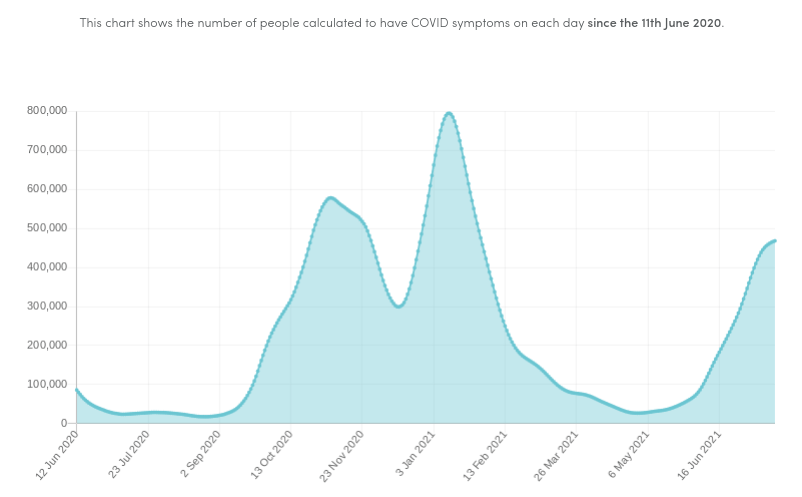
According to ZOE COVID Study incidence figures, it is estimated that among unvaccinated people in the UK there are currently 17,581 new daily symptomatic cases of COVID on average, based on PCR test data from up to five days ago [*]. A decrease of 22% from 22,638 last week. Suggesting that the wave in the unvaccinated population has now peaked in the UK. The overall number of estimated cases is 33,118 which remains similar to last weeks which was 33,723.

Comparatively there are currently 15,537 new daily symptomatic cases in partly or fully vaccinated people, an increase of 40% from 11,084 new cases last week. With cases in the vaccinated group continuing to rise, the number of new cases in the vaccinated population is set to overtake the unvaccinated in the coming days. 

In terms of prevalence, on average 1 in 142 people in the UK currently have symptomatic COVID (Table 1). 

The UK R value is 1.0 and regional R values are; England, 1.0, Wales, 1.1, Scotland, 0.9 (Table 1). Across the regions, it’s a mixed picture. New cases in the North East and East of England are still rising but in Scotland cases are now falling. In Wales cases remain relatively low and are rising very slowly. The rest of the UK reflects the overall picture, which is one where cases have stopped in their tracks for now.

According to the ZOE COVID Study there are an estimated 550 cases of Long COVID a day among unvaccinated people in the UK. This is calculated by using the estimated number of daily new cases from ZOE and the rates of long COVID from the latest research on risk factors for long COVID [ref] and adjusting for age differences. This figure is smoothed, see Graph 2. 

The ZOE COVID Study incidence figures (new symptomatic cases) are based on reports from around one million weekly contributors and the proportion of newly symptomatic users who have received positive swab tests. The latest survey figures were based on data from 10,303 recent swab tests done between 26 June and 11 July 2021. The data excludes lateral flow tests.

Tim Spector OBE, lead scientist on the ZOE COVID Study app and Professor of Genetic Epidemiology at King’s College London, comments on the latest data:

“We are seeing the overall incidence rates plateau in the UK with an R value of 1.0, which is good news. But the rate of decline may be slower this time, as many of the restrictions in place previously will end. The numbers are still high with around 1 in 142 people with COVID, so we’ll keep a close eye on numbers and the effect of the Euro Football Championship in the coming days and weeks. Interestingly, comparing the UK globally, we are starting to see cases in the rest of the world catching up. This is probably due to the Delta variant taking hold, and the relative success of the vaccine roll out in the UK as well as vaccination rates slow in other countries. In the UK, new cases in vaccinated people are still going up and will soon outpace unvaccinated cases. This is probably because we’re running out of unvaccinated susceptible people to infect as more and more people get the vaccine. Whilst the figures look worrying, it’s important to highlight that vaccines have massively reduced severe infections and post-vaccination COVID is a much milder disease for most people. The main concern is now the risk of Long COVID.”

Graph 1. The ZOE COVID Study UK Infection Survey results over time 

Graph 2. Long COVID incidence in the UK

Table 1. Incidence (daily new symptomatic cases)[*], R values and prevalence regional breakdown table 

Map of UK prevalence figures

U.K. Counts More New Covid Cases Than Any Other Country, One Day Before Dropping Pandemic Restrictions

The world watches “the great experiment” – Owl

Carlie Porterfield www.forbes.com 

Topline

The United Kingdom reported a whopping 48,161 new coronavirus cases Sunday, more than any other country in the world, just one day before most of the country is set to pull all of its pandemic restrictions despite rising infections.

Key Facts

The figure represents a more than 43% surge in new cases compared to a week ago as the U.K. is facing another wave which experts attribute to the spread of the delta variant, which is believed to be more transmissible than earlier forms of the virus.

The new infections have occurred largely among young, unvaccinated Brits, who were among the last in line to be eligible to receive a vaccine from the U.K.’s National Health Service, which is now offering jabs for anyone 18 and older.

England, which makes up more than 84% of the U.K. population, is slated to drop all pandemic restrictions Monday, including masking rules and capacity guidelines.

The other three countries that make up the U.K.—Scotland, Northern Ireland and Wales—will also loosen their existing restrictions, but not to the extent that England is.

Public Health England data show coronavirus deaths and hospitalizations remain far lower than during previous pandemic peaks, which experts attribute to vaccinations preventing serious illness, though the numbers have risen over the past week.

Surprising Fact

Even the new health secretary, Sajid Javid, tested positive for coronavirus over the weekend, sending some of the nation’s top officials—including Prime Minister Boris Johnson—into isolation.

Contra

The decision to open up the U.K. amid the spike in cases has drawn backlash from public health officials and members of the medical community. Earlier this month, after the U.K. government announced plans to loosen restrictions, 122 scientists and doctors signed an open letter calling the move “dangerous and premature” and urged the government to reconsider.

Key Background

According to a Johns Hopkins University tally, the U.K. has counted more than 5.4 million confirmed infections and nearly 129,000 deaths, making it the worst-hit country in Europe by coronavirus. Despite having a more effective vaccination campaign than most European countries, new infections began to gradually rise again in June, though hospitalizations and deaths tied to coronavirus have stayed low. 

Why ‘freedom day’ is the latest example of COVID propaganda

The lifting of most COVID legal restrictions on July 19 has been dubbed “freedom day” by some politicians and journalists. Though not an official designation, this popularisation of this moment with such a saying closely follows two of my 10 “golden rules” of propaganda that I’ve developed in my years studying the practice. First, appeal to the instincts rather than the reason of the audience, and second, build around a slogan. Then repeat, repeat, repeat.

Colin Alexander theconversation.com

To this end, the media’s regular use of the phrase reflects its compliance with – and encouragement of – the government’s pandemic communications strategy. It is one of these phrases that you cannot quite place where it first emerged but which quickly seeps into public discussion to the point that we all know what it means.

Throughout the pandemic, the British government has utilised a wartime propaganda playbook to deliver public communications about COVID and the purported solutions to it. In these terms, we are now heading for the end of the “combat” phase of the government’s propaganda delivery and the beginning of the post-pandemic – or post-war – phase.

In this sense, “freedom day” could be compared to VE Day (Victory in Europe Day, May 8 1945) and ought to be regarded as the latest in a long line of rhetorical associations with the second world war that have been encouraged over the last 16 months.

References to blitz spirit, the militarisation of language around and heroisation of the NHS and the attention on second world war veteran Tom Moore as the flagship of British determination and sacrifice are just a few of the ways this history has manifested in COVID Britain.

Concepts like “freedom” and “liberty” have been invoked by propagandists since the 16th-century Protestant Reformation and subsequent Enlightenment period. They emerged as influential writers – Thomas Paine, John Stuart Mill and Isaiah Berlin, to name a few – began to philosophise about the rights of the individual.

To this end, the popular use of “freedom” to describe the end of pandemic restrictions forms part of a populist audience seduction strategy, using emotional rather than rational rhetoric. The media’s purpose in using the phrase then is to be appear to be on the side of the public. As Harold Lasswell, one of the founding fathers of communications studies, wrote in 1927: the best propaganda is that which is the “champion of our dreams”.

The philosopher Patrick Nowell-Smith discussed the seductiveness of the propaganda of “freedom” in his 1954 work Ethics, noting its association with hedonism and its “deliciousness” within the human mind. He caveats that hedonism is not always about “gluttony and self-centredness” and is not always “carnal”.

From the propagandist’s point of view though, “freedom” is an effective rhetorical tool because it means whatever the target audience want it to mean. Its utility is that the term is vague but that it resonates with ease when uttered.

Understanding propaganda

One of the most common misconceptions around propaganda is that it always involves the communication of falsehoods to a mass audience and attempts to “brainwash” – evoking shades of North Korea or the Nazis. In the common mind, propaganda is synonymous with the use of dark arts to encourage a target audience to engage in behaviours or to think in ways that they would otherwise not. Undoubtedly, some propaganda does do this.

Propaganda is more complex than this and can also involve truth-telling, however selective or self-interested.

Today, propaganda is all around us. It is undertaken by governments, state institutions, corporations trying to sell us things, media organisations, charities and powerful individuals in advance of their own interests – just look at any billionaire philanthropist “doing good” while paying next to zero tax.

Individual citizens have obtained the means to broadcast for ourselves, particularly via social media platforms, and we too have become propagandists. “Influencer” is just a more acceptable way of saying “propagandist.”

“Freedom day” is not a lie, because restrictions will be lifted. However, the popularisation of it as such (rather than “most restrictions lifted day,” for example), is part of a strategy (endorsed by government and mainstream media alike) that has wanted the British public to think, act, associate and feel in certain ways since the pandemic began.

Indeed, the best, or most effective, propaganda is that which creates emotional bonds between the target audience and certain people, products, events or concepts. “Freedom day” has been so-called because the powerful want us to think in certain ways about this day, and to exclude or overlook other aspects of the pandemic that it deems undesirable.

To overwhelm the public’s conscience (or to subtly railroad it while making it seem like choices are available) is one of the highest art forms in propaganda. We see this perhaps most clearly within public discussion of the vaccine programme wherein government and media have sought to marginalise more critical views of it.

Calling it “freedom day” attempts to nullify the public by encouraging us not to scrutinise government and media performance as we should. It reflects an attempt to move the discussion from science, sociology and public health to patriotism and emancipation.

Labour accuses Gove of lying about extent of vetting for PPE deals

Michael Gove has been accused of falsely claiming all personal protective equipment (PPE) contracts for the NHS went through eight steps of vetting, as it emerged this did not happen with a deal for millions of unusable face masks linked to a Conservative adviser.

Rowena Mason http://www.theguardian.com 

Angela Rayner, Labour’s deputy leader, said Gove and other ministers were “apparently lying to the public and lying to parliament” by claiming that “every single procurement decision went through an eight-stage process”.

She uncovered the fact that the much-vaunted eight-step process was not undertaken in the case of Ayanda Capital, which was awarded £252m of deals for PPE supplies in spring 2020. Face masks provided by Ayanda were ultimately unusable because the Department of Health and Social Care had specified masks with ear loops, despite the NHS requiring masks that looped over the head.

The process was also not followed in the case of PestFix, a pest control supplies company with net assets of £18,000 that was awarded a contract to supply PPE worth £350m to the NHS, some of which also did not meet the health service’s technical standards.

In answer to a parliamentary question, the health minister, Jo Churchill, said: “The eight-stage process to assess and approve offers of support to supply [PPE] evolved over a short period of time at the end of April 2020 to formalise the checks quickly put in place by the cross-government PPE procurement cell in March 2020.

“Contracts with Ayanda Capital and PestFix pre-dated the formalised eight-stage assurance process but these suppliers were evaluated by officials on financial standing, technical compliance and ability to perform the contract. The contracts are awarded by the appropriate departmental accounting officer in line with our terms and conditions.”

Internal documents released as part of a judicial review case revealed in May that Ayanda, a “family office” finance house in London, was awarded two PPE contracts for a total of £252m after being referred to the VIP lane for assessing deals because its representative, Andrew Mills, was an adviser to Liz Truss, the trade secretary.

Officials pushed for the contracts to be processed as quickly as possible, with one marking emails “URGENT VIP CASE” and “VERY URGENT VIP ESCALATION”, saying that if the deal did not happen: “Andrew will escalate as high as he can possibly go!”

The two contracts were approved on 30 April 2020, five days after Ayanda was put into the VIP lane, but before required financial checks had been carried out on the company, despite a Cabinet Office official raising “major issues or concerns” because of inadequate availability of public financial information and a “low” credit score.

Ayanda has consistently said it fulfilled the contract according to the specifications it was given.

Rayner, who is the shadow chancellor of the duchy of Lancaster, Gove’s opposite number, said:

“Why have Michael Gove and government ministers apparently been lying to the public and lying to parliament to try to cover this up? Michael Gove needs to explain why he has not been telling the truth.

“We need a fully independent investigation into the Tories’ VIP fast track for PPE and testing contracts to get to the bottom of who got the contracts, how they got them and what connections they have to Conservative ministers and the Conservative party.”

Jo Maugham QC, director of Good Law Project, which brought the legal challenge to the Pestfix and Ayanda contracts, said: “You begin to wonder if there are any statements from ministers that you can rely on. It looks like they’ve been infected by Johnsonism: total lack of interest in the truth.”

A government spokesperson said: “All PPE contracts went through a robust process of checks and controls led by officials. These contracts have delivered over 9bn items of PPE to protect frontline workers.”

The government is defending the judicial review over the PPE contracts, arguing the VIP route and the contracts awarded, including to PestFix, Ayanda and another company, were lawful and reasonable as the government tried to rapidly meet a serious shortfall of PPE at the start of the Covid-19 pandemic.

A National Audit Office report in November said 144 referrals to the VIP lane had come from ministers’ private offices, but said of its investigation: “Ministers had properly declared their interests, and we found no evidence of their involvement in procurement decisions or contract management.”

East Devon receives £100k for climate change projects

East Devon District Council has been given £100,000 to help it tackle climate change. The money, from Defra and the Environment Agency is to be topped up with £10,000 from the council’s own budget for projects at Clyst Valley Regional Park.

Radio Exe News www.radioexe.co.uk 

The council is setting up what they call an environmental impact bond and triple the number of trees in the park through planting and natural regeneration.

Projects to restore kelp forests, create new woodland, deliver natural flood risk management, and improve water quality are among 27 schemes nationally, including the East Devon one, to benefit from the new fund to drive private investment in nature and tackle climate change,

Revenues will be generated through the sale of carbon and biodiversity units, natural flood management benefits and through reduced water treatment costs. In developing these revenue streams, the Fund will help create a pipeline of projects for the private sector to invest in, and develop new funding models that can be scaled and replicated elsewhere.

Projects receiving funding focus on tackling climate change and restoring nature through schemes such as woodland and habitat creation, peatland restoration, sustainable drainage and river catchment management.

Cllr Geoff Jung, East Devon District Council’s portfolio holder for coast, country and environment, said: “The EDDC Climate Change Strategy 2020–2025 sets out how we will reduce our carbon emissions year on year and mitigate against the threat that climate will place on our communities. The strategy is being developed following research by Exeter University to establish our current carbon footprint. Our strategy will encompass all our 10 nature reserves and open spaces by increasing natural habitat and increase tree planting to sequester carbon and allow nature to recover, and this funding will help in our exciting plans for the Clyst Valley Regional Park. 

Simon Bates, East Devon District Council’s green infrastructure project manager said: “We want to explore whether an environmental impact bond is the solution. This would blend cash from publicly funded grant schemes and private finance from woodland carbon and biodiversity credits. With major companies such as EON, EDF and many smaller environmental start-up businesses on our doorstep, we expect high demand for voluntary carbon credits in particular.”

Freedom day dawns with Boris confined to the garret

It took 2 hours 38 minutes for Boris to realise that his latest “one rule for you, another one for us” little wizz of enrolling himself on “a pilot testing scheme” to avoid self isolating wouldn’t wash with the public or business.

Says a lot about Conservative arrogance these days that the thought came into his head at all (and Rishi Sunak’s head) and that Robert “three homes” jenrick was prepared to defend it on TV.

Maybe the arrogance runs deeper and Ministers have already dropped their guard and assumed that Covid would only infect the”little people”.

U-turn as Boris Johnson and Rishi Sunak to self-isolate after criticism

Ben Quinn www.theguardian.com

Boris Johnson and Rishi Sunak have been forced into a U-turn and will self-isolate after coming into contact with the health secretary, who has contracted Covid-19.

The UK prime minister and chancellor had initially tried to avoid isolation by saying they were part of a pilot testing scheme, prompting an outcry from members of the public and backbench Conservative MPs.

Their U-turn came after only three hours amid chaos at No 10 over plans to drop many Covid restrictions for “freedom day” on Monday, and minutes after the communities secretary, Robert Jenrick, had defended their plans to continue working from Downing Street.

It means the prime minister, chancellor and health secretary will all be isolating, along with hundreds of thousands of others due to exposure to coronavirus, when restrictions are dropped across England from Monday.

A Downing Street spokesperson said: “The prime minister has been contacted by NHS test and trace to say he is a contact of someone with Covid. He was at Chequers when contacted by test and trace and will remain there to isolate. He will not be taking part in the testing pilot.

“He will continue to conduct meetings with ministers remotely. The chancellor has also been contacted and will also isolate as required and will not be taking part in the pilot.”

Sunak tweeted: “Whilst the test and trace pilot is fairly restrictive, allowing only essential government business, I recognise that even the sense that the rules aren’t the same for everyone is wrong. To that end I’ll be self-isolating as normal and not taking part in the pilot.”

Javid tested positive for coronavirus on Saturday. The prime minister is reported to have had a lengthy meeting with him at No 10 on Friday.

02:29

‘Important everybody sticks to rules’: Johnson explains U-turn on self-isolation – video

Downing Street earlier confirmed Johnson and Sunak were part of a pilot scheme that allows certain people to have daily rapid flow tests instead of having to self-isolate. “They will be conducting only essential government business during this period,” said a spokesperson.

Reaction to the news was rapid and furious, with instances on social media of people reporting they were going to delete the NHS Covid-19 app from their phones.

The shadow health secretary, Jonathan Ashworth, said many people across the UK would be dismayed by the “special, exclusive rule” for Johnson and Sunak.

“There will be parents across the country who have struggled this year when their children have been sent home because they were in a bubble and had to self-isolate,” he told Sky News.

“There will be workers across the country that have to isolate because they’ve been pinged, including in public services, including the NHS. For many of them, waking up this morning to hear that there is a special rule, an exclusive rule, for Boris Johnson and Rishi Sunak, they will be saying that this looks like one rule for them and something else for the rest of us.”

Kate Nicholls, the CEO of UK Hospitality, which represents bars, hotels and others in the sector, said: “It cannot be right that only those on pilot projects are exempt from the need to self-isolate. We need a workable and pragmatic self-isolation policy which keeps people safe but also keeps the economy moving.”

Jonathan Bartley, the co-leader of the Green party, said: “Hundreds of thousands of young people, including my children, had their education and lives repeatedly turned upside down again and again after dutifully and responsibly isolating. And now this. Anger doesn’t begin to cover it.”

Alastair Campbell, Tony Blair’s former director of communications at Downing Street, described it as the “Johnson-Sunak test pilot scandal” and predicted it would “cut through” to the public even more directly than the controversy surrounding the lockdown journeys undertaken to Durham by Dominic Cummings, Johnson’s former chief adviser.

Organisations taking part have to have an asymptomatic testing site set up. Individuals who have been “pinged” after being in contact with someone who has tested positive for Covid can go to work on the basis that they are using lateral flow tests, but must self-isolate when not at work.

The organisations known to be part of the trial have given their consent to be identified, according to No 10, which added that a full list would be published after the results have been recorded.

A spokesperson said the study was separate from a better known pilot scheme, outlined online by the Department of Health and Social Care, which splits participants at random into two groups. In that study, those in a control group will be given a PCR test and must self-isolate as normal for 10 days, while participants in another group benefit from having a 24-hour release from self-isolation if daily lateral flow tests return negative results.

Javid was self-isolating on Saturday after testing positive for Covid, as senior public health leaders from across the UK accused Boris Johnson on Sunday of “letting Covid rip” by relaxing legal restrictions.

The health secretary, who is double-vaccinated, said he had mild symptoms and confirmed the result of a lateral flow test with a positive PCR test.

“I will continue to isolate and work from home,” Javid tweeted.

Labour accuses Gove of lying about extent of vetting for PPE deals

Michael Gove has been accused of falsely claiming all personal protective equipment (PPE) contracts for the NHS went through eight steps of vetting, as it emerged this did not happen with a deal for millions of unusable face masks linked to a Conservative adviser.

Rowena Mason www.theguardian.com

Angela Rayner, Labour’s deputy leader, said Gove and other ministers were “apparently lying to the public and lying to parliament” by claiming that “every single procurement decision went through an eight-stage process”.

She uncovered the fact that the much-vaunted eight-step process was not undertaken in the case of Ayanda Capital, which was awarded £252m of deals for PPE supplies in spring 2020. Face masks provided by Ayanda were ultimately unusable because the Department of Health and Social Care had specified masks with ear loops, despite the NHS requiring masks that looped over the head.

The process was also not followed in the case of PestFix, a pest control supplies company with net assets of £18,000 that was awarded a contract to supply PPE worth £350m to the NHS, some of which also did not meet the health service’s technical standards.

In answer to a parliamentary question, the health minister, Jo Churchill, said: “The eight-stage process to assess and approve offers of support to supply [PPE] evolved over a short period of time at the end of April 2020 to formalise the checks quickly put in place by the cross-government PPE procurement cell in March 2020.

“Contracts with Ayanda Capital and PestFix pre-dated the formalised eight-stage assurance process but these suppliers were evaluated by officials on financial standing, technical compliance and ability to perform the contract. The contracts are awarded by the appropriate departmental accounting officer in line with our terms and conditions.”

Internal documents released as part of a judicial review case revealed in May that Ayanda, a “family office” finance house in London, was awarded two PPE contracts for a total of £252m after being referred to the VIP lane for assessing deals because its representative, Andrew Mills, was an adviser to Liz Truss, the trade secretary.

Officials pushed for the contracts to be processed as quickly as possible, with one marking emails “URGENT VIP CASE” and “VERY URGENT VIP ESCALATION”, saying that if the deal did not happen: “Andrew will escalate as high as he can possibly go!”

The two contracts were approved on 30 April 2020, five days after Ayanda was put into the VIP lane, but before required financial checks had been carried out on the company, despite a Cabinet Office official raising “major issues or concerns” because of inadequate availability of public financial information and a “low” credit score.

Ayanda has consistently said it fulfilled the contract according to the specifications it was given.

Rayner, who is the shadow chancellor of the duchy of Lancaster, Gove’s opposite number, said:

“Why have Michael Gove and government ministers apparently been lying to the public and lying to parliament to try to cover this up? Michael Gove needs to explain why he has not been telling the truth.

“We need a fully independent investigation into the Tories’ VIP fast track for PPE and testing contracts to get to the bottom of who got the contracts, how they got them and what connections they have to Conservative ministers and the Conservative party.”

Jo Maugham QC, director of Good Law Project, which brought the legal challenge to the Pestfix and Ayanda contracts, said: “You begin to wonder if there are any statements from ministers that you can rely on. It looks like they’ve been infected by Johnsonism: total lack of interest in the truth.”

A government spokesperson said: “All PPE contracts went through a robust process of checks and controls led by officials. These contracts have delivered over 9bn items of PPE to protect frontline workers.”

The government is defending the judicial review over the PPE contracts, arguing the VIP route and the contracts awarded, including to PestFix, Ayanda and another company, were lawful and reasonable as the government tried to rapidly meet a serious shortfall of PPE at the start of the Covid-19 pandemic.

A National Audit Office report in November said 144 referrals to the VIP lane had come from ministers’ private offices, but said of its investigation: “Ministers had properly declared their interests, and we found no evidence of their involvement in procurement decisions or contract management.”

EDDC election breaks new ground with Labour’s Jake

Liz Pole, Labour’s spokesperson for Tiverton and Honiton constituency www.midweekherald.co.uk 

At 19 years old, he embodies the fresh start and the kinder, more community-oriented and visionary politics the public wants post-Covid. He has been a mover at a national level of a “new deal” approach to the greening of Britain’s economy, and has locally pioneered the Honiton Foodsave project, redirecting supermarket over-stock from going to waste towards those who need it.

A true Devonian, Jake has dispelled the idea that there are “no-go areas” for the Labour Party in Britain. On the doorstep, conversations were striking for the enthusiasm with which many residents were planning to vote Labour for the first time. Here was a candidate living and breathing community values and delivering on them, so here was the candidate Honiton was going to vote for. Although this is the first time in its history Honiton has turned to Labour, there was no sense of it being a political wrench to do so. The message is loud and clear that showing up and delivering on community values in our own neighbourhoods is the way to build a new hope, a new political consensus, a rejection of secret dealings, asset-stripping and sell-offs, and a new appetite for proper investment in our infrastructure and our communities.

Jake’s refreshing, proactive approach means where problems can be easily fixed, he is tackling them hands-on – literally taking a strimmer to the brambles and nettles blocking the walkway under the railway bridge at Streamers Meadows so residents can shop and go to school more easily.

Where solutions require more elbow grease to deliver, Jake is working strategically with community groups and across political divides to make sure Honiton gets its share. The focus is on the King Street loos, and the sport, leisure and youth facilities. But Jake’s approach will stand in good stead for future challenges. His integrity, and his accountable and transparent style of leadership, means an absolute commitment to represent all residents in Honiton St Michael’s irrespective of their age, politics or any other status.

Land in Axminster is reserved for affordable homes and council housing

Affordable housing and new council homes could be within reach for Axminster after a suitable parcel of land was identified this week.

Becca Gliddon eastdevonnews.co.uk

East Devon District Council (EDDC) said it ‘hopes’ to build ‘much-needed’ affordable and social housing on the former football pitch, in Millwey Rise, Axminster, after councillors on Wednesday (July 14) approved the use of the land.

Councillors this week recommended the land was reserved for council homes, affordable housing, and a new community centre.

An EDDC spokeswoman said: “Some years ago the land at Millwey Rise was returned to East Devon District Council and is now currently designated as land for council housing.

“At the authority’s cabinet meeting on Wednesday, 14 July, councillors approved a report recommending the land is reserved for much needed social and truly affordable housing development and a replacement community centre undertaken by the council.

“Councillors felt passionately that, in view of the desperate shortage of affordable housing in the district, they wanted to set the wheels in motion for the site to be used for its original intended purpose, at the earliest opportunity.”

She added: “There is currently a well-used and valued community centre, owned and managed by EDDC and allotments, on the site.

“This means any future use of the site will need to factor in considerations for the future provision of these essential community facilities and balance the need for housing against competing demands.”

EDDC said the report, which was in the form of a discussion document, was considered by the cabinet.

Councillors ‘recognised a range of planning constraints’ that would need to be overcome as part of any plans, EDDC said.

The district council spokeswoman said: “Although comments from the local community were gathered some years ago, on the original plans, these will need to be updated and addressed before any work can start on-site too.

“EDDC’s next step will be to produce a development brief and feasibility study for the site, consult and report back on options.

“The cabinet were clear that they wanted to optimise social housing and incorporate other community uses, as appropriate including retaining the existing amenities wherever possible.”

Tory MPs urge Boris Johnson to reshuffle underperforming ministers next week

Would there be anyone left unshuffled? – Owl

By Arj Singh inews.co.uk

Tory MPs have urged Prime Minister Boris Johnson to carry out a Cabinet reshuffle next week to sack underperforming ministers and end the “paralysis” in Whitehall.

Several Conservatives, including some who are unlikely to be promoted, have told i the Prime Minister should change his team of ministers before Parliament goes into summer recess on Thursday.

The party is “looking for a reshuffle”, one said.

However, Mr Johnson is not expected to carry out a reshuffle before MPs leave Westminster for the summer, despite widespread speculation in the spring that a rejig was imminent.

One of the main reasons for making a change would be to remove “ministers that shouldn’t be ministers”, with some MPs fearing a repeat of the exam grades chaos of last summer under Education Secretary Gavin Williamson.

“The Government needs sharpening up and some of the ministers need sharpening up,” one experienced MP said.

“There are one or two that certainly should be moved or dropped, definitely.”

Another Tory said: “The education department has not shown itself in a particularly good light, it’s the one that’s messed up the most (during the Covid pandemic) and hasn’t actually come back with anything productive.”

But they speculated that Mr Johnson may hold fire until autumn or even spring 2022 to use ministers as a firebreak for any more Covid-related disasters.

Exam grades were “a complete fiasco”, the MP said.

“But maybe if it’s a complete fiasco again they can get rid of Gavin Williamson after blaming him for the mess.”

Health Minister Lord Bethell was also said to be in line for the chop having been caught up in the scandal that forced the resignation of his boss Matt Hancock as Health Secretary.

Some sources meanwhile blamed persistent briefings and rumours of a reshuffle in recent months for paralysing the Government.

In March, the PM’s then-press secretary Allegra Stratton even suggested to reporters that Mr Johnson would shake up the Cabinet in the coming months and promote more women.

There were further briefings and rumours around the time of the Hartlepool by-election in May.

One Whitehall source told i the situation has caused paralysis in Government departments for weeks.

Officials would begin preparing packs for new recruits, while filing away difficult decisions that they disagreed with their current minister on – in the hope that their successor would approve them, the source said.

MPs meanwhile see the effect on ministers, with one suggesting some have “given up completely and are just waiting to hear if they are staying, moving or being dumped”

“Everything awkward is now just stuck in the ‘leave it for next person’ tray,” one said. 

Another MP warned Mr Johnson it would be a “mistake” to delay a reshuffle, as appears likely.

“There’s too many people in the wrong jobs, there’s too many people looking to the next job, thinking they are going to move in three weeks’ time”, they said.

Some experienced ministers are also said to want a reshuffle now, fearing they could be “squeezed out” with a delay that would see more 2017 and 2019 intake MPs come into the frame as they gather experience.

But MPs were sceptical about the chances of any changes next week, with Johnson already having a mini-reshuffle forced on him by the departure from the Cabinet of Hancock for breaking Covid rules, to be replaced by Health Secretary Sajid Javid.

“I think the general attitude before was that Hancock was going to go in this reshuffle,” one of the MPs said.

“Brokenshire has also resigned for health reasons, so we’ve had a sort of piecemeal reshuffle that isn’t a reshuffle.

“There’s too much little stuff going on so there won’t be a big one, which I think will frustrate some people.

“There are some Cabinet members who frankly shouldn’t still be in place, but somehow manage to survive.”

Downing Street was approached for comment.

England’s Covid unlocking is threat to world, say 1,200 scientists

Boris Johnson’s plan to lift virtually all of England’s pandemic restrictions on Monday is a threat to the world and provides fertile ground for the emergence of vaccine-resistant variants, international experts say.

Ben Quinn www.theguardian.com

Britain’s position as a global transport hub would mean any new variant here would rapidly spread around the world, scientists and physicians warned at an emergency summit. They also expressed grave concerns about Downing Street’s plans.

Government advisers in New Zealand, Israel and Italy were among those who sounded alarm bells about the policy, while more than 1,200 scientists backed a letter to the Lancet journal warning the strategy could allow vaccine-resistant variants to develop.

An adviser to New Zealand’s government told the summit he and his colleagues were astounded at the approach being taken in England.

“In New Zealand we have always looked to the UK for leadership when it comes to scientific expertise, which is why it’s so remarkable that it is not following even basic public health principles,” said Michael Baker, a professor of public health at the University of Otago and a member of the New Zealand ministry of health’s Covid-19 technical advisory group.

Also participating was Prof José Martin-Moreno of the University of Valencia, a senior adviser to the World Health Organization (WHO), who said: “We cannot understand why this is happening in spite of the scientific knowledge that you have.”

Others warned the British government’s approach would be imitated, for political expediency, by authorities elsewhere.

“What I fear is that that the some of the worst impulses in many of our states will follow the UK example,” said Dr William Haseltine, a former Harvard Medical School researcher and a pioneering Aids researcher who chairs Access Health International, a New York-based thinktank.

“I am extremely dismayed to see the very rapid rate of increasing infections in a population that is vaccinated pretty much like we are.”

Prof Christina Pagel, the director of University College London’s clinical operational research unit, told the meeting: “Because of our position as a global travel hub, any variant that becomes dominant in the UK will likely spread to the rest of the globe. The UK policy doesn’t just affect us. It affects everybody and everybody has a stake in what we do.”

The letter to the Lancet said: “We believe the government is embarking on a dangerous and unethical experiment, and we call on it to pause plans to abandon mitigations on July 19, 2021.”

“The world is watching the current avoidable crisis unfold in the UK,” said Dr Deepti Gurdasani, a clinical epidemiologist and senior lecturer at Queen Mary University of London, who is taking part in Friday’s summit.

She added on Twitter: “Let’s be under no illusions – we are in a country where our government is taking steps to maximally expose our young to a virus that causes chronic illness in many. Our govt is ending all protections for our children including isolation of contacts of cases in schools & bubbles.”

The summit, facilitated by the Citizens, a journalism NGO, was being broadcast live on YouTube at noon UK time.

The concerns expressed in other countries comes after Prof Chris Whitty, the chief medical officer for England, warned on Thursday that the number of people in hospital with Covid-19 could reach “quite scary” levels within weeks, as cases soared caused by the more contagious Delta variant and the lifting of lockdown restrictions.

Whitty said in a webinar late on Thursday, hosted by the Science Museum, that hospital admissions were doubling about every three weeks, and that the current low numbers of Covid admissions could rise to serious levels in the next couple of months.

New coronavirus infections in the UK are at a six-month high, according to government figures, and the number of people in hospital and dying with Covid are at their highest level since March. Thursday’s data showed 3,786 people in hospital with Covid and another 63 virus-related deaths.

Downing Street, which has defended the lifting of all remaining legal restrictions on social gatherings in England on 19 July, is hoping the rapid rollout of vaccines will keep a lid on the number of people becoming seriously ill.

Boris Johnson – the “Magic Sauce” speech – in full

The “Magic Sauce” speech, supposedly on levelling up, has come in for much criticism, ridicule even.

Owl posts the whole text so that readers can form their own views and would be grateful if anyone can divine anything of substance in it. 

Boris muses over inequalities; such as life expectancy in Glasgow or Blackpool, compared to Rutland, the economic inequality between York and Doncaster, and unemployment differences between Leeds and Bradford. Yet he offers no causal analysis and therefore no solution.

He mentions that in the last 40 years we have had 40 different schemes or bodies to boost local or regional growth and that we must stop chopping and changing. He does not mention what he proposes to do with the business led Local Enterprise Partnerships which have had about a ten year life. In fact he doesn’t mention them at all. And how many funding schemes has Exmouth been promised a shot at?

Ideas must be pretty thin on the ground if he has to introduce, somewhere in the middle, the concept of “back to basics” and “build back better”.

He does have one big announcement: another £50m for football pitches.

But here is the crux “ ..one final ingredient, the most important factor in levelling up, the yeast that lifts the whole mattress of dough, the magic sauce – the ketchup of catch-up and that is leadership and this brings me to the crux of the argument- this country is not only one of the most imbalanced in the developed world, it is also one of the most centralised…..” 

Though he goes on to say that there will be no “one size fits all template”.

It ends with the desperate plea “Come to us with a plan for strong accountable leadership and we will give you the tools to change your area for the better”.

No doubt The Great South West has their’s already in the post again.

Counting cliches and mixed metaphors might be a way to pass the time on a hot July weekend.

Before that here is a verdict from the Telegraph: 

Is Boris Johnson off his shopping trolley when it comes to levelling up?

Madeline Grant on 15 July wrote: www.telegraph.co.uk 

“….there you have it. Levelling up is both everything and nothing. It is a cliche wrapped in a soundbite inside an inanity. And because it is fundamentally meaningless, its success is impossible to measure.

Britain voted Conservative, and instead it got government by platitude. World-beating, turbo-charging, rocket-boosting platitude.” 

The Prime Minister’s Levelling Up speech: 15 July 2021

Prime Minister’s Office, 10 Downing Street www.gov.uk 

I wish I could tell you that this pandemic that we’re going through was over, I wish I could say that from Monday we could simply throw caution to the winds and behave exactly as we did before we had ever heard of COVID, but what I can say is that if we are careful if we continue to respect this disease and its continuing menace, then it is highly probable – and on this the scientists are almost all agreed – that the worst of the pandemic is now behind us. There are difficult days and weeks ahead as we deal with the current wave of the delta variant there will be, sadly, more hospitalisations and sadly there will be more deaths but with every day that goes by we build higher the wall of vaccine acquired immunity, a wall that is now higher and stronger in this country than almost anywhere else in the world, and with every day that goes by our economy is slowly and cautiously picking itself up off the floor, businesses are opening their doors, you will see the employment figures this morning, people are slowly coming back to the office and over the next few weeks more and more people will find themselves back on their daily commute and as Andy Haldane of the Bank of England has said – there is every prospect that this country is poised to recover like a coiled spring and it is the mission of this government to ensure that in so far as COVID has entrenched problems and deepened inequalities – we need now work double hard to overturn those inequalities so that as far as possible that everyone everywhere feels the benefits of that recovery and that we build back better across the whole of the UK. We need to say from the beginning that even before the pandemic began the UK had and has a more unbalanced economy than almost all our immediate biggest competitors in Europe and more unbalanced than pretty much every major developed country and when I say unbalanced I mean that for too many people geography turns out to be destiny.

Take simple life expectancy – even before covid hit, it is an outrage that a man in Glasgow or Blackpool has an average of ten years less on this planet than someone growing up in Hart in Hampshire or in Rutland why do the people of Rutland live to such prodigious ages? Who knows – but they do. There’s a glaring imbalance- or take university entrance- if you are a child on free school meals in London, you now have more than double the chance of going to university than a child on free school meals growing up outside London. It is an astonishing fact that 31 years after German unification, the per capita GDP of the North East of our country, Yorkshire, the East Midlands, Wales and Northern Ireland is now lower than in what was formerly East Germany – and I remember going to former East Germany in 1990, just after the wall had gone down, and I remember being amazed at how far behind west Germany it then was a place of strange little cars with two stroke engines and fake coffee and yet we must be honest with ourselves – to a large extent Germany has succeeded in levelling up where we have not and it is vital to understand that these imbalances and inequalities are found within the regions of the United Kingdom– not just between them. A woman from York has on average a decade longer of healthy life expectancy than a woman from Doncaster 30 miles away – one stop away on the east coast mainline. In York nearly half the working population has a higher education qualification, in Doncaster that figure is only 25 per cent. Why is it that Leeds has 1 in 5 working age people not in work, while in Bradford next door the number is as high as one in three? Why should income per head in Monmouthshire be 50 per cent higher than in Blaenau Gwent?

No one believes, I don’t believe, you don’t believe, that there is any basic difference in the potential of babies born across this country. Everyone knows that talent and energy and enthusiasm and flair are evenly spread across the UK, evenly spread, It is opportunity that is not and it is the mission of this government to unite and level up across the whole UK not just because that is morally right but because if we fail then we are simply squandering vast reserves of human capital we are failing to allow people to fulfil their potential and we are holding our country back and so today I want to talk again about that project of levelling up and to define it more closely and in advance of a white paper later this year that will set out our plan to level up and we should begin by stressing – in all humility – that this is a huge undertaking that many governments have debated about and dabbled in before and though there have been some successes the overall results are disappointing and yet it could be so very different. We don’t need to look at what has happened in the old East Germany which has now overtaken parts of our country, we can look at our own history and the ability of places to recover and regenerate – without natural resources, without discovering gold or oil under their streets and we should never forget that our national capital suffered a 50 year period of decline when its population shrank by as many as two million people between the 1930s and the mid 1980s and the same urban decay was seen in cities around the country and the inequalities were so acute that when I became mayor in 2008 you could travel from Westminster to Canning Town on the jubilee line and lose a year of life expectancy with every stop and yet at the end of my time as mayor that was no longer true- life expectancy had increased across the capital – but the gains had been greatest among the poorest groups and that is what I mean by levelling up.

There is much more to do in London, and there are still huge inequalities – but deprivation levels have been dramatically reduced and let us be clear about the difference between this project and levelling down. We don’t want to level down. We don’t want to decapitate the tall poppies, we don’t think you can make the poor parts of the country richer by making the rich parts poorer and you can’t hope to stimulate growth around the country by actually constraining companies from developing as the Labour government did in the 1960s, with the ludicrous industrial development certificates.

Levelling up can only be achieved with a strong and dynamic wealth creating economy. There has got to be a catalytic role for government, and government is there to provide a strategic lead but that requires consistency from government – not chopping and changing – in the last 40 years we have had 40 different schemes or bodies to boost local or regional growth- we had the Abercrombie plan in London, the new towns, the economic development committees, the urban regeneration corporations, the new deal for communities, the regional development agencies, and yet none of these initiatives have been powerful enough to deal with the long term secular trends- de-industrialisation or the decline of coastal resorts and that basic half-heartedness has been coupled with an unspoken assumption by policy makers that investment should always follow success- so that to use a football metaphor the approach has always been to hang around the goal mouth rather than being the playmaker. Or to borrow from the Bible, for biblical comparison, governments have created a sort of Matthew effect to him that hath shall be given so you end up investing in areas where house prices are already sky high and where transport is already congested and by turbo charging those areas, especially in London and the south east – you drive prices even higher and you force more and more people to move to the same expensive areas- and two thirds of graduates from our top 30 universities end up in London – and the result is that their commutes are longer, their trains are more crowded, they have less time with their kids, they worry at the same time that the younger generation won’t be able to get a home and that their leafy suburb or village will be engulfed by new housing development but without the infrastructure to go with it.

And so the process of levelling up is not just aimed at creating opportunity throughout the UK, it is about relieving the pressure in the parts that are overheating and to those who seriously worry that levelling up could in some way be to the detriment of London and the south east let me make some obvious points and I speak as someone who has spent more than a decade now campaigning to extend the lead of London as the greatest city on earth. Does anyone really think it has been bad for London to have the BBC growing and flourishing in Manchester as well? Is it bad for JP Morgan that they have a back office Bournemouth that is one of the biggest private sector employers in Dorset? That’s not bad for London. Of course not. And it is obvious that greater regional prosperity means more customers and more business for our national metropolis that already leads the world in financial and business services and so many other sectors of the 21st century economy, and so levelling up is not a jam-spreading operation, it’s not robbing Peter to pay Paul, its not zero sum it’s win win for the whole United Kingdom and so here is the plan for levelling up. And I believe we will have made progress in levelling up when we have begun to raise living standards, spread opportunity, improved our public services and restored people’s sense of pride in their community.

We’ve got to begin by getting the basics right, begin with fighting crime because we will never level up our country while some kids face the misery of dealing with the county lines drugs gangs, and some kids do not and that is why we are putting rings of steel around towns that are plagued by these gangs – and steadily driving them out and so far we have squeezed more than a thousand of these county lines out of business and that’s why we have tough sentences, we are recruiting 20k more police, and we will be ruthless in fighting crime because it is the poorest and most vulnerable who suffer the most, and to give kids alternatives to these gangs we will invest in grassroots sports of all kinds.

And I can today announce another £50 m for football pitches so that we give new opportunity to the stars of the future and so that ultimately you are never more than 15 minutes away from a high quality football pitch and we won’t level up when so many people are sick, or off work because they are stressed, or because they suffer from obesity or problems with their mental health and that’s why we are tackling the problems of junk food and rewarding exercise and that’s why we are building 40 new hospitals and recruiting 50,000 more nurses, and we are going to deal with the backlog of those waiting for elective surgeries and the single biggest thing we can do of course, is investing in public services to change their lives to give them the confidence and the natural serotonin they need to deal with the day is to help them into a good job on decent pay and that means the private sector has to invest to create those jobs and we must create conditions for business confidence and when people look at the west midlands, here where we are today, the birthplace of the industrial revolution, the place that changed the world, they remember that – unbelievably – the number of private sector jobs actually fell three per cent under the last Labour government in the West Midlands, and they know that one of the problems holding the west midlands back has been the lack of mass transit, public transport, the basic difficulty of getting from your home to your place of work and so that’s why I support the mayor’s plan to put in those new metro lines, and that’s why today I am fulfilling my promise to give eight city regions like the west midlands the funding to start making their bus and train networks as good as London by launching our city region sustainable transport fund with £4.2 billion that local leadership can spend on projects like contactless ticketing new tramlines, bike lanes – massively popular in this country, believe me as part of the biggest infrastructure investments in history.

We are spending £640 billion on roads and rail, on housing and clean power generation and we will use the findings of Sir Peter Hendy’s union connectivity review to see how we can strengthen the sinews of the whole United Kingdom getting HS2 trains to Scotland and giving new impetus to projects that benefit the whole country the A1 that links Scotland and England, and the A75 that links Scotland and Northern Ireland, the links into wales along the M4 corridor and the A55 and dozens of other crucial and overdue projects like the A303 to the greater south west. We have made huge progress in rolling out gigabit broadband throughout the UK. When I became Prime Minister almost exactly two years ago, 7 per cent of the country, that I never tired of saying at the time, had gigabit connection. By the end of the year we will be hitting 60 per cent and that has the potential to revolutionise our patterns of work and provide a tail wind for levelling up and no matter how frustrating we may find a life on zoom we can see how this technology – and its successors – will allow the places that have been left behind to become places that retain their talent, and professionals will be able to stay and bring up their families and enjoy a higher quality of life without the need to move to the supposedly fashionable conurbation and we are also helping young people to fulfil their dream of owning the home they live with our 95 per cent mortgage guarantee and reserving a portion of homes in some new developments for first time buyers at a discount of at least 30 per cent and this government is backing the improvement in the lives of people growing up in those areas, with the levelling up fund worth £4.8 billion – to be spent across the whole of Britain – England, Scotland and Wales and with town deals – with another 15 of them announced today, helping local people to renew they live from the civic square in Tilbury to the hippodrome theatre in Todmorden, removing chewing gum and graffiti, breathing new life into town centres through our new High Streets Strategy, published today and though each change may be small the overall effect can be transformed in making that environment attractive as a place to live and bring up a family and to invest and what is the key question that young families ask themselves about a neighbourhood- not just whether it is safe – but whether the schools are good and we need to give all our children the guarantee of a great education with safe and well disciplined classes and fantastic teachers so we are literally levelling up funding for primary and secondary education, with a higher level of funding per pupil and so that every teacher starts on a salary of £30,000 and we must face the reality that in loss of learning, and loss of life chances, some children have been hit harder by this pandemic than others and so we have put in place the biggest tutoring programme anywhere in the world to help them catch up, a catch up programme that is already worth £3 billion that was invested as soon as this government came in.

But it is in post 16 education where the differences across our society are the starkest It cannot be right that Bath has 78 per cent with a level three or a level equivalent qualification and Bradford has only 42 per cent, and that is why this government is obsessed with skilling up our population. We love our universities and we believe they are one of the glories of this country but we need to escalate the value of practical and vocational education that can transform people’s lives. And that is why we are rolling out T-levels and apprenticeships because we know that higher level apprentices earn more than the average graduate five years after graduation. That’s why we’re creating the lifetime skills guarantee and so as we improve skills and cut crime and upgrade transport and ensure that gigabit broadband is probing its invisible electronic tendrils into every home in the land and opening limitless vistas of information and opportunity. By that process, we want to make the whole country more attractive for investment. We are turning this country into a science superpower, doubling public investment in R and D to £22 billion and we want to use that lead to trigger more private sector investment and to level up across the country so that we have hubs or research and innovation like the one we are in today which is actually driving battery technology. This battery industrialisation sector is helping to drive battery technology and we’re going to need huge numbers of these batteries. We need 70,000 skilled individuals to be making the batteries alone. This battery development will drive investment from Cornwall to Thurso, so that without in any way detracting from the golden triangle of Oxford London Cambridge – the greatest scientific constellation anywhere in this hemisphere – we drive high tech high wage jobs across the UK and we will use new post Brexit freedoms – such as freeports – to drive those investments across the UK especially in green technology, from wind turbines to batteries we’ve seen being developed here today, to zero emission planes to solar to nuclear power , hydrogen – all of which is set out in the ten point plan for a green industrial revolution and our new office for investment will land investments and continues to land investments in all parts of the UK, like– Nissan in Sunderland and the new gigafactory for batteries, Stellantis in Ellesmere port, Fujifilm in Teesside, Ciner Glass in Ebbw vale – all just in the last few weeks. Not forgetting the wise decision of Heinz tomato ketchup to relocate back to Wigan from Holland and now is the time to scrutinise those incentives that we offer against those offered by other countries.

Yes business already overwhelmingly chooses Britain and it was good to see the London stock market recover its edge over Amsterdam the other day. But now is the time to do even better and then there is one final ingredient, the most important factor in levelling up, the yeast that lifts the whole mattress of dough, the magic sauce – the ketchup of catch-up and that is leadership and this brings me to the crux of the argument- this country is not only one of the most imbalanced in the developed world, it is also one of the most centralised – and those two defects are obviously connected. We are making progress… we have created metro mayors, I used to be one, and the best of them are relentless champions for their communities like Andy Street and Andy provides the answer to the question of who you going to call in the West Midlands– if you are an EV pioneer- and you want a brownfield site and you want someone who can put together the transport, the skills, the utilities– then you know exactly who to ring- you ring Andy- and already after 20 years of trial and error we are starting to the see the results of this devolution.

It is not entirely a coincidence that our great cities that had seemed to be in long term decline are now seeing a resurgence in population and a growth in productivity that outstrips the rest of the country and we need this levelling up to go much further and faster. Because the UK is outstandingly successful in spite of its handicap. If you look at France or other G7 economies the levels of productivity are much more comparable across all their big cities.

Imagine if we could level up – not just lengthening London’s lead around the world. but closing the gap between London and the rest of the UK’s great cities. That would increase the national GDP by tens of billions, the opportunities for millions of people and then we should go further. The political geography of this country is as rich and as diverse and as idiosyncratic as the very landscape itself. The UK will never fit into some cookie cutter division into regions named after points of the compass.

But where there are obvious communities of identity and affinity and real economic geographies – there is the chance to encourage local leadership and I want to return to this point. It is not just that this country is the most economically imbalanced – it is the most centralised. That’s because for many decades we relentlessly crushed local leadership and we must be honest about why this was necessary, it was because we were in the grip of a real ideological conflict in which irresponsible municipal socialist governments were bankrupting cities and were so genuinely hostile to business in such a way that government was forced to intervene. Now, with some notable exceptions that argument is now over and most of the big metro mayors know that private sector investment is crucial. They know that one of their jobs – for which they will be attacked in their local media – is to get on a plane and go to the big trade and property fairs and hustle for their hometown and today we want to go a step further, because if the big cities are beginning to catch up it is the rest of the country, those historic towns, our shires where local leaders now need to be given the tools to make things happen for their communities and to do that we must now take a more flexible approach to devolution in England.

We need to re-write the rulebook, with new deals for the counties. There is no reason why our great counties cannot benefit from the same powers we have devolved to city leaders so that they can take charge of levelling up local infrastructure like the bypass they desperately want to end congestion and pollution and to unlock new job or new bus routes plied by clean green buses because they get the chance to control the bus routes. Or they can level up the skills of the people in their area because they know what local business needs, and they are working with them every day and of course you can see risk and the catch in all this, we have to learn lessons of the last 50 years. Ken Livingstone of the 2000s was a very different creature from Ken Livingstone of the 1980s, but the loony left remains pretty loony and we need accountability.

As I say, we will not be proceeding with a one size fits all template. One possibility is a directly elected mayor for individual counties but there are other possibilities. We could devolve power for a specific local purpose like a county or city coming together to improve local services like buses. So my offer to you – and I am talking to all those who see a role for yourselves in this local leadership- come to us, come to Neil O Brien or to me with your vision for how you will level up, back business, attract more good jobs and improve your local services.

Come to us with a plan for strong accountable leadership and we will give you the tools to change your area for the better, and it can be done, because there is no intrinsic reason why one part of this country should be fated to decline or indeed fated to succeed. The towns and cities that people say have been left behind have not lacked for human ingenuity, they have not been short of people with courage or intelligence or imagination, and there is no place in this country that does not have something special, something about their scenery or culture or history, some selling point unlike anywhere else in the world and they don’t think that they are left behind and they are right. They think that they are the future or could be the future and they are right about that too, all they need is the right people to believe in them to lead them and to invest in them and for government to get behind them and that is what we are going to do.

Boris Johnson charged taxpayers £28,000 for fancy-floorboards refurb

The government has admitted it received Conservative Party funds to help pay for the refurbishment of Boris Johnson’s Downing Street flat.

Seth Thévoz www.opendemocracy.net 

The money was eventually refunded and paid by the prime minister himself. But authorities now believe there are “reasonable grounds” to suspect an offence may have occurred.

The Cabinet Office also revealed that Johnson charged taxpayers £28,647 for part of the refurb, including painting and sanding his floorboards.

For months, government officials have remained silent about how the work was funded, amid speculation about a ‘phantom’ donation.

But a report, quietly released today, confirms that invoices for the refurbishment work were “received and paid for by the Cabinet Office and subsequently recharged to the Conservative Party in July 2020”.

This came on top of the prime minister’s official budget for the upkeep of his Downing Street apartment, which is funded by taxpayer money.

But there are still questions over how much the additional bills came to, and how the Conservative Party raised money to pay for it.

A previous report by Lord Geidt, the prime minister’s ethics adviser, named the Tory peer and major party donor Lord Brownlow as being behind the donation.

Geidt’s report said the bills were “recharged to the Conservative Party in late June 2020 in anticipation of the yet to be established [Downing Street] Trust repaying the amount”. But Geidt did not spell out whether the Conservative Party ended up actually paying the Cabinet Office the bill.

Today’s Cabinet Office report is therefore the first official confirmation of Conservative Party funds being used to pay the refurb bill. The planned Downing Street Trust was never set up.

Geidt wrote in May: “I advise that an interest did arise in [Boris Johnson’s] capacity as a Minister of the Crown. This is as a result of the support provided by Conservative Campaign Headquarters and by Lord Brownlow to the Prime Minister.”

By law, all political parties have to report all donations over £7,500 to the Electoral Commission. An Electoral Commission investigation by the watchdog is currently under way, after it said it had “reasonable grounds to suspect an offence” may have been committed.

But no refurb-related donation by Brownlow into Conservative Party funds has yet been reported.

Dominic Cummings, the prime minister’s former chief adviser, has claimed the prime minister’s “plans to have donors secretly pay for the renovation were unethical, foolish, possibly illegal and almost certainly broke the rules on proper disclosure of political donations”.

Cover-up?

Details of the arrangement were first exposed in early March. Today’s report says that Johnson only covered “all final costs” out of his own pocket in the same month.

It is unclear how the prime minister was suddenly in a position to pay the outstanding bill, especially as his widely reported financial worries had precluded him from paying it in the first place. Johnson has not declared any additional income over his normal levels recently, nor has he registered any loans.

The government had already spent £28,627 of its official annual budget of £30,000 for renovating the prime minister’s flat. The money went to Mitie Facilities Management, including for “painting and sanding of floorboards”.

The Cabinet Office then received several more invoices – reportedly from top designer Lulu Lytle, starting with a £58,000 bill.

A photograph subsequently emerged of Lytle visiting Downing Street. A leaked memo suggests that the Conservative Party’s co-chairman Ben Elliot, who is Johnson’s friend and fellow Old Etonian, knew that the still-undeclared £58,000 was earmarked for the Downing Street refurb.

The full refurb bill is believed to be a six-figure sum.

Neither the Conservative Party nor Lord Brownlow have responded to previous requests by openDemocracy for comment on the refurbishment.

Chris Whitty warns UK Covid cases could reach ‘scary numbers’

The number of people in hospital with Covid-19 is currently doubling about every three weeks and could reach “quite scary numbers” if the trend continues.

But with Freedom Day on Monday, won’t the trend accelerate? We haven’t reached “herd immunity” yet- Owl

Max Channon www.devonlive.com

The UK is “not out of the woods yet” and the public should approach the end of coronavirus restrictions next Monday with caution, Professor Chris Whitty has said.

England’s chief medical officer warned that the number of people in hospital with Covid-19 is currently doubling about every three weeks and could reach “quite scary numbers” if the trend continues.

Speaking at a webinar hosted by the Science Museum on Thursday evening, Prof Whitty said: “I don’t think we should underestimate the fact that we could get into trouble again surprisingly fast.”

He added: “We are not by any means out of the woods yet on this, we are in much better shape due to the vaccine programme, and drugs and a variety of other things.

“But this has got a long way to run in the UK, and it’s got even further to run globally.”

The Government’s decision not to mandate the wearing of masks in indoor public spaces in legislation from Monday has caused a lot of controversy.

But Prof Whitty said the key on July 19 was “to take things incredibly slowly”, adding that he fully expected most people to continue to take precautions.

“If you look over what people have done, and in fact if you look at what people intend to do now, people have been incredibly good at saying, ‘I may be a relatively low risk, but people around me are at high risk, and I’m going to modify my behaviours’,” he said.

He added that people should not be “mesmerised” by the anti-vaxx and anti-lockdown movements.

“Although people who think this is not a big problem and make a lot of noise and get on quite a lot of news channels, actually they are a very, very small minority of the population,” he said.

Many businesses and transport networks have said they will enforce mask-wearing after June 19.

Prof Whitty said that in the medium term, the virus could mutate into a “vaccine escape variant” that could take the UK “some of the way backwards” into the worst days of the pandemic.

“The further out in time we go, the more tools we have at our disposal from science, the less likely that is but you can never take that possibility completely off the table,” he said.

“But you know, science has done a phenomenal job so far and it will continue to do so.”

Boris Johnson’s speech on ‘levelling up’ decried for lack of substance

“The yeast that lifts the whole mattress of dough, the magic sauce, the ketchup of catch-up” (Johnson on strong leadership)

Wiff waff, wiffle waffle – did we expect more? – Owl

Heather Stewart www.theguardian.com

Boris Johnson’s flagship “levelling up” speech has been criticised by experts for containing scant new policy as concern grows among Conservative MPs that the guiding principle of his premiership risks becoming little more than a soundbite.

Two years after first committing to levelling up, the prime minister travelled to Coventry to deliver a freewheeling speech heavy on rhetorical flourishes but light on detail, and urged local leaders to send in their own suggestions.

Thinktanks including the Institute for Fiscal Studies and IPPR North said it contained nothing new and that it was time for “deeds not words”.

Despite Johnson’s levelling up adviser, the Harborough MP Neil O’Brien, being well liked, some MPs are beginning to worry about whether the plans have any substance.

The Conservative MP Laura Farris told the BBC on Thursday that levelling up was an ambiguous phrase that “means whatever anyone wants it to mean”, and a former cabinet minister said of the speech: “He seems to be throwing the kitchen sink at it, which suggests there isn’t much of a coherent idea behind it.”

Johnson said in his speech that strong leadership was “the yeast that lifts the whole mattress of dough, the magic sauce, the ketchup of catch-up” and suggested he would like to see more local mayors, perhaps at the county level. He then appeared to say he would not want to devolve too much power in case the “loony left” took charge.

“Of course, you can see the risk and the catch in all this. We have to learn lessons of the last 50 years. Ken Livingstone of the 2000s was a very different creature from Ken Livingstone of the 1980s, but the loony left remains pretty loony and we need accountability,” he said.

He called for more “county deals” to devolve power to local areas, which he said would not be “one size fits all”. Several county devolution deals already exist. The communities secretary, Robert Jenrick, separately announced 15 more town deals on Thursday to fund high street regeneration.

Johnson also reiterated a string of existing government policies, many of which apply across the UK, including hiring new nurses and boosting the science budget, and he sought to reassure southern MPs anxious that their voters are being forgotten that levelling up applies across the country.

More policies for levelling up are expected in a white paper on the subject in the autumn, but experts criticised the speech for failing to address the problems of inequality and economic imbalances that Johnson set out, and for contradicting other government policies.

Erica Roscoe, a senior research fellow at IPPR North, said: “Boris Johnson promised to ‘level up’ the country in his first speech as prime minister. It was welcome rhetoric, but two years on our deep divides between and within regions are growing, and places like the north are still waiting for the powers, resources, and transparency they need to see from government to level up for themselves.

“The need for deeds, not words, has never been more urgent.”

Torsten Bell, the director of the Resolution Foundation, said: “The speech was light on new ‘levelling up’ policies, but much more of a problem is that the government already has a big levelling down policy – the £20 a week cut to universal credit. One in three households in the Midlands and the north will lose £1,000 a year, compared to one in five in the south-east.”

Paul Johnson, the director of the Institute for Fiscal Studies, said: “There’s nothing new, either about the diagnosis or the fact that you need to do something about it, or about anything that’s been said.” Devolution may well be part of the solution to the UK’s imbalanced economy but “the fundamental issue is jobs and skills”, he said.

The Coventry South MP, Zarah Sultana, said: “Boris Johnson came to Coventry today to talk about ‘levelling-up’ but he’s not fooling anyone. It’s a meaningless soundbite, totally at odds with his record in office. His party has overseen 11 years of managed decline and levelling down“Johnson didn’t even bother to mention Coventry once in his speech.”

The prime minister’s hostile former adviser Dominic Cummings wrote on his blog that levelling up was “just a vacuous slogan” that Johnson had come up with “partly out of irritation with being told to focus on the core message in 2019 and partly because he was irritated with people calling him a puppet who repeats my slogans”.

More haste, less speed as “Pingdemic” set to increase from Freedom day.

Or how to crash the economy in one easy step.

Dido Harding’s “Track and Trace” was designed separately from the pre-existing system baked on local public health. How useful has it been? – Owl

www.dailymail.co.uk 

Britain’s ‘pingdemic’ lockdown: Record 500,000 Brits are sentenced to self-isolation as union warns factories are ‘on verge of shutting’ with 900 Nissan workers told to stay at home

  • Latest NHS England figures show 520,000 alerts were sent last week
  • Ministers have lost the appetite for updating the app over hospitalisation fears
  • Communities Secretary Robert Jenrick today called on Britons to use the app
  • He said officials were still ‘giving further thought’ on how to update it