Around 800,000 homes have been built to lower emissions standards or without carbon offsets because the government scrapped tough environmental rules six years ago, it can be revealed.
Ministers were accused of wasting “years of vital progress” in the fight against the climate emergency, baking in high-carbon housing stock for decades, and driving up energy bills for families.
The last Labour government introduced a legal requirement for new homes to be made net zero carbon by 2016, but in 2015 the Conservative government scrapped the plan at the last minute.
796,710 new dwellings have been built since then, according to official figures – practically none of them net zero and all expected to last well beyond when the whole economy must hit net zero.
It comes amid concern about the influence of property developers on the Conservative party, with the party having taken £891,000 in donations from the sector in the first quarter of 2021 alone.
Companies linked to property developers have donated over £10 million to the governing party since the start of 2019 and Labour says Tories have consistently put the interests of donors ahead of the public.
Approached about the policy change, the Ministry of Housing, Communities, and Local Government said the net zero requirement’s inclusion of “carbon offsetting” as a possible way for homes to hit net zero justified ending the requirement altogether.
However, the government could have changed the rules of the schemes to simply not allow carbon offsetting.
Offsetting, which involves strategies like planting trees to reduce the net emissions of a project, is also used in other areas of government policy, including as part of the government’s own national net zero emissions target.
Labour’s shadow business secretary Ed Miliband said: “The Government’s dither and delay means we’ve lost six years of vital progress in reducing emissions and lowering energy bills.
“Sadly this mistake isn’t just a one-off but part of a damaging pattern. Just this year, the Government axed the Green Homes Grant scheme which could have helped households insulate their homes, reduce their emissions, and save money on bills.
“800,000 households could have had lower energy bills and zero carbon homes by now if the zero carbon hones standard had not been abolished. Hundreds of thousands more homes will also be built before this standard comes in.
“The Conservatives cannot be trusted to deliver, whether it’s on reducing emissions or protecting family finances.”
The government has now said it will require homes to be made net zero by 2025, with higher emissions standards phased in. Offsets will also be used as part of the government’s plan to eventually make homes net zero.
A spokesperson for the Ministry of Housing, Communities, and Local Government said: “The Zero Carbon Homes policy involved carbon offsetting, rather than making homes zero carbon, and would have would have provided limited benefits to consumers as it wouldn’t necessarily have increased the efficiency of their homes.
“By delivering carbon reductions through the fabric and building services in a home, rather than relying on wider carbon offsetting, the Future Homes Standard ensures new homes will have a smaller carbon footprint than any previous government policy.”
Erection of livestock housing Straitgate Farm Exeter Road Ottery St Mary EX11 1LGRef. No: 21/1954/FUL | Validated: Wed 04 Aug 2021 | Status: Awaiting decision
Erection of livestock building Straitgate Farm Exeter Road Ottery St Mary EX11 1LGRef. No: 21/1950/FUL | Validated: Wed 04 Aug 2021 | Status: Awaiting decision
A Tory donor and his son are facing questions about two private companies they run offering Covid-19 PCR tests for travellers, amid complaints about poor service.
Dr Ashraf Chohan, founder and chair of Conservative Friends of the NHS, which aims to forge ties between politicians and healthcare workers in the private and public sectors, is the sole director of 1Rapid Clinics, a government-approved Covid-19 testing company that some customers have claimed sent results back late, lost samples and refused refunds.
Chohan’s testing company is just one of a number of private firms with links to the Conservatives. Details of his involvement have emerged amid concern that the for-profit Covid testing regime put in place by the government is on the brink of collapse.
The industry has left a trail of unhappy holidaymakers complaining that the testing kits, or the results from those kits, often failed to arrive as promised, ultimately placing an extra burden on the NHS, which is supplying free tests for those let down by private providers.
The firms typically charge £80-£200 for pre-bought PCR tests that are mandatory for people arriving in the UK, almost twice the price that passengers pay in Europe. It is thought travellers to the UK have spent at least £500m on PCR tests from private companies since mid-May.
According to Companies House, Chohan’s 1Rapid Clinics was set up in December 2020 to offer traveller-testing including PCR tests for £70. The company received a string of negative ratings on the customer review website Trustpilot in May, the month that international leisure travel became legal again. At some point, the company’s name on Trustpilot was changed to 92 Workbooks. More than half of the ratings are marked “bad”, a worse performance than other testing companies’ Trustpilot ratings reviewed by the Observer. More recent reviews, which appear on Google against the 1Rapid Clinics name, are much more positive.
The doctor-turned-businessman, who owns a care home company, was previously a significant Labour donor but began giving money to the Conservative party in 2019 and has since given £20,000, as well as sending a £750 hamper to Boris Johnson.
The tweet, since deleted, of Dr Ashfraf Chohan meeting the foreign secretary, Dominic Raab. Photograph: @DrAshrafChohn Twitter account
At the start of August, Chohan posted a picture of himself on Twitter – deleted last week after the Observer contacted him – with the foreign secretary, Dominic Raab, saying he had discussed “red lists”. This is thought to be a reference to coronavirus travel restrictions. Raab’s office did not return a request for comment.
Jo Maugham, director of the Good Law Project, which has launched legal action against the government over its handling of contracts with private companies, raised concerns about the testing provided by private firms.
“When things (inevitably) go wrong, it’s the NHS and the public paying the price. Has this government learned nothing 18 months on?”
1Rapid told the Observer it had only been added to the list of approved Covid testing companies after “following the defined normal standard process”. It said complaints were dealt with through normal procedures, and suggested the conversation between the businessman and Raab concerned a “visit to Pakistan for a bereavement”. Chohan has not responded personally to requests for comment.
Chohan is not the only family member with an approved Covid testing company. In April, his son Jamal Chohan set up Quick Clinics to offer tests to returning holidaymakers. His company, previously called Quick Translate, used to offer translation services to people making personal injury claims. Reviewers of Quick Clinics on Trustpilot have complained that test results from the company were delayed or lost, while test kits were missing swabs, with 67% of reviews deemed “bad”.
The company also received positive reviews but some appear to have been added by people connected to it. One positive review was posted on 30 July by a user who shares a name with a person whose LinkedIn profile states that they are an intern at Quick Reporting, also controlled by Jamal Chohan.
Jamal Chohan did not respond to a request for comment.
Negative headlines about the testing system reached fever pitch last week when photos surfaced online showing drop-off boxes run by Randox, the UK’s largest PCR testing provider, overflowing with unprocessed swabs. The Conservative MP Owen Paterson is a £100,000 a year consultant to Randox.
The Department of Health was approached for comment.
Boris Johnson’s plan to “level up” the UK will require a similar scale of funding to the near-£2tn reunification of Germany after the fall of the Berlin Wall, a leading thinktank has said.
Centre for Cities said the schemes outlined so far by the government were a “drop in the ocean” and that closing the north-south divide would cost hundreds of billions of pounds over decades if done properly.
In a stark analysis shared with the Guardian, the non-partisan research group said England’s biggest cities, including Birmingham, Manchester and Leeds, have the lowest productivity and life expectancy in western Europe.
In Madrid, the average person can expect to live nearly a decade longer than someone in Glasgow or Liverpool, where life expectancy is four years below the European average. People in Manchester, Newcastle and Birmingham live on average two years less than those on the continent, the figures show.
Paul Swinney, the policy director of Centre for Cities, said: “We’ve had this north-south divide for at least 85 years now. It’s a huge challenge [to address].”
Levelling up has been a keystone of Johnson’s domestic policy since his election in 2019 but there has been scant new policy to match the rhetoric. The government is expected to offer more policies in a white paper in autumn but experts have been underwhelmed by what they describe as a lack of coherence, urgency or ambition in the prime minister’s announcements so far.
Swinney said the scale of funding needed to be similar to that spent by the German government on the rehabilitation of East Germany following the fall of the Berlin Wall in November 1989. That cost is estimated to have reached €2tn (£1.7tn), met partly by a solidarity surcharge (Solidaritätszuschlag) tax on all German adults.
“The East German example gives you a peg to [assess] how far we are away from that. If we’re absolutely miles away, which we are currently, that feels uncomfortable. But if there’s something more comprehensive that gets you closer to that, then that’s pretty close to where you need to be.”
A government spokeswoman said it was investing billions of pounds to regenerate parts of Britain, including the £4.8bn levelling up fund and £2.4bn distributed to 101 areas through the towns fund.
The spokeswoman said the white paper would show how “bold new policy interventions will improve livelihoods across the country” and added: “We are taking decisive action to level up health inequalities across the country, providing extensive support to protect and improve the public’s health and wellbeing during the pandemic and beyond.”
Research has shown that the UK has higher levels of regional inequality than any other large wealthy country. Analysis by the University of Sheffield two years ago found that the UK was more inter-regionally unequal than 28 other advanced Organisation for Economic Co-operation and Development (OECD) countries. Slovakia and Ireland were the only wealthy nations with worse inequality between regions, it found.
Analysis by Centre for Cities shows all major British cities outside London at the bottom of the western European league table for productivity. In Newcastle, Sheffield, Nottingham and Glasgow, the gross value added (GVA) per head – a measure of what is generated by economic activity in an area – is almost half that in Brussels, Amsterdam and Munich.
Life expectancy in UK cities is also among the lowest in western Europe. Female life expectancy in the UK is the 17th lowest when ranked against EU countries (83.1 years), higher only than Denmark, Poland, Bulgaria and Romania. A woman in Glasgow will on average live to nearly 80, compared with 88 in Madrid and 87 in Lyon, Toulouse and Nantes.
Jo Bibby, the director of heath at the Health Foundation, said the UK’s generally poor health was holding back the country’s economic performance. Mental health issues are the biggest cause of people being out of work, she said, and are an “obvious place to start” in the levelling-up agenda. “You won’t level up the economy unless you level up health,” she added.
Henri Murison, the director of the Northern Powerhouse Partnership, the business and civic group chaired by George Osborne, urged the government to commit urgently to the rail projects HS2 and Northern Powerhouse Rail and address deep inequalities in health and education, “otherwise levelling up will be nothing more than rhetoric – not the serious economic rebalancing we were promised”.
Will we reach herd immunity for the new coronavirus?
David Spiegelhalter is chair of the Winton Centre for Risk and Evidence Communication at Cambridge. Anthony Masters is statistical ambassador for the Royal Statistical Society www.theguardian.com
The Office for National Statistics Covid infection survey estimates that, either through vaccination or infection, an extraordinary 94% of adults now have antibodies to Sars-CoV-2.
So why are cases increasing and why does vaccine star Prof Sir Andrew Pollard say herd immunity for Covid-19 is “mythical”?
The reproduction number “R” is the average number of people infected by someone infected with Sars-CoV-2. If everyone in the population were susceptible, as in the start of an epidemic, this is labelled R0 (the basic reproduction number). For “vanilla” Sars-CoV-2, R0 was about three; with the Delta variant, it is about seven.
Suppose that among these seven people who would – on average – be infected, six were immune, the virus would only get passed on to one new person and the epidemic would stop growing. In this scenario, R would be effectively one. So, in theory, when 1 – 1/R0 of the population are immune, we reach herd immunity, which for Sars-CoV-2 is 6/7 = 86% of the population.
So what’s the problem? First, the neat formula does not describe real life: immunity is not uniformly spread and people do not mix evenly. Second, including children, the proportion of the population with antibodies is likely to be less than 94%. Third, the formula requires sterilising immunity: stopping infection in potential hosts. For this kind of virus, vaccinations reduce but do not eliminate the risk of infection, subsequent transmission and severe disease.
Sars-CoV-2 differs from measles, which has a very high R0 of about 16, but for which full vaccination or survived infections probably bestow lifelong immunity. Of course, measles can still spread when those lacking immunity are close, such as when young people who had not been vaccinated following the MMR scare in the early 00s grew up and started gathering at music festivals.
Sars-CoV-2 is becoming endemic, meaning continued recurrent outbreaks, especially in communities with low levels of immunity. We shall all remain at some risk, which is a difficult message for those with extreme anxiety about Covid-19. But while herd immunity may be an unattainable goal, every step towards it helps.
EDDC is revising its Local Plan.Two thirds of East Devon are covered by supposedly protected AONBs. The Government wants to “Build, build, build” everywhere to meet its unsupported 300,000 thousand houses a year target.We await the autumn’s“simplifications” to the NPPF which will achieve this.
From the full report: four AONB areas – High Weald, Cotswolds, Dorset and Chilterns – have accounted for over half (52%) of all greenfield development in AONBs. Dorset, for example, granted 771 housing units on greenfield sites between 2017/18 and 2020/21. The majority of planning applications on greenfield AONB land are being built at low densities; they are also not providing the affordable homes that rural communities need.
The saga of how the percentage of affordables in the “Evan’s Field” greenfield site development outside the Budleigh Salterton built-up area boundary but inside the AONB fell from 30 to 21, and then to only 5, is chronicled in the second half of this post.
Executive summary
Areas of Outstanding Natural Beauty (AONBs), are some of the UK’s most distinctive and cherished landscapes. Despite this, for several years there have been concerns about an ambiguity in the policy wording that underpins the planning protection for AONBs. This is leading to local authorities finding difficulty in applying weight to the AONB designation under the pressure placed on them to find land for housing to meet ‘objectively assessed need’.
This report from CPRE, the countryside charity, highlights the extent of the threat facing England’s 34 AONBs as a result of unsuitable housing developments. The main findings are:
The threat to AONBs from development is increasing with pressure targeted on the south east and south west of England. Since 2017/18, an average of 1,670 housing units have been approved on an average of 119 hectares (ha) of greenfield land within AONBs each year. This is an average increase of 27% and 129% from the five years leading to 2017, respectively. Housing pressure in the south east and south west is most intense, with 85% of greenfield housing units being granted in AONBs in these regions.
The majority of planning applications on greenfield AONB land are allowed, and are being built at low densities; they are also not providing the affordable homes that rural communities need. On average, 80% of planning applications on greenfield AONB land are given permission. The density of housing on greenfield AONB land is on average just 16 dwellings per hectare, the focus of which is largely on building ‘executive’ houses with only 16% of all homes built being considered as affordable by the government’s definition.
High housing pressure is also being translated to land around AONBs, with houses built in the setting of AONBs increasing by 135% since 2012/13.
To ensure that these special landscapes are safeguarded and are receiving the highest level of protection against development, CPRE recommends:
A new requirement for the government and local planning authorities to maintain and publish annual information on the number of housing units that are permitted or refused in AONBs, and the amount of land developed for housing.
Prioritising small scale affordable and social homes for local people, held by the community in perpetuity, on sustainable AONB sites.
The public interest in conserving and enhancing AONBs should be prioritised over meeting and delivering on local plan housing targets.
AONB partnerships should be treated as statutory consultees on major developments within or in the setting of AONBs, with a requirement for local authorities to give weight to their advice.
The NPPF should be strengthened to prevent high levels of development in the setting of AONBs, all of which should be of a sensitive scale, location and design and only be permitted if it results in no adverse impacts on the AONB.
A man accusing former Exmouth mayor John Humphreys of sexually assaulting him as a teenager while he was on school work experience told a jury he ‘just froze’ when abused.
Humphreys, aged 59, of Hartley Road, Exmouth, is on trial at Exeter Crown Court accused of historic sex offences against two underage boys.
He denies ten charges against him, alleged to have taken place between 1990 and 2002.
The court heard Humphreys denied ever having any sexual activity with either of the boys.
The male – now an adult – in court on Thursday, August 11, said he ‘froze’ when as a teenage boy Humphreys allegedly took him to his flat during his work experience lunch break, put porn on the television, and touched him sexually.
He told the court ‘some months later’ he had oral sex with Humphreys while working for him full-time, and described another instance of sexual touching and masturbation.
He said the sexual abuse only stopped when they were ‘disturbed’ by other workmen at Humphreys’ gardening firm returning to the property to collect tools.
The male told police: “He put the telly on and there was porn on the telly. He unzipped my trousers and started touching me and making comments. I just froze.”
He added: “Most of the time it would be disturbed by the other guys coming back to get tools. Other times it seemed to last for hours.”
He told police he felt like Humphreys was in control of the situation, leaving him feeling ‘trapped’.
The male said: “There was no escape really. I couldn’t tell anyone or do anything about it. I had to keep going back [to work].”
The court heard he ‘felt sick’ and ‘just wanted to leave’.
“It was control, mental control,” he said. “Because you are a child you look up to adults. I was taught to respect adults, no matter what.”
He added: “I felt pressured to go back. I felt if I told anyone, people wouldn’t believe me anyway.”
The male, who said he was not attracted to men, said: “I didn’t know whether it was right or wrong, the things that had been done to me, I didn’t know if it changed me as a person.”
The court heard the male’s mother ‘dragged’ him to a police station in 2003, to report Humphreys for allegedly touching him sexually during his work experience fortnight, and again over the summer holidays while he continued working for the defendant.
The male gave police a written statement in 2004, but Humphreys was not charged.
In 2015 the male was approached by police to give a video statement, which he made in 2016.
That time he added fresh information, alleging Humphreys also engaged him in oral sex.
Under cross-examination, the male said he failed to tell police earlier about the oral sex allegation because his mum was in the interview room.
But his mother told the court she had waited outside the interview room when her son first spoke to police.
The male told the jury: “I was embarrassed about what people would think of me, being a straight person. It’s confusing.”
Defence barrister Fiona Elder told the jury the male continued to opt to work for Humphreys after his work experience placement ended, returning to take a summer job, and then onto additional employment with the landscape gardening firm when the school term restarted.
He accepted Humphreys’ help and money to enroll him at an agricultural college to gain a professional qualification, the jury heard.
And the male went back to work for Humphreys again in the summer of 2002, after dropping out of agricultural college, the court was told.
Ms Elder said: “When he [Humphreys] was involved in your life he was kind to you, encouraged you and gave you opportunity with your work.”
The male said: “I felt controlled and like I had to go back. I think I was a bit scared of him.”
The male told the court he had ‘no reason to lie’.
The man’s mother told the court she took her son to the police because he confided he had been abused when she found him ‘paralytic’ drunk after smashing up his flat in 2003.
She told the jury: “He was absolutely paralytic. I was very concerned. I got him into the car to try and find out what had gone wrong and why he had done what he had done.
“He broke down in tears. I was at the end of my tether with him. He walked around like he was under a cloud all the time. That wasn’t the person we knew. He was going off the rails and was drinking quite heavily.
“He said ‘you won’t believe me’.
“He said ‘I have been abused’. He sat on the car seat and was in a ball, just absolutely sobbing.
“I hugged him and held him close. I asked him who did this and he told me it was John Humphreys, of which I replied ‘we are going to the police’.”
Humphreys has denied two charges of indecent assault and three counts of a sex assault on a boy aged 12 to 13, between 1990 and 1991.
He has also pleaded not guilty to five further counts of indecent assault of a second boy aged 14 to 15 between 1999 and 2002.
Owl’s selection of interesting insights. Especially the finding that Infections are higher than in the corresponding week of the second wave, but, mercifully, hospital admissions and deaths remain lower. Registered deaths in the South West are comparatively low but are increasing.
Coronavirus (COVID-19) cases continued to be high in England and Northern Ireland in the latest week, while the trend is uncertain in Wales. Infections have decreased in Scotland.
The estimated percentage of the community population (those not in hospitals, care homes or other institutional settings) that had COVID-19 in the latest week was:
1.33% (1 in 75 people) in England in the week ending 6 August 2021
0.46% (1 in 220 people) in Wales in the week ending 7 August 2021
1.88% (1 in 55 people) in Northern Ireland in the week ending 7 August 2021
0.53% (1 in 190 people) in Scotland in the week ending 7 August 2021
Across England, infections increased for those between school Year 12 and those aged 24 years, while the trend is uncertain for all other age groups.
Infections have also decreased in the North East, North West, West Midlands and London. In other regions, the trend is uncertain in the latest week.
Although the percentage of people in England testing positive for coronavirus continued to be high in the latest week, our modelled estimates suggest an overall decrease in people testing positive over the past two weeks.
Hospitalisations and deaths are below second wave levels
Infections are higher than in the corresponding week of the second wave, but hospital admissions and deaths remain lower
Estimated percentage of the population testing positive for COVID-19, number of hospital admissions per 100,000 people, and number of deaths involving COVID-19, England
Infection levels in the week ending 6 August 2021 were higher than in the corresponding week of the second wave (week ending 21 November 2020). Despite higher infection levels, hospital admission rates and number of deaths involving COVID-19 are lower in the third wave. There were 6.63 hospital admissions of COVID-19 confirmed patients per 100,000 people in the week ending 8 August 2021, compared with 15.60 in the corresponding week of the second wave (week ending 22 November 2020). There were 389 deaths involving COVID-19 registered in England in the week ending 30 July, compared with 2,274 in the corresponding week of the second wave (week ending 13 November 2020).
The rise of COVID-19 infections was slower in the first few weeks of the third wave in comparison with the second wave. There is a period of time (lag) between a person becoming infected with COVID-19 and being admitted to hospital or dying because of it. Therefore, we might still see a change in hospital admissions and deaths corresponding to the recent changes in the infection levels.
The second wave of COVID-19 infections is estimated to have started in the week beginning 4 September 2020, and the third in the week beginning 23 May 2021. However, these are not exact dates and should be treated with caution.
You can read more about our definitions of waves and lags of COVID-19 in England in our technical article.
Last updated: 13/08/2021
Hospitalisations and deaths were highest in oldest age groups
In older age groups, recent COVID-19 positivity rates were lowest, but hospital admission rates and deaths were highest
Estimated percentage of the population testing positive for COVID-19 in the week ending 6 August 2021, hospital admission rates in the week ending 8 August, and deaths registered in the week ending 30 July, by age, England
Positivity rates were highest among secondary school age children (school Years 7 to 11) and young adults (school Year 12 to age 24 years) and lowest in adults aged 70 years and over in the latest week (week ending 6 August 2021). Hospital admission rates remained highest in those aged 75 years and over (week ending 8 August). The number of deaths involving COVID-19 increased in all age groups aged 45 years and over (week ending 30 July, England). The number of deaths involving COVID-19 was highest in those aged 85 years and over and lowest in children aged 14 years and under.
Last updated: 13/08/2021
Hospitalisations decreased in most English regions while deaths increased
In most English regions, hospital admissions decreased but deaths increased
Change in hospital admission rates and numbers of deaths involving COVID-19 from previous week, England, weeks ending 8 August and 30 July 2021
Hospital admission rates of COVID-19 confirmed patients decreased or remained similar in all English regions except East Midlands in the week ending 8 August 2021. The largest decrease was seen in the North East.
The number of registered deaths involving COVID-19 increased in seven of the nine English regions in the week ending 30 July. The largest increase was recorded in Yorkshire and The Humber (30 more deaths).
What’s the biggest threat to Boris Johnson this autumn? Another wave of coronavirus and another lockdown? Failure at the Cop26 climate summit? A row with Rishi Sunak over the level of public spending (or perhaps about which of their pets is Downing Street’s top dog)?
No. The issue that spooks many ministers is NHS waiting lists. The number of people waiting for treatment has risen to 5.45 million in England, the highest since records began in 2007. The record will continue to be broken every month. Officials believe about 7 million more people did not come forward for treatment during the pandemic even though they might have needed it.
When Sajid Javid, the health secretary, warned that the lists could increase to 13 million, he wasn’t painting it black to strengthen his hand in budget negotiations with the Treasury. The Institute for Fiscal Studies predicts the number could be 14 million by the end of next year. The backlog could take three years to clear; ministers worry that it won’t happen by the next general election, due in 2024 but likely in 2023.
The NHS is accustomed to winter crises but this year has a summer one, as my colleague Shaun Lintern has chronicled. Even though admissions in the current Covid wave are lower than expected, NHS bosses report that hospitals are busier than they have ever been, saying that exhausted staff cannot keep working at their current pace forever.
Chris Hopson, chief executive of NHS Providers, says every part of the service is under pressure. He lists six reasons: tackling care backlogs; the loss of up to 10,000 hospital beds due to infection control measures; the number of NHS staff self-isolating; the peak annual leave season; urgent and emergency care exceeding pre-pandemic levels and 5,000 beds still being occupied by Covid patients.
Ministers, who frequently grumble that NHS chiefs cry wolf, know they are not exaggerating this time. But the government is adding to their burdens. Although the NHS is already working out how to switch to a more preventative system next April to reduce hospital admissions, Johnson overruled Javid to press ahead with yet another shake-up.
The Health and Care Bill going through parliament will hand ministers more power to direct NHS England, diverting the service’s attention from the main public and political priority of the backlog. NHS managers fear ministers will use their new powers to block proposed closures in alliance with local Tories, disrupting sensible rationalisation plans.
Labour, which cut waiting times between 2004-10 through an 18-week target from GP referral to hospital operation, notes the irony of a Tory administration taking more nationalising, micro-managing measures when devolving power would give frontline staff more flexibility to tackle the backlog.
Although spare capacity in the private sector is rightly being used to reduce waiting lists, Labour is gearing up to accuse the Tories of ushering in a two-tier health service as more people without private health insurance opt for “pay as you go” private treatment. Not a good look to the Tories’ new working-class voters who can’t afford that luxury.
Voters instinctively trust Labour on the NHS, a recognition the party was its midwife in 1948. In recent years, the Tories have had some success in neutralising the issue. After David Cameron slept on hospital floors while NHS staff cared for his late son Ivan, the public trusted him when he promised: “I’ll cut the deficit, not the NHS.”
At the start of the pandemic, the Tories benefited from a “rally round the flag” effect and moved ahead of Labour when people were asked which was the best party at handling the NHS. Despite the successful vaccine rollout, the Tories now trail by 11 points.
The sheer number of people on waiting lists will make it very hard to turn that round. If we don’t already, we’ll soon all know someone on the list. “You can’t trust the Tories with the NHS” is a dangerous Labour attack line when the NHS is in trouble. At the next election, Labour will pledge to clear the remaining backlog. So the Tories have every incentive to do it by then.
However, that would require a massive investment – a top-up in the second half of this financial year to extend a successful scheme helping hospital patients to be discharged more quickly, and a big boost in three-year spending review this autumn. Initial revenue from a proposed one percentage point rise in national insurance will help to clear the backlog, but the money can’t be spent twice and will be needed to make long overdue social care reforms work.
With Sunak facing so many rival spending demands – such as other Covid catch-up priorities, notably schools; the cost of net zero and levelling up – the fear inside the NHS is that it will not get enough. That would be a real threat to the Tories’ electoral prospects.
Gaby Hinsliff argues that British seaside towns excel at: surprises. They’re all about the unexpected, the quirky, even the subversive; places for mooching around and stumbling across things, boasting a certain indomitable spirit born of constantly having to think of stuff to do in the rain. And that makes them natural wellsprings of creativity.
A couple dance on top of a bus shelter to the music of a nearby accordion player. Children play in a boat, on a wall in a Lowestoft park. And by the beach huts in Cromer, a hermit crab with a placard reading, “Luxury rentals only” guards a pile of empty whelk shells from a huddle of homeless crabs.
A string of artworks that may or may not be by the pseudonymous graffiti artist Banksy have been discovered scattered along the East Anglian coast, raising the tantalising prospect that like everyone else who couldn’t get abroad this summer, he just went to Norfolk and hung around in bus shelters instead. “Is Banksy in Great Yarmouth?” ran the dream August headline, after a miniature cottage with his name sprayed on one side and “Go big or go home” on another was mysteriously added overnight to the resort’s Merrivale model village. Maybe it’s real, and maybe it isn’t, but it’s absolutely the sort of thing the British seaside is for.
Coastal towns get a miserable rap. Regardless of all that bracing sea air, they’re notorious hotbeds of poor health and low life expectancy (England’s chief medical officer, Prof Chris Whitty, is making tackling health inequalities in impoverished seaside towns a priority, post-Covid) and lagging educational performance. I last went to Yarmouth on the eve of lockdown, to see a school serving a deeply deprived neighbourhood that had been transformed from chaotic to thriving; but the kids still needed more decent local jobs to move into. And while some coastal towns are struggling with the loss of both a once booming industry – fishing in Lowestoft or Grimsby, bucket-and-spade tourism in Skegness or Scarborough – for others, it’s prosperity itself that is the problem.
“Don’t feed the locals; they bite,” read the handwritten sign by a pretty Cornish cove this summer, where holidaymakers were spreading towels around fishing boats drawn up on the shingle. A joke, though only just; second homers and wealthy retirees have long monopolised the prettier bits of Devon and Cornwall, and this year’s holiday feeding frenzy saw reports of landlords evicting long-term local tenants in order to cash in on renting to tourists via Airbnb. A post-Covid exodus of Londoners realising that remote working allows them to earn a city wage from the seaside, meanwhile, risks breeding resentment among priced-out locals along the Kent and Sussex coasts. But these tales of loss aren’t the only ones to be told, as a staycation summer gives fading seaside glories one last chance to reintroduce themselves.
Recently I had some time to kill in Bangor, Gwynedd, although that’s a story for another day. Someone kindly showed me around its botanic gardens, a hidden delight known only to local dog walkers, where luscious fresh passion fruits grow under glass. The town’s high street has arguably seen better days, but it has a lovely pier reaching out towards Anglesey, and for 50p you can spend as long as you like watching the tide come in through the gaps in the boards beneath your feet. There’s a cafe serving rhubarb crumble ice cream, but I was drawn to a line of plaques along the railing, mostly marking departed loved ones, including one for “Florence Magdalen Feasey, who swam the Menai Strait in 1929 aged 15 years.”
There is no mention of a spouse or children; either Florence never married, or rather thrillingly, that one great adventure was the way she chose to be defined. (The crossing from the Welsh mainland to Anglesey is less than a mile but notoriously dangerous, with fast running tides and swirling whirlpools.) Whoever she was, Florence must have been fearless.
And that’s what British seaside towns excel at: surprises. They’re all about the unexpected, the quirky, even the subversive; places for mooching around and stumbling across things, boasting a certain indomitable spirit born of constantly having to think of stuff to do in the rain. And that makes them natural wellsprings of creativity. (It’s probably no coincidence that the maybe-Banksys have appeared just as Great Yarmouth and Lowestoft are jointly bidding to become the 2025 UK City of Culture; art’s role in economic regeneration is not to be underestimated, given the Tracey Emin effect in Margate further down the east coast.)
British seaside towns may never realistically trump the Med as places to spend a sun-soaked fortnight. But they could make perfect short breaks for Britons in a climate-conscious era in which jetting off to Rome or Paris for the weekend feels too wanton, and their residents deserve better than a future oscillating wildly between unsustainable property booms and crumbling neglect.
Two years ago, a select committee report on regenerating seaside towns highlighted the success of Seaminster, a once-shabby resort that learned to make a virtue of its “romance and its grit”, after recognising that behind the tatty amusement arcades and stink of seaweed lay a place of “creativity, unconventionality and misrule”. A journalist who had grown up there was enlisted to promote it. A music festival, film-making co-operative, fast broadband and sustainable energy projects did their bit. Someone even built a sauna on a beach. The only snag, the committee admitted, was that Seaminster was fictional; it had completely made it up. But like the maybe-Banksys, if it was fake it was strangely convincing; a glimpse of what could happen given enough imagination. And who doesn’t long for them both to be real?
Councillors in Edinburgh have proposed measures to crack down on Airbnbs and other short-term lets in the city.
The council wants to create a “control area” where property owners must acquire planning permission to run a short-term let.
There has been a significant rise in such lets in Edinburgh – particularly on Airbnb – in the last five years.
Campaigners say this has exacerbated housing shortages and led to an increase in antisocial behaviour.
However, a body representing short-term let owners said the plans were “wholly disproportionate”.
More than a third of Scotland’s short-term let properties are believed to be in the capital, according to City of Edinburgh Council officials.
Under the proposals, council officers and councillors would determine whether a short-term let was suitable based on density, residential amenity and housing shortages in the area.
The control area would be city-wide and would not focus on the city centre and Leith where the majority of short-term lets are, because of fears this would lead to a high concentration of lets in neighbouring areas.
However, if a home has been continually used as a short-term let for more than 10 years before a control area is designated and no enforcement action has been taken during that time, planning permission would not be required.
Renting out a room in your house or letting your property whilst on holiday would also still be allowed.
Councillors voted to launch a consultation with the city’s residents at a meeting of the council’s planning committee. A final proposal will be sent to the Scottish government after the results of the consultation.
Separately, the Scottish government is currently consulting on legislation to introduce a licensing scheme for short-term let operators.
Campaign organisation PLACE, a network of Edinburgh residents fighting against short-term lets, said the lets often led to rent increases as well as disturbance from noisy parties, verbal abuse and damage to property.
“Neighbours of short-term lets are almost guaranteed to experience anti-social behaviour from customers,” a spokesperson added.
“Alcohol is a regular contributing factor which makes these situations particularly unpredictable and intimidating to deal with.”
However, the Association of Scotland’s Self-Caterers said the council had not provided evidence to back up the claim that short-term lets reduced available housing stock.
The organisation’s chief executive Fiona Campbell said: “Furthermore, their proposals appear to rely on pre-pandemic listings from one online platform only and this does not provide an accurate reflection of the situation.
“Self-catering properties have been a long-standing presence in the capital for decades, enhancing the tourist offering and boosting the local economy, and should not be used as a convenient scapegoat for policy failures elsewhere.”
Airbnb said it did not expect the proposed changes to affect the majority of its hosts.
However, Airnbnb director of public policy Patrick Robinson added: “We are concerned about the impact these measures could have on some hosts who bring great benefits to Scotland, and we look forward to engaging with Edinburgh City Council to secure the best outcomes for everyone.”
Another day, another example of priorities for Tory MPs – Owl
Shameless senior Tory Sir Geoffrey Cox trousered more than £900,000 working as a barrister while the Covid pandemic ripped through Britain – and failed to speak in Parliament once.
The former Attorney General has three second jobs as a barrister, including a lucrative role he began last September as “consultant global counsel” for Withers LLP with an annual salary of £468,000.
The MP for Torridge and West Devon last spoke in the Commons around 18 months ago – on January 16, 2020 – and stands accused of neglecting his constituents and being “missing in action” ever since.
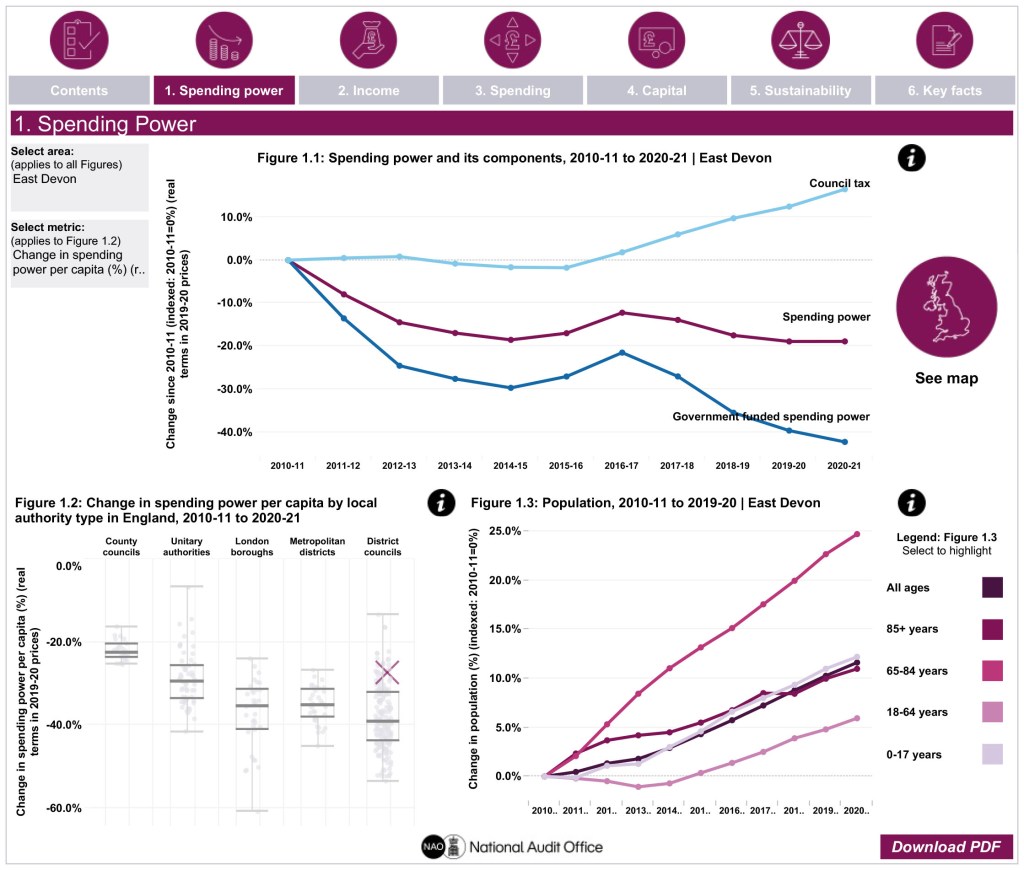
In the visualisation for a decade of data for East Devon you can clearly see the reduction of direct government funding and, despite the increase in council tax receipts, the net overall reduction in council spending power. (Fig 1.1).
You can see the switch in spending on highways, housing and the environment towards central services (Fig 3.1).
There is an interesting increase in capital expenditure charged to the revenue account in recent years (Fig 3.4).
There appears to be a curious gap in debt servicing costs around 2016 (Fig 5.3).
This is just to whet your appetite, there is a lot more to digest. – Owl
The data visualisation below describes changes in English local authorities’ financial circumstances over the last decade. [Owl has selected East Devon]
The analysis below does not cover the impact of the COVID-19 pandemic on local authorities’ finances. The national data required to undertake this analysis at the level of individual local authorities has not yet been published. However, our March 2021 report Local government finance in the pandemic sets out the pandemic’s impact at the national level.
While the pandemic has had a significant impact on authorities’ finances the fundamental patterns of financial restructuring over the last 10 years shown in this visualisation remain highly relevant. These trends shaped the financial circumstances of individual authorities and the sector as a whole entering the pandemic. They also represent the ongoing structural context that may need to be addressed in any future government reform of local government.
Key themes explored in the data visualisation include:
Reductions in revenue funding
Growth in some new and alternative income streams
Changing patterns of service spending
New capital investment strategies and associated risks
Changing patterns of financial sustainability
Purpose of the work
The objective of the visualisation is to allow you to explore the key trends identified in our recent reports in order to gain a more detailed and up-to-date understanding of the experiences of individual local authorities or groups of authorities.
The data we present show changes in income and spending alongside analysis of factors such as budget overspends and levels of reserves. These figures can change for a range of reasons such as local political priorities, changes in local demand and changes in government policy and priorities. Readers also need to bear in mind the differences in the functions and responsibilities of different types of authority. Consequently, comparisons between authorities need to be undertaken with caution. Overall, the complexity of factors underlying the data means that differences in figures presented here should not be viewed as indicative in any way of the current ‘performance’ of an authority. Any apparent differences between authorities should be seen as an opportunity to gather more information and build a richer understanding.
The data in the visualisation present a picture of the key trends affecting the sector and how individual authorities or groups of authorities compare to those trends. The analysis is not designed to identify specific authorities whose financial sustainability may be at risk. While the data in this visualisation are potentially relevant to an assessment of individual authorities’ financial sustainability they by no means represent a full assessment. Other data resources focused on financial sustainability, such as the Chartered Institute of Public Finance and Accountancy’s (CIPFA’s) Financial Resilience Index, are available.
Spending power: The Ministry of Housing, Communities & Local Government measures the impact of reducing government funding on local authority income via ‘spending power’. This indicator captures the main streams of government funding to local authorities alongside council tax.
Data in Figure 1.1:
Estimates of change in spending power: Due to regular changes to local authority duties and reporting arrangements since 2010-11 like-for-like comparisons over time are only possible if the data are adjusted to account for these changes. Each year the Department publishes an adjusted version of the year’s data that is comparable to the previous year, enabling comparison between pairs of years. We use this to create a chain-linked index for the years 2010-11 to 2019-20, in which pairs of adjusted years are linked by a weighting process. Because the data are weighted they will not match spending power and council tax data published by the Department precisely. We exclude Public Health Grant, the original Better Care Fund and other NHS health transfers from our analysis of spending power. For full details please see the standalone methodology from our 2018 report. Note that spending power does not include a measure of authorities’ above baseline retained business rates growth.
Government funded spending: Government funded spending power is defined as the grants and funding streams listed by the Department in any given year as components of spending power, with the exception of council tax, Public Health grant, and transfers from health bodies. This definition includes an assumed amount for 50% retained business rates.
Council tax: Data are taken from the spending power series published by the Department. The data are weighted through a chain-linking process and will therefore not match data published by the Department.
Demographic data in Figures 1.2 and 1.3: We use ONS local authority-based population estimates by single year of age from June 2021. We group these data into age bands in Figure 3.3. The data were sourced from NOMIS. For the per capita analysis of change in spending power in Figure 3.2 we use the total population data in Figure 3.3.
Dashboard 2 – Income
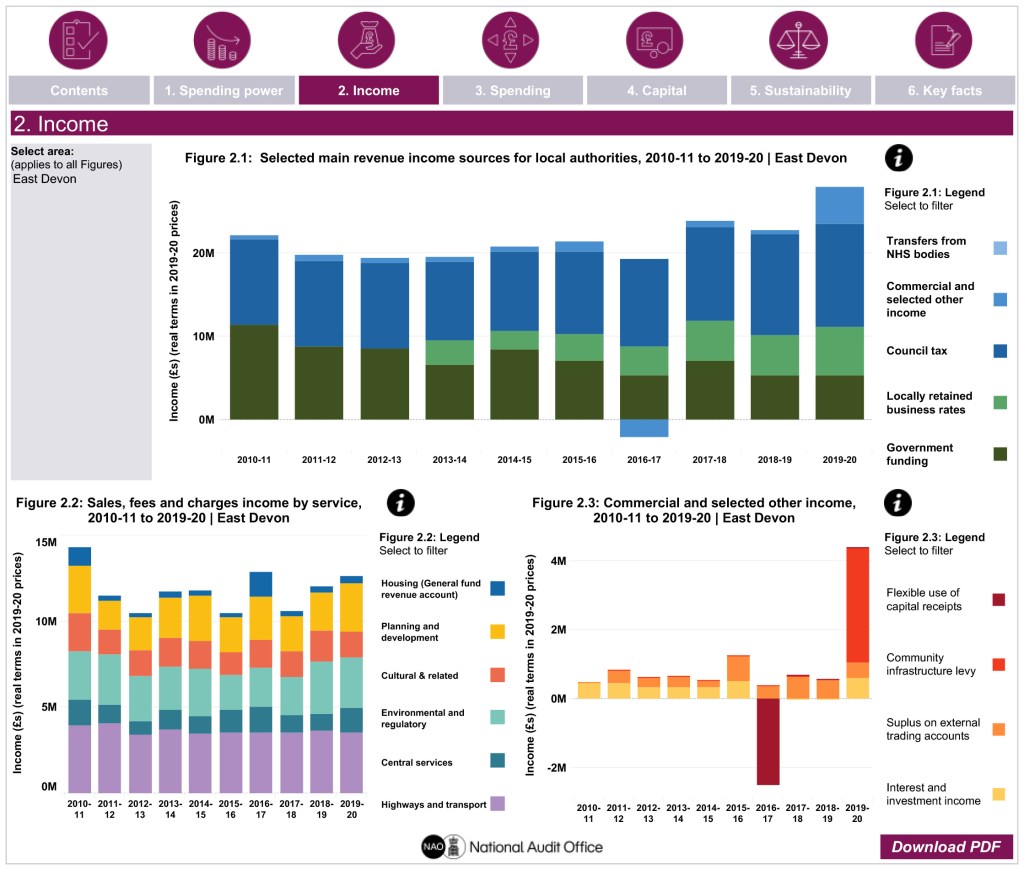
This dashboard shows a broader set of revenue income streams than those shown in the spending power data in Dashboard 2. While spending power is the Department’s preferred measure of revenue income, it is nonetheless informative to set out this wider set of income streams available to local authorities to fund service provision.
Data in Figure 2.1:
Government funding includes redistributed non-domestic rates, revenue support grant, area-based grant, local service support grant, and special and specific grants inside aggregate external finance (excluding schools grants). We exclude public health grant. We include a broader range of government grants than in spending power. We also do not weight the data to address any year-on-year discontinuities. As such the figures for government funding in this Figure are not directly comparable to those in the spending power dashboard. We do not include COVID-19 grants received by local authorities in late March 2020.
We show NHS transfers to support adult social care. These are taken from NHS Digital’s PSSEX and ASC-FR data.
We show income from locally retained business rates. In contrast to spending power data this will include retained income from above baseline business rates growth. Data are from the Department’s RS return.
Council tax figures are not comparable to those in the spending power dashboard which have been weighted to address year-on-year discontinuities. A key issue is the switch from council tax benefit to council tax support in 2013-14. Funding for council tax benefit forms part of council tax income prior to 2013-14 in Figure 2.1. Funding for council tax support from 2013-14 onwards appears in government funding.
Commercial and selected other income includes four income streams. We include surpluses/deficits on trading services accounts (gross of capital charges) and interest and investment income. We also include levels of the flexible use of capital receipts by local authorities. For a temporary period, government has allowed local authorities to use capital receipts to meet the revenue costs of transformation programmes. Under normal circumstances capital receipts are generally only available to fund capital investments. Finally, we include income received from community infrastructure levies.
Data in Figure 2.2: We show sales, fees and charges income for each named service area. Income generated through sales, fees and charges in a particular service is used to support the further provision of the service in question. Data are taken from the Department’s RSX form. We include an estimate of non-schools education sales, fees and charges income. This is based on our estimate of spend on non-schools education (see methodology section on Dashboard 3 below). We calculate our estimate of non-schools education spend as a share of total education services spend in any given year. We then apply this figure on a pro-rata basis to education services sales, fees and charges income to calculate an estimate for non-schools education sales, fees and charges. We recognise that this pro-rata approach is unlikely to reflect the actual distribution of sales, fees and charges income between non-schools and schools spending precisely, but any alternative approach is likely to be excessively complex for our purposes.
Data in Figure 2.3: We include surpluses/deficits on trading services accounts (gross of capital charges) and interest and investment income. We also include levels of the flexible use of capital receipts by local authorities. Finally, we include income received from community infrastructure levies.
Dashboard 3 – Service and non-service spending
Default data are shown for change in net spend. Net current expenditure is funded by an authority’s own resources, such as business rates, grants and council tax. This is in contrast to total spending which includes net spending but also includes spending supported by other sources of income. This includes income from sales, fees and charges or ‘other income’ such as transfers from other public bodies.
Net spend can fall due to both reductions in total spend and increases in income. Growth in income reduces the need for authorities to use their own resources (which registers as net spend) to support spending. In some instances, an authority may register negative net expenditure in a particular service area. This means that its income has outstripped its net spend in that year. Negative net expenditure is effectively net income. In our analysis of change in spend over time by service area, where an authority has experienced an increase in net income (i.e. its income outstrips total expenditure more in the second period than the first), or where it has moved from a position of positive net spend to net income, this will show as a decrease in net spending in the visualisation. Where an authority moves from net spend in 2010-11 to net income in 2019-20 this will show as a reduction of over 100% in net spending in the visualisation in Figure 3.1.
Sales, fees and charges income into Figures 3.1 to 3.3: We include the option to show the data in these charts either not or gross of sales, fees and charges income. However, we do not include service spend funded by ‘other income’. This income line includes recharges and as such creates the risk of double counting.
Highways and transport data in Figure 3.1 to 3.3: There is a discontinuity in the data for district and county councils in 2011-12 due to the transfer in concessionary fares between these two types of authorities. Responsibility, and the associated funding, for concessionary fares in two tier areas was transferred from district to county councils. This has the effect of reducing net spending for many district councils from 2011-12. As a result, from 2011-12 onwards for many district councils, sales, fees and charges income in highways and transport exceeds the level of net spend funded from their own resources. This is shown in the data visualisation as negative net spending, or net income. Where an authority moves from net spend in 2010-11 to net income in 2019-20 this will show as a reduction of over 100% in net spending in the visualisation in Figure 3.1.
Data in Figures 3.1 and 3.2:
All data are taken from the Department’s RS data return. We do not show data in Figure 3.1 for housing services and planning and development spend for county councils. These authorities do not have (significant) responsibilities in these areas and therefore only record minimal, if any, spend. Presenting this in Figure 3.1 which shows percentage change, could be potentially misleading. However, we do include this residual spend in Figures 3.2 and 3.3 (and Figures 5.2 and 5.4). Similarly, in Figure 3.1 we do not include the spend recorded by a small number of district councils on adult or children’s social care as they do not have statutory responsibilities for these services. However, in contrast to county councils, we do not include this spend in Figure 3.2, 3.3 or anywhere else in the data visualisation. The sums recorded by district councils in these areas are not material and are potentially confusing.
Adult social care spend: We adjust this data to include an estimate of funding transferred from NHS bodies to local authorities to support adult social care. This is necessary not only to capture income provided through funding lines such as the original Better Care Fund but also to capture Valuing People Now transfers in 2010-11. We use data on NHS transfers to individual local authorities contained in the PSSEX and ASC-FR data sets published by NHS Digital. These local authority level figures are slightly higher than the national totals NHS Digital publishes for the key NHS transfers relevant to our work, suggesting that the local data also contains other NHS transfers. However, the local data are broadly in line with the scale and direction of travel of the national data on key transfers. In our assessment the adjusted data provides a more accurate view of the resources used by local authorities than the unadjusted data.
Children’s social care spend data has been adjusted. In 2014-15 a number of sub-service spending lines were moved in the data returns from education services to children’s services. In order to ensure consistency over time we move these two sub-services – Sure Start and services for young people – from our children’s services figures back into education services from 2014-15 onwards. This adjustment applies wherever children’s social care spending appears in the data visualisation.
Non-schools education spending includes spend recorded under the education services line in the Department’s RO data returns. However, we have stripped out spending by schools and spending passed through local authorities to support adult education. We add spending on Sure Start and services for young people into this line from 2014-15 onwards to enable a like for like comparison over time. For full details and caveats please see the standalone methodology that accompanied our 2018 report. In a small number of cases our adjustments create anomalies in individual years for individual authorities. We address these by replacing the adjusted data for the years in question with interpolated data based on the preceding and subsequent years. This metric is an estimate and needs to be used with caution. However, we feel there is value in including it in our analysis as there is a clear imbalance between change in income and change in spending as reported in the RS if it is excluded.
Highways and transport and environmental and regulatory services: We include levies paid by authorities to passenger transport authorities and combined authorities, and waste disposal authorities in the relevant service lines.
Housing services: In line with the RS form, we only show revenue spend from the general fund revenue account (GFRA). We do not include revenue spend from the housing revenue account (HRA).
Spending on public health is excluded: Local authorities were given public health responsibilities in 2013-14. Given the complexities of including this activity for only an element of the data visualisation’s time period we exclude this spending from this dashboard and across the data visualisation as a whole.
Data in Figure 3.3: ‘All services’ includes all the services listed in Figure 3.2 for each authority. For single tier and county councils, social care spend includes adult and children’s social care. Non-social care includes all the remaining service areas listed in Figure 3.2 for each authority. Figure 3.3 includes an option to view the data for ‘all services’ on a per capita basis. We use the total population data presented in Figure 1.3.
Data in Figure 3.4: We include capital expenditure funded from the revenue account (CERA) (excluding public health CERA), minimum revenue provisions and interest payments (adjusted for HRA item 8).
Dashboard 4 – Capital
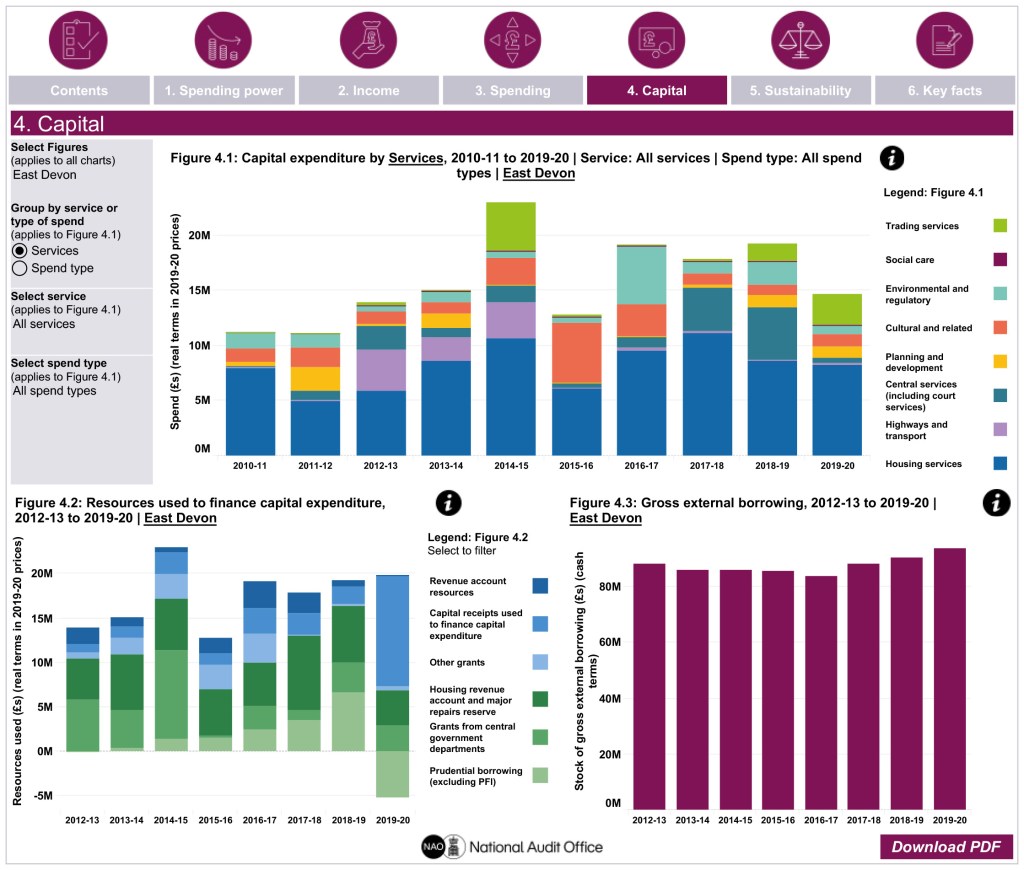
All data are taken from the Department’s annual capital outturn return (COR) data set.
Data in Figure 4.1: We show total capital expenditure by service area and type. This includes total expenditure on fixed assets and total financial expenditure. We exclude ‘other transactions’. We do not include capital expenditure on education services and some other service areas. Housing spend is funded from the general fund revenue account (GFRA), the housing revenue account (HRA) and the major repairs reserve.
Data in Figure 4.2: These data include capital spend on all service areas as it is not possible to identify individual service areas within this data. As such, these data are not directly comparable with Figure 4.1 which excludes education and some other service areas. Data on prudential borrowing refers both to spend supported by external borrowing, and also to spend funded by internal borrowing. This is a treasury management practice whereby an authority delays the need to borrow externally by temporarily using cash it holds for other purposes, such as insurance funds held in earmarked reserves. The chart starts in 2012-13 rather than 2010-11 in order to avoid the discontinuity created by the localisation of authorities’ housing revenue accounts in 2011-12.
Data in Figure 4.3: We show the stock of gross external borrowing as of 31 March in each year. Data are from the COR in cash terms. The chart starts in 2012-13 rather than 2010-11 in order to avoid the discontinuity created by the localisation of authorities’ housing revenue accounts in 2011-12.
Dashboard 5 – Financial Sustainability
We show a selection of measures of financial sustainability drawn from across our recent studies. While these provide some insight into the financial sustainability of authorities, they do not represent a full analysis.
Data in Figure 5.1: We show data for unallocated and earmarked reserves. We exclude public health, schools, and dedicated schools grant (DSG) reserves. We show data as a share of our chain-linked measure of spending power. Net revenue expenditure is our preferred denominator, but inconsistencies in the way that some authorities have recorded data in the RO over this period mean that this metric is not sufficiently stable. Our weighted spending power timeseries provides a similar, but more stable measure. The main data we show for reserves are as reported by local authorities and published in the RO.
We also include an option to view an adjusted measure of authorities’ reserves. In late March 2020, local authorities received additional funding to support their COVID-19 response. Given this proximity to the end of the financial year, this funding was not necessarily spent in 2019-20 and some authorities included it within their 2019-20 end of year reserves. This has the effect of seemingly inflating some authorities’ reserve levels in that year. We therefore provide an adjusted measure of reserves that seeks to strip out this additional funding from authorities’ reserves. We do this by subtracting the value of the COVID-19 grants from authorities’ earmarked reserves as of 31 March. In recognition of the fact that not all authorities recorded this grant funding in their reserves however, we use the authorities’ estimates of their reserves as of 1 April 2020, as reported in their RA budget returns, as a benchmark. The RA returns were submitted before the 2019-20 RO return, and unless specified in the return, reflect authorities’ budget planning before COVID-19 and the associated grant funding were a significant feature. If our adjusted earmarked reserves figure from the 2019-20 RO is below an authority’s estimated earmarked reserves for 1 April in its 2020-21 RA return we assume that the authority did not record their COVID-19 grants in their reserves, and we therefore do not adjust their RO figures. There are a small number of authorities that state in their 2020-21 RA that they have adjusted their reserves to reflect COVID-19 grants. For these authorities we assume that these grants were also in their reserves in their 2019-20 RO return, and therefore we have adjusted their 2019-20 earmarked reserves. Clearly our figures are estimates and need to be treated with caution, and we would recommend that readers engage with local information sources such as authorities’ annual accounts. Nonetheless we think they are worthy of inclusion as there is a risk that the sector’s reserves are over-stated otherwise.
There is a further discontinuity in the reserves data timeseries in this data visualisation. In 2018-19 the Department asked single tier and county councils to identify dedicated schools grant (DSG) reserves separately in their reserves data. Some authorities had previously recorded this data in their schools reserves. However, we estimate that around a third of authorities had previously recorded their DSG reserves in their earmarked reserves and a further small number in their unallocated reserves. The fact that these authorities have now started recording their DSG reserves separately creates a potential discontinuity in our data series for earmarked and unallocated reserves. It would be possible to adjust for this by adding DSG reserves back into these authorities’ reserves from 2018-19 onwards. However, this would create two separate and non-comparable groups of authorities in this period, one with DSG reserves in their earmarked and/or unallocated reserves and one without. Given this, as well as existing complexities around the COVID-19 grants’ impact on reserves and the fact that in most cases the DSG discontinuity is not material for individual authorities, we have not included this adjustment in the data visualisation. However, readers should bear this potential discontinuity in mind when considering the reserves timeseries for single tier and county councils.
Data in Figure 5.2: We show outturn against budget data for all the services shown in Figure 3.2 for each authority. However, we exclude non-schools education and we do not include NHS transfers in our measure of adult social care spend. Budget data for these two figures is not available. We start the time series in 2011-12 as budget (RA) data are not comparable with outturn (RO) data at the service level in 2010-11. The metric shown is the difference between outturn and budget spend calculated as a percentage of an authority’s overall service budget. A positive figure indicates that the level of outturn spend exceeds the planned budget spend – an overspend. For single tier and county councils we include the option to focus separately on adult social care, children’s social care and spending on all other service areas (as defined in Figure 3.3). For each of these three service areas we show the variation between outturn and budget as a share of that specific service area’s budget.
Data in Figure 5.3: We include interest payments (adjusted for HRA item 8) minimum revenue provision and leasing payments in our measure of debt service costs. We use our chain-linked measure of spending power to standardise the data (see notes on Figure 5.1).
Data in Figure 5.4: We show spend on adult and children’s social care. We adjust adult social care to include estimated transfers from NHS bodies. The all services denominator includes all the service areas shown in Figure 3.2.
Dashboard 6 –Key Facts
All data shown in this dashboard are taken from Dashboards 1 to 5.
“The Conservative Party is the party of aspiration and opportunity for all, no matter your gender, your ethnicity or where you come from.” – Great quote, Owl.
Two of Boris Johnson’s closest advisers were being lined up for leadership roles in the Middle East outreach group at the heart of a dispute that has shaken Tory high command, The Times can disclose.
Lord Udny-Lister, the prime minister’s former chief of staff, and Baroness Finn, his present deputy chief of staff, were in talks to take senior roles with Conservative Friends of the Middle East and North Africa (Comena).
Comena is being set up by Mohamed Amersi, a telecoms millionaire and Conservative donor who made incendiary claims at the weekend about Ben Elliot, the party chairman. The group has applied for formal affiliation to the party and is being formed to develop its links to Middle Eastern countries.
Amersi’s close links to such senior Conservatives will make it harder for the party to distance itself from him after his assertion that Elliot had fostered a culture of “access capitalism” at the heart of the establishment.
Udny-Lister, who served as the prime minister’s special envoy to the Gulf before he left government in April, was to become one of Comena’s vice-chairmen, according to documents seen by this newspaper. He said he had agreed to be involved but did not recall agreeing specifically to accept a vice-chairman role.
Finn was approached about taking a role before she joined No 10 but the discussions never led to formal agreement and she never reached the stage of seeking permission from Downing Street. A friend said: “Simone was approached to join the advisory council but this was not progressed.”
Theresa May was to be a patron. A spokeswoman for the former prime minister confirmed that she had agreed to this but added that she was no longer involved with the organisation.
According to documents seen by The Times, other Tory politicians who were being lined up for leadership positions included Lord Johnson of Marylebone, the prime minister’s brother, Sir Hugo Swire, the former Tory minister, the MP Mark Garnier and Lord Lamont of Lerwick, the former chancellor.
Amersi’s list of supporters was subject to Comena becoming affiliated to the party and the parliamentarians declaring their interests in the Commons and Lords registers.
Garnier said he had agreed to be vice-chairman of the group “subject to Comena achieving affiliate status with the party and then moving forward into a properly structured organisation”. Lamont said he had agreed to be a vice-president about six months ago but that progress had stalled. Neither Johnson nor Swire responded to requests for comment.
At the weekend Amersi claimed that Elliot benefited from giving wealthy clients of his company access to the Prince of Wales. Amersi said Elliot had introduced him to Prince Charles in 2013 after he paid thousands of pounds for elite membership of the Tory chairman’s concierge company, Quintessentially. A spokesman for Elliot said the introduction was “entirely about helping to raise money for charity”.
Amersi told The Daily Telegraph last night: “I highly regret that Prince Charles has been involved in this.” He became a leading figure in several of Charles’s charities, including Prince’s Trust International.
Last night Amersi also claimed that he would have been treated better by the Conservatives if he had was white. He told The Daily Mail: “I sometimes wonder if I was white and my surname was John Smith and I had been to Eton and Oxford I might have been treated differently. And I think there is some truth in that.”
A party spokesman said: “The Conservative Party is the party of aspiration and opportunity for all, no matter your gender, your ethnicity or where you come from.”
Comena was to rival the Conservative Middle East Council, which is led by Charlotte Leslie, the former MP for Bristol North West, but severed its formal ties to the party in 2019.
From Mike Temple (upgraded from comment to full post)
I’m a Red Grouse, a High-Class Bird, Of all Game-Birds the one preferred By gentry, lords and the top brass, All members of the ruling class.
I’m courted by the richest in the land Who make damn sure Grouse-Shooting isn’t banned. I live amongst the purple moorland heather Where noble folk and I can come together.
Yes, I’m well-bred, a highly favoured Grouse, Like Eton Boys and chaps from Charterhouse, For that is where all those chaps born to rule Are sent away from home to public school.
It’s there they learn to tell a clever lie, Their feelings only for the Old School Tie. I play my part to see the rich have fun, A leading role, together with the Gun.
The Glorious Twelfth is my great Day. I’m centre-stage in that display. I look down on all other Game; Pheasants and I are not the same.
We meet with low-class Beaters on the heather, For Grouse-Shoots bring the classes close together And those who normally get little pay Can now earn a cool fifty quid a day. (No matter if their noble “chum” Should miss and shoot them in the bum.)
They flush me out. I fly up in the sky. Bang, bang! I’m hit. I topple and I die And then I’m roasted on an open fire. What greater Glory could a Grouse desire?
Public health bosses put the spike down to “greater social mixing” – How’s your pub crawl going Simon? – Owl
From today’s Western Morning News.
Public health bosses say they have no evidence a rise in coronavirus infection rates which has led to record case levels in Devon is down to an influx of holidaymakers.
Exeter has the second highest infection rate in England, while rates in Devon currently stand at 335 per 100,000 – only just below the peak seen in July.
Suggestions had been made that the rebound in case rates could in part be down to the surge of tourists visiting the Westcountry.
However, a spokesperson for Public Health Devon dismissed the rumours and instead put the rise in cases down to greater social mixing following the relaxation of Covid restrictions on July 19.
“There is no evidence to suggest that the rise in cases is attributable to holidaymakers visiting Devon. We are seeing a rise in positive cases, and that is to be expected as more people mix socially,” they said.
Exeter has recorded 780 positive cases of Covid-19 in the last week of available figures, predominantly among younger working age people. An infection rate of 583 per 100,000 in the city was the second highest in England after Lincoln.
In Cornwall the busy holiday resorts of Falmouth and Penryn are experiencing high case rates. It comes after Newquay saw Cornwall’s largest spike in figures last Tuesday, with a case rate of 577 per 100,000.
Public Health Cornwall says the rise in cases is down to a combination of factors, including the lifting of restrictions and increased transmissibility of the Delta variant.
Meanwhile, Plymouth has seen 1,162 new infections in the past week as the case rate rises.
NIMBY is an acronym for the phrase ‘Not In My BackYard’, which is a characterization of opposition by residents to proposed undesirable developments in their local area.
Large development companies often use this colloquialism in a derogatory sense, labelling NIMBYS as obsessive, ‘nerdish anoraks’ for blocking housing, economic and employment growth benefits, lacking forward-thinking and fearing changes to the identity and character of their neighbourhoods.
However, in reality NIMBYS usually are normal, ordinary people who have a very strong sense of what is right and what is wrong, are often open-minded to innovative, progressive development that will enhance communities but will not tolerate over-development and inappropriate designs just to ‘line the pockets’ of development company directors and shareholders!
For centuries people have identified that ‘An Englishman’s Home Is His Castle’ – so most would agree that their homes are a sanctuary, an oasis and a shelter from undesirable encroachment, with any invasion being vehemently defended.
So it is no surprise that, when inappropriate development is proposed directly in their back yards, that they will oppose any detrimental effects and they will summon those who have been elected as decision-makers at East Devon District Council (EDDC) to ensure that firstly they represent the people who will be substantially affected by this development and secondly that they make the correct judgement on the density and designs of homes that will remain in this historic, rural community for several lifetimes!
The precedent for this development ship has already sailed with the approval in December 2020 by EDDC Planners of the Outline Hybrid Application (20/1001/MOUT) commending the economic benefits of 2,000+ jobs alongside up to 94 housing units in a village community that actually has no local housing need.
However, the majority of the proposed housing directly overlooks existing residents’ homes and back gardens, from not only a green field open space (Zone A) historically outside of the Local and Neighbourhood Plans but also from 40 towering four-storey apartment blocks on brownfield land (Zone D) opposite a Grade II* listed Manor House.
The present Reserved Matters plans appear to show a welcome reduction in the Zone A green field housing but unfortunately the Zone D proposals still contain three blocks of 40 four-storey apartments, with an access road (serving a minimum of 80+ apartment vehicles) directly in line with the boundaries of existing residents’ homes, making them vulnerable to excessive vehicle noise, air and light pollution. However, a worthless, ‘spitting in the wind’ politically-correct ideal showing ‘grass-roofed’ covered parking for the apartments is also planned to ‘green up’ and mitigate the intense, substantial harm of such over-development in this countryside location.
These urban apartment proposals fail to promote sympathetic, considerate, neighbourly designs in a rural community and display a harmful intensity and over-development of the brownfield site and require a major rethink before they will persuade NIMBYS to become YIMBYS!
We’ve just started a collaboration with the brilliant folks at Good Law Project.
First up, a six-minute film on the jaw-dropping story of the secret back-channel that allowed friends of the Conservative Party and other politically-connected suppliers to secure billions of pounds of PPE contracts.
We projected it late last night on Parliament – it’s a film that everyone in the country should see (huge thanks to Gavin Esler for providing the voice over).

 Springdale Combe Raleigh Honiton EX14 4TNRef. No: 21/2127/FUL | Validated: Fri 06 Aug 2021 | Status: Awaiting decision





 East Devon Watch