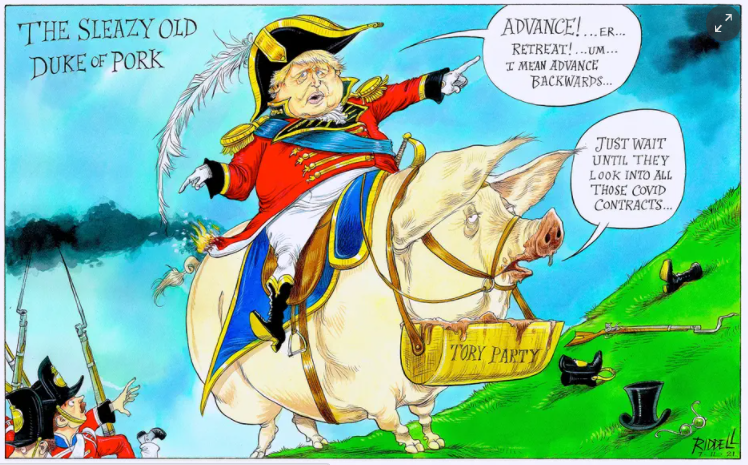
The Sleazy old Duke of Pork

The row over Tory sleaze reached new heights on Saturday night as MPs demanded details of any lobbying by Owen Paterson of government ministers on behalf of a company that won almost £500m of Covid-19 related contracts last year.
Toby Helm www.theguardian.com
The crisis facing Boris Johnson also worsened after the former Tory prime minister, Sir John Major, described his successor’s attempts to block Paterson’s suspension from parliament last week for breaching paid advocacy rules as “shameful”.
A new Opinium poll for the Observer shows ratings for Johnson and his party have slumped dramatically since last weekend, with the prime minister’s personal approval figures hitting their lowest ever level.
With Tory MPs already fearing their party is regaining its reputation for financial impropriety after last week’s chaotic events involving Paterson, all the main opposition parties turned up the pressure.
Labour, the SNP, the Liberal Democrats and the Green party all switched their focus to the award of pandemic contracts, demanding investigations by the cabinet secretary, Simon Case, or the parliamentary commissioner for standards, Kathryn Stone, into Paterson’s contacts with ministers during the pandemic.
Paterson, who announced his resignation as an MP last week, was paid more than £8,000 a month for 16 hours’ consultancy work by Randox Laboratories, until he resigned from the role on Friday. Randox was awarded two Covid testing contracts last year worth nearly £480m without the normal competition. Government officials cited the urgency of the pandemic as grounds for not advertising the contracts.
The company insists Paterson “played no role in securing any Randox contract”, but on 9 April last year the MP had a telephone meeting with the firm and Lord Bethell, then a health minister, about Covid testing.
On Saturday, Labour’s deputy leader, Angela Rayner, said she had written to Case demanding “the publication of all correspondence and details of all meetings between ministers and the businesses that were paying Mr Paterson to lobby on their behalf”.
The Observer has been told that before Paterson resigned as an MP on Thursday, Conservative whips understood that Stone was seriously considering launching an investigation into the former Northern Ireland secretary’s lobbying of ministers since the pandemic began. She is also believed to be considering an inquiry into the controversy over the prime minister’s refurbishment of his Downing Street flat.
Over the coming days, the opposition parties are determined to raise the pressure. Rayner said: “It is particularly brazen that Randox were awarded £347m of taxpayers’ money after already failing to deliver on a previous contract that resulted in the recall of 750,000 unsafe testing kits and care homes being left without regular testing. Ministers need to set out how they will claw back taxpayers’ money that was wasted on duff PPE and failed testing contracts.”
The SNP leader, Ian Blackford, said he had also written to the cabinet secretary demanding “full transparency about Paterson’s lobbying, particularly relating to Covid-19 contracts involving huge sums of money”, while the Lib Dem chief whip, Wendy Chamberlain, called for “a full and thorough investigation by the standards commissioner” into the links between Paterson, Randox and the former health secretary, Matt Hancock.
The Lib Dems have secured a three-hour debate on the issue on Monday in which the way Covid contracts were awarded will be central.
The latest Opinium poll suggests the sleaze rows are hitting the Conservatives. The Tory lead has fallen to just one point, from five points a week ago, while Johnson’s personal rating has dropped to -20 from -16 last week, passing a previous low of -18 recorded a month ago.
There has also been a significant shift in views of who would make the best prime minister. An 11-point lead for Johnson last week has shrunk to just two points. Johnson is regarded as the best candidate by 28% of voters, down five, with the Labour leader, Keir Starmer, on 26%, up four.
Speaking on BBC Radio 4’s Today programme, Major was scathing about Johnson’s government, the damage it was doing to the UK’s reputation, and the way it treated parliament. Referring to efforts to block Paterson’s suspension, Major said: “I think the way the government handled that was shameful, wrong and unworthy of this or indeed any government. It also had the effect of trashing the reputation of parliament.”
He added: “There is a general whiff of ‘we are the masters now’ about their behaviour. I’m afraid that the government, with their over-large majority, do tend to treat parliament with contempt. And if that continues, it will end badly.”
Writing in the Observer, the shadow justice secretary, David Lammy, also takes aim at the business secretary over his suggestions last week that Stone should consider her position because of the way she conducted her inquiry into Paterson’s lobbying activities prior to February last year.
“Kwasi Kwarteng’s attempt to bully Kathryn Stone out of her job was yet another breach of the ministerial code, and the latest example of the Tories’ slide into corruption and moral bankruptcy. Boris Johnson has already had multiple run-ins with the standards commissioner. It is clear he simply wants revenge and impunity from the rule of law,” he wrote.
“This level of flagrant norm-shattering and proud lawbreaking demands more than tut-tutting. That’s why we need the adviser on ministerial interests to launch an inquiry into Mr Kwarteng’s threats. And it is why Labour has urged the standards commissioner to open an investigation into the prime minister over the financing of the refurbishment of his Downing Street flat.”
The climate emergency is the most pressing challenge of our times. With the UK keen to trumpet its climate action credentials, our planning system is sending out very mixed messages.
By Andrew Wood www.cpre.org.uk
With the COP26 global climate conference hosted in Glasgow in 2021, you’d expect the host country to be leading on climate crisis-busting plans with flying colours – including by adapting the rules that govern new building here.
But put simply, it’s just not doing enough to drive progress.
Let’s start with the good news. The government has led the world by setting a legally binding target to achieve net-zero carbon by 2050, meaning that our carbon levels work out as zero thanks to cutting emissions and carbon-capture methods.
And the government’s also ramped this up further by committing to get 78% of the way there by 2035, and announced that the UK is on track to achieve this 2035 target.
‘Local authorities want to get to net-zero even faster.’
For the first time, international aviation and shipping emissions will be counted into this budget – something CPRE has been demanding for years, and a really important step forward.
Local authorities want to get to net-zero even faster, which shows great ambition. We love to see it! Over 80% of councils have now officially declared a climate emergency and set local targets for carbon reduction. In most cases, they’re aiming for net-zero by 2030, twenty years ahead of the UK government’s legally binding date.
So far, so good. So how does planning fit in?
The planning system, the name we give to the toolkit of rules that govern what gets built and where, should naturally fit into this progress, right? Erm… Right?
And in theory, that’s the case: the planning system should support the quest for net-zero. The sectors that emit the most carbon are housing, industry and transport – which happen to also be the main forms of development that planning helps to regulate.
And the rules governing planning, the National Planning Policy Framework (NPPF), require planning to ‘shape places in ways that contribute to radical reductions in greenhouse gas emissions’. Local authorities’ development plans are also bound by a legal duty, under the Climate Change Act, to contribute to achieving net-zero.
And there’s more.
The NPPF also contains useful hooks to hang climate-friendly policies onto: for example, poor design should be refused planning permission, and development should be focused where it’s accessible by public transport and offers scope to reduce private car travel.
So surely local authorities are only allowing new building that’s doing lots to tackle the climate emergency… aren’t they?
Local heroes… and the rest
Some local plans (the document created by local authorities and, ideally, residents which lays out the principles for new development in the area) are rising to the climate crisis challenge.
Plymouth & South Devon Councils have already adopted a joint plan which commits to implementing their carbon reduction target. Hurray! And we know that at least Lancaster, Leeds and Bradford are aiming to follow suit – double hurray!
But… that’s where the good news ends. There are plenty of signs that, in practice, the planning system is well behind the curve on climate action.
What’s not working
Here are four things that we know are going wrong:
Despite powerful evidence that car use needs to be reduced by between 10% and 60% to achieve net-zero, all across the country, councils are still earmarking land for new housing and commercial development in car-dependent locations, planning for new roads, and pinning their economic ambitions on the continued growth of airports.
A landmark 2020 report by Transport for New Homes found that new ‘garden communities’ were being built that were overwhelmingly car-dependent and the government’s Housing Infrastructure Fund is regularly used to fund roadbuilding projects. This is not a recipe for reducing car use.
‘This is not a recipe for reducing car use.’
When local plans are examined by government-appointed inspectors, the remit is considered on very narrow criteria – and is purely about housing numbers.
The inspector asks, ‘Will this local plan provide enough development land to meet the council’s housing target?’ If not, the council must go away and find more land.
But there are no such penalties for not having a convincing strategy to reduce carbon emissions. Providing the homes people need and tackling the climate emergency are both important objectives, yet it seems that plans are judged against one and not the other.
The much-vaunted planning reform programme, which began in summer 2020, made bold claims about speeding up and simplifying the planning system, but soon became bogged down in controversy about top-down housing numbers (the ‘mutant algorithm’) and the risks to local democracy.
But, as CPRE and many other groups pointed out, there was little mention of climate action in the new proposals – in fact, they didn’t even commit to setting a firm date for new development to be zero-carbon.
Considering that the government had previously cancelled a 2016 zero-carbon date for new housing, this was incredibly disappointing.
The government is also currently reviewing its Nationally Significant Infrastructure Projects (NSIP) regime, which delivers big projects mainly for energy and transport. The review says it wants to halve the time it takes to make decisions on proposals, and cites the need to move towards net-zero carbon super-speedily as a key objective.
But nearly a third of these large projects already approved or awaiting decisions are for major road schemes – such as the Lower Thames Crossing – or for airport expansions, all of which will inevitably cause increases in carbon emissions and work directly against meeting the government’s net-zero target.
There are solutions. Now we need action
Each of these problems has an obvious solution – if the government has the will to act. Local plans should place extra focus on urban brownfield locations for new development (read what brownfield is, and why we care about it so much, here) and stop enabling homes and commercial premises to be built in car-dependent locations.
Plans should be judged on their emissions-reducing credentials as much as on housing supply. Cutting carbon should be a basic criterion for major new projects to be considered, negating new roads or airport expansion and following the moves to this effect already made in Wales. Business as usual is not an option.
And, as Mr Gove looks to make his mark on his role as Minister for Housing, he could explicitly make moving to net-zero carbon one of the key purposes of planning reforms.
Will the government give the planning system a real role and purpose in tackling the climate emergency? It’s high time.
 East Devon Watch