Jacob Rees-Mogg wears a mask in the commons but it’s in the colours of the “old school tie” (so Owl is informed).
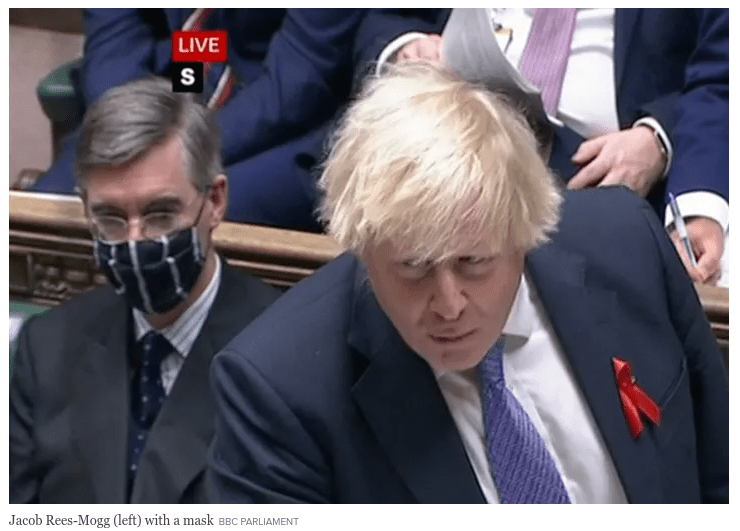


Jacob Rees-Mogg wears a mask in the commons but it’s in the colours of the “old school tie” (so Owl is informed).
The former Tory health secretary Jeremy Hunt and Labour launched stinging attacks on the government on Wednesday as it unveiled long-awaited social care reform plans lacking significant new funding to resolve the current crisis.
Another example of delivery falling a long way short of promise and expectation – Owl
Robert Booth www.theguardian.com
The white paper confirmed new spending including £300m over three years to help councils increase the range of supported housing options which allow people to live more independently, £150m to drive the greater adoption of technology, as well as details of £500m for workforce development, primarily through training and qualifications. There were also plans for a new national social care website and money for modifications to people’s homes to help them stay in them longer.
But amid a staffing crisis in which about 60,000 workers quit between April and October and 1.5m hours of commissioned care have not been delivered in England in recent months, the plans were widely criticised.
Hunt, who chairs the Commons health and social care select committee, told the care minister Gillian Keegan the plans would do nothing to stop “hospital wards continuing to be full of people who should be discharged and older people not getting the care they need because the carers don’t exist”.
He described it as “three steps forward and two steps back” and said the spending plans of around £1bn it outlined were “a long way off” the £7bn a year extra the health and social care select committee called for by the end of the parliament.
Labour’s Liz Kendall, the shadow care minister, said: “Ministers have utterly failed to deal with the immediate pressures facing social care as we head into one of the most difficult winters on record.”
She said: “Hundreds of thousands of older or disabled people [are] being left without vital support, piling even more pressure on their families at the worst possible time, yet the minister has announced absolutely nothing to deal with any of this.”
“Where was the long-term strategy to transform the pay, terms and conditions of care workers?” she said. “Can she tell me how some kind of website is going to pay a care worker’s bills or put food on the table? No wonder staff are leaving the sector in droves.”
On Wednesday, the Nuffield Trust estimated that in the six months to October the number of social care staff in England fell by between 50,000 and 70,000. Low pay, exhaustion after 18 months tackling Covid and the “no jab, no job” policy are key reasons.
Keegan stressed that the 103-page plan – called People at the Heart of Care – was a 10-year vision and “an important step on our journey to giving more people the dignified care that we want for our loved ones, setting out important changes that will last for generations and will stand the test of time”.
She also defended the design of controversial plans to cap care costs at £86,000, which would allow wealthy people to keep a greater proportion of their assets than poorer people who still stand to lose their homes to pay long-term care bills.
“No one will be worse off compared to the current system and many people will be better off,” she said.
But the King’s Fund said the measures failed to “fix social care” as Boris Johnson promised he would do “once and for all” in July 2019.
Sally Warren, the thinktank’s director of policy, said: “The government’s commitments do not match the ambition set out by the prime minister and urgency of change which the people who draw on care and support rightly expect to see.
“There is little to tackle poor workforce pay and conditions and high vacancy levels in the sector.”
The council social services group Adass welcomed it as “a foundation stone” which “paints a promising picture of a more professionalised care workforce in the future”.
But Stephen Chandler, its president, said: “What we urgently need now is a bridge to that brighter future, to address the immediate crisis and ensure that everyone gets the care and support they need this winter.”
The focus on the quality of care, housing and innovation using technology was welcomed by the National Care Forum, which represents providers. Its director, Vic Rayner, said it offered a “different vision for care that starts from the perspective of people who receive care”. But she said urgent action over the next four months was needed to tackle the crisis now.
Caroline Abrahams, a director of the charity Age UK, said: “Millions of older and disabled people putting up with inadequate services … needed the [white] paper to turbo-charge a process of transformation, but that was never going to be possible with the meagre funding allocated by the Treasury … Rather than the Formula One vehicle that was required, the paper is an underpowered saloon car at best.”
Do any rules apply to him? – Owl
Peter Walker www.theguardian.com
The parliamentary commissioner for standards has begun a formal investigation into Jacob Rees-Mogg after a complaint from Labour that he failed to declare that he received £6m in cheap loans from one of his companies.
The website for the commissioner, Kathryn Stone, has been updated to show that Rees-Mogg, the leader of the Commons, is among MPs being investigated. It says the inquiry concerns the section on rules for MPs connected to the declaration of employment and earnings.
The website also shows Douglas Ross, the Moray MP and leader of the Scottish Tories, is being investigated. Ross apologised earlier this month and referred himself to the watchdog for failing to declare his pay as an MSP and as a part-time football referee.
Rees-Mogg did not report to the official register that he received director’s loans from Saliston between 2018 and 2020.
The North East Somerset MP owns Saliston, even though he gave up his directorship in 2019. It has a stake in Somerset Capital Management investment company.
Rees-Mogg says the loans were mainly used as “temporary cashflow measures” to pay for a property purchase and refurbishment, and did not need to be declared.
But Thangam Debbonaire, the shadow leader of the Commons, said it was right that the commissioner was investigating “what appears to be yet another egregious breach of the rules”.
She called for a parallel inquiry into whether Rees-Mogg had breached the ministerial code, which governs conduct for ministers.
“Over the last few weeks, we have seen that Conservative MPs repeatedly act as if they can put their own private business interests ahead of their constituents and the prime minister must put a stop to this,” Debbonaire said.
Accounts for Saliston show the £6m in loans – £2.94m in 2018, £2.3m the following year and £701,513 in 2019-2020 – attracted interest paid at the equivalent of about 0.8%, which is below market rates.
The accounts list the loans as attracting interest rates of 2.5% and 3.5% in individual years, raising the prospect that he could have borrowed the money and repaid it over short periods of time.
The MPs’ code of conduct does not specifically cover director’s loans but it states: “Members shall fulfil conscientiously the requirements of the house in respect of the registration of interests in the register of members’ financial interests. They shall always be open and frank in drawing attention to any relevant interest in any proceeding of the house or its committees, and in any communications with ministers, members, public officials or public office holders.”
The wider issue of MPs’ conduct and outside interests, and the way these are publicly declared, has been in the news since the furore over Owen Paterson’s punishment for breaching lobbying rules, which Downing Street initially sought to overturn.
Labour has proposed a new system that would ban almost all second jobs for MPs, while the Commons standards committee, which is separate to Stone’s role, has recommended changes, including greater clarity on MPs’ and ministers’ interests.
In a statement released when the Labour complaint was made, Rees-Mogg said: “Saliston is 100% owned by me and this is declared clearly in the Commons register and to the Cabinet Office. It has no activities that interact with government policy.
“The loans from 2018 were primarily taken out for the purchase and refurbishment of 7 Cowley Street as temporary cashflow measures. All loans have either been repaid with interest in accordance with HMRC rules or paid as dividends and taxed accordingly.
“The register asks for earnings, not loans, which is why I was declared an as a non-remunerated director until I resigned on entering government. Loans are not earnings and are not declarable in the register of interests.”
Patients are being refused treatment, discharged too early and pushed towards private referrals, openDemocracy’s largest-ever reader survey has found
Caroline Molloy www.opendemocracy.net
One in five patients has been told by a doctor or another NHS professional that they would have to go private to get the treatment or test they need. That’s just one of the shocking results from a survey of nearly 7,000 openDemocracy readers – backed up by separate polling commissioned by openDemocracy.
NHS staff echoed the patients’ claims. Nine out of ten (87%) members of patient-facing staff said they had been simply unable to give a patient treatment or a procedure they would benefit from.
The survey, one of the largest of its kind of NHS patients and staff, provides a detailed – and worrying – breakdown of what happens to these patients.
The government has repeatedly reassured the public that the NHS will remain “free at the point of use”. But such language will bring little comfort to the many who told openDemocracy that the NHS had been scaling back what it offers even before the pandemic.
Both patients and NHS staff also reported an increasing reliance on the private sector to fill in the gaps – whether funded by the taxpayer or the patient themselves – despite successive prime ministerial promises that the NHS is “not for sale”.
Paying privately
Forty per cent of patients who replied to our survey were told that the NHS simply can’t offer them the treatment they need. Half of these patients – one in five of all patients – said an NHS worker then told them they would instead have to pay privately for the treatment they needed:
‘There’s an increasing sense that if you can’t pay for private healthcare you are treated worse than before.’
‘My GP was always pushing me for private care and never took steps to refer me to the specialist.’
NHS staff themselves told us a similar story.
One GP said: “I now routinely ask people if they have private insurance before referring them as I know the system is so overwhelmed.”
Suggesting patients pay “alleviates patient and carer/family anxiety regarding delays for diagnostic tests,” added a nurse.
Many respondents noticed NHS staff were “apologetic” and “saddened” when they had to suggest people went private. NHS staff “were always honest and showed they didn’t like the situation any more than I did”, said one patient. Their doctor’s “hands were tied and they would have helped if they could”, added another. Their GP told them it was “due to funding issues”, said yet another.
Another told us: “The doctor apologised for not being able to offer me the operation. My condition is not considered bad enough. I am prescribed Tramadol for pain. I have a poor quality of life, so am not sure how bad I would have to be before an operation was offered. I am a widow, which means my quality of life is even poorer, as I can go days without a visitor, and rely on the internet for shopping and have to pay a gardener and cleaner. My savings are rapidly disappearing.”
NHS guidelines have become increasingly restrictive in recent years, with a large range of procedures, from ear syringing to hip operations, either no longer paid for in some areas, or funded only in exceptional circumstances or conditions of extreme pain.
What else are patients told to do?
Other advice given to those who had been refused NHS treatment included recommendations of ‘self-care’ (one in five was given this advice), being directed to a cheaper option such as a voluntary service (one in ten), and being directed to an online service (one in 20). Some 84-90% of patients reported being dissatisfied with these options, with the highest dissatisfaction (90%) among those who were directed to an online service.
“I had to attend a pointless group education session on women’s urinary issues. I live in a small town, and it’s an embarrassing topic – I wondered if they did it to lower referrals due to embarrassment,” said one patient. “There was nothing in the education session that couldn’t have been provided in a leaflet.”
And there were real-world consequences, for many – 38% of those who’d been refused the ideal treatment or a test and been given this range of other options – said their health had worsened as a result, a similar number (38%) had suffered anxiety. Twelve per cent said a diagnosis had been missed.
Staff worries
Of the 500-odd NHS staff who responded to our survey, most (68%) said the problem had got worse in the past decade. Only 12% blamed the pandemic.
Nearly all frontline NHS staff – 98% – said they had felt worried that a patient’s health was going to deteriorate due to the length of time they would have to wait for an NHS treatment, with around three-quarters saying the wait times had got worse over the past ten years, and around a sixth (14%) saying it had got worse mostly since the pandemic.
Around 48% of current NHS staff were thinking about leaving the service, with only 37% saying they weren’t.
Public money, private sector
Nearly two in five patients (38%) said that an NHS worker had told them they’d get seen more quickly if they accepted an NHS referral to a private hospital or clinic. Staff confirmed this – nearly three in five frontline NHS workers told us they’d had to refer patients to an NHS-funded private provider. Of those who did so, the majority (70%) had misgivings about this approach, but many said they felt they had little choice.
‘Patient [was] seen faster. NHS clinic [had] very long wait so we were told to refer.’
‘In my field of ophthalmology (eye care) the only way to get the elderly population the treatment they need is to resort to NHS-funded private care. It’s still the thin end of the wedge!’
‘I felt torn as every use of private provider means decline of the NHS funds.’
‘Made me feel complicit in privatisation by stealth. By sending them patients I was driving their profit, eroding the platform I stand on.’
Around half of patients and nearly three-quarters (73%) of staff who’d experienced this issue said it had got worse over the past decade, with far smaller proportions saying it was mainly a COVID issue or had always been an issue. Not a single member of staff said it had got better over the past decade. Four in five (82%) of NHS staff said they’d seen evidence of privatisation.
And both patients and staff explained how the private firms doing NHS work wanted only the easy cases they could “cherry-pick” NHS cash for, and make a profit from – with one patient commenting their private referral was “usually a waste of time as I end up being referred back to the NHS”.
The government has recently set aside another £10bn for the private sector to deal with the backlog of cases that built up during COVID.
Getting in – and being pushed out
While most people were positive about the physical healthcare, if and when they actually received it, difficulties in even getting through the door were highlighted as a concern for many.
One patient told us that getting an appointment at his local GP was “harder than joining the Masons”.
Mental health services were highlighted as a particular concern, with another patient saying: “Local primary mental health triage sends you away with a list of phone numbers for other services. Took eight months, two attempts and six assessments just to see the doctor.”
Once through the door of NHS services, there’s also the problem of being allowed to stay there long enough. Two out of five (41%) patients said that they or someone they cared for had been discharged from hospital or another NHS service too early, though some were better able to navigate the system than others.
One told us: “Mother yo-yo’d in and out of hospital with broken leg and infections. Repeatedly released while still ill.”
Another said, “I was going to be discharged from hospital far too early. but my wife who was a senior social worker intervened, and I was kept for another seven days until care provision at home was organised.”
Again, NHS workers agreed. Fifty-six per cent of patient-facing staff told openDemocracy they’d had to discharge a patient too early.
Currently, hospitals and local authorities are required to assess a patient’s care needs before they are discharged from hospital – a requirement many cash-strapped organisations have struggled to do promptly. This requirement was suspended during COVID and the Health and Care Bill currently before Parliament scraps it altogether.
Not a pandemic problem
Most concerns were identified as long predating the pandemic. Over half (56%) of patients who were refused treatment on the NHS, and a similar proportion of those who’d been discharged to early (55%) said the problem had got worse over the past decade, compared with around a quarter who felt these issues had been caused mostly by COVID. Only 1% said things had got better over the past decade.
Perhaps unsurprisingly, the single most common problem reported was having to use a telephone or online service to access the NHS, which most patients affected identified as something that had happened primarily since the pandemic (86%). But of more concern is that 64% of all respondents said they’d had to use remote access to use the NHS when they didn’t feel it was suitable for their needs.
The government has recently responded to a backlash against online and telephone GP appointments by pledging support for more face-to-face appointments. But the move has left many doctors infuriated, coming as it does after years of the government heavily promoting online and remotely delivered health services in both primary and hospital care.
“My wife and I are over 80 and not comfortable with triage by unknown person over [the] phone, etc,” said one patient. “We’d like to see our GP to assess our health issues which, though minor, may worsen over time if not treated. Too often we rely on brief and inconclusive chats with pharmacist.”
Patient anger
However, respondents to the openDemocracy survey were deeply unhappy about the prospect of more private involvement in healthcare, with the most common responses being “angry”, “disgusted”, “worried”, horrified”, “appalled”, or “concerned”.
The 40 most common words used by openDemocracy readers to describe what is happening to the NHS. The more frequent a word’s use, the larger it appears | openDemocracy. All rights reserved
Many highlighted that they felt the attacks on the NHS were deliberate and political, and some pointed to funding issues:
“There is no discussion anymore. Was told [the NHS] won’t pay for lots of things any more. Because I can largely self-manage and have been successful, I am on the virtual ‘to be ignored list’, it seems.”
The NHS was hugely important to our readers – 95% gave the NHS five out of five for importance – the average score being 4.92 out of five.
But some expressed despair, saying they had “lost trust in the NHS” and felt “abandoned”.
“Since COVID, it no longer feels there is a health service for all,” said one.
“I feel there is no longer any adequate health care in this country. I must take care of myself,” added another.
Note: The figures in our survey refer primarily to the English NHS, but early indications suggest a significant difference in the experience of users in Scotland, Wales and Northern Ireland, which we will report on further.
Councillor Eileen Wragg in Exmouth Journal
Shocking details were given in a recent court case by the parents of a man who has been locked away for 21 years. Yet he has committed no crime. The reason? He is autistic, and his name, Tony Hickmott, was allowed to be known following an appeal by his parents.
His distressed, elderly mother 78, and father, 81, brought the case before a judge, in despair at having to continue to drive 100 miles each week to visit him in a secure hospital, despite a ruling in 2013 which said that he was fit to be discharged. His parents say that the situation has ruined their lives, and they don’t smile any more. Ironically, he has been incarcerated for as long as a paedophile was sentenced to for heinous offences, following his conviction In a recent jury trial. Yet Tony is entirely innocent. He has done nothing wrong.
I recently attended a service of celebration for the life of Geoffrey Folland, who had spent his working life helping people with learning disabilities and complex needs. After retirement, Geoff was elected to Devon County Council (DCC) where he continued his work, becoming Vice Chair of Social Services. I recall that when I became a County Councillor, Geoff told me how disappointed and troubled he was that the Doyle Centre in Exmouth had closed, along with other daycare centres in Devon, where many of the people he had helped care for were able to work and socialise with each other. It provided respite for the carers and enabled their charges to enjoy friendships with others, giving them a semblance of normal life.
That was denied them when the centres closed, and Geoff and his wife, Maureen, also a retired care worker, were clearly distressed to witness their former clients wandering around the town feeling quite bereft at losing their work and more importantly, their friends.
In 2009, a Task Group to investigate Services to People with Learning Disabilities was set up at DCC consisting of three Labour, three Conservative Councillors, and myself as the only Liberal Democrat. I was nominated by those colleagues to be Chair of the Task Group. The work was extensive and thorough, lasting seven months, during which we visited residential and shared homes, and called in over 50 witnesses, including GPs, Consultants, Social Workers and Carers, and we eventually produced a report making 37 recommendations for improvements. We called back senior officers to agree with our findings, which they did. However, days before the report was due to be published, attempts were made to prevent publication. As chair, I went through each recommendation with the very professional Scrutiny Officer, and apart from one minor amendment, my colleagues in the Task Group unanimously approved that the recommendations should be released into the public domain, which then went ahead. Clearly, this had been opposed for some unexplained reason. [Report can be found here – Owl]
It is shameful that vulnerable people with learning and other disabilities, as well as mental health issues are still at the bottom of the pile when they need to be addressed and help and funding provided.
When I was made Honorary Alderman of the County of Devon in 2017, I gave a speech, asking for the Task Group’s report to be followed up. I have heard nothing since then. If there were more Maureen and Geoff Follands in the system, I believe that actions would have been taken. Sadly, until there are more caring people, there will always be the Tony Hickmotts in the world, being denied the rights to which they should be entitled under the European Human Rights Act, which has been recently disgracefully denounced by Justice Minister Dominic Raab.
More waste of taxpayer money – Owl
Sandra Laville www.theguardian.com
The government’s green homes grant scheme underperformed badly and risks damaging future efforts to deliver net zero, the public accounts committee (PAC) said.
Hailed by the prime minister, Boris Johnson, as a key plank in his green industrial revolution, the grants only upgraded about 47,500 homes out of the 600,000 originally planned. They also delivered a small fraction of the expected jobs.
The grants were intended to support the public in England to make their homes more energy efficient and move away from fossil fuel heating by installing heat pumps and solar energy.
But the PAC said the scheme unveiled in 2020 by the Department for Business, Energy and Industrial Strategy (BEIS), was poorly designed and had a troubled implementation. The Guardian previously revealed the grants were administered by ICF, an American corporation based in Fairfax, Virginia. Renewable energy businesses said the administration of the grants was chaotic, inefficient, confused and created long delays for the public and those installing the systems.
MPs on the public accounts committee said more than £1,000 per home upgraded was spent on administration; a total of £50m or 16% of the total spend of £314m. This was a fraction of the £1.5bn budget promised to upgrade 600,000 homes. The scheme began operation in September 2020 and was scrapped abruptly in March this year after just six months operating.
Cutting carbon emissions from homes – which emit 20% of the UK’s CO2 – is seen as crucial if the country is to reach net zero by 2050.
Dame Meg Hillier, chair of the public accounts committee, said: “It cost the taxpayer £50m just to administer the pointlessly rushed through Green Homes Grant scheme, which delivered a small fraction of its objectives, either in environmental benefits or the promised new jobs.
“We heard it can take 48 months – four years – to train the specialists required to implement key parts of a scheme that was dreamed up to be rolled out in 12 weeks. It was never going to work at this time, in this way, and that should have been blindingly obvious to the department. That it was not is a serious worry, I am afraid there is no escaping the conclusion that this scheme was a slam dunk fail.”
The MPs said they were not convinced that BEIS had fully acknowledged the scale of its failures with this scheme. Hillier said it was vital to have a massive step-change in the way homes and public buildings are heated. “But the way this was devised and run was just a terrible waste of money and opportunity at a time when we can least afford it.”
The report said the failure of the scheme had damaged confidence in government efforts to improve energy efficiency in private domestic homes. The way government was tackling the issue of domestic heating was “fragmented, stop-go activity” which had hindered stable long-term progress towards its energy efficiency ambitions.
The government awarded the administration of the grants to ICF, who had promised to deliver it in six weeks – other companies said fully implementing such a system would take at least 15 weeks – but ICF was not challenged by the department to explain how it could deliver, the report found.
In the end, the department launched the complex scheme without an IT platform that had been fully developed and tested to run it. ICF struggled to implement the digital voucher application system, leading to greater amounts of manual processing being needed for applications, contributing to the delays in processing vouchers.
The report found the scheme promised to create jobs but its design and duration limited its impact on employment and its abrupt closure may have led to redundancies.

 East Devon Watch