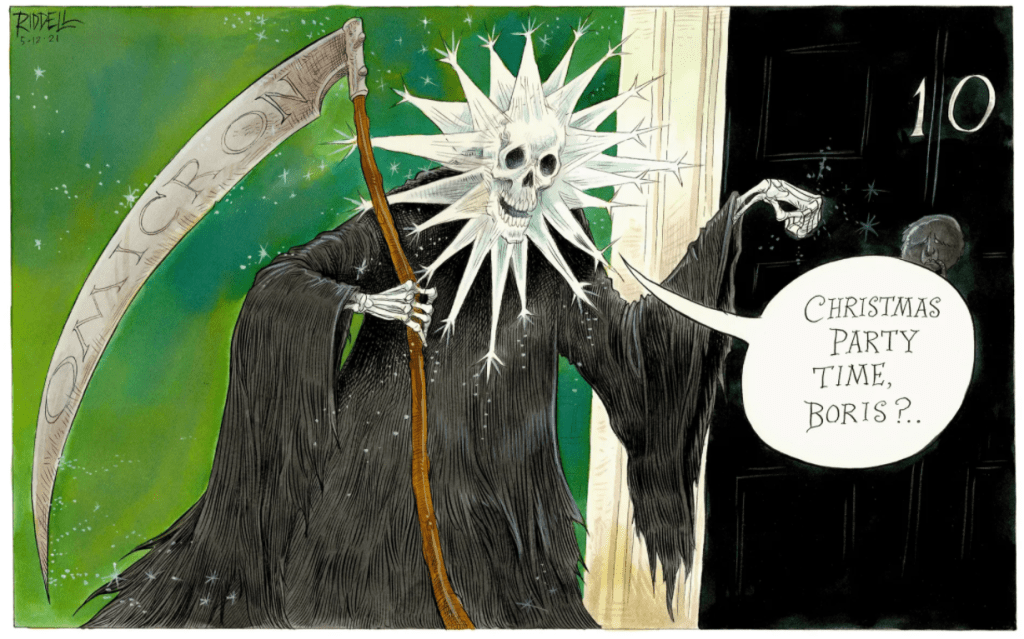
Raab says ‘formal party’ in No 10 last Christmas would have broken rules

Remember Owl’s advice a few days ago regarding parties? Just keep saying  “all guidance was followed” (even if it wasn’t, because it was).

Now lawyer and deputy Prime Minister, Dominic Raab, clarifies the point, or does he M’lud? 

Jessica Elgot www.theguardian.com 

Dominic Raab has become the first cabinet minister to concede that a “formal party” in Downing Street last December would have been contrary to Covid-19 guidance, saying it would have been “the wrong thing to do”.

It came as MPs and campaigners, including a woman whose mother died of Covid-19 on the day when staff are alleged to have held a drinks party at No 10, called for the Covid inquiry to investigate the effect that politicians breaking rules has had on the erosion of public trust in politics and compliance with pandemic restrictions.

Anneliese Dodds, the Labour party’s chair, said it was the first admission that a party inside No 10 would have been, in itself, against the rules.

“We have it in black and white from the prime minister’s right-hand man: a formal party at Downing Street would have been both wrong and against Covid rules,” she said.

“These comments from his deputy pile the pressure on Boris Johnson to come clean about what happened last Christmas and publish the full facts about the party at No 10. There cannot be one rule for senior Conservatives and another rule for everyone else.”

Raab, the deputy prime minister, said Johnson had assured him that no rules had been broken over the alleged gathering last year, despite reports from various sources in several newspapers. “Let’s just be clear what we’re talking about here, something that took place a year ago, unsubstantiated anonymous claims being made,” Raab said on Sunday.

“It’s impossible to answer the charge on that basis, only that we are clear the rules were being followed. If there is a breach of the rules, there is a breach of the rules, but I don’t know the full facts because I wasn’t there.”

Asked if, as a lawyer, he agreed it would have been a breach of the rules to have held a gathering, Raab said: “Of course, if there was a formal party held … that is something that is clearly contrary to the guidance.

“If anyone held a party contrary to the rules, of course that is the wrong thing to do.”

“If something unsubstantiated from anonymous sources actually materialised, then of course it would be wrong,” he added.

Two Labour MPs have reported the alleged gathering at No 10 to the Metropolitan police. However, Raab, who is also the justice secretary, said the police “don’t normally look back and investigate things that have taken place a year ago” – a comment that drew some incredulity from the opposition.

Jackie Green, whose 86-year-old mother, Beryl, died of Covid in hospital on the night of 18 December, when a party is alleged to have been held, said she was shaken by Raab’s comments.

“The claims that there is any distinction between a formal or informal party or that the guidance was caveated is total nonsense,” she said. “It was crystal clear. As far as I am concerned, by abiding by those rules, the consequence was my mum died alone and frightened – and if I had been with her, I might have been able to alleviate some of that fear.”

The government is due to announce the chair of its Covid-19 inquiry within the next fortnight. Green said she hoped the inquiry would look into rule-breaking by politicians in power. “It was shameful how Dominic Raab was trying to evade the questions,” she said.

Daisy Cooper, the deputy leader of the Liberal Democrats, said the party would write to the inquiry chair to urge them to investigate the truth about what happened in Downing Street.

“Lessons must be learned, and there is no doubt the endless list of ministers breaking rules has destroyed the public’s trust in Covid rules which keep us all safe,” she said.

Raab earlier told Sky News’s Trevor Phillips on Sunday programme that the rules for Christmas parties this year were “very clear”. He said: “People can go in and have Christmas parties.

“Of course, employers will want to think common sense about how they do that. We won’t be having a Ministry of Justice-wide Christmas party this year. We will be having appropriate drinks at a smaller scale.

“The government wants people to be able to enjoy Christmas this year. People should feel free to go and enjoy those celebrations, and every employer will think about the right way to do it and I’m the same as everybody else.”

Teignbridge councillor suspended as Lib Dems investigate confrontation

A senior councillor’s membership of the Liberal Democrats has been temporarily suspended as the party looks into a physical confrontation he had at a full council meeting.

Ollie Heptinstall www.devonlive.com

During a question on planning, Teignbridge councillor Gary Taylor (Dawlish South West) appeared to try to pull opposition member Liam Mullone (Newton Says No, College) away at a meeting in September. The pair were broken up.

Cllr Mullone told BBC Radio Devon that Cllr Taylor “grabbed me by the lapels and I heard my jacket tear. He was trying to pull me out of the room.”

Addressing the first council meeting since the incident, Cllr Taylor, who holds the planning portfolio, said: “You have my word that I will not act in this manner again in the future.

“Whilst my actions were intended to prevent an escalation of an ongoing situation, I recognise that in the field of politics, there is no place for physical confrontation, however well-intentioned or otherwise.”

But he didn’t apologise to Cllr Mullone directly.

The Liberal Democrats have now confirmed in a statement that “Mr Taylor’s membership of the party has been temporarily suspended while a complaint is investigated.”

It added: “The Liberal Democrats operate a robust and independent complaints process.”

However, Councillor Alan Connett (Kenton & Starcross), leader of the council and the Lib Dem group, confirmed that Cllr Taylor remains on the executive and part of the local political group while it awaits a decision from the national party.

Following Cllr Taylor’s apology this week, a council spokesperson said: “As a local authority we expect all councillors and officers to demonstrate the highest standards of behaviour.

“Councillor Taylor apologised at [Tuesday’s] full council for his actions at the previous meeting. Therefore, no further action is considered appropriate or necessary.”

Urgent action agreed to tackle Devon’s housing crisis

Last week John Hart trailed this initiative in his press article “Perfect storm has created a housing crisis” [see Owl’s comments here.] 

Now we learn that John has cleared the next hurdle of getting his Council to agree to the cross-party, cross-council approach working through “Team Devon” (see article below). 

Of relevance to the debate is what is happening in Wales: 

The average [house] price in Wales has risen only 35 per cent since 2008, versus 77 per cent in London. The pandemic drive for green space has driven Welsh demand, according to the head of residential research at Hamptons estate agency, but not among second-home buyers: they are down 5 per cent year-on-year in the countryside (Wales brought in a 4 per cent surcharge on holiday homes in December 2020). It’s owner-occupiers moving from more expensive locations, and buying above £500,000 at record levels, who are fuelling the upper end of the Welsh market. (Extract from the Times)

(Wales is also consulting on further measures, including increases to council tax and closing loopholes on business rate relief on holiday letting) A recommended 35 min read as it discusses the pros and cons – Owl

Daniel Clark www.devonlive.com

Urgent action to tackle Devon’s housing crisis has been agreed by councillors.

There was cross-party support for a range of measures to try to deal with the growing issue

It comes as new figures show house price rises in some parts of Devon are among the highest in the country.

At the same time the lack of affordable rental properties means key workers in care, health and education can’t fill job vacancies because they can’t find anywhere to live.

And more and more long-term rental properties are being converted to short-term holiday lets or sold off to take advantage of rising prices.

Devon County Council’s full council on Thursday backed the creation of a new strategic housing task force in partnership with Devon’s district, town and parish councils in Team Devon and other key partners such as Homes England.

The county council will also look at whether it can offer accommodation to key workers to attract them to work for the authority and lobby MPs to press for tax loopholes on holiday rental homes to be tightened up.

Devon County Council leader, Cllr John Hart said: “This problem is so serious that we need a united, cross-party approach. This is where Team Devon comes into its own.

“We are all talking the same language and should lobby together. We are speaking on behalf of 800,000 people.

“Together we have a more powerful voice in lobbying the Government for the changes that need to be made.”

“The county council is not a housing authority. That is the job of the districts and we are not seeking to usurp any of their powers. But it is why we want to work in close partnership with them, our town and parish councils and Dartmoor National Park under the umbrella of Team Devon, which has been so successful in developing a countywide approach to the pandemic.

“Together we have a more powerful voice in lobbying the Government for the changes that need to be made.”

Cllr Hart added: “Hospitality businesses in coastal areas can’t get staff because they can’t find anywhere to live and that is stifling our strong economic recovery.

“But we’ve also heard from one Devon business which employs around 300 people which is considering re-locating some of its operations to Bristol because of the housing situation here.

“The county council is struggling to fill hundreds of vacancies for care staff who can’t find anywhere to live. And that has an impact on our hospitals if they can’t discharge patients who could go home with some support from a carer which would free up beds, and some schools are finding it difficult to recruit staff because they can’t find accommodation.”

Liberal Democrat group leader Cllr Alan Connett said: “We all agree there is an issue and something needs to be done. Every one of us should be able to live in a safe, warm, secure home.

“I welcome the county council changing its approach and looking to help tackle the new and mounting challenges to provide homes for key workers. There is no doubt there is a real shift in the housing markets in a way councils have not seen before. My own view is that as a country we should start building council houses again.

“A century ago we talked of homes fit for heroes, as the men returned from World War I. Today, we still need homes for modern heroes, including former service personnel, emergency workers, health and social care staff.”

Labour leader Cllr Rob Hannaford added: “We must come together and work together to deal with this crisis. We can do more, we should do more and we must do more.

“Second home sales are soaring, private landlords are switching to holiday letting in huge numbers, significantly fewer homes are available to buy or rent and both renters and buyers are being priced out of the county in an unprecedented way.”

The latest figures from the Office of National Statistics show house price inflation in Devon is running at 13.4 per cent – more than Cornwall or Somerset – and some parts of the county are even higher. North Devon at 22.4 per cent is in the top 10 districts in the country for house price growth with Torridge on 19.8 per cent, the South Hams at 15.5 per cent and East Devon on 14.8 per cent.

Figures produced for Team Devon show Air B&B offering 253 rentals in Exmouth compared with just four residential lettings. In Ilfracombe the figures are 326 compared to four.

Cllr Hart said some necessary actions would need Government support but there was a lot councils could do themselves. Devon is to consider the potential to convert some offices or other properties into housing for key workers and offering grants towards deposits for house purchase.

The council will also look at whether it could offer accommodation to key workers to attract them to work for the authority and lobby MPs to press for tax loopholes on holiday rental homes to be tightened up.

Team Devon has a bid for Government cash to help promote small-scale housing projects providing local homes for local people under Community Land Trusts which is being led by Mid Devon District Council’s Chief Executive, Stephen Walford.

Councils could also learn from best practice in other areas and share ideas on how housing and planning policies could be adapted to ensure some affordable homes were allocated solely for essential local workers.

“There has always been an issue in Devon with young people not being able to live where they grew up because of low wages and high house prices but this is a perfect storm and we need to take urgent action,” added Cllr Hart.

New town confirmed in major Devon housing plan for East Devon

A second new town for East Devon in addition to currently being built Cranbrook is among the proposals as part of a draft new Local Plan reveals potential locations for where new homes could be built.

In the spirit of being open and transparent the draft document, which may change as a result of further consideration and public consultation, will be debated for the first time in public on Tuesday, December 14, by EDDC’s Strategic Planning Committee. (This provides link to agenda, supporting papers, speaking and viewing arrangements – Owl).

Daniel Clark www.devonlive.com

This is the first time in East Devon District Council’s history that it has revealed a ‘work in progress’ draft for a Local Plan, normally waiting until work is further progressed before showing it to the public.

The document, which will help shape East Devon until 2040, builds on the authority’s recently adopted Council Plan and looks at how the district can protect the environment, build employment space and ensure only high quality developments are built.

The Government says EDDC must deliver 918 homes a year. This means the new Local Plan needs to identify land for more than 6,900 additional homes. This is in addition to those already planned for, like at Cranbrook and developments expected to come forward by 2040.

Most of the large scale housing sites will also be expected to provide a range of employment spaces and community facilities and create sustainable communities where walking and cycling are the norm.

East Devon potential housing locations

East Devon potential housing locations

The current preferred strategy could deliver:

  • A concentration of new development on the western side of East Devon to include an additional new town (a further new town in addition to Cranbrook) to provide around 2,500 homes by 2040 but ultimately to grow to around 8,000 homes;
  •  Major strategic developments close to the city of Exeter including new developments off Clyst Road, North of Topsham and expansions to Exeter Science Park and further employment spaces north of Sowton Village and near the airport
  • Axminster – approx. 335 homes in a series of small scale urban extensions providing a mix of housing and employment sites.
  •  Exmouth – approx. 455 homes within a number of sites focused on the north east of the town with some smaller scale allocations to the south and east.
  • Honiton – approx. 228 homes with a large allocation to the eastern edge of the town and a series of smaller applications to the other edges of the town.
  • Ottery St Mary – approx. 250 homes to the western side of the town including an area of employment land.
  • Seaton – approx. 264 homes largely focused on 4 sites to the north of the town including a large allocation between Harepath Road and Colyford Road comprising a mix of housing and employment.
  • Sidmouth – approx. 196 homes comprising a large allocation west of Woolbrook Road and a series of smaller scale allocations to the north and west of the town.
  • Around 400 homes could be built in total across a number of ‘local centres’ including Broadclyst, Budleigh Salterton, Colyton, Lympstone and Woodbury.
  • With a further 500 homes split between the ‘service villages’ including Clyst St Mary, Feniton and Whimple among others.

On the new town, the plan says: “A new town will be a long time in the planning and it is unlikely that any new homes will be built until into the 2030s. On this basis, and at build out rates that if they escalate up to around 300 homes per year, there might be expected to be up to 2,500 new homes built at the new town before the 2040 end date of the East Devon working draft Local Plan.

“The second new town will, therefore, see most of its development happening outside of the life of this local plan and potentially running beyond the mid-point of the 21st Century. There will be a need to build up a long term strategy and vision for the development of this new town.”

If the proposals are endorsed but a second new town is rejected the extra housing that is needed is more likely to be around 3,800 new homes, the plan adds.

The plan adds: “The work on developing a plan strategy (including looking at alternative options) has identified the appropriateness of building another new town close to the City of Exeter.

“There is clearly an option of not planning for a second new town though this would raise fundamental questions about where housing growth in particular would go.

“As a variation or alternative to a self-contained new town there would be the option of planning for a series of separate larger scale new villages in the western part of East Devon. Such villages may have the potential for speedier delivery though are unlikely to secure the range of services and facilities that a new town may provide.”

In green, the outline of the sites for the three potential new towns in East Devon

In green, the outline of the sites for the three potential new towns in East Devon

It continues: “It is proposed that the policy of the new local plan will provide for a second new town in East Devon, though with a specific site still to be defined, on land in close proximity to the City of Exeter.

“The intent is that in the Draft Local Plan, to be consulted on, a specific site (or at least a much more explicit statement on location) will be identified with a proposal that the site is allocated for development.”

Among the submissions were three different proposals for new settlements, in the west end of the district – with a Clyst Valley Garden village on land south of Clyst St Mary and Clyst St George, land around Denbow Farm between the A30 and the A3052, and a site between Crealy Adventure Park and Greendale Business Park known as ‘Greenbrook’.

The first potential ‘new town’ would be for a new ‘garden village’ on land around Clyst St Mary and Clyst St George. The site has been submitted as part of the HELAA process, and maps show that the site would extend to the north of the existing Clyst St George settlement to around where Winslade Park currently lies, before expanding out to the east towards Crealy Adventure Park, as well as out from the east of Clyst St George towards Woodbury Salterton.

The second proposal for a new town is at Denbow Farm. That scheme, which was also suggested during GESP, covers a large area of 660 hectares largely of rolling farmland extending from the A30 to the A3052, before adjoining the Hill Barton industrial area to the south.

It covers the parishes of Clyst Honiton, Sowton, Farringdon, Aylesbeare and could see 10,000 homes built, as well as employment land provided, and could deliver a new route connecting the A30 to the A3052, a self-sufficient, mixed-use garden community and it could deliver a regional hub for sports.

The third is on land south of the A3052 between the Greendale Business Park and Crealy Adventure Park – the proposed ‘Greenbrook’ development. The map shows that the entirety of the land between the two sites is included, with it also stretching slightly further south towards the edge of Woodbury Salterton.

In the spirit of being open and transparent the draft document, which may change as a result of further consideration and public consultation, will be debated for the first time in public on Tuesday, December 14, by EDDC’s Strategic Planning Committee.

A council spokesman said: “It is appreciated some of the proposals are controversial and will cause concern to communities but the proposals may well change following further work and input from councillors.

“Residents have been asked not to submit comments at this stage and to wait until the final draft plan has been published. A public consultation, including workshops, will then be held next summer based on current timescales.”

They added: “The plan showcases EDDC’s aspirations for all new homes to be zero carbon with measures such as better insulation, triple glazing, solar panels and special pumps that extract heat from the air to warm people’s homes as well as district heating systems like the one at Cranbrook, which can be run on renewable energy.

“Policies that minimise the carbon footprint while building developments have also been proposed along with measures that ensure more is put back to create natural habitats, affected by developments, than is taken away.

“Alongside the new homes the working draft plan looks at where employment space can be put to deliver new jobs alongside the homes to create a “…resilient, inclusive, green economy, delivering growth and prosperity for the benefit of everybody in the district”.

The working draft of the plan will be considered by councillors and amended and modified as work progresses over the coming months

Full details of the proposed sites can be viewed at

John Hart set to be “Governor Hart” for Devon?

Is this Michael Gove’s idea of “levelling up” through devolution?  

There are concerns over whether there are enough mechanisms to hold powerful local politicians to account day to day. In areas that are staunchly Labour or consistently Tory, would there be enough incentives for mayors or governors to deliver for their constituents, or will they just be able to cling on for term after term?”

American-style governors could level up England

Henry Zeffman www.thetimes.co.uk

Swathes of rural England could elect powerful American-style governors under Michael Gove’s plans to “level up” the country.

Devolution is at the heart of his attempts to flesh out Boris Johnson’s domestic slogan, with an ambition for every part of England to have a local leader with equivalent powers to London by the end of the decade.

Residents of some rural areas where the term mayor is deemed inappropriate could elect governors instead.

The proposal is contained in a draft of the levelling up white paper being written by Gove’s new Department for Levelling Up, Housing and Communities. Though Downing Street announced in May that the paper would be published by the end of this year, it has been delayed to early next year, The Times has learnt.

Government figures insist that the delay is simply a reflection of a busy few weeks of announcements before the Christmas break, though there have been tensions about how far-reaching the paper’s proposals should be.

One idea being considered by Gove but yet to receive the green light is a statutory levelling-up quango, which would monitor every aspect of government policy for its impact on regional inequalities.

Plans to “extend, deepen and simplify” devolution, though, are fundamental to Gove’s aims. He has identified an absence of local empowerment as a core reason for regional disparities: the UK is one of the most centralised major economies. Top-down government, Whitehall sources believe, has failed to utilise local knowledge and meant that policy can often benefit commuters or new arrivals in a local area rather than its long-standing residents.

London has had mayors since 2000 but a new generation of Conservative mayors, such as Ben Houchen in Tees Valley and Andy Street in the West Midlands, has helped some in government warm to extending devolution.

Gove wants the devolution deals to cover areas with a strong identity and community, which in practice means many will be county deals. Any area negotiating devolved powers will have to have a population of at least 500,000.

The devolution deals will see counties or other areas given more powers over policy areas such as transport, housing or health, and given money to deliver the services that would otherwise be run from Westminster.

Not every area will be forced to have a directly elected mayor, or governor, but those that agree to do so will be given the most powers.

A government source told The Times: “Levelling up is about empowering local leadership and allowing communities to take back control. The white paper will set out ambitious plans on devolution so we can see more Andy Streets and Ben Houchens delivering for communities across the country.” The plan for a new tier of local leaders is likely to meet resistance from councillors wedded to the existing system.

An idea being considered is to form a levelling-up quango that would monitor the progress of levelling up against a series of core missions, such as improving living standards and boosting local pride. The independent oversight body would take inspiration from the Office for Budget Responsibility, which provides independent analysis of public finances.

The body would also have an important role collating and publishing new data on regional disparities in the UK.

Michael Gove’s plans for the levelling up white paper make clear his belief that wider devolution will help him give meaning to Boris Johnson’s slogan (Henry Zeffman writes).

It is, in effect, a bet that expansion of elected mayors, and governors, will reduce regional inequalities and drive growth around the country. Whether the smattering of metro mayors supports that is arguable.

The idea is that devolving powers to locally-accountable leaders will improve local quality of life, as well as giving somebody with a high profile the ability to promote an area in Westminster.

If the eventual model for the whole country is London, then the government can point to the London Plan, which under three mayors of two parties has given coherence to the revitalisation and regeneration of large parts of the capital. The most prominent mayors have brought a new kind of civic leadership too: be that Andy Burnham in Manchester rebuking the government for its regional tiers system or Johnson throwing himself into the hosting of the 2012 Olympics.

Ben Houchen, the Tory Tees Valley mayor is praised by party colleagues in Westminster for turning a traditional Labour area deep blue. He has brought his local airport back into public ownership.

But there are questions about local enthusiasm. Turnout in the last London election was 42 per cent; in Manchester 35 per cent; in the West Midlands 31 per cent.

There are concerns over whether there are enough mechanisms to hold powerful local politicians to account day to day. In areas that are staunchly Labour or consistently Tory, would there be enough incentives for mayors or governors to deliver for their constituents, or will they just be able to cling on for term after term?

UK’s progress on Covid now squandered, warns top scientist

The emergence of the Omicron variant shows that the world is “closer to the start of the pandemic than the end”, one of Britain’s most senior scientific figures has warned, as he lamented a lack of political leadership over Covid.

Michael Savage www.theguardian.com

Sir Jeremy Farrar, the director of the Wellcome Trust who stepped down as a government scientific adviser last month, said the progress in combatting Covid-19 since its emergence was “being squandered”.

Writing in the Observer, he said rich countries had been taking “a very blinkered domestic focus, lulled into thinking that the worst of the pandemic was behind us”. He said while he was cautiously hopeful that current vaccines would protect against severe illness from Omicron, that may not be true for future variants.

“The longer this virus continues to spread in largely unvaccinated populations globally, the more likely it is that a variant that can overcome our vaccines and treatments will emerge,” he writes. “If that happens, we could be close to square one.

“This political drift and lack of leadership is prolonging the pandemic for everyone, with governments unwilling to really address inequitable access to the vaccines, tests and treatment. There have been wonderful speeches, warm words, but not the actions needed to ensure fair access to what we know works and would bring the pandemic to a close.”

He said that the urgent action needed had not changed – “wearing masks indoors, increasing testing, social distancing, isolating if positive (with support to do so) and vaccination will all help to drive down transmission and protect against illness.”

Farrar’s intervention came as a major charity raised concerns about the government’s booster jab campaign, which it sees as the best current method of combating the virus. Caroline Abrahams, charity director at Age UK, said the programme was “frankly in a mess”. She said: “It’s way behind where it should be, and to hear this week that as many as one in five care home residents have not yet had their boosters was nothing short of alarming.”

She spoke out after some targets for GPs were suspended to allow them to concentrate on administering jabs. Routine health checks for the over-75s and for new patients may be deferred under the new guidance.

“Against this context we agree that the top priority now is to turbo-charge the booster programme, to ensure as many older and vulnerable people as possible get their jabs, and fast,” said Abrahams. “In the end this situation is another demonstration of how underpowered our GP system has become. Unless and until we invest more heavily in it we will continue to see these hard choices arising whenever a crisis comes along, and that’s certainly not in any one’s interests, least of all older people’s.”

Sajid Javid, the health secretary, called on all eligible people to have a booster before spending time with family this Christmas. “It’s absolutely crucial that everybody who is eligible gets their booster jab to top up their immunity before spending time with loved ones,” he said. “While our brilliant scientists learn more about the new Omicron variant, we need to do everything we can to strengthen our defences, and vaccines are the best way to do that.”

On Saturday Downing Street announced that it was introducing pre-departure tests for people travelling to the UK. From 4am on Tuesday, travellers will have to complete a lateral flow or PCR test 48 hours before entering the country. Nigeria has been added to the red list, and from 4am on Monday arrivals will have to quarantine in hotels. Officials said the moves came as evidence emerged that the Omicron strain had been reported in more than 40 countries, with apparent community transmission in places such as Norway. They also said there was evidence that the incubation period was shorter than for other variants.

Labour had been pushing for the introduction of the tests. A Downing Street source said that new evidence about the spread of the variant and its characteristics had driven the decision. It will cause further frustration for the travel industry, which has been heavily affected by Covid restrictions.

The sudden spread of Omicron has dismayed many scientists. “What has really surprised me has been the rapidity of the increase in numbers of cases being reported from South Africa,” said Prof François Balloux of University College London. “Cases are doubling at a rate I have never seen before. It is very worrying.”

Early estimates have suggested this rise is being driven by the fact that the Omicron variant can infect between three and six times as many people as Delta, over the same time period. It is an alarming figure that has been balanced by early reports which have suggested the variant is, at present, less likely to lead to hospitalisation.

However, scientists last week warned caution should be taken with such data. “It is already a tight situation. Even if Omicron is less likely to cause severe illness, it may still cause more hospitalisations and put further strain on the health service, because so many more people will become infected,” said Prof Rowland Kao, of Edinburgh University.

There is also evidence that more than one in four (27%) British workers would turn up for work with symptoms of the Omicron variant because they needed the money, including 23% of those whose job puts them at increased risk of infection. Also, 16% of workers say they would be able to work from home, but are not allowed to by their employer, according to polling for the Royal Society for Arts, Manufacturers and Commerce (RSA). Just 31% say they would get support from their employer beyond statutory sick pay.

“To secure the economic recovery, workers must be economically secure,” said Anthony Painter, RSA’s chief research officer. “In the short term, we need to see an ‘auto-furlough’ system and more generous sick pay, but long term, both the Conservatives and Labour must spell out how they will address the deep economic insecurity Covid has only exposed.”

Saturday saw further demonstrations in Europe against various governments’ coronavirus measures. In Austria, the first country in the EU to announce that it is to make vaccination against Covid mandatory, more than 40,000 joined a protest in Vienna.

The Dutch city of Utrecht saw several thousand demonstrate against restrictions that were introduced last weekend. Protesters carried banners reading “Medical Freedom Now!”. Many protesters denounced what they see as increasing pressure from the Dutch government to get vaccinated if they want to participate in regular society.

In Frankfurt, Germany, police broke up a demonstration of several hundred people for failing to wear masks or maintain social distancing, using batons and pepper spray after they were attacked by a group of protesters. In Berlin, small groups gathered to protest after a large demonstration was banned.

The Mirror uncovers new sleaze: ex-minister ‘broke rules and lied’ about job

Former health minister Stephen Brine claimed to have consulted Parliament’s revolving door watchdog before taking a £200 an hour job with a drug company. In fact, ACOBA refused to discuss the job with him because he’d already started it. Read the story here.

Call to end ‘turds-in-street’. South West Water “summoned” to EDDC Scrutiny Committee.

A few weeks ago Owl posted: water profits surge as leaks wash away public trust. Since then, the Pennon Group (owner of South West Water) has published its latest half-year results showing profits are up, as was expected.

On “Improving river and coastal water quality” the bullish Pennon half-year report claims “our best ever performance” on bathing water (“100% water quality standards achieved at our bathing beaches”); and that they are “focused on reducing our impact on river quality by one third by 2025”.

Owl reads all this with “interest” considering Owl recently reported, according to the 2021 Water Quality report by Surfers Against Sewage, that: South West Water also produced a “notably poor performance for the third consecutive year”, with 406 discharges in the bathing water season on to popular beaches. Owl also reported a correspondent quoting Luke Pollard MP, shadow environment secretary, saying in October “Not one English river is in a healthy condition and there has been zero improvement since 2016.” 

Owl has also previously drawn attention to the fact that, though South West Water may not have found the resources to make any headway in reducing sewage pollution, it has found the time and effort to write a “green jobs” report on behalf of the Great South West.

The report, Levelling Up the Great South West: A G7 Legacy, analyses every parliamentary constituency in Devon and Cornwall and says that they deserve as much political attention as those in the electoral battleground of the so-called “Red Wall” in the North of England and Midlands. 

Owl has also questioned whether South West Water can be considered to have any authority or credibility to take the lead on “green” issues. Owl wonders who commissioned such a study?

Is South West Water emulating Sir Geoffrey Cox MP in the priorities devoted to “second Jobs” compared to the day job? In the case of  South West Water surely sorting out Clyst St Mary’s “turds in streets” has priority?

Owl wants everyone to remember, as well, the beavers who have to swim around in all this.

This special scrutiny meeting should be worth looking out for!

Too many sewage incidents in East Devon

Joe Ives, local democracy reporter www.radioexe.co.uk

“Turds in the street” should be a thing of the past in East Devon – or at least that’s the hope for 2022.

East Devon councillors say they’ve had enough of surplus sewage spewing into road, so they’ve summonsed South West Water to explain what’s going wrong at a special meeting of the council’s scrutiny committee.

The water company has been under the spotlight after it was revealed that the company made 42,000 raw sewage discharges into Devon’s rivers and coastal areas last year.

It has been particularly bad for residents of Clyst St Mary. The village has flooded with sewage at least 11 times this year, with South West Water offering portable loos to the worst affected households, some of which were left without working toilets for up to 60 hours at a time.

The situation attracted criticism from local councillors and East Devon’s Conservative MP Simon Jupp.

Addressing the scrutiny committee, Councillor Eleanor Rylance (Lib Dems, Democratic Alliance Group, Broadclyst) said: “We actually have turds in the streets in some places when it rains, and that’s really not on. 

“This is 2021 we cannot be running a local area that has this sort of thing happening. We can’t have poo in the streets, we can’t have poo in the rivers and we can’t have poo in the sea. We need to find out why it’s happening and get it sorted out.”

Councillor Jess Bailey (Independent, West Hill and Aylesbeare), who suggested the meeting with South West Water and got unanimous agreement from committee members, said the issue was a “matter of massive public concern.”

“Having clean water in our rivers and on our coast is absolutely fundamental to East Devon, both for wildlife and tourism.”

Speaking recently about concerns over flooding in East Devon, South West Water’s engineering director Matt Crabtree said: “We are committed to delivering a permanent solution which will involve detailed works and upgrades to our network.”

Act now against Omicron to stop new Covid wave, UK ministers warned

UK ministers have been warned they cannot wait for new research on the Omicron variant and must act now to prevent a potentially “very significant wave of infections” that risks overwhelming the NHS.

Ian Sample www.theguardian.com 

A 75 further cases of the variant have been identified in England, the UK Health Security Agency (UKHSA) said on Friday night, bringing the total number of UK confirmed cases to 134. The head of the agency, Dr Jenny Harries, said: “We have started to see cases where there are no links to travel, suggesting that we have a small amount of community transmission.”

The Guardian understands the government has been privately urged by some of its own scientific advisers to tell people to work from home until Christmas if they can, when more will be known about the dangers posed by the new variant.

Growing concern about the spread of the variant was reflected at the latest meeting of the Sage committee, details of which were released on Friday. The minutes show experts saying there is no time to wait for more data on the Omicron variant. “Even if measures are introduced immediately, there may not be time to fully ascertain whether they are sufficient before decisions are needed on further action,” the documents say.

“The situation could develop quickly over the coming weeks and decision-makers may need to act while there is still a high level of uncertainty including considering the potential need for stringent response measures.”

However, on Friday, during a visit to Oswestry in Shropshire before an upcoming byelection, Boris Johnson said that Christmas this year should go ahead as “normally as possible” and reiterated that people did not need to cancel plans for parties and nativity plays.

Sage’s warning came as ministers gave GPs in England the green light to provide less care to millions of patients for the next four months so they can join the “national mission” to urgently deliver Covid booster jabs.

Family doctors will spend less time monitoring people with conditions such as diabetes and heart problems, do fewer health checks on the over-75s and stop performing minor surgery until April.

A Department of Health and Social Care (DHSC) source made clear the government sees the accelerated vaccination campaign, combined with border measures, as its main weapons against Omicron. “Stepping up the boosters is the key thing: buy as much time as we can with the measures at the border to slow the incursion, and then make good use of that time to understand the variant.”

Ministers are keeping Covid measures under constant review, but it is understood fresh restrictions at the border – such as adding more countries to the red list – are considered more likely than domestic changes such as the reimposition of working from home guidance.

The Sage experts praised scientists in South Africa for swiftly identifying and sharing details of the highly mutated Omicron variant in November, a move that prompted a string of travel bans and a global research effort to understand how dangerous the variant may be.

According to the minutes, it is “highly likely” Omicron will escape immunity to some extent, given the large number of reinfections already seen in South Africa, and a raft of mutations that affect every known site that neutralising antibodies bind to.

The scientists expect protection against infection to be hit harder than protection against severe disease. But even if vaccines hold up well against severe illness, any significant drop in the prevention of infection could drive a “very large wave” of disease that requires “very stringent response measures to avoid unsustainable pressure on the NHS”, the experts say.

“It is important to be prepared for a potentially very significant wave of infections with associated hospitalisations now, ahead of data being available,” the minutes add.

The warning comes as the latest figures from the Office for National Statistics (ONS) reveal that infection levels have risen in the UK, echoing trends seen in recent daily case numbers. The ONS survey, which is based on swabs collected from randomly selected households, found in the week ending 27 November an estimated 1.65% of the population in England had a Covid infection, equating to about one in 60 people. In Northern Ireland and Wales, the rate stands at one in 45, and at one in 65 in Scotland. The figures represent a rise in all nations except Wales, where the trend was uncertain. None of the cases were confirmed as Omicron, which was first reported to the World Health Organization (WHO) on 24 November.

On Friday, the UK reported a further 50,584 cases, up 1% on the week, with 787 hospitalisations and 143 deaths, down 3.8% and 5.2% on the week respectively.

Adam Finn, a professor of paediatrics at the University of Bristol and a member of the Joint Committee on Vaccination and Immunisation (JCVI), urged people to work from home where possible until more was known about the risk Omicron posed. The European Centre for Disease Prevention and Control believes the variant could become dominant on the continent within months.

“The honest truth is that the booster programme, which I think will work, is not going to work soon enough if there is a big wave here soon,” said Finn. “It takes time to get them into people and it takes time for them to make an immune response.”

“We need to buy time. If in three weeks it’s died out, then fine, we can all relax, but right now is the time when you could prevent there being a big wave,” he added. “The more people can work from home now the better, until we are more definite about what’s going to happen.” Sage scientists estimate that more than a third of people’s contacts occur in the workplace and that home working can have a significant impact on transmission.

Prof Anthony Harnden, the deputy chair of the JCVI, said while boosters would give the majority of people their best chance of fighting Omicron, there remained a small proportion, but large numbers, of unvaccinated adults who would be “at very high risk” if Omicron proved to be highly transmissible. “We should explore every measure to reach out to these unvaccinated adults,” he said.

No 10 on Friday ruled out making vaccines compulsory, as has happened in Austria and is being considered in Germany. A spokesperson for the prime minister told reporters: “We’ve set out our policy on this and we’ve said it’s not something that we would look to introduce. You’re aware of the changes we made in terms of social care settings and for NHS workers, given the importance of protecting the most vulnerable in our society. But there’s no plans above and beyond that in that regard.”

Finn believes mandatory vaccination of the general public could cause more harm than good in the UK, but favours an approach used in South Africa, where trusted individuals go door-to-door to talk through people’s concerns about having a Covid jab. “They are literally going to people’s houses and talking to them, one by one, and I think that’s what you’ve got to do, and it has to be the right person doing it,” he said. “We know who’s not had the shots and you can have a real impact if you get the communication right.”

Labour and Lib Dems’ new strategic relationship will strike fear in Tory hearts

On the face of it, nothing much happened in Old Bexley and Sidcup yesterday. The by-election produced a pretty bog standard midterm shift from the governing party to the opposition. The Conservatives fell 13 points to 51.5 per cent. Labour rose seven points to 30.9 per cent. The constituency stayed in Tory hands.

Ian-dunt inews.co.uk 

But underneath that result, something rather striking happened. The Liberal Democrat vote plummeted five points to just three per cent. And that was not because of a poor showing by Ed Davey’s party. It was because they effectively stood aside to give Labour a clear run. We seem to be witnessing the start of an informal, organic anti-Tory strategic arrangement.

No-one expected this seat to be an upset. Old Bexley and Sidcup has been Conservative since it was created in 1983. Even in 1997, the party secured a seven per cent majority. Barring an asteroid hitting the earth, it’ll still be Conservative at the next general election, no matter who ends up in Downing Street.

It’s not part of the Blue Wall – that smattering of Remain-voting Conservative seats in the South with high numbers of graduates and professionals feeling alienated from the government. Just 22.6 per cent of its electorate are graduates. It voted 62 per cent Leave in the referendum. It has an 89 per cent white population. It has a higher-than-average number of people aged over-65. Basically, this is a classic constituency for the modern Conservative party. Johnson is having a rough time of it at the moment, but it would have to be many degrees worse for places like this to be in the running.

All of which makes it seem like yesterday’s vote was pretty boring. Labour were doing well enough to stay in the game, the Tories well enough to dispel talk of disaster. Nothing of any interest.

Except for the Lib Dem vote. That was the real eye-opener.

For years now, and particularly since the 2019 election, progressive voters have been calling for a formal alliance between the non-Tory parties. And you can see why. Look at a seat like the Cities of London and Westminster. In the last general election, the Lib Dems secured 13,096 votes, Labour 11,624 and the Tory candidates sailed through the middle with 17,049. It’s a classic case of how badly the first-past-the-post system punishes a split vote on the left.

But the Lib Dems and Labour have been knocking the suggestion back. Voters don’t like the smell of a top-level stitch up, they say, and anyway local parties wouldn’t countenance it. Even in 1997, when Tony Blair and Paddy Ashdown were working closely together, there was no formal pact. They just generally tried to stay out of each other’s way so that each could inflict maximum damage on the government.

And that, on the face of it, seems to be what is happening now. “What I see is a party led by Keir Starmer, who shares our view – that we’ve got to remove Boris Johnson from 10 Downing Street,” Lib Dem leader Ed Davey said last month. “They will campaign in areas where they think they can win and we’ll campaign in areas that we think we can win. We have to manage our resources carefully. It’s no secret that we haven’t put all our effort into some by-elections.”

The Lib Dems therefore didn’t really get involved in this by-election. They consequently fell five points and lost their deposit. But they are focusing on a by-election in the seat vacated by sleaze-ridden MP Owen Paterson on 16 December. “We certainly want to make our case in North Shropshire,” Davey said.

What’s interesting is that Labour seems to be playing ball. The party finished second in Paterson’s seat in 2019, but it seems to be standing aside for Davey so the Lib Dems can monopolise the anti-government vote.

This isn’t the first time this has happened. Labour effectively stood to one side during the Chesham and Amersham by-election in June, scoring just 622 votes and allowing Lib Dem Sarah Green to secure a shocking 25 point swing. Weeks later, the Lib Dems were pretty much invisible in the bitterly fought Batley and Spen by-election, which arguably allowed Labour to retain the seat.

That puts all eyes firmly on North Shropshire in two weeks’ time. The seat shouldn’t be in play. It has a massive 40 per cent Tory majority. But it is ground zero of the Tory sleaze scandal. Conservative figures are getting jittery. The Lib Dems seem increasingly bullish about it. And Labour looks set to allow them a clear run.

There isn’t going to be a formal progressive alliance. But it’s becoming increasingly clear that Labour and the Liberal Democrats are pursuing an organic strategic relationship, in which they prioritise their resources in those seats where they think they have the greatest chance of winning. In short, it looks like they’re getting their act together. And that, more than a 13 point fall in their vote share, will put fear in Tory hearts.

Ambulance queue chaos at Devon A&E

The state of the NHS in Devon was highlighted today by a student paramedic who took a video as he waited at the back of a queue this afternoon when up to 26 ambulances did not move in six hours.

Colleen Smith www.devonlive.com

The shocked medic wrote: “Currently at the back of a 22 ambulance queue. No movement in 6 hours. Staff are broken, the hospital is full. This is not sustainable. Patients are being affected and so are staff. The NHS in south Devon just broke. There was time to fix this, I don’t think so anymore.”

A member of the public earlier told DevonLive that he had counted 26 ambulances in the queue.

Currently at the back of a 22 ambulance queue. No movement in 6 hours. Staff are broken, the hospital is full. This is not sustainable. Patients are being affected and so are staff. The NHS in south Devon just broke. There was time to fix this, I don’t think so anymore. pic.twitter.com/C4LVPc9fTE

— will P (@willprice999) December 3, 2021

It comes as hospital staff face huge pressures with reports of people waiting for up to 13 hours in A&E at Torbay Hospital. Staff are also reeling today after being told their annual Christmas parties have been cancelled by bosses worried about the new Omicron variant of Covid.

In a statement to DevonLive today, Torbay Hospital said their emergency department has been under “sustained pressure” for several months now and they apologised to anyone waiting for treatment.

The hospital statement in full from Ian Currie, Medical Director at Torbay and South Devon NHS Foundation Trust, said: “Like many hospitals across the country, we have been under sustained pressure in our emergency department for several months now.

“Currently extreme pressure is impacting on our ability to admit patients in a timely way which means that ambulances are currently waiting to discharge patients and we are not able to see people as quickly as we would like. We would like to offer our sincere apologies to everyone who is waiting for treatment.

“We always aim to see and treat patients as quickly as possible. All patients arriving at our emergency departments are triaged and assessed with the most clinically urgent being prioritised. This does mean that anyone presenting with less urgent needs is likely to face a very long wait for treatment.

“We are asking everyone to think carefully about which service is right for their needs. Our Urgent Treatment Centre at Newton Abbot is open 8am to 8pm every day and can provide treatment and care for a range of urgent care needs.

“We are working together with local health and care partners to ensure that people who need hospital care can be admitted and then supported to return home safely as soon as they are medically well enough to leave hospital.

“Family and friends of patients can also help by being ready to collect their loved one from hospital when we call, and supporting them when they get home.”

Owl need to make a correction to earlier post

Javid says snog who you like under mistletoe

contradicting Coffey

Jessica Elgot www.theguardian.com 

Ministers have clashed repeatedly over advice on festivities and mistletoe, with Home Office staff being urged to limit numbers attending Christmas parties in the office and the health secretary contradicting a cabinet colleague to insist “people can snog who they wish”.

Amid concerns over the new Covid variant, Omicron, the government was accused of sending mixed messages about whether people should change their behaviour in the festive period despite no laws prohibiting social contact between healthy people.

Sajid Javid became the latest to weigh in, contradicting the work and pensions secretary Thérèse Coffey’s warning against kissing strangers under mistletoe.

“People can snog who they wish,” Javid told ITV News. “I’ll certainly be kissing my wife under the mistletoe – it’s a Javid family tradition. It’s got nothing to do with the government who you kiss or anything like that. But the only thing is just – there’s guidance already out there – just be cautious and enjoy yourselves.”

Coffey had said on Wednesday night that “we should all be trying to enjoy the Christmas ahead of us”, but “for what it’s worth, I don’t think there should be much snogging under the mistletoe”.

Meanwhile, guidance issued to civil servants in the Home Office on Wednesday, seen by the Guardian, said they could celebrate with colleagues, but urged people to “take sensible precautions”.

The advice said that for festive gatherings in the workplace, “numbers should be kept to a minimum”. It also stated: “Colleagues should refrain from undertaking irregular travel solely to attend a Christmas gathering.” It advised staff to “take steps to minimise contact, including the avoidance of sharing food and drink”.

An influential scientist also warned that he would not feel safe going to a Christmas party this year. Prof Peter Openshaw, a member of the Government’s New and Emerging Respiratory Virus Threats Advisory Group (Nervtag), said the “chances of getting infected were too high” to have a party.

Earlier, George Freeman, the science minister, admitted that “given the new variant” his team had decided to “get together on Zoom and toast each other” virtually.

Freeman had told the BBC: “Individual businesses, in the end, have to make judgments on what is appropriate internally … For many small businesses, four or five staff, who are working together every day anyway, gathering to have a drink isn’t a big step up in risk.

“But some companies might normally bring hundreds of people in from around the world to a big party, and they may decide, this year, is that sensible, given the pandemic and given where we are?” Freeman was reprimanded by Boris Johnson, who insisted that “people shouldn’t be cancelling things; there’s no need for that”.

Pressed on whether Christmas parties and children’s nativity plays should be scrapped given Omicron’s spread in the UK, Johnson said: “That’s not what we’re saying.”

He stressed that the government was trying to respond in a “balanced and proportionate way” to the variant, and said Downing Street was holding events “the whole time”, citing the recent turning-on of the Christmas lights outside No 10. His spokesperson confirmed that several more gatherings would go ahead in Downing Street this Christmas.

It comes after Jenny Harries, who heads the UK Health Security Agency, suggested people should avoid unnecessary socialising in the run-up to Christmas. but was contradicted by No 10.

The issue of such advice for people to alter their behaviour running contrary to official guidance and new Covid rules has infuriated some, who believe it will hit businesses hoping for high levels of trade as Christmas approaches.

Johnson is also on tricky ground, after it emerged that he attended a leaving party in Downing Street last November, during the second lockdown. Angela Rayner, Labour’s deputy leader, wrote to the cabinet secretary, Simon Case, asking him to investigate that and another alleged gathering in No 10 last winter.

She said in her letter: “This government is undermining public health messaging with their actions and we cannot let this go on unchecked. It cannot be that the prime minister believes there to be a set of rules for the public and a totally different set of rules for himself.”

Layla Moran, a Liberal Democrat MP and chair of the parliamentary group on Covid, said: “Mixed messages and obfuscation is this government’s bread and butter when faced with hard decisions, and we can see this again in their completely confused statements on Christmas parties.

“The evidence is unequivocal: clear government messaging is extremely important in preventing infections and so the prime minister must overcome his aversion to delivering bad news, as his abdication of responsibility has cost us dearly throughout this pandemic.”

Johnson’s spokesperson on Thursday insisted all rules were followed at gatherings in Downing Street throughout the pandemic. Asked if Freeman was wrong to imply that firms should consider not having a Christmas party or replace it with a smaller gathering, he replied: “That is not in the guidance, it is not in the regulations.”

Planning tensions in Teignbridge 

Teignbridge Council spat leads to apology

Ollie Heptinstall, local democracy reporter www.radioexe.co.uk

A spat at a Teignbridge council meeting which involved one member trying to drag another away has led to an apology two months after the event.

In September, a full meeting of Teignbridge District Council descended into chaos in an incident involving Councillors Gary Taylor (Lib Dem, Dawlish South West) and Liam Mullone (Newton Says No, College) during a question on planning procedures.

During an impassioned speech, Cllr Mullone claimed false “ghost objectors” to a planning application last year had been deliberately chosen by the council to fill the two permitted speaking spots which otherwise would have been taken by “concerned locals or their advocates”.

The councillor then left his seat and began shouting – which he later said was due to his microphone being switched off – and made his way towards the front of the room, before standing with arms folded.

Executive member for planning Cllr Taylor then got out of his seat and approached Mr Mullone, appearing to try and drag him away before the council live-stream stopped showing the incident.

A recording later showed Councillor Sarah Parker-Khan breaking the pair up.

Chairman Colin Parker hurriedly adjourned the meeting and when the live stream recommenced he pleaded for “a sense of decorum” while the authority’s solicitor invited Cllr Mullone to meet with him to discuss his allegations.

Speaking to BBC Radio Devon, Cllr Mullone said Cllr Taylor “grabbed me by the lapels and I heard my jacket tear. He was trying to pull me out of the room”.

“I kept saying, ‘Gary, this is assault’. Eventually I broke away from him and I continued until I got to the end of my bit of paper.”

He added that councillors should be setting a good example: “These people are making multi-million-pound decisions about things that effect thousands of people. These arguments are real and they’re important,” he said.

At a full council meeting on Tuesday [30 November], the first since the incident, Cllr Taylor apologised, but not directly to Cllr Mullone.

Addressing the meeting, he said: “You have my word that I will not act in this manner again in the future.”

“Whilst my actions were intended to prevent an escalation of an ongoing situation, I recognise that in the field of politics, there is no place for physical confrontation; however well-intentioned or otherwise.”

In a statement, a council spokesperson said: “As a local authority we expect all councillors and officers to demonstrate the highest standards of behaviour.

“Councillor Taylor apologised at yesterday’s full council for his actions at the previous meeting. Therefore, no further action is considered appropriate or necessary.”

Mid Devon bid for first round of “levelling-up” found founders

Cullompton relief road funding fails. Bid for £13.5 million rejected.

Neil Parish has agreed to “try and see how far he can get at the Westminster end with conversations.”

Cullompton looks to be in the same boat as Exmouth – Owl

Ollie Heptinstall, local democracy reporter www.radioexe.co.uk

The future of a relief road for Cullompton remains uncertain after it failed to secure millions of pounds of government funding.

Mid Devon District Council’s £13.5 million bid from the first round of Westminster’s ‘levelling-up’ fund – more than half of the road’s projected cost of nearly £25 million – has been turned down.

The planned road to the east of Cullompton will improve capacity at junction 28 of the M5 – though upgrades will need in future. It will also help reduce traffic through the town centre.

The scheme will unlock the development of 2,000 homes as part of the council’s local plan, including an initial 500 properties east of Cullompton which will form part of the Culm Garden village, one of 14 such areas announced by the government in 2017.

Planning permission was granted in January for both the road and a new home for Cullompton Cricket Club, which will need to relocate if the road is built.

Originally set to cost £15 million, councillors were told in August that the projected cost had risen to an estimated £24.8 million – blamed on increased costs from construction, replacing sporting facilities and the potential amount needed for land acquisition.

At a meeting of the council’s ruling cabinet this week, members agreed to work on identifying alternative funding sources to make up a shortfall of just over half of the total.  It can reapply to further funding rounds of the levelling-up programme – the next of which is in the spring.

Cabinet member Councillor Richard Chesterton (Conservative, Lower Culm) said the road was “absolutely crucial,” citing it as a solution to congestion and air quality problems.

“This is, after many years of looking at it, the best way that both Mid Devon and Devon County could come up with delivering something that would take Cullompton forward – particularly with the levels of growth that are likely in a town like Cullompton and with the garden village in mind,” he said.

Deputy chief executive Andrew Jarrett said the council is meeting with the government later this month to discuss why the bid has not succeeded, and stressed: “We will be doing everything we can.”

“This is a key strategic piece of infrastructure that is very, very important to this council’s delivery aspirations.”

Cllr Chesterton added that he had held “exploratory conversations” with the area’s MP Neil Parish (Conservative, Tiverton & Honiton) about what other options might be to get the road built.

“He has certainly agreed to go and take it on board and try and see how far he can get at the Westminster end with conversations.”

Have A Party, Don’t Have A Party: Ministers Aren’t Sure What To Say On Christmas Festivities

And if, like last year at No 10, you have a party and anyone questions it, just keep saying  “all guidance was followed” (even if it wasn’t, because it was). – Owl

PS One piece of ministerial advice to follow: whatever you do “Don’t kiss with people you don’t know

Kate Nicholson  www.huffingtonpost.co.uk

Government ministers have been sending out a rather inconsistent message about how the public should behave during the festive season in the last week.

The discovery of the Omicron variant has seen Downing Street bring mandatory mask-wearing back.

But should we limit our social interactions too? That remains far from clear.

Here are all the recommendations put forward by ministers about Christmas this week.

Cancel your Christmas party

Science minister George Freeman revealed that he had cancelled his work Christmas party and decided to hold it virtually instead when speaking to LBC on Thursday.

Blaming the discovery of the Omicron variant for the change, he said: “We’ve decided this year that it is probably sensible to do it by Zoom and wait for the spring.”

Don’t cancel your Christmas party

Prime minister Boris Johnson explicitly said the opposite of Freeman on Tuesday.

When asked by reporters if Christmas celebrations should be called off, he said: “The answer is no. The guidance remains the same, and we’re trying to take a balanced and proportionate approach.”

He even maintained that nativity plays should not be cancelled, adding: “We think that, overwhelmingly, the best thing for kids is to be at school.”

No snogging allowed

“I don’t think there should be much snogging under the mistletoe” at any Christmas parties according to work and pensions secretary Therese Coffey.

However, she added that the government was working hard so that everyone could enjoy a “knees-up”.

Speaking to ITV’s Robert Peston on Wednesday, she said: “I think we should all be trying to enjoy the Christmas ahead of us and that’s why we’re working so hard to get the deployment of as many vaccines as possible.”

She later clarified on Twitter: “Don’t kiss with people you don’t know…”

Watch the full interview folks … Don’t kiss with people you don’t know..Government working exceptionally hard with NHS and the Jabs Army to get boosters in arms so we can all enjoy a proper Christmas knees up https://t.co/3jgYFNM070

— Thérèse Coffey #PlanforJobs (@theresecoffey) December 1, 2021

Get your lateral flow test before

People should test themselves for Covid by taking a lateral flow test before social interactions this Christmas, according to health secretary Sajid Javid.

He said: “It’s not a formal recommendation, the guidance, but if I was going to a party with lots of people [I would get tested].

“But I would have done that by the way even before we knew about this variant.”

He later told BBC Radio 4′s Today programme: “Go to the party but just be cautious.”

Don’t socialise

Head of the UK Health Security Agency Dr Jenny Harries urged people not to socialise “when we don’t particularly need to” on Tuesday.

She also said working from home would be “a good thing to do” if case numbers continue to rise.

Do socialise

No.10 slapped down Dr Harries’ advice not to socialise where possible by claiming that was not the government’s official advice at the moment.

Asked about her recommendation, the prime minister’s spokesman said: “No. Our advice to the public is as set out at the weekend.”

They pointed out that beyond the mandatory face coverings in some settings, contacts of those who tested positive for Covid and new travel rules, the government has released no “further guidance to the public”.

Wear a mask – but not all the time

People are now legally obliged to cover their faces in shops and on public transport, but not in other areas such as theatres, pubs and bars.

Asked if this means you should wear a mask during a Christmas party, Javid told BBC Radio 4: “It depends if I am walking around or sitting down. It depends if I’m eating.

“People just need to make a decision based on the guidance.”

Self-isolate – but not for long

The government announced that double-vaccinated people arriving into the UK will now have to take a PCR test and their second day in the country. They will have to self-isolate until they receive a negative test result.

Leaked documents from Sage scientists revealed that the government had been advised to ask travellers to take PCR tests on day five and eight after their arrival in the UK – meaning they would have to self-isolate for much longer.

But Johnson has maintained that two-day isolations were “balanced and proportionate measures designed to protect the British people from the Omicron variant”.

Jeremy Hunt and Labour attack ministers’ social care plan

The former Tory health secretary Jeremy Hunt and Labour launched stinging attacks on the government on Wednesday as it unveiled long-awaited social care reform plans lacking significant new funding to resolve the current crisis.

Another example of delivery falling a long way short of promise and expectation – Owl

Robert Booth www.theguardian.com

The white paper confirmed new spending including £300m over three years to help councils increase the range of supported housing options which allow people to live more independently, £150m to drive the greater adoption of technology, as well as details of £500m for workforce development, primarily through training and qualifications. There were also plans for a new national social care website and money for modifications to people’s homes to help them stay in them longer.

But amid a staffing crisis in which about 60,000 workers quit between April and October and 1.5m hours of commissioned care have not been delivered in England in recent months, the plans were widely criticised.

Hunt, who chairs the Commons health and social care select committee, told the care minister Gillian Keegan the plans would do nothing to stop “hospital wards continuing to be full of people who should be discharged and older people not getting the care they need because the carers don’t exist”.

He described it as “three steps forward and two steps back” and said the spending plans of around £1bn it outlined were “a long way off” the £7bn a year extra the health and social care select committee called for by the end of the parliament.

Labour’s Liz Kendall, the shadow care minister, said: “Ministers have utterly failed to deal with the immediate pressures facing social care as we head into one of the most difficult winters on record.”

She said: “Hundreds of thousands of older or disabled people [are] being left without vital support, piling even more pressure on their families at the worst possible time, yet the minister has announced absolutely nothing to deal with any of this.”

“Where was the long-term strategy to transform the pay, terms and conditions of care workers?” she said. “Can she tell me how some kind of website is going to pay a care worker’s bills or put food on the table? No wonder staff are leaving the sector in droves.”

On Wednesday, the Nuffield Trust estimated that in the six months to October the number of social care staff in England fell by between 50,000 and 70,000. Low pay, exhaustion after 18 months tackling Covid and the “no jab, no job” policy are key reasons.

Keegan stressed that the 103-page plan – called People at the Heart of Care – was a 10-year vision and “an important step on our journey to giving more people the dignified care that we want for our loved ones, setting out important changes that will last for generations and will stand the test of time”.

She also defended the design of controversial plans to cap care costs at £86,000, which would allow wealthy people to keep a greater proportion of their assets than poorer people who still stand to lose their homes to pay long-term care bills.

“No one will be worse off compared to the current system and many people will be better off,” she said.

But the King’s Fund said the measures failed to “fix social care” as Boris Johnson promised he would do “once and for all” in July 2019.

Sally Warren, the thinktank’s director of policy, said: “The government’s commitments do not match the ambition set out by the prime minister and urgency of change which the people who draw on care and support rightly expect to see.

“There is little to tackle poor workforce pay and conditions and high vacancy levels in the sector.”

The council social services group Adass welcomed it as “a foundation stone” which “paints a promising picture of a more professionalised care workforce in the future”.

But Stephen Chandler, its president, said: “What we urgently need now is a bridge to that brighter future, to address the immediate crisis and ensure that everyone gets the care and support they need this winter.”

The focus on the quality of care, housing and innovation using technology was welcomed by the National Care Forum, which represents providers. Its director, Vic Rayner, said it offered a “different vision for care that starts from the perspective of people who receive care”. But she said urgent action over the next four months was needed to tackle the crisis now.

Caroline Abrahams, a director of the charity Age UK, said: “Millions of older and disabled people putting up with inadequate services … needed the [white] paper to turbo-charge a process of transformation, but that was never going to be possible with the meagre funding allocated by the Treasury … Rather than the Formula One vehicle that was required, the paper is an underpowered saloon car at best.”

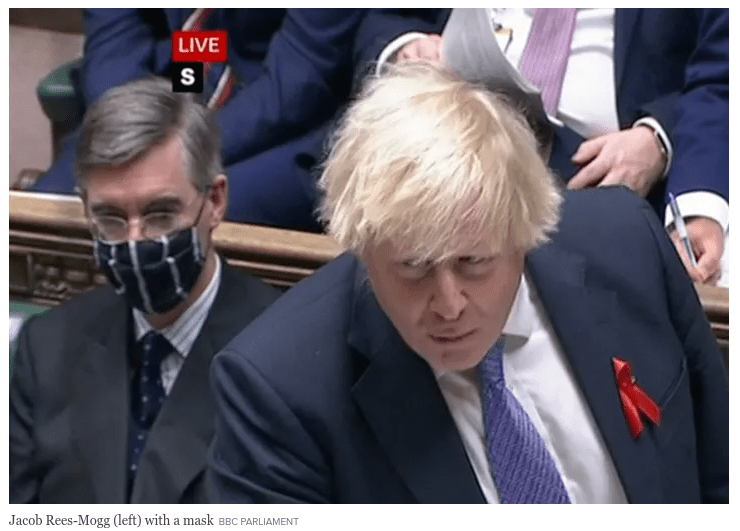
Jacob Rees-Mogg faces Commons inquiry over undeclared £6m loans

Do any rules apply to him? – Owl

Peter Walker www.theguardian.com 

The parliamentary commissioner for standards has begun a formal investigation into Jacob Rees-Mogg after a complaint from Labour that he failed to declare that he received £6m in cheap loans from one of his companies.

The website for the commissioner, Kathryn Stone, has been updated to show that Rees-Mogg, the leader of the Commons, is among MPs being investigated. It says the inquiry concerns the section on rules for MPs connected to the declaration of employment and earnings.

The website also shows Douglas Ross, the Moray MP and leader of the Scottish Tories, is being investigated. Ross apologised earlier this month and referred himself to the watchdog for failing to declare his pay as an MSP and as a part-time football referee.

Rees-Mogg did not report to the official register that he received director’s loans from Saliston between 2018 and 2020.

The North East Somerset MP owns Saliston, even though he gave up his directorship in 2019. It has a stake in Somerset Capital Management investment company.

Rees-Mogg says the loans were mainly used as “temporary cashflow measures” to pay for a property purchase and refurbishment, and did not need to be declared.

But Thangam Debbonaire, the shadow leader of the Commons, said it was right that the commissioner was investigating “what appears to be yet another egregious breach of the rules”.

She called for a parallel inquiry into whether Rees-Mogg had breached the ministerial code, which governs conduct for ministers.

“Over the last few weeks, we have seen that Conservative MPs repeatedly act as if they can put their own private business interests ahead of their constituents and the prime minister must put a stop to this,” Debbonaire said.

Accounts for Saliston show the £6m in loans – £2.94m in 2018, £2.3m the following year and £701,513 in 2019-2020 – attracted interest paid at the equivalent of about 0.8%, which is below market rates.

The accounts list the loans as attracting interest rates of 2.5% and 3.5% in individual years, raising the prospect that he could have borrowed the money and repaid it over short periods of time.

The MPs’ code of conduct does not specifically cover director’s loans but it states: “Members shall fulfil conscientiously the requirements of the house in respect of the registration of interests in the register of members’ financial interests. They shall always be open and frank in drawing attention to any relevant interest in any proceeding of the house or its committees, and in any communications with ministers, members, public officials or public office holders.”

The wider issue of MPs’ conduct and outside interests, and the way these are publicly declared, has been in the news since the furore over Owen Paterson’s punishment for breaching lobbying rules, which Downing Street initially sought to overturn.

Labour has proposed a new system that would ban almost all second jobs for MPs, while the Commons standards committee, which is separate to Stone’s role, has recommended changes, including greater clarity on MPs’ and ministers’ interests.

In a statement released when the Labour complaint was made, Rees-Mogg said: “Saliston is 100% owned by me and this is declared clearly in the Commons register and to the Cabinet Office. It has no activities that interact with government policy.

“The loans from 2018 were primarily taken out for the purchase and refurbishment of 7 Cowley Street as temporary cashflow measures. All loans have either been repaid with interest in accordance with HMRC rules or paid as dividends and taxed accordingly.

“The register asks for earnings, not loans, which is why I was declared an as a non-remunerated director until I resigned on entering government. Loans are not earnings and are not declarable in the register of interests.”

Go private for the treatment you need, NHS tells patients

Patients are being refused treatment, discharged too early and pushed towards private referrals, openDemocracy’s largest-ever reader survey has found

Caroline Molloy www.opendemocracy.net

One in five patients has been told by a doctor or another NHS professional that they would have to go private to get the treatment or test they need. That’s just one of the shocking results from a survey of nearly 7,000 openDemocracy readers – backed up by separate polling commissioned by openDemocracy.

NHS staff echoed the patients’ claims. Nine out of ten (87%) members of patient-facing staff said they had been simply unable to give a patient treatment or a procedure they would benefit from.

The survey, one of the largest of its kind of NHS patients and staff, provides a detailed – and worrying – breakdown of what happens to these patients.

The government has repeatedly reassured the public that the NHS will remain “free at the point of use”. But such language will bring little comfort to the many who told openDemocracy that the NHS had been scaling back what it offers even before the pandemic.

Both patients and NHS staff also reported an increasing reliance on the private sector to fill in the gaps – whether funded by the taxpayer or the patient themselves – despite successive prime ministerial promises that the NHS is “not for sale”.

Paying privately

Forty per cent of patients who replied to our survey were told that the NHS simply can’t offer them the treatment they need. Half of these patients – one in five of all patients – said an NHS worker then told them they would instead have to pay privately for the treatment they needed:

‘There’s an increasing sense that if you can’t pay for private healthcare you are treated worse than before.’

‘My GP was always pushing me for private care and never took steps to refer me to the specialist.’

NHS staff themselves told us a similar story.

One GP said: “I now routinely ask people if they have private insurance before referring them as I know the system is so overwhelmed.”

Suggesting patients pay “alleviates patient and carer/family anxiety regarding delays for diagnostic tests,” added a nurse.

Many respondents noticed NHS staff were “apologetic” and “saddened” when they had to suggest people went private. NHS staff “were always honest and showed they didn’t like the situation any more than I did”, said one patient. Their doctor’s “hands were tied and they would have helped if they could”, added another. Their GP told them it was “due to funding issues”, said yet another.

Another told us: “The doctor apologised for not being able to offer me the operation. My condition is not considered bad enough. I am prescribed Tramadol for pain. I have a poor quality of life, so am not sure how bad I would have to be before an operation was offered. I am a widow, which means my quality of life is even poorer, as I can go days without a visitor, and rely on the internet for shopping and have to pay a gardener and cleaner. My savings are rapidly disappearing.”

NHS guidelines have become increasingly restrictive in recent years, with a large range of procedures, from ear syringing to hip operations, either no longer paid for in some areas, or funded only in exceptional circumstances or conditions of extreme pain.

What else are patients told to do?

Other advice given to those who had been refused NHS treatment included recommendations of ‘self-care’ (one in five was given this advice), being directed to a cheaper option such as a voluntary service (one in ten), and being directed to an online service (one in 20). Some 84-90% of patients reported being dissatisfied with these options, with the highest dissatisfaction (90%) among those who were directed to an online service.

“I had to attend a pointless group education session on women’s urinary issues. I live in a small town, and it’s an embarrassing topic – I wondered if they did it to lower referrals due to embarrassment,” said one patient. “There was nothing in the education session that couldn’t have been provided in a leaflet.”

And there were real-world consequences, for many – 38% of those who’d been refused the ideal treatment or a test and been given this range of other options – said their health had worsened as a result, a similar number (38%) had suffered anxiety. Twelve per cent said a diagnosis had been missed.

Staff worries

Of the 500-odd NHS staff who responded to our survey, most (68%) said the problem had got worse in the past decade. Only 12% blamed the pandemic.

Nearly all frontline NHS staff – 98% – said they had felt worried that a patient’s health was going to deteriorate due to the length of time they would have to wait for an NHS treatment, with around three-quarters saying the wait times had got worse over the past ten years, and around a sixth (14%) saying it had got worse mostly since the pandemic.

Around 48% of current NHS staff were thinking about leaving the service, with only 37% saying they weren’t.

Public money, private sector

Nearly two in five patients (38%) said that an NHS worker had told them they’d get seen more quickly if they accepted an NHS referral to a private hospital or clinic. Staff confirmed this – nearly three in five frontline NHS workers told us they’d had to refer patients to an NHS-funded private provider. Of those who did so, the majority (70%) had misgivings about this approach, but many said they felt they had little choice.

‘Patient [was] seen faster. NHS clinic [had] very long wait so we were told to refer.’

‘In my field of ophthalmology (eye care) the only way to get the elderly population the treatment they need is to resort to NHS-funded private care. It’s still the thin end of the wedge!’

‘I felt torn as every use of private provider means decline of the NHS funds.’

‘Made me feel complicit in privatisation by stealth. By sending them patients I was driving their profit, eroding the platform I stand on.’

Around half of patients and nearly three-quarters (73%) of staff who’d experienced this issue said it had got worse over the past decade, with far smaller proportions saying it was mainly a COVID issue or had always been an issue. Not a single member of staff said it had got better over the past decade. Four in five (82%) of NHS staff said they’d seen evidence of privatisation.

And both patients and staff explained how the private firms doing NHS work wanted only the easy cases they could “cherry-pick” NHS cash for, and make a profit from – with one patient commenting their private referral was “usually a waste of time as I end up being referred back to the NHS”.

The government has recently set aside another £10bn for the private sector to deal with the backlog of cases that built up during COVID.

Getting in – and being pushed out

While most people were positive about the physical healthcare, if and when they actually received it, difficulties in even getting through the door were highlighted as a concern for many.

One patient told us that getting an appointment at his local GP was “harder than joining the Masons”.

Mental health services were highlighted as a particular concern, with another patient saying: “Local primary mental health triage sends you away with a list of phone numbers for other services. Took eight months, two attempts and six assessments just to see the doctor.”

Once through the door of NHS services, there’s also the problem of being allowed to stay there long enough. Two out of five (41%) patients said that they or someone they cared for had been discharged from hospital or another NHS service too early, though some were better able to navigate the system than others.

One told us: “Mother yo-yo’d in and out of hospital with broken leg and infections. Repeatedly released while still ill.”

Another said, “I was going to be discharged from hospital far too early. but my wife who was a senior social worker intervened, and I was kept for another seven days until care provision at home was organised.”

Again, NHS workers agreed. Fifty-six per cent of patient-facing staff told openDemocracy they’d had to discharge a patient too early.

Currently, hospitals and local authorities are required to assess a patient’s care needs before they are discharged from hospital – a requirement many cash-strapped organisations have struggled to do promptly. This requirement was suspended during COVID and the Health and Care Bill currently before Parliament scraps it altogether.

Not a pandemic problem

Most concerns were identified as long predating the pandemic. Over half (56%) of patients who were refused treatment on the NHS, and a similar proportion of those who’d been discharged to early (55%) said the problem had got worse over the past decade, compared with around a quarter who felt these issues had been caused mostly by COVID. Only 1% said things had got better over the past decade.

Perhaps unsurprisingly, the single most common problem reported was having to use a telephone or online service to access the NHS, which most patients affected identified as something that had happened primarily since the pandemic (86%). But of more concern is that 64% of all respondents said they’d had to use remote access to use the NHS when they didn’t feel it was suitable for their needs.

The government has recently responded to a backlash against online and telephone GP appointments by pledging support for more face-to-face appointments. But the move has left many doctors infuriated, coming as it does after years of the government heavily promoting online and remotely delivered health services in both primary and hospital care.

“My wife and I are over 80 and not comfortable with triage by unknown person over [the] phone, etc,” said one patient. “We’d like to see our GP to assess our health issues which, though minor, may worsen over time if not treated. Too often we rely on brief and inconclusive chats with pharmacist.”

Patient anger

However, respondents to the openDemocracy survey were deeply unhappy about the prospect of more private involvement in healthcare, with the most common responses being “angry”, “disgusted”, “worried”, horrified”, “appalled”, or “concerned”.

NHS word cloud reader survey

The 40 most common words used by openDemocracy readers to describe what is happening to the NHS. The more frequent a word’s use, the larger it appears | openDemocracy. All rights reserved

Many highlighted that they felt the attacks on the NHS were deliberate and political, and some pointed to funding issues:

“There is no discussion anymore. Was told [the NHS] won’t pay for lots of things any more. Because I can largely self-manage and have been successful, I am on the virtual ‘to be ignored list’, it seems.”

The NHS was hugely important to our readers – 95% gave the NHS five out of five for importance – the average score being 4.92 out of five.

But some expressed despair, saying they had “lost trust in the NHS” and felt “abandoned”.

“Since COVID, it no longer feels there is a health service for all,” said one.

“I feel there is no longer any adequate health care in this country. I must take care of myself,” added another.


Note: The figures in our survey refer primarily to the English NHS, but early indications suggest a significant difference in the experience of users in Scotland, Wales and Northern Ireland, which we will report on further.