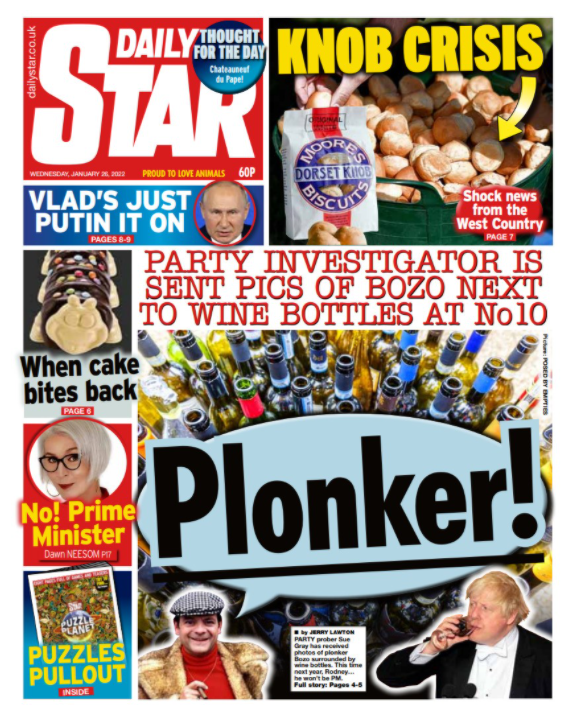
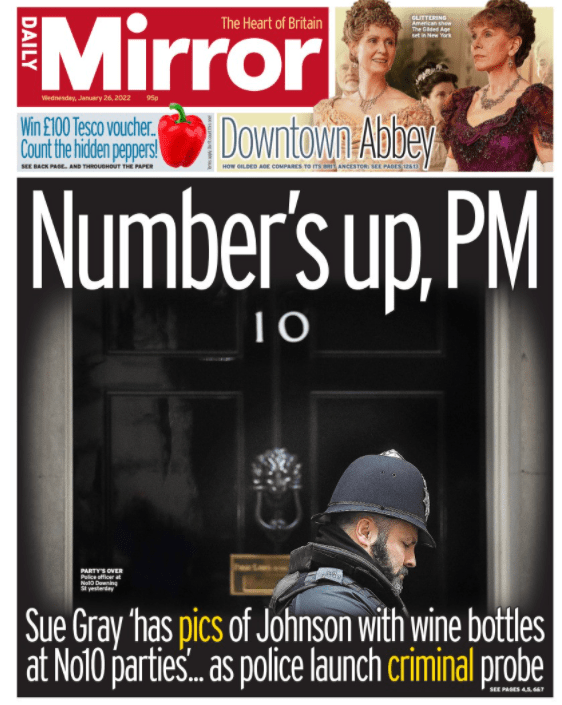
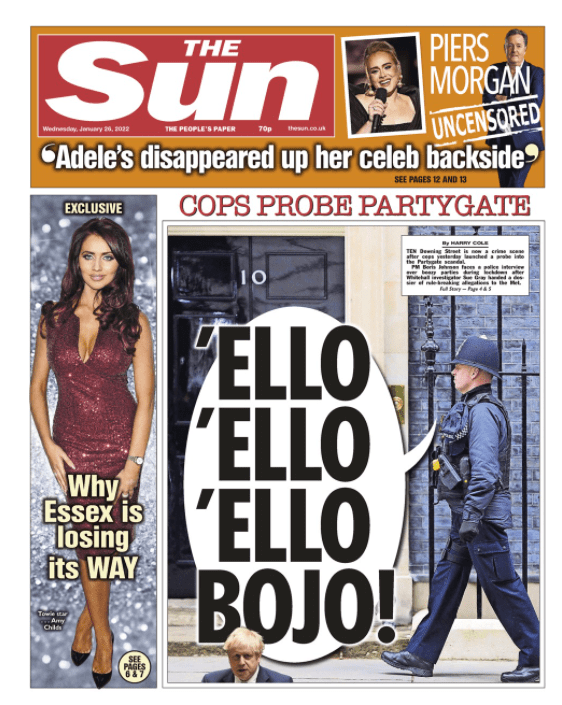
Sue Gray’s report: Who’s behind the partygate leaks – and why?

Marie Le Conte www.opendemocracy.net 

It seems fair to say that the Number 10 parties scandal has brought several issues into the spotlight. There is the harshness of the UK’s lockdown rules; the seemingly endless capacity for those in power to regard themselves as above the law; the inscrutable internal mechanics of the parliamentary Conservative Party and so on.

What do they all have in common? Well, none of them would be making headlines now – or getting investigated by Sue Gray – if it weren’t for leaks. After all, the boozy work events took place last year and the year before that; had insiders not decided to start spilling their secrets to journalists last month, we would collectively be none the wiser.

It isn’t possible to know who decided to tattle and why they decided to do so now, but it seems worth taking a broader look at the leaking culture in Westminster, how it works, and what it tells us about how our Britain is being run.

Jigsaw puzzle

“I see it as a jigsaw with some of the pieces missing,” says one senior political journalist. “If you’re lucky, you’ll get a big bit – something identifiable – and from that you can extrapolate and build outwards. But mostly what happens is you get the outside bits and have to build inwards.”

Far from brown envelopes and shady meetings where everything is revealed in one fell swoop, leaks to journalists usually start with a morsel, given purposely or by mistake, which sets reporters on a certain trail.

In over a decade in political journalism, “I’ve only ever been given one proper big leak, which ended up making a splash in the paper I worked for,” the journalist added, “and the person who gave it to me did it for money. That was unusual.”

It’s a rare occurrence because no one person will have access to every possible bit of information on one story; they can share only what they know then rely on the hack to reach out to people who can help build a fuller picture.

It is also usually the case that political insiders do not want to be wholly responsible for one seismic leak. There is safety in numbers, and being one of several blabbers will always be better than potentially being singled out as the one chatty rat.

A natural follow-up question should be: why do people even leak information when it could cost them their reputation, or even their job? Well, it depends.

As a former government special adviser explained, “there are several ways in which people leak. Sometimes it’s by accident, and they give up information that they don’t realise is important in the course of conversations.”

What is obvious to some will not be obvious to others; it can be hard to know what is an open secret, what is known by all, and what really should stay hidden.

“Sometimes it’s because Westminster is based on the currency of information,” they continued, “and people quite often want to pretend that they’re more important than they are – and their stock-in-trade is information.”

What you know can be just as important as what you do in British politics; marking yourself as someone who is in the thick of it can elevate you in the minds of your peers. Of course, it is a fine line; staffers can further their career by hinting to journalists that they are terribly well-informed, but too much gossipping will make them look needy and unreliable.

Being known as a sieve is not something you can usually come back from; the streets of SW1 are littered with the ghosts of advisers who realised this only once it was too late.

Still, it feels worth reiterating that most of what makes it to the papers does so purely because British politics is built on casual conversations. MPs and staffers talk to each other; those staffers talk to journalists, who talk to special advisers, who talk to ministers and to each other, ad nauseam.

Information is constantly floating around and, sometimes, some of it will happen to be in the public interest and make it into print. Once that starts happening, things can get sharper very quickly.

As ‘partygate’ has shown, tattling calls to tattling everywhere; few people want to throw the first stone but once it has happened, heads suddenly start appearing above the parapet.

Thanks to modern technology, it has also become easier than ever to leak information confidentially. When sources once had to meet journalists in person to hand in hastily photocopied documents, anything and everything can now be discreetly pictured and sent on WhatsApp.

This is one of the reasons why it feels like leaking is currently out of control; give people the means, and they will deliver the goods. That is, however, only one part of the equation. If people are happy and secure in their jobs, they are unlikely to try and drown their own government, even if doing so would require minimum effort.

That every day now feels like it comes with its own serving of dramatic leaks means that – at risk of stating the obvious – Number 10 isn’t currently a happy ship. There are few ways in which people can fight back in politics if they feel they have been treated wrongly; handing journalists helpful information is one of the only weapons at their disposal.

In short: if the hull keeps filling up with water, it is probably a sign that whoever is at the helm isn’t doing a very good job.

The Sue Gray report is not about the government – but Boris Johnson

In an attempt to belittle the Sue Gray report and the police investigation into breaches of lockdown laws in Downing Street, some of the more loyal Conservative MPs have joked that the whole scandal is about a birthday cake.

Editorial www.independent.co.uk

Not only is such banter in poor taste, it is actively damaging their prime minister’s slim chance of surviving the revelations in the report. It is not all about a birthday party cake, or wine or cheese platters for that matter. What Partygate was – and is – about is Boris Johnson and the political culture he inculcated; not least the sense of entitlement and “one rule for us few and another rule for the many outside”.

One misguided Tory MP even suggests that everyone in the country was breaking the rules. The great majority were not. The great majority, of all kinds of political persuasions and one, played by the rules, to protect themselves and others, and out of respect for the law.

They made sacrifices – unable to celebrate the birthdays of loved ones, even when it would turn out to be their last birthday. Unable to say goodbye to the terminally ill. Families effectively separated. Funerals without many mourners and without the salve of a drink after the service.

Socially distanced misery was endured by millions because they wanted to do the right thing. The Queen set a fine example, as did many others. In Downing Street, the culture – we now know – was rather different: contemptuous of others, and contemptible.

People care about these things, as well as caring about the cost-of-living crisis, the freedom of Ukraine, social care and much else. It is not a zero-sum game. The voters have a certain – usually low – expectation of how their politicians behave, but not to the extent that lying is the default reflex to every problem.

This is a further reason why the prime minister has become such a liability for his party, though some refuse to accept the reality. It would now appear that Mr Johnson was inaccurate and less than candid in the public statements he made about the evacuation of Pen Farthing and his menagerie from Kabul during the emergency evacuation last August.

It was a controversial matter at the time because the concern was that Afghans who had assisted the UK and US would be displaced in the airlift by cats and dogs. There were limited spaces on a limited number of flights.

It seems likely that the issue reached the prime minister’s desk. Some say his wife, Carrie, an animal welfare champion, had some influence in this matter. The prime minister at the time maintained that he had not approved any prioritisation of the animal airlift.

Now, leaked emails made available to MPs by a whistleblower suggest that Mr Johnson did indeed approve the operation and offer his support. There seems, not for the first time, to be some discrepancy between the public impression he gave at the time – “complete nonsense” – and what was really happening.

One leaked email states that the situation at the Nowzad animal charity set up by the former royal marine has “received a lot of publicity and the PM has just authorised their staff and animals to be evacuated”.

The lesson from this latest story is that the government – and the Conservative Party, and the country – is never more than a day or two away from some fresh scandal; usually with its origins in the prime minister’s uneasy relationship with the truth, and with the demands of his office.

It has been a way of life for him, according to even the most sympathetic biographers, that he has a habit of pushing his luck and being economical with the truth if he gets found out.

Indeed, many would say the 2016 Brexit Leave campaign and the Conservative victory in the 2019 general election were built on such mendacious foundations. He has always had a habit of bouncing back from his misfortunes, but the point is that in order to recover he first had to be fired from various jobs, or leave them voluntarily before the truth caught up with him – as with the London mayoralty and his personal IT consultant, Jennifer Arcuri.

Under the most intense of scrutiny, it looks increasingly as though he won’t get away with his old tricks again. Even if he does, he will be a permanent source of embarrassment to his party and the nation. He might not mind – but do his MPs?

Lawyers challenge water firm’s immunity over sewage discharge

Environmental campaigners are fighting to stop a water company being given almost total immunity from any private legal action for discharging untreated sewage into waterways.

Sandra Laville www.theguardian.com 

The Good Law Project (GLP) and the Environmental Law Foundation (ELF) are challenging a decision by the high court that the water company United Utilities cannot be subject to any private legal action for its discharges of raw sewage from storm outfalls into the Manchester ship canal.

The decision made last April is being reviewed by the court of appeal, which this week granted permission for the legal groups to submit evidence as part of the case.

Jo Maugham, the director of the GLP, said if United Utilities was to win the case it could end a vital legal option to hold water companies to account for sewage dumping. Lawyers for the GLP say the decision would effectively act as a precedent which all water companies would seek to rely on.

The environmental groups will tell the court of appeal it has now become clear that sewage dumping from storm overflows has been occurring with alarming regularity and does not just take place in exceptional circumstances, for instance after very heavy rainfall.

Emma Montlake, the joint executive director of the ELF, said: “ELF works with and assists communities across the country plagued by the environmental and health consequences associated with sewage pollution into British water systems.

“We are delighted that the court [of appeal] has agreed that the ELF’s evidence and that of others in the consortium will be able to assist the court of appeal to understand the context and wider ramifications of unchecked sewage pollution.”

The fight over the rights to sue a water company over discharges from outflows of raw sewage began in 2010 when the owners of the Manchester ship canal sought damages against United Utilities for discharges of sewage into the waterway. MSC argued that water companies did not have a legal right to pollute waterways with raw sewage. They argued that untreated, or inadequately treated, discharge that was unauthorised would be unlawful and therefore could be challenged by legal action.

In response United Utilities sought a declaration in court that as a water company it could not be subject to private legal action because it was a matter for the regulator.

The high court agreed with the water company and granted the declaration it sought, that there was no case in law against United Utilities in respect of discharges from the company’s outfalls. The judge – in supporting his decision – said discharges were “the effect of sudden heavy rainfall, which causes flooding and results in the capacity of the existing system being exceeded” and had “occurred without United Utilities doing anything to cause it or being able to do anything lawfully to stop it, except by spending money on large-scale capital improvements”.

In 2020 water companies discharged raw sewage into rivers and waterways more than 400,000 times over 3.1m hours.

A United Utilities spokesperson said: “The legal case you have referenced is not about avoiding accountability, the aim is to clarify the regulatory position regarding wastewater outfalls. This is the latest in a long series of cases brought against United Utilities by the owners of the Manchester ship canal. We cannot comment any further on this as the legal proceedings are ongoing.”

Cost-of-living crisis: Jack Monroe hails ONS revision of inflation calculations

Concern that rising inflation is having a disproportionate impact on people in poorer households in the UK has prompted government number-crunchers to provide a more detailed breakdown of the cost of living.

Larry Elliott www.theguardian.com 

The Office for National Statistics said it accepted that every person had their own inflation rate and it would do more to capture the impact of price increases on different income groups.

Mike Hardie, the head of inflation statistics at the ONS, said in a blog the published annual inflation rate – currently 5.4% – was an average for all households. “But everyone has their own personal inflation rate. Some people may spend a larger proportion of their income on gas and electricity, or petrol if you commute via car daily.”

The move was welcomed by the food writer and activist Jack Monroe, who has exposed how prices for cheaper food products have soared as availability fell, contributing to rising hunger and poverty.

Monroe, who is drawing up an inflation index to track basic food prices, tweeted: “Delighted to be able to tell you that the @ONS have just announced that they are going to be changing the way they collect and report on the cost of food prices and inflation to take into consideration a wider range of income levels and household circumstances.”

Writing in last week’s Observer, Monroe said: “In 2012, 10 stock cubes from Sainsbury’s Basics range were 10p. In 2022, those same stock cubes are 39p, but only available in chicken or beef. The cheapest vegetable stock cubes are, inexplicably, £1 for 10.

“Last year the Smart Price pasta in my local Asda was 29p for 500g. Today it is unavailable, so the cheapest bag is 70p; a 141% price rise for the same product in more colourful packaging.”

Terry Pratchett’s estate has authorised Monroe to use the Vimes Boots index as the name of the new price index, which is intended to document the “insidiously creeping prices” of basic food products.

The index, Monroe said, would be called the Vimes Boots index in honour of Pratchett’s creation Sam Vimes, who in the Discworld novel Men at Arms lays out the “Sam Vimes ‘Boots’ theory of socioeconomic unfairness”.

The author’s daughter, the writer Rhianna Pratchett, said her father would have been proud to see his work used in this way by the anti-poverty campaigner.

The ONS previously published a more detailed breakdown of inflation but it was suspended during the Covid pandemic because so many items were unavailable. During the previous economic downturn, the financial crisis of 2008-09, when inflation also surged, the ONS said poorer households were more severely affected.

Sign up to the daily Business Today email or follow Guardian Business on Twitter at @BusinessDesk

“Given the level of interest in the cost of living and inflation we are planning to restart this series,” Hardie said.

Over the longer term, he added, the ONS was “transforming” the way it measured prices in order to understand people’s spending patterns in a more detailed and timely way. The ONS measures inflation by looking at the cost of 700 items from a number of price points.

“We are currently developing radical new plans to increase the number of price points dramatically each month from 180,000 to hundreds of millions, using prices sent to us directly from supermarket checkouts,” Hardie said.

“This will mean we won’t just include one apple in a shop … but how much every apple costs, and how many of each type were purchased, in many more shops in every area of the country.”

Ian Hislop Tears Into MPs Over Sleaze, Second Jobs And Lobbying

Worth spending 24 minutes watching the video (best bits from an hour long session). Alternatively read the report in the Huffington Post below.

Owl can think of a number of EDDC Tory councillors who might benefit from watching the video as well!

Graeme Demianyk www.huffingtonpost.co.uk 

Ian Hislop has evoked the public’s anger over the series of sleaze allegations engulfing British politics, telling MPs in parliament they are “very sick of being taken for fools”.

The editor of Private Eye magazine was appearing before the standards watchdog on Tuesday when he clashed with politicians over the recent lobbying scandal.

Speaking about some MPs’ second jobs, Hislop told the Commons committee on standards: “What do you think these companies are paying the money for? Do you think they are chucking it away?

“When politicians declare their interests, why do they think businesses are paying them this money?

“I think the public is very sick of being taken for fools at the moment on all sorts of levels, and it is very sick of being taken for fools on this level.”

His comments came as MPs have been embroiled in sleaze allegations over money earned outside parliament.

The scandal erupted after Tory MP Owen Paterson resigned over findings that he lobbied on behalf of two companies paying him more than £100,000 per year.

Hislop told the committee: “I think we have to admit that the system failed in that Owen Paterson had obviously no idea he was breaking the code, and a large number of his fellow MPs decided that they had no idea either, and that the whole system wasn’t working.

“We have to redefine the term lobbying, and we have to incorporate some of the proposals you have made, and instead make them harder.”

During the hearing Hislop clashed with Tory MP Bernard Jenkin, who suggested more rules are not enough to change MPs’ attitudes towards breaking them.

Jenkin said: “You can police rules and have tougher rules but lots of people will carry on gaming rules.

“If they think rules are the only issue and they don’t understand why the rules exist – what the principles are behind the rules – you aren’t going to change people’s attitudes.”

But Hislop said: “That’s just depressing – the idea that politicians are just so innately corrupt that they won’t understand public anger at what they are doing and none of them will obey the rules.”

He later added: “You want a moral shift in the type of people who become MPs, I can’t do anything about that.”

Jenkin responded by suggesting that conversations may help to foster better attitudes.

Hislop said: “Why do you have to explain to a new MP why he shouldn’t lobby for a company taking government contracts? Why isn’t that blatantly obvious?”

Journalists also spoke to the committee about the lack of transparency in the way MPs declare their interests, including second jobs and what constitutes lobbying.

Hislop said that contracts for second jobs outside parliamentary duties should be published.

He said: “If you’re taking money from a company, what are they getting out of it?

“At least print the contract, tell us what you’re being employed for and let’s have a look at the minutes of the board meeting.”

Richard Brooks, another journalist at Private Eye, told the committee that current definitions of lobbying are not wide enough.

“By restricting what you band to lobbying, you narrow it down too much because lobbying is open to a very legalistic technocratic interpretation that doesn’t include all kinds of behaviour – a quiet word in the ear, expressions of opinion without formally lobbying – all those sorts of things that are just as important,” he said.

“The problem is that a lot of what goes on that distorts public decision-making doesn’t qualify as lobbying and I think you perhaps need to look a little bit further and say ‘OK, what sort of jobs do we need to ban’.”

When asked specifically which second jobs should be banned, he said: “Any job that is given to a member of parliament because they are a member of parliament, rather than because they have some other qualification for it.

“For example, if they’re a doctor, teacher, lawyer, nurse, that sort of thing.”

‘Levels of Scrutiny and Accountability of those employed and Represented to Stand Up for Sidmouth’.

(Letter from last week’s Sidmouth Herald)

The Sidmouth Jazz and Blues Festival planned for 2022: 

I read with interest in last week’s Sidmouth Herald that the proposed Sidmouth Jazz and Blues Festival for 2022 will not take place on The Ham, or in Connaught Gardens, and will only take place in Blackmore Gardens if monies can be raised to fund it. The Parish Church is hosting events. 

The Festival was ill-conceived and ill-thought through. It was attempted to be pushed through by Sidmouth Town Council. 

Much upset and dismay was caused by Sidmouth Town Council in relation to the Event taking place on The Ham. This was compounded by the actions of the EDDC Planning Department and EDDC Planning Committee Councillors. 

The Sidmouth Town Clerk and Leader of Sidmouth Town Council told the Festival Organiser that Plans for the use of The Ham and the Festival were ‘agreed, done and dusted’, before they were. 

Local residents were told that the Festival was agreed, before it was, and that there was therefore no point in objecting to it taking place. 

There was also the expectation that a late-night lounge Music and drinking Event would take place on The Ham, until 2.30am, each night, during the proposed Festival, in a residential area. 

A full meeting of Sidmouth Town Councillors giving them the opportunity to consult, consider, understand, debate or decide upon any proposals, at this point, had not taken place. 

Local residents highlighted serious concerns raised by the Festival Plans: the arrangements made, the numbers involved, safety and accessibility for Sidmouth residents and proposed attendees. 

These included 2,250 people attending the afternoon or evening Events and the impact on The Ham area. That Sidmouth residents and visitors would be denied access for 14 days to The Ham pathway and cycleway whilst the Festival was set up and taken down on The Ham, funnelled onto a small unsafe pathway and narrow road to access the Town and Esplanade, with these concerns intensified with the increased Festival attendees and traffic. 

The Festival Organiser with the support of Sidmouth Town Council presented their Application to the EDDC Planning Committee, as part of the formal process for the Festival taking place. 

Arrangements for making a Formal Objection were not straightforward with the EDDC Planning Department. 

This was another opportunity for the EDDC Planning Committee to externally scrutinise the concerns raised, and for the Plans to be fully reappraised by the Festival Organiser and Sidmouth Town Council. 

The EDDC Planning Committee Councillors, at the Objections Committee Hearing, gave full approval to the Festival Plans supported by Sidmouth Town Council. 

This was on the basis of the provision of ‘no information, no Consultation, no Consultation of Statutory Bodies, no risk and safety assessment’ and on ‘promises’ made by the Festivals representative, and the assurance that they would act in the best interests of Sidmouth. 

Sidmouth Town Councillors and Sidmouth EDDC Councillors (except one) provided no support and made no intervention on behalf of the ill-conceived and ill-thought through proposal, causing great upset and dismay. 

There had been no consultation, involvement or consideration of local residents, or Sidmouth townsfolk by Sidmouth Town Council, EDDC or their Councillors. Concerns exist about the role of scrutiny and accountability exercised by Councillors. 

For many, the case is strengthened for major events to take place out of Town. 

It heightens longstanding and ongoing concerns about the lack of consultation with, and consideration of local residents by Sidmouth Town Council, (except one) Sidmouth Town Councillors, and Sidmouth EDDC Councillors. 

Sidmouth Town Councillors and EDDC Councillors for Sidmouth need to actively stand up for Sidmouth, and its residents, and be seen to do so. 

Stephen Pemberton, 

SIDMOUTH, 

Some Tories have perfected the art of defending the indefensible 

Given the sheer volume of scandals emanating from Downing Street – Partygate being only the latest – the prime minister is fortunate in having someone ready to rush to a keyboard or broadcast studio to deploy immediate assistance to their stricken chief.

Sean O’Grady www.independent.co.uk 

The prime minister is a little less fortunate in that the first figure on the scene is usually the elaborately syruped figure of Michael Fabricant MP.

Fabricant has been around Westminster for some many years. He was first elected in 1992 to represent Mid-Staffordshire and later the city of Lichfield, his luxuriant hairstyle often echoing the magnificent unchanging frontage of the medieval cathedral.

This does not detract from the substance of his words – which are not always helpful to Boris Johnson. In the recent row about Nusrat Ghani’s sacking and Islamophobia in the Conservative Party, for example, he declared to LBC: “She’s hardly someone who’s obviously a Muslim.” He argued that Ghani’s accusation of Islamophobia is a “lame excuse” for her sacking as it’s “not apparent” she is Muslim. Cue a warranted backlash. He tries to be helpful, with mixed results.

In the case of “Birthday Partygate”, Fabricant was slower to get to Twitter than usual, but with a novel, albeit riskier, take: “I am pleased that @metpoliceuk are now involved along with Sue Gray of the Cabinet Office investigating so-called ‘Party-Gate’. Rather better to have a professional investigation than trial by social and mainstream media!”

Only a little behind Fabricant in the rush to a microphone when the chocolate birthday cake hits the mainstream media fan is Peter Bone, now a BBC Newsnight favourite (even though he wants to defund the BBC). When all other lines of defence collapse in his dogged trench warfare campaign, he retreats to the unchallengeable salient of his own seat. He declares that allegations of law-breaking in Downing Street (or whatever) are of little interest to his Wellingborough constituents, who prefer to kick off about Ukraine when they see him on their doorstep. Maybe Abkhazia will be the next big talking point across the East Midlands.

Quick as Fabricant and Bone are, though, the most loyal of the loyal in Johnson’s Praetorian Guard is Nadine Dorries. It was she who sacrificed what remained of her reputation by appearing in the Commons to de-announce the abolition of the BBC licence fee and admit that the government hasn’t in any case got any idea of what to replace it with. Birthday Partygate brought a typically robust response, and one that displayed a commendable disregard for public sensitivities about bereavements and the like during lockdown. As usual, Twitter was the channel of choice: “So, when people in an office buy a cake in the middle of the afternoon for someone else they are working in the office with and stop for ten minutes to sing happy birthday and then go back to their desks, this is now called a party?”

This drew some harsh responses, including from the fine satirist Rosie Holt: “So, when 12 people vote in the middle of the jungle for someone else they are living in the jungle with to eat an ostrich’s anus and stop representing their citizens for three weeks and then go back to their constituency, this is now called the culture secretary?”

Other members of the guard also overstate their case to comical effect, such as Jacob Rees-Mogg emerging from the last cabinet meeting (when the Metropolitan Police investigation wasn’t mentioned, let alone discussed), and telling reporters that the government is going “from strength to strength”. I could detect just a hint of desperation through the Etonian drawl.

Other cabinet colleagues – Michael Gove, Rishi Sunak, Liz Truss – have tended to keep a lower profile, probably having better career prospects than Rees-Mogg, Dorries and indeed Priti Patel in the event of regime change.

The Academy Award for improvised but effective defence of the indefensible must go to Gavin Shapps. He prefers guerrilla warfare through the rubble of the prime minister’s standing in the polls to the formalities of logical debate. Though no stranger to gaffes himself, Shapps possesses a preternatural ability to fumble and scrabble his way through even the most pressing of forensic examinations, darting between irrelevant observations and twisted facts to dodge the bullets.

It is always a simple matter of surviving the next quarter of an hour in a studio, and Shapps knows it. Up against sharply focused questioning by Justin Webb on the BBC Radio 4’s Today programme and on all the morning broadcast round, somehow Shapps made it through the ordeal without ever referring to the truth.

It was strongly reminiscent of his slaloming defences of Dominic Cummings during the height of the Barnard Castle affair in 2020 (plenty of irony there). None of these encounters do anything for Shapps’ personal reputation but goodness, what staying power! Like Dorries or Rees-Mogg, he sounds absurd, but manages not to combine it with being offensive or sounding arrogant – a rare skill. A man with such vast reserves of stamina used to such futile purpose must surely be an asset to any prime minister. Regime change holds no terror for him.

Keep wearing masks plea in Devon

Devon’s public health director is advising people to carry on wearing masks after the lifting of Covid restrictions as “we are not yet out of the woods”.

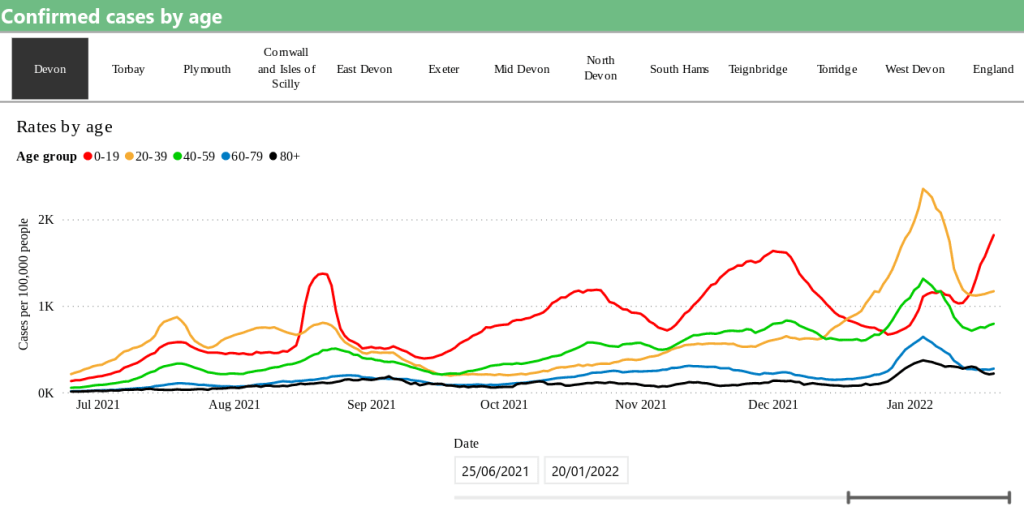
From the Devon Covid dashboard, which contains cases up to 20 January, case rates appear to be rising in all age groups below 60 years. See below – Owl

Edward Oldfield www.devonlive.com 

Steve Brown said it was a “sensible precaution” in crowded and indoor spaces.

He was responding to the Government announcement of the end of Plan B Covid measures.

Working from home guidance has been lifted, and from Thursday, masks were no longer required in classrooms.

From Thursday, January 27, Covid passes will no longer be needed for entry to some venues, and the requirement for masks on public transport and in shops will end. The rules on self-isolation are expected to finish on March 24.

The Prime Minister said the change was possible as the Omicron wave had passed its peak and vaccinations had kept people out of hospital.

Mr Brown’s comments came as some Devon schools decided to keep mask-wearing in place due to the number of cases among pupils.

Mr Brown said that the number of positive tests was down, but case rates were still high and had risen in younger children.

He urged caution and said that the change was to revert back to Plan A measures, warning that people should stay alert to the risks.

According to the latest seven-day figures for Devon as a whole, Covid cases rates were highest in Torbay, with 1,101 per 100,000 population.

Plymouth was on 939, and the Devon County Council area saw an overall rate of 742 cases per 100,000 people, compared to the rate for England as a whole at 967.

Mr Brown, director of public health for Devon County Council, said: “Omicron is by no means a mild virus, and the symptoms to those who are unvaccinated or who have underlying health concerns can be extremely serious if not life threatening.

“So while the Prime Minister is indicating light towards the end of the tunnel, my advice is that we are not yet out of the woods.

“We must stay vigilant and alert to risk that is still around us.

“Being fully vaccinated, and boosted, gives us best protection from this virus. It’s not too late to start vaccinations, and there are now plenty of opportunities in Devon to get your booster jabs at walk-in and vaccination centres.

“Wearing face coverings is still an effective and sensible precaution to continue in indoor and crowded spaces, especially with people you don’t know.

“Regular lateral flow device testing for people with no symptoms is still the best way to identify those carrying the virus. As is taking a PCR test by people showing symptoms.

“Keeping indoor spaces ventilated is a sensible precaution to reduce risk.

“And staying at home and avoiding others if you have symptoms of the virus or test positive for it, is still the most responsible way to avoid spreading it to others.

“Please be cautious, let’s use our common sense, and continue to follow good basic public health advice.”

Mr Brown said more than 85 per cent of eligible people in Devon had received a booster jab.

But he said that take-up was lower in some younger groups and it was “imperative” they and everyone eligible came forward “as soon as they can”.

Confirmed case by age up to 20 January from the Covid dashboard:

The verdict is in: George Osborne’s help-to-buy scheme has been an utter disaster 

The Lords-built environment committee has revealed that all of the £29bn spent on the help-to-buy scheme has been wasted. The scheme gives subsidies for homeownership, but all they do is “inflate prices by more than their subsidy value”.

Polly Toynbee www.theguardian.com 

A rogue prime minister on the verge of defenestration drives out news of almost anything else. But housing usually languishes in the forgotten in-tray anyway. It sits low in voters’ and government concerns: the last 17 housing ministers remained in post, on average, for barely more than a year. Housing stories fill news pages, but only if they provide an opportunity to gloat over escalating property prices.

So it shouldn’t be a surprise that a shocking report on a Conservative flagship housing policy fell below the news radar. The Lords-built environment committee has revealed that all of the £29bn spent on the help-to-buy scheme has been wasted. The scheme gives subsidies for homeownership, but all they do is “inflate prices by more than their subsidy value”. They “do not provide good value for money”, which would be “better spent on increasing housing supply.”

The report, chaired by the Tory ex-minister and businesswoman Lucy Neville-Rolfe, shows that Margaret Thatcher’s signature right-to-buy policy lies at the heart of the ballooning housing crisis. The council house sales under this policy symbolised a rolling back of the state to create a property-owning, share-holding, Tory-voting electorate. (Pollsters use homeownership as a strong indicator for voting Conservative.) Councils that were forced to sell at knockdown prices were also barred from using the receipts to replenish the council housing stock. This meant a bargain for the 2 million tenants who bought council homes, but a disaster for the low-earners who came after.

In 1980, a third of people lived in socially rented homes, at genuinely affordable below-market rents. That’s now fallen to 17%. Over the past 30 years, England has seen a net loss of 24,000 social homes every year on average. Another 29,000 social homes vanished alone through sales and demolitions.

Those disappeared tenants end up in the expanding private-rented sector. Instead of paying for lasting brick-and-mortar council homes, the taxpayer subsidises private landlords through housing benefit, costing £22bn a year. The Lords report quotes the housing analyst Toby Lloyd: “The private rented sector is by far the most expensive, by far the lowest quality and by far the least popular. It is absolutely the worst possible tenure for almost everybody in it.”

Of the many destructive Tory social policies, help to buy, announced in 2013, was always an especially egregious example of naked vote-getting. Its creator, George Osborne, knew a subsidy to buy homes worth as much as £600,000 would just inflate prices – and it did. It slightly speeded up the purchase date for those who were already likely to buy, often via family help. More people on high incomes – over £80,000 – use the scheme than low earners. Yet ownership is still falling and the age of first-time buyers keeps rising.

Bringing up a family in a private-rented home means living under the shadow of eviction, with private landlords using section 21 orders to evict tenants for no reason. I once followed the misfortunes of one family that was forced to move, time and again, sometimes having to move their children’s schools too, often living in squalor, once through a long winter with a broken boiler. They weren’t destitute, both parents were in work, but their children were deprived of a permanent home in their early years. Last month’s excoriating report by the National Audit Office (NAO) on private renting found that in 29,000 instances in one year, “households were, or were at risk of being made homeless following an eviction that was not their fault”.

I heard a few of those voices of distress last week when I listened in to the helpline at the housing charity Shelter, hearing the struggles of those who should be in social housing. Among the many homeless, Jay (not her real name) was typical of those NAO findings. Frail and on personal independence payment, she was suddenly facing eviction. Why? She complained to her landlord about frequent sewage flooding; getting no response she called environmental health. Her landlord, taking revenge, is evicting her, needing no reason. The NAO says a quarter of private rentals are of “non-decent” standard, and 13% have at least one serious hazard. The government long ago promised a bill to protect tenants, abolishing section 21 evictions, but there’s no sign of it.

What hope is there of “levelling up”? Access to quality, affordable housing is going into reverse, according to a report from Legal & General this week. Property is where the nation’s wealth is stored, and there it stays – useless and unproductive. Who dares break the taboo on the sacred right of homeowners not to be taxed on their ballooning unearned property wealth? A hypothecated tax spent directly on council housing would link the winners to the growing numbers of those who lose out in Britain’s grossly dysfunctional housing market.

More on: South Somerset secrets exposed

The editor of “The Leveller” has contacted Owl to point out that the story posted on EDW about Clare Pestell being dismissed from South Somerset District Council had been reported in the print edition of The Leveller on 15 January, much earlier than the sources Owl quoted.

The editor also helpfully pointed out that the best bits of the story weren’t covered but could be found on an online post of 13 December – see below the screen grab of the Leveller 15 January scoop.

South Somerset secrets exposed

Readers will recall that for a while EDDC “shared” Mark Williams as CEO with SSDC until they suddenly terminated the arrangement in July 2015. This severance cost SSDC upwards of £100,000. No reason was given at the time but SSDC decided temporarily to have a management team without an overall CEO. (We seemed to manage quite well with only Mark Williams on half time at the time) – Owl

by Andrew Lee leveller.live

This Thursday,16 December, all members of South Somerset District Council (SSDC) will meet. An item of huge public importance has been scheduled but the press and public are due to be excluded. So that members of the public and rank-and-file councillors fully understand what is going on, we are publishing a special online report. There will be a much fuller story, going into much more of the hidden detail, in the 15 January Leveller®.

We understand that the confidential agenda item (22. Confidential Staffing Matter – verbal report from the Chief Executive) is about Clare Pestell, the council’s former Director, Commercial & Income Generation. She was appointed SSDC’s new interim chief executive (CEO) back in the summer, only to resign before taking up office for reasons which have never been publicly stated. SSDC has undertaken a massive cover-up to prevent the facts from getting into the public domain – until now.

The Chief Executive Who Never Was.

Ms Pestell is no longer employed by the council. However, if things had turned out differently, she would now be its interim Chief Executive, drawing a salary of £118,767.

On 5 May this year the Full Council met. On the agenda (item 10, seeing as you ask) was the appointment of an Interim Chief Executive-designate (CEO). There was only one candidate, Clare Pestell. Councillors, given no reason not to appoint her, duly ratified her appointment.

Yet, less than a month later, on 4 June, outgoing CEO Alex Parmley announced Ms Pestell would not be taking up her appointment after all. Council staff were told this was for “personal reasons.”

Cover up

The real reasons for the decision were covered up. The press and public will be excluded from any discussion about Ms Pestell on Thursday and how she nearly came to be appointed interim CEO.

We have decided to publish now because each time we have asked SSDC straight questions, it has responded with answers that we consider to be somewhere between evasive and disingenuous.

If SSDC wishes to comment on this article it is, of course, welcome to do so. We will publish any response.

What went wrong?

The timeline that led to Ms Pestell’s appointment on 5 May is crucial to the story. Please bear with us, as there will be many dates!

On 19 April, Mr Parmley announced his resignation from SSDC. He would be leaving later in the summer for a new life in New Zealand. Given the future of the council was in doubt because of the unitary debate, SSDC decided, quite reasonably, to appoint an interim CEO.

That process started, according to the minutes of the 5 May Council meeting, on 20 April.

On 22 April, Council leader Val Keitch and Mr Parmley received a letter from a whistleblower. The letter made a number of serious accusations against Ms Pestell, concerning the alleged abuse of council property and the alleged unauthorised use of council employees at her own business, a vineyard in north Dorset.

We should state clearly that Ms Pestell did refute and continues to refute all the allegations against her.

However, and quite properly, the leader and chief executive commissioned a fact-finding report by local government auditors SWAP.

The date that happened is not clear but, whether it was commissioned before or after 5 May, Ms Keitch and Mr Parmley clearly took the allegations against Pestell very seriously.

What happened next…

From 28 April to 4 May a recruitment process was undertaken in which there was only one candidate. That candidate was Ms Pestell.

She was then recommended for appointment at the full Council meeting on 5 May. Despite the fact both the leader and then-chief executive between them knew the following:

  • Serious accusations had been made against Ms Pestell. Even though a fact-finding exercise was to be commissioned, neither the leader nor the CEO seems to have decided it was necessary to wait for its results. These, bear in mind, would either confirm serious accusations against Ms Pestell or put her in the clear, allowing her appointment to be ratified.
  • Equally importantly, Mr Parmley had stated that, in his view, Ms Pestell was already struggling to balance her existing senior job at the Council with running her personal business, Melbury Vale Vineyard in Dorset. In August 2019, Mr Parmley had specifically authorised her to work four days a week for the Council, so she could balance working for the council with working on the winery and vineyard. In October 2019 he noted that, even the four-day arrangement did not seem to be working out. Yet, in May 2021 he was proposing she should lead the entire Council…..

Deceived?

Councillors were asked to ratify the appointment of Clare Pestell even though Mr Parmley and Ms Keitch had deliberately kept from them significant information – information which would have a direct bearing on the new chief executive’s suitability for the position.

With only one candidate and the most significant information withheld, it was hardly surprising that Councillors ratified her appointment.

Mr Parmley and Ms Keitch could – and, arguably, should – have waited. Once the fact-finding report was in their hands, they would have been in a position to make an informed decision. Mr Parmley did not leave the council until July. The report was presented on 24 June and, after reading it, the leader and CEO appointed an Investigator to further investigate Ms Pestell.

We now know that on 4 June Ms Pestell stood down from the top job without even starting it. And in November she left the council.

So, why the rush to get her appointed on 5 May?

How could the leader and CEO put a proposition to the full Council while deliberately withholding relevant – and serious – information?

Did other members of the Cabinet also know? Surely they must now account for what they did and what they knew about the matter before it went to the full Council.

They might like to reflect, as they meet on Thursday, whether this is an issue which requires resignations.

More breaking news: Sue Gray report delayed while police investigate Downing Street parties

www.bbc.co.uk

BreakingSue Gray report to be delayed
The Cabinet Office will not publish Sue Gray’s report while the Met Police are investigating events at Downing Street and Whitehall during lockdown, the BBC has been told.
It is not clear how long this investigation will take.
The Cabinet Office put out a statement earlier to say the investigation by Gray, a senior civil servant, would be continuing while maintaining “ongoing contact” with the police.
The terms of reference of the Gray investigation say: “As with all internal investigations, if during the course of the work any evidence emerges of behaviour that is potentially a criminal offence, the matter will be referred to the police and the Cabinet Office’s work may be paused.”


Breaking news: Met Police now investigating Downing Street parties

Scotland Yard is now investigating “a number of events” in Downing Street and Whitehall in relation to potential coronavirus regulation breaches, Metropolitan Police Commissioner Dame Cressida Dick said.

Neil Shaw www.devonlive.com

Metropolitan Police chief Dame Cressida Dick confirmed the force was investigating allegations of coronavirus rule breaches in Downing Street and Whitehall.

She told the London Assembly’s Police and Crime Committee: “We have a long-established and effective working relationship with the Cabinet Office, who have an investigative capability.

“As you well know they have been carrying out an investigation over the last few weeks.

“What I can tell you this morning is that as a result of the information provided by the Cabinet Office inquiry team and, secondly, my officers’ own assessment, I can confirm that the Met is now investigating a number of events that took place at Downing Street and Whitehall in the last two years in relation to potential breaches of Covid-19 regulations.”

Sue Gray’s investigation into gatherings held at No 10 and across Whitehall will continue after the Metropolitan Police said it will probe “a number of events”.

A Cabinet Office spokesman said: “The investigation being carried out by Sue Gray is continuing.

“There is ongoing contact with the Metropolitan Police Service.”

It is not clear whether the publication of the senior official’s report will be delayed by the opening of the police investigation.

In the latest party revelation, No 10 has conceded staff “gathered briefly” in the Cabinet Room on the afternoon of June 19 2020 following a meeting after it was alleged 30 people attended, shared cake, and sang “happy birthday” to the PM, despite social mixing indoors being banned.

Grant Shapps said it was disputed how many people attended, and that the surprise gathering had not been organised by the Prime Minister’s wife Carrie Johnson as reported.

But he said “it clearly shouldn’t happen” and that people should have stuck by the rules.

ITV News reported the get together featured a rendition of “happy birthday” and was attended by staff, Mrs Johnson, and interior designer Lulu Lytle.

Ms Lytle, who was doing up the PM’s flat, admitted attending but insisted she was only present “briefly” while waiting to talk to Mr Johnson about the lavish refurbishments.

A Downing Street spokeswoman said: “A group of staff working in No 10 that day gathered briefly in the Cabinet Room after a meeting to wish the Prime Minister a happy birthday.

“He was there for less than 10 minutes.”

Mr Shapps said staff would have “thought they were being kind” by marking the PM’s birthday but he said it was “almost certainly very unwise”.

The Transport Secretary was asked on BBC Radio 4’s Today programme about a letter sent to Mr Johnson by then seven-year-old Josephine Booth in March 2020 who told the Prime Minister she had cancelled her own party due to coronavirus.

Mr Johnson tweeted at the time that she “sets a great example to us all by postponing her birthday party until we have sent coronavirus packing”.

Mr Shapps said: “I think that she did exactly the right thing.

“I think that should have been done in all cases, and I don’t seek to say otherwise.”

He told ITV’s Good Morning Britain: “I think people should stick by… should have stuck by the rules.”

But he sought to explain the gathering by saying those present had already been working together.

“I think we can be pretty clear that the Prime Minister didn’t present the cake to himself.

“This is somebody coming in with that cake and I’ve explained to you that I’m furious with everybody who broke the rules,” he told Sky News.

But he added: “These are staff he would have been working with and was working with all day long, and will have been many a time in the same room with them working on the response to coronavirus.

“They come in, give him a cake, I understand I think it lasted for 10 minutes and that was it.”

He told Good Morning Britain: “Look, as the Prime Minister’s said, where mistakes were made, even though it wasn’t… I mean, he would have turned up and the cake would have been there.

“He didn’t know about it, and it clearly shouldn’t happen.

“But Sue Gray will get to the bottom of that; the Prime Minister’s already said there will be consequences falling out from the Sue Gray report, and my hope is we can get to see that very quickly.”

Chancellor Rishi Sunak was understood to have briefly attended as the gathering was breaking up as he entered the room to attend a Covid strategy meeting.

ITV reported picnic food from M&S was eaten and Martin Reynolds, Mr Johnson’s under-fire principal private secretary, was also said to have attended, as was No 10’s director of communications Jack Doyle and head of operations Shelley Williams-Walker.

Social gatherings indoors were forbidden under lockdown laws at the time, with a relaxation of the regulations permitting gatherings of up to six people to take place outside.

Senior official Sue Gray was already aware of the birthday party allegations, Mr Shapps said.

She has been investigating a series of claims of rule-breaking parties in No 10 and across Whitehall as Mr Johnson faces calls to resign as Prime Minister, including from some of his own Conservative MPs who are waiting for her report before deciding on the PM’s fate.

ITV News also reported later the same evening family friends were hosted upstairs to further celebrate the Prime Minister’s 56th birthday in his official residence.

No 10 said: “This is totally untrue.

“In line with the rules at the time the Prime Minister hosted a small number of family members outside that evening.”

The allegations capped another torrid day for Mr Johnson after Lord Agnew dramatically resigned as a minister at the despatch box over the “schoolboy” handling of fraudulent Covid business loans.

Mr Johnson was earlier forced to launch a Cabinet Office investigation into Tory MP Nusrat Ghani’s allegation that a Government whip linked her “Muslimness” to her sacking as a minister in 2020.

List of the alleged gatherings, which in several cases have been admitted to

– May 15 2020: Downing Street garden party

Boris Johnson, his wife Carrie, former chief adviser Dominic Cummings, and Mr Johnson’s principal private secretary, Martin Reynolds, were all pictured, in a photograph leaked to The Guardian, sitting around a table in the No 10 garden, with wine and cheese in front of them.

Some 15 other people were also in the photograph, but the Prime Minister has insisted this was a work meeting, saying: “Those were meetings of people at work, talking about work.”

– May 20 2020: BYOB garden party

The revelation came in an email, leaked to ITV, from Mr Reynolds to more than 100 Downing Street employees inviting them to “bring your own booze” for an evening gathering.

The Prime Minister admitted attending the gathering, but insisted he believed it was a work event which could “technically” have been within the rules.

– June 19 2020: Alleged birthday party for Boris Johnson

A Downing Street spokesperson admitted staff “gathered briefly” in the Cabinet Room after a meeting, following a report from ITV News which suggested up to 30 people attended.

The broadcaster suggested the Prime Minister’s wife, Carrie Johnson, had organised the surprise get-together.

The PA news agency was told Lulu Lytle, the interior designer behind lavish renovations of Mr and Mrs Johnson’s No 10 flat, briefly attended while undertaking work in Downing Street.

– November 13 2020: Leaving party for senior aide

According to reports at the time, Mr Johnson gave a leaving speech for Lee Cain, his departing director of communications and a close ally of Mr Cummings.

– November 13 2020: Johnsons’ flat party

There are allegations that the Prime Minister’s then fiancee hosted parties in their flat, with one such event said to have taken place on November 13, the night Mr Cummings departed No 10.

A spokesman for Mrs Johnson has called the claim “total nonsense”.

– November 25 2020: Treasury drinks

A Treasury spokesman told The Times that a number of staff had gone into the office to work on the Spending Review.

He said: “We have been made aware that a small number of those staff had impromptu drinks around their desks after the event.”

– November 27 2020: Second staff leaving do

The Mirror reported that the Prime Minister gave a farewell speech to an aide at the end of November while the lockdown in England was still in place.

Other reports have said the leaving do was for Cleo Watson, a senior Downing Street aide and ally of Mr Cummings.

– December 10 2020: Department for Education party

The DfE confirmed a social event had happened after The Mirror reported that former education secretary Gavin Williamson threw a party and delivered a short speech at an event organised at his department’s Whitehall headquarters.

A spokesman acknowledged that “it would have been better not to have gathered in this way at that particular time”.

– December 11 2020: Wine fridge delivered to Downing Street for staff’s ‘wine-time Fridays’

A fridge with the capacity for 34 wine bottles was delivered through the back door of No 10.

According to sources cited by The Mirror, the fridge became necessary for staff’s “wine-time Fridays” which were held throughout lockdown, with the Prime Minister allegedly encouraging the parties to help aides “let off steam”.

The regular social gatherings were reported to be particularly popular among staff between autumn 2020 and spring 2020 when staff were “fatigued” with tough Covid restrictions that banned socialising.

Mr Johnson was said to have attended a “handful” of these gatherings.

– December 14 2020: Party featuring Tory London mayoral candidate Shaun Bailey and staff

Shaun Bailey apologised “unreservedly” for attending the gathering at Conservative Campaign Headquarters (CCHQ) organised by staff on his campaign team.

“It was a serious error of judgment at a time when Londoners were making immense sacrifices to keep us all safe and I regret it wholeheartedly,” he tweeted.

He quit his role chairing the London Assembly’s Police and Crime Committee after The Mirror published a picture showing him at the gathering.

– December 15 2020: Downing Street quiz

The Prime Minister appeared on contestants’ screens at the quiz but insisted he broke no rules.

An image published by the Sunday Mirror showed Mr Johnson flanked by colleagues, one draped in tinsel and another wearing a Santa hat, in No 10.

Downing Street admitted Mr Johnson “briefly” attended the quiz after the photographic evidence emerged but insisted it was a virtual event.

– December 16 2020: Department for Transport party

The Mirror reported that senior civil servants were “boozing and dancing” at the event, allegedly planned by staff from Transport Secretary Grant Shapps’ office.

A DfT spokesman said: “Fewer than a dozen staff who were working in the office had a low-key, socially distanced gathering in the large open-plan office after work on December 16, where food and drink was consumed.

“We recognise this was inappropriate and apologise for the error of judgment.”

– December 17 2020: Cabinet Office “Christmas party”

A number of outlets reported that a gathering was held in the Cabinet Office on December 17.

The Times reported that Cabinet Secretary Simon Case attended the party in room 103 of the Cabinet Office, that it had been organised by a private secretary in Mr Case’s team, and that it was included in digital calendars as “Christmas party!”.

The Cabinet Office confirmed a quiz took place, but a spokesman said: “The Cabinet Secretary played no part in the event, but walked through the team’s office on the way to his own office.”

– December 17 2020: Leaving drinks for former Covid Taskforce head

The former director-general of the Government’s Covid Taskforce said she was “truly sorry” over an evening gathering in the Cabinet Office for her leaving drinks during coronavirus restrictions days before Christmas in 2020.

Kate Josephs, who is now chief executive of Sheffield City Council, said she gathered with colleagues who were in the office that day and added that she is co-operating with the probe by senior civil servant Sue Gray.

– December 18 2020: Christmas party at Downing Street

The claim which kicked off the rule-breaking allegations is that a party was held for Downing Street staff on December 18.

Officials and advisers reportedly made speeches, enjoyed a cheese board, drank together and exchanged Secret Santa gifts, although the Prime Minister is not thought to have attended.

Mr Johnson’s spokeswoman, Allegra Stratton, quit after being filmed joking about it with fellow aides at a mock press conference.

– Run up to Christmas 2020

The Daily Mirror reported that Mr Johnson attended a leaving do for defence adviser Captain Steve Higham before Christmas 2020.

The newspaper alleged the Prime Minister made a speech but No 10 did not respond to a request for comment and the Ministry of Defence declined.

– April 16 2021: Drinks and dancing the night before the Duke of Edinburgh’s funeral

The Telegraph reported that advisers and civil servants gathered after work for two separate events on the Friday night.

They were to mark the departure of James Slack, Mr Johnson’s former director of communications, and one of the Prime Minister’s personal photographers.

Mr Slack, who left his No 10 role to become deputy editor-in-chief of The Sun newspaper, said he was sorry for the “anger and hurt” caused by his leaving do, while Downing Street apologised to the Queen.

The Telegraph quoted a No 10 spokesman as saying Mr Johnson was not in Downing Street that day and is said to have been at Chequers.

The newspaper reported accounts from witnesses who said alcohol was drunk and guests danced to music, adding that it had been told that around 30 people attended both events combined.

No 10 ‘held birthday party for Boris Johnson during lockdown’

Following the latest allegations, many people on Twitter shared a letter Mr Johnson wrote to a seven-year-old girl in March 2020 after she had delayed her own birthday party because of Covid rules. “Josephine sets a great example to us all,” the PM tweeted.

(See tweets below – Owl)

www.independent.co.uk 

Downing Street staff held a birthday party for Boris Johnson inside No 10 in June 2020 despite Covid lockdown rules banning all indoor socialising, according to fresh claims.

The prime minister’s wife Carrie Johnson led the surprise gathering on the afternoon of 19 June which featured up to 30 people, ITV News reported on Monday evening.

She is said to have led staff in a chorus of happy birthday, before well-wishers enjoyed picnic food from M&S at the event held just after 2pm.

The Independent has seen evidence which suggests that Mr Johnson had a birthday cake with candles which he blew out after attendees finished singing happy birthday.

A No 10 spokeswoman confirmed that a group of staff had “gathered briefly” in the Cabinet Room “to wish the prime minister a happy birthday”, adding: “He was there for less than ten minutes.”

Downing Street did not deny Mr Johnson had a birthday cake and blew out candles, but instead referred to their previous statement.

The Independent has separately been told by sources that a group joined Mr and Ms Johnson in their flat the same evening, as first reported by ITV – a claim denied by No 10.

“This is totally untrue. In line with the rules at the time, the prime minister hosted a small number of family members outside that evening,” a Downing Street spokeswoman added.

Interior designer Lulu Lytle – the person later caught up in the scandal over the complex funding of the PM’s flat refurbishment – also attended the afternoon birthday gathering, ITV reported.

A spokeswoman for Soane Britain, the luxury designer co-founded by Ms Lytle, said she had been in Downing Street on June 19 working on the refurbishment.

“Lulu was not invited to any birthday celebrations for the prime minister as a guest. Lulu entered the cabinet room briefly as requested, while waiting to speak with the prime minister,” said the spokeswoman.

Mr Johnson was also said to have been joined for food and cake by Martin Reynolds, his under-fire principal private secretary, as well as No 10 special advisers, operations and events staff.

Sir Keir Starmer responded to the latest claim of a rule-breaking party by saying Mr Johnson had become a “national distraction”, adding: “He’s got to go”.

The Labour leader added: “We’ve got a prime minister and a government that spends their whole time mopping up sleaze and deceit, meanwhile while millions of people are struggling to pay their bills.”

Liberal Democrat leader Sir Ed Davey said it was time for the “disgraced” prime minister to “save the country even more pain and resign”.

He added: “It is clear now the Sue Gray inquiry is not fit for purpose. The Met must investigate this to deliver justice for millions who sacrificed so much during this pandemic.”

One Tory MP – who has been considering whether to send a letter of no-confidence in Mr Johnson to the 1922 Committee of backbenchers – told The Independent the claims made the PM’s position more precarious.

“There’s a sense of shock about these allegations. A lot of us are still getting our heads around it. I think many MPs will still wait to hear what Sue Gray says. But it’s going to make it more difficult for him to survive.”

In June 2020 all social gatherings indoors were still banned under Covid laws. Mr Johnson had asked the public to “show restraint and respect the rules” during a press conference nine days before his birthday gathering.

Jo Goodman, co-founder of Covid-19 Bereaved Families for Justice, said the latest claim was “completely sickening” and “though we’re not even surprised any more, it still brings fresh pain.”

She added: “Every day and every fresh scandal pours salt on the wounds of the hundreds of thousands who have lost loved ones – if he had any decency he would do what we and the country is calling for him to do and go.”

However, culture secretary Nadine Dorries, a staunch ally of Mr Johnson, appeared to question whether the birthday gathering would have broken the rules in place at the time.

“So, when people in an office buy a cake in the middle of the afternoon for someone else they are working in the office with and stop for ten minutes to sing happy birthday and then go back to their desks, this is now called a party?” she tweeted.

Following the latest allegations, many people on Twitter shared a letter Mr Johnson wrote to a seven-year-old girl in March 2020 after she had delayed her own birthday party because of Covid rules. “Josephine sets a great example to us all,” the PM tweeted.

The latest allegation came as senior civil servant Sue Gray continues to complete the inquiry into a series of claims of rule-breaking parties in No 10 and Whitehall departments.

Her report – which could prove critical for the PM’s political survival – was expected to be published this week. But it was not immediately clear whether the latest allegation will further delay its publication, or whether Ms Gray had been aware of the birthday event.

On Monday night, The Guardian reported claims that Ms Gray was expected to make deeply critical recommendations on overhauling No 10’s operation, after uncovering “appalling evidence of mismanagement” at the heart of Downing Street.

It came after Dominic Cummings claimed evidence was being kept from the investigation because staff fear it will be seen by Mr Johnson.

The former Downing Street adviser suggested on Monday that the fear of reporting to Ms Gray officially meant that further evidence – including photographs – will keep leaking after she publishes her report.

“I know others are very worried about handing things to the Cabinet Office because they know the PM will see everything SG [Sue Gray] collects,” Mr Cummings said in his latest blog post.

It follows The Independent’s exclusive report that officials at No 10 have held back information due to a “culture of fear” surrounding the probe.

Three sources said they had not divulged messages and pictures on their phones after a senior member of staff told them to remove anything which could be damaging following the first party revelations.

Minister quits in Lords over government handling of Covid loans fraud

Boris Johnson suffered another major blow to his authority on Monday after a Treasury minister staged a dramatic public resignation over the government’s decision to write off £4.3bn in fraudulent Covid loans.

Jessica Elgot www.theguardian.com 

Theodore Agnew, a Treasury and Cabinet Office minister, called the oversight of the scheme “nothing less than woeful” and accused officials of “schoolboy errors” on multiple fronts.

Speaking in the House of Lords, he accused the government of “arrogance, indolence and ignorance” in its attitude to tackling fraud estimated to cost £29bn a year.

The row over the decision will leave Johnson fighting Conservative anger on yet another front, with the prime minister facing pressure from backbenchers over Sue Gray’s inquiry into alleged lockdown-breaking parties, as well as over the rise in national insurance contributions, whips’ tactics, and accusations of Islamophobia.

In his statement, Lord Agnew said his resignation was not an attack on the prime minister but that he could not stay on in good conscience.

“Given that I am the minister for counter-fraud, it would be somewhat dishonest to stay on in that role if I am incapable of doing it properly. It is for this reason that I have sadly decided to tender my resignation as a minister across the Treasury and Cabinet Office with immediate effect.”

Agnew, a life peer since 2017, was responding to a Labour urgent question about the Treasury’s decision. He left the chamber to applause from fellow peers.

Asked by the Labour peer Denis Tunnicliffe if he could provide an accurate figure for how much had been written off, Agnew said he was speaking to defend the government, adding: “But I will only be able to do that in part.”

Oversight of Covid loans by the business department and the British Business Bank had been “nothing less than woeful”, Agnew said.

“They have been assisted by the Treasury, who appear to have no knowledge or little interest in the consequences of fraud to our economy or our society,” he said, adding that two counter-fraud staff at the business department would not “engage constructively” with his counter-fraud team in the Cabinet Office.

He said: “Schoolboy errors were made: for example, allowing over 1,000 companies to receive bounce-back loans that were not even trading when Covid struck.”

Agnew insisted that his decision had nothing to do with “far more dramatic political events being played out across Westminster” relating to Johnson and a continuing investigation into No 10 parties.

He said: “This is not an attack on the prime minister and I am sorry for the inconvenience it will cause. I hope that as a virtually unknown minister beyond this place, it might prompt others more important beyond me to get behind this and sort it out.”

Labour’s Rachel Reeves, the shadow chancellor, said Agnew’s resignation was a “damning indictment of the chancellor and the government’s failures on fraud”.

She said: “That the government’s own anti-fraud minister feels he is unable to defend the government’s record on billions of pounds of taxpayer cash gifted to criminals tells you all you need to know about the incompetence of this government.”

Speaking after him, the Lib Dem peer Susan Kramer said: “Can I just take this opportunity to say on behalf of these benches how much we appreciate the honour and integrity that has just been displayed by the minister? I don’t think anyone could have raised questions more forcefully, more accurately or more completely than he has.”

Johnson’s spokesperson said: “We are grateful to Lord Agnew for the significant contribution he has made to government.

“On the wider issues that he’s raised, we introduced our unprecedented Covid support schemes at speed to protect jobs and livelihoods, helping millions of people across the UK, including nearly 12 million on the furlough scheme alone.

“We’ve always been clear fraud is unacceptable and are taking action against those abusing the system, with 150,000 ineligible claims blocked, £500m recovered last year, and the HMRC tax protection taskforce is expected to recover an additional £1bn of taxpayers’ money.”

HMRC believes that about £5.8bn, or 7%, of the £81.2bn paid out by the taxpayer through the various Covid-19 emergency response schemes has been stolen. So far, just £500m has been recovered, and it expects to be able to recover between another £800m and £1bn by 2023.

The National Audit Office (NAO) has singled out the government’s “inadequate” attempts to tackle fraud within the £47bn business bounce-back loan scheme (BBLS). It warned in December that loans worth £4.9bn, or 11% of the total, would be lost to fraud because anti-fraud checks had been “implemented too slowly”.

“It is clear that government needs to improve on its identification, quantification and recovery of fraudulent loans within the scheme,” Gareth Davies, the head of the NAO, said in his report.

HMRC said in its briefing paper on money lost to fraud through the various schemes, including furlough, the self-employment income support programme, BBLS, and “eat out to help out”, that: “From the beginning it was clear the schemes would be targets for fraud.”

A British Business Bank spokesperson said: “From the launch of the [bounce-back loan] scheme, the British Business Bank has worked with lenders and across government to prevent, detect and counter fraud and put in place as quickly as possible additional measures to further mitigate fraud risks.”

Senior council officer dismissed from South Somerset District Council

(Owl has since learned that this story, and more, had been published by “The Leveller” much earlier, see updated post here)

“She failed to declare that council staff had been used (on council time) to build glamping pods, strim grass, lay turf outside her cottage and – on one occasion in February 2020 – remove a dead pig from her land, his [independent investigator] report found.”

See also: www.dailymail.co.uk 

Daniel Mumby, Local Democracy Reporter www.chardandilminsternews.co.uk 

A SENIOR council officer in Somerset was dismissed following allegations that she used council staff to build glamping pods, lay turf and remove a dead pig from her Dorset vineyard.

Clare Pestell joined South Somerset District Council in 2012, eventually becoming its director of commercial and income generation and at one point was in line to become the new interim chief executive.

Following a letter from a whistleblower in April 2021, an independent investigation was conducted into numerous claims that council money and resources had been misused by Ms Pestell.

Ms Pestell, who vehemently denied the allegations, was summarily dismissed in October after the Appointments Committee of the council met to discuss the findings of independent external investigator Richard Penn.

Ms Pestell, who had already resigned and was serving out her notice, appealed the decision but the decision was upheld by the council’s appeals committee. She left the council in October.

In his confidential report that has been seen by the Somerset Local Democracy Reporting Service, Mr Penn ruled: “My conclusion is that, taken as a whole, the cumulative conduct of the Director amounts to gross misconduct.

“I conclude that there is evidence that CP has abused her position as a council director and has failed to ensure that the correct information was documented and declared.

“CP has also disregarded government guidance and paid council employees who were in receipt of furlough payments as part of the Coronavirus Job Retention Scheme for work which could be seen as enabling benefit fraud and a reputational risk to the Council and the spirit of the scheme to preserve employment.

“CP has been negligent to the council in that she failed to take the appropriate steps to ensure that employees were not working for her and using council resources at the same time as being paid by the council, thereby resulting in a loss to the council.”

Although the council has not released the report, we believe there is a strong public interest in reporting the dismissal of the senior officer who was in charge of the authority’s commercial investment programme and who had been lined up as interim chief executive.

We also believe that the public has a right to know that that dismissal came after an independent investigator found she had breached the council’s code of conduct on numerous occasions and had risked bringing the authority into serious disrepute.

Who is Clare Pestell?

Ms Pestell began working for South Somerset District Council in 2012 as a development and valuation manager, before being promoted in 2017 to become its director of commercial and income generation.

This put her in charge of the council’s commercial investment programme – under which the council invested millions of pounds of taxpayers’ money in commercial properties, such as offices and retail outlets, with the rental income serving as a long-term funding source for front-line services.

Under her watch, the council made a large number of commercial investments – including a battery storage facility on the outskirts of Taunton and purchasing the Wilko and Marks & Spencer outlets in Yeovil town centre.

Outside of her official duties with the council, Ms Pestell runs Melbury Vale Winery near Shaftesbury in Dorset, which she purchased with her brother Glynne in December 2003, according to its official website.

She declared this business as an interest, as well as declaring that some off-site meetings or training for the council had been held at her premises.

Ms Pestell originally worked full-time for the council, but her working week was reduced to four days a week in August 2019 on agreement with the then chief executive Alex Parmley, with the decision being shaped in part by the demands on her Dorset business.

She was the council’s original choice to succeed Mr Parmley as interim chief executive, with the council’s appointments committee confirming her appointment on May 4.

However, she dropped out in June 2021 for “personal reasons” before she had formally taken up the post – with the committee meeting in July to appoint her replacement.

She left the council on October 21, 2021.

When did the investigation start?

On April 22, 2021, Mr Parmley and leader Val Keitch received a letter from an anonymous whistleblower.

The letter – which has not been made public – alleged Ms Pestell had breached the council’s code of conduct by failing to “declare conflicts of interest between her official duties for the council and her private business, her personal relationships and other interests.”

Following an initial “fact-finding” investigation by the South West Audit Partnership (SWAP), the council commissioned Richard Penn in July to conduct a full, independent, external investigation.

Mr Penn – who spent ten years as chief executive of Bradford City Council – interviewed numerous members of staff, including Ms Pestell, and delivered his final, damning report in September.

This report was not released to the public but has been seen by the Local Democracy Reporting Service.

What did Mr Penn’s report find?

Mr Penn has ample experience of holding public figures to account, having spent ten years as commissioner for standards for the National Assembly for Wales between 2000 and 2010.

He concluded Ms Pestell had breached the council’s code of conduct numerous times, identifying several occasions where she used council employees to carry out work on her Dorset winery, and recommended she should be subject to a disciplinary hearing for gross misconduct.

She failed to declare that council staff had been used (on council time) to build glamping pods, strim grass, lay turf outside her cottage and – on one occasion in February 2020 – remove a dead pig from her land, his report found.

According to the report, she sent a message to an officer on February 24, 2020, asking them to take the pig to the Frome Vale livestock dealer near Maiden Newton.

The officer (who is not identified in the report) responded: “I can be with you no later than 10am and will bring everything we need (rope etc.). If you say where we need to get her to, then you can leave it with me.”

The glamping pods were granted planning permission by the then-North Dorset District Council in May 2018, before the current Dorset Council unitary authority was formed.

Ms Pestell also failed to declare that one of her relatives was appointed to the council’s commercial services and income generation team, having been recruited out of the council’s normal recruitment processes through an external agency – which charged the council for its services.

Mr Penn also concluded she had “risked bringing the council into serious disrepute” by paying council employees cash in hand or in kind for work done on her winery.

Some of these employees were shielding under the government’s coronavirus restrictions, and were already in receipt of furlough payments through the coronavirus job retention scheme.

Mr Penn said Ms Pestell’s actions represented a “serious misuse of council resources” – including repairs carried out to her own tractor and other vehicles at the council’s official Lufton depot on Artillery Road in Yeovil during work hours.

How did Ms Pestell respond to the investigation?

When interviewed by Mr Penn, Ms Pestell “consistently denied” all of the allegations laid before her, according to his report.

She acknowledged that the code of conduct had been breached and council resources had been misused, but “blamed other managers in her directorate for allowing this to happen” – claiming that she would have taken “corrective action” if such things had been brought to her attention, the report said.

Mr Penn said: “Clare Pestell has consistently claimed that she had no knowledge of SSDC employees carrying out work at her premises in working time, or that she knew that any of this work was carried out using council equipment, plant and fuel.

“She has not denied that this may have been the case but she has also consistently blamed others – those who organised the work and those who carried it out – for any improper use of council resources or for working at her premises in working time when they had not taken leave.

“As she said in response to my question about her responsibility as director: ‘If some staff have taken advantage of this situation and not been honest then they will need to answer for their actions’.”

Responding to the cash in hand claims, she stated during interviews: “I think that people are entitled to do what they want to do in their own time and it is above board.

“I think it would be naïve to think that these trades do not do this in their own time.

“To say that I am not aware would be wrong, but I cannot manage my own business alone and therefore use various people and trades that do work in their own time.

“To my knowledge I have declared everything I need to declare and as far as I am aware, the work had not been done in council time or using council equipment.”

Mr Penn said that there was “sufficient evidence” from both managers and employees within the commercial services arm of the council that the misuse of council resources “was known” by Ms Pestell – and that she had commissioned the work herself “in a number of instances”.

When asked what the public would think about her conduct, Ms Pestell said she “doubted the public would be interested in what council employees do in their own time as self-employed individuals” and “would be more concerned about their bins not being collected”.

She added that she had “never missed a deadline, never not responded, nor not delivered for the council in nine years”, and that her work for the local authority had generated “substantial income to cover known council revenue shortfall”, ensuring front-line services could still be delivered.

Ms Pestell was approached by the Local Democracy Reporting Service but did not respond to requests for a comment.

How has the council responded?

Following Mr Penn’s investigation, the council’s appointments committee met on October 15 to discuss its findings.

The committee ruled Ms Pestell should be dismissed, with these findings being confirmed in writing on October 21 – a decision which Ms Pestell appealed.

The council released an initial statement on December 14. Elected members were informed a few days later.

It said: “This was a complex and difficult investigation. We thank all those involved for their diligence, and also express our thanks to all colleagues who have participated in the process.

“This has been kept confidential to date to ensure that the appropriate evidence was gathered and any disciplinary proceedings resulting from the investigations were fair and legal.

“It was always the council’s intention to inform elected members, staff and the public appropriately at the right time. It would not have been appropriate to comment on this matter publicly during the investigation to respect all of those concerned.”

The council did not respond to suggestions that information surrounding Ms Pestell’s conduct had been kept from the appointments committee when it met to appoint her in early May.

The spokesman added: “We have a proud reputation for going above and beyond to support our communities, and it is vital that we follow our code of conduct in all the work we do, which sets standards of behaviour and conduct that we expect from all of its employees.

“The investigation has also highlighted a number of actions that we need to undertake to ensure lessons are learned. This will include but will not be limited to reviewing our training offering and the implementation of our financial policies, and these will be implemented as a matter of urgency.

“Please be reassured, as this has demonstrated, we take all allegations of misconduct and gross misconduct very seriously, so that we protect our residents, partners and our staff.”

Here is what I think will be in Sue Gray’s report

A cartoon in Private Eye has a man cheerily greeting a neighbour: “Nice day!” The other replies: “We should wait for Sue Gray’s report before making a judgement.” The whole country is waiting for Gray’s findings as if they will decide the prime minister’s fate and therefore the direction of the nation.

John Rentoul www.independent.co.uk

But we already know what Gray, a senior civil servant with long experience in charge of ethics at the Cabinet Office, is likely to say. There may have been other parties in Downing Street, and there may be new details that have been reported to her by the people she has interviewed, but the main facts are known. If we look at the terms of reference of Gray’s inquiry, it is possible to guess what her report will be like.

The terms of reference say that “the primary purpose” of her investigations is “to establish swiftly a general understanding of the nature of the gatherings, including attendance, the setting and the purpose, with reference to adherence to the guidance in place at the time”.

An important word there is “guidance” rather than “regulations”, which means that she will not be making any direct findings about whether there might be a case against anyone for breaking the law. She will be looking at whether ministers and officials followed the government’s own advice.

At least two parties from which Boris Johnson was absent do seem to have been in breach of the guidance. There was the Christmas party in No 10 on 18 December 2020 – about which Allegra Stratton, the prime minister’s former spokesperson, was asked in a rehearsal for a news conference. The guidance at the time said: “You must not have a work Christmas lunch or party, where that is a primarily social activity.” I doubt if Gray will be persuaded that handing out prizes is enough to activate the “not primarily social” exclusion.

Then there was the party in the basement of No 10 on 16 April last year – the one which ended with Wilf’s swing in the garden being broken. Again, that would seem to be in breach of the guidelines for step two of the “road map” out of lockdown.

In both cases, some officials seem likely to be told off, although Gray’s terms of reference say that “any specific HR action against individuals will remain confidential”.

The implications for Johnson, however, are limited. Gray may have some words about how unwise it was for the prime minister to allow his staff to form the impression that he thought shipping suitcases of booze into the party house was absolutely marvellous. But he wasn’t there. Alibi in Latin means “elsewhere”.

Two other alleged gatherings may be more dangerous for Johnson. We do not know the full story, and here Gray may add to the sum of public knowledge. Dominic Cummings, Johnson’s former chief adviser, claims that Boris and Carrie held a party in the Downing Street flat to celebrate his departure on 13 November 2020 – the second national lockdown having come into effect eight days earlier. And Johnson is reported to have made a speech at a leaving party for Cleo Watson, a special adviser, two weeks later. However, I suspect nothing is going to come of either of these.

The main event, therefore, is likely to be the “bring your own booze” gathering in the Downing Street garden on 20 May 2020, during the first lockdown. About which we already know most of what we need to know. The government’s guidance at the time is unhelpful, because it wasn’t written to cover the unusual situation of an office with a private garden.

In law, the prime minister has an arguable case that it was “reasonably necessary for work” that staff should gather to be thanked for their efforts. That doesn’t cover the “bring your own booze” email invitation and a loud party continuing for some hours after people had been thanked, but Johnson said he didn’t see the email and was only at the “work event” for 25 minutes. He also denied that anyone had suggested to him that there was any doubt that the event was within the rules. This contradicts Cummings’s claim that he and another official warned him, but I imagine that Gray will avoid adjudicating on a “who said what” dispute with a former adviser who has made it clear that he is out to remove the prime minister from office.

In any case, simply laying out the facts will confirm everyone in the view they hold now, which in most cases is that the party in the Downing Street garden was clearly contrary to the spirit of the guidelines. Indeed, Johnson admitted it himself, saying that, “in hindsight” – and he has the gall to call Keir Starmer Captain Hindsight – he should have told everyone to go inside.

We know, therefore, that Gray will find that the gathering should not have happened, and that Johnson was responsible for it, even if Martin Reynolds, his principal private secretary, sent the email invitation and is likely to be criticised as well.

When her report is published, therefore, there is likely to be a propaganda exercise from No 10 declaring that it says nothing new, or nothing significantly new, that the prime minister has apologised to parliament and the country, and that it is time to unite and get on with delivering the people’s priorities.

But the importance of the publication of the report is that it is for Conservative MPs a moment of decision. They will have given the prime minister the benefit of due process, which will have concluded what he has already reluctantly admitted. He made an error of judgement. For a large number of voters it was a serious enough mistake to require his resignation.

But Conservative MPs are not waiting for Gray’s findings; they are waiting for the publication of her report as the moment to trigger – or to refrain from triggering – the removal of Johnson and his likely replacement by Rishi Sunak. They will make that decision not on what they think of what happened in the garden of Downing Street 20 months ago, but on who they think will best put them in an election-winning position in 20 months’ time.

Send Devon homeless to Cornwall, says councillor

Ron Dolley, vice chairman of Mid Devon District Council, has been reported as saying that homeless people in the area should be sent to Cornwall to cut the amount of money being spent on B&B accommodation.

Richard Whitehouse Local democracy reporter www.radioexe.co.uk 

The Cornwall councillor responsible for housing has told a Devon councillor to concentrate on solving his own area’s problems after he suggested that homeless people should be sent to Cornwall.

The Independent councillor said: “We are here in Devon, but over the border in Cornwall, they’re begging for people to come down. They have lovely chalets and all the mod-cons, everything you could want.

“I’ve been around the town and spoken to a few people in doorways and asked them why they can’t get there.”

He said that the suggestion was coming from ‘left-field’ that the council could liaise with Mid Devon charity CHAT who provide services for the homeless and those at risk of losing their accommodation to ‘get something done’.

“If we could find five or ten people and send them down there on a mini-bus or other transport,” he said.

However the suggestion has been met with a frosty response from Olly Monk, Cornwall Council’s cabinet member for housing.

He said: “Councillor Dolley should concentrate on solving and addressing the issues in his own area before he advocates an exodus of people to Cornwall where we have our own issues and challenges in Cornwall.

“I can’t understand why he thinks that Cornwall is a land of milk and honey when it comes to housing. It is clear to anyone who takes an interest in south west current affairs that Cornwall faces an extremely challenging time with regards to housing.”

He added that he could assure Cllr Dolley that Cornwall definitely is not begging for people and that it was more the opposite.

Cllr Monk did offer to have a conversation with Cllr Dolley to see whether work being done in Cornwall to address the current housing crisis could be replicated and used to help in Devon.

“If councillor Dolley sees Cornwall as doing some good with temporary accommodation and our plans with housing then by all means contact us and we can have a conversation with them about how we can help Devon rather than simply telling people to come to Cornwall.”

The Conservative councillor said that Cornwall Council would be contacting Mid Devon District Council to get some clarity on Cllr Dolley’s comments and see whether the two authorities can work together.

Planning applications validated by EDDC for week beginning 10 January

Boris Johnson’s ‘bus back better’ plan in tatters as Treasury cuts funding by half

Boris Johnson is facing a growing backlash over his “levelling up” agenda as leaked documents on Sunday reveal that funding has been slashed in half for his favourite transport policy – improving bus services in more deprived areas including “red wall” seats.

Toby Helm www.theguardian.com 

The prime minister announced last year that £3bn would be spent on “new funding to level up buses across England towards London standards” as part of the government’s “bus back better” strategy. He said: “I love buses and I have never quite understood why so few governments before mine have felt the same way,” adding that “better buses will be one of our major acts of levelling up”.

But a letter sent to Local Transport Authority directors by the Department for Transport on 11 January – and obtained by the Observer – makes clear that the budget for the “transformation” of buses – a pot from which local regions can bid for funds – has now shrunk to just £1.4bn for the next three years.

The letter says this will mean hard choices for areas that had expected more, adding that “prioritisation is inevitable, given the scale of ambition across the country greatly exceeds the amount”.

The funding cuts have caused dismay behind the red wall and are an embarrassment for the government, particularly as a white paper on levelling up is expected to be published by Michael Gove – the cabinet minister in charge of the broad push to equalise standards of living across the country – within a fortnight.

The white paper has already been delayed, partly as a result of pressure from the Treasury to keep costs down. In his spending review last autumn the chancellor, Rishi Sunak, prepared the way for a reduction in spending on buses, but local transport leaders had still pinned hopes on the prime minister sticking to his word about £3bn for extra investment.

Figures compiled by the shadow buses minister Sam Tarry’s office show the amount of funding bids submitted by 53 out of 79 local transport authorities from the extra funding pot is already more than £7bn. This suggests the total is likely to exceed £9bn, against a total available of £1.4bn.

Local transport authorities and bus operators are already facing huge financial uncertainty as a result of the fall in passenger numbers and fare revenue during the Omicron surge, and lack of clarity from government over whether extra Covid-related funding will continue.

Tarry said last night: “The Tories promised ‘transformational’ investment in bus services. But millions of passengers are seeing managed decline. They’ve dramatically downgraded the ambitions of local communities. With bus services being slashed nationwide, this is proof that this government simply will not and cannot deliver for the people that need it most.”

The mayor of West Yorkshire, Tracy Brabin, said the decision to cut the funding for bus service improvement by more than 50% was a major blow. After losing out on long-promised rail investment – with the scrapping of HS2 and paring-back of Northern Powerhouse Rail – we in the north of England were counting on this funding, so we could deliver the green, reliable and affordable bus network our people deserve.”

The director of the Urban Transport Group, representing the transport authorities for the largest urban areas, Jonathan Bray, said: “We welcome any additional funding for buses given they are relied upon by those communities with the least and which are most in need of levelling up. However it is disappointing that the Treasury has substantially reduced the amount we were originally promised.”

Transport expert Stephen Joseph, a visiting professor at the University of Hertfordshire’s Smart Mobility Unit, said: “On buses, the Treasury isn’t counter-signing the cheques No 10 is writing. In fact the prospect seems to be of cuts, including in the red wall areas, rather than the expansion Boris Johnson has been promising.”

A Department for Transport spokesperson said: “It is incorrect to claim that funding has been cut from our original ambition. Over this parliament, the government has committed to making a step change investment of over £3bn into bus services.

“This includes £1.2bn in dedicated new funding to deliver improvements in fares, services and infrastructure, and a further £355m of new funding for zero emission buses.”