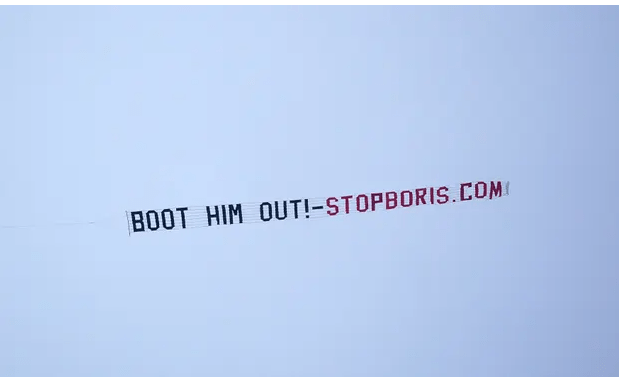
Move along – nothing to see here

Boris Johnson still believes he broke no lockdown rules at Downing Street party

Henry Zeffman www.thetimes.co.uk 

Boris Johnson is “determined” to fight on and still does not believe that he broke any lockdown rules as he braces himself for Sue Gray’s imminent verdict on parties in Downing Street.

The senior civil servant’s report on a series of allegations about rule-breaking in Downing Street during periods of severe coronavirus restrictions is expected to be published this week.

It could prove decisive in determining the fate of Johnson’s faltering premiership, and he is drawing up plans to “own the narrative” afterwards. The vast majority of Britons have already made up their minds about the allegations, regardless of what the report says, polling for The Times has found.

Johnson, who faces allegations that he did not take seriously the case of Nusrat Ghani, who was told she was dismissed as a minister because of her Muslim faith, spent the weekend making calls to Conservative MPs trying to shore up support before Gray’s findings.

“He’s feeling determined,” one loyal MP said. “He genuinely believes that he didn’t break any rules and that he was going to the garden [on May 20, 2020] to say thank you.”

Even Johnson’s allies accept that the report by Gray is likely to make a series of damaging claims about the conduct of people working in Downing Street at the height of the pandemic.

The prime minister’s inner circle — recently bolstered by the return of the MPs who masterminded his 2019 leadership campaign — is preparing to argue that whatever Gray’s findings it would be “disproportionate” for him to resign.

“Clearly there was a culture and clearly that culture was wrong,” one ally said. “But the prime minister was not in No 10 for many of these events, he didn’t know about them, and while it’s perfectly proper to hold the prime minister to account for things that he is responsible for, are we really going to ask the prime minister to resign because some people organised a party that he didn’t know about? It’s an argument about proportion.”

Downing Street is drawing up plans to “own the narrative” of Gray’s report, The Times has been told. Members of Johnson’s team have approached Sir Lindsay Hoyle, the Speaker, to ask whether Johnson could go to the dispatch box almost immediately after Gray delivers her findings to address MPs, regardless of what business is planned for the Commons at that time.

Johnson’s team is especially keen for him to speak on the same day as the findings are published if the report is critical. “If it’s leaning towards a difficult finding then you don’t want an overnight period for a narrative to build,” a minister said.

Relatively few voters are waiting to read the Gray report to form a view of the issue, according to polling by YouGov for The Times. Fifty-one per cent believe that Johnson should resign as prime minister whatever Gray’s report says, including 26 per cent of people who voted Conservative in 2019. Nineteen per cent think he should remain as prime minister regardless of the findings. Sixteen per cent think that Johnson’s future should depend on what the report says.

Dominic Raab, the deputy prime minister, declined to commit the government to publishing Gray’s report in full, saying only that “the substance of the findings” would be released, and that there would be “full transparency” and “full scrutiny”.

Angela Rayner, the deputy Labour leader, said that the report “must be published in its entirety with all accompanying evidence”, adding that Johnson “cannot be allowed to cover up or obscure any of the truth”.

Last night it was reported that Gray had interviewed police officers who guarded Downing Street when the gatherings took place. Members of the Metropolitan Police’s parliamentary and diplomatic protection command provided an account of who entered and left No 10, according to The Daily Telegraph. Gray is said to be in “ongoing dialogue” with the Met about her investigation.

Johnson’s official diary is also said to be among the sources being examined as part of the inquiry. It is understood that Dominic Cummings, the prime minister’s former chief adviser, is to be interviewed by Gray today.

The Sunday Times revealed that Gray had widened her inquiry to include allegations that parties were held in Johnson’s flat above 11 Downing Street. The paper claimed that two government advisers, Henry Newman and Josh Grimstone, visited the flat on several occasions during lockdowns.

Did you get the call?

Neil, Simon did either of you get a personal call from Boris over the weekend?

On balance was it more stick or more carrot?

Did he make any promises?

If you didn’t get a call, are you disappointed?

Owl

PS hope you weren’t in a mobile blackspot.

No 10 police officers ‘interviewed in Partygate inquiry’

Police officers who guard No 10 have reportedly been interviewed as part of Sue Gray’s inquiry into parties held at Downing Street during Covid restrictions.

www.independent.co.uk 

A source told The Telegraph their statements to the civil servant in charge of the probe were “extremely damning”.

Ms Gray is looking into allegations of a number of parties held at Downing Street while the country was under Covid restrictions. She is expected to publish her findings in the next week.

Officers who were on duty outside No 10 at the time of alleged rule-breaking parties have now reportedly been spoken to for the inquiry.

Access to Downing Street is controlled by the Metropolitan Police’s parliamentary and diplomatic protection command. According to The Telegraph, members of this branch have given detailed testimonies about what they saw to Ms Gray.

Asked how significant their information was, a source told the newspaper: “Put it this way, if Boris Johnson is still prime minister by the end of the week, I’d be very surprised.”

Downing Street refused to comment on the ongoing investigation.

On Sunday, Dominic Raab, the deputy prime minister, said Tory MPs were rallying behind the prime minister ahead of the Partygate inquiry’s expected publication this week.

The Met has previously faced questions over how officers could have been unaware of a “bring your own booze” garden gathering as they stood guard outside Downing Street.

Ms Gray is also looking into reports of other gatherings alleged to have happened at No 10 – including two events on the eve of Prince Philip’s funeral.

Officials working in No 10 claim they have held back information from the investigation into the partygate scandal due to “culture of fear” surrounding the probe. Three sources told The Independent they had not divulged messages and pictures on their phones after a senior member of staff told them to remove anything that could fuel speculation in the wake of the first party revelations.

The Met has been approached for comment.

We face a land crisis, not a housing crisis 

Letter www.theguardian.com

Sam Bowman (The big idea: could fixing housing fix everything else, too?, 17 January) is quite right in pointing out that one social problem – the housing shortage – lies at the root of many other problems, and he provides a pretty full list of what those problems are.

As he says, it is not the cost of bricks and mortar that has sky-rocketed, but the cost of land. We face not a housing crisis, but a land crisis. It is clearly wrong that when the state – in the guise of the local planning authority – grants permission for development on an area of land, the enormous increase in its value is largely pocketed as unearned income by the landowner, rather than going to the community whose needs and whose taxes that have paid for local infrastructure give value to land in the first place.

Bowman blames the shortage on the scarcity of permissions to build, but Julia Kollewe (Report, 8 May 2021) told us that since 2010-11, permission for 2.78m houses has been given but only 1.6m have been built in the same period, prompting the suspicion that developers are holding land unused while speculating on further increase in its value, and therefore in their profits.

Bowman considers various ways to fix this modern ill, but fails to mention the best one: a revenue-neutral reform of the tax system so that tax is increased on the unearned income from land, ignoring improvements, and reduced on earned income and consumption. Such a land value tax would be levied on unused land as well as other land and so would put a stop to land speculation. There would be a strong incentive to develop, the cost of land and therefore of houses would reduce, leading to real affordability, as well as to solutions of all the problems he identifies as stemming from our housing crisis.

Dr Justin Robbins

Yealmpton, Devon

Hospital patients to be moved to hotel to free up beds amid ‘enormous pressure’ on NHS

Hospital patients in Norfolk will be moved to a hotel to free up bed space as the NHS faces extreme pressure.

news.sky.com 

Up to 15 patients will be moved to the hotel in Norwich in a three month pilot scheme, NHS Norfolk and Waveney Clinical Commissioning Group has confirmed.

Patients are expected to move there within weeks.

The scheme will only include people who are healthy enough to leave hospital, but may still require care before they can go home.

This comes as the area’s health system declared a critical incident on 5 January as it struggled for bed space.

Chief Nurse Cathy Byford says the system is under “enormous pressure” despite staff “working tirelessly to ensure that people get the medical help they need as quickly and as safely as possible”.

She added that using hotels for extra capacity had been “used successfully in other regions”.

Patients at the hotel will be looked after by Abicare, a care provider with experience of delivering similar services in England.

Its managing director, Anne-Marie Perry, said staff are “keen to help” relieve current pressures on the health system.

Please use Chrome browser for a more accessible video player

NHS deals with sicker patients this winter

“Care hotels are an excellent example of a proactive short-term solution that can be readily set up as they are needed, utilising resources that exist within the community,” she added.

The scheme will not include people who have tested positive for coronavirus, or anyone with symptoms.

Similar methods have been used in other parts of England.

A hotel in Plymouth saw 30 patients moved into its rooms in December 2021 to relieve pressure on hospitals.

Health Secretary Sajid Javid told the Commons this month that he has “looked at every available route to secure the maximum capacity possible across the NHS”.

This includes creating virtual wards, using beds in hotels and hospices, setting up new Nightingale “surge hubs” within hospital grounds, and making use of the private sector.

Omicron falling fast, but new uptick detected in children

covid.joinzoe.com

According to ZOE COVID Study incidence figures, in total there are currently 144,527 new daily symptomatic cases of COVID in the UK on average, based on PCR and LF test data from up to three days ago [*]. A clear decrease of 21% from 183,364 reported last week (Graph 1). 

In the vaccinated population (at least two doses), there are currently 53,703 new daily symptomatic cases in the UK. An decrease of 36% from 83,699 new daily cases reported last week (Graph 2).

The UK R value is estimated to be around 0.9 and regional R values are; England, 0.9, Wales, 0.8, Scotland, 0.9. (Table 1). 

In terms of prevalence, on average 1 in 27 people in the UK currently have symptomatic COVID. In the regions, England, 1 in 26. Wales, 1 in 30. Scotland, 1 in 35. (Table 1).

New daily symptomatic cases are now dropping in all regions (Graph 3).

New daily symptomatic cases have seen a recent uptick in the age group 0-18. Cases in the over 75’s have fallen back to very low levels (Graph 4).

According to the data, ZOE estimates that 46% of people experiencing new “cold-like“ symptoms are likely to have symptomatic COVID-19, meaning any new ‘cold-like’ symptoms are now again more likely to be a cold than COVID. (Graph 5).

The ZOE COVID Study incidence figures (new symptomatic cases) are based on reports from around 840,000 weekly contributors and the proportion of newly symptomatic users who have received positive swab tests. The latest survey figures were based on data from 46,284 recent swab tests done on symptomatic cases in the two weeks up to 17 January 2022. 

Professor Tim Spector, lead scientist on the ZOE COVID Study app, comments on the latest data:

“It’s great to see cases falling rapidly. In just two weeks, the number of new cases per day has fallen around 31% from its peak of over 211,000 to under 145,000 and new cold-like symptoms are now again slightly more likely to just be a cold and not COVID. While it is easy to think the worst is over, our health service is still not functioning properly, and complacency will inevitably lead to trouble. The ZOE data is already showing an uptick in symptomatic cases in children due to the back to school effect. With cases still high and restrictions being lifted, we’ll just have to hope that people remain sensible, their households are triple vaccinated, and regardless of official advice, that everyone knows to isolate and self test when experiencing cold-like symptoms.” 

Graph 1. The ZOE COVID Study UK incidence figures total number of daily new cases over time.

Graph 2. The ZOE COVID Study UK incidence figures results over time; total number of new cases and new cases in fully vaccinated

Graph 3. Incidence rate by region

Graph 4. Incidence by age group 

Graph 5. Comparison of new onset of cold-like illness and new onset of COVID with respiratory symptoms

Table 1. Incidence (daily new symptomatic cases)[*], R values and prevalence regional breakdown table 

Map of UK prevalence figures

Families forced to leave Isles of Scillies amid housing crisis

“Several properties on the island which have historically been rented out to people on a long-term basis have either been sold or converted to holiday lets as a result of the growth in staycations – or because of the boom in property prices because of the pandemic.”

www.itv.com

A housing emergency has been declared on the Isles of Scilly as a lack of homes mean families are being forced off the islands.

The council is warning essential services – such as the hospital and the school – could soon be in “danger” due to a lack of homes.

It comes as 15 households are being forced to leave the islands due to having nowhere to live.

Councillors unanimously agreed to support an emergency motion recognising a housing crisis exists on the Isles of Scilly at a full council meeting this morning (January 21).

The motion was was put forward by Cllr Tim Dean, who is the lead member for housing for the Council of the Isles of Scilly.

He said the isles are facing unprecedented pressure on housing.

Part of the motion says: “We currently have 15 households who have presented themselves as homeless. This means that they will be without a home in March and will have to leave the islands.

“These are our friends, colleagues and family and many perform essential work on the islands. We are in real danger of putting essential services at risk, such as the hospital and the school.

“Without these, our islands will no longer be a viable place for our community to survive. Our population is declining and getting older. If we don’t act now, we will pay the pricein the coming years.”

The letter goes on to say the housing crisis affects everyone on the island, from businesses, schools and health providers who are in need of accommodation for staff.

It adds: “The council is finding it increasingly difficult to recruit, as are pubs, restaurants, hotels, the Steamship company, the carriers, and the boatmen and letting agents. Without all of these services, the islands economy will change irreversibly.

“So, what can we do? One thing is for sure, we at the council can’t solve this crisis on our own. We need the help of the wider community. The Duchy of Cornwall, private landlords, second homeowners and even households with a spare room can help.”

The council has bought a property on St Marys to try to ease the situation and plans to covert it to provide two properties with two bedrooms and one property with one bedroom.

“But it’s an expensive solution,” the motion adds.

“We are a very small authority with very limited financial capability, but we felt it was the right thing to do given the current situation. However, we are acutely aware that it is not enough… we need help.”

Hugh Town, Isles of Scilly Credit: Steve Spinner

Several properties on the island which have historically been rented out to people on a long-term basis have either been sold or converted to holiday lets as a result of the growth in staycations – or because of the boom in property prices because of the pandemic.

The council is also asking tenants to consider downsizing and is offering to help with moving costs and looking at financial incentives.

Plans going forward will include a public meeting to explore the current housing issues facing the islands and possible solutions.

Silence over Teignmouth Hospital’s future

Will long standing local Tory dogma on bed closure withstand scrutiny?

When Claire Wright tried to challenge hospital bed closures during a County Council Health Scrutiny meeting in  2017, Cllr. Randall Johnson ignored her motion and instead allow a fellow Tory, Rufus Gilbert, to seize the momentum by kick starting the debate and swiftly proposing the exact opposite. – Owl

Ollie Heptinstall, local democracy reporter www.radioexe.co.uk

Members of the public expecting to hear an update on the future of Teignmouth Hospital at a council meeting this week were left disappointed when there wasn’t one.

In November, it was announced that plans to close the community hospital on Mill Lane will be reviewed by independent experts after an intervention by the health secretary, Sajid Javid, who asked them to aim to report back by mid-December.

At a meeting of Devon County Council’s health and adult care scrutiny committee on Thursday, the first since then, the agenda contained ‘modernising health and care services in the Teignmouth and Dawlish area – update on referral to secretary of state for health and social care’ as one of the items.

However, when it came up an hour into proceedings, chair of the committee, Councillor Sara Randall-Johnson (Conservative, Broadclyst) announced there was no update and she had yet to receive a response.

The town’s county councillor David Cox (Lib Dem) responded: “How did this get on the agenda then? Because there’s lots of people watching this at home in Teignmouth because they believed there was going to be a great announcement – either yes or no – and it seems a bit bizarre that it’s on the agenda.”

The clerk of the meeting clarified it had been included because Mr Javid’s letter said that he hoped to get information to the committee by then, calling it a “just in case item, in case any information had been sent to us.”

But Cllr Cox remarked: “It could have been removed because people have been inconvenienced and they’re watching at home expecting to hear something, and they’ll be a bit disappointed.”

Cllr Randall-Johnson then said: “There hasn’t been an update. There might well have been an update this morning, but there hasn’t been,” to which Cllr Cox replied: “Oh well, fair enough.”

The community hospital was the first to be built by the NHS after it was established 74 years ago but was facing closure, with services moving to Dawlish Hospital and a new £8 million health centre in Teignmouth town centre.

However, campaigners argued against the decision made by NHS Devon’s clinical commissioning group (CCG), saying community hospital beds are “desperately needed,” while a petition entitled ‘Hands Off Teignmouth Hospital’ has been supported by more than 1,000 people.

Local MP Anne Marie Morris has also campaigned to keep the hospital open and welcomed the decision by the Exeter University-educated Mr Javid last year.

It is not known when a decision will be made on the hospital’s future.

Friday – Go back to your constituencies and prepare for …..

A call from Boris Johnson ensuring that you’re not wavering in your undying support for him?

A party with activists as they are now legal, though you could always have had a work gathering?

Being seen out and about your constituency – business as usual?

Or just keeping your head down?

Police stations should reopen to ‘reassure the public’

But … but … but – when they closed did that mean we ought to have been worried?  If so, why were they closed in the first place! – Owl

www.bbc.co.uk

More police stations should be reopened to give the public “reassurance” and revive confidence in policing, according to a crime chief.

Alison Hernandez, the Conservative police and crime commissioner for Devon and Cornwall, said the idea was “controversial with chief constables”.

She said public confidence needed to be restored.

“We need to reopen and show that policing is open to the public,” Ms Hernandez said.

Speaking to reporters at an Association of Police and Crime Commissioners’ briefing, she told of her plans to reopen six stations in her region but said it was “very hard” to get such proposals “over the line”.

Hundreds of police stations are thought to have closed to the public across Britain over the past decade as part of cost-cutting measures.

Typically the front desks of the stations, where people could come to report crime, were shut but the offices behind remained in use.

Alison Hernandez was first elected as the Devon and Cornwall Police and Crime Commissioner in 2016

Ms Hernandez said the difficulty in reopening stations was low footfall – the reason many closed in the first place.

“I’m determined,” she added.

“I’ve only got six I’m trying to reopen and you’d think I was trying to reopen 60.

“It is really hard because the resourcing for them, they know will mean low footfall, and it feels to them like a wasted resource.”

Exmouth’s police station was closed to the public in 2015 but remained a base for operational officers

She made clear she thinks police staff, as opposed to officers, should be posted to front desks.

“So yes, it’s controversial in the chiefs’ world. I’d say it’s very hard to get it over the line, to get that push forward because they feel like they should be spending it on policing rather than being accessible to the public,” Ms Hernandez added.

Some police and crime commissioners have used mobile vans, particularly in neighbourhoods where it may not be possible to have a station, to make policing more visible.

Stephen Mold, the Conservative police, fire and crime commissioner for Northamptonshire, who has dubbed his mobile vans “beat buses”, said: “It’s very much an evaluation but it’s already proving itself to be so successful. I’ll probably be buying another one.”

Ms Hernandez said mobile vans were “great”, but added: “What the public need for reassurance is that there’s a reliable place that you can go to and you know it’s there.”

‘Half a million’ new Covid-19 cases each day in UK over Christmas

We will follow the data hour by hour – Owl

www.inyourarea.co.uk

New cases of Covid-19 in the UK averaged nearly half a million a day during the week after Christmas, almost three times the official figures, new analysis suggests.

It comes as health agencies have urged caution about interpreting the regular case numbers published each day for the UK, following changes in rules about testing.

An average of 173,400 new cases of coronavirus per day were recorded from December 26 to January 1, according to the Government’s Covid-19 dashboard.

But the true number of cases was likely to be nearer 479,100 a day, according to estimates by the Office for National Statistics (ONS).

The sharp difference in totals reflects just how many new cases of Covid-19 are being missed in the dashboard figures, which count only those people who have reported themselves as having tested positive for the virus.

This means the numbers are affected by how many people are coming forward for tests, have chosen to report their test results, or who are taking a test because they know they have coronavirus symptoms.

By contrast, the ONS figures are based on analysis of nose and throat swabs taken from a representative sample of more than 150,000 people in private households.

The same people are sampled every week, regardless of whether they know they have Covid-19 or have reported a positive result.

The ONS then produces estimates of the likely number of new cases of coronavirus across the country.

The estimates for the week after Christmas have only now been published, due to the time needed to collect and process the data.

The number of new cases reported by the Government has always been lower than the level estimated by the ONS, but the gap has become wider since the arrival of the Omicron variant of the virus.

In the week to November 27, before Omicron had started to spread in the UK, the ONS estimated an average of 99,100 new cases a day – just over twice the average of 41,900 a day recorded on the dashboard.

The ONS estimates are now nearly three times the equivalent total on the dashboard.

High levels of under-reporting will still be affecting the Government’s daily figures, meaning the true volume of cases in the UK is increasingly unclear.

The recent change in the rules for testing, removing the the need for asymptomatic people to get a confirmatory PCR test after a positive lateral flow result, is also likely to affect the daily figures.

In its latest weekly Covid-19 surveillance report, the Health Security Agency said the removal of confirmatory PCR testing “may affect case rates” in England.

Public Health Wales has estimated that removing the follow-up test “is likely to reduce overall reported cases by at least 10%, based on analyses linking lateral flow tests to PCR positive episodes”.

The agency acknowledged that “changes in testing behaviour” may lead to under-reporting “should symptomatic new cases not test using PCR”.

In Scotland, health officials have recently widened their method of counting new cases to also include people who have recorded a first positive lateral flow test – though this change has yet to be reflected in the figures published on the UK Government dashboard.

The dashboard numbers are currently limited to all positive lab-confirmed PCR test results in the UK, plus positive lateral flow tests in Northern Ireland and, in England, any positive lateral flow tests not followed by a negative PCR test taken within 72 hours.

Shining a spotlight on recycling and waste in Sidmouth and East Devon 

Cllr Denise Bickley (Independent East Devon Alliance, Sidmouth Town Ward) sidmouth.nub.news 

L: Cllr Denise Bickley. R: A pile of recycling waiting to be sorted at Greendale.

L: Cllr Denise Bickley. R: A pile of recycling waiting to be sorted at Greendale.

I’m writing my first column for Nub News linked to my ‘passion’ – the environment, litter and specifically this time to shine a spotlight on recycling and waste collections in the area.

Being both a member of East Devon District Council and Sidmouth Town Council, plus being the Chair of the Sidmouth Plastic Warriors I have a unique insight into the work of the teams in Streetscene and Suez, who do such a fantastic job.

I sit on the Recycling and Waste Partnership Board, which meets to discuss how the contract between Suez and EDDC is going, and gives us regular updates on the service.

There are complaints, of course, but the statistics regarding recycling and waste in East Devon are impressive. As members of the public we are the third partner in this system and we all need to do our bit to keep our recycling rates as high as they are.

The teams are stretched because of the following factors:

• More properties being built;

• Consumption high due to pandemic effects (working from home, self- isolation, internet shopping);

• Christmas-equivalent levels of collection every week since the pandemic started. Christmas week this year was unprecedented;

• Regular crews having to self-isolate.

There have unfortunately been some missed collections and some spillage complaints, but the vast majority of collections have been trouble-free.

This is all done for a tiny fraction of what houses spend on their council tax, which I did not realise before I was a councillor. A mere 7% of total council tax goes to EDDC. Of this 7%, 54% goes to Streetscene in total, with Recycling and Waste getting a mere 26% of the 7%.

To illustrate this, if we use the band D average council tax of £151.78 a month, 7% equals just £10.62 to EDDC, with just £2.76 (26%) per month for the complete recycling and waste service. Less than the price of a coffee, per month!

If there is litter left on the ground in your street when the crew have speeded through, maybe we could all be a little more tolerant?

Sidmouth Plastic Warriors are happy to give out litter pickers to anybody who would take a little responsibility for their road and a 2 minute walk around after the crew have been would be fantastic teamwork! Contact info@sidmouthplasticwarriors.org to find out more.

The massive Christmas tonnage should start to decrease now, so well done to the teams for getting through so well. Thanks to all of us too for helping East Devon to be the ninth-best recycling council in the country, whilst having the number one spot for least residual waste (that goes into our black bins) per household! That is all down to households actively recycling. What teamwork!

Lastly, remember that none of our waste goes to landfill – all non-recycling goes to the Energy from Waste Plant, to generate electricity.

Next time: reducing our carbon and waste footprints, circular economy and true recycling.

Cllr Denise Bickley with Cllrs Ledger, Jackson and Hayward in a trip to the recycling centre at Greendale

Covid in Devon’s care homes at highest level

Covid outbreaks in Devon’s care homes are at their highest level since the pandemic began.

BBC News www.bbc.co.uk

New figures presented to Devon County Council showed 160 outbreaks in care settings across Devon as of 10 January.

The number is far higher than the previous peak of just over 90 a year ago, with the total number of active outbreaks tripling in less than a month.

A council director warned the situation in care was “as tough as ever”.

Tim Golby, associate director of commissioning at the county council, warned that despite reports the pandemic may be easing, outbreaks were having a “massive impact” on the ability to discharge and support people from hospital.

“But we manage that,” Mr Golby said, “and we work with the market teams to get those homes clear of infection and work through all national protocols to make sure that eventually we can admit people once the infection is brought under control.”

Mr Golby was speaking to Devon County Council’s health and adult care scrutiny committee on Thursday, as reported by the Local Democracy Reporting Service.

The government is providing an additional £60m to local authorities to support the social care response to Covid in January, with Devon receiving just under £900,000 from the fund.

The money is going towards increasing ventilation in care homes, enhancing the direct pay local authorities can offer to friends and family carers, and pay for temporary staff to cover increased staff absence.

MP blackmail claims: Tory William Wragg to meet police

A Conservative backbencher who accused Downing Street of trying to “blackmail” MPs seeking to oust Boris Johnson is to meet police to discuss his allegations.

www.bbc.co.uk 

William Wragg said he will be speaking to a Met Police detective in the House of Commons early next week, after requesting a meeting with the force.

The MP, who wants the prime minister to quit, said he wanted to leave any probe to “experts” rather than No 10.

Downing Street said it had not seen any proof of the behaviour he alleges.

A spokesman said on Friday they were not investigating the allegations but would look “carefully” at any evidence presented to them.

It comes as Tory whips and No 10 try to shore up support for the prime minster ahead of civil servant Sue Gray’s report into a series of Downing Street lockdown parties which is expected next week.

Mr Johnson has been facing down an attempt from some Conservative MPs to oust him since he admitted attending a drinks event at No 10 during the first lockdown, although he says he believed it was a work event.

So far six Tory MPs have publicly declared no confidence in the PM, but more are thought to have submitted letters to Sir Graham Brady, chairman of the backbench 1922 committee, who organises Tory leadership contests.

Under party rules, if 54 letters are submitted a no confidence vote is triggered which could result in a leadership election.

Mr Wragg, MP for Hazel Grove in Greater Manchester and chairman of the Commons Public Administration and Constitutional Affairs Committee, first raised his concerns on Thursday and advised colleagues who feel threatened to go to the police.

He told the committee that Tory whips – the MPs in charge of party discipline – had threatened those suspected of wanting Mr Johnson out with the removal of government investment in their constituencies.

He also said he had received reports of government ministers, advisers and staff at No 10 “encouraging the publication of stories in the press seeking to embarrass” those suspected of lacking confidence in the prime minister.

Mr Wragg claimed the reports “would seem to constitute blackmail” – and as well as contacting police, affected MPs should contact the Commons Speaker.

He told the Daily Telegraph he would outline “several” examples of bullying and intimidation when he speaks to police.

“I stand by what I have said. No amount of gas-lighting will change that,” he said.

“The offer of No 10 to investigate is kind but I shall leave it to the experts.”

A Met Police spokesman said: “As with any such allegations, should a criminal offence be reported to the Met, it would be considered.”

After Mr Wragg made his allegations on Thursday, Christian Wakeford – who this week defected from the Conservatives to the Labour Party – said he was threatened he would not get a high school in his constituency if he did not vote in a certain way.

Business Secretary Kwasi Kwarteng later questioned Mr Wakeford’s claims, saying he had “never heard of anything like this” since becoming an MP but if it had happened it would be “very seriously regarded” by the government.

West worst affected by ambulance A&E waits

From today’s Western Morning News:

Ambulance handover delays at A&E departments in England improved slightly last week, though hospital pressures “remain high”, figures show. Nationally, a total of 14,961 delays of at least 30 minutes were recorded across all hospital trusts in the seven days to January 16, representing 18% of all arrivals. This is down from 23% in the previous week, which was the highest level so far this winter. 

Some 7% of arrivals last week (5,610) took more than 60 minutes to be handed over to A&E teams, down from 10% in the previous week, according to figures published by NHS England. 

A handover delay does not always mean a patient has waited in the ambulance as they may have been moved into an A&E department, but staff were not available to complete the handover. 

Analysis of the data by the Press Association shows that University Hospitals Plymouth NHS Trust reported the highest proportion of ambulance handovers that were delayed by at least 30 minutes last week (58%), followed by University Hospitals Bristol & Weston (53%), Gloucestershire Hospitals (51%) and Torbay & South Devon (49%). 

Royal Cornwall Hospitals topped the list for the proportion of arrivals that were delayed by more than an hour (41%), followed by University Hospitals Plymouth (39%), Torbay & South Devon (35%) and University Hospitals Bristol & Weston (34%). 

Hospital pressures in England “remain high”, with staff facing a growing number of routine checks as well as ambulance arrivals, NHS England said. 

More than 93% of general & acute beds were occupied last week, the equivalent of nearly 500 more adult patients per day than the previous week. 

Staff absences due to Covid-19 have fallen week-on-week in every region, though most areas are still reporting higher numbers than at the start of December. 

Separate figures published by NHS England yesterday show that just under half of all patients in acute trusts are being treated primarily for something else. Of the 14,588 patients reported as having the virus on January 18, 6,983 (48%) were not being treated principally for Covid-19. This is the highest proportion since these figures were first published in June 2021, and is up from 26% at the start of December, 2021. 

All hospital patients who have tested positive for Covid-19 need to be treated separately from those who do not have the virus, regardless of whether they are in hospital primarily for Covid-19 or not. But the growing proportion of patients who are in hospital “with” Covid-19 rather than “for” Covid-19 is another sign that the current wave of the virus has not led to the same sort of pressure on critical care as in previous waves. 

A total of 614 patients in all hospitals in England were in mechanical ventilation beds on January 18, compared with 773 at the start of December – well below the 3,736 recorded on January 24, 2021. 

Masks stay mandatory at Exeter secondary school

St Peter’s head says covid still here.

More evidence that Boris Johnson’s sudden “Freedom” announcement is not based on evidence. – Owl

Sam Sterrett www.radioexe.co.uk

St Peter’s School in Exeter have made face masks mandatory, despite Boris Johnson saying school pupils no longer have to wear them from today (Thursday 20th January).

However, the school’s headteacher, Phil Randall, emphasised that covid has not gone away.

On St Peter’s Facebook page, Mr Randall wrote: “Despite the Prime Minister’s announcement earlier today regarding wearing of face masks in classrooms I will be requesting that students do wear them in classrooms as well as corridors in line with other local and national schools.

“This is because: Public Health predict increased covid in our area over the coming weeks. Our own evidence of increasing absences amongst students and staff indicate we should not be reducing approaches to keep our community safe.

“Wearing a face covering in indoor areas is a kind and thoughtful approach that supports our school community and our families, many of whom have vulnerable children and adults living with them

Therefore we will still be expecting all of our community to wear appropriate face coverings in corridors as well as classrooms. Please remember to bring a spare face covering and a suitable bag to keep them in.”

Rage against the Party Machine

Repurposing Rage Against The Machine‘s 1991 protest anthem ‘Killing In The Name’ starring Boris Johnson with his own words!

Owl is not sure how familiar readers might be with 1991 protest anthems, but have a go!

Spaffing the Cash – your cash

Research into Johnson’s planned Irish Sea bridge cost taxpayers £900,000

www.theguardian.com 

Nearly £900,000 of taxpayers’ money was spent on a study commissioned by Boris Johnson that found it would be too expensive to build a bridge or tunnel between Scotland and Northern Ireland.

The Department for Transport (DfT) said the research into the feasibility of a fixed link cost £896,681.

The Network Rail chair, Sir Peter Hendy, led the investigation, which found that a bridge would cost £335bn, while a tunnel would require a budget of about £209bn.

His report concluded that the project “would be impossible to justify” as “the benefits could not possibly outweigh the costs”.

In addition to the huge expense, the inquiry also noted that the necessary work would be incredibly challenging.

The report described how Beaufort’s dyke – an underwater trench on the most direct route between Scotland and Northern Ireland – would need to be “carefully surveyed” due to 1m tonnes of unexploded munitions being dumped there between the first world war and the 1970s.

Johnson previously talked up the creation of a fixed link but accepted the conclusion of the report.

The research was carried out alongside a wider review of connectivity in the UK, which cost £1,102,525.

The DfT said the total of £1,999,206 for both studies was the amount spent on consultancy fees and department staff costs.

Sir Peter led the review alongside his role at Network Rail, and did not receive additional pay.

Louise Haigh, Labour’s shadow transport secretary, said: “There is a cost of living crisis and the prime minister blew nearly £1m on an utterly infeasible vanity project. That’s enough to fill 18,000 potholes.

“This just shows the Tories’ sheer disrespect for public money.”

Willie Rennie, the economy spokesman for the Scottish Liberal Democrats, said: “This is a gobsmacking sum to have spent on a PR stunt. It sounds like something that the prime minister came up with at 2am at a Downing Street party.”

Mhairi Black, an SNP MP, said the bridge was an “unworkable, doomed from the get-go idea”, and added: “This just goes to show the Tories’ warped spending priorities. How many lateral flow tests could this have bought, or nurses’ salaries paid, or PPE purchased for those on the frontline in this pandemic?

“However, as daft as this idea was, it still promised to put £20bn of investment into the Scottish and Northern Irish economies. The prime minister must honour the spending commitments he made and deliver that money to Scotland and Northern Ireland so they can use it for worthwhile infrastructure proposals.”

A Department for Transport spokesperson said: “The purpose of the Union Connectivity Review was to examine, in detail, all aspects of transport connectivity between the nations to boost and deliver further opportunities for people, families and communities.

“As part of this detailed review, we consulted with the best engineers and technical consultants and undertook extensive social and geographical research to carry out a comprehensive study. This has informed our approach to rail, road and air, including making travel cheaper for all parts of the UK by reducing air passenger duty by 50% for domestic flights.”