Strange time continued: Brexiteer Jacob Rees-Mogg is a throwback that is here to stay

In normal times, the absurd Jacob Rees-Mogg would have been regarded as, at best, a political curiosity, a self-consciously self-manufactured, affected toff who goes around with a plummy accent and double-breasted suit merely to goad members of the Labour Party.

www.independent.co.uk 

Indeed, while David Cameron and Theresa May were running things that is precisely how Rees-Mogg was regarded by some. Not even the most junior of ministerial roles would be awarded to the young fogey. Now, in the post-Brexit world, it would seem, he is a power in the land, clashing with the prime minister and, most recently, the chancellor of the exchequer. The government looks, and is, deeply divided, and “JRM” is becoming the leader of the internal opposition within government.

With an almost admirable impertinence he reportedly argued with the UK chief scientific adviser about Covid, and derailed Boris Johnson’s attempt to extend plan B before Christmas. Johnson was reduced to asking how Rees-Mogg would answer questions about it at a Downing Street press conference. Rees-Mogg gamely replied that he’d ask the British people to be responsible. Perhaps he mistook Johnson’s challenge for an invitation to chair the next live media presentation.

Emboldened by the prime minister’s visibly draining authority, on Wednesday, it’s reported, Rees-Mogg had the audacity to challenge Rishi Sunak (and Johnson) about the scheduled rise in national insurance in the spring. He wants the increase scrapped, because of the cost-of-living crisis. His policy is similar to Labour’s, but he doesn’t mind about that.

It is mark of how weak Johnson has become that he is being pushed around by Rees-Mogg. It is a measure of how fractious the cabinet is that Sunak can be told to abandon a central plank of his fiscal policy by this elegant anachronism. The post Rees-Mogg occupies, leader of the House of Commons, is an ancient and honourable one, but in brutal political terms one of the positions a premier will give to someone they want to marginalise or humiliate, or both. It has been used by prime ministers to park troublesome critics. The very notion of a minister given his job (and the right to attend cabinet) for a laugh chucking his weight around with the PM and chancellor should be ludicrous.

It is not, of course, because JRM is a veteran fundamentalist Brexiteer, a former chair of the European Research Group, a Eurosceptic long before the careerist Johnson clambered onto the bandwagon. JRM has a fan club among the “Spartans” and the wider, substantial, body of Tory MPs fed up with Johnson behaving (in their eyes) like a horrific cross between Jeremy Corbyn and Greta Thunberg.

They see JRM, even more than the likes of Liz Truss, as their champion in cabinet; and they are right to do so. Rees-Mogg is part-high priest, part-shop steward, part-kingmaker for a large faction of the parliamentary Conservative Party, and it is no joke for Johnson.

It is strange. A child of the Sixties (the 1660s), Rees-Mogg fits exactly into the pantheon of past colourful parliamentary eccentrics with reactionary views, now largely forgotten figures such as Nicholas Fairbairn, Sir Gerald Nabarro or, in our own time, Michael Fabricant. Norman St John-Stevas, a now half-forgotten figure, was a similar personality, a parliamentary boulevardier and “wet” Tory who was retained by Margaret Thatcher on sufferance, until one too many of his private jokes about “The Leaderene” made its way back to her ears, and he found himself relieved of his light duties as leader of the House of Commons.

The difference now is that Rees-Mogg is unsackable, even after his disastrous scheme to save Owen Paterson did so much damage to the party. If and when Johnson is replaced, Rees-Mogg will survive and probably prosper. The throwback is here to stay and, for the time being, debates in the British cabinet are increasingly a battle of wills, if not ideas, between two posh blokes who went to the same school. Floreat Etona!

Michelle Mone referred company for PPE contracts five days before it was incorporated

There must be no bullying and no harassment; no leaking; no breach of collective responsibility. No misuse of taxpayer money and no actual or perceived conflicts of interest. The precious principles of public life enshrined in this document – integrity, objectivity, accountability, transparency, honesty and leadership in the public interest – must be honoured at all times; as must the political impartiality of our much admired civil service.” (Boris Johnson in his forward to the Ministerial Code 2019)

David Conn www.theguardian.com 

The Conservative peer Michelle Mone referred a business to the Cabinet Office for potential multimillion pound PPE contracts before it had even been incorporated as a company, it has emerged.

The business, PPE Medpro, was fast-tracked by the government through its “VIP lane” for politically connected firms following the referral by Mone.

Within weeks of the company’s incorporation on 12 May 2020, PPE Medpro was awarded contracts worth £203m to supply millions of masks and gowns.

The Guardian revealed on Thursday that leaked files appear to suggest that Mone and her husband, the Isle of Man-based financier Douglas Barrowman, were secretly involved in PPE Medpro, despite both consistently denying any “role or function” in the company.

It has now emerged that Mone’s referral of PPE Medpro occurred five days before the company was formally registered.

Responding to a recent parliamentary question from the late Labour MP Jack Dromey, health minister Edward Argar said: “Departmental records indicate that Baroness Mone identified Medpro as a potential supplier on 7 May 2020 and highlighted this opportunity by email on 8 May 2020.”

Mone referred PPE Medpro to the office of her fellow Tory peer Theodore Agnew, a Cabinet Office minister responsible for procurement during the Covid pandemic. PPE Medpro was then added by Agnew’s office to the VIP lane, which analysis later showed gave companies a 10 times greater chance of being awarded a contract.

PPE Medpro was not incorporated in the UK until 12 May 2020, five days after the initial referral. The UK company was effectively a subsidiary of another PPE Medpro, registered in the Isle of Man on 11 May. The director of both companies was Anthony Page, who works for Barrowman’s Isle of Man-based financial services firm and runs his family office.

Lawyers for Mone, who ran a lingerie company before David Cameron made her a member of the House of Lords, have always said she “was not connected to PPE Medpro in any capacity”.

They also said she had no “association” with PPE Medpro, and “never had any role or function in PPE Medpro, nor in the process by which contracts were awarded” to the company.

Contacted on Friday, Mone did not respond to questions about why she referred PPE Medpro the week before the company had even been incorporated. Both Mone and Agnew have declined to say what, if anything, she disclosed about her own links to the company when she referred it.

A Cabinet Office spokesperson said Mone’s emailed referral is considered “private correspondence” that would not normally be publicly disclosed.

Angela Rayner, Labour’s deputy leader, wrote to Cabinet Office minister Stephen Barclay on Friday, expressing concern about “the lack of transparency around the award of significant sums of public money to PPE Medpro”.

“I would ask now that the government … commits now to place all correspondence and records relating to the award in the library of the House [of Commons] for parliamentary scrutiny,” Rayner said in her letter.

The timing of Mone’s referral of PPE Medpro also appears to be significant because it seems to have occurred days before the company had even secured the crucial business deal that enabled it to supply PPE to the NHS.

Documents seen by the Guardian suggest it was not until 11 May – the same day the Isle of Man PPE Medpro was registered – that the company secured its agreement with a London importing company, Loudwater Trade and Finance.

Under the terms of the business deal, documents suggest Loudwater promised to supply the PPE, whereas PPE Medpro appears to have committed to use its “extensive network to seek to secure … contracts with the NHS and other government bodies within the British Isles”.

It appears PPE Medpro undertook that commitment just days after Mone had made the referral to the Cabinet Office.

Documents seen by the Guardian also appear to show Barrowman was personally involved in setting up PPE Medpro’s deal with Loudwater’s director, Maurice Stimler, as well as related business matters.

Barrowman’s lawyers have also repeatedly distanced him from the company, saying he was not an investor, director or shareholder. They have said the Guardian’s reporting amounted to “clutching at straws” and was “largely incorrect”.

Mone’s lawyers have said the Guardian’s reporting is “grounded entirely on supposition and speculation and not based on accuracy”, adding: “She is under no obligation to say anything to you.”

They have also said that after she took the “very simple, solitary and brief step” of referring the company to Agnew, she “did not do anything further in respect of PPE Medpro”.

However, WhatsApp messages believed to have been sent by Mone in late June 2020, over a month after the referral, appear to show her discussing the gown sizes and purchase order details with a person in PPE Medpro’s supply chain.

The messages, which Mone appears to have sent shortly before taking off in a private jet, occurred shortly before PPE Medpro secured its second contract with the government.

Mone’s lawyers said she could not be expected to comment on “unknown and unattributable WhatsApp messages allegedly sent 19 months ago”.

Her lawyers have also refused to be drawn on why, according to a Financial Times report, Mone was in contact with officials as recently as February 2021, and appeared to be “incandescent with rage” over the treatment of PPE Medpro.

Jackie Weaver pleads for return of online council meetings

The government’s failure to enable local politicians to meet virtually is hampering councils, worrying older councillors and shutting out new participants, according to Jackie Weaver, who shot to fame thanks to a video clip of an ill-tempered council meeting 10 months ago.

Alexandra Topping www.theguardian.com 

Weaver, who became one of the most unlikely breakout stars of 2021 after footage from the Handforth parish council meeting she was attending went viral, has issued the rallying cry amid fears that current high infection rates could hit participation in local politics hard.

In April the high court ruled that from May council meetings in England must take place in person – after coronavirus restrictions which allowed virtual meetings lapsed.

“It is completely unreasonable that we are having to cancel council meetings or hold them only in emergencies for goodness knows how long. Where is democracy?” said Weaver in an interview conducted, inevitably, over Zoom.

This week Lawyers in Local Governmentthe Association of Democratic Services Officers (ADSO) launched a petition calling for councils to be allowed to meet remotely because “they know best” what type of meetings work in their area.

After a tumultuous 10 months in which Weaver, the chief officer of the Cheshire Association of Local Councils, has played herself in the Archers, opened the Brit awards as “Weaver the Cleaver” and featured on Celebrity Mastermind, she is also calling for legislation that will, once again, allow council meetings to be held online.

The public can only hope that it will lead to more filmed exchanges like the Handforth meeting that gripped the nation in the dark days of last February’s lockdown, when Weaver was commanded by Aled’s iPad to: “Read the standing orders, read them and understand them!”

Weaver said: “Despite everyone and their cat and dog saying it should be local councils that are able to determine how they hold meetings, that legislation has lapsed and the impact is quite profound.

“Because of the demographics of many of our parish councils, we have a lot of parish councillors still very reluctant to attend. And should we even be encouraging attendance?”

She said the lack of virtual meetings was a blow to the government’s “levelling up” agenda, making democratic participation more difficult for those with caring responsibilities and disabilities. A recent Local Government Association (LGA) survey of councils, conducted before the emergence of Omicron, found that 72% had recorded a drop in councillor attendance at statutory council meetings and 73% had reported a fall in public attendance.

The LGA has called on the government to urgently bring forward emergency legislation, saying the gathering of up to 200 people in one room is an “unnecessary public health risk”.

James Jamieson, the chair of the LGA, said emergency legislation would help curb the spread of the virus and make sure “councils can continue to make democratic decisions, even during times of emergency”.

A spokesperson for the Department for Levelling Up, Housing and Communities said it was considering a call for evidence on the matter, which closed on 17 June, and would be responding shortly.

Reflecting on the year that made her a particularly British type of hero, Weaver said that while she relished being given the “opportunity on a plate” to spread the word about the importance of local government, the line between Jackie the local government champion and Jackie Weaver the viral star had become blurred in recent months.

“I can’t say it annoys me, that just would be ungrateful,” she said. “But at the same time, it costs.”

But with the no-nonsense good humour that saw her booting several Handforth parish councillors out of the meeting during the infamous fracas – two have since stepped down – she brushed off any suggestion she was indulging in a “pity party”, expressing her dislike of moaners and admiration for people who get stuck in.

“People feel like the only way you effect change is from the top, and I don’t subscribe to that at all,” she said. “I think often we end up doing nothing, because we can’t change the world.”

As for her own future, after writing a book, You Do Have the Authority Here, based on her own wisdom, she “doesn’t have a plan as such” for this year beyond calmly carrying out her day job and continuing to bang the drum for local government.

“I hope that every time we’re coming up to elections, there is something that helps us capture ordinary people’s imaginations and makes them feel that they actually can make a difference,” she said. “For me, that is always the most important thing.”

Farmers could be paid for post-Brexit ‘rewilding’ land changes

According to Thursday’s Western Morning News: “The initial focus will be on restoring England’s water courses and helping native species to recover.”

By Claire Marshall www.bbc.co.uk 

Farmers and landowners in England could be paid to turn large areas of land into nature reserves, or to restore floodplains, under new government agriculture subsidies.

When the UK was part of the EU, farmers were given grants based on how much land they farmed.

Following Brexit, the government has pledged to pay based on how farmers care for the environment.

But environmental groups say the new plans lack detail and may not deliver.

In what the government describes as “radical plans”, landowners and farmers will be allowed to bid for funding to turn vast areas of land – between 500 and 5,000 hectares – over to wildlife restoration, carbon sequestration, or flood prevention projects.

“What we’re moving to is a more generous set of incentives for farmers doing the right thing,” Environment Secretary George Eustice told the BBC.

“We can have both sustainable, profitable food production, and see a recovery for nature as well.”

Agriculture is a devolved issue meaning that each UK nation has its own plans. Wales, for example, has said its new funding scheme will promote environmental benefits and be in place from 2025.

Improving the environment

Under the EU’s Common Agricultural Policy, farmers were given taxpayers’ money largely based on the amount of land they farmed: the more land they held, the more cash support they got. In 2020 about £3.5bn was handed out.

Now the government says that instead of rewarding farmers for how much land they work, it wants to encourage farmers to introduce practices that improve the environment.

Farming creates 10% of the UK’s greenhouse gas emissions, and large-scale agriculture has long been accused of degrading the environment.

Applications will shortly open for the first wave of “Landscape Recovery” projects. Mr Eustice said the scheme would lead to “fundamental land use change” creating new woodlands, restoring peatlands, and other “intensive interventions”.

The aim of these pilot projects is to create 10,000 hectares of restored wildlife habitat, which could help sequester carbon and restore England’s rivers and streams. Mr Eustice said he hoped it would lead to more large-scale rewilding projects like the Knepp estate in West Sussex.

But Craig Bennett, chief executive of the Wildlife Trusts, said the “golden opportunity” of the agricultural transition was in danger of being “wasted” .

“While we’re hearing the right noises from the government, the devil will be in the detail, and the detail is still not published nearly six years after the EU referendum,” he said.

James Robinson, a farmer in Cumbria with 300 acres of land, said it was difficult to judge the proposals because they still lacked detail.

“It will make a difference but we need action now. The way farming has been run for the last 40-50 years has been for field production at the expense of environment. We can’t keep going as we are, we need to make a change now, and as farmers we need to step up and make a change. But we also need government support to do that and it’s still not quite there yet,” he said.

There were also concerns among tenant farmers about how they could take part. George Dunn of the Tenant Farmers Association said: “Payments are being removed from tenant farmers in real time while we have a vague commitment for further work to be undertaken on how tenants can access schemes”.

Dr Alexander Lees, from Manchester Metropolitan University, said the schemes fitted well with the challenges of reversing declines in Britain’s most endangered species – those on the Red List. But the aspirations of the pilot seemed “simultaneously low and over-ambitious”, he said.

“It would seem very hard to reverse biodiversity loss for the ‘most threatened species’ in just 10,000 hectares,” he added.

“If we are serious, then we need to be racing towards the 300,000 hectare target as fast as possible.”

An additional plan, called the Local Nature Recovery scheme, will pay farmers to deliver on small-scale environmental priorities, such as “creating wildlife habitat, planting trees, or restoring peat and wetland areas”.

Mr Eustice said it was “about individual farms or groups making space for nature on part of their holding, perhaps creating water features on some of the less productive land, or hedgerows for breeding sites for birds.”

The government says, by 2030, the policy aims to:

  • halt the decline in species
  • put up to 60% of England’s agricultural soil under sustainable management
  • and by 2042, restore up to 300,000 hectares of wildlife habitat

Details of the broader Sustainable Farming Incentive (SFI), which aims to support sustainable farming practices, were revealed in December.

The Wildlife Trusts, National Trust and RSPB were highly critical of the SFI plans, saying they were “deeply concerned” that they did not go far enough.

According to the Wildlife Trusts, the SFI allows 30% of arable soils to be left bare over winter, which is damaging to soil health. The standards also do not address the damaging impact of pesticides and artificial fertilisers on soil, it said.

It also claimed that farmers would be left to measure and assess their own management plans.

Mr Eustice said judging how successful the plan is would be a “complex” thing to do in the years ahead.

He said: “We’ve been running agri-environment schemes in one form or another for well over 20 years, and each of those have been evaluated. It may not be perfect, but we think it’s reasonably accurate. And you have to work on something.”

Update on “Gatherings” investigation

No 10 party inquiry to name ‘people in charge’

The official investigation into Downing Street Christmas parties will not blame the junior officials who organised them but will instead identify their bosses, Whitehall insiders believe.

Henry Zeffman, Oliver Wright http://www.thetimes.co.uk

Sue Gray, a former Whitehall ethics chief, took charge of the inquiry into alleged rule-breaking last month, shortly after The Times revealed that Simon Case, the cabinet secretary, who had been leading it, had been aware of a Christmas event in his own office.

The inquiry was primarily asked to look into claims that staff at No 10 held a party on December 18, 2020, when London was subject to severe restrictions, but will examine other alleged lockdown breaches too.

It has been widely reported that the December 18 event was organised by civil servants in a WhatsApp group. But Gray is much likelier to find fault higher up the chain of command, senior figures say.

“I don’t think she would reasonably expect an office junior to carry the can for senior people who ended up attending any events,” a source said. “I don’t think she is looking for scapegoats in that sense. If somebody junior was asked to do something that will be reflected, but it will be reflected who asked them to do it.”

Whereas Case’s inquiry was thought to be fairly close to publication before he recused himself, Gray is conducting extensive new interviews. One ally said she was surprised by the limited nature of the work she inherited from Case.

Gray has emailed more than a dozen people, including Downing Street officials, special advisers and departed staff. Some in government expect Gray’s report to be tougher than Case’s would have been. “I think she has to now deliberately go harder than Case because she’s so publicly associated with it,” a source said.

Gray was expected to interview Case in his role as cabinet secretary when the alleged Downing Street parties took place, although he is not accused of having attended them. It is not clear whether Gray has yet done so.

Several people present at the December 18 event have said there was cheese and wine, music and that it went on until 2am. No 10 has denied that it was a Christmas party.

There are suggestions that up to seven lockdown-breaking gatherings took place in November and December 2020. Gray’s investigation will also examine a reported leaving event for a No 10 aide on November 27, which was said to have been attended by Boris Johnson, and a party at the Department for Education. Sajid Javid, the health secretary, has said that Gray will be free to investigate other events.

Downing Street staff were also photographed drinking in the No 10 garden during the first lockdown in May 2020. The government has insisted that it was a work meeting. The Cabinet Office declined to comment.

Wallpaper for Access?

Boris Johnson is facing fresh sleaze allegations after appearing to back a plan for a new “Great Exhibition” put forward by the Tory donor who funded his luxury flat redecorations.

www.independent.co.uk 

The prime minister told Lord Brownlow he was “on the great exhibition plan” in a WhatsApp message in which he described his Downing Street rooms as “a bit of a tip” – and pleaded for more money.

Two months later, the donor joined a meeting with the culture secretary “to discuss plans for Great Exhibition 2.0” – a showcase of British innovation later renamed “Festival UK” – a government document revealed.

The link was exposed after Mr Johnson’s ethics adviser demanded to know why WhatsApp exchanges were kept secret in his probe into the controversial £142,000 refurbishment.

In a new letter to the prime minister, Christopher Geidt attacked the failure to pass on the messages – blamed on a change of mobile phone – as “extraordinary”, warning public faith in government had been dented.

He continued to conclude there was no breach of the ministerial code, but did not fully exonerate Mr Johnson, ahead of a further possible inquiry by the parliamentary commissioner for standards.

Lord Geidt expressed “doubt” on whether he would have found that the prime minister “took steps to make the relevant declaration”, had he known the full story.

Opposition parties demanded to know what Mr Johnson promised about an exhibition – after Lord Brownlow’s WhatsApp reply pledged to get the flat funding “sorted ASAP” and added: “Thanks for thinking about GE2.”

Angela Rayner, Labour’s deputy leader, alleged: “It appears that Lord Brownlow had access to the prime minister and culture secretary to discuss Great Exhibition 2 because he was paying for his luxury flat renovations.”

And Wendy Chamberlain, the Liberal Democrat chief whip, said: “It stinks of the worst kind of Conservative cronyism, with Boris Johnson seemingly happy to scratch his donor’s back to get his flat spruced up in return.”

Downing Street insisted the idea for “Great Exhibition 2” was “not taken forward” – arguing “Festival UK” was a different project entirely – but was unable to explain the differences between them.

Asked if the prime minister’s support was sought in exchange for “giving him some cash for the flat refurb”, the spokesperson replied: “No. This isn’t something that we’ve taken forward.”

It then emerged that, on 18 January last year, then culture secretary Oliver Dowden met with Lord Brownlow and Royal Albert Hall bosses “to discuss plans for Great Exhibition 2.0”.

Ms Rayner added: “No one should be able to buy access or exchange wallpaper for festivals. Boris Johnson has serious questions to answer.”

The new controversy comes on top of a stinging rebuke delivered by Lord Geidt for the failure to hand over the messages for his inquiry, which concluded in May last year.

No 10 admitted officials failed to take up Lord Brownlow’s offer to provide “all the material”, arguing it feared compromising a parallel probe by the Electoral Commission.

In his letter to his adviser, Mr Johnson agreed it was not “acceptable” that the Cabinet Office “at the very least did not inform you of the position they had taken”.

He offered a “humble and sincere apology” for what happened – but insisted he did not recall asking Lord Brownlow for the funds for the lavish refit of the No 11 flat.

Interviewed at a vaccination centre, the prime minister was asked if he expected people to believe he had forgotten to disclose key evidence simply because it was no longer stored on his phone.

“I followed the ministerial guidance at all times – and yes,” he replied, declining to expand on what happened.

The released messages revealed he told the donor: “Parts of our flat are still a bit of a tip and am keen to allow Lulu Lytle to get on with it,” referring to the designer whose wallpaper sells at more than £800 a roll.

Lord Brownlow funded the redecorations, as attempts to set up a blind trust faltered, before Mr Johnson finally settled the bill – standing at £112,000, with £30,000 met by the taxpayer.

The controversy was reignited when last month’s Electoral Commission report revealed the prime minister personally asked the peer for more funds, in November 2020.

Yet he told Lord Geidt that he knew nothing about the way the work was being funded until three months later, triggering accusations that the adviser was misled.

In his letter to his watchdog, sent on 21 December, Mr Johnson blamed replacing his phone number due to “security issues” – which meant he “did not have access to my previous device and did not recall the message exchange”.

Strange times – JRM could even be right for once

I, For One, Welcome Our New Rees-Mogg Overlords

By Stephen Bush, political editor New Statesman go.pardot.com 

Good morning. How should the government respond to the cost of living? The FT  reveals that Jacob Rees-Mogg has told Boris Johnson that Rishi Sunak’s planned increase in national insurance should be shelved due to the inflationary pressures facing households – while yesterday in the House of Commons, Boris Johnson faced not-so-subtle calls from his own side to scrap green levies on energy bills and to prioritise the United Kingdom’s energy security.

Johnson’s preferred approach is to invest in renewable energy and in more nuclear power stations – rather than accede to the demand of some of his backbenches and in his Cabinet that the UK end its moratorium on fracking. Sunak is widely believed to have doubts about the government’s net zero strategy: but his aversion to further borrowing puts him at odds with the low-tax Conservatives who ought to be his closest natural allies. (It’s also true to say that most in the Cabinet think that the government should be willing to borrow more in order to avoid immediate tax rises.)

One thing that Rees-Mogg is surely right about: the combination of price increases and tax rises in April look like a perfect storm to make the 2022 local elections a very painful time for the country, and therefore a very painful set of contests for the Tory party, and of course, a painful time for Boris Johnson personally.

One advantage that Liz Truss has over Sunak in the leadership election we’re all pretending isn’t underway is that as Foreign Secretary she has an opt-out from all that. She can use her Women and Equalities brief to wade in or out of domestic policy when it suits her (and it’s a sign of which of the possible successors to him that Johnson favours that she still retains the Equalities brief) but she doesn’t have to get bogged down.

But her and Sunak both share a weakness which is that they are, broadly, from the same bit of the Conservative party and they are fighting for the same set of votes. Truss is using the Equalities brief to signal to the right of the party that she is not just an economic liberal like them, but she is aligned with them on (some) social issues too. Given Priti Patel’s well-advertised difficulties at the Home Office, there isn’t really an alternative candidate on the right of the party at the moment.

Except, of course, if Rees-Mogg’s willingness to intervene on difficult issues like tax-and-spend means that he emerges as the most authentic hope for the party’s right flank. And that’s another looming problem for Boris Johnson: his political weakness means that everyone in the Cabinet will, increasingly, be thinking not of how best to advance under him, but after him.

Jupp, stand to attention while you’re counted!

[Just dream of “fizz with Liz” – Owl]

Boris Johnson forced MPs to show up in parliament to make it look like his support is more solid than it is, sources claim.

Catherine Neilan www.businessinsider.com

  • Conservative MPs were ordered to attend parliament to vote on an unremarkable piece of UK legislation.
  • But after attending prime minister’s questions, the order was dropped — leading some to suspect it was a ruse.
  • Some MPs told Insider it left them feeling used.

Some of Boris Johnson’s own MPs told Insider they were “dragged” into parliament today in a ruse to make it look like the UK prime minister is in full command of his party when in fact his grip over them is slipping.

Conservative backbenchers were strongly encouraged to attend the first session of prime minister’s questions (PMQs) of the year. MPs were also told that party whips had ordered a three-line whip on a vote at 10 p.m. on January 5. Such a measure is usually reserved for controversial votes, meaning they must vote unless there are exceptional circumstances. 

It was the first time lawmakers have gathered since Johnson’s Conservatives lost the safe seat of North Shropshire, following a slew of headlines about senior Tories failing to follow pandemic rules they required the rest of the country to obey.

The constituency, previously represented by Owen Paterson and other Conservative MPs dating back to the 1830s, was lost to the Liberal Democrats in one of the biggest political upsets of living memory. Paterson was forced to resign after it was reported he breached parliamentary rules while acting as a paid lobbyist for the healthcare company Randox, which won roughly £490 million in no-bid contracts from the government in 2020.

Over the Christmas break, successive polls suggested Johnson’s popularity continued to decline amid further allegations that he and members of his government held parties in Downing Street in 2020 after asking the rest of the country to cancel their Christmas gatherings to stop the spread of coronavirus.


A three-line whip is suddenly dropped

While it is not unusual for a sitting government to order an en masse demonstration of solidarity, the fact that some Conservatives complained about it afterwards demonstrated the fragility of Johnson’s support among some members of his own party.

This afternoon saw standing-room-only at PMQs in the House of Commons as Johnson was challenged by Labour party deputy leader Angela Rayner on the rising cost of living. This was followed immediately afterwards by the prime minister giving an update on Covid-19 to a packed Commons chamber.

Shortly afterwards, the three-line whip on the otherwise unremarkable public sector pensions and judicial offices bill was dropped. 

Angry MPs told Insider there was no reason for the original order. One suggested it was because “they [Number 10] wanted us all here for PMQs and the statement”.

‘A sure sign of a PM in trouble’

But the Tory politician claimed the move had provoked suspicions among colleagues that they had been used. “Not a good one for morale at the start of the year,” he said. 

One former minister also told Insider the plan had backfired, saying: “They dragged us in just to sit behind him at PMQs … it has upset a number of the 2019 intake [new MPs who won seats in the last election]. The mood in the tea room is not good.”

Asked if they thought it was a ruse, one MP replied: “exactly that.”

Another added: “We were all strongly encouraged to be in for PMQs — a sure sign of a PM in trouble.”

Number 10 was contacted for a comment but did not immediately respond.

New suit, new hair, same lies – welcome back to Prime Minister’s Questions

New suit. New hair. Same lies. Well, not the same ones actually. There were new lies too. There always are. Whatever the subject, whatever the question, the prime minister will find a way to lie about it.

www.msn.com  Tom Peck 

At this point it would be apposite simply to rename the weekly House of Commons sessions “Prime Minister’s Lies”, if only for the acronym. What did you do this week? PMSL at PMLs. It is the only psychological coping strategy.

Angela Rayner had to stand in for Keir Starmer, who – 24 hours after his most recent relaunch –has tested positive for Covid and has had to self-isolate for what is understood to be the eighty eighth time.

Starmer rules the Labour Party in much the same fashion as King John VI of Portugal, when the royal court was formally transferred to Rio de Janeiro; the only difference being Starmer’s Rio de Janeiro is his upstairs back bedroom.

Anyway, back to the lies. Angela Rayner had the temerity to tell the prime minister he had claimed, in October, that fears about inflation were “unfounded.” “I said no such thing,” he replied.

The world moves pretty fast, these days. So naturally, by the time he had sat down, the clip of him saying this exact thing, in a television interview on Sky News, had resurfaced. “People have been worried about inflation for a very long time, and those fears have been unfounded,” Johnson said then.

So, you know, just another one to add to the ledger there. Another blatant lie, breezily told at the despatch box of the House of Commons.

Not that long ago, the Labour MP Dawn Butler got into a tremendous amount of bother for calling Boris Johnson a liar in the House of Commons and refusing to withdraw the remark, arguing that to withdraw it would be to tell a lie herself. Everything, in the end, must be degraded to Johnson’s level.

Rayner also asked him about rising energy bills, and specifically his promise, made in the EU referendum campaign, that “energy bills will be lower.” He said this in a column in The Sun newspaper, featuring not only his byline but also a little graphic of him dressed up as a musketeer.

This was also raised at the Downing Street press conference on Tuesday night. Johnson’s answer, frankly, a lie for the ages. Not a blatant lie, but a misrepresentation so ridiculous as to be far worse.

The promise, made in 2016, that energy bills would be lower was, of course, itself a lie, in the sense that it was a promise that could never, ever be kept. But underlying it was a vague truth – that the EU does not allow member states to charge less than 5 per cent VAT on fuel bills, and outside the EU the government could scrap this charge.

Leave won that vote, you may recall, and five years later, the man who wrote, very clearly, that “energy bills will be lower” is now the prime minister; there’s an unprecedented energy crisis and he’s not done the thing he said he would do.

Having been so hopelessly exposed, Johnson’s only response is to blame remainers. He claimed on Tuesday night that it is “paradoxical” for anyone who voted to remain to expect Johnson to keep the promises he made. He told Rayner the same. That expecting him to do what he said he would do and cut VAT on fuel, was “effrontery”, it was “bare-faced cheek.”

He made a promise on Brexit. He won. He’s now the prime minister. He’s broken it and, in his golden-wallpapered world of lies and absolutely nowhere else, this is, apparently, evidence that “Labour can’t be trusted on Brexit.”

And this, yet again, is the remarkable thing. Why isn’t he any better at this lying business? Having told as many as he has, for as long as he has, can he not see that he really can’t get away with claiming that his own lies are proof that someone else can’t be trusted?

And the answer is no. He can’t. And it’s why his party, and his country, have very clearly seen through him, as everybody who’s ever known him does in the end. The precise circumstances and the intricate details might not be clear just yet, but the outcome will be the same. It will end as it has done every other time before – with Johnson kicked out of the house.

Ministers must act now on NHS staffing crisis, health chiefs warn

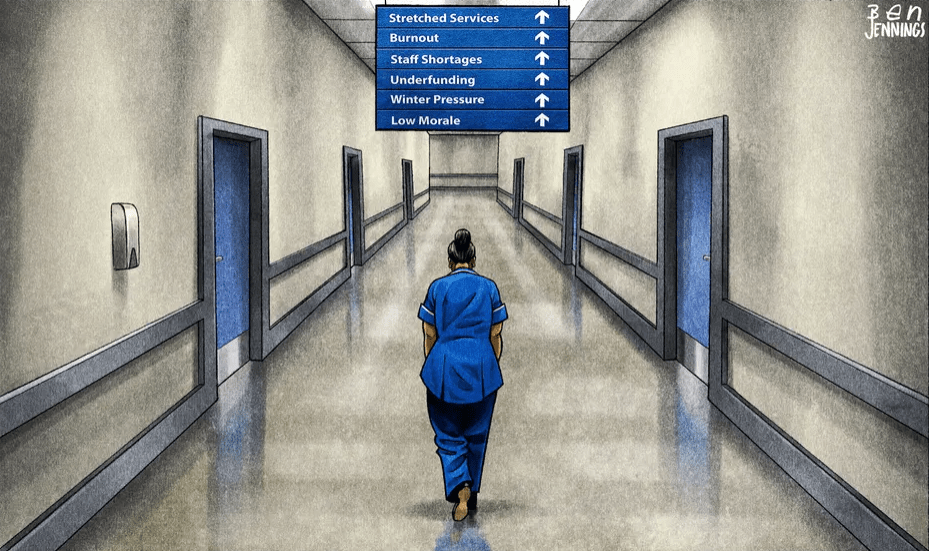
Millions of patients will suffer worsening quality of care unless ministers take immediate action to alleviate the staffing crisis engulfing the NHS, health chiefs have warned.

Andrew Gregory www.theguardian.com 

The NHS Confederation, which represents the whole healthcare system, is tonight calling for a range of new measures to be implemented in the NHS in England to help overstretched hospitals and struggling ambulance, mental health, community, GP and social care services cope with “widespread” shortages of medics and health workers.

Tens of thousands of medical students should be deployed on to wards and other healthcare settings, NHS and social care staff must be granted priority access to lateral flow and PCR tests, and the self-isolation period should be reviewed to see if it can be slashed from 10 days to five, as has happened in the US and France, it said.

The call came as growing numbers of operations are being cancelled, with more than 20 NHS trusts declaring an “internal critical incident” in recent days as they struggle to cope with the intense Covid pressure. It emerged on Wednesday that at least four more NHS trusts have taken that step, the highest form of alert any hospital can issue, as had the entire NHS in Norfolk.

NHS staff absences have now spiralled to double what they normally would be at this time of year, and 17,276 people are in hospital in the UK with Covid – up 58% in a week – as Omicron continues to put “enormous strain” on every part of the health service, the NHS Confederation added.

The absence of tens of thousands of staff is already having a “detrimental” impact on the ability of the NHS to provide healthcare, it warned, and said that, without further measures, the staffing crisis “threatens the quality of patient care”.

Given the worsening situation, there should also be “explicit acknowledgment” from the national regulators that clinical tasks “might need to be allocated in ways which would not normally be recognised as best practice”, the NHS Confederation said.

Matthew Taylor, its chief executive, told the Guardian that in the last 24 hours hospital bosses had become “extremely concerned” about the widening ratio of staff to patients.

Boris Johnson insisted on Wednesday he was right not to take any further action.

The prime minister told MPs the cabinet had agreed to keep the existing plan B restrictions and ease travel testing rules. He also confirmed plans being implemented across the UK to end the requirement for confirmatory PCR tests for asymptomatic people who test positive using a lateral flow device (LFD).

An estimated 3.7 million people in the UK had Covid in the week ending 31 December, the highest number since comparable figures began in autumn 2020, the Office for National Statistics (ONS) said. In England one in 15 people in private households had Covid-19, according to ONS estimates. The level is one in 10 in London.

A further 194,747 lab-confirmed Covid-19 cases were recorded in the UK as of 9am on Wednesday, while 334 more deaths were recorded – although this figure includes a backlog of hospital data from England since 1 January.

“It’s clear that we are facing a staffing crisis in the NHS, with a number of hospitals telling us they have around 10% of their staff in self-isolation or on sick leave for other reasons,” Taylor told the Guardian. “This is pushing up the ratio of staff to patients to levels hospitals are extremely concerned about.

“The prime minister’s attempts to reassure the public that the NHS is not being overwhelmed will not chime with the experience of staff working in some parts of the NHS. The government now needs to do all it can to mobilise more staff and other resources for the NHS to get through this extremely challenging period.”

While he welcomed Johnson’s announcement that 100,000 critical workers will get direct access to testing from next week, the move “does not go far enough”, Taylor said, and NHS, social care and other key workers should also have “priority access” to tests.

He said there was “merit” in reviewing the self-isolation period “to see if the evidence supports a halving of the period to five days”. “We also need other short-term measures, including deploying medical students on wards and taking other steps to cover rota gaps,” he added.

All of Greater Manchester’s 17 hospitals have postponed non-urgent surgery. Its healthcare system will not necessarily be able to “ride out” the wave of Omicron infections, the mayor, Andy Burnham, said, with the number of Covid patients in the region’s hospitals almost tripling in the past two weeks, from 346 people to 1,020.

Cara Charles-Banks, the chief executive of the Royal United Hospitals Bath trust, one of those to declare an internal critical incident, said it had done so on New Year’s Eve “due to ongoing pressures caused by both Covid and non-Covid patients, sickness among our staff and availability of beds.”

University Hospitals Dorset, which runs acute hospitals in Bournemouth and Poole, is preparing to cancel some routine operations after also declaring a critical incident. On Wednesday Poole hospital had only four free beds while Bournemouth had 25.

The same level of sickness absence prompted West Suffolk hospital to join the lengthening list of trusts declaring an incident. Both the acute trusts which provide care to people in Bristol, North Somerset and South Gloucestershire also declared an internal critical incident over the bank holiday weekend.

The chief executive of one trust in the north of England said it has had to scale back non-urgent surgery after the number of Covid inpatients it is treating soared by 80% since Christmas Eve.

“We are doing priority one and priority two surgical cases, with others having to be cancelled,” the chief executive told the Guardian. Their trust is also redeploying staff because 10% of frontline personnel are off sick.

“The NHS runs hot all of the time so it doesn’t have the reserve for extraordinary events. Something has to give and, as in previous waves, it will be the care that can be delayed and it will be the goodwill and potentially the wellbeing of staff.”

Cash found to slow Seaton cliff-falls

Nearly a million pounds is to be spent to try to slow the cliffs at Seaton in East Devon which have been falling into the sea.

Radio Exe News www.radioexe.co.uk 

The beach and cliffs at Seaton (Sarah Charleworth/WikiCommons)

Like much of the western part of the Jurassic Coast, the area is subject to occasional cliff-falls, and cliff erosion seems to have been speeding p.

Now East Devon District Council has solved a funding gap to allow a £900,000 scheme to get cracking, with construction of the main elememt probably starting in the autumn of 2023.

The Seaton Hole Beach Management Plan has been rubber stamped by the Environment Agency and should improve protection of 41 homes above the cliffs, by upgrading and extending the existing rock structures on the beach.

This should reduce the rate of erosion to the base of the cliff, as the toe will be better protected from storms thanks to the additional rock placed on the existing rock, which will offer more protection to the toe of the cliffs from storms.

Due to the worsening condition of the concrete covered rock section to the west of the beach, works are due to start this year, ahead of the main scheme. Other works require more detailed planning and consultation.

The scheme had a funding gap of  just over £400k in 2019, but changes in central government funding rules and other local funding has been found.

The next step is to begin detailed design and further consultation to allow the project to go out to tender.

Councillor Jack Rowland, who represents the Seaton ward and is EDDC’s portfolio holder for finance, said: “It’s great news that the funding is now in place to enable works to proceed to provide more protection for Seaton beach at the western end beyond West Walk that is even more essential in the light of climate change and the associated risks to our coastline.”

Cllr Geoff Jung, EDDC’s portfolio holder coast, country and environment, added: “Our officers and staff are working on various schemes with agencies and other authorities to protect our vulnerable areas of coast line, which due to climate change estimations will result in sea-level rise and increased storm events effecting our coast and low laying areas.

“This scheme is just one of many which will provide the required protection for these predicted changes.

“Therefore, it’s fantastic news we are able to move forward in the knowledge we have the required funding in place.”

Axminster: The worst town I have ever visited!

Is this review just a rehash? – compare “Don’t try to escape by bus”. Does Axminster deserve to be trolled? – Owl

Four places in Devon have been listed in the top 50 ‘worst’ places to live in England – according to their own residents.

The annual survey broke records for 2022, with 110,172 locals voting for their own communities and offering a sniping insight on what it’s like to live there.

While no Devon town or city managed to reach the top 10, a total of four places were included in the top 50 worst places to live in England.

Starting at least-worst, according to the voters, was Plymouth, which came in at 48th.

Riviera town Paignton was listed at 40, followed directly by Axminster.

The top/bottom Devon place on the list, however, was Torquay – a town which in October was said to be the most dangerous place in the county.

Torquay was voted as the 33rd worst place to live in England, though residents would agree this might not be fair.

Living in Axminster, Devon

Axminster: The worst town I have ever visited!

www.ilivehere.co.uk

I travel around a lot these days, and have visited countless towns and cities across the land. I’ve been to places where I witnessed seagulls eating fresh sick, places where the desolation rivals that seen in war torn Aleppo. Places where you’re lucky to get out alive after 7pm. Yet none of them compares to Axminster, by far the worst town I have ever spent time in!

At First Glance

At first glance, Axminster appears to be a quiet and pleasant town, with a small shopping area, a pretty railway station, and a large Tesco. But it’s only when you dig a little deeper, that the truth soon reveals itself.

Local Yokels

Let’s begin with the locals. I don’t mean those who have moved from better areas, no, i’m referring to the local locals. These people are really something else. You can’t even talk to someone without being approached by strangers at a later date, who know exactly what was said down to the most minute detail. That said, if they approach you and ask about who you’re friends with/dating, then you’re lucky, as most are the sort who will stop their car alongside you, wind down the windows, shout a load of abuse at random, then drive away (had that happen a fair few times).

Little of Note

The town itself has little of note apart from a medium sized Tesco, from which access to the town centre on foot requires a climb which is comparable to scaling the north face of the Eiger, whilst making your way past a large cow statue (which a number of locals have likely violated over the years). Once on the high st, you will find the traffic is atrocious due to the lack of a north/south relief road, and convoys of tractors race through, almost knocking you off the narrow pavements. Many of the shops here have disappeared in recent years. The newsagents has gone and the small department store (Trinity House) has also gone. All that really remains is the River Cottage restaurant which more geared towards tourists than locals anyway.

Getting Out

One of the main ways to leave town is the bus of course. The main bus stop in town is actually a traffic island with a bird bath on it, well, i say bird bath, but over the years it’s spent more time being used as a toilet or a sick bucket than it ever did bathing birds.

Education

The school (which i attended during my teens) was a ****, reprehensible, and often incredibly violent place, which at the time (1990’s) was put into special measures thanks to it’s crumbling structures and unpleasant atmosphere.

I could go on forever as to why Axminster is utterly dreadful, but instead i will conclude with this; i spent many years walking the streets of Axminster, i was miserable, it is a fleapit.

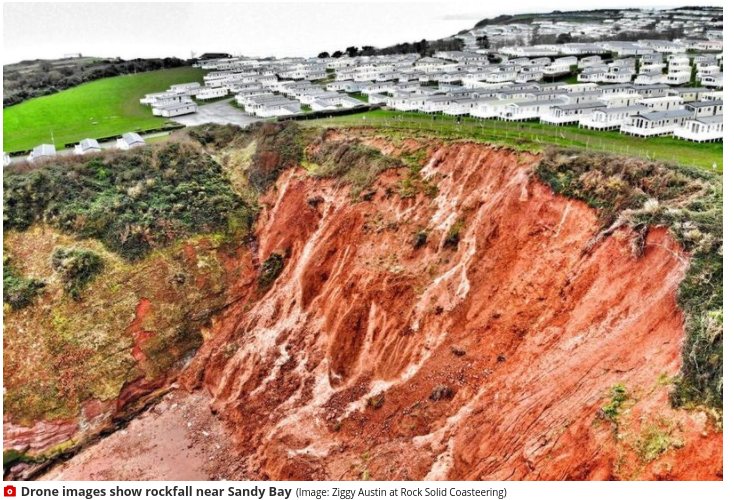
New images of aftermath of huge cliff falls near popular Sandy Bay caravan park

Dramatic drone images have captured the aftermath of another cliff fall in East Devon.

Chloe Parkman www.devonlive.com 

The pictures, which were captured by Ziggy Austin at Rock Solid Coasteering, were taken near Sandy Bay caravan park – and they captured the extent of East Devon’s notorious crumbling cliffs.

Over the last 18 months, there have been a number of cliff falls in the area with some of the most notable taking place in Exmouth and Sidmouth.

The pictures, which were taken on Monday, show some caravans are now just metres away from the edge of the cliff.

Back in August, the stretch of cliff saw five massive falls in one morning.

Crumbling clay tumbled from the cliffs between Sidmouth and Salcombe Mouth, which sparked a warning from Beer Coastguard Rescue Team.

In a statement made on Facebook last year, a spokesperson said: “Cliff falls this morning, please stay away from the base of cliffs and take note of the signs, they are there for a reason.”

The images were captured near Sandy Bay (Image: Ziggy Austin at Rock Solid Coasteering)

And much to the horror of many, back in July, groups of beach-goers were pictured sitting directly under East Devon’s crumbling cliffs, despite an enormous sign warning them of the potential dangers.

The photograph was taken near Sandy Bay as many people across the county raced to the coast in order to take advantage of the heatwave.

The image which shows the beach-goers located right next to a yellow sign which reads: “DANGER – beware of falling rocks” has sparked upset in local residents to the area.

Following the scene, eye-witness Raymond Loades, said: “[This happened] at Sandy Bay last Wednesday (July, 21).

The caravan park is located on the cliff top (Image: Ziggy Austin at Rock Solid Coasteering)

“Having seen this every time we go there for the last five or six years I felt it was time to try and get something done as when I usually point out what the notice says, the majority of the replies are unprintable.”

Read the full story here.

Can Britain really learn to live with Omicron? This week we’ll find out

The roulette wheel is spinning, the ball already rattling towards its final destination. Boris Johnson has bet the house on his Omicron gamble and now there’s no going back. 

Gaby Hinsliff www.theguardian.com 

The bullishness of ministers insisting over the weekend that they see no case for further restrictions glosses over the fact that it may now be too late for that anyway, given an estimated one in 25 people in England already had the virus before New Year’s Eve.

Double or quits it is, then, as a country drags itself back out to work and school after the Christmas hibernation period. We’re about to find out exactly what it means to experience unprecedented levels of Covid infections, but from a strain that may be less dangerous, at least in the fully vaccinated. Once again, a virus we thought we’d got to know has abruptly shapeshifted and once again, history isn’t necessarily a reliable guide to the present. We’re all back on the seesaw, lurching between hope and fear, never knowing quite what to expect.

The novel threat this time is not death on the biblical scale forecast during the first wave – although sadly there will be too many deaths, hospitalisations and cases of long Covid disabling people for months to come – but knock-on chaos and disruption caused by the potential mass infection of key workers, leaving them unable to do their work. We’ve entered an unpredictable world of people who have heart attacks waiting for well over an hour for an ambulance, critical incidents being declared by hospitals that can’t maintain safe staffing levels and large organisations being warned to plan for up to a quarter of their people being off sick or self-isolating. Now imagine what that worst-case scenario might do to the everyday grind of supermarket deliveries, bin collections and bus timetables, let alone to policing or critical infrastructure such as the power and water industries.

Education ministers have meanwhile vowed to keep schools and nurseries open wherever possible – rightly given the profound impact we now know closures had on poorer children’s education, and on a vulnerable few who are sadly safer with their teachers than with their parents – but are simultaneously letting heads know they can send year groups home if they have to. For secondary schools in England and Wales hit by serious staff shortages, in practice that would probably mean prioritising GCSE and A-level classes for pupils who need to sit their mocks this term but switching to home schooling for other years if necessary, something already happening in some parts of the country before Christmas as Omicron hit.

Nurseries and primary schools catering for pupils too young to be vaccinated will meanwhile be flinging windows open to the January air and crossing their fingers, knowing that (at least according to the Office for National Statistics) about one in 15 children aged between two and 11 had Covid before Christmas. Since many key workers are also parents who can’t easily do their jobs if their child gets sent home sick, we’re probably about to be reminded that childcare is the fourth emergency service, without which the other three would struggle very quickly. In other words, it’s time to prepare ourselves at least for the possibility of things getting messy; of everyday life becoming harder and more volatile as Covid jams its spokes into wheels that in good times you barely even notice turning.

With luck, that upheaval could be mercifully brief. But any country that nearly ground to a halt overnight thanks to a temporary post-Brexit shortage of fuel tanker drivers and a panicky stampede for petrol should probably have learned by now not to get cocky. Over and over again this virus has reminded us of just how much happens unseen beneath the surface of a functioning society; of how complex our just-in-time modern lives with all their endlessly interconnected moving parts have become, but also how fragile, dependent on things and people we mostly take for granted until brutally reminded not to do so.

And that’s why learning to live with this or any other virus, the mantra of those who never want their liberties restricted by government diktat again, doesn’t mean quite what some hope it does. It’s not about ripping off your mask and gleefully forgetting that any of it ever happened, but about building in resilience and learning from the weaknesses exposed by Covid. Rubbing along successfully through what might hopefully be the tail end of a pandemic should mean investing not just in vaccines and antivirals but in more hospital beds and people to staff them, creating enough slack in the system to absorb seasonal Covid surges without having to throw up tent wards in NHS car parks. It’s going to mean well-honed contingency plans for critical industries, better ventilation in schools, and more imaginative answers to the question of protecting people who are shielding or clinically vulnerable than are so far forthcoming from lockdown sceptics bellowing that it’s time everyone was left to get on with their lives. But it may also take something of a shift in national attitudes.

Living successfully with Covid-19 will require not just a virus obliging enough not to mutate in more lethal ways but the maturity to self-police sometimes – as plenty did last month by voluntarily side-swerving parties or the pub so they could have Christmas with their families, and as Swedes have always quietly done in what was the unsung element of their country’s no-lockdown policy – and the resilience to live with a degree of unpredictability in life, which is infinitely easier said than done for some. Low-income families especially are likely to need help absorbing the sudden shocks and disruptions this virus is still capable of delivering, even as it hopefully burns itself out.

The silver lining to the Omicron cloud is, of course, that it could pass relatively quickly. It’s risky reading too much into data collected over the Christmas holidays when reporting was potentially patchy, but all hopes are now pinned on Britain following the same path as South Africa, where infections seemed to peak relatively quickly before falling back. A rocky few weeks, so the cabinet’s argument goes, beats months of economic and personal misery; better to rip the plaster off and get it over with. Whether that gamble was uncharacteristically shrewd or lethally reckless will become clear enough in the next few days as Omicron spreads from London to the rest of the UK, with hospitalisation rates doubling already across much of the north of England. But right now, the wretched roulette wheel is still spinning, and all most of us can do about it is hold our breath.

Parts of NHS may be overwhelmed by Covid wave, admits Boris Johnson

On 20 December the Prime Minister said the latest data will be kept under constant review “hour by hour”, and refused to rule out further measures after Christmas. 

“We will have to reserve the possibility of taking further action to protect the public and to protect public health, to protect the NHS,” he said. “We won’t hesitate to take that action.”

All weekend Ministers’ have been making bullish statements that Plan B was sufficient. These have been made on the basis of the fragmentary and incomplete data emerging during a prolonged holiday period accompanied by shortages of testing kits. The Prime Minister also presents the choices available as a binary one between Plan B and “closing down the economy”.

Derriford is one of the latest to declare an internal critical incident.

To have any chance of making any impact that action would have had to have been taken and implemented  before the New Year. It’s now too late, the roulette wheel is spinning. – Owl

Rowena Mason www.theguardian.com 

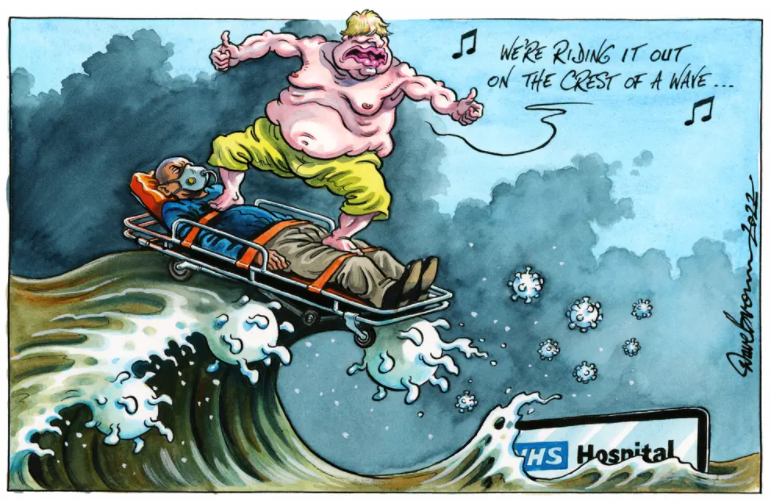
Parts of the NHS may be overwhelmed in the coming weeks, Boris Johnson has admitted for the first time as he insisted England can “ride out” its biggest ever Covid wave “without shutting down our country once again”.

The prime minister acknowledged the health service is under huge pressure after four more NHS trusts – all outside London – declared critical incidents amid rising staff absences and Covid patients. On Tuesday evening hospitals across Greater Manchester announced some non-urgent surgery and appointments would be suspended.

Heart attack patients calling 999 in parts of northern England were also asked to get a lift instead of waiting for an ambulance as hospitals in the region experienced more than double the growth rate in numbers of Covid patients compared with London, which was previously worst hit by the Omicron variant surge.

With frontline worker absences fuelled by a record 218,000 new confirmed UK cases of Covid on Tuesday, Prof Chris Whitty, England’s chief medical adviser, said the NHS faced “very substantial pressure over the next couple of weeks” – though there was not yet a “surge in mortality” seen with other waves by this stage.

Johnson claimed the vaccine programme and reduced chance of hospitalisation with Omicron meant there was now a chance for the country to get through the wave without imposing new restrictions.

To reduce disruption from staff off sick or isolating with Covid, he unveiled a plan for 100,000 critical workers to get tests on every working day to detect cases quickly and prevent them spreading, although some experts raised concerns that was not enough.

Previously, Johnson has said he would bring in further restrictions if there was a risk of the NHS becoming overwhelmed. However, the prime minister accepted it may already be happening in some areas when asked for a definition of this, given many medical staff feel that situation has already been reached.

“The NHS is under huge pressure,” he told a Downing Street press conference. “I won’t provide a definition of what being overwhelmed would constitute because I think that different trusts and different places, at different moments, will feel at least temporarily overwhelmed.”

He said hospitals were “at the moment … sending out signals saying that they are feeling the pressure hugely and there will be a difficult period for our wonderful NHS for the next few weeks because of Omicron”, adding: “I just think we have to get through it as best as we possibly can.”

In a further sign of the intense strain on hospitals NHS bosses in Greater Manchester decided on Tuesday to postpone planned surgery and outpatient appointments amid a major surge in both Covid admissions and staff isolating with the virus.

In a statement the Greater Manchester Combined Authority said that the region’s 17 hospitals “have made the difficult decision to pause some non-urgent surgery and appointments due to the rising impact of Covid”. However, surgery for cancer, heart conditions, vascular problems and organ transplantation will still go ahead, it pledged.

Medics and scientists have been pressing Johnson for weeks to bring in restrictions beyond the advice for people to work from home and requirement for masks in shops and on public transport, with tougher measures already in force in Scotland and Wales. But the prime minister would find it very difficult to get support for further measures in England from Tory backbenchers, scores of whom voted against current plan B restrictions before Christmas.

Johnson did not rule out further measures to tackle Covid transmission but said the current plan was to “keep our schools and our businesses open, and we can find a way to live with this virus”.

Health leaders reacted with concern, saying Johnson had not acknowledged the depths of the NHS’s problems despite unprecedented pressure in some areas. Pat Cullen, general secretary of the Royal College of Nursing, said nursing staff will have “watched the prime minister’s statement in disbelief”. “One described to me today that the NHS feels more broken than she’s ever known it. This is not hysteria, this is blowing the whistle on falling standards as patient care comes under real threat,” she said.

“Vaccinations alone will not reduce infections and hospitalisations – more must be done to prioritise nursing staff for access to testing and high-quality PPE. Meanwhile, the emphasis on virtual and temporary beds shows that the government still fails to recognise the value of highly skilled nursing staff or grasp the extent of the workforce crisis.”

Matthew Taylor, chief executive of the NHS Confederation, said the attempt to reassure the public that the NHS is not being overwhelmed “does not chime with the experience of staff up and down the country who are facing fast-rising hospital admissions, intense pressures on all parts of the health and care system and widespread staff absence”.

“We urge the government not to allow its optimism to lead to complacency given the rapidly changing situation we are seeing on a daily basis,” added Taylor. He welcomed the plan for daily rapid testing of key workers but said it should have been made available earlier in the pandemic.

The British Medical Association, which represents doctors, urged Johnson to impose new restrictions to help relieve the pressure.

“The facts, figures and the living reality for thousands of patients and NHS staff daily demonstrate undoubtedly that the NHS is currently already overwhelmed,” said Dr Chaand Nagpaul, the BMA’s chair of council. “Asking the NHS to ‘just get through it’, without doing anything to help, would be to wrongly accept avoidable suffering to thousands of patients in the coming weeks.”

Johnson was flanked by Whitty and Prof Sir Patrick Vallance, the UK government’s chief scientific adviser, as he outlined the approach for England. Vallance said there were “extraordinarily high levels of infection at the moment” in the UK. Hospital pressures would depend on how Omicron had an effect on the older generation, he said.

Whitty acknowledged that “some hospitals, some areas of the country” will come under “very substantial pressure over the next couple of weeks” with high numbers of staff isolating over infections compounding the typical winter pressures.

He also spoke of being left “saddened” by the proportion of unvaccinated patients in intensive care, as he urged people to get their boosters. He said “the great majority” of those who were in intensive care and had not been jabbed were “not anti-vaxxers in the ordinary sense with some really weird ideas” but had been taken advantage of by those seeking to misinform them online.

Whitty said “misinformation” on the internet, “a lot of it deliberately placed”, about potential side effects from jabs was fuelling fears about whether Covid was important enough to warrant vaccination, as well as whether the vaccines were effective against the disease.

The figure of 218,724 confirmed cases on Tuesday was a new UK record for the pandemic, although it included some delayed data from Wales and Northern Ireland.

Here’s what a Tory donor and a lavish Liz Truss lunch in Mayfair tells us about British politics 

A woman must lunch somewhere……….

Simon Jenkins www.theguardian.com 

When the prime minister told Liz Truss to examine every road post Brexit, her thoughts naturally turned to Mayfair and Hertford Street. Perhaps that nice caff at No 5. We are after all lunching with that nice American trade envoy, Katherine Tai. Perhaps two measures of dry gin; two bottles of Pazo Barrantes Albariño, a Spanish white wine, costing a total of £153; and three bottles of the French red Coudoulet de Beaucastel, costing a total of £130. Perhaps a £3,000 bill.

Besides, the proprietor of 5 Hertford Street is Robin Birley, half-brother to Boris Johnson’s mate Zac Goldsmith, and buddy of Michael Gove and David Cameron. And he tipped Johnson 20 grand for his “leadership” campaign, wherever that went.

Surely such generosity calls for a kindly nod and wink. 5 Hertford Street posted substantial losses last year, so the money might come in handy. Birley even halved the bill if it could be paid straight away. The office wants Truss to slum it in Soho. She hits the roof. Who wins trade deals in Soho? Besides, this is one for Birley.

The joy of British corruption is that there are no crude brown envelopes stuffed with notes. Money is never seen changing hands. Negotiation is via a pat on the shoulder, a placement at a dinner, a nod at the tennis net. There need not be a direct quid pro, but favours can flow both ways: a party donation, a contract, a planning refusal overturned, all rounded off with the knighthood or peerage.

The British like to pretend their political culture is pure, but benign terms have been used to mask questionable interactions. In times past, the Metropolitan police vehicle for the receipt of informal benefit was the “police benevolent fund”. It was the stuff of legend and occasional comedy. Now, at a time of wild budgetary spending, every dodgy oddball is crowding round the pig trough. Goodness knows what antics will be revealed, if ever, from the proposed inquiry into the pandemic. It should be standing room only at the Old Bailey.

The strangest transactions seem to revolve around politicians striving to live up to the dignity of their office, be it flat decorations, country houses or foreign holidays. Lunch at 5 Hertford Street is a classic. Turn to a party donor; at least he could host a good lunch.

Truss’s civil servants saw the danger a mile off and steered her towards a more modest watering hole. She would have none of it. It went to her permanent secretary, who let it through, but he is clearly a mouse not a man. Should it now go to the cohort of Whitehall standards scrutineers? If so they must be worked off their feet, with every self-respecting property developer or drug manufacturer feeling they are carrying the weight of the Tory party on their shoulders.

Perhaps the best discipline is daylight. Lunch at 5 Hertford Street is hardly a hanging crime. It rather indicates a general casualness towards public funds and relationships; an attitude of mind. Johnson was very nice to Truss. She returns the favour by shamelessly going on manoeuvres to replace him. Now she is currying favour with his friends. Is that who we want as a future prime minister?

Arise “Sir” Boris – “Knight of the Garter”?

Lindsay Hoyle says all ex PMs should be knighted after Tony Blair honoured

Fatima Aziz www.lancs.live

Chorley MP and the Speaker of the House of Commons has said he believe that all former Prime Minister’s should be given a knighthood.

Following the knighting of Tony Blair, Sir Lindsay Hoyle has called for all former prime ministers to be knighted with the highest possible ranking.

Sir Tony was appointed as a Knight Companion of the Most Noble Order of the Garter, the oldest and most senior British Order of Chivalry, with the honour from the Queen regularly bestowed upon past prime ministers including most recently Sir John Major.

Sir Lindsay told BBC Radio 4’s Today programme, however, it should be given to all ex-PMs including David Cameron because it is “one of the toughest jobs in the world”.

“Whatever people might think, it is one of the toughest jobs in the world and I think it is respectful and it is the right thing to do, whether it is to Tony Blair or to David Cameron. They should all be offered that knighthood when they finish as prime minister,” the Chorley MP said.

“I would say if you’ve been prime minister of this country, I do believe the country should recognise the service they’ve given,” Sir Lindsay added.

“It is not about politics, it is about the position they have held in this country: It’s about the position and it’s the respect that we show to those people who’ve led this country. And I think it’s a fitting tribute to the job they’ve carried out.”

Sir Tony, who left Downing Street more than 14 years ago, was one of three new appointments announced by the palace alongside Baroness Valerie Amos and the Duchess of Cornwall.

Appointments to the Garter are in the Queen’s gift and made without prime ministerial advice, and are usually announced on St George’s Day, April 23, but the monarch can do so at any time, and chose this year to coincide with the New Year’s Honours.

They are for life unless a Knight or Lady Companion offends against certain “points of reproach”.

Founded in 1348 by Edward III, the Garter is awarded by the sovereign for outstanding public service and achievement.

There are now 21 non-royal companions in the order out of a maximum of 24.