UK’s biggest housebuilders hand top bosses bumper bonuses

Persimmon and Taylor Wimpey, Britain’s two biggest housebuilders, handed their chief executives bumper bonuses last year, when building bounced back amid a house price boom.

Julia Kollewe www.theguardian.com 

Persimmon boss Dean Finch received a total pay and bonus package of £2.6m last year, the York-based builder’s annual report showed. That compared with £218,326 in 2020, although he only took over as boss in September of that year.

His pay included a £725,000 salary, a £1.3m annual bonus, and a buyout award of £404,384 to make up for earnings he lost out on when he left his previous employer, National Express.

Finch’s fixed pay and benefits of £833,742 was 32 times the £26,005 that Persimmon’s lowest-paid quartile were paid last year.

However, Finch’s package was still well short of the £110m proposed bonus for Jeff Fairburn, who served as Persimmon’s chief executive until November 2018. The bonus was cut to £75m and Fairburn promised to give a “substantial” amount to charity, but he was still ousted in November 2018. It prompted public outrage, especially as the housebuilder partially relied on the government’s help to buy programme for its sales.

The £29bn help to buy scheme, which is aimed at first-time buyers and ends next year, was criticised by a House of Lords report in January for failing to “provide good value for money” for the taxpayer.

Fairburn has since made a comeback with Berkeley DeVeer, a Wetherby-based housebuilder in which he acquired a controlling stake in January 2020. A year later, the company acquired another builder, Avant Homes.

At Taylor Wimpey, the outgoing chief executive Pete Redfern received a total pay and perks package of £2.8m last year, up from £1.1m in 2020, according to its annual report. It included a cash and share bonus of £1.3m whereas in 2020, at the height of the pandemic, the company decided to cancel executive bonuses.

Redfern has run the company for 15 years and is handing over to Jennie Daly, the current group operations director, who becomes chief executive at the annual meeting in late April. Her total remuneration rose to £1.3m last year from £515,000 in 2020.

Sign up to the daily Business Today email or follow Guardian Business on Twitter at @BusinessDesk<br>

Taylor Wimpey’s median pay and benefits for employees is £46,455, while the lowest quartile is paid £31,651.

Revenues at the housebuilder rose 54% from 2020 to £4.3bn last year, similar to its pre-pandemic revenues, while profit before tax jumped 157% to £680m. This was still below its 2019 profit of £836m.

Persimmon made a profit before tax of nearly £1bn last year, up by a quarter from 2019, as it completed 14,551 homes, generating revenues of £3.6bn.

The Berkeley Group chief executive Rob Perrins is the highest-paid boss of a UK housebuilder. He received just under £8m in salary and share bonuses last year. Most of this, £7.3m, was a payout from a 2011 long-term incentive plan, a share bonanza that also prompted public criticism. The seven-strong executive team at the London and southeast-focused builder collectively received around £24m in pay and perks last year.

Persimmon and Berkeley declined to comment.

The Productivity Puzzle back in the news

Friday’s Times Editorial picked up on Richi Sunak’s mention of the need to accelerate growth and productivity. Old arguments rehearsed yet again with three being stressed: private sector investment, education and technical training, and a culture of innovation. It ends with the statement that Britain’s economic prospects and the wealth of the nation rest on breaking a cycle of low productivity. 

We have been here before with our Local Enterprise Partnership HotSW. 

These are all good things to do but Owl’s personal view is that we need to change fundamentally our short-term business and financing culture. Not until companies and financiers stop looking for quick gains but take the long term view, ploughing profits back into investment in the “tools of the trade”: plant, machinery, training and human capital, will we start to improve.

In crude terms: stop asset stripping, seeking to make a quick buck and paying directors obscene multiples of the average wage.

Increasing productivity means getting more output for each hour worked. A happy and motivated staff are key.

It’s not going to happen is it? 

The Times view on Rishi Sunak’s conundrum: Productivity Problems

The Times Leading Article www.thetimes.co.uk 

“Productivity isn’t everything,” the Nobel laureate Paul Krugman has written, “but in the long run it is almost everything.” Sustainable gains in living standards are only possible if output per worker goes up and Britain’s performance has long been disappointing. Hence, in his spring statement, Rishi Sunak stressed “creating the conditions for accelerated growth and productivity”.

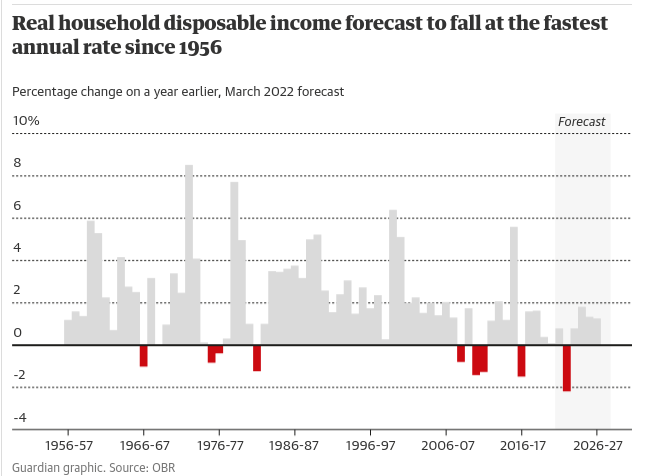
The chancellor is right to perceive the urgency of the challenge. Unless the puzzle of low productivity can be solved, household incomes will stagnate and the country will become relatively poorer. Mr Sunak’s proposed remedies are sensible but they are long term. The risk is that Britain will meanwhile be locked into a cycle of depressed output, real wages and tax revenues.

For most of the postwar era, Britain’s productivity grew by 2 to 3 per cent a year. Between the financial crash and the pandemic, however, it barely expanded at all. Judged by output per hour, its productivity is roughly at the level of Italy, whereas the American economy is estimated to be a startling 23 per cent more productive than Britain’s. The equivalent figure for France is 18 per cent higher, and for Germany it is 10 per cent. Mr Sunak stresses three issues: private sector investment, education and technical training, and a culture of innovation. These are sound aims. The chancellor points to the fact that in Britain corporate investment amounts to 10 per cent of GDP, compared with an average in countries within the Organisation for Economic Co-operation and Development (OECD) of 14 per cent. He has signalled that in the budget this autumn he will provide further tax breaks for business investment.

In his budget last year he gave generous capital allowances for corporate investment in plant and machinery to the end of 2022-23. Whether an extension of this approach will be effective depends on the investment being something the companies would choose to do if financial conditions allowed. Investment is vital but it can sometimes be wasteful, as happened in the dot-com bubble 20 years ago. Tax breaks will work if they bring forward investment programmes that give a more than proportionate boost to national income. The same test holds for public sector investment in infrastructure.

On vocational training, Britain again lags the OECD average. Tax incentives to boost training of workforces in skills is valuable, but the effects are unlikely to show up in the data in the immediate future. Lastly, encouraging innovation through regulatory reform and tax credits for research and development works with the grain of the market. The history of capitalism is dotted with inventions that boost productivity, such as containerisation or the microchip. The market economy allows entrepreneurs to succeed, and government should encourage this activity with financial incentives.

For Britain the problem is urgent. Its productivity record is poor and it has lagged behind the eurozone and the OECD since 2016. Uncertainty over Brexit has deterred investment and constrained productivity growth. It is Mr Sunak’s task to help turn that performance round. The levers available to him are limited, for wealth creation depends on private enterprise rather than the state. These are the right areas to be looking at, however, and the chancellor’s aims are sound. Britain’s economic prospects and the wealth of the nation rest on breaking a cycle of low productivity.

Dumped Plymouth Tory explains why he quits

Independents are on the rise in Plymouth but have, as yet, no formal grouping. 

In Owl’s view “Independents” do need to declare some core principles. 

Philip Churm, local democracy reporter www.radioexe.co.uk

A former Tory and leading member of Plymouth City Council has been explaining why he will now stand as an independent candidate, against the Conservatives, in the upcoming local elections.  

Cllr Dave Downie (Independent, Budshead) was cabinet member for education, skills and children and young people but was suspended from the Conservative after he challenged a decision by Plymouth Moor View Conservative Association, in January, not to put him forward for selection. 

Cllr Downie said he had appealed the decision to stop him standing for election but wanted an independent panel to hear his complaints. 

“That was my right but it hasn’t transpired,” he said.

“I would assume that Moor View [Conservative Association] were dragging their heels. And then once it came to the next election time I was out anyway. 

“So, I didn’t get my hearing and I was no longer prepared to be a pawn in someone else’s power games.”

As well as leaving the Conservative group, Cllr Downie has also left the Tory party altogether. 

He says his mind was made up after the selection of a new cabinet on Tuesday following the election of a new leader. 

Cllr Richard Bingley (Cons, Southway) was elected as council leader after Cllr Nick Kelly (Cons, Compton) was ousted from his role following a vote of no confidence.  

Cllr Downie, who has lost his cabinet role, says the new cabinet are not up to the job.  

“I did have and do have real concerns about the lack of experience and the cabinet that I think it’s mostly made up of people who have been in council less than one year. 

”So I’m very concerned for the city, for the lack of experience and knowledge that these people are bringing to the table.”

He says he has told the residents in his ward that he will be standing as an independent.

“I have put that out there on social media. I definitely will be standing in Budshead ward.”

He also joins a growing group of independent councillors on the council, many of whom have left mainstream parties. However there is no formal independent group. 

Cllr Downie praised Cllr Chaz Singh (Drake) who left the Labour group in September 2019 and now represents Drake Ward as an independent.   

 “I would love to be elected and work with Cllr Singh, for example,” he said. “Only because we could be called ‘Chaz and Dave.’”  

One third of the city council in Plymouth faces re-election on Thursday 5 May.

Weekly Covid cases in UK increase by 1m, figures show

The number of coronavirus infections across the UK rose by an estimated 1m compared with the previous week, with figures in Scotland at a record high, data from the Office for National Statistics has revealed.

See below for latest data for infections and hospital Covid cases in Devon. The third wave this year may be peaking but over 75s are in the thick of it. Hospital cases are still rising steeply with consequent knock on effects.

Nicola Davis www.theguardian.com

According to the latest information from the ONS, based on swabs collected from randomly selected households, an estimated 9% of the population in Scotland had Covid in the week ending 20 March, about one in 11 people. The figure is the highest recorded by the survey since it began looking at the situation in Scotland in October 2020.

Infection levels also increased in England and Wales, although they decreased slightly in Northern Ireland, with data revealing that about one in 16 people in England had Covid in the most recent week, compared with one in 20 the week before, a rise from about 2,653,200 to 3,485,700 people.

The figure is just shy of the all-time high for England, when about 1 in 15 were estimated to have Covid in the week between Christmas and New Year’s Eve last year, at the height of the Omicron wave.

Experts have suggested that the recent surge in infection levels in the UK is owing to a number of factors, including the lifting of Covid restrictions to various degrees across the UK, changes in behaviour, waning immunity after the booster programme and – crucially – the rise of the BA.2 variant, which appears to be more transmissible than the earlier form of Omicron.

“The percentage of people with infections compatible with the Omicron BA.2 variant increased in England, Wales and Scotland and decreased in Northern Ireland,” the ONS report states.

Previous ONS figures have suggested that Northern Ireland experienced a rise in BA.2 before other parts of the UK.

On Friday, the UK Health Security Agency reported that cases of the BA.2 Omicron variant were increasing 75% faster than the original variant, BA.1, and now made up almost 89% of Covid infections sequenced in England. There is no evidence that BA.2 causes a greater risk of hospitalisation.

The agency is also monitoring three “recombinant” forms of the coronavirus that can occur when a person is infected with two Covid variants at once. The first, a mix of Delta and BA.1, known as XF, caused a small cluster in the UK but has not been spotted since mid-February. The second, XE, is a combination of BA.1 and BA.2 and is spreading about 10% faster than BA.2 in the UK, with 637 cases identified as of 22 March.

The third, XD, is another blend of Delta and BA.1. While it has not yet reached the UK, it has surfaced in France, Belgium and Denmark, and scientists are watching it closely because it is essentially the Delta variant with the Omicron spike protein.

The ONS figures also show that infection levels rose in all age groups in England. While the percentage of people testing positive was highest in children between two years old and school year 6, infection levels reached unprecedented levels in older adults: among those who are 70 or over, the figure hit an estimated 5.7% on 19 March.

While all regions of England experienced a rise, the highest levels of infection were in the south-east, with about 7.5% of people – or one in 13 – estimated to have had Covid during the week.

Sarah Crofts, the head of analytical outputs for the Covid-19 Infection Survey, said: “Our latest data show infection levels have continued to increase in England, Wales and Scotland, driven by the rise of the Omicron BA.2 variant.

“Northern Ireland was a few weeks ahead of the rest of the UK in this rising variant, where we now see a welcome decrease. Meanwhile, Scotland has now reached the highest level of any UK country seen in our survey.

“Across England, infections have increased in all regions and age groups, notably the over-50s, who are at their highest levels since our survey began.”

The figures come the week before free community testing ends for most people. After 1 April, most people in England will have to pay to take a Covid test, while advice to stay at home if someone has Covid symptoms is also set to be scrapped.

While vaccinations, improved treatments and a shift in variant severity have all helped to weaken the link between infections, hospitalisations and deaths, the recent surge in the number of people with Covid has nonetheless affected the NHS, with an uptick in hospitalisations – including an increase in those primarily being treated for Covid – increasing concerns about infections in vulnerable people and posing logistical challenges. Some hospitals have suspended visiting because of rising infection levels.

Latest data from Devon Covid Dashboard

Confirmed Cases by age

Hospital cases for the whole Devon Integrated Care System i.e. including Plymouth and Torbay

Tory peer lobbied for PPE firm months after lawyers said she had stopped, leaked emails suggest

Leaked emails suggest that the Conservative peer Michelle Mone lobbied a health minister on behalf of a company seeking Covid contracts – five months after the point at which her lawyers said she had stopped doing anything for the firm.

David Conn www.theguardian.com 

The documents add to questions surrounding Lady Mone’s account of her involvement in PPE Medpro, which was awarded government contracts worth more than £200m to supply personal protective equipment early in the pandemic.

Several months later, according to the leaked emails, Mone was trying to help PPE Medpro secure a lucrative contract to supply the government with Covid-19 antigen tests.

Mone has repeatedly sought to distance herself from PPE Medpro, whose business she first recommended to the government in early May 2020.

When Mone’s referral of May 2020 became public, she said her involvement in the company went no further than a single recommendation to the then Cabinet Office minister Theodore Agnew. Her lawyer said: “Having taken the very simple, solitary and brief step of referring PPE Medpro as a potential supplier to the office of Lord Agnew, our client did not do anything further in respect of PPE Medpro.”

However, emails seen by the Guardian from October 2020 suggest that Mone was by that point still promoting the company, which was selling Covid tests.

Anthony Page, one of PPE Medpro’s directors, emailed the Tory peer James Bethell, then a minister at the Department of Health and Social Care (DHSC), on 6 October mentioning Mone’s involvement.

“I write to you in my capacity as UK managing director of PPE Medpro,” Page said. “I understand that Baroness Mone has kindly made you aware of the company and our recently developed coronavirus antigen rapid test.”

The email continued: “By way of introduction, PPE Medpro is a PPE and medical product supplier that, in recent months, has successfully completed orders of 235m units to DHSC.”

In addition to his role as the sole public face of PPE Medpro, Page is a longtime senior employee in the Knox Group, the Isle of Man-based financial services firm run by Mone’s husband, Douglas Barrowman.

Lawyers for Mone, who sold her stake in the Ultimo lingerie company before David Cameron made her a member of the House of Lords in 2015, have said she “was not connected to PPE Medpro in any capacity” and “has no involvement in the business”.

Barrowman’s lawyers have similarly distanced him from the company, but they have not denied that he benefited financially from PPE Medpro’s business.

Last month the Guardian revealed that leaked files appear to suggest that both Mone and Barrowman were secretly involved in PPE Medpro’s mask and surgical gowns business.

The newly leaked emails between Bethell and Page suggest that Mone was subsequently also involved in supporting PPE Medpro’s attempt to secure a slice of the testing market.

In his 6 October 2020 email, Page told the Tory minister that the “consortium behind PPE Medpro” had partnerships with two factories that could produce 1.9m Covid tests a day. “We are able to start production immediately following agreement of terms and on receipt of signed contract and PO [purchase order] from DHSC. I would welcome a dialogue with you and/or your team to get things moving.”

According to a government source, Bethell then referred PPE Medpro to a specialist team of officials and consultants who gave him prompt, attentive service. PPE Medpro, the source added, was among a number of companies referred as potential Covid-testing suppliers that were given a similar priority service.

The source, a government official who spoke on the condition of anonymity, described the process of prioritising well-connected firms offering coronavirus testing kits as akin to the government’s “VIP lane” for well-connected PPE firms.

Despite the special attention, Page appears to have become impatient with his treatment by the department, complaining in an email to officials and copying in Bethell and Bethell’s private secretary.

PPE Medpro ultimately failed in its testing bid. However, the government source believes officials gave PPE Medpro undue priority because of its political backing.

“Given their lack of experience, PPE Medpro should have been turned down at the start for testing contracts, which were such a vital part of our response to the pandemic,” the official claimed. “But instead we tutored that company through the process because we knew that senior people were involved: we were very aware that Baroness Mone had held that initial discussion with Lord Bethell.

“The concerns were already starting about the VIP lane that operated for PPE, yet here we were giving a special service to companies just because of their political connections.”

Mone appears to have been still contacting officials on behalf of PPE Medpro four months after her contact with Bethell, and nine months after she first recommended the firm to Lord Agnew.

Jacqui Rock, the chief commercial officer for NHS test and trace, told colleagues in February 2021 that Mone was “incandescent with rage” at the treatment of PPE Medpro over testing contracts, saying they had been “fobbed off”, and was planning to speak to Michael Gove and Matt Hancock about her concerns.

Mone’s lawyer did not respond directly to questions from the Guardian about her referral of PPE Medpro to the government for Covid-19 tests, saying: “She has no involvement in the business.”

Bethell did not respond to a request for comment.

A DHSC spokesperson said there had been “a rigorous scientific validation process with officials to ensure no products were progressed that did not meet the required specification”.

Page denied that the company was given preferential treatment because of Mone’s recommendation, saying that PPE Medpro had already been working with the DHSC, so already had the necessary contacts. He blamed the company’s failure to secure testing contracts on “adverse press” and “the process being frustrated by the various testing phases,” although he said they “passed at each phase”.

More crocodile tears over P&O?

Grant Shapps calls for P&O Chief Executive to resign and Boris Johnson agrees.

No doubt, were he to go, there would be relief all round. But a much bigger question would remain. Is the parent company of P&O, DP World, a suitable strategic partner for the government-backed freeport scheme?

Also how surprised should Grant Shapps have been following his meeting with DP World last November? – Owl

P&O Ferries may not regret breaking law, but the UK should regret dealing with its owner 

Nils Pratley www.theguardian.com

More than a few business chancers have appeared before Commons select committees over the years, but it’s hard to recall a chief executive who has admitted that his company carefully assessed its options and decided that breaking the law was its best bet.

Peter Hebblethwaite of P&O Ferries, the firm that sacked 800 seafarers last week, offered candour and cynicism in the same breath. “There’s absolutely no doubt that we were required to consult the unions. We chose not to do that,” he said. For good measure, he said he would take the same decision again.

Naturally, Hebblethwaite laced his account with pleas that P&O Ferries wasn’t viable unless it replaced its UK crew with foreign agency workers being paid salaries as low as £5.15 an hour. No doubt he’s correct about the many millions P&O has been losing amid the pandemic and energy crises, but this was a brazen attempt to claim that protecting wealthy parent DP World’s investment was more important than staying within the law. Trade unions would never accept P&O Ferries’ proposals, said Hebblethwaite, so there was no point negotiating with them.

Via video link from Dubai, Jesper Kristensen, the chief operating officer of marine services at DP World, weighed in that P&O Ferries was not a rogue part of the corporate empire. Hebblethwaite would not be sacked, the mass dismissal of the UK crew had been blessed in advance and DP loved doing business in the UK, where its major investments are the Thames and Solent port terminals.

Government ministers spluttered in the following session to explain why they had not immediately run off to the high court last week. The gist of it was that the Insolvency Service must be given time to get on top of the legal details. In due course, ministers would look to close any loopholes in the law to better protect employees.

Wherever those subplots lead, one move for the government ought to be straightforward: DP World, for all its wealth and state backing, cannot be considered a suitable partner for the UK’s freeport programme. A company that declares a casual relationship with UK employment laws does not belong in a government-backed scheme. Nor, frankly, should it be here at all.

But how surprised should Grant Shapps have been?

P&O Ferries: questions raised over Grant Shapps’ meeting with DP World 

www.theguardian.com 

The UK transport secretary, Grant Shapps, met the DP World boss Sultan Ahmed bin Sulayem last November and told him that he was “aware of the issues at P&O Ferries” but recognised “you will need to make commercial decisions”, according to official minutes of the meeting.

The revelation raises further questions about whether Shapps could have acted to head off the mass sackings last week at the Dubai-owned ferry operator.

National Trust vows to ‘bring back the blossom’ as new research reveals massive drop in orchards since 1900s

“The south-west, which was home to the largest area of orchards at the beginning of the 20th Century, has experienced the loss of nearly 24,000Ha (around 74 per cent), over twice the size of Bristol – of its orchards, the single biggest loss in terms of hectares of any region.” 

www.nationaltrust.org.uk (Extract)

The National Trust study is the first comprehensive review of both traditional and modern orchards in England and Wales. Data from historic maps has been compared with data from People’s Trust for Endangered Species (PTES) and Natural England, and analysed using artificial intelligence (AI) mapping technologies from ArchAI Ltd. It is aimed at improving understanding of the historic loss of blossom across landscapes, and the impact on nature and wildlife.

The research exposed a huge 81 per cent decline, (78,874Ha), in traditional orchards in England and Wales – equivalent to an area close to the size of the west Midlands – spelling bad news for nature.

And, even when taking each country in isolation, England’s figures alone revealed a loss of 82 per cent of traditionally managed orchards (77,926Ha) – twice the size of the Isle of Wight.

‘Total blossom’, ie the area from all types of orchard in England has more than halved (56 per cent) since around 1900, with 41,777Ha left growing today. 

In Wales a loss of 948Ha of traditionally managed orchards, 48 per cent, since around 1900, is significant but compares much more favourably than England, likely due to the number of orchards in Wales which are small  family-scale orchards that are not exposed to the development and modernisation pressures experienced in England, particularly in the commercial sector. 

‘Total blossom’ from orchards in Wales has fallen by 38 per cent to 1,240Ha since around 1900.

Tom Dommett, Head of Historic Environment at the National Trust says: “Using cutting edge technology we now have a much better understanding of how we’ve managed landscapes in the past, which is invaluable when thinking about how to tackle the nature and biodiversity crisis that we are facing, and restoring nature.” 

Looking in more detail at orchard loss in the regions, the north of England, whilst being home to only a relatively small proportion of the orchards in England and Wales in 1900, has seen the largest regional declines in orchard area, with 80 per cent in the north-west, 78 per cent in the north-east and 77 per cent in Yorkshire and Humber.  

However, the south-west, which was home to the largest area of orchards at the beginning of the 20th Century, has experienced the loss of nearly 24,000Ha (around 74 per cent), over twice the size of Bristol – of its orchards, the single biggest loss in terms of hectares of any region. 

London and the south-east fared much better with the smallest overall orchard losses of 24 per cent, largely due to the number of significant modern orchards which have been planted.  However, the region has seen a reduction of 84 per cent in the area of traditional orchards, representing big losses in nature value.

In a bid to bring blossom back to landscapes in England, Wales and Northern Ireland, the charity has now vowed to plant four million blossoming trees as part of its commitment to plant and establish 20 million trees across England, Wales and Northern Ireland by 2030.

It is also planting new traditional orchards at sites to include Stourhead in Wiltshire, Arlington Court in Devon, Kingston Lacy in Dorset, Brockhampton in Herefordshire, Attingham Park in Shropshire, Westhumble in Surrey and is planting new fruit trees at Cotehele in Cornwall which is already home to traditional orchards.    

For further information and to make a donation towards the National Trust’s tree planting ambitions visit www.nationaltrust.org.uk/blossom-watch 

The tragedy of Matt Hancock

And now banged to rights by the National Audit Office (NAO) which, in a critical report, concluded that the Department of Health and Social Care (DHSC) did not record properly why it awarded contracts worth nearly £500m to the healthcare firm, Randox.

Matt Hancock, the former health secretary, failed to notify his officials about private messages he exchanged with disgraced Conservative MP Owen Paterson, a healthcare firm’s paid lobbyist, the official watchdog has disclosed.

Will Lloyd unherd.com

The first lockdown deepened during a luridly warm spring. Strange things began to happen in England. Mr Motivator MBE returned to television, and a TikTok about pubs made young men cry. The middle-classes baked until the flour ran out; the bus drivers, cabbies and chefs contracted the virus, then died. The rich just became richer; they were like the aristocrats who viewed Borodino’s bloodbath from the heights. But strangest of all was the daily, hourly, minute-to-minute ubiquity of Matt Hancock.

Long before SARS-CoV-2 was a twinkle in the eye of a Wuhan cave bat, Hancock worked on the student radio station at the University of Oxford.  A contemporary, Gina Coladangelo, reminisced that Matthew read the sport “because he wasn’t good enough to do the news.” Another remembered Hancock as the “butt of everyone’s humour”. He wanted to go to Westminster and be an MP.

He nearly blows himself up. Guildford, 2001. Young Matt does an election leaflet for the Tory candidate Nick St Aubyn. Instead of saying that St Aubyn wanted to “unite” the community, a 22-year-old Hancock writes: “I want to untie the community”. The leaflet lands in 50,000 letterboxes. St Aubyn loses his seat by 538 votes.

Shortly after becoming a junior minister, Hancock compares himself to Pitt the Younger, Disraeli, and Churchill; their achievements are quite well known, but he will make history on his own terms in 2018 when he becomes the first MP to launch a personal app: The Matt Hancock App.

Its creation leads to the memorable onscreen prompt “Matt Hancock would like to access your photos”  — and he appears to get them even if users deny the ‘The Matt Hancock App’ access to their libraries. A spokesman for the Information Commissioner’s office admits, “We are checking reports about the operation of The Matt Hancock App”.

In a party where the average age of a member is 72, Hancock appears young and bright. He is marked out by the early patronage of Osborne, who says of his protege: “In a political system that is full of Eeyores we could do with a few more Tiggers.”

That nickname fits well. Tigger Matt has the tamped energy of the short man, over-exercised. Enthusiastic; readily and sycophantically agreeable. His colleagues mock him — Matt Wankcock and Matt Handjob will be insider nicknames for him — but they are usually reluctant to fire him, even when it makes sense to do so.

***

As the Conservative Party tortures itself in 2019, Hancock decides he would like to be leader. Or raise his profile. So he attacks Boris Johnson and a hard Brexit: “To the people who say fuck business, I say fuck fuck business.”

He fuck fuck’s himself into sixth place in the first ballot of the party’s MPs. Then he withdraws; he spends a month on television and radio praising the new leader… Boris Johnson. Hancock expects a promotion for his breathy verbal parkour. He keeps his job as Health Secretary instead.

To run the NHS is no Conservative’s idea of a dream. Neville Chamberlain was the last Tory Health Secretary to become Prime Minister. The service itself is a patched-up patchwork, a tax sink, an organisation colossally vast and maddeningly confusing. Hancock’s real brief is to make sure the whole thing doesn’t fall apart when people are looking.

The pandemic is the greatest health crisis to face Britain since mad George III thought that an oak tree in Kew Gardens was Napoleon’s ambassador. Fate, or a lab-leak, means that soon everybody will look at the NHS.

***

A relaxed, Prime Minister-less COBRA meeting is held at the end of January 2020. After chairing it Hancock tells reporters the risk Covid posed to the public was “low”. On the same day a study published by Chinese doctors in The Lancet suggests SARS-CoV-2 is comparable to the 1918 Spanish flu, which killed around 50 million people.

The risk to the UK is deemed so low that on 24 February the Government supplies 1,800 pairs of goggles, 43,000 disposable gloves, 194,000 sanitising wipes, 37,500 medical gowns and 2,500 face masks to China. Looking back at meetings that month, one senior Department for Health official remembers thinking “‘Well, it’s a good thing this isn’t the big one.’”

***

A clip of Boris Johnson, patiently explaining possible Covid strategy to fellow scientific luminary Phillip Schofield goes viral. “One of the theories,” Johnson had said on March 5, was that “perhaps you could take it on the chin, take it all in one go and allow the disease, as it were, to move through the population, without taking many draconian measures”.

Loo paper soon begins to disappear nationwide. Hancock is rolled out — he was always being rolled out, like a new carpet to be trodden on — into a breakfast TV studio to deny that the Government wanted to massacre the Grannys. “Our goal is to protect life and our policy is to fight the virus.”

Then Neil Ferguson releases his controversial paper. It claims hundreds of thousands will die if Britain is left to take the virus on the chin. Sage advises the Government to embark on a full lockdown that day.

It arrives on 26 March 2020, as Covid cases double every 72- hours. Between 89% and 94% of the public support lockdown. And the Grannys? Care home deaths accounted for 40% of Covid-19 deaths in England and Wales during the pandemic.

***

Like other ministers, after the passage of the Coronavirus Act, Hancock develops war fever. “Our generation has never been tested like this”, he writes to a nation frantically, pointlessly washing its hands. “Our grandparents were, during the Second World War, when our cities were bombed during the Blitz… they pulled together in one gigantic national effort.” The allegory is both ugly and lazy, but Britain is a country where poppies are made to wear poppies.

***

Prince Charles opens the first Nightingale Hospital at the ExCel centre in London. He says the Nightingale “will be a shining light”. The hospital is constructed in nine days, and holds 500 extra intensive care unit beds. (For every hundred thousand members of the population the UK has 7.3 intensive care beds — less than Spain, Greece, and Estonia. This lack of provision will mean more deaths.)

More Nightingales open across the country. They cost the taxpayer £500 million pounds. Only three of the seven hospitals end up treating patients. They are described by one MP as a “massive white elephant conjured up by Matt Hancock to create a good headline”.

***

It’s not really worth it, going outside. A family of five is sent home by the police in Conwy after being caught having a day at the seaside. They scuttle back to Merseyside. Police in Derbyshire “divide opinion” when they use drones to film people walking in the Peak District. A “major incident” is declared when thousands travel to Bournemouth beach, to swim, eat ice cream, and burn in the sun. (Belatedly, it is revealed that the “major incident” did not lead to a spike in Covid cases.)

Speaking to Andrew Marr, a concerned Hancock threatens to ban outdoor exercise. “Let’s not have a minority spoiling it for everybody.”

***

Nothing works properly. The Test and Trace App doesn’t work. PPE doesn’t work — because it’s all out of date. Protecting care homes doesn’t work. Dido Harding doesn’t work. The Civil Service literally doesn’t work. Big-hitter commentators start saying that the entire British state doesn’t work. It is described as “simultaneously overcentralised and weak at its centre”.

But ‘The Matt Hancock’ app still functions. In May 2020 the Telegraph reports that it is becoming a “virtual home for online pranksters and trolls”. Posts to the ‘Have Your Say’ section include drawings of cocks, general abuse, and a date invitation for the (then) married Health Secretary.

When ‘The Matt Hancock’ app is updated a year later, access to the ‘Have Your Say’ section is hidden. One of the last posts read: “Is there a portal on here where I can be awarded a Government contract for an area I have little experience of scale please?”

***

Hancock always looks caught between a giggle and a sob. A new round of Covid restrictions makes casual sex illegal. Or at least that’s how Sky News’ Kay Burley interprets the guidance when she interviews him about it. “You are saying that no social distancing is needed in established relationships,” she notes. “But what about people who are not in an established relationship?”

The Health Secretary, embracing his role as national sex cop, confirms that Government rules do ban shagging someone who is not your normal partner. Apropos of nothing, he adds that, fortunately “I’m in an established relationship”.

A few weeks later, the Times reveals that Gina Coladangelo was appointed to a £15,000-a-year advisory PR role in the Health Ministry. The appointment was never declared. Coladangelo and Hancock are described as “close friends”. A source tells the paper: “Before Matt does anything big, he’ll speak to Gina. She knows everything.”

***

He appears to cry on television when the first Pfizer jabs are stuck into the arms of two pensioners: Margaret Keenan and William Shakespeare. “It’s been a tough year for so many people,” he sobs, rubbing his waterless, unreddened eyes.

The Government spends £12 billion on vaccines. Total pandemic spending is estimated to reach £372 billion. Research finds that under-30s will be disproportionately forced to bear the brunt of these costs. They are described as the “packhorse generation”. The median age of death from Covid is 83 years old. There is no national discussion, parliamentary inquiry, or interest from the Government in working out how the old can make it up to the young.

William Shakespeare dies naturally within a few months of taking the vaccine.

***

In January 2021, a week after the virus death toll tops 100,000, a focus group asks some ordinary people questions about the Health Secretary. A man called Jason compares Hancock to Ian Beale from Eastenders — “He wants people to feel sorry for him.” Asked what sort of car he would be, mother of two Donna suggests that he would be “something that breaks down.”

***

During a committee hearing Dominic Cummings says that Hancock should “have been fired for at least 15, 20 things, including lying to everybody on multiple occasions in meeting after meeting in the Cabinet room and publicly”. Cummings then puts a WhatsApp screenshot on his blog that shows the Prime Minister describing Matt as both “hopeless” and “fucking hopeless”.  When he is interviewed about the message, Hancock says: “Boris has apologised for the way that came over.”

***

The story and the footage and the photo are exquisitely simple. After nearly 18 months of tiers, colour-codes, R-numbers, powerpoint slides, and graphs, here is something everyone could understand: a hand on an arse.

Yes, Hancock’s downfall was exquisitely simple. His affair with Gina Coladangelo was unambiguous. It made sense like fairy tales make sense. The Princess in the tower must let her hair down. The wolf is wearing sheep’s clothing. The apple offered by the witch is poisoned. The politician who spent the pandemic agitating for the harshest restrictions, who would describe Professor Neil Ferguson’s lockdown sex fiasco as a “matter for the police”, who ensured that the public could be fined for sitting on park benches, who threatened them with 10-year prison sentences for breaking quarantines, this ogre of the new common sense, would — of course! — be breaking all his rules.

The press is devastating, and relentless. With a deep understanding of public humiliation, the Queen describes Matthew as a “poor man”. He resigns, his only consolation being one of the most Googled news stories of 2021.

***

Hancock keeps coming back, like Covid. His head pops out of the ground. Phillip Schofield asks him: “Was it your dyslexia that meant you misread the social distancing guidelines?” The nation laughs, bitterly. It is reported that, off air, Hancock “almost seemed euphoric… He didn’t seem to mind being the butt of the joke.” He has returned to his student days, but made them the business of the entire country. He buys stonewashed jeans, and new turtlenecks. He does podcast interviews, and goes to the BRIT awards. He says he is writing a book for Harper Collins. Harper Collins says he is not writing a book for Harper Collins, and Hancock never mentions it again. A role with the UN is torpedoed, and a comeback video — unanimously described as “cringe” — is swiftly deleted. It is impossible to tell, as with England’s experience of three lockdowns, whether he is enjoying all this, or if he is the saddest man in the world.

***

Everybody wanted a lesson from the last 24 months. Neat, comprehensible wisdom. An intelligible narrative. They wanted to say that it finally proved that Germany was a better country than England, or they wanted to say that our vaccine programme proved the EU was useless. They thought England’s experience of Covid could tell us about the national character, the flaws in our state, or otherwise be used to justify every kind of pet project, ideological hang-up, or personal vendetta. There was no narrative line. All that the pandemic proved was that what happened a hundred times before in history could happen to us too.

***

The number of children referred for specialist mental health help rises above one million for the first time in 2021. Cases involving those 18 and under increase by 26% during the pandemic. The Royal College of Psychiatrists warns it is “becoming an impossible situation to manage”.

People, including Hancock, like to talk about learning the lessons of the pandemic. So we can prepare better for the next one. They don’t realise that between the million mentally hamstrung teenagers, the NHS waiting list hitting 9.2 million within two years, an endless backlog of cases in criminal courts, and inflation, that the pandemic hasn’t ended yet. It’s barely started.

26 March 2020 — 26 March 2022

Plymouth Tories disintegrating?

Plymouth councillor quits Conservatives amid ‘bullying’ claim

Carl Eve www.plymouthherald.co.uk 

Plymouth’s Lord Mayor has quit the Conservatives accusing the new leader’s regime of “bullying”, just two days after he was voted into the top job. Councillor Terri Beer departure from the group to go Independent came with a blistering attack on new leader Richard Bingley’s Cabinet.

The long-standing Plympton Erle councillor accused Tory group members of “mentally torturing” ousted leader Nick Kelly, who was toppled on Monday, and said she couldn’t work with “people who have a record of doing some questionable things”.

Cllr Bingley told PlymouthLive tonight he was “mystified by the allegations” and said Cllr Beer was “unhappy that her friends were voted out.” But her resignation is a major blow to the ruling Conservative group, who now find themselves with fewer councillors than Labour in the run-up to the local elections in May

Cllr Beer’s decision to leave the party has – yet again – left the city in a position where the ruling Conservative party has 22 councillors, while Labour have 23 and the Independents rise to 12 members. Hers just the latest in a string of resignations among Tory councillors over recent months.

Cllr Terri Beer, who is Lord Mayor until May, presided over Monday’s full council meeting which saw a no-confidence vote brought by Plymouth Labour and backed by a number of Independent councillors – particularly some who had previously been Conservatives themselves. However, at the close of the meeting, while receiving a number of plaudits and thanks from councillors on all sides, Cllr Beer appeared to have been considering her future.

Taking to Facebook this evening she issued a statement – which appears to have been written on Tuesday March 22 – “which will explain why I am no longer part of the Conservative group in Plymouth.” She noted that she remained “very close friends” with Conservative ward councillor Andrea Loveridge and would continue to “work for our residents.”

She continued: “Having reflected on recent events I have no option but to resign from the Conservative Party and the Local Conservative Group. I cannot continue to be associated with questionable people and bullying under the new leadership.

“I really fear for Plymouth under a cabinet who are lacking in experience and ability. It would not feel right to stay in a group with people who have a record of doing some questionable things.

“The Conservatives locally have been run into the ground by unelected chair persons not from South West Devon. Brilliant and well experienced people have been denied the opportunity to serve communities because their face didn’t fit or they failed to to follow the chairperson’s misguided instructions.

“Cllr Kelly has over the last two years been mentally tortured by certain members all of whom need to bow their heads in shame. It hasn’t just stopped at Cllr Kelly but others in the Conservative group have also suffered. If only the public had the full story.

“As from today I will be the first Independent Councillor to be Lord Mayor and will complete my term as just that. In the last 11 months I have dedicated myself to serving the City and being an Ambassador which is why I swore an oath at last year’s Lord Mayors Choosing.

“Cllr Nick Kelly has always been very supportive of me and my decisions alongside Cllr Tudor Evans and several members of the opposition for which I thank them. At yesterday’s full council Cllr Kelly praised me for the work I have done to date in my role as Lord Mayor and I acknowledge his kind words and that of Cllr Evans.

“This last 11 months I have had everything thrown at me from tragic incidents in the City to joyous events and have carried this out with dignity. The residents in Plympton Erle who know me so well will understand and accept the family pressures I have faced through family illness.

“I will continue to serve Plympton Erle residents as I have for the last 15 years following my year as Lord Mayor as an Independent.”

In reply, Cllr Bingley told PlymouthLive: “I and my colleagues are mystified by the allegations of bulling, because we’ve not had any dialogue [with Cllr Beer] since Monday because Cllr Beer was clearly unhappy that her friends were voted out of office. Nevertheless, I personally wish her well in the future and look forward to taking this opportunity to bring in fresh new blood into the Conservative party and the council chamber.”

In February the Conservative group saw the ousting of Cllr David Downie after he was deselected by the Conservative Moor View Association – rather than the Conservative Councillor Group. The previous month the Conservative Group saw the resignation of Cllr Stephen Hulme.

Last October Moor View’s Shannon Burden waved goodbye to the Conservative group and joined the Independents, while in November Conservative councillor Nigel Churchill walked away from his group citing “unacceptable” conduct of senior members.

The return of the unpleasant and unacceptable face of capitalism

We really are returning to a darker world – Owl

P&O Ferries boss admits firm broke law by sacking staff without consultation

Gwyn Topham www.theguardian.com 

P&O Ferries broke the law by choosing to sack 800 workers without consultation because “no union could accept our proposals”, the firm’s boss has admitted.

Peter Hebblethwaite told a Commons hearing on Thursday into last week’s firings that the firm was halving its costs under a “new operating model”, which meant international seafarers would be paid less than minimum wage.

Fresh questions also arose about what warning ministers had received of the sackings, after Hebblethwaite said P&O’s parent company, DP World, had told the transport secretary, Grant Shapps, of planned changes to its business model in November.

Hebblethwaite faced an intense examination at a joint hearing of the transport and business committee. The business committee chair, Darren Jones, opened by asking about Hebblethwaite’s recent rise to the chief executive position at P&O: “Are you in this mess because you don’t know what you’re doing, or are you just a shameless criminal?”

Hebblethwaite apologised but said the firm had “otherwise had no future”.

Later he admitted: “There’s absolutely no doubt we were required to consult with the unions. We chose not to do that.”

Andy McDonald MP interjected: “You chose to break the law?”

Hebblethwaite said: “We chose not to consult … and we will compensate every one in full for that.”

McDonald said: “You can’t just absent yourself from the legal framework of the UK.”

Hebblethwaite replied: “It was our assessment that the change was of such magnitude that no union could accept our proposals.”

The P&O boss said the average sacked seafarer on the previous Jersey contracts was paid £36,000 per year.

The replacement crew will receive an hourly rate starting at £5.15, except on the Larne-Cairnryan route between Northern Ireland and Scotland, where it will be bound by UK minimum wage law.

He told MPs he was “saving the business”, adding: “I would make this decision again, I’m afraid.”

Hebblethwaite said he was paid £325,000 with two performance-related bonuses, although he said he “did not know” if he would accept a bonus this year. He did not answer when asked if he could could sustain his own lifestyle on £5.15 per hour, the rate paid to the new crew.

McDonald asked: “How do you expect them to be able to feed their families and pay their bills? It’s incomprehensible that you have broken the law as a business decision.”

Hebblethwaite admitted people were cancelling their trips, especially on the Dover-Calais route: “Some people certainly have.”

He added: “There’s no question the brand has taken a hit. But we now have a competitive, modern business. We have a future now. We don’t have to close the business. I am, again, incredibly sorry.”

Incredulous MPs asked Hebblethwaite to confirm his earlier testimony. Gavin Newlands asked: “What employment law provisions have you breached?”

Hebblethwaite said: “We have not consulted, and for that we are fully compensating people.”

Jones later asked: “You said to this committee you wilfully broke the law …”

Hebblethwaite responded: “I completely hold our hands up that we chose not to consult.”

Hebblethwaite told the MPs that Shapps was informed on 22 November by P&O Ferries’ parent company, Dubai-owned DP World, that it would be changing its business model.

Appearing later in the hearing, Robert Courts, the maritime minister, said: “There was a discussion about challenges to the business but not any more than that.” He said he would send a copy of minutes of the meeting with Shapps to the committee.

Asked if the government intended to prosecute P&O Ferries, the business minister Paul Scully said they were still awaiting guidance from the Insolvency Service, and investigating whether the company had broken the law. But, he added: “You’ve absolutely heard that he has.”

On employment law, he said: “We’ve heard that they have deliberately, wilfully broken the law. That will be for workers and their representatives to address.”

The transport committee chair, Huw Merriman, closed the hearings by describing the evidence as a “tale of corporate thuggery where a huge company thinks it can break the law with impunity”, adding that he hoped the government would seek swift legal remedies against P&O Ferries and legislate to tighten up law.

Unions called for the government to issue an immediate injunction to prevent the ships sailing and reinstate sacked crew. The RMT general secretary, Mick Lynch, said: “This should include the government seizing control of the ships if necessary. We are also calling for the immediate disqualification of Peter Hebblethwaite as a director after he admitted the company broke the law and would do it again.”

Lynch had told the hearing how sacked staff were given until today to accept payoffs, on the basis of non-disclosure and an agreement to forfeit any further legal action.

Legal experts also told the committee that P&O should have notified their ships’ flag states in Cyprus, Bermuda and the Bahamas between 30 and 45 days in advance – rather than on the day.

After the hearings, the Liberal Democrats said Shapps had “serious questions to answer about what he knew and when about P&O’s plans to shamefully sack its workers”.

The transport spokesperson, Sarah Olney, said: “It looks increasingly like Grant Shapps was asleep at the wheel, and missed vital opportunities to intervene and protect people’s livelihoods.”

A Department for Transport spokesperson said DP World did not tell Shapps of “any changes it would be making to P&O Ferries” nor give an indication of the “completely unacceptable changes it has subsequently made”.

All Chums Together! 

Private emails reveal Michael Gove’s role in Tory-linked firm’s PPE deals

Michael Gove was secretly involved in the process through which a PPE company linked to the Tory peer Michelle Mone secured huge government contracts, according to newly released documents that show private emails being used for government business.

David Conn www.theguardian.com 

The correspondence threatens to embroil Gove in the deepening controversy surrounding PPE Medpro, the company awarded government contracts worth £203m after it was referred to the “high-priority lane” for well connected companies.

They will also add to the growing scepticism over Lady Mone’s repeated insistence that she was not involved with the company, and cast further doubt on statements made on her behalf by her lawyers. Her relationship to PPE Medpro is under investigation by the House of Lords commissioner for standards.

In one key email, sent on 8 May 2020, Mone proposed supplying large quantities of PPE face masks to the government, saying they could be sourced through “my team in Hong Kong”.

The email was sent to Theodore Agnew, a fellow Tory peer who was at the time a Cabinet Office minister responsible for procurement. Mone copied Gove in to the email, telling Agnew that Gove had asked her to “urgently” contact him.

Mone used her private email address, writing to Agnew at his private email address linked to his Norfolk private estate. She copied in Gove via his private Gmail account.

The Guardian was only able to establish that non-government emails had been used because of an apparent administrative error by the Cabinet Office, which failed to properly redact documents released after a freedom of information request (FoI) from the Guardian.

The information commissioner, John Edwards, is investigating the use of private emails at the Department of Health and Social Care (DHSC) during the pandemic, including by then ministers Matt Hancock and Lord Bethell.

While it is not in itself unlawful for ministers to use private emails, there is strict guidance on ensuring it is done in accordance with transparency laws, and Edwards’s predecessor, Elizabeth Denham, expressed “concern” and “worry” at the practice.

The emails released under FoI reveal how Mone laid out a sales pitch to Agnew for the supply of PPE. The government had by then suspended normal competitive tendering processes and, it would later emerge, was fast-tracking to a “VIP” lane offers of PPE referred by politically connected people.

“I hope this email finds you well,” Mone wrote to Agnew, copying in Gove. “Michael Gove has asked to urgently contact you [sic]. We have managed to source PPE masks though [sic] my team in Hong Kong. They have managed to secure 100,000pcs per day of KN95 [face masks] which is equivalent to N95 or FFP2. In order to commit to this 100,000pcs per day could you please get back to me asap as freight will also need to be secured. Hope to see you in the House of Lords when we get out of lockdown. Kindest Regards, Michelle.”

Agnew replied from his personal email address, copying in the government email address of his private secretary. “Michelle, Thank you for your kind offer. I am forwarding this into the appropriate PPE workstream with Dept of Health. They will ask you some basic questions on the details of the offer and then hopefully progress it from there. Best wishes Theodore.”

One of his staff then emailed a Covid PPE “priority appraisals” mailbox, asking them to “pick up with Baroness Mone”. The staff member added the words “VIA LORD AGNEW” and “VIP” to the subject field.

Within weeks, PPE Medpro was awarded two government contracts worth £203m to supply millions of face masks and sterile surgical gowns.

Mone has repeatedly distanced herself from PPE Medpro, despite leaked documents and WhatsApp messages, seen by the Guardian, appearing to suggest that she and her husband, Douglas Barrowman, were secretly involved in the company.

Lawyers representing Mone said the Guardian’s reporting was “not based on accuracy”. They have repeatedly said she “was not connected to PPE Medpro in any capacity”, had no “association” with the company and “never had any role or function” in the process by which contracts were awarded to the firm.

Barrowman’s lawyers have similarly distanced him from the firm, but they have not denied that he benefited financially from PPE Medpro’s business.

The Lords standards commissioner, Martin Jelley, is investigating Mone for “alleged involvement in procuring contracts for PPE Medpro, leading to potential breaches” of three provisions of the Lords code, which requires peers to publicly register “all relevant interests” and prohibits them from lobbying for a company or a person in which a peer “has a financial interest”. Mone denies she broke any rules.

The newly released emails, in which Mone offered PPE sourced by “my team”, raise several new questions for the peer, who was previously involved in the lingerie company Ultimo before David Cameron appointed her to the House of Lords in 2015.

Her lawyers have previously said her involvement in PPE Medpro did not extend beyond a “very simple, solitary and brief step” of referring the company to “the office of Lord Agnew”. However, the emails suggest that it was not a solitary step, because she had already made contact with Gove , and she did not refer the company to Agnew’s office, but to his personal email address.

She also did not technically refer PPE Medpro – which, at the time of the email, had not been incorporated as a company. Instead she referred to PPE that would be supplied by “my team”.

(Link to pdf of original documents here.)

Agnew declined to respond to questions about the issue, explaining that he had recently been interviewed by the Lords commissioner on the matter and had been asked to keep his evidence confidential.

Gove also declined to answer several questions from the Guardian, including about why he was Mone’s first point of contact. A government spokesperson said all emails were dealt with appropriately because they were passed on to officials, and contracts were awarded “in line with procurement regulations and transparency guidelines, and there are robust rules and processes in place to prevent conflicts of interest”.

A lawyer for Mone said there was “nothing new” or “sinister” in the new emails and accused the Guardian of having a “deliberate and vexatious interpretation of them, characterising them in a wholly negative manner”.

The lawyer did not respond directly to questions about the newly released emails, or about a previously disclosed civil servant’s email that appears to show that Mone was still lobbying government officials nine months after she first made contact.

The email was sent to colleagues by Jacqui Rock, the chief commercial officer for NHS test and trace, in February 2021. She revealed that Mone had been contacting officials on behalf of PPE Medpro, which appears to have been seeking government contracts for the provision of Covid tests.

In the email, published by the government last month, Rock told fellow civil servants: “Baroness Mone is going to Michael Gove and Matt Hancock today as she is incandescent with rage on the way she believes Medpro have been treating [sic].”

NIMBYism is alive and kicking within the upper echelons of ……

Burrington Estates Property Development Company!

From a Correspondent:

If you want to be aware of the epitome and personification of two-faced, hypocrisy, exhibiting double standards beyond belief . . . then read on!

How ironic it is to view the YouTube footage (below) of last week’s EDDC Planning Committee meeting (on 16th March 2022) where an Application (21/2989/FUL) for a demolition and re-build in West Hill Road, Ottery St Mary was recommended for approval by East Devon’s Development Manager and after discussion was subsequently approved by the Planning Committee.

(see Planning Committee Discussion/Decision on 21/2989/FUL – located 1hr/05mins into the meeting).

However, living next door to this new-build in West Hill Road, Ottery St Mary and vehemently objecting at the meeting to his neighbour’s proposals was a Director and Property Development Manager of Burrington Estates Limited.

He contributed as one of the opposition speakers, strongly objecting to this two-storey new build that he felt impacted on his adjoining property. He had previously instructed Burrington Estates’ associate professional planners (Avalon Planning) to object on his behalf to this application and consequently a complex list of executive-level planning objections had been prepared within an 8-page submission that was published on EDDC Planning Portal in the documents file for 21/2989/FUL.

Below are some of the objections included on the vast list submitted:-

Overdevelopment of the site with an appearance of cramming, resulting from the excessive scale, mass, height and form of the new development; inappropriate density and incongruous to the immediate surroundings; design is too contemporary with uncharacteristic design, shape, massing and finishes for the locality;  adverse effect on neighbouring property with overlooking, overshadowing and loss of daylight affecting both the home and garden by being too overbearing; too close proximity to existing neighbours detrimentally affecting the amenities enjoyed specifically concerning  privacy, outlook and artificial light spill; contrary to the character of the area; removal/loss  of trees that make a significant contribution to the character and ecological value of the local area; failing to protect the area’s cherished features; development in too close proximity to mature trees resulting in pressure to lop, thin or fell protected species in the future; loss of verdant character and appearance of the area; lack of respect for the key characteristics of the area, particularly the woodland character and the low density plots; detrimental removal of boundary vegetation/trees to provide additional access; unacceptable impact on neighbouring property with no thought minded to neighbours whose outlook and sense of comfort within their home and garden will be detrimentally impacted; increased heights creating additional viewpoints into private gardens and habitable rooms of neighbours; inadequate provision of parking for the new development;  contrary to the Neighbourhood and EDDC Local Plans et al.

At this point, Clyst Valley Road residents in Clyst St Mary will definitely have a feeling of déjà vu because the above objections are almost identical to those that the residents of Clyst St Mary have submitted in opposition to the 40 (equivalent to 5-storey) apartments, with associated service road and multiple parking spaces that Burrington Estates (including the above-featured Property Development Director) have proposed adjacent to residents’ Winslade Park homes and gardens that will tower above the existing woodland area (which provides screening to their homes) and encroaches adjacent to their boundaries  . .  and furthermore Burringtons intend cutting down significantly more TPO protected trees than one West Hill Road cherry tree to achieve these incongruous 40 multi-storey flats on a limited car park site!

Such behaviour seems to display a double standards attitude being practised by property developers and the old adage ‘Practise What You Preach’ comes to mind!

The residents of Clyst St Mary have always been of the opinion that appropriate quality development in a small rural village adjacent to existing homes is acceptable – but can anyone else highlight where 40 (equivalent to 5-storey) flats exist in a small East Devon pastoral settlement – because such designs are, surely, more fitting in an urban locality?

To end on a positive note, both Burrington’s Development Director and the residents of Clyst St Mary obviously are in complete agreement on what should and should not be built next to our homes both in West Hill, Ottery St Mary and the village of Clyst St Mary.

So this would seem a good place to point out that Burringtons should follow their own advice (that was voiced at the meeting on 16th March) to withdraw the current application in favour of a new application that is far more suitable for the locality and apply those principles to their Winslade Park Zone D application.

In 2020 residents supported Burrington’s design proposals for 14 traditional homes for this Winslade Park car park (that were displayed to all at the Public Consultation at the Village Hall) as highly sustainable and appropriate – but unfortunately Burrington Estates subsequently decided to substitute the 14 homes with 40 towering (equivalent to 5-storey) multiple-occupancy flats, resulting in entirely different plans being submitted to East Devon Planners in this location. These inappropriate plans are still awaiting a decision by EDDC Planners but are due to be heard by Committee in the near future and it is hoped that elected and professional local authority planners will agree that looking forward multi-storey flats do have a developmental role and  place  –  but that place is not in the village of Clyst St Mary!

There is no doubt that when property development encroaches into anyone’s back yard – then it becomes a personal issue – people and, indeed, most species are innately territorial.  It is a human trait to passionately defend our homes (and that is seen as a worthy characteristic) and most people will display some NIMBYism in similar circumstances.

However, to inflict incongruous development on a community when you have a personal,  professional awareness of the plethora of detrimental issues that will harm other people is both unacceptable and totally hypocritical – so shame on you Burringtons – what goes around comes around . . . and sometimes fate will make you face your own personal nemeses! 

Council seeks your opinion on East Devon culture scene

Surprisingly, Owl understands that the “New Guard” found that EDDC had neither a strategy for Tourism nor Culture, where various grants might be available.

Paul Arnott www.midweekherald.co.uk 

I don’t think I’ve ever asked readers before to be kind enough to take part in an online survey from EDDC, so this is a first. Curiously, a driver for this is that the administration I am lucky to be leader of wants to do all we can to help grow the local economy.

Now that may not seem consistent with a request to fill in our Public Survey to help us all develop a 10 Year Culture Strategy. But it is. I have been lucky enough to have worked in arts or entertainment, journalism and television or film production and publishing for nearly 40 years, and here is the single most valuable lesson I ever learned:

If you want to feel good about yourself, or be able to lord it over your peer group that your work is the bee’s knees, then get a review in The Guardian or The Independent. However, if you wish to carry on with your project on a sound financial footing, what you also need are good reviews in The Daily Telegraph and the Daily Mail, because to be brutally frank the older readers of both are the ones with the disposable income and the available time to attend.

In other words, don’t ghettoise what you create, always think about how you can do the thing you believe in whilst making sure that the box office is still taking ticket money, or sponsors are happy to donate. This does not mean you have to only produce unchallenging work. Quite the opposite. It means you have a duty to the public to take great care to explain what you are doing, even if it is potentially controversial.

At the Edinburgh Fringe Festival, for every young person in the audience for even the most provocative of work, there is always another who looks at first glance like they most enjoyed a gentle amble around a National Trust house. Don’t judge a sausage by its skin – often this latter group may be comfortably set-up in their middle to later years, but that does not mean they do not have excellent critical faculties.

Which brings me back to the survey. The English language does not really help – even the term “Culture” strategy risks seeming a little elitist. But then that is what we all live in, a culture. It could as well be called an Entertainment strategy, or Arts strategy – all these things mean more or less the same thing.

So what might be considered Culture in East Devon? That’s for you to say. Perhaps a book group, taking part in am-dram or an art class. Private activity such as reading, crafting or knitting. Bouncing around an outdoor festival, or quietly watching a play. Watching or taking part in dance.

Classical or jazz concerts, going to an art gallery or looking at some outdoor art. Nipping to the Picturehouse or the Radway for a sub-titled film or the new Batman, or closer to home supporting film in a screening in your village hall. Folk music. As well of course as visiting our many historic houses, or scheduled monuments.

All of this is “Culture”, which also is “art” and also “entertains”. Crucially, it has the ability to create and sustain many worthwhile and skilled jobs, as well as benefitting our sense of well-being. In some aspects, the creation of something amazing, or just witnessing that, is a life-affirming, even spiritual experience.

Of course, we all get an awful lot from the superb output on British TV, but we are very passive in that context. What we would like to find out through the survey instead, please, is what the residents of East Devon are up to, what they particularly like and what they would love to see more of. The survey is open till March 27th. Please do give it a go. https://eastdevon.gov.uk/community-engagement/culture-strategy-consultation/

Government ignored warnings about Putin’s ‘march to war’ for 10 years

Government ignored warnings about Putin’s ‘march to war’ for 10 years, says ex-UK defence official.

In scathing remarks, Mr Scott said the warnings were “subjugated” to the City of London – and making sure financial capital remained a “safe haven for corrupt wealth”.

Is our defence safe in Tory hands? – Owl

Adam Forrest www.independent.co.uk

The UK government consistently ignored warnings that Vladimir Putin could wage war in favour of welcoming Russian money into London, Britain’s former defence attache to Moscow has claimed.

Retired air commodore Carl Scott said he and others warned of the “inevitability of conflict in detail, regularly” during his period in Russia between 2011 to 2016.

The former defence official said Putin’s “long, dark march to war was obvious”, having pointed out many pronouncements from the Kremlin about conflict ahead.

In scathing remarks, Mr Scott said the warnings were “subjugated” to the City of London – and making sure financial capital remained a “safe haven for corrupt wealth”.

In a letter to the Financial Times, he said the Russian president’s aims were “never concealed”, having instigated “colossal” militarisation, control over the media and clampdowns on dissent.

The former attache stated: “The list is remorseless, the consequences could not be ignored. But they were … We reported the inevitability of conflict in detail, regularly and with the despair of Cassandra.”

Mr Scott also said Brexit “emboldened” Putin’s regime. “It was not until I returned to the UK on the eve of our withdrawal from the EU, a manoeuvre which greatly emboldened those in Moscow, that I understood how our society had changed in the years I was serving overseas.”

The retired defence official added: “All was subjugated to the City, all served the interests of our lucrative status as a safe haven for corrupt, and corrupting, wealth. The values we were demanding of other nations had long since faded from our own actions.

“I despair at the decisions Putin has taken, but even more at the prospect of finding credible leadership at home in the UK among those who have compromised so long with his regime and the wealth it offered.”

Boris Johnson’s government has joined allies in imposing punishing economic sanctions on Russian banks and other crucial parts of the economy. But MPs have urged ministers to go further on individual sanctions aimed at targeting Putin’s cronies.

Doubts have been raised about the effectiveness of sanctions after a billionaire hit by an asset freeze earlier this month said he had already handed ownership of UK mansions over to trusts.

A spokesperson for Alisher Usmanov told the BBC and The Guardian that most of the businessman’s British properties and his yacht were “transferred into irrevocable trusts”.

Rachel Davies, Transparency International’s head of advocacy, recently told The Independent that oligarchs were using shell companies registered in Britain’s crown dependencies and overseas territories to hide their wealth in London.

MPs and campaigners are worried that the Economic Crime Bill rushed through parliament last week could still allow some wealthy property owners using overseas companies to hide behind trusts.

It comes as MPs warned that sanctions against Russia will come at a cost to the UK and the poorest households will be hit hardest.

A report by the Treasury select committee revealed the UK is not protected against the economic impact of unprecedented sanctions on Russian oil and gas and that soaring prices will intensify the cost-of-living crisis.

The cross-party group of MPs said the impact on the UK is a “cost worth bearing” to help Ukraine in fighting for its freedom and to damage Russia’s ability to fund the war.

Alienation fears as Devon village set to grow

Plans for a big increase in the size of a Devon village which one local claimed would cause “division and alienation” have been approved. Developer Baker Estates has won its appeal to build 60 homes on farmland in Chudleigh Knighton.

The scale of local development used to be set by local councils (remember the “old guard” EDDC “jobs on high growth scenario”), now it’s dictated by the government’s 300,000 houses a year. – Owl

Edward Oldfield www.devonlive.com

Hennock Parish Council objected to the original outline planning application, arguing that the scheme was too big and would increase the size of village by 12 per cent. The developer appealed after Teignbridge District Council failed to make a decision by a deadline set out in planning law. And the inspector has decided after a hearing that the development can go ahead.

The developer has offered 30 per cent of the homes to be classed as “affordable”, including homes for rent and shared ownership, and self-build plots. An agreement sets out financial contributions to public services, and the site will include public open spaces and a play area. Neighbouring farmland will be set aside for biodiversity, and there will be a series of measures to protect rare greater horseshoe bats and improve their habitat.

The outline application submitted in September 2020 is for 10 acres of two fields at Tollgate Farm, alongside the B3344 Plymouth Road at the north-eastern edge of the village. It includes the access onto the main road, a drainage pond and open space.

The planning application illustrates the tensions involved in finding acceptable sites for new housing, including affordable homes, to help solve the housing crisis. Thousands of families in Devon are on the waiting list for social housing as a shortage of accommodation drives up private rents, and the stock is further squeezed by second home buyers and owners switching to short-term holiday lets. Yet many people are concerned about the impact of greenfield housing developments on the landscape and wildlife, and the increased pressure on already stretched local services like health and education.

According to the 2017 census, the village of Chudleigh Knighton had a population of 1,155. Objectors said the site was outside the settlement and not zoned for housing in the Local Plan, and they raised concerns about the impact of the extra residents on village services. One local said: “I worry that this development will drive current residents out of our village if the school can’t cope with the extra influx.”

One Teign Valley resident said: “It is utterly ridiculous to countenance that number of houses in one small village. You’d be doubling the size of somewhere like Hennock and experience shows such actions cause division and alienation within a community as the incoming population take time to assimilate.”

Another local resident commented: “We need to nurture and protect our countryside. Too many of these soulless community devoid developments are being built in Devon, especially around Newton Abbot and Exeter.” Action on Climate in Teignbridge’s Ecology Group objected to the potential impact on greater horseshoe bats, which have special protection.

Responding to the comments, planning inspector Hollie Nicholls said she considered that conditions on the development would allow it to go ahead without harming the South Hams Special Area of Conservation, which gives protection to the greater horseshoe bats in the area.

Illustrative masterplan for around 60 homes on land at Tollgate Farm, Chudleigh Knighton

Illustrative masterplan for around 60 homes on land at Tollgate Farm, Chudleigh Knighton (Image: Focus on Design/Baker Estates)

On the size of the scheme, she said she did not consider around 60 homes “should be considered out of scale or excessive.” On school places, she said she noted the comments from Devon County Council education department that the local schools had enough capacity to cope with the expected extra pupils.

The inspector said the benefits of the development included affordable housing in an area of housing need and an increase in demand for goods and services in the village. The benefits were not outweighed by significant harm, even though the scheme was outside the development plan. Given a shortfall of identified housing sites in the district, there was a titled balance in favour of development, so she allowed the appeal.

The next stage will be a “reserved matters” planning application to Teignbridge Council, including detailed designs of the homes and covering the layout and landscaping of the development.

Mum left homeless blames second home owners

Full time working mum Trudy Lincoln can’t afford the soaring rental prices which have been pushed up by holiday homes

Becky Dickinson www.devonlive.com 

A single mum and her four children have been left homeless after being evicted from their home in Hartland, North Devon, this week. Trudy Lincoln and her family are now ‘sofa surfing’ and Trudy says second home owners and Airbnbs are to blame.

The family, who had lived in the same property for eight years, were forced to leave after the landlord decided to sell. Trudy says she asked her landlord if they could remain in the house until it was sold, to give them more time to find somewhere else, but he refused.

She told DevonLive: “He says he wants to sell it but it wouldn’t surprise me if he wanted to Airbnb it. People are advertising Airbnb for over a £1,000 per week in North Devon.”

Despite working full-time in middle management, Trudy says she can’t afford the high rental prices in the area, which have been pushed up by second homes and Airbnbs. And she says many estate agents wouldn’t even let her have a viewing because she has four children and three dogs (who have been in the family for years.)

Trudy said: “I have applied for 45 houses since October and I’ve not been able to get one viewing. I’m now in a position where I don’t know what else I can do.”

The family are currently staying with a friend, but need to move out after tomorrow. All their possessions are being put into storage. On top of that, Trudy is trying to cope with juggling work and school runs.

“I’m having to manage it all as well as working full time and trying not to not disrupt the children’s schooling. I’m also having to sort out school transport as their school route changes, I am waiting to hear back from these as to what happens,” she said.

Unsurprisingly, she said the situation is taking its toll on family life. “We are all really struggling and tension is high between us all. Two of the children have been really upset all weekend,” she said.

Trudy said the council offered the family a room in a hostel with a shared bathroom, but she didn’t feel this would be a suitable option. “As I work full time, the children would be home alone for a while till I got home and I really wouldn’t feel safe knowing that they would be in a place with other people they don’t know.” On top of this, the family would have been forced to give up their beloved dogs.

Trudy added: “To all Airbnb and second home owners I would like to say thank you, thank you for making a housing crisis worse than it already is and thank you for putting pressure on families who are struggling to put a roof over their heads through no fault of their own.”

Despite working full time, Trudy said she felt like she was letting her children down by not being able to provide a roof over their heads. For now, the family are relying on the goodwill of friends and will continue ‘sofa surfing’ while they carry on the desperate search for a place of their own.

Yvette Cooper criticises “deeply shameful” Tory MP votes on borders bill 

Our loyal members, Neil and Simon, had a busy day on Tuesday knocking down all those irritating Lords amendments to the borders bill. – Owl

Katie Neame labourlist.org

Yvette Cooper has criticised the “deeply shameful” votes of Tory MPs who have rejected House of Lords amendments to the nationality and borders bill after a parliamentary debate today.

Conservative MPs have scrapped all changes made to the legislation by peers, including an amendment that would have blocked government plans to criminalise asylum seekers arriving in the UK without permission.

Reacting to the votes, the Shadow Home Secretary said: “Tory MPs voted to make it a criminal offence for Ukrainian families to arrive in the UK without the right papers with a penalty of up to four years in prison. At a time when the British people have made clear that we need to help Ukrainian refugees, this is deeply shameful.

“The Conservatives also voted against the international Refugee Convention which Britain helped to draft in the wake of the Second World War, calling on all countries to do their bit to help those fleeing the horrors of war. This should be a source of pride, and for the British government to reject it when war is raging in Europe once more is inexcusable.

“More than three million people have left Ukraine since the Russian invasion, many of them children and elderly people. They need support and solidarity from all countries. The Home Office has already been far too slow to help. Today’s votes make that much worse. Britain is better than this.”


Results of House of Commons votes on House of Lords amendments today:

  • Motion to reject amendment four, which proposed to remove a clause that would allow the UK to strip dual nationals of their British citizenship without notice, passed by 318 to 223
  • Motion to reject amendment five, which sought to ensure the bill remained compatible with the 1951 Refugee Convention and the 1967 Protocol Relating to the Status of Refugees, passed by 313 to 231
  • Motion to reject amendment six, which tried to force the government to drop its plans to treat asylum seekers differently depending on how they arrive in the UK, passed by 318 to 220
  • Motion to reject amendment seven, which proposed to reduce the period asylum seekers are unable to work after arriving in the UK from 12 months to six, passed by 291 to 232
  • Motion to reject amendment ten, which sought to make it easier for those already in Europe to be reunited with family members lawfully residing in the UK, passed by 305 to 230
  • Motion to reject amendment 11, which would have required the government to commit to resettling at least 10,000 refugees each year, passed by 313 to 227
  • Motion to reject amendment 13, which would have removed from the bill a new offence of knowingly arriving in UK without valid entry clearance, passed by 317 to 220

In a speech during the debate today, Labour frontbencher Stephen Kinnock said the bill “doesn’t only fail to meet any of the challenges our migration system faces” but “actively makes the system worse”.

He described the proposal to criminalise people seeking asylum in the UK without clearance as “a particularly disturbing aspect”, saying “we should not be seeking to criminalise refugees desperately looking for a new home”.

The shadow immigration minister also highlighted the proposal to allow asylum seekers to be offshored to overseas processing centres, calling it “perhaps the most unhinged element” of the legislation.

“It’s operationally illiterate because it’s so utterly impractical, and it’s economical illiterate because it costs an eye-watering amount of taxpayers’ money,” Kinnock told MPs today, calling Britain’s asylum system “utterly inflexible”.

The shadow minister said the bill represents “a catalogue of failure on immigration policy” and “a combination of incompetence and indifference from a government that is presiding over a system which is neither fair, compassionate nor orderly”.

Tory rebel Damian Green told the House of Commons that safe routes to the UK are unavailable for “far too many people”, including 87% of those arriving in small boats, as they come from Iran, Iraq, Syria and Yemen.

Fellow Conservative rebel David Davis slammed asylum offshoring as a “moral, economic and practical failure”, saying: “What we cannot do is basically put aside our ethical standards to drive people away from our shores”.

Tory backbencher Robert Buckland argued in the debate that asylum seekers “have a contribution to make to our society” through alleviating labour shortages and bringing revenue to the Treasury.

Andrew Mitchell, a former International Development Secretary, criticised the offshoring asylum seekers idea by noting that “it would be much cheaper to put each one in the Ritz and send all the under-18s to Eton”.

The controversial nationality and borders bill returned to the House of Commons today after the government suffered 19 defeats on the legislation in the House of Lords, where peers made a number of amendments.

Proposed changes to the bill from the Lords included scrapping plans to allow asylum seekers to be offshored to overseas processing centres, as put forward by former Tory immigration minister Lord Kirkhope.

Peers had also voted to reduce the amount of time asylum seekers have to wait before they can work in the UK from 12 months to six months, and to create a statutory resettlement scheme with a target of 10,000 refugees per year.

The House of Lords tried to force the government to drop plans to treat asylum seekers differently depending on how they arrive in the UK, as ministers intend to make arriving in the UK without permission a criminal offence.

Labour’s Lord Dubs – who fled Nazi Germany as a child – described the government move as “a complete nonsense” and “not workable”, highlighting that people often struggle to get to the UK via official routes.

Peers had also voted against plans to allow the UK to strip dual nationals of their British citizenship without notice. Tory peer Baroness Warsi said the proposal would make her and her children “second-class citizens”.

The bill was passed by MPs in December, with 298 for and 231 against, giving the government a majority of 67 votes. Ministers say the legislation will establish a “firm but fair” system and enable the UK to “take full control of its borders”.

Human rights organisation Amnesty International says the legislation would “create significant obstacles and harms to people seeking asylum in the UK’s asylum system”.

Rishi Sunak takes us back to the 50’s 

Saves his “War Chest” for a pre-election bonanza.

Do you remember the 50’s or will this be a new experience for you? – Owl (who is as old as the hills)

Real household disposable income forecast to fall at the fastest annual rate since 1956 – graphic

Cabinet split over changing planning law to allow more wind farms

If the Tories hadn’t torn up the planning policies on land based wind farms in 2015 we would have had a seven year start to make ourselves less dependent on fossil fuels. There can be no quick fixes from nuclear power as the Hinkley saga demonstrates. Tories aren’t good at strategic planning. – Owl

Ione Wells www.bbc.co.uk 

Boris Johnson’s cabinet is split over proposals to ease planning rules in England to enable more onshore wind farms, sources have told the BBC.

Ministers are next week due to set out plans to produce more energy in the UK to tackle spiralling household bills.

Business secretary Kwasi Kwarteng is in favour of loosening planning regulations to make it easier to approve plans for more onshore wind.

But the BBC has been told other cabinet ministers strongly oppose the plans.

In 2015, planning laws were changed to give local councils tougher powers over whether onshore wind turbines were built in their areas. Labour have described this as an effective “moratorium” on onshore wind – and have called on the government to end it.

The government wants the UK to become more “energy independent”, as the West tries to wean itself off Russian gas and oil.

Its “energy supply strategy” will focus on:

  • Nuclear energy
  • Renewable energy
  • Making homes more energy efficient
  • Increasing North Sea oil and gas production

This week, Kwasi Kwarteng told the i newspaper “the prime minister has been very clear that onshore wind has got to be part of the mix and we’ve got to look at planning”.

Speaking ahead of Wednesday’s cabinet meeting – the last before the energy strategy is due to be unveiled – he said: “We are not saying we are going to scrap all planning rules and all of these things have got to be in line with community support.”

He described 2015 arguments against more onshore wind as “historic”, as the government had not then committed to achieving “net zero” emissions by 2050.

“The circumstances today with Putin, Russia, Saudi Arabia, all of those things, mean that we’ve got to have more energy independence and I think onshore renewables are absolutely part of that,” he added.

Downing Street sources told the BBC the government has “got to be open” to more onshore wind where it works, but that the “big wins are offshore”.

Boris Johnson is thought to be particularly keen on offshore wind and nuclear power, telling nuclear industry leaders on Monday that he was “insanely frustrated” that the UK has “so little” nuclear capacity and was “moving so slowly” on building new reactors.

But multiple cabinet sources have told the BBC they are against relaxing planning laws for onshore wind, with one saying there was “very, very little” support for the idea.

‘Fed up’

Another cabinet source said ministers were generally united on the need for more offshore wind and nuclear power, but onshore wind would cause a “bigger problem” and needed more discussion.

Among the cabinet ministers opposed to more onshore wind turbines is Scottish Secretary Alister Jack, but the BBC understands he backs offshore developments.

The majority of the UK’s large scale wind farms are in Scotland, and onshore wind is Scotland’s main source of renewable energy, with about 70% of electricity generated in Scotland coming from onshore wind in 2020.

Onshore wind farms have been controversial among Tory MPs in the past, with David Cameron saying in 2014 that people were “fed up” with onshore wind farms being built, and Conservative activists criticising the visual impact of them on the landscape.

But in recent years government surveys have shown public support for onshore wind, albeit not always in the areas where turbines are built.

Some cabinet ministers we spoke to were “sceptical”, rather than strongly against, more onshore wind.

Separately, the BBC has been told that Brexit opportunities minister Jacob Rees-Mogg would back whatever would bring “cheap and reliable” energy to the UK, but has long been frustrated by what he views as its unreliability as an energy source.

Flybe, now Birmingham based, full list of new flight routes for 2022

Collapsed airline Flybe has announced 23 new flight routes ahead of its return next month.

Exeter isn’t even on the map, let alone being a regional hub.

Natasha Meek www.winsfordguardian.co.uk 

The regional carrier will operate up to 530 flights per week across 23 routes, serving airports such as Belfast City, Birmingham, East Midlands, Glasgow, Heathrow and Leeds Bradford.

Flybe flights will resume on April 13, 2022. 

If you’re already planning an adventure, here’s the full list of flight routes for 2022.

New Flybe flight routes

  • Belfast City to Birmingham from April 13: Up to 4x daily later in the year
  • Belfast City to Glasgow from April 14: Up to 4x daily
  • Amsterdam to Birmingham from April 28: 1x daily
  • Amsterdam to East Midlands from April 28: 1x daily
  • Belfast City to Leeds Bradford from April 28: Up to 3x daily
  • Belfast City to London Heathrow from April 28: Up to 2x daily
  • Leeds Bradford to London Heathrow from April 28: Up to 3x daily, no head-to-head competition
  • Amsterdam to Belfast City from May 28: 1x daily
  • Amsterdam to London Heathrow from May 29: Up to 2x daily
  • Belfast City to Edinburgh from June 23: Up to 3x daily
  • Belfast City to East Midlands from July 7: Up to 2x daily
  • Belfast City to Manchester from July 7: Up to 4x daily
  • Birmingham to Avignon from July 9: 1x weekly
  • Birmingham to Brest from July 9: 1x weekly
  • Southampton to Avignon from July 23: 1x weekly
  • Southampton to Toulon Hyères from July 24: 1x weekly
  • Belfast City to Southampton from July 28: Up to 2x daily
  • Birmingham to Edinburgh from July 28: Up to 4x daily
  • Birmingham to Glasgow from July 28: Up to 3x daily
  • Aberdeen to Birmingham from August 18: 1x daily
  • Aberdeen to Belfast City from August 25: Up to 4x weekly
  • Belfast City to Inverness from August 25: Up to 4x weekly
  • Belfast City to Newcastle from August 25: 1x daily

Flybe was pushed into administration in March 2020 with the loss of 2,400 jobs as the Covid-19 pandemic destroyed large parts of the travel market.

Before it went bust it flew the most UK domestic routes between airports outside London.

Its business and assets were purchased in April 2021 by Thyme Opco, which is linked to US hedge fund Cyrus Capital.

Thyme Opco was renamed Flybe Limited.

The airline will be based at Birmingham Airport.