‘It’s a glorified holiday camp’: St Ives fights losing battle over second homes

Andrew George, formerly MP for St Ives, is calling for intervention at national level. “Since the late 80s, I’ve argued for a new planning use class for non-permanent occupancy,” he says. “So any person wishing to convert an existing property from permanent to non-permanent use would need to apply for planning permission.

“Local communities and authorities could set limitations on this, and there would also be a register of existing second and holiday homes, based on which authorities could apply higher levels of tax.”

Jonny Weeks www.theguardian.com 

“Holiday let, holiday let, holiday let,” says Leo Walker ruefully, as he leads the way through the historic fishing quarter of St Ives in Cornwall, pointing to successive properties.

As the afternoon sunshine breaks through the clouds and gaggles of tourists devour ice-creams at the nearby harbour beach, Walker is reminiscing about how this area – known locally as “downlong” – was once affordable for young renters and was populated with traditional B&Bs.

“I used to pay £25 a week to live here, but those prices are long gone,” he says. “Housing poverty here is not a new thing. Something should have been done about it 20 years ago.”

In 2016, residents in St Ives voted to take action against the scourge of second home ownership. By inserting a “principal residence” condition into the sale of new-build properties, a mechanism known as Policy H2, the St Ives Area Neighbourhood Development Plan hoped to curb the influx of investment buyers, while providing better and more sustainable housing prospects for locals.

Residents of Whitby in Yorkshire recently voted in favour of similar action. But the people of St Ives have a warning for them: such action may not be “bold enough”.

Morag Robertson, chair of St Ives Community Land Trust, says: “The policy was designed to temper the feverishness at the edges of the market and to ensure open land was used for housing for local people, not for speculative investments or holiday lets. We think that’s been a success, but we should’ve gone further.

“The town has been sucked out by holiday lets in the last couple of years because H2 doesn’t stop existing properties from being turned into holiday lets. We’ve also faced issues such as no-fault evictions [long-term renters have been forced to leave their properties at short notice when the owners turn their properties into holiday lets]. Maybe we should have tackled the existing market head on. Maybe we weren’t bold enough.”

The average sale price of a home in the heart of St Ives has risen from £336,153 in 2016 to £556,493 this year. Local estate agents attribute some of that increase to heightened demand throughout the south-west since the Covid pandemic, but lifelong resident Vaughan Bennett feels “the horse had already bolted”.

“You won’t hear a St Ives voice here anywhere, it’s now a glorified holiday camp,” he says. “I’m Cornish born and bred; a big chunk of my heritage has gone. I don’t feel good about that.”

Bennett collects waste on behalf of holiday companies in St Ives and feels “conflicted” about being part of such a ravenous tourism industry. “I don’t know what anyone can do about St Ives,” he adds. “Perhaps restrictions will work elsewhere, but not this end.”

Cath Navin, co-founder of campaign group First Not Second Homes, welcomed the news of Whitby’s referendum.

“Amnesty International recently said housing needs to be enshrined in human rights – I agree, it does,” she says. “The way things are now, we’ve lost our moral compass.

“The fact that you’ve got queues of people stepping up for a referendum to change things in Whitby is really important. There are many more honeypot areas like this, and I think more places will follow suit.”

Even the tourists themselves are sympathetic. Paul Thomas and his family live in Upton St Leonards, near the Cotswolds, and say their community has been eroded by second-home owners.

“Houses in our village get bought up by people from London who then lease them out,” Thomas says. “You have to find the right balance between tourism and residential, because tourism does fund these areas.”

However, many academics have criticised the limitations of Policy H2. Among them is Nick Gallent, professor of housing and planning at University College London.

“If you’ve decided to buy a second home in St Ives, do you really want a new redbrick house on a peripheral estate or are you looking for an old fisherman’s cottage by the harbour?” he says. “I think most buyers want the cottage. But H2 hasn’t restricted the sale or usage of existing properties. That’s the problem.

“H2 in St Ives was an act of political theatre because the local authorities needed to be seen to be doing something. That’s not a criticism of them – they’re doing what they can with the powers they have through the planning system.”

Andrew George, formerly MP for St Ives, is calling for intervention at national level. “Since the late 80s, I’ve argued for a new planning use class for non-permanent occupancy,” he says. “So any person wishing to convert an existing property from permanent to non-permanent use would need to apply for planning permission.

“Local communities and authorities could set limitations on this, and there would also be a register of existing second and holiday homes, based on which authorities could apply higher levels of tax.”

As Walker wanders the streets of St Ives pondering the merits of ethical tourism, he describes the current situation as “an economic accident”. Yet he says he is lucky.

“My mum bought a four-bedroom house in 1971 for £15,000 – it’s now worth £1.1m,” he says, pointing “uplong” to their family home on the hillside. “We don’t want to sell it because we live there together. But if it wasn’t for that house, I couldn’t afford to live here because I don’t have a million pounds for a house!”

Tiverton by-election: Will a leaky school roof hand the Lib Dems Devon’s floating voters?

In the English department on the top floor of Tiverton High School, there are holes in the ceiling. Rain leaked in last year, damaging GCSE coursework. When a tile fell off in the girls’ toilets, asbestos was discovered. There are boarded-up windows, damp patches and mould, peeling paint and signs warning of a “fragile roof”.

Environment Agency officials say the school of 1,400 pupils “is at risk of dangerous flooding, in excess of 1.5m . . . a depth that poses a risk to life”. A county council report says it would cost £16 million to repair.

Sian Griffiths, Ademola Bello www.thetimes.co.uk (Extract)

……Since last spring, the government has chosen 100 schools to be rebuilt. Just over a quarter are in Tory marginals or target seats with a majority of 10 per cent or less, and nearly a fifth (18) are in Tory marginals or target seats with a majority of 5 per cent or less, according to analysis by The Sunday Times.

Adam Wishart, the convenor of Fund Our Tivvy High, said: “This is one of the safest Conservative seats in the country. But people feel let down.

“They have been promised this school would be fixed for more than 15 years. It is rated a ‘good’ school but the buildings are 60 years old and not fit for purpose.”

Wishart, a documentary maker, has two children at primary school who he wants to send to Tiverton High. He added: “We want a school fit for our kids. I am worried about sending mine here because of the Environment Agency warnings.

“The government has agreed to fund 100 schools for rebuilds since February 2021. Only four are in the southwest.”

Christian Wakeford, the former Tory MP who defected to Labour, has said that he was warned when he was a Conservative MP that funding for a new school in his Bury South constituency would be scrapped if he voted against the government.

Wishart added: “Even if you take his [Wakeford’s] testimony with a pinch of salt, we have been concerned that Tiverton and Honiton is being left behind because we aren’t a red wall marginal, and we have a solid Conservative majority. So now we are asking . . . can the Conservative candidate [Helen Hurford] secure a commitment from government to promise the money to rebuild the school before Thursday’s election. Then we can decide how to vote.”

The Liberal Democrat candidate, Richard Foord, 44, a former army major and father of three who lives locally, has made school repairs one of his top priorities, along with reducing ambulance waiting times, forcing water companies to reduce sewage in rivers and cutting VAT by 2.5 per cent.

He says he has a “mountain to climb” to win the seat but many expect the Conservative majority to be slashed. “While it is regarded as a safe seat it does not get the funding it needs,” he said. “The levelling-up money goes to the Midlands and north where the Tories are chasing votes. The southwest is neglected — that is what folk here tell me.”

At hustings in the school with all the by-election candidates on Thursday last week, Hurford said she had told Boris Johnson when he visited Devon to help her to canvass that she backed the school rebuild “100 thousand trillion percent”. When she refused to reveal the prime minister’s response but said his pledges were “honest”, the audience jeered.

Photos dating back to the 1960s show how the problems with the school buildings have escalated. One shows Parish standing next to the head teacher. He is holding a bucket to catch water coming through the roof next to a sign that says ‘Caution: wet floor’.

Kyle Alves, a university lecturer whose daughter Enelle, 11, is in her first year at the school, said: “We can see areas where the roof has leaked, where there has been water damage, there is paint peeling and damp behind walls. This is all noted even in recent surveys.” He fears the “left-behind” and “dingy” buildings will dampen students’ academic aspirations.

Built in 1959, the school, part of a federation of three run by the local authority, was identified as in need of a new building in 2009. A year later, Michael Gove, then education secretary in the new coalition government, scrapped the existing building programme for schools which had been established by Labour in 2006.

School representatives have since met ministers in London several times to beg for help. Once they were told to “sell off school playing fields” to pay for the work.

“I thought, have they read the papers, do they understand it is on a flood plain — who would build houses here?” Sowden said.

Head teachers across the country have had to ask parents to dip into their pockets to repair schools. In one London school, parents recently chipped in to refurbish the staff room; in another, parents held an art auction with postcard-sized works by artists including Tracey Emin to pay for a photographic studio.

But that approach relies on parents with the wherewithal to help. At Tiverton High, Sammy Crook, the head teacher, says parents cannot afford the millions of pounds required. The average salary in Tiverton is about £23,000. In some rural schools, head teachers have volunteered their DIY skills.

Crook is “disappointed and frustrated”. Most head teachers of crumbling schools stay quiet for fear of deterring parents. While private schools embark on ambitious programmes to create state-of-the-art theatres, swimming pools and classrooms, she would be happy with a school that does not leak or flood.

“I accept I am not going to have an Olympic-size swimming pool in a state school. What I don’t accept is that our young people don’t deserve the inspiring facilities any young person should experience, irrespective of whether they go to a private or state school.”

A Department for Education spokesperson said: “School rebuilding is directed solely by data on the condition of the estate, both from schools themselves and one of the largest, most comprehensive datasets in Europe. The safety of pupils and staff is paramount, and buildings where there is a risk to health and safety will always be prioritised. We have allocated over £13 billion since 2015 to improve their condition, including £1.8 billion this financial year. Our school rebuilding programme will also transform 500 schools over the next decade, prioritising schools in poor condition or with potential safety issues.”

Tory councillor compared to Jimmy Savile was allowed to mix with children despite NSPCC warning

Devon County Council has now launched an independent investigation.

However, “Alison Hernandez, the Conservative Police and Crime Commissioner for Devon and Cornwall, was unavailable for comment.” – how unusual for her, too busy taking selfies perhaps?

Are Devon and Cornwall Police still in denial? – Owl

By David Parsley inews.co.uk

Devon County Council has launched an independent investigation after admitting it made mistakes in its handling of allegations of child rape against the former mayor of Exmouth.

John Humphreys, who was also a Conservative councillor on East Devon District Council until May 2019, was permitted to continue to mix freely with children for seven years before his eventual conviction despite a warning to county council officials from the National Society for the Prevention of Cruelty to Children (NSPCC) in 2014.

The Conservative-run county council has now conceded that it should have shared the referral from the child protection charity regarding Humphreys more widely.

Humphreys, who also served as a primary school governor in Exmouth, was eventually convicted in August last year, and received a sentence of 21 years for raping two boys in the 90s and 2000s. The victims were aged between 12 and 15.

In a letter seen by i, Cllr Andrew Leadbetter, Devon’s cabinet member for children’s services and schools, confirmed the NSPCC’s concerns around Humphreys’ behaviour after Independent county councillor Jess Bailey raised questions about the case.

Cllr Leadbetter wrote: “I can confirm that the Local Authority Designated Officer (Lado) received a referral via the NSPCC in 2014.

“As part of the Lado process, our officers discussed the case with the police. The police were already aware of the individual and allegations that had been made and advised us that there was not enough evidence to investigate further, and it was agreed that no further action would be taken.”

Cllr Leadbetter added that the council had “evaluated the response” to the NSPCC referral and had concluded that “we should have held a multiagency meeting to share information and consider what if any next steps could be taken”.

A spokesman for Devon County Council said: “We are reviewing the decisions that the council made at that time, and will be undertaking an independent review to ensure that our service is robust and effective, implementing learning arising from that review.”

While the NSPCC was unable to comment on its referral to the council regarding Humphreys on confidentiality grounds, i understands it related to the councillor having continued access to schools despite the allegations made against him to police and council officials years earlier.

Referrals from the NSPPC are made when it believes the information given to it should receive further assessment from an external agency, such as the police or a local authority.

Paul Arnott, the elected leader of East Devon District Council (EDDC) who compared Humphreys’ modus operandi to prolific predatory sex offender Jimmy Savile, said: “I have done as much as I can to ensure that the victims have a voice.

“One has informed me now that he alerted the NSPCC in 2014 to the ongoing risk of Humphreys’ access to minors at local educational establishments.

“It is my understanding that this was the nature of the NSPCC referral made to Devon County Council.”

Cllr Arnott previously told i that Humphreys’ behaviour bore a worrying similarity to that of paedophile Jimmy Savile.

In May, i revealed that at least one unelected official at EDDC had also been made aware of the child sexual assault allegations made against him in in 2016.

Despite this information, the district council continued to permit Humphreys to serve as a councillor, attend civic events where children were present, and awarded him its highest accolade of Alderman in December 2019, just two months before his case was passed to the Crown Prosecution Service.

Asked if district council officials were also aware of the NSPCC referral regarding Humphreys to the county council in 2014, EDDC declined to comment.

Mr Arnott, who became EDDC leader after an independent, Liberal Democrat and Green alliance took control of the council after 45 years of Conservative control, added: “Since Humphreys’ historic 21-year sentence 10 months ago, the local and national Conservative Party, Simon Jupp MP, the police and the County Council have adopted a blood-from-a-stone communications strategy.

“What right-minded person would not now see this as a conspiracy of silence involving different entities over two decades? Why did they not make a clean breast of their various involvements and what they knew on the day Humphreys was jailed?”

Devon and Cornwall Police has also been accused by one of Humphreys’ victims of not taking his allegations against his abuser – which were first made in 2004 – seriously.

In a written statement the victim, who was sent by his school to work at Humphreys’ gardening business in 1999, wrote: “My mum took me to Exmouth Police Station where I made a full signed statement,” he said.

“Then I heard nothing at all, except I was regularly harassed by local police officers afterwards. In 2005 they just said that the case had been dropped.”

When the crimes of Jimmy Savile emerged in 2012, the victim says he decided to call the police again. However, it was not until a second victim came forward to police in 2015 that the investigation was re-opened.

Asked if Devon and Cornwall Police would launch its own investigation into its handling of the case, a spokesman said: “There are no current matters of police conduct that would require referral to the Independent Office for Police Conduct.”

However, the police added that its approach to investigating sexual offences, both current and historical, “is all but unrecognisable from the early 2000s, both in how we approach investigations through to how victims are supported.”

Ms Bailey suggested Devon County Council’s failure to review its handling of the case until now could lead accusations of a cover-up.

“A very worrying pattern is emerging. Now we have Conservative run Devon County Council apparently failing in its safeguarding response to Humphreys in 2014, then also failing to examine its actions in the ten months since his conviction,” said Ms Bailey.

“Surely, when there were so many red flags as there were in the Humphreys case you would have expected Devon County Council to have reviewed its response.

“Instead, it remained silent and only provided information and initiated a review when they were forced to do so by my direct questions. This silence will lead many people to wonder whether there has been some kind of cover-up.”

“We still do not know how Humphreys, whilst under criminal investigation for very serious offences against children, was allowed to continue being a Conservative councillor.”

Alison Hernandez, the Conservative Police and Crime Commissioner for Devon and Cornwall, was unavailable for comment.

Martin Bell: ‘The sleaze now is worse than when I ran for MP’

Independent candidate who toppled disgraced Conservative in 1997 urges non-Tory voters to think tactically in byelections

Michael Savage www.theguardian.com 

The former anti-sleaze MP Martin Bell has urged voters to turn this week’s byelections into a referendum on the “loss of trust in public life”, as he warned that Boris Johnson’s conduct had slipped well below those of the government he successfully stood against in the 1990s.

Bell ran as an anti-sleaze unity candidate in the Cheshire constituency of Tatton in 1997, in the wake of a series of scandals that helped sink John Major’s government. However, he said that the attempts by Johnson to change rules for political ends meant things were “worse now”.

In an interview with the Observer, he called on Labour voters to vote tactically to unseat the Tories in Tiverton and Honiton, where the Lib Dems are attempting to overturn a huge 24,000 majority. He said it was similar to the majority he had had to overturn in Tatton to defeat disgraced Conservative Neil Hamilton.

“Obviously, local issues are going to be important,” he said. “But just the way that events have fallen, it is in a sense a sort of referendum on the present practice of politics and the loss of trust in public life. I really think we’re in a worse place than we were in 1997, simply because the government keeps trying to change the rules to its advantage. I think the people in both Wakefield and Tiverton have a wonderful opportunity to send a message that ‘up with this we will not put’.”

He said that the attempt last year to change Commons rules to help Owen Paterson avoid censure after a lobbying scandal, combined with the resignation of Johnson’s second ethics adviser, Lord Geidt, meant voters should send the prime minister a message about his government’s conduct. “Honestly, as bad as things were in the 1990s – in the first age of sleaze, if I may put it like that – I think they’re worse now. I was so much struck by the Owen Paterson affair last November and the attempt by the government to change the rules. The idea that you replace the committee on standards with one of your own choosing struck me as gerrymandering.

“Every week it gets worse. The government redraws the code of conduct, it puts [Geidt] in an impossible position. The Lib Dems have a much harder task in Tiverton than Labour does in Wakefield, but I know from experience that it is doable.”

Bell said that those loyal to Labour who wanted to vote for the party in Tiverton were able to do so. Unlike in his victory in 1997, Labour has not stood aside. However, he said that anyone who helped unseat the Conservatives would relish being on the “winning side”.

“Individual enthusiasts, if they’re Labour in Tiverton or a Lib Dem voter in Wakefield, they are not disenfranchised, they still have a candidate to vote for. But I think there’s a strong case for them to vote tactically. If the Tories managed to hold on to Tiverton, I think they’ll see it as a great success. But I cannot remember a byelection which is likely to have a greater national impact than these two because of the peculiar situation in which we find ourselves.

“If you’re going to be made really unhappy by not voting for your Labour candidate, you’ve got someone to vote for. But think of the impact that you can make by being, for once, on the winning side. Even the minority of Labour supporters in Tatton who really did not like the idea being thrust upon them of an outsider coming in were absolutely delighted to see the back of Neil Hamilton. I think the voters have a huge opportunity to just send a very strong message to Downing Street on Thursday.”

Greenery and bright colours in cities can boost morale – study

Having bright colours and greenery in our cities can make people happier and calmer, according to an unusual experiment involving virtual reality headsets.

Sofia Quaglia www.theguardian.com 

A team of researchers at the University of Lille, in France, used VR to test how volunteers reacted to variations of a minimalist concrete, glass and metal urban landscape. The 36 participants walked on the spot in a laboratory wearing a VR headset with eye trackers, and researchers tweaked their surroundings, adding combinations of vegetation, as well as bright yellow and pink colours, and contrasting, angular patterns on the path.

By tracking their blink rate, the researchers learned about what the volunteers were most interested in. The participants then filled out a questionnaire about their experience.

The researchers found that the volunteers walked more slowly and their heart rate increased when they saw green vegetation in their urban setting. They also kept their heads higher, looking forward and around, instead of towards the ground. While adding and taking away colour didn’t make quite as much of a difference for the participants, they were more curious and alert when colourful patterns were added to the ground they were virtually stepping on, according to the study. According to Yvonne Delevoye-Turrell, a professor of cognitive psychology at the university and the lead author on this study, the results demonstrated that the urban experience had been made more pleasurable.

The research, published on Friday in Frontiers in Virtual Reality, suggests that making some small tweaks to the city boosts morale, even when people are experiencing them through virtual reality. “We think that the variations in human behaviour obtained in virtual reality can predict the changes that would be obtained in the natural settings,” said Delevoye-Turrell.

Michal Matlon, an architecture psychologist and consultant, who was not involved in the study, said: “I think that though most people appreciate nature in cities – they find it beautiful, and they usually react with anger when it’s taken away – they don’t fully understand how beneficial spending time in nature is.

“We often underappreciate the compounding effects that enriching ordinary places with nature can have.”

Matlon said even the smallest of changes, as demonstrated in the study, could affect the experience of someone on their way to work, for example.

The findings are part of a growing body of research into the restorative effects of vegetation and colour in urban settings.

However, Steffen Lehmann, a professor of architecture at the University of Nevada, in the US, who was not involved in the study, wondered whether a VR simulation could provide the input to back up the thesis. He said he was also concerned that the study was reductive.

“It is not particularly useful to build a scientific argument on the dichotomy, ‘concrete versus vegetation’,” he said. “[This issue] requires a more differentiated and nuanced discussion.”

Delevoye-Turrell said using VR to carry out the study was fundamental to the experiment, because testing the elements in real-life environments would mean very little control of the distractions participants experience, such as noise, traffic or weather changes.

“We have reached the technological capacities to produce a virtual environment that offers similar immersive experiences, [in contrast to] the natural settings,” said Delevoye-Turrell.

In future research, she said she planned to also measure physiological changes, such as temperature, and add smells and sound to create multi-sensory, immersive environments.

Exeter on track to miss net zero target

Exeter will miss its target to become a carbon neutral city by 2030 unless emissions reduce significantly, a new report by the city council’s CEO reveals.

The building sector has the highest emissions (35 per cent) followed by power (24 per cent) and transport (22 per cent). Levels from each of the remaining sectors are seven per cent or less.

Ollie Heptinstall, local democracy reporter www.radioexe.co.uk 

The council declared a climate emergency in 2019 and pledged to work towards creating a net zero city by 2030. The target is 20 years in advance of the 2050 target set nationally.

Since January, its chief executive Karime Hassan has also been working on the city’s carbon neutral goal at Exeter City Futures, a community interest company.

Exeter currently produces just under half a million tonnes of carbon dioxide (equivalent) per year, according to a report by Mr Hassan to a council scrutiny committee, a reduction of around a third since 2008.

The report outlines how reaching the target by 2030 requires a “much greater reduction” in emissions and says significant private investment will be needed, well in excess of what the council can afford on its own.

The drop in emissions in Exeter since 2008, when they were estimated at 717 thousand tonnes of CO2, is due to ‘grid decarbonisation’ – moving away from fossil fuels like coal – which has taken place outside Exeter.

However, the current level of reducing emissions because of grid decarbonisation will not continue. Even if it did, Exeter would still be producing 291,000 tonnes of CO2 in 2030 based on current trends – “nowhere near net zero,” the report says.

Local sector reductions in buildings and transport emissions have failed to even meet previous targets set in 2007, with a lack of progress in these areas described as “particularly concerning.”

The building sector has the highest emissions (35 per cent) followed by power (24 per cent) and transport (22 per cent). Levels from each of the remaining sectors are seven per cent or less.

The document says: “Growth in the city is leading to increases in emissions and the decarbonisation of electricity cannot continue to make up for the shortfalls in these sectors. The city needs to make significant progress in buildings and transport to deliver net zero.”

Emissions from Exeter’s buildings have “hardly changed since 2008,” it adds, with almost half of the city’s homes estimated to still need more loft insulation.

Exeter has a target of 42,200 homes to be powered by heat pumps by 2030, as gas boilers are phased out, but only 449 homes currently have such a heating system.

Emissions from transport remain “stubbornly high,” the report says, stating that huge increases in electric car ownership, charging points and active travel (walking and cycling) will be needed to meet the 2030 target.

Reductions in waste emissions have also failed to materialise, with levels described as being “similar over the past four years.”

The UK’s carbon budget – a set of national targets enshrined in law – includes increasing recycling rates to 70 per cent by 2030. However, Exeter is way off meeting this target.

Just 28 per cent of the city’s waste was recycled in 2020/21 – a figure slammed as “appalling” earlier this year by one councillor who criticised the lack of a universal food waste collection service.

Kerbside collections are being be rolled out, but not particularly quickly. Currently Alphington only has access to the service, meaning most of the city’s unwanted food ends up in general rubbish. Exeter residents still have to take glass to bottle banks if they want them to be recycled, unlike most of Devon.

The council blames vehicle and driver shortages for the delays.

In the report, a senior officer says the carbon reduction findings explain “in stark terms the challenges to deliver net zero. From a financial point of view, the scale of investment required is far in excess of that which the council can afford.”

They added the authority “set aside £1 million a year ago in order to provide some resource to the project, but this in itself is clearly a tiny fraction of what is required.”

Despite this, the report concludes it is “broadly understood” what needs to be done to make Exeter carbon neutral. This includes replacing all gas boilers with heat pumps, replacing all fossil fuel cars with electric ones, producing more renewable energy from extra solar panels, retrofitting homes, improving recycling rates and “massively” increasing cycling.

“There are plenty of political, financial, legal, technical and supply chain reasons why this may be extremely challenging to deliver by 2030,” it warns, but adds there will be “opportunities for the local economy, investment, labour demand, and innovation in technology.”

Tiverton and Honiton: Can the Lib Dems turn a true-blue seat yellow?

A by-election deep in once-safe Conservative territory threatens to upend British politics. For the parties fighting it, the stakes are huge – but they’re picking their battles in very different ways.

By Jon Kelly www.bbc.co.uk

River Exe at Tiverton

It’s a hot summer morning in mid-Devon and Kayleigh Diggle stands in the bookshop she runs, feeling conflicted. The 32-year-old, who normally supports the Greens, is annoyed with the Conservative government and is considering a tactical vote for the Liberal Democrats. But the sheer relentlessness of latter’s campaign makes her recoil.

“It’s their constant leafleting,” says Kayleigh. She’s sick, too, of looking at the party’s Day-Glo yellow-and-black diamond-shaped posters (“Winning here!”) everywhere she goes. “It’s very, very, over-the-top.”

Voters in Tiverton and Honiton aren’t used to anyone having to fight quite this hard for their votes.

Kayleigh Diggle in her bookshop in Tiverton, Devon

Kayleigh Diggle

Sprawling from the fringes of Exmoor to a stretch of the Jurassic Coast, this cluster of villages and market towns was seen until recently as an extremely safe Conservative seat.

Then erstwhile MP Neil Parish admitted watching pornography in Parliament after, by his own account, searching online for tractors.

Now there’s a by-election to replace him. Partygate, turmoil on the Tory benches and the cost of living crisis have made the 23 June vote a crucial test of the public’s mood.

And with another by-election taking place on the same day in the northern “Red Wall” battleground of Wakefield, Tiverton and Honiton has been tasked with delivering an interim verdict from the Tories’ southern base on Boris Johnson’s government.

The Lib Dems came third here in 2019, while the Conservative winning margin was a gargantuan 24,239. But having recently won a brace of safe Tory seats at by-elections in Chesham and Amersham and North Shropshire, Lib Dem campaigners have poured into the seat.

However, the Conservatives are also battling hard to hold on to what was theirs, albeit with a lower-key, tightly controlled strategy that couldn’t be more different to the Lib Dems’ electoral shock and awe.

And despite talk of an informal alliance between opposition parties, Labour’s candidate, who came second here in 2019, insists she hasn’t given up the fight, either.

Honiton high street

On Honiton’s handsome Georgian High Street, Jubilee bunting flutters against the florists and tea rooms. It’s here that the Lib Dems have set up one of their campaign headquarters in an empty shop unit.

Inside, a crudely sketched map on the wall shows where party volunteers have travelled from – Orkney, Carlisle, Kingston-upon-Hull. The party say that last weekend, 350 activists knocked on 14,000 doors.

Piles of leaflets are carefully arranged into neat bundles by polling district. Canvassers are given issues specific to each area to discuss – river pollution in Axminster, for instance, or lack of dental services here in Honiton.

In charge of directing volunteers today is Chessie Flack, 24. What gives her a political identity, she says, is “this perfect Lib Dem machine of a load of activists in socks and sandals, and they knock on every door in the constituency and they win the campaign”.

But no-one is under any illusions that overturning such a huge majority will be easy.

Chessie Flack working for the Lib Dems

Chessie Flack

In a cafe across the street, the party’s candidate Richard Foord empties a pile of miniature marshmallows into his hot chocolate and stirs. Bookmakers have named him the favourite to win but he knows he’ll need all the energy he can summon.

“I think we can’t entirely take at face value the bookies’ odds as a predictor or a forecast of this election outcome,” Foord says.

“We are absolutely working for every single vote but recognising that there’s a mountain to climb, frankly.”

Richard Foord, Liberal Democrat candidate, Honiton, Devon

Richard Foord

In his Tattersall shirt, Foord, who lives locally, looks like he’s stepped out of the pages of Country Life magazine. He has the military bearing, too, of a man who spent a decade in the Army, having risen to the rank of major. On the front page of a leaflet distributed by his campaign, he is pictured in uniform above the slogan: “I served my country. Now I’m fighting for Devon.”

Along with the Union Jack bunting in the window of the campaign office, this looks a lot like a pitch to the 58% of voters in the seat who voted to leave the EU.

Earlier in the day I spotted Sir Ed Davey, the Lib Dem leader, on a train heading west, and asked if his party’s “Stop Brexit” slogan under former leader Jo Swinson in 2019 damaged its chances here in 2022. He was emphatic that it didn’t: “Traditionally we’ve been strong in rural communities, Liberal Democrats have been strong in the West Country,” said Sir Ed. “So in many ways this is going back to where our roots are.”

Helen Hurford, Conservative candidate participates in and interview, Tiverton , Devon

Helen Hurford

In a 1980s estate on the fringe of Tiverton, the sun blazes down on a near-empty car park outside a community centre. Half an hour ago, the phone in my pocket buzzed and a Tory press officer summoned me here to meet candidate Helen Hurford.

Previously, the Independent reported that she had been “ordered not to speak to the media”. The Financial Times wrote that she “was being shielded from the national media” and the Times described her as “somewhat elusive”.

But now a car pulls up and out steps Hurford, in a blue dress and trainers. With a broad smile, she flatly rejects the suggestion that she’d been kept hidden from the press corps.

“If you’d wanted to find me you could have just followed me around, knocking on the doors – you would have easily found me,” she says.

Her focus, she suggests, is on the residents of Tiverton and Honiton, not reporters: “The people of the constituency come first.”

Tiverton and Honiton map

She talks about the need to improve the area’s road and rail network and support local farmers. Hurford emphasises, too, that she was born and brought up in Honiton and was the head teacher at a local school. “She has probably taught a large part of the population around here,” says local Conservative activist Luis Gordon.

It’s not the only way in which the Conservative campaign appears to have been carefully managed. While Johnson has visited the constituency during the campaign, his appearances have been low-key and without advance fanfare.

The Lib Dems have accused the prime minister of “hiding away” – but equally, it makes sense for the Tories not to take risks. “It’s a small-C and big-C Conservative area,” says Dr Hannah Bunting, a political scientist at the University of Exeter. “It would really be remarkable if we saw the seat changing hands, even under the current conditions.”

Liberal Democrat campaign boards

Privately, senior Lib Dem insiders concede that the Conservatives are taking this contest a lot more seriously than they did prior to their December 2021 defeat in North Shropshire.

And while national issues might be a headache for the Tory campaign, it’s not clear that the circumstances of Neil Parish’s departure are having much of an impact. The former MP, a farmer himself, enjoyed a lot of goodwill among the agricultural community, according to Richard Tucker, chair of the local National Farmers Union.

Richard Tucker on his farm near Tiverton, Devon

Richard Tucker

“As farmers we felt we were well represented in this area,” adds Tucker. At a recent NFU hustings, he says, “all the candidates were pretty open in acknowledging that they weren’t as agriculturally qualified as Neil. But they’re all open to learning – well, they’ve got to be.”

Issues they’ll need to have brushed up on include the government’s new food strategy, the phasing out of taxpayer-funded direct payments to farmers under an EU scheme and the surging cost of fertiliser – all of huge concern to those working in agriculture locally.

Among those contesting the by-election are the United Kingdom Independence Party, which came second in the seat in 2015, and Reform UK, which shares some of its political DNA, having also once been led by Nigel Farage.

The Green Party, which attracted more than 2,000 votes here in 2019, is also standing again.

Above all, what seems to motivate Conservative activists is the suggestion that Labour – who are concentrating their fire on Wakefield – have agreed to give the Lib Dems a free run in Tiverton and Honiton. Both opposition parties strenuously deny there has been any kind of formal agreement.

But Chris Daw, a local councillor who has been campaigning for Hurford, is visibly riled at the notion of any stitch-up. “It annoys me because I think, you know, let’s just be honest with each other,” she says. “Not just put out hints. I believe they should be straight up front and say what they’re doing.”

Short presentational grey line

If anyone could confirm or deny the existence of a pact, it’s Liz Pole. This is the second time she has stood as Labour’s candidate in Tiverton and Honiton. On the previous occasion, in 2019, she earned more than 11,000 votes while finishing second, albeit distantly.

Over tea in a cafe in Cullompton, in the west of the constituency, Pole is emphatic that there has been no deal. “That is definitely not part of my political DNA whatsoever,” she says. “I’m fighting to win this constituency, I want to see Labour thriving and growing.”

Liz Poole, Labour candidate

Liz Pole

However, Pole, who runs a software business and has lived locally for 20 years, admits it’s “frustrating” to read articles anointing the Lib Dems as the main challengers. Remarks by nearby Exeter MP Ben Bradshaw were interpreted as calling for a Lib Dem win, although Pole says his comments were “taken a little bit out of context”.

While Labour’s big beasts, including party leader Keir Starmer and deputy Angela Rayner, have flocked to Wakefield, it’s harder to detect them in this part of Devon. Asked about this, Pole replies that she’s expecting a visit from shadow food, farming and fisheries minister Daniel Zeichner – a frontbencher, certainly, but perhaps not one with the greatest box-office appeal.

So Pole is getting help from closer to home. She says Labour has activists in each of the seat’s 24 wards and their campaign will go into each of them with her messages about affordable housing, the cost of living crisis and food strategy.

Richard Clarke, 49, has travelled here from Cawsand, south-east Cornwall, to campaign for Pole. He says that on the doorstep, voters are receptive to what she’s saying.

“People know we need a change of government – and people also know that needs to be a Labour government, because obviously you don’t get Liberal governments, unless you’re living in 1906,” he says.

Paul Furlong and Richard Clarke, Labour activists

There’s a sense among Labour’s activists, however, that the by-election has come at an inopportune time for the party.

Broader trends suggest traditional north-south political divides are being upended and in 2021’s local elections Labour won district council seat in Honiton, its first in East Devon for more than two decades. Parish’s resignation, some volunteers feel, interrupted that momentum.

“Voters are looking for a home, I think, and a by-election isn’t necessarily the best time to find that,” says retired academic Paul Furlong, 73, from Aveton Gifford in south Devon.

Nonetheless, Tiverton and Honiton has until Thursday to find a berth, temporary or otherwise.

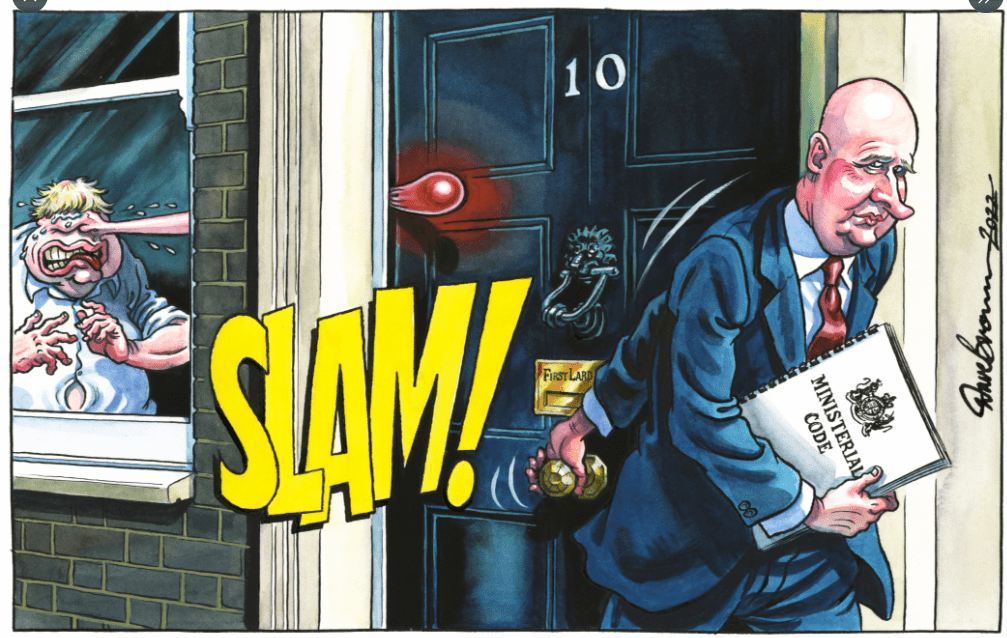
Geidt doubles down on claims No 10 wanted to break international law

“The cautious language of my letter may have failed adequately to explain the far wider scope of my objection.”

Lord Geidt puts a bit more “roar” into his “squeak” – Owl

Aubrey Allegretti www.theguardian.com 

Boris Johnson’s former ethics adviser has said the reason given by Downing Street for his resignation was a “distraction” and doubled down on claims that the government wanted to break international law.

After he dramatically quit this week, Christopher Geidt said his explanation had used too much “cautious language” leading to “some confusion about the precise cause of my decision”.

In Lord Geidt’s initial letter to No 10 on Wednesday, he said he had been asked to give advice on an “odious” breach of the ministerial code. The response from Johnson suggested this was over a plan to extend steel tariffs in contravention of World Trade Organization rules.

However, after much mystery over why Geidt decided to quit over this issue and not greater concerns around Partygate, he issued a “clarification about the reasons for my departure”. “There has been some confusion about the precise cause of my decision,” he wrote in a letter to the Tory MP William Wragg, the chair of the public administration and constitutional affairs committee (PACAC).

“My letter has been interpreted to suggest that an important issue of principle was limited to some narrow and technical consideration of steel tariffs. The cautious language of my letter may have failed adequately to explain the far wider scope of my objection.”

Geidt, a former private secretary to the Queen, said the emphasis on the steel tariffs issue was a distraction and “simply one example of what might yet constitute deliberate breaches by the United Kingdom of its obligations under international law, given the government’s widely publicised openness to this”.

While the explicit reference to international law was removed from the ministerial code in 2015, Geidt said there was “no explicit derogation, no let-off written into the code to absolve individual ministers of their own obligations”. He said given his commitment to integrity, “I could not be a party to advising on any potential law-breaking”.

Angela Rayner, Labour’s deputy leader, said Geidt had quit “because of the odious behaviour of Boris Johnson’s Downing Street”, and added: “It’s high time for Tory MPs to do the decent thing by showing this rotten, rule-breaking prime minister the door.”

Sign up to First Edition, our free daily newsletter – every weekday morning at 7am BST

Karin Smyth, a Labour MP who sits on PACAC, said the Geidt letter had provided “helpful clarity”, but that “it isn’t steel that broke the camel’s back”.

The government was accused earlier in the week of threatening to breach international law by publishing plans to unilaterally override the Northern Ireland protocol signed by Johnson as part of his Brexit deal.

Westminster insiders speculated that Geidt could have been referring to the issue without explicitly referencing it in his latest letter when he referred to concerns about ministers breaking international law.

Geidt is the second ethics adviser to quit under Johnson. In November 2020 Alex Allen stepped down after his finding that the home secretary, Priti Patel, had breached the ministerial code by bullying staff was brushed aside by No 10.

Downing Street has launched a review of the ethics adviser role and has not confirmed whether it will replace Geidt.

Tory candidate in Tiverton by-election booed over Boris Johnson’s conduct

The Conservative candidate in the Tiverton & Honiton by-election was jeered and heckled by an angry crowd last night [Thursday] as she tried to dodge questions on Boris Johnson’s integrity.

YouTube video below – Owl

George Grylls www.thetimes.co.uk 

Helen Hurford, the owner of a beauty salon, was met with hostility at the only hustings held before the ballot next Thursday.

The by-election was triggered by the resignation of Neil Parish, the Tory MP who was forced to stand down after he admitted to watching porn in the House of Commons.

The Liberal Democrats are hoping to overturn a huge Tory majority of 24,239 and deliver another blow to Johnson after the prime minister narrowly survived a vote of no confidence last week.

The party secured by-election upsets last year in the traditionally Conservative safe seats of Chesham & Amersham and North Shropshire.

At the hustings, which took place in Tiverton High School, Hurford was asked what she made of the resignation of Lord Geidt, who stood down as the prime minister’s adviser on ministerial standards on Wednesday.

“In light of the resignations of two ethics advisers in less than two years, what is your personal view on the moral character of Boris Johnson?” a member of the audience asked.

Hurford said that Johnson was “honest in relation to the pledges he makes”, but did not give her own view on his moral character.

As she tried to list the government’s achievements in rolling out the coronavirus vaccine and providing military support to Ukraine, her response was increasingly drowned out by angry cries of “shame” and “answer the question”.

“It is very easy to stand on the sidelines and attack and be aggressive,” Hurford retorted. “What I am hearing on the doorsteps is people are fed up of it. They are sick to death of it. And what they want to hear is how we are going to support them with the cost of living which is affecting us all.”

Pressed about whether she had any concerns about Johnson’s character, Hurford said: “I have no concerns that his pledges are honest.” Her answer was greeted with boos and jeers.

Johnson visited Tiverton & Honiton last week, where he held a private meeting with Hurford and a group of farmers.

The Conservatives have stepped up their campaign with Michael Gove, the housing secretary, and Rishi Sunak, the chancellor, among those to go canvassing in east Devon.


Time to end decades of being taken for granted by complacent Tory MPs – Martin Shaw

Martin Shaw, Chair East Devon Alliance seatonmatters.org 

My latest column in today’s Midweek Herald.

I imagine that most readers are simply exasperated that Boris Johnson, despite being so comprehensively disgraced, has still not gone. He has lost the confidence of the public in Devon and across the country, but he continues to cling to power. Finally, his MPs managed to hold a vote of no confidence and many of them voted against him. But it seems that still the majority will back him come what may.

In their party best: Hurford and Johnson hiding from the public together for a photo-opportunity in a supporter’s garden.

The spinelessness of East Devon’s Conservatives

It is sadly no surprise to find that our local Conservative representatives appear to be among these. Simon Jupp, the MP for the East Devon constituency, had said he was waiting for the Sue Gray report to make up his mind. Well the Metropolitan Police issued Johnson with a fixed penalty, Gray issued a damning report, and still Mr Jupp had nothing to say. We must assume he’s one of the MPs who backed Johnson but was too ashamed of it to let his constituents know. Maybe Johnson promised to make him a junior minister for paper clips next time round?

What is it with the East Devon Conservatives? Having produced over the last decade one councillor, Graham Brown, who was caught offering to fix planning for large sums of money, an Alderman, John Humphreys, who was convicted of appalling rapes, and now an MP, Neil Parish, who had to resign for watching porn in the House of Commons, the rest of them just seem to be particularly spineless.

Certainly their by-election candidate in the Tiverton and Honiton constituency, Helen Hurford, is in no hurry to break the rule. Still silent on virtually all the issues of the day, Ms Hurford sat out the Johnson confidence vote and waited until the prime minister had won before making a comment, to the effect that she gave him her support. If voters are misguided enough to return her to Parliament on June 23rd, don’t expect her to be outspoken about East Devon’s interests –  or anything else.

A captive of the party machine

We only have to look at Ms Hurford’s campaign literature to see that this very inexperienced politician – she only recently became a town councillor – has already become captive to her party machine. How else to explain that she put out a leaflet addressed to the voters of ‘Tiverton, Honiton and the surrounding villages’, seemingly unaware that Seaton, Axminster and Cullompton are substantial towns? The leaflet was clearly written by some advertising person from London, but why didn’t the candidate put them right?

More serious was the leaflet on yellow paper which contained a collection of smears and distortions about the Liberal Democrats. The leaflet had Ms Hurford’s name in tiny print at the bottom but no indication at all that it was produced by the Conservatives. This leaflet has now attracted national notoriety – why didn’t the candidate veto it?

Most concerning of all to me was that she used Seaton’s community hospital for a photo opportunity, claiming that there are hundreds of new nurses ‘in our area’. This is the hospital that lost its beds and was almost demolished for housing development because of her government’s policies and the refusal of Devon Conservative councillors to block the closures. Given the national shortage of beds, the hospital ward could be put back to use – but the shortage of nurses is so chronic that it probably couldn’t be staffed as things stand.

Support Richard Foord on the 23rd

This is my last column before the by-election, in which we have the chance to end decades of being taken for granted by complacent Conservative MPs. Richard Foord, the Liberal Democrat candidate, has been on the doorsteps in Seaton and Axminster and is running an honest – and vocal – campaign. I will not be going as far as my East Devon Alliance colleague, Paul Arnott, and actually joining the Liberal Democrats. I intend to remain independent of any national party. But I urge all my readers to support Mr Foord on the 23rd.

District council powerless to stop ‘vanlifers’ from using de-regulated car park

East Devon District Council has admitted it is currently powerless to stop ‘vanlifers’ from using a de-regulated car park.

Dan Wilkins www.exmouthjournal.co.uk

Vanlifers are are people who live in a car or van either part time or full time.

The Journal understands there have been caravans and motor homes parked in on the site behind the Marks and Spencer Foodhall, in Royal Avenue, for around three months.

The site is owned by East Devon District Council (EDDC), however, the authority has confirmed that the site was re-regulated as a car park to facilitate works to improve the town’s sea defences.

This has left the council powerless to stop motor homes and caravans parking there.

EDDC says it is looking at future regulation of the site.

An EDDC spokesman said: “We are aware of a number of vanlifers who have been using the area behind Marks and Spencer, in Royal Avenue, in Exmouth.

“The car park was de-regulated as part of the tidal defence work to allow it to be used as a construction compound and site office, and so far a new parking places order has not been applied, this means we cannot stop campers and motorhomes parking there at this time.

“The council is currently considering the future regulation of the site and it will be discussed next month, at a campervans and motorhomes car park workshop.”


Councillors call for prior sewage warning for beach users at Maer Rocks

Water bosses have been urged to put a system in place alerting beach users when the sewage is being pumped into the sea at Maer rocks.

Adam Manning www.exmouthjournal.co.uk

Currently, water quality for sewage and swimming quality is reviewed once a week by the Environment Agency and South West Water.

At the full council meeting on Monday (June 13), members of the Exmouth Escape (End Sewage Convoys and Pollution in Exmouth) group provided evidence to councillors about the amount of sewage being pumped into the sea at Exmouth, and the Exe Estuary. 

In response, councillors discussed inviting a representative of South West Water to a town council meeting to discuss what more can be done to limit the amount of pollution and sewage. 

Councillors said they were ‘extremely concerned’ about the increasing amount of sewage being imported into Exmouth by lorry, the consequential damage to roads and the resulting carbon footprint.

Cllr Olly Davey said: “I notice in one of the answers from South West Water to Simon Jupp that when they were queried on whether there was insufficient evidence, their response was there is, but not in the summer when the tourists arrive, well, that suggests to me it’s insufficient for several months of the year.

“That’s not an answer, so if you can’t cope when the tourists come 

“I agree South West Water have had pressure from EDDC (East Devon District Council), I don’t think they need pressure from us as well, they need pressure from absolutely everybody.

“They have been able to distribute eye-watering amounts of sewage and yet somehow they keep telling us they cant do this and that.

“I would like to make one amendment one bit of this, point three, I think we should write to the CEO and ask her to address a council meeting, not the council because you’re only giving yourself one bite of the cherry and also CEO or a representative because they may feel someone else may be more appropriate.”

Exmouth Town Council will now go back to South West Water and invite them to the next town council meeting to discuss.


‘Boris Johnson thinks he’s honest’: Devon candidate declines to say if PM trustworthy

“I will be giving my loyalty to somebody who has been given a third mandate by the party. This has happened. We need to move on.”

Questioned a second time if Johnson was fundamentally honest, she replied: “I think Boris thinks that he is an honest person. How I conduct myself is how I conduct myself, and I think you are trying to catch me out here.”

A vote for Helen Hurford is a vote for Boris – Owl

Peter Walker www.theguardian.com 

The Conservative candidate in Tiverton and Honiton has blamed the media for preventing the public from “moving on” from Partygate and twice declined to say that Boris Johnson was honest.

In an interview with the Guardian, Helen Hurford acknowledged the party faced a very tight battle to retain the previously ultra-safe seat and criticised what she called the media’s “persistent regurgitating of Partygate”. Asked if she believed Boris Johnson was fundamentally honest, Hurford twice refused to say.

Hurford, a former headteacher and a Honiton town councillor who now runs a beauty training business, is defending a 24,000-plus majority won in 2019 by the MP Neil Parish, who resigned in April after admitting he had watched pornography on his phone in the Commons chamber.

But the byelection on 23 June, which comes on the same day the Tories defend another seat in Wakefield, West Yorkshire, is widely seen as an ultra-close race between Hurford and the Liberal Democrat candidate, Richard Foord.

Internal polling by the Lib Dems of those intending to vote on the day of the byelection, released on Wednesday, put the Conservatives on 46% and the Lib Dems on 44%.

“I think it’s going to be very tight, and we can’t take anything for granted whatsoever,” Hurford said. “It could come down to very small numbers.”

Asked why a seat that has been Conservative-held in its various geographical variations for well over a century was now under threat, Hurford said issues raised by voters included the cost of living and “what happened with Neil Parish”.

She added: “And thirdly, the media’s persistent regurgitating of Partygate – even though there has been a line drawn in the sand, and there has been a report, it is constantly in the news, and people aren’t allowed to move on from it.”

“So, of course, that’s impacting. That is what I’m hearing on doorsteps as well – people are sick and tired of seeing it. They are sick and tired of hearing it. They want to talk about what’s important.”

Asked if this meant the media were in part to blame for the Tories’ struggles in the seat, Hurford said: “It’s not necessarily the media’s fault, but I think it’s time to stop. There needs to be a change of narrative about what is important.”

Hurford said she did understand voters’ worries about trust as a result of the Downing Street parties, adding: “All I can say is that the byelection is to pick a representative for Tiverton and Honiton, your next MP. As a former headteacher I am very trustworthy. When I say I’m going to do something, I do it. This is what is important – the person who is going to be representing you in Westminster.”

Asked if Johnson was equally trustworthy, she declined to answer directly, saying: “I will be giving my loyalty to somebody who has been given a third mandate by the party. This has happened. We need to move on.”

Questioned a second time if Johnson was fundamentally honest, she replied: “I think Boris thinks that he is an honest person. How I conduct myself is how I conduct myself, and I think you are trying to catch me out here.”

Asked, finally, if she was comfortable going into a parliamentary party led by Johnson, she replied: “I’m comfortable representing Tiverton and Honiton as their MP with the Conservatives, with a prime minister who has once again, for the third time, been shown support by the majority of the party. That is what I will be going for. Everything else has happened. I’m looking forwards to the future.

“I don’t want to play party politics. I don’t want to be drawn into things that have happened. I want to be talking about what I can deliver for Tiverton and Honiton.”

Lib Dem Foord calls for change

Tories have held Tiverton & Honiton forever.

Liberal Democrat candidate Richard Foord has set out his stall ahead of next week’s Tiverton and Honiton by-election, claiming it’s “time for change.”

Ollie Heptinstall, local democracy reporter www.radioexe.co.uk

The 44-year-old is bidding to end Conservative domination of the seat since it was created in 1997 but faces having to overturn a majority of more than 24,000 secured by disgraced former MP Neil Parish in 2019.

Both parties are campaigning hard in Devon, where defeat for the government on 23 June would be seen as a big blow to Boris Johnson’s leadership. No other party has represented this area at Westminster – both before and after boundary changes – since 1924.

Mr Foord, a former army major who now works for Oxford University from his home in Mid Devon, says such a single party domination can “breed apathy.”

“Honestly the feedback I’m getting is [that this is] a by-election and is about choosing our MP rather than necessarily choosing the government, we can do differently this time,” he said.

“That’s the message that I’m getting back, and I would just reinforce the point that, yes, we’ve been neglected and taken for granted for so long that it is indeed time for change.”

The Lib Dems point to high ambulance waiting times, problems with funding a new town centre relief road in Cullompton and the lack of a new high school in Tiverton as just a few examples.

The Conservatives reject claims about underfunding, which have also been made by Labour candidate Liz Pole. It says their government is “delivering for people in Tiverton and Honiton and across the whole south west.”

In addition to cash towards transport improvements, the party claims £77 million has been spent supporting people in Devon during covid, protecting 17,000 jobs in Tiverton and Honiton through the furlough scheme and by providing loans to local businesses.

Tory candidate Helen Hurford, who has also backed the new relief road and upgraded high school, last week said she was only one who could work directly with the government and was “focused solely on delivering” for the area.

But Mr Foord, speaking in Honiton, suggests it’s time for a shake-up: “I don’t think that we have seen very much interest paid by the government in our area while we’ve consistently returned Conservative politicians to parliament.

“And this this kind of complacency is apparent when you knock on doors around here. People say to you, ‘well, it’s fantastic that you’ve called because we haven’t had a Conservative politician knock on our door for decades.’”

He is aiming to become the first Lib Dem MP in Devon since Sarah Wollaston, who defected from the Tories in 2019 to the short-lived Change UK and subsequently the Lib Dems.

Mr Foord’s campaign is focussing on action to tackle the cost of living, including a VAT cut from 20 to 17.5 per cent, cutting waiting times for GPs and ambulances and getting a ‘fairer deal’ for Devon farmers.

Eight candidates – including from each of the main parties – are vying for the Tiverton and Honiton seat:

  • Jordan Donoghue-Morgan – Heritage Party
  • Andy Foan – Reform UK
  • Richard Foord – Liberal Democrats
  • Helen Hurford – Conservative
  • Liz Pole – Labour
  • Frankie Rufolo – The For Britain Movement
  • Ben Walker – UK Independence Party
  • Gill Westcott – Green Party

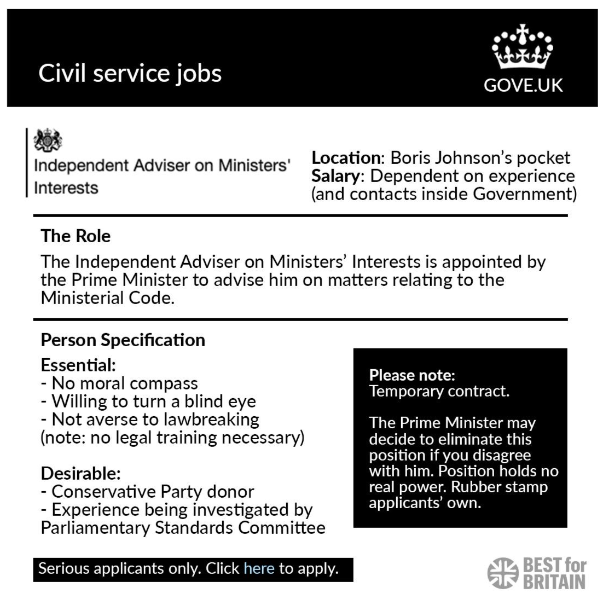
Lord Geidt’s resignation letter  – a roar or a squeak?

Lord Geidt’s resignation letter and the Prime Minister’s reply were published yesterday. Does this provide the clarity we all hoped for? – Owl

Here is an extract from Paul Waugh’s view from inews:

……Some Tory MPs may view Geidt as the mouse that finally roared. But others will see his letter as a squeak, and allow the PM to carry on regardless.

Timing in politics is also everything. If Geidt had quit in the wake of the full Sue Gray report, it would have had much more impact on Tory MPs and their confidence vote.

He ends up seeming more furious about trade tariffs than about Partygate itself. Why didn’t he say Covid rule-breaking had put him in “an odious position”? Why hadn’t the PM’s misleading Parliament “made a mockery” of the principles of public life?

Appearing to expend more anger about obscure trade rules (for which the Government will get popular support) than lockdown law-breaking only confirmed the image of a man who has spent so long in the thicket of the Establishment that he can’t see the wood for the trees. After his humiliation by MPs, Geidt may have been looking for any excuse to quit, but this excuse just wasn’t that great.

In the end, his resignation seemed to be more about protecting his own damaged reputation than doing anything to seriously question that of the PM’s. That’s why Johnson may well escape the opprobrium once more.

And the final insult was yet to come. No.10 hinted the independent ministerial adviser may not even be replaced and the role handed to a civil servant. Perhaps the most damning indictment of Geidt’s record would be if no one notices he’s actually gone.

GP contracts to be changed to get more seeing patients face to face, under Sajid Javid proposals…

“Incentivising contracts”? What happened to the concept of “professionalism”? – Owl

SAJID Javid is eyeing up major changes to GP contracts to get more doctors to see patients face to face.

Kate Ferguson www.thesun.co.uk

He wants to end the shameful postcode lottery which leaves millions of Brits unable to get an appointment not on Zoom.

Vast parts of the country have a massive shortage of full-time GPs – fuelling the problem.

The Health Secretary is considering a range of reforms to try to end the scandal.

One option is to change GP contracts so they are “incentivised” to go from working part time to full time.

While they could also be offered lucrative bungs to move to left-behind areas.

And a big focus will also be put on getting GPs to offer more face to face appointments.

A Government source said the aim is to give patients “more choice” so elderly patients are not forced to go online when they really want to physically see a doctor.

But the number of face to face appointments “is expected to increase”.

Whitehall insiders insisted that changing GP contracts is just one of the options being looked at.

With No10 already bracing for a “summer of discontent” from militant rail unions, they do not want to have a row with doctors unions too.

So they are expected to try to lure GPs into increasing their hours and being more flexible rather than ordering them to.

THE CRISIS CAUSED BY THE GOVERNMENT’S POLICY OF CLOSING NHS COMMUNITY HOSPITAL BEDS  

(And their zealous local Tory acolytes)

Lest we forget – Owl

From a correspondent:

Yet another report has revealed that patients are suffering because of delays in ambulances being able to discharge them into hospital beds. This means long delays when awaiting an ambulance: the very sick and injured, in category two, now have to wait for an average of more than 40 minutes. The target is 18 minutes. Quite simply, there are too few available beds and one reason for this is that at least 10 per cent of patients are “bed blocking”. They do not have access to “care packages” so cannot leave hospital. In many instances, the percentage is higher and in Gloucestershire  it is 29 per cent. With many others in East Devon,  I campaigned vigorously to defeat the government’s plan to remove dozens of beds in local and modern community hospitals. We failed: the consequences are painfully evident. Doubtless, this grim situation will be blamed on Covid but England has cut the total number of NHS beds from nearly 300,000 in 1987 to 141,000 in 2019, despite an increase in population from 47.3 million to 56.6 million with the elderly accounting for a higher share. The UK has fewer beds per thousand of population than most comparable countries in Western Europe. Many of us, even before Covid, warned that this grim situation could occur because of the government’s policy but we were ignored and damaging closures, especially in East Devon, were implemented.  

Lord Geidt: Why did the PM’s ethics adviser quit?

What use does Boris Johnson have for an ethics adviser anyway? – Owl

His demeanour and delivery screamed exasperation, even if his words were carefully chosen. When Lord Geidt appeared before a parliamentary committee on Tuesday, for the best part of two hours, he didn’t look like a man in love with his job.

By Chris Mason Political editor, BBC News www.bbc.co.uk

Just over 24 hours later, in a written statement of few words and even less detail, came confirmation that he really didn’t.

He was resigning, the second such ethics adviser to the prime minister to walk in the last eighteen months. It appears he had concluded his position was untenable, enough was enough.

It also appears there are more details he is privy to about what has been going on than are currently known about more widely.

So what do we know about what happened in the last few days?

I’m told that on Monday, Lord Geidt met the prime minister and offered to serve in the job for another six months.

He was also asked by Boris Johnson to advise on a commercial decision the government is contemplating – and whether this would breach any existing commitments and so not be in line with the ministerial code.

We don’t know the details of this yet, nor if this request contributed to his resignation, but the specific timing of his departure has left No10 baffled, given his commitment to stay.

On Wednesday evening, Lord Geidt phoned the prime minister’s principal private secretary to tell him he was resigning. Mr Johnson was informed of the decision at about 18:30 BST, shortly after finishing a phone call with Ukraine’s President Volodymyr Zelensky.

But while the particular timing has surprised some in Downing Street, Lord Geidt’s discomfort in the job has been evident for a while.

Just last month he had said in a report that it was a legitimate question to ask if Boris Johnson had breached the ministerial code by breaking Covid laws.

But, as Lord Geidt put it, the code’s “author and guardian” is Mr Johnson. The prime minister hadn’t sought an investigation from Lord Geidt into whether he had, and was of the view that he hadn’t.

As Lord Geidt put it: “I have attempted to avoid the independent adviser offering advice to a prime minister about a prime minister’s obligations under his own ministerial code.

“If a prime minister’s judgement is that there is nothing to investigate or no case to answer, he would be bound to reject any such advice, thus forcing the resignation of the independent adviser. Such a circular process could only risk placing the ministerial code in a place of ridicule.”

Lord Geidt also spelled out in the report that he didn’t like the terms of his job – “the prevailing arrangements still remained insufficiently independent to be able to command the confidence of the public” as he put it.

No 10 would point out some of those arrangements have since changed. But it is also true that so too had new guidelines meaning ministers wouldn’t get sacked for “minor” breaches of the ministerial code.

The truth is we don’t yet know definitively why Lord Geidt resigned, as his resignation letter has not been published – which itself is unconventional.

The prime minister is expected to write back to Lord Geidt on Thursday morning, and that reply may well be made public.

What we do know is it wasn’t just Partygate that caused headaches: a row about the renovation of the prime minister’s flat led Lord Geidt to rebuke Boris Johnson for showing “insufficient” respect for his role.

And remember, too, Lord Geidt’s predecessor resigned as well. Sir Alex Allan walked out in November 2020 after concluding the Home Secretary Priti Patel had breached the ministerial code, which conventionally results in a resignation or sacking. And yet Ms Patel didn’t leave and the prime minister didn’t sack her.

So twice in a year-and-a-half, the person appointed to oversee ethics and conduct in Mr Johnson’s government has given up.

Just as Mr Johnson had managed to shift the political conversation away from his behaviour and on to policy, a swirl of headlines about this appears.

And along with the headlines, comes a vacancy in government. I walked down Whitehall earlier on; I can’t say I spotted a queue of people lining up to take the job on.