Liz Truss chief of staff Mark Fullbrook is paid through his lobbying company

The prime minister’s chief of staff is being paid through his lobbying company in a highly unusual arrangement that could allow him to pay less tax.

Gabriel Pogrund www.thetimes.co.uk

Mark Fullbrook insists he is not being paid through his company for tax reasons and has obtained no tax benefit from the arrangement. However, he is refusing to explain the agreement that lets him direct government strategy without being directly employed by the government.

Previous holders of the role have been treated like any other special adviser (Spad), appointed on a temporary civil service contract and paid a salary that is made public. Fullbrook is instead a contractor and will receive any payment through Fullbrook Strategies, a private lobbying company he created in April but which he says has suspended commercial activities.

One Whitehall source said it was “unheard of” for a No 10 official of his seniority to be employed in this way although Fullbrook disputed this. It is unclear what the implications of the arrangement are from a financial and transparency perspective.

Between April and June, according to the Office of the Registrar of Consultant Lobbyists, Fullbrook’s company contacted the government on behalf of clients including the Libyan House of Representatives, which is opposed by the West and the UN, an energy provider and a PPE firm linked to a fundamentalist Christian sect.

It announced it had “suspended” its commercial activities earlier this month after Fullbrook was appointed by Liz Truss to be her top aide.

However he is continuing to use it as a vehicle to receive his publicly funded salary. The equivalent post under Boris Johnson carried a salary of £140,000.

The arrangement will lead to questions days after No 10 scrapped the so-called IR35 reforms of previous Conservative governments that were designed to stop people paying themselves via a company to avoid tax.

In 2019, HM Revenue & Customs (HMRC) won a case against BBC presenters who were told to pay back hundreds of thousands of pounds in tax after working via personal service companies when they were employees in all but name.

In 2017 and 2021, the Treasury introduced measures that made employers responsible for determining the tax status of workers who provided their services through a company.

They were required to decide if a person was a freelance contractor, meaning they could pay corporation or dividend tax on any earnings, or whether they were effectively an employee and liable for income tax. Employers who got it wrong were required to pay tax, penalties and interest.

On Friday, Kwasi Kwarteng, the chancellor, said the burden would once again fall on employees to determine their own status, with critics saying the system would become vulnerable to abuse.

Dan Neidle, a tax expert and the founder of Tax Policy Associates, said he could not fathom any reason for Fullbrook’s arrangement. “I don’t understand why someone would do it,” he said. “Before yesterday, responsibility for applying IR35 [rules] — and liability for getting it wrong — would have fallen on the civil service. I’d expect them to take a very conservative view.

“The effect of the budget change is that Fullbrook gets to decide himself. Of course [it is] subject to later HMRC challenge, but it still gives him an ability to take a more aggressive view than the civil service would have permitted.”

Fullbrook is already facing questions after The Sunday Times revealed he had been interviewed by FBI agents in connection with an alleged criminal conspiracy to bribe a US politician and influence the outcome of an election in Puerto Rico.

He has since signed an agreement with US law enforcement and is co-operating as a witness. It is understood that he is not under investigation. He denies any knowledge of the bribe and in a statement says he is “confident” he behaved within the law at all times.

According to the Institute for Government, Spads are appointed as temporary civil servants. They are given contracts and their employment and salary band is published by the Cabinet Office annually. After leaving government they are required to inform the appointments watchdog of any private sector appointments.

A former No 10 insider said some Spads had in the past “topped up” their salaries by receiving extra income from Conservative Party Headquarters as they provided party political, as well as policy, advice.

Edward Lister, previously Johnson’s principal strategic adviser and now Baron Udny-Lister, continued to be paid for consultancy by a property developer while in Downing Street. But the ex-No 10 source also said there was no precedent for Spads being paid for their government work primarily through a consultancy company.

It is unclear whether Fullbrook’s salary will be reported as standard and whether being paid through his company could alter the usual terms of a Spad’s employment in any other way.

A spokesman for Fullbrook said: “This is not an unusual arrangement. It was not put in place for tax purposes and Mr Fullbrook derives no tax benefit from it.”

A government source said: “It is not unusual for a special adviser or civil servant to join government on secondment. Any government employee hired on secondment is subject to the usual special adviser or civil service codes.”
Conservation groups brand mini-budget an ‘attack on nature’

The government has been accused of launching an “attack on nature” with its mini-budget, which conservationists warn could roll back environmental rules.

Miranda Bryant www.theguardian.com 

Groups including the Royal Society for the Protection of Birds (RSPB), the Wildlife Trusts and the National Trust have criticised plans, announced on Friday, to create 38 “investment zones” across England.

The announcement of the new areas by the chancellor, Kwasi Kwarteng, where planning rules will be loosened to release more land for commercial use and housing, will act as a “carte blanche” for development, leading conservation charities warned, and represent an “unprecedented attack on nature”.

“Make no mistake, we are angry. This government has today launched an attack on nature,” the RSPB tweeted. “As of today, from Cornwall to Cumbria, Norfolk to Nottingham, wildlife is facing one of the greatest threats it’s faced in decades.”

Making reference to a new bill introduced to parliament on Thursday, which could lead to the removal of EU environmental protections such as the Habitats Regulations, the charity added: “What the government has proposed in today’s mini-budget on top of yesterday’s announcements potentially tears up the most fundamental legal protections our remaining wildlife has.”

Beccy Speight, the charity’s chief executive, said: “Nature is already in trouble. Taken together, these announcements, combined with the rumoured watering down of the new land management schemes for farming, could be the final nail in its coffin.”

She added: “Our economy and our health depend on a thriving natural world.”

In a strongly worded tweet in support of the RSPB, the Wildlife Trusts said: “Make no mistake – we are also incredibly angry.

“We stand with RSPB England in calling out the unprecedented attack on nature launched by UK government over the last few days. We’ll be challenging this together and asking for our supporters to stand with us.”

Craig Bennett, the trust’s chief executive, said environmental organisations were previously reassured over nature protections lost through Brexit, but now nature is in “catastrophe”.

“Farming reform was supposed to be the silver lining but now the government looks set to renege on that too,” he said, adding: “We need more nature.”

Sharing the RSPB’s tweet, the National Trust pledged to work with other nature charities and supporters to “defend important protections for nature long into the future”.

Labour also joined criticism over the planned investment zones, calling it “reckless”.

Lisa Nandy, the shadow levelling up secretary, said: “Slashing standards, destroying the environment and scrapping affordable housing is reckless and offers no prospect of sustainable growth. For most people, that’s levelling down, not up.

“This country needs a serious plan to get jobs and investment into every nation and region, money back into people’s pockets and locally driven growth, not more Amazon warehouses and deregulation.”

The Department for Environment, Food and Rural Affairs (Defra) dismissed the claims, tweeting: “We have a plan for economic growth. It is not true to claim we are attacking nature nor going back on our commitments.

“We have legislated through the Environment Act and will continue to improve our regulations and wildlife laws in line with our ambitious vision.”

A Defra spokesperson added: “Farmers are brilliant at producing high-quality food for consumption at home and for export and now we need them to go further, as productivity gains have been flat for many years.

“To boost the rural economy, food production and our food security, we will continue to support farmers and land managers by reviewing farm regulation, boosting investment and innovation in the sector.

“This autumn we will set out our plans for working with industry to maximise the long-term productivity, resilience, competitiveness, and environmental stewardship of the British countryside.”

A Treasury spokesperson claimed that investment zones will “enable locally elected leaders to set out bold new visions for their areas, and we want to ensure that they have every tool available to them in driving forwards local growth.”

They added: “The government remains committed to setting a new legally binding target to halt the decline of biodiversity in England by 2030.

“We are working closely with areas to develop tailored proposals that support their ambitions and deliver benefits for local residents.”

Mini-budget benefits London and south-east England, study shows

It also shows Kwasi Kwarteng’s new tax and benefit policies will result in those on middle incomes losing most, with the poorest fifth of households gaining an average of £90, the middle fifth losing £780 and the top 5% of earners gaining £2,520.

Welcome to Trussonomics – Owl

Miranda Bryant www.theguardian.com 

The chancellor’s mini-budget will disproportionately benefit London and the south-east, a new analysis has found, marking a sharp U-turn from the levelling up strategy of the previous government.

According to the Resolution Foundation, an independent thinktank, households in London and the south-east could gain an average of £1,600 next year from Friday’s fiscal statement. This is three times as much as those in Wales, the north-east and Yorkshire, which it predicts will gain an average of £500.

Its calculations also found that overall, Kwasi Kwarteng’s new tax and benefit policies will result in those on middle incomes losing most, with the poorest fifth of households gaining an average of £90, the middle fifth losing £780 and the top 5% of earners gaining £2,520.

The measures announced by the new chancellor on Friday included a string of tax giveaways that are expected to benefit the rich at the expense of those at the lower end of the income spectrum.

The new measures include scrapping the 45p additional tax rate on earnings above £150,000, removing the cap on bankers’ bonuses, cancelling the planned rise in corporation tax to 25% and doubling the stamp duty holiday on property purchases to £250,000.

The incomes of the richest 5% will grow by 2% in the next financial year as a result of the tax cuts, the thinktank said, while the remaining 95% of the population will get poorer as the cost of living crisis mounts.

An additional 2.3 million people will fall below the poverty line, it estimates, including 700,000 children.

Meanwhile, the Resolution Foundation said borrowing is on course to settle at 3.4% of GDP in the medium term – 0.7% higher than the average level under the Labour governments between 1997 and 2010.

The £45bn of tax cuts announced by the chancellor would need to increase GDP in the long term by 4% to be self-funding. This, the thinktank said, is implausible.

It said in order for debt to fall in the middle of the current decade without raising taxes, the government would have to make spending cuts of £35bn in 2026-27, a sum that would be on the scale of former chancellor George Osborne’s spending cuts in 2010.

Torsten Bell, the thinktank’s chief executive, accused Kwarteng of “blowing the budget” on a £45bn package of tax cuts.

“In doing so he rejected not just Treasury orthodoxy but also the legacy of Boris Johnson as a wholly new approach to economic policy was unveiled,” he said.

“Today’s Conservative party is no longer fiscally conservative or courting the red wall, with debt on course to rise in each and every year, and its focus is shifting south, where the main beneficiaries of these tax cuts live.”

In spite of the chancellor’s announcement, the cost of living crisis will result in “virtually all households getting poorer” next year, he said, amid high inflation and rising interest rates.

“But while the measures announced won’t prevent more than 2 million people falling below the poverty line, they will mean only the very richest households in Britain seeing their incomes grow,” he added.

While he said the package was likely to boost growth in the short term, it would take a “large dose of economic good fortune” – such as a dramatic fall in gas prices – to make the move fully pay off.

“Should strong growth fail to materialise, and tax rises be ruled out, then Osborne-esque spending cuts would be needed to achieve the chancellor’s fiscal rules.”

The Resolution Foundation’s findings come after the Institute for Fiscal Studies thinktank said the chancellor was “betting the house” by putting government debt on an “unsustainable rising path”.

The Treasury did not comment on the findings, instead pointing to the chancellor’s speech on Friday.

Covid hospitalisations rise by nearly 20% in a week in England

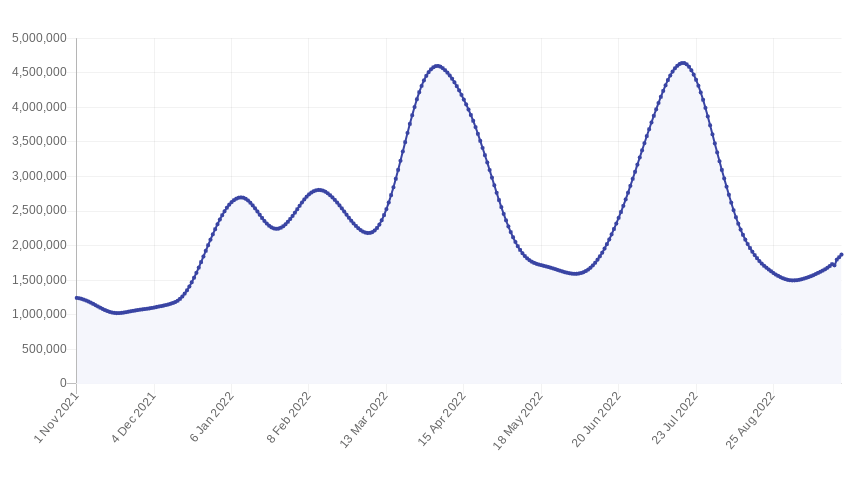
Coronavirus cases and hospitalisations are rising once again in England after declining since early July, data suggests, with experts warning people should stay at home if ill and get a Covid booster if eligible.

Nicola Davis www.theguardian.com 

According to the latest figures on the government coronavirus dashboard, both the number of cases detected through mass community testing, and patients admitted to hospital with Covid have risen in the past seven days, suggesting the country could be facing a resurgence of the virus.

On Monday, 781 Covid patients were admitted to hospital in England, up from 519 the week before, with the seven day total rising 17%, from 3,434 in the week ending 12 September to 4,015 in the week ending 19 September.

As noted by the Health Service Journal, admissions in the south-west rose 39%, to 509, in the last seven days, and by 30% in the north-east and Yorkshire region.

While data on Covid infection levels across the UK is expected from the Office for National Statistics (ONS) tomorrow, data from the Zoe health study suggests cases are rising, with hints also seen in the latest figures for the number of cases picked up in mass community testing in England.

Dr Susan Hopkins, chief medical adviser at the UK Health Security Agency, said there were actions people could take.

“While Covid-19 rates are still low, the latest data for the last seven days indicate a rise in hospitalisations and a rise in positive tests reported from the community,” she said.

“For those eligible, the time to get your autumn booster is now. Getting a booster will give your immune system time to build up your protection against being severely ill from Covid-19 as we move into winter.

“All of the available boosters provide good protection against severe illness from Covid-19 and getting your booster sooner rather than later is crucial.

“As it gets colder and we head towards winter, we will start to see respiratory infections pick up – please try to stay at home if you are unwell and avoid contact with vulnerable people.”

Devon renters priced out by Housing Benefit freeze

People renting homes in Devon are seeing their income increasingly squeezed as housing benefit has failed to keep up with rising costs. Almost all of the 556 privately rented properties available in Devon this week on the Zoopla website are advertised at more than the local housing allowance – the amount paid by housing benefit.

Edward Oldfield www.devonlive.com

The sum varies according to the local rental market but has been frozen since 2020. It is meant to be set to cover the cost of the cheapest 30 per cent of homes on the private rental market. But rents soared in Devon during the pandemic as landlords sold up or forced out tenants so they could switch to more profitable holiday lets. As a result, almost all the properties listed this week in Devon, from one-bedroom flats to four-bedroom homes, were unaffordable from housing benefit payments alone.

That means renters claiming the support will have to find extra cash to cover the shortfall from their other income. It could also force families to move around the county in a kind of postcode lottery, to where the allowance most closely matches rents, usually in more rural areas. Others could end up homeless if they cannot find the extra cash to cover the gap when they are forced to move.

MPs on the select committee for Work and Pensions released a report in the summer recommending an increase in the local housing allowance. The housing campaign group Shelter says: “For renters, the cost of the living crisis is being driven by a failing housing policy. Having to make up ever-increasing shortfalls in housing benefits means that a growing number of families are now having to make the difficult choice between rent and food: eviction or eating. As the cost of living rises, growing housing benefit shortfalls risk pushing people into homelessness as they struggle to avoid rent arrears and eviction.”

Searching on Zoopla this week for two-bedroom homes suitable for a single parent with two young children, the cheapest rental in Exeter was a flat in Cowick Street, advertised at £183 a week. That is more than £25 a week above the allowance of £156.49.

Outside the city, but still in the area covered by the allowance, which has the highest rates in Devon, there was a flat in Starcross at £156, a flat in The Parade, Exmouth, at £167, and a two-bedroom semi-detached house at Christow at £179.

In South Devon, where the allowance is lower at £138.08, there were no affordable properties on offer. The cheapest two-bedroom home was a flat in Pembroke Road, Torquay, at £150 a week. In Torbay outside Torquay, the lowest price was £196 for a two-bedroom terraced house in Brixham. The cheapest similar property in Paignton was a cottage at £207, or a terraced house at £208.

Torbay has a particularly acute problem with housing affordability, as one in four households renting privately and there is a low level of social housing. That means families are even more vulnerable to the housing crisis, as rents rise due to a shortage of available homes, and rises in inflation and energy bills erode spending power. Commenting on a post on Facebook about the effect of the housing crisis in Paignton, one user said they had been looking for a property to rent for seven months, and had viewed around 50 without success.

In North Devon, the local housing allowance for a two-bedroom property is £126.58. Of the six homes available for rent in the Barnstaple area, the cheapest was a maisonette at Sticklepath at £164 a week, followed by a flat at Fremington for £167. In the Bideford area, a two-bedroom house was on offer at £138 a week in Great Torrington, the cheapest in the whole of Devon, but still more than £10 a week above the local allowance.

The cheapest three-bedroom home in Devon was a bungalow at Highampton, near Beaworthy, close to the western edge of the Exeter valuation area. The cost at £160 a week put it below the £189.86 Exeter allowance. Renters a few miles west or north are entitled to a much lower amount for the same size of property, at £149.59 a week. That is the rate payable in Braunton, where the next cheapest three-bedroom home was on offer at £173.

Three bedroom homes at £185 a week were advertised at Hatherleigh and Okehampton, both in the Exeter allowance area and therefore just below the allowance limit. At Paignton, where the amount payable is the South Devon figure of £168, the same rent for a three-bedroom home made it unaffordable for claimants.

Figures from the Office for National Statistics shows that the cost of private home rental in the South West region grew by the fastest rate ever in the twelve months to June. Prices were 4.1 percent higher in June 2022 than in June 2021 – the largest year-on-year increase since comparative records began in 2006. The record-breaking hike in home rental came at the same time that workers across Britain saw their regular pay fall by 3 percent, according to separate figures from the ONS.