Warning of ‘constitutional crisis’ if Boris Johnson returns as PM in face of opposition from MPs

If the contest for the next PM results in a vote of the Conservative party members, Conservative MPs will conduct an indicative vote.

As Politico Newsletter explained: the point of the indicative vote is to either (1) encourage the losing candidate to stand down so a new PM can be in place on Monday night or (2) show the mad, swivel-eyed loons in the membership who to vote for this time.

Reassured? – Owl

Andrew Woodcock www.independent.co.uk 

Supporters of Rishi Sunak have warned of a “constitutional crisis” if Boris Johnson becomes the second prime minister in succession to be elected by Tory members in the face of opposition from the party’s MPs.

The former PM may find himself faced with a boycott of his government by MPs along the lines of the mass resignation that forced his departure in July, said one minister, who warned that Mr Johnson would not last until 2023, let alone the general election expected in 2024.

The warning came after the Johnson camp sensationally claimed to have secured the promise of the 100 MPs’ signatures he needs to enter the race to succeed Liz Truss, apparently dashing Mr Sunak’s hopes of an uncontested coronation on Monday.

But the claim by Johnson ally Sir James Duddridge was greeted with deep scepticism by Sunak supporters, with one challenging him to “prove it” and another retorting that the supposed hidden army of “Bring Back Boris” MPs “don’t exist”.

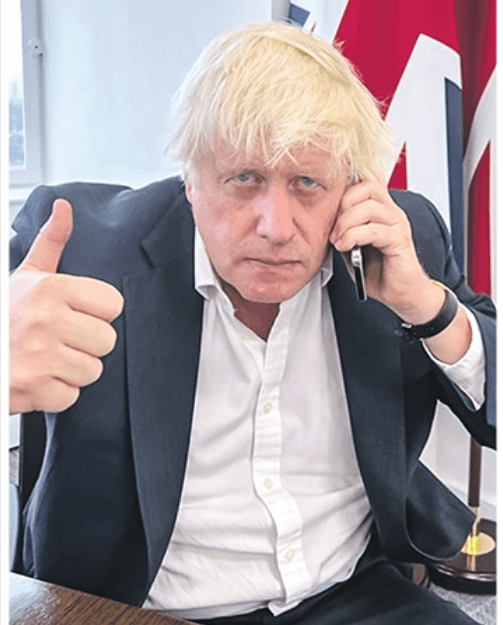
“If Boris has 100 in the bag, why is his campaign putting out pics of him begging for votes?” asked Poole MP Sir Robert Syms.

With Sir James saying only that 100 MPs were “prepared to sign nomination papers”, there were suspicions in the Sunak camp that Mr Johnson was laying the ground for a face-saving announcement that, while he had the necessary support, he felt the time was not right for him to return to frontline politics.

Earlier on Saturday, the Johnson campaign appeared to be sputtering to a halt before it was even formally confirmed, despite winning the high-profile endorsement of former home secretary Priti Patel.

While Mr Sunak sped past the 100-nomination threshold late on Friday, Mr Johnson appeared becalmed on the declared support of a little over half that figure, and was hit by former close allies David Frost, Dominic Raab and Steve Barclay – his erstwhile Brexit negotiator, deputy prime minister and chief of staff – all declaring for his rival.

Mr Sunak was also boosted by the backing of trade secretary Kemi Badenoch, who ran a well-regarded bid for the leadership in the summer and is seen as a rising star.

If two contenders clear the nominations hurdle on Monday, MPs will hold an “indicative” vote to give members a clear steer on how much support each candidate enjoys in the Commons – and to give the second-placed candidate the chance to pull out if they trail by an overwhelming margin.

But the Johnson team believe that if the ex-PM can get onto the ballot paper alongside Mr Sunak, even in second place, he can sweep to victory on the back of members’ votes in an online vote set to conclude on Friday.

Apparently spooked by the prospect of Mr Johnson gathering the necessary support to run, a series of Sunak supporters issued statements warning of the dire consequences for the party if activists impose another leader against MPs’ will.

“Being elected the leader of the largest party in parliament, but without being able to form a stable government, would be a new set of circumstances which could lead to constitutional crisis and early general election in chaotic circumstances,” said trade minister Greg Hands.

His warning came as The Independent’s petition calling for an immediate general election passed 360,000 signatures.

Mr Hands claimed that the former PM had offered him the cabinet role of Northern Ireland secretary as he struggled to fill government posts amid an exodus of ministers in July.

“I think he would have offered me almost anything,” said Mr Hands. “I refused.”

And he warned that the situation could be repeated under a second Johnson premiership: “Some of my colleagues think he could win a 2024 general election. But if you can’t form a workable, effective and stable government, you’ll never get to 2023, let alone 2024.”

And former cabinet minister Robert Jenrick warned that the scandals that had forced Mr Johnson out of office “remain unresolved”, while the newly jittery markets would no longer tolerate the former prime minister’s “fiscal cakeism”.

“There may be another moment for Boris, but now is not the time for him to take back the reins,” said Mr Jenrick.

Mr Raab warned that a Johnson premiership would plunge the country and the Tory party back, Groundhog Day-style, into the Partygate “soap opera”, with the PM forced to give evidence on camera to an inquiry by the privileges committee into alleged lies to parliament, the outcome of which could lead to his removal as an MP.

With Penny Mordaunt so far the only contender formally to declare her candidacy, a Tory MP who quit the government ahead of Mr Johnson’s downfall in July told The Independent she hoped the former prime minister would not put himself forward.

“I hope he has some integrity left and will not stand,” said the MP. “Whilst the standards investigation is ongoing it is wrong. He cannot unite the party that he divided.

“While Boris is popular with the electorate, we need to calm the markets and bring back the brilliant voices and wisdom that have been returned to the back bench in the interests of the country and the economy – not one man’s political ambition.”

Meanwhile, long-serving Tory MPs Sir Roger Gale and Andrew Bridgen declared that they were ready to decline the Conservative whip and sit in parliament as independents if Mr Johnson was re-elected for a second stint at 10 Downing Street.

And a flash survey of members of the Tory Reform Group found 86 per cent saying they did not want Mr Johnson back. The group’s chair, Flora Coleman, said his return would spark an exodus of moderates from the party.

“We have seen that the party’s centrist members have been ‘quiet quitting’ for years,” said Ms Coleman. “It’s clear the return of Johnson would finally end the relationship for many.”

Mr Johnson returned to the UK from a Caribbean holiday on an overnight plane arriving at Gatwick early on Saturday, and immediately took to the phones to drum up support.

Supporters released photos of a determined but tired-looking Mr Johnson on the phone in a grey suit, doing a thumbs-up in front of a union jack flag.

Backer Andrew Stephenson said that many of the more than 60 MPs who had quit government posts in protest at Mr Johnson’s behaviour in July now regret forcing him out.

“I have heard lots of MPs who now feel that they were rash to judge him before the summer, rash to encourage him to resign then, and now feel that this is somebody who – in terms of the big national and international challenges we face – has very good judgement, and therefore at a difficult time for the country we need him back,” the former Tory chair told BBC Radio 4’s Today.

But the Labour chair of the Commons standards committee, Chris Bryant, said Mr Johnson was a “disgraced” figure who was “unfit for office”.

Mr Bryant said that if elected PM, Mr Johnson would spend the first months of his second premiership “entirely focused” on the contempt probe by the separate privileges committee.

And he added that he could then, “at the end of it, be found to have been in contempt of parliament, suspended from the House of Commons, and potentially facing a by-election in a seat which he would lose”.
Four reasons why a Boris Johnson return could end in disaster

“Boris Johnson divides opinion in the Tory party and the country alike. His Conservative supporters believe he is the only person who would stand a chance of winning the next election for them…….But other Tories believe a second stint in No 10 would be even more of a disaster than the first one, and the short leadership of Liz Truss, for the following reasons.”

Intruding on private grief – Owl

Toby Helm www.theguardian.com 

Boris Johnson divides opinion in the Tory party and the country alike. His Conservative supporters believe he is the only person who would stand a chance of winning the next election for them. They point out that despite having been ousted in July he still has a mandate, having won an 80 seat majority for the Tories at the 2019 general election. Because of that, they argue that calls by Labour and other parties for a general election would have far less resonance under a Johnson Mark II premiership. But other Tories believe a second stint in No 10 would be even more of a disaster than the first one, and the short leadership of Liz Truss, for the following reasons.

His return would split, possibly destroy, the party

Weighed down by scandals, including Partygate, Johnson was forced to quit in July after more than 50 government ministers and aides resigned, saying they could no longer back him. Most Conservative MPs thought he should go by that time and a large majority of voters. If he were to return – as if his removal had not been driven by issues of principle – many of those same MPs and ex-ministers would be enraged. Large numbers of former ministers would refuse to serve or back Johnson and some backbench MPs would quit the party. A parliamentary party already riven by splits would be potentially ungovernable at the time of an economic crisis and when the Tories are about 30 points behind in the polls.

The worst of Partygate – and Johnson’s role in it – is yet to come 

Tory and Labour MPs say investigations by the Commons privileges committee into whether Johnson misled MPs over Covid rule-breaking parties in No 10 are turning up such devastating evidence that he could “be gone by Christmas” if he were reinstalled. A large amount of documents from inside No 10 have already been handed over to Labour’s Harriet Harman, who is chairing the inquiry by the Commons privileges committee. Evidence sessions at which Johnson is expected to appear will begin in November. Such a prospect has already persuaded the likes of Dominic Raab, the former deputy prime minister under Johnson, to think again about attempting a comeback that could land him and his party into even deeper crisis. For the Tory party to lose another leader (albeit a retread) after just a matter of weeks would probably be terminal. If Johnson is found to have misled the Commons, he could be suspended, making his position untenable.

The economy and the markets would be destabilised – again.

Johnson has never been one for fiscal discipline and following the disaster of Liz Truss’s unfunded tax cuts, his return could unsettle the financial markets again, after Jeremy Hunt brought some calm by scrapping Truss’s economic plan. Johnson is also personally associated with many of the high-cost levelling up infrastructure projects that will probably be in the chancellor’s sights in cutting public spending. The return of Johnson would look like a backward step and is unlikely to signal more stable times ahead to the financial markets.

The rightwing press, and public opinion

On Saturday, even some leading rightwing commentators were arguing that Johnson should stand aside and not attempt a comeback. His time had passed. This was the view of Charles Moore in his Daily Telegraph column. There were signs too that the Sun and Daily Mail were hedging their bets, keen not to back a loser, as they had done with Truss, and seeing the dangers of another act of Tory self-harm.

Tories in trouble in Devon

‘Strong liberal tradition’ here says politics expert

Ollie Heptinstall, local democracy reporter www.radioexe.co.uk 

The Conservatives are likely to be “in real trouble” in Devon based on current polling, according to an expert from the University of Exeter.

Liz Truss this week announced her resignation as Tory party leader and prime minister, less than two months after defeating Rishi Sunak in a leadership contest that lasted longer than her premiership.

Her reign was blighted by turmoil, with Tory MPs revolting after Ms Truss was forced to abandon much of her tax-cutting economic plan following a negative reaction from economic markets.

Opinion polls reacted badly to her government, with support for the Conservatives nosediving during her time in Downing Street. The Politico website’s poll of polls gave Labour a 32-point lead as of midday on Friday [20 October].

Dr Hannah Bunting, lecturer in quantitative British politics at the University of Exeter, remarked: “The Conservatives are definitely going to be in trouble all over the country, but particularly in Devon and the south west overall.

“I think one of the more cautious projections that we’ve seen recently has the Conservatives losing half of the seats that they have in the south west at the moment at the next general election.”

The Tories currently hold nine of the 12 seats in Devon. All but one has a majority less than the 24,000 successfully overturned by Liberal Democrat Richard Foord to defeat the Conservatives in June’s Tiverton & Honiton by-election.

“I don’t think that Labour would win with the 400-odd seats [nationally] that are being projected at the moment,” Dr Bunting added, “but they are still likely to win with what we would call a landslide. And certainly, there are many areas in Devon and the south west where those members of parliament who are Conservatives are in real trouble.

Describing the Liberal Democrats as a “viable alternative” to the Tories, Dr Bunting added: “There’s a strong tradition of liberalism here, so when people in Devon and the south west turn against the Conservatives, they tend to go towards the Lib Dems unless you’re looking at cities such as Plymouth and Exeter.”

“So, for certain, the Conservatives are definitely going to be in trouble in Devon and Cornwall, and that’s just indicative of how unhappy people are with what’s happened over the past nine months plus.”

On whether the Tories could recover before the next general election, which does not have to be held until January 2025 if a new prime minister can command a majority in parliament, Dr Bunting believes there could be some respite for the governing party.

“If somebody such as Rishi Sunak, for instance, who was the MPs’ favourite ahead of the membership vote in the last leadership election, has some government experience … and seems to have quite a coherent plan and would hopefully be able to work with Jeremy Hunt in the chancellor’s office quite well together.

“If somebody like him wins this contest and becomes prime minister, and Jeremy Hunt’s budget goes quite well on Halloween, 31 October, then we could see some stability heading towards Christmas.

“But that doesn’t really do much to help a lot of the crises that are happening at the moment. There is a health care crisis, the cost-of-living crisis, people’s mortgages are more expensive, energy bills.

“There are so many things that that we need a government for at the moment, that if it’s not a kind of holistic plan, then even if they do manage to hang on until Christmas, they’ve then got the May local elections coming up and it’s probably going to be a pretty disastrous result for the Conservatives there.”

While Dr Bunting is “certain” that the Conservatives “will try and hang on as long as possible,” she believes the next general election could be held next September.

“I think whoever [takes over] is really going to try and keep things together until Christmas and then after those May local elections perhaps they’ll have to start taking stock again.

“But there’s so many variables and so much going on at the moment that it’s really, really difficult to predict.”