Citizen scientists play key role in helping Devon fish populations thrive

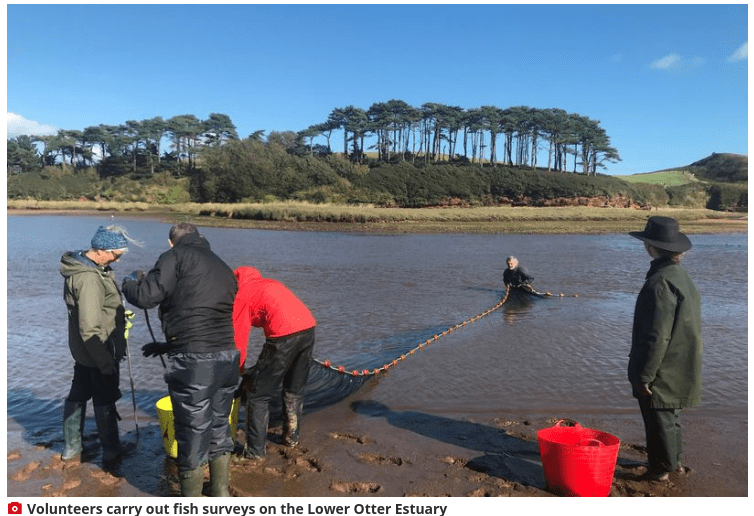
Fish populations could thrive in East Devon thanks to the Lower Otter Restoration Project (LORP). Local residents have been taking part in an ongoing ‘citizen science’ project with the East Devon Pebblebed Heaths Conservation Trust and Clinton Devon Estates, helping to carry out fish surveys that form part of the Project PACCo (Promoting Adaptation to Changing Coasts) environmental monitoring work in the Lower Otter Estuary.

Lewis Clarke www.devonlive.com
LORP is a landscape-scale climate adaptation scheme to address the impact of climate change, by returning the Lower Otter estuary and flood plain to a more natural condition. Its benefits include the re-creation of 55 hectares of intertidal habitats, including mudflat and saltmarsh which provide a home for numerous rare and endangered native and migratory species.

Along with the Saâne Valley in Normandy, France, the estuary is one of two pilot sites where 100 hectares of coastal wetland will be restored under Project PACCo. The aim of PACCo is to demonstrate that it is possible for coastal communities to deliver a range of benefits for people and the environment, by adapting pre-emptively to climate change. Led by the Environment Agency, this project lasting over 3 years has a budget of €25.7m, of which €17.8m in funding has been provided by the European Regional Development Fund, via the Interreg France (Channel) England Programme. The project is also part-funded by the Environment Agency.

Fish surveys carried out on the Lower Otter Estuary

Fish surveys carried out on the Lower Otter Estuary

Volunteers have recently returned to the estuary and saltmarsh areas of the River Otter to continue gathering important baseline data, under the watchful eye of marine fisheries management consultant and marine lead for the Institute of Fisheries Management (IFM), Steve Colclough, a recognised UK expert in the field.

This data will be used as a baseline from which to inform how fish will hopefully thrive in the new saltmarsh area that will be created in 2023, when the embankment of the estuary is breached, as part of the LORP and PACCo schemes.

Steve said the signs are positive. In the latest survey, carried out in late July, similar species of fish were identified at the site, but were smaller, as this year the monitoring was taking place earlier in their life cycle. “It’s what we expected to find, but what this did demonstrate was that they had spent the whole summer in this environment and shows how critically important the area is as a marine nursery ground,” said Steve, who led another monitoring session at the end of September.

Steve continued: “Sadly, we have removed 80 percent of saltmarshes around western Europe over the past 200 years through land claim and sea defence work. Now we have the exciting potential, through this restoration project, to create a new saltmarsh as it was two centuries ago.

“The baseline data we have gathered so far suggest fish will thrive, but it’s not just beneficial for the fish and other wildlife. A new piece of saltmarsh is ten times as good as a piece of woodland for sucking carbon out of the atmosphere.”

Steve first joined volunteers working with the East Devon Pebblebed Heaths Conservation Trust/Clinton Devon Estates last September, when the initial two-day monitoring was carried out on the River Otter, which was also designated a Marine Conservation Zone in 2019.

Volunteers using intertidal netting

Volunteers using intertidal netting

Over two days they netted a number of fish species, including mullet, bass, pollock, plaice and an abundance of common gobies. During several training sessions, Steve has taught the volunteers the importance of estuarine areas to fish populations, how they use tidal flows to feed in intertidal habitats and how to identify certain fish species. They were also shown how to safely deploy both fyke and seine netting to catch fish for measuring.

Steve said the monitoring has also shown the strength of ‘citizen science’ in helping advance scientific study. As it has grown in popularity, he says the government is now seriously looking at providing additional support for projects moving forward.

Steve added: “These are local people who care about their local environment and you get a real sense of their commitment. The East Devon Pebblebed Heaths Conservation Trust and Clinton Devon Estates have a long-range plan to carry on this survey work themselves, now they have the trained volunteers to do it. The IFM will continue to support such citizen science programmes going forward.”

Patricia Hitchcock, who lives in Budleigh Salterton, spotted the opportunity for volunteers on social media. She and her husband Brian fish from a canoe off their local beach and she was keen to do what she could to help the local fish population thrive. “I have really enjoyed learning new skills and it’s very much ‘hands on’ too which I prefer,” said Patricia, who has taken part in all the sessions so far, and will join the next survey this month. I like the social side too, meeting new people. They call me the scribe as I write down all the figures for the fish count and then transfer them to a spreadsheet for Steve.”

Established in 2014, LORP is a partnership between landowner Clinton Devon Estates, the Estate’s East Devon Pebblebed Heaths Conservation Trust, the Environment Agency and Kier.

Kendal Archer, PACCo Environmental Project Manager for the East Devon Pebblebed Heaths Conservation Trust said that the embankment breach is a key element of the overall LORP and PACCo projects. “It will recreate significant areas of intertidal habitat, which it’s hoped will result in increasing numbers, and maybe species, of fish using the Lower Otter estuary as a nursery and for feeding and shelter,” said Kendal. “Increasing the fish population in this way has a wider importance for wildlife, birdlife and biodiversity as a whole, as well as the socio-economic fabric of the area.

Kendal also paid tribute to the volunteers who had joined the project, adding: “Citizen science formed an important part of the fish monitoring and will continue to do so.”

Other aims of the project include maintaining and securing existing public footpaths, some of which form part of the South West Coast Path, and working with tenant farmers from Clinton Devon Estates to adjust existing land use to make the project possible.

Vulnerable people in supported housing ‘victims of terrible crimes’, says report

England’s supported housing sector is a “complete mess” that is failing communities at the expense of the taxpayer and making residents “victims of terrible crimes at the hands of staff”, according to a scathing select committee report.

Jessica Murray www.theguardian.com 

The report found loopholes had turned the sector into “a licence to print money” for unscrupulous providers and that there has been “a complete breakdown of the system, which calls for immediate action from government”.

After a year-long investigation into “exempt accommodation”, a type of supported housing for vulnerable people with a broad range of needs, the cross-party levelling up, housing and communities (LUHC) committee called on the government to implement urgent reforms, including national standards and compulsory registration.

“We were absolutely shocked and appalled,” said the Sheffield MP Clive Betts, the chair of the LUHC committee. “As 11 MPs, we’re generally pretty experienced, we’ve been in public service a long time, and I think this was as bad as anything we’ve ever seen.”

The committee heard evidence residents were being “raped and sexually harassed by their landlords under threat of eviction” and “staff were assaulting residents and asking them for sexual acts in return for money, food or better accommodation”.

The report, published on Thursday, said residents had been forced to carry out work, such as tiling a bathroom, “for nothing or for a pittance”, and staff and landlords were selling drugs to residents.

There have also been instances of residents dying of drug overdoses or being murdered by fellow residents.

The Guardian recently reported that organised crime groups were taking millions of pounds of taxpayers’ money by buying properties and setting them up as supported accommodation to receive higher housing benefit rates but providing little to no support for the vulnerable tenants.

“We would describe the system of exempt accommodation as a complete mess,” the report states. “The current system offers a licence to print money to those who wish to exploit the system.”

Exempt accommodation, which is paid for through housing benefit, is set up to support people with a range of needs including refugees, care leavers, the formerly homeless, people with alcohol and drug addiction and those who have recently been released from prison.

It is exempt from locally set housing benefit caps to cover higher costs of maintenance and insurance.

The report criticised the government for failing to collect data on how many exempt accommodation claimants there were or how much taxpayer money was being spent on it, saying “successive governments have been caught sleeping”.

Crisis, a charity for people experiencing homelessness, estimates the number of households living in exempt accommodation grew to 156,868 from 2016-2021, a rise of 65%. A report from Prospect Housing estimated the annual cost in 2020-21 to be £816m, but the committee suggested it could be much higher.

“This issue has been ignored unacceptably. It’s happening all over the country,” said Betts. “We’re seeing people set their own rents, charge what they want and then provide nothing for it but bad accommodation.”

The report calls for urgent reforms, including national minimum standards for support and housing, extra powers for local councils, compulsory registration of all providers and the creation of a national oversight committee to mend “patchwork regulation”.

As part of their inquiry, committee members travelled to Birmingham, which has become a national hotspot for exempt accommodation. The number of claimants in the city rose to nearly 22,000 earlier this year.

The Birmingham MP Preet Gill, who campaigned to shut down a poor-quality exempt accommodation property in her constituency, said “the government needs to urgently get on with the job” of tackling the issue.

“For years I have been sounding the alarm about the explosion of the exempt accommodation sector in Birmingham, which has become a magnet for rogue operators, exploiting vulnerable residents and visiting misery on our area,” she said. “I am delighted the select committee has endorsed many of the reforms we have been campaigning for.”

Sharon Thompson, the Birmingham city council cabinet member for housing and homelessness, said the report reflected what the council “has been saying for a long time”.

“The government has finally woken up to the scale of the problem and, based on this report, they must now commit parliamentary time to bringing in new legislation,” she said.

The Department for Levelling Up, Housing and Communities said: “It is unacceptable that unscrupulous landlords are trying to profit at the expense of vulnerable people and we are bringing forward a package of measures to stop them in their tracks. This is backed by a £20m investment to drive up quality in the supported housing sector and protect the most vulnerable in society.”

East Devon’s cash saving £2 parking is back

East Devon District Council’s winter deal where car parking costs £2 all day is back. Running until the end of March 2023, you can park all day at any council car park for just £2.

Daniel Clark www.devonlive.com

The annual winter car parking deal comes at the right time with Christmas just around the corner giving people even more reason to shop local and support their High Street. By reducing car park charges across the district, the council hopes it will help to boost trade over the winter, especially during the typically quieter months of January and February.

Although a printed ticket may not display an expiry time of midnight, it will still be valid for the whole day. You are able to park in multiple locations throughout the whole day as all East Devon car parks across the district are eligible.

Cllr Jack Rowland, EDDC portfolio holder for finance, said: “The car park charge of £2 all day that applies from November 1 through to the end of March next year is great value in these difficult times and I hope that many residents and visitors will take advantage over the next five months and also help our local businesses.”

A spokesperson for East Devon District Council added: “It is hoped that residents and visitors will be able to take advantage of exploring what East Devon has to offer with no time constraint on their stay. From the myriad of local shops to the array of cafes and restaurants, our £2 all day parking ticket gives you the perfect opportunity to enjoy a full day out this winter.”

Scrapping farm nature payments may worsen English river pollution up to 20%

Weakening or scrapping the nature-friendly farming payment schemes could increase river pollution by up to 20%, an analysis has found.

Helena Horton www.theguardian.com 

The payments are due to replace the EU’s area-based payments scheme, in which farmers are paid for the amount of land they manage. The new system would instead pay land managers to provide “public goods” such as enhanced nature and clean rivers.

Liz Truss’s administration made reviewing the upcoming schemes a priority in the few weeks of her premiership, and government sources said the intention was to remove nature restoration from the programme.

However, Sunak’s government appears less hardline on this issue, and sources at the Department for Environment, Food and Rural Affairs (Defra) said a review of the schemes, originally planned for this week, was likely to be delayed, with few if any substantive changes from the original plan.

Removing incentives to create wetlands around waterways and increase biodiversity could mean rivers become more polluted. Every single river in England is polluted beyond legal limits, and 86% are deemed not to be in “good ecological condition”. According to the Environment Agency, agriculture is the reason for 40% of water bodies in England failing to meet good status, due to pollution from animal manures and slurries, the use of chemicals such as pesticides and fertilisers, and soil running off fields, especially in wet weather.

Government analysis, compiled by the water pollution campaign group River Action, has also found that a current localised nature-friendly payment scheme, Countryside Stewardship, reduced river pollution by 2%. However, its impacts are very localised; measures such as the planting of winter crop cover and the creation of ponds to retain runoff can reduce nitrate pollution by 10%, phosphates by 16% and sediment by 20%. This scheme was expected to be brought into the new payments system but strengthened, with further financial benefits for farmers who work across river catchment areas, meaning these local benefits could become more widespread.

Charles Watson, founder and chairman of River Action, said: “Removing the payments that reward these vital environmental measures would leave England’s rivers in an even more polluted and degraded state than they already are.

“The public is looking to the government to sort out this appalling issue and it is abundantly clear that more measures, not fewer, are needed to clean up England’s rivers, protect our wildlife and ensure communities can safely enjoy their local watercourses.”

Farmers and environmentalists have warned that the retained EU law bill, which had its second reading in parliament this week, could also threaten the country’s rivers.

The same government analysis found that regulation and good practice leads to a 7-8% reduction in phosphorus, nitrate and sediment pollution across Britain. The regulations referred to are ones which are enshrined in retained EU law, which the new bill could scrap.

What a time to be a fracker Simon!

What a time to be a fracker. No sooner had they ordered fresh geological surveys, drill bits, hard hats and barbed wire, than their hopes have been dashed. 

[But the ban on building new on-shore wind farms remains, despite them being the cheapest and quickest way to increase sustainable power generation. No logic to Tory thinking. – Owl]

Rishi Sunak has reinstated the fracking ban – but the damage of the Truss era is done

Editorial www.independent.co.uk 

In his first policy U-turn, announced as a response to a question from Green Party MP Caroline Lucas, Rishi Sunak has restored the moratorium on extracting shale gas that formed part of the 2019 election manifesto. Mr Sunak has made many errors of judgement in his brief but meteoric rise to power, but on this he deserves lavish praise.

Of course, there is a political aspect to the change of tone and policy. The fracking policy affected areas such as Lancashire, Yorkshire and Somerset which had plentiful supplies of marginal parliamentary constituencies as well as shale gas. Whether justified or not, residents feared that fracking would produce earthquakes and devastate house prices, as well as cause noise, traffic and noxious fumes during and after development.

The voters in these areas are disinclined to believe in assurances from fossil fuel companies that fracking is “safe”. Jacob Rees-Mogg declared that he’d be happy for it to take place in his back garden, but of course no such licence has been applied for that affects the Rees-Mogg estate.

In itself, the new ban will leave fossil fuels in the ground, help contain greenhouse gas emissions and will make it marginally easier to meet the Cop26 targets on climate change.

Symbolically, the revived ban is a clear signal that the Sunak government is at least somewhat more serious about climate change than Liz Truss was, and that is welcome. How far it will be followed by other measures designed to deal with the transcendent issue of our items is less clear.

Investing in green technology, insulating Britain’s stock of older, draughty homes and generating more power from renewables will cost public money, one way or another. There is little sign, for example, that the ban on new onshore wind turbines will be lifted or new solar farms encouraged. That investment will soon repay itself in cheaper energy supplies and stronger energy security, but the pressures on public spending are well-known and the Tories seem to have a visceral aversion to any change to rural land use (whether farmers and landowners agree or not).

They are certainly not acting like there is a climate emergency, or indeed a man in the Kremlin determined to “weaponise” energy. Britain is better off and safer with green energy, underpinned by a steady base load of nuclear power and a rapid run-down on fossil fuel usage. The UK is in a strong position to be something like what Boris Johnson called, albeit with typical hyperbole, “the Saudi Arabia” of wind.

Such confusions about policy are damaging to investment, whether in fossil fuels or renewables. Before the fall of Mr Johnson, they had no hope of being able to extract shale gas from Britain’s (or more accurately England’s) apparently plentiful reserves. Indeed, one of the few pieces of advice offered in public by Mr Johnson to his successor was that fracking wasn’t really worth it.

Then came the arrival of the impetuous Liz Truss, enthusiastically abetted by Mr Rees-Mogg, and her bold move to reverse the ban imposed by her predecessor. She often added that fracking would not be permitted without local support, but the method by which that would be measured and obtained was opaque. However, her intent was plain.

In one of her last legislative acts as prime minister, with a substantial injection of incompetence and confusion, she forced through her policy; it contributed significantly to her demise.

The damage is done, however, and the Sunak administration has been gifted the worst of all worlds. The voters in areas targeted for seismic action cannot trust the Tories to keep their promises on fracking, no matter how sincere Mr Sunak sounds. The energy industry, both fossil and renewable, is left with a development and pricing regime that they cannot rely on for the long term – the Conservatives are liable to change their minds, and Labour would reverse much of the policy framework they have created, such as it is.

The vast investments the energy companies have to make – especially in the nuclear sector – demand long-term security. A cross-party consensus on the future of energy would help, but it remains as distant a prospect as nuclear fusion or, for that matter, unrestricted fracking.

Plymouth City Councillors join forces for independent group

Three senior Plymouth councillors including the former Tory leader have joined forces to form a new independent group. Nick Kelly, Terri Beer and Chaz Singh are the founding members of the Independent Alliance Group on the city council, which is currently in a state of no overall control following Cllr Kelly’s recent departure from the Conservatives.

Philip Churm www.plymouthherald.co.uk

They say the new group will allow them to represent residents on the various city council committees, with Cllr Kelly explaining: “We share common beliefs and values, and simply want the very best for Plymouth’s residents and businesses.” Ousted as leader of the council earlier in the year following a vote of no confidence, Cllr Kelly left the Conservative group in acrimonious circumstances this month.

He claims he resigned after being deselected by the Tories, accusing senior members of the party of pursuing an “ongoing vendetta” against him. The Plymouth Conservatives, in a statement reported by PlymouthLive, responded by saying Cllr Kelly had been suspended pending an investigation following “several serious and different complaints and allegations made formally to our group executive team.”

His departure leaves the 57-seat council with 28 Conservatives, 24 Labour members, three Independents and two Green Party councillors. Cllr Terri Beer, last year’s lord mayor, resigned from Plymouth’s Tory group days after Kelly was replaced as leader by Cllr Richard Bingley in March.

She said of the new group: “Despite coming from very different backgrounds, we have a strong sense of fairness and equality.” The new alliance’s third member, Cllr Chaz Singh, a former deputy lord mayor, has been an independent member for three years since resigning from the Labour group in 2019.

He said: “We feel liberated that we can do the very best for Plymouth and our residents, and not be concerned about going against any national party policies or having disciplinary action taken against us. We are truly independent.” Cllr Kelly has opened the door for other councillors to join the group and claims that since leaving the Conservatives he has been “inundated with people urging me to stand as an independent and form an alliance.

“Previous councillors and councillor candidates have contacted me in the past few days wanting to stand and be part of this alliance in May 2023 [when the next elections will be held]. We already have enough candidates to stand in each of the 19 wards.”

He added: “This is something new and exciting, although a lot more work and planning will now start to truly offer the residents of Plymouth a real and credible alternative to the mainstream parties.”