Council lifts the lid on ‘heart-wrenching’ mould misery 

A family in Exmouth whose children were bullied at school because their damp and mouldy bedrooms made their uniforms smell have been helped by the district council and landlord.

Becca Gliddon eastdevonnews.co.uk

East Devon District Council (EDDC) said it decided to lift the lid on the ‘heart-wrenching story’ of the privately-renting family in a bid to encourage tenants to seek support and ‘not suffer in silence’.

The family – from an unnamed area of Exmouth – were left living in a damp home, with black mould growing up their bedroom walls and ceilings.

The council said condensation had begun running down the walls ‘with an overwhelming smell of damp infesting the home’.

mould

The bathroom wall was covered in black mould. Photo: EDDC.

The children had only one set of school uniforms, which were washed every day – but the youngsters were bullied by other pupils when the clothes failed to properly dry because the family could not afford to use the tumble drier.

Instead, the kids’ clothes were dried in front of a heater in the living room and started smelling when the heating stopped working properly

EDDC said the family’s ‘willing landlord’ made changes to the property once he was made aware of the damp.

After the family contacted the council, it was found they were eligible for financial help to cope with the cost-of-living crisis – finding funding for extra school uniform, food and white goods.

The investigating officer at EDDC said: “We learnt the resident had just one set of school uniforms for their children, which was being washed every day.

“Although they had a tumble dryer the family couldn’t afford to use it so were drying their clothes on a heater in the living room.

“Not only this, but they also couldn’t get the heating to work properly.”

They added: “We gave general advice about condensation and heating, and referred the resident to the resilience team who found that they were eligible for money towards school uniforms, white goods and food.”

Exeter Community Energy gave practical advice on energy efficiency so the tenant could save money on their energy bills, EDDC said.

The investigating officer said: “As well as this, we recommended the tenant wrote to their landlord so our team could arrange to do a full inspection of the property with the landlord – this resulted in the installation of an electric extractor fan in the bathroom and kitchen to remove moisture, reducing condensation.

“The landlord altered the worktops in the kitchen, so the tumble dryer could be installed and used properly also and showed the tenant how to use the heating.

“All the area affected by mould were also cleaned and re-painted.”

The district council said the damp and mould season has coincided with scores of residents struggling with the cost-of-living crisis, and concerns over how to afford to heat their homes.

EDDC urged tenants to inform landlords if they are struggling with home repairs in rented properties.

The council said its environmental health private sector housing team receives at least one call a week from tenants reporting damp and mould problems.

Councillor Dan Ledger, EDDC portfolio holder for sustainable homes and communities, said: “It was really nice to know our officers were able to help this family in need who didn’t know what to do to fix the issue in their home.

“In this case, we worked with a very willing landlord who wanted to help as much as we did, once they knew there was a problem at the property.

“A big part of officers’ jobs is to help tenants communicate issues when they either don’t know how to themselves, are embarrassed or are worried, so need support contacting their landlords.”

Cllr Ledger added: “We would like to encourage anyone who is having damp or mould issues, or any other repair problems, to contact their landlord or letting agent. And if they still need help, your council is here to help you.”

An spokesperson for the council said: “One of EDDC’s many roles is to help residents struggling with the cost-of-living – which is why its financial resilience team plays such a crucial role in assessing and offering advice, as well as direct support to make sure residents can get the best help available – that they would otherwise not know about.

“The team works with various partner organisations and are experts in knowing who can help when and referring residents in need.”

‘Wild camping ban on Dartmoor is a threat to us all’

Martin Shaw, Chair East Devon Alliance www.exmouthjournal.co.uk

The High Court ban on “wild camping” on Dartmoor is a threat to us all. A right enjoyed over many decades shouldn’t be abolished by the stroke of a judge’s pen. Like most people who visit the moor, the vast majority of campers act responsibly and respect the environment. Dartmoor is a national park, protected by law for the enjoyment of all, and the national park authority rightly defended the right to wild camp.

This case also involved an abuse of multimillionaire power. Hedge fund manager Alexander Darwall, who with his wife Diana brought the court case, purchased 4,000 acres of Dartmoor twelve years ago and organises pheasant shoots and deerstalking on them. Mr Darwell seems to think that having made millions from handling other people’s money, he can trample over the rights of the public to enjoy Devon’s most precious open space.

The compromise supported by the Totnes Tory MP Anthony Magnall (who accepted £5,000 from Mr Darwall), that wild camping will still be allowed where landowners opt in to a scheme administered by the park authority, involves a bureaucratic waste of public money and restricts where people can camp. This “stitch up”, as campaigner Guy Shrubhole, of campaign group Right to Roam calls it, is no substitute for the right to camp freely.

Richard Foord, our own Liberal Democrat MP, was on the ball, immediately tabling a motion in Parliament calling for a change in the law to protect this. Green MP Caroline Lucas followed this up with a private member’s bill. Echoing other campers’ comments, Richard said, “As a child, I wild camped on Dartmoor when training for the Ten Tors expedition and for the Duke of Edinburgh award. Without these experiences I would not have joined the army or trained to be a mountain leader.“

Yet Mr Darwell is not the only financier disrespecting our environment this month. Rishi Sunak, our near-billionaire prime minister, took an official plane from London to Leeds – a two-hour train journey – just for a photoshoot. 

Mr Sunak tells us he’s committed to stopping global heating, but actions speak louder than words. He then flew up North again to promote some of the successful bids for the “Levelling Up Fund”, while other ministers sped off to all the regions where bids had been approved. In East Devon, the bid for Exmouth, represented by Tory Simon Jupp, was approved, while that for Seaton and Axminster, in Richard Foord’s constituency, was rejected. As he commented, we have been taken for granted yet again.

The only silver lining that I can see – since the Tories have shamelessly used the Levelling Up money to boost their chances in marginal seats – is that it means that while they’re still hoping Simon Jupp can sneak back in the general election, they’ve written off their chances of unseating Richard, who is making a great impression as our district’s first non-conservative MP.

Unfortunately we’ll have to wait for the election, and our chance to pass judgement on this sorry excuse for a government, until 2024. But there is hope in 2023 – in May we elect our district councillors, and I can tell you that the excellent local coalition of the East Devon Alliance, Liberal Democrats and Greens is firing up to regain control. They have made a great start in reforming EDDC after 45 years of Tory misrule – including a real priority for climate action in all that the council does – and deserve to be re-elected.

The next month will see conversations in all wards about who will stand for the council. Some sitting councillors will stand down and many of the Tories deserve to be removed by the voters, so we are looking for fresh faces. If you think you could contribute to EDDC, do contact a sitting councillor or one of the parties in the coalition.

Planning applications validated by EDDC for week beginning 9 January

Blast from the past: Warwickshire Tory MP Nadhim Zahawi used firm in tax haven to buy his £1m home

This is a story from ten years ago. 

Owl still can’t get their head around someone so careless as to let a £5m bill to HMRC “slip between the cracks” could ever be fit to be Chancellor. Suppose it’s only small change to Rishi!

Les Reid www.coventrytelegraph.net 

Millionaire MP Nadhim Zahawi used a company in an offshore tax haven to buy his constituency home in Warwickshire.

Conservative MP Mr Zahawi – an adviser to David Cameron – used the company in low-tax Gibraltar as a lender to buy an estate and riding stables now worth £1 million in Upper Tysoe, near Stratford-upon-Avon, in 2011.

Berkford Investments Limited were traced to a PO box in the British overseas territory off Spain and to a residential address in Putney, south London.

Documents obtained from Companies House in Gibraltar show Berkford Investments Limited is managed by T&T Management Services Limited, which shares the same address.

Using offshore companies is commonplace and not unlawful. There is no suggestion that Mr Zahawi or his wife avoided any taxes by financing their purchase with a mortgage from the Gibraltar-based company.

Earlier this month, it was revealed that Mr Zahawi’s MP expense claims for his Upper Tysoe 31-acre ‘second home’ estate included energy bills of £5,800 in 2012/13, including for his riding school business.

MPs’ expenses can only be claimed “wholly, exclusively and necessarily” in performing Parliamentary duties.

Mr Zahawi initially denied wrongdoing, but later admitted a “mistake” in claiming for the riding school, and pledged to pay back any claim made in error.

“While a meter was installed in the stable yard I have only been receiving one bill and had not deducted usage on that meter from my claims,” he explained.

Mr Zahawi and his wife Lana used the Gibraltar company when the couple became the “registered owners” for Oaklands stables in May 2011, a year after the London-based wealthy businessman became MP for Stratford.

The couple bought the property for £875,000, and Berkford Investments Limited is registered as the “lender” for the purchase. Documents state a charge as security against the property is owned by the lender “Berkford Investments Limited (incorporated in Gibraltar)”.

Two addresses are given for the company – a residential property in Putney, London SW15, and 28 Irish Town, PO Box 15, Gibraltar. Company records trace Berkford Investments Limited back to 2006.

Gibraltar promotes itself as a low-tax location for finance and business. It features heavily in websites advising the wealthy on how to minimise taxes by setting up a company there.

Despite Gibraltar’s long-standing reputation as a tax haven, it is not among the Organisation for Economic Co-operation and Development’s list of “uncooperative tax havens” – set up to help stamp out tax evasion and improve transparency.

Mr Zahawi was asked whether he considered it politically unwise to have any arrangement with Berkford and T&T Management Services Ltd.

Mr Zahawi responded: “I did pay stamp duty on my property in Tysoe and have always paid stamp duty on my property purchases.

“I fully support the 2012 budget and all budgets of this government. I purchased my property in Tysoe with a mortgage from a Gibraltar company.

“This fact and the details involved are fully declared on the Land Registry and to suggest it is in any way hidden would be factually incorrect.

“Equally, to suggest that in any way I am using offshore to reduce my tax burden is entirely incorrect.”

* Rising Tory star Nadhim Zahawi, a Kurd whose family fled Iraq for the UK when he was nine, is also the registered owner of another residential property in Putney, which he bought for £1.85 million in December 2005.

The father-of-three’s business consultancy firm, Zahawi & Zahawi Ltd, is registered to this address with Companies House.

His declarations in the MPs’ Register of Financial Interests include his non-executive directorship of London-based SThree specialist recruitment firm, from which he receives a monthly salary of £2,916.67 for seven hours’ work attending board meetings.

Zahawi & Zahawi Ltd is also registered. Mr Zahawi’s shareholding in YouGov Plc is mentioned despite it being below the “registrable level”.

Mr Zahawi’s declarations under ‘Land and Property’ in last month’s MPs’ register of interests includes “31 acres of land in Warwickshire, with stables run as a livery yard by Zahawi & Zahawi Ltd.”

Also entered is: “Residential buy to let property in London, divided into three flats (Registered 12 June 2013).”

Land and Property entries in the register in January last year included: “One residential property in London, from which rental income is received, Sale of flat completed on 31 January 2011.”

His entry in September 2010 also listed: “One residential property in London, from which rental income is received.”

A previous version of this story which was first published in 2013 said T&T management services ltd’s website advertises its services as administering trusts for wealthy individuals and families to manage their assets, and avoid or minimise paying property taxes. We have been asked to point out T&T Management Services Limited is regulated by the Gibraltar Financial Services Commission to provide company management and trust services and they have advised that the business of TTMS does not include the avoidance or minimisation of property taxes. CoventryLive is happy to clarify this.

Cullompton’s relief road in doubt as Levelling Up bid fails again

“People across Tiverton & Honiton will rightly be outraged by this decision, which is holding up key projects like the Cullompton Relief Road and investment in both Axminster and Seaton” – Richard Foord MP.

Lewis Clarke www.devonlive.com

The future of Cullompton’s long-awaited relief road has been thrown into doubt after a bid for £19.5million Levelling Up funding failed. A second bid to the Government’s Levelling Up Fund, submitted by Mid Devon District Council has ended in disappointment following the announcement on Thursday, January 19.

The Council submitted a bid for £19.5 million of funds from the scheme which, combined with funding from Devon County Council and the Housing Infrastructure Fund, would have delivered the remaining money needed to build the town centre relief road for Cullompton. Despite a strong bid the Government has now confirmed the bid was unsuccessful.

It was one of a number of projects across Devon will failed to succeed in its bid. But bids for Appledore, Exmouth and Okehampton did succeed.

Councillor Richard Chesterton, cabinet member for planning and economic regeneration, said: “It is obviously extremely disappointing that Mid Devon has once again been unsuccessful. This was a high quality submission, supported by extensive technical evidence which clearly set out the need for funding in order to tackle existing transport and air quality challenges within the town, as well as the need to unlock strategic growth within the town.

“Clearly, the decision not to fund the delivery of the relief road will now directly limit housing and economic growth within Cullompton and have implications for the district as a whole.”

Even though the news is disappointing Mid Devon District Council remains committed to supporting investment in Cullompton, to address these existing challenges in the town and to realise strategic growth within the town as foreseen through the Local Plan.

The relief road, which has already secured planning permission, is considered to be a major strategic growth project for the district. Its delivery would unlock environmental and air quality improvements within Cullompton town centre, as well as unlock early growth capacity at J28. It is also needed to allow the area to meets its future housing delivery plans.

As such the Council will now seek other funding opportunities to support the delivery of the relief road whilst progressing the delivery of other key infrastructure projects, including the re-opening of Cullompton railway station by May 2025.

MP for Cullompton, Richard Foord added his frustration saying: “This news is a body blow for our communities, who have been crying out for this vital investment for years. By failing to honour their commitments to level up our part of Devon, the Conservatives have shown just how woefully out of touch they are.

“It’s clear they are continuing to take our communities for granted and have yet to hear the message from their by-election loss last summer. “People across Tiverton & Honiton will rightly be outraged by this decision, which is holding up key projects like the Cullompton Relief Road and investment in both Axminster and Seaton.

“I will continue to hold the Government to account and demand that the South West gets the investment we have long been promised – so we can unlock the true potential of our part of Devon.”

Speaking after a debate in the House of Commons he added: “Sat in the chamber and it’s pretty galling to hear Conservative MPs standing up one after the other to boast about the success of their Levelling Up bids – with some directly attributing it to the fact their party is in Government. No wonder Sunak’s patch got £19m while we got £0.”

Nadhim Zahawi misled his officials over Greensill texts from Cameron

Nadhim Zahawi wrongly told officials that he had not exchanged WhatsApp messages with David Cameron before it emerged that they had been deleted from his phone, The Times can disclose.

George Grylls, Billy Kenber www.thetimes.co.uk 

The Conservative Party chairman falsely claimed that he had not exchanged messages with Cameron when the former prime minister was trying to secure government loans for Greensill Capital.

It later emerged that the pair had discussed Greensill when messages from the instant-messaging phone app were released to a select committee inquiry into the lobbying scandal.

The revelations will add to pressure on Zahawi, who is facing calls to resign after he admitted reaching a settlement with HM Revenue and Customs over unpaid tax. He faced a reported bill of more than £5 million which included a tax penalty and interest payments over unpaid capital gains tax on shares in YouGov, the polling company that he co-founded. The shares, which were issued when the company was founded in 2000, were held by an offshore trust controlled by his father.

In a statement on Saturday describing it as a “careless, not deliberate” error, Zahawi said that his representatives had discussed and settled the issue with HMRC over the summer.

The settlement was agreed during his time as chancellor last summer, when he had direct oversight over tax policy, it has emerged. Zahawi admitted that an agreement was reached before he joined Liz Truss’s short-lived cabinet in September. It indicates it was negotiated and confirmed in less than two months. He has not confirmed the size of the payment.

Zahawi is fighting for his political career over the issue, which he initially dismissed last year as “smears”. Labour said that it was “corrosive to public trust”, and Sir Iain Duncan Smith, the former Conservative leader, told the BBC’s Sunday with Laura Kuenssberg that Zahawi should “get it all out now . . . and clear it up”. Angela Rayner, the Labour deputy leader, called for the release of all correspondence with No 10 and for Rishi Sunak to “come clean on what he knew and when” about Zahawi’s tax affairs. It was reported by The Sun on Sunday that Zahawi had been blocked from receiving a knighthood recognising his work as vaccines minister because of his tax affairs.

Separately, the Times can reveal further details about Zahawi’s involvement in the Greensill lobbying scandal along with Richard Sharp, the BBC chairman facing questions about a loan guarantee that he allegedly gave to Boris Johnson.

During the pandemic Cameron contacted Zahawi, who at the time was a minister in the Department for Business, Energy and Industrial Strategy, to ask for advice about approaching Sharp, a Tory donor and former banker who was advising Rishi Sunak when he was chancellor.

Cameron wrote: “Hi there. Well done with keeping going in the midst of all this. You’ve been v solid on the media. Lex Greensill — who I work with — says you are being v helpful over HMT and CBILS programme. Would it help if I pinged a message to Richard Sharp? I used to see him a bit in early leadership days but haven’t so much recently [. . .] All good wishes Dc.” There was no record of a reply from Zahawi. However, Cameron then sent a second message, saying: “Ta. Will do. Can you send me his contact details? Keep going! D.”

An investigation by the Information Commissioner’s Office has established that Zahawi did not tell officials about the messages following a freedom of information request from The Times. When civil servants in his private office asked if “he had any messages on his private mobile phone from David Cameron”, Zahawi replied “that he did not,” the inquiry found.

When the existence of the messages later emerged, officials returned to question Zahawi again. He then admitted that he had messaged Cameron but that the texts had been deleted.

“It is our understanding that Mr Zahawi does not know how the WhatsApp messages from Mr Cameron came to be deleted from his mobile phone,” the inquiry found.

Zahawi was approached for comment.

Revealed: Nadhim Zahawi’s legal threat to The Independent to stop tax revelations

This government will have integrity, professionalism and accountability at every level. – Rishi Sunak

The Conservative Party chairman Nadhim Zahawi tried to stop The Independent exposing that he was being investigated over his tax affairs by threatening to sue if we published.

Simon Walters www.independent.co.uk 

Mr Zahawi, who was chancellor at the time, repeatedly said he had paid “all due taxes” and would take legal action if we reported that he had been investigated.

The Independent ignored his threats and published two reports, detailing how Mr Zahawi had faced inquiries from the Serious Fraud Office, the National Crime Agency and HMRC.

Mr Zahawi did not sue or complain to this newspaper – and has now reportedly paid a penalty of more than £1m to HMRC in a settlement worth almost £5m in total.

In an extraordinary exchange before The Independent broke the story that he was being investigated last July, Mr Zahawi repeatedly threatened legal action:

• When asked about the NCA inquiry, he responded: “One hundred per cent I will take legal action.”

• When questioned about the HMRC probe, he responded: “I will take legal action.”

• When pressed for an answer, he responded: “I have responded to you. I repeat I will take legal action.”

The Independent first reported that Inland Revenue experts were investigating Mr Zahawi’s tax affairs on 6 July after a secret inquiry by the NCA in 2020.

That inquiry was codenamed “Operation Catalufa” – after a species of ray-finned fish, orange in colour found in deep waters in the Pacific known as Popeye Catalufa. The NCA inquiry was said to involve its International Corruption Unit.

Whitehall officials were told Mr Zahawi had not been informed because investigators were “trawling for information”. The NCA inquiry did not lead to action against Mr Zahawi.

On 9 July, The Independent reported officers from the Serious Fraud Office had investigated his financial affairs. The investigation had been passed to HMRC – controlled by the Treasury for which Mr Zahawi, as chancellor, was responsible. A Whitehall source said the tax investigation was “unresolved” at that time.

Then-prime minister Boris Johnson and home secretary Priti Patel and the Cabinet Office had all been informed.

Since the recent report that Mr Zahawi has agreed to pay millions to HMRC, he has been in hiding and refused to answer questions about the matter.

Last July, when we published our two stories, The Independent asked Mr Zahawi detailed questions.

Tory leadership contender Nadhim Zahawi claims tax investigation ‘a smear campaign’

In view of his refusal to respond following the recent reports, and amid growing pressure on him to do so from Labour and others, The Independent has decided to publish in full its correspondence with Mr Zahawi before our report on 9 July.

Asked now by The Independent to explain why he had said he would take legal action before our reports last July, Mr Zahawi did not respond.

Read the full exchange below:

6 July

The Independent:

Mr Zahawi, we have had it confirmed that your finances were investigated by NCA going back to 2019 (and are informed) they raised this matter with senior Whitehall figures.

Can you respond?

Can you give details?

Did you inform PM and Treasury of this when you accepted the job of chancellor?

Does this affect your ability to do your new job as chancellor?

Can you give assurances that you have paid all due UK taxes and obeyed all financial laws and regulations?

Nadhim Zahawi:

There was no such investigation by NCA. I have paid all due taxes and obeyed all financial laws and regulations.

The Independent:

We have spoken to a senior source who was approached by the NCA about it formally in 2019.

Nadhim Zahawi:

I would know if the NCA had investigated me. Right?

The Independent:

Are you adamant that the NCA never told you? Our source has a very clear memory of being approached by them formally and told they were looking at your finances.

Nadhim Zahawi:

One hundred per cent I will take legal action. I can confirm that the NCA never approached me/told me anything ever in my career.

The Independent:

We have spoken to someone who was involved in the matter. There definitely was an NCA inquiry.

We are reliably informed it was the International Corruption Unit of the NCA (and it) started in 2020. SFO also involved. (We understand that) Whitehall figures were informed at the time (and that) Boris Johnson was aware.

Was it raised with you by him or anyone else when he appointed you chancellor? Has it ever been raised with you?

No reply

7 July

The Independent:

Have you been informed since taking over as chancellor that NCA and HMRC have been investigating your tax affairs?

You said yesterday you did not know about this. Are you certain?

Are you aware that Boris Johnson, Priti Patel and Cab Office were briefed on this in 2020?

How can a chancellor take charge of tax when he has been investigated for possible tax avoidance? We believe the investigation is still live.

Can you respond?

No reply

8 July

The Independent:

We plan to (publish) a story stating that the NCA SFO and HMRC have all been involved in investigating your finances/taxes since 2020. And that they briefed No 10, Cab Off and Home Off on this. We have had this information confirmed.

Can you reply to the following?

Has the HMRC now informed you of this?

Doesn’t it present a conflict of interest?

Will you make your tax declarations public?

Nadhim Zahawi:

I will take legal action.

The Independent:

We have asked you straightforward questions based on reliable information on the grounds of a clear public interest.

Can you respond please?

Nadhim Zahawi:

I have responded to you. I repeat I will take legal action.

The Independent:

It is normal practice to ask a politician for a response to serious questions in the public interest so it can be weighed up prior to publication. It is reasonable to expect a considered reply.

We have also established that HMRC inquiry into your tax affairs was carried out by their tax fraud investigators and that the investigation is unresolved.

No reply

Nadhim Zahawi fights for his political life after admitting tax ‘error’

“Labour didn’t deal with tax avoidance for 13 years in government! We have introduced new avoidance laws just this month” Nadhim Zahawi April 2015.

This government will have integrity, professionalism and accountability at every level. – Rishi Sunak

Michael Savage www.theguardian.com 

Nadhim Zahawi was battling to save his political career on Saturday night after he finally admitted reaching a tax settlement with HM Revenue and Customs (HMRC) following an “error” over a controversial multimillion-pound shareholding in the polling company YouGov.

In a carefully worded statement, Zahawi appeared to confirm that HMRC had carried out an investigation into his financial affairs while he was serving as chancellor last summer. Zahawi, now the Tory party chairman, said that the tax authority had concluded that he had made a “careless but not deliberate” error.

“So that I could focus on my life as a public servant, I chose to settle the matter and pay what they said was due, which was the right thing to do,” he stated. Tax experts said the statement was a tacit acknowledgment that Zahawi had paid a penalty.

The admission raises questions for Rishi Sunak over what he knew about the settlement and when. It comes with the prime minister already under pressure after being fined for not wearing a seatbelt, with MPs also unhappy over his rejection of tax cuts and the government’s allocation of levelling up funds. In an attempt to protect Sunak, Zahawi added: “When I was appointed by the prime minister, all my tax affairs were up to date.”

Zahawi’s tax affairs were thrown into the spotlight last summer when he was appointed chancellor by Boris Johnson, the day before Johnson was forced to resign. The Observer reported that civil servants in the Cabinet Office’s propriety and ethics team had alerted Johnson to an HMRC “flag” over Zahawi before his appointment, but it had been ignored.

Zahawi faced scrutiny on a tranche of shares in YouGov, the polling company he co-founded, which were held by a Gibraltar company, Balshore Investments, and sold for about £27m between 2006 and 2018. It was estimated by the thinktank Tax Policy Associates he may have avoided £3.7m capital gains tax on the sale of these shares.

Saturday’s statement immediately set off new demands for Britain’s most senior civil servant and parliament’s standards commissioner to launch separate investigations into the affair, after questions over whether Zahawi has made the correct declarations to officials and parliament concerning his financial interests.

Zahawi has still not disclosed the size of the HMRC settlement or confirmed he paid a penalty. It follows a Guardian report that he paid about £5m in relation to the sale of shares in YouGov.

Unlike his YouGov co-founder, Stephan Shakespeare, Zahawi took no shares in YouGov. However, a 42.5% shareholding was held by Balshore Investments, an offshore trust controlled by Zahawi’s parents. As YouGov grew in value, Balshore sold all the shares by 2018.

Zahawi said his father took shares “in exchange for some capital and his invaluable guidance”. He added that while HMRC agreed that his father was entitled to shares, it “disagreed about the exact allocation. They concluded that this was a ‘careless and not deliberate’ error.”

Zahawi said HMRC had agreed he had never set up an offshore structure, including Balshore Investments, and that “I am not the beneficiary of Balshore Investments”. When asked on Saturday night, his team would not comment on whether he had ever benefited from Balshore Investments in the past.

Dan Neidle, a tax lawyer and founder of Tax Policy Associates, said: “When I first reported this, he denied it, threatened to sue me and said throughout his tax affairs were in order. It is a disgrace.”

[Dan Neidle writes an extensive investigative article in Today’s Sunday Times and postulates a most likely scenario and the key considerations it raises. Including: Ministers shouldn’t dodge questions about their tax affairs — and they certainly shouldn’t set lawyers on the people raising the questions.]

Opposition parties are now demanding the publication of all of Zahawi’s correspondence with HMRC. They are also calling for independent investigations into whether Zahawi made the necessary declarations to officials and parliament.

Simon Case, the cabinet secretary, is facing calls to oversee an investigation into whether Zahawi should have declared any links relating to YouGov or Balshore under the ministerial code. The Liberal Democrats’ deputy leader, Daisy Cooper, has written to Case, calling for his intervention.

Cooper said: “Zahawi and his Conservative cabinet colleagues are arrogantly trying to brush this under the carpet. There are facts that still need to be established so there must be an independent investigation to get to the bottom of this. The British public has lost all faith in Conservative ministers to tell the truth after years of scandal.”

Meanwhile, Labour has also written to Daniel Greenberg, the new parliamentary commissioner for standards, asking whether Zahawi should have declared Balshore Investments in the public register of members’ interests.

Anneliese Dodds, the Labour chair, said Zahawi’s new remarks raised more questions. “This carefully worded statement blows a hole in Nadhim Zahawi’s previous accounts of this murky affair,” she said. “He must now publish all correspondence with HMRC so we can get the full picture. In the middle of the biggest cost of living crisis in a generation, the public will rightly be astonished that anyone could claim that failing to pay millions of pounds worth of tax is a simple matter of ‘carelessness’.”

She added: “Nadhim Zahawi still needs to explain when he became aware of the investigation, and if he was chancellor and in charge of our tax system at the time.”

Several senior ministers have defended Zahawi, including the prime minister. At prime minister’s questions on Wednesday, Sunak said Zahawi had “already addressed this matter in full and there’s nothing more that I can add”.

Labour urges inquiry into claim BBC chairman ‘helped Boris Johnson secure loan guarantee’

Labour is calling for an investigation after claims that the BBC chair helped Boris Johnson arrange a guarantee on a loan of up to £800,000 weeks before he was recommended for the job by the then prime minister.

www.theguardian.com 

The party has written to the parliamentary commissioner for standards, Daniel Greenberg, after a report in the Sunday Times that Tory donor Richard Sharp was involved in talks about financing Johnson when he found himself in financial difficulty in late 2020.

Sharp introduced multimillionaire Canadian businessman Sam Blyth, who had proposed to act as the then PM’s guarantor for a credit facility, to the cabinet secretary, according to the newspaper.

The Sunday Times said Johnson, Sharp and Blyth then had dinner at Chequers before the loan was completed, though they denied the PM’s finances were discussed.

Sharp, a former Goldman Sachs banker, was announced as the government’s choice for the BBC role in January 2021.

A spokesperson for Johnson dismissed the report as “rubbish” and insisted his financial arrangements “have been properly declared”.

“Richard Sharp has never given any financial advice to Boris Johnson, nor has Mr Johnson sought any financial advice from him,” the spokesperson said.

Of Johnson’s private dinner with Sharp, an old friend, and Blyth, who is a distant relative, the spokesperson said: “So what? Big deal.”

Sharp told the Sunday Times: “There is not a conflict when I simply connected, at his request, Mr Blyth with the cabinet secretary and had no further involvement whatsoever.”

A BBC spokesperson said: “The BBC plays no role in the recruitment of the chair and any questions are a matter for the government.”

In the letter to Greenberg, the Labour party chair, Anneliese Dodds, called for an “urgent investigation” as she cited the MPs’ code of conduct that “holders of public office should not place themselves under any financial or other obligation to outside individuals or organisations that might influence them in the performance of their official duties”.

She told the standards commissioner she was concerned that Johnson “may have breached this section by asking for an individual to facilitate a guarantee on a loan whom he would later appoint to a senior public role”.

“The lack of transparency around it, like that of the issue raised around Mr Blyth, may give the impression that this was a quid pro quo arrangement,” she added.

It comes after Labour demanded an inquiry earlier this week into reports that Mr Johnson used Blyth, reportedly worth $50m (£40m), to act as a guarantor for an £800,000 credit facility.

Dodds raised concerns that neither alleged arrangement was properly declared.

She said: “The financial affairs of this disgraced former prime minister just keep getting murkier, dragging the Conservative party deeper into yet another quagmire of sleaze.

“Serious questions need to be asked of Johnson: why has this money never been declared, and what exactly did he promise these very generous friends in return for such lavish loans?”

West Hill housing developer responds to local concerns

The developer who wants to build 23 homes on the outskirts of West Hill is hoping to allay the concerns of the parish council and other local residents. 

Convinced? – Owl

Philippa Davies www.sidmouthherald.co.uk

Morrish Homes has applied for outline planning permission for a site off Oak Road – but the parish council is strongly opposing the scheme, and 96 objections have been submitted to East Devon District Council’s website. 

The concerns include the safety aspects of extra traffic using Higher Broad Oak Road, a narrow country lane, to reach West Hill, and Oak Road, also a narrow, tree-lined lane. Residents are also concerned about the potential loss of mature trees, and said the village school, doctor and dentist would be unable to cope with the extra demand. Many objectors feel that the site is too far from the village amenities, with some questioning the distances stated in the planning application.  

In response Morrish Homes has said: “There is a pressing need for more homes in East Devon and housing delivery in the district is falling short. The land at Oak Road is a suitable site for a well-screened, relatively low-density and beautifully designed development. Current planning policy indicates that the site is sufficiently close to services and amenities along a route that is already regularly walked and cycled. As we have demonstrated in our submitted surveys and reports to East Devon District Council alongside our planning application, traffic can be safely accommodated on the local road network.” 

The company said the walking distances to local amenities include 1.3km to a convenience store, 1.4km to the post office, 1.7km to West Hill Primary School and 2km to St Michael’s Church. It has offered to make ‘appropriate financial contributions’ to the local authority to ensure that public services such as education will be able to accommodate the new residents.  

On environmental issues, Morrish Homes said: “Independent ecologists have confirmed that any potential impacts on protected wildlife species can be successfully mitigated. The retention of native trees and hedges, extra planting and open space provision will support biodiversity and screen the development, maintaining the character of West Hill as a ‘woodland village’. We want to stress that no trees will be felled.” 

The company said access to the site will feature a new banked hedge sweeping into the development, and there will be additional planting to screen the new homes from view, which will also benefit local wildlife. 

MI5 refused to investigate ‘Russian spy’s’ links to Tories, says whistleblower

MI5 repeatedly refused to investigate evidence that an alleged Russian spy was attempting to cultivate influence with senior Conservative politicians and channel illegal Russian funds into the party, a Tory member has alleged in a new complaint lodged with the investigatory powers tribunal (IPT).

See also: Landmark Ruling in Strasbourg as MPs Challenge UK Government over Failure to Investigate Russian Interference in Brexit

Carole Cadwalladr www.theguardian.com 

Sergei Cristo, a Conservative party activist and a former journalist with the BBC World Service, has lodged a complaint with the investigatory powers tribunal, filing the case after corresponding with the chair of parliament’s intelligence and security committee, Conservative MP Julian Lewis, who recommended he take the information to the authorities.

The committee’s Russia report claimed in 2020 that the security services had turned a blind eye to “credible evidence” of Russian interference and Cristo’s allegations offer potentially explosive new evidence that confirms its findings. Labour MP Ben Bradshaw said “allegations that the security services ignored evidence from a Conservative whistleblower exposing Russian infiltration at the highest levels of the party are truly shocking” and claimed the “Conservative party’s Russia problem” was an ongoing threat to Britain’s national security.

Cristo says that it was reading the Russia report that made him “suddenly aware that maybe the story I had was more significant than I thought” and, at Lewis’s suggestion, he wrote to Cressida Dick, then commissioner of the Met police.

He received a response from the counter-terrorism command (SO15) who said it was not a matter for the Met and advised him to take it to the IPT – which oversees the security services – which he has now done.

The allegations centre around the formation of a group called Conservative Friends of Russia in 2012, and its relationship with a Russian diplomat, Sergey Nalobin.

In August of that year, the Russian ambassador, Alexander Yakovenko, hosted a lavish launch party for the group in the gardens of his residence in Kensington with guests who included the former minister of culture, media and sport, John Whittingdale, and Boris Johnson’s now wife, Carrie Symonds. The Russian government also funded an all-expenses-paid trip to Moscow for a handpicked group of members including the future CEO of Vote Leave, Matthew Elliott.

Cristo says his suspicions about Nalobin, who was the political first secretary at the embassy, had been aroused two years earlier when he was approached by the diplomat and they met at the Carlton Club. When Nalobin learned that Cristo was a volunteer with the treasurers’ department of the Conservative campaign headquarters (CCHQ), he said he could “make introductions to Russian companies who would donate money to the Conservative party”.

Russian diplomat Sergey Nalobin with Boris Johnson

Russian diplomat Sergey Nalobin at a function with Boris Johnson. Photograph: Twitter

“I knew straight away that what he was suggesting was illegal under UK law,” Cristo wrote in a letter to Lewis last year.

Alarmed by Nalobin’s efforts and the embassy’s sponsorship of the group, Cristo contacted Luke Harding at the Guardian and revealed Nalobin’s background and his disturbing relationship with the group. Harding and journalists at Russia’s The Insider found Nalobin had family connections to the FSB spy agency: his father, Nikolai, was a KGB general whose responsibilities included supervising Alexander Litvinenko, while his brother Viktor also worked for the FSB.

The resulting articles led to the resignation of the honorary president of Conservative Friends of Russia, Sir Malcolm Rifkind, and the renaming of the group.

What Cristo has never previously revealed is his abortive attempts to get the security services to act. He says that he whistleblew to the Guardian only after his attempts to get the authorities to act failed. In 2011, he tried repeatedly to raise the alarm with MI5. After an initial meeting with a junior agent went nowhere, he wrote to the director general of MI5, which resulted in a further meeting with two agents in a government building in Whitehall.

Cristo offered to meet Nalobin again and question him while wearing a hidden camera about how the Russian government intended to make the donations. That offer was also declined and he was advised to cease contact with Nalobin.

He also took his concerns to senior members of the party after a discussion with Britain’s most famous Russian defector, Oleg Gordievsky, a former KGB colonel. Gordievsky studied Nalobin’s biography and told Cristo that he believed he was a spy.

Conservative Friends of Russia was reinvented as the Westminster Russia Forum and only finally shut down altogether last year after Russia’s invasion of Ukraine. Meanwhile Nalobin continued to cultivate close relationships with MPs and Conservative party activists for a further three years until the Foreign Office declined to renew his visa.

In 2017, the Observer published an article that referred to Nalobin’s interest in the rivalry between David Cameron and Boris Johnson and his forced departure from the UK. It resulted in a series of furious emails from the Russian ambassador who sought to “correct” the article. The Observer declined to do so. Last year, Nalobin surfaced in Estonia when news broke that he had been expelled for espionage and had been “directly and actively engaged in undermining Estonia’s security”.

Russian president Vladimir Putin has been accused of deploying more intelligence agents in London than at the height of the Cold War.

“I think this is important because none of this ought to have happened,” Cristo said last week. “If MI5 had taken action, Conservative Friends of Russia would never have launched and Nalobin would not have been allowed to get close to so many key Conservative politicians and party members.”

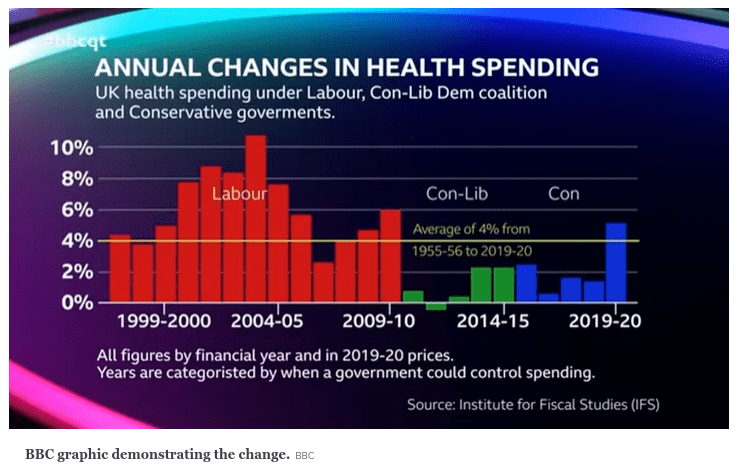
Minister Confronted With Damning Graph On NHS Funding During BBC Question Time

BBC Question Time presenter Fiona Bruce has said a Conservative claim of record spending on the NHS “doesn’t look so good” after a minister was confronted with a damning graph.

Graeme Demianyk www.huffingtonpost.co.uk 

A special edition of the corporation’s flagship political programme from Hoddeson, Hertfordshire, was devoted to health as the sector faces multiple crises, most notably a stand-off with nurses and other staff over pay.

Bruce presented health minister Will Quince with a graphic using Institute of Fiscal Studies data suggesting NHS spending between 1955-56 and 2019-20 increased by an average of 4% – but the annual rise has been below that for all but one year since 2010.

Bruce said: “Let’s just look at a graph looking at funding of the NHS. This will be familiar to you, in terms of where funding was for the NHS before the Conservative government came into power and where it is now.

“As you can see, if you look at the average there, it’s pretty dramatic in terms of the drop in funding. So when you talk about record investment, that doesn’t look so good.”

Quince replied by not addressing the point of the graph – that health spending went up by a greater percentage in the Labour years – but by saying “we’re spending more on health and social care now than ever in our country’s history”.

Bruce followed up by saying “the average increase has been something like 3% but when you look at that, it’s more like 1.6%”.

But Quince persisted: “If you take, for example, 2010, it was around £100bn that we spent on the NHS. By 2025, it will be £166bn.

“And, if you look at when times were tough, for example, when we came out of the economic crisis in 2008-2009, the coalition government, despite having to make reductions in spending elsewhere, prioritised the NHS.”

It’s unclear precisely which research by the respected think-tank the graph refers to. But one study that does not include the latest annual figure states spending increased by 6% annually during the Blair-Brown years, dropped to 1% under the coalition, and was up to 1.6% under the Conservative government up to 2018-19.

In any case, many watching seized on the figures.

The IFS report said: “UK health spending increased in real terms by an annual average of 3.6% per year between 1949-50 and 2018-19.

“Spending increased sharply during the late 1990s and 2000s, growing by an average of 6% per year during the Blair and Brown governments as part of a wider growth in public service spending.

“Since 2009-10, health spending growth has slowed sharply. Between 2009-10 and 2018-19, real spending grew by an annual average of 1.3%. Average increases of 1% per year under the coalition government (2009-10 to 2014-15) were the smallest five-year average seen under any government.

“However, it is important to note that these increases took place over a period during which most areas of public spending experienced large reductions. Indeed, spending on areas such as education, defence, and public order and safety has fallen, while spending on health has continued to rise – albeit at a slower rate than has tended to be the case historically.” [Osborne austerity – Owl]

Dartmoor wild camping protesters ‘defiant’ as they march in their thousands and summon “Old Crockern”

More than 3,000 protesters gathered in Cornwood, near Ivybridge, before marching on Dartmoor to show their anger at a new High Court rule banning wild camping on Dartmoor. Campaigners congregated at the War Memorial in Fore Street.

[Crockern Tor is said to be the home of the mythical Old Crockern, variously described as a spectral figure on horseback, galloping across the moor on a skeleton horse with his phantom hounds which were stabled at nearby Wistman’s Wood; or as a local god of the moor in pre-Christian times]

Amber Edwards www.plymouthherald.co.uk 

A campaign group called The Stars are for Everyone said: “3,000 people have come to become part of this historic movement. Here we stand. Defiant, hopeful, and powerful.”

Since the High Court’s decision, landowners have agreed to allow wild camping on most of Dartmoor without permission, they are said to be paid an ‘unknown sum’ by the park. However, Right to Roam campaigners have called it a “stitched up deal”.

The group is unhappy that the “already cash-strapped national park” have to pay the landowners for “granting such permissions”.

The protest event is taking place this afternoon [Saturday] between 1.30pm and 5pm. The village situated on the edge of Dartmoor will be filled by the sounds of drumming during part of the ceremony and musicians are also said to be attending.

The group posted on their Twitter page: “We’ll see you tomorrow for the first of many acts of resistance against this new enclosure. We summon Old Crockern to our side: the ancient spirit of Dartmoor. He has risen before to put the avarice of an arrogant landowner in check – may he do so again!”

An open invitation has been extended to all for the protest today (Saturday, January 21). People are being told that they are welcome to bring something small or large that they can make a drumming sound with.

On its event page, Right to Roam said: “Old Crockern represents the values that sit within our campaign and those that embody Dartmoor: inclusivity, freedom, growth, relationship and humanity.”

They added: “Our right to be in nature should not be the plaything of the landowning elite. It is not something to be stripped away by legal theatrics, nor negotiated for a doff of the cap. It is our collective inheritance; a birthright which brokers our connection to the land and the stars.”

Right to Roam is aiming to extend the Countryside & Rights of Way Act in England so that millions more people can have easy access to open space.

In no Levelling Up area do residents tend to think the local area has improved in recent years

“ ..one final ingredient, the most important factor in levelling up, the yeast that lifts the whole mattress of dough, the magic sauce – the ketchup of catch-up and that is leadership and this brings me to the crux of the argument- this country is not only one of the most imbalanced in the developed world, it is also one of the most centralised…..” Boris Johnson just eighteen months ago (July 2021).

Has there been a benefit from the first round of Levelling Up funding to local public pride and optimism? Our latest MRP-driven evidence suggests not

Patrick English, Jemma Conner, Lottie Thornton, Matthew Smith yougov.co.uk

As the government today announces another round of Levelling Up funding, YouGov MRP analysis reveals that many people in the target areas of the first funding round are more likely to think their local area has declined than improved in recent years, and many believe that their community is the kind of place that “people are trying to get away from”.

After collecting over 100,000 survey responses between August and October last year, we then used a statistical technique named Multilevel Regression and Poststratification (MRP) to estimate the proportions of each local authority in England, Scotland, and Wales holding each respective opinion.

Our analysis suggests that there is little optimism or positivity about local areas among the very people the Levelling Up fund was designed to benefit.

In only four local authorities do people tend to think that their local areas have generally improved in recent years. While in 215 local authorities the most common opinion is that the local area has stayed about the same, in as many as 142 council areas people tend to believe the local area has generally declined.

As many as seven in ten of the top priority Levelling Up funding local authorities from Round 1 (64 council areas) are among those where people say the local area has gone downhill. In the other 25 people tend to believe their local area has stayed largely the same; in no top tier target authority do people generally believe their area has improved recently.

While ‘no real change’ may be the prevailing view in most council areas, taking the data a step further and looking at whether those with a different view are more likely to say their area has improved or declined reveals that in almost all places people are more likely to say the latter.

In the 215 local authority areas where the most common view is that the local area has remained much the same over recent years, in fully 208 those who take a different view are more likely to say it has declined than improved. In just seven is the opposite true.

The strongest sense of decline appears in areas like Stoke-on-Trent (49%), Havering (48%), Thurrock (48%) and Rotherham (47%).

There are notable regional differences, with people in local authority areas in Scotland and the South generally less likely to feel their local area has declined.

In London, however, there is a great deal of variation from area to area. The aforementioned Havering has the second highest rate of people sensing decline in the country, yet at the same time the only four local authorities where “generally improved” comes out on top are also in London: Hackney (38% generally improved), Islington (36%), Southwark (36%), and Tower Hamlets (34%).

The mean share of the local population in 2021 top priority Levelling Up areas who believe their locality has declined is 41%, slightly less at 37% in tier two, and slightly less again at 35% in tier three (those areas not earmarked for any round one funding).

Of all local authorities where “generally declined” is the prevailing view, nearly half (64) are in the top level of 2021 Levelling Up funding.

Residents of Barking and Dagenham, Boston, and Newcastle-under-Lyme are most likely to see their local areas as places people want to get away from

A separate question asked Britons whether they live in “the sort of place that people try to get away from” versus “the sort of place that people would like to move to”.

The results show 45 council areas where the local population tend to take the gloomy view.

The London borough of Barking and Dagenham, as well as Midlands towns Boston and Newcastle-under-Lyme stand out, with more than half of people in each area describing them as the kind of place people flee if they get the chance.

The wider grouping of 45 council areas includes several large urban areas like Sunderland, Wigan, Coventry, Bolton, Stoke-on-Trent, Wakefield, Croydon, and Wolverhampton, large towns such as Luton, Stevenage, Oldham, Harlow, and Hyndburn, as well as some more rural areas such as North Lincolnshire, Ashfield, Pendle, and Boston.

There are notable regional divides in whether people view their area as the type of place people are trying to get away from or move to. Opinions across London, the South, and Scotland are generally more positive about their local area than they are on average in the North.

With many top priority areas from the first round missing out on the funding announced today, it remains unclear if the government’s strategy to Level Up areas in the North and Midlands is having, or will have, any discernible effect on local public opinion about opportunities and improvements in their communities.

Data tables can be downloaded here

YouGov interviewed over 115,000 British adults between 9th August and 21st September 2022, and used Multilevel Regression and Post-Stratification (MRP) to model the estimated outcomes at the local authority level (district, metropolitan borough, London borough, and unitary authority). MRP models first estimate the relationship between a wide variety of characteristics about people and their opinions – in this case, beliefs about their local areas – in what is called a ‘multilevel model’, which allows us to account for specific area (in this case, council) level effects as well as background information about respondents themselves. MRP then uses data at the local authority level to predict the outcomes at council level based on the concentration of various different types of people who live there. The model assigns each type of person a probability of (1) believing their area has “generally improved” or “generally declined”, and then (2) believing their area is the type of place people are trying to “get away from” versus “move to” (this is the ‘post-stratification’ component), and then estimates the area-level distributions using information about how many of those specific types of voters live in each area. In this instance, 1000 draws from the posterior distribution of the multilevel model were used to predict the council-level probabilities, which ran for 10,000 iterations across four parallel chains. MRP has been successfully used to predict the outcomes of both the 2017 and 2019 UK General Elections.

Another fine mess – second Tory Prime Minister gets fixed penalty notice

Sunak get another FPN months after the first.

“This government will have integrity, professionalism and accountability at every level.”

Nothing seems to have changed. – Owl

Tory Party chairman Nadhim Zahawi made to pay ‘million pound’ fine to taxman

Rishi Sunak is under pressure to sack Nadhim Zahawi from the cabinet after it was claimed the former chancellor paid a penalty of more than £1m to settle a probe into his tax affairs.

Kate Devlin www.independent.co.uk

The Tory party chairman has faced mounting questions over his personal payments to HMRC, but the prime minister has so far stood by him.

Some senior Tories believe it is now impossible for Mr Zahawi to continue in his job, with one describing the situation as “unsustainable”.

The revelation that Mr Zahawi was forced to pay the penalty – part of a reported total tax settlement of almost £5m – comes as The Independent reveals how he tried to gag this newspaper from revealing that he was being investigated by the National Crime Agency and HMRC last year.

In an extraordinary exchange last July, Mr Zahawi repeatedly threatened to sue if any stories were published, saying:

• One hundred per cent I will take legal action

• There was no such investigation by the NCA. I have paid all due taxes and obeyed all financial laws and regulations.

• I repeat I will take legal action

Mr Zahawi also paid a 30 per cent penalty to HMRC, according to a report in The Guardian, taking the estimated total to more than £4.8m – though his spokesperson told the newspaper he “does not recognise this amount”.

Labour last night called on the prime minister to sack Mr Zahawi.

Angela Rayner, the party’s deputy leader, said: “Rishi Sunak promised a government of integrity, professionalism, and accountability but instead he’s propping up a motley crew of scandal-ridden ministers.”

She added: “The position of the man who was until recently in charge of the UK’s tax system and who this prime minister appointed Conservative Party chair is now untenable.

“It’s time for Rishi Sunak to put his money where his mouth is and dismiss Nadhim Zahawi from his cabinet.”

One Conservative former minister said told The Independent Mr Zahawi’s position was “unsustainable”, because the former chancellor would be asked about his tax affairs every time he appeared in public.

The party would be left with a “chairman that can’t do media [interviews]”, he said, a role that is especially crucial around the upcoming local elections, which are already predicted to be difficult for the Conservatives.

Another former minister said there was a risk the row would “hang over” Mr Zahawi and “overshadow” the role of party chairman.

“A judgement needs to be made about whether this storm can be weathered and a line is drawn or it hangs over the chairman and overshadows [his role as party chairman],” they said.

“It is a conversation behind closed doors that needs to be had – about if he can fulfil his duties,” they added.

Mr Zahawi was seen by many MPs to have done a good job in the short time he has been in the role.

At the weekend The Sun on Sunday reported that he had settled a tax dispute relating to an offshore company registered in Gibraltar to hold shares in the polling company that he co-founded, YouGov.

YouGov’s 2009 annual report showed a more than 10 per cent shareholding by the Gibraltar-registered Balshore Investments Ltd, and described the company as the “family trust of Nadhim Zahawi”. At the time Mr Zahawi was an executive director of YouGov.

A spokesperson for Mr Zahawi has previously said that his taxes are “properly declared and paid in the UK” and the minister “has never had to instruct any lawyers to deal with HMRC on his behalf”.

During the week, Mr Sunak defended his party chairman, telling MPs at Prime Minister’s Questions that Mr Zahawi “has already addressed this matter in full and there’s nothing more that I can add”.

The prime minister’s press secretary also said Mr Zahawi “has spoken and been transparent with HMRC”.

On whether Mr Sunak believed the matter was now closed, she said: “I don’t know whether the prime minister has reviewed it in full, but I do know that he takes Nadhim Zahawi at his word.”

Mr Zahawi’s spokesperson did not respond to requests for comment.

A HMRC spokesperson said: “We are unable to comment on identifiable taxpayers due to strict confidentiality rules.”

No 10 declined to comment.

Dartmoor landowner who won wild camping ban may be putting rare beetle at risk

The landowner who took Dartmoor national park to court to ban wild camping may be putting a rare beetle at risk by releasing pheasants next to an ecologically important woodland, against the advice of environmental experts.

Helena Horton www.theguardian.com 

This is despite him having said he pushed for a wild camping ban in order to “improve conservation of the Dartmoor commons”, arguing that campers damage the national park with litter and disturbance.

Last week, the right to wild camp in England and Wales was lost after Alexander Darwall, a hedge fund manager, succeeded in his case against Dartmoor national park. It was the last place it was possible to wild camp without seeking permission.

Darwall, Dartmoor’s sixth-largest landowner, brought the case against the national park authority, arguing that the right to wild camp on the moors never existed. The owner of the 1,619-hectare (4,000-acre) Blachford estate on southern Dartmoor offers pheasant shoots, deerstalking and holiday rentals on his land.

On Saturday, hundreds of protesters from the Right to Roam campaign are to march on his land in protest at having their right to wild camp taken away. They are outraged that landowners this week including Darwall have struck a deal with the national park in which they are paid to allow camping on small portions of their land. Campaigners have called it a “stitch-up”.

Natural England, the government body in charge of enforcing conservation measures in national parks, has warned the estate not to release pheasants near Dendles Wood, a fragment of temperate rainforest on the southern edge of Dartmoor, adjacent to the Blachford estate. It is protected as a national nature reserve (NNR) and site of special scientific interest (SSSI), and falls within the Dartmoor special area of conservation (SAC). The letter to the estate contained details on the necessary maintenance to retain these statuses, including not releasing pheasants.

In a conservation plan for the wood, released under freedom of information laws, Natural England says that “operations likely to damage the special interest” of Dendles Wood include “the release into the site of any wild, feral or domestic animal” and “introduction of and changes in game and waterfowl management and hunting practice”.

The very rare blue ground beetle is put under pressure by the release of the birds, according to Natural England. The plan says “high pheasant stocking rates are a threat to this species”because pheasants prey on the beetles.

Dendles Wood is one of only a handful of sites in the UK where the large and distinctive beetle makes its home. It is found at just 15 sites in England and Wales, eight of which are in Dartmoor national park.

Despite this, local residents have found a pheasant release pen on land owned by the Darwall family that lies less than 250 metres from the edge of the NNR. Photos show the release pen has multiple entrances and exits for pheasants, meaning they are free to enter the surrounding woods. Volunteer rangers have said that pheasants are one of the most common birds to be found in Dendles Wood.

The estate also appears to be breaching the licence to release pheasants to shoot. It does not appear to have reported to Natural England the number or density of pheasants it releases near the wood, even though this is one of the conditions of the GL43 general licence under which landowners are permitted to release pheasants within 500 metres of an SAC.

The environmental campaigner and author Guy Shrubsole said: “It’s ironic that one of the reasons stated by the Darwalls for bringing their legal case against wild camping was its alleged impacts on Dartmoor’s ecology.

“The reality is that responsible wild camping leaves no trace. The same cannot be said of the 50 million pheasants that are released by landowners into the British countryside every year.

“Now the public have had their access rights sharply curtailed. The landowner’s pheasants, meanwhile, still have a full right to roam over a national nature reserve.”

The Dartmoor national park authority is consulting with its legal team with a view to appealing against the decision. Lawyers for the park have said that ecologically damaging actions by the estate could be a factor in any appeal.

Darwall was contacted via his lawyer but had no comment to make.

State of social care a ‘tragedy’ and cost-of-living crisis a ‘catastrophe’

The state of the UK’s social care system has been branded “a tragedy” by a prominent economist who was the architect of the original plans for a care cap.

Aine Fox www.independent.co.uk

Sir Andrew Dilnot, who led a review into the future of funding social care under the coalition government and whose proposed and long-awaited reforms of social care were delayed in the autumn statement, said it is a shameful situation.

It came as leading public health expert Professor Sir Michael Marmot described the cost-of-living crisis as a “humanitarian catastrophe” due to the effects it will have on physical and mental health.

Sir Andrew accused the Government of having done nothing to address problems in social care and said the most vulnerable people in society are “not being looked after properly”.

Speaking on Tonight With Andrew Marr on LBC radio, he said: “The thing that makes me cross is not that they haven’t implemented my proposals, it’s that we have people who are amongst the most vulnerable in our society who are not being looked after properly.

“And we have fabulous people delivering care to them who are under unnecessary and inappropriate pressure. So, the problem is not whether they’ve delivered my proposals or anybody else’s proposals, they haven’t done anything.

“We have an enormous challenge as a society. We have fabulous people willing to deliver the care. And we’re not looking after either the people who need the care or the people who are delivering it properly and we should be ashamed of ourselves.”

Reforms including an £86,000 cap on personal care cost contributions and an expanded means test that is more generous than the existing one had been due to come into effect from October 2023.

Asked how he felt about the reforms being delayed by Chancellor Jeremy Hunt in November, he said: “I think it’s a tragedy. I mean, I think the way that the social care system is in the UK at the moment is a tragedy, and we could do so much better.

“And I often hear people saying, ‘oh, it’s huge amounts of money’. It’s not huge amounts of money compared to the NHS, and the knock-on effects in terms of misery for families and problems to the NHS are vast.

“It just astonishes me after 40 years of working in this kind of area that something which seems so obvious could still not have happened. And I, and people like me, have to take some of the blame. We’ve clearly not explained it clearly enough. But it is something to be really ashamed of ourselves as a country about.”

Sir Michael said evidence from September suggested one in six households without children were in food insecurity while one in four households with children were in food insecurity.

He told the same programme on LBC: “That means missing meals, not eating when you’re hungry. That will damage health, living in cold homes, that will damage health, the stress of the struggle to try and make ends meet will damage health. It will damage physical health, and it will damage mental health. So, the cost-of-living crisis is indeed a humanitarian catastrophe.”

Asked about his choice of words, he referred to the case of two year-old Awaab Ishak, who died after prolonged exposure to mould in his flat, which was maintained by a housing association in Rochdale.

He said: “I think when a two-year-old boy dies because of mould in his home, what would you call it? This is a preventable tragedy. I don’t want to bandy words around and cheapen words. But when a two-year-old boy dies because of mould in his home, this is a tragedy, and it’s the tip of the iceberg.”

Levelling up’s winners and losers

Ministers have just disbursed some £2bn in the latest tranche of funding for levelling-up projects, as part of the overall £4.8bn programme. Rishi Sunak has promised that the spending will be “transformative”. The details of the announcement have been met with mixed reviews.

Sean O’Grady www.independent.co.uk 

Who is going to get the money?

A variety of schemes, including a northern Eden Project in Morecambe worth £50m, a new primates and conservation research centre at Twycross Zoo worth £19m, and converting the Old Town Hall in Whithorn, Galloway into a social enterprise training centre for £300,000. The money is scattered far and wide.

Is it fair?

Critics say the bulk of the spending is going to London and the South East. Ministers argue that, adjusted for population, the areas that do best are the North West, the North East, and Wales. Plus there are undoubtedly pockets of poverty in the South – some of the most deprived boroughs in the country are in London.

Is it ‘pork barrel’ politics – bribes to vote Tory?

Ever since Boris Johnson championed the policy, it has had a whiff of pork about it. The fact that some £19m is being spent on improving a high street in the prime minister’s own constituency has raised some eyebrows. There is even a grant of £230,000 to help keep a pub alive in the same North Yorkshire constituency. Indeed, the plight of The Countryman’s Inn in Hunton is a case in point. The village community group has purchased its local pub using cash from the community ownership fund. It will now be able to offer hearty meals and tasty ales to the people of Wensleydale and beyond, and not all of them are by any means rich. However, there are very many pubs throughout the country threatened with closure, and they are not going to receive a penny.

It highlights the seemingly arbitrary distribution of the “goodies”. Why, let us ask, should £5.1m be given to build new women’s changing rooms in 20 rugby clubs across Northern Ireland – a great idea – but nothing to improve the equivalent facilities in England, Wales or Scotland?

One might also ask why a solidly Labour city such as Leicester, with no chance of a Tory getting a seat, is doing relatively well out of the exercise, whereas Liverpool and Bradford – equally hostile to the Conservatives – have missed out again. There may be some political bias in the allocations, but it isn’t consistent.

What about the red wall?

It seems that Tory MPs and others in the Labour heartlands who turned to Johnson in 2019 are chastened and reportedly angry at missing out. “There are some really wealthy areas on the list,” said one. “It looks awful.” It cannot be entirely an exercise in party political favouritism if elected Tory politicians in marginal seats are complaining, but perhaps they are just hoping for more. None is more outspoken than Andy Street, the Conservative mayor of the West Midlands region: “Fundamentally, this episode is just another example as to why Whitehall’s bidding and begging-bowl culture is broken, and the sooner we can decentralise and move to proper fiscal devolution the better.”

Who are the losers?

It is a rule of political life that for every beneficiary of some official scheme – tax credits, a new university, an upgraded rail line – there will be many others who thereby feel hard done by. If residents in Morecambe and Cleethorpes are delighted at the largesse displayed by Michael Gove, it’s equally likely that folk in Blackpool and Skegness will feel slighted.

What does the opposition say?

Nationalists in Scotland and Wales, as well as Labour and Tory regional mayors such as Mr Street, resent the way in which ministers and civil servants in London make the final call as to who gets the cash. For the SNP, it is another betrayal of devolution. Welsh politicians resent part of their allocation being spent on HS2, which doesn’t go to Wales. Labour’s Lisa Nandy has been scathing about the competitive, demeaning nature of the bidding process: “It is time to end this Hunger Games-style contest, where communities are pitted against one another and Whitehall ministers pick winners and losers.”

Will levelling up even work?

As a modern iteration of what was once known as “regional policy”, perhaps not. Mr Sunak insists that the projects being funded will attract private-sector investment, but that is not guaranteed, and the money might not yield much except for a little civic pride. Regenerating one seaside town might simply attract visitors away from another, and much of the money is merely reallocated from other budgets, such as for transport or grants to devolved administrations. That might be said of the £3.3m being spent on electric-vehicle charging points in Northern Ireland.

Even the total sum, £4.8bn, is tiny in relation to Britain’s £2,500bn GDP, and is far less than the 30 per cent overall reduction in central government’s support to local authorities since 2010, which was driven by austerity. Politically and economically, at a time of severe pressure on the public finances, levelling up feels tokenistic and random.

Politically, few of these laudable projects will be completed by the general election, by which time voters may anyway have concluded that repaved town centres aren’t much use if they haven’t the cash to spend in them.

A more rational approach might have been to recognise that some poor people live in richer areas, such as Kensington and Chelsea, while some rich people live in poorer places, such as Newcastle, and to focus the process on demographics rather than geography. But perhaps that would be too socialistic for this government.