Weighed down by Brexit and austerity, the chancellor cracks his whip
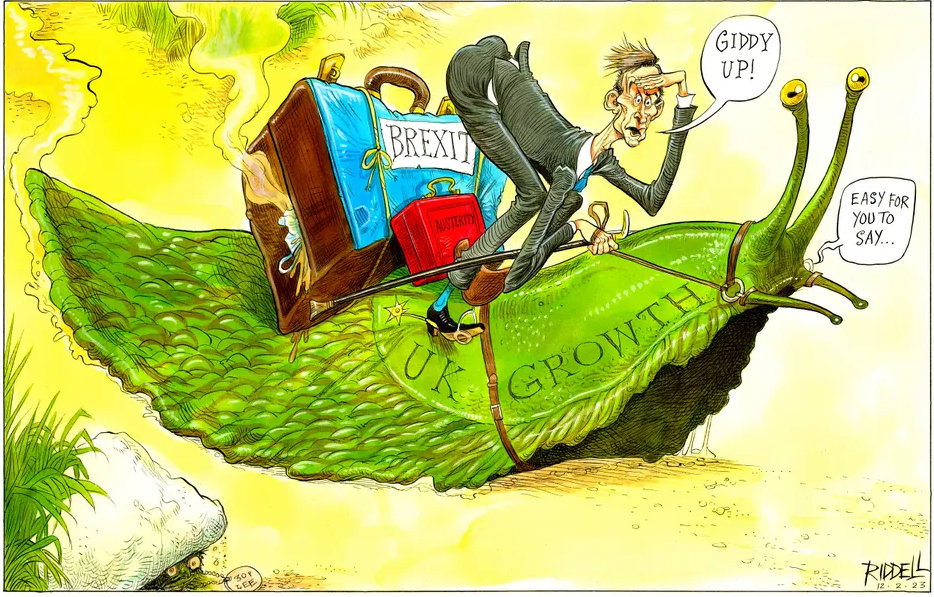

Weighed down by Brexit and austerity, the chancellor cracks his whip
Cuts to post-Brexit farming payments mean farms risk “going out of business” as new figures reveal only a tiny fraction of slashed EU subsidies went to agriculture businesses last year.
Helena Horton www.theguardian.com
The government is replacing the EU’s Common Agricultural Policy (CAP), which paid subsidies to farmers to keep them in business, with “payments for public goods”, meaning land managers get paid for improving nature.
Each year, ministers are cutting how much farmers get paid under the old scheme while they introduce new ones, which last year commenced with the launch of the sustainable farming incentive (SFI). This paid farmers for looking after their soil.
While subsidies were cut by an average of 22% for farmers last year, only 0.44% of the promised budget was spent on SFI, leaving farmers asking where the money is going. This year, the cuts are set to be even more stark, with the government planning to slash payments by 36%.
Data revealed to the Observer under the Freedom of Information Act from the Rural Payments Agency shows that a total of £10,692,415 was paid out under the sustainable farming incentive scheme in the 2022 calendar year. This is out of a budget of £2.4bn, meaning only 0.44% was spent on the new schemes.
Farmers have said they are noticing an underspend, with money missing from the rural community. Jake Fiennes, a conservationist who manages a large farm on the Holkham Estate, Norfolk, saw the farm’s subsidies cut by about 45% last year.
“In the last financial year, there was an underspend of about £100m. It looks like this is to be the case again. Our direct support has been reduced and we want to know where that money is going,” he said.
Dither and delay over introducing the new payment programme, including threats from the Liz Truss government that they would scrap it altogether, meant that many farmers have not signed up.
“These figures show that the Conservatives have broken their promise to farmers to keep farm funding at CAP levels,” said Tim Farron, the Liberal Democrat environment spokesperson. “They have rushed to cut basic payments and failed to deliver the new schemes on time.
“This will lead to farmers going out of business, which means that we will fail to deliver vital environmental goals.”
He added: “It’s hard to know if this is incompetence or deliberate betrayal of our rural communities, but they amount to the same thing.”
A Defra spokesperson said: “As direct payments are phased out, we are reinvesting the full £2.4bn into the farming sector each year throughout this parliament, through SFI, our other environmental land management schemes, and one-off grants. A small degree of underspend in 2021/22 has been made available for schemes in 2022/23.
“We are now accelerating and expanding our payment offer so that there’s something on offer for every farmer. We launched the Sustainable Farming Incentive in 2022 – more than 2,000 farmers are already part of the scheme and we expect this number to continue to rise over the coming months.”
BBC boss in ‘Cash for Boris’ row guilty of hiding his role, says inquiry
The reputation of the chair of the BBC was severely damaged last night after a damning report by MPs on his role in the “cash for Boris” row.
Matt Mathers www.independent.co.uk
Richard Sharp’s hopes of surviving the scandal appeared doomed after a Commons committee branded him guilty of “significant errors of judgement” by failing to declare his role in facilitating an £800,000 loan for Boris Johnson. The report stopped short of asking him to resign.
But its humiliating verdict that he should “consider the impact of his omissions” on trust in the BBC, and his own appointment, is likely to make it impossible for him to continue, effectively finding the BBC chair guilty of serious misjudgement.
MPs said the actions of Mr Sharp, a former Goldman Sachs investment banker and significant Conservative Party donor, constituted “a breach of the standards expected of individuals” applying for prominent public appointments.
The MPs added that Mr Johnson, the then-prime minister, was “fully aware” of a potential conflict after his government backed the man who helped arrange his loan as the chair of the BBC.
They say that future governments must ensure appointments to prestigious positions are not “clouded” in the same way again.
And they warn: “The public appointments process can only work effectively if all those involved are open and transparent.”
Labour claimed that “Conservatives’ cronyism is dragging down the BBC”, while the Lib Dems called for an independent inquiry into Mr Johnson’s actions, calling for the ex-PM to “face the music”.
The report piled further pressure on Mr Johnson after it was revealed the Met Police has been asked to reopen its Partygate investigation.
The deputy chair of the London Assembly’s Police and Crime Committee has written to the Met commissioner, Mark Rowley, asking if he was “taking new information into account when making a decision regarding the reopening of the investigation”, The Guardian reports.
New details were released by an ITV podcast claiming Downing Street staff corroborated before filling out questionnaires and No 10 officials destroyed evidence before the Sue Gray inquiry could investigate.
Mr Johnson is set to appear before parliament’s privileges committee next month and whistleblowers are said to be hesitant about being part of the investigation after being told they should not expect anonymity.
Mr Sharp’s failure to tell the Digital, Culture, Media and Sport Committee (DCMS) about his meeting with Mr Johnson and Sam Blyth, who backed the line of credit for Mr Johnson, meant that MPs were “left without the full facts” and unable to properly scrutinise his suitability for the role, the report said.
Mr Sharp admitted to the Cabinet Office that he set up a meeting between Mr Johnson and Mr Blyth but denied giving any financial advice.
A spokesperson for Mr Sharp said he “regrets” not telling MPs about his involvement with Mr Blyth “and apologises”.
Damian Green, the Conservative MP and acting chair of the DCMS committee, said: “The public appointments process can only work effectively if everyone is open and transparent, yet Richard Sharp chose not to tell either the appointment panel or our committee about his involvement in the facilitation of a loan to Boris Johnson.
“Such a significant error of judgement meant we were not in the full possession of the facts when we were required to rule on his suitability for the role of BBC chair.”
Mr Sharp was named as the government’s preferred candidate for the BBC in January 2021 and he had the backing of the DCMS committee, which at that point was not aware of his meeting with Mr Johnson and Mr Blyth.
The MPs said there was an “unresolved issue” as to why Simon Case, the cabinet secretary, believed Mr Sharp had himself been giving financial advice to Mr Johnson. They called on the Cabinet Office to “clear up the confusion”.
Mr Sharp was called back to the committee on 7 February this year following The Sunday Times’s revelations about his role in facilitating the loan for Mr Johnson.
He said that Mr Blyth’s offer of help for the then-prime minister was made in September 2020 and he had stressed the need for things to be done “by the book”.
Following the launch of the recruitment process for the BBC chair role, Mr Blyth contacted Mr Sharp to request an introduction to the cabinet secretary to ensure due process was followed.
Mr Sharp told the MPs that he met Mr Johnson before going to see Mr Case and informed him that he would be telling the cabinet secretary about Mr Blyth’s offer of financial assistance.
Mr Sharp met Mr Case in December 2020, at which point he “agreed no further participation” in relation to the financial support, in order to avoid any conflict of interest or perception of conflict given his application, the report said.
Mr Sharp told the MPs that as far as he was concerned, that meant “the matter had been resolved”.
In their new report, the MPs said: “Mr Sharp recognised the need to be open and transparent over facilitating an introduction of the then-prime minister to Mr Blyth regarding the £800,000 loan guarantee and brought this to the attention of the cabinet secretary.
“However, he failed to apply the same standards of openness and candour in his decision not to divulge this information during the interview process or to this committee during the pre-appointment hearing.”
A spokesperson for Mr Sharp said the BBC chair “appreciates that there was information that the committee felt that it should have been made aware of in his pre-appointment hearing”.
“He regrets this and apologises,” the spokesperson said.
The spokesperson said Mr Sharp was never involved in the arrangement of a loan between Mr Blyth and Mr Johnson and had not offered financial advice to the then-prime minister.
Sidmouth is well-known for its coastline, vast green spaces, friendly locals, seaside town charm…and some rather dramatic cliff falls. The town’s East Beach cliff is gradually falling away into the sea, taking the gardens of the homes on Cliff Road with it.
Mary Stenson www.devonlive.com
On a number of occasions over the years, the red rocks of Sidmouth’s cliff edge have sent clouds of dust into the air as they collapse into the sea. Last week, East Devon District Council agreed to put £1.7 million of funding towards ‘bigger and better’ Sidmouth sea defences, with construction not expected to commence until 2025.
In the meantime, the residents of Cliff Road are losing chunks of their gardens to the elements. Paul Griew lost an entire summerhouse back in 2017 and it was caught on video tumbling into the sea.
“My gardener used to have his bonfire there and he had one there half an hour before [the summerhouse] went,” said Paul. “The first thing I did was go and make sure his car had gone and he hadn’t actually been standing there.
“When I bought the house, I looked at records of rate of erosion and it appeared that there was between 300 and 1,000 years before it reached the house so it seemed perfectly acceptable.
“It’s increased ten times so possibly 30 years left rather than 300.”
Paul is in charge of the Cliff Road Action Group which campaigns for robust protection against increasing erosion. He says that, although it has taken some time, people are reassured by the council’s decision to fund sea defences.
He said: “It consists of most of the people along here and we put in for a planning application to put a whole load of rocks at the base in 2011. The council, instead of doing that, set up a committee to look into how to protect this and promised something would be done within five years. It’s now 11 years but they have just last week agreed that they would fund to put a groyne out there and five metres of shingle at the base which is what we lost.”
Despite the news of huge cliff falls over the years, Paul says buyers still have a keen interest in the area due to spectacular views of the sea and easy access to the beach and town. One property is even let out as a holiday home.
Paul said: “That’s the best thing to do because you don’t get the problem of the cliff going because it’s not your house but you get the view for two or three weeks.”
Peter Sinton moved into his home on Cliff Road in September 2022 as his wife had persuaded him that Sidmouth was not the “downmarket” place he had previously thought of it as. He said he quickly fell in love with the property and was unfazed by the stories of previous cliff falls.
Peter said: “When I saw the house, I said ‘that’s the only house I’ve seen that I feel I’d like to live in’. All the stories of the cliff falls didn’t put me off at all. It affected the price considerably so we got what I consider a fantastic bargain.”
He explains that the sloping nature of the road means that his property is “probably safer” than others further up the road, adding that he probably won’t live long enough for the erosion to reach the house anyway.
He said: “I’m 80 this month and the chances of it coming down in my lifetime is pretty remote.
“The chances of it being eroded significantly in the next 100 years, I think is absolute rubbish. That’s not just overconfidence, I did study geology at university.”
Whilst he isn’t “in the slightest bit bothered” about the receding cliffs, Peter still treats gardening like an extreme sport, tying a rope around himself as he works within a few feet of the edge.
He said: “I’ve been working down at the end [of my garden], clearing brambles and I’ve been working within four or five feet of the edge and I put a rope round me just in case.”
Further up the road, Denise Larkin bought her home in December but is yet to fully move in due to a broken boiler. Nonetheless, while staying with her daughter in Sidmouth, she is paying regular visits to the house and is hoping to move in next week.
She says Sidmouth is a “lovely place to live” and, like some of her neighbours, doubts the erosion will reach the house in her lifetime.
When asked if the coastal view was an attractive feature when moving from her previous home in Dorset, Denise said: “Yes, it sort of mitigates the fact that it’s falling into the sea.
“I’ve got a long garden, it will see me out. You trade one thing for another. At my sort of age, you trade it for the view and the enjoyment of life that you have. It’s a lovely place to live.
“I do hope that one day they’ll do something about it. It’s a concern but not one that worries me, it doesn’t keep me awake at night. My granddaughter worked it out and, with the amount that’s already gone, it’ll not only see me out, it’ll see her out as well.”
When Denise properly moves in, she’ll be bringing her dog with her. To protect him, she says she’s had the fence at the end of the garden rebuilt, which she joked that she’ll “keep moving” as the cliff erodes.
She said: “He’s quite likely to decide that he’s going to take a shortcut to the sea. He’s only little but he makes up for it in character.”
An extraordinary cross-party summit bringing together leading leavers and remainers – including Michael Gove and senior members of Keir Starmer’s shadow cabinet – has been held in high secrecy to address the failings of Brexit and how to remedy them in the national interest, the Observer can reveal.
Toby Helm www.theguardian.com
The two-day gathering of some of the country’s most senior Labour and Tory politicians from both sides of the Brexit debate, together with diplomats, defence experts and the heads of some of the biggest businesses and banks, was held at the historic Ditchley Park retreat in Oxfordshire on Thursday afternoon and evening, and on Friday.
Documents from the meeting, obtained by the Observer, describe it as a “private discussion” under the title: “How can we make Brexit work better with our neighbours in Europe?”
Those in attendance from the pro-Brexit side included the former Tory party leader Michael Howard, former Tory chancellor Norman Lamont and former Labour Europe minister Gisela Stuart, one of the leading figures of the leave campaign.
Among the prominent remainer politicians present were shadow foreign secretary David Lammy, shadow defence secretary John Healey and the former European commissioner and Labour cabinet minister Peter Mandelson, who acted as chairman. From the Tory remainer camp, the ex-cabinet minister and long-serving minister for Europe, David Lidington, attended.
Non-political attendees included John Symonds, chair of the pharmaceutical company GlaxoSmithKline; Oliver Robbins, Goldman Sachs managing director and former chief Brexit negotiator for the government from 2017 to 2019; Tom Scholar, the former Treasury permanent secretary; and Angus Lapsley, Nato assistant secretary general for defence policy and planning.
A confidential introductory statement for those at the meeting acknowledged that there was now a view among “some at least, that so far the UK has not yet found its way forward outside the EU” with Brexit “acting as a drag on our growth and inhibiting the UK’s potential”.
A source who was there said it was a “constructive meeting” that addressed the problems and opportunities of Brexit but which dwelt heavily on the economic downside to the UK economy at a time of global instability and rising energy prices.
“The main thrust of it was that Britain is losing out, that Brexit it not delivering, our economy is in a weak position,” said the source. “It was about moving on from leave and remain, and what are the issues we now have to face, and how can we get into the best position in order to have a conversation with the EU about changes to the UK-EU trade and cooperation agreement when that happens?”
Gove, who co-led the Vote Leave campaign in 2016 with Boris Johnson and Stuart, is understood to have made regular contributions including opening an informal conversation on Thursday night, with a source saying he was very “honest” about the shortcomings of Brexit, while still believing it would prove the right decision in the long run.
In terms that will anger ardent Tory Brexiters, the summit documents said that while on the European side there was “little interest in further wrangling over Brexit and little time being devoted to the relationship with the UK … there is also clear European as well as British strategic interest in a productive and closer relationship.”
Stating that “rejoining the EU will not be on the agenda”, the summit papers nonetheless stressed that the EU and UK “have shared interests on containing Russian aggression, developing new sources of energy and building major technology companies with their capital base on our side of the Atlantic, rather than just the US”, as well as common defence interests.
It also raised questions about forging closer links with the EU on tackling organised crime, illegal immigration and defence, and raised the possibility of a joint EU-UK policy towards China, asking: “What are the prospects for a fully coordinated policy on dealing with China?”
The unresolved matter of the Northern Ireland protocol, which is the main UK-related subject currently occupying EU officials in Brussels, was also central to the talks.
The highly unusual cross-party nature of the gathering of Brexit opponents – and the seniority of those who agreed to attend – reflects a growing acceptance among politicians in the two main parties, as well as business leaders and civil servants, that Brexit in its current form is damaging the UK economy and reducing its strategic influence in the world.
Concern is growing at the top of the Labour party that it poses a real threat to the success of any future Labour government unless problems such as increased trade friction can be addressed.
The Office for Budget Responsibility has predicted that, over the 15 years from 2016, Brexit will reduce the UK’s GDP per capita by 4%.
In effect calling for a cross-party consensus on Brexit, the summit papers referred to the need to move on from “the current mix of antagonism and nostalgia to excitement about what the future could bring for the UK and for Europe”. They also said that finding solutions was all the more urgent because of “global unrest, supply chain fragility and inflation”.
For those such as Gove who campaigned to leave the EU, there is also a clear interest in ensuring Brexit is not viewed as a failure over the long term, even if this means conceding that there will need to be closer engagement with the EU.
Much of the focus of the meeting was on how a Labour or Tory government would use a scheduled review of the Brexit trade and cooperation agreement “to reduce the some the current frictions” that have seriously damaged UK exports to the EU in particular.
Labour, which has said it will not take the UK back into the EU, the single market or customs union, has, however, already committed to using the 2025 review of the TCA to try to reduce barriers to trade.
According to the timetable of the meeting, the opening session was headed: “How might the trade and cooperation agreement be optimised now and amended later? How might trade and services between the UK and Europe be better managed?
Privatisation; “light touch” regulation; underfunded environment agency; dire opinion polls, followed by a “Whoopsie” moment for Simon.
Flushing the problem down the drain and out to sea until 2035 is too little too late!
South West Water says now is the time to create a “green jobs” G7 legacy (9 June 2021)
“Pennon, the South West’s biggest employer and parent company of South West Water, has written a report on behalf of the Great South West calling for the region not to be overlooked in the Government’s plans to level up the country. The report demands a “green jobs boom” to stop the brain drain of talented young people leaving the region.”
In this report, Susan Davy, CEO of Pennon, said, without a hint of irony:
“South West Water is making its own contribution to this with its Green Recovery Initiative, supporting the creation of up to 500 additional jobs over the next four years and taking extra action on the most pressing environmental issues that our customers tell us they care about most .We need to encourage more private investment into the region and we can do that by working closely with Government on a levelling up plan for the whole of the South West.”
Back to Simon Jupp and his inspired questions

To ask the Secretary of State for Environment, Food and Rural Affairs, with reference to the report by Ofwat entitled Water Company Performance Report 2021-22, published in December 2022, whether her Department plans to take steps to ensure that underspend is invested by water companies into reducing sewage discharges.
 Rebecca Pow The Parliamentary Under-Secretary of State for Environment, Food and Rural Affairs
Ofwat’s findings that water companies are not spending investment assigned to make service improvements is completely unacceptable. Overall, water companies have only spent 61% of their forecasted wastewater enhancement cost allowance during 2020-22, which has resulted in delaying crucial wastewater infrastructure to improve water resilience and the environment.
Yorkshire Water and South West Water have only spent 20% and 39% of their allowance, respectively. The SoS and I met with the CEOs of these two companies in December to discuss their performance.
I am aware that the COVID pandemic and the conflict in Ukraine have impacted on supply chains, but other water companies are exceeding their spend and I expect all water companies to urgently get their spending back on track and implement the upgrades to water and wastewater infrastructure they have been funded to deliver and that customers rightly expect. I will continue to meet with the CEOs of underperforming companies to monitor their progress.
Ofwat, as the economic regulator for the water industry, has been clear that where these expectations are not met and companies are failing to comply with their obligations, they will take action, including enforcement action where warranted.
 Simon Jupp Conservative, East Devon
To ask the Secretary of State for Environment, Food and Rural Affairs, with reference to her Department’s policy paper entitled Storm Overflows Discharge Reduction Plan, published on 26 August 2022, what steps her Department is taking to help reduce combined sewer overflow discharges in (a) inland and (b) coastal waters.
 Rebecca Pow The Parliamentary Under-Secretary of State for Environment, Food and Rural Affairs
The Storm Overflows Discharge Reduction plan will require water companies to deliver the largest infrastructure programme in water company history – £56 billion capital investment over 25 years – to significantly reduce sewage discharges.
Our plan prioritises areas at risk of the greatest ecological harm first, to ensure we have the biggest impact, as quickly as possible. Our targets will ensure that no water body in England should fail to achieve good ecological status due to storm overflow discharges. We have prioritised action for storm overflows discharging near or into inland and coastal bathing waters. By 2035, water companies must significantly reduce harmful pathogens from storm overflows discharging into and near designated inland and coastal bathing waters.
 Simon Jupp Conservative, East Devon
To ask the Secretary of State for Environment, Food and Rural Affairs, what recent estimate her Department has made of the number of sustainable urban drainage schemes that are (a) in full operation and (b) under construction in England.
 Rebecca Pow The Parliamentary Under-Secretary of State for Environment, Food and Rural Affairs
The number of sustainable urban drainage schemes that are in full operation or under construction in England is not held by my department.
 East Devon Watch