Devon still on flood watch after rain battered county

Flood warnings are still in place across Devon after yesterday’s deluge which saw flash flooding causing havoc across the county. There are a number of flood warnings in areas like Exeter, Sidmouth and Cullompton, according to the Environment Agency.

Zhara Simpson www.devonlive.com

It comes after a yellow weather warning was issued by the Exeter based forecaster yesterday (May 9) as parts of Devon were battered with thunderstorms and heavy rain.

In Exeter flash floods caused chaos in Honiton Road. Pictures showed vehicles stuck and bins floating in the water. The A3052 at Newton Poppleford was another area that experienced flooding with some parts of the road being impassable.

Guidance from the Environment Agency states that local residents should monitor water levels and weather conditions, adding to avoid low-lying footpaths or entering areas prone to flooding.

Here’s the flood warnings across Devon

Exeter River Clyst from Broadclyst to Clyst St Mary

Flood warning area: riverside locations and roads between Broadclyst and Clyst St. Mary, including Broadclyst, Ashclyst, Clyston Mill, Sowton Barton, Newcourt Barton, the A3052 at Clyst Honiton, and the B3181 at Broadclyst.

Sidmouth River Otter and Sid, and Exmouth area

Flood alert area: Lympstone, Exmouth, Budleigh Salterton, Honiton, Ottery St Mary and Sidmouth areas.

River Clyst and Culm and their tributaries

Flood alert area: Hemyock, Cullompton, Stoke Canon, Broadclyst and Clyst St Mary areas.
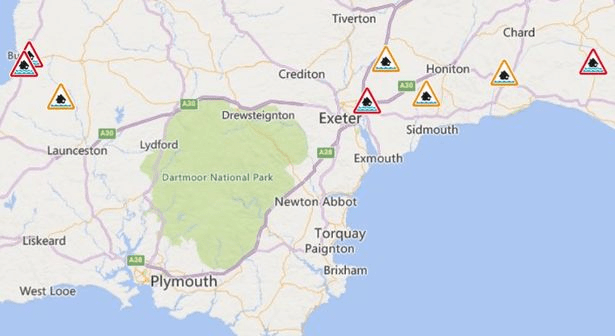
The Met Office flood warnings (Image: The Met Office)

River Axe area

Flood alert area: Rivers Axe, Coly, Yarty, Umborne Brook and coastal streams from Branscombe to Axmouth.

Upper River Tamar

Flood alert area: Bude, Helebridge, Bridgerule, Canworthy Water, Launceston and Yeolmbridge.

The guidance states: “Monitor local water levels and weather conditions. Avoid using low lying footpaths or entering areas prone to flooding. Start acting on your flood plan if you have one. Environment Agency Flood Warning Officers set the river or tidal levels that have triggered this message.

“During industrial action this message has been automatically issued based on rising river or tidal levels. Follow @EnvAgencySW on Twitter for information for your area.”

Today’s Met Office’s forecast for the south west is as follows:

Today: Rather cloudy to start with showery rain. Cloud breaking to allow for sunny spells, although further showers developing. Showers locally heavy and thundery, though less widespread than of late and dying out later. Breezier, but feeling pleasant in any sunshine. Maximum temperature 16 °C.

Tonight: Any remaining showers soon easing to leave some late evening sunshine, then clear spells overnight. Turning cloudier in the west later, with further showery outbreaks of rain arriving. Lighter winds. Minimum temperature 7 °C.

Thursday (May 11): A mixture of sunny spells and showers. Showers could be heavy at times and slow moving, carrying the risk of thunder. Light winds, and feeling warm in the sunshine. Maximum temperature 16 °C.

Outlook for Friday (May 12) to Sunday (May 14): Sunny spells on Friday, perhaps with the odd shower. Mostly dry on Saturday with sunny intervals. Cloud increasing on Sunday, with rain possibly arriving later. Feeling warm in the sunshine.
Tory MPs voice unease over Sunak’s flying pharmacy visit

Tory solution to beat the 8 am rush for GP appointments – take a helicopter! – Owl

Rishi Sunak flew to the south coast and back by helicopter to announce a new government health policy on Tuesday as he tried to calm Conservative jitters after a disastrous set of local election results.

Pippa Crerar www.theguardian.com 

In the latest example of the prime minister’s fondness for short-distance air travel, the prime minister visited Southampton to set out plans for pharmacists to provide prescriptions for millions of patients in England to help ease the GP crisis.

However, instead of getting the train from Waterloo station for the 160-mile round trip, which would have taken one hour 15 minutes and cost about £30 return, he opted to travel by air, at a cost to the taxpayer in the region of £6,000.

The visit, instead of reassuring Tory MPs that he was focused on getting on with the job after the Conservatives lost more than 950 seats in last week’s local elections, unintentionally underlined the fears of some that he is seen by voters as out of touch.

“Is it unfair to say that the weekend was about a powerful unelected individual who is unfeasibly wealthy and lacks the common touch … and King Charles III?” one Tory MP even joked darkly.

“To go backwards from our results in 2019 when we lost 1,300 seats is a damning indictment of the public view of the government. To outperform our own very low expectations is appalling.”

Sunak told reporters in Southampton that the local elections results were “obviously disappointing” but insisted his priorities were right for the country and he would “keep working” to deliver them.

His official spokesperson claimed that he had travelled by helicopter in part because he had “a series of meetings” in the afternoon that he needed to attend, with No 10 insiders insisting he was determined to stick with his plan.

Yet when his MPs returned to Westminster after the coronation weekend many were despondent. One former cabinet minister told the Guardian that Sunak’s allies were in “fantasy land” if they thought his plan could bring about the Tories returning to power next year.

“I think we can still deny Labour a majority, but I can’t see a path to us actually winning the election. Rishi has clearly decided his best bet is to stick to the path that he’s on, but I don’t think that will be enough.”

There are also concerns that voters do not see Sunak’s priorities as the right ones for the country – or at least don’t believe they’re deliverable. “If his five pledges were really the people’s priorities then they would presumably have voted for them,” one MP said.

Others have criticised party’s local election campaign, with Justin Tomlinson, the North Swindon MP, saying the Conservatives had gone into the local election lacking “a coherent message” and did not even hold a proper launch event.

“The results were devastating,” he told Times Radio. “It’s frankly insane for anybody to try and spin it otherwise … This was off the scale. We lost some very good councillors, not just in Swindon but in many parts of the country. It has to be a wake up call for the party at all levels. There’s no getting away from that.”

One former minister told the Guardian that beyond the sheer scale of losses last Thursday, the way it happened pointed towards more fundamental worries for the Conservatives.

“Obviously, a lot of it was because of where we are politically, but one thing I really noticed in my area this time is that we just don’t have the ground operation any more.

“There is a real lack of volunteers, and this is a long-term problem. We’re an ageing party. We’re a shrinking party. And every time we lose 1,000 councillors the problem gets worse. It’s going to be a real issue in the general election.”

However, one backbench MP insisted that despite the opposition gains, there was still a route for Sunak to lead the biggest party after a general election.

“Yes, some of the results were pretty grim, but voters like to give the government a kicking in local elections,” they said. “It doesn’t necessarily mean they will do the same in a general election.

“Rishi has really stabilised things since Boris and Liz, and in my area people are gradually starting to notice. We’re certainly in a much better place. There was a time when Liz was PM that I worried our election loss would be so bad there was an outside chance I’d end up as opposition leader.”

Downing Street will, no doubt, take some solace from the lack of appetite from MPs for yet another Tory leadership contest – or bringing back Boris Johnson. One MP admits: “Colleagues have run out of puff, but they’re not feeling rebellious. Though I think that’s probably the worst of all worlds for the party.”

London council spending thousands on art and security patrols in opulent wards

An example of Tory council priorities! – Owl

One of Britain’s most unequal boroughs is spending hundreds of thousands of pounds in social infrastructure funds on sculptures and security patrols for wards filled with multimillion-pound homes.

Robert Booth www.theguardian.com 

The Royal Borough of Kensington and Chelsea has agreed to spend £226,000 on an artwork outside a new luxury housing development where two-bedroom flats sell for close to £2m. It is also spending £50,000 erecting a sculpture by Sir Eduardo Paolozzi on a green off Kings Road.

In 2021 and 2022, £173,000 also went on community safety wardens to patrol wards including Holland and Brompton and Hans Town where a terrace house sold recently for £33m and a flat went for £5m.

The spending has sparked accusations the borough is failing to level up and prioritising the wrong things. Close to 70% of households in the poorest wards in the north of the borough, where Grenfell Tower is located, suffer deprivation, according to the latest census, while in the richest wards in the south less than a quarter are deprived.

The funds come from planning agreements with property developers – known as S106 and neighbourhood community infrastructure levy (NCIL) – and are meant for “local infrastructure”. Government guidance suggests potential projects such as affordable housing, in the case of S106, and play areas, healthcare facilities and schools in the case of CIL.

But over the last two years, the amount of neighbourhood CIL spent in Conservative-controlled wards in the south of the borough has been 10 times higher than in the poorer wards that are represented by Labour and Liberal Democrat councillors, Guardian analysis of spending records shows.

The council has agreed to allow luxury housing developer, Berkeley Homes, to use £226,000 from its own S106 payments to erect a 3.5-metre high bronze sculpture by the artist Nick Hornby at the entrance to a new housing complex. Berkeley Group agreed to contribute the funds as part of a deal to secure planning permission for 375 apartments at Royal Warwick Square. The sculpture will “sit right at the heart of the scheme, providing a point of curiosity”, the developer has said. The council said some S106 money was collected specifically for public art.

But John Lowery, a local resident who obtained details of the deal under the Freedom of Information Act, said: “The north of borough is in receipt of a pittance whilst in the south almost a quarter of a million pounds is lavished on a Nick Hornby commission right outside the development that made the S106 contribution. How is that mitigating the impact of the development? It’s enhancing it for the very few rich people who can afford to live there.”

Hornby has produced works for Glyndebourne opera house in East Sussex and exhibited at Tate Britain. The council has also allocated £94,606 from planning payments for a second Hornby sculpture at De Vere Gardens and £54,000 for a Sir Eduardo Paolozzi sculpture of Oscar Wilde to be erected at Dovehouse Green, off Kings Road in Chelsea.

Labour’s candidate for the Conservative-held Kensington & Chelsea parliamentary seat, Joe Powell, said: “RBKC is failing to serve the whole of Kensington fairly. While neighbouring Westminster extends free school meals and Hammersmith provides adult social care, RBKC continues to fail its residents and prioritise the wrong things.”

RBKC said national planning rules limit where it can spend money from NCIL but it is able to redistribute 25% of the funds “to make this fairer”. It also said Berkeley’s S106 payments have funded a new state primary school and affordable housing. The council funds the operator of the Tabernacle arts centre in the north of the borough and part-funds the Notting Hill carnival, it added.

“The amount that developers contribute to local communities is linked to land values,” a spokesperson for RBKC said. “With some of the most expensive land in the world in parts of borough, the NCIL funding pot is bigger in some neighbourhoods.”

Neighbourhood CIL is meant to be spent on priorities identified by local communities. RBKC consulted residents in 2020 who identified air quality, policing and emergency services, parks, streetscape and community safety as needs.

The council collected close to £19m in community infrastructure levies from approved planning applications and spent £3.8m in 2021-22. Most of these funds are allocated for use on borough-wide projects. More than £3.3m has been spent in the last two years on a replacement for the Grenfell Tower nursery and the refurbishment of Oxford Gardens and Park Walk primary school, both in the north of the borough.

“In North Kensington NCIL has funded everything from community kitchen gardens and a new sports pitch near Ladbroke Grove, to extra CCTV near Barlby Road and improved estate security at Notting Barn,” an RBKC spokesperson said.

Berkeley Group declined to comment.

Three UK water bosses give up bonuses after anger over sewage

Better late than never. Is it a coincidence that all three are women? 

With yesterday’s heavy rainfall do you need to check the Surfers against Sewage online pollution alert map or can you assume that there have been sewage discharges all over the place? – Owl

Three water company bosses have given up their bonuses in an acknowledgment of the public anger over companies’ dumping of sewage in Britain’s rivers.

Alex Lawson www.theguardian.com 

The chief executives of Yorkshire Water and Thames Water as well as the owner of South West Water have declined to accept bonuses this year.

Water companies have been criticised for raking in profits and their executives receiving large pay packets while sewage has regularly been released into Britain’s rivers and seas in large quantities.

Nicola Shaw, of Yorkshire Water, said she understood the “strength of feeling” on river pollution and had decided to refuse what would have been her first bonus since joining the company in May 2022.

Annual reports show she could have received between £600,000 and £800,000 if the company met its performance targets. Last year, the company paid out £878,000 in bonuses to directors.

She said: “I understand the strength of feeling about the issues linked to river health which is why I’ve decided that this year I won’t be accepting a bonus.

“This is the right thing to do and I’m committed to improving Yorkshire Water’s performance.”

Sarah Bentley, who runs Thames Water and last year received a £496,000 payout, forwent her payout alongside the company’s chief financial officer, Alastair Cochran, who will also skip his bonus for 2022-23. He received £298,000 last year.

Bentley said it “just did not feel like the right thing to take performance-related pay this year”.

South West Water’s Susan Davy, who received £522,000 last year, will also not receive a bonus. “This is the right thing to do. We’re listening to our customers, we get it,” said Davy, whose company spilled untreated sewage 37,649 times last year. She runs Pennon Group, the listed owner of South West Water, and has turned down a pay rise for the past two years.

The exact size of the bonuses that would have been due to the three executives has not been disclosed.

An analysis of water companies’ annual reports released last month found the bonus pool for executives stood at an average of more than £600,000 at each company. In total, the 22 water bosses paid themselves £24.8m, including £14.7m in bonuses, benefits and incentives, in 2021-22.

Emma Clancy, the chief executive of the Consumer Council for Water, welcomed the decisions. She said: “Our recent research, Bridging the Gap, shows that bonuses add to people’s current frustration with the water industry and they would like much more openness and transparency on this issue. This announcement shows that people’s concerns are being listened to.”

Gary Carter, a national officer at the GMB union, said it was “grotesque for water companies to post such mammoth profits while so many are repeatedly caught dumping sewage in our nation’s glorious seas and waterways”.

He added: “GMB calls on all water bosses to waive their annual bonuses until Ofwat can confidently say the scourge of sewage dumping is under control.”

The Financial Times reported on Monday that Britain’s privatised water and sewage companies paid £1.4bn in dividends in 2022, an increase from £540m the previous year.

Last week, Macquarie, the Australian owner of Southern Water, the utility company criticised for discharging sewage into the sea, posted record profits after a boom in its commodities trading division.

Flash flooding in Tipton St John and Newton Poppleford

The flash flooding in Newton Poppleford and Tipton St John was widely reported last night.

BBC spotlight reported that parents were told not to attempt to collect their children from the Tipton Primary. The children were rescued by a combination of the fire service and a local tractor and trailer.

The Environment Agency (EA) declared in 2015 that there is a ‘risk to life’ of the children attending the hub and that it must be rebuilt outside of the flood zone.

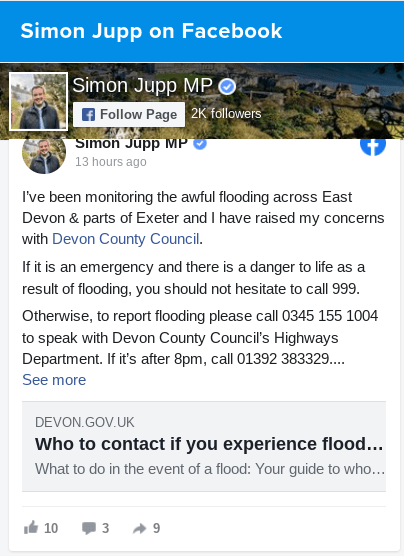
Don’t worry Simon Jupp is on the case! 

He takes aim at Devon County Council not EDDC for once.

Steve Brine breached rules when lobbying ministers in pandemic, watchdog finds

More Tory rule breaking – Owl

A leading Conservative MP and former health minister did not properly declare his second job for a health recruitment firm when lobbying Matt Hancock and Michael Gove during the pandemic, the standards watchdog has found.

Rowena Mason www.theguardian.com 

Steve Brine, the chair of the Commons health committee, was found to have breached the rules twice by failing to declare in his approaches to cabinet ministers in early 2021 that he was a paid strategic adviser to Remedium Partners, a recruitment firm offering doctors for free to the NHS.

In a new judgment, the standards commissioner found Brine should have been clearer in emails to Hancock, then the health secretary, and Gove, then a Cabinet Office minister, that he was employed by Remedium.

However, Daniel Greenberg, the commissioner, cleared Brine of paid advocacy because his efforts were not seeking “financial or material benefit” for Remedium because the doctors’ services were offered pro bono.

Greenberg said the case would be dealt with under the “rectification” process, with Brine acknowledging he broke the rules, apologising and promising not to do so again in future.

In response to the report, Brine said: “This was always about responding in the national interest in an emergency so I am pleased, and not surprised, to be cleared of paid advocacy and I accept fully the commissioners advice on declarations that, even in an emergency, I should have been clearer and follow a compliant form of words to avoid any misunderstanding.”

The complaint about Brine was made after messages from Brine to Gove, forwarded to Hancock, were published as part of a leak to the Telegraph of correspondence from the former health secretary during the Covid era.

The message said: “I have been trying for months to help the NHS through a company I am connected with – called ‘Remedium’. They have 50 anaesthetists right now who can be in the country and on the ground in the NHS if someone only said let’s us help. They just want to assist and asked me how they might.

“Despite offering this to health and to [the then chief of NHS England] Simon Stevens I’ve had nothing despite SS telling the press conference last week this is an acute problem, despite the PM telling the liaison committee this is his biggest problem etc etc.”

In his findings, Greenberg said: “It is disappointing that you have not been able to provide me with a detailed breakdown of the earlier approaches that you made to ministers and NHS officials, which you reference in your message to Mr Gove.

“Members working on behalf of an external employer are well advised to keep detailed records on such matters, not least so that they can be in a position to robustly defend their actions if challenged.”

During the course of the investigation, Brine also disclosed a further email he sent to Hancock in January 2021, saying: “Earlier at the liaison committee the PM said ‘we need more doctors’. He is obviously right. See below from friends of mine who I KNOW can help. They clearly have doctors right here and now who can help but they need your help. Can you help? Let me know.”

Brine was employed by Remedium as an ad hoc consultant being paid £800 a day from September 2019 to February 2020. From July 2020 he was paid £1,600 for eight hours’ work a month, which continued until the end of December 2021.

Under parliament’s rules, MPs are not allowed to lobby for any firm that pays them if it would confer “financial or material reward” on that company. It was a breach of this ban on paid lobbying that led to the resignation of the former Tory minister Owen Paterson in 2021.