High levels of drugs found in sea off south England coast

A study looking at water pollution on the south coast of England has revealed high levels of potentially harmful chemicals including recreational drugs and antidepressants.

Harriet Grant www.theguardian.com 

Scientists involved in the research say marine life is being harmed by human drugs, pointing to evidence that oestrogen in water can feminise male fish through biological changes.

Bianca Carr, the co-founder of the Clean Harbour Partnership (CHP) that coordinated the work, said: “We need to go beyond talking about poo in the water – now we are looking at what’s in that human waste? Now we know the chemicals that are in it, the next step will be to look across the UK at what cocaine and other human drugs are doing to our water, to our food chain.”

Campaigners in Hampshire and Sussex joined forces with Portsmouth and Brunel University London to analyse hundreds of water samples across Chichester and Langstone harbours.

In more than 288 samples, researchers have so far detected more than 50 compounds across 22 sites. These include pharmaceuticals and diabetes medicines as well as a chemical produced by the liver after cocaine use.

The team also discovered pesticides, including some that are banned in the UK.

Prof Alex Ford, from the University of Portsmouth’s school of biological sciences, said: “We know there are billions of litres of sewage discharges annually around the UK but the impact of these discharges are not clearly understood.

“This project is enabling us to determine what chemical contaminants are in our marine life and coastal waters. We have found a large variety of prescribed and illegal drugs plus a variety of pesticides in coastal waters and marine organisms, such as crabs and oysters.

“This is important, because we know that aquatic ecosystems are under threat from pharmaceuticals and farming practices, such as biocides and fertilisers.”

Ford has previously published research showing that even tiny quantities of antidepressants in water can affect wildlife, such as crustaceans and molluscs. Drugs will affect the behaviour and biological makeup of these creatures, including causing them to change colour or reproduce in a different way.

Ford said: “There is a staggering list of prescription drugs passed from humans to wastewater treatment plants and into receiving streams, estuaries, or oceans by direct consumption, metabolism and excretion or by toilet flushing of old prescriptions.

“The release of human pharmaceuticals into aquatic ecosystems is an environmental problem we should consider seriously.”

The study also found E coli bacteria at high levels. A post-storm seawater sample taken from near an outflow pipe from Budds Farm sewage treatment works, near Langstone showed a reading of 380,000 colony forming units per 100ml of E coli, which is 760 times the safe levels set out under the European bathing water directive.

The work is part of growing efforts around England’s coast to highlight the dangers of water pollution. CHP’s co-founder, Rob Bailey, said: “Thanks to community funding, we are starting to get an insight into the cocktail of chemicals polluting our seawater and their sources. Some pesticides seem to have been lingering for several years and the presence of partly digested antidepressants, drugs for type 2 diabetes and bladder infections is concerning. So little is known about their impact on marine life.”

Campaigners have been highlighting the amount of sewage entering Britain’s seas in recent months. In April, figures from an analysis of Environment Agency data done by the Liberal Democrats showed that some popular beaches, including in Sussex, are affected particularly badly.

One of the worst-hit was Brighton beach in East Sussex, where Southern Water discharged sewage 45 times last year, over more than 107 hours. At Meadfoot beach in Torquay, Devon, there were 79 dumps lasting 946 hours.

Southern Water said removing chemical substances from wastewater was not asked for by the Environment Agency.

The director of wastewater operations, John Penicud, said: “Tackling chemicals and impurities, especially ‘forever chemicals’, is a global challenge that requires close collaboration of industry, agriculture and other sectors, including water companies and regulators.

“Our treatment processes already comply with stringent Environment Agency rules relating to the removal of contaminants, and we are working with partners to explore how we can go further – through the use of cutting-edge technology and science, and investing in our network to improve treatment.”


Nuclear weapon secrets in the bathroom: five revelations from Trump’s unsealed indictment

Donald Trump took classified documents including information on nuclear weapons in the US and secret plans to attack a foreign country, according to a 49-page federal indictment unsealed Friday afternoon.

www.theguardian.com 

The former US president, alongside a military valet, now faces a sweeping 37-count felony indictment related to the mishandling of classified documents.

Here are some of the most shocking revelations in the indictment.

Trump took nuclear documents out of the White House

Upon leaving the White House in January 2021, Trump took with him boxes of classified documents, including information regarding US nuclear capabilities, as well as those of a foreign country.

One classified document from June 2020 contained information “​​concerning nuclear capabilities of a foreign country”. Investigators found another undated document “concerning nuclear weaponry of the United States”.

Boxes of records stored in a bathroom and shower in the Lake Room at Trump’s Mar-a-Lago estate in Palm Beach, Florida. Photograph: AP

Trump stored classified documents in the shower, among other places

The former president stored boxes of classified documents in various locations at Mar-a-Lago, including an office space, his bedroom, a storage room, a bathroom, a ballroom and in the shower, according to the unsealed indictment.

On 5 April 2021, a Trump employee texted a colleague to ask whether boxes in the business center could be moved to make room for staff to use it as an office.

The employee responded, “We can definitely make it work if we move his papers into the lake room?”

First employee: “There is still a little room in the shower where his other stuff is. Is it only his papers he cares about? Theres some other stuff in there that are not papers. Could that go to storage? Or does he want everything in there on property?”

After that text exchange, some boxes containing documents were moved from the business center to a bathroom and shower in a space at the Mar-a-Lago club known as the Lake Room.

Trump conspired with his valet to hide documents from attorneys

Trump’s valet, Waltine Nauta, was indicted alongside his former boss for conspiring to hide classified documents from attorneys searching for them. Nauta faces six federal charges, including concealing evidence and conspiracy to obstruct justice.

According to the indictment, Trump directed Nauta, who is currently a personal aide to the former president, to move boxes containing documents in order to hide them from his attorneys, the FBI and a grand jury.

When questioned under oath, Nauta said he was unaware Trump held on to boxes with classified documents. That was a lie, prosecutors found during their investigation, as Trump had instructed Nauta to move them from the White House to his Mar-a-Lago resort.

In July 2021, Trump shared unauthorized information about his desire as president to attack a certain country and a classified conversation with a senior military official during an interview with an unnamed writer and their publisher.

“Look what I found, this was [the Senior Military Official’s] plan of attack, read it and just show … it’s interesting,” Trump told the writer, the publisher and two members of his staff, acknowledging he held on to classified documents detailing the plans. None of those he spoke with had security clearances to know that information.

“See as president I could have declassified it,” Trump said. “Now I can’t, you know, but this is still a secret.”

“Now we have a problem,” said a staffer.

Trump: “Isn’t that interesting?

Trump suggested attorneys lie to DoJ about having no documents

The indictment suggests when lawyers for Trump met with him to discuss how to respond to a May 2022 subpoena seeking documents marked as classified at Mar-a-Lago, Trump allegedly suggested they should tell the justice department that they had no materials that needed to be turned over.

The indictment stated that Trump said: “I don’t want anybody looking, I don’t want anybody looking through my boxes, I really don’t, I don’t want you looking through my boxes.”

He allegedly added: “What happens if we just don’t respond at all or don’t play ball with them?” and “Wouldn’t it be better if we just told them we don’t have anything here?”

Devon council accused of ‘massive scandal’

Mid Devon District Council has been accused of a “massive scandal” over Three Rivers Development’s Ltd (3RDL). 3RDL is a company wholly owned by Mid Devon District Council and is behind projects such as St George’s Court, the development behind Tiverton Town Hall.

Lewis Clarke www.devonlive.com

Speaking during the democratic period at a council meeting on Wednesday, May 24, member of the public Goff Welchman spoke about a “massive scandal with criminal prosecution potential created by the previous administration”.

Mr Welchman was prevented from asking his question, being told it was not in relation to anything on the agenda for the evening’s meeting.

However, Mr Welchman continued his questions saying: “Although it was a problem created by the previous administration, it’s now down to this council to sort it out, even though they weren’t involved in the creation with it.

“The problem was handled with a lot of secrecy, behind closed doors, the public were not given information, and what has transpired is the elephant in the room, which is Three Rivers Development’s Limited, and the potential for criminal prosecution, and I want to know why, when 3RDL has absorbed vast summed of money, possibly approaching £20million of council tax payer’s money, has filed late accounts which are riddled with potential inaccuracies, why is this matter high on the agenda?

“The public is sick and tired of secrecy, and this council needs to demonstrate a line is going to be drawn under this whole, sorry affair.”

Councillor Frank Letch (Crediton Lawrence, Liberal Democrats) the newly elected chairman of the council responded: “This is the annual general meeting where we set the administration and appoint to various bodies. I’m sure this is a very serious issue, but may I suggest you bring this up at the next full council meeting and you discuss it with the new leader, new cabinet, and new team.

“This is not the right meeting.”

Tim Bridger, a member of Tiverton Town Council then asked: “Which of the committees will be tasked with investigating what has happened in relation to 3RDL and how has the competence of the people appointed to that, been discussed and will we be able to question that at a later date if we find out the people appointed to such committee do not have the relevant skills in order to take that role.”

Cllr Letch responded: “Again, I think you’ll have to wait and discuss with the new leader and then you’ll be able to put your thoughts forward. It looks to me it will go to audit and scrutiny.”

Councillor Luke Taylor, MDDC’s leader said: “I can assure those who have asked questions regarding 3RDL that I and my cabinet will be quickly looking at this, and setting meetings immediately with relevant officers and directors and we understand the concerns you have raised.”

You “stayed at home” while those who partied are honoured

“This government will have integrity, professionalism and accountability at every level.”

Why didn’t Rishi Sunak bin Boris Johnson’s disgraceful honours list?

Sunak approves Boris Johnson honours list including aides linked to Partygate

Rowena Mason www.theguardian.com 

Rishi Sunak has been accused of allowing Boris Johnson to hand out rewards to those involved in the Partygate scandal, including more than 40 honours and peerages for his closest allies at the time.

The prime minister faced criticism for approving the list despite police looking at fresh potential evidence of rule-breaking in Downing Street and Chequers during lockdown, as well as an ongoing parliamentary inquiry into whether Johnson misled the Commons.

Hours before Johnson announced he was quitting as an MP accusing the investigation of trying to “drive him out”, his long-awaited honours list was published.

Awards went to Johnson’s closest aides from the Covid era including an Order of the Bath for his former principal private secretary Martin Reynolds, who oversaw a garden party during lockdown restrictions in 2020.

He also gave a peerage to his chief of staff, Dan Rosenfield, and a CBE to Jack Doyle, his former director of communications, both of whom were in office during some of the Partygate era of controversy within No 10 and the investigations into the scandal.

Doyle was one of those in charge of formulating the response to the Mirror’s initial investigations about rule-breaking, saying to another official at the time: “I don’t know what we say about the flat … Ignore the Xmas quiz bullshit, who cares. Just be robust and they’ll get bored.”

Shelley Williams-Walker, who reportedly was the DJ in charge of the playlist at a Downing Street gathering on the eve of Prince Philip’s funeral, was made a dame, while Rosie Bate-Williams, a former press adviser, who issued some of the denials about rule-breaking, was made a CBE, alongside an OBE for Sarah Vaughan-Brown, a press adviser to Johnson’s wife.

Labour said the list amounted to “rewards for those who tried to cover up rule-breaking”, while the Lib Dems said it was “gongs for Johnson’s Partygate pals” and described it as “corruption pure and simple”.

No 10 insisted that Sunak had only been following “convention” by approving the list but he faced criticism for refusing to block it in its entirety.

The prime minister vetoed the inclusion of four sitting Conservative MPs, Nadine Dorries, Alok Sharma, Nigel Adams, and Alister Jack. However, Dorries resigned anyway on Friday, triggering a difficult byelection for the Conservatives in Mid Bedfordshire. Labour sources highlighted a poll showing them only three points behind in the seat.

Johnson’s proposal of a knighthood for his father, Stanley, was rejected, and widespread speculation about peerages for donors and other family members was also wide of the mark.

However, almost 40 honours and seven peerages made it through the vetting process. Political aides, Ross Kempsell and Charlotte Owen, were put forward for peerages and will be two of the youngest members of the House of Lords. Kempsell now works for Johnson as a media adviser.

Johnson also gave a knighthood to Ben Elliot, the former chair of the Conservative party, who faced controversy over the mingling of his political and business interests, and Jacob Rees-Mogg, while his former home secretary, Priti Patel, received a damehood. Other MPs to get knighthoods include Johnson allies Michael Fabricant, Conor Burns and Simon Clarke, while there were damehoods for Andrea Jenkyns and Amanda Milling.

Shaun Bailey, the former London mayoral candidate, also received a peerage, while former adviser Ben Mallet, a friend of Johnson’s wife, was given an OBE. Both men were pictured at a Conservative HQ for a buffet-style Christmas party during lockdown restrictions, which was investigated by police but ultimately no action was taken.

Two more aides to be rewarded with peerages were Johnson’s long-term aide Ben Gascoigne, and a former city hall adviser Kulveer Ranger. Ben Houchen, the Tees Valley mayor, was given a peerage despite him battling a controversy over the Teeswork project.

Ray Lewis, a former deputy mayor of London who resigned after a Guardian investigation into his conduct in 2008, was made a CBE. Other aides to get honours included the former communications director Guto Harri, who has launched a tell-all podcast-memoir about his time in No 10, Johnson’s personal assistant, Ann Sindall, who is to be made a dame and a longstanding House of Commons hairdresser Kelly Jo Dodge who gets an OBE.

Sunak faced an outpouring of criticism from within his own party for allowing Johnson’s list. One formerly loyal Johnson aide said it was a “list of bullies, sycophants”.

“Boris has slammed the door shut on the prospect of any return to the frontline of British politics and trashed what remained of his legacy,” they said. A second former senior Tory aide said it was “rewards for failure”.

A government source accused Johnson’s resignation honours of “dragging the whole thing into the gutter”, while a former cabinet minister called it “put out the trash day”.

A senior Tory said: “Let us hope this ghastly list brings down the final curtain on the Boris embarrassment.”

NHS waiting lists continue to grow

The latest figures show that there are now 220,000 more people waiting for treatment than when Rishi Sunak made cutting waiting lists one of his five priorities!

(Ben Zaranko, Senior Research Economist, Institute for Fiscal Studies.)

Mathematicians work out the north-south divide: where Greggs meets Pret

[Makes us, in the SW peninsula, “northerners”]

Or should it be where Morrisons meets Waitrose? 

[Categorising us as “southerners”]

This tongue-in-cheek analysis aims to highlight more serious factors highlighting the North-South divide, such as life expectancy, education, and poverty.

(See original article: a Machine Learning analysis of consumer habits as a metric for the socio-economic North-South divide in England) – Owl

Some say it’s the Watford Gap services, some say it’s the Severn-Wash line — but isn’t the true marker of arrival in the north the moment you reach a place where you can’t get a smashed avocado and roasted pepper baguette but can get an impressive variety of sausage rolls?

Tom Whipple www.thetimes.co.uk 

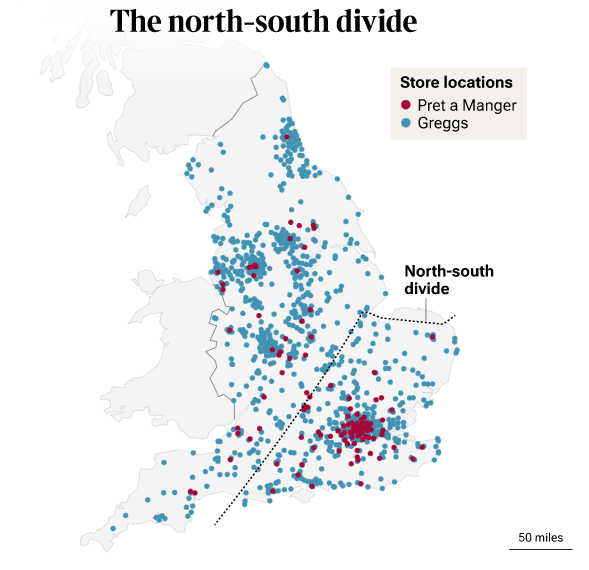
That is the contention of mathematicians, who have calculated the location where the writ of poncey southern Pret a Manger sandwiches ends and the rule of honest northern Greggs pies begins — and they have declared it the north-south divide.

And, lest the analysis seems flimsy, they have strengthened it by augmenting it with a separate set of strongly correlated data: the Waitrose-Morrisons Index.

As far as Sophie Maclean, from King’s College London, is concerned, this study ends a discussion that arguably began with William the Conqueror, who noticed that the residents in the north of his kingdom were more unruly and, “In mad fury . . . descended on the English of the north like a raging lion.”

Which were these recalcitrant northerners who resisted the raging lion? Where was their unruly land? “There’s a lot of debate but thankfully mathematicians have worked this out,” said Maclean, speaking at the Cheltenham Science Festival. “Really there is only one way to judge what’s north and what’s south and that is by looking at the distribution of Pret and Greggs.”

The analysis, published in the preprint journal ArXiv, used machine learning to define the optimal north-south boundary, seeking to divide the country in two according to the ratio of Prets to Greggs and, separately, Waitroses to Morrisons. Then, researchers combined the two.

This produced a line that cut off the top of Norfolk and all of Cornwall and Bristol, decreeing these traditionally southern regions spiritually and culinarily northern.

Part of this may be explained by the metric failing in the west country. While most of the country has a preponderance of one of the fast-food chains or another, Cornwall is low on Prets, possibly on socioeconomic grounds, but also resists Greggs, on grounds of pasty-purism.

Less controversially, further east the line confirmed conventional intuition — passing close to the Watford Gap.

Dr Robin Smith, from Sheffield Hallam University, led the study, adapting machine-learning techniques normally used to look at nuclear reactions. He said that in an inevitably subjective area, this analysis was as good as any. “The food we eat is a very good indicator of whether someone is northern or southern. Greggs is very popular in the north, where people do seem to prefer a steak bake.”

The new definition will nevertheless provoke some disquiet, possibly vigorously so. Cheltenham residents, for instance, who like little better than meeting on a Saturday morning in Waitrose to pick up “essential” parmigiano reggiano, might at the very least argue the case they are an exclave of the south.

Maclean conceded there would always be anomalies, but then the same goes for any other measure. There was even sometimes a pathos to the data, where you can see the anomalies in action — for instance in the few individuals trying to eke out a sophisticated culinary lifestyle amid the pastry-based wastelands of the north.

“You could imagine the single Pret in Newcastle surrounded by a swarm of Greggs,” she said. Whereas, she added, “In London, they say you’re never more than 6m from a rat, or a Pret.”

How long this might still be the case, though, is unclear. Smith said there were signs the usefulness of the metric might change. Already, Greggs has begun a southern invasion, with an appeal to more liberal metropolitan tastes. “Since Greggs produced the vegan sausage roll, it has become more popular in the south, so this might not be a marker of northernness for that much longer.”

Energy generators’ soaring revenues highlight deep problems in the way Britain prices its electricity

Twenty-nine billion pounds is a lot of money. It’s how much we estimate the total annual revenue to British electricity generating stations increased as a result of last year’s energy crisis – from £20.5 billion before COVID (in 2018 and 2019) to £49.5 billion in 2022. The indications are that these revenues increased by about twice as much as overall generation costs.

Serguey Maximov Gajardo theconversation.com 

Getting at the numbers is not easy. Britain has a competitive market for “wholesale” electricity, the bulk electricity sold by major generating companies from fossil fuel (overwhelmingly gas), nuclear and renewable energy power stations.

The price is set in an auction between the electricity consumers (large industries or electricity suppliers that purchase electricity for their clients) and its generators. Consumers submit the demand they are expecting during the next day, and generators offer a block of electricity to meet this demand for a certain price. The price in this “day-ahead” market reflects the cost of the highest-priced block needed to match demand.

Renewables and nuclear plants are relatively cheap to operate. But fossil fuels, although more expensive, are still required to meet demand nearly all the time. This means that gas largely sets the day-ahead price, with a margin. In 2021, the electricity price followed gas prices 98% of the time in Britain, despite gas generating only 40% of the country’s electricity.

But this is just the beginning of the pricing complexities. In practice, much gas and electricity is traded through forward contracts. Your electricity suppliers need to know they can buy the electricity their customers will demand, so they “buy forward” from generators on contracts ranging from months to more than a year ahead – usually at prices reflecting conditions at the time of contracting.

On purely day-ahead prices, the total revenue in 2022 would have soared by almost £40 billion. Our best estimate of forward-contract structures brings this down to the £29 billion indicated for last year.

However, this likely means some of the huge day-ahead prices in 2022 have been shifted forward into this year, whatever happens to gas generation costs (in reality, gas prices fell slightly during the first half of 2023).

Furthermore, gas-powered electricity generators buy their gas in advance, to be sure they have the fuel to generate – so a lot of their generation this year could reflect last year’s gas prices.

Our first conclusion: whatever happens to gas prices, don’t expect electricity prices to drop fast.

Soaring revenues

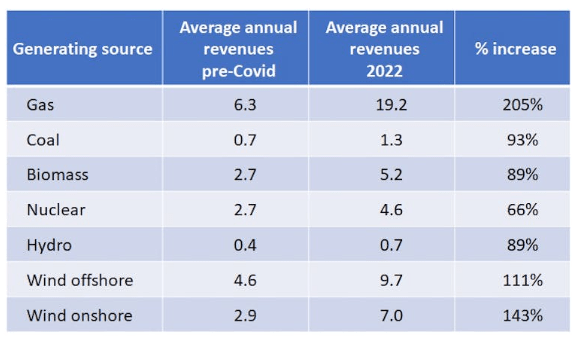
A key finding from our research is how revenue changed for different generators, with the growth for renewables of particular note. We estimate their revenue doubled from £7.7 billion pre-COVID to £15.5 billion in 2022 – yet there is no reason to think their costs increased.

Nuclear benefited too – but proportionately less than renewables. Nuclear generators sell more electricity on a year-ahead basis, given its predictable cost and output levels.

How revenues changed for different electricity generators (£ billion/year):

Maximov et al. (2023), CC BY-NC-ND

Perhaps the biggest surprise regards gas generation. Since these companies’ costs shot up following the start of the Ukraine war, it seems no surprise that their prices did too. We estimate their total annual revenue rose by about £13 billion, roughly trebling from the pre-COVID average of £6.3 billion. But the evidence suggests that this increase was, in fact, much bigger than the increase in their costs.

An industry metric called the “spark spread” historically gave gas generators an operating margin of about £5 for each megawatt hour (MWh) of electricity generated. That quadrupled in 2021 and doubled again in 2022, to an average of over £40 per MWh. This correlates with our best estimate that, while gas generators paid more for gas, their bill rose by a lot less than the £13 billion increase in their total revenue.

So what happened?

Electricity is supposed to be a competitive market, with competition holding down prices. But in reality, there is little competition between gas and other generating sources in Britain, since these other sources can’t increase their output or rapidly build more capacity when gas generators put their prices up.

Until at least 2020, a major factor constraining higher prices in the wholesale market was imports through interconnectors from mainland Europe. Yet, factors including post-Brexit trade frictions and low hydro (Norway) and nuclear (France) generation have impeded the inflows of competitive electricity from continental Europe over the past few years.

Exacerbated further by the gas crisis in Europe, this meant electricity generators in Britain were able to raise prices further above costs.

In the final quarter of 2022, the generators also knew that raising their prices even higher would not ultimately matter to customers – because in October last year, the UK government committed to subsidising energy bills down to £2,500 per household through its Energy Price Guarantee.

In addition, gas generators are exempt from paying the new Electricity Generation Levy – which imposes a tax of 45% on the revenues of electricity generators for the fraction of electricity they sell at above £75 per MWh each year. This levy is applied only to those generators who were assumed to be benefiting from the exceptional wholesale prices while their costs hadn’t increased.

Implications for the future

The real paradox is that all this happened just as non-fossil sources, with stable costs, started to account for more than half of Britain’s electricity (56% if we include nuclear).

As renewables expand further, we will start to see more periods when renewables and nuclear can meet electricity demand, so that gas no longer sets the day-ahead price and the wholesale price collapses. By 2030, non-fossil generation is expected to account for more than 75% of total electricity generation in both the UK and the EU. However, most of the time, the day-ahead price will still be set by the sliver of fossil fuels that are still required.

Given the experience of the past year, and what we will see this year in terms of high wholesale electricity prices, this doesn’t really make sense. For how long can the declining fossil fuel tail continue to wag the dog of Britain’s renewables-based electricity system?

England raw sewage taskforce has only met once in last year, FoI request reveals

An example of the government taking your concerns over sewage “very seriously”. – Owl

The storm overflows taskforce set up by the government to tackle raw sewage discharges by water companies in England has only met once in the last year, a freedom of information request has revealed.

Sandra Laville www.theguardian.com 

The group, which was promoted by ministers as evidence that they were taking the issue of raw sewage discharges by water companies seriously, is supposed to meet fortnightly, according to its mission statement.

But in response to a freedom of information request by the Good Law Project, officials from the Department for Environment, Food and Rural Affairs (Defra) said the taskforce had only met once in the last year.

The storm overflows taskforce was set up in August 2020 after the Guardian first uncovered the scale of raw sewage discharges into rivers by water companies.

It is made up of representatives from government, regulators, the water industry and environmental NGOs. Its terms of reference state: “The taskforce will meet fortnightly, with exact frequency and timings of meetings at the discretion of the chairperson in consultation with the group members.” Its goals are “to develop: proposals to significantly reduce the frequency and impact of sewage discharges from storm overflows short-term actions to accelerate progress to reduce the harm caused by storm overflows”.

Last August the group published its storm overflows reduction plan, which gives water companies a deadline of 2035 to reduce the amount of sewage flowing into bathing water and areas of ecological importance. Water companies were given a deadline of 2050 to stop dumping raw sewage elsewhere.

The then environment secretary, George Eustice, said water companies would have to invest £56bn over 25 years to tackle storm sewage discharges by 2050. But the plan was heavily criticised as too weak and is to be challenged in court by the Good Law Project and the campaign group WildFish. Since that publication the taskforce has not met again, the freedom of information request shows.

The Good Law Project sought all fortnightly meeting dates of the taskforce between 1 April 2022 to 25 April this year, but Defra revealed it had only met once in that time, on 30 August 2022. There have been no follow-up meetings to drive through the storm overflow reduction plan, or to check progress.

Defra said as the taskforce had published its storm overflows reduction plan in August last year it had not met again. “These proposals were outlined in the storm overflow discharge reduction plan (the plan). The plan was published on 31 August 2022, and we have therefore not called a meeting of the taskforce following the publication of the plan.”

Defra said in its response: “Since last summer officials have continued to take action on sewage discharges, including the development of the water restoration fund, launching the continuous water quality and event duration monitoring consultation and the variable monetary penalties consultation, as well as continuing to work with regulators to hold water companies to account. We have also recently announced a new statutory target for storm overflows and plans to consult on expanding the storm overflow discharge reduction plan.”

England has about 14,500 storm overflows, which are supposed to be used in exceptionally heavy rain to stop the sewage system backing up into people’s homes. But water companies have been routinely dumping raw sewage into rivers and seas even in periods of dry weather.

In 2021 the taskforce published a report that estimated the cost of cutting millions of hours of raw sewage discharges from storm overflows would be between £150bn and £660bn – figures that were challenged by some experts.

Emma Dearnaley, the legal director at the Good Law Project, said: “We now know that the government’s storm overflows taskforce has met only once since April 2022 – and not at all since its plan was published. That is, unfortunately, typical of this government’s laid-back approach to the sewage crisis blighting our country.

“We need the government to impose tougher measures to stop water companies from polluting our waters and bring this unacceptable situation to an end. That is why we are supporting a legal challenge to try to compel the government to put in place a much more robust and urgent plan.”

Ashley Smith, of the Windrush Against Sewage Pollution group, said: “[The taskforce] produced precisely what it was designed to do – nothing. We need an independent inquiry now to make sure this disgraceful scam on the public and environment is ended and never repeated.”

Calls for South West Water resignations over ‘obscene’ dividend

Tough talking from a Tory MP, but its not Simon Jupp – Owl

A South West MP has called for the entire board of the owners of South West Water to resign after approving what he called an ‘obscene’ dividend to shareholders.

Lewis Clarke www.plymouthherald.co.uk 

Ian Liddell-Grainger said that for the Pennon Group to line shareholders’ pockets while presiding over long-term water shortages in Devon and Cornwall was totally unacceptable – and consumers were rightly infuriated.

“There may have been worse examples of companies putting two fingers up to their customers but I cannot recall one,” said the Bridgwater and West Somerset MP.

Pennon Group, which also owns Bristol Water, posted a pre-tax loss of £8.5 million in the year to April, compared with a profit of £127.7 million in the previous 12 months. Yet it has raised its shareholder dividend by more than 10 per cent to £112 million.

In April South West Water was fined £2.15 million after being prosecuted by the Environment Agency for illegally dumping sewage into the sea.

It is currently the subject of two Ofwat investigations – one for its management of waste water treatment plants, the other into the accuracy of statements the company made last November about its performance in reducing leaks and on customer consumption rates.

It is one of only two water companies to have drought restrictions in force. These were imposed last year, extended in the spring and are likely to remain in place until December unless there is exceptional rainfall.

In April Pennon Group chief executive Susan Davy, announced she would not be taking her £450,000 bonus because of public anger over sewage pollution in rivers and seas.

Mr Liddell-Grainger said that had been a tacit admission of failure.

“But one highly-paid official declining a fat bonus looks like a token gesture when within weeks millions were being poured into the shareholders’ trough,” he said.

“Those shareholders are being rewarded with money that should rightly have been invested in improving and extending water supplies to the region and the fact that there are now long-term drought orders in force is manifest proof that South West Water has failed to do its job.

“Consumers in Devon and Cornwall are being asked to restrict water use so there is enough to go round when the main tourism season arrives – a highly precarious state of affairs by any measure.

“I lived in Devon for 25 years and even back then all the official agencies were aware that tourist numbers were going to grow year by year and infrastructure improvements would be necessary to cope with all the extra demands that would ensue.

“But South West Water has appeared more concerned about rewarding shareholders than building new storage capacity and the fact that it has been systematically fouling the finest beaches in the UK merely underlines the fact that it has prioritised profit, salaries, bonuses and obscene dividends before everything else.

“This is failure on a colossal scale and the chief executive and the entire board should pack their bags and go.”

If the Ofwat inquiry uncovers discrepancies in SWW’s reporting on leaks and consumption it could face a penalty equivalent to 10 per cent of its turnover.

If it is found to be in breach of wastewater regulations it will be ordered to implement improvements and could also be fined, the cost in both cases falling on shareholders.

A South West Water spokesperson said: “Pennon Group, including its subsidiary South West Water, is delivering record levels of investment, particularly in environmental initiatives such as reducing storm overflows and developing new water resources. We know more than ever before the growing concerns from customers about dividends. As we continue to accelerate the changes we all want to see, dividends are not made at the cost of greater investment.

“Our shareholders include UK pension funds, savings, and charities, as well as customers and colleagues, and most of our ultimate owners are ordinary people in the UK. They have fully endorsed our commitment to invest their money to make Pennon Group better. We are investing record amounts in the most important areas where customers want to see change.

“Alongside this, we have delivered over £85 million of customer support, including the industry leading WaterShare+ scheme, benefiting customers in the South West region.”

£150,000 levelling up grant awarded to Tory donor’s amusement centre in Hastings

A £150,000 grant from Boris Johnson’s flagship levelling up towns fund was awarded to an amusement centre launched by the Conservative donor Lubov Chernukhin, raising questions about whether public money has gone to projects most in need of financial help.

Rowena Mason www.theguardian.com 

Chernukhin, a businesswoman who has given more than £2m to the Conservatives since 2014 and is married to a former Russian finance minister, co-founded the Owens entertainment centre in Hastings, East Sussex.

The centre received £150,000 from the government’s towns fund in October after a tender process, through a company called C&O Entertainment. A further £250,000 went to the developer behind the refurbishment of the former Debenhams building in the seaside town.

It includes several restaurants, a bowling alley, immersive experiences, virtual reality rides, an oddity museum and amusement arcade. There is no suggestion of any political consideration in the award of the grant.

Chernukhin launched the project in October 2022 as a joint venture with an entertainment entrepreneur, Graham Owen, and she has been a director of C&O Entertainment since February this year. It is owned by a company called Triple 8 Holdings, held by two senior partners at a wealth management firm, and is believed to be at least in part owned by the businesswoman.

Owen does not own any shares in the company. Despite giving his name to the attraction, he is now believed to have left his role at the company.

A spokesperson for Chernukhin said Owens Entertainment was opened with a vision to “revive the British high street and stimulate local economies through the establishment of family-orientated entertainment centres”, with an estimated 100,000 visitors since launch. They said the centre had provided jobs by hiring 45 contracted staff members and space for four concession holders.

The spokesperson confirmed her involvement in C&O Entertainment but did not respond to a question about its ultimate ownership. She said Chernukhin “was not involved in any way whatsoever in the grant application process” and that it was driven by the developers and the Hastings towns deal board without her knowledge.

Last September a finance manager from Owens Entertainment gave a presentation to the Hastings towns deal board setting out that “development of the entertainment centre is going well, and it is hoped it can be officially opened on or around 14 October”.

In the minutes, it was recorded that the project by this time was already close to completion and the extra money was used to “extend the centre’s originally planned offer, therefore allowing for more attractions to be created”.

The bid was not part of the original towns fund allocation process but was added in summer 2022 by the Hastings towns deal board after another bidder pulled out and the tender was re-run. It was subsequently approved by the Department for Levelling Up, Housing and Communities and the money was paid in October 2022.

Hastings council said the business case for the town deal bid by Owens was confidential but had been “independently assessed against various criteria including jobs created, amount of public and private investment, wider economic impact in the town and value for money and deliverability”.

“The funding for Owens Entertainment was to enhance and extend the number of entertainment offers. It was also bringing back into use a large former Debenhams building which had been empty for more than a year,” a spokesperson said.

“There were no political considerations in the decision to support a project that brought a large potentially long-term empty building back into use so quickly.”

Chris Bryant, the Labour MP and chair of the House of Commons standards committee, called into question whether the project was deserving of the money, saying that “so-called discretionary funds” were a cause of concern. “Especially now we know the company of the largest female donor to the Conservative party has benefited in this way. Public funds should go to those areas most in need,” he said.

Chernukhin, a British citizen, is a former banker who has been under scrutiny over her links to offshore wealth and her husband’s former membership of Vladimir Putin’s government until he was sacked in 2004. Labour has previously called for the Conservatives to hand all money given to the party by Russian-linked donors to humanitarian causes, including more than £2m given by Chernukhin since 2014.

On her donations, Chernukhin’s spokesperson said: “It is correct that Lubov has donated more than £2m to the Conservative party, and all such donations have been properly declared in accordance with Electoral Commission rules. As a British citizen, Lubov is entitled to make donations to political parties as she sees fit, and any suggestion to the contrary would be patently xenophobic.”

Woking council declares bankruptcy with £1.2bn deficit 

Woking council has declared it is in effect bankrupt after admitting a risky investment spree involving hotels and skyscrapers overseen by its former Conservative administration had left it facing a deficit of £1.2bn.

The cost of a Tory attempt at “regeneration”, Owl can think of local examples that haven’t gone too well but not on such a scale.

Richard Partington www.theguardian.com

In what is thought to be the biggest financial failure in local government history, the Surrey council said it had issued a section 114 notice on Wednesday in response to “unprecedented financial challenges” facing the town.

A section 114 notice is effectively an admission that a local authority does not have the resources to meet current expenditure, with Woking joining Thurrock, Croydon and Slough as the latest English council to run into trouble after ploughing cash into risky commercial investments.

Woking said that against its available core funding of £16m in the 2023-24 financial year, the council faced a deficit of £1.2bn.

Laying bare its financial position, the tiny home counties authority in the affluent London commuter belt warned it had failed for the past 15 years to set aside enough money to keep up with payments on a vast debt pile amassed under its former Tory leadership.

Racked up to finance the building and acquisition of a vast empire of commercial assets, its investments included a complex of sky-high towers – standing as the tallest buildings outside a big city in England – including a four-star Hilton hotel, public plazas, parking facilities and shops.

Woking warned its debts were forecast to hit £2.6bn, while it had taken the uncomfortable step of writing down the value of its investment portfolio by more than £600m in a reflection that its property holdings were worth far less than previously anticipated.

Ann-Marie Barker, the council’s Liberal Democrat leader, whose party took over from the former Tory administration after it was voted out in local elections last year, said there was a danger that services could be cut as a consequence.

“We’re going to have to look at those and provide the services in a very different way in future. Inevitably it’s not going to be such a good service as it was in the past,” she told the Guardian.

Woking was put into special measures by ministers late last month amid rising concern in central government over the scale of its debt problems.

Most of the council’s spending had been financed by an obscure arm of the Treasury – the Public Works Loan Board – with £1.3bn worth of borrowing that Woking could now struggle to repay.

The process will be overseen by a team of expert commissioners after a review launched this year. It is believed the council’s troubles are so significant they could have an impact on the national government finances.

“The debt in Woking is staggering,” said Meg Hillier, the Labour chair of the Commons public accounts committee, adding that the government needed to have a “stronger oversight” of how councils were investing.

In 2020, the powerful cross-party committee said ministers were “blind” to “extreme risks” of investment by cash-strapped councils.

Hillier said: “We have seen too many councils borrow multiple times their annual budget at huge risk and real cost to local council taxpayers.”

Many councils piled into property and other commercial enterprises to raise money to fill gaping holes in their budgets and to undertake regeneration projects after sharp cuts to central government funding introduced under the Conservatives’ austerity drive.

Kevin Davis, the Conservative group leader on Woking council, said his local party had issued an apology to residents for the financial position the local authority was now in, while arguing that council’s investments were made in good faith in an attempt to regenerate the town.

Davis said: “Remember the cost measures coming through every year with the revenue grant being steadily reduced. It’s safe to construct an argument that says that period led the council to look for other ways to generate that missing income.”

He added that the pandemic had significantly affected the valuation of the council’s assets, but also suggested further investigation was required to establish whether the former Tory administration had adequate checks and balances in place when it was making investment decisions.

“It’s likely the answer is that, no, it was not robust enough, it is more than just Covid,” Davis said.

A government spokesperson said: “Following serious ongoing concerns about the financial situation of Woking council, the government announced an intervention into Woking’s financial position in May and commissioners have been appointed. We will continue to work closely with the authority and will take action if necessary.”

Parents slam Devon special education

Angry parents and carers have criticised Devon’s under-performing special education services in front of the county council’s leadership.

Ollie Heptinstall, local democracy reporter www.radioexe.co.uk

They say support for children with special educational needs and disabilities (SEND) is not improving, despite it now being one of the council’s top priorities.

Their comments come four months after they staged a protest at County Hall about what they believe is the council’s “neglect” of their children, and sent an open letter demanding “urgent action.”

Last year Devon was hit with a government improvement notice for its SEND services, which it runs in partnership with NHS Devon.

Both the Conservative-run council and NHS Devon apologised after a revisit by Ofsted and the Care Quality Commission in May 2022 found progress had not been made in fixing four areas of significant concern they identified in December 2018.

Another inspection last month found the quality of social work “remains inconsistent,” though DCC says it also suggested it is “now moving in the right direction, but we acknowledge that there is still much more to do.”

However parents who spoke at Devon’s children’s scrutiny committee on Tuesday, also attended by the council’s chief executive and the member in charge of children’s services, expressed concern about the state of affairs.

One parent spoke of the “dire situation” faced by their family, explaining that one child has been out of school since 2016.

“They’re now one year away from adulthood and have been unable to access any education at all for the last two years,” Nicola Brewin said. “This is due to the lack of care they’ve received by Devon County Council.”

She told the committee she had submitted six tribunal appeals to DCC. “Having children with additional needs is challenging, but the added stress of being forced to a tribunal so many times is horrific and is robbing my children of the support they need and the childhood they deserve.”

Ms Brewin also criticised the council’s processes, including for administering educational health and care plans (EHCPs), adding: “Our case presents a spotlight on the multiple failings of DCC to uphold its responsibilities to children.”

Fellow parent Caroline Bolingbroke said: “I have a 13-year-old autistic child who has not been able to attend school for four years. Getting the support they need has been a huge fight. I was an education professional but now I’m at home with my child every day.”

She added: “Parents of children with SEND in Devon know what is going wrong. We can help make things better but we are not being consulted or communicated with effectively. We are not seeing any improvements.

The council, under pressure from the Department for Education, has developed an improvement strategy to improve SEND services across the county, which includes recruiting more caseworkers.

But Ms Bolingbroke called it “just a wish list with no clear map of how the service is going to get from ‘failing’ to ‘good’.

“We don’t have a voice in our children’s future,” she said. “Our children don’t have a voice. When is anyone going to listen to us?”

Elaine Davis-Kimbell, another parent, then told the committee that parents and carers of young people with SEND are “absolutely sick and tired of decisions constantly being made for us without any proper consultation.

“We are so fed up of hearing the word ‘co-production’ being battered about this council within improvement plans. No one is producing anything with families.”

Fellow parent Astrid Harding said she is “outraged that our children and young people are missing out on their right to an education.

“We are parents and carers, not teachers, yet more and more of us are having to home-school our children as it feels the only option left to us given the significant dearth of appropriate educational provision on offer in this county.”

“I myself have reached out for over two years for support now for my son, who was forced out of school due to [EHCP] issues and tribunal and is now struggling to go back to school.

“All my family’s mental health and wellbeing is in tatters facing a system that doesn’t care about any of these matters,” said Ms Harding.

Devon’s interim director of children’s services, Julian Wooster, admitted the system is “failing to deliver improved outcomes for children and young people with SEND.”

He added: “Parents’ confidence in the system is in decline and, despite substantial additional investment, the system has become financially unsustainable. That is not a comment just on Devon. That’s the comment across the country.”

Mr Wooster said councils were facing a “system nationally which is not working” but accepted that in Devon “we need to make more progress than others in this area.”

But the council’s opposition leader, Lib Dem councillor Julian Brazil, took issue at the reference to national problems with SEND provision.

“We’re one of the worst [performing councils]. We are surrounded by Cornwall – outstanding. Torbay – good. Somerset – good. Devon – inadequate. So why is it that we’re so bad?

“Can we just stop saying it’s terrible across the rest of the country? It’s terrible here in Devon and we should look at ourselves and see how we can do it better.”

In response a spokesperson for Devon County Council said: “We understand the concerns and frustration of parents and share the desire to drive real improvement across SEND services as quickly as possible.

“Giving the right support to children with SEND to the age of 25 is a national challenge and one which Devon along with many other local authorities has found difficult to get right.

“We are working closely with parents and carers, with our schools and health partners, and with the government to make things better in Devon, but there are no quick fixes.

“This is a top priority for the council and we have been able to commit extra resources this year to help support change including appointing a dedicated deputy director of SEND to lead on this.

“The most recent Ofsted inspection last month did point to some positive improvements and suggested we were now moving in the right direction, but we acknowledge that there is still much more to do and it will take some time to get this right.”

Boris and Carrie Johnson ‘hosted friend at Chequers while Covid restrictions in place’

Boris and Carrie Johnson hosted a close friend at Chequers while some coronavirus restrictions were still in place, it has been reported.

Oliver Pritchard-Jones www.independent.co.uk

The former prime minister and his then-pregnant wife are said to have invited corporate events organiser Dixie Maloney to the Buckinghamshire country mansion on 7 May 2021.

At the time, indoor gatherings between different households were banned except when “reasonably necessary” for reasons such as work or childcare or to provide care or assistance to a vulnerable person, including someone pregnant.

The Guardian reported that she had been informally helping to plan the couples’ festival-style wedding, which took place at Downing Street three weeks later.

Any suggestion they broke the law has been disputed by the couple and Ms Maloney, with sources telling the newspaper that she was there for childcare reasons as Ms Johnson was pregnant.

Mr Johnson’s spokesperson insisted the event was “entirely lawful” and Ms Maloney told the paper she would not have done anything that she believed at the time to be unlawful.

The report comes as the former prime minister remains under investigation for allegedly breaching the Covid rules his own government drew up during the pandemic.

Liberal Democrat deputy leader Daisy Cooper told The Independent: “The public are sick of subsidising an ex-prime minister, especially one who once again appears to have shown complete disregard for the rules they had to follow.

“We’re all left wondering what more it will take for Rishi Sunak to finally scrap Johnson’s taxpayer-funded legal bill.

“Almost every day of this government brings more stories of Conservative sleaze and scandal, all whilst the problems facing the country get worse and worse.”

The visit was one of approximately 12 gatherings that allegedly took place at Chequers and Downing Street and are being assessed by two police forces. Thames Valley Police, which covers Chequers, told The Guardian that it is reviewing the evidence and has not yet launched an investigation.

Mr Johnson is also awaiting the outcome of the privileges committee inquiry into whether he deliberately misled MPs over the initial Partygate scandal.

A spokesperson for Mr Johnson said: “This was entirely lawful, and it was covered by relevant provisions in the Covid regulations, as The Guardian’s report makes clear. To suggest otherwise is totally untrue.”

More hand wringing from Jupp on sewage

In his weekly press article (see below) Simon Jupp says he wants to see action after he claims the Government has introduced the toughest ever crackdown on sewage spills.

By crackdown he means the 2022 plan described by the Rivers Trust as ”Too little too late”:

Far from revolutionising the sewer system, as the plan claims, this plan aims to claw its way back to what should have already been ‘business as usual’ by 2050 – with sewer overflows operating only during exceptional rainfall events by that time. This should be the current situation, and yet we are living with 2.6 million hours of overspills in England.”

[Remember In October 2021 Simon Jupp voted against the Lords  amendment designed to stop private water companies from dumping raw sewage into the UK’s waterways.]

Simon also says he firmly believes that long-overdue water company investment should not disproportionately affect bills. 

[ Remember In March this year Simon said:…”Of course, in a perfect world, we would stop sewage spills completely and immediately. Sadly, that is virtually impossible in the short term; because of the pressure on our water infrastructure, we would risk the collapse of the entire water network, and the eye-watering costs involved mean we would need not just a magic money tree, but a whole forest.” ]

Simon refers to the government multi-million-pound plans to reduce spills from Sidmouth and Tipton St John’s sewage system and reduce nutrient pollution from the Axminster-Kilmington water treatment site. These are the local “oven ready” schemes in the Ofwat/Defra “accelerated infrastructure delivery project for English Water companies”. Owl has already discussed the lack of clarity of who foots the bills under the heading: This raises the $64,000 question, who is paying for this: SWW; the consumer or the Tax Payer? 

Is Simon “on a journey”? [More to the point where might it end?] – Owl

‘We all want action taken now to clean up rivers and seas’

Simon Jupp www.exmouthjournal.co.uk

The water industry has finally apologised for not acting quickly enough on sewage spills, pledging an additional £10 billion to clean up their act.

An apology and more investment is welcome. But as many in East Devon have been heading outside to enjoy the warm weather, we all want to see action taken right now to clean up our rivers and sea.

Back in February, I led a debate in Parliament on the performance of South West Water. I live close to the sea in Sidmouth and have been relentlessly campaigning for investment in our water infrastructure.

Recently, I was pleased to see the government unveil multi-million-pound plans to reduce spills from Sidmouth and Tipton St John’s sewage system and reduce nutrient pollution from the Axminster-Kilmington water treatment site. At the request of the government and regulator Ofwat, South West Water is now spending their money on these projects.

I also want to see action in Exmouth and Budleigh Salterton. In Exmouth, South West Water say they are working to improve Maer Road and Phear Park pumping stations’ storm overflows performance. In Budleigh Salterton, South West Water say they are working to clean the 7km sewer pipe from Lime Kilns pumping station to Maer Lane sewage treatment works. I’m monitoring their progress closely.

I firmly believe that long-overdue water company investment should not disproportionately affect bills. Water companies simply cannot spend money to clean up their mess, expect customers – you and I – to pay for it by hiking up bills, and continue to pay hefty bonuses.

This Conservative government has brought in the toughest ever crackdown on sewage spills through the Environment Act and Storm Overflows Discharge Reduction Plan. I recently met with the Environment Agency in Exeter to discuss South West Water’s performance.

I’m also sitting down with South West Water bosses to scrutinise their latest full year results after they revealed shareholders are going to receive 10.9% increases in their payouts. It’s completely perverse to reward failure.

I won’t stop my calls for real change until South West Water put customers and our environment first.

Thames Water chief Sarah Bentley paid £1.6m despite giving up bonus

Thames Water accused of “flimsy PR stunt” when it previously said she would give up bonuses and performance-related executive payouts.

Robert Lea www.thetimes.co.uk 

Thames Water has confirmed that its chief executive Sarah Bentley will receive pay and perks topping £1.6 million this year despite the company indicating last month that she will forgo her bonus during the sewage and leakage crisis.

News of the Bentley’s payout was condemned by trade unions, who said Thames had conducted a “flimsy PR stunt” when it previously said she would give up bonuses and performance-related executive payouts. She said she was giving up the cash because the company had not yet delivered on “a customer service and environmental performance” turnaround.

Thames confirmed that Bentley’s remuneration for the last year would include no performance-related bonus for 2023, but would still total about £1.6 million. It said all components of her pay during 2022-23 had been previously disclosed.

When Thames publishes its annual report and accounts early next month it will show that Bentley, 51, received £750,000 basic pay, pension payments of another £90,000 and other travel, car and medical benefits expected to be a further £32,000.

On top of that she received in the last year a payment of £548,000, the latest tranche of a “golden hello” compensation package for shares and bonuses she had to give up from her time working at Severn Trent, the Midlands water group from where she was poached by Thames three years ago.

In addition, Bentley has also received £178,000 as a bonus related to Thames Water’s “performance” during her first two years’ service. It is uncertain how much in bonuses and performance-related pay she has actually given up in the last financial year.

The £1.6 million she will receive for 2022-23 is not too far off the £2 million she received in the prior year — which included a £496,000 bonus — and is more than the £1.2 million she received in her first year’s service.

Gary Carter, a national officer at the GMB union, told The Guardian, which first reported on the payout: “The UK water industry is in a complete mess, with creaking infrastructure, a disgruntled workforce and effluent allowed to flow freely into our beautiful waterways. To see those responsible for this carnage pocket a king’s ransom is particularly galling.

“Ms Bentley’s announcement she won’t take a bonus, while at the same time trousering a huge total pay package, shows it was nothing more than a flimsy PR stunt.”

Thames insisted that it stood by its announcement last month that Bentley would “forgo any bonus or long-term incentive payments for the financial year 2022-23”.

It said that announcement had been accompanied by “notes to editors” which said: “Separately, in July 2022, Ms Bentley received the final compensation payment for shares in Severn Trent she relinquished on joining Thames Water.”

The performance payment relating to Bentley’s service for 2020-21 and 2021-22 had been disclosed, the company said, in its annual report last year in a footnote on page 104.

Thames, the UK’s largest water company, has been a magnet for criticism of the industry’s poor record on river pollution and leakage — in Thames’s case, nearly one litre in every four flowing through its mains pipes is lost.

A Thames Water spokesman said: “As announced in May, Sarah Bentley has decided to forgo any performance-related bonuses for 2023 financial year. As disclosed at the time and in last year’s annual report, she received a final compensation payment in July 2022 for shares in Severn Trent she relinquished on joining Thames Water.

“The decision to forgo a performance-related payment was a personal one. Ms Bentley felt it would not have been right to take a performance-related bonus given the significant headwinds the company faced last year, which impacted performance.”

Less than 10% of emergency overflows monitored for raw sewage, figures show

Thousands of emergency overflows are not monitored for raw sewage discharge with information taken from only 10% of the total in England, a freedom of information (FOI) request has revealed.

[So multiply discharge figures quoted below ten times to get an estimate of true totals – Owl]

Danny Halpin www.standard.co.uk 

There are 7,016 emergency overflows which, unlike storm overflows, are only permitted to be used in extreme situations such as electrical power failure, a mechanical breakdown of pumps, rising main failure or blockage of the downstream sewer.

Water companies are only required to monitor emergency overflows that discharge into shellfish waters, so only 686 emergency overflows recorded data in the last two years.

Of those, 102 discharged into shellfish waters 635 times in 2021 while the following year, 86 discharged 491 times.

It’s not clear why, after the first incident, measures aren’t being taken to prevent another emergency overflow discharge

More than 60% of the emergency overflows that discharged did so on multiple occasions, raising concerns among campaigners that water companies are breaching the terms of their permits without punishment.

Dr Laura Foster of the Marine Conservation Society, who submitted the FOI request to the Environment Agency, said: “Emergency overflows are designed to be used as a last resort.

“Yet, from the tiny amount of data we do have, we can see that these discharges aren’t an uncommon occurrence, and there are repeat offences.

“It’s not clear why, after the first incident, measures aren’t being taken to prevent another emergency overflow discharge.

“Water companies are paid to treat our sewage and they need to be fulfilling this duty. The failure to put procedures in place, which they’re required to do, is putting marine life, and people, at risk.”

Last month the Guardian reported that 11 shellfish farms in Cornwall were forced to close because they were found to contain extremely high levels of E coli – a poisonous bacteria that grows in faeces.

Shellfish waters are considered to be highly sensitive, along with bathing waters, still or slow-moving water bodies, sustainable fisheries, public parks and water used for sports.

Emergency overflow permits only operate in urgent circumstances to prevent environmental damage or harm to the public and action is taken to ensure these are allocated appropriately

Water companies must demonstrate that the emergency was beyond their control and not because of a lack of maintenance and they are supposed to take all reasonable steps to prevent it happening again.

A spokesperson from Water UK said “urgent action is needed” and that water companies are putting in plans to track and reduce emergency overflow use but did not give further details.

They said: “We fully appreciate the strength of feeling about the health our rivers and seas. We get it and we are taking action to put it right. This includes investing £56 billion in the biggest modernisation of sewers since the Victorian era.

“Emergency overflows are a last resort for companies to relieve pressure on sewage pumping stations or treatment works when something goes wrong. It’s clear that urgent action is needed, which is why every water and sewerage company is putting in place plans to track and reduce their use.”

An Environment Agency spokesperson said: “Emergency overflow permits only operate in urgent circumstances to prevent environmental damage or harm to the public and action is taken to ensure these are allocated appropriately.

“We require water companies to monitor emergency overflows associated with designated shellfish waters as advised by Government.

“In 2022, emergency overflows in these locations operated at an average rate of 1.5 times per overflow a year, while over 70% were not even used. We will continue to investigate and act against permit non-compliance.”

The Marine Conservation Society said it is taking the Department for Environment, Food and Rural Affairs, which oversees the Environment Agency, to court over its “inadequate” plan to tackle sewage pollution, saying its Storm Overflows Discharge Reduction Plan should have tighter deadlines for water companies and include coastal waters.

Emma Dearnaley, legal director at the Good Law Project, said, “These extraordinary figures suggest that the true scale of the sewage dumping crisis is even more shocking and devastating than we knew.

“Good Law Project is playing its part to end this environment scandal by supporting the Marine Conservation Society and others in a High Court challenge next month which seeks to compel the Government to impose much more robust and urgent targets upon water companies to clean up their act.”

Cumbria: Anti-social behaviour in Maryport drops by almost half with just one ‘bobby on the beat’

Alison Henandez pushed the cost of policing up by 6% this year – are we getting values for money? – Owl

A seaside town has seen anti-social behaviour drop by almost half after introducing just one “bobby on the beat”.

www.telegraph.co.uk

In the last nine months, since community beat officer PC Sam Steele has patrolled the streets of Maryport, in Cumbria, anti-social behaviour (ASB) has reduced by 47 per cent compared to the same period last year.

Now Cumbria Police hope other forces across the UK will take note and reintroduce more local ‘beat’ policing – especially in rural areas where officers can really get to know all local youths and businesses.

PC Sam Steele explained: “They see you day to day and they know you’re their friend – and they know why you’re there.

“You’re not there to enforce necessarily on them, but you’re there to just be a part of their community. We’re not reinventing any wheels, we’re just doing it the logical way, the way it should be done.

“Walking around and being that visible presence, recognising people that we know and catching people in the act – and nipping it in the bud.

“We’ve seen it in Maryport, a 47 per cent reduction in the amount of antisocial behaviour logs. That’s great – that’s 47 per cent less calls that the officer that normally responds has to respond to.

“The different towns need different approaches and different officers and Maryport is one where it’s a very friendly, open town.

“They all talk to me – it’s all by names and as we said, you’ll fight with someone one day and the next day they’ll shake your hand.”

Anti-social behaviour (ASB) is classed as acts that cause intimidation and fear in residents, with examples being vandalism, harassment, anti-social drinking, vehicle abandonment and trespassing.

Just a week left to get your nominations in for…

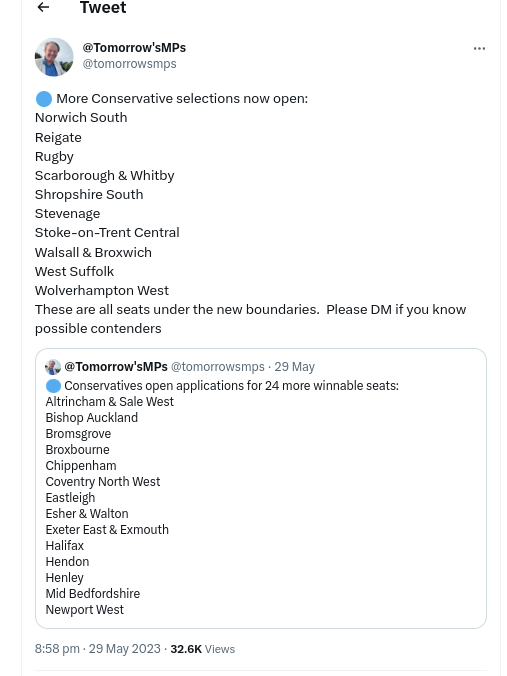
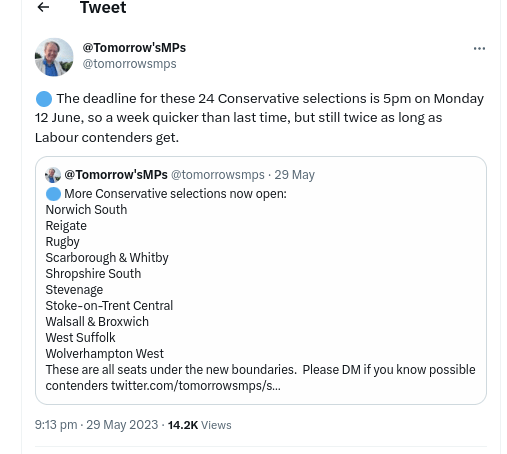
…….one of these 24 “winnable” parliamentary seats.

Simon Jupp has already opted for the Honiton/Sidmouth carve up of his old constituency. No one yet has described his move as a “chicken run” because it might turn out to be a bit of a turkey.

So now the Tories are offering up Exeter East & Exmouth as a definite “winnable” (though Simon doesn’t seem to have been convinced).

The East Devon Tory selection procedure in 2019 was one of the more secretive in the country with no openly published information on, for example, the shortlist of candidates from whom Simon Jupp emerged as the “chosen one”.

A photo, taken at the selection meeting in the Exmouth Community College (on a day that it was closed), was posted on the East Devon Conservative website.  The photo became newsworthy after John Humphreys’ conviction because it showed him as one of the main placard holders at the event.

A mole subsequently informed Owl that the shortlist comprised four individuals, two of whom were women, both “out of area”. The general belief at the time was that Simon was very much Hugo Swire’s choice.

Owl wonders if history will repeat itself.

Simon was very active recently helping Sophie Richards with her District Council campaign and Sophie has been busy networking recently with none other than Greg Hands, the party Chair.

As a new District Councillor it’s important to get your priorities sorted.

In 2019 Sophie unsuccessfully contested the Coventry North East constituency, a rather different kettle of fish from Exmouth.

She looks like a typical “career” politician to Owl.

Hopefuls have until 5pm on Monday 12 June to get their papers sorted.

Planning applications validated by EDDC for week beginning 22 May