…..Even though it’s been said before, it’s worth repeating that the UK is a country wrongly convinced that inflation-busting increases in house prices are a good thing. They are not. The flip side to over-investment in bricks and mortar is under-investment in other more productive uses of capital. The regular booms in the economy driven by consumers extracting and spending equity from the rising value of their homes are invariably followed by busts.
Those who benefit from rising prices tend to be better off people in older age groups. Those who lose out tend to be two over-lapping categories: renters and the young. Anybody under 35 who is saving up for a deposit on a flat will be glad of a drop in house prices.
Housing is likely to be a central issue at the next general election, with the two main parties each backing a different side. The Conservatives – who have all but dropped housebuilding targets – are lining up behind existing owner-occupiers. Labour has said it would impose targets and be prepared to build on parts of the green belt. It is also drawing up plans that would force landowners to sell plots of land for less than their potential market price in an attempt to stop land hoarding and so increase the supply of new homes.
Even if Labour actually goes ahead with its plan, it looks certain to be challenged in the courts. Currently, if a council wants to compulsory purchase a piece of farmland for housing development it has to pay a “hope” value. That’s the value not of the farmland but of the value of the farmland adjusted for planning permission, which is substantially higher.
What is certain is that Labour’s approach makes more sense than the government’s. The current levels of housebuilding are incompatible with a rising population, and increasing the supply of homes requires reform of the planning system.
The politics are also interesting. Onward, a right of centre thinktank, produced a report last week in which it said the current crop of 25- to 40-year-olds was the first not to become more rightwing as it grew older, and housing is one reason for this.
Current Conservative housing policy will help those in their 50s and 60s who have already benefited from house-price inflation rather than those in their 20s and 30s struggling to get on the housing ladder. If Labour has concluded this is dumb economics and dumb politics, it is right on both counts.
Here is the problem summarised, it doesn’t affect Whitehall (but it could affect marginal seats) – Owl:
Nationwide, newly registered second homes and tourist lets have a negligible effect on housing supply, accounting for just 26,000 properties compared with the 682,000 new homes added to England’s housing stock from 2019-22. But the effect they do have is highly concentrated, with 80% of the increase in second homes and holiday lets happening in just 25 local authorities.
The supply of new homes in some tourist hotspots is being almost completely negated by the rise of second homes and holiday lets, analysis has revealed.
In the Copeland area of the Lake District, which includes the beauty spot of Scafell Pike, there were 426 new homes created in the last three years. Over the same period, 407 existing homes were converted to commercial holiday lets or second homes.
Along part of the north Devon coast, including the Hartland peninsula – which featured in the Game of Thrones spin-off House of the Dragon – the number of new homes that have become second homes or commercial holiday lets was equivalent to almost two thirds of the new supply of regular housing between 2019 and 2022.
Generation Rent, the campaign group behind the research, said the figures meant that since the start of the Covid pandemic, housing planners had been almost “running to stand still” in the most desirable coastal areas and rural beauty spots.
Dan Wilson Craw, the acting director of Generation Rent, said: “The unregulated and undertaxed holiday let sector is out of control. It has taken homes away from locals who grew up in holiday hotspots and people who want to work in the tourist industries, making these areas unsustainable.
“A large part of the solution to high rents is more house building, but locals won’t see the benefits of this if houses continue to leak into the holiday homes sector.”
The figures come as a government consultation into whether holiday lets should require planning consent closes. The measure was proposed by Michael Gove, the secretary of state for levelling up, housing and communities. Housing campaigners believe such rules would reduce the number of family homes converted for tourism.
Announcing the consultation, Gove said: “In too many communities, we have seen local people pushed out of cherished towns, cities and villages by huge numbers of short-term lets. I’m determined that we ensure that more people have access to local homes at affordable prices, and that we prioritise families desperate to rent or buy a home of their own close to where they work.”
Nationwide, newly registered second homes and tourist lets have a negligible effect on housing supply, accounting for just 26,000 properties compared with the 682,000 new homes added to England’s housing stock from 2019-22. But the effect they do have is highly concentrated, with 80% of the increase in second homes and holiday lets happening in just 25 local authorities.
In the South Lakeland area of Cumbria, which includes Kendal and Windermere, the number of new holiday lets and second homes was equivalent to 63% of the new housing created. In Scarborough and Richmondshire, both in North Yorkshire, it was 56% and 49% respectively; and in north Norfolk, it was 42%.
The worst-affected London borough was Southwark, where more than 4,000 new homes were added to the stock, but more than 2,400 were lost to the second homes sector.
Cornwall, where 8% of homes are second homes or holiday lets, fared slightly better in recent years, with the growth in holiday homes equivalent to 27% of new stock.
Some campaigners are concerned measures to regulate holiday lets will have limited effect unless parallel rules around second home ownership are also introduced.
“The tories ignored all the warnings even before the pandemic began. They ignored the warnings of Operation Cygnus in 2016 – hence no P.P.E. or preparation within hospitals for a major pandemic. Johnson couldn’t be bothered to attend COBRA meetings. No temperature checks at ports and airports as people arrived from countries with high infection rates. Plans for quarantine and infection control non existent. Sporting events allowed to go ahead including allowing football fans from Spain to come into the country. Then we had eat out to help out which boosted infection rates followed by the tier system allowing people from areas with high infection rates to travel into low infection rates and spreading infection. Money wasted on ‘Nightingale Hospitals’ with out the staffing to cope with any patients. Then of course the Test and Trace fiasco. We already know that the whole thing was mishandled and ill judged and a highly expensive enquiry will tell us what we already know in high highfalutin legal terms. The members of the cabinet from 2016 onwards are responsible for thousands of deaths and permanent illness. Words fail me.“
A new overarching service to provide support for voluntary, community and social enterprise (VCSE) groups and organisations in East Devon will soon start to take shape.
Commissioned by East Devon District Council (EDDC), with funding from the UK Shared Prosperity Fund (Department for Levelling Up, Housing and Communities), this important work for the VCSE sector starts this summer and will be facilitated by independent charity, Devon Communities Together which has a long-established reputation for working closely with rural communities and the groups and organisations that support them.
The new service will be designed in close collaboration with East Devon’s VCSE sector to provide better connections across VCSE groups and organisations in the district. It will encourage joint approaches to tackling important local issues which it is anticipated will include topics such as health and social care, social isolation and loneliness, fund raising, community resilience, transport, inequalities and climate change. Local VCSE groups and organisations will decide what’s important.
It will also work on new ways of working on and influencing East Devon-wide policy and service development.
This newly commissioned work demonstrates EDDC’s commitment to the VCSE sector, which it greatly values for the impact it makes on the lives of residents.
Councillor Dan Ledger, EDDC’s portfolio holder for sustainable homes and communities, said: “Through this contract, the Council is looking forward to making new connections, supporting VCSE organisations and working with them to identify sustainable plans, including refreshing local grant schemes”
Nicola Gurr, chair of trustees of Devon Communities Together said: “I am really excited that Devon Communities Together and East Devon District Council have this opportunity to work together on such a great project. The wealth of knowledge available from all parties will be instrumental in providing even more support across the VCSE sector in East Devon.”
In coming weeks, the Devon Communities Together team will be contacting VCSE organisations across East Devon to make sure they have an opportunity to fully engage in this exciting new work.
For more information contact Devon Communities Together on 01392 248919.
A council and developer need to ‘step up and deliver on their moral obligations’ to people living on a Crewe housing estate with no planning permission, the House of Commons leader has said.
Penny Mordaunt MP also wondered ‘how in God’s name it could have happened’, as she was responding to a question from Crewe and Nantwich MP Kieran Mullan (Con) about the plight of residents living at Coppenhall Place.
The recently built Coppenhall Place, which is on the site of the former Crewe Works off West Street, was granted planning permission in 2018. That permission was lost last year because developer Countryside Partnerships failed to deal with a condition relating to contaminated land.
But most of the 263 homes are now occupied. Last Thursday (May 25) Dr Mullan raised the matter in the House of Commons. “I have been supporting hundreds of residents of Coppenhall Place who overnight found themselves living in homes without planning permission, never expecting that, between them, Countryside and Labour and Independent-led Cheshire East Council would let them down so badly,” said the Crewe and Nantwich MP.
“I welcome Countryside’s commitment this week to cover residents’ out-of-pocket costs, but will my right hon. friend ask for a minister to meet me to discuss how we can get all the residents a full investigation and the full compensation package that they deserve?”
Ms Mordaunt replied: “When I hear about such situations, I wonder how in God’s name it could have happened. How on earth does a local authority enable and watch homes being built, in the full knowledge that they have not been through the systems in its planning department?
“This is a disgraceful situation, and the developer and the local authority need to step up and deliver on their moral obligations to the individuals who bought those homes in good faith.”
She suggested the matter be raised at the next Levelling Up, Housing and Communities questions on June 5 as, ‘the Secretary of State takes a dim view of local authorities and planning authorities that do not adhere to their obligations to their residents’.
Two months ago, Cheshire East’s strategic planning board deferred an application from Countryside to regularise the development. It was deferred for a peer review regarding the contaminated land issue and for an open book viability financial assessment to see whether it was appropriate to ask the developer for further contributions.
No date has yet been set for when the application will be considered again by the council.. Shortly after that meeting the LDRS asked Cheshire East why its enforcement officers didn’t stop the developer from building until the contaminated land condition had been discharged.
Jane Gowing, interim director of planning at Cheshire East Council, said: “In 2020, the developer provided the council with information to support the discharge of conditions relating to land contamination. While this information was being reviewed, the council continued discussions with the developer so that enough information could be provided to resolve these issues.
“However, despite considerable time and effort, the council was not satisfied with the submitted information and refused the application to discharge the condition in 2022. During this time, the developer had started and continued to build on site, but due to ongoing efforts to resolve matters and considering national guidance and legal precedents regarding taking formal action, it was not deemed appropriate to begin enforcement action against the developer.
“However, it is important to make clear that prior to the construction of foundations of any properties on the development, the council had notified the developer that a failure to discharge conditions relating to land contamination may render the development unlawful, and that any further development would be entirely at their own risk.
“Because the developer had begun works on the site before that condition had been discharged, it was deemed that planning permission had been lost for the development in 2022, at the point the condition discharge application had been refused.”
Was No 10 really so chaotic that such questions need answers? – Owl
The Covid inquiry has sent Boris Johnson a list of 150 questions and requests for his witness statement, documents released by the Cabinet Office have shown.
Key questions the former PM has been asked include:
Did you say ‘let the bodies pile high’?
Was there any scientific evidence on Eat Out to Help Out?
Did the Cabinet secretary really suggest Covid ‘chickenpox parties?’
Did you really say you felt ‘manipulated’ by scientists into imposing a lockdown?
When and how did you first learn of Covid?
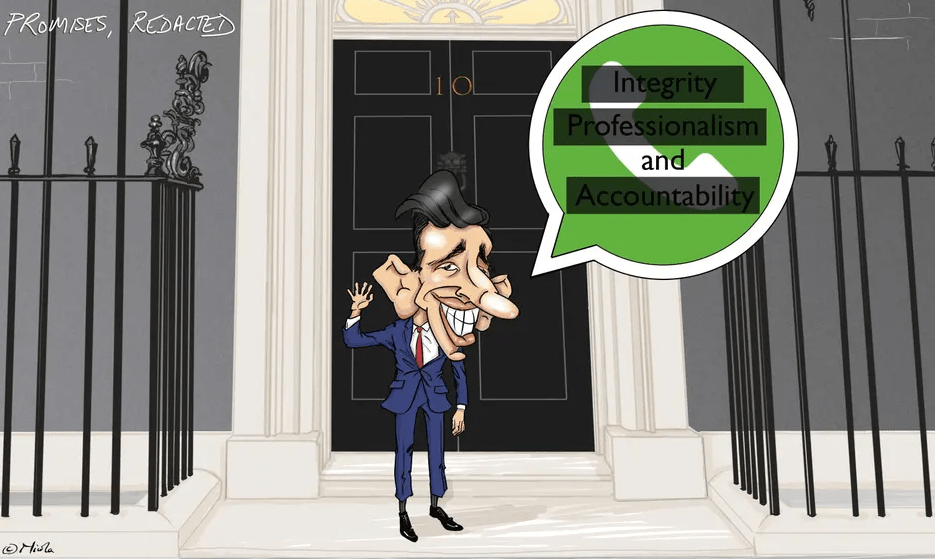
The UK Covid-19 Inquiry wants to see WhatsApp messages and notebooks kept by Mr Johnson to build a picture of how decisions were taken in government up to and during lockdowns.
But Rishi Sunak has refused to release unredacted documents as his government on Thursday launched legal action in a last-ditch attempt to protect the material.
Other questions Mr Johnson has been sent by the inquiry include:
Did the UK government/Cabinet Office structures and processes for dealing with emergencies at prime minister, Cabinet, Cabinet Office, ministerial and departmental levels work effectively and properly enable key decisions in relation to the response to Covid-19 to be taken?
To what extent were key decisions made outside formal government processes, for example in informal and non-minuted meetings?
Was the advice that you received from the government chief scientific adviser (GCSA) and chief medical officer (CMO) transparent and clear throughout the pandemic? Were the roles of the GCSA and CMO effective in harnessing and distilling advice from Sage to you and other core decision-makers? Did you feel able to properly challenge their advice?
Did you have any concerns regarding the adequacy or sufficiency of scientific and other expert advice (including where relevant, any underpinning data) on which decisions were based? If so, what were these concerns?
Between January and July 2020 did you receive advice from the then Cabinet Secretary that the Secretary of State for Health and Social Care, Matt Hancock MP, should be removed from his position? If so, why?
What steps did you take in January 2020 to ascertain the state of the UK’s emergency preparedness to deal with a pandemic?
Notwithstanding that the DHSC was the lead government department, why did you not attend any Cobra meetings in relation to Covid-19 prior to March 2 2020, given the seriousness of the emergency?
Why did you attend a personal/social meeting on the evening of March 19, after you had called on the UK on March 16 to stop all non-essential contact with others?
When did you become aware that Covid-19 could be spread person to person asymptomatically?
Please explain the concept of “herd immunity” and the extent to which seeking herd immunity formed part of the Government’s strategy for preventing a second wave following the lifting of social restrictions. To what extent did the Government consider that it would be possible to shield the vulnerable from severe infection as part of such a strategy?
Please confirm whether in March 2020 (or around that period), you suggested to senior civil servants and advisers that you be injected with Covid-19 on television to demonstrate to the public that it did not pose a threat? Please provide details of when any such conversation took place and the circumstances in which it was had?
Did the then Cabinet Secretary, Lord Sedwill, on March 12 2020 (or around that period), advise you to inform the public to hold “chickenpox parties” in order to spread infections of Covid-19? What was your response to any such advice?
What was your understanding as to whether individuals being discharged from hospital into care homes would first be tested for Covid-19? Did the Secretary of State for Health and Social Care provide you with an assurance, at any stage, that this testing would be in place for such individuals prior to discharge?
Please explain when and why a national lockdown was adopted in March 2020 as the UK Government’s strategy for responding to the pandemic.
What discussions did you have with the then Chancellor, about the Eat Out to Help Out scheme prior to its implementation in August 2020? Did you support the introduction of the Eat Out to Help Out scheme at the time? Did you consider at the time, the potential impact of the scheme on the number of Covid-19 infections?
Did you say on or around September 22 2020 that you felt that Sage had “manipulated” you into imposing the first lockdown?
In or around autumn 2020, did you state that you would rather “let the bodies pile high” than order another lockdown, or words to that effect? If so, please set out the circumstances in which you made these comments.
To what extent was there a four-nation approach to the Covid-19 response? Please comment on the effectiveness of intergovernmental working and decision-making between the UK Government, Scottish Government, Welsh Government and the Northern Ireland Executive during the pandemic.
Please explain what impact, if any, you consider alleged breaches of social restriction and lockdown rules by ministers, officials and advisers, and the associated public debate at that time, had on public confidence and the maintenance of observance of those rules by the public?
French towns and cities have banded together to fight Airbnb and other tourist rental platforms which they blame for hollowing out historic centres, driving up property prices and forcing locals to leave.
Campaign groups from 20 communities, ranging from the fortified Breton harbour of Saint-Malo to Marseilles port and Chamonix, the Mont Blanc mountain resort, have joined forces to press for state action against what they describe as a blight that is disrupting life in their towns.
“This is destruction. Entire neighbourhoods are being emptied,” Franck Rolland, a Saint Malo activist who heads the national group, said at its first news conference. Airbnb, by far the biggest platform, is advertising 800,000 offers of accommodation in France, with 22,000 in Paris, the group says.
Beyond the nuisance of noisy parties, suitcases clattering on cobblestones and messy rubbish bins, the rental boom is creating an exodus of local residents, forcing the closure of shops and schools and causing a labour shortage, the campaigners say. Their main target is not owner-occupiers, but people and companies who buy up property to cash in year-round on the lucrative tourist rental business.
In the southwestern Basque country, where local authorities have recently imposed restrictions, campaigners say half the homes in the village of Guéthary are short-term rentals, with 45 per cent in the port town of Saint Jean-de-Luz and 40 per cent in the resort city of Biarritz. In Saint Malo’s walled city, the first town to crack down on tourist lettings, local anger is reported to have manifested itself in damage to renters’ vehicles. Bastia, Corsica’s main port, began imposing curbs this week.
In the heart of the Alpine city of Annecy, Brigitte Cottet, an anti-Airbnb campaigner, said half the apartment buildings in her street were occupied by tourist rentals. “In the old town, 23 buildings have been declared dangerous for lack of upkeep. Airbnb owners don’t repair roofs,” she told Le Monde.
The campaign has been launched after a bill tabled by a cross-party group of MPs to curb the conversion of private residences into year-round commercial operations was delayed in parliament last month.
Paris has imposed a string of conditions that have cramped the activities of Airbnb and its smaller rivals. Homeowners are restricted to letting their primary residence for a maximum of 120 days a year. Non-resident owners and anyone wanting to rent a property out for more than 120 days must register as a business. Non-resident owners must also convert a commercial property into a residential one to qualify.
The city, however, depends on income from rental visitors and it is relying on Airbnb to help in next summer’s Olympic games. The fat rents that can be charged, up to €10,500 a night for a two-room flat in central Paris, are tempting many residents to think of moving out for the Games.
Paris has been working with Barcelona, Amsterdam and other tourist cities on ways of regulating the business.
Dario Nardella, the mayor of Florence said he wanted to ban short-term lets from the historic city centre entirely, and use tax breaks to encourage more permanent residents.
Susan Davy, Chief Executive Pennon Group, is quoted as justifying the payout because: “we have delivered improvements in environmental performance, building on our sector leading 100pc water quality for our 860 miles of coastline and on track to reduce our use of storm overflows by 50pc by 2025.”
Simultaneously, she has been setting herself up as an environmental champion to lead a community response to the climate crisis, with particular reference to water supply. See what is described as her “advertorial” here: www.devonlive.com
“….while climate change is a global issue, it has many local and community impacts, and working together with our customers and our communities holds the key to making the most difference.
“As the largest private employer and business in the region, Pennon takes its societal contribution extremely seriously….
“…We continue to invest in innovative solutions to mitigate the impacts of the drought, from repurposing ex-quarries to provide new water resources, to fixing customer-side leaks for free, launching pioneering initiatives such as Save Every Drop, and encouraging everyone to think differently about water usage…”
[Extremely seriously, how much water leaks away before it ever gets to our taps? – Owl]
South West Water pays £112m to shareholders amid sewage leak backlash
The owner of one of Britain’s biggest water companies has rewarded investors with an £112m dividend despite profits plunging and an ongoing probe into its alleged failure to report sewage leaks.
Pennon Group, the FTSE 100 company that owns South West Water, said shareholder dividends would increase by 10.9pc.
The company highlighted that the dividend rise was 2pc higher than inflation, as measured by the Consumer Price Index including housing costs.
The 42.73p-a-share dividend amounts to £112m. It leaves Pennon with just £144m of cash reserves, compared with almost £2.7bn two years ago.
Pennon posted an £8.5m pre-tax loss on £797m of revenue for the year ending 31 March. Last year it made £128m in profit.
The results come as Pennon, which also owns Bristol Water, faces an investigation by the industry regulator examining whether its reporting of leaks and water use was accurate.
David Black, the chief executive of Ofwat, said on Wednesday that a “thorough investigation will now be carried out and we will provide updates in due course on our findings and whether there is any further action Ofwat needs to take”.
Pennon responded to the investigation by saying that the figures were “subject to rigorous assurance processes” and signed off by a technical auditor.
Susan Davy, Pennon chief executive, said that the company’s annual loss followed “an extraordinary year for Pennon in which extreme weather patterns have tested our operational resilience”.
She added: “In a year in which the sector has been rightly challenged to clean up its act, we have delivered improvements in environmental performance, building on our sector leading 100pc water quality for our 860 miles of coastline and on track to reduce our use of storm overflows by 50pc by 2025.
“I am also clear that one pollution is one too many, and numbers are falling as we implement sustained change.”
Aarin Chiekrie, equity analyst at Hargreaves Lansdown, said that high power and inflation-related costs were responsible for eroding Pennon’s profits.
He added: “But cashflows are getting squeezed by higher investment levels as the group aims to shore up its water supplies for the year. Unseasonably dry winter weather means the drought status in southwest England remains in place.
“As summertime nears, it’s touch-and-go whether reservoir levels will be sufficient to keep customers’ supplies running at full flow. If not, Pennon could find itself in the regulator’s firing line.”
House prices are falling at their fastest rate for almost 14 years as buyers reel from the impact of sharply higher interest rates, figures showed on Thursday.
The annual rate at which prices are dropping picked up pace from 2.7 per cent in April to 3.4 per cent last month, the biggest fall since the aftermath of the financial crash in July 2009, according to lender Nationwide. Commentators said that the normal “spring bounce” seen in the London market at this time of year failed to materialise with buyers spooked by the threat of yet more interest rate pain.
The building society warned that further rate hikes from the Bank of England would “strengthen the headwinds” facing the already nervous market, although a full-scale crash is seen as unlikely. The Bank has already pushed through 12 rate increases, lifting the cost of borrowing from 0.1 per cent to 4.5 per cent since December 2021, in a bid to curb galloping inflation.
However, official figures last week showing that the Retail Price Index fell far less than expected in April to 8.7 per cent panicked City markets, which now fear the Bank will have to raise rates to as high as 5.5 per cent over the coming months.
That in turn brought turmoil to the fixed-rate mortgage market, where prices have jumped and hundreds of deals have been withdrawn.
On Thursday the average rate on a two-year deal was 5.49 per cent, up from 5.45 per cent on Wednesday, according to latest data from analysts Moneyfacts. The average five-year, fixed-rate deal rose from 5.12 per cent to 5.17 per cent, the highest since January. Meanwhile, the latest figures from the Bank of England showed the number of mortgage approvals dropping from 51,500 in March to 48,700 in April in another sign of rapidly falling confidence in the market.
Nationwide’s chief economist, Robert Gardner, said: “While consumer price inflation did slow in April, it was a much smaller decline than most analysts had expected. As a result, investors’ expectations for the future path of the bank rate increased noticeably in late May, suggesting it could peak at around 5.5 per cent, well above the 4.5 per cent peak that was priced in around late March. Furthermore, rates are also projected to remain higher for longer.
“If maintained, this is likely to exert renewed upward pressure on mortgage rates, which had been trending down after spiking in the wake of the mini-budget in September last year.”
Data from the building society also showed a month-on-month decline of 0.1 per cent in May, with the average cost of a UK home now at £260,736.
Commentators said the property market will continue to be overshadowed by heightened uncertainty over mortgages. Craig Fish, managing director at London mortgage broker Lodestone, said: “Just when you thought the market was stabilising, the inflation data emerged and triggered turmoil in the mortgage market. We were witnessing more normal levels of property activity in May, but there are now concerns about how much higher rates could go. Activity could stagnate moving forward as people take stock. We have already had some clients tell us that their property plans are on hold until things settle down.
“The hope is that as inflation drops, conditions will improve and we could see a strong end to 2023, which should continue into 2024.”
Jason Tebb, chief executive of property search website OnTheMarket.com, said: “Just as a welcome level of stability was returning to the market following the unprecedented uncertainty created by the min-budget in the autumn, something comes along to upset the apple cart.
“The inflation figures, which while moving in the right direction are proving to be more stubborn than first thought, have created volatility in the money markets, resulting in lenders increasing their mortgage pricing.”
Jonathan Hopper, chief executive of buying agents Garrington Property Finders, said: “Less than a week after the Nationwide increased its mortgage interest rates by up to 0.45 per cent, the lender’s latest House Price Index suggests the property market too has yet to settle.
“Its May data shows that average property prices fell in eight out of the past nine months, and prices are now four per cent lower than their peak of August 2022. For now, April’s fleeting price increase looks like a blip rather than the start of a rapid recovery.”
Samuel Mather-Holgate, from advisory firm Mather & Murray Financial, said: “Approvals for house purchases were down in April, and following the events of the past week, with lenders on red alert, activity in the housing market is set to dry up again, as confidence goes from boom to bust.”
A WORRYING scale of chemical pollution in England’s rivers and freshwater sites has been revealed following analysis of official Environment Agency data [1].
The research, from The Rivers Trust and Wildlife and Countryside Link, looked at the prevalence of five chemical cocktails known to have toxic impacts for wildlife.
It also highlights the lack of official monitoring for known harmful chemical cocktails, as well as the lack of a regulatory framework to address these mixtures.
Findings reveal that:
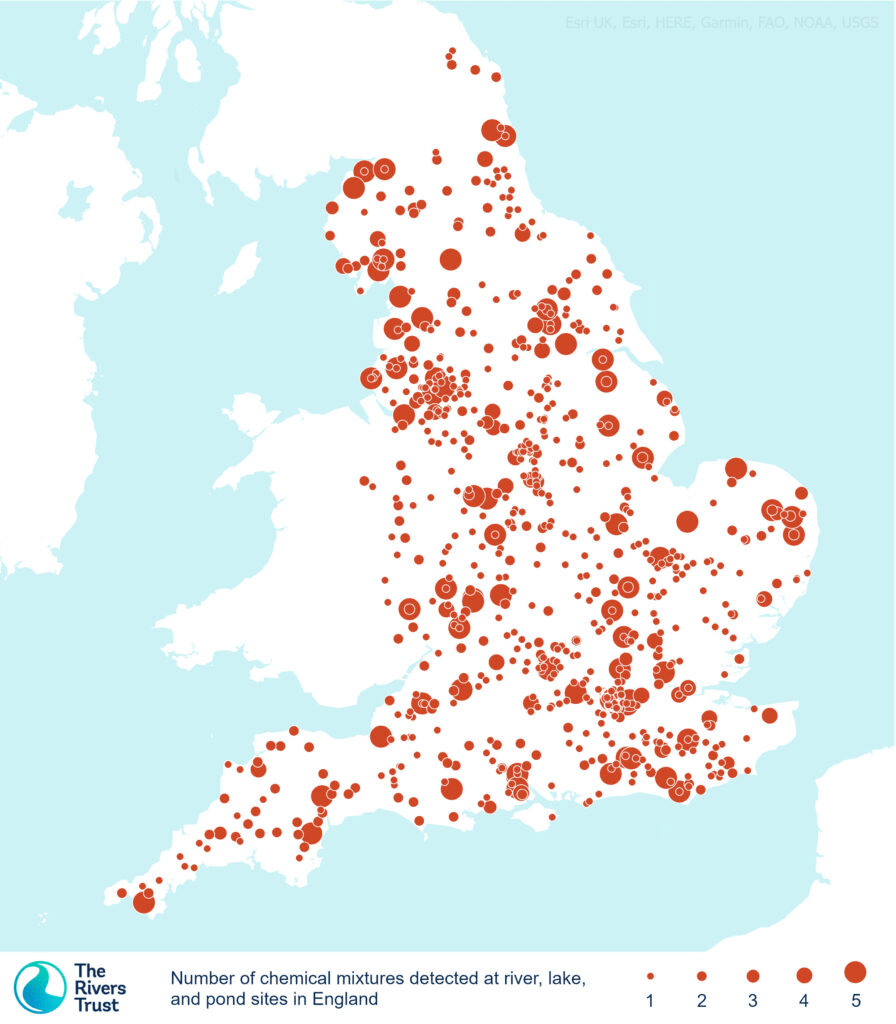
Chemical cocktails, that have been proven harmful to wildlife in scientific studies, have been found in 814 river and lake sites (out of 1,006 sites with data – 81% ) and 805 groundwater sites (out of 1,086 sites with data – 74%) across England
Over half (54%) of these sites contained three or more of the five harmful chemical cocktails investigated [2]
Up to 101 chemicals were identified in river samples, with sites along the rivers Mersey, Stour, Colne, Thames, Trent, Yare, Irwell, Medway, Humber and Avon among those containing the highest numbers of chemicals. The actual numbers of chemical pollutants will be even higher [3]
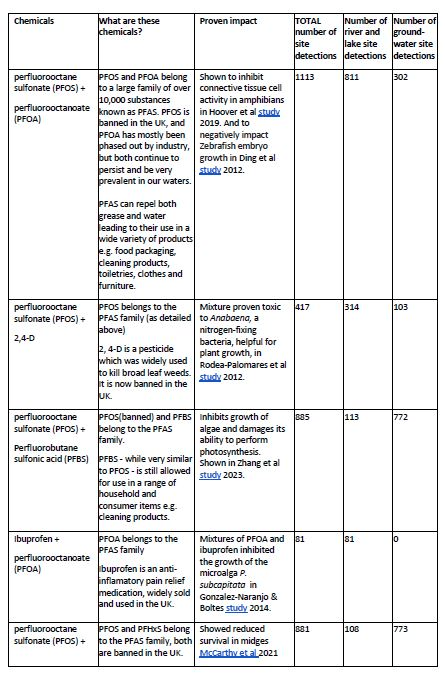
The chemical cocktails found across the 1,619 sites contained six different chemicals in five different hazardous mixtures. These included four toxic forever chemicals PFOS, PFOA, PFBS and PFHxS, the pesticide 2,4-D and the commonly used painkiller ibuprofen (see table below for more detail).
In specific combinations these chemicals are known to have increased harmful impacts on a range of species including amphibians, fish, insects, nitrogen-fixing bacteria and algae. Identified detrimental effects included reduced growth, cell function, impacts on embryos and lower survival rates. Any potential human health implications, for example through contact via bathing or recreation, remain unknown.
Some of the sites where all five chemical cocktails were found include: The Chelt (in Cheltenham); The Derwent (in Yorkshire); The Trent (in Staffordshire); The Exe (in Devon); The Ouse (in Lewes East Sussex); the Wansbeck (in Northumberland); and the Yare (in Norfolk).
Find out how you can support a call for action at the end of the article
A group of charities, including Wildlife and Countryside Link, The Rivers Trust, Surfers Against Sewage, Buglife, WildFish, Fidra, Pesticide Action Network UK, The Wildlife Trusts, The National Trust, Whale and Dolphin Conservation and the Pesticide Collaboration, launched a ‘Chemical Cocktail Campaign’ (24 May 2023), urging the Government to take a much more ambitious approach to regulating harmful chemicals. [4]
We are supporting their calls which include asking Government to include in its forthcoming UK Chemicals Strategy: regular monitoring for chemical cocktails in rivers, and new legal protections against dangerous chemical cocktails, including requiring assessments of potential hazardous chemical mixture impacts before any new chemical is allowed on the market.
Dr Laurence Couldrick, CEO at Westcountry Rivers Trust, said in an interview with ITV Westcountry: “Some of these forever chemicals are going to be in our rivers…forever. Because of the nature of them they just do not degrade but we do need to stop the flow of those pollutants. There’s so much we can do, in terms of how we live as a society, what we throw down our toilets and our sinks, but also how we buy our food and manage our lives.”
A range of five known toxic chemical cocktails has been looked for in Environment Agency data. While there are other known toxic combinations (and likely many more unknown) a narrow focus was used due to the volume of data that needed to be reviewed. All of the chemical combinations focused on cocktail impacts with the harmful and extremely prevalent forever chemicals perfluorooctane sulfonate (PFOS) and perfluorooctanoate (PFOA) . These were chosen due to how widespread they are (despite having been banned) and the need for them to be recorded under Water Framework Directive requirements, making them more visible chemical contaminants for assessment.
Rob Collins, Director of Policy and Science at the Rivers Trust, said: “We need to stop pumping poison into our rivers. Hazardous chemicals are flowing into our waters, derived from every aspect of our lives. On the small-scale from the toiletries, food packaging, clothing and other goods we use individually, to large-scale industrial, medical and food production, we are creating an ever-growing chemical cocktail in our rivers. The fact that these known toxic chemical combinations are found so widely across the country is deeply worrying. And that’s just the tip of the iceberg. Unless we act now we’ll see increasingly contaminated water, less wildlife in our rivers and ocean, and this raises implications for human health as well.”
The table below details the toxic chemical cocktails that were investigated and the number of sites they were discovered at. Alongside this, are details of the studies that have identified harm to wildlife species from these harmful chemical combinations. Please note that all of these studies were carried out in laboratory conditions, not in the field.
The levels of these contaminants in rivers were typically much lower than in the laboratory studies, but individually, each of these chemicals are known to impact wildlife at concentrations lower than those reported in these studies. In addition it is not known how these chemical cocktails (which are binary mixtures studied in the laboratory) interact with other chemicals in a wider mixture in our rivers. [5] Their widespread presence in our rivers, knowing their damaging impacts in laboratory studies, is cause for concern.
Table 1: Chemical cocktails identified in English river sites
Table 2: Number of chemical cocktails present at river, lake and groundwater sites across England
Richard Benwell, CEO of Wildlife and Countryside Link, said: “A harmful chemical cocktail is being stirred up in UK rivers, putting wildlife and public health at risk. Government regulates and monitors chemicals individually, ignoring the cocktail effect. But our research shows that toxic combinations of pesticides, pharmaceuticals and forever chemicals are polluting rivers up and down the country. The new Chemicals Strategy must make sure harmful substances are regulated not just for individual risks, but for their effects in combination.”
Map 1: River, lake and pond sites in England where 1 or more of the 5 chemical cocktails were found
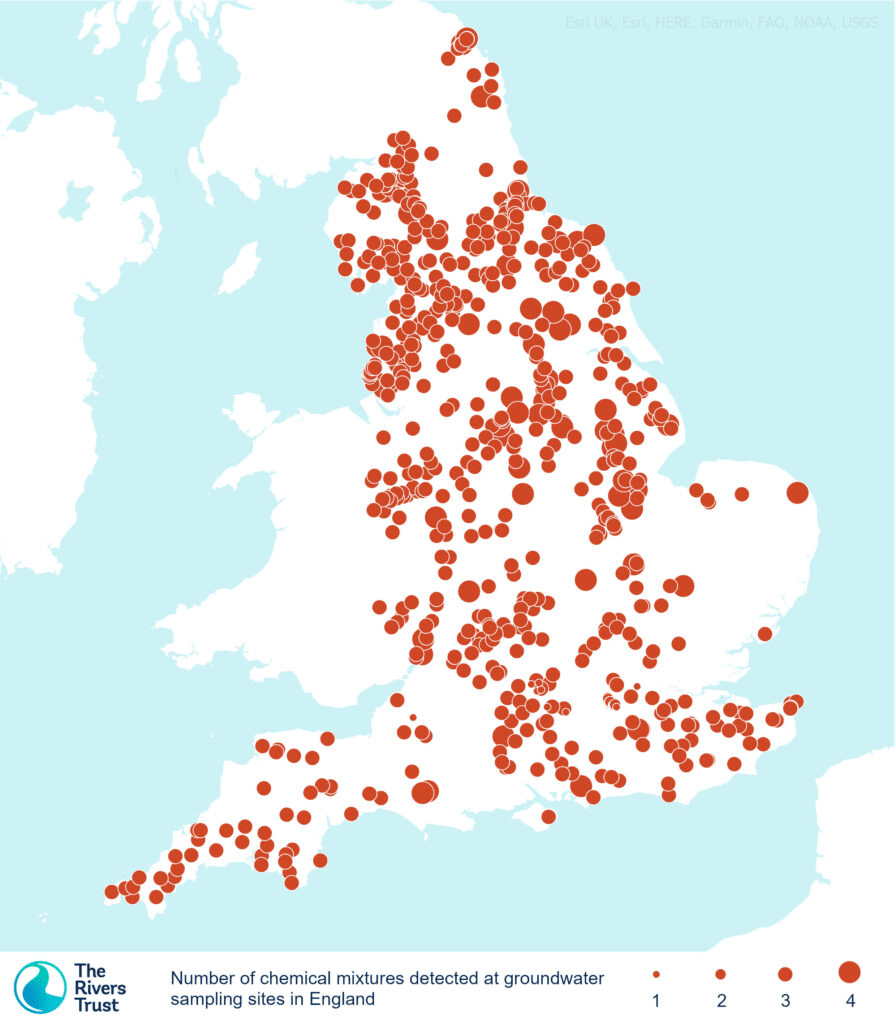
Map 2: Groundwater sites across England where one or more of the 5 chemical cocktails were found
Speaking at a Parliamentary event on chemical cocktail pollution (23 May), hosted by UK Youth For Nature and Wildlife and Countryside Link, the Rt Hon Philip Dunne MP, Chair of the UK Parliament Environmental Audit Committee, said: “The country’s precious waterways should be as free from pollutants as possible, yet the long-standing prevalence of harmful chemicals has meant that no river in England is in good chemical health. During the course of the Committee’s inquiry examining water quality of rivers, we were alarmed at the lack of monitoring taking place for harmful pollutants, including chemicals. We must know what we’re tackling, so monitoring and assessment is absolutely critical. The Committee concluded that annual chemical assessments should take place.
Ellen Bradley, Co-Director of UK Youth For Nature, said: “The chemical cocktail in our rivers is a recipe for disaster for nature and future generations. Everything from the clothes we wear to the medicines we use plays a part in the problem. Even the food we eat everyday is part of a broken system that is choking our rivers with harmful chemicals and leaving UK wildlife paying the price. Tougher chemical controls and curbs on agricultural pollution are vital if younger people are to see our not so freshwater cleaned up in their lifetimes.”
As well as some chemicals being damaging to wildlife on their own, sometimes when chemicals mix together in the environment, they can cause even more harm to nature. When several chemicals are present together, their toxicity can add up or interact to produce a mixture effect. The most common mixture effect is additional, this is when the toxicity of each chemical adds up, resulting in an adverse effect even when each chemical individually is at a low (“safe”) concentration. In rarer cases it can be antagonistic, resulting in a weaker effect or synergistic, resulting in an even greater effect. The above combinations searched for in our research are synergistic – causing multiple times the harm of the individual components.
Far too little is known about the impact of chemical cocktails on wildlife and people. It would not be economically feasible to specifically assess and regulate all of the vast number of possible chemical combinations. But we do need to deliver additional safeguards to reduce the risk of creating dangerous chemical cocktails in our rivers.
To tackle the chemical cocktail affecting our waters and wildlife, measures are needed which reduce the number and amount of chemicals used in our daily lives and which are released into the environment. We also need much greater understanding, monitoring and prevention of chemical cocktails at a Government regulatory level. Key actions nature organisations are calling for in the upcoming UK Chemicals Strategy include:
– Phasing out known toxic chemicals (including PFAS forever chemicals) from all but the most vital uses.
– Regulating chemicals in groups (where all chemicals with similar structures would be restricted if one was found to be harmful. Preventing one damaging chemical being easily replaced by another similar chemical).
– Specific measures to address the chemical cocktail effect in our rivers and ocean through: introducing a requirement to assess possible interactions with other chemicals before any new chemical is allowed on the market; greater research into chemical cocktail impacts for wildlife and human health; and routine monitoring of waters for known dangerous combinations of cocktails.
– Delivering more rigorous monitoring for chemical pollutants more widely, including through increased funding for the Environment Agency’s river monitoring programme.
Ruth Jones MP, Shadow Minister (Environment, Food and Rural Affairs), said: “The UK’s current approach on chemical pollution is failing, and these stark statistics are yet more evidence of this. We need action now to curb the chemical cocktail in our rivers. The Government must up its game and tackle the sewage pollution scandal and chemical pollution crisis together to give communities and nature the clean water they deserve.”
Wildlife and Countryside Link and the Rivers Trust analysed data in the Environment Agency’s LC-MS, GC-MS and Water Quality Archive databases. They identified presence or absence of up to 101 chemicals across river sites within these three databases, finding that there were over 50 chemicals present at 127 river, freshwater, estuary and coastal sites. Data was analysed from between 2016 to 2022. Searching for 5 known chemical cocktails in the LC-MS and Water Quality Archive identified a total of 1,619 sites with one or more of these combinations present. The combination of PFOS and PFOA was found at the vast majority of the sites (1113 sites).
In sites where at least one chemical cocktail was identified, groundwaters tend to show more of these chemical cocktails, with 96% (771) of the sites containing 3 or more of the 5 chemical cocktails, whereas 86% of river and lake sites (703) with chemical cocktails detected showed 1 or 2 of the cocktails. This may indicate a trickle-down effect, that this pollution reaches groundwaters and is stored here before a delayed release into rivers and lakes that could be months, years or even decades later. It may also reflect different monitoring of these chemicals in groundwater – with the main purpose of the Water Quality Archive data being statutory EU monitoring and the LC-MS data mainly being UK government policy. Beyond this difference it is difficult to properly understand the cause of the differences between surface and groundwater as information is not provided when chemicals are monitored for but not detected.
The number of chemicals will in fact be far higher than this number, due to only a limited number of chemicals being tested for by the Environment Agency
Supporters of the ‘Chemical Cocktail campaign’ include: Angling Trust, British Canoeing, Buglife, Fidra, The Institute of Fisheries Management, Pan UK, The National Trust, The Pesticide Collaboration, River Action, The Rivers Trust, Surfers Against Sewage, UK Youth for Nature, Whale and Dolphin Conservation, WildFish, The Wildlife Trusts, and Wildlife and Countryside Link.
A liquid mixture containing two components is called a binary mixture. When a binary mixture is distilled, complete separation of the two components is rarely achieved.
Property developers that have donated millions of pounds to the Conservative Party are “on strike” amid claims the party is blocking new house building.
Housebuilders and developers – who in the past have accounted for around a fifth of all donations – have turned off the taps.
A Tory source told The Times: “I think you might struggle to name a developer who is currently donating.”
It comes as the Home Builders Federation claims housebuilding in England is set to fall to the lowest level since the second world war. It has accused the government of having “anti-development and anti-business” policies which threaten to dramatically slow development.
The change made a centrally determined target to build 300,000 homes a year a “starting point” or “goal”. Councils can propose building fewer homes if they faced “genuine constraints” or would have to build at a density that would “significantly change the character” of their area.
The rate of new homes being built has fallen every month since, and developers responded furiously.
Rob Boughton, who runs one of the biggest developers in the southeast, Thakeham, said MPs should be “ashamed” for protecting “a vocal minority at the cost of so many”. Mr Boughton, whose company has donated nearly £1million to the party since 2017, wrote on LinkedIn: “What happened to creating opportunity? These small-minded, selfish people just don’t get it.”
In another post, he said: “What hope do the aspiring [first-time buyers] have? Do they care about 20 to 45-year-olds in this country or not?”
And the founder of one of the country’s biggest housebuilders Redrow described the government as “anti-housebuilding”. In an interview with industry publication Building, Steve Morgan, who has given more than £1.25million to the Conservatives, said: “It’s almost like the government wants to destroy the industry.”
The pair last donated to the Conservatives last October. Another Tory source told The Times: “They [the developer donors] are on strike. And is it any surprise? What a way to spit in their f***ing face.”
The Conservative party treasurer, Graham Edwards, is chairman of one of the UK’s biggest property companies Telereal Trillium. A party spokesman said: “We have had a very healthy first half of the year for donations.”
Labour is hoping to capitalise on the government’s record on housebuilding and has set out plans to give local officials sweeping new powers to buy land cheaply and develop on it.
It will let officials buy land under compulsory purchase orders without having to factor in the “hope value” – a massive price premium granted to any land on which developers hope to secure planning permission.



 East Devon Watch