
- Replacement of conservatory with single storey extension of 4m in depth, 2.6m in height, and 2.4m to the eaves. The extension will have a flat roof with a single roof light in the centre. Roof finish will be EPDM or similar with a small overhang to the rear.
 12 Milldale Crescent Honiton Devon EX14 1RBRef. No: 23/1356/GPD | Validated: Fri 23 Jun 2023 | Status: Awaiting decision
 - Lawful development certificate for proposed single storey rear extension.32 Avondale Road Exmouth EX8 2NQRef. No: 23/1353/CPL | Validated: Fri 23 Jun 2023 | Status: Awaiting decision
- Proposed demolition of existing single storey structure and construction of replacement side / rear two storey extension and alterations 2 Green Close Exmouth Devon EX8 3QQRef. No: 23/1330/FUL | Validated: Fri 23 Jun 2023 | Status: Awaiting decision
- 10 replacement windows to property to front and sides Autumn Cottage Dunkeswell Devon EX14 4RERef. No: 23/1339/LBC | Validated: Thu 22 Jun 2023 | Status: Awaiting decision
- Demolition of existing conservatory; erection of single-storey rear extension. Amberley House West Hill Road West Hill Ottery St Mary EX11 1UZRef. No: 23/1337/FUL | Validated: Thu 22 Jun 2023 | Status: Awaiting decision
- T1. Willow : repollard to existing pollard points Clyst Beare Cottage Sowton Devon EX5 2AERef. No: 23/1322/TCA | Validated: Wed 21 Jun 2023 | Status: Awaiting decision
- Proposed loft conversion including rear dormer and 2No. roof windows to front. 31 Churchill Road Exmouth EX8 4DNRef. No: 23/1329/FUL | Validated: Wed 21 Jun 2023 | Status: Awaiting decision
- Proposed single storey rear extension with loft room Killarney Hayne Lane Wilmington Devon EX14 9JYRef. No: 23/1327/FUL | Validated: Wed 21 Jun 2023 | Status: Awaiting decision
- Proposed alterations to roof of dwelling and insertion of dormer windows. 106 Scalwell Lane Seaton Devon EX12 2STRef. No: 23/1326/FUL | Validated: Wed 21 Jun 2023 | Status: Awaiting decision
- Construction of first floor extension 53 Slade Close Ottery St Mary EX11 1SXRef. No: 23/1325/FUL | Validated: Wed 21 Jun 2023 | Status: Awaiting decision
- T226, Common Ash : Fell T227, Common Ash : Fell T228, Common Ash : Fell Marketing Suite 8 Manley Meadow Exeter EX1 3GQRef. No: 23/1323/TRE | Validated: Wed 21 Jun 2023 | Status: Awaiting decision
- Certificate of proposed lawfulness for a loft conversion including rear dormer and 2No. front roof windows31 Churchill Road Exmouth EX8 4DNRef. No: 23/1321/CPL | Validated: Wed 21 Jun 2023 | Status: Approved
- The erection of an Outbuilding for use as Home Office / Garden Room Irongate Lodge Escot Park Ottery St Mary EX11 1LURef. No: 23/1319/FUL | Validated: Wed 21 Jun 2023 | Status: Awaiting decision
- Demolition of existing extension and proposed replacement single storey extension, reconfiguring external stone wall and hard landscaping Combehayes Farm Buckerell Devon EX14 3ETRef. No: 23/1317/LBC | Validated: Wed 21 Jun 2023 | Status: Awaiting decision
- Demolition of existing extension and proposed replacement single storey extension, reconfiguring external stone wall and hard landscaping Combehayes Farm Buckerell Devon EX14 3ETRef. No: 23/1316/FUL | Validated: Wed 21 Jun 2023 | Status: Awaiting decision
- 1867 Smooth Japanese Maple – Maintain 1m clearance from house by regular light pruning. 1870 Western Hemlock – Prune canopy to give 2m linear clearance to Hazel. 1878 Blue Atlas Cedar – Crown reduction of longest lateral branches by 2-4m in length. 1885 Wellingtonia – Shorten low branch to west by 2m to edge of parking bay making pruning cuts up to 50mm in diameter. 1887 Western Red Cedar – Crown raise to give 2m clearance above ground level making pruning cuts up to 30mm in diameter. Lawson Cypress in G3 – Fell. G4 Lawson Cypress; Western red Cedar – Prune back to give 1.5m linear clearance to lodge making pruning cuts up to 40mm in diameter. West Hayes West Hill Road West Hill EX11 1UZRef. No: 23/1314/TRE | Validated: Tue 20 Jun 2023 | Status: Awaiting decision
- T1: Monterey cypress – removal of roots up to 20mm where uplifting and protruding through driveway surface. (Consult with Tree Team if roots 20mm need works and alternative suitable driveway surface required.) T2: mature sweet chestnut with senescent crown – reduction of canopy on west side (nearest the house) and height reduction by approximately 1.5m. Removal of deadwood. T3: yew – crown lift to 2.5m above ground level to allow access under the canopy, reduce the extent of eastern canopy by up to 2m. T4 & T5: chestnuts – reduce overhanging branches back to hedgerow by approx 1.5m. Long Orchard Elysian Fields Sidmouth EX10 8UHRef. No: 23/1315/TCA | Validated: Tue 20 Jun 2023 | Status: Awaiting decision
- Creation of new vehicular access and track to Offwell wood Land South East Of Higher Lodge OffwellRef. No: 23/1308/FUL | Validated: Thu 22 Jun 2023 | Status: Awaiting decision
- Proposed two storey extension and relocation of Garage 2 Springfields Colyford EX24 6RDRef. No: 23/1310/FUL | Validated: Tue 20 Jun 2023 | Status: Awaiting decision
- To replace conservatory with single storey side extension Trow View Two Bridges Road Sidford EX10 9PLRef. No: 23/1294/FUL | Validated: Wed 21 Jun 2023 | Status: Awaiting decision
- T1, Ginkgo : crown lift to obtain a 5.5m clearance from the public highway and remove major deadwood. The Old Coach House Upottery EX14 9PNRef. No: 23/1287/TRE | Validated: Mon 19 Jun 2023 | Status: Awaiting decision
- T1, Beech : crown lift to 1.5m above the garden / patio, cut sizes of 5-8cm; prune back the longer laterals overhanging the patio area to a point directly above the low patio wall, cut size of 10cm. 45 Winslade Park Avenue Clyst St Mary EX5 1DBRef. No: 23/1289/TRE | Validated: Mon 19 Jun 2023 | Status: Awaiting decision
- Proposed single storey extension, cladding of external house walls and raising of existing garage roof 30 Holland Road Exmouth Devon EX8 4BARef. No: 23/1295/FUL | Validated: Mon 19 Jun 2023 | Status: Awaiting decision
- Single Storey Kitchen Extension Sidford Methodist Church Church Street Sidford EX10 9RLRef. No: 23/1288/FUL | Validated: Fri 23 Jun 2023 | Status: Awaiting decision
- The creation of a driveway to provide off street parking – previously approved under reference number 21/2947/FUL The Haven Frys Lane Sidford EX10 9SPRef. No: 23/1300/FUL | Validated: Mon 19 Jun 2023 | Status: Awaiting decision
- Erection of a single storey rear extension. 50 Pine Park Road Honiton EX14 2HRRef. No: 23/1302/FUL | Validated: Mon 19 Jun 2023 | Status: Awaiting decision
- T1: Birch – crown lift lower limbs to give a clearance of approx 5m from ground level. To prune limbs overhanging garden / patio areas back by removing branch ends of up to 2m in length, target pruning cuts of up to 75mm. Pipers Chantry Convent Road Sidmouth EX10 8RERef. No: 23/1286/TCA | Validated: Mon 19 Jun 2023 | Status: Awaiting decision
- Application to insert standard form of mortgagee exclusion clause as approved by the National Housing Federation in respect of the S106 agreement for 12/1016/MFUL Land Adjoining Withycombe Brook St Johns Road ExmouthRef. No: 23/1292/V106 | Validated: Mon 19 Jun 2023 | Status: Awaiting decision
- Two storey extension to side of existing house, replacing existing single storey side extension. Kilmore House Poltimore EX4 0ATRef. No: 23/1293/FUL | Validated: Tue 20 Jun 2023 | Status: Awaiting decision
- Replace corrugated tin roof with grey natural slate roof Roseneath And Copper Cottage Uplyme Lyme Regis DT7 3SDRef. No: 23/1285/FUL | Validated: Tue 20 Jun 2023 | Status: Awaiting decision
- Replace garage store with timber frame two-storey educational classroom space and farm office. Dennings Down Smallridge Devon EX13 7JNRef. No: 23/1278/FUL | Validated: Fri 23 Jun 2023 | Status: Awaiting decision
- General purpose agricultural building (Machinery & hay store) and provision for new access track. Land East Of Leggetts Lane RousdonRef. No: 23/1272/FUL | Validated: Fri 23 Jun 2023 | Status: Awaiting decision
- Beech tree – pollard to 8m creating standing deadwood habitat. West Hill Primary School Beech Park West Hill Devon EX11 1UQRef. No: 23/1273/TRE | Validated: Mon 19 Jun 2023 | Status: Awaiting decision
- Application for a Lawful Development Certificate (CLUED) submitted under section 171B(3) of the Town and Country Planning Act 1990 (as amended) for the use of the building known as The Olde Dairy as an independent dwelling. The Olde Dairy Hunthays Farm Awliscombe Honiton EX14 3QBRef. No: 23/1270/CPE | Validated: Tue 20 Jun 2023 | Status: Awaiting decision
- Demolition of former toilet block and construction of a replacement building for use as a single self-contained holiday let unit Former Toilets Causeway BeerRef. No: 23/1268/FUL | Validated: Wed 21 Jun 2023 | Status: Awaiting decision
- Provision of silage clamp Thorne Farm Exmouth Road Lympstone Devon EX8 5AGRef. No: 23/1259/FUL | Validated: Mon 19 Jun 2023 | Status: Awaiting decision
- T1, Grey Poplar : crown removal to the red line level shown in the photograph creating a biodiversity monolith. Metcombe Brake Higher Metcombe Ottery St Mary Devon EX11 1SRRef. No: 23/1264/TRE | Validated: Mon 19 Jun 2023 | Status: Awaiting decision
- Prior notification for the erection of a dual pitch portal framed agricultural building. Drakes Farm Musbury EX13 8AJRef. No: 23/1252/AGR | Validated: Fri 23 Jun 2023 | Status: Awaiting decision
- Outline planning permission for the construction of up to 30 dwellings (including affordable housing), open space, car parking, building for community use and associated infrastructure. All matters reserved except access. Land North Of Plymtree Primary School Plymtree CullomptonRef. No: 23/1247/MOUT | Validated: Fri 23 Jun 2023 | Status: Awaiting decision
- Outline application for the erection of HVDC Converter Station and associated infrastructure with all matters reserved Land East Of Antiques Complex/Harriers Court Industrial Estate Long Lane RockbeareRef. No: 23/1250/MOUT | Validated: Wed 21 Jun 2023 | Status: Awaiting decision
- Erection of detached double garage and section of driveway Huntisbeare Oak Road Aylesbeare Exeter EX5 2DDRef. No: 23/1243/FUL | Validated: Tue 20 Jun 2023 | Status: Awaiting decision
- Erect a 1.72 metre fence on top of existing 0.71 metre wall at the front of the property (retrospective) 186 Kingfisher Lodge Exeter Road Exmouth EX8 3DZRef. No: 23/1235/FUL | Validated: Fri 23 Jun 2023 | Status: Awaiting decision
- To subdivide 2 Lower Court Cottages, with creation of vehicular access and parking to serve new independent property The Barn Annexe 2 Lower Court Cottages Fluxton Ottery St Mary EX11 1RLRef. No: 23/1225/LBC | Validated: Fri 23 Jun 2023 | Status: Awaiting decision
- To subdivide 2 Lower Court Cottages, with creation of vehicular access and parking to serve new independent property The Barn Annexe 2 Lower Court Cottages Fluxton Ottery St Mary EX11 1RLRef. No: 23/1224/FUL | Validated: Fri 23 Jun 2023 | Status: Awaiting decision
- Introduce two new windows at ground floor The Linhay Rolle Court Harepath Hill Seaton EX12 2UBRef. No: 23/1205/LBC | Validated: Mon 19 Jun 2023 | Status: Awaiting decision
- Outline planning permission for the erection of a detached self build residential dwelling and associated parking with some matters reserved including access. Land South Of Knights Lane All SaintsRef. No: 23/1196/OUT | Validated: Fri 23 Jun 2023 | Status: Awaiting decision
- Erection of a rear orangery, and replacement of the flat roof (over the existing side extension) with a tiled duo-pitched roof 3 Broadoak Close West Hill Devon EX11 1XWRef. No: 23/1204/FUL | Validated: Mon 19 Jun 2023 | Status: Awaiting decision
- Change of use of existing from Class E to C3 Residential Former Archway Bookshop Church Street Axminster Devon EX13 5AQRef. No: 23/1180/LBC | Validated: Fri 23 Jun 2023 | Status: Awaiting decision
- Change of use of existing from Class E to C3 Residential Former Archway Bookshop Church Street Axminster Devon EX13 5AQRef. No: 23/1179/FUL | Validated: Fri 23 Jun 2023 | Status: Awaiting decision
- Prior approval for a general purpose agricultural building Newcott Farm Yarcombe Devon EX14 9NDRef. No: 23/1149/AGR | Validated: Mon 19 Jun 2023 | Status: Awaiting decision
- Demolition of existing garage for proposed car port, store and garden office. Inglenook Long Hill Beer EX12 3HURef. No: 23/1138/FUL | Validated: Tue 20 Jun 2023 | Status: Awaiting decision
- Extension of dwelling to provide ancillary accommodation Broom Hayes Clyst Hydon EX15 2NQRef. No: 23/1134/FUL | Validated: Mon 19 Jun 2023 | Status: Awaiting decision
- Demolition of barns and construction of 3no. dwellings Greenfields Sidmouth Road Aylesbeare Devon EX5 2JJRef. No: 23/1117/FUL | Validated: Tue 20 Jun 2023 | Status: Awaiting decision
- Combination of render and cladding on all elevations, addition of dormer on north-west elevation Globelands The Arch Woodbury Exeter EX5 1LLRef. No: 23/1112/FUL | Validated: Fri 23 Jun 2023 | Status: Awaiting decision
- Two storey, 5-bed, detached dwelling, with associated parking and amenity space and demolition of existing dwelling and garage Bung Ho Southdown Road Beer Devon EX12 3AERef. No: 23/1064/FUL | Validated: Thu 22 Jun 2023 | Status: Awaiting decision
- Demolition of existing 2 storey residential dwelling, new build partially 3 storey residential dwelling, retained garage and driveway. Foreland 12A Fore Street Budleigh Salterton Devon EX9 6NGRef. No: 23/1019/FUL | Validated: Thu 22 Jun 2023 | Status: Awaiting decision
Daily Archives: 3 Jul 2023
Housing plans unveiled for posh Devon coastal village
Plans for 42 new homes to be built in a posh Devon village have been submitted. The plans would see further development in the East Devon village of Lympstone – with a third of the homes being affordable.
Daniel Clark www.devonlive.com
The plans have been submitted by 3West Group, a privately owned, local house builder based in Woodbury, on land south of Meeting Lane in the town. The development comprises 42 new homes, including 14 affordable dwellings, including bungalows – and include a mix of 1, 2, 3, 4 and 5 bed homes in a variety of types, sizes and arrangements.
The site has been identified by East Devon District Council as being the most suitable place to build new homes at Lympstone, as part of their Local Plan review process. East Devon have draft allocated the site for the development of around 46 new homes – and the scheme would develop the remainder of the field that was not previously included within the Gulliford Close development that was built in 2018.
A statement with the planning application says: “The proposals have been designed to create a development that sits comfortably on the threshold between the village and the countryside, whilst integrating into its immediate context. It is a landscape led scheme and existing trees and vegetation features across the site have been retained, with the incorporation of ecological buffers.
“Across the masterplan, the position of each house is considered and designed in a bespoke way to respond to its position in the street and contribute to the site as a whole. East Devon District Council currently cannot demonstrate a 5 year housing land supply. The site is a preferred allocation in the emerging local plan, and considered appropriate for development subject to final mitigation measures. We consider that this should be accorded moderate weight in making a decision.”
East Devon District Council planners will determine the fate of the application at a later date.
The ‘unique’ UK seaside town so beautiful and friendly nobody ever leaves
The UK coastline is peppered with charming seaside destinations – some in the national spotlight, while others remain more peaceful hidden gems.
[In case Sidmothians don’t read the Express – Owl]
Ollie Corfe, Zhara Simpson www.express.co.uk
Sidmouth in East Devon is a prime example of the latter. Revered by locals and visitors alike, the coastal haven offers a picturesque waterfront as well as a tangle of quaint shops, cafes, pubs and hotels, all nestled between the dramatic cliffs of the Jurassic Coast.
Bricks and mortar there are in high demand in the town of just 13,000 people. Conversations with residents reveal its attractiveness is both a blessing and a curse.
The latest census data reveal 215 properties in the area are holiday homes, used either as occasional retreats by their faraway owners or rented out to tourists.
Although holidaymakers are crucial to a number of businesses in the area, they are also helping drive up prices – to the point where some Sidmouthians can’t afford to stay.
Sidmouth isn’t the easiest of places to get to without your own car, but this only adds to the secluded and intimate feel of the town.
This is reflected in the number of independent shops and eateries – and the scarcity of chains more common in other coastal resorts – as well as in the sense of community among the locals themselves.
Nikki Morgan is a retail assistant at The Old Sweet Shop on Church Street, which she described as the “best shop in the world.”
Speaking to DevonLive, she said: “On Church Street, we all know each other, and we take in each other’s parcels. It’s a very gentle place to live. I’ve lived in Sidmouth for nearly five years, but used to come here when I was a teenager and I grew up five miles away in Crediton, so I consider myself a local.
“A lot of people like to call Sidmouth ‘olde worlde’, but actually it’s got everything you need and it’s as modern as you need it to be. It doesn’t have a lot of arcades, there are no casinos or nightclubs, but for a lot of people, that’s what makes it so nice. We get the Folk Festival and the jazz festival, we have all of these lovely things going on, so you’re never bored.”
She added: “If there was a problem in Sidmouth, if you can call it that, like with most of Devon, it would be affordable housing and potholes. Not very original.
“I rent, and I was very lucky to find where I live. In the last year, I have only seen four properties in Sidmouth come up for rent, which is not great.
“So once you come here, they don’t leave, which is lovely, but we have a lot of people who work here who can’t afford to live here, which I think is a real shame.
“You get all these holiday homes in Devon, we get all these holiday homes, and they are all very welcome. We rely on them for an income and they keep the county going, but it’s a difficult one because there’s nowhere for the locals to live.”
We use your sign-up to provide content in ways you’ve consented to and to improve our understanding of you. This may include adverts from us and 3rd parties based on our understanding. You can unsubscribe at any time. More info
Phil Weaver owns The Barber, a few doors down on Church Street. He opened his salon in 2015, and has long taken care to keep it a familiar and intimate place for his customers.
He said: “I get my regulars who come in for haircuts, shaves and beard trims, then I pick up tourists and wedding parties, like stag dos. People come in for a bit of a man pampering.”
“Sidmouth is a unique and wonderful town. People say it is a retirement town, and it is, but it also has a lot of other things,” he said, adding: “It has a certain buzz to it, albeit at a slower pace.”
“Everyone is friendly, you can walk up to somebody and they can be a complete stranger, but within five minutes you’re chatting away like they’re your best friend. Sidmouth is welcoming.”
Mr Weaver was also keen to emphasize the importance of town’s small independent retailers. He said: “Please use them, don’t go to the big shops because they are chains. If you use a small retailer, you’re helping put clothes on their kids’ backs and it keeps it local.”
Charlotte and Jim McKechine, from nearby Honiton, were celebrating their wedding anniversary by going for a swim on Sidmouth Beach.
Jim said: “We come to Sidmouth quite often, we come probably once a week during the summer for a sea swim, and there’s lots of activities for the children to get involved in. They are also part of the life-saving sea club.”
Sidmouth Lifeboat Station’s Operations Manager Phil Shepperd had been working there for 21 years. He said running the local lifeboat station was a huge achievement, while also being hard work, and that residents were proud to have their own locally-run station.
He said: “So far this year we have had 12 callouts for the lifeboats, and typically throughout the year we will have around 25. We are a lot busier in the summer than we expect to be in the winter. You can’t predict what the callout will be. In the summer you get a lot of children who get blown out on inflatables, broken down boats, missing people. You just don’t know.”
Talking about life in Sidmouth, he said: “It’s very much a tourist destination, and it gets very busy through the summer. Something that is very nice about Sidmouth that I think all the people who live here, and our crew like, is the fact that through the off-season in the winter, it is still a vibrant town. The shops are still open and things are still going on all year round. There are plenty of local businesses and it always seems to be busy.”
Sally Church, Carole Thompson and Ruth Hichcock, who live in Honiton, spoke to DevonLive drying off from their morning dip on Sidmouth Beach.
Carole said: “We live in Honiton and we swim every week either in Sidmouth, Seaton, Lyme Regis Branscombe or Budley. We also swim on special occasions like the solstice, which was fantastic.”
Sally added: “Sea swimming boosts your immune system, even if it’s the quickest of dips, it is very good for your immune system. We have been doing it since lockdown, so three years now, and I haven’t had a cold since. It’s good for your well-being and your mental health. When you go home, you feel really refreshed. It is very cold when you first get in, but once you get your shoulders in, it’s very invigorating.”
Asked to describe Sidmouth, Ruth replied: “We love Sidmouth. We like shopping here. I’m a Sidmouth girl, so I have lived here all my life. I moved away, but came back to live in Honiton. It has changed a lot, it is still Sidmouth though.”
Asked whether she still felt like Sidmouth was a place to call home, without hesitation, she responded yes.
Funds for river pollution worse than a decade ago
England’s environmental watchdog is receiving less funding to tackle sewage pollution in rivers than it did 12 years ago, figures released under freedom of information laws reveal.
Reflects “Spreadsheet” Sunak’s “uninterest” in environmental matters. – Owl
Adam Vaughan www.thetimes.co.uk
Thérèse Coffey, the environment secretary, has boasted repeatedly that the government has raised Environment Agency funding over the past year. The agency’s total budget has increased slightly in the last financial year to £1.9 billion — but it had been cut by successive Conservative governments since 2010.
Figures provided to The Times show that the agency spent up to £142 million on fighting water pollution in the last financial year, 7 per cent less than the £152 million spent in 2010-11.
The low point in spending to tackle water pollution was 2018-19, when the figure was only £70 million. At that time Coffey was a junior minister in the Department for Environment, Food & Rural Affairs (Defra).
The Environment Agency promised this week that it would “ramp-up” regulation against water companies by expanding the number of specialist auditors by 25 per cent to 100 staff.
However, the figures obtained by The Times reveal that, despite a decade of inflation and increasing pressures, including growing populations, the funding for checks on water quality remains below 2011 levels.
The funding refers to the agency’s “environment protection grant in aid”, which covers all environment protection, not only action on water quality. The money is used to tackle breaches of permits that deal with spills of raw sewage from storm overflows, among other issues.
“We are in a freshwater emergency exacerbated by climate breakdown, industrial pollution and population growth,” James Wallace, the chief executive of River Action, a campaign group, said. “Surely Environment Agency regulatory budgets should not just be recovered from the devastating cuts 13 years ago but potentially doubled, not least to cover the costs of inflation.
“The threat of water insecurity has increased significantly in the past decade, while our rivers have declined to the lowest standard in Europe.”
Only 16 per cent of waterways are considered to have a good ecological status in England, the same level as six years ago. The government’s target is for that proportion to reach 75 per cent by 2027.
Beyond the core grant, the agency also raises money from charges and fees from companies, known as the water quality charges income. That stood at £73 million in the last financial year, the same level as 2018-19. A lack of data for before 2014-15 means that it is impossible to draw a comparison with the levels of 2010-11.
The Environment Agency budget is also under pressure from demands for a pay rise from low-paid staff.
Unions have warned of a “recruitment and retention crisis” and staff have been taking industrial action since the end of last year in an effort to secure what they see as an adequate pay rise.
One Environment Agency insider said the regulator had downgraded efforts to tackle water for years and that “it is not just lack of investment from the water companies over the last decade, but a deprioritising of water [by the Environment Agency] over the same period. Only a reversal of this ideology, and the cuts and processes that underpinned this ideology, will go to providing real change towards protection of the water environment.”
The staffer said monitoring of water had been cut and restrictions had been placed on attending minor pollution incidents, meaning that more serious events could be missed. They said that in the five years before the restriction, more than 1,400 serious incidents had been reported initially as minor ones.
Of the promised increase in regulation, they said: “It may be a step in the right direction, but it may be more lip service, which has been commonplace [from the agency] over the past decade. That has resulted in swathes of experienced officers leaving and the morale of those left behind still at rock bottom.”
Defra said: “We continue to work alongside the Environment Agency to toughen up enforcement against underperforming and polluting water companies. That is why we have boosted funding for the Environment Agency — with £2.2 million a year specifically for water company enforcement activity — so that robust action is taken against illegal breaches of storm overflow permits. Annual water company licence charges also fund [the agency’s] regulatory activity in the water sector.”
East Devon sewage spills: nowhere to go but into our rivers, then the sea
From a correspondent:
As a Budleigh resident I was looking at the Rivers Trust recently updated Sewage Map for 2022 in relation to the River Otter and the beach. I was diverted by the very large pollution indicators for the rest of East Devon.
Sewage Map | The Rivers Trust This makes very interesting and horrific reading.
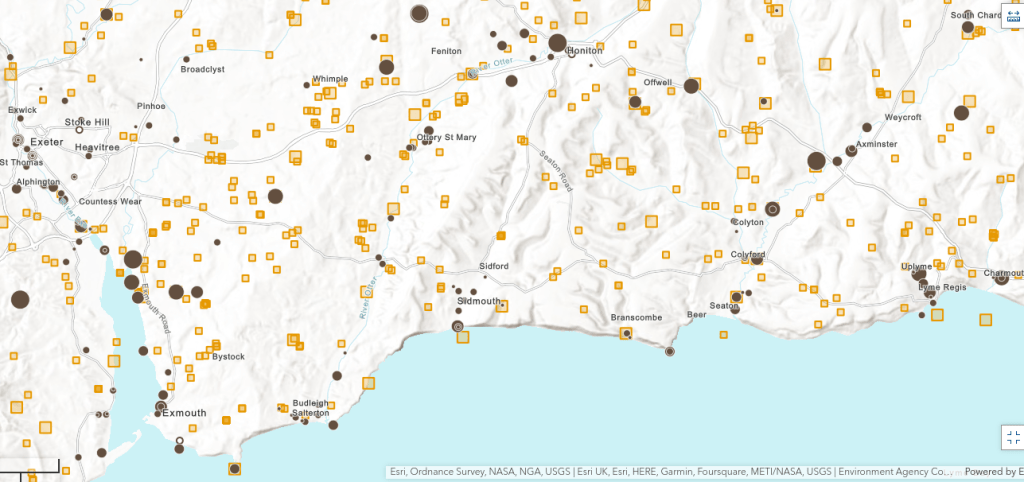
The brown spots indicate high discharge levels
The first thought that comes to my mind is that until raw sewage is treated, and I mean treated, with no spillages in East Devon’s waterways, development cannot take place sustainably anywhere in the district.
We are aware that Natural England has effectively put a halt to development around the Axe due to high phosphate levels. I cannot believe that the following pollution episodes that I have picked at random around the district do not have similar, if not worse, problems.
Woodbury Waste Water Treatment Works spilled 65 times (every 5 1⁄2 days) for a total of 1077.27 hours, discharging into the Woodbury Brook. This was equivalent to 45 days.
Aylesbeare’s sewer storm overflow spilled 65 times for a total of 561.10 hours, discharging into the Aylesbeare Brook.
I cannot miss out Honiton. The combined 2 waste water treatment plants had 226 occasions of 2646 hours and if I add the nearby village of Gittisham (2021 census population 838) 283 episodes and the colossal 3252 hours. All going to the small River Otter.
And finally what about Cranbrook? Agenda item – Public speaking – East Devon
“Further SWW data for 2021 indicates that the main sewage treatment works at Countess Wear, which services Cranbrook and surrounding communities, also released storm water on 72 combined occasions over a period of 230hrs +. An indication of capacity overwhelmed?”
“South West Water are aware of the issues, in particular the pumping station at Countess Weir which cannot expand due to the SSSI and that they have identified a further pumping station would be required to counteract the issues currently being experienced with Teignbridge, Exeter and East Devon “
So where will the sewage of the latest approved development of 870 houses go on a rainy day? The overloaded Exe? Then into Lyme Bay?
Why are we building with inadequate sewage facilities?
Why are sewage issues not part of the planning process and water companies not included as statutory bodies?
I will leave my beloved Otter with 3252 hours (135 days or 4 1⁄2 months) of poo being poured into it from Honiton last year for another day.
 East Devon Watch