Sewage discharge alert! It’s going to rain!

Exact date Britain will see a month’s worth of downpours in just 48 hours

Brits are in for heavy downpours as up to a month’s worth of rain is expected to fall in 48 hours while the rest of Europe continues to bake in a record-breaking heatwave.

Up to 60mm of rain could fall across a 48-hour period of Saturday and Sunday, medium-term forecasts indicate.

www.mirror.co.uk

Simon Jupp yet to acknowledge or congratulate Tory selection result for Exmouth

Same also seems to apply to the candidates.

With the “writing on the wall” have they all barricaded themselves in a very small room?

Or is the result being challenged? – just asking Owl

Affordable homes are included in approved plans to build 180 newbuilds in East Devon

Affordable homes are among 180 newbuilds given the green light for East Devon, this week agreed by council planners.

But do we have the sewage capacity? – Owl

Local Democracy Reporter eastdevonnews.co.uk

Up to 180 new homes will be built near Rockbeare as part of the wider Cranbrook development, writes local democracy reporter Ollie Heptinstall.

East Devon District Councillors approved the outline plan, for land west of Gribble Lane and south of London Road, at a planning meeting on Tuesday [July 18].

It is thought around 27 affordable homes could be built as part of the latest plans. Affordable housing will account for 15 per cent of the homes (classed as up to 80 per cent of market rates), and four per cent will be custom or self-build plots.

East Devon

The homes agreed for land west of Gribble Lane. Image: EDDC planning documents.

The development includes an adjoining piece of land to be used as natural green space, while all other matters will be considered as part of a detailed ‘reserved matters’ application at a later date.

Approval was given despite more than 100 public objections, as well as from Rockbeare and Whimple parish councils.

It was suggested the development contravenes the local plan and Rockbeare Neighbourhood Plan, that Cranbrook was originally planned with no building south of the former A30 (London Road), and it would have an adverse impact on wildlife.

Others suggested it would have a “detrimental impact on the rural character of the area,” cause greater pressure on local public services, go against efforts to reduce climate change, and lead to a loss of agricultural land.

However, subject to a number of conditions, planning officers recommended approval, deciding it would be an “attractive and legible development, which would integrate well with the natural environment within the site and beyond.”

Councillor Mike Howe (Independent, Clyst Valley) agreed, stating: “Our policies here and now dictate the Cranbrook Masterplan overrides the neighbourhood plan of Rockbeare. It’s the newer document and, as such, it has prominence.”

“When you add that to the fact we still don’t have a five-year housing land supply and, to be frank, this looks – I know it’s indicative and we’ve got reserved matters [to come]– like a lovely scheme. And this is the type of scheme we should be having.”

The planning committee voted to approve the plan by eight votes to three.

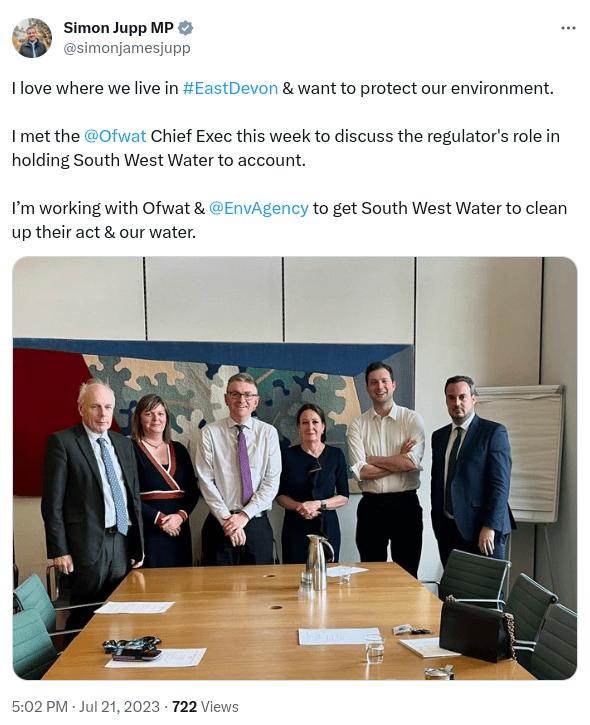
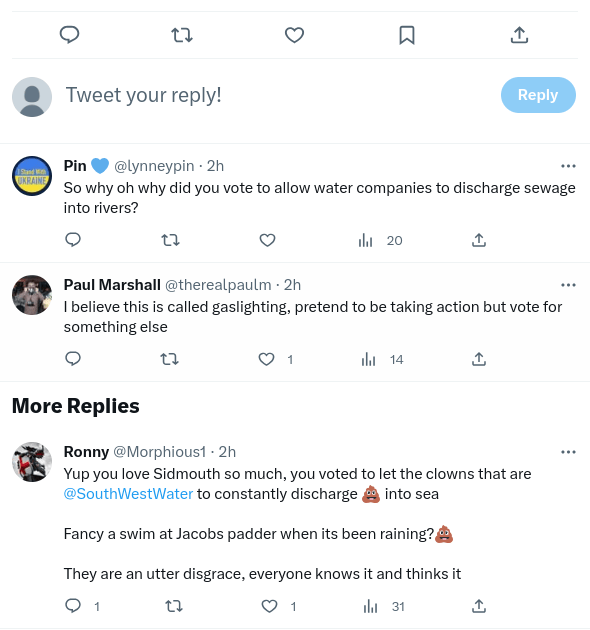
Campaigners protest South West Water’s failure to protect rivers

Campaigners gathered outside the AGM of South West Water’s parent company Pennon Group to protest against the ‘failure to keep rivers and waterways’ safe. Groups gathered before the meeting – before a further group protested inside the AGM on Thursday.

Daniel Clark www.devonlive.com

Protesters from Extinction Rebellion, Surfers Against Sewage, Friends of the River Exe and Greenpeace, wild swimmers, kayakers and citizen scientists attended the meeting at The Courtyard by Marriott hotel in Sandy Park. Their protests highlighted concerns over the state of our rivers and waterways.

A further group protested inside the AGM with a number of speeches. Searching questions to the board followed and the meeting ended with the unfurling of a ‘Dirty Profits = Dirty Water” banner. The protesters message was clear – Clean up your act!

Last week, South West Water (SWW) has been rated as among the worst water companies in England for water pollution. The company was given two stars, out of a possible four, in the annual Environmental Performance Assessment report for 2022.

It is an improvement on the previous rating of one star but the Environment Agency (EA) said the level of pollution remained “unacceptable”. SWW said it had delivered the biggest improvements on pollution sector-wide – but overall, SWW was ranked at the bottom of national performance tables – alongside Anglian Water, Thames Water, Wessex Water and Southern Water, the EA said.

In response to the protests, a Pennon Group Spokesperson said “We were pleased to see our customers at the Annual General Meeting today. The views of all our customers matter hugely to us and we fully respect the rights of those who wish to protest peacefully.

“We are listening and there is more to do. We are investing more than ever, delivering improvements in our environmental performance, and protecting our region’s beautiful seas and rivers.”

Campaigners gathered outside the AGM of South West Waters parent company Pennon Group

Alison Campbell from Extinction Rebellion, said: “This action is a result of the growing public outrage at South West Water’s poor record of sewage overflows and under investment. On average, last year there were over 100 sewage overflows from their network to our beaches and rivers every single day. South West Water puts profits before people and planet. This has to stop.”

Marcus Kern from Surfers against Sewage, added: “Clean water is a basic human right; protecting our waterways and seas is vital. In what world does poisoning the planet while paying out dividends to greedy corporations achieve this? As we protest outside, Pennon shareholders voted to help themselves to a whopping £112 million dividend, an increase of 11% over last year, while their water infrastructure fails to protect us from jaw dropping sewage pollution.”

Lib Dem leader vows to ‘get clowns out of No 10’

Including Simon Jupp! – Owl

George Thorpe www.somersetlive.co.uk

Lib Dem leader vows to ‘get clowns out of No 10’ after Somerset by-election success

Sir Ed Davey came to the county to celebrate his party’s victory in the Somerton and Frome vote after Sarah Dyke gained the seat from the Conservatives overnight

Sir Ed Davey and new MP Sarah Dyke were greeted with loud cheers in Frome

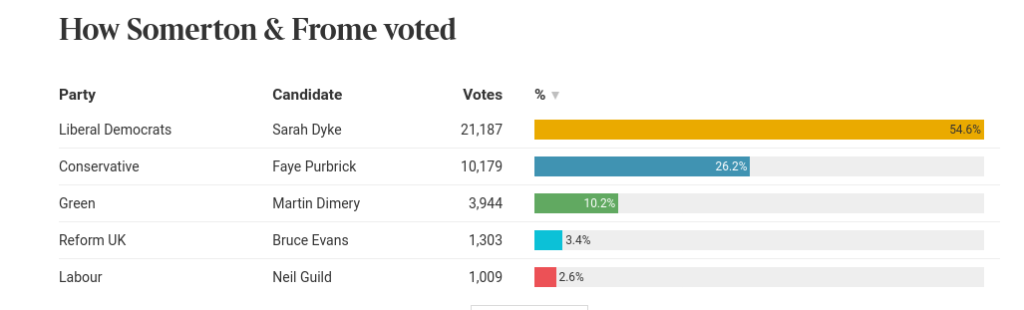
Liberal Democrat leader Sir Ed Davey has lauded his party’s victory in a by-election overnight in Somerset as they gained another seat in the House of Commons. Sarah Dyke won the vote in the Somerton and Frome constituency, which was triggered by David Warburton’s resignation, overturning a Tory majority of 19,000 in the process.

Ms Dyke ended up claiming victory by 11,008 votes from Conservative rival Faye Purbrick during a victory which she described as “humbling”. This morning (July 21), members of the party gathered in Frome to celebrate the win, with Sir Ed being among the guests along with Ms Dyke and Bath’s Lib Dem MP Wera Hobhouse.

The party also unveiled a sign which featured a dig at the Tory Government, who lost another seat in a by-election for Selby and Ainsty but kept hold of former Prime Minister Boris Johnson’s old Uxbridge and South Ruislip seat. The sign, shaped like a cannon, said: “Get these clowns out of No 10!”

As he and Ms Dyke arrived at the celebration, Sir Ed quipped that was “really starting to like by-elections”. Along with last night’s win, the Lib Dems have also gained seats for North Shropshire, Chesham and Amersham, and Tiverton and Honiton in the past two years.

Speaking in Frome, Sir Ed said: “We are back in the West Country. We will certainly not take voters for granted.

“The Conservatives keep taking people in the West Country for granted with their appalling record on the health service, on the economy.

“We won’t be complacent at all. But there are 15 seats in the West Country with majorities smaller than Somerton and Frome was.

[E.g the old East Devon constituency which Simon Jupp held with only 6,708 votes]

“We’ve got every reason to believe that people across the West Country … are turning to the Liberal Democrats as the party best placed in this part of our country to defeat the Conservatives.”

Tory angry outburst mars attempt to reset Council

Actions to provide the strong, united and informed managerial and political leadership

On Wednesday the council passed a motion to initiate six actions to reset the council and reinforce best practice by 28 votes to 17 with two abstentions. 

The motion was put by Cllr Paul Hayward, seconded by Cllr Todd Olive.

Paul Hayward said that the actions flowed from the letter to Michael Gove and were aimed at “looking to do things better”. An approach encouraged by the Local Government Association (LGA).

The full text of the motion can be found here.

Forceful case to reset the council came from unexpected quarter

The most forceful case for the urgent need to reset the council was made, not by the proponents of the motion but, unintentionally, by Tory Cllr Mike Goodman. 

Early in the proceedings he gave vent to an angry speech that was at times out of order. At one stage he had to be rebuked by the Monitoring Officer for naming officers. See below for verbatim quotes.

In reply, Leader Paul Arnott, said he would put aside all the venom and inaccuracies and deal with issues calmly and rationally. 

He stressed that this motion was as a result of the council, LGA and LGA(SW) coming together with the LGA offering to come forward to get this work underway. Otherwise the work was in danger of becoming piecemeal. 

See more detail on Paul Arnott’s reply below.

Costs and “value for money”

Cllr Goodman’s attack followed Conservative Group leader, Cllr Marcus Hartnell, contribution. Cllr Hartnell questioned the motives of the administration in bringing this motion to full council. 

Whilst saying that he could support the positive elements (at least five of the six) at Owl’s count. He ultimately voted against. 

The groove the Tories seem stuck in is one of cost and “value for money”. Though, as disclosed in the meeting, the bulk of the costs will be picked up by the  LGA and there is a motion item to review costs in any case. 

Later, Cllr Paul Hayward, Portfolio Holder Finance (Assets), confirmed that this would be covered within the existing “transformational” line of the budget. 

Technicalities

Both Cllr Eleanor Rylance (Chair) and Cllr Sam Hawkins (vice chair) voluntarily stepped down from their posts and left the chamber during this agenda item. This was because they were both signatories to the recent letter sent to the Secretary of State, Michael Gove, by the administration, revealed by the BBC.

The letter asked for government officials to become involved with overseeing an “improvement journey” aimed at bringing the cabinet and senior managers together as a “unified team” that can “move forward as one body”. The context concerns the “historic case of paedophilia and the way it has been treated within the council”.

Council agreed that Cllr Joe Whibley should take the Chair, (during the recorded vote he also followed suit and abstained). 

Quotes from Tory Cllr Goodman’s angry outburst 

Cllr Goodman started by saying (1hr 47approx on EDDC YouTube recording):

This has “nothing to do with helping residents, it is a personal motion to discredit officers of this council. We have all seen this in the tone of the letter Cllr Paul Arnott sent to Michael Gove….it is a reflection of the poor leadership of this council under Cllr Paul Arnott.” 

He then went on to accuse the Leader of undermining the Chief Executive Officer “This needs to be treated as a code of conduct issue and I have today reported this issue to the Monitoring Officer”.

He then, strangely, made heavy reference to the “mysterious report” reported last week.

“What a shame we have to wait for the critical Grant Thornton Report which I am confident will tell the truth about how the current Leader leads this council. This report was requested from this council after the procurement of the Verita report and was conducted independently by Grant Thornton [Fact check: the report was commissioned by the Chief Executive]. I have tried to get this report published before tonight’s meeting so members can make decisions based on facts. But I have not been successful…..We are here to serve our residents, not the ego of our leader.”

Calmer reflections from Paul Arnott

In reply, Leader Paul Arnott, said he would put aside all the venom and inaccuracies and deal with issues calmly and rationally. 

He made  three points:

It is a convention within the council that referrals to the Monitoring Officer are not made public. (This is probably his  fourth against the leader).

He stressed that this motion did not come from an ill-tempered councillor trying to dominate from the Chair, but was as a result of the council, LGA and LGA(SW) coming together with the LGA offering to come forward to get this work underway. Otherwise the work was in danger of becoming piecemeal. 

He asked, through the Chair, whether Cllr. Goodman had seen the Grant Thornton recommendations? (Cllr Goodman replied that he hadn’t) Paul Arnott then asked “So why are you beating me about the head with it? ” (The publication date of this “report” is unknown.) Paul Arnott then suggested that unless Cllr Goodman had some privileged information it was not relevant to the motion.

Worth a reread from May 2020:

Tories in denial, they have finally lost what they thought was theirs by right

As with last week’s extraordinary Council meeting, the Chief Executive did not attend.

Seagull droppings blamed for beach pollution

If it’s not the wrong sort of rain it must be the wrong sort of seagull poo. – Owl

Seagulls roosting under a pier could be to blame for a fall in water quality at a Portsmouth beach, according to a water company.

Adam Vaughan www.thetimes.co.uk

Portsmouth city council said this week it was working with the Environment Agency and Southern Water to investigate why water quality was deteriorating at a section of the beach at Southsea.

Quality at Southsea East declined from “excellent” in 2019 to “sufficient” last year, but officials fear bathing water tests this summer could result in it being classified as “poor” when this year’s results are released in November.

A poor rating would mean that swimmers would be advised against entering the water next year.

Southern Water said it took the decline “extremely seriously” and had been trying for more than a decade to tackle concerns in the area.

“Over this time, leaking ageing sewers have been identified as one contributing factor, prompting a major upgrade programme involving sealing pipes with special polymer linings and ensuring manholes are watertight.

“Other contributing factors include surface water run-off from roads and pavements, wildlife such as seagulls roosting beneath the pier and private sewer pipes wrongly connected to surface drains,” the company said in a statement.

Testing will be undertaken to establish whether gulls’ droppings are playing a role. Water testing by the company at Brighton Central beach last year found seabirds were an important source of pollution.

A spokesman for Southern Water said: “By looking at the samples we can find out the type of animal source it comes from.”

Southern Water used falconers with hawks to scare off seagulls at Worthing beach four years ago, much as a hawk is used to keep pigeons away from the Wimbledon tennis tournament each summer. The company ended the practice following local anger.

Southern Water’s environmental performance last year was ranked as two out of four stars — joint bottom for the industry — but up on the one star it achieved in 2021.

It is facing a private prosecution this week from the angling group Fish Legal over pollution of the River Test. The case relates to diesel from a tenant on an industrial estate which reached the river via a surface water drain owned by Southern Water. A company spokesman said: “An Environment Agency investigation into the cause of the incident and the identity of the polluters is ongoing.”

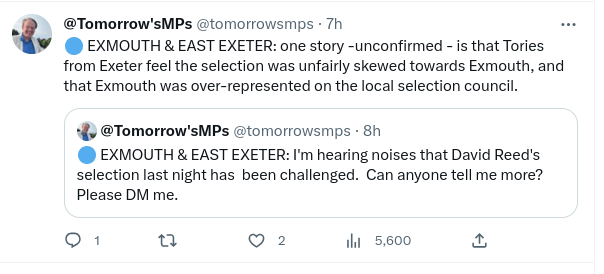
Breaking: Tories choose candidate for Exmouth & East Exeter

Not an auspicious day to announce the Tory candidate to contest the new Exmouth & East Exeter as the LibDems win Somerton & Frome taking 55% of vote. Tories share of vote crashes to 26%.

In retrospect was Simon Jupp’s chicken run towards LibDem country wise? Out of the frying pan into the fire?

Owl understands there was a short list of three: David Reed, a former Marine; Cllr Sophie Richards and Toby Williams who once worked for Hugo Swire.

Which prompted this wry commiseration to Sophie4Devon:

Demand for sea sewage pollution probe

Eight bay beaches had sewage warnings at the weekend

Torbay Council’s Conservative administration is being urged to think again after turning down a call to hold the government and South West Water to account for sewage pollution at sea.

Guy Henderson, local democracy reporter www.radioexe.co.uk

The call, from the council’s Liberal Democrat leader Steve Darling (Barton with Watcombe), follows a weekend during which Surfers Against Sewage named 37 Devon beaches where sewage was already in the sea or likely to be discharged.

They included some of the bay’s showcase holiday beaches including Meadfoot, Beacon Cove, Torre Abbey, Hollicombe, Preston Sands, Paignton Sands, Goodrington and St Mary’s Bay. 

Cllr Darling, who is also the Liberal Democrat Prospective Parliamentary Candidate for Torbay, said: “It is shameful how the Conservatives are wilfully blind to this continuing blight on our waters in the bay. As someone who loves sea swimming, I believe with a passion that we need to be holding the government and South West Water to account on this matter.”

The council was asked at its overview and scrutiny board meeting on July 5 to undertake a spotlight review of sea pollution and demand answers from the government and the water company, but the motion was not passed.

Now Cllr Darling will ask again, this time at a meeting of the full council on Thursday 20 July.

His question to the council’s Tory leadership says: “This dumping is poor publicity that Torbay could do without at the start of the school holidays.

Residents and visitors should have clean waters to enjoy.

“Do you agree that it was a poor judgement not to agree to undertake a bespoke spotlight review that would have held South West Water and the government to account on pollution of our seas that is significantly impacting on Torbay’s aspiration to become the premier resort in the UK?

“And do you agree that in light of this, a spotlight review should be undertaken as a matter of urgency by Torbay Council’s overview and scrutiny board?”

Private equity ownership of health services can worsen care, review says

Private equity takeovers of health services worldwide are associated with worse quality of care and higher costs, according to the largest study of its kind.

Andrew Gregory www.theguardian.com 

In the past decade, private equity firms have increasingly invested in, acquired and consolidated healthcare facilities. Globally, healthcare buyouts have exceeded £157bn since 2021 alone.

Despite much speculation, evidence about the impact of this rapidly growing global trend has been lacking.

Now a systematic review of private equity healthcare service takeovers across eight countries including the US, UK, Sweden and the Netherlands provides it. Private equity (PE) ownership of healthcare services including hospitals and nursing homes is linked to a harmful effect on cost and quality of care, suggests the review published in the BMJ medical journal.

The authors of the review, which was led by the University of Chicago, said: “The most unequivocal evidence points to PE being associated with an increase in healthcare costs. Evidence across studies also suggests mixed impacts of PE ownership on healthcare quality, with greater evidence that PE ownership might degrade quality in some capacity rather than improve it.”

No consistently beneficial effects of private equity ownership were identified, the researchers said. “The current body of evidence is robust enough to confirm that PE ownership is a consequential and increasingly prominent element in healthcare, warranting surveillance, reporting and possibly increased regulation,” they wrote.

The researchers identified 1,778 studies, of which 55 met the inclusion criteria. They looked at the impact of private equity takeovers on costs, quality of care and health outcomes.

Nine of 12 studies revealed higher costs to patients or the funders of healthcare at services owned by such firms, three found no differences, and none showed lower costs.

Private equity ownership was also associated with a mixed to harmful impact on healthcare. Of 27 studies that assessed quality of care, 12 found harmful effects, three found beneficial, nine found mixed – some measures declined, some improved – and three were neutral.

Health outcomes showed beneficial and harmful results, but the volume of studies for this measure was too low for any definitive conclusions to be drawn.

Cat Hobbs, the director of the public ownership campaign group We Own It, said: “This important new study is sadly no surprise. When vital services are privatised, patients get the worst of both worlds: higher costs for worse quality care.

“Private equity firms will always put their duty to make a financial return first – that’s their job. But these incentives are in direct conflict with the public good. Healthcare is not just another investment opportunity. It’s a crucial public service which we all need at some point in our lives.”

She added: “Private equity ownership in the healthcare sector is on the rise fast, and the public need to know the risks it poses to care quality and access.”

David Rowland, the director of the Centre for Health and the Public Interest, a thinktank, said regulators and politicians needed to “get a grip” of how private equity takeovers impact healthcare.

He said: “How one makes the sizeable returns which these private equity funds require from providing care to a child with learning difficulties, for example, is a question which is never asked either by regulators or politicians. But it is clear from this research that squeezing profit from these types of services can put patients and vulnerable people at risk.”

Dr Tony O’Sullivan, the co-chair of the campaign group Keep Our NHS Public, said the review provided a “screamingly obvious piece of evidence”. Policymakers must prioritise public funding and provision of healthcare if they are to avoid “damaging” consequences for patients, he said.

Devon asylum children as young as four left to get bus alone

Shocking urgent concerns have been raised about conditions asylum seekers are said to be enduring while being accommodated in an East Devon hotel. It is claimed some children who have sought refuge at Hampton by Hilton Exeter Airport are malnourished due to ‘inadequate’ and culturally inappropriate food being provided.

Anita Merritt www.devonlive.com 

Local councillors have condemned the ‘careless and inappropriate manner’ in which the asylum seekers are being treated following visit to the hotel. They have also raised concerns over medical concerns and transport issues to places such as schools and the doctors due to the hotel’s location. It’s even been alleged that children as young as four are being left to ride the school bus without someone looking after them.

At East Devon District Council’s (EDDC) cabinet meeting last Wednesday, July 12, members discussed the issues being experienced since asylum seekers were placed in the hotel by the Home Office. Since January, the hotel has been closed to hotel guests to accommodate asylum seekers and is said to be reopening again in early 2024.

The minutes of the meeting state that in the public speaking part of the meeting, Aynsley Jones, community hub manager at Cranbrook Education Campus told how 48 students on its roll were seeking asylum. She said following weekly meetings with families and from talking to the children, food was said to be substandard, the menu didn’t change and there was no consideration given to cultural differences.

From the evidence it has gathered, it was said 30 per cent of the children do not eat the food provided at the hotel, with two cases of malnutrition. There were said to be no individual cooking facilities or fridges, which impacted the storage of medication and baby milk, and snacks were provided on a first come first served basis, if issued at all.

It was also claimed 18 per cent of the pupils had severe trauma and through a lack of funds could not be adequately supported, and 21 per cent had potential undiagnosed Special educational needs and disabilities (SEND). Ms Jones added untrained hotel staff were triaging medical appointments resulting in residents ‘suffering’ and not getting the medical attention they required.

Multiple hotel management changes were said to have resulted in ‘misinformation or fear’. There was said to be no shuttle bus to Exeter or Pinhoe surgery and no provision of over-the-counter medication.

The taxi company being used was claimed to be ‘ineffective’ with an average waiting time of four hours. There was no transport for residents to leave the hotel and no clear complaints procedure.

She concluded there needed to be an independent body to coordinate the wellbeing of the hotel residents and commended the work being done by Refugee Support Devon. She called for a 40-strong volunteer buddy scheme supported by the Pickwell Foundation with financial support from EDDC and others.

Independent councillor Kevin Blakey, who represents the Cranbrook ward, read out a statement during the meeting that had been approved by all three ward members raising their concerns.

He said: “The recommendation is that cabinet endorse measures being taken to ensure the Home Office are accountable for providing adequate feeding and safeguarding of the asylum seekers. This is fine so far as it goes but it does not address the real and urgent matter of the provision of inadequate food for the disparate groups of people occupying the hotel.

“I have been to the hotel, along with Cllr Kim Bloxham and Cllr Jess Bailey, to observe the food service operation. While the residents say that matters have improved with the availability of fresh fruit such as oranges and bananas over the last few weeks; since the local school raised its concerns with us, the main meals remain woefully unappetising to many.

“There was a lack of variety and no provision of fresh vegetables or salads to ensure a healthy and balanced diet. On the occasion we visited, people were taking platefuls of only rice or potatoes, much of which was then thrown away, particularly potatoes that had not had eyes removed before cooking and were pale in colour even though they purported to be roast potatoes.

“Meat is an issue. The small amount served sat in a bland sauce that some of the residents disliked, the remaining residents could not eat it because their faiths do not permit the consumption of red meats. They will not eat the chicken because, according to all those that we spoke to, the meat stinks and they do not believe it is safe or good to eat.

“While there are certainly cultural issues with food at the hotel, we understand that the children are eating all types of foods at the Cranbrook Education Campus which seems to confirm the problem with the quality of the food being shipped in by the current contractor at the hotel.

“MP Simon Jupp has been in touch with the service provider, who told him that they had received no complaints about the food and that all special dietary needs were being met. All the residents we spoke to complained about the food and two people who are diabetic have never been offered food appropriate to their medical needs. Perhaps these complaints have never been expressed to the service provider.

“Some of those we spoke to reported increasing illness and weight loss. In short, many are suffering from malnutrition. This is not about quantity, it is about the quality, nutritional balance and cultural acceptability of what is offered.

“Remember that a significant proportion of the residents are children who need suitably balanced food to grow. The monotonous and unappetising offering currently provided is not working.

“This is not about providing a restaurant experience for the residents. We are not forgetting that all the residents are waiting for their asylum or residency applications to be determined by the Home Office, who will decide whether they have valid reasons to be in the UK.

“Whatever the outcomes of their applications, it is clear to us that while they wait for the Home Office decisions, they should be treated humanely and with respect. The rights and wrongs of how the asylum seekers got here is not a matter for us, but in the 21st century, the UK has no excuse for treating anybody in such a careless and inappropriate manner. East Devon surely cannot permit poor treatment of our guests, whether they are welcome or not.”

Regarding transport issues, it was said that due to the hotel’s ‘isolated location’ residents are reliant on buses or taxis to get to schools or doctors.

Cllr Blakey said: “In the case of school transport, some children as young as four years are travelling without a chaperone which is clearly unacceptable. We suggest that some of the available budget be used to pay for a coordinator to manage all residents’ needs, including transport, health and food requirements so that children can get to and from school with appropriate safeguarding and that transport to doctors can be effectively arranged.”

The Cranbrook councillors stated they are calling for a number of urgent changes, including for the Home Office to cancel the current food supply contract and for it to be provided locally at the same cost, with an emphasis on pulses and fresh vegetables.

It added Cranbrook Education Campus is providing food and even school uniforms with no additional funding which is ‘unsustainable’ and the government should provide additional funding for the extra costs incurred by local schools.

Cllr Blakey said: “EDDC must press the Home Office to make the changes we have suggested. This is a highly emotive matter but I believe the decisions made by Cabinet today should be guided by the humanitarian needs that are pressing here and now. We feel sure you will make the right choices.”

It was added that a grant of £217,500 is available to meet local needs, of which £31,000 has already been earmarked for transport, leaving around £186,000 for other support. Cabinet members agreed to maintain pressure on the Home Office to ensure that asylum seekers in the district are ‘properly fed and safeguarded’ while in its care.

The minutes of the meeting state it was resolved to: “Delegate authority to the director of Finance, Director of Housing, Health & Environment in consultation with the portfolio holder Finance (Assets) and Portfolio Holder Sustainable Homes and Communities, as well Cllrs Bailey, Bloxham and Blakey, to spend up to £217k.

“The spend is to be used for welfare support, transport, kitchens, food contract, healthcare and medication, fridges, hotel management, safeguarding, insurance concerning the use of kitchens and infant food. To send a further letter to the Home Office expressing the council’s ongoing concerns, while still putting pressure on the local MP Simon Jupp to take further action with the Home Office.

“To explore the issues of an off-site meeting and the hiring of a co-ordinator type role.”

In response to the claims made during the meeting, the Home Office has told DevonLive it does not comment on operational arrangements for individual hotels. It assured all asylum seekers in hotels are provided with three meals a day along with snacks and water.

Where concerns are raised about any aspect of the service delivered by the hotel, the Home Office works with the provider to ensure concerns are addressed in a ‘timely manner’. It also said it speaks to accommodation providers about delivery and performance daily, as well as holding formal weekly, monthly and quarterly meetings to ensure contractual obligations are followed.

Weekly food surveys for residents are said to be carried out to account for cultural preferences for food. It was added supported asylum seekers have access to a Migrant Help 24/7 helpline to raise any concerns regards the support they receive and are able to make formal complaints which are followed up.

In catered accommodation, asylum seekers receive £9.58 per week per each household member where eligible, and new mothers are provided with nappy packs and milk.

A Home Office spokesperson said: “Despite the number of people arriving in the UK reaching record levels, we continue to provide support for asylum seekers who would otherwise be destitute. Asylum-seekers in receipt of catered accommodation are provided with three meals a day along with snacks and water, and a weekly allowance where eligible.

“The food provided in asylum hotels meets NHS Eatwell standards and responds to all culture and dietary requirements. Where concerns are raised about any aspect of the service delivered in a hotel we work with the provider to ensure these concerns are addressed.”

East Devon MP Simon Jupp said: “I have been actively engaging with Home Office officials and service contractors on their delivery of contingency asylum accommodation at the hotel, including during my visit to the site earlier this month. I will continue to work constructively with all parties involved to resolve ongoing issues.”

Hilton and EDDC have both been approached for a comment.

Ed Davey says Lib Dems will need tactical votes to win Frome by-election as Tories put up fight

The Liberal Democrats will need to rely on tactical voting from constituents who want to defeat the Tories in Thursday’s by-election in Somerton and Frome, party insiders have told i.

David Parsley inews.co.uk 

The party, which is hoping for its fourth by-election victory against the Conservative Party in just over two years, needs to overturn a Tory majority of 19,213 to take the seat.

While Lib Dem leader Sir Ed Davey insists the poll is heading for a “photo finish”, campaign sources within his party suggest internal polling is showing both Green and Labour voters are shifting over to their candidate, Sarah Dyke.

One Lib Dem source said: “In the last 48 hours we’ve noticed a lot of traditional Green and Labour voters in Frome are coming over to us as they realise this will come down to tactical voting.

“Many who want to kick the Tories out of Somerton and Frome are coming over to us this time.”

However, the source added that the Somerset town of Frome makes up only 25 per cent of the total vote, and that the party in this largely rural constituency still had “some way to go” before the Lib Dems could be assured of victory.

“Over the past week we have seen voters in the villages moving towards us as well,” added the source. “So, we’re optimistic but not at all complacent.”

Davey, who was campaigning alongside Ms Dyke at a local equine charity, said the result was a “two-horse race”.

As he toured the Glenda Spooner Farm near Somerton, he told i: “It’s a huge majority to overturn and there’s no doubt the Conservatives have been campaigning hard in this by-election.

“But, we’re not going to pretend we’re not optimistic and hopeful.”

The Lib Dem leader added: “Given our successes in three by-elections that no one thought we could win, we’re getting used to winning.”

But Davey did seek to manage expectations, warning that a shorter campaign, compared with last year’s overturning of a 26,000 Tory majority in Tiverton and Honiton, did mean Ms Dyke was facing a tougher challenge to persuade voters to eject the Conservatives, who have held the seat since 2015.

“We have to keep going until 10pm on polling day,” he said. “We’re not taking anything for granted. This is my sixth visit and I think that’s a sign we’re taking it very seriously.

“If you compare it to that other three campaigns that we won, it’s a lot shorter and that has created challenges for us.

“I think if we had another month or so then we’d probably feel even more optimistic than we do.”

The Conservative candidate Faye Purbrick was campaigning in Castle Cary on Tuesday, but refused several requests to answer questions from the media.

This latest opportunity for the Lib Dems to inflict a defeat on the Tories was been caused by the resignation of David Warburton, who was suspended from the Conservative Party over allegations of sexual misconduct.

Warburton denied the allegations.

In June 2021 the Lib Dems overcame a Tory majority of more than 16,000 to take the Chesham and Amersham seat, while in December of the same year the party reversed a near 23,000 Conservative majority in North Shropshire.

Then last June the party celebrated a 29.9 per cent swing in its favour to take Devon’s Tiverton and Honiton seat in what was the eleventh largest swing in by-election history, and the largest since 1985.

Seaton seafront eyesore could become spectacular new café

East Devon District Council are looking for people to take over the running of a derelict seafront building which has glorious views. The council is looking to lease out the Seaton Moridunum – which has been plagued with controversy for years.

Daniel Clark www.devonlive.com

Planning permission for the redevelopment of Seaton seafront was granted in 2017. It would have included pedestrianisation of sections of the seafront, demolition of the existing public toilets and Moridunum.

The plans would also have seen alterations to the highway layout and a new pedestrian crossing, as well as new public space with raised seating and siting of seasonal huts for commercial use. But the plans never came to anything, and three years on, were scrapped, despite more than £50,000 having been spent on the scheme – and a second hope that the plans could have got the go-ahead were dashed when the Axe Valley missed out on Levelling-up funding.

Now though East Devon District Council are hoping to find a use for the dilapidated moridunum on Seaton seafront. It is currently being marketed as a commercial premises – with the chance it can be transformed into a café or other leisure related facility.

What the Seaton Moridunum could look like

The moridunum on The Esplanade – a former toilet block with ramps either side and a viewing platform above – is currently being marketed for lease by Lambert Smith Hampton. The seafront property is in a prominent tourist location, has impressive sea views, the opportunity for development, and the location offers high footfall, the listing says.

The property would suit a food and beverage operation development or refurbishment, the council says. Although development would be subject to the necessary consents being obtained.

You can view the full listing here: https://www.lsh.co.uk/find/properties/devon/seaton/2050090

Welsh government and Cornwall council sign collaboration deal

They are separated by choppy waters – and different political ideologies.

But the leaders of Wales and Cornwall have come together to sign an agreement vowing to work together on shared issues, ranging from the crisis of holiday homes to the prospect of cooperating on offshore wind power projects in the Celtic Sea.

Steven Morris www.theguardian.com

Mark Drakeford, the Labour first minister of Wales, and the Conservative leader of Cornwall council, Linda Taylor, put aside their party political differences to meet at Cathays Park in Cardiff to seal the five-year collaboration agreement.

Drakeford said Wales and Cornwall had much – challenges and opportunities – in common. “We share many historical, cultural and linguistic ties with Cornwall, and our economies, landscape and our people have many shared characteristics,” he said. “These commonalities enable us to learn from each other.”

On the opportunities side, Drakeford said they had “the shared resource” of the Celtic Sea. “We both have an interest in making sure we get the most we can from the fact that our geography is suddenly on our side. Here we both are on the western fringe of Europe, where our geography has been against us in many ways for economic development; now suddenly being on the edge is an advantage in terms of wind and marine energy.”

The challenges the two territories share include the second homes crisis, which pushes families and young people out from places favoured by holidaymakers. The Welsh government will share learning from its “radical” campaign to tackle the problem such as changing planning laws and allowing councils to increase taxes on second homes.

Cornwall may also be able to learn much about increasing the number of people who speak Cornish from Wales, which is aiming to have 1 million people speaking Welsh by 2050. On language, Drakeford said: “The three Celtic languages closest together are Welsh, Breton and Cornish. We want to support other branches of the Celtic language.”

Wales already has strong links with Brittany and Drakeford travelled to Paris earlier this year to mark the start of a year-long celebration of connections between Wales and France.

He said the move was not about bypassing Westminster. “It’s not antagonistic to the UK government – it’s much more a positive wish to engage directly with places beyond Wales.”

Taylor said Cornwall was proud of its language but its school programme did not have the reach of Wales’s. While Drakeford is a fluent Welsh speaker, Taylor admitted her Cornish amounted to little more than thank you – meur ras.

The Cornish council leader said she was keen to learn more about Wales’s new planning laws designed to make it harder for houses to be turned into holiday homes. “To me, it would be incredibly important to have those powers,” she said.

Garry Tregidga, a co-director of the institute of Cornish studies at the University of Exeter, said there were many common features between Cornwall and Wales. He cited the visit of the Welsh former prime minister David Lloyd George to Falmouth at the start of the 20th century, when he declared he was visiting “his fellow countrymen” since Cornwall and Wales had the “same Celtic passion for liberty”.

Joanie Willett, the institute’s other co-director, said: “As Cornwall pursues its goal of meaningful devolution to local government, building strong relationships with other governments is going to be incredibly important.”

Dennis Sorondo Salazar, an expert on sub-state diplomacy at Cardiff University’s Wales governance centre, said: “These kinds of agreements can sometimes be a way of bypassing the central government. Wales is increasingly active in this paradiplomatic sphere, in establishing both international and regional links.”

Bus ‘revolution’ questioned as rural services hit new low

The Government’s promised bus “revolution” is failing to address a steep decline in rural services as journeys hit a historic low, councils have warned.

The Newsroom www.newschainonline.com

The Conservative-led County Councils Network (CCN), which represents 37 authorities serving nearly half the population in England, said problems with the delivery of the Government’s national bus strategy is threatening to undermine a key aim of the levelling up agenda.

Research commissioned by CCN found the bulk of the £1.1 billion in funding made available as part of the flagship national bus strategy went to urban authorities following a bidding process.

This was despite these areas experiencing smaller percentage falls in passenger numbers since 2010.

Analysis of Department for Transport data found passenger numbers in rural areas declined by 14% between 2010 and 2019, compared with a fall of 8.5% in metropolitan areas outside London over the period.

Lockdown restrictions during 2020-21 caused passenger numbers to fall by a further 35% in both rural and metropolitan communities.

However, the study showed urban areas received £739 million (67%) of the available Government funding, while rural areas received £336 million – just 10% of the value of their submitted bids.

Buses have long been a lifeline for many people in rural areas, particularly the elderly and the disadvantaged. But outside of London and the cities, far too many services are at best patchy, and at worst non-existent

The report said more than one in four bus services in county areas have “vanished” over the last decade, with total bus miles travelled falling faster than in cities and adjacent places.

This limited availability has led to a historic low of 344 million fewer passenger journeys now being taken in rural areas compared with 2020, the report said.

CCN transport spokesperson Stephen Giles-Medhurst said despite high hopes, county councils felt let down by the Government’s funding allocations as the money has been “directed to places that arguably needed the least help”.

He added: “Buses have long been a lifeline for many people in rural areas, particularly the elderly and the disadvantaged. But outside of London and the cities, far too many services are at best patchy, and at worst non-existent.

“As their bids for the funding showed, councils have serious ambitions when it comes to improving and modernising their bus services. But it is increasingly likely that reversing the decline in passengers is a challenge to be picked up by a future government.

“Today’s report sets out a number of recommendations to transform local services. Failure to act will keep buses in county areas in a state of managed decline, with consequences for our residents.”

Announcing the plans in 2020, former transport secretary Grant Shapps said the Government was taking the lead by “launching a revolution in bus services”.

The national bus strategy was published in 2021 with the aim of increasing bus use above 2019 levels in the medium term.

Then-prime minister Boris Johnson said “better buses will be one of our major acts of levelling up” while the strategy added “buses are vital to ensuring the economy meets net zero carbon emissions and driving the green transformation”.

Under the strategy, transport authorities were required to produce a bus service improvement plan and the first of two rounds of allocations were confirmed in April 2021.

CCN called on the Government to provide a further round of funding as councils in rural areas have received only a fraction of the money needed to deliver their plans.

The organisation also called for greater transparency over how bids are evaluated and the amount of funding that can be expected.

CCN also called for the Government to move away from competitive bidding and allocate funding based on need and increasing passenger numbers.

Labour has proposed allowing local authorities to introduce bus franchising without Government approval and an end to the ban on creating council-owned bus companies.

But the report said the proposals are likely to have a limited take-up in county areas due to the limited viability of rural services.

A DfT spokesperson said: “This report only focuses on just one part of the £3.5 billion we’ve put into buses since March 2020.

“Our new bus service improvement plan funding will be focused on areas that didn’t receive support under the original scheme.”

Hospital staff parking charges in Devon are ‘stealth tax’

Parking charges being reintroduced for hospital staff are a “stealth tax” according to union leaders.

By Miles Davis www.bbc.co.uk

Staff at Royal Devon and Exeter (RD&E) sites and at North Devon District Hospital (NDDH) will have to pay once again for parking from 1 September.

More staff at the main RD&E site will also not be able to park on site as a “green zone” is extended.

Hospital bosses say the sites are among the last in the country to reintroduce parking charges scrapped during Covid.

Staff at RD&E will continue to be able to use the Digby Park and Ride service for free.

‘Unfair’

Helga Pile, deputy head of health at the Unison union, said: “These parking charges are a stealth tax that health workers can’t afford. No trusts should be imposing them on staff especially given the current cost-of-living crisis.

“Not only is such a policy unfair, but staff could quit as a result. This is at a time when the NHS is struggling to fill vacancies.”

Julie Connolly, senior officer for Royal College of Nursing (RCN) Devon said it was “more important than ever” for nursing staff not to have to worry about finding somewhere safe to park or facing additional expense.

She said: “Like many hospitals the demand for parking spaces outstrips supply. Congestion around hospital sites has increased over time and is the cause of stress and frustration for staff, patients and visitors alike.

“In the short and medium term, the Royal Devon and Exeter NHS Foundation Trust needs to continue to work with staff, the local council and other partners to alleviate pressure on parking across all its sites and to ensure the safety of staff arriving at and leaving their work places.”

Staff who live within 1.5 mile (2.4km) of the RD&E Wonford site are currently not eligible for a travel pass to park on the site from 08:00 to 16:00.

From Monday that area, referred to as the “green zone”, will be extended to cover staff who live within 2 miles (3.2km) of the site.

‘Air quality’

The parking charges for staff will be reintroduced from 1 September.

A spokesperson for the trust said: “Free staff parking was introduced at the beginning of the pandemic in 2020, and when national funding was removed in April 2022, the trust chose to continue with free parking to support colleagues.

“We are currently one of the last remaining trusts to offer free parking.

“This will also help us manage demand for our car parks as well as encourage more sustainable travel choices, in order to improve air quality.”

‘Vast’ growth in value of England rentals since 1990 would have built 3m council homes

Private landlords in England have made enough money from rising house prices in the last three decades to build at least 3m council homes, research suggests.

Robert Booth www.theguardian.com 

Owners of private rental properties have seen their assets grow in value by £400bn since 1990, equivalent to the amount needed to build more than 50 times the number of council homes that were actually built in England in that period.

The windfall calculation, commissioned by the Renters Reform Coalition campaign group and based on Office for National Statistics data, comes as landlords demand tax cuts to help ease the impact of rising interest rates. The National Residential Landlords Association has said many landlords “simply cannot afford to soak up” rising costs and will have to sell up or raise rents.

The growth in capital values means a landlord in London with five properties owned since 2013 has made £655,000 without even accounting for profits from rent.

Fewer than 54,000 council homes have been built in England since 1990, official figures show. They typically require grants of up to £200,000 per home in London and about £100,000 elsewhere, according to the National Housing Federation.

Fergus Wilson, one of Britain’s biggest buy-to-let landlords until a recent sell-off, told the Guardian that he and his wife, Judith, had bought 13 racehorses and 100 acres of farmland with some of the capital gains from selling dozens of homes they bought in the early 2000s on new estates around Ashford in Kent.

The sale of 15 homes they owned on one street – Grice Close – netted them close to £3m in profits, and another 20 homes on the Park Farm estate made nearly £5m.

“Mrs Wilson bought some National Hunt horses and had them trained with David Pipe – she had 28 winners,” he said. “I’ve got an awful lot of agricultural land. You wonder if you’re ever going to get permission to build houses on it.” The rest of their profits are “floating around” in investments, he said.

Last week, the ONS revealed that 43% of renters in Great Britain were finding it difficult to afford their rent payments. Fourteen per cent of renters said that in the last two weeks they had run out of food and been unable to afford more.

Wilson said he believed workers in the NHS and train drivers deserved to be paid more, but when asked if capital gains tax should be increased he replied: “The landlords would hate me if I said that.”

Half of English private residential landlords have owned a home since at least 2010, according to the research. During that time, the average privately rented home has increased in value by 41%, delivering the owner £76,000 in capital gains on top of profits from rent.

Landlords have on average made 23% “year one” cash profits on rental income from 2014 to 2021, according to separate research by Savills, an estate agent, although rising interest rates have pushed that down for landlords with mortgages.

The windfalls in the capital and south-east England are far greater, according to the analysis commissioned from Positive Money, a not-for-profit advocacy group. Owning a rental property for a decade in those areas would deliver between £100,000 and £131,000 in capital gains, which is taxed at lower rates than income.

“It’s difficult to miss the news stories of landlords complaining they are under the pump at the moment because of rising interest rates and, most absurdly, the government’s forthcoming renters’ reform bill,” said Tom Darling, a campaign manager at the Renters’ Reform Coalition. “[But] landlords have seen a vast expansion of their wealth over the last 30 years.”

But the windfalls are only available if landlords sell up, and those who continue to operate claim that incoming reforms protecting tenants from no-fault evictions and rising interest rates will squeeze their margins.

Chris Norris, policy director at the National Residential Landlords Association, said: “Landlord profits are at their lowest levels since 2007, a clear sign that they are not ‘cashing in’ on the cost of living crisis. What the country needs is a plan of action that recognises the need for more homes of every kind, whether they be properties for private rent, social rent or owner occupation.”

The geographic spread of capital gains is uneven. A typical landlord in the north-east of England has gained £12,000 per home in the last decade, compared with £40,000 in the north-west and £71,000 in the south-west, according to the estimates.

Meanwhile, in the last 30 years the number of households renting in England and Wales has more than doubled to 5m (one in five), census results show.

Amid rising interest rates and expiring fixed-term mortgages, last week the Bank of England forecast that average monthly payments on buy-to-let mortgages would increase by about £275 by the end of 2025.

Asking rents for new lets in London, Cardiff, Aberdeen, Southampton, Glasgow, Manchester and Edinburgh are all at least 10% up on last year, according to the property website Zoopla. Average London rent has increased by £490 a month to £2,001.

Across the UK, all private rents – including those paid by sitting tenants – rose by 4.9% in the 12 months to March 2023, according to the ONS.

Residents at UK’s biggest new ‘ghost town’ fume as it has no shops or GP six years on

Residents in England’s biggest new town have been left furious after developers failed to live up to their promises – forcing them to live without necessities six years on.

Ring any bells locally? – Owl

www.mirror.co.uk (Extract)

Northstowe, located 10 miles from Cambridge, has been left like a ‘ghost town’ with rows upon rows of newly-built houses, but not a single shop, café, pub or even a GP practice.

Around 10,000 homes are planned with a total population of 26,000, making it the largest new town in Britain since Milton Keynes was built in Buckinghamshire in 1967.

The construction started in 2017 and around 1,200 properties have been built, but families still don’t have any basic facilities and have to drive to buy a pint of milk or coffee.