Breaking: Calls for East Devon District Council chief executive to resign

There are calls for a council chief executive to resign following a report into the council’s handling of serious allegations against a councillor.

By Ewan Murrie & Johnny O’Shea www.bbc.co.uk

The report said it was unable to find “reliable evidence” the CEO of East Devon District Council knew about an investigation into John Humphreys.

But the Labour group said the report “proves” Mark Williams was “guilty of serious failings” and should resign.

Mr Williams has been contacted for comment.

Humphreys, a former Mayor of Exmouth and EDDC councillor for 12 years, was convicted in 2021 of three counts of serious sexual assault and seven of indecent assault against two boys in the 1990s and 2000s. He was jailed for 21 years.

In 2021, John Humphreys was jailed for 21 years after sexually abusing two boys

The independent report by Verita investigated a line from the minutes of a Local Authority Designated Officer (LADO) meeting in March 2016, suggesting Mr Williams had been “alerted to the situation”.

This was new evidence presented by Devon and Cornwall Police in March, causing the initial Verita report to be delayed while it investigated.

Verita said in its report this record “appeared to contradict” evidence which Mr Williams and the former monitoring officer of East Devon District Council had provided at an earlier stage in the investigation.

Humphreys was an alderman by East Devon District Council while under criminal investigation

Mr Williams told Verita he had never seen the minutes and had not been told about the criminal investigation at that time.

The report said it could not corroborate the statement from the minutes and concluded “it does not constitute sufficiently reliable evidence that the CEO of EDDC was aware of the Humphreys’ situation”.

Had Mr Williams been aware he would have had a duty to inform the safeguarding lead, which was not done.

Devon and Cornwall Police gave this statement to the BBC: “The appropriate and agreed route for sharing sensitive information with relevant partners is through the LADO process.

“Once a partner agency has been informed of a risk, it is for them to assess and manage the impact of that risk internally as they see fit.”

The Labour group of councillors on EDDC has written to Mr Williams having seen the report, calling for him to resign with immediate effect.

Dan Wilson, the leader of the Labour group, said “the report is completely damning” and the failure to inform the safeguarding lead was “unforgiveable”.

He said: “I certainly hope that no children were harmed in the three-year period between the information coming out and his conviction. The problem is that it could have.”

He added: “Because safeguarding weren’t informed, he could have gone into schools, colleges, he could have been in situations with vulnerable children and as we now know, that would have been extremely dangerous.

“Any harm that was avoided is down to luck when it should have been down to competence.”

‘Historic debate’

The Labour group leader told the BBC he would be tabling a vote of no confidence in the chief executive at a council meeting next week unless a resignation was forthcoming before then.

Humphreys was able to continue mixing with children while serving as an EDDC councillor until 2019 and stayed on Exmouth Town Council until he was jailed.

He was nominated for the award of Honorary Alderman which he received from EDDC on 18 December 2019.

It was rescinded weeks after his conviction.

Independent EDDC councillor Jess Bailey said: “There was a situation where a former councillor was awarded a civic honour whilst he was under a criminal investigation, and he went into that trial with that honour as an apparent badge of respectability and I think residents deserve to understand how that happened.”

The reports are on the agenda for discussion at an extraordinary meeting of the council on Tuesday.

In June it emerged the council had asked for government help to mend fractious relationships with its staff following its handling of the Humphreys case.

The leader of the council, Liberal Democrat Paul Arnott, said the extraordinary meeting “will be an historic debate for East Devon”.

He said: “I must not predetermine it, but members’ comments to me already suggest that councillors will seek to clarify senior officer statements about who knew what when, and to understand the reason for the inertia in a process we began in April 2022 which has taken until July 2023 to make the next step. Why?”

He urged everyone involved to remember the victims of Humphreys’ crimes, including one from East Devon, saying “members and officers alike owe him the truth, the whole truth, and nothing but the truth”.

The Conservative group said its thoughts were with the victims of the “despicable crimes” and it had “nothing further to add until the report can be debated at full council next week”.

East Devon District Council said it had no comment to make at this time.

Latest Westminster Hall debate on Levelling Up the South West disappoints

An opportunity missed, perhaps deliberately – Owl

On Tuesday local MPs debated levelling up in the South West under the chair of Ian Liddell-Grainger MP (Bridgwater and West Somerset) (Con) with Parliamentary Under-Secretary of State for Levelling Up Dehenna Davison in attendance.

Possibly because there are so few opposition MPs in the region, Richard Foord (LibDem) and Luke Pollard (Labour/Co-op) only managed to squeeze in a few words, and  the debate was dominated by Tory partisan attempts at point scoring.

The Chair set the  tone. The result was a disappointment. 

The debate was dominated by the minister, and Tory MPs like Simon Jupp, reeling off  lists of all the investments made recently, that most of us would regard as essential infrastructure projects.

For example, Jupp: “Devon, Cornwall, Dorset and Somerset have secured £231 million from the levelling-up fund so far.” 

Schoolboy point scoring

Here are schoolboy examples of point scoring:

Richard Foord 

I am grateful to the Minister for giving way. The Cullompton relief road has been part of the Mid Devon District Council levelling-up bid on two occasions. In both the first round and the second round, the bid was unsuccessful. How does the Minister recommend that Mid Devon District Council should pursue the relief road?

Dehenna Davison 

I am grateful to the hon. Member for mentioning the Cullompton relief road, but I am afraid he has been pipped to the post, as my hon. Friend the Member for East Devon (Simon Jupp) has raised the issue with me on multiple occasions, to the point that it is probably one of my favourite relief roads. I hear about it weekly. [Jupp is a PPS in her ministry]

Debate descends into farce

At one point the debate descended into farce skipping from Broadband, to blame shaming South West Water, to potholes and Belgian weak beer. What has this got to do with levelling up?

[Worth noting that BBC Spotlight chose to highlight, out of context, the “confected outrage” from these two Tory MPs diverting the blame for the state of pollution away from years of government inaction onto the water companies.]

Liddell-Grainger

[Following on from comments on broadband roll out]…The same goes for the management of what turns out to be the worst water company in the United Kingdom. Never mind Thames Water, we have South West Water. It overpays its top team, dumps sewage in rivers, fails to invest in new reservoirs, yet wants to be treated like a paragon of virtue. It sells services in Bristol and Bournemouth as well as in Devon and Cornwall. They are up to their necks in it.

Richard Foord 

Will the hon. Gentleman give way?

Mr Liddell-Grainger 

No. Anyway, I received a jolly little email from the PR chief, which I would like to share. I will read, if I may, the first paragraph of the email I got yesterday, addressed to “Dear Mr Liddell-Grainger”, which was spelled correctly.

“I wanted to get in touch in advance of your levelling-up debate. May I congratulate you on securing this important debate? If you are planning to attend this debate on Tuesday I would be grateful if you or your team could confirm this.”

That is a water company supplying millions of people with water, yet is not sure I am turning up for my own debate. What hope have the rivers and fish of Somerset and Devon got, with people like that? If I may, I would also like to bring in potholes, the bane of all our lives.

Anthony Mangnall 

rose—

Mr Liddell-Grainger

I will give way with pleasure.

Anthony Mangnall 

I apologise for having two bites of the cherry, but since my hon. Friend has raised South West Water, does he not agree with me that, if it is failing to clean up our waterways or expand our storm overflows, and is not following the laws that we have passed in this place, namely around dividend payments, we have to ask the question, what is the point of this place, if the company is not going to follow those laws? We have to ask it not to take Parliament into contempt when it comes to enacting the stringent laws that we have passed to ensure that it cleans up our waterways.

Mr Liddell-Grainger 

I am very grateful for that extremely serious intervention. My hon. Friend is quite right; it is beyond the pale. South West Water is a disgrace at every level. We are rightly trying to hold its feet to the fire. It has to be brought to account. If necessary, we have to get representatives here to ensure they understand just what a shambles and disgrace the company is. It is damaging the environment, damaging confidence and damaging people’s water. It is failing at every level. My hon. Friend gave an extremely good example of how it is holding this place, us, and the elected representatives of the people of the United Kingdom in contempt. That is wrong.

But back to potholes! Potholes are the bane of all our lives. Minister, I know they do not come under the remit of levelling up, but would it not be sensible if they did? Somerset has more roads than Belgium, and who knows where Belgium is? Weak beer and people in strange hats. Minister, we need to look at giving money to pothole improvement, in Somerset and Devon, as both counties desperately need it, which is important.

Here is the Ministers final statement. Vacuous platitudes about cream teas and tourism – Owl

Dehenna Davison 

As it stands, the two are separate strands, as the hon. Member will know. At level 3 devolution, there is the opportunity to access an investment fund, which is a fantastic way to fund local infrastructure projects and the like. It is up to local areas to decide what level of devolution they wish to pursue, and we are in talks with Devon, Plymouth and Torbay to explore opportunities there. As for round 3 of the levelling-up fund, we are dotting the i’s and crossing the t’s, so it would be inappropriate for me to make any announcements today, but I assure Members that we will provide full detail in due course and very soon. I hope that provides the clarity that the hon. Member seeks.

I am not suggesting that levelling up is a quick fix that will happen overnight, but our levelling-up plans, underpinned by 12 ambitious missions, are set to be achieved by 2030. For that to happen, they require serious cross-Government and cross-society efforts. The first mission, for instance, has a target for pay, employment and productivity to grow everywhere, which is vital for the south-west, where average productivity lags the national average.

As I have outlined, our plans will lead to more devolution in more places across England; rebalanced spending across regions in areas such as research and development, arts and culture, and housing; investment in infrastructure and skills to grow the economy; and, crucially, a renewed focus on regeneration, supporting community initiatives and community safety.

To many, the south-west is the region of cream teas, the world’s best cider and buildings made from the famous Bath stone. It is unquestionably a beautiful part of the world, and it is no wonder so many people choose to take holidays and make trips to the south-west. In fact, the south-west attracts more visitors than anywhere else in the UK bar London—but I reckon you guys can catch up if we work hard enough!

Relying on tourism to drive the economy is a double-edged sword, especially in the south-west. While it creates plenty of jobs, many are low-paid, and while it supports countless businesses, that can price local families out of their area. For example, a full-time worker earns an average of £33.40 less per week than the UK average and more than a third of local people do not have a level 3 qualification. The unfortunate reality is that for all the region’s incredible natural beauty, it is also home to significant pockets of deprivation and disadvantage. One in 10 of England’s most deprived neighbourhoods is in the south-west. I have always firmly believed that prospects should never be determined by postcode.

The challenges in the south-west are clear, but so too are the opportunities. The region is home to world-class universities, highly skilled workers and cutting-edge small and medium-sized enterprises. Bristol and Bath are centres of advanced manufacturing and engineering, aerospace and creative industries, Plymouth is a growing centre of expertise in maritime autonomy, and in Torbay, high-potential opportunities in photonics and microelectronics have been identified.

In my Department, we recognise the potential of supporting local projects and are investing—I hope hon. Members are ready for me to rattle off my list— £131 million in them through round 1 of the levelling-up fund. From creating a new training academy for health and social care in Bridgwater, which my hon. Friend the Member for Bridgwater and West Somerset referenced, to supporting the University of Gloucestershire to bring empty buildings back into use, we are supporting projects that are delivering on local priorities. We are investing a further £198.6 million across nine towns in the region through the towns fund, and an injection of £96.2 million is going to the south-west through the getting building fund. Those are just some examples of the diverse opportunities and incredible local projects that we are funding.

As I have said, we need to empower local leaders and communities, which is why we are carrying out an ambitious package of devolution—the biggest transfer of power away from Westminster to local government in modern times. I am delighted that Devon, Plymouth and Torbay, and Cornwall, are in the first wave, giving local leaders the tools they need to deliver for their communities, such as increased control over transport and infrastructure.

On transport, my hon. Friend the Member for Bridgwater and West Somerset raised the issue of potholes, that vital scourge on our society. I am pleased to say that there is an £8 billion pothole fund announced by the Government, which I hope he and his community can draw upon.

I am conscious of time, but let me again mention round 2 of the levelling-up fund, which will provide £186.6 million of funding across the south-west. The UK shared prosperity fund, which is worth more than £2.6 billion in total, is living up to the Government’s commitment to match EU structural fund receipts in each nation of the UK and in Cornwall and the Isles of Scilly. As I said, round 3 of the levelling-up fund will be announced very soon. I am pleased that we will be providing further funding in that way.

Levelling up is not just a slogan or a tagline; it is the central mission and commitment of this Government. We have defined the problem and drawn up a long-term plan based on measurable missions. Our focus now is on delivery. Work is under way. Funding has been allocated. Devolution deals are being negotiated. The whole of Government is being mobilised towards this goal. Decisions on transport, culture and healthcare are all being viewed through the prism of levelling up. That is no small task, but the size of the prize is clear, and I look forward to continuing to work with all hon. Members present to make levelling up a reality in the south-west.

Motion lapsed (Standing Order No. 10(6)).

So the upshot is they waffled their way out of time. – Owl

14 Devon beaches hit with pollution warnings after heavy rain

Fourteen Devon beaches have been marked as a “pollution risk” by Surfers Against Sewage (SAS) following heavy downpours yesterday (July 4). This is out of a total of 47 areas in Devon that SAS monitors live.

Every time it rains our beaches are “off limits” for 48 hours. – Owl

Elliot Ball www.devonlive.com

All but one (Paignton Sands) of the monitors are operational. This means roughly 30% of Devon’s beaches are currently considered a “pollution risk” as of today.

The main contributing factor to polluted beaches is urban runoff, which sees fertilizers, pesticides, oil, and untreated human and animal waste all entering waterways, such as rivers. They then eventually end up at our beaches.

The contaminated water largely remains on the surface. This can make it dangerous to enter the water. According to Surf Today, some experts even suggest waiting 72 hours before entering the sea again after it rains.

Swallowing water that could be contaminated with fecal matter could lead to gastroenteritis, hepatitis, giardiasis, skin rashes, amoebic dysentery, nose, ear, and throat problems, pink eye, and other respiratory illnesses. Symptoms to look out for include nausea, vomiting, diarrhea, cramps, inflamed stomach and intestines.

Devon beaches marked as pollution risks

Seaton – Storm sewage has been discharged from a sewer overflow in this location within the past 48 hours. The Seaton Sewage Treatment Works discharges disinfected sewage into the River Axe Estuary two and a half kilometres from the bathing water.

Beer – Storm sewage has been discharged from a sewer overflow in this location within the past 48 hours. Three sewer overflows surround Beer with one discharging from Beer car park, one discharging 600m North East and one slightly further to the South.

Sidmouth – Storm sewage has been discharged from a sewer overflow in this location within the past 48 hours.Two sewer overflows are located at Sidmouth, one discharges through a long sea outfall some 600m out to sea while the other discharges into the River Sid, just under 400m to the east.

Budleigh Salterton – Storm sewage has been discharged from a sewer overflow in this location within the past 48 hours. There are three sewer overflows in the area, one discharges directly onto the beach, another 400m east and another that discharges 1.3km away into the sea.

Sandy Bay – Storm sewage has been discharged from a sewer overflow in this location within the past 48 hours.

Exmouth – Storm sewage has been discharged from a sewer overflow in this location within the past 48 hours.There is a sewer overflow discharging through an outfall to the south east which may affect bathing water quality especially after heavy rainfall.

Dawlish – Storm sewage has been discharged from a sewer overflow in this location within the past 48 hours. There are five sewer overflows covered by the Safer Seas Service here within 650m off the beach which can operate in heavy rainfall.

Holcombe – Storm sewage has been discharged from a sewer overflow in this location within the past 48 hours. A sewer overflow discharges into the Holcombe Stream 40m upstream of the beach.

Meadfoot – Storm sewage has been discharged from a sewer overflow in this location within the past 48 hours.

Mill Bay – Storm sewage has been discharged from a sewer overflow in this location within the past 48 hours.

Mothecombe – Storm sewage has been discharged from a sewer overflow in this location within the past 48 hours. There are no sewer overflows directly on the beach at Mothecombe however a number of urban areas (Ermington, Ivybridge etc.) can discharge into the River Erme whose estuary Mothecombe is located in.

Plymouth Hoe East – Storm sewage has been discharged from a sewer overflow in this location within the past 48 hours. There is a sewer overflow that discharges SW of the beach and a number more in the surrounding area that support the city of Plymouth.

Plymouth Hoe West – Storm sewage has been discharged from a sewer overflow in this location within the past 48 hours. There is a sewer overflow that discharges south west of the beach and more are located in the surrounding area which support the city of Plymouth.

Extraordinary meeting of full council to  discuss Verita’s investigation of Humphreys case after review of “further information”

This is scheduled for next Tuesday, 11 July at 6.00pm in Blackdown House, streamed live on the EDDC Youtube channel

In October 2022 Verita Consultancy Ltd were appointed by East Devon District Council (EDDC) to carry out an independent investigation into the actions of the council following the allegations, criminal charges and subsequent conviction of former councillor John Humphreys.

The aim of the investigation is to understand the actions of staff and Councillors in the handling of matters relating to former councillor John Humphreys, and to recommend any improvements required for the Council with particular reference to safeguarding issues.

The purpose of the extraordinary full council meeting is to discuss and agree the recommendations of the Verita report.

There are now two Verita reports published in the public domain:

Independent investigation into the actions of EDDC following the allegations and criminal charges against John Humphreys This is a revised version of the original report that was withdrawn in March, following the receipt of further information.

Supplementary Report to the above which reviews the further information received from Devon and Cornwall Police that appeared to cast doubt on the accuracy of the evidence gathered originally.

It has taken longer than expected to conduct this supplementary work, partly because it spanned the period during which the elections were held, mainly because of “shortcomings in the retention of important information”.

In paragraph 24 of the supplement, Verita catalogues, over four pages, the sequence of key events and tasks (50) that needed to be completed for this phase of the review.

As Verita acknowledges, the commissioning group: led by the EDDC Finance Officer with Chair EDDC, originally Cllr Ian Thomas, now Cllr Eleanor Rylance, Cllr Sarah Jackson the Portfolio Holder for Democracy and Transparency and Cllr Jess Bailey; has had to work hard with them to facilitate progress and resolve barriers. 

The group met 13 times in 13 weeks.

This has now become a very involved and complicated inquiry.

To gain a flavour of this Owl reproduces the “Findings and Conclusions” of the Supplementary Report.

This is a review of the additional information provided by the Police.

However, it is necessary to read everything in the context of both reports.

Glossary:

LADO Local Authority Designated Officer

MAS Multi- Agency Safeguarding

fMO former Monitoring Officer

From the Verita Supplementary Report to EDDC dated June 2023.

3. Findings and conclusions

 Findings

73. We set out below the key findings of this phase of the investigation. 

F1 The minutes of DCC’s LADO MAS meeting of 9 March 2016 record that “The Chief of East Devon District Council had been made aware of the situation”.

F2 The fMO has denied that he received a copy of those minutes and maintains that he is unaware of the statement made in them about “The Chief”. Although the minutes of the meetings indicate that they were to be sent to those attending, we have been unable to get definitive confirmation from DCC that the minutes of the 9 March 2016 meeting were sent to the fMO. 

F3 Having seen the correspondence between the fMO and the Police we find that it reinforces our view that the fMO was under strict instructions from the Police not to let Humphreys know that he was aware of the circumstances. 

F4 Whatever his reasons for asking how he should engage, if at all, with Humphreys, our view is that he did not and this was consistent with Police advice, and with the evidence he had already given us. 

F5 The statement in the minutes of the DCC LADO MAS meeting on 9 March 2016 is not attributed to any person or organisation. We found no-one who was able to substantiate or corroborate the statement. We do not know which person or organisation made the statement. 

F6 The CEO, after delaying the release to Verita of his answers to our questions, has denied any knowledge of this statement. 

F7 We were unable to contact the three former DCC officers who attended the meeting as they had left the Council.  

F8 Our attempts to validate the information were reliant on DCC, the Police and EDDC holding comprehensive contemporaneous records. In the case of DCC and EDDC we found shortcomings in the retention of important information.

F9 We found no reliable evidence, other than this statement, to confirm that the CEO of EDDC had been made aware of any developments in respect of Humphreys. 

Conclusions 

74. We consider that the record in the minutes of the meeting on 9 March 2016 cast doubt on the evidence given by the fMO and the CEO in the course of our original investigation. 

75. The statement was, however, recorded in the formal minutes of a LADO MAS meeting, and we have no evidence that it was subsequently amended. In our view it is more likely than not, on the balance of probabilities, that the comment was made in the course of that meeting. 

76. Although the precise wording of the statement may be open to misinterpretation, we conclude that the reference to “The Chief” could only mean the CEO of EDDC. 

77. However, because we have been unable to corroborate this statement, we conclude that it does not constitute sufficiently reliable evidence that the CEO of EDDC was aware of the Humphreys situation.

Met Police reopens probe into Tory ‘jingle and mingle’ party

One rule for them, another one for us. – Owl

The Metropolitan Police is reopening an investigation into possible Covid breaches at a Conservative ‘jingle and mingle’ Christmas party in 2020.

The force also announced it has launched a new probe into a gathering in Parliament during the same month.

Miriam Burrell www.standard.co.uk 

The decision to reopen the investigation into the Christmas party at Tory headquarters comes after “new evidence” was provided to officers, specifically a video of two aides dancing together when the UK was under lockdown measures.

The Met said on Tuesday evening: “Following assessment of new evidence that was not previously provided to officers, the Met is now re-opening an investigation into potential breaches of the regulations at an event in Matthew Parker Street on 14 December 2020.”

The Met is also opening a new investigation into potential Covid breaches at a birthday gathering at Parliament on December 8, 2020.

Allegations were made to police on June 15 this year that senior Tory MP Sir Bernard Jenkin attended the birthday party when pandemic restrictions were in place.

Sir Bernard told the Telegraph: “It is not appropriate to comment on a continuing investigation.”

But the force will not open an investigation into further potential breaches of the regulations in Downing Street, and Thames Valley Police will not investigate potential breaches at Chequers, the grace and favour country residence, when Boris Johnson was prime minister.

Police said in a statement: “The Met and Thames Valley Police have assessed material referred by the Cabinet Office regarding potential breaches of the Regulations between June 2020 and May 2021 at Downing Street and Chequers.

“Based on an assessment of that material and an account provided regarding the diary entries, and also having sought some further clarification, the Met and Thames Valley Police have each assessed the events in their jurisdiction and concluded that they do not meet the retrospective criteria for opening an investigation.”

The Met said it had previously investigated the ‘jingle and mingle’ Christmas party but, “based on the information available at the time”, it did not issue any fixed penalty notices to partygoers.

It added: “The receipt of video evidence has resulted in the Met revisiting and updating the assessment.”

The footage, obtained by the Sunday Mirror, shows two workers on Shaun Bailey’s mayoral campaign team dancing while London was in Tier 2 of Covid restrictions in 2020.

The woman, Malin Bogue, is seen dancing in a red dress with Jack Smith, who works in Parliament for Tory minister Graham Stuart.

At the time Ms Bogue reportedly worked for Shaun Bailey’s mayoral campaign, which ended in defeat to Sadiq Khan in 2021, as did Tory aide Ben Mallet, who is also seen in the video.

Both Mr Bailey and Mr Mallet, who was handed an OBE in Mr Johnson’s resignation honours, attended the gathering. While Mr Bailey is not seen in the video, photographs show him at the event. He claimed he left the event before any dancing began.

Both Mr Mallet and Ms Bogue work for Moz Hossain KC, the barrister bidding to secure the Tory nomination to run against Mr Khan in next May’s City Hall elections.

Following the release of the footage, Mr Bailey apologised “unreservedly” and said it was for “others to decide” about whether he should be stripped of the peerage offered to him by former prime minister Boris Johnson.

Mayor Khan called for Mr Bailey to resign from the London Assembly in the wake of the scandal.

Mr Khan said: “We’ve heard mealy-mouthed apologies from those who have been caught out. We might ask why these are only forthcoming when the photos or emails appear in the papers.”

Meanwhile the Liberal Democrats renewed calls for Mr Bailey’s peerage to be paused amid the police investigation.

Deputy leader Daisy Cooper said: “Rishi Sunak needs to confirm he will call for honours to be stripped from anyone found to have broken the law. Anything less would make a complete mockery of his pledge to lead with integrity.

“He should also step in to stop Shaun Bailey from taking his seat as a peer while this investigation takes place.”

Mr Bailey has been approached for comment.

In 2021 he said: “I want to apologise unreservedly for attending a gathering held by some of my staff in my campaign office last December.

“I gave a speech to my team to thank them for their efforts, before leaving shortly afterwards. It was a serious error of judgement at a time when Londoners were making immense sacrifices to keep us all safe and I regret it wholeheartedly.”

Thames Water fined £3m for pumping raw sewage into rivers

Thames Water has been accused by a judge of “either deliberate dishonesty or breathtaking blindness” as it was fined more than £3 million for polluting rivers near Gatwick with sewage.

Peter Chappell www.thetimes.co.uk

The debt-laden utility firm was criticised over a “reckless failure” as Judge Christine Laing KC said it had deliberately misled the Environment Agency during its investigation.

Nearly 1,400 dead fish were found in Gatwick Stream in Sussex and the River Mole in Surrey in 2017 after the UK’s biggest private water company pumped raw sewage into them for nearly 24 hours. Bream, perch and pike were among the species killed. The true number of deaths is believed to be much higher.

The interim chief executives, Alastair Cochran and Cathryn Ross, the former boss of Ofwat, the regulator, were questioned by MPs today over the firm’s £14 billion debt and fears that it may collapse and need to be taken into public ownership.

Judge Laing said the sewage leak at Crawley on October 11, 2017, was a serious pollution incident that had caused substantial environmental harm along a 2.8-mile stretch of water.

Lewes crown court heard that failures in systems and management at Thames Water resulted in raw sewage being pumped into an overflow lagoon instead of the company’s treatment works.

Technology that could have alerted staff to the inevitable pollution incident existed but was not being used, the court was told. Laing said it should have been obvious the pump was running in error and it seemed extraordinary there was no process in place to check.

Raw sewage was pumped into the lagoon for 21 hours. There were no alarms in place to alert staff and no physical checks were made as pumping continued even after the lagoon filled and overflowed. The court was also told the lagoon capacity was shallower than it should have been.

“Thames Water missed several opportunities to prevent this pollution incident from occurring,” Jamie Lloyd, a senior environment officer at the Environment Agency, said. “Staff appear to have been oblivious to malfunctions at the sewage treatment works leading up to it and did nothing to intervene. When the alarm was raised, no decisive action was taken until the damage was done.”

He said the company failed to take responsibility for several years and did not provide vital information to the regulator.

The judge said there was a failure to disclose readings which showed levels consistent with sewage entering waterways. The readings were only provided years later after it was revealed that an Environment Agency officer had taken a photograph of the readings being taken by a contractor on the riverbank. Thames Water tried to blame the omission on a mix-up caused by similar file names.

Thames Water continued to deny there had been a leak from its facility at complete odds with the evidence, the judge said. “This was either deliberate dishonesty or breathtaking blindness,” she said, adding that documents filed by the company with the Environment Agency were utterly misleading.

Thames Water pleaded guilty at the court. The company said it was sorry about the incident. “It should not have happened and we deeply regret the incident,” Ross said.

The six-year lag between the pollution incident and the successful prosecution is one of the reasons the Environment Agency is pursuing unlimited fines via civil sanctions, which the regulator believes will be much faster and for which the burden of proof is lower.

The scale of the fine is broadly in line with other recent penalties, such as the £2.65 million Anglian Water was ordered to pay in April over sewage released in the North Sea, but well short of the biggest fine to date, the £90 million Southern Water paid out in 2021.

The Times’ Clean it Up campaign has been calling for tougher penalties for water companies who cause major pollution incidents, and for better funding for the Environment Agency. This week it was revealed the regulator’s funding still remains below 2011 levels.

The Times is demanding faster action to improve the country’s waterways. Find out more about the Clean It Up campaign.

Does Simon Jupp suffer from amnesia?

In his latest homily he says: 

Sidmouth, Exmouth, Ottery St Mary, Seaton, Axminster, and Honiton hospitals alongside Seachange in Budleigh Salterton all help take the pressure off the RD&E and provide services for people closer to home.”

Who proposed closing or reducing the beds in them and who fought hard to keep them? Budleigh “hospital hub”, with its elderly population no longer has any beds.

The East Devon Watch provides an archive you can consult. See:

Swire diary shows Hugo fears of Claire Wright drove Tory about-turn on community hospitals.

Also, shouldn’t “The Long Term Workforce Plan” have been in place years ago? The turn around on staff will take years. – Owl

‘One of the PM’s priorities is to cut NHS waiting lists’

Simon Jupp www.sidmouthherald.co.uk 

He’s right, and we’re making the investment we need locally to achieve our aim.

The NHS Long Term Workforce Plan, developed by the NHS and backed by the government, will meet the workforce requirements the NHS has for the future.

On training, the plan includes a commitment to significantly increase the number of domestic medical school, GP, adult nursing, and dental training places. I’m acutely aware of the challenges for people trying to get an appointment with an NHS dentist in East Devon, so a 40% rise in dental training places is a step in the right direction.

The plan also includes measures to provide more routes into NHS professions, such as expanding the number of apprenticeships so more medical students can qualify through this route.

Retaining more existing NHS staff is important to ensure talented people stay in the workforce. The plan will modernise the NHS pension scheme through new retirement flexibilities to retain the most experienced staff, whilst making it easier and attractive for retired staff to return.

The NHS workforce is already growing and is at record levels. There are 58,000 more staff compared to a year ago, including 5,800 more doctors and 14,900 more nurses.

We need these staff for our hospitals here, both now and into the future. Sidmouth, Exmouth, Ottery St Mary, Seaton, Axminster, and Honiton hospitals alongside Seachange in Budleigh Salterton all help take the pressure off the RD&E and provide services for people closer to home.

The multi-million-pound Exeter Nightingale Hospital has been kept open to help diagnose conditions and take pressure off the RD&E too. The South West Ambulatory Orthopaedic Centre has hit a major milestone as it completed its 1,000th knee/hip replacement since opening at the Nightingale in 2022. The Nightingale is now able to offer a range of orthopaedic, ophthalmology, diagnostic, and rheumatology services to local people.

We’re getting on with the job of cutting waiting lists. I’d like to thank everyone in the NHS in Devon for everything they do for all of us.

Transport Secretary Mark Harper visits Dawlish – did PPS Simon Jupp carry his bags?

Passengers in the South West will benefit from more reliable train journeys thanks to a new £82 million sea wall which aims to protect the vital coastal rail route in Dawlish. 

Long overdue, but we still have only single track access to Waterloo and no electrification south of Bristol. – Owl

Two major rail projects open

Radio Exe News www.radioexe.co.uk

In a visit to Devon today [Monday], Transport Secretary Mark Harper will attend Dawlish station to mark the completion of the wall and officially open a brand-new railway station at Marsh Barton, near Exeter – two projects that will boost local and regional connections, helping grow the economy. 

As a key transport artery for the South West, the projects demonstrate the Government’s commitment to the region and its continued investment in infrastructure to help grow the economy.

The new, rebuilt sea wall will protect the safety of local passengers from extreme weather conditions along the coast. It has been completed in two phases, with the latter stage protecting the Grade 2 listed Dawlish train station. 

Transport Secretary Mark Harper said: “I am delighted to see the completion of two major projects today, delivering a Government commitment to improve a vital rail route for passengers in the South West.

“These projects demonstrate a Government that is delivering our promises, investing in vital infrastructure and improving transport connections to help grow the economy.”

The work in Dawlish forms part of a multimillion-pound programme and delivers on a Government pledge to create a more resilient railway following devastating storms in 2014, which damaged the tracks beyond use for eight weeks and disconnected passengers from the network. 

The completion of the works marks a major milestone for the programme and will offer a promenade and new public areas for the local community. Ongoing work by Network Rail also continues to develop a new, accessible footbridge with lifts at Dawlish Station. 

Further cliff protection work, to deliver two additional phases of the programme, continues at pace including a rockfall shelter at Holcombe, along the coast from Dawlish. 

In Marsh Barton, the Secretary of State will also attend the official opening of a new, fully accessible, station which will be managed by Great Western Railway and serve the popular Exeter to Plymouth rail line. 

It is expected to open to passengers Tuesday (4 July).

Infighting continues as “The Saj” trashes Truss

He also says there’s “a problem with the talent of some ministers”.

He reminds us of Fizzy Lizzy’s unfunded tax cutting “growth” agenda.

An example of what Owl likes to call “hot-air balloon” economics, which is still costing us dear.

Ex-chancellor Sajid Javid criticises Liz Truss for ‘ignoring’ Treasury warnings against her disastrous mini-budget

Jennifer Scott news.sky.com 

Former chancellor Sajid Javid has criticised Liz Truss for ignoring the Treasury’s warnings about the market consequences of her disastrous mini-budget.

Ms Truss and her chancellor, Kwasi Kwarteng, announced a swathe of unfunded tax cuts in the weeks after she came to office in 2022.

But the policies led to economic turmoil and soon led to her downfall, seeing her become the shortest serving prime minister in British history.

Speaking at Institute for Government event on Monday, Mr Javid – who served as chancellor under Boris Johnson between 2019 and 2020 – defended the so-called Treasury “orthodoxy” that Ms Truss regularly criticised, with him saying it was a “good thing” that they sought to balance the books.

“I’m certain that the Treasury would have told Liz Truss when she was in office that if you go out with a budget that’s going to blow the deficit and without any sort of narrative, any sort of laying the ground or any plans to bring that under control even over the long term, the markets are not going to like it – you’re going to get a massive negative reaction,” he said.

“The Treasury would have told her, that’s orthodoxy at work. She ignored it and the country paid the consequences.”

But Mr Javid did say the Treasury needed to be “more flexible” and “invest to save”, adding: “It’s obvious that hospitals need more investment… and we should be investing more in technology, and it will definitely save money in the long term.

“The challenge the Treasury always has with that is that the long term for them is five years maximum. There should be a sort of proper look at changing the approach to longer-term investment.”

The former minister – who also served as health secretary under Mr Johnson – took a wider swipe at government too, calling for more experts to be brought in as there was “a problem with the talent of some ministers”.

Ms Truss defended her actions at the time – including scrapping the top rate of tax and reversing the rise in National Insurance, all to be paid for through borrowing – saying the government had to take “decisive action” to tackle rising inflation and a slowing economy.

But just three weeks after he delivered the mini-budget, she sacked Mr Kwarteng, appointed Jeremy Hunt in his place and reversed most of the policies.

Since leaving Downing Street, she has continued to say she was pursuing the right path, with the need for a “change in mindset in order to kick-start a return to sustainable growth”.

England’s water firms should pay to fix illegal discharges, high court to hear

Water companies must pay to fix illegal sewage discharges rather than pass the cost to customers, lawyers for the charity WildFish are to argue in the high court.

Latest data on sewage discharges in East Devon here – Owl

Sandra Laville www.theguardian.com 

The campaign group will allege at a judicial review that the government’s £56bn plan to reduce raw sewage dumping from storm overflows is illegal.

Lawyers will argue on Tuesday that dumping raw sewage has been in breach of the law for 30 years, unless the discharges take place in exceptional circumstances such as very heavy rainfall. They will point out that the regulator, Ofwat, has made clear that water companies must pay to make their infrastructure compliant with regulations rather than passing the costs on to customers.

But under the government’s storm overflow plan, the £56bn cost of upgrading the capacity at treatment plants to reduce the scale of raw sewage dumping is to be paid for through customer bills, with ministerial approval. Estimates of bill hikes to pay for the fix range from £91 a year to reports that water bills will go up by 40% to fund the investment needed.

Nick Measham, chief executive of WildFish, which is bringing the judicial review, said: “It is time for the government to … make the water companies do what they have promised to do, and have been required to do by law, for nearly 30 years.

“This must be at their own expense. Our wild fish, our rivers and all of us have had enough.

“If we win this case, it will fall to the secretary of state, Ofwat and the Environment Agency jointly to ensure the water companies now deliver what the law has required them to do for years.”

In a separate legal challenge also being heard this week, the Good Law Project is supporting the Marine Conservation Society, Richard Haward’s Oysters and the surfer and activist Hugo Tagholm, who argue that the government’s strategy allows water companies to pollute waters and beaches for another 27 years.

Water companies discharged untreated sewage through storm overflows more than 300,000 times in 2022 for a total of 1.7 million hours. These discharges are supposed to take place only in exceptional circumstances, but evidence uncovered by the Guardian revealed water companies have been using sewage dumping routinely to keep their systems going.

Scrutiny over the discharges of raw sewage has led to a public outcry, and the government attempted to force water companies to invest in infrastructure at treatment plants to cut discharges in its storm overflow reduction plan.

The strategy sets a series of targets up to 2050 but its ambitions have been limited by the need to spread the cost to customers over an extended period. The government makes clear in its plan that bill rises will pay for the investment, rather than water company shareholders.

Public outrage over sewage spills has been fuelled by the revelation that the companies are expecting the public to pay.

Under the plan, by 2035 water companies will have to improve all storm overflows discharging into or near every designated bathing water, and improve 75% of overflows discharging to high-priority nature sites. By 2050, this will apply to all waterways.

WildFish lawyers argue that a substantial proportion of raw sewage discharges from storm overflows are already unlawful under the urban wastewater regulations 1994, and setting targets to 2050 will allow water companies to keep illegally spilling raw sewage.

It wants the government to drop the storm overflow reduction plan and instead enforce the 1994 law and stop water companies from dumping raw sewage in rivers and to ensure water companies foot the bill for any increased sewage capacity required by the law, not pass it on to customers.

Emma Dearnaley, legal director of Good Law Project, whose challenge will also be heard this week at the high court, said: “The public is – rightly – angry and upset and calling for urgent action on sewage pollution.

“This hearing is a huge moment for the future of our rivers and seas. This is our chance to force the government to put in place a robust plan to put an end to the sewage scandal blighting our country.”

The legal challenges come as concerns continue about the financial stability of many water companies. Last week Thames Water was in crisis talks with Ofwat and the government amid suggestions ministers were considering putting the company into special administration to preserve services for the public.

The move came after Sarah Bentley, the Thames Water CEO, quit unexpectedly. The Guardian revealed Thames, which has debts of £14bn, was facing a £10bn black hole in its finances as it reached out to shareholders for an equity injection.

Since privatisation, water companies have collectively taken on close to £60bn in debt. This has triggered repeated warnings from Ofwat about the sustainability of their finances.

Yorkshire Water, which is also heavily indebted, last week said it had raised £500m on Monday to shore up its balance sheet. Its shareholders include Singapore’s sovereign wealth fund GIC and the German private equity group Corsair Capital.

The vast bulk of the cash will be funnelled immediately into the repayment of an intercompany loan.

Yorkshire Water and Thames Water are two of five firms that Ofwat warns are in precarious financial positions, along with Portsmouth Water, Southern Water and South East Water.

Planning applications validated by EDDC for week beginning 19 June

Housing plans unveiled for posh Devon coastal village

Plans for 42 new homes to be built in a posh Devon village have been submitted. The plans would see further development in the East Devon village of Lympstone – with a third of the homes being affordable.

Daniel Clark www.devonlive.com

The plans have been submitted by 3West Group, a privately owned, local house builder based in Woodbury, on land south of Meeting Lane in the town. The development comprises 42 new homes, including 14 affordable dwellings, including bungalows – and include a mix of 1, 2, 3, 4 and 5 bed homes in a variety of types, sizes and arrangements.

The site has been identified by East Devon District Council as being the most suitable place to build new homes at Lympstone, as part of their Local Plan review process. East Devon have draft allocated the site for the development of around 46 new homes – and the scheme would develop the remainder of the field that was not previously included within the Gulliford Close development that was built in 2018.

A statement with the planning application says: “The proposals have been designed to create a development that sits comfortably on the threshold between the village and the countryside, whilst integrating into its immediate context. It is a landscape led scheme and existing trees and vegetation features across the site have been retained, with the incorporation of ecological buffers.

“Across the masterplan, the position of each house is considered and designed in a bespoke way to respond to its position in the street and contribute to the site as a whole. East Devon District Council currently cannot demonstrate a 5 year housing land supply. The site is a preferred allocation in the emerging local plan, and considered appropriate for development subject to final mitigation measures. We consider that this should be accorded moderate weight in making a decision.”

East Devon District Council planners will determine the fate of the application at a later date.

The ‘unique’ UK seaside town so beautiful and friendly nobody ever leaves

The UK coastline is peppered with charming seaside destinations – some in the national spotlight, while others remain more peaceful hidden gems.

[In case Sidmothians don’t read the Express – Owl]

Ollie Corfe, Zhara Simpson www.express.co.uk

Sidmouth in East Devon is a prime example of the latter. Revered by locals and visitors alike, the coastal haven offers a picturesque waterfront as well as a tangle of quaint shops, cafes, pubs and hotels, all nestled between the dramatic cliffs of the Jurassic Coast.

Bricks and mortar there are in high demand in the town of just 13,000 people. Conversations with residents reveal its attractiveness is both a blessing and a curse.

The latest census data reveal 215 properties in the area are holiday homes, used either as occasional retreats by their faraway owners or rented out to tourists. 

Although holidaymakers are crucial to a number of businesses in the area, they are also helping drive up prices – to the point where some Sidmouthians can’t afford to stay.

Sidmouth isn’t the easiest of places to get to without your own car, but this only adds to the secluded and intimate feel of the town.

This is reflected in the number of independent shops and eateries – and the scarcity of chains more common in other coastal resorts – as well as in the sense of community among the locals themselves.

Nikki Morgan is a retail assistant at The Old Sweet Shop on Church Street, which she described as the “best shop in the world.”

Speaking to DevonLive, she said: “On Church Street, we all know each other, and we take in each other’s parcels. It’s a very gentle place to live. I’ve lived in Sidmouth for nearly five years, but used to come here when I was a teenager and I grew up five miles away in Crediton, so I consider myself a local.

“A lot of people like to call Sidmouth ‘olde worlde’, but actually it’s got everything you need and it’s as modern as you need it to be. It doesn’t have a lot of arcades, there are no casinos or nightclubs, but for a lot of people, that’s what makes it so nice. We get the Folk Festival and the jazz festival, we have all of these lovely things going on, so you’re never bored.”

She added: “If there was a problem in Sidmouth, if you can call it that, like with most of Devon, it would be affordable housing and potholes. Not very original.

“I rent, and I was very lucky to find where I live. In the last year, I have only seen four properties in Sidmouth come up for rent, which is not great. 

“So once you come here, they don’t leave, which is lovely, but we have a lot of people who work here who can’t afford to live here, which I think is a real shame. 

“You get all these holiday homes in Devon, we get all these holiday homes, and they are all very welcome. We rely on them for an income and they keep the county going, but it’s a difficult one because there’s nowhere for the locals to live.”

We use your sign-up to provide content in ways you’ve consented to and to improve our understanding of you. This may include adverts from us and 3rd parties based on our understanding. You can unsubscribe at any time. More info

Phil Weaver owns The Barber, a few doors down on Church Street. He opened his salon in 2015, and has long taken care to keep it a familiar and intimate place for his customers. 

He said: “I get my regulars who come in for haircuts, shaves and beard trims, then I pick up tourists and wedding parties, like stag dos. People come in for a bit of a man pampering.”

“Sidmouth is a unique and wonderful town. People say it is a retirement town, and it is, but it also has a lot of other things,” he said, adding: “It has a certain buzz to it, albeit at a slower pace.”

“Everyone is friendly, you can walk up to somebody and they can be a complete stranger, but within five minutes you’re chatting away like they’re your best friend. Sidmouth is welcoming.”

Mr Weaver was also keen to emphasize the importance of town’s small independent retailers. He said: “Please use them, don’t go to the big shops because they are chains. If you use a small retailer, you’re helping put clothes on their kids’ backs and it keeps it local.”

Charlotte and Jim McKechine, from nearby Honiton, were celebrating their wedding anniversary by going for a swim on Sidmouth Beach.

Jim said: “We come to Sidmouth quite often, we come probably once a week during the summer for a sea swim, and there’s lots of activities for the children to get involved in. They are also part of the life-saving sea club.”

Sidmouth Lifeboat Station’s Operations Manager Phil Shepperd had been working there for 21 years. He said running the local lifeboat station was a huge achievement, while also being hard work, and that residents were proud to have their own locally-run station.

He said: “So far this year we have had 12 callouts for the lifeboats, and typically throughout the year we will have around 25. We are a lot busier in the summer than we expect to be in the winter. You can’t predict what the callout will be. In the summer you get a lot of children who get blown out on inflatables, broken down boats, missing people. You just don’t know.”

Talking about life in Sidmouth, he said: “It’s very much a tourist destination, and it gets very busy through the summer. Something that is very nice about Sidmouth that I think all the people who live here, and our crew like, is the fact that through the off-season in the winter, it is still a vibrant town. The shops are still open and things are still going on all year round. There are plenty of local businesses and it always seems to be busy.”

Sally Church, Carole Thompson and Ruth Hichcock, who live in Honiton, spoke to DevonLive drying off from their morning dip on Sidmouth Beach.

Carole said: “We live in Honiton and we swim every week either in Sidmouth, Seaton, Lyme Regis Branscombe or Budley. We also swim on special occasions like the solstice, which was fantastic.”

Sally added: “Sea swimming boosts your immune system, even if it’s the quickest of dips, it is very good for your immune system. We have been doing it since lockdown, so three years now, and I haven’t had a cold since. It’s good for your well-being and your mental health. When you go home, you feel really refreshed. It is very cold when you first get in, but once you get your shoulders in, it’s very invigorating.”

Asked to describe Sidmouth, Ruth replied: “We love Sidmouth. We like shopping here. I’m a Sidmouth girl, so I have lived here all my life. I moved away, but came back to live in Honiton. It has changed a lot, it is still Sidmouth though.”

Asked whether she still felt like Sidmouth was a place to call home, without hesitation, she responded yes.

Funds for river pollution worse than a decade ago

England’s environmental watchdog is receiving less funding to tackle sewage pollution in rivers than it did 12 years ago, figures released under freedom of information laws reveal.

Reflects “Spreadsheet” Sunak’s “uninterest” in environmental matters. – Owl

Adam Vaughan www.thetimes.co.uk

Thérèse Coffey, the environment secretary, has boasted repeatedly that the government has raised Environment Agency funding over the past year. The agency’s total budget has increased slightly in the last financial year to £1.9 billion — but it had been cut by successive Conservative governments since 2010.

Figures provided to The Times show that the agency spent up to £142 million on fighting water pollution in the last financial year, 7 per cent less than the £152 million spent in 2010-11.

The low point in spending to tackle water pollution was 2018-19, when the figure was only £70 million. At that time Coffey was a junior minister in the Department for Environment, Food & Rural Affairs (Defra).

The Environment Agency promised this week that it would “ramp-up” regulation against water companies by expanding the number of specialist auditors by 25 per cent to 100 staff.

However, the figures obtained by The Times reveal that, despite a decade of inflation and increasing pressures, including growing populations, the funding for checks on water quality remains below 2011 levels.

The funding refers to the agency’s “environment protection grant in aid”, which covers all environment protection, not only action on water quality. The money is used to tackle breaches of permits that deal with spills of raw sewage from storm overflows, among other issues.

“We are in a freshwater emergency exacerbated by climate breakdown, industrial pollution and population growth,” James Wallace, the chief executive of River Action, a campaign group, said. “Surely Environment Agency regulatory budgets should not just be recovered from the devastating cuts 13 years ago but potentially doubled, not least to cover the costs of inflation.

“The threat of water insecurity has increased significantly in the past decade, while our rivers have declined to the lowest standard in Europe.”

Only 16 per cent of waterways are considered to have a good ecological status in England, the same level as six years ago. The government’s target is for that proportion to reach 75 per cent by 2027.

Beyond the core grant, the agency also raises money from charges and fees from companies, known as the water quality charges income. That stood at £73 million in the last financial year, the same level as 2018-19. A lack of data for before 2014-15 means that it is impossible to draw a comparison with the levels of 2010-11.

The Environment Agency budget is also under pressure from demands for a pay rise from low-paid staff.

Unions have warned of a “recruitment and retention crisis” and staff have been taking industrial action since the end of last year in an effort to secure what they see as an adequate pay rise.

One Environment Agency insider said the regulator had downgraded efforts to tackle water for years and that “it is not just lack of investment from the water companies over the last decade, but a deprioritising of water [by the Environment Agency] over the same period. Only a reversal of this ideology, and the cuts and processes that underpinned this ideology, will go to providing real change towards protection of the water environment.”

The staffer said monitoring of water had been cut and restrictions had been placed on attending minor pollution incidents, meaning that more serious events could be missed. They said that in the five years before the restriction, more than 1,400 serious incidents had been reported initially as minor ones.

Of the promised increase in regulation, they said: “It may be a step in the right direction, but it may be more lip service, which has been commonplace [from the agency] over the past decade. That has resulted in swathes of experienced officers leaving and the morale of those left behind still at rock bottom.”

Defra said: “We continue to work alongside the Environment Agency to toughen up enforcement against underperforming and polluting water companies. That is why we have boosted funding for the Environment Agency — with £2.2 million a year specifically for water company enforcement activity — so that robust action is taken against illegal breaches of storm overflow permits. Annual water company licence charges also fund [the agency’s] regulatory activity in the water sector.”

East Devon sewage spills: nowhere to go but into our rivers, then the sea

From a correspondent:

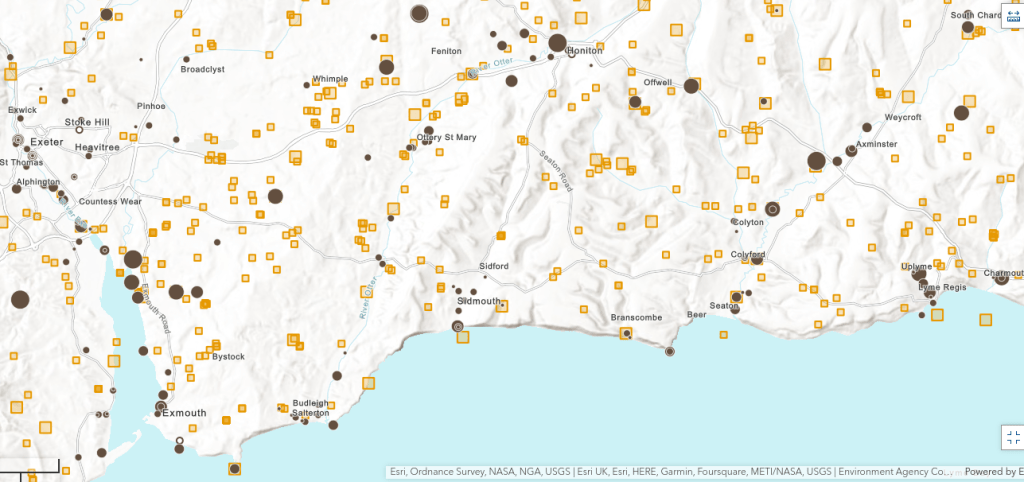
As a Budleigh resident I was looking at the Rivers Trust recently updated Sewage Map for 2022 in relation to the River Otter and the beach. I was diverted by the very large pollution indicators for the rest of East Devon.

Sewage Map | The Rivers Trust This makes very interesting and horrific reading.

The brown spots indicate high discharge levels

The first thought that comes to my mind is that until raw sewage is treated, and I mean treated, with no spillages in East Devon’s waterways, development cannot take place sustainably anywhere in the district.

We are aware that Natural England has effectively put a halt to development around the Axe due to high phosphate levels. I cannot believe that the following pollution episodes that I have picked at random around the district do not have similar, if not worse, problems.

Woodbury Waste Water Treatment Works spilled 65 times (every 5 1⁄2 days) for a total of 1077.27 hours, discharging into the Woodbury Brook. This was equivalent to 45 days.

Aylesbeare’s sewer storm overflow spilled 65 times for a total of 561.10 hours, discharging into the Aylesbeare Brook.

I cannot miss out Honiton. The combined 2 waste water treatment plants had 226 occasions of 2646 hours and if I add the nearby village of Gittisham (2021 census population 838)  283 episodes and the colossal 3252 hours. All going to the small River Otter. 

And finally what about Cranbrook? Agenda item – Public speaking – East Devon

“Further SWW data for 2021 indicates that the main sewage treatment works at Countess Wear, which services Cranbrook and surrounding communities, also released storm water on 72 combined occasions over a period of 230hrs +.  An indication of capacity overwhelmed?”

“South West Water are aware of the issues, in particular the pumping station at Countess Weir which cannot expand due to the SSSI and that they have identified a further pumping station would be required to counteract the issues currently being experienced with Teignbridge, Exeter and East Devon “

So where will the sewage of the latest approved development of 870 houses go on a rainy day? The overloaded Exe? Then into Lyme Bay?

Why are we building with inadequate sewage facilities?

Why are sewage issues not part of the planning process and water companies not included as statutory bodies?

I will leave my beloved Otter with 3252 hours (135 days or 4 1⁄2 months) of poo being poured into it from Honiton last year for another day.

Revealed: ‘Big Six’ energy firm bosses paid enough in 2022 to power 23,000 homes for a year

Energy bills may finally be dropping but bosses at the UK’s largest energy suppliers were paid enough last year to power 23,000 homes for an entire year, it can be revealed.

Matt Mathers www.independent.co.uk

Executives, board members and other high-level employees of the ‘Big Six’ gas and electric companies received £58m in salaries, bonuses and fees, analysis of their 2022 accounts shows. The average annual household energy bill up until the end of June was £2,500.

The disclosure comes as energy firms have raked in record profits – fuelled by Russian president Vladimir Putin’s illegal invasion of Ukraine on 24 February last year – while households still face huge bills.

Campaigners said that energy companies should be using their bumper profits to help their customers to improve the energy efficiency of their homes.

Gas and electricity costs have started to come down with decreasing wholesale prices but household bills remain well above average and are likely to remain so for years to come, economists have warned.

The typical household energy bill for a home in the UK was £2,500 until the end of last month, due to the government’s energy price guarantee that caps the unit cost of gas and electricity. Prices are set to fall from July as the energy price cap is lowered to £2,074 but for many bills will remain unaffordably high.

The government has introduced several other support schemes to help households and businesses cover the cost of powering their homes – funded by billions of pounds of extra borrowing.

But much of that help has ended and groups representing businesses previously warned that some companies could have to downsize or fold when the changes begin to bite.

Centrica, which owns British Gas, paid 11 people £6.5m last year. CEO Chris O’Shea personally raked in £4.5m – just under £700,000 of which came in the form of a bonus payment. Kate Ringrose, Centrica’s outgoing CFO, was paid just over £1m in salary and bonus.

Just two of the Big Six firms supplying UK homes with gas and electricity are owned by parent companies that are based in Britain.

E.ON, the German-headquartered firm, which has 5.5 million UK customers and took over Npower in 2019, paid 25 people more than £18m.

Chairman and CEO Leonhard Birnbaum took home €5.4m (£4.7m), more than £2m of which was a bonus. Chief operating officers Thomas König and Patrick Lammers were paid a total of €3.3mn (£2.89mn) and €2.4mn (£2.17m) respectively.

EDF (Électricité de France) is a French state-controlled energy generation and supply company that had nearly 700,000 UK customers in 2018.

Its annual report for 2021-22 said the group’s “key management and governance personnel” were paid a total of €12.5 million (£10.9m) in salaries and bonuses. It did not give a full breakdown of how this amount was distributed.

SSE, which has its headquarters in Perth, Scotland, paid 14 people £10.1m last year. CEO Alistair Phillips-Davies received £4.5m in salary and bonus while finance director Gregor Alexander and chief commercial officer Martin Pibworth were paid £3.1m and £2.5m respectively. SSE sold its domestic energy business to Ovo in January 2022.

Iberdrola, the Spanish utilities company that owns Scottish power, paid just 16 people £11m last year. Executive chairman José Ignacio Sánchez Galán was paid €6.3m (£5.5m) while CEO Armando Martinez received €250,000 (£220,000). Four other board members received around €500,000 (£441,000).

In 2018 Scottish Power said it became the first UK energy company to generate all of its electricity from renewable sources.

Jamie Peters, a campaigner at Friends of the Earth, said: “These figures illustrate the stark injustice that while millions of people struggle to afford to heat and power their homes, the bosses of the companies cashing in on the energy crisis are taking home huge pay packets and eyewatering bonuses.

“Raking in mega-profits through continued fossil fuel exploitation is something that should have been consigned to the history books decades ago.

“Private companies have a responsibility to align their business models with global climate targets, as well as to their customers who deserve clean and affordable energy. This starts with proper investment in cheap, homegrown renewable power and improving the energy efficiency of our heat-leaking homes.”

A spokesperson for SSE said: “We know it is vitally important to protect households from future energy price shocks and that’s why through our Net Zero Acceleration Programme we are investing £7m a day in critical low-carbon infrastructure that will help the UK achieve energy independence from those seeking to weaponise energy, and keep prices down in the long term.

“In doing so, we are currently building more offshore wind than anyone on the planet, creating thousands of green jobs and pioneering new energy technologies.

“ With this in mind, SSE’s executive remuneration policy – updated regularly and approved by shareholders at our AGM in July – aims to set a competitive, but not excessive, total remuneration package against appropriate benchmarks in order to encourage strong performance against delivery of this net zero-focused strategy.”

Centrica, E.ON, EDF and Iberdrola were contacted for comment.

Jeremy Hunt, the chancellor, in his Budget earlier this year updated plans for Great British Nuclear, which he said would provide “opportunities across the nuclear supply chain to help provide up to one-quarter of our electricity by 2050”.

Great British Nuclear is being created as the agency to establish “a secure energy future” in Britain following Russia’s invasion of Ukraine and the subsequent effects on energy prices globally.

Critics called on the government to act on the plan – announced over a year ago – more quickly.

At the end of March the government updated its Net Zero Strategy, which also included measures to improve energy security and bring down household bills.

The government previously said its plans would “scale up affordable, clean, homegrown power and build thriving green industries in Britain”.

Babylon Health faces legal headache over AI claims

A British technology firm hailed as the future of healthcare by former Health Secretary Matt Hancock could face legal action after its collapse in the US.

Adam Luck www.dailymail.co.uk

Babylon Health, which has 100,000 NHS patients, is being sold off after losing nearly all of its value since founder Dr Ali Parsa floated it for £3 billion on the New York Stock Exchange in 2021.

Last month, Jersey-registered Babylon announced that London-based AlbaCore Capital would take over its assets without shareholders’ approval and that it was also calling in administrators in the UK. 

Parsa, a former refugee, saw his net worth soar to £825 million after investors were attracted by his promise to revolutionise healthcare by using artificial intelligence (AI).

This included a controversial chatbot, which claimed to be able to diagnose illnesses, despite repeated criticism from senior health experts. Parsa also claimed that the company had designed software that ‘turns Alexa [Amazon’s virtual assistant] into a doctor’. But one unnamed investor is now understood to have assembled a UK legal team over claims surrounding Babylon’s technology.

David Watkins, an NHS consultant and arch-critic of Babylon, said: ‘The investor is considering legal action in relation to the company’s AI, and I have been asked to speak to their legal counsel.’

Last year, Babylon and the NHS agreed to terminate two long-term contracts due to ‘challenging global and macroeconomic conditions’.

The company, however, insists it will continue to run its GP@Hand app contract in Hammersmith & Fulham, which lets patients make virtual appointments. Hancock previously said he wanted GP@Hand to go nationwide.

Filings with US authorities reveal that Parsa received £5.6 million in pay and perks for 2022. In March, he claimed Babylon’s 2022 accounts showed ‘continuous improvement’ and predicted profitability by 2024 despite losses of £409 million in the three years up to and including 2022. Babylon has been repeatedly approached for comment.

Some links in this article may be affiliate links. If you click on them we may earn a small commission. That helps us fund This Is Money, and keep it free to use. We do not write articles to promote products. We do not allow any commercial relationship to affect our editorial independence.

Pupils in England sent to churches and village halls as crumbling schools close

Pupils across England are being taught in church and village halls, temporary classrooms and remotely at home, as crumbling school buildings are ordered to shut because of to safety concerns, an investigation has revealed.

Sally Weale www.theguardian.com 

In some cases, where an entire school has been forced to close, hundreds of pupils are split across neighbouring schools to take their lessons, while others are sent home to resume online learning, as they did during the pandemic.

After the immediate crisis of finding alternative accommodation, pupils and teachers can find themselves in temporary classrooms for months, if not years, while school and local authorities try to come up with a long-term solution.

The findings reveal the disruptive impact that school closures because of unsafe buildings have on pupils, whose education has already been interrupted by Covid. They also come just days after a highly critical report by the public spending watchdog, the National Audit Office, said an estimated 700,000 children are being taught in unsafe or ageing school buildings that needed major repairs.

It also revealed that more than a third of school buildings were past their estimated design lifespan, and specialists were carrying out urgent checks on almost 600 schools at possible risk of structural collapse because of crumbling concrete, with many more schools unaware of the danger lurking in their buildings.

Ministers admitted earlier this year that 39 schools had partly or fully closed since 2019 owing to unsafe buildings, including structural and general condition problems, such as roofing and boiler failures.

A freedom of information request by the Liberal Democrats has now revealed the location – though not identity – of each school, and how pupils have been affected. They say the true number of affected schools may be far higher, as schools are not obliged to report building-related closures to the Department for Education (DfE).

In one school in Hertfordshire, which had to close its entire site permanently in February 2022, all pupils were sent home to study remotely for three weeks. Face-to-face lessons resumed in a church hall for some children while others went to neighbouring schools, a situation that continued for three months, after which pupils were moved into temporary classrooms while waiting for a long-term solution.

In another case, an Essex school, which the Liberal Democrats have matched to local reports of King Edmund School in Rochford, closed in November 2022 after traces of asbestos were found in the rubble of a demolished building. Pupils were sent home to learn online for two months while the site was made safe.

And a school in Sunderland, identified in local reports as Burnside Academy in Houghton-le-Spring, closed in March 2021 because of pumping and drainage issues. Pupils were bussed to neighbouring schools for almost eight months, then returned to lessons in temporary classrooms until the school reopened earlier this month.

In other examples, two mobile classroom blocks at a school in North Somerset were declared unsafe within nine months of each other, while pupils at one Devon school took classes in the local village hall for a week and a half after their school was forced to close temporarily in June 2022.

The Liberal Democrat education spokesperson, Munira Wilson, called on ministers to clear the backlog of repairs so parents could be certain their child’s school was safe. “Each shut school is a concrete sign of years of Conservative neglect of our school buildings.

“Conservative ministers should apologise for the months of disruption that thousands of pupils have had to their learning. Whilst successive Conservative prime ministers cut capital spending on education, pupils have been forced to study at home, in church halls or were bussed miles to other schools.”

The DfE has been contacted for comment but previously said: “We are investing in 500 projects for new and refurbished school buildings through our school rebuilding programme. On top of this, we have allocated over £1bn since 2015 for keeping schools safe and operational, including £1.8bn committed for 2023-24.”