Yorkshire council warns of budget crisis as deficit reaches £47m

Where is the payoff for the Osborne austerity era? – Owl

A West Yorkshire council said it was close to going bust unless a £47m funding gap could be closed, as a growing number of local authorities warned that they were almost running out of funds.

Phillip Inman www.theguardian.com 

Kirklees council, which counts Huddersfield as its main town, said it could face a section 114 notice – signalling that it cannot balance its budget – in the 2024/25 financial year if the authority did not deliver required savings and minimise its expenditure this financial year.

It is understood several authorities are on the brink of issuing section 114 notices this year if the government does not release additional funding to stabilise the sector.

Hastings council, which has spent millions of pounds coping with a rise in demand for temporary accommodation, also signalled this month that it could be forced to issue a section 114 notice.

Last week, Derby City council’s leader, Baggy Shanker, described its finances as “absolutely dire” and its chief executive has called for urgent help.

A report by Kirklees council officers outlining the precarious financial position, due to be presented to councillors on 15 August, has warned that “the seriousness of the council’s financial position cannot be understated”.

The report says that the council has saved more than £250m since austerity measures were introduced in 2011 by the former chancellor George Osborne, and that it has continued to face “funding reductions and increasing demand pressures far greater than more affluent areas with lower levels of relative need”.

It added that the rising demand for services and cost of living crisis had also contributed to the council’s financial problems.

Kirklees council is the 13th biggest local authority in the UK in terms of population, with 430,000 people living in the area, according to the last census.

Councillor Paul Davies, the cabinet member for corporate services at Kirklees council, said: “Even though inflation has slowed marginally, prices are still increasing at a rate we haven’t seen for decades. Alongside additional demand for some of our most vital services and our need to protect our most vulnerable residents given the cost-of-living impact, we need to take action now to balance the budget.”

This year Woking council was forced to issue a section 114 notice after a risky investment strategy that left it with a £1.2bn deficit. The small local authority, in Surrey, purchased a slew of commercial assets, such as skyscrapers and hotels, but became overwhelmed by the sheer scale of its debt, which is forecast to hit £2.6bn.

Woking’s effective bankruptcy followed Thurrock, Croydon and Slough, where money was ploughed into seemingly lucrative commercial deals to try to plug gaping holes in budgets caused by central government funding policies.

A slew of other councils, including Kent, Hastings, Southampton, Guildford, and Bradford, have warned that they are also facing section 114 notices. After 13 years of slashed budgets and some poor commercial decisions, councils have more recently faced challenges with skyrocketing inflation, which has piled extra costs on local authorities to provide basic services.

In July, the Local Government Association (LGA), the membership body for local authorities, warned that councils were at risk of insolvency in the coming months due a £3bn funding black hole caused by inflationary pressures and an increase in the use of services.

The difficult financial position local authorities face has prompted them to continue cutting services this year, while also increasing council tax by the maximum amount possible, pushing further cost increases on to cash-strapped taxpayers.

The Department for Levelling Up, Housing and Communities has been approached for comment.
A Correspondent on Government vaccination policy

Is this a spreadsheet government that knows the price of everything but the value of nothing? – Owl

A Correspondent writes:

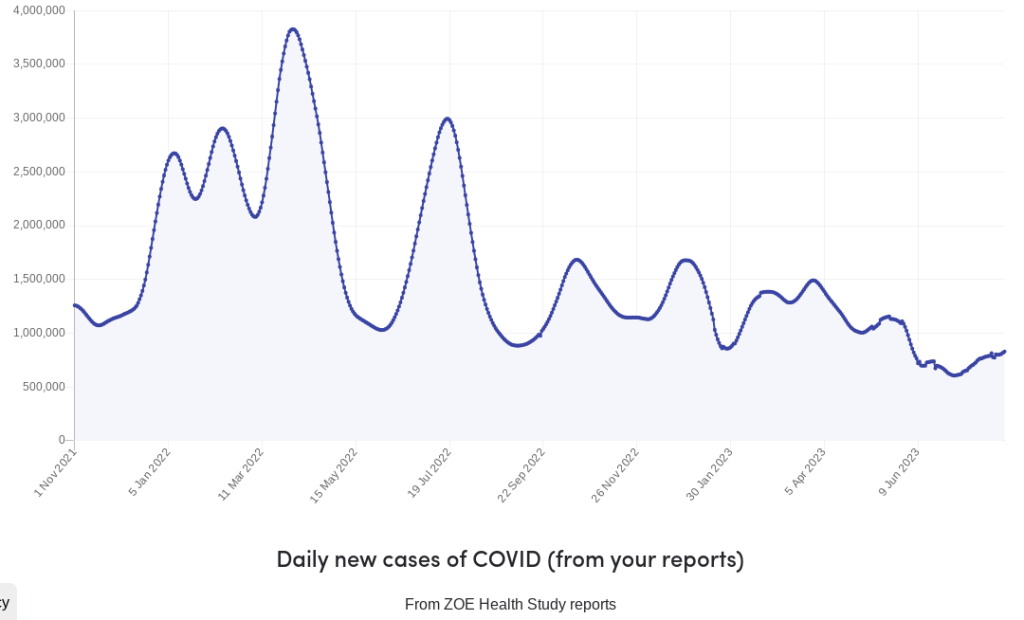
It seems that the UK Government has learned nothing from previous Covid fiascos, and are setting the UK up for another bad bout of the pandemic illness.

See: England to deny Covid and Flu jabs to under 65s amid fears for NHS this winter 

Although this appears at face value to be an acceptance of a recommendation from an independent body (the JCVI) allowing them an excuse, I would imagine that the Terms of Reference for the JCVI include some sort of value-for-money objective or a do-only-what-is necessary to avoid the NHS being overwhelmed guideline, thus giving the Government an excuse to save money rather than safeguard lives. Just because the most vulnerable and at-risk people get the COVID/Flue jab, does NOT mean that people who don’t get the jab but then develop the disease are not at risk of dying or having serious consequences to their health. And given the low cost of a vaccination jab vs. the high cost of COVID treatment when someone gets seriously ill and is hospitalised, and the significant economic  consequences when significant numbers are off work with Covid – I am surprised that there is not a decent business case to offer the vaccination to a wider group.

Petition:”Make lying in the House of Commons a criminal offence” – will be debated

Will Simon Jupp vote for this on 23 October?

No chance, Members of Parliament are all “Honourable” (by definition), not a rogue amongst them. – Owl

“The Government should introduce legislation to make lying in the House of Commons a criminal offence. This would mean that all MPs, including Ministers, would face a serious penalty for knowingly making false statements in the House of Commons, as is the case in a court of law.”

petition.parliament.uk

Parliament will debate this petition on 23 October 2023.

You’ll be able to watch online on the UK Parliament YouTube channel.

Government responded

This response was given on 12 August 2021

The Government does not intend to introduce legislation of this nature. MPs must abide by the Code of Conduct and conduct in the Chamber is a matter for the Speaker.

Read the response in full

It is an important principle of the UK Parliament that Members of Parliament are accountable to those who elect them. It is absolutely right that all MPs are fully accountable to their constituents for what they say and do and this is ultimately reflected at the ballot box.

Freedom of speech in Parliament is an essential part of our democracy. It is a right that enables Parliament to function freely and fully, ensuring that MPs are able to speak their minds in debates, and to represent their constituents’ views without fear or favour. Parliamentary privilege, which includes freedom of speech and the right of both Houses of Parliament to regulate their own affairs, grants certain legal immunities to Members of both Houses to allow them to perform their duties without outside interference.

Once elected, MPs are expected to abide by the seven principles of public life which form the basis of ethical standards required of holders of public office. These are set out by the Committee on Standards in Public Life and are: selflessness, integrity, objectivity, accountability, openness, honesty and leadership. It is a requirement that any holder of public office must be truthful and must act and take decisions impartially, fairly and on merit, using the best evidence and without discrimination or bias.

MPs are also subject to the House of Commons Code of Conduct and the Guide to the Rules relating to the Conduct of Members. The code includes a general duty on MPs to “act in the interests of the nation as a whole; and a special duty to their constituents”, alongside a requirement that MPs “act on all occasions in accordance with the public trust placed in them. They should always behave with probity and integrity, including in their use of public resources.” The Parliamentary Commissioner for Standards is an independent officer of the House of Commons and is responsible for investigating allegations that MPs have breached the rules in the Code of Conduct. Further details about the role of the Commissioner for Standards are available on the Parliament website at: https://www.parliament.uk/mps-lords-and-offices/standards-and-financial-interests/parliamentary-commissioner-for-standards/

Conduct in the Chamber is beyond the remit of the Parliamentary Commissioner for Standards. This is because the House has determined that how Members conduct themselves in the Chamber, including their adherence to the principles of public life, is a matter for the Speaker, and Parliament is responsible for its own procedures.

Office of the Leader of the House of Commons