More on Tory attitude on  the environment and climate change

Can you believe this? The government has privately asked water companies to explore saving money on future water supplies by assuming unrealistically low levels of climate change.

On sewage: the Environment Agency appears to ask companies [in a letter] to stick to the bare legal minimum on environmental efforts to save money. “You are expected to explore opportunities to phase non-statutory commitments including net zero to future price review periods where appropriate.”

Angling and river groups, including the Rivers Trust, warn the government that pushing back schemes to 2030 would “delay essential environmental action and, ultimately, increase costs to consumers”.

Separately, the Liberal Democrats accused water firms of a “scandalous cover-up”, after the companies said they either did not know or would not hand over data on how much sewage they were spilling into rivers and seas.

(And can you believe this? Regulators do not instruct water companies to monitor volume of sewage, only the duration and number of times it is discharged. Last year there were more than 300,000 spills.)

So how many gallons of poo (or Olympic sized swimming pools) were discharged, for example, in the 3,252 hours of spillage from Honiton and Gitisham into the Otter, or from the 1,077 hours from Woodbury into the Exe in 2022?

Not forgetting the direct discharges from all the coastal towns directly into the sea. – Owl

Water Firms can assume “climate change will be low” to cut costs

Adam Vaughan www.thetimes.co.uk 

Water firms are required to publish “water resources management plans” every five years for how they will ensure the water supply for the next 25 years, including new reservoirs and transfers from wet to dry parts of the country.

Amid rising government concern about how environmental targets will push up consumer water bills, the Environment Agency wrote to water companies in July to ask them to ensure their plans “protect your customers from adverse bill impacts”.

The agency said Thérèse Coffey, the environment secretary, had asked it to “investigate the scale of investment needed” in the context of “many families and individuals struggling to pay their utility bills”.

The regulator said companies should see how they could minimise costs from 2030 onwards, while meeting legal requirements. One option given was to see if money could be saved by assuming a “low climate change scenario”.

In the scenario, countries around the world would act dramatically to cut carbon emissions and ensure the global average temperature rose by only 1.6C above pre-industrial levels.

However, such a low level is considered unlikely. The United Nations has said countries’ climate plans put the world on track for 2.4C of warming at best and 2.8C at worst.

Earth has already warmed by 1.2C above the 1850-1900 average due to climate change and July was the hottest month on record.

“With hot tub temperatures at sea and many rivers still recovering from drought, the climate and nature crisis is clearly upon us. Yet the government is steering water companies toward the most optimistic warming scenarios,” said Eleanor Ward, policy officer at Wildlife and Countryside Link, an alliance of environmental groups including the National Trust and RSPB.

Climate change is expected to bring hotter, drier summers and warmer, wetter winters to Britain, putting pressure on water supplies. Even with an “exceptionally wet” July, parts of southwest England remain in drought. Devon and Cornwall remain under a hosepipe ban dating back to last summer.

The latest water supply plans include £14 billion of investment that would create seven new reservoirs, including at Havant Thicket near Portsmouth. Together they would provide an extra two billion litres of water a day, more than the 2.6 billion that the UK’s biggest water firm, Thames Water, provides today.

The Environment Agency asked water companies whether the “basic climate change scenario” would risk their water supply plans or if it might leave the firms “vulnerable to climate change”.

A spokesman for trade group Water UK said: “We strongly oppose the watering down of any plans that will help to safeguard water supplies in a changing climate. Last year’s record-breaking temperatures and the ongoing droughts across Europe are a reminder that investment in water resources must be a priority.”

In a separate letter to water companies, about the industry’s “national environment programme”, the Environment Agency appears to ask companies to stick to the bare legal minimum on environmental efforts to save money.

In one passage, companies are told: “You are expected to explore opportunities to phase non-statutory commitments including net zero to future price review periods where appropriate.” That implies ways of reducing carbon emissions — such as treating sewage with reedbeds rather than more carbon-intensive infrastructure at treatment works — could be delayed to 2030 and beyond.

Water industry figures think the government has realised how much its pledges on sewage pollution will push up water bills, and is now asking companies what they can cut to keep bills down. Normally, suggestions for what should be cut would come from the Environment Agency itself, but in this case firms are being told to look again at their plans for savings.

In a letter to Coffey’s department, environment, angling and river groups, including the Rivers Trust, warn the government that pushing back schemes to 2030 would “delay essential environmental action and, ultimately, increase costs to consumers”.

They added it put nature goals at risk. “This requirement on companies is out of step with the government’s commitment to halt and reverse the decline of nature by 2030,” the groups said.

Separately, the Liberal Democrats accused water firms of a “scandalous cover-up”, after the companies said they either did not know or would not hand over data on how much sewage they were spilling into rivers and seas.

However, regulators do not instruct water companies to monitor volume of sewage, only the duration and number of times it is discharged. Last year there were more than 300,000 spills.

The government was contacted for comment.
Yorkshire council warns of budget crisis as deficit reaches £47m

Where is the payoff for the Osborne austerity era? – Owl

A West Yorkshire council said it was close to going bust unless a £47m funding gap could be closed, as a growing number of local authorities warned that they were almost running out of funds.

Phillip Inman www.theguardian.com 

Kirklees council, which counts Huddersfield as its main town, said it could face a section 114 notice – signalling that it cannot balance its budget – in the 2024/25 financial year if the authority did not deliver required savings and minimise its expenditure this financial year.

It is understood several authorities are on the brink of issuing section 114 notices this year if the government does not release additional funding to stabilise the sector.

Hastings council, which has spent millions of pounds coping with a rise in demand for temporary accommodation, also signalled this month that it could be forced to issue a section 114 notice.

Last week, Derby City council’s leader, Baggy Shanker, described its finances as “absolutely dire” and its chief executive has called for urgent help.

A report by Kirklees council officers outlining the precarious financial position, due to be presented to councillors on 15 August, has warned that “the seriousness of the council’s financial position cannot be understated”.

The report says that the council has saved more than £250m since austerity measures were introduced in 2011 by the former chancellor George Osborne, and that it has continued to face “funding reductions and increasing demand pressures far greater than more affluent areas with lower levels of relative need”.

It added that the rising demand for services and cost of living crisis had also contributed to the council’s financial problems.

Kirklees council is the 13th biggest local authority in the UK in terms of population, with 430,000 people living in the area, according to the last census.

Councillor Paul Davies, the cabinet member for corporate services at Kirklees council, said: “Even though inflation has slowed marginally, prices are still increasing at a rate we haven’t seen for decades. Alongside additional demand for some of our most vital services and our need to protect our most vulnerable residents given the cost-of-living impact, we need to take action now to balance the budget.”

This year Woking council was forced to issue a section 114 notice after a risky investment strategy that left it with a £1.2bn deficit. The small local authority, in Surrey, purchased a slew of commercial assets, such as skyscrapers and hotels, but became overwhelmed by the sheer scale of its debt, which is forecast to hit £2.6bn.

Woking’s effective bankruptcy followed Thurrock, Croydon and Slough, where money was ploughed into seemingly lucrative commercial deals to try to plug gaping holes in budgets caused by central government funding policies.

A slew of other councils, including Kent, Hastings, Southampton, Guildford, and Bradford, have warned that they are also facing section 114 notices. After 13 years of slashed budgets and some poor commercial decisions, councils have more recently faced challenges with skyrocketing inflation, which has piled extra costs on local authorities to provide basic services.

In July, the Local Government Association (LGA), the membership body for local authorities, warned that councils were at risk of insolvency in the coming months due a £3bn funding black hole caused by inflationary pressures and an increase in the use of services.

The difficult financial position local authorities face has prompted them to continue cutting services this year, while also increasing council tax by the maximum amount possible, pushing further cost increases on to cash-strapped taxpayers.

The Department for Levelling Up, Housing and Communities has been approached for comment.

A Correspondent on Government vaccination policy

Is this a spreadsheet government that knows the price of everything but the value of nothing? – Owl

A Correspondent writes:

It seems that the UK Government has learned nothing from previous Covid fiascos, and are setting the UK up for another bad bout of the pandemic illness.

See: England to deny Covid and Flu jabs to under 65s amid fears for NHS this winter 

Although this appears at face value to be an acceptance of a recommendation from an independent body (the JCVI) allowing them an excuse, I would imagine that the Terms of Reference for the JCVI include some sort of value-for-money objective or a do-only-what-is necessary to avoid the NHS being overwhelmed guideline, thus giving the Government an excuse to save money rather than safeguard lives. Just because the most vulnerable and at-risk people get the COVID/Flue jab, does NOT mean that people who don’t get the jab but then develop the disease are not at risk of dying or having serious consequences to their health. And given the low cost of a vaccination jab vs. the high cost of COVID treatment when someone gets seriously ill and is hospitalised, and the significant economic  consequences when significant numbers are off work with Covid – I am surprised that there is not a decent business case to offer the vaccination to a wider group.

Petition:”Make lying in the House of Commons a criminal offence” – will be debated

Will Simon Jupp vote for this on 23 October?

No chance, Members of Parliament are all “Honourable” (by definition), not a rogue amongst them. – Owl

“The Government should introduce legislation to make lying in the House of Commons a criminal offence. This would mean that all MPs, including Ministers, would face a serious penalty for knowingly making false statements in the House of Commons, as is the case in a court of law.”

petition.parliament.uk

Parliament will debate this petition on 23 October 2023.

You’ll be able to watch online on the UK Parliament YouTube channel.

Government responded

This response was given on 12 August 2021

The Government does not intend to introduce legislation of this nature. MPs must abide by the Code of Conduct and conduct in the Chamber is a matter for the Speaker.

Read the response in full

It is an important principle of the UK Parliament that Members of Parliament are accountable to those who elect them. It is absolutely right that all MPs are fully accountable to their constituents for what they say and do and this is ultimately reflected at the ballot box.

Freedom of speech in Parliament is an essential part of our democracy. It is a right that enables Parliament to function freely and fully, ensuring that MPs are able to speak their minds in debates, and to represent their constituents’ views without fear or favour. Parliamentary privilege, which includes freedom of speech and the right of both Houses of Parliament to regulate their own affairs, grants certain legal immunities to Members of both Houses to allow them to perform their duties without outside interference.

Once elected, MPs are expected to abide by the seven principles of public life which form the basis of ethical standards required of holders of public office. These are set out by the Committee on Standards in Public Life and are: selflessness, integrity, objectivity, accountability, openness, honesty and leadership. It is a requirement that any holder of public office must be truthful and must act and take decisions impartially, fairly and on merit, using the best evidence and without discrimination or bias.

MPs are also subject to the House of Commons Code of Conduct and the Guide to the Rules relating to the Conduct of Members. The code includes a general duty on MPs to “act in the interests of the nation as a whole; and a special duty to their constituents”, alongside a requirement that MPs “act on all occasions in accordance with the public trust placed in them. They should always behave with probity and integrity, including in their use of public resources.” The Parliamentary Commissioner for Standards is an independent officer of the House of Commons and is responsible for investigating allegations that MPs have breached the rules in the Code of Conduct. Further details about the role of the Commissioner for Standards are available on the Parliament website at: https://www.parliament.uk/mps-lords-and-offices/standards-and-financial-interests/parliamentary-commissioner-for-standards/

Conduct in the Chamber is beyond the remit of the Parliamentary Commissioner for Standards. This is because the House has determined that how Members conduct themselves in the Chamber, including their adherence to the principles of public life, is a matter for the Speaker, and Parliament is responsible for its own procedures.

Office of the Leader of the House of Commons

Devon council pauses plan to stop funding for homeless

The council was planning to cut financial support to organisations helping people who were homeless or at risk of becoming homeless.

www.bbc.co.uk

It said it provided the money despite not having “a statutory responsibility to do so” and needed to balance the books.

But a coalition of groups, including homeless charities, said cutting the budget could lead to the closure of five homeless hostel services.

Council leader John Hart made the announcement having listened to members of the public speak about the impact the proposed cuts could have on them and others at a special scrutiny meeting.

He said the council needed to “take stock and understand more fully the impact” of any proposal.

“We need to better understand the full impact of such a decision on all aspects of our public services, including the impact on our Team Devon District and City Council partners.

“Therefore, I am putting a pause on the decision, so that we can have a full and frank discussion with our eight district council leaders and officers.”

Mr Hart said he also wanted to involve other agencies, such as the police and public health.

As a result the council’s contracts with providers will now be extended until the end of March 2024.

In the meantime, the council said it would continue to talk to Devon’s district and city councils, to “agree a way forward that ensures ongoing homelessness support across the county”.

Warning UK set for five years of lost economic growth

[But London recovers more quickly – Owl]

The National Institute for Economic and Social Research said a triple blow of Brexit, Covid and Russia’s invasion of Ukraine had badly affected the economy.

By Michael Race www.bbc.co.uk 

It added that the spending power of workers in many parts of the UK will remain below pre-pandemic levels until the end of 2024.

The BBC has contacted the Treasury for comment.

The amount of money made by the UK economy, its gross domestic product – or all the goods and services produced – is not forecast to return to 2019 levels until the second half of next year, Niesr forecast.

This weak “stuttering growth” over a five year period has widened the gap between the wealthier and poorer parts of the country, the think tank said.

In London, real wages are expected to be 7% higher by the end of next year than they were in 2019 – whereas in regions such as the West Midlands they are forecast to be 5% lower, its analysts said.

Despite pay increases, high inflation has forced up prices and the rising cost of living has left households throughout the UK feeling squeezed.

Niesr forecasts that inflation, the rate at which prices rise, will remain continually above the Bank of England’s 2% target until early 2025, meaning the cost of living will also continue to rise. Inflation is currently 7.9%.

It means that people’s wages, when taking inflation into account, would be below the level they were before the pandemic until the end of next year in “many UK regions”, the think tank said.

Prof Adrian Pabst, deputy director for public policy at Niesr, said low-income households would be hit hardest, with real disposable incomes in this group falling by about 17% over the five years to 2024.

“For some of the poorest in society, coping with low or no real wage growth and persistent inflation has involved new debt to pay for permanently higher housing, energy and food costs,” Prof Pabst said.

Last week, the Bank of England put up interest rates for the 14th time in a row as it continued with its efforts to make borrowing more expensive, dampen demand and therefore slow inflation.

But not all economists agree the Bank should be raising rates when many households and business are struggling financially. Raising rates too aggressively could also push the economy into recession, which is defined typically as when it shrinks for two three-month periods – or quarters – in a row.

Niesr said it expected the UK to avoid going into a recession this year, but said there was a “60% risk” of one by the end of 2024.

A growing economy generally means there are more jobs, companies are more profitable, and pay packets grow. Higher wages and larger profits also generate more money for the government in taxes that can be spent on public services.

Prof Stephen Millard, deputy director for macroeconomic modelling and forecasting at Niesr, said the “supply shocks” of Brexit, Covid, the Ukraine war and rising interest rates had “badly affected the UK economy”.

“The need to address the UK’s poor growth performance remains the key challenge facing policy makers as we approach the next election,” he added.

Plans submitted to build a new police station in Exmouth

The £5 million pound project includes knocking down the ‘ageing station complex’ in Exmouth’s North Street includes a disused magistrates court and a mothballed civil defence shelter.

Adam Manning www.exmouthjournal.co.uk

The site is currently occupied by officers but currently members of the public cannot enter without an appointment and Crime Commisioner Alison Hernandez says that “maintenance costs over the next 25 years have been estimated at more than £3m.”

The plans would see the 0.4 hectares of the site sold for redevelopment and a two-storey building built on 0.2 hectares of the site. 

The station will be the operational base for about 60 officers and staff including response officers, neighbourhood officers, Police Community Support Officers, and Special Constables and will include a new public enquiry front desk.

The Commissioner’s estates team is preparing to seek expressions of interest from contractors who may be interested in submitting a full tender for the project.

Commissioner Hernandez, who owns and manages the force estate said: “This project makes sense from every angle. Exmouth is Devon’s largest town and sees a huge increase in its population in the summer months. The teams based there, and the community they serve, deserve a station which is fit for the 21st Century, less harmful to the environment and cheaper to run.

“As with other police station building projects, I am insisting that a significant proportion of the public monies that we are investing in this project go to local people so that money benefits the local economy. The release of brownfield development land means additional housing can be provided in the town without greenfield sites being developed.”

She said improving public access to the force was a ‘non negotiable’ part of the project, adding: “When I carried out a public survey to determine which of the 58 possible locations the public would most like to see, a police enquiry office opened once again in Exmouth came eighth. People love the idea that they can walk into a station and talk to a real human being to report crime, receive advice on crime prevention and seek help for victims, so there is no way I am going to miss the opportunity to give this town back its front desk.”

Assistant Chief Constable Glen Mayhew, Force Lead for Local Policing said: “Our officers and staff are part of the local community, and this investment supports them to achieve this. They need a modern base to ensure that we deliver a local service that is effective and accessible to our communities. We are all looking forward to this development taking shape.”

Simon Jupp, MP for East Devon, said; “I am really pleased Exmouth’s new police station has taken another step forward with multi-million-pound investment planned in the town. The new state-of-the-art station will be open to the public with a dedicated front desk which I know is important to residents in East Devon. 

“After successfully campaigning to reopen Honiton police station to the public, I’m delighted to see progress across the district. Working with the Police & Crime Commissioner, I’m determined to improve visibility of the police and make our town centres and streets safer.”

A formal application is submitted to East Devon District Council.

Water firms face £800m legal action after ‘underreporting sewage discharges’

Six English water companies will face legal action over allegations of underreporting pollution incidents and “unfairly overcharging” customers.

Danny Halpin www.independent.co.uk 

Severn Trent Water, Thames Water, United Utilities, Anglian Water, Yorkshire Water and Northumbrian Water could end up paying over £800m in compensation to more than 20 million customers if the cases are successful.

Professor Carolyn Roberts, an environmental and water consultant represented by Leigh Day Solicitors, alleges the water companies have broken competition laws by misleading the Environment Agency and the regulator Ofwat.

She claims they have been underreporting the number of sewage discharges, resulting in customers being “unfairly overcharged” for wastewater services, and that, had sewage discharge reporting been accurate, it would have lowered customer bills.

The first claim, brought on behalf of eight million people against Severn Trent Water, is estimated to be worth more than £330m.

Further claims will be brought against the other companies in what Leigh Day said is the first environmental collective action case of its kind.

Commenting on the lawsuits, Ms Roberts said: “Like many others across the country, I have viewed with horror the escalating number of stories in the media regarding the volume of sewage discharged into our waterways and on to our beaches.

“The population of the UK has a right to expect that our rivers, lakes and seas will generally be clean, except under exceptional circumstances,” she continued.

According to Ms Roberts, these water companies have dodged Ofwat penalties “because of the serial and serious underreporting at the heart of these claims” that has resulted in customers being overcharged for water services.

Anyone who has paid a water bill to one or more of these companies from April 2020 – or April 2017 for Severn Trent Water customers – may be entitled to compensation if the claims are successful.

Leigh Day is seeking money for customers on an opt-out basis, meaning people only have to come forward to claim their compensation if the case is successful.

It is bringing Severn Trent Water to the Competition Appeal Tribunal and will issue five further claims against the other water companies over the coming months.

If successful, solicitors expect any compensation to be paid by the relevant water company and its shareholders, not by raising customer bills.

Zoe Mernick-Levene, partner at Leigh Day, said: “These claims are hugely significant. Not only is compensation being sought for millions of customers who have and continue to pay higher water bills, but we hope that it will also send a message to water companies that they cannot unlawfully pollute waterways and mislead their regulators without consequence.

“Customers put their trust in water companies, believing that they are correctly reporting these spillages and appropriately treating the sewage so it can safely be returned to the environment,” she added.

“Instead, our client believes they are misleading their regulators and customers are overpaying while England’s waterways are suffering as a result.”

Water UK has been contacted for comment.

More confusion over government environmental commitments

The Environment Agency issues “derogations” (free passes) to farmers to pollute rivers while Natural England cracks down on development to stop pollution in similar sensitive areas.

Recapitulation on “Bonkers” plans on barn conversions

Yesterday, Owl reported on the latest bizarre proposal, inspired by Michael Gove, to allow permitted development rights to apply to the conversion of agricultural barns to homes even in “Protected Landscapes”.

Given that a general presumption of permitted development to build a structure for “agricultural purposes” (with much larger footprint than a house requires) already applies to farms greater than 5 hectares (about 12 football fields). This will inevitably lead to uncontrolled peppering of barn-houses all over our countryside.

Housebuilders attack double standards as farmers pollute

Oliver Wright www.thetimes.co.uk

Farmers are being granted special licences to pollute rivers in areas where house building has been banned because of the danger of damaging rare ecosystems.

Over the past two years the Environment Agency has issued almost 500 derogations to farmers in so-called nitrate vulnerable zones.

But at the same time Natural England, another government environmental quango, has effectively banned new housing developments across 74 local authority areas due to similar pollution concerns.

Nitrate vulnerable zones are areas of the UK where rivers are at risk of pollution — in the form of excessive nitrogen and phosphorus from farm fertilisers, animal slurry and human sewage — which damages rivers by causing an overgrowth of algae that can kill off wildlife.

An analysis suggests that the additional nitrates discharge levels being granted to farmers by the Environment Agency is equivalent to the total annual nitrogen that would be produced by hundreds of thousands of new homes.

Under existing legal limits, farmers are allowed to discharge about 170kg of nitrogen per hectare. However, an agreement with the Environment Agency allows farm businesses within nitrate vulnerable zones to apply for an increase to 250kg per hectare. This is particularly used by dairy and cattle farmers as the manure produced is rich in nitrogen.

In the five years to 2022 the Environment Agency granted 99.4 per cent of the 1,191 applications it received for derogations.

Critics claim that the position taken by the Environment Agency is in marked contrast to that taken by Natural England, which has effectively banned housing across large parts of the country because of the risk to rivers.

The housing industry argues that water pollution from homes, which is treated in sewage plants, is a fraction of that from agriculture and that they are working to double standards. It says that every new home would produce 1.4kg a year or 62.5kg per hectare — a quarter of the level for agriculture.

A spokesman for the Home Builders Federation said that the discrepancy in approach between the two agencies was wrong. “It is frustrating that one government quango’s solution is to ban house building, despite its negligible contribution to the issue, whilst another signs off the use of thousands of tonnes of nutrient-rich fertiliser, the main cause of the issue,” they said.

“Everyone agrees action is needed, but the disproportionate move by Natural England is not improving our rivers and instead is exacerbating our housing crisis, preventing the provision of quality homes and costing jobs.”

Natural England was established in 2006 with a mandate to conserve, enhance and manage the natural environment. It has a statutory role to provide advice to local planning authorities on the impacts of development on the natural environment.

The Environment Agency is responsible for regulating water quality and improving standards in agriculture to tackle pollution.

The Times’s Clean It Up campaign has called on the government to maintain the “nutrient neutrality” rules laid out by Natural England. The campaign is also encouraging farmers to curb their pollution of rivers.

A government spokesman said: “The government remains committed to delivering housing in areas impacted by nutrient neutrality and is supporting local authorities and developers.

“We have already worked closely with farmers to reduce pollution and our Plan for Water committed to improving our farm regulations to make them clearer and more effective as we continue to work with the sector on this.”

A correspondent on plan for automatic right to convert barns in protected landscapes

From a Correspondent:

Owl, I would be grateful if you would publish this comment as an article as I feel that this is so important and the more who see it the better.


Barns in AONBs will also be included in this nonsensical proposition, and remember that two thirds of East Devon land is covered by AONBs.


We need social housing here, but how many farmers will convert barns for that purpose?


Another thought. Where do a majority of our bat population live? Barns of course.


I can see the bats in East Devon following the fate of those of “The Pound” in East Budleigh after Clinton Devon Estates allowed the demolition of a barn to create a house, and where the bats seem to have disappeared Despite the creation of a “mitigation” Bat House.

[And what is the next step after converting a barn on agricultural land? Build another barn of course! – Owl]

Planning applications validated by EDDC for week beginning 24 July

MPs’ income from outside politics: a timeline of the furore

Almost 18 months after the furore of the Owen Paterson scandal led to promises of a crackdown on MPs having second jobs, their income from work outside parliament has continued to rise, Guardian analysis has found.

Sophie Zeldin-O’Neill www.theguardian.com

The analysis looked at all MPs who had made more than £1,000 in the past year, excluding income from completing surveys, and found that they had collectively made £10m in this period, driven largely by a figure close to £5m made by the former prime minister Boris Johnson in his final months as an MP.

While some MPs gave up well-paid consultancy work in 2021 after the anger about Owen Paterson’s lobbying on behalf of a company that paid him, others have begun building up portfolio careers in the past 12 months.

October 2021: the Owen Paterson scandal

The former Tory cabinet minister Owen Paterson is found to have breached parliament’s rules after using his position as an MP to lobby ministers and government departments on behalf of two companies that employed him as a consultant.

Paterson’s proposed sanction from the Parliamentary Commissioner for Standards is a 30-day suspension from the House. However, this is delayed by a government motion (led by then-PM Boris Johnson), which proposed redesigning the disciplinary process for MPs. This is widely seen as an attempt to save Paterson’s career.

The government later U-turns on its decision, and Johnson describes it as a “total mistake” and calls for there to be “reasonable limits” placed on how much time an MP can spend on a second job versus their day-to-day role. Soon after, Paterson resigns.

November 2021: the Geoffrey Cox furore

The focus soon shifts to the former UK attorney general Geoffrey Cox. Guardian analysis of the MPs’ register of interests finds he has made nearly £6m from his work as a barrister outside parliament in the 16 years since he became a Conservative MP. An investigation by the Guardian finds that a quarter of Conservative MPs hold second jobs.

In an attempt to silence increasingly critical headlines, Boris Johnson writes to the Commons Speaker proposing rules that would update the code of conduct for MPs and ban MPs working as paid political consultants or lobbyists. Ministers say they will back reasonable limits on outside earnings and it is suggested that around 10-15 hours a week would be fair.

March 2022: plans to cap UK MPs’ income from second jobs are dropped

But six months later ministers tell the Commons standards committee that a time limit or ceiling on such earnings would be “impractical”.

Steve Barclay, the chancellor of the duchy of Lancaster, and Mark Spencer, the leader of the House of Commons, say: “The imposition of time limits would not necessarily serve to address recent concerns over paid advocacy and the primary duty of MPs to serve their constituents. It could be possible, for example, for a member to conduct work within the accepted time limits but that does not necessarily mean such work is ‘appropriate’ even if it did not constitute ‘paid advocacy’.”

They add: “Earnings from activities such as writing books for example, would not preclude members from meeting their principal duty to their constituents.”

May 2022: plans to limit the amount of time MPs can spend on second jobs are dropped

Changes to the MPs’ code of conduct were considered by the Commons standards committee after outcry over the Paterson and Cox scandals but they agree that without cross-party agreement on reform, the system should stay as it is.

January 2023: Keir Starmer proposes a ban on second jobs

The Labour leader calls for a ban, but adds that there may be some “exceptions”.

In this same month, the Guardian reports that Tory MPs have been paid £15.2m from second jobs since the 2019 general election, dwarfing the combined income of politicians who represent other parties. The former prime minister Theresa May is the biggest recipient at this point, with her office receiving £2.5m on top of her parliamentary salary, mainly from giving speeches to organisations in the US such as JP Morgan bank and the private equity firm Apax Partners.

March 2023: new MPs’ code of conduct comes into effect

The refreshed code introduces an outright ban on paid parliamentary advice, tightens loopholes and improves transparency. For the first time, the code now explicitly prohibits members providing parliamentary advice to an outside employer. This includes providing or agreeing to provide services as a parliamentary adviser, consultant or strategist. It also requires MPs to have a written contract for any outside work, stating that they cannot lobby for their employer or give paid parliamentary advice, and that their employer cannot ask them to do so.

July 2023: head of ethics watchdog calls for limits on MPs’ second jobs

Lord Evans calls for some form of limit on MPs’ second jobs, telling Sky News it is “hard to argue” some politicians are putting parliament first. The crossbench peer, who spent his career in the secret service and was head of MI5 for six years, says MPs should be given an “indicative” ceiling on how much time to spend on their extra-parliamentary roles.

Bonkers plan to allow barn conversions without planning permission ‘would destroy England’s national parks’

Guess who benefits from converting barns into airbnbs? Well, it’s certainly not the environment nor the local communities.

The Conservatives are still hell bent on destroying our countryside for profit. – Owl 

England’s national parks would be “destroyed” by proposed government rules that would allow landowners to convert barns into houses without planning permission, critics have said.

Helena Horton www.theguardian.com 

The levelling up department has launched a consultation into new legislation that would change permitted development rights to allow farmers to turn agricultural buildings into homes.

The consultation proposes to loosen the planning systems on national parks and other conservation areas to bring prosperity to towns and villages within them. It states: “Allowing our town and village centres within protected landscapes (such as national parks) to benefit from the right could help ensure the longer-term viability and vitality of these community hubs, supporting the residents and businesses that rely on them.”

It specifically cites the aim to give farmers the ability to change their agricultural buildings into houses: “We want to give farmers greater freedom to change the use of their existing buildings to residential use and support the delivery of new homes in rural communities.”

However, national park chiefs have said the proposals are “bonkers” and could cause thousands of new developments to mar the views in some of England’s most beautiful areas.

David Butterworth, the CEO of the Yorkshire Dales national park, told the Guardian: “If I was trying to devise a policy that would essentially lead to the destruction of Yorkshire Dales national park, this would be the policy. These are permitted development rights to convert a property without any planning restriction. This means the 6,500 field barns in the Yorkshire Dales could be converted into homes. The idea they could be homes with no restrictions would decimate the landscapes.

“It is one of the most bonkers examples of environmental destruction I could think of. I am extremely concerned that this has been introduced now with an eight-week consultation. It is just crackers.”

Kevin Bishop, the CEO of Dartmoor national park authority, added: “National parks were designated for their outstanding natural beauty. The proposed extension of permitted developments could destroy these landscapes and cause untold harm to the local economy and local communities. The ability to convert any equestrian field shelter or agricultural barn to an open market house would cause untold damage to our landscapes and yet do nothing to support the provision of affordable housing.”

Politicians have also vowed to oppose the proposed legislation. The Liberal Democrats’ environment spokesperson, Tim Farron, said: “The government needs to stop this now. Our national parks cannot become a developer free-for-all. Sadly we have a Conservative government which is bankrolled by developers, who don’t give a damn about the environment, let alone national park areas.

“As an MP representing both the Lake District and Yorkshire Dales, I will fight this tooth and nail. We simply cannot trust this government with our precious environment.”

Environment charities are also likely to challenge the idea. Paul Miner, the head of policy and planning at CPRE, the countryside charity, said: “These proposals, if enacted, would irrevocably damage our most treasured and protected landscapes. And no matter how serious the damage, there would be nothing anybody could do to stop it. The government cannot be serious.

“The countryside does not need more millionaires living in plush barn conversions. It needs affordable and social housing. These nonsensical changes to planning policy would entrench division and disempower local people. They would allow farm buildings to be converted with no scope to insist on affordable housing or any other measures that might alleviate the housing crisis.”

A spokesperson for the Department for Levelling Up, Housing and Communities said: “This consultation remains open and we will consider all responses, including that from National Parks UK, before coming to a decision. We have been clear that any developments must be beautiful and enhance the environment.”

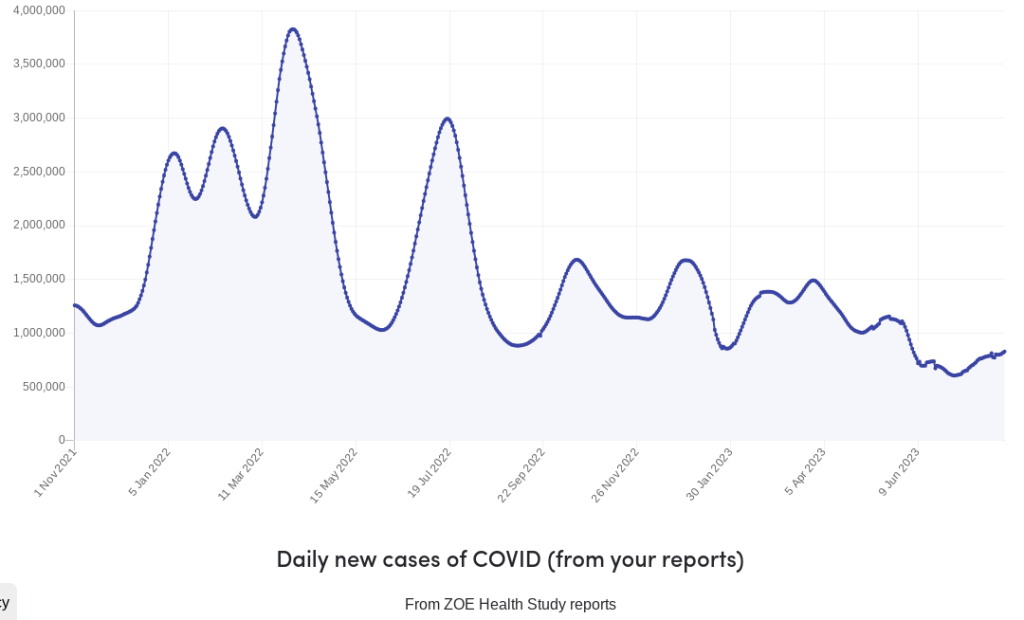
Summer holiday Covid-19 hotspots revealed as new variant Eris fuels surge in cases

Hospitals in the South-West of England recorded the highest hospital admission rate, with an interactive map showing a 104% increase in Covid cases in Devon in the seven days leading up to 29 July.

Holly Evans www.independent.co.uk (see original article for more charts and graphs)

With a new Covid-19 variant emerging across the UK, certain areas have seen an increase in cases and hospital admissions on the rise over the school summer holidays.

Named Eris after the Greek goddess of strife and discord, the descendant of the Omicron variant now accounts for as many as one in seven cases after it was first recorded in the UK last month.

The latest data from the UK Health Security Agency suggests that Eris, referred to as EG.5.1, represents 14.6% of all cases, with the World Health Organisation (WHO) adding it to the list of variants under monitoring.

However, health bosses at the UKHSA have said it is “not unexpected” to see new variants of Covid-19, with experts claiming it showed no signs of being more dangerous than previous strains.

This comes as hospital admissions have seen a recent spike, with an increase to 1.97 per 100,000 as of July 30. Data from the previous week recorded the hospital admission rate as 1.47 per 100,000, while those aged over 85 were the highest affected age group.

Hospitals in the South-West of England recorded the highest hospital admission rate, with an interactive map showing a 104% increase in Covid cases in Devon in the seven days leading up to 29 July.

Other Covid hotspots include Surrey, with a 103.3% increase, Derbyshire, with a 121.4% increase, as well as Cornwall, Somerset, Staffordshire, Darlington and Cumbria.

Experts have attributed the recent rise to a number of different reasons, including waning immunity, increased indoor mixing and the possibility that cinema trips to watch Barbie and Oppenheimer have caused the virus to spread.

Hospital admission rates had increased to 1.97 per 100,000 as of 30 July, with those aged over 85 being the age group with the highest rate (UKHSA)

According to the Zoe Health Study, estimated case numbers jumped by almost 200,000 last month, from 606,656 predicted cases on 4 July to 785,980 on 27 July.

Globally, the new variant Eris accounts for around 20% of Covid cases in Asia, 10% in Europe and seven per cent in North America. Common symptoms include a headache, mild or severe fatigue, a sore throat and a runny nose.

Independent Sage member Professor Christina Pagel told The Independent that she believed the UK is “definitely starting another wave” driven by the Omicron sub variants, Arcturus and Eris.

Sharing the latest Covid data, she said that there had been a 40 per cent jump in hospital admissions last week, with a 28 per cent jump in the number of patients in hospital primarily due to the disease.

However, the numbers overall remain low, with authorities continuing to monitor the situation as infection rates change.

Dr Meera Chand, Deputy Director of UKHSA, said: “It is not unexpected to see new variants of SARS-CoV-2 emerge. UKHSA continues to analyse available data relating to SARS-CoV-2 variants in the UK and abroad.

“EG.5.1 was designated as a variant on 31 July 2023 due to continued growth internationally and presence in the UK, allowing us to monitor it through our routine surveillance processes.”

“Vaccination remains our best defence against future COVID-19 waves, so it is still as important as ever that people come take up all the doses for which they are eligible as soon as possible.’’

Prof Francois Balloux, Professor of Computational Systems Biology and Director, UCL Genetics Institute, UCL, said: “The SARS-CoV-2 Omicron variant emerged nearly two years ago and rapidly became dominant worldwide. It has spawned a very large number of sub-variants constantly replacing other.

“The latest Omicron sub-variant to attract media attention is called EG.5.1. It is a direct descendent of the XBB.1.9.2 sub-variant, and carries one additional mutation in the spike protein. EG.5.1 is increasing in frequency and currently represents about 15% of the cases in the UK.

“Covid cases and hospitalisations have been going up slightly in the UK over recent days, but this is starting from the lowest baseline since March 2020. As such, the recent increases in case numbers and hospitalisations may sound ominous when expressed in percentage increase, but the numbers remain small in absolute terms.

“The EG.5.1 variant plays only a minor role in the current increase in cases, which is driven primarily by the weather and constantly waning immunity. There is nothing that feels particularly concerning about EG.5.1, relative to the many other Omicron sub-variants in circulation.”

Liz Truss hands out one gong for every four days she was in No 10

Who crashed the economy? – Owl

Fourteen people remain on her resignation honours list, which is being vetted by the House of Lords appointments commission. The list could have been even longer, however, as at least two people turned down a nomination by the former prime minister, The Times has been told.

Matt Dathan www.thetimes.co.uk

One source said they felt it would be “humiliating” to receive an honour from Truss, who served as prime minister for 49 days, the shortest spell in British history. Another said they did not deserve it.

Truss nominated four people for life peerages and 12 for honours such as knighthoods, damehoods, OBEs, CBEs and MBEs. According to previous reports the nominated life peers include Sir Jon Moynihan, a big pro-Brexit donor to the Conservative Party, and Matthew Elliott, who ran the Brexit campaign in 2016.

The others are said to be Ruth Porter, Truss’s deputy chief of staff in No 10, and Mark Littlewood, the outgoing head of the Institute for Economic Affairs, a think tank that backed her mini-budget.

Truss also wishes to recognise a “handful” of “local community heroes” in Norfolk, where her constituency is, according to a source close to her.

It is understood that Kwasi Kwarteng, who served as chancellor under Truss and oversaw the disastrous mini-budget, has not been included on the list. It is not known if he asked not to be included.

Mark Fullbrook, who also worked for Truss in No 10, had pushed for advisers to get honours in the days leading up to her departure last October. However, one aide rejected the honour as they did not feel they had earned it.

A source insisted the list was “very modest” and said it was customary for those departing No 10 to be given the chance to draw up a resignation list.

However, it is likely to renew criticism of the honours system, which was under fire over Boris Johnson’s list of more than 40 awards, which is said to have been whittled down from an original list of almost 100. It included seven peerages, including to an aide aged 30.

Opposition parties have called for Truss’s honours to be blocked. It is understood that she submitted the list to the commission several months ago and the names are still being vetted. Those on the list have not been given any indication of how long it will take. Truss’s office declined to comment.

Moynihan, 75, gave £20,000 to Truss’s leadership campaign last summer. He has attributed her demise to the Bank of England being “asleep at the wheel”, saying the end of her government would “reverberate to the detriment of many people’s view of democracy in this country”.

Elliott, 45, was chief executive of Vote Leave and founded the TaxPayers’ Alliance. Porter worked for Truss at the Ministry of Justice before her stint at No 10. Littlewood, 51, a former Liberal Democrat adviser, has known Truss since they were Oxford University undergraduates.

Since leaving office, Truss has spoken out predominantly about the need to stand up to China. She has been given tens of thousands of pounds by the investment banker behind the right-wing Reclaim Party, as well as a friend of the Duke of York as she seeks to portray herself as a victim of the “anti-growth coalition”.

After Liz the Lettuce, it’s Coffey the Cauli! Environment Secretary gets the vegetable treatment

  • Therese Coffey has been lampooned for not attending countryside festival
  • Game Fair enthusiasts were left disappointed after she didn’t attend the event
  • The environment secretary was travelling back from a G20 summit in India 

www.dailymail.co.uk 

Levelling Up just gets harder

London pulls away from rest of Britain in competitiveness index

The London economy and parts of the south-east have become more attractive to investors than the rest of Britain over the past year, according to a study.

Phillip Inman www.theguardian.com

A report by academics at the University of Cardiff and Nottingham Business School found that out of 362 areas across England, Wales and Scotland, nine of the top 10 in a competitiveness index were London boroughs.

Runnymede, a borough to the west of London, was ninth, below new entrant Hackney and above Southwark.

The study’s authors said London and the home counties, including the top-ranked City of London, Westminster and Camden, stretched their lead over the rest of the regions and nations of Britain as the most economically attractive areas.

Only East Anglia and Cambridgeshire managed to keep pace with the capital, which the report’s authors said was due to their integration with London.

“The east of England regions are becoming increasingly decoupled from the rest of the nation. It is clear that a location’s proximity to London is becoming an important determinant of its competitiveness and future economic growth. The nation will become further reliant on the relative growth hotspots in the capital and surrounding areas,” they said.

Camden was considered to have a cultural life that would be attractive to entrepreneurs, along with the transport, skilled workers and homes needed to support high-wage employees.

“In some regards, Camden, with its cultural amenities and bohemian flavour, might be regarded as the archetypical locality that would attract the high-skilled creative classes who not only innovate themselves, but also create an environment that is attractive to other high skilled groups,” the authors said.

A surge in start-up businesses in Hackney in the past year and similar cultural attributes to Camden meant that it jumped 10 places between 2019 and 2023.

The local areas ranked in the bottom 10 were scattered across much of England and Wales.

East Lindsey, which includes the east coast resort of Skegness, had the worst ranking.

The authors said: “It is a largely rural locality with a significant proportion of its economy associated with agriculture and food production.

“As this is one of the sectors which have been hit hardest by the loss of access to cheap labour from the European Union, this is likely to explain some of its loss in competitiveness.”

The report said Skegness held little attraction for businesses, like many resorts on the east coast affected by economic developments over the past 20 years.

Blaenau Gwent and Merthyr Tydfil in Wales, and Torbay and Gosport on the south coast of England, were also among the least competitive localities.

The authors said they defined competitiveness as “the capability of a local economy to attract and maintain firms with stable or rising market shares in an activity, without sacrificing the standards of living of those who participate in it”.

They added: “It is true that an area with low wages and property prices may be attractive for some businesses, but such activities tend to be low value-added and footloose, and are not necessarily going to improve standards of living and achieve levelling up. In other words, being cheap doesn’t equate to competitiveness.”

Rishi Sunak has said he wants the UK to be a high-wage economy, attractive to domestic and foreign businesses prepared to invest in high-skilled workers.

Mark Gregory, a visiting professor at the University of Staffordshire and a former chief economist at the consultancy EY, said the study was unable to capture some important aspects of a local economy that attract businesses.

He said that while London scored highly as a cultural centre, it was increasingly unattractive as a place for young, skilled graduates to work, mainly due to soaring housing costs.

Some areas that fell into the bottom half of the competitiveness rankings were attractive places to live and work even though wages were low, Gregory said.

“How an area is perceived by businesses is another important element driving decisions about where to locate. Tech firms will go where young people want to be and where infrastructure is best, while pharmaceutical businesses will want to be near universities,” he said.

“Manufacturing, which attracts most foreign direct investment, is highly sensitive to wage levels and will want to locate where they are relatively low, not in cities.”

The report found that between 2019 and 2023, the biggest improvements in the competitiveness rankings were in Folkestone and Hythe, Bury, Wolverhampton and Worcester.

Wolverhampton’s improvement was probably due to the potential benefit from the HS2 railway line, the authors said, while Worcester had become more attractive to skilled workers after the pandemic because of its proximity to rural areas.

MPs paid £10m for second jobs and freelance work over past year

MPs have been paid £10m from second jobs and freelance work over the past year, largely driven by the size of Boris Johnson’s earnings as well as former Tory ministers taking up a slew of highly paid roles, a Guardian analysis has found.

Rowena Mason www.theguardian.com 

Almost 18 months after the furore around second jobs led to promises of a crackdown, MPs’ earnings from work outside parliament have continued to rise.

The analysis looked at all MPs who made more than £1,000 in the past year, excluding income from completing surveys. Even stripping out Johnson’s £4.8m, about 90 other Conservative MPs brought in approximately £4.75m – an increase from nearer to £4m in 2021.

A much smaller number of Labour, SNP and Lib Dem MPs also brought in outside income of just over £400,000.

The government last year ditched plans to cap MPs’ income from second jobs, just months after the issue provoked a sleaze scandal that plunged Johnson’s government into crisis. The promised clampdown followed the Owen Paterson lobbying scandal and a furore over Geoffrey Cox being paid nearly £6m as a lawyer since joining parliament, voting by proxy on days he was undertaking paid work.

The rise in incomes over the past year appears to have been partly driven by a minority of Conservative MPs taking on very highly paid work, from lucrative consultancies to well paid media gigs for the rightwing GB News channel, as well as Rupert Murdoch’s TalkTV.

Some of the highest-paid include the former business secretary Jacob Rees-Mogg, who is paid about £29,000 a month to host a programme for GB News – which would make him about £350,000 in a year.

Brandon Lewis, a former party chair and ex-cabinet minister, now has three business strategy jobs, including one working for a property developer, making him in total £150,000 a year, while Chris Skidmore, a former minister who carried out a net zero review for No 10, has three jobs in clean energy and policy making him about £200,000 a year.

Sajid Javid, a former chancellor, is being paid £25,000 a month – or £300,000 a year – as adviser to Centricus Partners, a Jersey-based investment firm, related to “global economic outlook, geopolitics and financial markets”.

The figures, compiled from the Register of MPs’ interests, also highlight how some ministers have been part of a revolving door – leaving office during the Johnson era, taking on second jobs, and then returning to government during Rishi Sunak’s tenure.

Oliver Dowden, the deputy prime minister, was paid £8,000 to advise the hedge fund Caxton Associates on policy and £5,000 by an art services business in the short period he was out office last autumn under Liz Truss.

Meanwhile, Gavin Williamson, a former education secretary, resigned his £60,000-a-year second job working for RTC Education, a firm run by a Tory donor, when he went to work for Sunak in October 2022 and then signed back up again in February 2023, a few months after he was ousted from cabinet again.

Some MPs shed their second jobs shortly after Johnson said he was looking at limiting outside income in terms of hours or pay – a policy that was later dropped by the government. But a string of others have taken on new roles in the past year, such as the former Home Office minister Sir Mike Penning, who took a third extra job last October being paid £5,000 a month as a non-executive of a firm called Tenacious Holdings, which markets cannabidiol (CBD) products.

The high earnings are also driven by former prime ministers and senior ex-cabinet ministers making money from speeches and television appearances. Theresa May and Liz Truss were both paid six figures to run their post-No 10 offices from giving speeches, while the former health secretary Matt Hancock registered about £450,000 from media appearances, speeches and his book.

There were at least 18 MPs whose outside incomes totalled more than their £86k MP salary in the year to the end of July, compared with 11 in the autumn of 2021, when Owen Paterson was found to have committed an “egregious” breach of lobbying rules by lobbying for two firms he was paid to advise.

The highest Labour earner over the last year was David Lammy, the shadow foreign secretary, who made more than £90,000 from presenting on LBC radio and giving speeches. Labour has signalled that if it wins power it will not allow MPs to take up paid directorships or consultancies. Those Labour MPs conducting outside work at the moment are largely making money from freelance work, from books or professional jobs such as working shifts as a doctor.

Transparency campaigners called for tighter rules as more MPs will be looking to supplement their income over the next year: many Conservatives fear losing their seats at an election, with Labour favoured in the polls.

Jonathan Evans, the former MI5 chief and chair of the committee on standards in public life, renewed his call last month for new curbs on MPs’ outside work, suggesting to Sky News there should be an “indicative ceiling” on how much time they should devote to them.

At the same time, Eric Pickles, the Conservative peer and chair of the Advisory Committee on Business Appointments (Acoba), has asked for a new regime to fine ex-ministers who contravene lobbying restrictions on outside employment to be in place by the autumn reshuffle. A Sky News and Tortoise investigation found last month that MPs had worked about 89,000 hours in their second jobs since the beginning of the parliament.

Sue Hawley, of the campaign group Spotlight on Corruption, said parliament and regulators needed to tighten up the rules on second jobs as MPs within the next year, as some parliamentarians seek to maximise their earnings potential before leaving office.

“It’s increasingly clear that parliament, and its standards regulators, need to be looking closely at when MPs earning huge sums outside of their role in parliament damages the reputation of the House of Commons,” she said. “There is a real risk that MPs and ex-ministers earning such huge sums fuels cynicism about parliament and risks undermining faith in democracy.

“It’s also clear that as ministers eye the possibility of being ejected at the next election, the rules on the revolving door need toughening up urgently to prevent potential conflicts of interest. That’s why the government needs to heed Lord Pickles’ call to lay out a timetable for urgent implementation of these rules over the autumn.”

Tom Brake, the director of Unlock Democracy and a former deputy leader of the House of Commons, also made the case for reform, saying it was undermining faith in the democratic system.

“For too many, being an MP is a sideline or an afterthought. For them, earning big money elsewhere or brushing up their TV presenter skills is their priority, not fighting for constituents struggling with a cost of living crisis.

“Former PM Boris Johnson’s pledge to tackle MPs’ second jobs was always suspect. These latest figures show it was entirely bogus,” he said.

Richard Burgon, a Labour MP and former shadow justice secretary, said the figures showed why the government should adopt his bill that would ban MPs from having second jobs. “While millions face a cost of living crisis, it’s a disgrace that some MPs are still busy lining their own pockets through second jobs,” he said.

Planned cuts to homelessness budget should be delayed, committee says

Controversial planned cuts to Devon’s homelessness budget should be delayed, an influential group of councillors has recommended.

“Money we can’t afford,” – Councillor James McInnes (Conservative, Hatherleigh & Chagford),

Ollie Heptinstall www.midweekherald.co.uk 

The county council has consulted on proposals to scrap its £1.5 million contribution to projects which prevent people becoming homeless. 

However, the cabinet member responsible, Councillor James McInnes (Conservative, Hatherleigh & Chagford), recently said it was “money we can’t afford,” adding he was “very clear” it would not come out of existing budgets for the council’s statutory services.

A draft cabinet report presented to a health and adult care scrutiny committee this week revealed the funding could be cut at the end of September, but members of the committee decided this is too soon.

A majority instead urged the cabinet to delay the cuts until at least the end of the financial year in April, but another proposal to keep the funding until the end of the 2024/2025 financial year was rejected.

The £1.5 million currently pays for contracts with five providers who support around 250 people at any one time.

Their services are provided in multiple occupancy hostels in Exeter, East Devon, Torridge and North Devon, as well as through a countywide support service. None of the money pays for accommodation.

Local charities have hit out at the proposed cuts. YMCA Exeter, which receives £150,000 from the council, says “the consequences for vulnerable young adults will be huge”, while St Petrock’s, a charity in Exeter, warned it could lead to a “homelessness crisis”.

They believe it will end up costing other services such as district councils, the police, NHS and social care “significantly more” in the medium to long term, while Cllr McInnes has admitted there is a “risk that hostels may close”.

The meeting heard from one woman who said that, without receiving support from living at the Gabriel House shelter, she “most likely would not be here today”.

“I have significant traumas in my life,” she added. “This has led to me suffering the loss of my daughter and a breakdown of any relationship with my family.

“I’m now only able to share my story with you in the hope you can listen to me on why the proposal to stop the funding would have such a devastating impact on every resident at Gabriel House, who I see as my family.”

Peter Stephenson, chief executive of St Petrock’s, said the council’s claim that the funding is not part of its statutory powers is “dubious at best”.

He added: “Going ahead with this proposal will not only contravene your legal duties, but will make it abundantly clear that Devon County Council considers people experiencing homelessness as unworthy of the protection the rest of society rightly receives.”

Another charity, YMCA Exeter, has said it will take legal action if Devon goes ahead with the cuts.

In a statement, Cllr McInnes, who’s also the council deputy leader, said: “We fully understand that homelessness is a blight on people’s lives, particularly among younger people and others who need support, and that this is a real issue for all local authorities, locally and nationally.

“No decision has yet been made, and we are continuing to engage with district councils to explore all the inter-dependencies between housing and social care, particularly for our care leavers and other young people.”

The cabinet is expected to reach its decision on Wednesday, August 23.

Link centres closure plan withdrawn for now

Proposals to close North Devon’s link centres for people with complex mental health issues have been withdrawn to allow for further consultation with users.

Alison Stephenson, local democracy reporter www.radioexe.co.uk

To cut costs, Devon County wants to integrate mental health services in North Devon to be “more in line with the national focus” but in Bideford, one of three link centre locations, some residents are concerned it will lead to more hospital admissions and greater costs to the health service.

Torridge District Councillor for Bideford East Cllr Jamies Craigie (Independent), along with clients of the Bideford Link Centre, challenged the initial consultation as they said it didn’t extend to people who used the services before covid or those seeking after care after coming out of hospital.

Cllr Craigie is pleased everyone will now have an opportunity to put their views. The county council will come back with revised proposals for Bideford, Barnstaple and Ilfracombe link centres and further consultation later in the year.

“It is only fair that everyone is consulted, as the numbers that attend now are half the number pre-covid as the activities at Bideford have been scaled down,” said Cllr Craigie. “We feel the figures will show the case for keeping our centres open and there will be no manipulation of figures giving the county council a fig leaf for closure.”

Torridge District Council’s overview and scrutiny committee heard earlier this week that the centre in Bideford, which has traditionally provided therapy as well as well-being and creative activities, had not reopened all services in 2021 despite pleas to Devon County Council.
Users said the centre had worked successfully for 30 years keeping people with a range of moderate-to-severe mental health problems safe, but it has been scaled back to a three times a week drop-in centre.

Cllr Craigie said: “The link centre provides a good service in a building which is ideal for its purpose as we don’t have any community centres in the town. People are more in need than ever since the pandemic where they became isolated and separated from others. And lots are struggling financially which is one of the many causes of stress.

“When you consider that it costs £800 a day to keep a mental health patient in hospital and £250 to have a mental health assessment at the RD&E, it makes no sense to get rid of the link centre which is preventing people having to go into hospital or have additional care.”

Devon County Council says it is facing “huge financial pressure” and must get the best outcome for every penny spent, hence it is reviewing all areas of its work. The centres in Bideford and Ilfracombe will cost around £306,000 to maintain over the next five years, it says.

A spokesperson said: “There is a national focus on improving and developing mental health services that are much more integrated within in local communities than they are currently in North Devon.”

They continued: “Several reviews in North Devon found that many of the services delivered by the link service to support people with their mental wellbeing, such as craft clubs, coffee mornings and choir groups, help with form filling and IT support, can be delivered by the community and voluntary sector.”

The council said Holsworthy’s link service had moved to the town’s youth centre that offers a wide range of community support, including drop-in sessions that help reduce loneliness and isolation.

A spokesman for the council said: “We are grateful for the input of all those who have contributed to the consultation so far, these responses will be considered in addition to the responses to the further consultation before decisions are made.”