Sir, Tomorrow the House of Lords will vote on government proposals to overturn nutrient neutrality laws, the last legal line of defence for precious river habitats. Nutrient neutrality rules are part of the habitats regulations, the UK’s strongest nature protections. Scrapping them would be the worst unwinding of environmental law for decades.
The rules stop pollution from new developments near sensitive rivers. The weak, non-statutory measures proposed in exchange will fall short and more habitats will be harmed.
The existing rules do not stop housebuilding, they require housebuilders to mitigate impacts. Where there is a short-term shortage of mitigation credits, the government could speed up development without weakening environmental law. Unfortunately, the government did not consult before bringing forward proposals in the dying days of the Levelling-Up and Regeneration Bill.
We urge peers to vote against these damaging proposals, which are contrary to government promises to restore rivers and stop the decline of nature by 2030.
Hilary McGrady, director-general, National Trust;
Mark Lloyd, CEO, Rivers Trust;
Darren Moorcroft, CEO, Woodland Trust;
Craig Bennett, CEO, Wildlife Trusts;
Katie-Jo Luxton, executive director, global conservation, RSPB;
The British housebuilder Vistry is to shift its focus solely to social housing as soaring mortgage costs hurt sales completions across its wider business.
Vistry said streamlining its operations would result in some job cuts, while promising investors a £1bn windfall over the next three years as a result of the strategic shift.
It said the UK was facing a “chronic shortage” of affordable houses.
“The scale of the social need for affordable mixed-tenure housing across the country continues to increase,” said the Vistry chief executive, Greg Fitzgerald. “Delivering on the acute social need for housing across the country and increasing the availability of affordable, sustainable homes is at the core of the group’s social purpose and vision.”
The housebuilder reported an 8% fall in pretax profits to £174m in the first half of the year, despite a 32% increase in completions.
Vistry said it continued to see “good demand” for affordable housing from bodies including local authorities. By contrast, private sales had slowed further since June, the company said, as mortgage costs continued to soar for prospective homebuyers.
“The step-up in mortgage costs and increased macroeconomic led to a drop-off in completions to the open market,” the company said. “In particular, we saw a significant decline in completions to first-time buyers whose ability to purchase have been most affected by the rate increases.”
As mortgage approvals and house prices continue to fall at the fastest rate since 2009, the company said it intended to merge its affordable and private housebuilding operations by the end of this year, to focus on its “high-return, capital-light, resilient” affordable housing model.
Vistry indicated that the merger of its businesses would result in job cuts, with plans to launch an employee consultation to reduce the total number of regional business units it operates from 32 to 27.
The company laid off 4% of its more than 3,000 staff when it completed its £1.27bn acquisition of Countryside Partnerships last year.
Vistry reiterated its full-year guidance of achieving £450m in profits this year.
Cllr. Mike Goodman submitted a request to review car parking charges at last week’s EDDC Scrutiny Meeting (which he chairs).
He claimed that they had doubled in 2022 making them the most expensive in the South West.
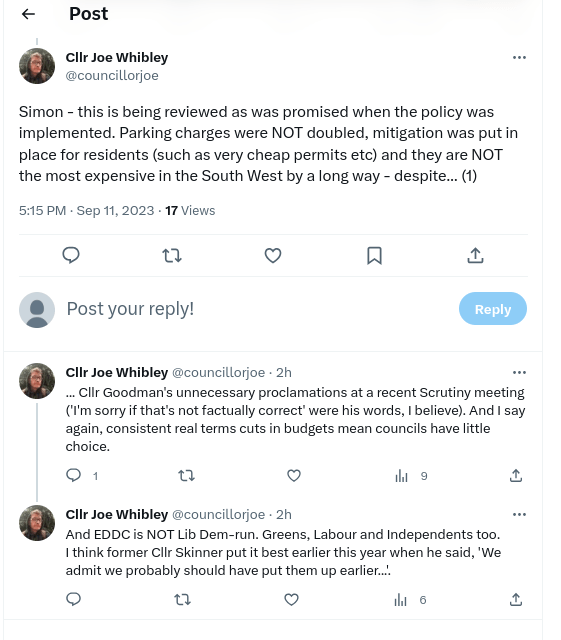
On cue, Simon Jupp launched forth on twitter about the impact of parking charges imposed by the “LibDem – run EDDC” (see below).
The claims made by Mike Goodman are misleading (see. Cllr Joe Whibley’s reply below.)
Conservative controlled Dorset unitary Council has particularly high charges, £3/hour, higher than East Devon!
Here is what Member of Parliament, Simon Jupp should be doing.
It is a little known fact that on-street parking (controlled by teetering on the brink of bankruptcy Devon County) is VAT free, whilst off-street parking (“Balanced Budget” EDDC’s only option) is subject to VAT.
Simon Jupp, PPS to the Secretary of State for Transport no less, would do us all a favour if, instead of moaning, he lobbied his boss for VAT on off-street parking to be removed. – Owl
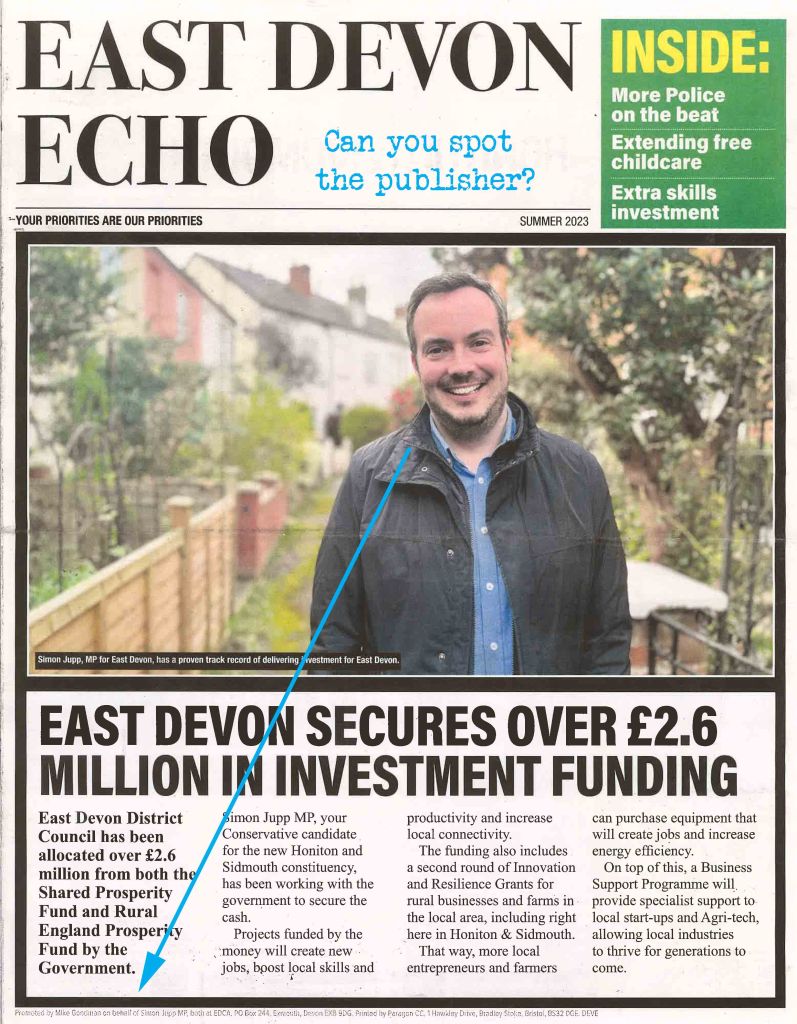
Can you spot the (very) small print declaring who is actually publishing the fake “local paper”, The East Devon Echo?
Let Owl enlarge it for you:
Could this be Cllr. Mike Goodman, chair of EDDC Scrutiny Committee?
He discloses that he is a member of the Conservative Party but Owl can find no mention that he has ever disclosed that he publishes a local newspaper on behalf of former journalist Simon Jupp.
As chair of the Scrutiny Committee is this consistent with the Nolan Principles of: Selflessness, Integrity, Objectivity, Accountability, Openness, Honesty and leadership?
The independent press regulator has written to the UK’s political parties – including Conservative Party chair Greg Hands MP – to oppose the use of party leaflets dressed up to look like newspapers.
As Owl reports elsewhere, the publisher of the new “fake” local newspaper hereabouts, the “East Devon Echo”, is none other than the Tory chair of EDDC’s Scrutiny Committee, Cllr Mike Goodman.
Does this demonstrate the maturity and wisdom one might expect from someone in such an important role? – Owl
Lexie Kirkconnell-Kawana, CEO of industry watchdog Impress, has written to representatives of each major political party to implore them to review this practice amid the “crisis of trust” that journalists and politicians face – and the negative impact it could have on democracy.
A spokesperson for the press standards body, which largely represents smaller and independent news organisations, said: “With an election just around the corner, this is a practice that should be addressed as soon as possible.”
Byline Times has seen dozens of examples of fake newspapers issued from Conservative Party HQ and distributed across the country in recent weeks – with many failing to identify which party is sharing the material on the so-called ‘imprint’ at the bottom of the publications.
Don’t miss a story
The vast majority of voters believe fake newspapers being promoted by political parties – sometimes without making clear who they’re from – should be banned.
Recent polling for this newspaper by independent pollsters Omnisis found that 62% of people in Britain think that the fake newspaper tactic should be banned if they do not make clear which party is behind it.
The figure rises to 65% among Conservative voters, the same as for Labour voters. Liberal Democrats, who also have been known to use fake newspapers for election material, are less in favour of a ban (55%).
The figure rises significantly among over 75s, some of whom may be more vulnerable to misleading campaign materials: 75% back a ban on the practice. And opposition sits at 71% among those with no formal qualifications.
Readers have responded with anger to the leaflets over the past few months. One wrote: “Many people will be fooled by this, especially older people who I would imagine tend to read the local papers more are also less likely to notice the microscopic small print in hard to find places.” Another branded it “Tory marketing deliberately disguised as independent news”, while one recipient dubbed it “dirty tricks” campaigning.
Some voters have been posting back fake newspapers sent by the Conservative Party to their head office – in a bid to cost the party in postage fees. One voter told Byline Times they had posted approximately half a kilogram of takeaway menus and junk mail to CCHQ, with a handwritten note saying “No more fake news please”.
Legal Loophole
The ruse has previously been condemned by industry body the News Media Association among other press groups. But despite being discouraged by the watchdog, the Electoral Commission, it is not against the law.
A spokesperson for the Electoral Commission told Byline Times recently that “generally speaking,” election materials require the name and address of the printer and promoter – but not the political party.
Moreover, the candidate rules setting out transparency for who is publishing campaign materials don’t apply yet, as the general election date has not been announced.
But the Electoral Commission figure added: “We encourage all parties and campaigners to include imprints on all material, to provide voters with transparency.”
The tactic of publishing fake papers was used successfully in Uxbridge and South Ruislip last month, with the party’s ‘Uxbridge and South Ruislip People’ urging people to “Stop ULEZ” (Labour London Mayor Sadiq Khan’s Ultra Low Emissions Zone expansion). The fake magazine mirrored the title of the local council-run Hillingdon People, which is meant to be apolitical.
Copycat Spat
Industry title Press Gazette reported that the Conservative Party was forced to apologise to the publisher of several Midlands newspapers after it distributed newspaper-style campaign literature in the area under trademarks owned by the company.
The Conservatives said it was a “genuine mistake” that three pamphlets resembled editions of MNA Media’s Chronicle Week. The party agreed to make a donation to charity as part of its apology, the title reported.
The Midland News Association said the leaflets “were designed to mimic the style of a newspaper and they caused confusion among many who received them, who believed they were reading their usual Chronicle”.
However, they do not appear to have apologised after High Peak MP, Conservative Robert Largan, distributed a “newspaper” titled the High Peak Reporter – despite the name of the title being owned by an actual newspaper group, Quest Media Network.
Chris Bird owns Quest Media Network, which owns the brand title High Peak Reporter, and told the Prolific North outlet: “I guess we should be flattered by this stunt, but we are not. Would Mr Largan have tried this with the Daily Mirror or Daily Telegraph? Absolutely not, because that would have cost him and his party a lot of money for the blatant breach.”
And Lincoln Conservative MP Karl McCartney issued a leaflet to residents branded as the ‘Lincoln Chronicle’ – the same name as a weekly newspaper in the seat that was closed 15 years ago, and which many residents remember. The move was condemned by a former photographer for the real paper, Dr Mike Maloney OBE, one of the UK’s most decorated photographers.
He told Byline Times that the fake newspaper was “typical of politicians”. He added it represented the idea of “never letting the facts interfere with a good story”.
Letter to Conservative Party chair
Dear Greg Hands, trust in journalism has reached a crisis point. Our research shows that less than half of the public trust news publishers, while journalists themselves are trusted by just 38% of the public; politicians are one of the few jobs to rank lower.
For democracy to flourish, it is essential that we have a thriving, healthy and trusted news media ecosystem. To achieve this, collaboration and transparency is needed between news organisations, the public and politicians.
It is entirely disheartening then to see the latter groups continuing to engage in the practice of distributing campaigning materials under the guise of local newspapers, misleading voters into believing what they are reading is the work of local journalists from independent publications.
Often, these are accompanied by either no clarification of their actual purpose or by only the smallest clarifying statements.
We are therefore asking that the Conservative Party, and all political parties, carefully review this practice among their candidates moving forward and the negative impact it will have on politics, journalism, and democracy.
If you do insist on continuing to produce these materials, we implore you to seek out rigorous and independent press regulation for them to ensure they meet robust standards.

 Clapp Mill Farm Broadclyst Devon EX5 3DNRef. No: 23/1882/FUL | Validated: Thu 31 Aug 2023 | Status: Awaiting decision


 East Devon Watch