Michael Gove’s local council warns of bankruptcy risk after failed Tory investments

Oh dear, chickens coming home to roost as a result of failed property investments.

What was it that Simon Jupp said regarding failing local authorities and fitness to govern? – Owl

Michael Gove’s local council is warning that it faces effective bankruptcy within two years after racking up millions of pounds in debt for failed property investments overseen by its former Conservative administration.

Richard Partington www.theguardian.com 

Surrey Heath borough council is in the parliamentary constituency of Gove, who as levelling up secretary is the cabinet minister in charge of local government.

The tiny Surrey local authority – where the Liberal Democrats seized power in May after almost half a century of Conservative control – said its finances were under “severe pressure” as it struggles with debts worth £165m, while warning that high inflation and rising debt interest payments could leave it in “effective bankruptcy”.

“Clearly he [Gove] and his colleagues have been asleep at the wheel for a long time,” said Shaun Macdonald, the council’s new Lib Dem leader.

“You’ve ended up with this cosy Conservative club in places like Surrey, where the parish, borough, county, and national government representatives are the same people. You really have to question who’s overseeing these things.

“It feels as if people are going to the casino and putting it all on black.”

The comments come amid an escalating crisis for town halls across the country after years of budget cuts and local mismanagement, as growing numbers of English councils warn that huge debt piles are leading them to the brink of financial meltdown.

Birmingham city council, the largest local authority in Europe, became the latest to declare that it was in effect bankrupt last week, issuing a section 114 notice to signal that it does not have the resources to balance its budget.

Although Rishi Sunak has sought to capitalise on the meltdown at the Labour-run council as a sign that Keir Starmer’s party would “bankrupt Britain”, dozens of other local authorities from across the political divide are in financial distress.

Seven local authorities in Surrey, largely controlled by Tory or Lib Dem administrations, were included on a list of 20 councils with the highest levels of debt in England relative to their size this week by the rating agency Moody’s. It warned that more were likely to go bankrupt after a string of high-profile failures at Woking, Croydon, Thurrock and Slough.

Highlighting a financial crisis in Gove’s constituency, Macdonald said Surrey Heath’s debts would take decades to pay off, while rising borrowing costs, high inflation, and soaring demand for services had left its finances on an unsustainable trajectory.

In 2016, the then Tory council borrowed to invest £113m in a shopping centre complex and House of Fraser department store in the town of Camberley. However, the properties are now valued at £33m – a loss of £79m.

Macdonald said the previous Conservative administration had lumbered Surrey Heath with £60m in short-term debt that would cost millions of pounds to refinance, while suggesting the investment spree had been undertaken without adequate scrutiny.

He warned that without central government support, the council could be forced to make cuts to discretionary services – such as provision of swimming pools and grants to voluntary organisations – in a similar package of localised austerity to neighbouring Woking.

“It’s not just here, it’s other places. The deals have gone sour – and the taxpayer locally is left to foot the bill,” he said.

Gove was warned in writing about Surrey Heath’s financial woes earlier this year by its former Tory leadership. The council wrote to the secretary of state asking him to intervene to help it sack its auditors, after lengthy delays in the checking of its accounts.

The council’s last set of fully audited accounts was for the 2018-19 financial year. Lee Rowley, a minister in Gove’s department, replied on his behalf, saying the government could not intervene.

A Conservative source said: “Sadly, this is the Lib Dems playing politics. It looks like an attempt by the Lib Dems to justify huge council tax hikes on residents.”
Devon council predicted to overspend by £9m next year

Simon Jupp please note! – Owl

Devon County Council is expecting to overspend by more than £9m next year. BBC News www.bbc.co.uk

Senior councillors were told at a cabinet meeting the authority would also have a deficit of £36.6m in services to children with special educational needs.

There were angry exchanges at the cabinet meeting on Wednesday, the Local Democracy Reporting Service (LDRS) said.

Adult social care and children’s services account for the majority of the overspend.

Conservative councillor Phillip Twiss outlined the figures and said the council was in a much better position than it had been this time last year when it was looking at a £35 million overspend.

He said savings could be made to create a £10 million “safety valve” to support the special educational needs deficit.

“This will signal to the Department for Education that we mean business and we will deal with it,” he said.

Liberal Democrat leader Julian Brazil said it was “incredibly frustrating” to hear that Devon’s problems were caused by Covid, inflation and the war in Ukraine when every council in the country was facing the same pressures.

He said: “If we continue along these lines of trying to pretend that everything is okay, we will go bankrupt.”

Independent councillor Frank Biederman added: “We are going to have to make savings, and it will be the most vulnerable people in our society that suffer.”

Rishi Sunak blocked rebuild of hospitals riddled with crumbling concrete

Rishi Sunak blocked plans to rebuild five hospitals riddled with crumbling concrete three years ago, prompting warnings of a “catastrophic” risk to patient safety, the Guardian has learned.

Pippa Crerar www.theguardian.com 

Just two of the seven hospital rebuilding projects requested by the Department for Health were signed off by the Treasury at the 2020 spending review when Sunak was chancellor and Steve Barclay, now the health secretary, was his chief secretary.

The other five were finally added to the new hospitals programme in May, when the government amended the list, but it has meant a three-year delay in starting to rebuild dangerous hospitals. In their most recent risk assessments, all five have been graded at “catastrophic” risk with warnings that an incident is “likely”.

The five hospitals are Frimley Park hospital, in Surrey; Airedale general hospital, Keighley, West Yorkshire; Hinchingbrooke hospital, Huntingdon, Cambridgeshire; Leighton hospital, Cheshire; and the Queen Elizabeth hospital in King’s Lynn, Norfolk.

The revelations will revive the row over reinforced autoclaved aerated concrete (Raac) which dominated the start of the new parliamentary session, with Sunak and his education secretary, Gillian Keegan, coming under fire for uncertainty and disruption over crumbling concrete in England’s schools.

NHS bosses have told hospitals across England to be ready to evacuate staff and patients if buildings containing concrete at risk of collapse start to fall down.

NHS England issued the instruction to all 224 health trusts on Tuesday in a letter from Dr Mike Prentice, the organisation’s national director for emergency planning and incident response, and Jacqui Rock, its chief commercial officer, telling trust officers that they should familiarise themselves with a “regional evacuation plan” drawn up by the NHS in the east of England so that hospitals can implement it in the event that buildings that contain Raac start to crumble.

The 2023-4 risk register of Frimley Park hospital, which serves Michael Gove’s constituency, reported widespread crumbling across its buildings. It warned: “There is a risk of injury or death to patients, visitors, and staff due either to delamination of a roof plank whereby a part of it falls, or a sheer collapse with no warning due to limited bearing on the concrete support beam.”

Across the five hospitals there were more than 100 incidents, according to NHS figures, where estate or infrastructure failures resulted in clinical services being delayed or cancelled in the year after the Treasury’s decision not to include them in the new hospital building programme.

Between them, they had a “high risk” infrastructure backlog – where repairs must be urgently prioritised to prevent major disruption – totalling £117m, but less than a third of that amount was spent. There were 21 patient safety incidents related to critical infrastructure risk in 2021-22 at the five hospitals.

An NAO report in July, Progress with the New Hospital Programme, suggested the risk of Raac to the five hospital buildings was known at the time of the Department for Health’s bid to the Treasury. However, the government decided against including all seven hospitals because “further assessment” was required.

Yet after a school roof collapse led to a national alert in 2019 about the risk of sudden failure, NHS England asked trusts to survey their estates for Raac. Forty-one buildings at 23 trusts contained the material, including the seven hospitals with Raac present throughout, which were at particular risk.

At a Westminster policy forum on Tuesday, Tim Phillips, director of Health Value for Money at the National Audit Office, said: “The NHS knew back in October 2020 that it had a lot of Raac across its estate, including seven hospitals that are to all intents and purposes constructed entirely of Raac.

“Back in 2020 the Department of Health actually proposed to the Treasury that NHP should be used to replace all seven Raac hospitals at that point, so in effect that all seven hospitals should be part of 40 new hospitals as early as 2020.

“But at that time, government decided that only two of the seven would be put in the programme. What we’ve seen since is that government has had to row back on that decision.”

Wes Streeting, the shadow health secretary, said: “Rishi Sunak and Steve Barclay are the guilty men of the crisis in our NHS. They literally failed to fix the roof when the sun was shining, putting patients and staff at risk and leaving taxpayers to pick up the bill.

“There is no image that better sums up what the Conservatives have done to our public services than the sight of crumbling hospitals and schools.”

A source close to Barclay suggested that as chief secretary to the Treasury he was responsible for setting the overall spending envelope, and that it was for the department to prioritise schemes.

A government spokesperson said: “These claims are untrue. The funding was not rejected by the Treasury, or the chancellor and chief secretary at the time, and there was an agreement to link these decisions into the wider new hospitals programme.”

They added that the full extent of Raac issues were not known until 2022 following an independent report by engineering consultants Mott MacDonald.

Government loses bid to relax waterway pollution as Lords rebel

The government has lost its bid to relax rules around the pollution of waterways after a rebellion in the Lords.

Simon Jupp: “I would never vote to pollute our water” – watch this space if the government tries to introduce a new bill in the commons. – Owl

Jennifer Scott news.sky.com

Levelling Up Secretary Michael Gove unveiled the plan last month, saying scrapping so-called “nutrient neutrality” measures would free up developers and lead to thousands more homes being built in England.

But the Tory amendment introduced in the Lords – which would have seen the policy tagged on to the Levelling Up and Regeneration Bill – was rejected by peers over the risk it would pose to the environment.

Nutrient neutrality rules were first introduced across the EU back in 2017, designed to stop developers from polluting local wetlands and waterways in protected areas when building homes.

In practice, it meant companies had to show how they would prevent or offset that pollution in order to win planning permission.

Developers claimed new homes only made a “negligible contribution to the river pollution”, so scrapping the measure would help ramp up projects – something Mr Gove and the government agreed with.

But opposition parties and environmental campaigners said it would lead to even more issues in the country’s waterways.

Putting the plan to peers, communities minister Baroness Scott said the powers were “necessary and proportionate”.

She said the current rules had “effectively stalled or blocked completely housing development in affected areas” and were “burdensome and expensive”.

But Labour’s Baroness Jones said scrapping the measure would set a “dangerous precedent”.

And Tory former environment minister Lord Deben – who chaired the Climate Change Committee until recently – said it was “one of the worst pieces of legislation I have ever seen and I’ve been around a long time”.

After the vote rejecting the policy, shadow levelling up secretary Angela Rayner called the defeat “humiliating” for the government, and said the “flawed plan” was just an attempt to “score cheap political points”.

She added: “We stand ready to sit down with the government, housebuilders and environmental groups to agree on a workable solution to build the homes we need.

“If they refuse this opportunity, ministers have only themselves to blame.”

The Liberal Democrats’ Lords spokesperson, Baroness Pinnock, called the vote “a great victory”, adding: “The Conservatives have continually promised not to roll back our environment rules, it is deeply shocking that they can’t be trusted to keep their word.”

But posting on X – previously known as Twitter – the Conservative Party said: “Starmer and Labour just voted to block 100,000 homes.

“Why? Short-term politics over the needs of British families.”

The current government has pledged to build 300,000 new homes every year by the mid-2020s.

Parliamentary figures show housing supply has increased year-on-year from a low point of 125,000 in 2012/13, reaching a high point of 243,000 new homes in 2019/20 – but they have not yet reached the target.

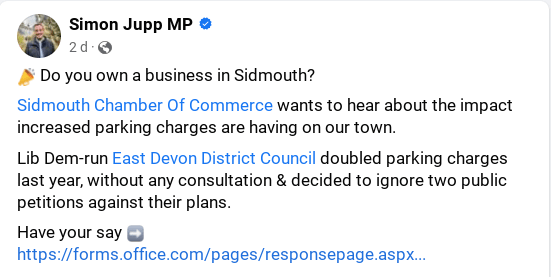
Simon Jupp get your car parking facts right!

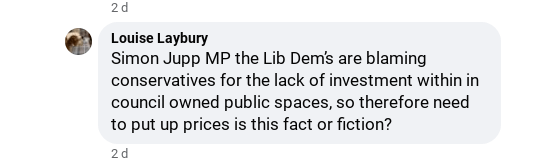
Louise Laybury commented on Simon Jupp’s Twitter post moaning about car parking charges asking him whether Lib Dem’s blaming Conservatives for the lack of investment within council owned spaces and therefore the need to put up [parking] prices was fact or fiction?

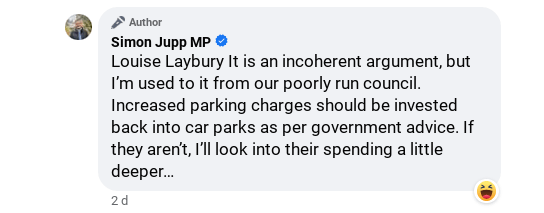
He didn’t answer the question directly but said that it was an incoherent argument that he was used to from “our” poorly run council. He then added: “Increased parking charges should be invested back into car parks as per government advice. If they aren’t, I’ll look into their spending a little deeper…”

Unfortunately this statement has failed Owl’s fact checking team.

It is factually incorrect, false in other words.

Somewhat surprising since Simon Jupp is a Parliamentary Private Secretary to the Secretary of State for Transport!

Louise, the answer to your question is FACT, (and the government trousers 20% of the parking fees to boot). – Owl

Report from Owl’s fact checking team

In East Devon most of the carparks are run by  EDDC (East Devon District Council), and on street parking by DCC (Devon County Council).

DCC is responsible for “on-street parking”  and is restricted by Government legislation  to ensure  any surplus after expenditure from fees is required to be spent on enforcing parking, contributing to off-street parking provision and, if the provision of further off-street parking is unnecessary or undesirable funds can be spent on public transport or highway improvements only.

*20% VAT is not applicable to on street parking and therefore “0 rated”.

EDDC is responsible for “off-street parking” in their carparks under Government legislation  any surplus after expenditure can be used for “environmental improvement” which can  include.

(a) The reduction of environmental pollution (as defined in the Pollution Prevention and Control Act 1999)

(b) Improving or maintaining the appearance or amenity of a road or land in the vicinity of a road, or open land or water to which the general public has open access.

(c) The provision of outdoor recreational facilities available to the general public without charge.

Therefore, in the case of EDDC this could include waste collections, street cleaning,
public conveniences, recreational open space, expenditure on the countryside or commons.

*20% VAT is required to be charged for off street parking therefore 20p in the £ goes directly to Government.

Consultation for off street parking requirements

If parking charges are to be introduced  at new locations that were previously free, then under the RTRA Road Traffic Regulations Act 1984 an Authority is required to  carry out a full “public consultation”.

If prices are to be changed, it is perfectly legal for a council to make a “parking order” and to simply provide a “public notice“ at each carpark and council office and website to inform the public of an intended price change.

Conservative government funding reduction

Since 2010 this Council along with all other authorities have seen significant cuts in general Government funding to support core service delivery, a reduction in funding of 50p in the pound since that point.

Government Funding to EDDC for General Services 2010    £7m
2010 funding indexed link to 2023 £10.3m
Actual Baseline Funding 2023£5m

Summary of the facts

  • East Devon is the only District Council in Devon not to borrow from reserves or cut services for this current year and we continually provide a balanced budget.
  • There is not a government requirement that carpark charges are invested back into carparks.
  • Government funding has halved in real terms since 2010.
  • The Government benefit from carpark charges at 20p in the pound.