Tide sweeps through banks into Otter Estuary

A Correspondent writes:

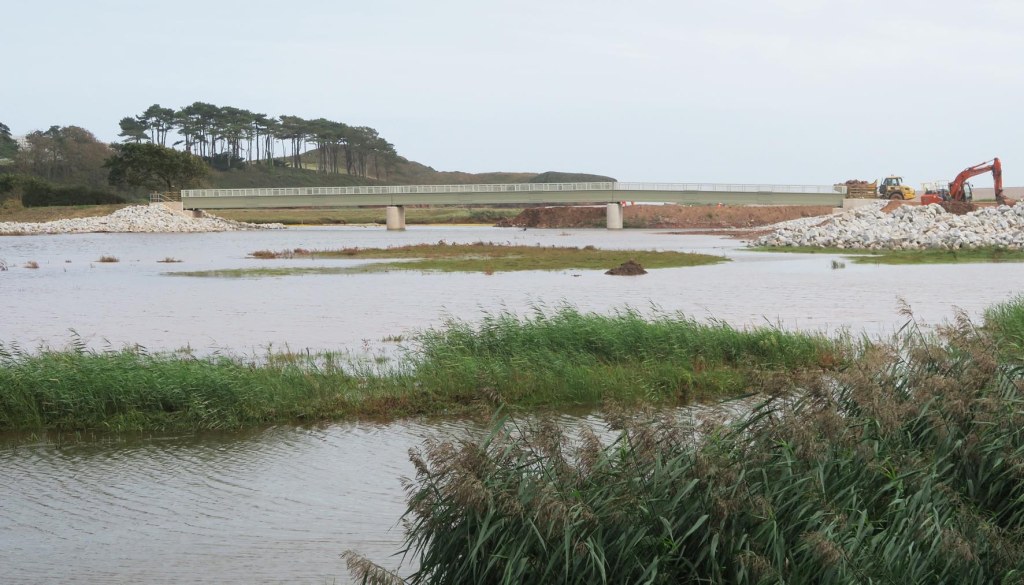
This week the Otter Estuary was reconnected to sea for the first time in 200 years as a section of the historic embankment next to the lime kiln car park was removed. 

At the beginning of the nineteenth century Lord Rolle started to plan a grand scheme for the River Otter below Otterton and East Budleigh. This part of the estuary, through which the river meandered, was  called the “Runnie”. The Runnie used to flood freely at high tide. The section just above, and including, what is now the lime kiln car park was called the “Salmon Pool” and formed a harbour for coasters and yachts. 

Plans to build a series of embankments were drawn up by the renowned Devon surveyor and civil engineer James Green. (James Green built many fine bridges in Devon including Otterton Bridge).

The aim was to reclaim land for agriculture and, by straightening and canalising the river along the eastern bank, to increase its navigability.

Work started around 1810, finishing with modifications and extensions around 1815. Local legend has it that the work was carried out by French prisoners of war but this is not supported by historical work on contracts carried out in the Clinton Estate archive.

Over the years the banks have been “overtopped” many times by flood water sweeping down the valley and sections have been swept away a number of times by flood tides. The first breach occurred during a particularly damaging storm of 1824. Major breaches also occurred in the fifties and the latest in 2018, requiring major repairs. 

Over two hundred years, the once productive reclaimed land now lies below the level of the river bed. It has become saline and difficult to drain. Navigability was never restored as shallow draft boats could no longer drift upstream at high tide in a wide estuary and beach as they did before . 

As it happens, this deliberate breach has occurred just before the equinoctial spring tides. These are tides with a greater than average range. On Saturday and Sunday, high tide will be 4.7 m. So we don’t have to wait to see what happens.

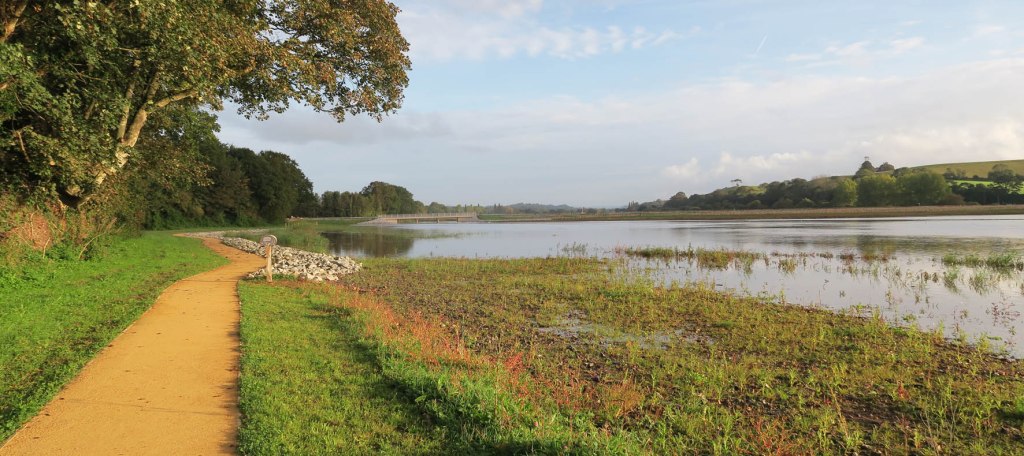
At this level there is expected that some water will cover parts of the new footpaths. And, indeed this was witnessed above South Farm Road. 

Here are some images of this historic moment:

The start of the breach, about one third of the intended 70m gap created, looking north from the beach

Partial breach looking south

Saturday flood tide looking north towards elevated South Farm Road

Tide over footpath north of South Farm Road

Looking south towards estuary mouth

Why do right wingers have such a “thing” about motor cars?

According to The Daily Mail, the Prime Minister is hoping to gain support from drivers by announcing a ‘Plan for Motorists‘ at the Tory conference early next week. 

Today’s Daily Express headline reads: Tories declare war against drivers is over!

Pro-motorist measures might include limiting council powers to impose 20mph zones and levy fines from traffic cameras and ensuring motorists get access to bus lanes for a minimum period.

Not only do we all need to reduce our dependency on cars but this policy would represent increased central “Whitehall” control over what should be devolved issues for decision making.

Neighbourhoods and communities have rights as well as car owners. Who has declared war?

Owl has often speculated that this obsession with motor cars may have resulted from Tories overdosing on, or being force fed, “Wind in the Willows” in their sensitive years. Resulting in an association with the entitled Mr. Toad, owner of Toad Hall who possessed large amounts of money but not much brain. Toad became mesmerised by automobiles, belching smoke, sound and fury, when his horse-drawn gypsy caravan was forced off the road. – Poop Poop. 

It didn’t end well for him.

Or perhaps car ownership in Britain is seen as a manifestation of “freedom” in the way that the right to bear arms is in the US.

PS Unlike “Winnie the Pooh”, the “Wind in the willows” doesn’t feature an Owl!

How a thinktank got the cost of net zero for the UK wildly wrong

Imagine demanding an “honest” debate over the cost of net zero in a report full of errors that even a schoolboy would be embarrassed about. Then imagine getting coverage of your report in the Sun, Times, Daily Mail, Daily Express and Spectator. (Not that difficult. – Owl)

Simon Evans www.theguardian.com 

Sound impossible? Well, let me tell you how Civitas, one of the thinktanks housed at 55 Tufton Street in London, did exactly that, and nearly got away with it.

On Wednesday, Civitas published a pamphlet on net zero by Ewen Stewart, whose consultancy, Walbrook Economics, works on “the interaction of macroeconomics, politics and capital markets”.

Stewart is also a climate sceptic, having written in 2021 that human-caused warming is a “contested theory”. Along with Civitas, 55 Tufton Street also houses the climate-sceptic lobby group the Global Warming Policy Foundation and its campaigning arm Net Zero Watch. These groups previously attempted to spark an “honest debate about the cost of net-zero” in 2020.

The Civitas report claims to offer a “realistic” £4.5tn estimate of the cost of reaching net zero emissions by 2050 and says “the government need to be honest with the British people”.

This estimate is much higher than the figure produced by the government’s official adviser, the Climate Change Committee (CCC), which has said that reaching net zero would require net investments of £1.4tn by 2050. Note the difference between Civitas’s “costs” and the CCC’s “net investments”. The CCC also found that reaching net zero would generate savings in the form of lower fossil fuel bills worth £1.1tn, resulting in a net cost of £0.3tn.

In his report for Civitas, Stewart adopts the well-worn climate-sceptic tactic of simply ignoring these savings. He also ignores what the Office for Budget Responsibility has called the potentially “catastrophic economic and fiscal consequences” of unmitigated climate change.

The report was timed to follow hot on the heels of Rishi Sunak’s big climate speech, in which he called for an “honest” approach to net zero that ends “unacceptable costs”.

Unfortunately the report’s author has confused power capacity in megawatts (MW) with electricity generation in megawatt hours (MWh). As a result, he presents a distinctly unrealistic “£1.3m per MWh” figure for the cost for onshore wind power. The true number is around £50-70/MWh – more than 10,000 times lower. He then compounded his embarrassment by mixing up billions with trillions.

Nevertheless the report got supportive coverage in the Daily Mail. A piece by the paper’s deputy political editor had a headline that claimed net zero “could cost households £6,000 a year”. At the Sun, the story also landed on the deputy political editor’s desk, and also inspired an editorial denouncing “dishonest rhetoric” on net zero.

In the Spectator, the climate-sceptic commentator Ross Clark hedged his bets a little, given the many errors in the report, but argued: “There is no reason to suppose Civitas’ figures will turn out to be right … But they are an important contribution to a debate.”

The Daily Telegraph and the Times – both of which have experienced teams of specialist energy and environment reporters – declined to give news coverage to the Civitas report. The Times, however, did give a prominent comment slot to Tim Knox, the former director of Civitas’s neighbours, the Centre for Policy Studies . The paper failed to mention his association with the report, which acknowledges on one page that it would not have been possible without him.

The Daily Express gave space to another Tufton Street thinktank to weigh in, with the Taxpayers Alliance also writing a comment in support of Civitas’s work.

Despite the report’s errors, the Tufton Street playbook had, at this stage, worked flawlessly, laundering a set of embarrassingly wrong numbers into the nation’s newspapers and giving the likes of the rightwing gossip blog Order Order the chance to promote them.

By lunchtime on the day after the report’s publication, however, its many errors had become the subject of viral tweets on X, previously known as Twitter, piling pressure on Civitas to respond.

An extremely hastily issued “update” on the Civitas website says: “There has been criticism on social media of two paragraphs on page 47 of this report, where capacity and output are confused. These paragraphs will be amended and updated. The author is happy to acknowledge this and correct the report.”

It then adds: “The fact remains that we are facing a huge bill for net zero that is many times more than official estimates.”

Stewart could easily have avoided this embarrassment. After seeing an embargoed copy of the report, I had emailed him pointing out the error over units the day before it was published. He never responded.

The update from Civitas ignored the many other problems with the report, including areas where it included costs for doing the same thing twice.

It is littered with assertions unencumbered by facts or evidence. It states, for example, that it is “not unreasonable to assume” that net zero would add £403bn to the cost of food.

Actual evidence that the impacts of climate change and high fossil fuel prices has added an estimated £11bn to UK food bills in 2022 alone, on the other hand, is conveniently ignored.

Similarly, Civitas cites a 2019 report from the Faraday Institute to claim that net zero could result in 114,000 job losses in the car industry, while ignoring the same report’s finding that, on the contrary, a well-marshalled shift to electric vehicles could support 246,000 jobs in the sector.

As well as ignoring the savings from net zero in terms of lower fossil fuel bills, the Civitas report sidesteps the costs of unmitigated climate change – and ignores the cost of business-as-usual.

This amounts to assuming that the UK could continue to get energy from fossil fuels for free, as well as being able to replace old gas boilers, cars with internal combustion engines and fossil-fuelled power stations as they retire with new fossil-fuelled infrastructure without ever having to pay for it.

At the time of writing, only one newspaper – the Times – had acknowledged any of these issues, albeit only half-heartedly. It has added a note to the Knox comment piece that repeats Civitas’s assertion that only two paragraphs of its report were in error. All of the other uncritical coverage remains.

Plymouth calls for voted ID to be scrapped

Voter ID should be scrapped and the money spent on encouraging more people to get interested in local democracy. That was the verdict of one of Plymouth city councillor this week.

Alison Stephenson, local democracy reporter www.radioexe.co.uk

Cllr Bill Stevens (Lab, Devonport) said considering only 38,000 out of 158,000 people eligilble to vote in person in this May’s local elections did so, effort should be spent “make it easier not harder” for people to vote.

The 32 per cent turnout in the city was slightly lower than the last comparable elections and 86 people who came to vote didn’t bring the correct ID.

New identifcation rules were introduced this year following a case of electoral fraud in Tower Hamlets in London. They have proved controversial, with critics claiming it favours older voters and addresses a problem that doesn’t exist.

The change means extra administration work for electoral staff. In Plymouth, additional funding of £60,000 has been allocated by the government to promote voter ID ahead of the next general election.

Assessing the impact of voter ID on Plymouth residents and the council, members of the audit and governance committee said they couldn’t fault the elections’ team and the low turnout was not down to voter ID.

Cllr Stevens said: “I have no criticism of the approach of our staff, this is not about them doing a shoddy job. Just the opposite; it’s about the government shoving this on us. Efforts should go into targeting those who don’t vote. All we are doing is making it harder for them, we are going in the wrong direction.

Councillors said voter ID was not a new concept internationally and it has been in place in Northern Ireland for some time.

“I understand the argument as what happened in Tower Hamlets was monstrous and in Northern Ireland there is a history of electoral malpractice but we don’t have it here in Plymouth,” added Cllr Stephens.

Cllr Lee Finn (Con, Budshead) said the campaign was well run and communicated. “We councillors have a lot of work to reach people who made it clear why they didn’t want to vote. We have to take some responsibility for the low turnout.”

Cllr Alison Raynsford (Lab, St Peter and the Waterfront) said postal voting should be promoted to make it easier for people to vote.

Councillors were told that many people are oblivious to voter ID rules as they only participate in general elections so there will need to be another media campaign.