Rishi Sunak said on Thursday that there had not been enough honesty and transparency about what is involved in the transition to net zero. And he has done various media appearances since his speech on Wednesday doubling down on the government’s U-turn on net zero policies. Here we examine five of Sunak’s key claims.
The claim: Sunak said he was not slowing down on climate targets and that the government had consistently overdelivered in meeting its targets so far.
For many years, the UK was a world leader on the climate, cutting greenhouse gas emissions further and faster than any other G7 economy. However, much of this was achieved long before this government, as a result of structural changes in the UK economy stretching back to the 1980s. The “dash for gas” took place in the 1990s and 2000s, replacing coal-fired power generation with North Sea gas, and accounts for most of the 50% fall in UK emissions since 1990.
Emissions from the power sector have continued to fall as more renewable energy is installed, helping the UK to meet its five-yearly carbon budgets to date, but carbon from transport, housing and farming has barely budged in the past decade.
Those are the key areas that would have been addressed under plans such as the switch to electric vehicles and heat pumps. Weakening those policies puts the UK’s current and future carbon targets in doubt. According to the statutory Committee on Climate Change (CCC), the government was already off track to meet the fifth and sixth carbon budgets, running from 2028 to 2032 and 2033 to 2037. Its experts are now considering whether the changes in policy are likely to make that worse.
2. Costs to consumers
The claim: Sunak said people who disagreed with him must explain why they want families to have to pay an extra £5,000, £10,000 or £15,000.
It was unclear, but Sunak may have been referring to the cost of installing heat pumps over gas boilers. The average cost of installing heat pumps is coming down, however, something the prime minister acknowledged when he said the cost of transition was falling faster than anyone had thought.
Octopus Energy has just unveiled a heat pump for a three-bedroom home that would cost £3,000 after the government’s boiler upgrade grant. Octopus said that with the increase announced by Sunak of the boiler upgrade grant from £5,000 to £7,500, an average home could get a heat pump for as little as £500 – not a figure mentioned by Sunak.
Mark Maslin, a professor of climatology at University College London, said: “His excuse again and again … is not to put the cost burden on the public – as if it is individuals that have to pay for the net zero transition. The prime minister seems to forget that government is there to enable major infrastructure changes, and the switch to renewable energy, electric cars and heat exchangers should be supported because all of them in the long run save people money and improve people’s health.”
3. Taxes and compulsory behaviour change
The claim: Sunak said he was scrapping various proposals for encouraging behaviour change – “for government to interfere in how many passengers you can have in your car”; “that we should force you to have seven different bins in your home”; “to make you change your diet and harm British farmers by taxing meat”.
None of these have ever been government policies or been about to become government policies. Sunak appeared to claim on BBC Radio 4 on Thursday that the CCC had proposed a meat tax, but it has never proposed one. The committee has recommended a reduction of meat and dairy intake by 20% by 2030.
Sunak claimed he had scrapped rules requiring households to have seven bins for recycling. In 2021, new regulations said local authorities should arrange for collections of seven different types of waste – paper, plastic, metal, glass, non-recyclables, food waste and garden waste – but there were never plans for households to have a bin for each. The recyclable waste could still all go in one bin.
His own officials reassured stakeholders hours after Sunak’s speech, saying: “It was never the case that seven bins would be needed by households.”
Companies involved in car sharing said they were surprised that Sunak appeared to be scrapping a policy to force people to car share, because it did not exist. “It would appear that the prime minister has just killed a policy that no one knew they had,” said Julie Furnell, of Mobilityways.
4. Boilers
The claim: Sunak said households would never be forced to “rip out their existing boiler and replace it with a heat pump”.
Until Wednesday, there was a 2035 target to phase out the sale of gas boilers. It would not have forced people to rip out their boiler at that date and replace it, however. In reality, only those who needed to replace their boiler from 1 January 2035 would have had to replace it with a non-fossil fuel option.
Boilers often last about 15 years, so the 2035 date gives enough time for most boilers to be gone in time for net zero in 2050.
The phasing in of heat pumps allows consumers to stop relying on ever-more expensive gas, and encourages the industry to come up with cheaper and more efficient options. It also incentivises insulation, which enables heat pumps to work more effectively. When properly installed in a home with sufficient insulation, a heat pump is already cheaper to run today than running a gas boiler.
The policy to allow gas boilers to continue to be sold for longer ultimately benefits the fossil fuel industry rather than consumers.
5. Proportionate and pragmatic
The claim: Sunak said he was taking a middle road between “eco-zealots” who want to go further and faster on cutting emissions, and climate denialists who say there is no problem.
Sunak’s new stance does not appear so pragmatic when measured against the likely economic impacts. Although many carbon-cutting measures require upfront investment, the savings in efficiency, fossil fuels and from adopting more productive new technology can rapidly pay back the cost. There are also frequently “co-benefits” to green measures, which are harder to quantify, such as improvements in health and quality of life from eating less meat, cycling or walking more, and the cleaner air from taking more cars off the road.
For the UK to be economically successful, new business investment and new or upgraded infrastructure is constantly needed – so the question is not whether to invest at all, but whether to invest in clean and green ways of doing business, or in old high-carbon ways. The government can help with this by setting out regulations that private companies must follow. If it does not do so, British people may be stuck with high-carbon infrastructure in a future low-carbon world – for instance, with roads instead of public transport, air travel instead of high-speed trains, gas-fired boilers instead of modern heat pumps.
The Office for Budget Responsibility calculated in 2021 that the low-carbon investment needed to reach net zero greenhouse gas emissions by 2050 would cost about £1.3tn in total. About £1tn of this will be offset by savings in fossil fuels and efficiency. The £300bn remaining, spread over 30 years, is now even less, the OBR said in its updated report in July, because of high gas prices – in fact, relying on gas for longer will now be more expensive than going low-carbon, it found.
Sunak, as a former chancellor of the exchequer, must have read the OBR reports, so the question is: if he is a pragmatist and economist, why is he failing to follow pragmatic economic advice?
The Department of Health and Social Care (DHSC) has paid £137m in hidden payments to a firm owned by Frank Hester, the healthcare tech tycoon. Hester, who was found to have given a £5m donation to the Conservatives earlier this month, has received around £800,000 a week to his company, Phoenix Partnership.
The enormous scale of the payments to Hester’s Phoenix Partnership has not previously been reported.
Good Law Project calculated the size of these payments by combing through four years of the department’s data on official payments.
The contracts under which the payments were made have not been published on the Government’s official procurement website, Contracts Finder, but the DHSC claims the payments were made under a published ‘contract framework’ and that there is no requirement to publish individual contract awards.
The accounts of the holding company, which is 100% owned by Frank Hester, reveal that he was paid £10m in dividends last year. In December last year Frank Hester wrote: “We are here for our NHS. We are here to help, not drive profits for shareholders or to grease revolving doors.”
The VIP lane – a system for fast-track access declared illegal in a Court case brought by Good Law Project – saw many controversial contracts given to Conservative donors, without competition.
“We’ve been shining a light on the donors’ money-go-round since the pandemic,” said the Good Law Project Executive Director, Jo Maugham, “but the huge size of Hester’s donation makes this stand out for its sheer ugliness.”
Just in case Simon Jupp is still in denial about this. – Owl
Over the past few weeks I have travelled across England speaking to leaders in local government – from Maidstone and Gravesend, in Kent, to Stoke-on-Trent, in Staffordshire, and then Surrey Heath and Woking in Surrey.
These claims come on top of a decade in which local government finance has been stretched to the limit following spending cuts through austerity, changes to the funding formula and now inflation.
It was that financial context that meant when Birmingham was hit by equal pay it basically toppled over, effectively declaring itself bankrupt by issuing a section 114.
This forces the council to stop any non-essential spending, including lots of things that you or I might consider pretty critical like youth services, or leisure centres and libraries.
Rishi Sunak accused the Labour administration in Birmingham of driving the council to bankruptcy, but the reality is a crisis that spans the country and all political colours.
At the biggest Conservative council in the country, Kent County Council, the leader Roger Gough told me things were “unsustainable”.
His deputy Peter Oakford, who is in charge of finances, painted an even bleaker picture.
“I think all of local government across the country is heading for a death spiral unless the issues around the funding of social care are resolved,” he warned.
He said that 70% of the council’s budget was now coping with spiraling demand for social care and children’s services – leaving a diminishing pot for everything else.
For example the roads budget, was squeezed despite Kent suffering record potholes in freezing weather last year, he said.
And Kent is not a council where there have been questions about bad financial decisions.
The same is true to a large extent in Stoke-on-Trent. There, leader of the council Jane Ashworth admitted she can’t promise they will balance the books next year.
They need to find £25 million and could be forced to issue a 114 notice.
She criticised the old Tory administration (that was voted out in May) for a bad decision to build a car park costing £15m but said mainly this was a national problem.
She warned that getting to that stage wasn’t a help to a council.
Stoke-on-Trent council leader Jane Ashworth Credit: ITV News
“In your stomach you tend to think that will sort it out. Well it doesn’t,” she said.
“All it does is limit your own spending powers. But as we’re limiting our own spending powers anyway.
“It doesn’t seem to be a particularly helpful device. It’s not like it brings with it a sack of money.
“It doesn’t bring any money at all – it just brings government commissioners telling you that you can’t do what you weren’t going to do in the first place.”
Stoke-on-Trent suffers with deprivation, which means it has a lower ability to raise council tax and a higher social care need.
The council argues a change in funding means less money follows need.
In Woking, where the borough council was accused of poor financial investments under the Tories, a new Lib Dem administration is looking at some dire cuts.
From parks and playgrounds, to closing public loos, the local swimming pool, and youth services, all these social services are being hit.
Next door is Surrey Heath, the backyard of Tory MP and levelling up secretary Michael Gove, whose job it is to make sure councils are operating effectively.
The Lib Dems accuse him of pushing their council to bankruptcy with a funding formula they feel is unfair to their much more affluent area.
There, they want to keep more of the business rates they raise. They don’t think they will issue a 114 notice soon but believe it could happen in two years.
The problem is everywhere – 60 council leaders and chief execs across England have spoken anonymously to the Local Government Information unit – which has shared some findings with ITV News.
“It’s the worst it’s ever been,” says one.
Councils are reduced to a “blue light service” says another.
There are warnings “libraries are gone, GP surgeries are gone”, and that they “can’t maintain roads and parks”.
Another admits: “We are on the verge of collapse…”
Meanwhile new research from the IPPR shows that councils have sold off £15bn of public assets since 2010 because of the financial strain.
The top five include: Birmingham, City of London, Westminster, Southwark, and Camden.
Councillor Niall Innes proposed to have current Stockton Council leader, Labour group leader Cllr Bob Cook, removed and replaced with the Tory group leader, Cllr Tony Riordan. He said this was to “move forward respecting the democratic choice of the electorate” after the Tories gained seats in May’s elections.
The Conservatives are the largest party on the council, with 26 seats to Labour’s 22, but Labour still enjoy the support of seven Independent councillors allowing them to keep minority control of the council, with Thornaby Independent Association (TIA) councillors and Ingleby Barwick Independent Society (IBIS) agreeing to work with Labour on an “issue-by-issue basis” without a formal coalition.
Cllr Innes, Conservative member for Hartburn to run as candidate for Stockton North MP, put forward the same motion to oust the leader in July, but withdrew it as he admitted “we just didn’t have the numbers”. He tried to withdraw it again in the meeting at Stockton Baptist Church last night (Wednesday, September 20).
But this time, mayor Cllr Jim Beall put it to a vote and let councillors decide whether the motion was to be withdrawn or not. They voted 29-25 against withdrawing it, with Labour member Cllr Paul Rowling saying the proposal needed to be heard “to create clarity for the borough”.
Cllr Rowling said: “There’s a clear stable political position in this council and bringing this motion back every month undermines that very fact. It is damaging investment in the borough so we need to create certainty.”
So the motion was heard, prompting a string of Labour members to deliver scathing critiques of the Conservatives including their electoral campaign, national and local record, while speaking up in praise of their leader. Cllr Innes’ proposal was lost by another 29-25 vote, allowing Labour to retain its control of the council.
How does “Spreadsheet” Sunak square this anomaly, or was this policy concocted in a rush? – Owl
Car firms will still be forced to meet strict quotas for selling electric cars despite the ban on sales of new petrol and diesel vehicles being delayed.
From January, just over a fifth of vehicles sold must be electric, with the target expected to hit 80% by 2030.
The government confirmed the policy would remain even though Prime Minister Rishi Sunak announced the petrol and diesel ban would be moved to 2035.
Firms that fail to hit the quotas could be fined £15,000 per car.
Industry insiders said the quotas would be a “stretch” for manufacturers to achieve, adding the delayed ban could make it harder to sell electric cars, while Auto Trader suggested firms might cut prices to boost sales and meet targets.
Prime Minister Rishi Sunak has defended the government’s decision to push back the ban, insisting the UK will meet its net zero targets.
But there was some uncertainty whether the change to the ban would affect the quotas for electric sales, before Business Secretary Kemi Badenoch confirmed that the so-called Zero Emissions Vehicle (ZEV) mandate would remain in place.
It is expected the mandate will require car makers to ensure 22% of vehicles sold are electric next year and increase each year after that to reach 80% by 2030.
If a car maker fails to hit the targets, it will either face fines expected to be £15,000 per vehicle, or have to buy a surplus credit from a company that has sold lots of electric vehicles. However, a firm could claim back penalties if it surpasses the quota in future.
One large manufacturer told the BBC that forcing firms to hit the target on electric vehicle sales, while pushing back the ban on new petrol and diesel cars, would make it harder for firms to sell the electric ones.
Ian Plummer, commercial director of online car selling site Auto Trader, said the quota on firms for electric car sales would be a “stretch for the majority of manufactures to achieve” in its current form.
He said to meet targets “some manufacturers are likely to use price reductions as a lever” to attract drivers to buy electric.
“It’s likely price will need to play a big part in this,” he added.
“Electric vehicles carry a hefty price premium, so if prices come down, they’ll suddenly become a far more attractive proposition for a greater pool of car buyers.”
According to Auto Trader, the average price of a new electric vehicle is 39% more expensive than a petrol or diesel equivalent.
Prices for second-hand electric cars are almost double (£31,946) on average compared to used petrol (£16,332) and diesel (£16,233) cars, and electric prices in the second-hand market are increasing as demand rises.
Motor industry analyst Philip Nothard, insight and strategy director at Cox Automotive, told the BBC the target for electric car sales was “arguably a greater influence” on the market than delaying the ban on new internal combustion engine vehicles.
He added that because many carmakers were already committed to hybrid and electric-only ranges based on the government’s previous 2030 policy, greener vehicles might be more attractive to buyers in terms of price because consumers would eventually face a “limited choice” of new petrol and diesel cars, causing the prices of those vehicles to rise.
The targets for electric car sales mean only a maximum of 20% or less of new cars sold by 2030 can be petrol or diesel, with some of those likely to be hybrids.
Car manufacturers have given mixed responses to the decision pushing the ban on new petrol and diesel car sales back from 2030 to 2035. Ford said the move undermined its electric car investment plans, but Toyota welcomed the announcement, saying the delay was “pragmatic”.
Motor industry sources said the impact of the ban being delayed was expected to be limited.
Mike Hawes, chief executive of the Society of Motor Manufacturers and Traders (SMMT), said the regulations compelling increased sales of electric vehicles “remains the single most important mechanism to deliver the UK’s net zero commitment”, rather than the ban on new cars with petrol and diesel engines being changed.
He said consumers needed to be encouraged to make the switch, which would “require a package of incentives for private buyers that complements those on offer to businesses, as well as measures to accelerate the rollout of charge points”.
What’s the policy now?
Prior to Mr Sunak announcing a shift in policy, the government had planned to ban the sale of new, pure petrol and diesel vehicles by 2030. Now, it will begin in 2035.
By phasing out fossil fuel-powered vehicle sales, it aims to accelerate the transition to electric and achieve net zero by 2050. Net zero is when a country’s net carbon emissions are cut to zero, and is seen as vital to tackling climate change.
Under the ban, from 2035 only electric battery-powered cars and other zero-emission vehicles will be able to be bought new. However, most people will not be affected by the ban immediately, as the majority of drivers buy vehicles second hand and only sales of new petrol and diesel models would be affected – not existing ones.
The delay in the ban brings the UK into line with the European Union, which is also banning sales of new petrol and diesel cars by 2035.
Thank Goodness! (Owl can never remember which of the seven to put out on a Friday)
Rishi Sunak’s pledge to scrap a series of green measures has prompted ridicule from critics who say they were never a reality – and on social media have taken on a life of their own.
“You boy, which of the seven bins is it this week?” read the caption above an image of Scrooge – from the 1951 adaptation of A Christmas Carol – in a tweet lampooning the prime minister’s claim he had spared people from being forced to recycle in as many different bins.
The pledge inspired the lion’s share of mickey-taking, including a mocked-up picture featuring a scene from a fictitious film, “Snow White and the Seven Bins (1937)”, with its eponymous heroine flying over a snowy, bin-strewn hillside.
The broadcaster and author James O’Brien, meanwhile, shared his relief on Thursday, telling followers: “Thank goodness I don’t have to put all seven of them out any more.”
Wednesday’s announcement at Downing Street was likened to Soviet-era rewriting of history, such as when secret police official Nikolai Yezhov was airbrushed out of a photo showing Stalin at the Moscow canal. Standing in front of Stalin in a new imaging of the photo were … those seven bins; it was followed by another version of this image in which the bins had been made to conveniently disappear.
Elsewhere, the thought of what the Conservative leader may promise next occupied users’ imaginations.
“Next up on @RishiSunak’s list: – Santa made to have a pilots licence – Monsters under your bed deported to Rwanda – Unicorns limited in horn length – Tooth fairy income will be taxed – Number limits on invisible friends kids can have,” suggested a user of X, formerly known as Twitter.
The @Parody_PM account, which boasts more followers than many MPs, promised to unveil further moves on Thursday to scrap imaginary proposals, pledging: “Today I will be announcing the cancellation of the requirement for people to work in a chain gang for five years.”
2030 is now 2035…. followed by 2040? ……….. towards 2050!
Time is running out. – Owl
“The whole point of setting interim targets is to make it more likely that you hit the main end goal. Presented with a legally binding commitment, the government risks looks incapable of delivering a plan that it can stick to.”
One can understand why Rishi Sunak sees political opportunity in watering down a few climate policies. Previous soundbites about “the economic opportunity of the 21st century” may be correct in the round, but voters have also noticed that heat pumps are expensive and that the path to net zero by 2050 involves costs as well as opportunities. A strategy that claims, in effect, that net zero can be delivered more gently is not absurd for a party that is miles behind in the polls.
The problem, though, is the one highlighted by the furious reaction from some carmakers, in particular, to Sunak’s flip-flop. Any realistic route to net zero involves winning, and keeping, the broad confidence of businesses that will be overhauling the infrastructure. At one level, hitting the 2050 target requires an enormous public-private effort to rewire the entire economy. The whole point of setting interim targets is to make it more likely that you hit the main end goal. Presented with a legally binding commitment, the government risks looks incapable of delivering a plan that it can stick to.
The former Siemens UK chief executive Jürgen Maier spoke about “a disaster for business confidence and investment” and one can understand why. The phasing-out of sales of new petrol and diesel cars by 2030 was a policy adopted as recently as November 2020, which is hardly another age. Sunak was chancellor at the time.
Manufacturing investment decisions were made on the assumption that the deadline was solid. Veering to 2035 – never mind what the EU is doing – feels perverse when the government is simultaneously throwing subsidies at Mini and Jaguar Land Rover to crank up their electric vehicle ambitions in the UK.
It was a similar story with the offshore wind auction a fortnight ago. In that case, the – still intact – goal is to have 50 gigawatts of capacity installed by 2030, which requires a tripling of what the UK already has. The auction, however, delivered precisely zero bids because the government’s maximum price for contracts was set at an unrealistically low level.
One can grumble about offshore developers’ greed – some have had a spectacularly good ride in the past – but inflation in construction costs was undeniable on this occasion. The government’s inflexible approach also looked counterproductive in its own terms if the 50GW target is to be hit. Developers next year will have a stronger negotiating hand in an auction in which the government is obliged to land more bids. A “pragmatic, proportionate and realistic” approach, to use one of Sunak’s phrases on Wednesday, would have been to try to smooth the bumps in the interests of steady delivery.
On cars again, if one challenge to electric adoption is the lack of charging points, as Sunak said, a legitimate role for government would be to fill the gaps in the network or create the incentives for companies to invest. If the problem, actually, is that the grid infrastructure is incapable of handling mass adoption of electric vehicles by 2030, it would be better to spell out the facts.
Business won’t hate everything in this reset, of course. If a “fast track” to improve connections to the grid is confirmation that decarbonisation of the power sector will happen by 2035, that is significant. The target is immensely demanding from a technical perspective – and more important than, say, what happens with heat pumps.
But consistency in policymaking matters. In attempting to signal pragmatism, Sunak may send the message to business that UK targets cannot be relied upon. An awful lot of foreign capital is required to deliver the investments behind transition. Overseas investors may fairly wonder if more U-turns are coming.
The announcement, which will also weaken the plan to phase out gas boilers from 2035, sparked an outcry from business leaders, climate campaigners and his own MPs, who believe it drastically undermines the UK’s position as a world leader on climate change.
But speaking from his Downing Street briefing room in front of a podium brandishing the Tory conference slogan of “Long-term decisions for a brighter future”, he claimed previous governments – both Tory and Labour – had sought to get to net zero “simply by wishing it”.
Mr Sunak added: “No one in Westminster politics has yet had the courage to look people in the eye and explain what’s really involved. That’s wrong, and it changes now.
“It cannot be right for Westminster to impose such significant costs on working people, especially those who are already struggling to make ends meet and to interfere so much in people’s way of life without a properly informed national debate.”
But there were significant doubts over the existence of several other policies Mr Sunak scrapped, namely a meat tax, a frequent flyer tax, “compulsory car sharing” and plans to force households to have seven recycling bins.
Plans to raise household grants for heat pumps from £5,000 to £7,500 were widely welcomed, however.
The decision to delay the ban on new diesel and petrol cars and gas fired boilers was met with significant unease from industry.
The Government’s own Climate Change Commission warned the UK has a “legal obligation to meet its net zero 2050 target” and a “commitment to hit the interim emission reduction targets” already in law.
“Today’s announcement is likely to take the UK further away from being able to meet its legal commitments,” the commission’s chair, Piers Forster, said, before adding: “This, coupled with the recent unsuccessful offshore wind auction, gives us concern.”
The Conservative Environment Network, which represents around 150 Tory MPs, warned Mr Sunak his watering down of green policies risks reputational damage for the Tories.
Director Sam Hall said: “This was an unnecessary speech that risks damaging the Conservative Party’s hard-won reputation on environmental issues.”
Labour’s shadow Climate Change Secretary, Ed Miliband, said the speech was an “act of weakness from a desperate, directionless Prime Minister, dancing to the tune of a small minority of his party”.
“Delaying the phase out of petrol and diesel cars will add billions in costs to families and damage investor confidence in the UK, as we have seen from the furious business reaction today,” he added.
The National Housing Federation said scrapping targets to insulate homes would lead to people facing higher bills “for years to come”.
Chief executive Kate Henderson said: “It’s hugely disappointing to see the Government row back from its commitments to net zero, particularly on improving the energy efficiency of our homes.
“Making homes more energy efficient is a win-win, not only helping to save our planet, but also boosting our economy by creating jobs and, crucially, saving money,” she added.
In the opinion of Claire Savage, the manager of the Ironstone Miner pub in Guisborough, the prime minister’s plan to water down net zero commitments that he says impose a direct cost on consumers is disingenuous.
And she is not alone in thinking that. Savage lives in the constituency of Simon Clarke, the Tory MP for Middlesbrough South and East Cleveland, who said on Tuesday that his constituents did not support the rollback.
The former levelling up secretary, who served under Liz Truss, posted on X (formerly Twitter): “Our climate is changing dramatically. The UK has carved out a world-leading role delivering net zero in a market-friendly way that will deliver clean, secure energy and thousands of jobs in deprived communities like Teesside. My red wall constituents overwhelmingly support it.”
And he appears to be right. Plans that could include delaying a ban on the sale of new petrol and diesel cars and watering down the phasing-out of gas boilers were not popular among those grabbing lunch in torrential rain on Wednesday.
For 17-year-old Jack McDougall, a college student, there needs to be a more holistic approach to tackling net zero: he said the commitments the prime minister was rolling back on were already not enough.
“It’s naive just to say we need to invest in more electric cars because in more deprived areas affording them is an issue. Mitigating climate change is really important so we need more investment, and wider investment, rather than less.”
McDougall, who is studying geography, added: “I’m going to spend my life being affected by this. The damage is already being proven by the wildfires we’re seeing.”
Joanne Powell, who works at a local accountancy firm, agreed but added that better infrastructure would incentivise more people to buy electric cars, rather than banning petrol cars. She said: “The main problem with the take-up of electric cars is that there aren’t enough charging points. Things are not going to get better until they install more.”
Green industry is growing on Teesside, where Europe’s first lithium refinery was given the green light last month.
It will start production in 2027, using materials imported from Australia, and is expected to have an annual production capacity of 50,000 tonnes of battery-grade lithium chemicals, enough to provide batteries for 1m electric car batteries.
“In the north-east in general, more jobs are needed,” said Amy Leach, a criminology student. “It’s worth investing to create those jobs.”
Sunak’s move is designed to shore up support among those who voted for the Conservatives in 2019. But a new poll of 4,000 voters by Public First for the centre-right thinktank Onward shows it could backfire.
According to the poll, the target of reaching net zero by 2050 is overwhelmingly popular with voters, including Conservative ones, 49% of whom say they support it while only 20% oppose it.
The individual policies Sunak will roll back also poll well: 35% of respondents said they supported the plan to phase out gas boilers by 2035, compared with 27% who opposed it. Meanwhile, 38% supported ending the sale of new petrol and diesel vehicles by 2030, with only 31% opposed to the move.
Sunak’s announcement came as a poll by the campaign group Green New Deal Rising found that most people wanted the UK government, fossil fuel companies and wealthy people to pay more for climate action measures.
A total of 60% of the public thought increasing taxes or ending subsidies for fossil fuel companies, rather than making cuts in other areas of UK spending, should be used to deliver the international climate funding the UK has promised.
At the Ironstone Miner, a Wetherspoon’s pub named after the industry that supported the town – and left its scars on the land – Savage said she felt there was a need for a more international view.
She said green technologies themselves were far from perfect and a big concern was the impact on people who lived and worked in the areas where minerals used for electric cars were mined.
“What about the people who are left with big holes in the ground and environmental problems? Aren’t we ruining the environment by digging up places?” she said. “I’m not against [net zero investment], not at all. I just want them to do what’s best for everyone, to do good.”
Pollution from treated and untreated sewage is the greatest threat to river biodiversity, causing more damage than runoff from farms, according to research.
There is a need for more regulation of water companies and improvements at their treatment plans to protect rivers, say the authors of the study.
The research from the University of Oxford was released on World Rivers Day. No river in England passes tests for chemical or biological pollution, and government targets to improve the water quality in rivers will not be met.
“Improvements to wastewater plants should be implemented along with more regulations. These efforts are crucial in safeguarding the integrity and safety of our rivers – fundamental elements of both ecosystems and human wellbeing,” said the lead author, Dr Dania Albini, of Oxford’s biology department.
Treated sewage released by water companies into rivers and raw effluent that is dumped in rivers via storm overflows is the primary driver of increased nutrients, algae and sewage fungus in rivers, according to the study.
Sewage discharge radically alters plant, animal and microbe communities and increases the abundance of harmful species. While runoff from farmland has negative impacts on river water quality, the research reveals that sewage discharge into rivers has a greater impact on water quality and the animals and plants that live in rivers.
The findings were published in the journals Global Change Biology and Ecological Solutions and Evidence.
Albini said: “Our study highlights the disproportionate impact that sewage discharge has on river quality, presenting an urgent need for a comprehensive action plan targeting the sewage discharge problem.”
Sewage from households and businesses is treated by water companies at treatment plants and then discharged into rivers. Raw sewage is also discharged via storm overflows, but this should only take place in exceptional circumstances. Water companies are at the centre of a criminal investigation by the Environment Agency and an inquiry by the financial regulator Ofwat into failures in the way they run their treatment plants.
James Wallace, of the UK-based charity River Action, said: “This important research demonstrates yet again the damage from unregulated water companies and agriculture. In addition to the catastrophic impact on wildlife from nutrient pollution, the public should be aware that sewage systems do not remove dangerous bacteria such as E.coli and intestinal enterococci from treated sewage.
“When will the government make water companies and farms clean up their act, especially in places where human lives and sensitive protected habitats are threatened?”
Separate research by Dr Leon Barron, part of the Environmental Research Group at Imperial College, which involved hundreds of samples taken from 14 waterways in Greater London over three years, reveals that 21 compounds were detected that posed a potential risk to the environment in freshwater ecosystems. The pollutants included antibiotics, pain medication and pet parasite medications, which contain neonicotinoids.
The study showed that water companies’ treatment plants and combined sewer overflows, which release raw sewage and runoff, were the main sources of chemical risks to rivers overall.
The team found that smaller rivers feeding into the Thames were most affected by wastewater pollution.
The research compared sampling taken during Covid lockdowns with those taken when society opened up again. Barron, a senior author of the research, said it was the largest study of a heavily urbanised river system and provided uniquely detailed insights into London’s water quality.
Guy Woodward, a professor of ecology in the department of life sciences at Imperial, and a co-author of the paper, said: “This … picks up on several [chemicals] that are at potentially harmful concentrations for wildlife, but which have seemingly been overlooked in traditional surveys of our water quality in urban areas at this resolution.”
“The debate about how we get to Net Zero has thrown up a range of worrying proposals and today I want to confirm that under this government, they’ll never happen.
The proposal for government to interfere in how many passengers you can have in your car.
I’ve scrapped it.
The proposal that we should force you to have seven different bins in your home.
I’ve scrapped it.
The proposal to make you change your diet – and harm British farmers – by taxing meat.
Or to create new taxes to discourage flying or going on holiday.
I’ve scrapped those too.
We will never impose these unnecessary and heavy-handed measures on you, the British people but we will still meet our international commitments and hit Net Zero by 2050.“
As a consequence of verbose schoolboy debating antics from the proposer, Mr Liddell-Grainger MP (Bridgwater and West Somerset), and nothing new from the Minister replying to him, the debate ran out of time and lapsed.
Mr Liddell-Grainger’s seat is being redrawn and he is now the prospective Tory candidate for the new Tiverton & Minehead constituency, which may explain a lot.
The debate achieved nothing more than puff a few Conservative egos.
For example Mr Liddell-Grainger managed to insert this piece of totally irrelevant electioneering propaganda into his speech:
“That reminds me that there is in Tiverton an almost dead building firm called 3 Rivers Developments. It was conceived by senior officers in Mid Devon District Council, next to the Exe. They thought it would solve their financial problems. They have never built a Lego house, never mind a real one. They do not have a clue. Six years and £21 million later, the company is stony broke.”
“She is running a mob that has convictions for polluting rivers, pays its top gun criminal bonuses and, despite the wettest July on record, still has a hosepipe ban. It is operating like a mafia.
“This is absolutely appalling. May we have an urgent debate in Government time on these ruddy water companies, who are blackmailing their customers and parliamentarians to stop the truth coming out?”
Mr Liddell-Grainger, remember, was the chair of Simon Jupp’s previous February Westminster Hall debate on SWW, used by both of them to indulge in political point scoring, thereby also achieving nothing of consequence.
On Tuesday 19 September Mr Liddell-Grainger (Landed Gentry according to Wikipedia) was granted a half hour slot for another Westminster Hall debate.
His opening harumph which did no more than repeat SWW’s well known failures in the style of a schoolboy from the lower fourth debating society took half of the 30 minutes allotted to the debate.
The other half was taken by a “reply” from the Parliamentary Under-Secretary of State for Environment, Food and Rural Affairs, Rebecca Pow. She listed all the actions the Government has taken (mostly only recently). Here is a sample quote:
“No Government have ever done as much as this Government are doing to tackle storm overflows. In 2013, the Government set out expectations that water companies must monitor the vast majority of those combined sewer overflows, as I referenced earlier. It is that monitoring that has meant that regulators understand the scale of combined sewer overflow discharges and can take stronger action within the existing legal framework.
In 2022, the Government launched the storm overflows discharge reduction plan. Our strict targets will see the toughest ever crackdown on sewage spills and will require water companies to deliver the largest infrastructure project in water company history—that is, £56 billion by 2050….”
In between, the only other speaker in the “debate”, Richard Foord, managed to put his finger two relevant issues but didn’t get answers.
At around half time when Richard Foord asked Liddell-Grainger if he would “give way” he did so saying:
“I give way to the Member for the women’s auxiliary ballerina corps.”
Yes, seriously, it’s on the record – Owl
Richard Foord’s point was:
“The hon. Member is giving a bombastic speech of which the late Lord Flashheart would have been very proud. What does he think of the actions of the Government in this space? Although he seeks to shift the blame on to water companies or regulators, the Government ultimately have the responsibility for the regulation of South West Water and for holding it to account.”
This was met by more bluster.
At one point the Minister said:
“The Environment Agency is investigating that (discharge at Harlyn bay, Cornwall). Clearly, action can be taken only if we have the evidence and if there is an issue. There is a permit system and there are exemptions for extreme weather—we know why that is in place—but I have asked the CEO to ensure that, should pollution be identified, signage is put on the beach so that it is made very clear to bathers and surfers alike. They have taken up my point.”
So Richard Foord asked this question:
“I heard the Minister say a moment ago that enforcement action can only take place where there is evidence. Is it the case that the Minister does not have sufficient evidence for enforcement action to take place against South West Water?”
Here is the Minister’s response:
“it would need to stand up in court if the EA chose to prosecute any of the cases raised by the BBC. If it stands up in court and the information is there, of course the EA will take action if it finds non-compliance.”
Owl’s take
The Tories are still in denial over the consequences of privatisation and the effect austerity cuts have had on regulators, trying to blame everyone else.
“If this is true, the decision will cost the UK jobs, inward investment, and future economic growth that could have been ours by committing to the industries of the future.
“It will potentially destabilise thousands of jobs and see investment go elsewhere. And ultimately, the people who will pay the price for this will be householders, whose bills will remain higher as a result of inefficient fossil fuels and being dependent on volatile international fossil fuel prices.” Chris Skidmore, a Conservative former energy minister.
Rishi Sunak risks sparking a furious Tory party row as he signalled plans to water down the government’s net zero pledges.
The prime minister confirmed he would use a speech in the coming days to announce a major shift in the Tory party’s approach to green policy, saying he wants to achieve net zero in a more “proportionate way”.
It comes after the BBC said it had seen documents suggesting that changes could be made to as many as seven core commitments, including weakening the plan to phase out gas boilers from 2035 and delaying the ban on the sale of new petrol and diesel cars – currently due to come into force in 2030 – by five years.
Confirming the reports on possible changes to policy, Mr Sunak said: “We are committed to net zero by 2050 and the agreements we have made internationally – but doing so in a better, more proportionate way.
“Our politics must again put the long-term interests of our country before the short-term political needs of the moment.”
It is also understood that some Tory MPs are considering submitting letters of no confidence in the prime minister if he goes ahead with the changes.
Mr Sunak has repeatedly deployed the language of pragmatism and proportionality when discussing net zero, but campaigners and activists have charged him with displaying a lack of interest in climate policies.
Tory success in the summer’s Uxbridge and South Ruislip by-election, won largely through a campaign against the expansion of the ultra-low-emission zone, has led some MPs to call for Mr Sunak to water down or abandon Britain’s net zero pledges.
While Mr Sunak has repeatedly said he is committed to cutting carbon emissions, the granting of new oil and gas licences for the North Sea and recent moves to curb green policies have attracted criticism.
Chris Skidmore, a Conservative former energy minister who has become increasingly outspoken on net zero, told reporters: “If this is true, the decision will cost the UK jobs, inward investment, and future economic growth that could have been ours by committing to the industries of the future.
“It will potentially destabilise thousands of jobs and see investment go elsewhere. And ultimately, the people who will pay the price for this will be householders, whose bills will remain higher as a result of inefficient fossil fuels and being dependent on volatile international fossil fuel prices.
“Rishi Sunak still has time to think again and not make the greatest mistake of his premiership, condemning the UK to missing out on what can be the opportunity of the decade to deliver growth, jobs and future prosperity.”
Hannah Martin, a co-director of Green New Deal Rising, said: “Once again this government has shown that they are hell-bent on breaking their promises and doing nothing to stop climate chaos. Just weeks after the hottest summer on record, Rishi Sunak has decided to ignore science and stoke a culture war.
“Whilst global leaders are meeting to discuss how to tackle the climate crisis, he has stayed home to set fire to some of the only remaining climate policies this government had left.
“Not only will the UK miss out on the opportunity to create millions of good green jobs and secure our energy future, we will be once again seen as a laggard as we duck out of doing our fair share to tackle the biggest existential crisis we face.”
Greenpeace UK’s policy director, Doug Parr, said rowing back on such policies would only ensure “we stay at the mercy of volatile fossil fuels and exploitative energy companies”.
“The many scandals we face, like the cost of living, inequality, and the energy crisis, can be fixed with the same solutions we know will tackle the climate crisis. Sunak must explain how we will meet our net zero commitments by rowing back on all of the policies to get us anywhere near it.”
And Jess Ralston, head of energy at the Energy and Climate Intelligence Unit, said that backpedalling on energy efficiency would only leave the poorest with higher bills. “All of this would leave us more dependent on foreign oil and gas, less energy independent, and with investors spooked, putting jobs in the industries of the future in jeopardy,” she said.
A government spokesperson said: “The government remains completely committed to its net zero commitments, with the UK having cut emissions faster than any other G7 country. Our approach will always be pragmatic and ensure costs are not passed on to hard-working families.
A grammar school in Devon is the latest to be confirmed as having been constructed using reinforced autoclaved aerated concrete, known as RAAC. Colyton Grammar School, located in the village of Colyford in East Devon, has confirmed the areas affected in the school have been closed for safety.
RAAC has been deemed dangerous by the government due to its tendency to crumble. Overall, 174 education settings in England have been confirmed with Raac as of September 14.
A spokesperson for Colyton Grammar School said: “We can confirm the existence of RAAC in a small part of our estate, and the affected areas are now closed. We are working with the DfE and related experts to mitigate the issue and to minimise the impact on students’ learning.”
DevonLive has also contacted Colyton Grammar School for comment. Elsewhere, Petroc College, situated in both Barnstaple and Tiverton, has also been impacted by RAAC.
Discussing the dangers of RAAC, Education Secretary Gillian Keegan said: “We are taking a cautious approach so every parent in England can be reassured their child is safe in their school. School and local leaders deserve huge credit for making sure the vast majority of settings with confirmed Raac are continuing to offer pupils face-to-face learning – including all of the 147 schools initially identified two weeks ago.
Liz Truss has been claiming from the £115,000-a-year public fund awarded to former prime ministers to run their offices, despite only serving for 49 days.
Cabinet Office accounts released on Tuesday show that the Conservative MP claimed £23,310 in her first five months out of office.
It was understood she has continued to claim in the current financial year that started in April, but the sum will not be disclosed until next year’s report.
Ms Truss’s office declined to comment.
After she announced her resignation, Labour leader Sir Keir Starmer was among those arguing that Ms Truss should “turn it down” because of the brief time spent in No 10.
The Liberal Democrats’ Cabinet Office spokeswoman Christine Jardine urged Prime Minister Rishi Sunak to “do the right thing and stop Liz Truss from claiming taxpayers’ cash from the ex-PM fund”.
“It’s an outrage that while families struggle to pay their bills and put food on the table, Liz Truss profits from her own failure,” she said.
“If Liz Truss wants to cut tax she should lead by example and stop taking hardworking British taxpayers for a ride by claiming handouts.”
The Public Duty Cost Allowance affords former prime ministers up to £115,000 a year to cover office and secretarial costs arising from public duties.
Applicable costs including those for running an office, handling correspondence as an ex-PM and for support with visits.
Sir Tony Blair and Sir John Major were the only former leaders to claim the maximum amount in 2022/23, though Gordon Brown was close on £114,627.
Ms Truss’s chaotic tenure in No 10 ended on October 25 after losing the support of Tory MPs.
On Monday she defended her economic crisis-inducing mini-budget a year on from her chancellor Kwasi Kwarteng unveiling the £45 billion package of unfunded tax cuts.
She hit out at economists and “institutional bureaucracy” for her downfall as she hinted at further plans to intervene in Tory politics at the party conference next month.
The Cabinet Office accounts also detailed the total cost of Boris Johnson’s taxpayer-funded legal defence to the inquiry that found he lied to MPs over partygate.
The final cost was put at £263,079, in line with what the department had previously revealed.
The public spending watchdog questioned the decision to use taxpayers’ money for Mr Johnson’s lawyers.
National Audit Office chief Gareth Davies said he looked at the spending because while the amount was “not quantitatively material” in the wider scale of the Cabinet Office’s finances, there was “significant public interest as to whether these costs are a legitimate use of public money”.
He said the arguments put forward to justify the spending – including that similar legal support had been provided to ministers appearing before public inquiries – were not “wholly persuasive” and it was a “borderline” judgment.
Text of recent Facebook page from Paul Hayward, Independent Cllr, Deputy Leader EDDC.
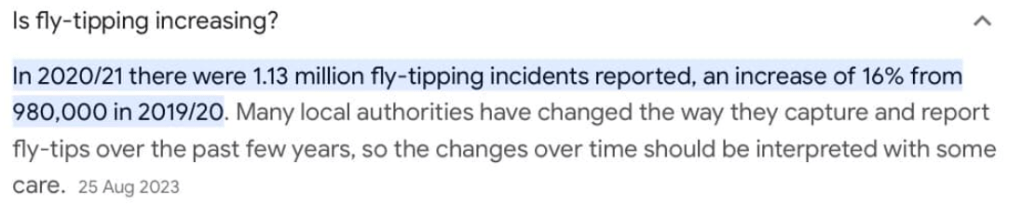
“You may have seen a recent post promoting the campaign of a certain local MP by a colleague in the same party which criticised the district council for low flytipping enforcement numbers.
The photos below (screenshots from relevant articles) go some way to explain why the statistics published by the MP (and shared without question) should be taken with a pinch of salt and read in the context of a forthcoming general election.
But, the facts are simple. Devon County Council refuses to permit trade waste disposal and recycling at its waste centres in East Devon. It levies some of the highest charges for household waste disposal of common household items. This is what causes fly-tipping. Devon County Council POLICY.
Not the authority that has to pick up the waste from laybys and streets, but gets virtually no money from DCC to do so. Not the farmers and landowners who have to pay to have flytipped material cleared from their private land.
It can be done differently but Councillors at DCC just stick their fingers in their ears and use the subject for electioneering- one might argue that they should have done something while they could instead of bleating about it now.
It can be done differently. Take Slough Borough Council. A builder can take their trade waste from a clients house to the tip. Their van is weighed in and weighed out. They pay a flat rate per tonne on the difference. They get a receipt and can give that to their client to get reimbursed. But, they don’t just dump it. No, they have to separate and recycle like everyone else. So, not only does Slough get paid for trade waste, they sell the tipped material for profit AND their fly-tipped rate is very low. Which means they save money too on the collection and disposal of fly-tipped waste. It’s a win-win-win. Because they provide the amenity for genuine builders, chippies, tilers, sparkys, plumbers, plasterers to use.
But Devon refuse to listen. Refuse to act. Refuse to help.
And so people take the law into their own hands under cover of darkness. We all pay the price of this rural blight and nuisance because the County Council is too insular, wooden and set in its ways to try a different approach. They’ve been asked multiple times, but they do NOTHING.
But, funnily enough, you don’t see the hopeful Tory candidate having a pop at the Tory run County Council. Strange huh?
It’s almost like they know that the problem is close to home, but they dare not rock the boat. The final photo also reveals that Government cuts (yes, a Tory government) are at the core of why local authorities down the line are struggling to cope).





 East Devon Watch