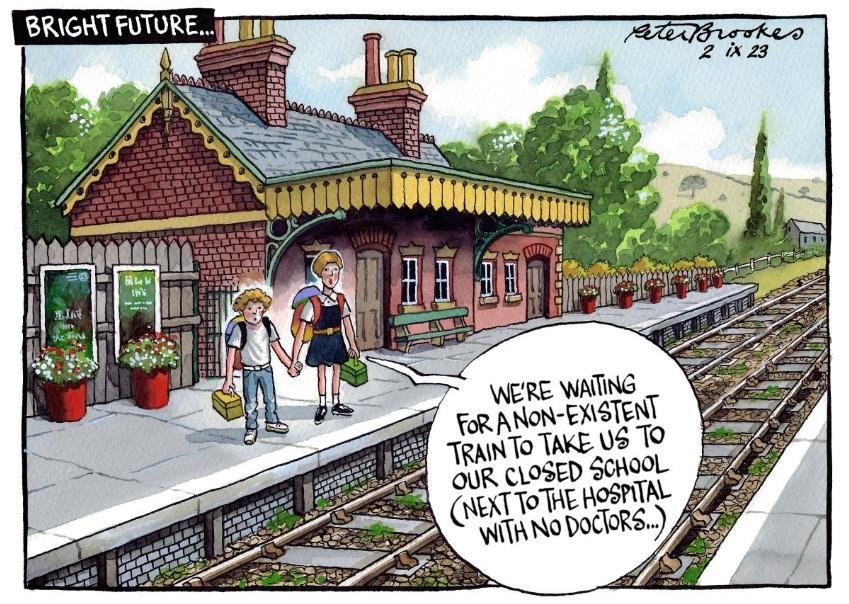
Rishi Sunak Halved The Amount Spent On School Rebuilding Despite Concrete Fears

Blame the Techbro “Beancounter”.

A self inflicted crisis by the Tories – Owl

Rishi Sunak halved the number of schools in a government rebuilding programme despite warnings that they posed a risk to pupils and teachers, a top civil servant has claimed.

Kevin Schofield www.huffingtonpost.co.uk 

Jonathan Slater, who was permanent secretary at the Department for Education for four years until 2020, said it was “frustrating” that the requests were rejected by the Treasury.

His comments drag the prime minister into the growing scandal over crumbling concrete in schools.

It emerged last Thursday that more than 150 schools had been ordered to either partially or completely close because the “RAAC” concrete used to build them is at risk of collapse.

Appearing on Radio 4′s Today programme this morning, Slater said education officials had asked for funding to replaced between 300 and 400 schools a year because of the problem.

However, they were only given the green light to replace around 100 of them.

He said: “We weren’t just saying there’s a significant risk of fatality, we were saying there was a critical risk to life if this programme is not funded.

“It was frustrating. I thought we would get there in the end because of the quality of the data, the age of austerity was over, Boris Johnson had been appointed prime minister, he wanted to put more money into schools we were told.

“I actually did think we would be able this time to increase the funding for the rebuilding programme.”

However, he said that at the time of the next government spending review, the number of schools in the rebuilding programme was halved.

He said: “The spending review was completed a year after I left the department and I was absolutely amazed to see that the decision made by the government was to halve the school rebuilding programme – down from 100 a year to 50 a year.

“The actual ask in the spending review 2021 was to double to 200 … but the actual decision that the chancellor took in 2021 was to halve the size of the programme.”

Asked who the chancellor was at the time, Slater said: “Rishi Sunak.”

A former top civil servant accuses Rishi Sunak of failing to fully fund a critical schools rebuilding scheme when he was Chancellor.

Jonathan Slater tells @BBCNickRobinson 300-400 schools a year needed to be rebuilt but there was only funding for 100, which was further cut to 50

— BBC Radio 4 Today (@BBCr4today) September 4, 2023

Lib Dem education spokesperson Munira Wilson said: “This bombshell revelation shows the blame for this concrete crisis lies firmly at Rishi Sunak’s door.

“He slashed funding to repair crumbling classrooms when officials said it needed to be increased. Now children and parents across the country are paying the price for this disastrously short-sighted decision.

“The government must publish the evidence that was provided by officials at the time, and Rishi Sunak must come before parliament today and explain why this potential threat to pupil’s safety was ignored.

“Families seeing their return to school ruined deserve full transparency from the prime minister about his role in this scandal.”

PM announces transformative school rebuilding programme

No, not Rishi Sunak 2023 but Boris Johnson 2020. In fact Rishi Sunak  halved the budget in 2021.

500 new schools to be built by 2030 but by July 2023 only 4 completed.

Prime Minister’s Office, 10 Downing Street 2020 www.gov.uk

Schools across England are set for a transformative ten-year rebuilding programme under radical plans to be set out by the Prime Minister today [Monday 29 June].

Representing the first major rebuilding programme to be launched since 2014, schools will benefit from substantial additional investment. Schools and colleges will also receive funding this year to refurbish buildings in order to continue raising standards across the country.

The rebuilding programme will start in 2020-21 with the first 50 projects, supported by over £1 billion in funding. Further details of the new, multi-wave ten-year construction programme will be set out at the next Spending Review.

Investment will be targeted at school buildings in the worst condition across England – including substantial investment in the North and the Midlands – as part of the Prime Minister’s plan to level up opportunity for all.

Prime Minister Boris Johnson said:

All children deserve the best possible start in life – regardless of their background or where they live.

As we bounce back from the pandemic, it’s important we lay the foundations for a country where everyone has the opportunity to succeed, with our younger generations front and centre of this mission.

This major new investment will make sure our schools and colleges are fit for the future, with better facilities and brand new buildings so that every child gets a world-class education.

He will commit:

  • Over £1bn to fund the first 50 projects of a new, ten-year school rebuilding programme, starting from 2020-21. These projects will be confirmed in the autumn, and construction on the first sites will begin from September 2021.
  • £560m and £200m for repairs and upgrades to schools and FE colleges respectively this year.

Rebuilding projects will be greener, helping meet the government’s net zero target, and will focus on modern construction methods to create highly skilled jobs and boost the construction sector.

Investment in schools will be prioritised on the basis of buildings’ condition and further details of the programme, including the approach to eligibility will be confirmed following the Spending Review.

The £560m for school repairs and upgrades comes on top of over £1.4bn in school condition funding already committed in 2020-21.

The £200m for FE colleges this year brings forward plans announced by the Chancellor at Spring Budget this year for £1.5bn of investment over five years to transform the FE college estate.

This fast tracked activity will further support the government’s wider plans to protect jobs and incomes and drive forward the country’s economic recovery from the pandemic.

Later this year government will launch a competition for further funding to ensure that all of England is covered by Institutes of Technology, making sure everyone has the chance to gain higher technical skills and helping unlock growth across the country.

Earlier this month, the Education Secretary announced a £1bn Covid catch-up plan to tackle the impact of lost teaching time.

This included new measures to help primary and secondary pupils catch up, including £650m for state schools to lift educational outcomes and a £350m tutoring scheme specifically for the most disadvantaged

This one-off grant to support pupils in state education during the 2020/21 academic year recognises that these young people have lost time in education as a result of the pandemic, regardless of their income or background.

In his first months in office, the Prime Minister announced an extra £14.4 billion in funding for schools over three years. That translates to £135 million a week and means that every secondary school will receive at least £5,000 a year for each pupil, and primaries at least £4,000 a year.

Crumbly concrete: “Spend what it takes” but there’s “No new cash”!

Education ‘in complete chaos’ as Labour plans to ramp up pressure in parliament

Pressure is mounting over the Rishi Sunak government to spell the scale of crisis to the British parents as Labour accused the education department of being in “complete chaos”.

www.independent.co.uk 

Labour’s shadow education secretary Bridget Phillipson said it is “vital” that the government publish the list of all RAAC-constructed buildings that are dangerous “as soon as possible”.

It comes as education secretary Gillian Keegan is set to face the morning broadcast round this morning for the first time since a crumbling concrete crisis and the parliament returns from recess.

Meanwhile, the Treasury has said there is “no extra cash” to fix classrooms prone to collapse, despite Jeremy Hunt’s promises to “spend what it takes” to make classrooms safe.

Speaking on the BBC, Mr Hunt would not speculate on the potential cost of fixing the problem, but said: “We will spend what it takes to make sure children can go to school safely, yes.”

However, Whitehall sources reported that additional costs for headteachers, including transport to alternative schools and catering, will not be covered by central government, according to reports in The Guardian.

Covid testing to be scaled up in England as winter pressure on NHS draws near

Scientists warned last month that the UK was nearly “flying blind” when it comes to Covid, because many of the surveillance programmes that were in place at the height of the pandemic have been wound down.

Consequences of a Government that knows the cost of everything but the value of nothing. – Owl

Nicola Davis www.theguardian.com 

Coronavirus testing and monitoring are set to be scaled up for the winter, the UK’s public health agency has said, as pressures on the health service are expected to rise in the coming months.

Scientists warned last month that the UK was nearly “flying blind” when it comes to Covid, because many of the surveillance programmes that were in place at the height of the pandemic have been wound down.

Now the UK Health Security Agency (UKHSA) has confirmed that it is planning to boost testing and surveillance as winter approaches.

The announcement has been made as schools and universities prepare for the return of students this week after the summer break, employees head back to work and indoor gatherings become more common – factors that are known to increase the risk of respiratory infections, including Covid, spreading.

Prof Steven Riley, the director general of data, analytics and surveillance at the UKHSA, said: “Planned scaling up of testing and community surveillance for the winter season, when health pressures usually rise, is in progress and UKHSA will make a further announcement regarding community surveillance plans for this winter shortly.

“Protecting the public from Covid-19 remains one of our top priorities. We continue to monitor the threat posed by Covid-19 through our range of surveillance systems and genomics capabilities, which report on infection rates, hospitalisations and the risks posed by new variants.’’

The UKHSA announced last week that the autumn Covid and flu vaccination programme in England was being brought forward to September to ensure that the most vulnerable are protected as the winter draws near.

A new variant, BA.2.86, which has been detected in a number of countries around the world including the UK, the US and Denmark, is probably behind the shift. The variant is being closely monitored because it contains a large number of mutations that might help it to evade immune defences – although experts say little is currently known about how big an impact it may have.

Prof John Edmunds of the London School of Hygiene & Tropical Medicine, said the discovery of the variant in a number of countries in a short space of time was one reason for concern. Another is the large number of genetic differences compared with other Omicron subvariants.

“It is definitely concerning, there’s no question about that,” he said. “The good news is we haven’t seen it suddenly take off anywhere.”.

Edmunds said there were still many unknowns about the variant, making it difficult to assess how much of a risk it posed – including whether it would cause more severe disease than other variants in circulation.

One reason for that, he said, is that there was less data available.

“Our surveillance has been much reduced so we are slightly blinded compared to where we have been in the past,” he said. “If you compare it to where we were with Omicron, it’s really very different in terms of just the quality of our surveillance.”

Dr Emma Hodcroft, a molecular epidemiologist at the University of Berne and the University of Geneva, agreed, adding that time was needed to see how the situation progresses.

“If the ‘slow start’ is real, it may eventually fade away, could linger on at a low frequency, or further mutations could enhance transmission and lead to faster spread,” she said.

Hodcroft said at the moment there was no cause for undue worry about the coming months. But she added:“We should be realistic that we often see waves and that for many people, immunity has waned as they haven’t been boosted or infected in a while.

“At the same time, we have the return from holidays, restart of schools, and resumption of a lot of business travel and meetings – all things we know contribute to respiratory viruses being able to get around.”

Edmunds said Covid had yet to follow seasonal patterns, with cases rising rather than falling over the summer. A key driver in waves so far had been changes to the virus itself, he said.

According to the latest data from UKHSA, largely covering the period between 21 August and 27 August, both the increase in Covid case rates, picked up through testing in hospitals, and the recent rise in Covid hospital admissions in England have stabilised.

Restrictions have been lifted as part of the government’s “living with Covid” strategy, but Dr Mary Ramsay, the head of immunisation at the UKHSA, said people with any symptoms of respiratory illness should avoid mixing with others.

Edmunds agreed. “I doubt whether we’ll see much of a return to a mask-wearing and hand-washing, but those things can help reduce spread as well,” he said.

More on Whelk Stall: Scale of Musical Chairs in Government since 2019 revealed 

‘No Way To Run A Whelk Stall’: Jeremy Hunt Savaged Over Shambolic Tory Record

Jeremy Hunt was left squirming on live TV as he was savaged over the Tories’ chaotic record in government.

Kevin Schofield www.huffingtonpost.co.uk 

The chancellor was shown a list of the astonishing number of cabinet jobs given to senior Conservative MPs since the last general election in 2019.

Nadhim Zahawi tops the lost with an incredible nine positions, while Oliver Dowden and Lucy Frazer have seven each, followed by Dominic Raab and Steve Barclay on six.

Appearing on Sunday Morning With Trevor Phillips on Sky News, Hunt was told: “One cabinet minister who’s not even in the cabinet any more [Zahawi] had nine jobs.

“This is a higher turnover of even a Premier League manager. You and I support the same team, Chelsea. A Chelsea manager feels safer than a cabinet minister.

“This is no way to run a whelk stall, is it, let alone a government?”

Hunt replied: “We have had turbulence caused by things like the pandemic [and] big changes in our economic model.

“What I would say is that since Rishi Sunak has become prime minister that has changed, and he has made only the most limited changes.

“The most recent change, the defence secretary, was caused by a personal decision by Ben Wallace to step down.

“What Rishi Sunak is interested in is not the personalities, but who is going to get the job done and when people get the job done, he backs them.”

Michael Gove’s U-turn on water is a weaselly move

“When making the relevant decision, the competent authority must assume that nutrients in urban wastewater from the potential development . . . will not adversely affect the relevant site,” The government amendment to the levelling-up and Regeneration Bill says.

An “adverse effect” from these nutrients “is not a ground for the competent authority to determine” that the development (basically, new housing) will add to pollution, “even if a finding . . . to the contrary is made”.

Welcome to Alice Through the Looking Glass!

Matthew Parris www.thetimes.co.uk (Extract)

Early this year The Times dedicated itself to a Clean It Up campaign to restore Britain’s rivers and waterways to ecological health. How are ministers doing in response? I hate to bother you with the actual wording of a piece of proposed legislation but don’t worry, I’m not asking you to make sense of it. I’m inviting you to take note of weird syntax, tortured logic and opaque intentions, then smell a big, fat rat.

The Levelling-up and Regeneration Bill has suddenly, weeks after most of it has gone through parliament, been landed with a late clause governing the impact of housebuilding on natural habitats. “When making the relevant decision, the competent authority must assume that nutrients in urban wastewater from the potential development . . . will not adversely affect the relevant site,” it reads.

Nutrients are what you flush down the lavatory, which can wreck the ecology of our rivers. So put in the language we are pleased to call English, this paragraph means that when considering an application to build, the authorities must assume that what poisons rivers does not poison rivers.

The clause goes on to deem that any concern about an “adverse effect” from these nutrients “is not a ground for the competent authority to determine” that the development (basically, new housing) will add to pollution, “even if a finding . . . to the contrary is made”. Thus, any finding that extra sewage will pollute rivers cannot be grounds for finding it will pollute rivers.

This is pure Alice Through the Looking Glass. In plain language, it means that if a new housing development will add to what’s tipped into our rivers, planning authorities must assume it won’t. And that is what the two responsible secretaries of state, Michael Gove and Thérèse Coffey, now want parliament to lay down. Clearly the big housebuilding companies have got at the prime minister; and the prime minister has got at Gove and Coffey; and Gove and Coffey have now executed a complete U-turn on a piece of environmental law that nibbled at the edge of big housebuilders’ profits……

……..Farewell, then, to this perhaps last of the once-famous Brexit dividends: that we’d be free to frame our own, enhanced, environmental protections. Farewell to the 2021 Environment Act, whose stipulation that the act “will not have the effect of reducing the level of protection provided for by existing environmental law” must urgently be removed by parliament if the government is not to be massacred at judicial review. In keeping with the new drafting style, the stipulation could be left in place but an amendment brought in providing that anything found to be a reduction in environmental protection must be assumed not to be a reduction.

Farewell, too, to the Rishi Sunak who as a young MP sat on the environment, food and rural affairs select committee. Farewell to the Michael Gove whose 2017 post-referendum speech (a fine speech: “The Unfrozen Moment — Delivering a Green Brexit”) quoted Philip Larkin, waxed lyrical and declared that “I have no intention of weakening the environmental protections that we have put in place while in the European Union”.

“We live on the same planet,” he said. “The only one we know which can sustain human life . . . Again and again, societies and civilisations have been gripped by hubris, by the belief that this time is different, that the cycles of the past have been broken.”

I plead guilty to hubris. I have believed that Gove would be different, that the cycle of ministers making promises and then forgetting them would be broken. I still cannot quite believe he is acquiescing in
this retreat.That Larkin poem lamented the approaching despoilation of our country. It bears the title Going, Going and includes the line: “And that will be England gone.” Gove should re-read it.

Top 10 Tory donors since Rishi Sunak became prime minister

A new analysis by The Independent reveals the prime minister is being forced to rely on a dwindling pool of donors, as support for the Conservatives drains away and opinion polls show the party is on course to be booted out at the next election.

Adam Forrest www.independent.co.uk

An astonishing four-fifths of all individual donations made to the Conservative Party since Mr Sunak entered Downing Street have come from just 10 wealthy people, according to an analysis by The Independent.

The 10 super-rich backers have given a combined sum of £10.6m to the Tories since Mr Sunak became PM – accounting for 83 per cent of the £12.7m received from individuals since he took charge.

That figure was much lower under his predecessors Boris Johnson, Theresa May and David Cameron – and suggests the party is becoming more “heavily reliant” on a small group of supporters under Mr Sunak than under other recent Tory prime ministers.

Egyptian-born billionaire Mohamed Mansour, a former minister in Hosni Mubarak’s government, is the biggest single backer of the Sunak era. The UK-based retail magnate said he gave £5m in May because the PM “understands how growth is generated”.

Others in the top 10 donors list for the Sunak era include long-time Tory backers such as Lubov Chernukhin – wife of the former Russian oligarch Vladimir Chernukhin – who gave £136,000. Her lawyer has insisted that her donations “have never been tainted by Kremlin or any other influence”.

Here are the top Tory donors since Rishi Sunak became PM

£5m – Mohamed Mansour

The Egyptian-born billionaire – a former minister under the Hosni Mubarak government – is chairman of retail and investment giant Mansour Group. The UK-based mogul said he made the huge donation because Mr Sunak “understands how growth is generated”.

£2.5m – Graham Edwards

Mr Edwards owns one of Britain’s biggest private property firms, Telereal Trillium. He said in June he had donated so much since Mr Sunak came to power because the PM was someone who could “get things done” and would keep the “dangerous ideologies” of the Labour Party out of power.

£2m – Amit Lohia

Dubbed the “Prince of Polyester”, the Indian-born 48-year-old is the non-executive director of Indorama Ventures Ltd – a major producer of polyester. His spokesperson said the donation, his first to the Tories, was made in a “personal capacity”.

£336,000 – Richard Harpin

A regular Tory donor, the chief executive of insurance giant HomeServe has personally donated more than £2m to the party since 2008. Mr Harpin’s company was fined £30m in 2014 for misselling insurance.

£250,000 – Malcolm Healey

The billionaire owns Wren Kitchens’ parent company, West Retail Group, and has given more than £3m personally to the party since 2017. Wren Kitchens was criticised for claiming millions of pounds’ worth of Covid furlough money, despite recording a £75.3m profit.

£163,000 – Christopher Wood

Professor Wood is the director at Medannex and several other biopharmaceutical firms. Another consistent Tory donor, he has personally given more than £1m to the Conservatives since 2014, the Electoral Commission records show.

£136,000 – Lubov Chernukhin

The former banker is married to the former Russian oligarch Vladimir Chernukhin. She has given more than £2.4m to the Tories since 2012. She reportedly paid £45,000 for a game of tennis with Boris Johnson. Her lawyer previously told the BBC her donations to the party “have never been tainted by Kremlin or any other influence”.

£125,000 – Selva Pankaj

Mr Pankaj founded the Regent Group, which has interests in education, training and investment management and runs London’s Regent College. He has personally given more than £600,000 to the Tories.

£100,000 – Alasdair Locke

The energy magnate is the founder of Motor Fuel Group, the UK’s largest owner of petrol station forecourts. Mr Locke has personally donated almost £1m to the party. He insists that he has “never sought to influence or shape policy”.

£83,000 – Michael Hintze

The UK-based, Australian-British financier is the founder of asset management giant CQS. Mr Hintze has given more than £4.5m to the Tories since 2001. He was given a peerage under Boris Johnson in 2022.

Concrete crisis is tip of the iceberg in a failing school estate

In one hospital, heavy patients must be treated on the ground floor because the combined weight with equipment is too heavy to be safe.

Meg Hillier, Chairwoman of Public Accounts Committee

It takes a lot to shock members of the Commons public accounts committee. In our review of major government programmes we see many costly failures. But in late July members visited two hospitals built with RAAC, a lightweight form of concrete cast in planks, and it was jaw-dropping.

We had held a hearing on RAAC in schools a week before but seeing the real-life impact was eye-opening — and alarming. In one hospital, staff can carry out roof maintenance only if they and their tools are below a certain weight. Heavy patients must be treated on the ground floor because the combined weight with equipment is too heavy to be safe. Roof failure is a daily risk.

The issue of RAAC in schools was first identified as a significant problem after a roof collapse in 2018. But it was as far back as 1999 when the standing committee on structural safety recommended that all buildings with pre-1980 RAAC plank roofs should be inspected. So why was action not taken earlier?

The most recent survey of stock condition of schools in England was in its early stages in 2017 and, with fractured ownership of school buildings and varied skills and resources at local level, there was too little oversight in Whitehall of the shared risks and potential costs across the estate. It wasn’t until 2020 that the current school rebuilding programme was established.

The problems with RAAC are concentrated in schools built between the mid-1950s and 1980s. It is not a coincidence that nearly three quarters of the schools in the poorest condition were built between 1951 and 1980. Funding is undoubtedly an issue. The longer schools are expected to operate beyond their expected life, the more they cost to maintain. Between 2016 and 2023, around three quarters of funding for buildings was spent on maintenance and repair. The Department for Education argued that £7 billion a year would be the best-practice level of annual capital funding. It asked the Treasury in 2020 for £4 billion a year and was allocated £3.1 billion. So even on its own estimates there is not enough funding to do the necessary work.

The impact of this week’s announcement on the wider school maintenance and replacement programmes is likely to be significant. At our hearing in July it was clear that officials were being thorough with the proportion of school buildings they were working on, including the surveys of 600 schools with RAAC which have led to this week’s decision. But this is the tip of the iceberg of a failing school estate in England. Most of the 700,000 pupils currently being educated in substandard buildings are not in RAAC buildings and will now be waiting longer for the improvements they need.

There are 500 “slots” in the school rebuilding programme and 100 unallocated which were set aside to respond to the very issues that have led to school closures this week.

The permanent secretary at the DfE told the public accounts committee in July that “if there is something that is putting students or teachers in danger that the school cannot manage itself, we will act immediately”. Ministers have done that — and rightly so. But this last-minute scramble just before term starts could have been avoided with longer-term planning, a coherent school-building programme and sustainable funding.

Ministers were ‘dangerously complacent’ on school safety, whistleblower reveals

Make do not mend! – Owl

Ministers and special advisers were “trying to get away with spending as little as they could” and hoping to “make do” rather than treating the problem with the urgency it required.

Toby Helm www.theguardian.com 

A senior civil service whistleblower has told the Observer that Tory ministers and their political advisers were “dangerously complacent” about crumbling school buildings constructed with aerated concrete, and that they were more concerned with saving money than improving safety.

The source, who worked in the private office of Nadhim Zahawi, the then education secretary, saw regular alerts crossing his desk. He said ministers and special advisers were “trying to get away with spending as little as they could” and hoping to “make do” rather than treating the problem with the urgency it required.

The insider, who no longer works in the Department for Education, said he had seen four or five detailed “submissions” from other civil servants to ministers and advisers on the specific issue of “reinforced autoclaved aerated concrete” Raac, in the space of a few months in early 2022.

Raac is a lightweight, bubbly form of concrete, usually found in roofs and occasionally walls and floors, and was used in many schools that were built from the 1950s to the 1990s. It looks like standard concrete but is weaker and less durable than the traditional reinforced material.

The whistleblowers’ remarks echo a series of emails leaked to the Observer last year in which civil servants said more money was desperately needed from the Treasury to repair dangerous school buildings. On 4 April 2022, officials raised the alarm, warning that some school sites were a “risk to life”.

The whistleblower added: “It just wasn’t a priority for the Spads [special advisers] or politicians. There is a good case for being cautious and prudent but the general environment of not funding things and trying to make do – that is where we are after 13 years [of Conservative government].”

He also pointed out that the DfE had been able to fund a large extra pay settlement for teachers this year from an underspend in its budget, suggesting there had been money available to do more on school rebuilding had the issue been a top priority.

On Thursday, with only days to go before children return to their classrooms after the summer holidays, the government ordered more than 100 schools to either shut buildings that were constructed with Raac, or cordon off parts of them. The DfE refused to say how many schools had been closed completely although the number is understood to be about two dozen.

Officials said the emergency measures were due to “a small number of cases where Raac had failed with no warning”. One of these is believed to have occurred last week.

Hundreds of specialist surveyors are now being sent out to schools known to be have been constructed to varying degrees with Raac to assess their safety, meaning inevitable disruption for pupils and staff, who in some case are being moved to temporary accommodation.

Labour is aiming to pin responsibility for spending cuts to the school rebuilding programme on Rishi Sunak after new analysis from the party showed that, since he was appointed chancellor in February 2020, the government’s total spending on the programme had been cut by a cumulative £869m.

The leaked emails published last year by this newspaper suggested that the Treasury was blocking more funds for school rebuilding. Labour’s analysis reveals that spending on school rebuilding in 2019-20 was £765m, but after Sunak became chancellor this dropped to £560m in 2020-21 and as little as £416m in 2021-22, a fall of 41% overall.

Bridget Phillipson, the shadow education secretary, told the Observer in an interview that it was “incredible” that the government had not heeded warnings and had refused to publish a detailed list of schools in danger.

“Labour warned time and again about the risks posed by the crumbling schools estate under the Conservatives but were met with complacency, obstinacy and inaction.

“Ministers need to come clean about the number of schools affected, what they knew, and when they knew, about the risks posed by Raac so that parents can be reassured their children are safe at school.”

Labour is planning to force a Commons vote this week to compel the government to reveal information about what it knew about the use of Raac and the dangers it posed. The party plans to put forward a “humble address” – an arcane parliamentary mechanism sometimes used to demand papers from government departments – to force the publication of a list of affected schools.

As parliament returns from its summer recess, Opinium’s latest poll for the Observer has Labour leading by 14 points with 42% of the vote share (+1 compared with a fortnight ago). The Conservatives are on 28% (+2). The Liberal Democrats are on 9% (-2), Reform UK is on 8% (-1) and the Green party is also on 8% (+1).

Sunak will be disappointed to see that his approval rating has not seen any recovery during the summer, despite a series of announcements on immigration and schools, which have been dogged with problems such as the concrete crisis.

The prime minister’s rating has fallen two percentage points in the past two weeks to -25% net (24% approve, 49% disapprove). The Labour leader Keir Starmer’s approval rating is -7% net (28% approve, 35% disapprove).

Similarly, views on who would make the best prime minister have also remained stable – Starmer now leads with 27% choosing the Labour leader, versus 23% who told pollsters they would pick Sunak.

George Eustice to take role at UK waste firm fined for polluting water under his watch

(as environment secretary)

“It is a kick in the teeth that a former secretary of state responsible for overseeing environmental degradation is now working for a firm that has been fined for these very acts.

“This comes as the Conservatives continue to tear up environmental regulations and leave communities to pick up the pieces of our withering countryside.” – LibDems

Henry Dyer www.theguardian.com 

A former UK environment secretary is to take a consultancy role with a waste management firm that had to pay £36,000 after an Environment Agency (EA) investigation found contamination of groundwater at a site.

George Eustice, who was the secretary of state for environment, food and rural affairs from February 2020 until September 2022, is joining Augean, a waste treatment company with sites across the UK.

The Advisory Committee on Business Appointments (Acoba) gave Eustice permission to take the role as a strategic adviser, responsible for providing “strategic counsel […] on how to navigate existing permitting and regulatory regimes’ processes [and] offering wider advice on the environment, social and governance issues”. He is banned from lobbying the government or using his contacts in Whitehall on behalf of Augean until September 2024.

Eustice declined to answer questions on how much he would be paid for his role and what experience he would rely on in his work for Augean. He said if a financial interest did arise it would be declared through the parliamentary register.

In Acoba’s advice letter, neither Eustice nor the Department for Environment, Food and Rural Affairs made any mention of the investigation by the EA, an arms-length body of Defra.

The investigation resulted in Augean South, a subsidiary of Augean, paying £25,000 to an environmental charity in Northamptonshire, where the company’s site is located, as well as £11,058.90 to cover the costs of the EA inquiry.

The groundwater contamination was discovered during routine inspections by Augean in March 2020, with the agency finding the company had “negligently exceed its environmental permits”.

The EA investigated a discharge in 2020 that had a “short-term impact on wildlife and saw some amphibian species decline but populations recovered by the following summer”.

The agency said “vegetation also naturally improved after the pollution”, and it was satisfied that Augean had taken appropriate action to resolve the situation.

Eustice told Acoba that a meeting, held in April 2023, with one of the partners of a private equity firm that is a shareholder in Augean had led to the job offer being made.

Augean said neither it nor the private equity firm had any contact with Eustice before the conclusion of the agency’s undertaking.

Defra told Acoba the department had no “specific dealings” with Augean, but transparency records show other ministers had three roundtable meetings with the company in 2016 and 2017.

The Liberal Democrats have criticised Eustice’s appointment. Christine Jardine, the party’s Cabinet Office spokesperson, said: “It is a kick in the teeth that a former secretary of state responsible for overseeing environmental degradation is now working for a firm that has been fined for these very acts.

“This comes as the Conservatives continue to tear up environmental regulations and leave communities to pick up the pieces of our withering countryside.”

Rose Zussman, the policy manager at Transparency International UK, said: “This latest appointment should serve as a compelling reminder to government that, despite Acoba deploying stringent terms in this case, the public are likely to find the relationship between public service and private interests too close for comfort in the absence of better regulation.

“To mitigate this risk, the government should implement its existing commitments for better regulation of the revolving door, and bring forward plans for tighter controls on lobbying.”

Defra declined to comment.

Planning proposals a ‘charter for developers’ – Dartmoor boss

Proposals to loosen planning rules to make it easier to build houses “drives a coach and horses” through conservation efforts, a Dartmoor boss says.

BBC News www.bbc.co.uk

The government is consulting on new legislation, external that could allow landowners to convert barns into houses without planning permission.

Kevin Bishop, chief executive of the Dartmoor National Park Authority (DNPA), said the move could significantly weaken the authority’s conservation powers.

The BBC contacted the Department for Levelling Up, Housing and Communities for comment.

The proposals, aimed at “removing the time and money needed to submit a planning application”, could also remove a requirement that shopfronts should be vacant for at least three continuous months before they are turned into homes.

The plan has been linked to government attempts to find ways to increase housebuilding in the face of a national housing shortage

But Mr Bishop said the proposals favoured development over environmental protection.

“Basically it drives a coach and horses through the powers that we have to protect Dartmoor for future generations,” he said.

“On one level it’s a charter for speculators and developers – it’s not a charter for conservation and our communities.”

High street businesses the BBC spoke to in Ashburton, on Dartmoor’s southern edge, also expressed concern.

Tess Coulson, of Tess Designs, said: “We enjoy our town as it is and we don’t want it spoiled by a lot of different developments.”

Reuben Lenkiewicz, from Reuben Lenkiewicz Fine Art and Jewellery Gallery, said it was a “complicated issue”.

He said: “Obviously people need housing, however if you lose the uniqueness of a town like Ashburton, then you lose the reason for people wanting to go there and visit.”

Karen Dinnie, of Quirky Bird, said she preferred the DNPA to make local decisions “rather than somebody in Westminster”.

The consultation is open until 25 September.

Tim comments on Chicken Run or Wild Goose Chase

Comment posted by Tim:

If I understand Chris Bryant MP correctly, from his excellent book ‘ Code of Conduct’, levelling up funding must indeed have the support of the constituency MP.

Well, its difficult to imagine a local MP not accepting funds, funds that will by the way, be less than the amounts government have cut from council direct funding.

But to whom should credit go? Some research suggests these funds go to help MPs whose seats are becoming a tad dodgy to hold on to rather than to those in greatest need.

Bryant’s work is well referenced as you might expect and he reports, ‘ of the forty five successful Towns Fund bids in 2021, seventeen went to ‘priority towns’, twenty-eight to ‘medium priority’ towns with seventy nine per cent to towns in Conservative held constituencies’ ( p110). Bryant goes into considerable detail about how and what influences these successful bids and one is left in no doubt that any award has little or nothing to do with need, nor the work of the sitting MP, but many other factors that are politically based. It seems the Tory world revolves around what we might think of as bribery in one form or another.

Hence I suggest, the credit for any additional East Devon funding lies with Claire Wright who turned a very strong 50 year old Conservative safe seat into one of the most marginal seats in the country. It was Claire and her team that put the frighteners on CCO with a level of decency and honesty they just didn’t comprehend. Their answer? Throw money our way and claim it was ‘Simon wot dun it for us’ as MP 30 bob might say.

We must not be fooled by misleading Tory propaganda that is now so desperate it dare not speak its name, nor clearly express its origins ( now often Tufton Street -https://www.bbc.co.uk/news/uk-politics-63039558) and is ditching their traditional blue to appear to be other parties material and using their colours – and neither must we be taken in by Tory faux Indies.

Thank you Claire.

UK health officials bring forward autumn flu and Covid vaccinations – starts 11 September

Health officials have brought forward plans for autumn flu and Covid vaccinations after detecting a highly-mutated Covid variant that is spreading around the world.

Ian Sample www.theguardian.com 

The UK Health Security Agency (UKHSA) said vaccinations would be available from 11 September in England as a precautionary measure intended to protect the most vulnerable as the winter months approach. The vaccination programme had not been scheduled to launch until early October.

The move comes after scientists at the agency detected the first UK case of the new variant, named BA.2.86, on 18 August and as many schools in England prepare to go back after the summer break next week.

The variant has a large number of mutations and has been spotted in several countries in people without any recent travel history, suggesting that it is spreading in more than one region. According to the US Centers for Disease Control and Prevention (CDC), cases have been recorded in Denmark, South Africa, the US and the UK.

BA.2.86 has yet to be classified a “variant of concern”, meaning it has the potential to drive a fresh wave of illness, but health officials decided to bring forward the flu and Covid vaccine programmes to help those at greatest risk of severe disease and reduce the potential impact on the NHS. The large number of mutations make it a contender for evading immune defences built up by previous vaccination and infection.

Under the revised plan, people in care homes for older people, the clinically vulnerable, those aged 65 and over, and health and social care staff can have a Covid vaccine in September. Where possible, the annual flu shot will be made available to the same groups at the same time, the UKHSA said.

“Thanks to the success of our vaccine programme, we have built strong, broad immune defences against new variants throughout the population,” said Jenny Harries, the chief executive of the UKHSA. “However, some people remain more vulnerable to severe illness from Covid-19. This precautionary measure to bring forward the autumn programme will ensure these people have protection against any potential wave this winter.”

Scientists have little information on BA.2.86 so its potential impact is hard to estimate. Dame Harries said the agency would continue to monitor the variant and advise the government and the public as it learned more.

It is unclear whether BA.2.86 will cause more severe illness than previous variants. So far, areas that have the variant have not recorded increases in transmission or hospital admissions compared with neighbouring areas where the variant has yet to be detected, the CDC said, though it cautioned that it was too soon to evaluate the variant’s eventual impact.

Genetic analysis shows that BA.2.86 has more than 30 additional mutations compared with BA.2, the Omicron lineage that dominated last year, and more than 35 extra mutations than the XBB.1.5 variant which has so far dominated 2023. The number of extra mutations is similar to when the first Omicron variant, BA.1, emerged and spread rapidly around the globe.

The UK vaccination campaign was originally scheduled for October because the jabs tend to provide the best protection when there is a short gap between receiving the shot and being exposed to the circulating viruses.

Following advice from the Joint Committee on Vaccination and Immunisation (JCVI), the Covid vaccine will be offered to all adults over 65, residents of care homes for older adults, those at clinical risk, frontline health and social care workers, and people aged 12 to 64 who are household contacts of people who are immunosuppressed and so less able to fight off infections.

‘National tragedy’: figures show large rise in people dying while on NHS waiting list

More than 120,000 people in England died last year while on the NHS waiting list for hospital treatment, figures obtained by Labour appear to show.

Denis Campbell www.theguardian.com 

That would be a record high number of such deaths, and is double the 60,000 patients who died in 2017/18.

For example, the Royal Free hospital in London said it had had 3,615 such deaths, while there were 2,888 at the Morecambe Bay trust in Cumbria and 2,039 at Leeds teaching hospitals trust.

Hospital bosses said the deaths highlighted the dangers of patients having to endure long waits for care and reflected a “decade of underinvestment” that had left the NHS with too few staff and beds.

Healthwatch England, a patient advocacy group that scrutinises NHS performance, said the number of people dying while waiting for care was “a national tragedy”.

Louise Ansari, the chief executive, said: “We know that delays to care have significant impacts on people’s lives, putting many in danger.”

Dr Emma Runswick, the British Medical Association’s deputy chair of council, said the fatalities were a “terrible indictment of this government’s mismanagement of our health services”.

Labour asked 138 health trusts how many patients had died during 2022 while they were on the NHS waiting list. Of those, 35 (25%) responded, showing that 30,611 such deaths had occurred.

Labour then extrapolated that figure to estimate that across England as a whole, 120,695 people had died while awaiting hospital care, such as a hip or knee replacement.

“Record numbers of people are spending their final months in pain and agony, waiting for treatment that never arrives,” said Wes Streeting, the shadow health secretary. “The basic promise of the NHS – that it will be there for us when we need it – has been broken.”

But NHS England criticised the way Labour reached their conclusions and insisted that they were unreliable and misleading.

“This analysis, based on figures from just a quarter of hospital trusts, does not demonstrate a link between waits for elective treatment and deaths, and it would be misleading to suggest it does, given the data does not include the cause of death or any further details on the person’s age and medical conditions,” an NHS spokesperson said.

However, groups representing doctors did not raise any concerns about the accuracy of the figures. They said the deaths were closely linked to the intense pressure hospitals were under and the widespread lack of staff that was hampering the NHS’s efforts to provide timely care and cut the waiting list, which has now risen to 7.6 million people – by far the largest number on record.

“These figures are extremely worrying as waiting lists are highly likely to continue to rise, potentially reaching the 9 million predicted by [ex-health secretary] Sajid Javid. Every one of those has symptoms that may become increasingly unbearable”, said Dr Tim Cooksley, the president of the Society for Acute Medicine.

Matthew Taylor, the chief executive of the NHS Confederation, which represents trusts, said that Covid-19 would have been a factor in some of the estimated 120,695 deaths, but the key cause was the fact that the NHS has been left with far too few resources to deal with the demand it is facing.

“These figures are a stark reminder about the potential repercussions of long waits for care,” Taylor said. “They are heartbreaking for the families who will have lost loved ones and are deeply dismaying for NHS leaders who continue to do all they can in extremely difficult circumstances.”

A Royal Free London spokesperson said: “There is nothing to indicate that waiting for an elective procedure contributed to or caused the death of the patients captured in this data. A routine review of patients waiting longer than 18 weeks for treatment at the Royal Free London confirmed that none came to severe harm or died as a result of their wait.

“We have recently made significant progress in reducing waiting times and many of our services continue to run additional clinics and surgical lists during evenings and weekends so patients are seen as soon as possible. We always prioritise patients according to clinical need.”

Meanwhile, separate NHS figures showed that some hospitals have fewer beds per 1,000 people in their area than countries such as Mexico and Colombia.

Research by the House of Commons library for the Liberal Democrats showed that England has 2,233 (6%) fewer beds than it had in 2015, despite a sharp increase in patients’ need for care.

The Homerton hospital in east London has just 0.9 beds for every 1,000 local people. That is even fewer than in Mexico, which the Organisation for Economic Co-operation and Development (OECD) says has the lowest number of beds per capita in the world. The Homerton has 41.4% fewer beds than eight years ago, the library found.

This is no way to run a whelk stall, let alone a government – Shapps fifth Ministerial role in a year.

“This is no way to run a whelk stall, let alone a government. Instead of spreading the reassuring balm of competence, this shuffle reminds people of the chaos of last year when the Conservative Party provided a game show rather than a government, with three prime ministers and a succession of stopgap cabinet ministers – some of them, such as Shapps, holding office for only a few days in the turmoil.”

John Rentoul www.independent.co.uk

Rishi Sunak wanted a minimal reshuffle to replace Ben Wallace without fuss, so that he could project an image of competence into the new political season. Instead, by appointing Grant Shapps to his fifth cabinet role in a year, he gives the impression of the government as a TV reality show called Cabinet Musical Chairs.

Shapps was transport secretary until September last year when Liz Truss sacked him for being a Sunak supporter. Forty-three days later, she fell out with Suella Braverman and needed a home secretary to plug the gap, so she brought Shapps back into government. Shapps enjoyed the great office of state for six days before Sunak became prime minister and restored Braverman to the Home Office in a cynical operation to buy off the anti-immigration Conservative right.

Shapps was business secretary until February this year when Sunak broke up his department and gave him one of the smaller bits, the new Department for Energy Security and Net Zero.

Now he is defence secretary. It looks like a consolation prize for previous slights. What is worse, it looks like yet another attempt by Sunak to manage his chronically divided party. Boris Johnson tweeted his support for Shapps’s appointment suspiciously quickly, making it look as if the promotion of a Ukraine-war enthusiast was designed to keep Boris on board the pre-election Tory bus.

This is no way to run a whelk stall, let alone a government. Instead of spreading the reassuring balm of competence, this shuffle reminds people of the chaos of last year when the Conservative Party provided a game show rather than a government, with three prime ministers and a succession of stopgap cabinet ministers – some of them, such as Shapps, holding office for only a few days in the turmoil.

There was nothing Sunak could do about Wallace’s departure. The defence secretary obviously wanted to get out, having pre-announced his desire to leave after saying he wouldn’t be standing again as an MP. Something about wanting to “invest in the parts of life that I have neglected”, he said in his resignation letter. But he had been defence secretary for four years, which is a long stint in a revolving-door government, and he looked the part of an old soldier, which is what he is – captain of the Scots Guards, mentioned in despatches (Belfast).

And you can see the case for Shapps as his replacement. One of the government’s best communicators, he was highly effective during the pandemic in explaining some of the trade-offs in lockdown decisions in plain language. Wallace has done the hard negotiating over the defence budget, with Sunak when Sunak was chancellor, and it is not unreasonable for the prime minister to appoint someone totally committed to support for Ukraine in its war against Russia. Just because Boris Johnson is pleased doesn’t mean it is a bad idea to underline Britain’s resolute position, at a time when people might suspect Sunak’s rationalist Treasury brain to be wondering how much it is all going to cost.

But the trouble is that Shapps looks like a winner of a tombola of trivialisation.

It turned out that it was indeed a minimalist shuffle: Shapps to defence, Claire Coutinho to energy, and David Johnston, an unknown backbencher of the 2019 intake, to her post as a junior minister in the education department.

Coutinho’s promotion is a striking one – the shock of it concealed somewhat by the Shapps merry-go-round. She, too, only came into parliament in 2019, making hers an even faster promotion to cabinet than Sunak’s own. Resentment will be generated. Even more than the usual problem with which Abraham Lincoln was familiar: “To remove a man is very easy, but when I go to fill his place, there are 20 applicants, and of these I must make 19 enemies.”

Perhaps Sunak decided that if he were going to make enemies, he might as well go all out. Coutinho has been plucked, as he was, from the lowest level of ministerial life, parliamentary under secretary of state, and put straight into the cabinet, leapfrogging middle-ranking ministers. She is also close to Sunak politically, having been his special adviser when he was chief secretary to the Treasury, and then she was, as an MP, his unpaid ministerial aide when he was chancellor.

Sunak must have a high opinion of her ability because the energy brief is a difficult one in normal times – and a make-or-break one over the next year. Sunak is trying to scare the voters by presenting Labour’s climate-change policies as “eco-zealotry”, contrasting them with his own “proportionate and pragmatic” approach to net zero.

Yet Sunak and Coutinho will struggle to get that message across against the impression, accentuated by this reshuffle, of a dying government in which cabinet jobs related to national security – defence, the Home Office – are traded for reasons of party management and election propaganda.