Hull set to allow ‘right to grow’ on unused council land in UK first

Hull is set to become the first city in Britain to give people a “right to grow” on unused council land.

Patrick Barkham www.theguardian.com

Community groups, charities and even small groups of neighbours would be able to cultivate fruit and vegetables on suitable council land in what campaigners say will provide healthy local food, boost mental health and revive neglected spaces.

Hull councillors unanimously passed the “right to grow” motion that means the council will produce a map of suitable land it owns and help those who want to grow food on it overcome practical obstacles such as insurance or provision of water for the plants.

The motion, which will first go before the council scrutiny committee, follows a burgeoning local and national campaign for a “right to grow” on neglected urban land.

The waiting list for allotments in England has risen by 81% over the past 12 years as more than 150,000 people seek a place to grow fresh food.

“It will benefit Hull in many ways,” said Gill Kennett, a local councillor who backed the motion, which received cross-party support. “We are a deprived city and we do need cheap food. In terms of mental health benefits, growing food gives people something to do, it gives them confidence, it ticks so many boxes.”

Incredible Edible, a grassroots network of more than 150 community growing groups, is calling for a national “right to grow” law obliging all local authorities to keep a register of land that could be used for growing, and which people could apply to.

Campaigners say councils can meet the growing demand for places to grow in urban areas by stripping away bureaucratic obstacles such as growers requiring public liability insurance, which could be provided under councils’ existing insurance. Even land earmarked for development that sometimes lies unused for years could be cultivated for one or two harvests.

Pru Elliott of Incredible Edible said: “We need to see a change of rules and a change in the way land is used. If communities are given a right to grow they will use it. We just need to get rid of the red tape. If Hull can bring this to life I hope it will be an example for councils around the country that it’s something really tangible that they can run with. It’s about letting go of control a bit and trusting communities.

“It’s producing healthy food, it’s benefiting mental health, it’s reducing crime and antisocial behaviour – we’re seeing that councillors in more deprived areas get it. They recognise all these extra benefits that come with something as simple as people growing food in the local community.”

The Create Streets thinktank, whose chair is an adviser to the levelling up secretary, Michael Gove, recently produced a report calling for a “right to grow” as part of a greening up of British cities.

In Hull, the motion came about after Hull Food Partnership – a collaboration between local people, businesses, charities and the council – devised “food hustings” at the local elections, where councillors discussed how Hull could address local food issues from food banks to “food deserts”.

Anna Route of Hull Food Partnership said: “Everyone should have the ability to access good quality locally produced food regardless of their background or income, and we want to remove as many barriers to feeding people well as possible.”

Darren Squires of Rooted in Hull, a social enterprise that grows food on former industrial land in Hull, said the benefits of growing food in urban spaces included providing fresh, healthy produce for food banks, boosting mental health, growing low-carbon food, and also providing wildlife-friendly green corridors in the city.

“People do want to grow but we don’t have the opportunity to unlock that land normally,” he said.

Squires said he hoped the motion would result in the council providing groups with public liability insurance under its own umbrella as well as practical help such as connecting up growers with sources of water for dry spells, whether harvested from nearby roofs or via mains pipes.

“I grow in a small yard and I can eat salad all summer and it costs me a few pounds rather than a few pounds every couple of days from the supermarket,” he added.

“There are some veg that no amount of money will get you the same quality as something you get when you pick and eat it the same day. You’ve not eaten French beans until you’ve eaten some you’ve grown.”
Business rates could rise by £1.95bn in ‘bleak picture’ for UK retail and hospitality

For Simon Jupp’s information: Business Rates are set by central Government.

Simon, readers will remember, claims that it’s East Devon that is killing off the high street. Not true! – Owl

Sarah Butler www.theguardian.com 

High street shops could see their business rates bill increase by up to £1.95bn next year because the rate charged is linked to inflation.

Hospitality industry leaders warned the expected rate rises would “undoubtedly be the final nail in the coffin” for many businesses which have already been squeezed by the rising costs of labour, energy and ingredients.

Helen Dickinson, head of the British Retail Consortium trade body, which represents most of the UK’s major chains, said the rise would “inevitably put renewed pressure on consumer prices” and called on the government to take steps to ease the expected increase.

Last month, bosses from major retailers including Tesco, M&S and Ikea called on the government to scrap the planned inflation-linked rise in next month’s autumn budget.

The September inflation figure is typically used to decide the annual increase in the property-based tax levied by local councils from businesses such as retailers, pubs and offices. On Wednesday, the Office for National Statistics revealed the inflation rate for September was 6.7%.

The data signals a £1.95bn jump for business rates in England, according to the real estate intelligence firm Altus Group. Property experts at Gerald Eve have predicted it will be closer to £1.7bn.

Kate Nicholls, the chief executive of UKHospitality, warned of a “bleak picture”. She said the trade body estimated the jump in tax bills paid by pubs, restaurants and hotels to be £234m, while an end to government relief schemes on rates could add a further £630m to costs.

“Almost a billion pounds in extra costs from business rates alone is unfathomable – and insurmountable – for many,” she said. “Such dramatic cost increases would undoubtedly be the final nail in the coffin for many businesses. It would be particularly perilous for small, independent businesses, for which ongoing relief measures are a lifeline at a challenging time.”

Alex Probyn, the global president of property tax at Altus Group, agreed there could be a “double whammy” on business rates if relief in place for small businesses and certain categories, such as music venues, were removed.

Simon Green, head of rates at Gerald Eve, said: “Clobbering high streets, retail parks, office blocks and logistics firms with these sky-high rises will create a significant blow to the economic recovery that everyone wants to see.”

Tories on backfoot over threat to Seaton Hospital

Longstanding readers will remember 2017, the year the local Tories ruthlessly started stripping out our Community Hospitals and the disgraceful part played by Sarah Randall -Johnson in particular.

Now Simon Jupp is trying to rewrite history in order to save his skin.

Below is the Hansard record of Richard Foord’s attempt to raise the matter in yesterday’s PMQs.

The prime Minister’s reply is a desperate attempt to deflect the question into a pathetic name check for Simon Jupp who has no official parliamentary standing to be representing Seaton. 

What does “providing a future sustainable use” actually mean?

It shows just how worried the Tories are of being wiped out in East Devon.

Richard Foord 

(Tiverton and Honiton) (LD)

Q3. On behalf of the Liberal Democrats, may I associate myself and my party with all the comments about the protection of innocent civilians today wherever they may be? A whole wing of Seaton Hospital in Devon is earmarked for demolition under this Government. The proposal to demolish this wing is an insult to the communities that raised millions of pounds to help fund the upkeep of services at that hospital. The space was given to NHS Property Services, but, thanks to the charging policy introduced by the Conservatives, that company is demanding £300,000 in rent. Will the Prime Minister let NHS Property Services hand over the space to health charities and community interest groups so that we can stop a wrecking ball going through Seaton Hospital? (906571)

The Prime Minister 

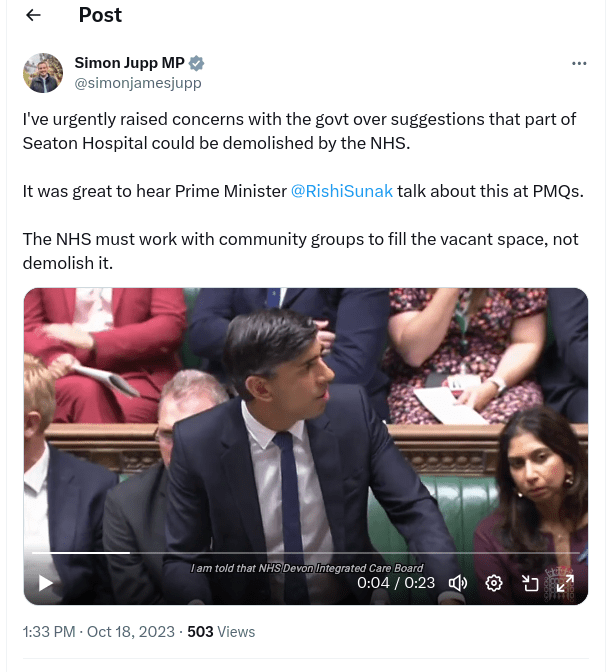
As the hon. Gentleman knows, decisions about hospital infrastructure are a matter for the NHS. I am told that Devon Integrated Care Board is working together with NHS Property Services and local community healthcare providers to establish a future sustainable use for the currently vacant space. May I also take the opportunity to commend the work that my hon. Friend the Member for East Devon (Simon Jupp) is doing on this topic?

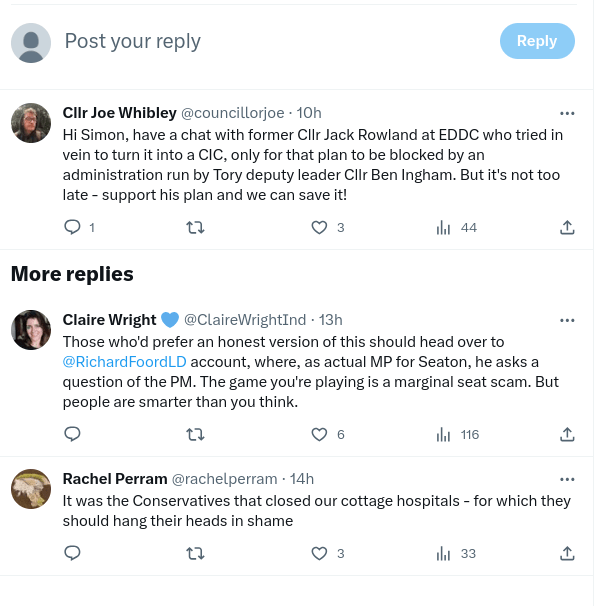
And here is how Simon Jupp twists the reality on his twitter account. We are left to infer that it was him who asked the PMQ. His video clip, for example, doesn’t include Richard Foord asking the question.

Claire Wright calls the game he’s playing “a marginal seat scam”.

Owl’s message – Leopards don’t change their spots!

The video recording of PMQs can be found here. Richard Foord’s question starts at 24:30 mins. If you continue to the next question you can catch a short glimpse of Simon Jupp sitting at the back of the chamber looking very smug after being mentioned by the PM.