Special needs deficit hits new record

Devon is set to see its special needs deficit surge beyond £160 million – a new record – as pressure mounts on the service.

Guy Henderson, local democracy reporter www.radioexe.co.uk 

A report to the council’s cabinet meeting today (8 November) shows the deficit relating to special educational needs and disabilities (SEND) is forecast to be £37 million this financial year, up more than half-a-million pounds in just two months.

This pushes the cumulative total to a predicted £163 million by next April.

The council agreed in September to cut spending in a bid to create a £10 million reserve that it could use to contribute towards the deficit.

Progress has been made, with £7 million in savings identified as achievable, and with plans ongoing to secure the remaining £3 million.

The report for councillors notes that “unlike in previous years”, the council’s finance team and its counterpart at the Devon Integrated Care Board are supporting the delivery of services “on budget within a particularly challenging environment”.

But it warns of continued hurdles.

“There are, however, emerging risks within Children and Young People’s Futures with increasing numbers of complex placements and continued pressure associated with excessive agency costs,” the report said.

“In response additional intensive work and the establishment of a cross-council placement taskforce is seeking to address this issue at pace.”

It added there had been “significant progress” in stabilising management tiers within the SEND system, with the level of interim managers reducing by 70 per cent since February.

Guidance from central government means that local authorities can hold their SEND deficits off their balance sheet, meaning any shortfall is essentially ring-fenced away from the main budget.

Devon’s Lib Dem leader, Councillor Julian Brazil (South Hams), said that many authorities are struggling with funding SEND services, but that the county is “an outlier in a bad way” in terms of its service.

“We’re surrounded by good and excellent authorities while Ofsted has rated us inadequate,” he said.

“We are failing vulnerable children, and these are the people we need to support.

“The issue hasn’t been given the time and effort it has needed.”

A spokesperson for Devon County Council acknowledged the predicted £162 million figure “could be the highest the SEND overspend has been at the end of the financial year,” adding that this had been accumulated over a number of years.

“Devon – like a number of other councils – is negotiating for extra funds with government, and we hope to have good news after Christmas,” the spokesperson said.

“The government has told all top tier councils to hold the overspend in a separate account off the main budget.

“As for the overall budget predictions, we’ve made substantial progress since the summer of 2022 when an overall overspend for 22/23 of over £40 million was predicted.

“After a cross-council exercise to reduce spending and increase income, we actually finished the year in the black.”

Devon’s children’s services were rated inadequate in 2020, and a letter from Ofsted in January this year said its visit to the county showed its leaders had “not ensured that all children who come into their care know early enough what the permanent and secure arrangements are for their lives”.

“There has not been enough progress for children in this area of practice since the full inspection three years ago,” it added.

However, it did acknowledge the “energy and strong commitment” of middle and frontline managers who were trying to maintain a level of continuity and implement an improvement plan.

More on: Hundreds pack meeting to back bid to save Seaton hospital wing

NHS Property Services was established in 2011 as part of the “disastrous” Andrew Lansley reforms. Its purpose is to manage, maintain and improve NHS properties in England and facilities previously owned by strategic health authorities and primary care trusts. 

It is intended to drive efficiency by charging hospitals a “market rent” for the land and buildings they use. But this transfer of funds from one public sector pocket to another comes with considerable administrative costs including £57m in staff costs alone, and consequences. 

Richard Foord MP reports that the NHS Property Services, locally, is seeking to charge local charities and community groups a “market rate” that has been pitched at the upper-end clinical rate.

It raises the question of how applicable the adoption of commercial accounting is to public sector activity and what rental NHS Property Services might reasonably charge.

Valuable publicly owned sites, accessible to communities, are a strategic asset, not some commodity that can be sold off to the highest bidder..

Community schools aren’t treated in this way.

Just how NHS  Property Services sets their rates is a mystery and certainly challengeable. This has been demonstrated in a recent High Court case, supported by the BMA, when a group of GPs agreed an out of court settlement in which their rental was significantly reduced.

The crazy thing is that this asset, the Seaton hospital wing funded by the local community, could be lost because NHS Devon is forecasting another budget deficit of more than £40m and wants to ”save” £300,000 a year by not paying rent to NHS Property Services, though it is short of beds.

According to the NAO  NHS Property Services is also struggling to meet its financial and performance objectives. In fact it posted over £1bn “losses” between 2012/13 and 2018/19 (some of this attributable to “asset revaluations”}.  

What NHS Devon might gain, NHS Property Services Ltd (sole shareholder, Health Secretary, Steve Barclay) will lose.

So there does seem a very real possibility that the hospital wing could be demolished and sold as a building site to “balance” the books.

Receipts from NHS Property Services sales are reinvested at a National, rather than local, level.

Is this another example of levelling up? – Owl

Local Democracy Reporter eastdevonnews.co.uk

Hundreds of residents packed a community hall in an impassioned bid to save a wing of Seaton Hospital it is feared could be demolished.

They say the wing’s construction was funded entirely by the community and that they should therefore have the say about its future – rather than just the NHS, writes Local Democracy Reporter Bradley Gerrard.

Devon’s Integrated Care Board (ICB), which because of its financial deficit is in special measures, pays a market rate of rent on the wing to governemnt-owned NHS Property Services (NHSPS), is considering handing it back to its landlord to save money.

However, campaigners fear that if that happens, the wing could be demolished.

Martin Shaw, a former county councillor, organised the meeting at Colyford Memorial Hall on Friday, November 3, attended by an estimated 250 people.

Mr Shaw said campaigners were ‘looking at all possible solutions to save the hospital [wing]’ and to find a way to provide other services to complement the hospital’s existing offering.

“We are now in a position where the NHS [in Devon]is looking to hand the building back, and there is the potential for the wing to be sold or demolished, which is why we are all here today,” said Mr Shaw.

Dr Mark Welland, chair of the Seaton and District Hospital League of Friends, said a major issue in his discussions with the Devon ICB and NHSPS related to the costs of rent.

“There have been several meetings between the League of Friends and the NHS in terms of securing some of the void space in Seaton Hospital, but in each discussion it seems to always come up against one seemingly unmoveable problem, which is the amount that NHSPS demands for renting the space,” he added.

Dr Welland said the NHS charges the Devon ICB roughly £200,000 per year for the space that is currently empty and where campaigners want additional services to go.

“We have a real opportunity with this void space to do good things,” he added. “While the hospital continues to house NHS clinics, physiotherapy and community rehab and nursing services, there is an opportunity for the likes of the League of Friends and [community interest company]Re:store to put further services in.”

He added that it had only been when the League of Friends recently approached NHS Property Services to secure space in the void area for the Seaton hospice-at-home service that the NHS disclosed there was a plan to lose it.

The meeting heard that a previous plan in 2019 created by Seaton Area Health Matters to buy the hospital outright and then rent space out at concessionary rates to local groups, had progressed well until a stumbling block prevented campaigners from securing funding. Shortly after, the pandemic started and the plans were shelved.

Paul Arnott, leader of East Devon District Council, said he couldn’t make any promises on his own, but assured campaigners that the authority was keen to help.

“This issue has already been discussed and we have the capacity to take on Public Works Loans Board loans, so it may be that East Devon has a role to play,” he said.

He said any potential financial help from the council would need to be agreed by councillors, but that it could form part of a financial package with other donors to save the hospital.

“We are a way from that yet, but East Devon District Council, as the closest body democratically that is able to do something financially about this situation, does stand ready to help, but any details have to be subject to confirmation.”

Tiverton and Honiton MP Richard Foord, who raised the plight of Seaton Hospital at Prime Minister’s questions last month, said the strength of feeling in the community showed how important the hospital is.

“The local community fundraised to pay for this hospital, with small donations from people, including those in this hall, contributing to it, and people don’t feel they should be asked to pay twice to save it,” he said.

“As such, we’re calling on NHS Property Services to charge a concessionary rate to use this facility as a health hub for people in Seaton and the surrounding villages.”

He added that Seaton Hospital was handed to NHS Property Services in 2016, and that that organisation’s one shareholder – Secretary of State for Health Steve Barclay – could intervene.

“If the secretary of state wanted to, he could change [the rental rate]tomorrow and ensure Seaton Hospital is available for use by the local community,” Mr Foord added.

Many residents hailed the care at Seaton Hospital, with community organisations such as hospital transport services suggesting that significant round-trips for many outpatients to the Royal Devon and Exeter Hospital in Exeter could be avoided if services at Seaton’s expanded.

The meeting also heard that the average age in Seaton, and the prevalence of age-related diseases such as dementia, were higher than the national average, making the campaigners’ plans for a health hub that would house additional services even more important.

Representatives from the Devon ICB and NHS Property Services were invited to the meeting, but did not attend.

Mr Shaw asked for attendees to vote on creating a steering committee comprising the meeting’s speakers, which included Mr Foord, Dr Welland, Cllr Arnott and other stakeholders, to pursue the matter.

This was supported, and Mr Shaw now hopes to lobby Devon County Council’s health scrutiny committee later this month to support the Seaton Hospital campaign. Mr Foord is set to discuss the issue again in parliament later in the month, too.

NHS Devon has previously said the site’s high rent and other charges – which it said amounted to £300,000 a year – were a ‘poor use of taxpayers’ money at a time when we are forecasting another budget deficit of more than £40 million this year’.

“In recent months, we have been talking to local health, care and community partners to see if they are interested and financially able to take on the space, but no viable schemes have been received and we started the process of handing the ward space back to NHS Property Services (NHSPS) so we can save the money that is currently being wasted on it,” a spokesperson said.

“We have always been very happy to talk to prospective occupants of the space if they have a financially viable scheme to take it on – and we remain so.”

MP Mr Foord said after the meeting: “The future of Seaton Community Hospital is one which concerns everyone living in and around the Axe Valley. Today’s packed public meeting, attended by hundreds of people, clearly demonstrates the strength of feeling locally.

“The hospital belongs to the community.  Members of the community and volunteer groups raised millions to help fund construction and equipment – including the very ward that is now threatened with demolition. We cannot allow it to be taken away from those who worked so hard to build it.

“NHS Property Services needs to review the way they rent out facilities such as this. Seeking to charge local charities and community groups a market rate that has been pitched at the upper-end clinical rate is short-sighted and wrong.

“I have met recently with NHS Devon, NHS Property Services, and the Seaton Hospital League of Friends charity. There are potential solutions, but we need the political will from those in Government who have the power to make these decisions.

“NHS Property Services is a Government-owned company with just one shareholder, the Health Secretary Steve Barclay. He has the power to resolve this situation and secure the long-term future of our hospital, and other small rural hospitals across the country.

“I will continue to raise the threat posed by these damaging proposals and fight to save the whole of this local hospital for the community. Local people have made plain to me this afternoon that they feel that the Hospital is theirs – and in their eyes – not available for NHS Property Services to sell.”

Covid inquiry hears more testimony about Johnson’s ‘brutal and useless’ No 10

“It is like taming wild animals. Nothing in my past experience has prepared me for this madness. The PM and the people he chooses to surround himself with are basically feral.”

[Sedwell] “had sought the dismissal of Hancock as health secretary to “save lives and protect the NHS”

“Hancock so far up BJ’s [Boris Johnson’s] arse his ankles are brown.”

Sedwill apologised for suggesting in a meeting in March 2020 that people could hold “chickenpox parties” to spread the virus.

Is this government going to stagger on for another? – Owl

Peter Walker www.theguardian.com 

Mark Sedwill, the UK’s most senior civil servant at the start of Covid, viewed Boris Johnson’s government as “brutal and useless” and did not trust Matt Hancock, then health secretary, to be truthful, the inquiry into the pandemic has been told.

In testimony that shines yet more unforgiving light on Johnson’s Downing Street, Sedwill agreed that the PM had veered wildly in his opinions and seemed unable to manage a team, saying it was his job as cabinet secretary to help “force a decision”.

Sedwill also said he concurred with earlier testimony about Hancock not being routinely honest, saying he would regularly double-check things with others “to make sure he wasn’t over-promising”.

Sedwill, who was Johnson’s cabinet secretary until September 2020 and is now a crossbench peer, did not dispute an August 2020 diary entry by Sir Patrick Vallance, the government’s chief scientific adviser, quoting Sedwill as saying “this administration is brutal and useless”.

“I can’t actually recall what might have prompted it but … I don’t doubt Sir Patrick’s memory,” Sedwill said.

He also did not dispute earlier evidence from Dominic Cummings, Johnson’s former chief adviser, and Lee Cain, his former communications chief, which described the prime minister as poorly suited for the Covid crisis, liable to oscillate between different views, and unable to manage a cohesive team.

Asked by Hugo Keith KC, the inquiry chair, if he agreed, Sedwill said: “I recognise them but I wouldn’t express them that way myself.”

Sedwill said while it was not his job to judge the suitability for office of a democratically elected leader, he had sought to put in place a system to help “force a decision”, one in which cabinet ministers had a voice. He added: “It’s exhausting for the people in his [Johnson’s] inner circle.”

The hearing was shown extracts of messages between Sedwill and his eventual successor as permanent secretary, Simon Case, in which Case, at the time the head civil servant at No 10, wrote: “It is like taming wild animals. Nothing in my past experience has prepared me for this madness. The PM and the people he chooses to surround himself with are basically feral.”

Sedwill said in reply: “I have the bite marks.”

In another message to Case, Sedwill said he had sought the dismissal of Hancock as health secretary to “save lives and protect the NHS”, a play on a Covid-era health slogan which Sedwill called “gallows humour”.

Around the same time, Sedwill said, he spoke to Johnson about Hancock’s role. While his role meant he would not have explicitly told the PM to sack his health secretary, Johnson “would have been under no illusions about what would have been best”, Sedwill added.

In a further message to Case shown to the hearing, Sedwill wrote: “Hancock so far up BJ’s [Boris Johnson’s] arse his ankles are brown.”

Johnson needed reminding to involve cabinet in Covid decisions, says civil service ex-chief – video

Earlier in his evidence, Sedwill apologised for suggesting in a meeting in March 2020 that people could hold “chickenpox parties” to spread the virus so children and others could catch Covid and help the country reach herd immunity.

Sedwill said this was suggested in the context of the plan at the time to try to mitigate the peak of Covid, and that his idea was for people less susceptible to Covid to catch it and acquire immunity while those more vulnerable could quarantine.

He added: “These were private exchanges and I certainly had not expected for this to become public. I understand how, in particular, the interpretation that has been put on it, it must have come across as someone in my role was both heartless and thoughtless about this, and I genuinely am neither. But I do understand the distress that must have caused and I apologise for that.”

Earlier evidence has heard that both Johnson and Cummings viewed Sedwill as being “off the pace” over Covid, and too slow to respond to the scale of the threat.

Asked by Keith if this was true, Sedwill argued it was in part because of his role: “It is possible. It is also possible I might have created that impression. I felt I had to provide leadership for a system that was on the edge of panic then. I did not have the luxury of saying, even in private, ‘We are doomed.’”

Does Sunak’s focus on Crime, Law & Order mean John Humphreys can forget early release?

In August 2021 John Humphreys was sentenced to 21 years for the historic rape of two underage boys. Under current legislation he might expect to be considered for release after 14 years (⅔ of his time).  

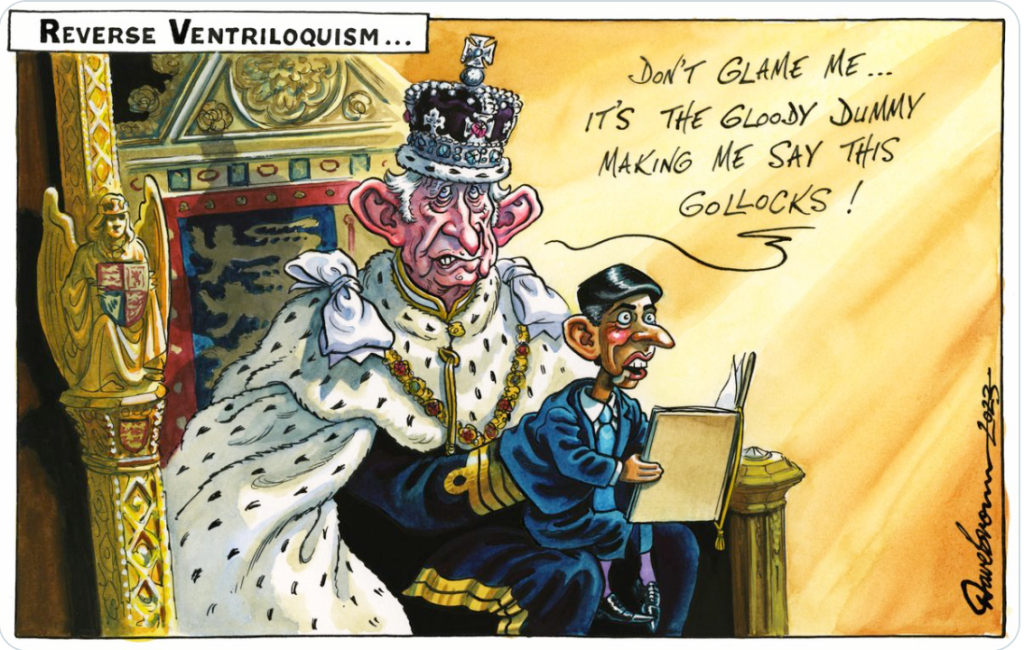
This week’s King’s speech, with its emphasis on crime and law and order (how ironic, Owl) puts this in doubt.

“Last year’s Police, Crime and Courts Act ended automatic early release for all sexual offences that carry a maximum life sentence, including rape and sexual assault of a child aged under 13.

It meant that those given a sentence of four years or more are now required to serve at least two-thirds of it before being considered for release.

But a Government source confirmed that ministers are now considering going further and ending any early release for the most serious sexual criminals.”

Source: Daily Mail

See also this explanatory paper:

King’s Speech 2023: Crime and justiceHouse of Lords Library 

“On 16 October 2023, Mr Chalk [Lord Chancellor and Secretary of State for Justice] announced that legislation would be introduced to ensure convicted rapists and other serious sexual offenders would spend their entire sentence in prison.[32] This would see offenders remaining in prison until the last day of their custodial term. The MoJ has not yet published further details about this proposal.”

Somerset Council declares financial emergency as it votes through ‘urgent’ measures to close £100m…

Somerset Council declares financial emergency as it votes through ‘urgent’ measures to close £100m budget gap amid fears it will go bust like Birmingham

Sukhmani Sethi www.dailymail.co.uk 

  • The council cited soaring costs of services for the crisis in a meeting on Tuesday

Somerset Council have declared a financial emergency as it voted through ‘urgent’ measures to close a £100m budget gap amid fears that it could go bust like Birmingham

The local authority was forced to make the alarming declaration on Tuesday after pointing towards the soaring costs of services, particularly adult social care, which it said was rising faster than the council’s income.

This significant gap in its budget threatens the local authority going bust, with fears that it could mirror the financial disaster faced by Birmingham City Council, which declared it could not afford equal pay claims worth up to £760m. 

Councillor Liz Leyshon, lead member for resources, said that Somerset Council would ideally look to avoid filing a Section 114 notice – the equivalent of bankruptcy for a council –  because it would have to to fork out ‘£1,200 a day each plus expenses’ for government commissioners. 

Ms Leyshon told the meeting the ‘situation is now too serious for us to avoid the word emergency’.

The local authority was forced to make the alarming declaration on Tuesday after pointing towards the soaring costs of services, particularly adult social care (Pictured: Somerset County Hall)

She added: ‘The last thing we want to do is be paying people from outside the county to make decisions for Somerset’.

Following the meeting, which took place in Yeovil, Council leader Bill Revans stated he will  be writing to Michael Gove to make the Secretary of State for Levelling Up, Housing and Communities aware of the crisis. 

Councillors agreed to form a financial focus group in order to figure how the local authority can cut costs and avoid a Birmingham-style catastrophe.

The rising cost of adult and children’s social services is at the forefront of the financial challenges that the local authority is looking to tackle with the aid of external consultants. 

Other possibilities that will be considered, with their costs scrutinised, will include a recruitment freeze, selling off the council’s commercial investment properties and pausing many building projects, such as the refurbishment of the Octagon Theatre – a venue used by the Salvation Army for the annual Christmas Carol services.

Councillor Liz Leyshon, lead member for resources, said that Somerset Council would ideally look to avoid filing a Section 114 notice – the equivalent of bankruptcy for a council

On Somerset council’s website, it informs residents: ‘In addition to inflation, which increases the costs of the goods and services the council buys, the council has seen an unprecedented rise in demand for care services for Somerset’s most vulnerable residents. 

‘We are seeing an increase in the number of residents, both adults and children, who need support from the council and with the support needed becoming increasingly complex.

 ‘Funding for these two services has had to increase by £28 million and £19 million respectively, just to support existing demand’. 

For the 2023/24 financial year, the total amount of the Somerset Council charge has increased by an overall five per cent from last year – three percent for general expenditure and two percent for adult social care, 

Further details are expected at the next executive meeting in December, revealing which services face cuts, which council buildings could be sold off and how much more local people can expect to pay in council tax from April.